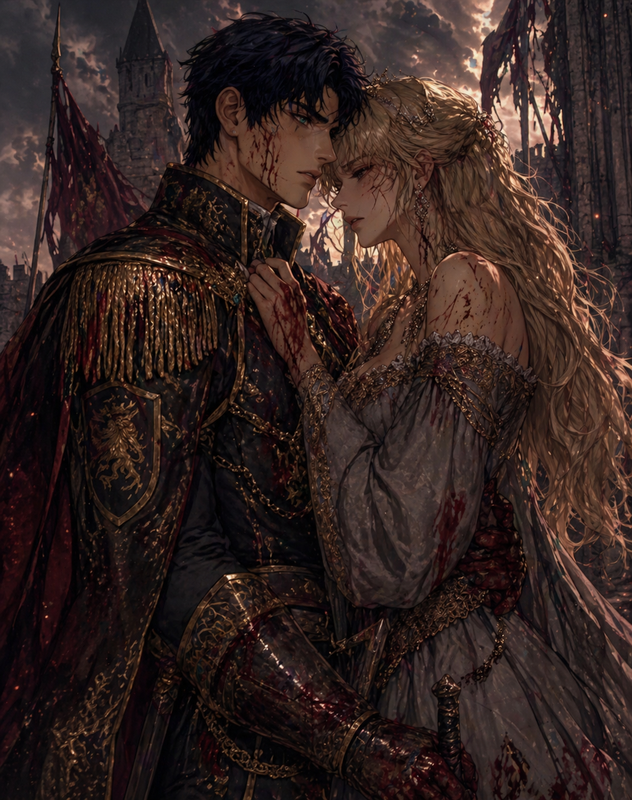
Chapter Text
** Prologue I
The waves crashed against the marble cliffs of Athens, a rhythmic percussion that had lulled Annabeth Chase into existence, that had been her first lullaby before she ever drew breath. At seven years old, she sat cross-legged on a cushion of embroidered silk, her small hands folded neatly in her lap, her storm-grey eyes fixed upon her tutor with the intensity of a scholar thrice her age.
Chiron's voice was gentle, melodic, weaving through the afternoon light that spilled through the arched windows of the eastern study. He held a leather-bound book, its pages yellowed with age, and read the tale as he had read it a hundred times before to other children of the royal court.
"And the wolf," Chiron intoned, his finger tracing the illustration of a creature with teeth like daggers and eyes like burning coals, "wore the grandmother's skin and lay in her bed, waiting."
Annabeth did not shiver. She did not clutch a blanket or hide her face. Instead, she tilted her head, considering, as the story unfolded—the deception, the violence, the woodsman's axe. When Chiron finished, closing the book with a soft thud, she spoke.
"The wolf is clever," she said, her voice high but steady. "But his cleverness is a lie. He wears kindness like a costume to get close, then he devours."
Chiron smiled, that patient, knowing smile he reserved for moments when his pupil exceeded his expectations. "And what else, my lady?"
"He is not brave," Annabeth continued, her small chin lifting. "Bravery would be hunting in the open. He is a coward who hides behind disguises. And he is..." She searched for the word, her brow furrowing. "Barbaric. Ruthless. He takes what he wants without honor."
"An astute observation."
The voice came from the doorway, deep and warm, and both student and tutor turned. King Frederick Chase stood there, his crown of olive leaves catching the sunlight, his presence filling the frame without effort. He wore no ceremonial robes, only a tunic of Athenian blue, and his smile was the private one he saved for his only daughter.
"Father." Annabeth rose, smoothing her pale chiton, and dipped into a curtsy that Chiron had drilled into her until it was as natural as breathing.
Frederick crossed the room in three strides and lifted her easily, settling her on his hip as if she were still a toddler and not a girl growing too fast for her own good. "Chiron tells me you have been studying the kingdoms' histories."
"I have, Father."
"And the animals?"
Annabeth did not hesitate. "The wolf is the beast of the north, of the wild places. The lion belongs to the southern kings, proud and loud. The serpent coils in the eastern sands." She paused, her grey eyes meeting his. "But we are the owl."
Frederick set her down gently, kneeling so they were eye to eye. His hands, calloused from years of holding a sword despite Athens' preference for diplomacy, cupped her face. "Why, little one? Why is the owl the soul of Athens?"
"Because the owl sees in the dark," Annabeth answered, the lesson as fresh in her mind as morning dew. "Because it does not need to roar to be heard. Because it waits, and watches, and knows."
"Yes." Frederick's thumb brushed her cheek. "The wolf may have teeth. The lion may have claws. The serpent may have venom. But Athens..." He stood, gesturing toward the window where the city sprawled below them—white columns and measured streets, the agora humming with debate, the library's scrolls numbering in the tens of thousands. "Athens has wisdom. Intelligence. We do not conquer with brute strength, Annabeth. We conquer with understanding. With strategy. With minds sharp enough to cut where swords cannot reach."
Annabeth looked out at their kingdom, at the olive groves swaying in the breeze, at the Parthenon's gleaming roof visible even from this distance. She thought of the wolf in the story, hiding in the bed, pretending to be something he was not.
"The wolf would not survive here," she said quietly.
Frederick laughed, a sound like thunder wrapped in velvet. "No, my little owl. The wolf would find no grandmother to deceive in Athens. We see too clearly."
He turned to Chiron then, nodding his approval. "Continue with your lessons. My daughter has the mind of a strategist already. Cultivate it."
As Frederick left, his footsteps echoing down the corridor, Chiron opened another book—this one filled with maps and treaties, with the complex dance of alliances and trade routes. Annabeth settled back onto her cushion, her seven-year-old heart swelling with pride, with certainty.
She was an owl. Athens was wisdom. And the wolves—the deceitful, barbaric, ruthless wolves who wore disguises and devoured the innocent—they belonged in stories, in dark woods, in places far from the enlightened reach of her father's kingdom.
She did not know then, sitting in a sunbeam with maps spread before her, that fifteen years later she would board a ship with sails the color of the sea. She did not know that she would walk into a throne room and look up into eyes the precise shade of those sails—sea-green and depthless—and see a wolf looking back at her.
She did not know that she would be expected to marry him.
The owl, after all, was meant to fly above the reach of wolves. She was meant to watch from a distance, wise and untouchable, safe in her towers of intellect and reason.
But the world, Annabeth would learn, was not a fairytale.
And some wolves did not bother with disguises.
Some wolves wore crowns.
**Prologue II
The throne room of Atlantis was built to inspire awe—columns of coral-veined marble rising like the ribs of some leviathan, the floor a mosaic of pearls and black volcanic glass that caught the torchlight and threw it back in fractured, dancing patterns. It was a room designed for the sea's kings, for the weight of crowns and the gravity of command.
It had never been meant to hold so much blood.
Perseus Jackson stood at the center of it all, nineteen years old and crowned a year ago only by the salt-spray that still clung to his hair from the ride through the storm. He wore no royal robes—only the leather and bronze of a soldier, his father's sword—*Riptide*, they called it—hanging loose at his hip. His sea-green eyes scanned the room with the flat dispassion of a man watching the tide erase footprints from the sand.
Around him, arranged in a semicircle like supplicants at an altar they had not chosen, knelt the conspirators.
Kronos was at their center. His grandfather. A man who had sat in the shadows of the court for decades, content to play the advisory role while his son wore the crown. But his son had died a year ago—too young, too suddenly—and Kronos had seen opportunity in the grief. He had looked at the eighteen-year-old bastard grandson thrust onto the throne and seen weakness. A boy raised in the streets, rough-edged and untutored in the games of power. A boy who could be molded. Or failing that, broken.
For twelve months, Kronos had woven his web. The boy was now barely nineteen. Secret rebellions in the outer provinces, funded by his gold. Rumors whispered in taverns and marketplaces about the unreliable boy-king who spent more time brawling with sailors than studying statecraft. Assassins sent in the dark hours, their blades meant to wound, to frighten, to make Perseus appear vulnerable. Kronos had sought to destabilize the very kingdom his son had built, all to prove that Perseus could not rule, all to position himself as the necessary hand that must guide, then seize, then control.
He had mistaken survival for weakness. He had mistaken silence for ignorance.
"Perseus." Kronos's voice was steady, the voice of a man who still believed he commanded the room despite the chains on his wrists. "You have made your point. The palace guards are yours. The navy answers to you. But this—" He gestured to the men kneeling beside him, seven lords of the court who had taken his gold, who had whispered his poison, who had thought the bastard prince would crumble beneath their machinations. "This is not justice. This is cruelty. This is against every law of Atlantis, every tradition of mercy for defeated enemies. Especially against your grandfather."
Perseus said nothing. He walked slowly, his boots clicking against the pearl mosaic, the sound too loud in the hush that had fallen over the hall. The storm outside pressed against the high windows, lightning illuminating the chamber in strobes of silver and shadow.
"You were not defeated," Perseus said. His voice was soft, almost conversational, and somehow that made it worse. "You were never my enemies in the open. You smiled and called me 'grandson' while you burned villages to make me look weak. You bowed and slipped poison into my wine. You sent boys with knives to my bedchamber and told the council I was too reckless to live. You are not defeated warriors, Grandfather. You are traitors who tried to destroy your own kingdom to steal it. And I have learned from my tutors that traitors do not merit mercy."
One of the lords—a man named Procrustes, who had taken Kronos's gold to arm rebels in the eastern isles—surged against his bonds. "You ungrateful bastard!" he spat. "We were trying to save Atlantis! You are a child, a street rat playing at king—your mother was a whore and you are—"
Perseus moved.
It was not the movement of a boy who had spent a year being manipulated. It was the movement of the street rat he had been, the creature who had learned to survive by being faster, meaner, more willing to do what softness forbade. The dagger was in his hand—not the ornate ceremonial blade of kings, but a simple, wicked thing of folded steel—and then it was across Procrustes's throat.
The blood sprayed in an arc, hot and arterial, painting the black glass floor. Procrustes gurgled, his eyes wide with shock, his hands going to his neck as if he could press the wound closed. Perseus stepped back, letting him fall, watching without expression as the man twitched and drowned in his own fluid.
The other lords began to scream. Some begged. Some cursed him, called him monster, called him the bastard prince who had fooled them all, who had played the foolish boy while he sharpened his teeth.
Perseus moved through them like a reaper through wheat.
The second lord—an old man named Polybotes who had held him as a child and smiled while he funded the assassination attempts when he became king—looked up at him with tears streaming down his face. "Perseus, please. I held you when you were small—"
"You held me like a leash," Perseus said, and slit his throat.
The third tried to run. Perseus caught him by the hair and opened his neck with a single, economical stroke.
The fourth, the fifth, the sixth—they died with curses on their lips or prayers to gods who had never answered Perseus's prayers. The blood pooled around his boots, slick and thick, turning the pearl mosaic into something dark and obscene. The storm outside seemed to celebrate, thunder cracking like a whip.
Only Kronos remained.
The old man had not moved. He knelt in the spreading lake of his followers' blood, his ceremonial robes drinking it in, turning from white to crimson. His hands were clasped before him, not in prayer, but in the patient stillness of a man who had seen empires rise and fall. For a year, he had plotted to make this boy a puppet. For a year, he had failed to see the wolf beneath the skin.
"You will burn for this," Kronos said. Not shouted. Not begged. Stated, as fact. "You think this makes you a king? You think this makes you strong? You are a child playing at butcher. The people will know. The court will remember. You will die alone, Perseus, and when you do, you will find yourself in the Fields of Asphodel, wandering mindless and forgotten for eternity. That is your fate. That is the fate of kinslayers."
Perseus crouched before him, the dagger dripping in his hand. He met his grandfather's eyes—those storm-green eyes that were so like his father's and perhaps his—and he smiled.
It was not a kind smile. It was the smile of the wolf, the smile of a creature that had never worn a disguise because it had never needed to.
"Good," Perseus said softly. "Then it will be a family reunion."
Kronos's eyes widened.
Perseus gripped his grandfather's chin, tilting his head back to expose the throat that had issued so many commands, so many lies, so many whispers meant to unmake a king. The blade was sharp. It did not hesitate.
The cut was deep, clean, final.
Kronos died with his grandson's name on his lips, or perhaps a curse—Perseus did not listen. He let the body fall, stepping back as the last of the conspirators slumped into the blood, joining the others in the red pool that now covered the throne room floor.
For a long moment, Perseus stood alone in the center of the carnage. Nineteen years old. King by blood, by blade, by the simple, ruthless calculus that the sharks of the court had forgotten: the throne belonged to whoever was willing to do what others would not.
He walked to the throne—not the ornate seat where his father had sat, but the simple chair of black coral behind it, the one Kronos had coveted. He sat. The blood on his hands left prints on the armrests.
Outside, the storm broke, and the first rays of dawn pierced the clouds, turning the sea to beaten gold.
Perseus, bastard son of the late king, killer of his own blood, looked out at his kingdom and felt nothing at all.
The wolf did not wear a crown because he wanted to be seen as gentle.
He wore it because he had torn it from the heads of those who had tried to chain him.
And now, the ocean was his.
**~End of Prologue~**