
Work Text:
I think we may have finally reached the limit of Open World games
'In my experience, freak meteor showers that destroy the entirety of human civilization tend to play havoc with deadlines.'

Charlie Brooker
guardian.co.uk, somewhen in paradox space
Article history
If the quality of this particular column seems a bit rougher than my usual polished gemstones of wit, it's because, to be honest, I never expected to have to write it; in my experience, freak meteor showers that destroy the entirety of human civilization tend to play havoc with deadlines. But it turns out that the Guardian, like most other British newspapers, is controlled by invincible demonic forces which dwell deep in interdimensional space, and I have therefore been informed that my contract is still in effect despite the death of my entire universe.
On that note: Sburb, the latest psychedelic experimental game to hit the capitalist hype machine, is a surprisingly minimal install for all of the immersive fantasy worlds it promises; the entire game fits on two CDs or in one archived file small enough to quickly e-mail to a friend. That's because the game files themselves consist mostly of a special chat client, a simple point-and-click user interface, and some management consoles. Its much-vaunted artificial reality open world and spectacular graphics, meanwhile, are achieved by having the bulk of the game played in reality itself.
As the first game in which game mechanics actually have a physical effect in the world around you, it certainly breaks new ground, often quite literally, and it's hard to criticize on that score. However, there are certain other aspects of the game that may be deal-breakers for some people.
To start with, there's the aforementioned meteor shower that will begin destroying your planet a set number of hours after the first player installs the game. Now, I have been wishing for a bombardment from the heavens to wipe the pustulent infestation which is humanity from the face of the Earth for much of my life, so that particular aspect was a bonus for me, but it might be something to consider for any prospective players who are not heartless autogenocidal nihilists like myself.
The game itself is set up as a sort of chain reaction, where each player acts as 'server' to the next player in the chain, until the first server player becomes client for the last player in the chain. The initial goal of play appears to be for each player to escape into gamespace before their home is destroyed by a meteor impact. This exposes a second weakness of the game among its target audience, which the designers might have wanted to take into account: briefly, that it requires you to have friends. Not only that, friends who will respond to being given near-unlimited powers over your living space by desperately working to save your life, rather than by, say, scrawling giant cocks and balls over every flat surface, or doing disturbing and inexplicable things to your toilet.
I don't have any friends, of course, but I do have a production company, and therefore I have people who really, really want me to fund their projects, who occasionally can be manipulated into serving the same purpose as 'friends'. So I sent a copy of the game to David Mitchell, one of the only people I know who is as misanthropic and socially awkward as myself, and on that basis he agreed to enter the game as my client player.
The smallest possible Sburb session involves two players each acting as the other's server, and as I was playing under my publishers' duress solely in order to write this half-arsed review, that was the limit of the session I had planned. However, Mitchell, with his much-vaunted logical tendencies, then decided to bring in his friend Victoria Coren, because she, and I quote, "likes games and that sort of thing," as he was apparently unable to tell the difference between 'an experimental immersive infinite-sandbox multiplayer adventure' and 'World Series Poker'. This would have left Coren as my client player, as she is obviously my first choice of responsible person in whose hands to place my future existence, but she, instead, chose to send a copy to my wife, who I had thought was safely visiting with her sister. Coren's later excuse was that she didn't want to have to listen to my whining, and at least Konnie is legally obligated to put up with me.
Which is fair enough I suppose.
As for gameplay itself, operating primarily in reality makes basic functions fairly self-evident. The inventory management system is based on the new Captchalogue technology on which I shall not elaborate because every other even vaguely technology-related column in existence has already done so at interminable length. There does seem to be an issue with strife specibi, in that whatever weapon you have allocated at the beginning of the game session appears to get stuck as your specibus for the rest of the game, which can be a problem if, like a certain person I am choosing not to name in this column, one began the game having jokingly assigned oneself to 'sarcasmkind'.
Once play begins, however, you run into the next problem: the almost complete lack of documentation. When you have completed the first puzzle, by deploying random pieces of machinery and then pushing buttons until something happens, you do unlock an in-game entity called a kernelsprite, which is designed to give you cryptic advice regarding your next moves. However, by this point, you are already being menaced by impending space rocks, and before the sprite's advice can be rendered intelligible you have to 'prototype' it twice, using whatever objects you happen to have around the house, which will give it a personality and frame of reference.
Attempting to prototype with no idea of what is going on, however, inevitably ends badly. For example, Mitchell, unaware of the importance of his choices, prototyped his sprite using his BAFTA - sorry, one of his BAFTAs - and a dead plant he had sitting on the kitchen windowsill. Meanwhile, due to an unfortunate occurrence involving a shelf being knocked over, mine ended up being prototyped by a carton of takeaway curry that was so old even the mold had gone bad, and an old Barry Shitpeas script. Now, imagine the most annoying support companion you can imagine - no, worse than Navi from Zelda - no, even worse than the Microsoft paperclip - and that's what playing with a Shitpeas prototyped kernelsprite is like.
I recommend ignoring the sprite entirely, unless you want to do what I did and spend several days' playing time figuring out how to trick the game mechanics into letting you slowly and messily murder a character who was supposed to be nearly unkillable and also theoretically on your side. Instead of bothering with this, try finding a walkthrough online, as they are far more informative than anything the game itself provides. Unfortunately, since playing the game almost immediately results in the destruction of the planet it is being played on, the only place to find accurate walkthroughs before starting the game is on the secret extradimensional filesharing servers maintained by the horrorterrors from beyond. Luckily, my wife's old logins from her Blue Peter days still work, so I had access to several useful walkthroughs. I want to especially commend the evocative narrative set down by a person named Rose Lalonde, who is a lady after my own heart - if you're still out here in paradox space somewhere, Lalonde, ping me! We'll do coffee.
Once through the preliminary stages of the game, the player and his, her, or its dwelling are transported bodily to a custom-generated fantasy planet, which can perhaps be best described as a live-action platformer. The player is granted a mythological title which is somehow related to his planet - I, for the curious, am apparently the Knight of Rage, hero of the Land of Waves and Televisions, which looks quite a lot like the set of You Have Been Watching, actually. The Lands are connected to each other by way of portals, which allow players to assist and interact with each other, and are populated by a variety of NPCs, and XP- and wealth-building sidequests, puzzles and minigames, which I would describe as pedestrian and repetitive in design, if it were not for the rather compelling fact that I had to do them in person, at constant risk of very real death. (While there are some mechanics built in to the game to allow for a certain number of extra lives, these are limited and cannot be replenished, and the equivalent of returning to save points is extremely complicated and only possible for an Heir of Time, who in our session was David Mitchell. You can probably fill in the rest of that story for yourself.)
The game appears to make some attempt at an overarching narrative, but it suffers from trying to do too much, and also being fucking confusing. There is a storyline involving two chess-themed races of people locked in eternal combat on a chess-themed planet, which is frankly boring, but has the interesting side-effect of establishing personalities, backstories, and relationships for the expendable monsters you've been blithely and consciencelessly killing off since the start of the game, providing ample justification for a good bout of self-loathing if you're the sort of person who goes in for that sort of thing. This belated attack of remorse is something that I have been wanting in shooter games for a very long time and I would have loved to see something similar in, say, the newest outing of Call of Duty. (As Earth is a smoking pile of meteor craters now, perhaps there will never be another Call of Duty game. It seems a small price to pay.)
There's also some sort of mandatory quest involving breeding magic frogs in order to create a new universe, which is tedious, incredibly finicky, and frequently vomit-inducing, and which, according to my wife, also known as the Seer of Space, I was obligated to help her with in every slimy, batrachian, strangely perverted detail.
Moving on.
The real goal of the game, from what I can tell, is to achieve God Mode. Sorry, 'god tier'. I won't go into detail on how to do this, because it's absolutely fascinating to discover it for yourself in extremis, and also we learned that attempting to skip ahead and get there too early generally ends badly. However, once you have made it to this tier, you are, to all intents and purposes, a god, and so overpowered that there's very little left in the game to challenge you other than meddling for your own entertainment in the affairs of lesser mortals. With only a minimal amount of cheating, our session managed to god-mode all four of its players, including myself.
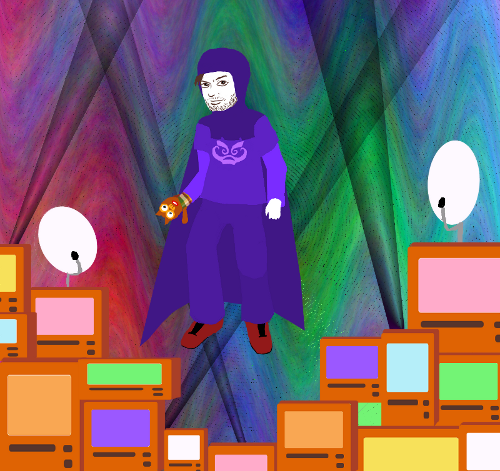
I, for the curious, am apparently the Knight of Rage, hero of the Land of Waves and Televisions, which looks quite a lot like the set of You Have Been Watching, actually.
Let me repeat that.
I, Charlie Brooker, am a god.
Yes, you should be cowering in fear.
Now go away before I smite you.