
Work Text:
Everything should have been fine.
They'd proven themselves. Project Fair Play would no longer have been a concern even if they hadn't demonstrated that they could handle every countermeasure President Waller had had to throw at them—Lane hadn't just changed her opinion on the League, she'd run a series of segments investigating what had actually happened, painstakingly exonerating each of them. Their approval ratings had only increased, for all the holes Hernan had smashed in downtown Metropolis.
And the repairs to the tower had gone smoothly. The files Luthor had turned over to Hernan were absolutely fascinating, more than enough to keep Kirk busy in the labs for years. It was—
It was almost a relief, to have a reason to work on something other than a cure. He shouldn't have been grateful for it; but he was.
So everything should have been fine.
But Kirk had become gradually aware that he had a whole new problem, and it was one that no laboratory, no Kryptonian technology, no superpower, could solve for him.
It hadn't been there in the first few weeks afterward, for the very simple reason that it couldn't have been. There hadn't been room for it, not in comparison to the numb blank void where Tina and Will used to be, eating him up from the inside out.
But he'd held himself together. He'd had the vague thought that it should've been more difficult than it was—but then again, he'd had so much practice. Every time he'd gone to the house, seen Tina or Will or both of them, it had made that old ache new again, and every time, he'd left; gone back to the tower, gone through the motions of his life and waited distantly for it to ease, and it had. Granted, this had been a different kind of pain, a different quality and intensity. But its roots had been familiar enough. He'd known how to bear it, and he had.
And the terrible truth was that he hadn't been mourning Will and Tina themselves so much as their memory. Their memory, and his understanding of who they were, who they'd been. Tina had died years ago, years—Kirk had been over it a thousand times in his head, had tried to pinpoint when it must've happened, a gap long enough for Will to have built that thing to replace her, but Will hadn't told him a date. He couldn't be sure, would never know for certain when he had last seen her, last spoken to her, and not the construct.
She'd been gone for so much longer than he'd known. Losing her the day of the fire, right there but unable to stop it, might well have broken him. At least once the rest had been over with, once he'd had five minutes to feel it. But learning she had died already, all that time and he had never even known—and that Will had, too, in a way, because a man who could have done that to Tina wasn't the Will Magnus Kirk had loved—
It changed the feeling, changed the shape of the hurt. It hadn't hurt less, exactly, than if they'd been killed in the fire; more deeply, in a way, and yet at the same time more dully, a matter of coming to grips with the bitterness of the truth rather than systematically tearing himself apart for having failed to save them.
Either way, he'd survived it. He'd survived it, and once the worst of the cold empty sensation in his chest had passed, once he'd found himself able to feel anything else alongside it again, well.
There had been Hernan.
Bekka had been in touch several times; she looked well. She seemed happy. She and Luthor were apparently enjoying their educational jaunt across the universe.
And with the Justice League down to two, only Kirk and Hernan living in the tower—it was astonishing, how much more time they spent together.
Kirk had, perhaps inevitably, begun tracking it, after the first month. A single spreadsheet, numbers that meant nothing to anyone but him. He'd tried to estimate from memory, to give himself a baseline for comparison, and then he'd marked down each day's total without allowing himself to jump to conclusions, without letting the subjective experience overwhelm him, even though it had felt like so much.
But statistics didn't lie. An increase of over 200%, even using his least conservative estimates to cobble together a past average.
Bekka and Hernan used to spar with each other. Spar, or sit at the monitors and chat; go out for coffee, for lunch, and they'd always brought back something for Kirk, but delivering it to the labs hadn't typically added more than about ten minutes to his tally, versus a half-hour at minimum for them. Even missions—when Kirk was busy in the lab, waiting on crucial results or in the middle of a long titration sequence that needed to be closely watched, two-thirds of the Justice League packed a substantial punch, especially that particular two-thirds. There had always been plenty of situations Wonder Woman and Superman had been able to handle without Kirk.
But after Bekka had left, everything had changed. Every mission that required more than one member of the Justice League, by definition, meant Kirk and Hernan in the field together. Every time Hernan had decided he didn't want to be alone for a while or didn't have anything else to do, he came to find Kirk. To talk to him—to tease him, in that wry warm tone. To smile at him. Even just to sit with him quietly, to occupy the same space, when Kirk needed to concentrate and had told Hernan as much. Hernan was always good about it, considerate, kind. He never made a sound. It was increasingly distracting anyway. It was—
It was a problem.
By the time he'd become fully aware of its progression and able to categorize it as such, it was already too far along for him to have any hope of solving it.
A familiar rut to find himself in. He should've known, should've stopped it—he should've been prepared to snuff it out the moment the first spark had caught alight. The possibility had always been there, in the background; of course it had been. Hernan was Hernan, a pile of fascinating contradictions, impossible to look away from even if he hadn't also been stupidly handsome. Kirk had simply, foolishly, grown used to not thinking about it. There had been Tina, there had been Will. His greedy, selfish, grasping heart had found itself able to fit two people inside of it, but not three, and so he'd been safe.
Except he wasn't safe, not anymore. He wasn't safe, and he should've expected this. It had always been his worst sin—nothing he could blame on the serum, and even if one day he did manage to cure himself, to make himself into something other than a monster, it would still be there, this desperation. This urge to cling, beyond reason or sanity, to anyone kind enough to reach out for him in friendship, far, far past the point where they would have been better off without him
(—his fault. Will had said as much, had clarified beyond any doubt. If only he'd left them alone, if only he hadn't kept coming back—then Tina wouldn't have had any reason to push, any reason to argue with Will. She'd have learned not to care about him so much, if he'd let her, if he hadn't been so goddamned selfish. Will would never have hit her, if it hadn't been for Kirk—)
and yet he could never figure out how to let go, not until it was too late.
Even if he'd managed to learn from his mistakes, there was no way out, with Hernan. It was just the two of them, in the tower. He couldn't leave, he had nowhere else to go; there was no reasonable excuse to move out or to avoid Hernan.
Most damning of all—he didn't want to. He liked it. And he hated himself for that, but he still couldn't make it stop.
It wasn't as if he deserved it. He wasn't charming, entertaining, a good conversationalist; he had done nothing to earn Hernan's undivided attention, and he had no idea what to do with it when Hernan bestowed it on him anyway. Hernan's patience, his quiet amusement, his willingness to sit there in awkward pointless silence while Kirk practically ignored him, only made it worse.
There was no way to avoid him, no way to retreat to a safe distance.
Which meant that Kirk actually had two problems: the feeling, and the wings.
It had taken him some time, after his initial—transformation, to realize he even had them.
As best he'd been able to determine, they were shaped projections of energy, generated by Will's nanites. Not any of the functions Will had programmed the nanites for, and probably not one he'd expected them to acquire; but they formed a distributed network, communicated with each other, and were equipped with a limited ability to reprogram themselves, if they encountered environmental conditions, parameters, that their existing programming hadn't accounted for.
It was possible that combining them with Kirk's formula, the bat venom, had altered them somehow. Or it was possible that they'd decided to take matters into their own hands, as it were, by the fourth or fifth time Kirk had been thrown off a roof during a fight.
The wings were redundant, obviously. Unnecessary. Kirk never used them, never manifested them in front of anyone—there was no reason to. He could levitate; almost any limitation on that ability, its speed or maneuverability in a tactical situation, could be overcome by means of the artificial glide-wings he'd built into his suit. He neither needed wings nor wanted them.
(—he'd have cut them off, if he could—)
He'd have preferred to forget about them entirely.
But he felt a certain discomfort, an indefinable itch that built up beneath the surface of his skin, if he didn't let them out at all. Trapped energy, presumably; an excess the nanites had stored for the purpose and couldn't discharge unless he gave in and permitted it.
And before, it had been relatively easy to find some time alone—to hide himself away in some corner of the tower and let them out for a few hours, now and then. Once every few months was enough, bearable, and there had always been a mission, a sparring session, something, that he could count on to keep Bekka and Hernan busy for a little while.
But not anymore.
Hernan rarely went on missions alone, these days. He seemed disinclined to leave Kirk in the tower by himself—and considering that the last time he'd done so, he'd ended up having to punch his way through the shields and the roof alike, and had found Kirk pinned to the floor about to have his head ripped off, Kirk couldn't precisely blame him.
They ate together, every day. Ate together, watched the monitors together, attended meetings with President Waller or with a wide variety of government officials from around the world—together. They dealt with natural disasters, dangerous accidents, and deliberate crime alike, together. And when they had nothing else to do, nowhere to be, Hernan seemed to gravitate toward wherever Kirk was. He left sometimes, to take calls, to do interviews; he was still the public face of the Justice League, and far better suited to the role, in all his sun-soaked blue-eyed charisma, than Kirk would ever have been. But he was rarely gone long.
Kirk was as careful as he had ever been—more so. And Hernan still almost caught him.
He'd waited as long as he could stand. The sensation, the itch, had escalated to a relentless prickling tingle, the kind of pins-and-needles Kirk hadn't felt since he'd been human. But at last, at last, Hernan had a conference call scheduled with President Waller, the Joint Chiefs of Staff, that was supposed to take at least an hour. He'd left the labs, and Kirk had forced himself to wait, breathing through the strain of it, until he'd heard Hernan reach the end of the hallway, the center of the tower—lift off, the sudden absence of footsteps, because he always preferred to fly up to the control floor when he had the chance.
And then Kirk had let them out. Had shut his eyes against the burst of impossible light, stretched them out behind himself where he couldn't see them, didn't have to acknowledge them at all.
He was still working his way through the Kryptonian data. Luthor had been right, the implications for almost every field of human science and engineering were incredible, and it was fascinating, impossibly absorbing. Even all his labs in the tower didn't feel like enough, compared to the sheer breadth of the information; he was always going back and forth between floors, a dozen different interfaces and data stations, separate workspaces for each of his various attempts to build or test or formulate even a fraction of the technological wealth of Hernan's homeworld.
Fortunately, he'd had a lot of practice attuning his super-hearing to the precise level required to allow the slightest sound to catch his attention, no matter how intently he was focusing.
So he caught the scuff of a shoe-sole, just in time.
He felt a spike of cold panic; too close, much too close. Hernan must've drifted through this wing of the labs in the air, trying to figure out which one he'd ended up in, instead of touching down in the central corridor the way he normally did.
But Kirk pushed it away, shut his eyes and forced himself to concentrate. He had to think them away firmly, with crystalline clarity, to make them go—they never wanted to listen to him.
They made a sound, too, a faint high shimmering, as they dissolved into nothing. He opened his eyes again, relieved, as they went, and looked up only a fraction of a second before Hernan strode into the doorway.
Close. Much too close. Hernan met his eyes, and there was something in Hernan's gaze that Kirk didn't recognize, odd and sharp and searching—but then Kirk wasn't the only one in this building with super-hearing. Had Hernan heard them? Surely Kirk could pass off the sound as an unexpected chemical reaction, an unusual type of Kryptonian energy he'd only been able to generate for a few seconds—
"What are you doing down here?"
Kirk looked away. If he was going to lie, then at least he wouldn't be doing it right to Hernan's face. At least if Hernan did find out, and thought back to this moment, he might understand that Kirk had been ashamed to do it. "Just finishing up an experiment. I needed some equipment."
"Ah," Hernan said, and then, without preamble, "Dinner?"
Kirk blinked. "What?"
"Dinner," Hernan repeated, warm, amused, and raised a single stern eyebrow. "The call ran long; it's getting late. I ordered out."
Half a joke. Since that first day, they'd always ordered out—Hernan liked to alternate between places they'd never tried before and personal favorites. The latter was easy to understand; the former, Kirk suspected, was because Hernan still got a kick out of calling somewhere new and placing an order for the Justice League, to be delivered to a very, very well-known address.
Neither of them even needed to eat, technically. But Hernan had always enjoyed it, and Kirk had found that keeping up the habit made him—feel human, almost.
"Ah," Kirk said. "Of course."
Hernan smiled at him. Kirk allowed the jolt of it to travel through him without reacting to it.
He hadn't lied to—to the construct that had replaced Tina. Neither figuratively, nor literally. His body temperature was unnaturally low, his circulation slow; his hands were always cold. But his heart still beat, he still had a pulse, and however weak it was, however sluggish—
Hernan, looking at him like that, could be counted upon to kick it to life, even if only for a moment.
They went upstairs together.
The food was Thai, from that one place a few blocks away that Hernan liked reasonably well, and Kirk had once admitted to loving. Hernan had never forgotten that he'd said so—or at least Kirk helplessly inferred as much from the fact that Hernan ordered from it approximately once every two weeks, more often than any of their other regular places.
For such an impossibly powerful man, Hernan so often liked to be kind.
They ate out of the containers, seated across from each other at the island in the kitchen. Hernan summarized the conference call; whatever excuse President Waller had given him, the actual point of the whole thing seemed to have been that the Joint Chiefs wanted to make absolutely sure the League didn't happen to be holding any grudges over all those tanks and helicopters and fighter jets. Kirk listened, and offered the occasional dry commentary where it seemed salient, and dug into his pad kee mao—spicy enough that he could actually experience some ghost of the real taste, even though it wasn't blood.
Hernan paused to pick out a dumpling, popped it in his mouth with an absent noise of warm enjoyment that Kirk tried very hard not to memorize, and then swallowed and said, "So, out of curiosity—when were you going to tell me you had wings?"
Kirk felt himself go utterly still. He'd wondered once, grimly, early on, whether he would still show up in mirrors; whether the serum had been merciful enough to grant him invisibility along with the rest of it. He'd never wished with quite this much force that it had.
He had only just stabbed a fork into his noodles. He stared down into them. He couldn't make himself look up. He couldn't think.
"You managed to put them away before I came into the lab," Hernan said, almost gently. "But you weren't where I'd left you, my friend. I didn't know where you'd gone, and so I looked for you. Through the walls."
Kirk shut his eyes.
Idiotic of him to overlook the possibility. All his effort, all his care, and he'd only been an inch from disaster, the whole time. It was a miracle Hernan hadn't happened to see them out years ago.
"Never," he said aloud, once he could—once it would come out level, a little dry, the way it was supposed to. "I was never going to tell you, ideally. Though it appears that's no longer an option."
"Ah," Hernan said, "but technically you still haven't told me anything."
And Kirk had to look at him, then.
His tone had remained mild. Mild, a little warm, gently fond. That was how he was looking at Kirk, too—watching him, patient and attentive, without irritation.
It had been half a test, Kirk understood now. The way Hernan had walked in as if he hadn't seen a thing, the way he'd asked Kirk what he was doing; to see what he would say, whether he would admit it. And Kirk had, in lying to him, surrendered any chance to pretend the wings were new, a surprise to him as much as to Hernan—had confessed nearly everything, without even knowing it.
Because Hernan knew him, and Hernan wasn't stupid.
"I don't know how long they've been there," he made himself say.
Hernan raised an eyebrow.
"I don't," Kirk repeated. "Not for certain. They're projections of energy, formed by the nanites. But they weren't part of—the initial transformation. The nanites developed a new set of programming instructions for themselves. Unintended side effect."
Redundant to say it; of course it had been unintended. It wasn't as if they were necessary, even if some quirk of interaction with the bat venom, some misplaced one or zero, had convinced the nanites to produce them anyway.
(—of course it had been unintended. They were made of light, pure and soft and silvery; they were beautiful.
Will had confessed outright to exactly what it was he'd been trying to do. He'd turned Kirk into a monster on purpose. He would never have given Kirk anything like that, not deliberately—)
He cleared his throat. "They're under my control. I can activate or deactivate them at will. But—"
"But," Hernan repeated, gently encouraging, after a moment.
"But sometimes they—need to come out," Kirk said at last, and then cleared his throat again. "I assume that it's the energy they require. When the nanites have stored too much for too long without expending enough, it becomes perceptible to me. They," and it felt so stupid to say, but it was only the truth. "They itch."
"And if they didn't," Hernan said slowly, "you would never—activate—them at all."
Kirk glanced at him, frowning a little.
They were unnecessary. He hadn't bothered to tell Hernan as much word-for-word, but surely Hernan understood that. It was obvious. Kirk didn't need them, they served no purpose; they were superfluous, pointless.
But Hernan was looking at him now in a strange, searching way, any trace of teasing amusement gone from his face.
"You don't seem to like them very much." He paused. "It doesn't hurt to let them out?"
"No," Kirk said, baffled. "No, it doesn't hurt. They're—fine." He looked back down at his noodles, shifted his fork between his fingers. It was uncomfortable, to talk about them, but that was only reasonable considering how long he'd kept them a secret. It didn't mean anything. "I don't need them, so I don't use them. That's all."
Hernan made a soft contemplative noise in the back of his throat. "I only saw them for a few moments," he said. "But they were lovely." A pause, a long beat that couldn't be anything but deliberate. Kirk waited it out, and didn't look up. "You don't let yourself have very many lovely things."
Kirk bit down on the inside of his cheek—dug in with a fang, let it cut deep, even if it was going to heal again in a second. "I haven't worked out a way to get rid of them yet," he said flatly.
Half true: he hadn't, though he supposed he also hadn't really tried. He'd preferred to ignore them entirely, for as long as they would let him.
"Yes, of course," Hernan said quietly, and when Kirk risked half a glance to check, his mouth had quirked, a soft rueful twist that was almost the shadow of a smile. "Have you ever used them?"
"Used them," Kirk repeated.
Hernan's eyebrows went up. "To fly."
Kirk scoffed, half a breath through his nose, before he thought better of it. It felt telling, too clear a reaction; but telling of what? He couldn't define it, even to himself. It was only that this was all so strange, he told himself. That was what made thinking or saying anything about the wings in front of Hernan feel like giving away another secret, another, every moment. "No," he said aloud. "I told you—I don't need them."
Hernan adopted a considering expression. "But what if you do? Theoretically, isn't it possible that there could be something out there that suppresses your levitation ability, but not the wings?"
It wasn't particularly likely, and that assessment was pre-emptively borne out by the fact that it hadn't happened in the ten years the Justice League had already been around. But—
"Theoretically," Kirk allowed, and Hernan must've known perfectly well that he'd have to. They'd had more than one long late-night discussion, Hernan playing devil's advocate the way he so liked to do, about the difficulty inherent in proving a negative.
"Or if, someday, you find yourself without your suit," Hernan went on. "Hypothetically, it could happen," and that—that was teasing again at last, bland on the surface, warm underneath.
Kirk hadn't worn anything except the suit in years. This was who he was, now. There was no pretense of normalcy to be gained by changing his clothes; there were no public events at which he ever had the need to appear as Kirk Langstrom, independent of the Batman or the League.
But, hypothetically, even if Hernan was only teasing him—it could be taken from him, plausibly. It wasn't as if he didn't remember Will's constructs, being swarmed by them, outnumbered, trapped. Until Hernan had come through the roof—
Anything could happen.
"Hypothetically," he said aloud, and sighed through his nose.
"So—shouldn't you at least try them out? Learn how they work, how to use them, just in case?"
Kirk shut his eyes. And then he lifted his chin, and made himself look at Hernan.
He didn't need the wings. He didn't want them.
(—unintended side effect: they'd never been meant for him. They couldn't have been, not something like that, something made of light. He didn't—
—he didn't deserve them, he couldn't be trusted with them; surely the only thing that would happen if he tried to use them would be that they would—crack, break, go dark and dull, fill up with shadow as if stained from within—)
But Hernan had a point, if a minor one.
"Come on," Hernan murmured. "Let's go flying for a while, shall we?"
"I'll think about it," Kirk heard himself say.
Which was, he thought grimly, as good as a yes; and by the smile that spread itself across Hernan's face, Hernan knew that as well as Kirk did.
He managed to hold out for a while, at least.
They finished eating. Hernan didn't bring it up again—switched back to the call with the Joint Chiefs, to thinking through what President Waller might do next. Kirk was, helplessly, relieved, even though he knew perfectly well it was only temporary; Hernan was hardly going to forget Kirk had secret wings he'd never used, whether he was making Kirk talk about them or not.
It was a reasonably busy week, as the Justice League tended to measure these things. A couple different flavors of natural disaster; Hernan was the one on-call, able to lift pretty much any quantity of water that could be placed in a single container and dump it along the front line of a wildfire, equally able to stand at the foot of a volcano and redirect the flow of a lahar away from half a dozen villages. But he still needed Kirk to serve as operational support, to get local emergency services to give him what he needed and then get out of his way. And there was the usual smattering of interventions required, criminal or military operations the Justice League was able to disrupt. Hernan even followed orders sometimes, these days, and left at least a few of the perpetrators alive afterward to be arrested.
But a busy week would only spare Kirk for so long.
And indeed, inevitably, there came a night that was quiet.
They were both in the tower, waiting, uniformed, prepared. But nothing was happening. Nothing seemed to be happening anywhere, no disasters springing up no matter how fixedly Kirk stared at the monitors, no matter how conscientiously he checked every single level of automated alert in the tower's systems.
Hernan was expressing no impatience. He was sitting quietly in his chair, thumbing a tablet; reading something. Perhaps an after-action report; perhaps simply yet another article about them, more opinion polling or more inane conspiracy theories about the "real" reasons for Wonder Woman's absence.
Kirk could hear his heartbeat.
(—too well, always too well; but it was what he was made for, now. He hated the reminder most of the time, hated standing in a room full of humans and finding his ears full of the rush of their blood, unable to shut out that delicious sound, feeling the edges of his fangs against his tongue—
But not with Hernan. He couldn't pierce Hernan's skin if he tried, not without the help of kryptonite. Even if he'd lost control of himself entirely, even if he were to surrender to the monster Will had made him into, that would still be true. Hernan was safe from him; he was safe, with Hernan, from himself—)
Kirk sat there at the monitor console, and looked out across the city without seeing it, and swallowed.
"Yes," he said aloud, into the silence.
Hernan shifted in his seat; Kirk could hear that, too, without turning. Looked up, probably. "Yes?" Hernan repeated. And then, in a warm mild tone that said he already knew the answer, "Yes what?"
"Yes, I'll—I should learn to use them," Kirk made himself say.
He didn't use the word, didn't name them. The wings. He hadn't done it, not once during that whole conversation with Hernan. Because—because he didn't need to, that was all. Because Hernan understood perfectly well what he meant.
Unless, of course, Hernan decided to make a point out of it. Decided to pretend ignorance yet again, and said, Use what?
But that wasn't what happened. A moment's silence; and then the soft sounds of motion, Hernan's long sweeping jacket, the heels of his boots against the floor. It wasn't hard to do the math, and Kirk was almost ready for it when a broad, warm hand settled on his shoulder.
"Only if you want to," Hernan said quietly, and then stopped. "I—know what it means, to keep a secret for a long time, one you never intend to share. You've given me enough already. You don't owe me any more."
Which was nonsensical at best. Hernan had saved Kirk; everything he was now, everything he had become that was anything more than a creeping starving shadow feeding off the rats at the docks, was because of Hernan.
And that made it suddenly easy to look up at Hernan, to say, "No. You were right—I should. You were right."
Hernan was looking down at him gravely, searchingly, for a long moment. But whatever it was he wanted to find in Kirk's face, it seemed he was able to locate it; the line of his mouth began to slant, slow warmth crinkling up the corners of his eyes.
"All right," he said, and then, more lightly, "If you insist." He paused, and tilted his head. "This isn't a mission, you know. You won't need that."
Ah. He meant—the helmet of the suit.
Kirk lifted a hand to the edge of it. He'd never particularly liked to leave the tower without it. Behind it, behind the cover of it, the red lenses that he could pretend hid ordinary eyes, he felt fractionally more comfortable being seen. But—
"I already know what you look like," Hernan murmured.
Kirk huffed a wry breath through his nose. As if once hadn't been enough, Hernan insisted on continuing to be right.
And he thought he understood the line Hernan intended to draw, too. This wasn't a mission. For all the perfectly practical reasons Hernan had come up with, for all that Kirk had grudgingly agreed with them—this wasn't going to be an official action of the Justice League. It was going to be Kirk and Hernan, out flying for a little while. And if Hernan wanted that, wanted this to qualify if only in the smallest part as time spent together simply for its own sake—
Well, it wasn't as if Kirk had the strength to refuse.
He lifted both hands to the helmet properly, shifted it forward over his head and lifted it off.
"You realize that doubles as just as good a reason to leave it on."
Hernan grinned. "Granted," he allowed. "But I—" He stopped again; something about the angle of his mouth changed, turned rueful. "I like to be able to see your eyes."
Kirk raised an eyebrow. "You already can," he said, because it wasn't as if it wasn't true. "You can look through the helmet whenever you want."
"But I like not needing to," Hernan murmured, and it was—it was fine, he was only teasing, he liked to do that, but that odd rueful slant, self-aware and self-deprecating, hadn't left his smile.
And then he lifted off the floor, drifted into the air and hovered there.
"Well, shall we find a roof?"
They did.
Not the roof of the tower—that was Kirk's first suggestion, but Hernan had vetoed it. Either an accident or else some unexpected attack, and they might end up putting a hole in it all over again; Hernan hadn't liked having to deal with the reconstruction the first time around.
So Kirk gave in, and they used the roof Hernan picked out instead: a nearby building, and one that had quite a bit more ornamentation, massive gargoyle-like statues with necks and heads that extended out over the streets below. Better launching points, Hernan argued, and it might be shorter than the tower, but it wasn't as if Hernan was going to need the extra distance to catch Kirk, if something managed to go wrong.
It wasn't until Kirk had risen all the way up, to the point where he'd come even with one massive head, that he understood that the statues had wings, too. Open, arching back to rejoin the edge of the roof, spread wide.
"How thematically appropriate," Hernan said in a marveling tone, as he rose up himself until he was hovering at Kirk's shoulder.
Kirk gave him a flat look—as if he hadn't seen them from the top of the tower, hadn't picked this building precisely because it tickled his sense of humor.
But it was as impossible as ever to mind, truly mind, when Hernan still had half a smile tucked into the corner of his mouth like that.
And then, well. Kirk levitated the last few feet easily, touched down in the middle of the statue's wide scaled neck, and—brought the wings out.
It wasn't as if he hadn't known he'd need to; that was the whole point of all this. But it was undeniably odd, to do it this way. With Hernan still drifting in the air in front of him, seeing him do it, watching them form. It wasn't as if Kirk was looking over his shoulder, but then he didn't need to. He could see it happening anyway, the dim pearlescent light they cast blooming over the stone of the statue in front of him, over Hernan. They weren't particularly wide, either individual wing not much broader at the broadest point than Kirk's shoulders were, but they were long, extending up over his head in a scalloped shape taller than he was. They had no joints, no folds, no feathers; they never had. The edges were all curves and angles, but the wings themselves were flat, a single impossibly perfect sculpted plane of light.
He found himself watching Hernan, as they formed. He didn't even know what it was he was looking for. Surprise, though Hernan had already seen them in the labs; Kirk hadn't seen him see them, then, and some part of him was still subconsciously expecting shock. Or—dismay, however brief and unintended a flicker might pass across Hernan's face, adjusting to seeing such undeniably lovely constructions attached to Kirk.
(—or even, worse still, wonder. Wonder, awe, some unfamiliar shade or flavor of stunned appreciation: for the wings, the sight of them, when Kirk himself had never earned such a look and never would again, if he did manage to get rid of them—)
But he saw neither. Hernan did look at them, followed the line of them up as they were projected outward and upward from Kirk's back, with frank interest. But his gaze was for Kirk, too, and the weight of it wasn't new or unusual; it was the same warm, admiring, pleased weight with which he'd always looked at Kirk, whenever Kirk shared something with him or did something clever, talked to him about something that mattered to him or thanked him for anything.
And it had the same effect on Kirk that it had always had, which was to say that he tried not to care about it more than he should, failed, and felt his heart clench itself into a slow warm fist in his chest, as if it meant to remind him it was still there, still awake; as if he didn't already know.
He shut his eyes, and stepped off the edge.
A test, that was all. He kept his arms at his sides, kept the gliders built into the suit collapsed and deactivated, and the wings did catch him after all—Hernan would have, of course, if they hadn't, but they did. Just a simple soaring glide, at first; over the street and into a long wide turn, which was easy enough.
Regaining altitude with them was a little harder. They could move, and they did, and he began to understand that he didn't have to think about every single motion he wanted them to make, in order to get them to do it. That was clumsy, choppy. Thinking about where he wanted to be, what he wanted to achieve, let the nanites figure out how to do it for him, queue up an instruction set that could run itself through the wings much more smoothly. He still—wobbled, trying to come in for a landing on the statue; he couldn't help but grimace. It was always a little bit extra unpleasant, to be uncoordinated or ill-prepared in front of Hernan. Hernan, who was always so entirely put together, so steady and sure and dignified.
But Hernan was smiling. "Not bad," he said—as inclined to be undeservedly generous toward Kirk, Kirk thought grimly, as he had always been.
"Could be better," Kirk said.
He tried again, again—a handful more short little test flights, enough to allow him to try out a few basic maneuvers. As much as he would ever need the wings for, in some kind of emergency, because that was why they were doing this. That was the whole point. That was as much of this as could be justified by practical necessity; he wasn't going to waste Hernan's time or his own with anything more.
Or at least he hadn't intended to.
But Hernan was watching him quietly through all of it, hanging there in the air, sharp eyes missing nothing.
Kirk came in for one more landing—better, definitely better, and he was able to moderate the force of it by snapping the wings out wide, allowing his legs to fold up, catching himself neatly on one knee. He turned, sank to both knees for a moment and set a hand to the firm cool stone of the statue beneath him, looking out across the street, the city; as if a million distant points of light had anything to draw his eye compared to Hernan, who was—
Who had allowed himself to float a little higher, a little closer. Who was hanging there in the air, the long swirling line of his coat caught by the night breeze, looking down at Kirk and extending a hand: courteous, and even—even old-fashioned, the other hand behind his back, the shadow of a bow in the angle of his waist and shoulders, as if Kirk were standing in a ballroom and not kneeling on a gargoyle, hanging off the edge of a Metropolis rooftop at night.
"Shall we try a little higher?"
Kirk looked at him.
There was no purpose in it. He had to know that. Lower, higher, it hardly mattered, not for—not for a little practice, not to achieve the bare minimum, to prove Kirk could make use of the wings if he absolutely had to and then call it a night.
Which meant that wasn't why Hernan was asking.
He hadn't moved, though Kirk hadn't said anything in what was already too long. He was waiting, patient, hand held out. Beckoning, an invitation.
Hernan had always offered an open hand to Kirk too readily, even—even ten years ago, in the dark, at the docks. But Kirk wasn't any better at refusing now than he had been then.
It was all over his face. He could feel it, but he couldn't stop it; he wished, distantly, without sincerity, for the helmet, the cowl, some way to cover it up, but he had none. He swallowed, and reached up.
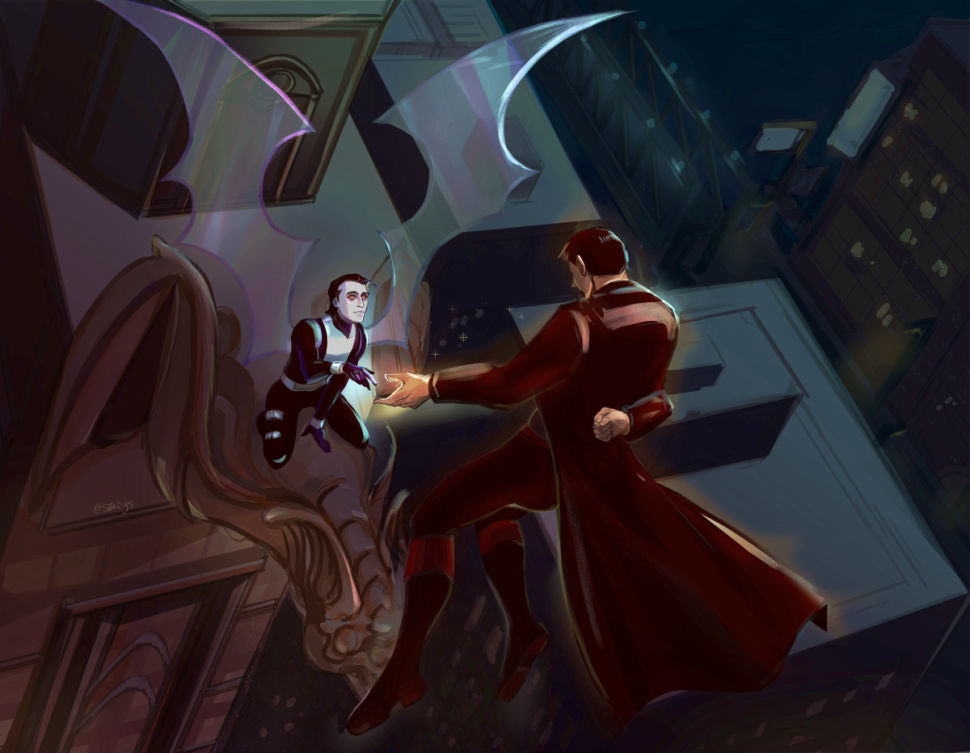
And Hernan took his hand, and lifted him into the air.
It wasn't about practice, after that.
It wasn't for any good reason at all. Kirk let the wings shimmer away, and Hernan was—he—he held Kirk against him, and flew, up and up, high over the city, the bay, tiny glimmering lights and dark water; his grip was warm, strong, and yet only ever a fraction of the impossible power Kirk knew perfectly well he could have exerted, against which even Kirk's abilities amounted to hardly anything.
In principle, the way Hernan flew wasn't dissimilar to Kirk's own levitation. But in practice, it couldn't have felt more different. Hernan wasn't just able to untether himself from gravity, to rise unhindered. He had a reflexive, instinctive grasp of his power that Kirk could never have matched, and in the air, he was—natural, graceful. He'd only ever carried Kirk while he did it a handful of times, over the course of the Justice League's existence to date, but Kirk had been struck by it every time, how smooth and effortless Hernan was about it, how beautiful.
"High enough?" Hernan murmured in his ear.
Kirk looked down. Metropolis was spread out beneath them, a glittering web of light in the dark, stretching out. So many people; an entire city, their own tower; but from here, it was insubstantial, ten thousand distant fireflies, in comparison to the solid immediate reality of Hernan.
"High enough," he managed to say.
And for an instant, he was still suspended. Hernan took his arms, turned them in the air and turned Kirk at the same time: he was above, Kirk below, the two of them facing each other, Kirk's feet braced on the tops of Hernan's boots, Hernan the only solid ground. Hernan was framed against the night sky, the stars, the distant wisps of clouds, the tiny slice of the moon—his smile was the brightest thing Kirk could see, fierce and pleased.
And then Hernan's grip tightened fractionally, an instant's warning, before he let go.
Kirk dropped, for the space of a breath. And then he shut his eyes, and reached for the wings, and they came.
And this—this was different again. The way they felt, the thin shimmering glow of them catching the air, it was—it wasn't like the levitation, and it wasn't like the way Hernan flew. It wasn't even like the glide-wings in the suit. Because the wings were so long, Kirk could stretch them so far; because they were so incredibly responsive to his slightest thought. He'd never been much of a physicist, but he could almost see the draw in it, now: this, understanding this, the pure clean movement, the aerodynamics of it, the rush of air and the way the wings cut through it, the way the tiniest change in their shape or motion could bring him into a turn, a dive, a roll, or out of it again—
"Wonderful!"
A shout—Hernan. Kirk blinked, let the edge of one wing draw itself in and rolled again, more slowly, searching; and he found Hernan, the familiar shape of him in the sky, just as Hernan laughed and turned in the air himself, sped effortlessly closer, almost within arm's reach.
"You seem like you're enjoying yourself."
"I am," Kirk admitted.
It was—it was hard to say. His throat closed briefly, too late, the words already out. He shouldn't be; of course he shouldn't be. He wasn't meant to enjoy this, any of this. It was punishment for the way he was, the way he'd always been, not the Batman but Kirk Langstrom—Will's punishment. He wasn't supposed to be happy.
But he was.
Hernan dipped low, turned in the air: beneath Kirk, now, as Kirk soared, with the wings spread out wide, almost level. Hernan had clasped his hands behind his head, as if reclining, relaxing, except that of course he wasn't, when he was matching Kirk's speed—how fast were they even going? Kirk didn't know, had no way to guess. There were no reference points up here, nothing to measure by, the whole world dim and distant except for Hernan.
"I'm glad," Hernan said, so softly the wind might have snatched it away, if only Kirk's hearing hadn't been as good as it was. And then, looking at the wide curving shape of the wings spread out above him, "They are beautiful. You look as if you were made for this."
"It's easy," Kirk said. Another thing that shouldn't be true, but was. It should have been difficult, painful. Even—even the responsiveness of the wings was probably Will's genius at work; the beginnings of his plan in motion, the nanites with a direct connection to Kirk's brain, the kind of near-instantaneous communication Will had envisioned enforcing on the world.
But it was hard to remember that, hard to think about it, like this. They had stopped Will. They'd stopped Will, and tonight the world was safe, at least for a while, and Kirk could fly. Kirk could fly, and Hernan had wanted to fly with him, had gone to the trouble of talking him into it, of coaxing him up here one step at a time, hoping he would enjoy it.
Something in the quality of Hernan's smile changed—softened, strange and wistful. "You give yourself too little credit," he said quietly. "As always." And then—
It took a handful of seconds, no more. But in the moment, it felt like eternity, every detail crisp and clear and indelible.
Hernan drifted closer. Rose, as if he couldn't help it, as if drawn upward by—by Kirk above him, more forcefully than gravity could ever hope to draw him down. He reached up with one hand, fingertips the barest shadow of warmth over Kirk's jaw, thumb hovering the barest fraction of an inch from the corner of Kirk's mouth, and the look on his face was—
Kirk sucked in a breath, sharp, shocked. Awareness flickered through Hernan's expression, awareness and abrupt, devastating regret, and then it was gone, all of it; Hernan's face went blank, hard, utterly unreadable, and he jerked his hand away and dropped out of the sky like a stone.
It didn't take Kirk long to find him.
Kirk hung there where Hernan had left him for only a moment. The wings responded as readily to his thoughts as ever, and vanished—but that could only help him so much, when Hernan could leave terminal velocity behind as easily as he could Kirk.
He was lucky, that was all. Hernan hadn't actually gone that far.
And once Kirk had fallen close enough to Metropolis to bring the levitation to bear, to begin to slow himself down, it wasn't hard to pick out the tall dark shape standing on the roof of the tower.
But Hernan hadn't gone inside, hadn't turned on the shields to keep Kirk from following him. That had to count for something.
Kirk touched down without taking any particular care, letting his uniform boots come down on the roof of the tower audibly—not that he could ever have done it quietly enough to prevent Superman from hearing him do it, but the blatant lack of effort was a gesture Hernan would understand, a warning.
Hernan didn't move.
Kirk had landed behind him, and that, too, had been deliberate; in case Hernan didn't want to look at him, didn't want to have to face him. In case Hernan changed his mind, while Kirk was still approaching him, and decided to head to Mars for a few hours rather than have this conversation.
But Hernan didn't take off. Kirk walked across the roof of the tower, and Hernan didn't do anything; and once Kirk had drawn even with him, a careful stride away, Kirk bit his lip and then said, cautiously, levelly, "I—wasn't expecting that."
Hernan snorted, half a breath through his nose. "No," he agreed. "I'm sure you weren't," and when he turned his head, met Kirk's eyes, it was—he wasn't upset or angry. He seemed calm, rueful; softly, quietly bitter, but as if he were used to it, as if it no longer troubled him.
Which was utterly, inexplicably bizarre.
"Hernan," Kirk said slowly. Because it couldn't—it wasn't what it had seemed to be. Surely it wasn't.
Hernan offered him half a smile, wry, and then looked away, up at the sky. "I was doing so well, before," he said. "There wasn't any point in trying, and I knew it, and so it was easy. You were hungry, you were—I wanted to help you. You were so quiet, you hardly spoke to me at all back then, but you were so smart, you understood everything before I could even explain it to you. I wanted to know everything about you. And one of the first things you told me—" He stopped. Kirk could see his throat move. "You told me about your friends."
Kirk swallowed. "Tina," he said.
"Tina," Hernan agreed, in a quiet, even tone. "I understood, then. There was no chance, and for ten years, that made it easy." The corner of Hernan's mouth quirked. "There was no need to fight with myself, no need to wonder whether it was right to take any opportunity open to me—because no opportunity existed. You had given yourself away before I had ever met you."
No. He didn't—he couldn't possibly mean to say he'd—
"And then, that day with Magnus, in the tower. You said it."
"You weren't there," Kirk said blankly. "You were—you were punching a robot into a pool of lava." He hadn't known it at the time, but he'd seen the footage afterward, overhead cameras capturing the hole Hernan had put in the ground; and it had been hard to miss the way Hernan had looked when he'd returned to the tower afterward, to take the Kryptonian pod before it could explode, with half his clothes burned off his body.
Kirk hadn't cared about it, then. He couldn't have, not that day.
But he—had returned to the memory a few times, since.
Hernan looked at him, something grim and amused, self-aware, in the line of his mouth. "I was listening," he said. "I'm almost always listening to you, a little bit." He paused, drew a soft slow breath and let it out again. "'I loved two people in my life'. That's what you told him. He couldn't hear you. But I could. And I never wanted you to lose them both, Kirk, especially not like that. You have to know—"
"I do," Kirk said. "That wasn't your fault."
But he understood, now, what that must have meant. Hernan—Hernan had thought it was only Tina. That there was no chance, twice over. And then Kirk had told him otherwise without even realizing it, and in almost the same moment that Will had taken both himself and Tina away from Kirk forever.
"I didn't want you to be hurt," Hernan was saying, very quietly. "I wasn't going to do anything. I was—I told myself to leave it alone, to leave you be. That it had to be up to you, that I couldn't—" He stopped again, caught his lip against his teeth; the first shadow of anger, frustration, crossed his brow, but directed only now, at himself. "I was going to be careful," he bit out, and then blew out a sharp breath, rubbed a hand over his face, self-castigating.
And Kirk—
Kirk almost wanted, for a moment, to smile.
It was so strangely sweet, to think of it. Hernan, careful—Hernan, who threw himself through buildings; who had punched a hole in the earth, a hole in the tower; who had, in point of fact, punched a robot into a pool of lava while half his clothes burned off him. Hernan was stern, decisive, unimaginably powerful and unafraid to use that power, and hardly ever careful.
But Kirk had thought it himself: Hernan so often liked to be kind. And he had been trying very hard to be kind to Kirk, for as long as Kirk had known him.
Silence. Hernan was looking up at the night sky again, for a long moment; and Kirk watched his face, the sharp familiar lines of it in the starlight, the sober wistful cast to it, and felt the heavy warm weight of his heart in his chest.
His hands were still cold. But he was suddenly, irrationally sure Hernan wasn't going to mind.
"Forget it," Hernan said. "I won't speak of it again, I promise you that. Say you'll forget it—"
"No," Kirk said.
Hernan turned to look at him, frowning, surprised. And Kirk—
Kirk wasn't good at this. At touching people, being close to them, making them happy; he couldn't be when he'd never—he'd never tried to, not really. A leap he'd never made, a chance he'd never tried to take, because it wasn't meant for him, it couldn't be.
But he lifted his hand, and he touched Hernan's face, skimmed gloved fingertips daringly along the line of the beard, and the look in Hernan's eyes changed, suddenly intent.
"Kirk?" he said, very low.
"I—don't know if this is a good idea," Kirk made himself say, because Hernan deserved at least that much of a warning.
But Hernan didn't move out from under his hand, didn't look away from him, close and searching, even wondering.
And Hernan, Kirk thought dimly, had spent so long trying to help Kirk learn how to fly—it wasn't that hard after all, to step in close to him, to touch his face; to kiss his mouth, feel it soften beautifully in surprise, before Hernan gripped his arm, his shoulder, warm and strong and surrounding, and kissed him back.