Work Text:
Asogi is drunk.
He’s become quite good at it. Just as articulate as usual, or perhaps even moreso. Only a sway in his step and a flush on his face to give it away. Barok is unsure if he always took it this well, or if he’s been drinking so heavily during his apprenticeship that he’s built up the skill. If so, it hasn’t been under his oversight.
It's certainly not hereditary. Even as a youth Barok had drunk Genshin Asogi under the table with ease.
Barok watches his apprentice walk in front of him, silhouetted in the early dusk. It’s strange to see. For as long as he’s worked with Asogi, the both of them have made an effort to avoid vulnerability of any kind. Barok can’t help but feel privileged to be allowed the sight of this. This uncharacteristic looseness in the way he carries himself is so rare, so entrancing as to be otherworldly.
Of course…whether or not he prefers to acknowledge it, Barok knows Asogi has an active social life. He’s not the first person to see him like this, not by any means. But even so… He finds it means a great deal to him, to be given the same trust as perfect strangers.
Though, of course, he doesn’t deserve it.
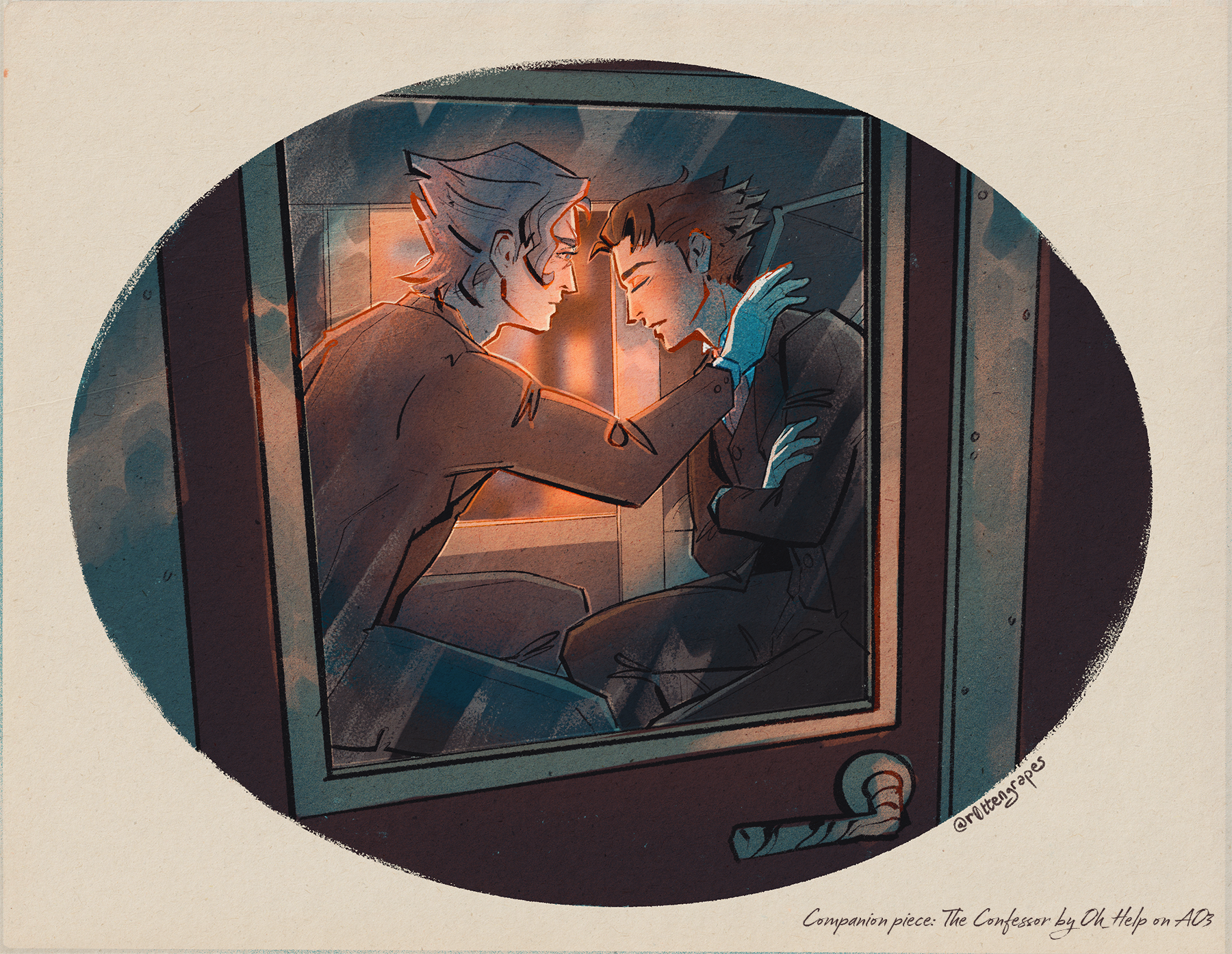
As his carriage door is opened for them, as he watches Asogi heave himself up into it, Barok hesitates. He can’t help but wish they’d taken an open cab. Wind in their faces might have done both of them good—but the thought of sitting beside Asogi in a hansom seat makes dread knot in his stomach. He cannot do that when his apprentice’s usual poise is so compromised. Not when he’s warm and soft and there’s sweet champagne on his breath that Barok can almost taste on his own tongue. When everything heady about Kazuma Asogi is heightened. Even a closed carriage will be easier than that.
Barok cannot embarrass himself. He cannot push Asogi away. Not on the evening when he’s first shown him this trust, after so many years of distant partnership. He boards the carriage and stiffly sits on the back bench, opposite.
Asogi has closed his eyes, head tipped back over the seat.
“That was exhausting,” he mumbles.
“The dancing?” asks Barok. Asogi had certainly taken his lessons to heart. Interested young ladies had flocked to him all evening, and by the end of it he’d become quite decent.
He shakes his head. “The propriety,” he replies. “Parties with one’s colleagues are absolutely loathsome.”
“…Ah.”
Barok knows exactly what he means. The unending performance of it all, under the thin veneer of leisure. He’d been born and bred in it. Picking up any glass that crossed his path had been his own coping method as well.
He looks back at Asogi, relaxed on the other side of the carriage, moreso than he’s seen him in years. Eyes still closed, long lashes brushing his reddened cheeks. Back slumped into the seat. Thighs slightly splayed with his hat resting between them. Barok is honored to be exempt from the performance tonight. To be allowed behind the curtain. But beneath that…he’s a little worried. Perhaps it means Asogi is more impaired than he appears.
“You’re sure you’d like to return to your own lodgings?” asks Barok. “You’re welcome to spend the night at my house, if that would be more agreeable.”
Asogi lifts his head. “What on earth for?"
Barok glances away uncomfortably. He feels much more foolish now that he’s being looked at. “Frankly,” he says, “I hesitate to send you home alone in this state.”
“…Are you joking?” Asogi snorts. “I’m perfectly well, sir.”
“You’re intoxicated.”
“Of course I am, and I’ve been far worse. Do you think I’m a child?”
In truth…Barok has been trying to. It’s easier to distance himself from his desires the more he convinces himself that they’re immoral, and if he can stack immorality upon immorality then he prays it will someday be enough. Asogi was hired as his subordinate. He’s young, far younger than Barok is—no more than a child while he was becoming a man. Any overture—any affection—on Barok’s part is an abuse of power. Any reciprocation on Asogi’s part would be a fearful reaction to that abuse.
In the beginning he could have believed it, but after four years Barok knows it’s nonsense. His former apprentice is now his co-counsel. Kazuma Asogi is nearing thirty now. He can make his own choices, and one of those choices has been to remain with Barok for all this time. He’s a grown man. (He’s a man. That alone should be enough. But it’s never been enough.)
As his points abandon him one by one by one, Barok finds himself grateful to the shame. He’s never liked to put much weight on emotionality. He’s always scoffed at gut feelings. But when all that holds him back from felony is the bitter disgust in the pit of his stomach, that sickness that sours each temptation… He can’t help but value it. Feed it. He’s felt it all night, and it’s a comfort.
Asogi stares at him, and the judgmental scowl is almost enough to make Barok fear he can read minds. But he’s got plenty else to judge. “If you’ve survived alone all this time,” he says, matter-of-fact, “then there’s certainly no reason to worry about me.”
“Hm.” Barok supposes it’s an insult to him to imply otherwise. He lowers his head, snorting softly. A logical argument to counter his emotional one. He’s trained Asogi well.
“Hm, indeed.”
Barok lifts his eyes across the carriage, to where Asogi is grinning in his victory. He looks at him for as long as he dares. He wishes Asogi smiled like that more when he was sober. Perhaps he does, but not with his colleagues. Perhaps it’s only the champagne that gets Barok behind the curtain.
“Are you well, sir?”
He starts, and he stiffens his back. “Perfectly.”
Asogi’s grin has faded into smug amusement. “You’re sure you’re not intoxicated enough to require supervision this evening?”
Barok has been trying to drink less himself, these last few years. He’d had one slow flute of champagne at the wedding and nothing more. “I’m not at all intoxicated, Mr. Asogi,” he mutters, defensive.
His apprentice nods. “I’m pleased to hear it.”
“Are you?”
“Absolutely. People are concerned, you know. About your drinking.”
Barok knits his brow. The closest thing to concern that had ever been expressed to him directly was Dr. Gorey’s periodic offer to inspect the condition of his liver. “Whoever do you mean?”
“The judge says something to that effect from time to time,” says Asogi, head rolling over to look out the darkening window. “Ryunosuke and Susato ask in their letters. Even Professor Mikotoba. Inspector Gregson.”
The dead man gives Barok pause, if only because he’s the only one on the list he had never known to be a busybody. “Gregson?”
“Of course,” replies Asogi, as if this was obvious.
“He certainly gave me no indication of it.”
“Who would, sir? With your attitude?”
The sheer audacity catches Barok by surprise, makes him laugh out loud. But Asogi’s grin is truly gone now—just a pensive, distant look left behind.
He picks at a stray thread on his hatband. “He’d have looked after you himself if you’d have let him,” he says. “That’s what he said to me, when he told me how relieved he was that I was there now. To look after you.”
“The inspector told you that?” Barok repeats, stunned.
Asogi slowly lifts his head again.
“Well—not me,” he says, looking blankly back into Barok’s face. “You know. Him.”
Him. Asogi hasn’t ever seemed to feel that the man he’d been without a memory was the same man that he was with one, but Barok has never heard him frame it this way before. “…I see.”
“He’d never have told me anything,” says Asogi.
Not even at swordpoint—they both know that. Barok’s lips twitch.
Asogi shrugs. “But he seemed to find your apprentice easy to confide in. Lots of people did, actually.”
Barok cannot believe the nonchalance. Did Asogi think he’d known? Did he think he’d be unsurprised to hear it?
“I suppose I understand,” says Asogi.
“You do?”
“Don’t you find it easier, sir, to speak to someone unknown? Someone who will do nothing but listen?”
One more soft, breathless laugh escapes Barok’s throat. Confession.
A little smile curls on Asogi’s lips. “Me too.”
Barok leans back, thoughtfully watching him. Is this what the perfect strangers are to Asogi? Why—of course it’s far easier to trust a stranger with one’s vulnerabilities. Far easier than to trust one’s colleagues with them. How could he have ever worried otherwise?
“He was ideal for that sort of thing, then,” says Asogi. “A good listener. Or he had the appearance of one, anyways. I don’t think it would have mattered one bit if he weren’t listening at all. He could have been utterly brain-dead.”
But he’d been listening. Barok knows he’d been listening. His apprentice—no, the both of them—had always listened, to everything.
Asogi yawns, still staring out the window at the passing countryside. “People just seem to prefer opening up to someone who won’t offer their opinion in return,” he says. “I suppose all any of us truly wants is to be heard, isn’t it?”
Barok slowly nods. He knows the feeling, and he knows Asogi knows it too. It was what his own trial had been. It was what Genshin Asogi’s trial had been. A desperation. A scream.
“I…regret that you were made to remain silent,” says Barok. To listen to anyone with stoic grace? “To bear that burden…”
“No, sir.”
“No?”
Asogi smiles tightly at his reflection in the window-glass. “It was an interesting opportunity. To know people, in the ways they didn’t want to be known. That they wouldn’t allow someone like me to know them.”
It’s sunk in now. Barok’s stomach twists in horror.
“Others were truly so …forthcoming with you?” he asks quietly.
Asogi’s eyes slide over to him, his head following behind. Barok can’t tell whether it’s amusement or sympathy in his face.
“Did you think you were the only one?”
For a few moments Barok cannot breathe. However insistently Asogi separates them in his mind, this is the proof that they’re the same man. Kazuma Asogi has inherited the trust that his masked apprentice had been given. Kazuma Asogi knows Barok van Zieks more truly than almost any man alive.
When his apprentice was first sent home with him, Barok had been…unstable. The beliefs he’d spent years clinging onto were crumbling in his hands. The past was growing ever nearer. He was grieving the nemesis he would never meet, and his feelings for his new nemesis defied description. He’d been drinking a great deal. The grimness that came with with it was easier to shoulder than the guilt or the fear it blotted out.
And then, all of a sudden, there was someone. Barok hadn’t planned to trust Stronghart’s masked man. He hadn’t trusted anyone since Genshin Asogi pierced his brother’s heart. But working with this man came easy, and their quiet rapport grew more easily still.
Barok understood exactly what he meant, about the allure of a good listener.
Sometimes the quiet companionship had been refreshing. Sometimes he’d been tempted by more. His apprentice had never asked him questions, but Barok had spoken to him anyways. Intimate things. Never anything truly incriminating, nothing the shame in his stomach was still too strong to voice, but things he’d never have said to another living soul. It was almost as if the masked man weren’t living at all. As understanding and as trustworthy as Barok had always found ghosts to be.
And of course, he was beautiful. In the most haunting way he could be, in a way that froze Barok’s veins with terror. But he’d also been the only one to whom he could express that terror. There’s someone you remind me of, he’d said once, deep in a bottle. Someone who was very dear to me once.
His apprentice had looked back at him, a face that would have looked impassive to anyone else. In lamplight the man’s dark eyes glittered behind the mask. He could have spoken, but he didn’t. He didn’t need to.
Barok had lifted a hand, gently tilted up his apprentice’s chin, drawn his thumb feather-lightly along the bone. It’s remarkable, he said. Remarkable only to a man forcing himself to believe it coincidence, but remarkable nonetheless. Remarkable enough to forget himself.
He’s always wondered but now he’s sure. Kazuma Asogi had known him, as he’d led his murder trial. He’d known him as he remained in England. As he’d put his career in his hands. Asogi knows him now, as he tells him this.
Across the carriage Asogi sits up straight, bracing his hands on his knees to tell him one more thing he knows. “You miss him, sir,” he says.
Barok snorts, turning away. He won’t indulge this.
“I don’t blame you for it,” Asogi continues, a soft little laugh in his voice. “I’m well aware I’m far less agreeable.”
“Don’t be ridiculous.”
Asogi remains firm. “I miss him too, you know,” he says. “Being him.”
At this Barok looks up. It’s a desperately sad sentiment. Was Asogi truly happier as a man without a history, without a life behind him? It’s a feeling, of course, that Barok can understand. He’d envied his apprentice’s freedom himself from time to time then, moreso the more it became clear precisely what pain his memory’s loss had hidden. But it’s still a feeling that it hurts to hear Asogi has felt.
Asogi shakes his head. “His feelings were much simpler,” he says. “I wish I remembered, then, how difficult being Kazuma Asogi had been. I never got to enjoy the break from it.”
Barok clenches one hand around his wrist to keep himself from reaching out.
“…Are you alright, Mr. Asogi?” he asks quietly.
Asogi exhales, a mirthless smile on his lips. “No less alright than you are, sir.”
Barok stares back at him, speechless.
“Though I suppose I wouldn’t know, these days,” muses Asogi.
“Mr. Asogi…”
“He would. Wouldn’t he?”
Barok swallows. It’s a bitter realization. He would.
“I miss being trusted the way that he was,” says Asogi. “But—especially by you, sir.”
“...I do trust you,” Barok replies firmly, when he can speak. “Of course I do.”
“Do you?”
“I wouldn’t stand in court with a man I didn’t trust.”
Asogi shakes his head once more. “That’s not the same trust,” he says. “You know exactly what I mean, sir.”
Barok looks away. He does know. He’d hoped not to face it. But he could have expected nothing less of his apprentice than to force him to.
“You’ve never spoken to me the way that you spoke to him,” says Asogi. “Occasionally the others come close to it. But never you.” He leans back again into the seat. “You feel further away than anyone, I suppose. Considering how close you once were.”
Sickened, Barok closes his eyes. He’d felt so honored, by Asogi’s trust tonight. Had he been denying Asogi that same feeling? Could he ever bring himself to give it?
“I don’t ask for that again,” says Asogi, reading his mind with the unspoken intuition of the masked apprentice. “I know it’s undeserved. I…simply like to remember that feeling, sometimes.”
Barok still cannot look at him. He hears Asogi chuckle softly.
“How funny,” he mumbles. “That I’m speaking to you like you might have spoken to me, all those years ago.”
Slowly, helplessly, after a long silence, Barok turns back to him. He looks back at him to listen, as Asogi deserves.
“Yes,” he murmurs. “I suppose.”
“Hm.” Asogi leans his head against the seat, yawning. “You’re a very good listener, sir.”
“No better than you were,” says Barok. “No better than you are.”
Asogi’s lips curve into the slightest smile.
They continue toward London in silence.
When they arrive outside the boarding house, it’s well into the night. Asogi is asleep on the carriage-bench. Barok gazes at him for a long moment.
He indulges a fantasy. He’d lift Asogi into his arms, let his lovely head fall heavy against his chest and cradle him there. Carry him up the steps. Lay him down, unlace his shoes, remove the jacket of his old morning suit. Draw the covers over him. Brush back his hair as it falls over his eyes.
He breathes in, frozen for just a second, then he reaches out across the carriage to gently shake his apprentice’s shoulder.
“Mr. Asogi,” he says. “Wake up.”