
Work Text:
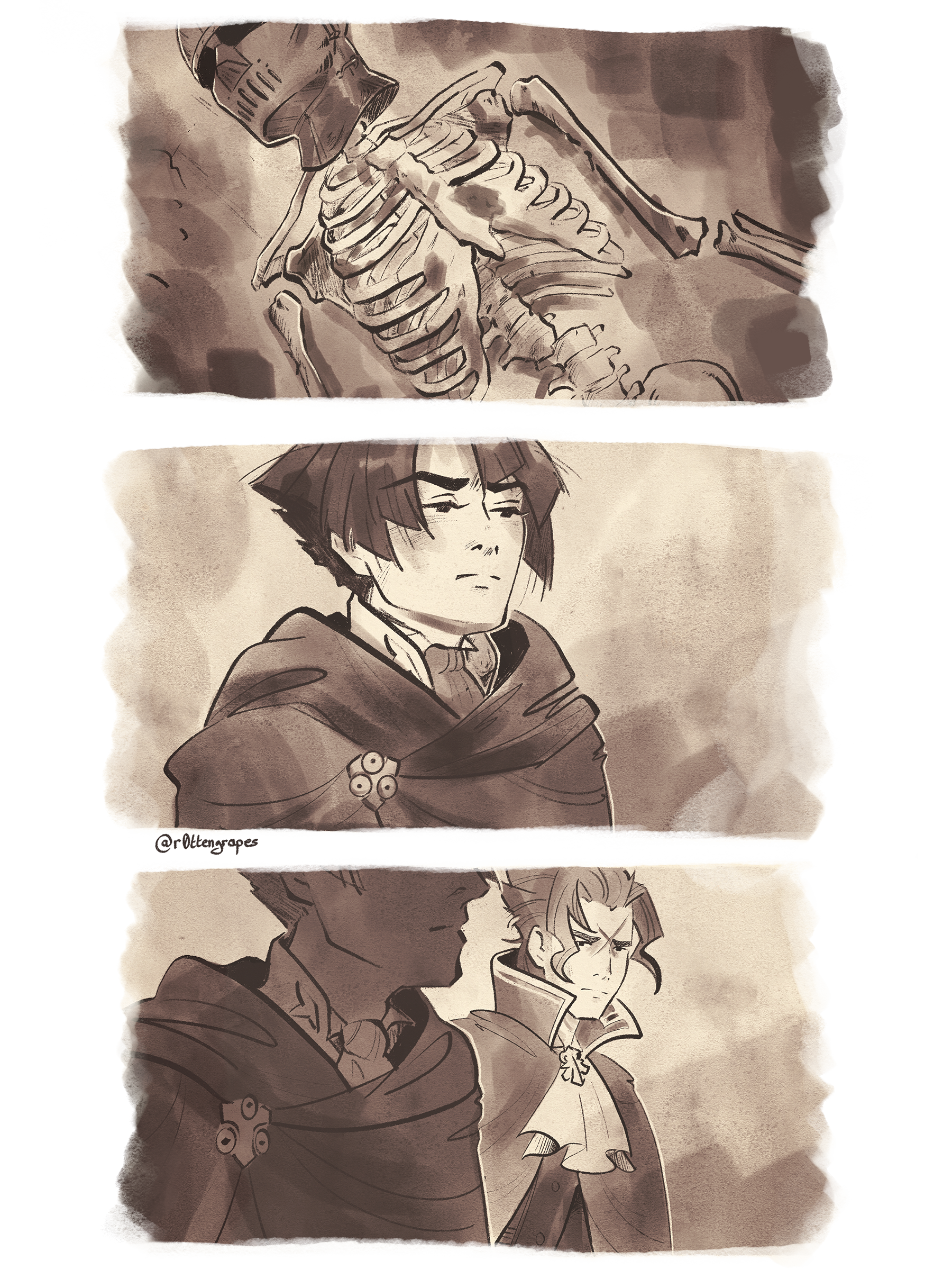
Genshin Asogi is exhumed on Monday morning. He's dug up with the same urgency as he’d been ten years ago, when it was alleged in every paper that he’d risen from his grave. Barok had attended too, then. He couldn’t do anything but. But he couldn’t do enough, either. His young, broken self had let the opportunity of that day pass him by, the momentousness that it could have held in braver hands.
Gregson had overseen it then. The only man Barok had trusted, and the only one he shouldn’t have. Not, to his knowledge, a man who’d known about the shooting previously—but one who knew enough about Mael Stronghart to speak to him about it before making it public. Certainly before telling the prosecutor, the friend, the disciple, the killer.
Today it’s a handful of men Barok doesn’t know. There is no one remaining on the police force, debatably excepting the far-too-junior Lestrade, whom he trusts. He would not have allowed anyone he trusted to touch this even so. He doesn’t want anyone with even a hint of connection to the case to be involved wherever possible—aside, selfishly, from himself. Himself and Asogi. Barok imagines this chance was the reason his apprentice had stayed in London, and that forbidding him from the case would be impossible now that he’d allowed him to remain in his employ.
It had been warmer ten years ago. Midsummer. Today the ground crunches with frost, and Asogi has worn his cloak. The hood down, now that it’s allowed to be, despite the cold. His cheeks raw and reddened from the bitter wind. He doesn’t look at Barok, nor does Barok want him to. They stand there together staring at the grave.
It’s to be a proper medical examination, not just a confirmation that Genshin Asogi is present and unbreathing. The last time they’d cracked open the casket in the ground. This time there is no casket, and for that matter, no flesh. No face to gaze into and remember it smiling. This time Barok is strong enough to watch.
Asogi steps up with him, intently watching as the bones are carefully removed from the soil, arranged and catalogued. His face is as impassive as it might have been behind his mask. Barok knows that if he were there ten years ago, his father’s corpse just beginning to decay… Asogi would still have been brave enough to look inside. He is desperate for every bit of him remaining.
The bones are loaded into the police carriage, and then there’s nothing left for them to look at but the gaping earth of plot 139.
“I want a stone with his name,” says Asogi. He’s less adept at disguising the strain in his voice. “A carver who reads Japanese. I’ll have one imported if I need to.”
Barok lowers his head, a slow nod. “Certainly.”
He’d offer to pay himself, but he can’t see Asogi agreeing. A headstone for a man he’d killed is a gift in poor taste. It’s a better gift from a devoted son, someone who’d been through hell and back to prove his innocence. Someone who’d loved him properly.
They stare down at the open grave for a little longer, as if some part of him remains there, and then they turn to leave.
The next Monday, after Naruhodo’s contingent has gone, they begin the case. The cases, more properly. Mael Stronghart will go to trial, and not a closed one—the Queen herself had made her wishes in the matter clear. But all the loose ends, each of the coercions and complicities, still remain on the periphery of his crimes. If Barok and Asogi can settle the accomplices’ charges with pleas it will be far easier. It’s a rare step…but there’s much to do. If it’s done, they can focus their efforts where they’re most necessary.
Asogi lifts his eyes from the file of Minister Seishiro Jigoku, and he lifts his chin.
“I won’t let you go lower than capital murder,” he says.
“What?”
“Asogi Genshin and Tobias Gregson. Two counts.”
Barok barks with astonished laughter. He’d been hoping, perhaps too optimistically, that Asogi could approach this particular defendant with a more objective eye.
“Why waste the time, in that case?” he says. “It would be more efficient to just begin preparing a trial.” Minister Jigoku had struck him as a man with a monstrous drive toward self-preservation. To imagine him agreeing to an execution? Absurd.
“He’ll want to avoid a trial,” Asogi replies, shaking his head. “He’s a proud man, more than anything, and he’s clever enough to know there’s no way out. He doesn’t like to be humiliated.”
“No way out, perhaps,” says Barok. “But he’d have a chance at a lighter sentence, and a likely one.” It’s clear that Minister Jigoku was little more than a pawn, after all. Like Gregson had been, like Wilson and Sithe. Like Barok’s own poor, proud brother.
“Likely?”
“Lord Stronghart will almost certainly be tried himself for both of the deaths in question. A jury wouldn’t assign him equal blame.”
“Are you mad?” Asogi snorts. “He’s Japanese. More Londoners than not will happily hang him without a trial at all.”
Barok breathes in sharply. The words are a knife in the stomach, Asogi knows that they are. But he’s right. In the sting of his shame, Barok is glad he’d said it—that his apprentice can see these things that he is still blind to.
“For that matter, he’s been violent,” Asogi continues. “In court. More than once.”
“…Ah.”
It had been fury no less than Barok’s own, in the same trial. Fury far more entitled. Minister Jigoku had seen his dear friend hang in a show trial, and he’d been indicted himself for calling it obscene. At the time… Barok had seen the man as coarse and vicious. Ungrateful to the country that had welcomed him for six years, had taught him in an earnest hope to spread their legal expertise to such far-flung places. A loathsome Nipponese heart finally unveiled.
This is how the judiciary will still see him now. At the very least, they will still feel the echo of it beneath their reason. Barok van Zieks can break as many bottles as he likes, but Seishiro Jigoku’s righteous rage had branded him a savage a decade ago.
Asogi snorts again, more softly. “He always used to tell me to hold back from that. Control the impulse, no matter how infuriating the argument. I had no idea he’d been to trial for it.”
That trial had never been one of the ones that haunted Barok, that had driven him mad with regret. He’d barely even remembered it. Today the guilt crashes over him in a sickening wave. If he hadn’t been so cruel in his prosecution… If he hadn’t driven the man to furor, goaded him into destroying his future along with the witness stand, if he hadn’t put him in the position to owe the Lord Chief Justice who’d shown him lenience… Could Genshin Asogi have escaped his grave?
No. Stronghart would have shot him himself, if that was what it took. Or, more likely, he’d have come up with a different way to keep the blood from his own hands.
It’s something Barok has been telling himself quite a lot, this last week.
“You’re right,” he says. “It’s best he not be tried. But all the more reason to soften the charges.” He looks down at the file, at Minister Jigoku’s glowering photograph. “I still struggle to imagine him agreeing to such a plea.”
Asogi shakes his head and squares his shoulders. “He will,” he says. “If—we offer him extradition in exchange. An execution on his home soil.”
“He’s worked in the law for twenty years,” Barok replies. A man like this one’s experience is easy to underestimate, and he cannot blame Asogi if he has. “He’ll know a poor bargain when he hears one.”
“It’s not a poor bargain. Not to him.” Asogi stares evenly back at him. “He’d rather die in Japan than rot in an English prison. I’m certain.”
They stare at each other for several moments. Barok breaks the eye contact to sigh helplessly.
“…Very well, then,” he mutters. “Prepare a pleading, and I’ll discuss with him posthaste.”
Asogi is still eyeing him as he reaches for the next file, watching, waiting to see if he says anything more. “…We will, you mean.”
Barok snorts. It had been the sort of denial Asogi wouldn’t have picked up on unless he’d been half-expecting to hear it. “No, Mr. Asogi,” he says, “I will.”
“I need to talk to him.”
“Absolutely not.”
“He won’t trust you,” says Asogi, voice growing heated. “Not like he’ll trust me. I have to be there.”
Barok knits his brow in incredulity. “You believe he’ll trust you?” The man he’d betrayed the most grievously, the most personally? The man most likely to want the worst for him?
“Yes, I do!” Asogi stands. “Sir, I’m going with you.”
“You were the one who chose to remain in my tutelage,” snaps Barok. “And, therefore, at the mercy of my will. You were the one who demanded that I remain to teach you. You refuse now to take my direction?"
“You’ve grown too used to an apprentice who won’t question your direction?” Asogi retorts.
They stare at each other through narrowed eyes.
“I know him,” says Asogi.
“…Clearly,” replies Barok, “you do not.”
Asogi glowers at him, murderously. It’s well deserved. In cold regret, Barok clenches his jaw.
“I know him as well as you knew my father,” hisses Asogi. “Better. Better than I knew my own father.”
Lately Barok has been hearing “…because of you” after so many things Asogi says, but this time it feels intentional. “He murdered your father,” he snaps, infuriated beyond delicacy. “The crime, if I may remind you, that last week you tried to hang me for.”
Asogi scoffs.
Barok shakes his head. “I thought perhaps that you might try to distance yourself from your personal connection to the case,” he mutters. “But it seems clear that such a thing was too much to expect of you, so soon after—"
“Clear?” repeats Asogi, incensed. “How so!?”
“Listen to yourself!” snaps Barok. “You’re fighting me to see him dead!”
For several long seconds Asogi is silent, and then he finds his tongue.
“Yes,” he says. “Yes, I am.” He stares back into Barok’s eyes again, betraying the intensity behind his blank tone. “I want to see him pay the price he deserves to pay for the lives of two men, and so should you.” Confidently, he lifts his chin. “But I also want to see him treated fairly by the Crown. Punished for his crimes, rather than for his existence, and there is no other man in London who can do that for him.”
Barok draws in a slow breath.
“…And that, Lord van Zieks, is what you neglected to do for my father.”
Asogi doesn’t know how desperately he’d searched for any evidence of Genshin Asogi’s innocence. He doesn’t know that he’d begged the man to defend himself and that he’d been denied. What Asogi does know is that he had taken that denial and refused to look beyond it. That he’d let the betrayal overwhelm him and the rage consume him. It's all he needs to know. It’s what Barok had done in the end, and that’s all that matters.
Even before Asogi’s apprenticeship he’d spent years regretting that. He’d come to understand how grievously even the guilty can be mistreated. But it had come in time, with experience, and he still isn’t sure that Asogi knows what will be facing him in Seishiro Jigoku’s jail cell.
“I don’t want to see any more justice driven by rage,” Barok says quietly. “By revenge.”
“You’re a hypocrite,” snaps Asogi at once. “You’d never consider letting another man take the Stronghart case. Just as you begged to take my father’s—"
“It isn’t hypocrisy, Mr. Asogi, to understand one’s own choices and want those in their care to make better ones!” Barok’s voice frays hysterically as he slaps the desktop. “You, more than anyone, understand what I wrought in my anger! Can’t you understand how dearly I wish I’d had someone then to warn me against it?”
“So you condescend to me instead, I see!” Asogi stares down at him, furious. “Do you think forcing me down the path you wish you’d taken will change what you did? When you were in my shoes?”
Barok exhales sharply, as if he’d been struck.
“Of course not,” he mutters. “That’s absurd.”
“Yes,” says Asogi. “It is absurd. Nothing you do for me will change the past.”
And I can offer no forgiveness. Barok looks away.
“I don’t wish to change the past,” he says, strained, through the ice in his chest. “I simply wish to ensure that it doesn’t repeat.”
"But you’ve already done that, sir.”
“What?”
Asogi sits against the edge of the table, thoughtfully glancing away.
“I know what you were feeling then,” he says. “Of course I know. I feel the betrayal and the anger as keenly as you fear I do. But I’m not you, sir.”
Barok snorts. “You consider yourself cleverer, then?”
“Simply more experienced.” Asogi shakes his head. “Do you think I could have stood in that trial and not learnt what becomes of unchecked grief in justice?” He turns back to look into Barok’s eyes again. “I know how you treated my father. I know how you treated my friends. I know how I treated you. You think I learnt nothing?”
Silently, Barok looks back at him. It occurs to him that this is the most he’s done so since his apprentice removed his mask.
“I don’t need your orders to learn from you,” says Asogi.
“I’m your cautionary tale?” asks Barok, skeptical.
“If you choose to think of it that way,” Asogi replies. He pauses. “And a cautionary tale, as I understand it, was what you never had. Back when you were in my shoes.”
It was what had been denied him. It was a lesson his brother could have taught him, if he’d been brave enough to admit his sins. Barok pictures the prosecution of Genshin Asogi, in a world where he’d been able to learn the truth. A trial for the death of one man who’d asked for it and nothing more. For actions he could understand, but not condone.
Barok sighs once more, long and slow. If he is a cautionary tale, then Asogi is an inspirational one. That’s the sort of tale that he needs now—of a man striving to grow beyond his grudges.
He looks forward to watching it unfold.
“…Alright,” he says.
“Alright?”
“But I will be supervising.”
Asogi bows, hiding his triumph behind a lowered head. “Of course, sir.”
On the day of the first exhumation, Mael Stronghart had gripped him by the shoulders and held him back. “You don’t want to see it,” he’d whispered. “You don’t need to.”
And so Barok had turned from the grave. His strength had been so grievously chipped away then, and once he’d finally allowed himself rest, he had woken from it to discover that the nightmare was unending. He’d barely had the fortitude to stand, much less to look upon the first man he’d sent to the gallows. The first man he’d loved.
Could everything have changed, if he’d insisted? If he’d seen the gunshot wound and discovered something was terribly wrong?
Most of all, in his mentorship, Barok wants to give Asogi transparency. He doesn’t want to turn him away from the horrors of their work, whether through malice or through well-meaning guidance. He wants to let him work unled. Supported, in the way that he had been missing in his own youth. But unled.
He prays he has the strength to.