
Chapter Text
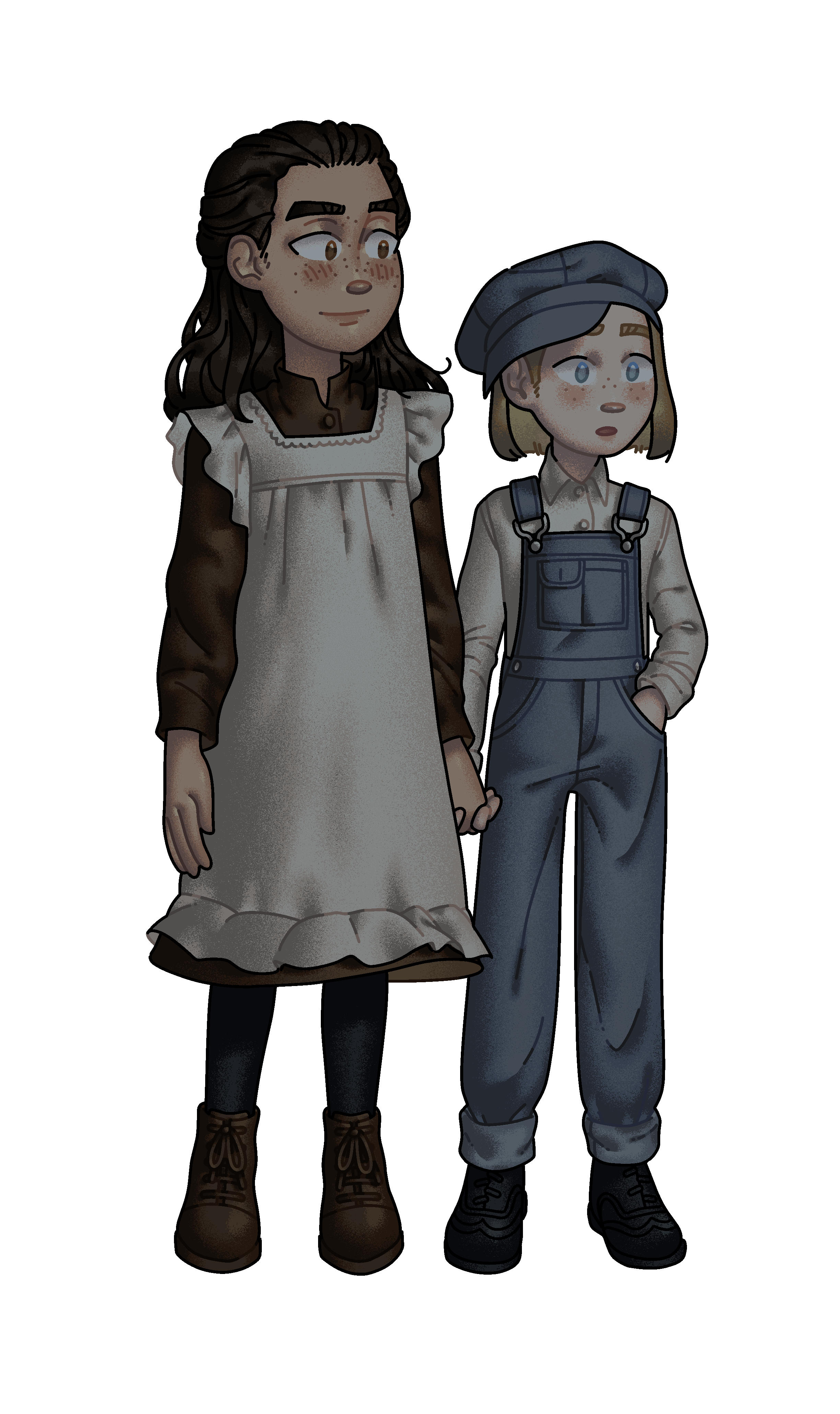
The Girl From The Gilded Hotel - A Story From The Freehold States
“Don’t go too close to the edge, Ruthie, okay?”
“Okay, mom.”
Ruth waited for her mother to turn away before rolling her eyes. She loved her, she really did, but she wasn’t a baby anymore; in a week, she’d be ten years old, and she’d been doing this since she was half that age or less. So she ignored the soft, chiding sigh that followed her, and shimmied off between the restaurant tables.
The terrace ran right up to the edge; so did the building itself, its great glass windows overlooking the drop, but she’d insisted they sit out here, under the open cave-ceiling. Because here she could hurry over to the rim, with nothing but the green wrought-iron of the railings to hold her, and lean out into the open air.
And sure enough, with new boots, an early birthday present from her Uncle Owen, clacking on the flagstones, and her pretty pleat-front dress swaying in the breeze, she found that railing. And she took it in both hands, holding tight between the stanchions, and let the world roll out beneath her.
From up here, it was almost two miles to the far side cave wall, and sixty-something-stories to the ceiling, speckled with crystals and mushrooms. Once, those had glowed, rising and falling, to give the city day and night, but now those miles were full of streets and railway lines and gaslit buildings, and the stone overhead was marked in soot by the industry beneath. And from the edge, Ruth could see all of it.
She let her eyes trace the balconies of the Gray Quarter, with their elegant Creole wrought-iron, and the dark pagoda-roofs of the Imperial Quarter, lit by anbaric lights imported from the distant lands of Shan Guo. Then she looked up, to the churning factories of the industrial districts, where cinders flickered like fireflies in the chimney-smoke. And then she looked higher still, to the skyscrapers, thirty, fourty stories in Beaux-Arts brick or Art-Deco Portland stone, and to the islands between them.
She’d always thought that ‘islands’ was a bad choice of name; islands were surrounded by water, really, not the streets of a burgeoning city. Uncle Owen said they’d been hills, once, before the city had grown in and the land around them had been levelled, and their sides had gotten steeper and steeper until only the hilltops had been left, turned to plateaus hedged-in by sheer retaining walls.
The buildings atop them were the finest of them all, great elegant structures of clean-washed brick and whitestone, lined with gilt and interspersed with crystal palaces of iron and glass. Proud and tall they stood, clear of the smoke and grime below, and between them ran the greatest bridges in the Freehold, carrying people and trams and autowagons over bounding iron spans.
The island upon which she stood was one of her favourites. From here, she could peer from atop the retaining wall, and see it all; or look down to the railway line built along its base, and watch the trains go by. But her real favourite was another, out within the skyline-view; a broad, stout district raised seventeen-stories up. Because that island held her home.
Even from here, it stood tall, rising up the side of the island and clear above it for another thirty floors. All were clad in Portland limestone, proud pale-grey, with the dark glass of the windows forming neat vertical stripes; at the top, setbacks formed a staircase of raised ridges, their faces carved with symbols of progress, and four statues punched skywards at the roof’s corners. If you’d asked Ruth, in that moment, she would have confidently said that the Kittredge Hotel was the finest building in all the Below, and she was the luckiest girl for getting to live in it.
She looked at it for a moment, before a new sound split the air: the shriek of steam in a single-chime. Then a sputter of steam and a clatter of cog-wheels, and Ruth turned back to see an autowagon, a neat little coupé with its engine humming, clatter into view beyond the tables where the terrace met the street.
It braked to a stop at the kerb. The driver, a tall halfling, set his levers, then climbed down briskly from his high seat and whirled to the door. A tall, broad-shouldered shape stepped out as he opened it; there was a moment of stooped, polite conversation, a flash of copper coins, and then the newcomer straightened and the driver scurried back up to his seat.
He blew his whistle again, crashed his gears, and clattered away, but Ruth paid him no mind. No, all her focus was on the man he’d dropped off. She’d have recognised that face anywhere, with its sideburns and neatly trimmed beard, and that suit and long coat, matched in pale green-brown to his fedora. Her eyes widened; she hadn’t known he was coming.
“Owen.” It sounded like Dad hadn’t, either; looking over, she saw him turn his chair, scraping on the flagstones, and lean back to drape one arm over the backrest.
“Gareth,” Uncle Owen breathed tensely, “Ida.” A waitress appeared at his shoulder, but he waved her away wordlessly, taking what had been Ruth’s seat and easing down into it. “Figured I’d find you here.”
“Gar…” Mom warned, but Dad wasn’t having it; he leaned in, bristling.
“Now what’s that supposed to mean?” There was frown in his voice, deep enough that part of Ruth wanted to run over, and join Mom in asking them not to fight. But she also knew that would only get her in trouble. So she pretended not to hear, shifting over slightly so one of the gas-lamps obscured her, and listened softly.
“You know what it means,” Owen grunted, punctuating his words with a screech of chairlegs. “You’re how far behind on rent, now? Two, three months? And yet I find you out here, dining on the terrace.”
A thump of hands on the table. “It’s Ruth’s birthday, brother. I wanted to treat her to something nice. I thought you’d understand that; you got her those shoes, didn’t you?”
“Her birthday’s not for a week yet,” Owen countered bluntly; something in Ruth’s chest twisted at the way the words came out, making it just a little harder to breathe.
“And I’m going to be in Kiramman then.” Dad’s voice was higher, now, yet more agitated. “I told you; I’ve got the whole thing with Maxson lined up.” He blew out a long breath. “Once that deal goes through, I’ll have all the money in the Below; I can pay you back, with interest.”
Uncle Owen replied with a sigh of his own, low, frustrated. “You said that last time, brother. I want to be fair to you, really, I ain’t… happy, that it’s come to this. But the market does what the market does and right now it’s being… unkind.”
“I know, Owen,” Dad cut back in, almost hissing the words out. “That… that’s part of the problem.” He went down to a near-whisper. “And you know how much it costs to raise a kid these days. You… you wouldn’t take this away from her, would you?”
“I wasn’t finished.” There was a weight to her uncle’s voice that Ruth had never really known, one that made the squirmy feelings inside all the worse. “Sometimes, staying afloat means making sacrifices; I gave you that suite at the Kittredge ‘cause I thought it would help you get on your feet, Gareth, I didn’t think you’d still be in it a decade later.
“And now this. At some point, I’ve got to call it what it is, and what it is, is freeloading.” There were soft gasps from both her parents, then, more anger in her father’s. But Owen still wasn’t done. “I’m not… I don’t want to force you out, but that suite is worth fifteen gold a night, and that’s not counting the extra room. I need at least the costs covered.
“So I suggest you make sure that the deal in Kiramman goes through, and have a long, hard think about unnecessary expenses like this.”
There were more words after that, words from Mom, and Dad, and him all over again. But Ruth didn’t really hear them; because that phrase was lodged in her mind. Unnecessary expense: her birthday, her presents, the extra room… that was her bedroom they were talking about, its dark window a distant splotch on a skyline-wall. She tried to put it out of her head, to focus on that, but she found that just made her throat close up and her insides squirm even more.
Instead, she looked down, down at the polished shoes that her uncle had so recently given her. And then further, down the retaining wall, because she didn’t want to look at those anymore, either. Until she was looking right at the city floor, fifteen stories down, and the railway-spur below.
And as she watched, trying to ignore the tightness against each breath, a grimy six-coupled engine came clanking down it, boxcars and open trucks jolting behind. It was rolling away, out towards the junction beyond the great glittering roof of the passenger station. And as it did, a flash of movement caught her eye; from one of the far-side alleys, a tiny shape in pale denim scurried out, and caught hold of one of the rail-vans and disappeared inside it.
And suddenly there was a tiny, awful thought there. A single idea that made her chest tighten even more. What if…?
“Ah, Ruth!”
The gentle thump of a broad hand upon her back made the girl jump, train and passenger forgotten in a moment. She looked back, blinking; Uncle Owen stood over her, his face set in a thin line of a smile that didn’t reach his eyes. “You, uh, hear anything I said to your folks?”
Ruth shook her head; she knew eavesdropping was bad, that was what Mom always said, and now… now she knew what he really thought of her. “I’ve been looking at the view.”
“Nice, isn’t it?” She couldn’t tell if he was being honest, or if he knew she wasn’t, but his voice was calm, soft. “I just wanted to drop in, since I’m going to be busy on your birthday.” He let out a low hiss, the kind he made when he wished he had a cigarette to blow out on. “And your father, off in Kiramman, under the open sky… you’re gonna be okay turning ten with only your mother there?”
“Yeah, I’ll be okay,” Ruth breathed softly; it hurt, but it wasn’t a lie. She was going to be okay.
She had to be.
That night, back in her broad suite-bedroom in the Kittredge, Ruth found herself stopping in front of the mirror opposite her bed. She’d always liked it, always liked how she could see all of herself in its shine, but now, for the first time, she found it felt too big for her. Quietly, irrationally, she worried that that great silver shape would swallow her whole, and spit out all her finery.
Those boots, black, polished, new; that dress, pale purple, patterned and pretty; her hair, blonde, styled into curls that fell past her shoulders; the bow that Mom had tied neatly atop it. Those were all expensive things, she knew, things she hadn’t paid or worked for, things Mom and Dad and Uncle Owen had spent their own hard-won silver on.
Her throat clenched again, and her eyes stung, because she knew, now, what that meant; it meant she couldn’t keep any of them.