
Chapter Text
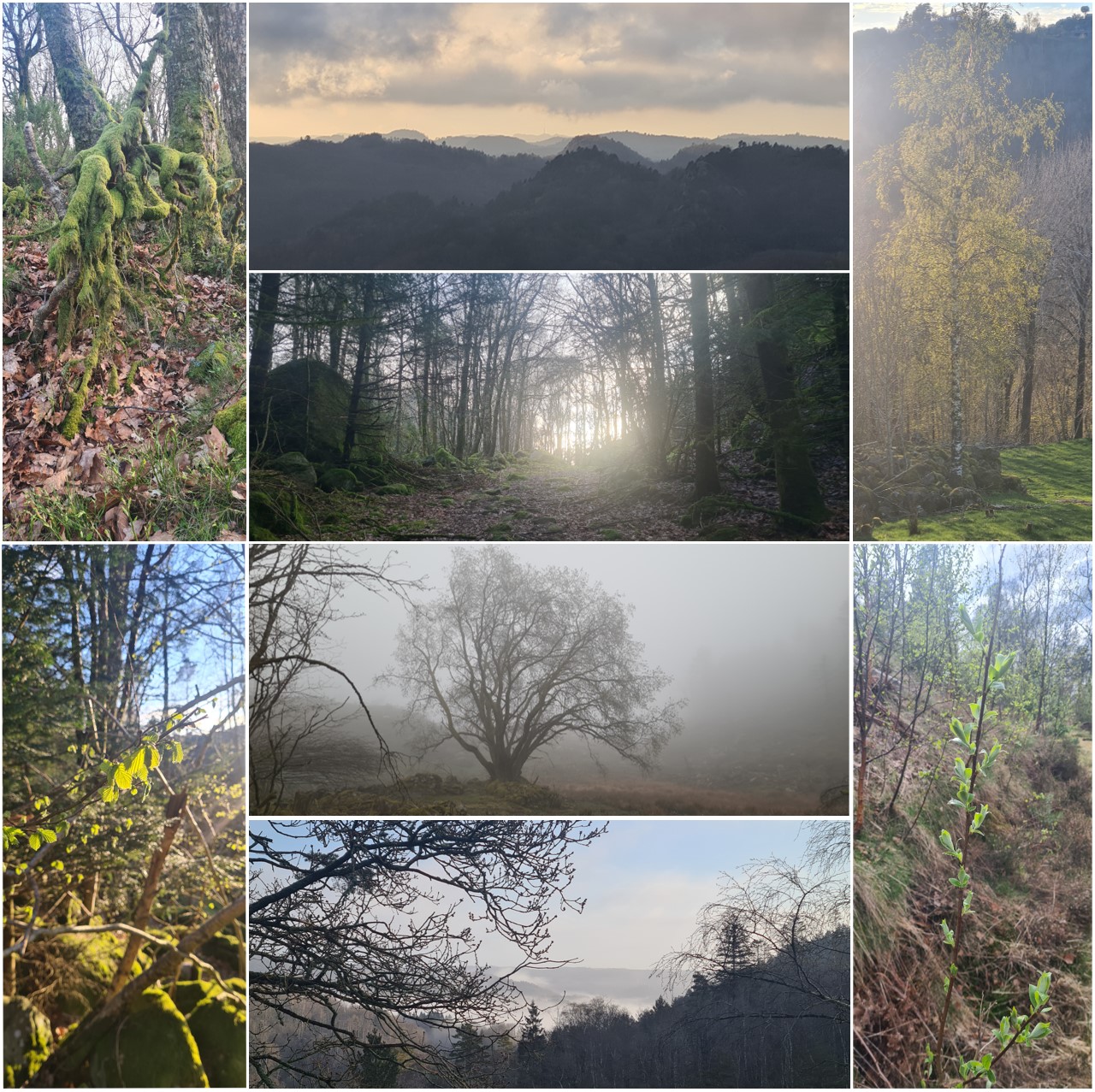
TRSB 2025 Prompt #17 - The Woods
⋅.˳˳.⋅ॱ˙˙ॱ⋅.˳˳.⋅ॱ˙˙ॱ⋅.˳˳.⋅
The Great Smials, green-roofed and root-bound, spread beneath the Green Hills of Tuckborough like a great sleeping dragon buried in its hoard—tidy little burrows and clean-cut tunnels wound through the earth, echoing with the footfalls of Tooks (and Tookish in-laws, and those who’d simply attached themselves by sheer force of appetite or admiration), and above all, with the shrieks and thumps of many, many children.
On this particular morning, Gerontius Took—known by some as the Old Took, and by most as the Thain of the Shire—sat perched on the ledge of his office window, feet swinging over the mossy drop, whittling at a wedge of yew and humming, a little off-key, as if he had all the time in the world for it.
Which, by rights, he did. No one in living memory had ever seen him in a hurry. At 110 years old he was nearing the ripe old age of the longest-lived in the Shire’s records, but his fingers were still nimble and his mind was still sharp as ever, and so he kept on at his own, staid, pace.
He had finished all of his Thainly business before second breakfast that day, dispatching a troublesome parcel of letters—something about boundary stones and the improper construction of a cow-shed, which in the annals of the Shire could nigh be considered an act of war—and soon he would be free to indulge in the real business of his life: his grandchildren.
Not running after them, which was the inclination of the younger and more sturdy parents, aunts, and uncles, but the running of them, as in the running of a circus or the running of salmon up a stream. He was, as his daughter Belladonna once called him, chief mischief-maker and the merry conductor of a symphony of noise.
Through the door, bustling in with a tray laden with elevenses nibbles and a pot of tea, Adamanta Took, née Chubb, smiled to see her husband sitting idly in his windowsill. “You’ll muss your foot hair if you keep that up,” she chided fondly, setting her burden down on the side table reserved for meals the Thain took in his office.
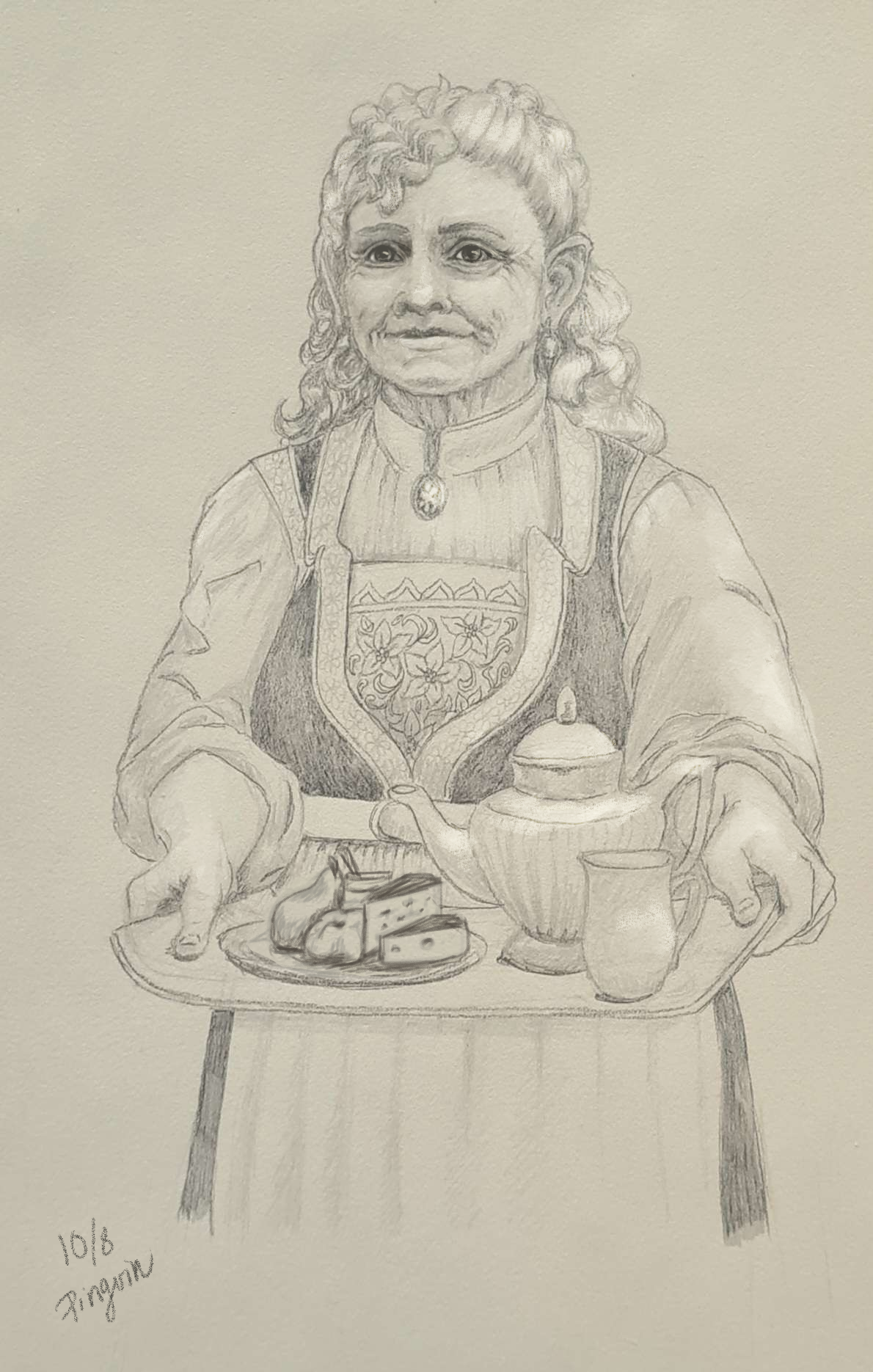
Adamanta Took neé Chubb by Unlos (sublimpingvin)
Slowly, the Old Took swung his creaky knees back into the room, surreptitiously smoothing the errant curls of his grayed feet as he steadied himself and dropped down to the floor. He stretched his shoulders back, hands propped on his aching hips, until he felt a satisfying pop. “Ah, Andy my love, where would I be without you?”
“Hungry, and looking frightful, no doubt,” she quipped.
Shuffling to the table, Gerontius chuffed a laugh under his breath. Too right, he'd be a fright without his Andy, the soil in his garden.
He frowned a bit at the lack of biscuits or pastries on the tray and dutifully served up some fruit and cheese. “I’ll be singing to the children today,” he mentioned idly.
“Oh Gerry,” Adamanta fussed, “you're not going to sing them one of those fae songs, will you? You know I hate how they all have nightmares for days after.”
“Isn't that the point?” he groused back. “They won't mind the dangers they don't fear.” He thumped on the table for emphasis. “‘Sides, not all of ‘em are scared.” He added with a glint in his watery old eyes.
“Little Bilbo does so love your tall tales.” She said fondly. “Just like Bella, that one is. And now it's her turn for a taste of what that's like!” She chortled in glee, remembering all the hours of worry and wonder that had come with raising such a spirited daughter.
Their meal passed in quiet reminiscing about their large and varied brood before Gerontius shooed his wife off so he could finish the last of his record-keeping before song time. She tidied up the tray and left with a kiss to his wrinkled cheek.
⋅.˳˳.⋅ॱ˙˙ॱ⋅.˳˳.⋅ॱ˙˙ॱ⋅.˳˳.⋅
At the prescribed hour (half-past elevenses, that is, half-way between elevenses and luncheon), the Old Took closed the heavy ledger, set aside the official quill of the Thain, and rummaged under his desk for a battered leather case. The air that wafted from its tatty interior smelled heavily of pipe-ash and plum preserves. Nestled inside, as precious as any family heirloom, was his banjo. The skin of its drum was yellowed. The fretboard finger-dipped and mapped with a history of thumbprints. The third string peg was a little loose, but the body was sound, and the whole of it strung tight as anticipation. He plucked idly, tuning it up and giving the strings a few rolls to limber up his fingers.
Once a week or so, and sometimes more often (for there were so many children living in or visiting the Great Smials at any one time that birthdays had to be celebrated by the batch), the Old Took would leave his office at half-past elevenses, meandering through halls that lingered with the scent of baking and the hums and sighs of hobbits going about the business of the day. He would stroll along, strumming his banjo to summon his grandchildren to follow him like a furry-footed Pied Piper, leading them all the way to the First Sitting Room at the very front of the Smials.
Today it started with a single little girl, sweet Jessamine, hair bound up in two long pigtails and sucking on her fingers as she trailed after her Pappy, as they all called him. Soon a rangy Fortinbras joined her, just sprouted so his trouser hem was nearly above his knobby knees, then the twins Paltram and Poppy leading the newly toddling Jago, his mouth sticky with porridge. Soon, the Old Took was followed by a gentle thunder of little feet, and they all poured into the sitting room around him like a flood breaking around a boulder.
The First Sitting Room was not so much a room as a burrow that had gotten ideas above its station: low-ceilinged (for Hobbits), the beams blackened from years of oil lanterns and cosy fires. At one end stood a wide hearth with a deep slate bench before it, worn concave in places by generations of little bottoms. At the other end, the Old Took presided from his unofficial chair of office, a lushly-upholstered armchair that managed to look both impressive and inviting. In between, a variety of thick rugs, cushions, and plush sofas made the room welcoming and warm.
The children scattered around his chair, claiming their favorite cushions and tussling over the ones that were left. Isengar’s little Mirabella shrieked bloody murder as someone yanked her curls, and Bilbo was scolding Adalgrim, who had been sitting right behind her. All their yipping and yapping came to a sudden halt when Gerontius gave his banjo a mighty buzzing strum.
“Is everyone here?” he called, though he could see at a glance that the room was only a little over half full. The rest were probably conducting a raid on the pantry.
Fortinbras, who fancied himself quite the little leader, climbed up onto the bench and counted off on his thick fingers. “Eight so far, Pappy. Daffy’s in the kitchen with Gramma Andy. We’re still missing Rudi, Bertram and Fulbert, Siggy…oh, and Hollyhock went out walking with Teddy Skinner…I think that's it for who’s here today.”
The Old Took grinned around his pipe-stem. “Then we’ll start the music, and see if we can coax the rest out.”
He settled into his plush green armchair with the banjo in his lap. It was not the prettiest instrument, and some said its sound was like the rattling of spoons in a rain barrel, but the children always came running at the first rolling tune. He rapped the pot of it twice, and began to strum an idle rhythm through a simple progression of chords as he looked around, winking and smiling at them each in turn.
In a blink the children had stilled, watching his nimble fingers with the avidity of hunting cats. Bertram and Fulbert came tumbling into the room shortly with suspicious crumbs around their mouths. A hesitant face appeared at the door behind them, streaked with jam and curiosity—Sigismond, never one for the crowd, hovered in the hallway, his gaze fixed on the Old Took as if he were studying something possibly dangerous.
“All right, gather round,” Gerontius announced. “Closer, now. Don’t worry, I’ve scared off worse things in my time.”
The last of the children tumbled toward him, settling in a many-legged heap at his feet like a pile of piglets. Siggy finally crept in and perched at the back, and he took that as his cue to begin.
“Now, today,” said the Old Took, picking out a tune as familiar as boiled potatoes, “we’ll have a story from the Old Forest. Not the forest here in these parts, in the Westfarthing,” he said, as Mirabella’s hand shot up, “but far to the East, past Buckland; the Old Forest back before the Shire was the Shire. Back in the days when all this land was wild, and there were trees older than my feet, and streams that sang louder than any banjo.”
The room hushed. Outside of the windows the wind was up, rattling the sashes, and somewhere a dog barked at nothing, but as the banjo rang and rolled, the world outside fell away.
“Who wants to hear about the Sprites of the Water?” he asked, and every hand shot up, most urgently little Bilbo, his golden brown curls bobbing.
Gerontius began to play a tune in earnest, nimble fingers bouncing along the strings, and then he sang in his cracked, affable voice:
Well, I know the secret places, and the nests in hedge and tree,
At what doors are friendly faces, in what hearts are thoughts of me.
Far from the gentle smials, near the flowing river’s shore,
Their tinkling laugh beguiles. It's the home of something more.Down by the Withywindle where the current never dies,
The Nentavari whisper as Old Man Willow sighs.
Slip-shod and thin-skinned, in silver and in green,
They’ll tickle at your toes, and you’ll nevermore be seen!”
He leaned forward and pinched the youngest one’s toes. This caused a delighted uproar, and little Jago shrieked with gleeful fright. The twins, always susceptible to suggestion, tucked their feet up onto the bench.
The Old Took settled back into the tune, which shifted and flowed like the river.
Oh, Nentavari! Tell me, do you hear?
Oh, Nentavari! Show me, please come near.Now tender faunts please listen, lest the magic draw you near.
These fae make waters glisten, but their power you must fear.
His voice took on a high-pitched sing-song tone,
In our dance we may beguile, so with caution wade our streams.
Luring you for mile by mile, til our waters drown your screams!
At the last of that line, Gerontius let out a wail that had more than half the faunts burying their heads under their cushions, covering their ears, or clutching at their neighbors. Only Bilbo sat perfectly still, enraptured, his eyes shining with wonder as he met his grandfather's rheumy gaze.
Oh, Nentavari! Tell me, do you hear?
Oh, Nentavari! Show me, please come near.When you call on water's guardians near a river, pond, or lake,
Lo, our queen demands an audience with those our aid doth take.
There's a price for all that shimmers, there's a fee behind the shine.
There's a home in far off Evendim where water spirits dine.Oh, Nentavari! Tell me, do you hear?
Oh, Nentavari! Show me, please come near.Oh, Nentavari! Tell me, do you hear?
Oh, Nentavari! Show me, please come near.
The song ended with a flourish. The Old Took took a moment to regain his breath as the faunts all shifted and sighed.
“Are they real?” piped up Bertram, voice quivering somewhere between terror and hope.
The Old Took set his banjo across his knees and folded his arms over it, eyes bright. “Some say yes, and some say no. But there’s a place by the river Withywindle, just east of Bucklebury, where the water runs cold as moonlight, and if you sit very still, you can hear them singing to each other. My own mother, Yavanna give her rest, warned me never to follow their music. And so, of course, that is exactly what I did, when I was a faunt no bigger than you.” He stabbed a crooked finger out at the crowd, but in truth he was looking directly into Bilbo’s wide hazel eyes.
He paused to let this sink in, and several children did their best to look unimpressed, though they inched closer to his chair.
“But if you’re clever, and polite, and never, ever try to take more than you’re given, the Nentavari will let you go. You might even get a gift.” He rapped his banjo, winked, and picked up the lilting melody again as if the song itself had trickled down from the river.
At this, the banjo began to behave strangely—nothing supernatural, merely the performer’s skill at his craft. He played a trilling run, which sounded very much like the giggle of water over pebbles, and then switched to a deep, rippling chord, the perfect aural image of a slow-moving current. The roomful of children fell into a reverent hush. Even the twins leaned in close, faces shining with anticipation.
Over the slowly rolling chords he told the tale—how, as a boy, while visiting relations in Buckland, he had crept out late at night with nothing but a lantern and a seedcake, to the banks of the forbidden stream; how he'd sat for hours until the Nentavari appeared, slithery and luminous, flickering in and out of the reeds as they danced; how he listened to their music until the stars went out, and then (this was the best part) how he bargained with them for his freedom by offering the very song he had just played.
"They nearly dragged me under," Gerontius said, his eyes twinkling. "Those Nentavari, they're tricky creatures. Beautiful, mind you, but tricky."
"And did they really let you go, just for a song?" Poppy asked, worrying the hem of her apron.
"Just for a song," he nodded solemnly. "But it had to be perfect. One wrong note and I'd have been swimming with them forever!"
The faunts all gasped, their eyes wide as saucers in the lamplight. Poppy shivered and pressed her fist to her mouth, and little Mirabella clutched her wooden doll tighter, while Sigismond leaned forward on his elbows, chin cupped in his palms.
"But Pappy," Siggy asked in a small voice, "if you gave them your song, how can you still play it for us?"
The old hobbit’s fingers stilled on the strings, and his weathered face crinkled into a knowing smile. "Ah, but that's the magic of it, my boy. The Nentavari, you see, they don't take things the way we do. They took my song for their midnight revels, yes—but a song shared is a song doubled, not halved."
He strummed a soft, shimmering chord that seemed to hang in the air like dewdrops. "Every time I play this tune, they dance somewhere in the reeds. And every time I play it, I’m paying a little of the debt I owe them. So listen well, for someday you may owe your own debts to the fae folk of the Old Forest, or to something like them.”
The lesson was not lost, necessarily, though the children received it with the shifting, selective attention of the young. Some were sharing knowing glances, clearly plotting to try their own luck at the nearest riverbank; others looked as though they might never bathe again.
“Will you play it again?” asked Fulbert, whose knees were drawn up to his chin.
“I will. And you’ll sing the chorus.” The Old Took began again, louder, and this time the children joined in, their voices piping and sweet:
Oh, Nentavari! Tell me, do you hear?
Oh, Nentavari! Show me, please come near.
And so it went: song, then story, then another song. The tales grew wilder, and the circle of children drew ever tighter. At last, when even the most skeptical cousin had stopped pretending indifference and was curled up contented on the hearth, the Old Took declared the session at an end.
“Off you go, then,” he said, “and remember what I told you—avoid the waters and don’t listen to the sprites, unless you’re prepared to pay!”
The mob of Tooks scattered, some pelting down the corridor to reenact the stories they'd heard (already changing the details to suit themselves), some drifting into the garden to look for traces of sprites in the wet grass. In the quiet that followed, the Old Took sat back, closed his eyes, and ran a thumb along the banjo’s rim.
In the hush he fancied that he could hear the Nentavari, humming faintly from the shadows of memory. But perhaps that was just the wind in the grass, or the pulse of his own good heart.
⋅.˳˳.⋅ॱ˙˙ॱ⋅.˳˳.⋅ॱ˙˙ॱ⋅.˳˳.⋅
The next gathering, just a week hence, was even more crowded. Word had spread through Tuckborough that the Old Took had a new tale in his arsenal. The First Sitting Room, among the most commodious in the Great Smials, was thick with bodies—fauntkin sprawled on every surface, older cousins lounging with an air of disinterest they could not quite maintain, and a few mothers and fathers hovering at the doorway with mugs of cider, drawn by the sound and the nostalgia.
The Old Took had barely warmed up his banjo before the clamoring began.
“Play the Nentavari song!” shouted Fortinbras, red-faced and bold.
“Yes, play it! The scary one!” echoed Poppy, though her hands were already bunched in anticipation over her mouth.
He obliged, launching into a sprightly picking that belied the darker shimmer of the lyrics. The children fell silent at the first chord. Only the music and the low crackle of the fire could be heard.
Well, I know the secret places, and the nests in hedge and tree,
At what doors are friendly faces, in what hearts are thoughts of me.
Far from the gentle smials, near the flowing river’s shore,
Their tinkling laugh beguiles. It's the home of something more.Down by the Withywindle where shadows shiver thin,
The Nentavari gather, and they bid you wander in;
They comb the rushes gentle, with their voices cold and sweet,
And if you mind the music, you may keep your furry feet.Oh, Nentavari! Tell me, do you hear?
Oh, Nentavari! Show me, please come near.
At each refrain the hush would thicken, broken only by the shifting of a log or the sniffling of a faunt. Launching into an even more embellished version of his tale, the Old Took displayed his knack for narrative to the full; his voice would sink to a whisper, then leap up in a bark or crow, always catching his audience off guard. Sometimes, he would break the verse with a sudden stop, let the silence hang, and then—without warning—strike the banjo so sharply that several children leapt in their seats.
On foggy nights they’re hungry, on sunny days they weep,
And if you spy their footprints, they’ll follow in your sleep.
They love the littlest hobbits, and hate a greedy hand;
Mind well the water’s border when you’re walking in their land.Oh, Nentavari! Tell me, do you hear?
Oh, Nentavari! Show me, please come near.
Even in this menagerie, there was a pecking order. Some of the older boys tried to laugh off their nerves by making faces or scoffing under their breath. But the Nentavari had a way of slipping past bravado. More than one child scooted closer to a sibling, or, in the case of little Jago, burrowed half-under his mother's skirts. By the time the Old Took reached the third verse, the room was gripped in a spell as potent as any conjured by his good friend, Gandalf the Grey.
When you call on water's guardians near a river, pond, or lake,
Lo, our queen demands an audience with those our aid doth take.
There's a price for all that shimmers, there's a fee behind the shine.
There's a home in far off Evendim where water spirits dine.Oh, Nentavari! Tell me, do you hear?
Oh, Nentavari! Show me, please come near.Oh, Nentavari! Tell me, do you hear?
Oh, Nentavari! Show me, please come near.
He strummed extravagantly, letting the last chord linger. There was a moment—no more than a heartbeat—when the atmosphere in the room was suspended like a held breath. Then the spell broke and the room exploded with competing reactions. Some cheered, and some cried, the adults all burst into applause, followed by the fauntkin.
Fortinbras loudly boasted that he’d seen the Nentavari himself, last summer near the duck pond; Poppy insisted she’d never so much as looked at a river, not ever. The twins attempted to sneak off, perhaps to investigate the nearest stream before nightfall, or perhaps the nearest pantry while the grownups were occupied. The oldest children scoffed loudly, but more than one kept a nervous eye on the dark corners of the hall.
The Old Took smiled, content with the havoc. But his gaze kept drifting to a single boy, sitting on the edge of the hearth, silent and unmoved through the entire performance.
Bilbo was neither the largest nor the loudest of the fauntkin. In fact, he was so slight and soft-spoken that one might mistake him for a mouse if he did not so resemble his mother. But his eyes, large and dappled as plums, seemed to take in the world with a hunger and a clarity that unsettled even grown hobbits. Now, as the room churned with shrieking, boasting, and chatter, Bilbo sat perfectly still, legs crossed, hands in his lap.
He watched the Old Took with the same steady attention that an owl gives to a mouse in the moonlight. His grandfather beckoned him over, and when he drew near the old Hobbit pulled him up into his lap for a visit.
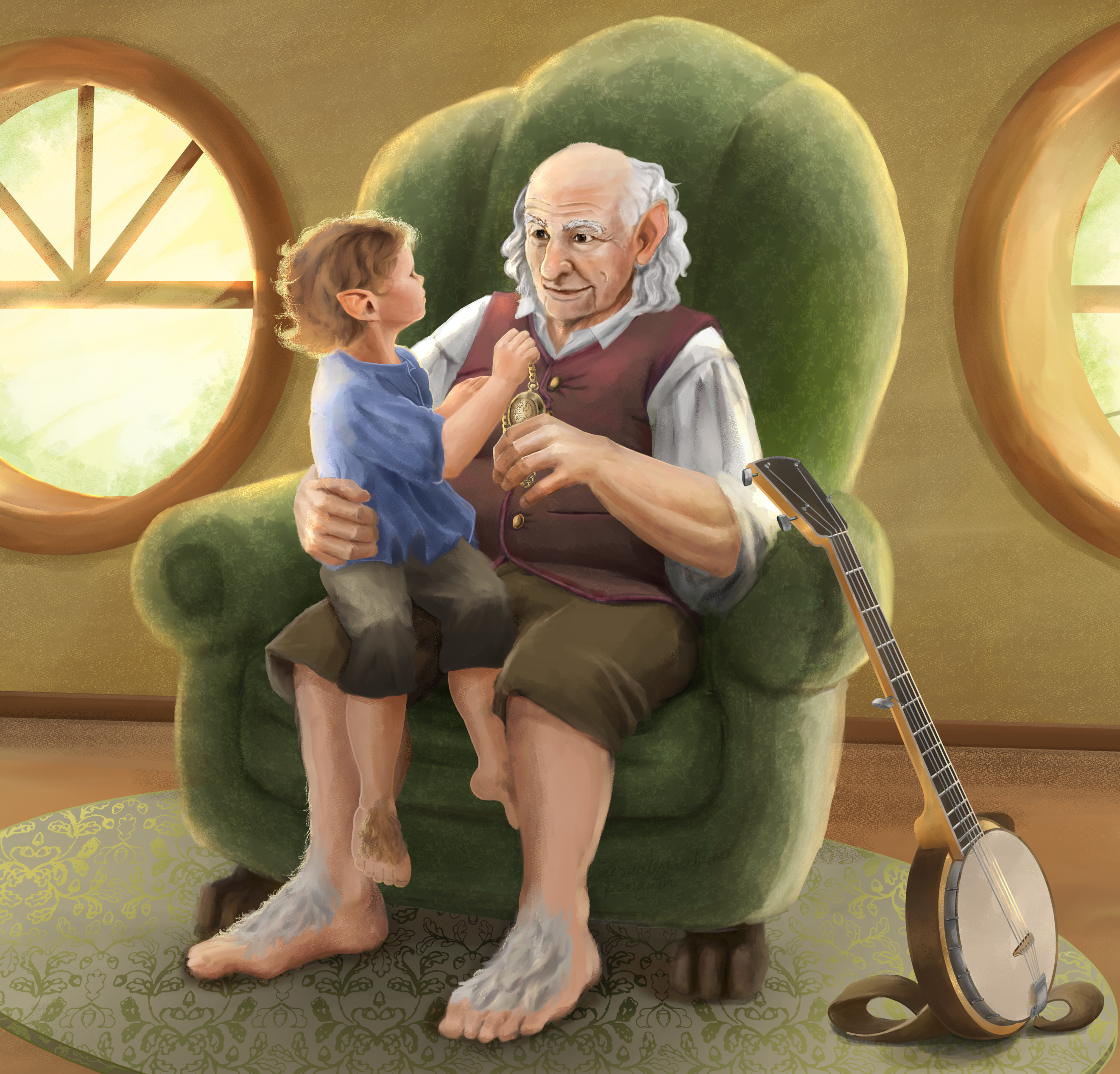
Bilbo and the Old Took by Unlos (sublimpingvin)
“Did you like the song, Bilbo?” asked the Old Took, as the crowd began to disperse.
“Yes,” said Bilbo, his voice not much more than a whisper. “But I think the Nentavari would not take a whole child, not unless they were very ill-mannered, I suppose. I think they’d rather have a story, or a song, or maybe something shiny. Maybe if you asked very politely, they’d show you where the water tastes the sweetest.”
The Old Took’s bushy brows rose in appreciation. He had always held that children should be curious first, and cautious only when curiosity failed. “You may be right, lad. But you mustn’t trust everything in a pretty song. That’s how they get you.” He tickled Bilbo’s plump belly and the little boy giggled appreciatively. Bilbo leaned up and placed a gentle kiss on his grandfather’s wrinkled cheek and smiled. It was a gentle, almost invisible smile, but it carried more confidence than any shout or boast.
From across the room, Belladonna watched her son with deep fondness and only a little concern. She was herself one of the most Tookish of the Tooks, tall for her kind and insatiably curious, and in Bilbo she saw all the bright recklessness of herself and her own father, distilled. At his birth, the sour old midwife had whispered that the boy would come to no good, not with those long-fingered hands and restless feet, and that someday he would bring trouble to the Baggins name. Belladonna had laughed and said, “Trouble is only the beginning of a good story, not the end.”
“Grandfather?” Bilbo said, so quietly that only a hobbit of great age and sharper-than-average hearing would have caught it.
“Yes, my lad?”
“Do you think the Nentavari are lonely?”
The old hobbit considered. “All creatures are, from time to time. Even Tooks. Why do you ask?”
“I don’t think I would mind talking to them,” Bilbo replied, after a moment. “If they wanted a story, I could tell one. Or two.”
Gerontius leaned forward and placed a hand on Bilbo’s cheek fondly. “You’ve got the Took heart, and the Baggins sense. If anyone could charm the sprites, it would be you, my lad.”
Bilbo beamed at this and, unknown to them, some spark inside him was kindled, never to be put out entirely.
⋅.˳˳.⋅ॱ˙˙ॱ⋅.˳˳.⋅ॱ˙˙ॱ⋅.˳˳.⋅
They went home the next day, arriving that evening in Hobbiton. Bilbo trotted along with his mother, walking side by side in the violet dusk. The road was damp, and the air smelled of coming rain. Belladonna watched her son, whose feet strayed to every puddle and whose eyes scanned the hedgerows as if he expected an elf to leap out at any moment.
“Bilbo, darling,” she said, as they reached their round green door, “if you ever find a Nentavari, do promise you’ll tell me first?”
He nodded, solemn beyond his years. “I promise, Mama.”
And inside Bag End, with the lamps lit and the scent of his father's baking bread warming the air, Bilbo Baggins sat by the window and stared out into the dark, dreaming of the river and its hidden voices.
Bilbo did not sleep much that night, or if he did, his dreams were as vivid as the waking world. The next morning he popped out of bed long before first breakfast, crept out of his snug little room, and gathered his essentials: a seedcake and two apples (wrapped up in a handkerchief), an extra handkerchief (just in case), a small lantern (in case of fog) and matchsticks, and a sturdy stick just like his father’s old walking stick, cut down to his size.
His mother found him assembling his provisions at the door. “Are you off on another great journey, then my love?” asked Belladonna, hiding her smile behind the curtain of her hair as she gently smoothed his wayward curls.
“Only to the woods, Mother,” said Bilbo. “I won’t be long.” He reached up and kissed her cheek, then scampered out through the garden door.
“Mind you take care,” she called after him, though she knew better than to forbid an adventure. She’d made many of the same pilgrimages, seeking spirits in the dew and ghosts in the fog.
The Shire was green and drowsy that morning, but to Bilbo’s mind the world was alive with possibility. His path to the stream led deep into Bindbole Wood, through a tangle of hedge, out past Farmer Cotton’s potato patch. He walked along the top of the old boundary wall, where the stones wore soft coats of moss that squished under his toes and the bindweed blossoms were yet closed up tight against the damp. Bilbo whistled as he walked, but kept his large ears pricked for anything out of the ordinary—any ripple in the grass, any note of music not his own.
He reached the stream as the sun crept over the tops of the maple trees. It was a modest little flow, barely wide enough to warrant the small wooden bridge that took the path over its waters, but its banks were as wild and weedy as any river in his grandfather's tall tales. Bilbo knelt by the edge and let his fingers drift into the chilly water. It nipped at his skin and made him gasp.
He settled on the stones of the river’s bank, cross-legged and alert, and waited. And waited. He sang the Nentavari song in a hush, hoping the words might carry. He recited stories, offered crumbs of cake, even dipped a brass button into the water, but nothing happened. The stream gurgled and the reeds rustled, but there was no answering chorus, no shimmer or voice, not even a trick of the light that could be mistaken for magic.
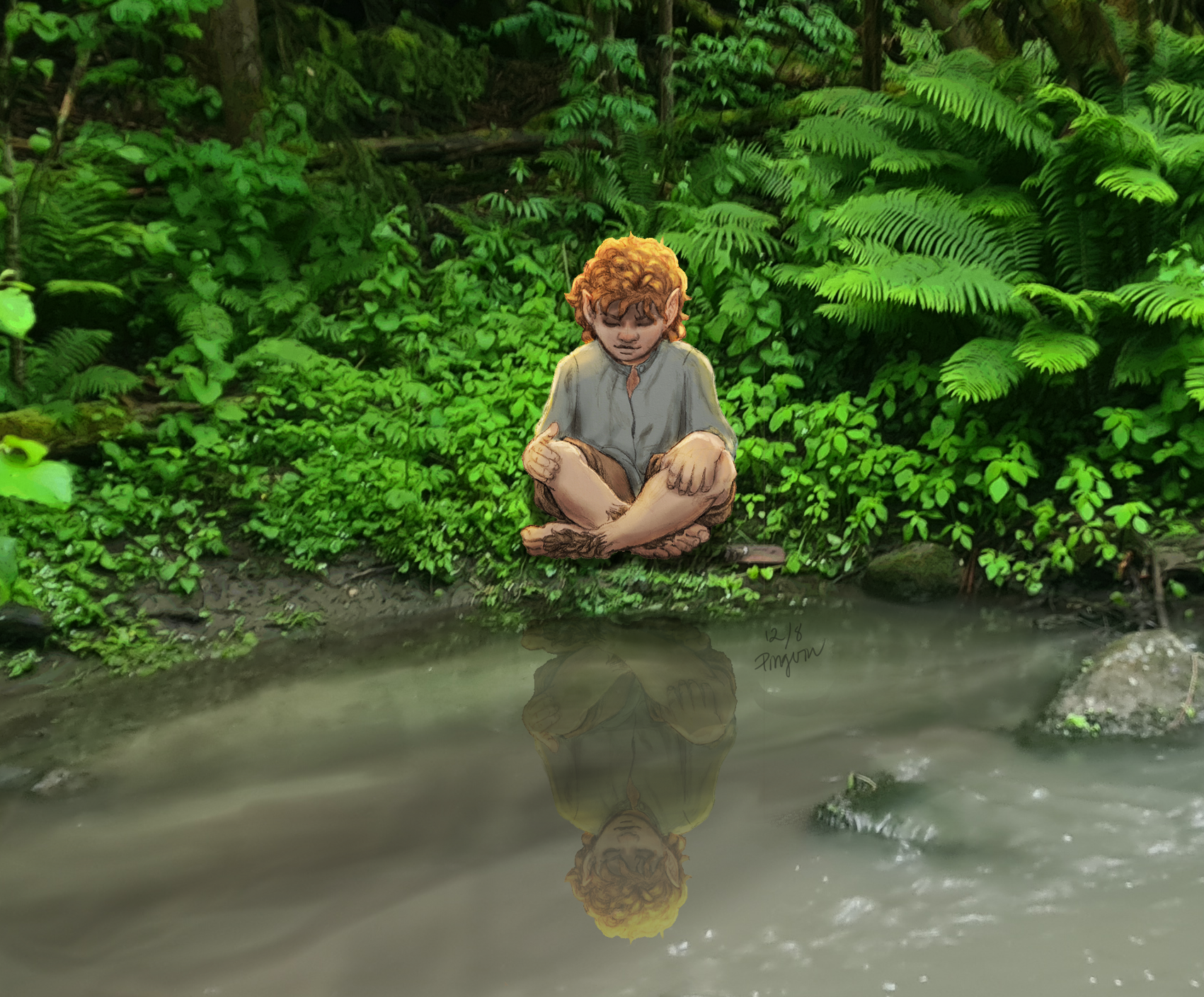
Bilbo at the Brook by Unlos (sublimpingvin)
After a while, Bilbo grew bored. He clambered up and down the banks, peering into every hole, trying every possible hiding place. He even splashed through the shallowest parts of the stream, not minding the water that soaked the hair on his toes and muddied the hem of his pants. Trailing his fingers through the cool waters, he spied a smooth stone, wide and flat, and blue as a robin's egg. As he drew it from the water he thought he heard a giggle, high and bright as a bell, but when he spun around, there was nothing there but a startled frog.
Hours passed, measured by the slow sinking of the sun and the hollow ache in his stomach. His provisions were long since eaten, the lantern forgotten by the footbridge, and his walking stick stuck deep in a hole, a handkerchief tied to the end like a tattered flag. Bilbo’s nails were caked with dirt, his face streaked with green and brown, and his hair—already unruly—was now woven with leaves and sticks, and a single pink wildflower.
As the air again grew chill and damp, Bilbo realized that he was tired. He sat on the mossy bank one last time and stared at his reflection, which looked both smaller and older than he’d remembered. He held the smooth stone, now dry and gray, completely ordinary but still treasured, and thought of the Nentavari, of their lilting songs and clever ways, and wondered if maybe they preferred to remain unseen. He wondered, too, if the Old Took’s debt would ever be paid, and how much of the story his grandfather had, in fact, embellished.
The walk home was longer than the walk out, for his feet were heavy and his pride was sore. The lamps were already glowing in the windows of Bag End when he tramped up the garden path, leaving muddy tracks on the stones behind him.
Belladonna was waiting on the doorstep, arms folded but eyes bright.
“Any luck?” she asked, as she knelt to wipe the worst of the mud from his feet.
“Not a one,” said Bilbo dully, “unless you count frogs.” The stone sat, heavy in his pocket, but something about the adventure of the day made him keep its discovery to himself.
“I always count frogs,” said Belladonna. “They’re very wise, if you listen.”
She drew him inside, to warmth and lamplight and the smell of dinner nearly ready. She set him by the fire and gently worked the burrs and sticks from his hair, humming the Nentavari song softly under her breath.
“It’s all right to be disappointed,” she said, “but I don’t think the sprites would like to be found so easily. Some magic is shy, Bilbo.”
He nodded, and said nothing. There was a small, sullen ache behind his eyes, the sort that lingers after a great hope is dashed. But as Bungo tucked him in that night, smoothing his blankets and kissing his brow, Bilbo’s mind was already churning with plans for tomorrow: a longer search, a different song, a new kind of offering. The stone was slipped under his pillow like a talisman to bring good dreams.
He fell asleep quickly, and in his dreams the riverbank was crowded with shadows. Shimmering green and silver sprites flickered at the edge of vision, singing in voices just beyond hearing, as if waiting for him to grow just a bit more clever, or a bit more patient.
In time, he would. One day he would call upon the guardians of the river when he found himself in great need. They would answer his call and take him and his companion on a great adventure that neither his grandfather, his mother, nor his young self could have ever dared dream.
But for now, there was comfort in his parent's arms, and the steady certainty that the world was as wide, and as wild, as any song could tell.
⋅.˳˳.⋅ॱ˙˙ॱ⋅.˳˳.⋅ॱ˙˙ॱ⋅.˳˳.⋅