Work Text:
The Strip was a long, glittering argument with the desert—neon insisting itself into the night, heat still clinging to the pavement like a hand that didn’t want to let go, every doorway exhaling cigarette smoke and perfume and the metallic jangle of luck being tried again.
Phoebe Whitford walked it like she belonged to the light.
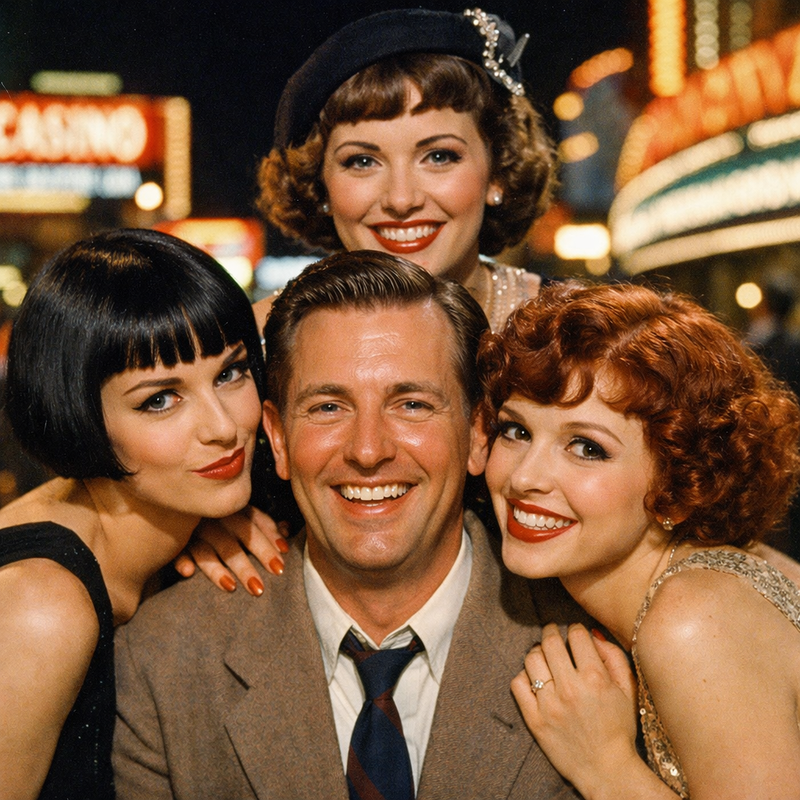
Not because she was loud—she wasn’t, not in the simple way—but because the night seemed to recognize her as one of its own working parts. She had slipped out of the stage door with the easy, practiced timing of a dancer who knew exactly when the band would take its last bow and when the crowd would surge toward the bar. She’d traded feathers and sequins for a short, clever dress that still moved when she moved, and she’d done her hair in glossy, finger-waved devotion to a girlhood she’d never lived but could summon like a trick: Clara Bow, down to the bright mouth and the mischievous tilt, the impression of a laugh waiting just behind her teeth.
On either side of her were two fellow dancers—friends by proximity at first, by choice now—women who’d learned to hold themselves with a kind of economy in a town that asked for excess.
Margo Delaney, called Mimi by everyone who liked her, wore her black bob as a dare and had a Louise Brooks severity that made men straighten up without knowing why. She’d lined her eyes into a dark, perfect punctuation, and she walked with that straight-backed, silent-film certainty that suggested she might at any moment turn and stare directly into a camera that wasn’t there.
Evie Serrano had gone the other direction: Colleen Moore sweetness turned just sharp enough at the edges to cut. Her curls were pinned into a soft halo that looked effortless until one understood how many bobby pins were holding it together. She had a small hat perched at an angle that seemed to disobey gravity out of pure charm. Her smile could be genuine, or it could be a tool. Most nights it was both.
They had come out together not with a plan, exactly, but with the kind of casual hunger that showedgirls got after a second set—fresh air, a little walking to unknot the feet, a few minutes where nobody asked them to sparkle on command. They were off the clock and still, inevitably, on display.
Behind them, the casino’s marquee thrummed. Ahead, the Strip spilled itself into more signs, more entrances, more laughter that sounded like it had been purchased by the drink.
Phoebe linked her arm through Evie’s and leaned her head a fraction, as if confiding something scandalous.
“Do you know,” she said, “I could feel my left ankle trying to write its last will and testament during that final kick line.”
Evie didn’t miss a step. “Your left ankle is dramatic. Your left ankle has always been dramatic. Your left ankle should stop seeing that poet.”
Mimi’s voice came out dry as a match. “Your left ankle should pay rent if it’s going to carry on like a tenant.”
Phoebe’s grin widened. “Oh, I’ve told it. I said, ‘Listen, pal—either you behave, or you’re moving back in with my mother and learning a trade.’”
Evie made a little sound that was half laugh, half gasp. “Phoebe, don’t say ‘mother’ and ‘trade’ in the same sentence. I can feel my own childhood trying to crawl out of my body.”
Mimi looked at them both as if they’d confessed to a crime. “You two are allergic to sincerity. It’s very moving.”
Phoebe tipped her chin toward a passing couple—tourists, unmistakable, walking with that cautious awe of people who were trying to be thrilled without admitting it. The man’s tie was slightly too tight. The woman’s purse was clutched like a life preserver. They stared at every sign as if it might bite.
“Look at them,” Phoebe murmured. “They’re doing it right. The terror. The wonder. The sense that a cocktail might cost them their mortgage.”
Evie’s smile softened, then sharpened again. “That man’s tie is trying to strangle him. Should someone intervene?”
Mimi didn’t even glance. “If it succeeds, the town will take his money anyway.”
They walked on, their heels clicking in a rhythm that was half music, half defiance. The street was busy but not crowded, a moving collage of uniforms and tuxedos, women in bright dresses, men in hats, a few sailors on leave loud enough to be their own weather. Cars slid by in slow, polished confidence. Somewhere, a band’s brassy practice spilled out of an open door and then got swallowed by the next doorway’s laughter.
Phoebe breathed it in like she could.
She was mid-sentence—something about the trumpet player in the pit who played like he was trying to seduce the ceiling—when she felt it: that slight hesitation near her shoulder, a shadow that didn’t belong to her friends.
A man had slowed beside them. Not one of the bold ones—the ones who thought a compliment was a right and a body a public amenity. This one hovered at the edge of their orbit like a polite moth, careful around the flame.
He was in his thirties, maybe, clean-shaven, sunburned in the way of someone who didn’t live in Nevada. His suit was decent but travel-wrinkled; his shoes looked new enough to hurt. He held a small camera in both hands as if it were fragile, or holy, or both.
His eyes darted from Phoebe to Mimi to Evie, then to the pavement, then back up with a kind of sheepish courage.
“Uh—” he began, and stopped, as if the sound had surprised him.
Phoebe, who had been raised on attention the way some people were raised on soup, turned fully toward him. Her face arranged itself into a look that was bright, expectant, and absolutely unhelpful.
“Yes?”
The man cleared his throat. “I’m sorry to bother you, ma’am.”
Mimi’s eyebrows flicked upward at the “ma’am,” as if tasting it.
Evie leaned in with faux concern. “Are we—are we being arrested? Because if we’re being arrested, I need to know which hairpin to hide the bail money in.”
The man’s ears reddened. “No. No, no, nothing like that. I just—well—my wife and I came in from Topeka and we saw your show and—”
Phoebe’s smile snapped wider. “Topeka!”
Evie put a hand to her chest. “Topeka, Kansas?”
Mimi’s voice stayed deadpan. “Topeka, Neptune.”
The man blinked rapidly, trying to keep up, trying not to laugh yet, as if laughter would be disrespectful. It was already twitching at the corners of his mouth.
“Topeka,” he confirmed, helplessly. “Yes. And I—I wondered if—if you ladies might—”
He lifted the camera a little, then lowered it again, like he didn’t want to point it at them without permission.
Phoebe leaned closer, conspiratorial. “You want a photograph.”
He nodded too quickly. “If that’s all right. If it’s not, I understand. Truly. I don’t want to be—”
“A nuisance?” Evie supplied brightly.
“A menace?” Mimi offered.
“A legend?” Phoebe finished, as if that were the obvious third option.
The man let out a short, involuntary laugh—more surprise than amusement. It broke something open in his face, made him look younger.
“I don’t want to be rude,” he managed.
Phoebe’s eyes sparkled. “Oh, honey, you came to the Strip. Rude is the cover charge.”
Evie reached out, gently took the camera from his hands like she was receiving a baby. “What kind is it?”
“Kodak,” he said, still watching them as if they might vanish. “A Brownie. I—”
Mimi leaned in, inspecting him like a prop. “You brought a Brownie to Las Vegas. That’s adorable.”
Phoebe clucked her tongue. “That’s practically chaperoned photography.”
Evie flipped it over, peering at the back as if she might find its soul printed there. “Does it do the little flash? The—pop?”
The man’s grin wobbled. “It does. I have bulbs. I have—” he patted his pocket, then seemed to realize he was patting himself in front of three women dressed like sin’s charming cousins, and stopped patting himself at once.
Phoebe watched the whole thing with delighted pity. “Oh, he’s sweet. He’s trembling. Mimi, he’s trembling.”
Mimi’s mouth twitched. “He should. We’re armed.”
Evie handed the camera back carefully. “All right, Topeka. What’s your name?”
“Russell,” he said. Then, because the universe liked to pile on, he added, “Russell Naismith.”
Phoebe made a small, reverent sound. “Russell Naismith. That is the most polite name I’ve ever heard.”
Evie nodded solemnly. “That name has never jaywalked.”
Mimi looked Russell up and down. “That name doesn’t even chew gum indoors.”
Russell laughed again, louder this time, and then seemed to be embarrassed by his own laughter, covering it with a cough that didn’t fool anyone.
Phoebe slid a step closer, as if they were old friends now. “All right, Russell Naismith. Where’s your wife?”
Russell jerked his head toward the curb. “She’s—she’s over there. She didn’t want to—she thought you might not—”
“Bring her,” Evie said instantly.
Mimi nodded once. “Bring the witness.”
Phoebe waved a hand in a wide, theatrical arc, as if inviting the entire state of Kansas. “Bring Mrs. Naismith. We don’t bite unless asked nicely.”
Russell’s eyes widened at the word “bite,” and he looked toward the curb with the expression of a man about to walk into a bank and ask for a loan.
He called, tentative at first: “Doris?”
A woman stepped forward from beside a lamppost, clutching her purse with both hands as if it might attempt escape. She wore a sensible dress and a cardigan despite the lingering warmth, and her hair was pinned in careful victory rolls that suggested she had seen a magazine and said, *I can do that.* Her smile was anxious and eager in equal measure.
“Oh,” Doris said, and then, because she seemed to have run out of oxygen, she said again, “Oh.”
Phoebe lit up like she’d been waiting for Doris specifically. “Doris!”
Doris flinched in a way that would have been comic if it wasn’t so sincere. “Yes.”
Evie stepped toward her with a kindness sharpened into humor. “Doris, darling, don’t look like we’re about to sell you a timeshare. We’re just girls with feet that hate us.”
Mimi added, “And hairpins that could kill a man at twenty paces.”
Doris’s mouth fell open, then snapped shut as laughter tried to climb out and got tangled in propriety.
Phoebe took Doris’s free hand—quick, warm, decisive—and gave it a little squeeze. “Do you want the photograph too?”
Doris looked at Russell as if asking permission to want something. Russell looked back at her, helplessly delighted, and nodded like a man granting a wish.
“I—yes,” Doris said, and sounded startled by her own honesty.
Phoebe beamed. “Perfect. Russell, you stand right here.”
Russell hesitated. “Me?”
Evie blinked, all innocence. “Who else? The sidewalk?”
Mimi pointed at the exact square of pavement as if it were marked. “Center. That’s where the light is. You want the light. Everyone wants the light.”
Russell obeyed because it was easier than thinking.
Phoebe circled him with exaggerated seriousness, hands on her hips. “All right. Shoulders back. Chin up. Do not look like you’re at the dentist.”
“I’m not—” Russell began, then broke into laughter again because Phoebe’s face had gone into a tragic silent-film pout, eyes wide, mouth downturned, Clara Bow playing heartbreak in the middle of Las Vegas traffic.
Evie leaned into Mimi, stage-whispering loud enough for everyone to hear, “He’s laughing already.”
Mimi stage-whispered back, “He has no defenses.”
Phoebe dropped the pout and tapped Russell’s tie with one finger. “This tie is nervous.”
Russell’s laughter sputtered. “My tie?”
“It’s strangling you,” Evie said briskly, stepping in and tugging the knot a hair looser with the confidence of a woman who had fixed costumes in thirty seconds and could therefore fix anything. “There. Breathe. You’re not in Kansas anymore, Dorothy.”
Doris made a squeak of laughter at that—small, delighted, like it had escaped without permission.
Phoebe’s eyes found Doris at once. “Oh, Doris laughs. Doris laughs! Mimi, she laughs.”
Mimi nodded gravely. “A miracle.”
Phoebe turned back to Russell. “Now. We’re going to pose with you.”
Russell’s face froze in a look of pure, overwhelmed joy. “You are?”
Evie snatched the camera from his hands again before he could drop it. “Yes, Russell. That’s the arrangement. You ask for a photo of us, we turn it into a group project.”
Mimi held out her palm. “Flashbulb.”
Russell fumbled in his pocket, producing a small paper packet with all the care of a man handling evidence. He offered it to Mimi like tribute.
Mimi opened it, selected a bulb, and screwed it in with an efficiency that made it look like she’d been born with a camera in her hand. She handed it back to Evie.
Phoebe leaned toward Russell, lowering her voice as if confiding state secrets. “When we say ‘smile,’ you smile. When we say ‘jump,’ you ask which direction.”
Russell tried to nod and laugh at the same time and ended up doing a kind of bobbing motion that looked vaguely nautical.
Doris put a hand over her mouth, eyes shining. “Russell.”
“I can’t help it,” Russell wheezed. “I’m—I’m trying—”
Evie lifted the camera to her eye, then lowered it again. “All right. Doris, where do you want to be?”
Doris startled. “Me?”
Phoebe turned on her full attention like a spotlight. “Yes, you. This is your anniversary? Your honeymoon? Your daring escape from the cornfields? What is it?”
Doris blinked rapidly. “It’s our—our fifth anniversary.”
Phoebe gasped theatrically. “Five years! Doris, that’s practically a dynasty.”
Mimi said, “Put her in the middle.”
Evie nodded. “Bride in the center.”
Doris’s cheeks flushed. “Oh, no, I couldn’t—”
Phoebe guided her gently but firmly into position beside Russell. “You can and you will. That’s how a photograph works. The middle is for the brave.”
Russell looked at Doris and softened, laughter easing into something tender.
Phoebe watched that, and for a second the wildness in her face gentled too—then she snapped back into performance like it was safer there.
“All right,” Phoebe declared. “We’re going to be flappers. Which means we’re going to pretend we’re having fun even if our feet are dying.”
Evie shot her a look. “Pretend?”
Phoebe pointed at Mimi. “Mimi’s doing Louise Brooks. Mimi, give him the stare.”
Mimi leaned in toward Russell, eyes heavy-lidded, mouth perfectly neutral, and stared at him like he was a secret she already knew.
Russell let out a strangled laugh. “Oh—oh my—”
Phoebe pointed at Evie. “Evie’s Colleen Moore. Evie, be adorable.”
Evie’s face rearranged instantly into wide-eyed sweetness, chin tucked, smile bright enough to sell toothpaste. She clasped her hands under her chin like a chorus girl on a Valentine card.
Doris laughed openly now, shoulders loosening. “Oh!”
Phoebe turned the finger to herself. “And I’m Clara Bow, which means—” she hopped closer, hooked one arm through Russell’s, leaned her head toward his shoulder with the cheeky intimacy of a photograph that didn’t intend to be respectable, and flashed a grin like she’d just stolen something and gotten away with it.
Russell’s laughter broke free fully then—big, helpless, body-shaking. It startled him; it delighted Doris; it set Phoebe off too.
“Oh, listen to him,” Phoebe crowed. “That’s honest laughter! That’s Midwest laughter, that is! Evie, Mimi, we’ve captured a live one!”
Evie laughed so hard she had to lower the camera. “Hold still—Russell, hold still, I can’t—”
Mimi’s shoulders shook once, twice, the closest she came to losing composure. “He’s going to ruin the exposure.”
Phoebe squeezed Russell’s arm. “Russell Naismith, you are ruining everything beautifully.”
“I’m sorry,” Russell gasped. “I’m—I can’t—when you—”
“When I what?” Phoebe demanded, delighted.
“When you said ‘not in Kansas anymore’ and then—your face—” He tried to gesture and got lost in laughter again.
Doris wiped at her eyes with her cardigan sleeve. “Russell, you’re crying.”
“I am not,” Russell protested, laughing so hard it was almost true.
Phoebe stepped back, hands on hips. “All right. We need discipline. We need silence. We need—Mimi, you do it. You’re the only one with authority.”
Mimi lifted one hand, palm out, like a traffic cop. “Everyone shut up.”
The command was so blunt, so sudden, so unlike the fluttering flirtation of the moment, that it worked.
For one miraculous second, they all fell silent.
Then Phoebe snorted.
Evie made a little choking sound.
Russell tried to hold his breath and ended up making a noise like a kettle.
Doris shook her head, defeated by joy.
Mimi’s eyes narrowed. “I will walk into the desert.”
Phoebe clapped her hands once, sharp as a cue. “No! No desert. We do it again. We do it right. Russell, Doris—hold.”
Evie lifted the camera back up, squinting through it. “Okay. Okay. Everyone close in.”
Phoebe slipped back into position, pressing her shoulder against Russell’s, tilting her face toward the lens.
Mimi moved in on the other side, her Louise Brooks stare aimed straight through the camera like it could be intimidated.
Evie took half a step back to frame them, then paused. “Wait. Doris, you look like you’re about to faint.”
Doris startled. “Do I?”
Phoebe reached out and adjusted Doris’s cardigan collar with quick tenderness, then gave her a little chin lift. “There. Now you look like you own the place.”
Doris swallowed, smile trembling. “I don’t.”
Phoebe’s grin softened. “For the picture, you do.”
Russell, still holding himself together by sheer will, whispered, “Doris, you look beautiful.”
Doris’s eyes went wide, and she laughed again—quiet, astonished, as if compliments weren’t things that happened out loud in public.
Evie’s voice went firm. “All right. On three. One—”
Phoebe hissed, “Nobody breathe.”
Mimi said, “Nobody exist.”
Russell choked back a laugh so hard his face went red.
Doris pressed her lips together, smiling with her eyes.
“Two—” Evie continued.
Phoebe leaned in and whispered, rapid-fire, right into Russell’s ear, “If you laugh, I’ll haunt you.”
Russell’s shoulders shook.
Mimi’s hand shot out and lightly pinched Russell’s elbow—just enough to ground him. “Hold.”
Russell froze in obedient terror, eyes watering.
Evie said, “Three.”
The flash popped. For an instant the Strip turned white-hot, a quick artificial lightning. The bulb did its brief, bright death.
And in that instant, all four of them—Russell and Doris and Phoebe and Mimi—held a ridiculous, perfect stillness: Doris in the middle with her brave smile, Russell on her side trying not to burst, Phoebe gleaming like trouble made human, Mimi staring like an art-house poster. Evie, behind the camera, caught it all.
Afterward, the world rushed back in at once: neon, traffic, music, laughter—especially laughter, because the moment the flash faded, Russell exploded.
“Oh, Lord,” he wheezed. “Oh—oh—”
Phoebe threw her head back and laughed with him, bright and full-bodied. “We got it! We got it, didn’t we?”
Evie lowered the camera and checked it like she could read the picture through the casing. “We got *something.* Whether it’s art or evidence, we’ll see when it’s developed.”
Mimi looked mildly satisfied, which on her was practically a standing ovation. “He held.”
Doris exhaled like she’d been underwater. “That was—” she searched for the word, then gave up and laughed. “That was something.”
Phoebe took Russell’s hands—both of them—just for a beat, warm and sudden. “Thank you, Russell Naismith. For asking nicely. For bringing Doris. For not being a menace.”
Russell wiped his eyes, still grinning like his face might split. “Thank you,” he managed. “I—my brothers won’t believe me.”
Phoebe’s eyes danced. “Tell them you met Clara Bow.”
Evie added sweetly, “Tell them Louise Brooks threatened you.”
Mimi said, deadpan, “I did.”
Doris squeezed Russell’s arm, looking at Phoebe with a kind of shy wonder. “We—we really loved the show.”
Phoebe’s laughter eased into something softer, more grounded. “Good. That’s the point, isn’t it? To make the night feel like it’s yours for a little while.”
Doris nodded, as if that sentence landed somewhere important.
Russell held the camera to his chest like a treasure. “I didn’t mean to—”
Phoebe cut him off, bright again, refusing the gravity before it could settle too hard. “You meant to. You meant to have a story. Congratulations—you’ve got one.”
Evie pointed a finger at him. “Now go develop it. Don’t leave it in a suitcase for ten years. People do that.”
Russell laughed. “Yes, ma’am.”
Mimi’s eyebrow flicked again at the “ma’am.”
Phoebe waved them off with a flourish. “Happy anniversary, Doris. Russell, stop strangling yourself with that tie. Kiss your wife somewhere with decent lighting. And don’t gamble more than you can afford to regret.”
Doris laughed, truly at ease now. “We won’t.”
Russell nodded solemnly like he’d been given a civic duty. “We won’t. Thank you again.”
They walked away—Russell still laughing under his breath, Doris leaning into him, both of them moving lighter than they had approached, as if the night had lifted them by the elbows.
Phoebe watched them go with a small smile that lingered a second too long.
Evie nudged her. “Don’t get sentimental. It’ll ruin your face.”
Phoebe blinked hard, then scoffed. “This face cannot be ruined. It’s been through worse than sentiment.”
Mimi started walking again, leading them back into the current of neon. “Come on. We’ve got five minutes of freedom left before someone recognizes us and asks for directions to the buffet.”
Phoebe linked arms again—Evie on one side, Mimi on the other—and let herself be tugged along.
As they walked, she leaned her head toward her friends, voice dropping into the quick, bright patter again, like a switch flipped back.
“So,” she said, “if I ever marry, and a woman refuses to take a photograph with me on our anniversary—”
Evie cut in instantly. “You won’t marry a woman who refuses. You’ll marry a woman who *insists* on the photo, then critiques the angle.”
Mimi added, “You’ll marry a woman who brings her own flashbulbs.”
Phoebe grinned into the neon, the desert night warm on her skin, the Strip loud as a promise. “Perfect. Then I’ll know she’s serious.”
They disappeared into the light, three flappers out of time and perfectly at home in it—heels clicking, laughter braided through their words, the city behind them still popping like a camera flash that wouldn’t quite fade.