Work Text:
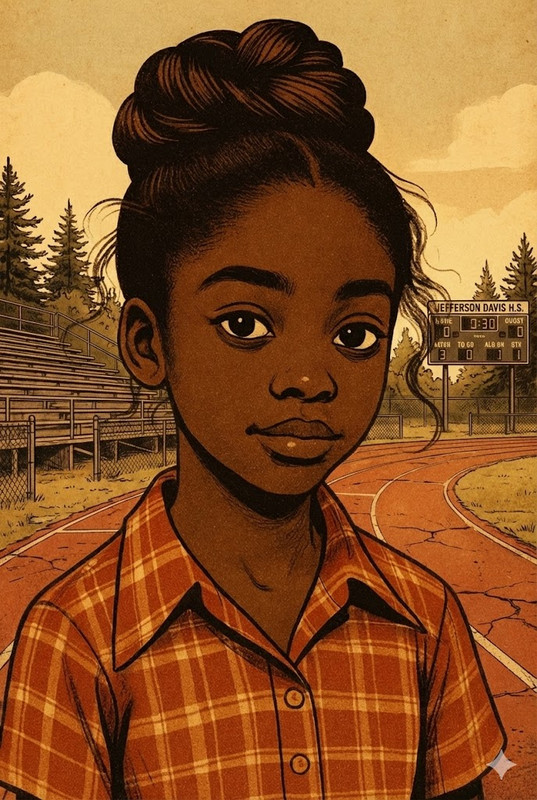
Heat shimmered off the track in thin, wavering veils, the late-afternoon sun flattening everything into long shadows and hard edges. The bleachers sat empty, pale metal ribs catching the light; the fieldhouse door was shut, a rectangle of dull brown against the cinderblock wall. Somewhere beyond the chain-link, a truck downshifted on the road and the sound rolled past like a low wave, then faded. No whistles. No shouted times. No other feet.
Just Glenda.
She moved along the inside lane with the steady insistence of a clock hand, each footfall landing exactly where she meant it to. The track surface had a particular feel she could have recognized blindfolded: that thin crust of grit over rubber giving just enough, the tiny drag she felt through the soles of her shoes as she pushed off. She knew this lane’s personality the way someone else might know the quirks of a favorite instrument. There was a rougher patch on the back straight where the material had broken up some; there was a faint dip near the 200 mark; a darker smear by one of the staggered start lines where somebody had spilled something and it had never quite washed out.
Her pace sat right on that narrow line she liked—too fast to talk, slow enough that her thoughts didn’t splinter apart. She breathed in for four steps, out for four. One-two-three-four, one-two-three-four. After a while she forgot to count and just felt it. Air in, air out. Sole to track, sole to track. The repetitive scrape and push was a drum under everything.
She wasn’t chasing a stopwatch. There was no paper on a clipboard somewhere with today’s splits written down, no coach pacing the infield pretending not to stare. Today’s job was different, quieter: hold this pace, and keep her head quiet enough that it didn’t try to drag her off into worry or numbers or Bennett’s voice. Let the body do the work, see if the mind could stay with it without getting in the way.
She took the curve with the kind of attention that didn’t look like attention. The lane line flicked past at the edge of her vision, a chipped white guide. She leaned just enough to ride the bend, adjusting her foot placement by fractions: a slightly shorter stride here, a hair more push there. It all happened beneath speech, beneath thought. She’d run this oval enough times that her muscles carried their own set of instructions, a layered palimpsest of every previous lap.
Sweat had turned the back of her T-shirt two shades darker, clinging between her shoulder blades. Damp hair stuck to the nape of her neck and the small of her back itched where a few crystals of salt had dried under the hem. She ignored it. Those sensations were part of the landscape, like the brightness in her lungs or the faint iron taste at the back of her throat. If anything, they were reassuring; they meant the machine was on and doing what it was supposed to do.
Her face was set in the expression that had started to appear more and more often in mirrors these last couple of years—calm, intent, a little inward. Not grim, not ecstatic. Working. When she hit the short straight opposite the bleachers, the sun slid across her left cheek and she squinted a little, not enough to break rhythm. On the home stretch, the light swung behind her and the shadow of her own body ran out ahead like a darker, leaner version leading the way.
Thoughts moved in and out around the edges, like clouds that never quite covered the sun. A flash of irritation from that morning’s conversation about “socialization,” Bennett’s voice insisting she needed peers, not just doctoral students and technicians. A half-remembered chord progression she’d been picking at with Scarlett two nights ago. A quick inventory of which muscles felt tight, whether her right ankle was behaving, how long it had been since she’d eaten something that wasn’t bread or coffee.
Each one rose and then dissolved back into the cadence of her stride. The track took them the way it took everything else—heat, sound, the scuff of shoes—and folded them into the loop.
She sensed, more than saw, the emptiness around her. The bleachers’ hollow silence. The stillness of the infield grass, cropped short and gone a little yellow in the relentless sun. The glint of chain-link fencing all the way around, catching bits of sky in each diamond. This hour was chosen on purpose, the sweet spot when school was done but most kids were still drifting home or hanging around the parking lot. Custodians might be pushing brooms somewhere inside the building; maybe a janitor would glance out a window, see her circling, and go back to his work without comment. They were used to her by now. The girl with the red hair who showed up when there wasn’t practice, ran like the devil was keeping time, and left without leaving trash behind.
She hit the far turn again and felt the familiar almost-imperceptible rising of the lane under her feet, the way the inner edge lifted by a hair to help hold runners on the bend. That slight tilt fed straight up through her ankles and knees and hips. She adjusted without thinking, letting her arms swing a little more compactly, keeping her shoulders loose. Nothing bunched, nothing wasted. The trick wasn’t to attack the curve so much as let it carry her, to work with the geometry instead of against it.
Her breathing deepened, edged toward roughness, but never fell apart. In for four steps, out for four—sometimes it drifted to five, sometimes down to three when she pushed a touch, but always came back to that middle place. There were days she went out here and chased a number, days she tried to shave seconds and felt sick afterward in a way that was half pride and half punishment. Today wasn’t about that. Today was about seeing if she could stay here, in this controlled discomfort, this manageable edge, for as long as she’d told herself she would.
Keep the bargain, she thought, but in a wordless way. You said five miles. You do five miles. No bargaining halfway through, no quitting because your brain starts wondering what Scarlett is doing or whether Bennett is going to bring up your sleep schedule again.
Another lap slid past almost without her noticing. The painted numbers by the start line blurred into the same burnt orange and white pattern as before. The bleachers, the fieldhouse, the gate. All markers ticking by in their order. Each time she passed them, the small, counting part of her brain clicked up by one. Three. Four. Five. The numbers weren’t important themselves; what mattered was not letting how far she had left become a weight. Just this straight. Just this curve. Just these next ten steps.
She felt the faint pull in the tendons at the backs of her knees, the familiar tightening in her calves that meant she was warm and well past the easy part. Her chest worked harder, ribs lifting and falling with more force. It was a good kind of strain, the kind that drew a clean line between what she could already do and what she might reach if she stayed with it.
Outside the fence, a car door slammed, a sharp, hollow sound that bounced off the empty metal seats. Someone’s voice called across the lot. She let it skim along the outer edge of her awareness and pass on. Unless a ball rolled onto the track, unless a person stepped into her lane, the outside world could wait.
Track under her soles. Breath in her lungs. The faint taste of rubber and sun in the air. Her arms swinging in a narrow, purposeful arc beside her ribs. The thrum of blood in her ears slowly syncing with the pattern of her footfalls.
Every lap was supposed to feel the same. Not because she was stuck, but because there was something soothing in the sameness, in proving to herself that she could reproduce effort like a musician running scales. She knew, intellectually, that time was passing, that shadows were lengthening, that the light on the bleachers had shifted from harsh to golden. But around and around, the oval stayed constant—even as everything else in her life insisted on changing, pulling, demanding.
She exhaled again, counting without consciously hearing the numbers, and watched the inner line of the lane carry her forward. The track didn’t care where she came from or what she’d done that morning or what she would be when she left it. It only cared that her feet kept finding it, that she respected its curves, that she stayed until she’d done what she came to do.
So she ran, alone in the late, bright quiet, each step a small, private agreement between her body and her will.
On her third pass around the oval, Glenda’s shape slid out of the center of attention and the focus shifted to the edge of the world she was circling.
Beyond the lanes, beyond the patch of trampled grass, the chain-link fence ran its dull silver line. On the far side of it, a small pair of hands curled into the metal diamonds, fingertips going a little pale where they pressed. Taylor had her face tilted toward the track, not quite pressed against the wire, but close enough that she could feel the faint coolness of it where the sun hadn’t warmed it through.
She was small for eight, the kind of child adults described as “petite” when they were being kind and “scrawny” when they forgot to soften it. Her T-shirt was clean but a season out of date, the color a little faded from too many wash cycles. Her shorts were neat, hem patched once at the side, socks rolled down evenly at the ankles like someone had knelt in front of her and checked. The clothes didn’t shout poverty, but they whispered carefulness—every item chosen to last, to endure playground gravel and laundry day and whatever else the week threw at them.
All of that neatness stopped at her eyes.
They were wide, set on Glenda with an intensity that would have been unnerving if it weren’t so plainly full of awe. There was nothing guarded in her face, no attempt to look away when someone looked back, no pretense of casual interest. She watched the older girl run the way other kids watched television: totally absorbed, waiting for the next frame.
Her gaze tracked Glenda’s stride with unbroken concentration. She followed each lift and fall of the runner’s knees, the easy, pendulum swing of her arms, the steady way her feet found the same slim ribbon of lane over and over. Taylor didn’t know about pacing strategies or training blocks, but she knew, in the wordless way of a child who had spent her life studying people, that this older girl was doing something deliberate. There was a difference between kids racing in the street until they were breathless and laughing, and this: a measured, silent rhythm that didn’t depend on anyone else.
She listened, too, even if she couldn’t have said that’s what she was doing. The sound of Glenda’s breathing reached her on the turns, a faint rush under the hum of the day. Not ragged, not gasping—just a steady in-and-out that seemed to match the beat of the shoes on the track. Inhale, footfall, exhale, footfall, over and over. Taylor’s own chest rose and fell in sympathy, tiny lungs echoing the pattern without meaning to.
In her mind, Glenda existed separate from everyone else. Even on days when the high school team was out here and the lanes were busy, Taylor had noticed that the girl with the red-brown hair moved on her own count, kept her own distance, didn’t jostle or show off. Today, with the track empty, that separateness was even clearer. There was a whole world down there inside the fence, but somehow it seemed like it belonged to Glenda alone.
Around Taylor, life carried on in louder colors.
From the playground just behind her came the metallic squeak of the monkey bars as two younger kids scrambled across, shoes clanking on the rungs. Someone shouted, “My turn, my turn!” and another voice snapped back, “Wait!” A plastic swing chain creaked in an irregular rhythm. The air smelled of sun-warmed rubber, dust, and distant cut grass.
A rubber ball thudded against the lower part of the fence a few feet away—once, twice, three times—boink, boink, boink, each bounce sending a tremor up through the wire. Taylor’s fingers tightened reflexively, holding her spot. She didn’t flinch, but the movement tugged the corners of her mouth down for a second before she smoothed them out again. She didn’t look toward the ball; she kept her eyes on the track, as if staring hard enough could make the rest of the world fall away.
Behind her, shoes scuffed gravel. The particular uneven crunch of older kids who weren’t running for fun but drifting, seeing what there was to see. A knot of middle-schoolers, voices low at first, rose and fell in a muddled stream: half-formed insults, half-jokes, the lazy sing-song of boredom looking for something to do.
They were close enough now that Taylor could feel the way their presence thickened the air at her back, close enough that their shadows stretched long and thin on the ground near her feet. She knew that proximity without turning around. Her shoulders pulled in a little, soft frame folding like a paper cup under a hand, but her fingers stayed hooked in the fence. Glenda was coming around the far curve again, and Taylor couldn’t bear to miss it.
The contrast between her and everything around her was stark. Where the playground kids swung and shouted, flinging themselves from one game to the next, she was stillness: elbows locked, eyes wide, mouth slightly open, standing as if she’d grown from the patch of dirt at the fence line. The world behind her was all noise and motion; the world in front of her was one girl running steady circles. Taylor hovered exactly in the middle, pressed up against the boundary, small and exposed and shining with the kind of wonder that never learned how to protect itself.
Gravel crunched behind her in that scattered way that meant more than one person, feet hitting the ground out of sync. Taylor’s fingers tightened on the fence automatically. She didn’t turn. She knew better than to whirl around when she felt a certain kind of attention gathering; it only encouraged them. Instead, she tried to make herself even smaller, shoulders inching closer to her ears, elbows pulling in toward her ribs.
The voices came in first, a little louder than the rest of the playground noise, the rough-edged humor that always seemed to sharpen when it had a target.
“Hey, look at her,” a boy’s voice said, too close, thick with the satisfaction of a new find. “You in love with track girl or what?”
A laugh rippled through the group, the quick, mean kind. Taylor’s ears burned hot. She watched Glenda’s form float into the far curve again and felt her own chest tighten—not from running, not from effort, but from the familiar mix of embarrassment and something like panic. Her chin dipped, eyes flicking briefly down to her own shoes before dragging back up to the lane.
Another voice, higher, another boy: “She don’t even blink. Look at that. Creepy.”
They moved in closer, the cluster of them, arranging themselves around her in a loose half-circle that cut off her escape backward. One leaned forward, planting his hand flat on the fence just above her head, the metal rattling with the impact. His arm cast a shadow over her cheek. The smell of sweat and cheap cologne and the salt-and-vinegar tang of chips on his breath crowded her as much as his body did.
On her other side, a girl stepped in so near their shoulders almost touched. She jutted one hip, chin lifted, posture casual on purpose, like she was just hanging out and Taylor just happened to be caught in the middle of her hanging-out. If Taylor turned sideways to slip away, she would brush right against her. The message was clear: stay put.
Taylor’s shoulders folded in, spine curving as if she could duck under their words. The bones at the back of her neck prickled. She stared harder at the track, heart thudding in her ears. The world wobbled a little at the edges as her body prepared for something, even though she didn’t know what exactly. Her mouth pressed into a thin line. She told herself she could keep watching Glenda, just keep her eyes on the running girl and let everything else blur.
But the voices wouldn’t blur.
“Why you staring like that?” the girl demanded, leaning closer. “You some kinda stalker?”
“Maybe she broken,” someone else said, snorting. “Like, brain broke. Always quiet. Always starin’.”
The words weren’t new. Taylor had heard versions of them in classrooms and on sidewalks, in line at the store. They still hit like small rocks, thrown fast and hard, each one leaving a sting even if none knocked her down. Her instinct, honed over too many days like this, was not to fight back. Fighting back made it last longer. Fighting back invited more people in. Instead, she tried to shut down her face, smooth it into something blank, as if nothing they said could catch.
Her chin dipped another fraction. Her fingers dug into the wire until the pattern pressed faint red diamonds into her skin. She tried to breathe in on four beats like she’d unconsciously matched to Glenda’s stride, out on four, but the rhythm kept catching in her throat.
“Hey,” the first boy said, tone shifting toward taunt disguised as curiosity. “For real, what’s wrong with you? You don’t talk? You mute or somethin’?”
“She can talk,” the girl answered for her, like she was an expert witness. “I heard her talkin’ to her sister once. She just weird around people. My mama say she always watchin’. Like that.” She imitated Taylor’s gaze, widening her own eyes and letting her jaw go slack. The others laughed.
Taylor’s cheeks flamed. She wanted to turn around, to say something sharp like she heard kids say on TV, some neat comeback that would make them leave. The words balled up just behind her tongue and disintegrated there. If she opened her mouth, she knew what would come out instead: a small, shaky sound that would feed them more.
A boy behind her piped up, voice cracking at the edge of adolescence. “She don’t even look like anybody. What is she, anyway?”
The question jabbed in under her ribs. It came wrapped in the particular emphasis on what that adults used too. What. Not who.
“Yeah,” another chimed in. “You mixed or somethin’? You don’t look all Black. You Mexican? You Indian? What are you?”
They said it like a puzzle, like a guessing game where the prize was her discomfort.
Taylor’s jaw clenched. She stared even harder at the track, focusing on the white line, on the way Glenda’s foot landed just inside it. The older girl was hitting the back stretch again, sunlight skating over her shoulders. Taylor clung to that image as if it were a handhold. If she could just keep watching, maybe the words would slide off. Maybe they’d get bored and go away.
Behind her, gravel popped under shifting feet. The boy with his hand above her head drummed his fingers restlessly against the fence, sending little shocks through the metal that traveled into Taylor’s wrists. “She ain’t gonna answer you,” he said. “She too busy drooling over track girl. Look at her. Bet she don’t even know we here.”
“Oh, she know,” the girl disagreed, smirking. “She just too chicken to say nothin’.”
Taylor’s shoulders rose toward her ears, her whole body tightening in on itself as if making less of a target might make her less real. She didn’t move her feet. Leaving the fence meant turning her back on the track or pushing past them, and both options terrified her in different ways. So she stood, pinned between the wire and their voices, caught in that tension between wanting to vanish and wanting desperately, stubbornly, to keep that one bright moving figure in sight.
On the playground, someone’s laughter spiked as a kid tumbled out of a swing. A mother called halfheartedly for her toddler to “get off that before you fall.” A pair of younger children chased each other in lopsided circles, shrieking. A few adults, seated on a bench near the sandbox, glanced over toward the knot of kids at the fence, eyes trailing over the scene. One frowned faintly and then looked away. None of them stood up.
No one stepped in, no teacher’s voice cracked across the distance telling the bigger ones to cut it out. The world beyond the little circle at the fence went on, loud and busy, as if this sort of thing was too small to notice.
For Taylor, it filled up the whole moment. The sharp, needling questions. The looming shoulders. The weight of a hand on the fence over her head. The familiar urge to fold herself down into the smallest, quietest version of herself she could manage, to wait for it to blow past like a storm she’d learned she couldn’t stop.
On the far curve, the world narrowed again to the arc of red beneath Glenda’s feet, the pull of the lane, the stretch of muscle from hip to ankle. She tipped into the bend with the same care she gave every other, arms set in that compact swing, breath threading in and out on its quiet count. Inhale, one-two-three-four. Exhale, one-two-three-four. Her mind had settled into that almost-empty place where stray thoughts came and went without catching.
She came out of the curve and onto the back straight, eyes tracking the familiar markers ahead without really seeing them—the faded white hash marks, the scuffed patch where someone had dragged a piece of equipment. Her focus sat just a few feet in front of her, where her next steps would land. The rest of the scene blurred at the edges.
Something at the edge shifted.
It wasn’t loud, not from where she was. No shout, no distinct call. Just a change in the way bodies arranged themselves in her peripheral vision. A lump where there should have been a line.
She hit the midpoint of the straight and, without meaning to, her eyes lifted off the lane. The opposite fence came into clearer focus. She saw the small figure first, because she knew it. The little girl who watched. Hands on the chain-link again, the narrow shoulders she’d noticed on other afternoons. But today those shoulders were tucked in tighter, almost up around her ears.
Around her, a knot of older kids had formed, like a thorny bush grown overnight. They weren’t just standing there. Their postures told a whole story Glenda didn’t even need to hear. One boy with his arm braced high on the fence, elbow locked, body angled in just enough to crowd. A girl with her hip cocked, leaning in close, head tilted in that way that said this was a show and she was enjoying it. Others shifting in that restless, circling way that meant they were feeding off each other’s energy, waiting for the next laugh.
The smaller figure at the center—Taylor, though Glenda didn’t know her name yet—was half-hidden by all that motion, but Glenda caught the tense curve of her back, the way her chin had dropped. Even from that distance, even with her own breath in her ears, she recognized the stiff, folded-in shape. It was the same shape she’d seen in mirrors, in hallways, in the corner of playgrounds. The shape of someone wishing they could shrink out of their own skin.
She couldn’t hear the words. They were just moving mouths from here, sharp little bursts of sound ripped away by distance and the wind. But she didn’t need the content. The outline of it was enough. She’d seen that outline too many times: in Plano, in Huntsville halls, in the narrow spaces between lockers where older kids boxed smaller ones in. There were only so many ways kids could line up around a target.
For a split second, her body wanted to react the way it knew how: stop now, cut across, get there fast. A little surge of something hot pressed against the edges of her focus.
She kept running.
Not away. Not past. Just to the end of the lap.
Discipline. Bennett had drilled that word into her in different contexts—problem sets, rehearsals—but she’d already had some of her own before he put a name to it. You finish what you started. You don’t blow up the whole pattern the second something tugs at your attention. There was enough time between here and there for one more circuit done right.
Her jaw tightened, but her stride didn’t break. She took the next curve with the same form as the last, though her gaze kept snagging toward that corner of the fence whenever the angle allowed. The cluster of bodies didn’t disperse. The little girl’s shape didn’t change. The knot was still there when Glenda hit the home stretch and the painted numbers slid under her feet.
Only then, as she crossed the line she’d chosen as her mental finish, did she allow herself to shift gears.
She didn’t slow to a stop the way she usually did, hands on hips, pacing the inside of the lane. She didn’t bend over to rest or walk back along the track. Instead, she let her run loosen into a controlled jog and drifted toward the infield, feet leaving the rubber for the scratchier, uneven grass. The field felt different under her soles—softer, dipping slightly under each step—but her momentum carried her smoothly.
She cut diagonally across, angling straight for the section of fence where the pack had gathered. Her breathing was heavier now, heartbeat loud in her chest, sweat cooling on her skin as the breeze hit. She rolled her shoulders back once as she moved, a small adjustment that settled her posture. The inward focus she’d held around the oval opened outward, eyes sharpening, attention no longer counting steps but measuring distance to that knot of kids and the girl folded into their center.
Her pace eased down to something between a jog and a purposeful walk as she neared the edge of the infield, but there was no hesitation in the line she took. The track had been her world a few minutes ago. Now it was the route. The real point lay at the fence, where a small, soft shape stood pinned, and Glenda was already on her way.
The boy with his hand braced above Taylor’s head was in the middle of winding up another comment—something about how she “looked like a little robot”—when the light on the ground shifted. A darker shape slid over their sneakers, stretching long and narrow across the dust.
He glanced down, then up.
Glenda was already there.
She came up to the fence at an angle, breath still lifting her chest from the last of her run but otherwise steady. Sweat shone along her hairline, dampening the curls at the nape of her neck. She didn’t skid in or stomp or do anything dramatic. She just arrived, closing the last few feet with the sure, unhurried stride of someone who had decided where she was going and why.
She stopped close enough that the metal links pressed faint impressions into the heel of her hand when she reached up and set it on the top rail. Her fingers wrapped over the cool bar, loose but firm. Her other hand found her hip, thumb hooking into the band of her shorts. The stance was casual on the surface—one more teenager leaning on a fence—but there was something in the set of her shoulders that said she wasn’t going anywhere.
Up close, the kids could see that she was older than them by a year or two, maybe more. Not an adult. Not a teacher. But not their age either. Red-brown hair pulled back, running shoes, the kind of control in her breathing that meant she’d been pushing herself and still had plenty left.
“Hey,” she said.
The word was soft, but it cut through their chatter anyway. Something in the way she dropped it—no question mark, no smile—made all of them look at her.
“What’s going on here?” Glenda added, voice level.
The boy on Taylor’s left straightened, his arm lifting off the fence as if it suddenly felt too obvious up there. He rolled his shoulders back, trying for nonchalance. “We’re just talkin’,” he said. “Ain’t no big deal.”
“Yeah,” the girl chimed in, tipping her head and twisting a piece of hair around her finger. “We just messin’. None of your business.”
Glenda’s eyes went past them without pause, landing on Taylor.
It was only a flick, a quick sweep, but she took in everything she needed: the way Taylor was folded in on herself, spine curved, shoulders almost touching her ears. The way her small hands were clamped around the wire, knuckles pale, skin pinched by the diamond pattern. The way her gaze, which had been fixed on the track, had dropped to a point somewhere around Glenda’s shoes as soon as the group turned.
Fear there, and shame, and something stubborn holding her in place.
Glenda looked back up at the kids.
“Looks like my business,” she said, the smallest hint of a drawl at the edges of her vowels. “Y’all are crowding my cousin.”
The word slipped out smooth, as if it had always been true.
The reaction was instant. It was as if someone had reached into the middle of their little circle and turned down a dial. The giggles stuttered. A couple of the kids took a half-step back without thinking about it. Cousin was a different category. Cousin meant kin. Kin meant someone who might tell somebody’s mother, somebody’s auntie, somebody’s big brother.
The girl squinted at Glenda, brow furrowing. “She your cousin?” she said, skepticism giving the words a little edge. “I ain’t never seen y’all together.”
Taylor’s head jerked the tiniest bit at that—cousin?—but she didn’t speak. She pressed her lips together tighter, as if afraid anything she said would make this better or worse in ways she couldn’t predict.
Glenda didn’t miss the flicker, but she didn’t look at Taylor again just yet. She kept her gaze trained on the older kids, lids relaxed, mouth neutral.
“We just moved over,” she said, not even bothering to inject a shrug into the lie. Her shoulders gave the tiniest lift, as if the question bored her. “Her mama and my daddy’s people go way back. You don’t have to keep track of our family tree.”
There was a tone there that every kid on that side of town recognized: mind-your-own-business, we got more cousins than you got fingers, don’t worry about it. It wasn’t defiant. It was simply stating a fact that didn’t require their acceptance.
The boy who’d been leaning on the fence tried to reclaim ground. “We weren’t doin’ nothin’ to her,” he said quickly. “We just—”
“Mhm,” Glenda said.
She didn’t sound convinced. She also didn’t sound particularly angry. If anything, the flatness of the sound made it worse, like she had heard it all before and filed it under lies not worth repeating.
She didn’t move. She didn’t push off the fence. She didn’t ball her hands into fists or puff herself up. She just stayed there, hand on the top rail, one hip cocked, taking up that slice of space between Taylor and the rest of them, her shadow draped over the smaller girl’s shoes.
“Anyway,” she went on, the word light but edged, “you’re done.”
The way she said it, you might have thought she was talking about a drill, about a set of laps, something that had an end point decided by someone who knew what they were doing.
“Go find something else to do,” she added.
There was a beat—a little pocket of time where the older kids could have chosen to push back harder, to scoff, to test how far they could go. You could almost feel the air teetering on that edge. Glenda’s face didn’t change. Her fingers stayed loose on the fence. But the line of her jaw was clear under her skin, the tilt of her chin a fraction up. She was not spoiling for a fight, but she was not planning to move aside either.
Her eyes flicked, just once, past them toward the fieldhouse and the hulking shape of the building beyond. “Or,” she said, voice still mild, “I can go have a little talk with Coach about how y’all like picking on little kids down here.”
She didn’t raise her chin to point. She didn’t have to. They all knew who she meant. Everyone on this side of the tracks knew how fast the grown-ups who ran the field got mad when their space was used for the wrong kind of game.
“He ain’t here,” one of the boys muttered, reflexive.
Glenda’s eyebrows just tipped up a millimeter. “He don’t gotta be here right now for me to tell him what I saw,” she said. “I run his track all the time. He listens when I talk.”
There was the faintest emphasis on his track that reminded them she belonged here in a way they didn’t. They were just orbiting. She was in the system.
The balance tipped.
The boy with his hand on the fence dropped it, shoving his fingers into his pockets instead. “Whatever,” he mumbled, letting his weight fall back onto his heels. “We were leavin’ anyway.”
The girl made a dismissive noise in the back of her throat, rolling her eyes in that exaggerated way that let her save some face. “Yeah, it ain’t that serious,” she said, already turning. “Come on.”
They peeled away in twos and threes, each trying to make their exit look voluntary. One boy gave Taylor a last, quick sideways glance, expression muddled—part lingering cruelty, part the unease that comes from suddenly realizing your target has people. Another kicked at a rock, sending it skittering across the dirt as he went.
In a few seconds, the knot had loosened, then dissolved altogether, leaving only the shape of where they’d been.
The noise of the playground swelled in to fill the gap, kids’ laughter and swing chains and a distant bark from a dog by the road. The air felt a shade lighter.
Glenda stayed where she was, hand still resting on the top of the fence, eyes following the retreating backs just long enough to make clear she was watching. Only when they were far enough away to re-fold themselves into some other game did she turn her attention fully to the girl at her feet.
From Taylor’s vantage point, the whole thing had unfolded like the sudden arrival of a wall—one instant she was bare and ringed by sneers, the next there was a taller body between her and the world, voice speaking over hers without silencing her, claiming her with a single word. Cousin. She felt it reverberate inside, strange and warm and confusing. No one had ever stepped in quite like that. No one had ever thrown a net of belonging over her in public just to make other people back off.
The place where Glenda’s shadow fell across her shoes felt, for the first time that afternoon, like shade instead of cover.
The air settled in the wake of the older kids, their laughter and scuffing footsteps fading into the general playground noise. The spot by the fence where they’d been felt abruptly wider, but the space didn’t fill all at once. It stayed thin and brittle, like something that had been stretched too far and hadn’t quite snapped back into place yet.
Taylor’s fingers were still locked around the chain-link, the metal biting into her skin in tiny, repeating diamonds. She hadn’t noticed the ache while they were there; now, in the quiet left behind, the sting began to register. She didn’t let go. Her shoulders were welded up around her ears, her spine a tight curve. Even with the circle gone, her body still thought it was surrounded.
Behind her, a swing chain shrieked as some kid jumped off mid-air. A toddler somewhere wailed and was hushed. A car rumbled by on the street beyond. All of it sounded far away, muffled by the rush of her own blood in her ears.
Glenda’s hand stayed on the top rail of the fence, fingers relaxed now that she wasn’t bracing against anything. She could see the faint white impressions in Taylor’s knuckles, the way her hands shook just a little, so little you might miss it if you weren’t used to looking for the aftershocks instead of the quake.
She let a breath out slowly, pulling some of the sharpness from her voice with it.
“You okay?” she asked.
Just that. Two words, no sugar, no cooing. She didn’t bend down and put her face in Taylor’s, didn’t widen her eyes in concern, didn’t reach for her without warning. She stayed where she was, weight resting easy on one hip, letting the question sit between them like something Taylor could pick up or not.
Taylor’s head jerked in a nod almost before the question was fully out. It was too fast, the reflex yes of someone who knows adults are tired of hearing the truth. “Yes, ma’am,” she added, the ma’am tumbling out of her without thought, soft and fragile at the edges. Her voice was barely more than air, catching a little on the m, like it wasn’t sure it was allowed to be heard.
Glenda felt the breath she’d been holding shift into something like a laugh, small and wry. One corner of her mouth tipped up. “I ain’t a ma’am yet,” she said. “Glenda’s fine.”
The name hung there for a second, offered like a hand.
Taylor’s eyes flicked up, quick, to her face and then back down. “…Glenda,” she repeated, tasting it. The way she said it put the emphasis just a little different, the vowel softened by the hint of Spanish she’d carried from home. It made the name sound newly minted, like she was tucking it away somewhere careful.
Glenda watched her for a beat. Up close, she could see details she’d only registered as impressions before: the faint scatter of freckles across Taylor’s nose, the way her lashes cast little shadows on her cheeks when she kept her gaze lowered, the neat parting in her hair like someone had smoothed it down with a careful palm. Small, sweet, shy. That was the first layer.
Under that, something else. A particular stillness she recognized—not the laziness of kids who didn’t care, but the braced quiet of someone who had learned it was safer to shrink than to stand out. She’d been that kid, pressed into corners, absorbing jabs because she’d believed there wasn’t much else she could do. It hit her like a mirror held at a slightly different angle.
Her fingers drummed once, lightly, on the rail. Then she lifted her hand and tapped the fence instead, knuckles knocking softly against the chain-link between Taylor’s hands.
“You come out here a lot?” she asked. “I seen you a couple times. Always watchin’.”
Taylor’s cheeks warmed. The blush didn’t rush up all at once; it crept, a slow deepening of color from neck to face like someone turning up a dimmer switch. Her grip on the fence eased just a hair, enough that she could shift her fingers, but she still didn’t let go. Her eyes dropped fully to her sneakers, as if the cracks in the dirt there had suddenly become fascinating.
“I like watching y’all run,” she said, the words small but clear once she pushed them out. She hesitated, then added in a rush, “You run… real pretty.”
The word hung there, unexpected, hovering between them.
Pretty.
Glenda blinked. Of all the adjectives she’d heard about running, that wasn’t one of them. Fast, sure. Strong, maybe. Crazy, sometimes, when people saw her out there alone. Pretty sounded… gentler. Focused on the lines, the ease, the way it all looked stitched together.
For a heartbeat, the compliment slipped past the defenses she kept up around other people’s opinions. It struck some old, quiet place in her that remembered being the too-serious kid, the one who was more brain than anything else. To have this soft-voiced child at the fence call the thing she did with her body pretty felt like someone had taken the time to see it whole.
“Pretty, huh?” she said, a slow grin blooming across her face. There was no mocking in it, just surprise turned into lightness. “I’ll take that. Don’t usually hear that about sweat and red face.”
The tiny joke seemed to give Taylor permission. Her mouth twitched, then tugged upward, just at one corner. It was the smallest of smiles, but it was real, careful and sincere. Like a crack opening in a shell that had been held shut for a long time.
Glenda tucked that away as a minor victory. She knew how fast kids like Taylor could collapse back in on themselves, how one wrong note could send them scuttling away behind their walls again. So she kept talking, laying planks across the gap so the girl wouldn’t feel like she had to leap.
“So,” she went on, sliding smoothly from one thought to the next, “my cousin Taylor—”
The word cousin came out easy this time, no pause, no check. If she was going to claim it, she might as well do it properly. She watched, from the corner of her eye, as the designation settled onto Taylor’s shoulders.
The little girl’s head twitched again, that tiny disbelieving jerk, but there was no flinch in it now. More like she was startled by the sound of her own name and that new word wrapped together. Cousin Taylor. The combination rearranged something in her posture, loosening it in imperceptible ways. The fence wasn’t the only thing holding her up anymore.
“—you got a little time?” Glenda finished. “You live far?”
Taylor shook her head, dark hair brushing the curve of her jaw. “We’re not far,” she said. “Down near Cherry.” The way she said we carried a lot: sisters, mother, house. A whole constellation summed up in one syllable.
Glenda nodded, mapping it instantly. Cherry wasn’t far at all. “I’m over by Willow,” she replied. “That’s close.”
The statement sat between them like another small bridge. Same side of town, same bus routes, same grocery stores. Not just a stranger who’d swooped in from somewhere else. Someone whose world overlapped with hers.
Behind them, a whistle blew halfheartedly as a parent tried to wrangle kids off the jungle gym. The sun had shifted lower, the light starting to mellow, but there was still time before it sank fully. Glenda glanced up at the sky, gauging the angle, the heat still clinging to the track. Her mind ticked over the possibilities—Scarlett at home, the leftover pizza in the freezer, the phone on the counter they could use so this didn’t feel like a kidnapping.
She looked back down at Taylor, at the way the girl still clung to the fence out of habit more than necessity now, and felt the shape of a bigger offer forming, surprising even herself with how natural it seemed.
The sun had slipped a little lower while they were talking, trading its harsh overhead glare for a softer angle that made the metal bleachers glow. Shadows stretched longer across the infield, thin and cool against the fading heat radiating up from the track. Glenda tipped her head back just enough to squint at the sky, gauging how much blue they had left before it started going orange.
She’d been out here long enough to measure time by light and temperature as much as by her own watch. The air still clung warm against her skin, but there was a tiny hint of relief in the breeze now, the first sign that the day was starting to tilt toward evening. She had a mental clock running—how long it would take to walk back across the field, grab her things, drive home, shower, eat, and get this kid back before anybody’s grown-up panic switch flipped.
Her gaze dropped back to Taylor, still glued to the fence like it was the only thing keeping her upright, fingers hooked tight but not desperate anymore. The girl’s eyes were a little less wide now, the shine of panic dulled down to something like wary calm. Her shoulders had lowered a fraction, enough that Glenda could see the actual shape of her frame instead of just the hunch.
Glenda weighed it for all of one breath, then decided.
“You wanna come by my place for a bit?” she asked, as if she were suggesting they walk to the vending machine at the corner. “I gotta shower and eat. I can drop you back home ’fore it’s dark.”
She didn’t lean in or make it sound special. The offer came out light, almost offhand. If you listened close, there was a stripe of intention under it, but on the surface it was just another option dropped between them.
Taylor went very still.
It wasn’t the frozen-stiffness from when the older kids had surrounded her, exactly. This was different: a full-bodied pause, like every part of her had to stop and consider this new possibility from every angle before she dared move toward it. Her grip on the fence stayed, but her fingers flexed once, nails scraping lightly over the dull metal, as if the contact anchored her while her thoughts raced.
No one outside her house invited her places just for the sake of it. She was the quiet one, the observer, the kid on the fringe of the group, tolerated but not scooped up. Other children’s plans happened in clumps around her—sleepovers, trips to the pool, birthday parties spilling over lawns—while she stood at the edge, waved to by someone who remembered at the last second to be polite. Being drawn in deliberately by someone like Glenda, someone older and impossibly self-possessed, felt like someone had opened a door in a wall she’d always assumed was solid.
Curiosity hit first, fast and bright. The small animal part of her that loved new things, if she could just watch them safely, lurched forward. She wanted to see where Glenda lived, what the inside of that world looked like. She wanted to know what kind of room belonged to a girl who ran by herself for fun, who spoke to bullies without even raising her voice. She wanted to know who Scarlett was, the name Glenda had dropped a minute ago like it meant something. The idea of being in that space, even for a little while, tugged at her like a hand on her sleeve.
Right behind it, shyness barreled in, loud and flustered. What if she was intruding? What if Sadie got mad that she’d gone anywhere without asking first? They had rules about where she could be and who she could be with for good reasons. Sadie was not their mama, but she carried the weight of one. Taylor could imagine her face tightening in that specific, tired way when she found out: you did what? with who? She’d never been the kid who just announced, “I’m going to so-and-so’s house,” and expected it to be fine.
Her stomach fluttered uneasily, caught between the pull of wanting and the habit of staying put.
“I don’t wanna… bother you,” she managed, the words catching on themselves as they came out. She ducked her head as she said it, as if the sentence were something to be embarrassed about. The idea that her presence could be a bother was so deeply baked in she didn’t even hear it as self-effacing; it was just what felt true.
Glenda shook her head at once, like she’d been expecting that exact response. “You’re not botherin’ me,” she said, and there was no fake cheer in it, just flat certainty. “Scarlett’s home. We’re just hangin’ out. And I got a pizza in the freezer with your name on it.”
She let that sit for half a second, then added, lips quirking, “It’s all I know how to cook, so you’d be doing me a favor, really.”
The joke wasn’t loud, but it had weight. It took the invitation from some big, glittering thing—come to my house—with all the pressure that implied, and shrank it down into something everyday. Not “I am rescuing you,” just “come help me eat this dumb pizza I’d be eating anyway.” It made the whole idea feel less like stepping onto a stage and more like sliding into a running scene midway.
Taylor’s mouth ticked up before she could smother it, a quick, breathy little sound escaping that might have been the start of a laugh. She clamped it down, then let it out anyway as a tiny huff, the kind of shy, surprised amusement that comes when something nudges through your worry.
“Pizza,” she repeated under her breath, as if she were testing out the word too, the promise tucked inside it. They didn’t have it often at home—too expensive to be casual—and when they did, it was a shared treat, slices divided carefully.
Even with the joke, even with the pull, the uncertainty didn’t vanish. It clung to her like the heat. Her fingers tightened again on the fence, the metal digging little crescents into the pads of her fingers. You didn’t just go off with people. That was what adults always said, voices grave when the news was on and someone’s face flashed across the screen. And even if Glenda felt safe in a way few people did, there were the rules of her own house to think of.
Glenda saw the doubt settle back over her, the way her shoulders tried to curl inward again. She didn’t sigh or push; she just shifted tactics, sliding a practical plank under all that anxiety.
“Tell you what,” she said. “We’ll call your people when we get there. You can tell your sister where you are. All above-board.”
The phrase all above-board sounded faintly like Bennett, like something he would say when explaining why certain arrangements mattered. Coming out of Glenda’s mouth, it was softened, but still carried that sense of doing things properly. She wasn’t suggesting sneaking. She wasn’t suggesting Taylor lie or just not mention it. She was building the permission into the plan.
Taylor’s brow furrowed as she turned that over. The idea of being the one to speak up, to tell Sadie herself, made her throat feel tight. But it also meant she wouldn’t come home and spring it on her like a secret. There’d be less chance of that tired-edged anger if Sadie heard about it first, if she knew where Taylor was and who she was with.
“You got a phone?” Taylor asked softly, surprising herself. The question made her feel oddly grown.
Glenda nodded once. “On the kitchen wall,” she said. “You can stand on a chair and dial if you want. I’ll stand right there. I’ll tell her my name. She can yell at me if she don’t like it.”
Something in the humor of that—this tall, confident girl calmly volunteering to be the one on the receiving end of Sadie’s displeasure—punctured the last of the paralyzing fear. Taylor could picture it for a second: Glenda, unfazed, holding the receiver away from her ear while Sadie lectured, then bringing it back with the same level tone she’d used on the kids at the fence. The image was strangely comforting.
Her grip on the wire loosened. Slowly, like her hands had to remember how, she unhooked her fingers from the metal. Little red imprints marked her skin where the fence had held her. She rubbed her thumb over them once, then let her hand drop to her side.
She nodded, the movement small enough it might have been missed if Glenda wasn’t watching her this closely. “Okay,” she said, the word trembling just a touch but still coming out. After a beat, she added, “We’re really not far.”
Glenda’s answering smile was quick but not triumphant. It was the quiet satisfaction of someone who’d seen a door open and was already stepping aside to let someone else walk through it. “Good,” she said. “Makes it easier to get you home on time.”
She pushed away from the fence, taking a small step back to give Taylor space. Then, gesturing with her chin toward the gate, she said, as casually as if they’d known each other for years, “Come on, cuz. Let’s go get that pizza before Scarlett eats it without us.”
It wasn’t a rescue scene in a movie. There was no swelling music, no grand pronouncements. Just a tired track, a lowering sun, a girl who had spent most of her life on the sidelines finally choosing, on purpose, to turn away from the fence and follow someone into something new.
The ride didn’t take long. To Taylor, sitting small and straight in the passenger seat, it felt like a stretch of road pulled out of her usual map and laid next to it at a different angle. She watched familiar landmarks slide past through the window—the corner store with the crooked “Open” sign, the bus stop bench where she’d sat with Sadie on too many hot mornings, the little church with the peeling white steeple—then the car turned down a street she knew only vaguely, a row of modest houses with small, scorched lawns and patchy hedges.
Glenda eased the car up to a one-story place with light-colored siding and a shallow front porch. A strip of grass separated it from the street, edged by a low chain-link fence that sagged slightly in the middle. The porch had two mismatched chairs on it, one metal, one plastic, and a pair of sneakers tossed under the rail as if someone had kicked them off on the way in and never bothered to line them up.
She cut the engine. The sudden quiet made the neighborhood sounds feel louder: a distant dog barking, a lawnmower two houses down, cicadas starting up in the trees now that the worst heat was ebbing.
“This is us,” Glenda said, more out of habit than necessity. She popped her door open and climbed out with easy, loose-limbed movements, circling around to Taylor’s side.
Taylor hesitated for a second before she followed, fingers brushing briefly over the seat as if reluctant to let go of the familiar texture. Then she swung her legs out, shoes meeting the cracked driveway. The evening air smelled different here somehow—not better or worse, just different, like each street had its own mix of dust and cooking and cut grass.
Up close, the house showed its age in small ways: a hairline crack in one corner of the concrete steps; paint slightly faded around the doorframe where hands had touched it a thousand times. But there were signs of life layered over that—chalk scribbles near the edge of the driveway, a small potted plant gamely clinging to green on the porch despite the heat, a wind chime made from bent spoons and forks tinkling faintly by the door.
Glenda pushed open the screen door with her hip. It squeaked, then smacked lightly against the frame as she caught it with one hand and held it so Taylor could step through first. The gesture was so casual it didn’t register as gallant; it was just how she moved through space with other people in mind.
Inside, the air was cooler by a few degrees, a faint hint of something citrus from a cleaner or an old air freshener lingering near the door. The entryway didn’t really exist as a separate room; one step and they were in the small living area that made up the front of the house.
The place felt lived-in in a way Taylor wasn’t used to. The room was not messy exactly, but full. A low couch with a faded patterned blanket thrown over the back faced a scratched coffee table scattered with the detritus of a day: a half-read magazine, a pencil, a mug with the ring of dried tea at the bottom. Stacks of books and papers rose in uneven towers along one wall—textbooks thick with diagrams and symbols Taylor didn’t recognize, thinner spiral notebooks with covers bent, loose sheets marked with Glenda’s looping hand or Scarlett’s smaller, sharper script.
In one corner, pushed just far enough away from the wall to keep the neighbors from complaining, sat an amp with a small guitar propped carefully beside it. A coil of cables lay on top like a sleeping snake. On the floor nearby, a drum machine rested on a crate, its buttons and dials catching the afternoon light in dull plastic glints. A tangle of extension cords snaked around it all, their routes deliberate even in their apparent chaos.
The air hummed with the faint sense of things in progress—music half-finished, ideas mid-thought, nothing all packed away at the end of the day.
From the kitchen, Taylor could see the edge of a refrigerator door. It was dotted with magnets: a bright red apple holding up what looked like a penciled grocery list, a small plastic rocket, a round magnet with a chipped smiley face. Wedged under them were a couple of pieces of paper—a schedule scribbled with days and times, a folded note with Bennett’s neat, forceful writing visible in the exposed corner, and a postcard of some far-off city where the buildings looked too big and too close together.
“Scar, we home,” Glenda called, letting the screen door thunk shut behind them.
There was a rustle from the other side of the room. Scarlett emerged from the doorway that led down the short hall to the back, wiping her palms on the thighs of her jeans as if she’d just been handling something—wires, maybe, or dishes, or a screwdriver. She was only a little taller than Glenda, but everything about her felt more compressed, tightened inward. Her hair was pulled back in a way that looked like it had been done once in the morning and forgotten since. Her T-shirt was soft from too many washes, the logo on the front half-flaked, her bare feet quiet on the worn strip of carpet.
Her eyes moved first to Glenda, checking automatically for any sign of hurt, then slid past her to Taylor. That glance was quick but sharp, taking in the small girl’s stiff posture just inside the doorway, the careful way she held her arms close to her sides, the faint pink still hanging at the edges of her cheeks.
Scarlett’s expression didn’t change much, but something in it softened. She tilted her chin up in greeting, that bare minimum nod that, coming from her, counted as a whole paragraph.
Glenda, still standing between the two of them like a bridge, jerked her thumb toward Taylor. “Scar, this is Taylor,” she said, as if they’d all known each other in theory for ages and were only now making it official. “Some track drama, I shooed away idiots. She’s hanging for a bit, then I’m taking her home.”
It was the cliff-notes version of what had happened, stripped of detail in a way that made it sound almost mundane. This kind of thing happens; I dealt with it; here we are. No mention of the knots in Taylor’s shoulders, or the way the boys’ hands had hit the fence, or the word cousin. Just enough to explain why this small stranger was standing in their living room, blinking.
Scarlett met Taylor’s eyes again. The look wasn’t a stare, more a steady acknowledgment. “Hey,” she said, voice low, a little husky from underuse. There was no forced cheer in it, no attempt to swoop in and overwhelm. It was simple and gentle, leaving plenty of room for Taylor to approach or retreat.
Taylor’s fingers twitched against the seam of her shorts. The house felt huge and close at the same time, full of someone else’s air. Her gaze flickered over Scarlett’s face, then dropped to the floor, then came back up in a small, brave effort to be polite. “Hi,” she answered, the word slipping out like a pebble falling into water.
The quiet that followed wasn’t uncomfortable, exactly. It was an adjustment period, like everyone in the room was tuning themselves to a new frequency.
Glenda clapped her hands together softly once, breaking the spell. “I’m gonna shower real quick so I don’t stink up the whole place,” she said, already stepping toward the hall. “There’s juice in the fridge, Taylor. Scar, can you show her where the glasses are?”
The ease with which she gave the instruction made it sound like an old routine, something they’d done a hundred times with other names swapped in. Scarlett didn’t roll her eyes or sigh; she just tipped her head in agreement, as if Glenda had said something as obvious as the sky being blue.
“Yeah,” Scarlett said. She jerked her chin toward the kitchen. “Come on.”
Glenda vanished down the hall, bare feet thumping lightly on the linoleum. A bathroom door clicked shut; the faint squeak of its old hinges floated back to the living room.
That left Taylor standing at the edge of the carpet with Scarlett.
For a second, Taylor’s instinct was to follow Glenda with her eyes until she disappeared, like a child watching a parent leave a room and trying not to panic. Then she dragged her attention back to the girl in front of her. If Glenda was a burst of motion and easy talk, Scarlett was a different kind of presence: quieter, her energy gathered, but not sharp. She moved like someone used to making room for someone else’s noise without losing her own center.
Scarlett didn’t step closer right away. She gave Taylor a few beats to decide whether her feet would move. When they didn’t, she cut the distance in half herself, slow and nonthreatening, then turned sideways, angling her body toward the kitchen instead of directly at Taylor.
“You like orange or grape?” she asked as they started walking, the question tossed over her shoulder in a tone that implied of course you’re getting juice, this is the next thing we do.
Taylor blinked, surprised by the choice. “Orange,” she said, after a moment. Her voice sounded a little stronger now, buoyed by the fact that orange or grape was a question she knew how to answer.
“Good,” Scarlett said. “Grape’s nasty.”
Taylor let out a too-quick little laugh, then covered it with a hand, worried she’d been rude. But Scarlett’s mouth twitched up, just a tiny bit, like she’d meant to get that reaction.
The kitchen was narrow and bright, linoleum floor patterned in small squares that had been white once and were now a comfortable off-color from years of footsteps. The fridge stood against one wall, humming gently. Its face was a collage up close—those magnets Taylor had glimpsed from the living room, a hand-drawn calendar with days crossed out in blue pen, a strip of paper with numbers written in Bennett’s tidy hand, a doodle of a rabbit Scarlett must have scratched on scrap paper and then stuck up for no reason other than that it made someone smile.
Scarlett tugged the fridge door open. Light spilled out, cool and blue-ish, washing over shelves crammed with mismatched containers, a carton of eggs, a half-empty jar of something that looked like salsa. On the bottom shelf sat a plastic pitcher of orange juice, bright as a cartoon sunrise.
“Glasses are up there,” Scarlett said, nodding toward a cabinet. “You wanna grab one?”
It was a small, deliberate act—letting Taylor do something instead of doing everything for her. Taylor looked up at the cabinet handle, then back at Scarlett, as if checking to make sure she’d heard right. When Scarlett didn’t retract the offer, Taylor reached up and eased the door open.
Inside, the glasses were a collection of whatever had survived the last few years: a couple of proper tumblers, a chipped mug with a slogan fading on the side, a jelly jar that had been scrubbed clean of its label. Taylor chose one of the intact tumblers, fingers curling carefully around the cool glass. It felt solid in her hand, an anchor.
Scarlett poured the juice, steady and unhurried, then nudged the glass across the counter. “There you go,” she said.
“Thank you,” Taylor replied automatically, wrapping both hands around it. The first sip was colder than anything she’d had all day, sweet and tart and unfamiliar in this setting. It settled something jittery in her stomach.
From down the hall came the sound of pipes shuddering as water started in the shower, a faint hiss layered under the kitchen’s hum. The house, for all its smallness, felt surprisingly expansive to Taylor, not in size but in the way it held only these two girls and whatever they’d chosen to bring into it. No adult footsteps thumping, no television droning an endless game show in the background, no sibling cries cutting through every conversation. The quiet had contours here, shaped by Glenda and Scarlett’s routines, their music, their papers.
Taylor turned slowly, letting her eyes take it in. The stack of books half-blocking a bookshelf, some titles in big, grown-up fonts she couldn’t quite parse. A pair of shoes abandoned under a chair as if their owner had walked right out of them and into a song. A pen mark on the wall near the light switch, a height measurement that had never been wiped away.
She realized, with a small start, that for the first time in a long time she was in a space where she was not expected to be responsible for anyone else. She was not watching Sharon to make sure she didn’t wander into the street, not listening for Isabel’s tone to shift, not checking Sadie’s face to see if the day had been too hard. Here, she was the youngest not only in age but in obligation. The air carried a different weight on her shoulders because of it.
Scarlett leaned back against the counter, arms folding loosely over her chest, not in a defensive way but in a comfortable one. She nodded toward the corner where the amp and guitar sat. “You like music?” she asked, tone light, as if they had all the time in the world to move from one subject to another.
Taylor glanced in that direction and felt the pull again, the same one that had held her at the fence. “I like listenin’,” she said. It came out honest, the confession of someone who didn’t feel like she had much right to claim more than that.
Scarlett’s mouth lifted at one corner. “That’s the important part,” she said. “Playin’ ain’t much good if nobody’s listening.”
The words slid into Taylor like something that had been waiting for a place to land. She took another sip of juice to hide the way her throat tightened.
In the background, a door thunked as Glenda shifted in the bathroom. The house held the sound easily, absorbing it instead of amplifying it. Taylor stood there with her glass, in a kitchen that smelled faintly of detergent and something baked earlier in the week, surrounded by evidence of lives run mostly by teenage girls themselves.
It was not tidy the way Sadie liked their place to be when she could manage it, but it wasn’t neglect, either. It was a different sort of order, one that made room for unfinished songs and piles of ideas on the coffee table. A place where the fridge held more juice than milk, where the notes on the door were written by girls, not scrawled by a rushed parent.
Taylor let herself breathe it in, feeling a strange, cautious comfort seep into the spaces that had been tight all afternoon.
By the time Glenda padded back into the kitchen, the room felt different in a way Taylor couldn’t quite name. The light had shifted a little more toward gold, slanting in through the small window over the sink. Scarlett had drifted back to the living room, leaving Taylor at the kitchen table with her half-empty glass of orange juice and the quiet hum of the fridge for company.
The bathroom’s pipes had gone silent a minute before; now Glenda appeared in the doorway in clean shorts and a soft T-shirt that looked like it had known a lot of wash cycles. Her hair was damp, darker where water still clung in the curls, leaving little dark spots on the shoulders of her shirt. Barefoot, she moved more loosely, the tautness of the run worked out of her muscles.
“All right,” she said, clapping her hands once, lightly. “Time for the fancy part of the evening.”
She tugged open the freezer door with a small flourish and peered inside with exaggerated intensity, as if considering a multitude of gourmet options. There wasn’t much—some ice cube trays, a bag of frozen peas, a half-empty box of waffles—but she made a show of selecting the frozen pizza as if it were a rare treasure.
“Behold,” she said, turning and holding it up with both hands like an offering. “My culinary masterpiece. This is pretty much the only thing I know how to make without setting off alarms.”
She waggled it a little for emphasis. The box art showed a perfectly round, perfectly topped pie that no frozen pizza had ever actually resembled, but the picture still made Taylor’s mouth water just a little.
Taylor smiled, the expression easier now, quicker to surface. “We don’t have pizza that much,” she said, voice soft, like the admission was something private. She didn’t know why she said it; it just slipped out, a small truth.
Glenda’s eyebrows popped up in mock horror. “Oh, well, that’s a crime,” she said, turning to shove the freezer door shut with her hip. “Then we definitely gotta fix that.”
She opened the oven, cranked the dial with a familiarity that said she’d done this exact motion a dozen times in the last month alone, and slid the pizza onto the middle rack. The oven door squeaked a protest as she closed it, the warped seal thumping into place. She set the timer on the stove with a few quick taps, then turned back to the table.
“C’mon,” she said, jerking her head toward the living room. “We’ll sit while it turns into food instead of cardboard.”
They migrated to the tiny table wedged between the kitchen and the living room, a square thing with one edge pressed against the wall. Two mismatched chairs flanked it, and a third, older one sat a little off to the side, half-buried under a draped jacket. Glenda dragged that one closer with her foot, nudging a stack of paper out of the way to make room.
Plates were pulled from a cupboard—one with a small chip on the rim, one with faded blue flowers, one plain white. Glenda set them down with the kind of absent precision that came from habit, not thought. Then she plopped into a chair opposite Taylor, spinning it once on its back legs before letting it drop all four feet solidly to the floor.
“So,” she said, resting her forearms on the table, “what grade you in?”
“Second,” Taylor answered, fingers tracing the faint groove in the tabletop where someone had once carved a line with a knife or a key. “Second grade.”
Glenda nodded like that told her something useful. “You like school?”
Taylor considered. “It’s okay,” she said finally. “I like reading.” That word came out firmer, with more ownership. Reading was something that belonged to her, not to teachers or schedules. It was the part of school that made sense, the part where the world shrank down to a page and whatever noise was happening around her turned into a blur.
A corner of Glenda’s mouth lifted. “Reading’s the good part,” she agreed. “The rest you just survive.”
Taylor’s eyes flicked up at that, a glimmer of recognition sparking. She hadn’t heard many older kids admit that surviving school was part of the job.
“You got any sisters or brothers?” Glenda asked, sliding another question into the space before silence could stretch too long.
“I got two big sisters and a little sister,” Taylor said. The words came out in the order that made most sense in her head: Sadie and DeWanda, then Sharon. The way she said “big sisters” had weight to it; the way she said “little” carried a thread of responsibility. Then, unprompted, she added, “My sister’s probably home now,” and the way she said sister that time meant Sadie, the one who would notice her absence first.
Glenda caught the micro-shift in tone, the way Taylor’s eyes darted toward the window as if she could see all the way back to Cherry Street. “We’ll call her in a sec,” she said, not missing a beat. “I promised, remember? You gonna tell her you’re helping me with dinner.”
Taylor relaxed a notch, head bobbing in a little nod. The simple reassurance—that the plan hadn’t been forgotten—set some clock inside her back on track.
From the couch, Scarlett made a quiet noise of agreement without looking up from the notebook in her lap. She was half-listening, pen moving in slow loops as she wrote or drew something only she could see. “Sadie’ll be fine once she hears your voice,” she said, more statement than guess. “Grown folks like a plan.”
Glenda shot her a quick grin. “See? Scar’s on my side.”
The oven ticked softly as it heated, the smell of thawing dough and cheap cheese beginning to seep into the air. It mingled with the faint citrus hovering from Taylor’s nearly empty glass and the ambient scents of the house—soap, paper, a trace of something fried days ago.
“So what else you like?” Glenda asked. “Besides reading and watching people run in circles.”
Taylor’s shoulders lifted in a small half-shrug. “Sometimes I draw,” she said. “Not good, just… on paper.” She was quick to qualify it, disclaimers at the ready.
“Hey, paper’s what you’re supposed to draw on,” Glenda said. “Way better than walls.”
Scarlett snorted softly at that, eyes flicking to a faint set of colored pencil marks near the light switch that had clearly not been made this week. “Depends on the wall,” she murmured.
The questions kept coming, gentle and plain. Favorite subject. Favorite thing to do at recess. Whether she liked cartoons or live-action shows better. Taylor answered each one in short bursts, words economical but honest. She didn’t volunteer much extra, but what she did say added up: that she read under blankets with a flashlight when she could get away with it, that she liked the swings best because she could watch everything from up high, that she thought rabbits were better than dogs because they were quiet.
All the while, Glenda’s brain worked like it did on the track: taking little pieces of information, fitting them into a pattern. The way Taylor referred to “my sister” in the singular when she talked about who told her what she could and couldn’t do. The quick glance at the clock on the wall every few minutes, even though she hadn’t been the one to set any deadlines. The slight flinch when someone raised their voice on the TV in the other room, even if it was just a commercial.
She didn’t tug on any of those threads directly. No questions about where her daddy was, what her mama was like, why she’d been alone at the fence. Those were stories that didn’t belong to this first afternoon. But she catalogued the clues the way she did rough patches on the track—important to remember, easy enough to step wrong on if you weren’t paying attention.
The oven timer eventually let out a shrill ding that made Taylor jump in her seat. Glenda sprang up with a groan that was only half exaggerated.
“Moment of truth,” she announced, grabbing a pot holder from the counter. “Prepare to be dazzled by my mediocre cooking skills.”
She opened the oven, a wave of hot, pizza-scented air rolling into the kitchen. The pizza had crisped more on one side than the other, cheese bubbling dangerously close to the edge where a few spots had gone from golden to dark brown. One section of crust looked a little too enthusiastic about becoming charcoal.
“Aw, man,” Glenda said, drawing the pan out and setting it on the stove with a soft clang. “You see? This is why Scarlett doesn’t let me cook when people are watching.”
Scarlett, without looking up, called, “It’s fine. Just turn the ugly side away.”
Taylor, who had been holding her breath, let it out as a burst of laughter. It was the first time sound came out of her without her catching it, high and clear and unguarded. Her hand flew up to cover her mouth, eyes wide at herself, but the smile stayed, stretching fuller than any of the cautious ones she’d offered so far.
Glenda glanced over her shoulder at the sound, grin widening as if she’d just nailed a chord progression that had been eluding her. “See? It’s a comedy pizza,” she said. “Makes people laugh whether they want to or not.”
She cut the pizza into uneven wedges with a knife that had seen better days, flipping the slightly burnt edge to the far side of the tray as instructed. She loaded slices onto plates—being careful not to give Taylor the blackened part—then set them down at the table with another flourish.
They ate with their heads bent, the way people do when they’re focused on something both simple and satisfying. The crust crunched in spots, chewier in others, sauce a little too sweet, cheese stretching in strings Taylor had to catch with her fingers. It was, objectively, nothing special. To her, it was wonderful.
Between bites, the conversation loosened further, like a knot working itself out.
“I like the swings ‘cause you can see everything,” Taylor said, in response to a question about recess. “But sometimes people say I take too long. They wanna go higher and higher, and I just like… the part where you move slow.”
“And watch everybody,” Glenda guessed. She took a bite, chewed thoughtfully. “You don’t have to play freeze tag to see who cheats at freeze tag.”
Taylor nodded, relieved that someone understood. “I’m not good at running,” she added, almost apologetically, as if this disqualified her from having opinions about tracks or sports at all.
Glenda shook her head immediately, swallowing before she spoke. “You don’t know that,” she said. “You never tried with someone who’s not yelling at you.”
Taylor blinked. “They don’t yell,” she said reflexively, then paused, remembering gym teachers’ sharp whistles, older kids’ taunts, the way adults’ voices got tight when she lagged. “Not always,” she amended, barely audible.
“Yeah, well,” Glenda said, “that’s the difference. Somebody barking at you to move faster ‘cause they got a stopwatch is not the same as somebody running next to you, telling you how to breathe.” She shrugged, taking another bite. “Anyway, there’s more to running than being fast. Half of it’s in your head.”
Taylor thought about that, about the steady rhythm she’d watched at the track and the way Glenda had seemed… not happy, exactly, but settled, inside it. “Maybe I could,” she said slowly. The idea sounded fragile and strange. “If I wasn’t… scared.”
“You’re allowed to be scared,” Glenda replied. She said it like she was stating a basic physical law. “You just don’t have to let that be the only thing that decides what you do.”
Scarlett looked up from the couch at that, her eyes flicking between them, the faintest approval in her gaze. “She’s good at bossing people’s brains around,” she said. “She does it to mine all the time.”
“Only when you’re bein’ ridiculous,” Glenda shot back.
“I’m never ridiculous,” Scarlett deadpanned, and that made Taylor giggle again, pizza halfway to her mouth.
Later, when the slices had been reduced to crumbs and grease spots on plates, the conversation drifted around to quieter insecurities, the ones Taylor usually kept locked in.
“People say I’m too quiet,” she blurted at one point, lips all of a sudden ahead of her caution. Odd timing—Glenda had just stood up to grab more napkins, Scarlett had turned a page in her notebook—but the words were there now, hanging between them like she’d spilled something.
She rushed to fill the silence. “At school,” she clarified. “And sometimes at church. They say it like… like it’s bad. Like I’m supposed to talk more.” Her fingers worried the edge of a napkin, shredding it into little curls.
Glenda didn’t answer right away. She set the napkin stack down, then leaned her hip against the table, crossing her arms loosely. “Quiet’s not a problem,” she said finally. “Means you’re paying attention.”
Taylor looked up, startled.
“People who talk all the time don’t learn anything,” Glenda went on. There was no heat in it, just a matter-of-fact certainty. “’Cause they too busy hearin’ themselves.” Her mouth quirked. “You? You see stuff. That’s worth something. Don’t let nobody tell you it’s not just ‘cause they don’t like sittin’ in their own noise.”
Taylor’s throat felt thick. She swallowed around it. No one had ever described her quiet as anything but an absence—of courage, of confidence, of normal. To have it framed as presence—of attention, of seeing—smoothed something rough inside her that she hadn’t even realized was raw.
“Besides,” Scarlett added from the couch, voice casual, “some of us like having somebody in the room who’s actually listening, not just waiting for their turn to talk.”
Taylor looked between them—Glenda leaning easy against the table, Scarlett sprawled with notebook and pen, both of them treating her like someone whose habits made sense—and felt a warmth seep into her bones that had nothing to do with the leftover heat in the kitchen.
Her quiet didn’t feel like a flaw here. It felt like part of the reason they’d noticed her at all.
Outside, the heat had let go of the day a little. The sky over the street had shifted from hard blue to a softer, washed-out color, with the first hints of gold tracing the tops of the trees. The shadows of the houses stretched longer across the patchy lawns, and the cicadas were louder now, their rattling chorus building as if the lowering sun were a cue.
Inside, plates sat rinsed in the sink, the last curls of pizza crust gone. Taylor’s glass was empty, a faint ring of orange at the bottom. She could still feel the warmth of the kitchen, the echo of laughter she’d surprised herself with. It clung to her skin even as the air cooled.
Glenda scooped her keys off the counter with a jingle, tossing them once in her palm before closing her fingers around them. “We’ll be back in a bit,” she called toward the living room.
“Don’t crash,” Scarlett replied without looking up, pen moving across the page. It sounded like a joke, but under it was the easy trust of someone who knew Glenda wouldn’t.
“Don’t steal my side of the bed,” Glenda shot back.
“You snore,” Scarlett said.
“You snore worse,” Glenda answered, and that was the last word, because she was already moving toward the door, screen squeaking as she pushed it open.
Taylor followed, one step behind, the way she’d learned to do with adults—close enough to be included, not so close that she bumped them. The air on the porch was cooler than the house, a faint breeze finally starting to move through the street, stirring the leaves of the chain-link fence and the lonely potted plant by the rail.
Parked along the curb in front of the house was Glenda’s truck.
Taylor had noticed it on the way in only as part of the scenery, nerves too loud to let details stick. Now she took it in properly: an old pickup, the paint a tired shade of blue that had given up on being shiny years ago. A faint streak of rust traced the edges of the wheel wells. The bed was empty, save for a coil of rope and an old milk crate turned on its side. The front windshield had a thin white crack spidering out from one corner, like a small frozen lightning bolt.
It didn’t look like anything special. It looked like it belonged exactly where it was: on this street, by this house, used to doing a hundred small jobs without complaint.
Glenda unlocked the driver’s side, then leaned across to flip the lock up on the passenger door. “Hop in,” she said, as if this were the most ordinary thing in the world.
Taylor climbed up carefully, using the little metal step and grabbing the inside of the doorframe for balance. The seat was wide and a little sunken, vinyl cracked in places and patched with strips of tape. It smelled faintly of dust, old coffee, and the ghost of fast food from meals long gone. She slid across until she was settled, legs swinging a little before she planted her feet firmly on the floor mat.
The dashboard was cluttered in a way that told a story: a cassette halfway poking out of the deck with its handwritten label smudged but legible; a couple of gas receipts crumpled in the space between the seats; a stray pen; a folded road map soft at the creases. Hanging from the rear-view mirror was a small token on a string—two guitar picks punched through and threaded together with a bead, clacking softly when the truck moved. They shifted gently now as Glenda climbed in and the cab rocked under her weight.
Taylor’s eyes went to the cassette again. The label had been written in a looping cursive that wasn’t quite Bennett’s neatness and wasn’t quite Scarlett’s sharpness—maybe Glenda’s. The words were half worn off, but she could make out “mix” and “side A.”
The engine coughed when Glenda turned the key, then caught, settling into a rough but steady idle. The vibration traveled up through the seat into Taylor’s bones. She smoothed her hands down the front of her shorts, then folded them in her lap, fingers lacing together tightly.
“Sadie’s the one we called, right?” Glenda asked, glancing over her shoulder as she checked the street before pulling out. “Sadie Delgado?”
“Mm-hm,” Taylor said, nodding. She’d stood on a chair in the kitchen, as promised, small fingers dialing the number from memory while Glenda leaned against the counter, arms crossed, listening. Sadie’s voice had come over the line tired and wary, softening only when she heard Taylor. There had been questions, and then buttoned-up gratitude, and Glenda had handled all of it without flinching. The sound of it still echoed in Taylor’s ears: Sadie’s mixture of concern and relief, Glenda’s calm answers.
“You told her Cherry, right?” Glenda pressed gently, easing the truck into gear. “So I don’t go dropping you off on the wrong side of town.”
Taylor’s worry surfaced all over again at that thought. “Cherry and Ninth,” she said quickly. “I told her. Twice.”
“Good,” Glenda said. “We’ll get you there.” She checked her mirrors one more time, then eased the truck out from the curb with a smoothness that made Taylor trust the motion before she’d even fully registered it.
They rolled down the street, the tires thumping over a familiar crack in the asphalt, the houses passing in a gentle procession. From the passenger seat, Taylor saw the neighborhood from a height she wasn’t used to, small details coming at her from new angles. A chalk drawing on a sidewalk she’d only ever glimpsed at ground level. A dog watching from behind a screen door, nose pressed flat. A kid on a bike she knew from school, eyes sliding over the truck without recognizing her inside it.
They turned onto a busier road, where cars flowed in both directions and the fading sunlight streaked off windshields. Taylor’s neighborhood was close; she knew that from the map in her head. But the route Glenda took brushed past corners that, for Taylor, had always been distant points in a walking radius. Seeing them slide past the passenger window at truck-speed made everything feel both closer and bigger.
“We’ll go up by the store,” Glenda said, mostly to herself but loud enough for Taylor to hear. “Less traffic this way.”
Her hands were steady on the wheel, fingers wrapped without death-grip tension. She checked intersections like she’d been taught, head turning slightly, eyes flicking to mirrors and back. She wasn’t old, not by grown-up standards, but she drove with a mix of caution and confidence that made the truck feel less like a rattling piece of metal and more like an extension of her will. Even when another car cut in a little close, she didn’t swear or slam the brakes; she just lifted her foot, let the idiot go, and carried on.
Taylor sat small and very straight, the seatbelt a firm line across her chest. She kept her hands folded in her lap, thumbs rubbing against each other. Every few blocks, she found herself running the conversation with Sadie over in her head—had she said thank you loudly enough, had she made it clear she’d asked before agreeing, had Sadie really sounded not-mad or had Taylor imagined it? The questions flipped like pages in a book she couldn’t close.
“Any time those kids give you grief again,” Glenda said suddenly, eyes still on the road, “you tell ’em your cousin Glenda’ll come run ’em into the ground.”
She said it light, like a joke thrown into the cab to see if it stuck, but there was steel under the words. The image it conjured—the same legs Taylor had watched eat laps on the track now chasing down bullies—made something inside Taylor glow.
A smile tugged at her mouth before she could stop it. “I don’t know if they’d believe it,” she said. In her mind, the older kids at the fence were still taller, louder, heavier with the weight of their meanness than anything she could counterbalance.
“Doesn’t matter,” Glenda replied. She checked the rear-view, then turned the wheel to take a gentle curve, the little token hanging from the mirror tapping lightly against the glass with the motion. “It’s true.”
She glanced over just long enough to catch Taylor’s eye, then looked back at the road. “We can be cousins,” she added, simpler now, no swagger in it. “Huntsville’s full of ’em.”
Cousins who weren’t about blood but about proximity, about choosing each other. The idea settled into Taylor’s chest like a small, warm stone. She turned it over silently, feeling the weight of it.
“Okay,” she said, very quietly. It wasn’t clear whether she meant I’ll tell them that or I’ll be your cousin or both.
They let the quiet stretch after that. Glenda reached with one hand and pushed the cassette the rest of the way into the deck. It clicked home, and a moment later music spilled out of the speakers—slightly muffled, that faint hiss underneath that meant it had been recorded off something else. A guitar line slid in first, then drums, then a voice, something older and rougher than the pop Taylor heard on the radio at home. The volume was low enough that they didn’t have to talk over it, but loud enough to fill the spaces between their sentences.
Taylor let her head lean lightly back against the seat, watching the world spool by. The grocery store where she’d stood in line with Isabel and felt the cashier’s tone change. The bus stop where she’d swung her legs from the bench, feet never quite touching the ground. The little used-book shop she’d only ever seen from the other side of the street, its windows glowing now with lamplight.
From here, everything looked slightly transformed, as if she’d been given new glasses. These weren’t just places she passed; they were locations on a route, part of a path that had brought her from Glenda’s slightly messy, music-soaked kitchen back toward the solid lines of home.
She realized, gradually, that for once she wasn’t responsible for making sure the path was safe. She wasn’t scanning for broken glass on the sidewalk where Sharon might trip, wasn’t listening for the change in Isabel’s voice that meant they needed to head back, wasn’t counting quarters in her pocket to see if they had enough for bus fare. All of that had been lifted, quietly, by the simple fact of Glenda’s hands on the wheel.
Taylor wasn’t luggage; she wasn’t cargo. She was a passenger, deliberately taken on.
The feeling of being carried—safely, intentionally—was so unfamiliar it almost made her uneasy. Then it made her breathless. Then, slowly, it started to feel like something she could lean into, just for these few blocks.
“That your sister gonna be on the porch?” Glenda asked after a while, breaking the comfortable silence. “Sadie?”
“Maybe,” Taylor said. “Sometimes she’s in the kitchen. Or upstairs.” Her mind’s eye conjured the front of their house as it would look now: the light on over the small table, Sharon toddling around somewhere, DeWanda half-hanging over the banister.
Glenda nodded, absorbing that, then fell quiet again.
The song on the tape shifted to another, the little plastic rectangle whirring gently as the reels turned. Outside, the last of the sunlight clung to the tops of the telephone poles, streaking their wires in orange before sliding away. The truck’s headlights hadn’t come on yet; they didn’t need them. The world was in that in-between state, not day anymore, not night yet, where edges blurred and sounds carried differently.
Taylor watched the road ahead, the curve of it leading them toward Cherry. She felt the minor bumps translated through the truck’s frame, the way Glenda eased up at every stop sign, the small lurch of acceleration when the way was clear. Each of those movements was a wordless reassurance: I see the world, I know how to move through it, I’ve got you.
She didn’t think of herself as someone people got. She thought of herself as someone people got stuck with, or around, someone whose presence required extra work—extra explanations at parent-teacher meetings, extra patience when she froze, extra trips to the doctor when her mother was having a bad swing and Sadie couldn’t leave the house.
Sitting there in that worn seat, orange juice and cheap pizza still warm in her stomach, the cassette’s low hum in her ears, she let herself feel a different version of that story: she was someone a girl like Glenda had noticed, stepped in for, invited home, fed, and was now returning, all as if it were the most natural thing in the world.
The truck rolled on, carrying that fragile, new feeling with it toward the small house on Cherry and Ninth where, for the first time, someone outside the family would walk her to the door.
Cherry and Ninth slid into view like the end of a film strip, familiar houses lining up in their proper order. Glenda eased the truck toward the curb, the engine’s low growl softening as she took her foot off the gas. Taylor saw her own house before the truck had fully stopped—single-story, siding gone a little dull, front steps chipped at the edges, the railing on one side wobbling where the cement had cracked and never quite been fixed.
The small patch of yard in front was mostly hard-packed dirt with stubborn tufts of grass. A narrow flowerbed hugged the base of the house, holding a few brave marigolds Sadie had coaxed from seeds. The curtains in the front window were drawn just enough that you couldn’t see all the way in, but open enough that light from the living room spilled onto the porch.
Glenda cut the engine. The sudden quiet was filled by the familiar sounds of the block: a TV on too loud two doors down, someone’s screen door creaking open and shut, a dog a street over letting out a short run of barks. In that quiet, Taylor became acutely aware of her own heartbeat, a quick thud-thud-thud behind her ribs.
The truck here, in front of her house, made the two halves of her day collide all at once. Glenda’s music and mess and laughter felt like they should belong to some other neighborhood, or at least some other life. But here they were, parked against her curb like they’d always been part of the picture.
Glenda flicked the keys out of the ignition, the little guitar-pick charm on the rear-view mirror swinging gently. “This it?” she asked, mostly rhetorically.
Taylor nodded, throat a little tight. “This is us,” she said, echoing Glenda’s earlier words without quite meaning to.
She fumbled with the seatbelt latch, fingers briefly clumsy, then managed to unclip it. The belt snapped back into place with a muted thwack. She gathered herself for a second, hands resting on her knees, then reached for the door handle.
She was used to the next part in a different script: hopping out alone, closing the car door, walking up to the house with the weight of the day hanging on her shoulders and no one at her side to share it. Kids got dropped off from rides all the time; the adults wave, the kid runs in. That was how it went.
Glenda didn’t stay behind.
She stepped out too, closing her own door with a solid thunk, then came around the front of the truck. She didn’t say anything about it, didn’t make a show of escorting Taylor. She just joined her on the sidewalk, matching her pace up the short path to the steps.
It was a small thing, but it landed heavy in all the right places. It said: I brought you, I’m bringing you back. Not just dropping you at the curb and disappearing.
Taylor’s sneakers scuffed the familiar crack in the cement at the base of the steps. Her heart kicked a little faster as she put her hand on the worn rail, feeling the slight wobble she knew by muscle memory. The porch boards creaked under their combined weight. The light from inside painted a warm rectangle on the peeling paint of the door.
She stopped in front of it and hesitated, fingers hovering over the knob. This door was the line between the two worlds—the kitchen with pizza and amps and juice on the counter on one side of the day, and this: aprons, bills, duty.
Behind the thin wood she could hear the muffled sounds of home: the clink of something in the kitchen, the low murmur of Sadie’s voice, the patter of Sharon’s feet. It was all so known it made her chest ache.
She glanced sideways at Glenda, needing, for a heartbeat, the reassurance of her physical presence. Glenda stood a half-step back and to the side, not crowding her, giving the door space. Hands at her sides, shoulders loose, eyes on the handle, she radiated a kind of alert calm that said she was ready for whatever happened when it opened.
Taylor drew in a breath that felt too big for her small lungs, then reached out and turned the knob.
The door swung inward on its squeaky hinges.
Sadie stood there, framed in the doorway.
She wore her work clothes—faded slacks, a blouse that had seen better days beneath a thin apron dusted with flour or detergent, it was hard to tell. Her hair was pulled back in a quick, tight twist, a few tendrils escaping around her temples. The day sat on her shoulders in the set of her spine and the faint smudges under her eyes, but she held herself upright out of sheer practice.
In the instant before she spoke, her gaze flicked over the scene in a swift, practiced scan. First, Taylor: slightly rumpled, cheeks healthy, eyes bright, no visible bruises or dirt. Relief flashed so quickly it was almost invisible, softening the hard line between her brows. Then, over Taylor’s head and shoulder to Glenda: older teen, unfamiliar face, no nonsense in her posture, keys in hand, standing like someone used to being the one in charge of herself.
The combination—little sister safe, unknown girl behind her, a truck in the street—registered all at once as a situation to be managed.
Behind Sadie, the living room spread out in its cramped familiarity: the sagging couch with its crocheted blanket half-folded over the back, the little table with a lamp whose shade had a dent on one side, the worn rug covering the worst of the scuffs in the floor. Against one wall, near the old TV, Sharon toddled in a wide, unsteady loop, barefoot on the rug.
Sharon was still small enough that her head was a little too big for her body, cheeks round and rosy, hair a soft blur around her face. She moved with that determined wobble that came between crawling and true running, feet slapping the rug in soft, uneven rhythms. At the sound of the door, she paused, swaying slightly where she stood, one hand clutching a wooden block.
Her eyes—large, dark, endlessly curious—fixed on the doorway. She stared at Taylor first, recognizing her anchor, then at the taller figure of Glenda behind. Something about the unfamiliar shape delighted her. She let out a little noise that wasn’t quite a word, clapped her hands together in a tiny burst of applause for no reason but that there were new shapes to look at, then dropped the block and toddled off toward some other point of interest, the whole world still one big connected landscape to explore.
Up the narrow staircase that led to the tiny second floor, a movement caught Glenda’s eye. A hand curled around the banister, knuckles pale against the dark wood. Then the rest of DeWanda leaned into view, her body angled so she could look down without being too obvious about it.
She rested her forearms on the rail, chin hovering just above them, eyes narrowed in a way that wasn’t unfriendly but definitely assessing. Her hair was pinned back in a style that suggested she’d done it herself, practical and quick. The expression on her face was familiar to anyone who’d spent time being an older sibling in a house that ran on too little money and too much stress: a wary readiness to step in if she had to, mixed with a teenager’s annoyance at having to always be on alert.
She took in the tableau from her vantage point: Taylor on the porch, Sadie in the doorway, the strange older girl just behind her, the truck parked out front. Her gaze lingered a fraction of a second longer on Glenda, on the way she stood—not slouched, not aggressive, just there, a steady presence. Then she shifted her weight, deciding for the moment to watch instead of descend.
On the porch, Taylor felt all those eyes at once—the familiar weight of Sadie’s, the sharper edge of DeWanda’s from above, the diffuse, bright curiosity of Sharon’s. Behind her, she could sense Glenda without looking: taller, solid, the small warmth of her close enough to feel but not touching.
The two halves of her day met right there on the worn threshold: the house where she knew every creak of the floorboards and every mood wrapped inside a sigh, and the girl who’d fed her pizza in a kitchen full of cables and half-finished songs. For a second, it was like standing in the doorway of two rooms at once, each with its own rules and gravity.
Sadie’s hand was still on the edge of the door, knuckles white where she gripped the wood. The relief of seeing Taylor whole had flickered through her so fast it had barely had time to register before all the other pieces of the moment crashed in—the truck outside, the stranger on the porch, the fact that the sun had shifted farther down than she liked before her little sister came home.
Her mouth moved before she had time to slow it.
“Taylor, where you been?” she snapped, the words sharp with worry. “You can’t just—”
The sentence trailed off, but the shape of it was familiar. You can’t just disappear. You can’t just be gone. You can’t just leave me here wondering.
Taylor flinched, shoulders hunching instinctively, head ducking as if she’d been physically struck. The shy softness that had unfolded a little in Glenda’s kitchen snapped back into place. For a moment, she looked exactly as she had at the fence—small, folded, bracing.
Before the silence could stretch, Glenda stepped forward half a pace.
She didn’t push past Taylor or wedge herself into the doorway; she just adjusted her position so she was clearly visible, not a shadow behind the child. The movement was subtle but deliberate. She planted one foot solidly on the porch boards, weight balanced, keys dangling from one hand at her side.
“Ma’am,” she said, voice steady, “I’m sorry we didn’t call sooner.”
She’d already apologized once on the phone, but she knew better than to assume that counted for everything. This was a different arena; here, words had to be said face to face.
“I’m Glenda,” she went on. “We were at the school. Some kids were messing with her at the track. I ran them off.”
The phrase “ran them off” made Sadie’s gaze flick to her with a sharper edge. Trouble magnet, her brain supplied, almost reflexive. She took in the girl’s stance, the damp curl at the ends of her hair, the faint lingering flush of exertion in her cheeks. Not soft, this one. Not someone who melted under pressure.
Glenda kept going, not rushing but not leaving room for misunderstandings to creep in. “I live over on Willow with my friend Scarlett,” she said. “I had her over for a couple hours so we could eat and calm down.” The words were plain, free of embroidery. “I just brought her home.”
The street name—Willow—clicked somewhere in Sadie’s internal map of the city. Not the worst part of town, not rich either, just another strip of houses like theirs, a couple of blocks over. Not so far that it felt like another world, but far enough to make the fact of Taylor being there without her feel like something that needed a name.
Her eyes narrowed slightly at “ran them off” and “over on Willow,” but they didn’t go hard. They weighed. The part of her that had been doing this since she was barely older than Taylor herself went to work, sliding information into place like cards in a quick hand of gin.
Respectful tone, it noted. The ma’am had come without sarcasm. Clear explanation—no hemming, no um, no “we were just.” The girl wasn’t trying to hide what had happened, not really. The truck was parked like she meant it to be seen. And Taylor, for all her flinch, was standing on the porch, not pressed into Glenda’s side, not sneaking behind her. She kept glancing up at Glenda as if drawing strength from the sight of her, but her feet were planted firmly on home ground.
In the living room, Sharon’s toddling path curved closer to the door. She swayed up to Sadie’s leg and grabbed the fabric of her apron, using it as an anchor as she craned her neck to peer around at the visitors. Her eyes went wide at the sight of Glenda—taller, brighter-haired than most people who came to the door. She pointed with one tiny finger, mouth forming a small O, then giggled at her own discovery, clapping once before hiding half behind Sadie’s knee, peeking out again like this was part of a game.
Upstairs, the wood of the banister creaked softly as DeWanda shifted her weight, leaning a little farther out to catch every word. From her vantage point she could see the slope of Glenda’s shoulders, the way she carried her keys, the tight line around Sadie’s mouth. She didn’t say anything, but her eyes narrowed just a fraction—not in hostility, but in concentration. Ready to move if she had to.
Sadie’s fingers flexed on the doorframe, then she forced them to relax. She didn’t throw the questions she wanted to—How long? Exactly which kids? Did you hit anybody?—because those would come out sounding like accusations, and this girl, for all that she was a stranger, had called her kitchen and put Taylor’s small voice on the line.
“You go to the high school?” she asked instead, practical as a ledger. It was a way of saying, Who are you in relation to my world?
“Yes, ma’am,” Glenda answered. “I mean—” she caught herself, mouth quirking briefly, “I run with the team. Coach lets me join ’em for training sometimes. I’m in some other classes in town.”
The mention of Coach’s name—she supplied it, a familiar one from local sports pages and neighborhood gossip—softened something almost imperceptibly in the air. People in Huntsville knew who worked on that track, who they trusted with their kids’ legs and lungs. You didn’t throw that name around lightly if it wasn’t true; somebody’s cousin or auntie would check.
Sadie held her gaze for a long second. In that second, years of having to make snap judgments flickered behind her eyes: men at doors offering deals that were too good to be real, women from church with advice that came with strings, teachers calling about problems they thought were new and weren’t. She had learned to read posture, tone, eyes, the angle of a person’s shoulders in the space of a breath.
This girl’s shoulders said I’ll take the heat if you throw it. Her voice said I know I’m intruding and I’m doing it anyway because I think it’s right. The fact that she’d driven Taylor home herself, hadn’t just let her jump out at the corner, made a difference. So did the plain confession of “we ate and calmed down” instead of some vague “hung out.”
In front of her, Taylor’s own small voice piped up, barely above a whisper.
“She helped me, Sadie,” she said, the words tumbling out as if she’d been holding them in the whole time. “They were picking on me.”
There it was. Not just some older kids playing around too rough. Not Taylor wandering off to somewhere she wasn’t supposed to be for fun. The thing that had tightened Sadie’s chest all day—the knowing, without details, that her quiet, dreamy sister was out there in a world that liked to dig its fingers into softness—suddenly had shape.
Her eyes dropped to Taylor’s face. The shy, earnest seriousness there made Sadie’s throat pinch. She could see the specter of what might have been if nobody had come along by chance: Taylor shrinking more and more, coming home eventually with that unreadable look she wore when something bad had happened and she’d decided not to say.
Sadie exhaled, the sound halfway between a sigh and a release valve. The line of her mouth eased, just barely.
“Uh-huh,” she said, the annoyance cooling into something else. “I figured it was somethin’ like that.”
Her gaze slid back to Glenda. Some part of her still wanted to say, You should’ve called sooner, to scold this strange girl for not following rules she’d never been told. But another part, the one that knew what it was to be sixteen, seventeen, figuring things out on the fly, recognized the courage it took to stand on somebody else’s porch and offer yourself up for examination.
“Thank you,” she said, the words a little rough from disuse in this particular direction. “For stepping in.”
Glenda dipped her chin, a small acknowledgment. “Yes, ma’am,” she said again. “Wasn’t right, what they were doing.”
Sharon chose that moment to abandon her post at Sadie’s leg and waddle two steps forward, drawn by curiosity. She stared up at Glenda, eyes big, then at Taylor, then back again, as if trying to figure out how this new tall person fit into the pattern of their evenings. Her hand came up, fingers opening and closing in the wild approximation of a wave.
“Hey, little bit,” Glenda said softly, giving her a small wave back.
From the stairs, DeWanda huffed out the barest laugh—a single exhale—at Sharon’s fearless inspection. She shifted again, the banister creaking under her forearms, but didn’t make a move to come down. Her role, for now, was to observe and remember.
Sadie took all of this in: the easy way Glenda met Sharon’s gaze without overdoing it; the way Taylor stood a half-step in front of her, not behind; the fact that the stranger had given her a name and an address and a relationship to something Sadie recognized. Her annoyance hadn’t vanished—there were still conversations to be had about checking in, about how quickly “a couple hours” could turn into panic when you were counting—but it no longer sat on top of fear. Fear had been replaced by something closer to gratitude laced with caution.
“All right,” she said quietly, more to herself than to anyone else.
Her fingers finally eased fully off the edge of the door. The threshold between inside and outside felt less like a wall now, more like a seam that could be crossed without things ripping.
Sadie’s shoulders seemed to drop a fraction, like she’d been holding her breath for longer than she meant to. She let it out now in a slow exhale that eased some of the tightness from her face.
“Thank you,” she said, turning her attention fully to Glenda this time. The words came out steadier, quieter. “For looking out for her.”
Glenda shrugged, an easy roll of one shoulder, as if they were talking about picking up a dropped book instead of stepping into somebody else’s family gravity. “Ain’t no problem,” she said. The corner of her mouth hitched. “I hate bullies.”
It was simple and unvarnished, and something about the way she said it—as if it were a basic fact, like her height or hair color—made it clear this wasn’t a one-off gesture. It was a principle.
There was a pause that wasn’t uncomfortable so much as careful. The sounds of the house filled it up: the faint buzz of the TV in the next room, Sharon babbling softly to herself as she rummaged through her toy basket, the creak of the stair as DeWanda shifted her weight again above.
Sadie’s gaze slid from Glenda back to Taylor.
Taylor was standing just inside the frame of the door now, one foot on the porch boards, one foot on the worn lino of the living room, as if she hadn’t quite committed to being home yet. Her hands, which had been clenched, were looser now, fingers relaxing at her sides. She looked smaller than she had on Glenda’s couch, but not as small as she’d looked at the fence.
Sadie took in the sight of her—cheeks a little flushed, eyes still bright, shirt rumpled from the seatbelt and from Sharon’s earlier grabs. There was a particular look on her face Sadie hadn’t seen often enough: the afterglow of having been somewhere that wasn’t all obligation and endurance. It hit Sadie in a place that had been tender for years.
She looked back at Glenda.
“If she’s with you,” Sadie said slowly, “I know she’s okay.”
It wasn’t a full endorsement, not yet. There were still things to find out, conversations to have, rules to reinforce. But in the language of women who had learned to be careful with their trust, it was as close to a blessing as anyone got on a first meeting.
She stepped back from the door, the motion small but significant. It opened a slice of space in the doorway where before she’d filled it completely, her body an unspoken barrier between inside and outside. Now there was room for air, and for people, to move through.
“You ever wanna stop by, you can,” she added, the words cautious but sincere. “Door’s always open for you.”
There was steel under the hospitality—if this girl ever gave her a reason to regret that invitation, the door could shut just as firmly—but it wasn’t a threat. It was an offering. A recognition that this red-haired teenager who ran on the track and chased off bullies might be somebody her baby sister needed in her life.
Taylor’s eyes went wide.
She’d expected a scolding—not cruel, but sharp, about calling and checking and the way worry ate at a person when little girls were late. She’d expected, at best, a grudging nod in Glenda’s direction. She had not expected Sadie to leave the door open for future visits, to speak like this could be a regular thing instead of a once-in-a-lifetime accident.
Sadie extending that trust felt like the floor under her feet shifting a little, widening. The possibility of Glenda as a presence that wasn’t just confined to the oval of the track or this one extraordinary afternoon made her heart thump against her ribs.
Glenda absorbed the offer with a small, genuine smile that softened the lines of her face. “Thank you, ma’am,” she said. “I’ll bring her back sooner next time, I promise.”
The next time came out of her mouth without hesitation. It implied a future built into the sentence: more afternoons, more pizza, more rides across town. She didn’t overemphasize it or push; she just let it sit there, a simple fact she’d commit to.
Taylor, suddenly aware of being the subject of all this adult talk, felt a wash of embarrassment creep up her neck. She made a tiny sound in her throat and took the opportunity of Sadie’s step back to slip sideways, scooting past her into the house.
As she did, Sharon latched onto her leg, small hands wrapping around her calf with the fierce grip of a toddler using her as a human lamppost. Taylor staggered a half-step, then reached down automatically to steady her, fingers brushing the soft hair at Sharon’s crown.
Sharon tilted her face up, gazing past Taylor’s hip at Glenda with frank, open curiosity. Her mouth stretched into a delighted grin at the sight of the tall girl on the porch. She lifted one hand away from Taylor’s leg and did that floppy, enthusiastic wave again, fingers splaying and curling. For a heartbeat, she seemed ready to waddle right back to the doorway to investigate further.
Then something—a squeaky toy on the floor, a patch of sunlight hitting the rug—caught her eye, and her focus slid away as quickly as it had landed. She let go of Taylor and toddled off, giggling at whatever small treasure she’d just rediscovered.
From the stairs, DeWanda leaned a little farther into view, elbows now planted fully on the banister. She locked eyes with Taylor, a silent line of communication running from the upper landing to the living room.
You okay? the look asked, without words.
Taylor gave the tiniest nod in response, lips pressing together in a half-smile. The expression said enough: I’m fine. It’s good. I’ll tell you later. Some of the tension drained from DeWanda’s shoulders. She didn’t smile back—not yet—but the sharpness in her eyes dulled, replaced by a wary acceptance.
On the porch, Glenda shifted her weight back onto her heels. The moment had reached its natural end. She lifted her hand in a casual half-wave, fingers wiggling once in a gesture that took all the formality out of goodbye.
“Y’all have a good night,” she said, stepping back off the threshold.
Sadie nodded, one hand coming up automatically to rest on the door as she watched the girl turn toward the steps. For a second, she saw what Taylor had seen all afternoon: the sure set of Glenda’s shoulders, the ease in the way she moved, the quiet way she occupied space.
Then the spell of the moment broke into its ordinary pieces. Porch, door, truck. Dinner still to put away, Sharon to bathe, DeWanda’s homework to check. All the tasks that knitted their evenings together.
The screen door squeaked as Sadie pulled it gently toward her. The wooden door followed, closing with a soft, solid click. Not a slam meant to push someone away, not a hurried shove that spoke of anger. Just the everyday sound of a barrier resting back into its frame.
Outside, on the steps, Glenda’s footsteps thudded down to the walkway, then faded toward the truck. Inside, the house swallowed the last of the light from the doorway, settling around Taylor in its familiar embrace.
The day’s chapter ended there, not with a dramatic flourish, but with the quiet certainty that when the next one began, it would start in a world where Taylor had, for the first time, a named ally waiting just a few streets over.