Work Text:
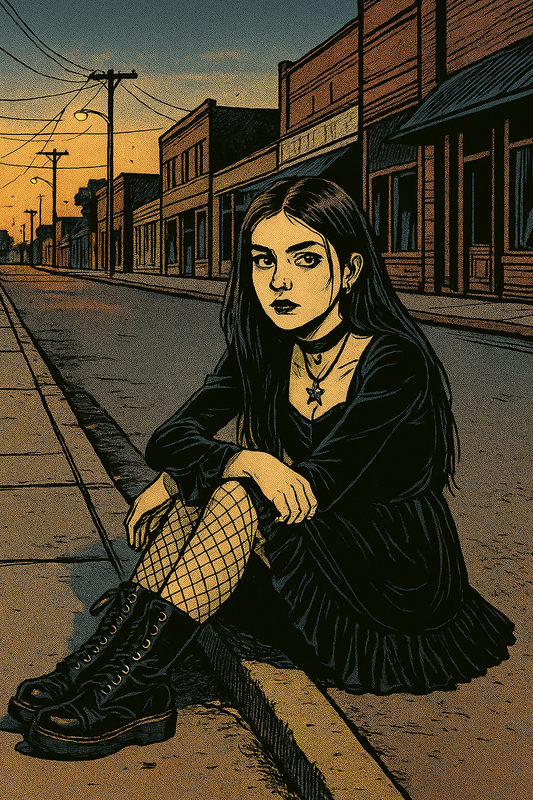
She knelt in the church lobby like a penitent who had forgotten their prayer, hunched over, elbows tucked to her ribs, hair spilling forward to make a moving curtain. From the sanctuary came a softened river of voices and the faint, careful thump of the organ diluted by the double doors. In the vestibule, the air smelled like floor wax and lilies and the damp wool of coats that had been hung too close together. A fluorescent tube drilled quietly in the ceiling. The corkboard with its looped announcements—bake sale, softball, homecoming choir—watched her with a hundred beige pushpins for eyes.
Her all-black ensemble gathered the room’s light and did not return it. On her feet: scuffed black combat boots, not the kind ordered from a catalog but earned from the thrift aisle, the right boot’s last lace tipped in silver duct tape where the aglet had given up. The boots made her ankles look narrow, coiled; above them, black nylon tights, laddered at the shin and invisibly darned with a few strokes of black thread that only became noticeable upon closer inspection. The tights met a black skirt that moved like it had a memory, the hem blunt with hand-cut scissors, the fabric a matte that drank the glow off the Exit sign. It was a shade too big, pinned inside at the waist with two black safety pins and cinched with a belt that had once been brown and was now stained into compliance, buckle spray-painted the same midnight as everything else.
Her torso was layered for secrecy. A button-down blouse, also black, from a rack meant for office women—its collar points sharp enough to whisper. The blouse was tucked with teenage precision, smoothed flat under a cropped black denim jacket whose seams had been worry-picked with a seam ripper and resewn by an impatient hand: her own. Black-on-black embroidery crawled the jacket’s yoke—tiny thorns that only appeared when she turned just so. A pair of dull nickel buttons had been painted over with brushy nail polish and chipped in two places, illness-white under the black like teeth.
Beneath the black blouse and the cropped denim jacket, the t-shirt told on her. It was a veteran—cotton thinned to the softness of old paper, neckline slightly scalloped from a hundred pulls and laundromat spins. The print had surrendered in most places to a gentle fog, but not the name—SLAYER—which shouted across her ribs in blood red as if it were the only part of the shirt that still believed in color. She had made sure of that.
It was the South of Heaven design, worn almost to legend: the ghost of a skull half-collapsed into a tangle of wires and cathedral scaffolds; a suggestion of stained windows pricked like old bruises; an altar shape swallowed by shadow. The lower art lay in ruins—cracks in the ink like parched mud, islands of pigment drifting in a black sea—but the band’s name soared above the ruin, a red so fresh it looked wet until the light proved otherwise. She had retouched the letters herself on a Thursday night with a model-paint enamel she’d carried home from the five-and-dime in the sleeve of her jacket.
Up close, the brushwork confessed its maker: edges of the S a hair wilder than the template, the Y’s fork just a little long, the R’s leg twitching with the hand that had painted it after midnight. Here and there the red rode up onto cracked black like a tide climbing rock. She’d gone back the next day with a toothpick and shaved the overreach into obedience, leaving a thin outline of darker red that read as shadow. When she bent, the enamel caught the vestibule’s fluorescent and returned it in a mute gleam, a lacquered heartbeat under the jacket.
The shirt had stories written in its fabric. A crescent moth-hole near the left hem, laddered outward into a comet tail she had whip-stitched shut with black thread. A bald patch at the shoulder where a backpack strap had chewed. At the collar, one “bacon” ripple that never lay flat and didn’t try. Over the stomach, the print’s once-white splinters—bits of bone, or splashed light from the album’s hell-cathedral—had turned to a kind of antique ivory that made the fresh red scream louder by comparison. A faint solvent tang clung to the cotton if the nose got bold; she had aired it on the back porch rail overnight to tame that note, and now it only surfaced when the cloth warmed with heat and intent.
A thin triangle of the tee showed where the blouse didn’t quite meet the jacket—just beneath the throat, where the key on its shoelace sometimes tapped. In that triangle, the red letters arced like a private banner. The lower edge disappeared into the skirt’s waistband, tucked with care; when she shifted on her knees, the fabric pulled and released, sending minute tremors through the printed name as if the word itself were breathing.
She had considered blacking the red, once—there was a pen mark on the underside of the right sleeve where she’d tested a marker and changed her mind. The blood color mattered. It was the part that was not a shadow, not a ruin, not a ghost. It was the part that refused to fade on schedule. The retouching had become ritual: once every few months, she laid the shirt flat on the kitchen table, slipped a flattened cereal box inside to keep the paint from bleeding through, and traced life back into the letters while the house slept. The jacket hid it most days. Not today.
When the jacket shifted, the rest of the artwork flashed and retreated—the skull’s molar ridge like a low shoreline, the scaffold like a thorn hedge, a slant of crosses barely there. The enamel letters did not retreat. They held, a red arch bridging the black. Her hair, fallen forward, sometimes grazed the paint and left a faint, darkened sheen that would dull again as strands slipped away.
Her wrists wore bracelets made of rubber bands she’d dyed in a cup of India ink pilfered from art class—thin midnight parabolas snapping softly with each movement. On the left, a frayed ribbon wrapped three times and knotted fast as if it were holding something important inside. On the right, a narrow black watch with no brand name and a cloudy face that reflected only the least of the light; it ticked a little faster than the organ did. A key dangled from a black shoelace around her neck, its grooves clogged with paint, the bow worn shiny where her thumb worried it when she had to think.
Her hair, long and brunette, had been persuaded into obedience with a black barrette and a second barrette under that one, because one was never enough. It fell forward now, hiding her face, strands static-clung to the wool shoulders of her jacket and catching the faint lily pollen that floated here the way dust floats in a school auditorium. A thin line of smudged black kohl traced the lower edge of each eye—yesterday’s line; she hadn’t put on fresh this morning—so that when she glanced up, quick and sharp, the whites of her eyes looked luminous, like the flash of a fish under a bridge. Her nails were painted with the same motorcycle-gloss polish as her jacket buttons, chipped at the tips to show crescents of ordinary girl.
Nothing on her was brand new, and yet the whole of her felt like a deliberate invention. The black wasn’t a color so much as a signal, a negative flame. Pocket seams bloused a little where invisible weight pressed: a squareish shape against the left hip, a coil of wire tucked flat along a waistband, a knuckled cylinder in the jacket interior that could have been lipstick or a fuse or a magician’s wand, depending on the story you wanted to tell yourself. The belt’s tail threaded back under itself and lay against her with disciple’s neatness. A small iron-on patch the same color as the denim hid a scar in the fabric; a black star painted on the patch hid the idea of what the patch hid.
She worked with her hands close, precise, thumbs doing the small work while the fingers screened them from any casual glance. There was a shape on the floor in front of her, but the angle of her shoulders and the poured-tar dark of her clothes made it indistinct—only the faint suggestion of a rectangle under an eclipse. Her head tilted, listening to the geometry.
Another layer of black revealed itself: the inside of her jacket, stitched with a pocket she’d cut from the leg of a pair of jeans and dyed in a coffee can. Inside that pocket, something clicked—soft, tactile, like a bead in a rosary passing into the notch it had been made to find. Her fingers came away powdered faintly gray, as if she had argued with graphite. She wiped them on the skirt, a whisper of cloth on cloth that got lost in the vestibule’s woolen hush.
The clothes changed her outline, made her look narrower where she wished, broader where she needed to be believed. The jacket’s hem sat high enough to free her arms, the skirt’s hem low enough to say she knew where she was. The tights, dark as river glass, turned her legs into a single thought. The boots locked her to the floor like vows. She had dressed for this moment the way other people dressed for photographs—meticulous, a little ruthless, choosing which truth to frame and which to let fall away just beyond the edge.
On the coat rack behind her, other blacks sulked: a funeral dress left over from last winter, a choir robe preferred by a contralto with no patience for pastels. Her black was different from those blacks. It had velocity in it. It made the church lobby look like the inside of a camera: everyone else was the background, and she was the aperture, opening.
A cough from the sanctuary threaded through the door seam; someone turned a page; a child—bored, saved, sticky with jelly beans—whispered a question. The organ massaged a chord into place and held it there like a hand on a shoulder. The vestibule’s thermostat ticked from 72 to 73 and, satisfied, clicked.
She glanced up through her hair to check her perimeter. To the right, the bulletin table with its neat stacks and a pen tethered by a string; to the left, the umbrella stand with two black umbrellas and one that pretended it was black but was really navy; directly ahead, the double doors with their brass plates polished by fifty years of palm prints. Behind her, the glass outer doors and the world: lilies on the steps; an April sky; the suggestion of insects rehearsing the noon.
Willow lowered her gaze again and returned to her small, exact labor. Her sleeves—rolled once, then rolled again—stopped at the midpoint of her forearms, exposing pale crescents of skin that looked more deliberate because of all the black around them. A faint bruise purpling the heel of her left hand winked when she flexed; a row of pen-ink tally marks climbed her right thumb in private notation. The key at her throat tapped a single beat against her sternum, then fell still, listening as she listened.
There was a patch of threadbare in the runner where her knees pressed. There was a nick on the baseboard where a dolly had hit it during a Christmas pageant. There was a little storm of glitter—black glitter, errant from some previous project—caught in the nap of the carpet where the light could not quite reach, like stars that had run away to live under furniture. All of it assembled around her and made her look less like a girl and more like a deliberate arrangement: black, black, black, and then the pale blade of her cheekbone when she turned.
A breath. Another. She counted them, the way you count before you plunge, the way you count before you light a fuse or jump from the bridge rope or break a habit. Her all-black outfit kept absorbing and absorbing—of color, of fear, of uncertainty—until it seemed there was no place left for those things to go but forward.
She primed the cassette with the care of a locksmith, thumb finding the rewind ridge and pressing until the spools inside the smoked-plastic window sprinted backward. The tape counter stuttered to 000, overshot, and she tapped stop with an economical click. A lean forward, a breath, then a short nudge of fast-forward to take up slack. The capstan would bite better that way. She rocked back on her heels—black nylon squeaking against the runner—and watched the ribbon whirl, oxide-brown fluttering from one clear hub to the other like a narrow river obeying a moon only she could see.
Her grin came on slow and bright, the kind that started in the eyes and lit up the rest of her face. The tape’s little world turned and turned; the white leader flashed past, then the dark again. She was counting, not out loud, a rhythm that lived in her jaw and wrists. When she eased the button, the reels rounded down to stillness with a soft elastic wheeze. The pause switch flicked up; the play key waited, square and patient, a promise laid out in graphite gray.
The boombox itself sat like a black altar on the vestiblue runner—anonymized brand plate painted over, corners armored with black hockey tape, handle wrapped in a sticky spiral of the same. Twin speakers hid behind punched-metal grilles, one grille dented into the ghost of a crescent where some previous day had not been gentle. A five-band graphic equalizer crouched under the tuner window, its sliders all nudged north of center at 60 Hz and 250 Hz—a curve like a grin that liked thunder. A red LED marked POWER with a faint, steady diode glow that looked more like intention than electricity. The telescoping antenna was retracted and scarred; a scratch ran its length like a lightning strike photographed in miniature.
Every blank surface had been claimed. Stickers crowded the lid and flanks, a traveling museum of loud devotion and teenage time. A jagged Morbid Angel logo unfurled in white-out pen across the top edge, the letters barbed like wrought iron from a haunted fence. Beneath it, DEATH in its hooked scythe font, the T a gallows; below that, Possessed with the tail of its final D flicking into a tiny inverted cross that had cost her two detentions and one lecture about “symbol literacy.” Obituary lurched in gristle-script along the tape door, carefully cut to leave the window clear. A shield-shaped Bolt Thrower decal—hand-traced from a magazine and shaded with the side of a pencil—anchored the right side like a coat-of-arms for a country that only existed in downstrokes and double-kick.
Between the famous glyphs sprawled homemade devotionals. A grinning skull in a bishop’s mitre—her invented mascot for an invented band, Grave Famine—glimmered where she’d gone back over the lines with silver marker. Near the handle, a diving vulture with cathedral wings swooped toward a tiny flock of sheep; the caption, in ultrafine Sharpie, read Vermin Cathedral and beneath it, an album title: Processional of Knives. The left speaker wore a hospital diagram of lungs reproduced from a biology textbook and annotated with “Carcass — Reek of Putrefaction,” arrows pointing to bronchi like roads to nowhere. A goat-soldier with a bandolier—Sarcofago by way of algebra-class daydream—marched across the bass port, hooves sparking where she’d dotted the tape with correction fluid.
A yellowing rectangle at the flank offered Earache and Roadrunner logos clipped from ads, block capitals laid down with glue-stick zeal. Above the tuner dial she had penned a miniature cemetery gate, iron curls framing the dial numbers; at 88.5 she’d lettered Napalm Death — Scum, at 91.1 Sepultura — Beneath the Remains, at 100.7 Celtic Frost — Morbid Tales, and at 106.3, just for the private joke, Hymnal Hour in a prim schoolteacher hand. The cassette well’s eject key bore a sticker of a skeletal astronaut—Nihilist morphing toward Entombed—planting a flag on a moon scratched in with a compass point.
The center panel had become a palimpsest of tracklists and myth. Altars of Madness crawled there in careful capitals, underlined twice, with “vision from the dark side” written lowercase like an invocation. In the margin, other reliquaries: Autopsy — Severed Survival; Deicide — Lunatic of God’s Creation; Sodom — Agent Orange; Bathory — Under the Sign of the Black Mark. A catalogue of her own fabrications ran beside them: Anoxia — The Flayed Seraph; Maggot Jubilee — A Choir of Sorry Doors; The Plague Surveyor (mascot for Hunger Saint) bent over a tiny town with a theodolite, measuring sin in degrees and minutes.
Near the tape counter, she had glued a snip of notebook paper—frayed, college-ruled—listing PO boxes from fanzines and tape traders: “TAPE CRYPT, P.O. Box 134,” “Rot Zine,” “Festering Mailorder.” A tiny black crosshair marked the counter’s reset button; three dots of nail polish made a clover at the edge to hide a gouge. The battery hatch wore two bands of electrical tape to keep it from rattling; inside, four D-cells made the box heavier than its size, a portable gravity she had chosen.
The deck’s smoked window allowed a peep-show of mechanics and hope. The cassette inside, a TDK D90 with its paper label painted over in flat black, wore new lettering in the same silver pen: “SIDE A: MORBID ANGEL — live rip + studio. track 03: vision…” Below, smaller: “gain +/- 2, bass +1, treble flat.” The clear hubs held a thin halo of leader, then the chocolate ribbon, then leader again. When she jogged fast-forward for a heartbeat, the tape jumped; the idler whirred; the pinch roller and capstan waited like a mouth about to take a bite. She watched it all with the keen animal stillness of someone who has built a tiny machine and is about to set it free in public.
Other saints of noise had claimed inches where they could. Cannibal Corpse—just the name, the shock doing the work—marched along the ridgeline above the equalizer; the O in Corpse had been turned into a screaming face with four teeth. Slayer’s pentagram hid under the handle where only she ever saw it, a private badge. A white-on-black Venom logo, slashy and impatient, veined with cracks where the sticker had tried and failed to conform to a curve. A two-inch square of grocery-bag paper bore a toothy cartoon called The Necro Parishioner—her own mascot—caught mid-communion with a record needle. It was bad drawing and perfect doctrine.
She tilted the box a fraction, and a fresh riot of glyphs and mascots crawled into view—the black skin of it so crammed with ink and paper that even the scratches looked intentional. Along the top ridge, a serrated Kreator K shared space with Destruction’s fractured stencil and Exodus’s jutting angles, the three of them queued like teeth. On the left flank, the radio scale had been turned into a graveyard map: at 89.7 she’d penned Pestilence — Consuming Impulse; at 92.3 Voivod’s cyclopean head peered over the numbers; at 97.9 a tiny triskele marked Coroner; at 101.5 she’d lettered Dark Angel and drawn a wing that looked like a guillotine blade. Below the glass, a narrow strip praised labels like saints—Metal Blade, Combat, Peaceville, a small Nuclear Blast atom sketched with a Bic and shaded with patience.
The right speaker ring wore a wreath of death metal proper. Immolation’s thorny script curved above the grille; Incantation dripped candle-wax letters down the side; Atheist tucked in small and sly beside the bass port with “’88 demo!” added like a proud rumor. Nocturnus got a tiny planet with rings; Massacre earned “Chamber of Ages” in parentheses; Suffocation was squeezed in at a diagonal, its barbs softened by the textured plastic. A square of matte tape announced Dismember with “tape ’88” in her tidy hand; Grave leaned against it like an old fence post; Unleashed howled in block print across the battery hatch, which had been cross-banded with electrical tape so the D-cells wouldn’t chatter when she ran. Asphyx and Morgoth split the hatch’s lower edge, each name crowned with a sketch of a gas mask that had more feeling than perspective.
Florida and Sweden traded inches like pen pals. Obituary already held the tape door; now Malevolent Creation wedged under the handle with a skull in aviators; Ripping Corpse slashed across a corner as if it refused to sit still. On the opposite side, the Stockholm school staked claims: Nihilist ghosted toward Entombed; Carnage was stamped in brutal capitals; a tiny teddy bear with fangs, inked in a math class, served as the accidental mascot for all three. Between them, a hand-cut rectangle honored Terrorizer — World Downfall with a stick-figure mushroom cloud whose edges had bled under the glue stick. Repulsion got a cartoon fly with manic eyes; Extreme Noise Terror earned a single jag of lightning.
Thrash elders and blackened cousins jostled in the margins. Hellhammer brooded under the tuner with a nail-pile logo; Mayhem appeared as four knife-strokes and a church silhouette the size of a thumbnail; Samael, Blasphemy, and Root huddled like a bad prayer near the antenna socket. Sodom and Destruction flanked Kreator in a Teutonic triptych; Razor, Exciter, and Sacrifice took the handle’s underside, visible only when she lifted it—private badges she liked to keep for herself. Onslaught was squeezed into a seam. Death Angel barely fit at all. A little Godflesh—two blocky words—hugged the corner in defiance of categories and good manners.
There were homages to the southern weird too: Rigor Mortis in Texas barbed-wire; Devastation stamped like a shipping stencil; Nasty Savage with a cartoon jaw that hinged too far. A neat, small Disharmonic Orchestra tucked under a screw; Pungent Stench lurked by the headphone jack with a nose she’d drawn and then immediately regretted. A pair of deep-cut nods rode the equalizer slots: Derkéta in tiny solemn print, Acrostichon lettered with affection, both flanked by hearts that had been blacked-in so completely the paper shone.
And then the inventions—her parish of invented filth—multiplied wherever the real bands left daylight. Orthostat wore a megalith for an O; their album Cathedrals of Bone marched down a margin in minuscule capitals. Sable Sermon unfurled in ribbon script above a lamb with a third eye; beneath it, Vespers at the Abattoir. Black Harvest Choir claimed a torn corner with Pig Iron Psalms. Pilgrim Rot featured a pilgrim hat on a skull; Angelrust had wings made of nails; Scaffold Choir perched neatly on a sketched gallows; Epitaph Orchard grew tiny tombstone fruit. A pocket-sized bishop with a broken crozier grinned for Plague Sister—mascot to another of her fictive bands, Vermin Seminary, whose fake single Habeas Corpuscles had three stars next to it as if a magazine had reviewed the lie and agreed.
On a scrap of index card taped near the pause switch, she’d made a micro-index of her own tapes: “TAMPA/BRANDON — live rips,” “STHLM — Sunlight Sound,” “EARSPLIT MISC.” The Sunlight entry sported two little saw blades—her tribute to Tomas Skogsberg made in pen and devotion. Another scrap listed shadow addresses: Peaceville’s P.O., Earache’s Nottingham box, Roadracer scrawled with a lightning bolt; beneath them, zines and traders—“Slayer Mag (Nor),” “Morbid Tales Zine,” “Tape Altar—write polite.” A line at the bottom read “send stamps,” underlined twice.
Everywhere a corner threatened to look bare, a small icon settled the argument: Atrocity got a tiny gallows; Protector a medieval visor; Voivod’s head reappeared peeking over a screw; Coroner’s triskele nested in negative space between two sticker edges. Even the volume rocker had been christened—“Kill” scratched at the high end, “Maim” at the low—though she almost never pushed it to the joke.
She eased the box back to square, the silver reels winking behind smoked plastic. The cassette’s oxide river sat exactly where she wanted it—ready in the hush, waiting for her thumb to drop the pause and let every name and sigil erupt into the one thing they all promised: noise with a heartbeat.
Closer to the tuner, an index-card triangle fluttered under a single strip of tape, its edge lifted from too many thumbings. Scribblings intended to distract if detected, to confuse and annoy, the last line had a smiley face beside it with vampire fangs; someone—herself, hours earlier—had blacked one fang in.
She leaned back again, rocked heel-to-toe, and the equalizer sliders flicked a shadow along the brass of the vestibule threshold. A strand of hair lifted from her cheek as static paid its tithe to the polyester in her jacket lining. The church’s hush continued to breathe around the box’s black geometry, around the stickers and the ink and the dents—around this carried cathedral of other cathedrals, each song a window without saints.
The play key waited. The pause tab stood like a finger raised to a mouth. She slid the volume rocker up a whisper more until the white notch aligned with the mark she had scratched at “8” using a safety pin. The tape reels sat expectant behind their plastic, a pair of pupils trained on the double doors, ready to flood the room with everything those logos promised and everything the lily-sweet air was not.
She grinned again, smaller now, private and bright, and let her thumb settle on pause. The cassette’s oxide river trembled in its bed. The machine’s black body—graffitied, scarred, ridiculous—looked, for a long second, like the only honest thing in the room.
A breath of tape hiss rose the way gnats lift from a puddle.
Then
the first skittering blast of guitars found the wood and glass and traveled. It crawled up the plaster like ivy. It sank into the church’s ribs.
On the other side of the swinging doors, the Easter service stuttered. Reverend Dale Merriweather had just said, “He is risen in each of our—” when the sound knifed through the walls—cavernous, chaotic, like a storm learning to walk upright. Heads turned. Sister Eloise Garner, the organist, snatched her hands from the keys, a C major blooming into nothing. Miss Birdie Puckett’s choir mouths froze in perfect O’s. One of the ushers, Mr. Bertram Lee, said, “Lord have mercy,” because it felt like the only proper sentence left in the English language.
Reverend Merriweather tried to smile the way the handbook said. “Friends,” he offered, “I’m sure it’s just—”
“Just the devil’s transistor,” Mrs. Luanne Cobb said, hat quivering like a terrified bird. “Earl! Do something!”
Her husband, Earl Cobb, had a gallant jaw and a knee brace. He stood with the determination of a man born to open pickle jars. Hank and Clyde DuPree—the Deacon twins who owned a feed store and shared one brain between them on weeknights—rose too. The three men moved down the center aisle as if wading through high water.
The Reverend’s smile went softer, then truer. “Take your seats,” he said, gentle as a hand to a fevered brow. “We will address this.”
Clyde and Hank burst through the vestibule like quarterbacks who’d forgotten the ball. Outside, the lawn lay vacant save for the lilies trembling in their foil jackets. A squirrel threw itself up an oak with great personal offense.
“Gone,” Hank said, hating the word.
“Which way?” Clyde said, as if directions were prayers.
“South,” Earl decided, though he had no earthly idea. “Or west.”
“Or straight to hell,” came Mrs. Cobb’s voice from behind them, because she could not be contained by doors.
The doors to the vestibule flapped once, twice, and Earl hesitated. Through the crack he saw a flash of black. Not a man’s Sunday suit black, but midnight black—boots, skirt, jacket, hair. The figure sprang away, already receding.
“Hey!” Hank barked, because he’d never met a problem he didn’t think could be solved by hollering at it.
But the figure—was gone. Like a rabbit.
A mockingbird followed her for a while, trying on the boombox’s snarl in miniature, then deciding it preferred its own cleverness.
The rumor, of course, had already left the building. By the time Sister Eloise took her afternoon nap, the story had become three different stories: a vengeful ex-choir member, a Satanist from Phenix City, and a boy from the next county with no respect for Easter. By supper, “boy” had become “boys,” and by Monday morning, the prankster had a switchblade and a tattoo of a snake that hissed Scripture. By Tuesday she was a ghost. By Wednesday she was a cautionary tale. By Friday, she was an omen.