Work Text:
Morning slid into the house gently, like it knew the rooms and didn’t want to wake anyone too fast. Sun pooled in an oval on the living room carpet, catching threads of lint and dust that drifted like slow snow. Somewhere in the kitchen a pot clicked as it settled, and the smell of soap from the washing machine braided itself with the faint sweetness of whatever Glenda had simmered earlier—apples and cinnamon and something that lived in the cupboards, learned and repeated.
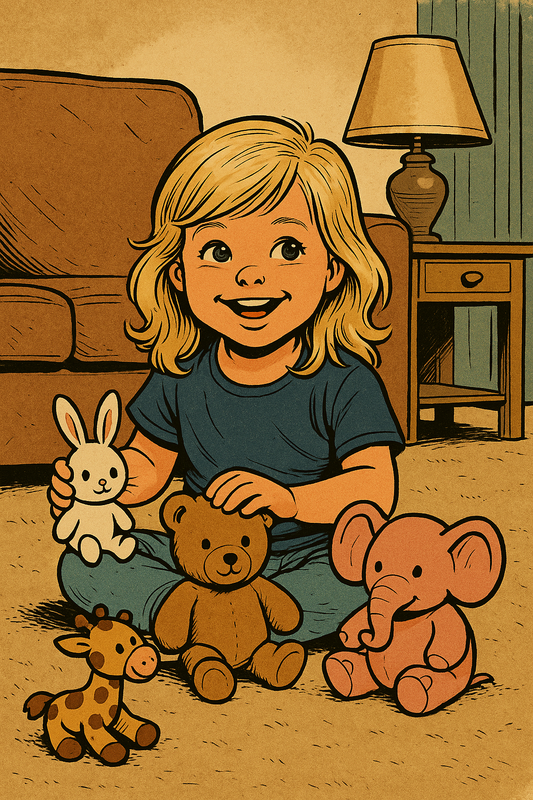
Jess had made a semicircle army. Animals and people with button eyes and scuffed paint and ribboned necks, all turned toward her like students waiting for a lesson. There was Ribbons the pony—ribbon, once pink, now the color of sunset clouds—propped on stiff legs. Teddy, with one flatter ear that never quite remembered to stand up. Duckling, whose beak had a nick where teeth had tested the world. A plastic tiger with the word “SAFARI” stamped into its stomach where only adults ever looked. And Bunny, whose left foot wore a carefully applied bandaid after some unremembered accident at bath time last week.
Jess sat cross-legged in the sun, where it warmed her knees through the cotton of her leggings and turned the pale hairs on her arms to gold. She leaned forward until her forehead nearly touched Ribbons’. “’Kay,” she told the circle in the crisp voice of someone making a plan. “’Kay, utten-shon.” Attention. Her hands patted her thighs twice, a sound like two little drums. “We is do in’ a—” She searched for the word, eyes tipping sideways toward the couch as if she might pluck vocabulary from wherever Holly kept it. “A ’sembly.”
On the couch, Holly’s book tilted enough to let her watch without seeming to. She was reading something with chapters and a map on the inside cover, a world in small letters that adults built for children to discover. Her knees were tucked under her, socked feet knitting together under an old crocheted throw. A piece of hair had come loose from its ponytail and slipped forward, a soft braid of shadow across her cheek. She blew upward to push it, failed, and tried again with the sigh of an older sister who’d learned patience very young.
“Ho-ho,” Jess called, without looking up. She leaned, arms open wide. “Ho-ho, look. We ’sembly.”
Holly leaned forward, elbows on knees, grin small and easy. “Who’s in charge?”
Jess glanced at the ranks. The question rearranged her face into carefulness. She tapped Ribbons’s nose, then reconsidered and touched her own chest with two fingers. “Me,” she decided, and Ribbons accepted the demotion without complaint.
“Good meeting,” Holly said, and picked her book up again. But the breeze from the hall kept lifting the strand of hair over her cheek until it fell and hid her eye. Jess watched it fall three times, and on the fourth she broke from the sun and crossed the rug barefoot, the little pads of her feet whispering over the fibers. She reached up without warning and swept the hair back with the gravity of a nurse. Her hand was small and gentle; her fingers hesitated at Holly’s temple as if to make sure they were doing it right, then slipped away.
“Puppy hidin’,” Jess pronounced, satisfied. “No hide.”
“Thank you,” Holly said, and it was gratitude big enough for big things, laid over something very small.
Jess stood looking at her, weighing whether to climb into that lap and become part of the story, or return to the semicircle where she was already queen. The fan hummed. A washing machine somewhere down the hall diverted its spin. Jess glanced at the book, trying to read the picture that wasn’t there, then back at her own crowd: a known geography.
She went back to the sun and her animals. She stooped to straighten Teddy and then, noticing that Ribbons’s ribbon had rotated so the frayed part faced front like a ragged tongue, she turned it and smoothed it flat in the back with two careful strokes. “’Kay,” she told them again, and set her thumb and forefinger like pincers, counting the assembly. “One, two, free, fi’—” She paused, frowned. “No four,” she confided to Bunny, and then, after a moment’s private struggle with the shape of numbers, sighed. “We got lots.”
“Lots is good,” Holly murmured, eyes on the book now, but listening the way some people listen with their shoulders. She tipped the pages, and the bent corner made a little triangle tent, promising the story would wait. Without looking up, she stretched one leg until her toe nudged the plastic tiger closer to Jess’s circle. “He was late,” she explained, keeping her voice solemn. “Traffic.”
Jess received the tardy tiger like a dignitary. She set him beside Duckling and patted his head. “We talk im-portant,” she informed the new arrival. “No bite.”
“No bites in meetings,” Holly agreed, then she breathed in through her nose and smiled at the soap-and-cotton that drifted in along the hallway. Jess didn’t know about cycles and rinse and spin, but she knew about the warm thing. It meant the basket would arrive smelling the way clean blankets smell when you pull them up to your chin, and sometimes Glenda put the socks on her hands like puppets while she sorted, and Jess laughed so hard her cheeks hurt. The smell made her head feel fuzzy in a good way, like sunshine you could breathe.
Duckling fell. The reason was gravity, but to Jess it was because the circle needed her. She set Duckling upright again and leaned her cheek on Ribbons for a second, the way you lean your face against the back of a friendly dog to say hello without words. Ribbons smelled like dust and ribbon and the faintest hint of orange peel from that time she’d sat too close to the peels on the counter. Jess’s hand smoothed down the pony’s spine until the seam lay quiet.
“Tell ’tory,” she ordered herself softly, to get the engine going. “Oncepona time… pony go fast.” Her hands became hooves. The hooves clopped across her knees. “Clip—clop—clip—clop—”
“That is exceptionally fast.” Holly turned another page without really leaving the room with it. “Is there wind in her mane?”
Jess knew wind. The fan made wind, and also cars, and sometimes Mama’s blow-dryer, which was friend and enemy both. “Yeh,” she said. “Winnnnn’.” She blew out a steady stream and made the ribbon dance. The ribbon all but thanked her.
The book on Holly’s knees wasn’t just any book; it was Dana’s—lifted (with permission and ceremony) from the cataloged shelf the night before. Dana had stood in front of her books like a librarian who knew the medicine cabinet of the world and pulled this one with a sure finger. “Start here,” she’d said, tapping the green spine. “You’ll like how stubborn she is. And how she makes up names for things.” She’d turned it over in her hands like checking a horse’s teeth, then pressed it into Holly’s palms. “Bring her back,” Dana added, voice mock-stern but real about the returning part. “I’m trusting you with Anne.”
So Holly was reading Anne of Green Gables, the paperback with its soft, sat-on corners and Dana’s name block-printed inside the front cover in pencil. Underneath, in smaller letters: (if lost, check my room before panicking). The inside page had a faint greasy oval where someone’s thumb had loved it a thousand times, and there was a tiny pressed clover sleeping flat between chapters—Dana’s old habit of tucking the outside world into stories to see if they got along.
Holly nested into the couch the way cats do. The book opened with that friendly looseness of paper that has already been read enough to know how to fall open at favorite parts. She’d been skimming the map at the front matter earlier—no real map, not like the fantasy ones Dana adored, but the sort that bloomed up in your head as soon as a red-headed girl began describing ponds like lakes of shining water and paths as if they’d been designed for thinking—and now she’d slipped into the chapter where a thin, talky hurricane of a child refuses to be quiet about anything.
Dana, in her recommendation voice, had said, “Let Anne show you how to name things.” Holly took that instruction like a mission. As she read, the world rearranged around the words like it was happier in this order. The little spray of dust in the sun became golden motes because Anne would have said it like that. The laundry smell turned into the breath of warm fields. The hallway fan stopped being a fan and became a companionable wind, and when the bird outside did its three notes again, Holly privately tried “Morning bellbird” on for size. It fit.
The first time Anne made a promise to herself—one of those solemn little child-vows that grown-ups forget how to make—Holly’s mouth opened a fraction in recognition. She read the sentence twice, not because the words were hard but because feelings sometimes were. Anne didn’t say “I belong nowhere,” she said everything but that, painting over emptiness until it looked like a garden. Holly felt that tug of kinship you get when a book gently touches the exact bruise you didn’t realize you had. She was the furthest thing from an orphan. But the part about wanting to be chosen—to be understood in her exact color—rang through her like a tuning fork.
Jess’s voice pipped up from the rug: “Ho-ho, what ’bout da mapp?” Jess had noticed the absence of pictures the way small detectives do, and therefore suspected there had to be a secret one.
“This one draws itself,” Holly said, smiling down at the crown of Jess’s head. She smoothed the page’s bent corner with her thumb. “Close your eyes.” She lowered her voice half an octave—the reading-aloud register that made even the dogs next door sigh without understanding why. “Imagine a pond so shiny it needs a better name. A long road lined with trees that knit their leaves together over the top like a tunnel. And a kitchen where someone very sensible thinks puffed sleeves are foolish,” she added, conspiratorial, “which is obviously incorrect.”
Jess shut her eyes obediently and made the face she wore when imagining: eyebrows up, mouth soft, as if she were trying on a new hat and felt it fit. “Shiiiiny,” she said. “The wader shiny. It like our bowl.”
“Exactly.” Holly tucked the falling strand of hair behind her ear and dipped her eyes back to Dana’s penciled margin, where a small note marched beside the paragraph: scope for imagination!!! (three exclamation points—Dana, emphatic). There were a few such notes throughout; Dana reserved her pencil for love or argument with a book. Holly had promised. She fully intended to keep the promise, and also to win the conversation like a game—bring back insights like trophies.
Her finger kept its place down the side of the page so she could lift her eyes to Jess without losing the line. Anne talked and talked—about hair, about names, about the right way to walk down a road when it is late afternoon and you are finally wanted somewhere. Holly’s chest performed that odd trick of breathing in more air than the room gave, as if the book had created extra space in her ribs. She wasn’t Anne—Holly’s quiet ran deep and reliable; she didn’t somersault her words in the air just to watch them flicker—but she liked how Anne made wanting tidy and beautiful. How she didn’t apologize for it, just kept naming the world until it made proper sense.
From the hall, the squeak again; the spell of domestic morning threaded through with the plot. Holly read three more paragraphs, then paused on a place that felt like a good hilltop to look from. “She has a friend already,” she told Jess, “and she doesn’t even know it. There’s a lady who thinks she is too much, and a man who thinks she is exactly right, and that’s enough to start.”
Jess peeked through her eyelashes. “She got a Ho-ho?”
“Not yet,” Holly said. “Maybe she gets a… Dana.” She glanced toward the hallway like Dana might lean in and issue a footnote. Dana could have a thesis statement about Anne inside of six minutes. Stubbornness + imagination + mischief → self-invention, something like that, then she’d prove it with four quotes and a minor scene involving a plum pudding.
Jess mulled on ‘Dana’ as a category. “Is Dana puff sleeves?”
“Dana would say puffed sleeves are a distraction from the work at hand,” Holly said, trying on Dana’s cadence with affection.
“Pf sleeves,” Jess repeated.
In the margin of the next chapter opener, Dana had scribbled: Marilla is the spine; Anne is the lungs. Holly liked that. She could see it now: the firm, plant-stake woman keeping the vine of Anne from choking itself with its own enthusiasm. She penciled a tiny heart beside Dana’s note, breaking the house rule only slightly; you didn’t write in someone’s book unless the writing you added felt like a thank-you to what was already there.
“Ho-ho,” Jess said again, that gentler version of her sister’s name that sounded like a secret between them. “Read me… the shiny part.”
Holly nodded, found it, and read a few sentences aloud, rolling the words across her tongue. The language walked with its back straight and its shoes muddy, exactly the way Holly thought sentences ought to move. Jess swayed a little with the rhythm. When Holly reached the renaming—when an average pond got christened into something far too grand and therefore perfect—Jess breathed, “Shine water,” and set the plastic tiger facing toward whatever she was seeing.
“It’s actually called ‘Barry’s Pond,’” Holly said, amused by how insufficient that sounded after Anne had worked on it. “Think we could make up a name too, Jess?”
“Rename… couch,” Jess proposed, patting the cushion. “Couch is… Big Soft.”
“Accepted,” Holly marked this by pressing the pad of her thumb into the same greasy oval thumbprint that Dana or someone like her had left years before. The book had been in their house long enough to become a sort of relative: dependable, a direct speaker, generous with comfort.
She read on. The pages made their quiet paper-murmur. Every few paragraphs she paused to look at the room with Anne-colored eyes: the throw blanket on her lap was now a shoreline shawl, the hallway light a dawn. When Marilla’s sensibleness ran up against Anne’s hurricane, Holly felt a tiny itch between her shoulders, the way she did when she knew two people who simply needed a small translation. That was her favorite work in the world: noticing the hinge, oiling it, saying, “I think what she means is—”
“Do Anne fall?” Jess asked abruptly, anxious on behalf of someone she had just met.
“Not today,” Holly said. “Today she gets to arrive.” She skimmed ahead to double-check; you didn’t lie about falls to children. “There’s cake trouble later,” she added, eyes flicking through future pages, “but that’s for another cup of tea.”
“Tea,” Jess echoed, already tasting the pretend.
Holly reached for Jess’s sippy cup with her free hand. She folded one corner of the page down just enough to hold her place (Dana allowed dog-ears only on paperbacks and only if you promised to smooth them later), and traced the penciled sentence that had snagged her earlier: scope for imagination. Dana’s exclamation points winked at her like constellation pins. Holly had never thought of imagination as scope, a tool; now she wanted to carry it the way grown-ups carried flashlights, beam it at dark corners and say the names of things until the corners stopped being dark.
From the hall, Glenda’s step; the warm cotton smell like a soft weather front; the basket’s little complaint at the scuffed floor. Holly shut the book gently onto her finger and glanced down at Jess’s circle. The toys faced the doorway like congregants waiting for the minister and the music.
“Anne says,” Holly told the assembly as if passing a law, “that when something beautiful doesn’t have the right name, you just… fix it. With words.”
Jess pointed at Bunny’s bandaged foot. “Fix,” she agreed. She considered the space beside her and patted it twice, making the little seat ready. “Mama is ‘Warm.’ New name.”
Holly grinned. “Perfect.” She looked at the cover again—at the girl in a straw hat, serious and bright-eyed, thinking her way into being loved—and thought about Dana upstairs somewhere, already three books ahead, certain in a way that made certainty look like a kind of kindness. Borrowed from Dana’s collection, per her recommendation, the story had come with an assignment written in invisible ink: learn how to hold a room with nothing but attention and good names for things.
The house, attentive and unhurried, seemed to lean in. The warm smell reached the room like a promise kept. And Jess, sun bright on her knees, sat there with her circle in perfect readiness—already building the space her lesson would someday need, without yet knowing the shape of it, only the feel: room made, held open, waiting.
The basket came first—the little wheel-squeak at the hallway scuff, the warm breath of cotton drifting in before Glenda did. She had a dish towel twisted on her shoulder like a flag. “Hey, love,” she said into the room, easy as the fan. “Holly, give me a hand with folding?”
Holly’s eyes lifted from the green-covered book. She pinched the corner down, soft, just enough to save the sentence. “Okay,” she said, quiet, setting aside the opened book.
Jess’s head snapped up. “No,” she said, as if the room had tilted. “No-no-no.” She scrambled on her knees and reached both arms toward the couch. “Ho-ho stay! She mine!”
Glenda set the basket just inside the sunlight and crouched to level. “I hear you,” she said, warm and low. “You want Holly with you.”
“Wif me,” Jess insisted, palms opening and closing. Her face had already started to bunch, that storm-face that pulled her eyebrows down and made her mouth small. “No fold. No fold!”
Holly slid off the couch, book in one hand. She moved light, like she didn’t want the air to notice. “Hey, Jess,” she said, shy smile tugging at one corner. “I’ll be right back.” She touched the cushion where she’d been sitting. “Can you save my spot?”
“No.” Jess shook her head so hard her curl bounced. “No save. You sit. You sit now.” She clambered up to the couch and put both hands on Holly’s knees as if to weigh her down. “Ho-ho mine. Stay wif me.”
Holly glanced up at Glenda. Glenda nodded once—go on, little one; we’re okay—and picked a towel from the top of the basket. Steam wasn’t visible, but the heat was there, soft as a hug. “We’ve got the warm ones,” she said, trying gentle humor. “Someone’s got to keep them from getting lonely.”
Jess’s hands slid from Holly’s knees to her wrists. “No go,” she whispered, voice going thin. Her eyes shone suddenly, wet around the rims. “Ho-ho don’ go.”
Holly set the book on the couch, open but safe, then bent until her forehead could touch Jess’s, quick and careful. “I like sitting with you,” she said, just that. “I’m coming back.” She dipped her head toward the toys. “Ribbons can watch my book.”
Jess followed the look to her semicircle. The idea was not as good as the real girl. “Ribbons no read,” she argued, wobbling now between fury and tears. “He has no mouf.”
“He can guard,” Holly tried, softer. She picked up the tiger instead and set him on the cushion like a sentry. “He’s good at guarding.”
Jess’s breath hitched. She swiped at her cheek with the back of her hand, hard. “Guard?”
“Yeah.” Holly’s voice made the word small and sure. “He’ll tell me if anybody tries to take my seat.”
“Nobody take,” Jess muttered, still stormy, but she pressed a palm to the tiger’s head like making an oath. “No-body.”
Glenda shook out a bath towel, the motion big but not loud, and folded it in half, then thirds, edges kiss-neat. “Holly,” she said without looking away from Jess, “start with the small towels? We’ll race.”
“Mm-hm.” Holly slid a step toward the basket and then stopped because Jess’s fingers tightened.
“No race,” Jess said, voice going up. She climbed down and flung herself at Holly’s thigh, face pressed to denim. “No race, no fold. Ho-ho stay.” Her feet did a tiny stomp-stomp—the kind that didn’t hurt anyone, just told the floor how she felt.
Holly’s hands hovered, unsure, then rested lightly on Jess’s shoulders. “I’ll do two towels,” she said, picking a number because numbers sometimes made things safer. “Then I’ll sit back. You can count me.”
“Count?” Jess hiccuped. The word made a small path through her upset.
“Just two,” Holly whispered. “One towel. Two towel. Then me again.”
Glenda passed a washcloth over, light as passing a secret. “Here,” she said to Holly, “these are the fast ones.”
Jess saw the handoff and let out a sound like a kettle starting up. “Nooooo.” She tried to push the washcloth back into the basket with one flat palm. “No fold!”
Glenda caught her hand gently and kissed the tips of her fingers, one-two-three, silly-soft. “Oh, I see that feeling,” she murmured. “Big, big feeling.” She moved the basket an inch back, out of the sun, not as surrender, just to give Jess more room to breathe. “She’s just helping me for a minute.”
“Mine,” Jess said again, louder now, the word round and hot. She reached up and grabbed a fistful of Holly’s T-shirt, not yanking, just holding like a child holds a ledge.
Holly let her hold. “You can hold my sleeve,” she offered, pre-teen diplomacy, small and plain. Jess transferred the grip, fingers pinching fabric, cautious now. “Not too tight,” she echoed, testing the shape of permission.
Jess sniffed hard. A tear escaped anyway, quick down, and she batted it away like a gnat. “No fold,” she repeated, but it wasn’t the same shout; it was smaller, frayed at the edge.
Jess’s mouth trembled. It wanted to cry. It considered not crying. It chose the middle and let out a shaky breath instead. “Don’ go, Ho-ho,” she said, quieter. “Don’ go far.”
“I won’t,” Holly said. She lifted the tiger from the cushion and put him into Jess’s hand like passing a baton. “He can help you watch me.”
Jess clutched the tiger to her chest. “He bite if you go far,” she warned, a last flare of unfair magic.
“Ow,” Holly said, amiable, like she agreed to be bitten if she broke the rule. “Okay.”
Glenda’s hand brushed Jess’s back once, then fell away, letting the quiet fill back in. The fan hummed. The laundry smell settled like a blanket nobody had to fight over. Glenda waited the way she did when bread needed one more minute in the oven—eyes on, hands off.
Jess’s breaths evened by degrees. She held the tiger up so his plastic face could look at Holly. “Guard,” she said again, like making it true out loud helped.
“I see him,” Holly said, small smile, the kind that didn’t show teeth. “Very strict.”
Jess sniffed, then wiped her nose with the heel of her hand, then remembered and scrubbed her hand on her leggings because Mama liked clean faces. She looked at the basket and at Holly and back at the basket. “One towel,” she said, making the deal herself this time. “Then sit ’gain.”
Jess held up two fingers because she’d seen Dana do it, got the angle wrong, didn’t care. Holly mirrored it, smaller, better, but didn’t correct her.
Glenda didn’t hurry. She set one knee down so she was on the rug with them, not above them. Her eyes flicked to the basket, then to Ribbons in the semicircle—ribbon turned neat, ears soft from years of petting. She reached, not for Jess’s hands (those were busy), but for the pony.
“Can I borrow this teacher?” she asked the air, light, like it might be a game.
Jess’s grip didn’t loosen. Her eyes tracked Ribbons anyway. “Teacher,” she repeated, suspicious but listening.
“Mm-hm.” Glenda eased Ribbons into the beam of sunlight like introducing a guest. With her other hand she drew a bath towel from the basket, shook it once, quiet as a breath, and laid it flat on the carpet. “Look,” she said. “A pasture.”
Holly’s shy mouth tipped into a small smile. She shifted a little, making room. “I can make a gate,” she offered, barely above the fan, picking up a washcloth and folding it in half. She set it at the edge of the towel square like a door.
Jess’s shoulders stayed tight, but her eyes went to the square. Ribbons sat inside, tidy as a picture. “Pastur,” she said, the word thick but curious.
Glenda nodded. “Now,” she said, sliding another towel down so it touched the first, “a second pasture.” She patted one towel, then the other. “Two places to run. Two places to rest.”
Holly’s hands hovered. “Do you want me here?” she asked, only to Jess.
Jess breathed hard. She didn’t answer with words. She leaned her forehead against Holly’s sleeve again—consent, of a sort—and then sat back so she could see more of the towels.
Glenda touched Ribbons’s nose. “Question,” she said, as if to the pony. “What if all the horsies in the whole world were taken by one person. They could say, ‘No one else can ride. No one else can brush. No one else can feed them carrots.’ Mine, mine, mine.”
Jess’s head snapped toward Glenda, offense lit. “No,” she said, with the gravity of someone defending the moon. “No-one can say dat. Horsies… people like horsies.” She groped for the right connection and found one that fit her hand. “Kids like.”
“Kids do like,” Glenda agreed. She stroked the ribbon flat. “If they kept them all, what would the horsies feel in their tummies?”
Jess’s mouth pulled in. “Sad,” she said, quick, as if the answer hurt to hold. “Stompy.” She lifted both hands and pantomimed a little hoof-stamp. The tiger got jostled; she tightened around him and then, remembering, loosened.
“Sad stompy,” Glenda echoed. She moved Ribbons to the edge of the first pasture and set him so his nose touched the washcloth gate. “What if they were allowed to run here,” she tapped the towel, “and here,” she tapped the second towel, “and let other kids take turns brushing and feeding and riding?” She turned Ribbons so he looked out at them both. “What then?”
“Happy,” Jess said. The word came out round and soft. She reached with two fingers and smoothed Ribbons’s ear like Glenda did the ribbon. “Run-run.” She made gallop-hoof sounds with her tongue.
Holly’s eyes met Glenda’s for a heartbeat—there it is—and then went back to Ribbons. “He likes friends,” she said to Jess, small and sure.
Glenda added another towel, overlapping a little, making the pastures a long green of cotton. She placed a pair of socks—one pink, one blue—beside Ribbons. “Riders,” she told the pony. “They use gentle hands. They say thank you.”
Jess peered at the socks. “Sock riders,” she decided, approving. She touched the blue one and nudged it toward the gate with careful forefinger pushes. “Dis one say tank-you.”
Glenda considered the small set of the toddler’s jaw, the thinness that still clung to her voice, the heat climbing down out of her cheeks by slow degrees. “Another question,” she said, and now she set Ribbons between the two towels, one hoof touching each. “What if you were a horsie.”
Jess blinked. The idea landed like a pebble in a puddle—ripples, then quiet. “Me,” she said, less question than test.
“You,” Glenda nodded. “What if one person said, ‘Jess is mine. Nobody else gets time. Nobody else gets snuggles. Nobody else gets her little songs or her giggle. I keep it all.’” She kept her voice even, simple. “How would your tummy feel?”
Jess’s eyes jumped to Holly and stayed there. The sleeve was still under her hand. She pressed her forehead against it for a second, opened her mouth like a fish, then shut it, then whispered, “Sad.”
Holly moved nothing but her fingers. She slid them under Jess’s hand until their hands were palm-to-palm, light, not trapping. “I like your songs,” she said, which was all she had to say.
Glenda’s hand came down on the towel pasture and smoothed it once, the same motion she used on sheets, the same motion she used with upsets. “Me too,” she said. “Me too, sugar.” She looked at the two socks. She set the pink one beside Ribbons and tapped it. “What if we let this rider have a turn.” She tapped the blue. “Then this one.” She tapped Jess’s knee. “Turns are how we make sure the horsie doesn’t get tired and the riders don’t get sad.”
Jess stared at the socks, and the idea did work here—it fit the carpet and the pony and the warm smell and the shape of Holly’s sleeve in her hand. “Turns,” she repeated. The word made shape in her mouth; she liked how it felt. “Turn… is share.”
“Mm.” Glenda moved the socks in a tiny, gentle procession—pink across the pasture, pause, petting; blue across, pause, carrot. “And guess what happens to the love?” She touched the towel. “It doesn’t get smaller.” She touched Jess’s chest, two fingers over the shirt where her heart thudded. “It gets bigger.”
Jess’s eyes followed the fingers. She frowned, not to argue, just to be sure. “Biggie?”
“Bigger,” Glenda said, smiling without making it a show. “Horsies are meant to be shared.”
Jess’s head tilted. The sentence went in like a key finding its way around a corner in a lock. She whispered it back, testing the teeth. “Horsies are meant to be shared.”
Holly’s cheek went pink at the ears, the way it did when she felt things hard. “I can be a rider,” she said, soft, almost like asking permission of the room.
Jess looked up fast. “Ho-ho… rider?”
“Just for two towels,” Holly said, a tiny grin that asked Jess to grin back. She held up one finger. “One.” Another finger. “Two.” She tucked her hand back into Jess’s so she could feel the count right there.
Jess rolled that in her mouth. “Two.” She looked at Ribbons. She looked at the pastures. She looked at the book, green on the couch like grass. “Two, den back,” she bargained, newly brave in bargaining because the pony had told her how.
“Two, then back,” Glenda agreed, solemn. She set Ribbons right between them all, facing Jess, as if he were listening. “You’re the gate-keeper,” she added to Jess. “You tell us when it’s time.”
“Gate-keeper.” Jess liked jobs. She scooted closer and put one hand on the folded washcloth gate, her other still caught in Holly’s fingers. She made a small door-noise. “Kshhht.”
Holly laughed once, not loud. “Good gate.”
Glenda passed her a towel. Holly kept her steps tiny as she moved just enough to reach, not enough to break the chain of hands. The towel was warm. She folded it slow, so Jess could see. “Half,” she murmured, for herself more than anyone.
Jess watched. The rush had left her; what was left was careful. “Half,” she echoed. She moved the blue sock rider through the gate, paused him for a pat at Ribbons’s neck, and brought him back, making a small “clip-clip” with her tongue because her hooves were busy.
Glenda set the folded towel on the growing stack and didn’t say “good girl.” She said, “I saw you share the gate,” like she was pointing out a fox in the yard.
Jess’s mouth wanted to smile and wasn’t sure yet. It wobbled at the edges. “Gate-keeper,” she said again, checking the sound was still hers.
“Still yours,” Holly said. “I’m still here.”
The fan rubbed the air. A bird took its three-notes from the window and hung them on a wire. The room breathed with them.
Glenda lifted a second towel. Jess’s eyes went to her fingers and then to Holly’s. Holly’s thumb rubbed the back of Jess’s hand once, steady as a metronome.
“Gate says… go,” Jess whispered, lifting the washcloth and lowering it again with ceremony.
Holly folded the towel. “Half,” she murmured again. She looked up, quick, shy. “And… half.”
Jess followed with the pink sock. “Pat,” she instructed it. The sock obeyed. “Tank-you.” She put the sock back where it started and straightened Ribbons so he looked exactly at the gate-keeper.
Glenda wiped a stray bit of lint off Jess’s cheek with her thumb. “I love how careful your hands are,” she said. “Ribbons likes them too.”
Jess, who trusted Ribbons more than language, believed it.
Holly glanced at the couch. “After this,” she whispered, including Jess with her eyes, “I can read the shiny part.”
Jess’s chin lifted, sudden spark. “Shiny water,” she confirmed, as if signing a treaty. “Trees tunnel.”
“Mm.” Holly’s smile sat gentle on her face, not too big, just enough.
Glenda sat back on her heels, let the towels wait a beat. She touched the blue sock with one finger. “Can the riders say what they need?” she asked Ribbons, as if the pony would make the rules stick.
Jess tipped the sock forward. “Pwease turn,” she made it say, then widened her eyes at the pink sock. “Okay,” she answered herself, nodding. She set the blue one behind the pink neatly. “Waitin’.”
Glenda breathed that out like a prayer. She reached for the washcloth gate and straightened its edge—no real need, just something to do with her hands that respected the work being done already on the carpet. “You’re making room,” she told Jess. “That’s big.”
Jess’s eyes shone again, but this time it wasn’t panic. It was shine. “Big,” she repeated, proud and a little shy about it.
Holly, who didn’t talk much when things felt fragile, just reached and tucked the falling curl behind Jess’s ear with two fingers. “Can I go do… one little thing with Mama?” she asked, when she felt the timing come loose. “I’ll come back fast.”
Jess looked at the gate, at Ribbons, at their hands. She squeezed Holly’s fingers once—tight, then not. She slid her hand out and put it, deliberately, on the washcloth gate instead. “Go,” she told the gate—not the girl, the gate—and lifted it. “Only two towels.”
“Only two,” Holly promised. Eleven-year-old promises were quiet; hers sat down like a cat and stayed. “Be right back.”
She stood. Jess’s body stiffened for the first second—old spike of fear—but Ribbons stayed, the socks lined up, the gate in her hand, and the panic didn’t climb all the way up. She made a very small sound in her throat instead and pressed her lips together and looked at Glenda.
Glenda leaned over and kissed her hair. “We’re all here,” she said, ordinary as weather. “Call if you need us.”
Holly moved to the basket, folding beside Glenda within arm’s length of the pasture. She kept glancing back like a lighthouse—same flash, same interval. Jess caught the rhythm without trying and watched for it, gate up, gate down.
“One,” Jess announced loudly when the second towel met the neat stack.
Holly set her hands on her knees, waiting for the call-off. She looked to Jess, not to Glenda.
Jess looked at Ribbons for a ruling, because rules are easier when someone else wears them. Ribbons looked wise. Jess lifted the gate and set it down—kshhht. “Come back,” she said, trying on what it felt like to be the one who could open the door.
Holly came. She came slowly enough that Jess could see her coming the whole way. She sat on the exact patch of carpet Jess had patted earlier, and she put her palm down flat so the room could feel the weight of her being there. “Hi,” she said.
Jess made a sound like a laugh trying to hatch. She put the tiger down on the cushion facing the pasture, promoted him on the spot. “Guard,” she told him, serious as church. Then she leaned into Holly and pressed her cheek to Holly’s arm. “Share,” she said, the word shaped careful, like a new thing bought with her own small money.
Glenda watched the gate-keeper lower her little door and rest her head, and the air went soft around them all at once. She set her towel down because there was a more important thing to do than folding. She reached and touched Jess’s back with two fingers, the way you touch a sleeping bird so you don’t startle it. “Thank you for sharing Holly with me,” she said—not a rule, not a lesson, just gratitude stated plain.
Jess nodded into the sleeve, as if she’d known all along how to do this and had only been waiting for the story to tell her so. “Horsies is meant to be shared,” she said, small and sure, and Ribbons, who knew these things by heart, stood watch over the pasture in the sun.
The hallway held a different kind of quiet—cooler than the living room, paint a shade dimmer, the air carrying the warm breath of cotton like a weather front that had come inside to rest. Family photos lined one wall in mismatched frames; a toddler handprint in blue paint sat at grown-up height because it had been lifted there and pressed with ceremony. The floorboard just past the bathroom squeaked if you didn’t step left. Glenda stepped left without thinking. Holly, with her arms full of folded towels, stepped left because she watched how things were done and copied the way that made least noise.
Glenda shouldered the linen closet open. Its shelves were neat in the way of things that get used every day: stacks like book spines, colors sorted only by accident, one old pillowcase curling at the edge where the elastic had given up. The light in here was the kind of light that looks like it has a little dust in it even when it doesn’t. Holly’s arms sank a little with the weight. Glenda took half the stack, the top towel still warm enough to make a small cloud of comfort when it moved.
From the living room came the fan’s steady drone and, under it, the soft plastic clack of the tiger being set back down. The sound traveled down the hallway like a pebble rolling along a dock.
Glenda slid a towel onto the middle shelf, lining its edge with the one beneath. “Thank you,” she said, not big, just the amount that fit the space. She pressed two corners to meet. “Edges together.”
Holly matched her. She didn’t talk much in the hall; she used her hands instead. She squared a towel with careful taps, as if it might wrinkle into a wrong shape if she hurried it. She set it down and pulled the stack straight with her fingertips so the line looked like the spines on a shelf. Her eyes kept tugging back toward the doorway in a rhythm she didn’t seem to control, as regular as breathing: glance, place; glance, fold; glance, place.
Glenda watched the rhythm and let it be. She took two washcloths, shook them once (soft sound, one breath long), and slid them into the little basket that lived on the top shelf. “She did well,” she said, quiet enough that the words didn’t leave the closet. “I liked her gate.”
Holly nodded without looking up. She lifted a towel, folded it over, smoothed the seam once with the side of her hand. The seam lay flat the way a promise lies flat when it’s already true. She placed that one next to its twin and made the edges kiss. Her mouth shaped a thought and let it go again. She turned her head a fraction toward the living room and, without raising her voice, let the words travel along the length of the house the way soft things know how to travel. “I’ll be back to read the rest,” she called, gentle as a hand on a cat’s back. “Same page.”
The sentence tucked itself around the doorway and vanished. In the living room a small thump answered—Ribbons being adjusted or a knee bumping the coffee table—and then the fan reclaimed the air.
Glenda passed a stack of pillowcases, already folded. Holly received them as if she were catching something that might break and slotted them into the shelf in pairs, tiny beats of order: white next to white, floral next to floral, the faded blue one on top because Jess liked that one against her cheek in summer. From the doorway, a thin strand of sun reached into the hall and stopped at the scuffed spot where wheels always complained. The complaint didn’t come now; the basket had been left in the living room, a small anchored moon in Jess’s tide.
Holly’s eyes drifted to the doorway again. She could just see the couch arm and the green cover of the book Dana had lent her, a corner resting open the exact polite amount. The plastic tiger sat on the cushion facing it, ridiculous and perfect, like a soldier standing guard over a lunch pail.
Glenda tucked a fitted sheet—the mortal enemy of closets—into something that looked like surrender and would hold until it didn’t. “She wasn’t worried about minutes,” she said, barely more than breath. She slid the sheet home and put a flat palm on the shelf. “She wanted her spot to wait.”
Holly’s chin dipped. She didn’t answer with a speech, just with how she set the next towel down, two fingers pressing the corner lightly as if she could press the idea in place everywhere. Her cheeks were a little pink. She shifted her weight and looked toward the doorway again. “She just—” The words were small enough to fit under the fan’s sound. “—wanted the seat to still be hers.”
Glenda’s mouth tilted. She reached up and smoothed the edge of the top stack, thumb along the line. “You gave her something to hold,” she said. “Good.”
Holly’s eyes jumped once to the tiger. “I left the tiger looking at it,” she murmured. She kept her hands moving because her hands liked to move. A towel, another towel. Edges together. Her fingernail had a smudge of blue ink where math had been yesterday; it looked like a tiny lake against her skin. She rubbed at it, then stopped, deciding it could live there for now.
They moved down the hall together, closet to bedroom, bedroom back to closet, the work like a tune you can hum without hearing it. Glenda carried the heavy things; Holly took the stacks, light and steady, fingertips curled under, thumbs securing the top cloth so corners wouldn’t drift. In the girls’ room, the dresser had a knob that wobbled. Holly tightened it with her fingers, quick, no announcement, and slid the drawer open. Socks went in like soft birds finding nest. She did not throw; she nested. When two socks didn’t match exactly, she paired them anyway, the kind of kindness nobody sees unless they’re the sock.
Glenda watched all this sideways, the way you watch a familiar river you still like to be surprised by. She didn’t say a lot, just “Top drawer, please,” or “Save the thin towels for the bathroom,” and Holly did as asked with a little bit extra—one towel edge straightened, a drawer closed with a wrist instead of a hip so it wouldn’t bang. On the way back down the hall she reached up to rescue a spider thread catching sun; she touched it with her knuckle and wound it around until it came free in a clear curl. She held it a second, then blew it from her fingers with a breath that didn’t carry.
At the linen closet again, Glenda set the last of the towels down and leaned her shoulder against the door jamb to fix a bent hinge screw with two turns of her fingers. The house was full of small things to fix and small people to teach and sometimes the fixing and the teaching were the same job. She glanced toward the living room. “She’s quiet,” she said, which was not always a sign of ease but was today.
Holly took a washcloth from the bottom of the basket and stood there with it, thinking about nothing and everything. She folded it once, then unfolded it, then folded it again smaller, the motion turning into a tiny square that sat neat on her palm like a kept thought. Her eyes did their circle to the doorway. She could hear, now, the minute shift of Jess on the rug—the sound of a child practicing not to jump up and run down the hall. “She’s counting me,” Holly said, almost smiling, hearing the count in the way the house breathed.
Glenda looked at her, at the way the girl kept herself small to fit the space. She reached out and tucked back the strand of hair that always fell forward—Jess had done it earlier with the little nurse’s hand; Glenda did it now with the mother’s. She kept the touch quick, like birds landing on a rail. “Go on then,” she said. “The page is waiting.”
Holly nodded. She put the last cloth on the shelf, pressed the stack flat with her palm, then pressed the same palm against her own chest—one beat, just to remember the thing she’d said. She stepped left over the squeak board again and let her shoulder brush the wall where the paint wore down to a soft shine at children height. At the doorway she paused and touched the frame exactly where Jess’s hand always reached up when she walked by. She didn’t look at Glenda when she spoke; she spoke to the room, to the book, to the small person standing guard with a washcloth gate. “I’m coming back now,” she said, soft enough to keep the spell intact. “Same page.”
In the living room, the tiger turned out to be very good at guarding, which was lucky because nobody had told him what guarding meant. He faced the book with his stamped belly and his painted eyes and looked as serious as plastic could look. Jess sat exactly where she had sat before, hand on the washcloth gate, Ribbons at the seam between the two towel pastures, socks waiting their patient turns. Her head came up at the sound of steps, and the part of her face that had been working hard at being brave eased. Holly slid back down to the exact square of carpet Jess had patted, set her palm down like claiming a seat in a game, and lifted the book without rustle. She showed Jess the bent corner with her thumb soft against it, unbent it together with her, and the story opened where it had been paused, like a breath taken up again.
In the hall, Glenda closed the closet with a quiet push and, for a moment, stood listening to the way the house sounded when everybody had their place. Then she went to the basket and rolled it back over the scuffed spot that squeaked—one finger on the rim, gentle, the way you move a sleeping thing through a doorway so it doesn’t wake.
The room kept its slow heartbeat—fan hum, warm-cotton breath from the hall, a bright oval of sun edging across the rug like it had somewhere polite to be. Jess stayed planted by the towel pastures, small hand on the washcloth gate the way you keep a hand on the rail of a boat. Ribbons stood at the seam where the two towels met; the sock riders waited in a neat line she’d made on purpose. On the couch, the plastic tiger faced the green book, guarding like a toy learns to guard when someone tells it that’s the job.
Jess moved the pink sock half an inch so its toe kissed the blue one. “Line up,” she told them, serious. Her voice came out a little hoarse from earlier crying. “Wait turn. No push.”
She checked Ribbons’s ribbon—smooth—and pressed his ear flat with two careful strokes. Then she nudged the pony forward, exactly one hoof over the seam, and back again, like showing him the rule. “Here,” she murmured. “An’ here. We share.” The word felt right now, like a bead she could keep hold of.
Her eyes jumped to the hallway. The quiet there was friendly, but it was still the kind of quiet that makes you think about doors. She lifted the washcloth gate halfway, the little sound ready on her tongue—kshhht—and then she stopped, breath catching. “Two towels,” she told herself, whisper-firm, and put the gate back down so gently it didn’t make any noise at all.
Waiting came out through her fingers. She rearranged the circle of toys so the stuffed bunny could see the pasture, then decided the bunny might get scared of hooves and swapped him with the plastic tiger, then remembered the tiger was guarding the book and swapped them back. “Guard,” she informed the tiger again, in case he’d forgotten. She pointed two fingers at his painted eyes. “No nap.”
Her own eyelids did a long blink. She pressed her palm on the washcloth gate and felt the weave under her skin, rough and real. The fan breathed. Outside, the bird did its three notes and she answered with a whisper-whistle that almost matched.
“Mama!” she called suddenly, the word popping out like it had been hiding in her chest. “Ho-ho can come back now?” The question ran into the hallway and came back as warm cotton and no footsteps yet. Jess listened hard, head tipped, like dogs do. Nothing. Just the house being a house.
She frowned at the washcloth, then at the couch arm, then at the mouth of the hall. Her knees twitched, wanting movement. She stood, all at once, and the world jumped a little because her blood did. Two steps, three, she toddled toward the doorway, small feet pat-pat over the rug to the hardwood edge. The hall looked long the way streets do when grown-ups say five minutes and mean a different number.
At the threshold she paused. The scuffed spot that squeaked sat three boards down; she knew exactly where it lived. She could go past it. She knew how to step left.
Her toes curled over the seam between rug and wood. She bounced once, heel to toe, started—then stopped. The tiger was on the couch. The gate was in her hand (it wasn’t; her hand had let go). Ribbons stood right at the seam like he was asking her what the rule was again.
Jess lifted her hands into the air—half reach, half “I don’t know.” The small throat sound came back, thin like a string pulled too tight.
“Gate-keeper,” she told herself, because saying the job made it heavier in a good way. She backed one step, two, until her heels found rug again and the room let out a breath she didn’t know she’d been holding. “Gate say…” She bent, picked up the washcloth, and laid it back true. “Closed.”
She sat, hard, like landing in her own shape. Her hands found work: she squared the towel pasture corners so they lay neat, patted the seam where they touched, tapped it twice like a stamp—approved. “No bite,” she reminded the assembly, because rules like to be spoken out loud. “We is nice. We wait.”
Waiting wanted something to count. She held up her fingers and made them be numbers. “One towel,” she said solemnly, though she hadn’t seen it, only felt the truth of it. “Two towel.” She looked toward the hall and made her eyes do brave. “Then Ho-ho.”
Her lip wobbled. She pushed it flat with her teeth, then let go and tried a different idea. “Story,” she told them, the way Holly did when everything got too big. “Story now.”
She picked up Ribbons and set him nose-to-nose with the socks. She cleared her throat the way grown-ups did when they were about to say important. “Oncepona time… dere is a shiny water.” She blew a long gentle stream so the ribbon lifted and danced. “Shiiiny.” She pointed the socks toward the couch. “An’ da trees make a tunnel.” She made her fingers hook and meet overhead, a little arch, and inched the pink sock underneath. “Go, rider. No fall.”
She touched the book with the back of her knuckles, shy. “Ho-ho read da shiny,” she promised the cover, because promising was a way to keep things from slipping off the table. She set the tiger straighter and gave him a pat on the head. “Watch,” she commanded. “No nap.”
The room settled around her story voice. She liked how it made her chest feel bigger without shouting. She moved the blue sock through the washcloth gate and paused it for petting at Ribbons’s neck. “Tank you,” she made it say. She carried it back and set it next in line again, toe exactly parallel with the pink.
The fan changed pitch for a breath. Jess listened, thinking: footsteps. No footsteps. She put her cheek on her knee for a second and looked at the hall sideways, the way things look less dangerous when you’re not eye-to-eye with them. She could go. She could step left over the squeak and arrive at the closet door and put her hand on the frame and say the thing out loud. She pictured it so hard it felt like half a memory.
Her body leaned forward with the idea. Then she remembered the gate in her hand that wasn’t in her hand anymore. She grabbed it and held it like you hold a handle on a bus when it starts.
“Gate say…” She made the little door sound for herself—kshhht—without lifting it. “Closed ’til two.” She added, because rules like company, “Den open.”
Her mouth needed something to do besides make sounds that wanted to be crying, so she kissed Bunny’s bandaid quick—stamp—and set Bunny down to face the pasture. “Watch Ribbons,” she told him. “He’s brabe.” Brave was how Holly said it. Jess rolled the R hard anyway because she liked how it felt.
She leaned down and pressed her ear to the towel for a second. It was warm like someone's lap. She could hear the house in it: fan breath, distant little water noises as pipes thought about being pipes. She shut her eyes and hummed two notes, the not-quite-song she used to keep her insides from falling over.
“Mama!” she called again, but softer now, an ask and an answer together. “Ho-ho can come back now?”
From the hallway, a soft drawer sound answered—the kind that meant hands doing putting-away. Jess sat up straight like a meerkat, listened, then made herself fold the blue sock in half and unfold it again, because folding made waiting look like something. “Flat,” she said, tapping the corner down, the word more breath than voice.
A little wind from the fan lifted her curl and laid it back. She reached up and smoothed it the way Holly had, copying the care. “No hide,” she told the hair, gently. She looked at the couch arm where Holly’s book lay open just enough to save the sentence. “Same page,” she said to it, minding the ritual. She didn’t know what a ritual was, but she knew the shape of the promise and wanted to hold it with both hands.
Her body stood again without asking permission. She took one step toward the hall. The scuffed board waited, a squeak shaped like temptation. She stuck her foot out and hovered it over the spot… then pulled it back and planted her heel on the rug like a flag. She didn’t like the way her chest leaped when the hallway stared back at her.
“Two is two,” she told the gate, trying out Holly’s number voice. “Gate-keeper say.” She knocked her knuckles on the washcloth. “Knock knock,” she added, because doors like manners.
She set Ribbons with his nose toward the gate as if he could smell time, and put the socks behind him in a tidy queue. She raised the washcloth a hand’s width and lowered it again without letting anyone through. “Practice,” she explained. “Gate go up-down up-down ’til Ho-ho.” She made the little kshhht each time, soft, practice-quiet, like sliding a drawer with gentle fingers so you don’t wake a sleeping cat.
The warm cotton smell drew closer, like weather remembering where to go. Jess’s shoulders dropped a little. She pressed her palm to the rug beside her and patted twice, making the seat like she had before. “Seat,” she told the empty space, and then told it again, because empty spaces like to hear who they belong to. “Seat.”
She thought of reading the shiny part herself and tried. “It called Barry’s Pond,” she announced to the socks, making her voice taller, “but no. We call… Shiny Water.” She grinned, proud. “Fix it, wif words.” She liked how that sounded, like a game where words had jobs.
Her eyes skipped to the hall in time with a light touch on the squeak board—the smallest complaint from wood. Her breath snagged in the net of her ribs and then wriggled free. She didn’t run; she made her hands busy instead, because busy was the same as brave if you did it carefully. She moved the pink sock through the gate with ceremony and set it still, then pressed her palm to the carpet again where Holly’s hand would go. “Seat save,” she whispered. “Ho-ho seat.”
The guard tiger faced the book, ridiculous and perfect. Jess tipped his head a degree toward the doorway, like he could watch both important things at once. “Guard,” she told him one more time, not bossy—conspirator. “Tell me if anyfing.”
Another sound from the hall, the soft whisper of fabric stacks settling, the tiny clack of a shelf touched. Jess exhaled, the breath rough at the end. She tucked her chin down and rolled her shoulders the way she’d seen Holly settle a cat. “We okay,” she informed Bunny and Ribbons and the socks and maybe the house. “We wait.”
She lifted the gate, lowered it. Kshhht. “Open for Ho-ho,” she rehearsed. Lower. “Closed for not yet.” She nodded, satisfied at her own system. “No bite,” she repeated, because some rules are for now and some are forever.
A shadow lengthened at the mouth of the hall and became a person because that’s what shadows do when you hope right. Jess didn’t move. She did the hardest thing in the world and kept her palm pressed to the rug where she wanted Holly to land. The fan breathed with her. The warm cotton smell drifted into the room like a promise keeping itself.
“Seat,” Jess said to the air, to the shadow, to her own brave body, pat-pat. “Seat is ready.” Then, because the two towels inside her had counted all the way down and the gate-keeper knew her job, she grinned so fast it surprised her face and lifted the washcloth with ceremony so the air could pass through. “Kshhht,” she whispered, opening, and the tiger didn’t nap at all.
=========
“After laundry,” Holly promised Jess, “I’ll read you the part about the road with the trees.” She lifted the book a little, like a toast. “Then we can go rename the whole block.” She pitched her voice in faux-Dana: “Operation Shining Waters.”
“Opera-shun,” Jess said, echoing syllables like treasure. “Shiny ’ration.”
“Close enough.” Holly smoothed the dog-ear, reopened to her hilltop line, and felt the sentence take her weight. The house breathed with them—the warm cotton weather moved in—and somewhere between the fan’s companionable wind and Anne’s talk of new homes, Holly felt the tidy snap of something important clicking into place: books told the truth sideways, and sisters sent you toward them like signposts, and once you learned a good name for a thing, you never had to be lost there again.
The living room had half a dozen familiar islands: the couch with its dip in the cushion where Holly sat, the low table with a ring no coaster could erase, the toy bin that tossed up treasures like a tide. Sun moved on the carpet as if it were a careful visitor, stepping politely from one square to the next. The clock did its work without boasting. Outside, a bird repeated three notes in a row, considering them in all their available moods.
Holly, reading, reached down with the blind accuracy of a big sister and nudged Jess’s sippy cup closer with the back of her knuckles. “Hydration break available,” she announced, and then the hair fell again. She blew, and this time it lifted and settled back neatly—behavior modified, lesson learned.
Jess did not drink on command, which made offering it an act of faith. She picked the cup up when her own inner bell rang for it and took two measured sips, watching the toys while she swallowed like a very serious bird. Then she put the cup back exactly where Holly had pushed it, as if this were now, and had always been, the cup’s place.
“Mama say…” she began, thinking of rules. But rules are big shoes, and sometimes you try them on and they flop. “Mama say… no put ducky in… in—” She gestured, her small hand drawing a shape in the air.
“In the air vent,” Holly supplied. “He doesn’t like the dark.”
“Dark no like him,” Jess corrected, pleased with the physics of that. “Dark go ’way.” She pressed two fingers to the vent grate anyway, feeling the fan’s breath on her skin. “S’wind.”
From the hallway a soft squeak announced the laundry basket’s wheel or maybe a floorboard that had learned to sing. Jess’s head tilted at the sound—birdlike, curious. She looked toward the hall the way dogs look toward doors they’ve memorized. “Mama comin’,” she predicted, as if predicting weather.
“Mama’s always coming back,” Holly said, plain as weather.
Jess tested those words in her mouth, then tucked them away with the important shells. She adjusted the circle so there was a space where someone could sit later. She was good at making space when she understood it was time.
She reached for Bunny to press another bandaid over the one that already existed. The adhesive pulled a little at the plush, made a sticky hum. “Fix,” she told Bunny, who didn’t argue. “All better.” She kissed the bandaid, quick as a stamp.
Holly’s book gave a soft paper-crack as she smoothed the folded corner flat again and turned the page. “We’re almost to the river,” she told no one and Jess both. “The map says the bridge might be out.”
Jess took that as an immediate threat to her town. She pointed two fingers, a decisive gesture. “We fix bidge,” she declared. Her toys pivoted (some with help) to face the imaginary river. “We help. No fall.” Her brows drew together. She leaned forward until her hair shadowed her eyes. “No fall,” she told them again, quieter, like making a promise.
“Good plan,” Holly murmured.
On the far cushion, a light patch of thread had been tugged up into a tiny loop. Holly’s hand found it and eased it back down with the pad of her thumb, not pulling, not risking the unravel—just smoothing, coaxing the loop to lie flat again. That was Holly’s way: the fix you didn’t notice unless you were the thing being fixed.
“Ho-ho,” Jess said, not calling this time—more like confiding. “You read me ’gain? ‘Bout the mapp.”
“After my next chapter,” Holly said, which in their house meant soon. “And after we do a helpful thing for Mama.”
Jess considered helpful things with the sincerity of a councilwoman. She held up Duckling, then put him down. She arranged Ribbons so she faced the hall like a small, proud sentinel. She arrived at Teddy and hugged him thoughtfully, chin parked in the dent between his ears. “We do help,” she decided. Her eyes went to the couch. “Ho-ho and Jess do team.”
“Unstoppable,” Holly agreed.
The fan droned. The washer thunked then began to hum itself into its last pirouette. Sun moved one more square. Outside, a car’s tires whispered over the street, and a dog across the way answered the bird in three notes of its own. The house held its breath the way houses do when everything good is happening very quietly—no news, just continuation.
Jess, feeling the tide of helpfulness rise, set about straightening the semicircle again, this time by her new interior standard: space for arrivals, faces toward the middle, ribbon smoothed. She tucked Bunny’s foot the way a nurse tucks sheets, precise and proud. She moved the plastic tiger a little to the left, then a little to the right, aligning some geometry only she could see. She glanced toward the hallway again, not with the urgency of “right now,” but with the soft counting that lives inside children who believe that what they love will, as a rule, return.
“Ready,” she told the empty space beside her, making room with her palm against the carpet, pat-pat. “Seat.” She patted again and looked up, not at the book exactly, but at the person holding it.
Holly’s gaze came up in the same breath, like they’d agreed on a secret rhythm. She closed the book around her place with a quiet clap and rested it on her knees. “Copy,” she said, radio-serious, playing Jess’s game without being asked. “Seat acquired.”
Jess glowed, and returned to her circle to say what leaders say before important visitors arrive. “’Member,” she told them. “We is nice. We listen. No bite. We ’share.” The last word came out with a little extra care, like something she had seen on a high shelf and was trying on her tongue to see if it belonged to her yet.
From down the hall, the scent of warm cotton grew a little stronger, as if the laundry were sighing hello. The squeak sounded again, closer now, the wheel catching a scuffed spot on the floor that had been there since before Jess was born and would still be there when her shoe size doubled. Holly folded the throw blanket into her lap without thinking about it—the quiet tidiness she practiced spilling across her hands like a habit—but left the book open, page saved with a flat palm.
“Ho-ho,” Jess whispered, because whispers are how you talk when important things are about to happen. Her hand patted the carpet one last time, soft invitation. Her toys faced the doorway with her, a tiny assembly of expectant faces waiting for the world to bring them the next necessary thing.
The room had settled into that careful hush it gets when something small and important is happening. Holly was back on the exact square of carpet Jess had patted, palm down to claim it, the green book resting open against her knees—same page, the bent corner smoothed flat under both their thumbs. The tiger still faced the book like a guard at a museum. The towel pastures lay neat, seam patted flat, washcloth gate straight as a rule.
Jess sat cross-legged in the sun patch, considering. You could almost see the idea climb onto her shoulder and whisper. She reached for Ribbons with ceremony—both hands, gentle—lifted him, and stood him on the seam where the two towel fields met, hooves evenly spaced.
“You,” she told him, tapping his soft nose with one forefinger, “is Teacher.”
She turned the pony to face the assembly, which she arranged with equally grave hands: Teddy to the left, Bunny next, Ducky at the end, all their button eyes pointed toward Ribbons. She nudged Teddy until his flatter ear leaned the right way, adjusted Bunny’s bandaid so the little printed bears lined up, and set Ducky so his nicked beak looked attentive instead of chewed. Then she sat back on her heels and folded her hands in her lap like someone who had seen school once through a doorway and remembered everything.
“Class,” she announced, voice small but important, “we hab turns.” She lifted her chin, trying on Glenda’s calm cadence. “Turns make bellies happy. No one left.”
Holly looked up from the page and didn’t say anything, but her eyes smiled. She made herself very quiet so Jess’s voice could be the biggest thing in the room.
Jess touched the washcloth gate. “Gate say… go when is time,” she explained. She lifted it half an inch—kshhht—and let it rest again, practicing the sound. “Not before.”
She squared her shoulders the way teachers do when it’s time to begin. “Teddy first,” she decreed, and tapped the seam. “Bunny wait. Ducky wait ’hind.” She moved Teddy forward in two careful scoots to Ribbons’s nose. “Pat,” she instructed, and patted the air, modeling gentle. “Say tank-you.”
She held Teddy’s paw up, made it stroke the pony’s ear. The touch was slow and kind. “Tank-you,” she said in Teddy’s voice. She paused, listening to something only she could hear, then added, “Good horsie.”
Bunny twitched, or maybe Jess made her. Jess placed a hand lightly on Bunny’s head—settle—and glanced, unconsciously, at Holly to check if this was how patience looked. Holly’s eyes said yes and kept their silence.
“Now Bunny,” Jess intoned, lifting the gate with exactness. Kshhht. “Go.” She moved Bunny to the front, made her put a small paw on Ribbons’s ribbon and smooth it flat in the back the exact way Jess had learned to do. “Pat. No yank. We is gentle.” She made Bunny’s head bow once. “Tank-you.”
Ducky, who had been waiting behind, tipped forward. Jess caught him at the tail. “Wait yo’ turn,” she reminded, not unkind. “We is nice.” She gave him a tiny shake, the corrective kind, then set him back in line and checked his beak with her thumb to be sure he could still speak when it was time.
She touched the seam between the towels, two fingers pat-pat like a gavel. “Turns help nobody be left out,” she declared, and the sentence—almost Mama’s sentence—sat sturdy in the air. “An’ love don’t get smaller when we share.” She tapped her own chest where her heart sat. “It gets biggie.”
Holly’s face went pink at the ears, the way it did when a line landed right. She glanced toward the hallway without moving her head and knew—because she always seemed to know—there was a listener on the threshold.
Glenda had come as far as the doorway and stopped. One hand curled around the doorframe, thumb rubbing an old paint nick smooth without thinking. She watched her small professor with that stillness she kept for birds on a fencepost and first steps and any sound Jess tried out for the first time. She didn’t announce herself. She let Jess’s lesson run.
Jess rocked back and surveyed her class, assessing morale. She nodded once to herself. “Ducky,” she said, ceremonial, “now you.” The gate lifted. Kshhht. “Go pat. Den back.” She advanced Ducky, paused him at Ribbons’s nose, and made him bob, duck-like, three times, because three was the number of the bird outside and it felt lucky.
“Tank-you,” Jess said for Ducky, then—quoting again, the words learned in a body way—added, “We share so no one sad. Horses is supposed to be shared.” She liked the rhythm of it and ran it again, smoother. “Horsies are meant to be shared.”
She held Ducky there a second longer, considering fairness, then returned him to the line and straightened the queue so all the toes reached exactly the same invisible line. Her voice slipped softer, almost like prayer. “Love gets biggie,” she told them again, and she looked at Holly when she said it, to make sure it counted in both directions.
Holly’s mouth barely moved. “Mm,” she said, which was her yes.
Jess turned Ribbons so he faced the gate and scanned the group. “Any ’jections?” she asked, a word she’d heard floated at grown-up tables and had kept because it sounded official.
Teddy, Bunny, Ducky, and the socks said nothing. Approval hummed the way fans do.
Satisfied, Jess tucked her hands under her legs and looked at Holly. “’Kay,” she said, brisk now that the groundwork was true. “Read shiny.”
Holly slid one finger down the page to find the line. Before she could draw breath, Jess remembered she had one more thing. She hopped her voice back to teacher. “Rule ’minder,” she said, holding up a palm. “No bite. We listen. Gate-keeper say when.” She folded her hand back down, as if putting the rule away in a drawer, and settled in, cheek already drifting toward Holly’s sleeve.
At the doorway, Glenda pressed her lips together to keep from grinning too much and peeled herself off the jamb. She waited still longer—two more breaths, a sentence, the exact place where Anne walked beneath a tunnel of trees—and then came in without the bustle of a person, just a new warmth in the air.
She knelt beside the pasture and didn’t reach for anyone. She looked at the line of animals, at the gate-keeper’s hand resting on the washcloth, at Ribbons’s purposeful stance on the seam. When she spoke, she aimed it where praise works best: small, specific, true.
“I heard your teacher voice,” she said, like naming a rare bird. “The way you made the rules clear—‘no bite, we listen’—and the way you lifted the gate only when it was time.” Her eyes took in Teddy, then Bunny, then Ducky. “I saw you give Teddy a turn, then Bunny, then Ducky. Everybody got a chance. Nobody got left.” She tipped her chin at Ribbons. “I saw gentle hands on soft ears. That was beautiful to watch.”
Jess’s back straightened by degrees you could have marked on a doorframe. She kept her eyes down, as if letting the praise soak all the way through would take concentration. The corners of her mouth flinched upward, failed to stop, and then did their own climbing. Her cheeks went bright—not the storm red from earlier, but a light that came from inside.
Glenda touched the seam between the towels with one fingertip. “And this…” she said, reverent about cotton fields, “this is clever. A pasture with a gate so you can practice turns. I love how you made room.”
Jess’s hands remembered the exact pat-pat. She did it again, two neat taps on the seam. “Room,” she echoed, and the word came out round and proud. She could feel the spot on her chest where “love gets biggie” had gone in. She touched it with two fingers, like a secret handshake with herself.
Holly didn’t look up from the book, but her voice sat a little closer to her sister. “Here comes the shiny,” she murmured, because rituals keep rooms together, and went on—“the trees making their tunnel” and “a pond that needed a better name”—while Jess rested her cheek against the fabric of Holly’s sleeve and watched the gate with one eye, steady.
Glenda shifted her weight back onto her heels and let herself say one more thing, heaped but careful. “I could watch you teach all afternoon,” she admitted, delight tucked into the sentence. “I love your careful brain. I love your gentle hands. I love how you use your words to help everyone feel okay.”
Jess glowed. There wasn’t a better word for it. It started at her ears and ran down to the place where her shirt bunched at her waist. She didn’t try to hide it this time. She turned her face into Holly’s sleeve and grinned so hard it wrinkled the cotton. She gave a little shimmy that wasn’t quite a wiggle and wasn’t quite a dance, just the way your body does when praise fits.
She lifted her head and re-assumed the mantle of authority before it slid off. “Okay,” she told the class, a manager again. “Teddy, you listen.” She pointed at Bunny with extreme fairness. “Bunny, you is next again when shiny is done.” She raised and lowered the washcloth with ceremony. “Gate say later.” Kshhht.
Holly’s finger traced along the line of words, steady as a river. “They went down the road with the arching trees,” she read, letting the tunnel be a tunnel in her mouth, “and the light fell through in patches like lace.”
Jess breathed the sentence in and pressed it into the room with her own small version. “Lace,” she repeated, soft. She slid her palm over the towel field as if it had become a meadow. She leaned into Holly until their shoulders matched and, without looking away from the book, let her free hand drift back to pat the seam between the towels twice, the teacher’s gavel, the maker’s sign.
Glenda watched another breath or two, a woman letting herself witness the small rightness she worked for all day: a gate-keeper who knew her job, a class who knew their turns, a reader whose voice made pictures stand up, and a pony who’d been promoted and was taking the responsibility very seriously. Then she stood and took the basket’s handle as if it were the lightest thing in the house, and on her way out she said the kind of thanks that sticks.
“Thank you for sharing Holly with me,” she said, not to test the lesson but to honor it. “And thank you for letting me share you.”
Jess tipped her face toward her mother and gave a little nod that felt like a bow. “We share,” she said—quoting Mama, quoting herself, quoting the room—and the tiger, who had not napped for even a second, continued to guard the page while the story poured on.