
Chapter Text
Born of the Quendi (1)
Three boys sat on the log outside the hut and pretended they weren’t listening.
Elwë had clasped his hands around one knee, the posture of an eldest son who suspects composure is expected of him. Olwë worked at a splinter of bark with his thumbnail, careful and methodical. The youngest, Tirion, had turned his ear frankly toward the doorway and was not bothering to hide it.
“Is it always this slow?” Tirion whispered.
“Yes,” said Elwë, who had been very small the last time and remembered none of it.
“You don’t know that.”
“Father said.”
Olwë did not look up. “Quiet, mother can hear you.”
They managed perhaps a count of ten before Tirion said, smaller, “What if something goes wrong?”
“Nothing will go wrong.”
“But what if —”
“Tirion.”
From inside the hut came a sound that was not quite a cry, then one that almost was, and at last the thin indignant wail of something brand new to the world.
All three of them were on their feet before they knew they had stood.
—•——•——•——•——•——•—
For him, there was pressure before there was anything else.
It came from everywhere, and it did not ask.
Light came next, through what he would later understand to be eyelids, a blinding white wash he had no defense against.
Cold came first.
A shock of it, brutal and immediate, flooding skin that had known nothing but warmth.
Then came the breath.
Something in his chest seized, pulled, and air forced its way into lungs that had never opened. Tissue tore from tissue. Folds that had lain quiet since before memory ripped apart and filled, and the pain of it was beyond anything, past naming, past bearing.
His own voice tore out of him without permission.
Hands caught him.
He was wiped and wrapped. He was lifted, and the lifting set off a spinning in him that had no anchor. Above him, at an impossible distance that was probably not impossible at all, a voice spoke.
The screaming thinned, not because he had chosen to stop but because the voice had reached inside him somehow and loosened the knot.
He tried to open his eyes.
The light punished him and he closed them again.
He tried to understand where he was and got nowhere. Thoughts would not form; they were not yet made of words, and the reaching in him had nothing to take hold of.
Underneath it, very quiet, there was something else: a low hum beneath what he was beginning to register as skin, steady as a heartbeat and yet not a heartbeat, not warmth and not cold, just a current that seemed to have always been there.
The voice above him said something again.
Warmth settled against his cheek, and much later he understood that what he had felt was skin.
I have been born, he thought, with a clarity that did not belong in a body that young.
And under it, colder: born where?
—•——•——•——•——•——•—
Enelyë held him against her chest with the last of what the birth had left her.
Her hair, which on a still night was the silver of the lake below the window, lay dark with sweat against her temples. Her arms trembled under the small weight in the blanket, but she did not let go. Her eyes were wet and very clear, grey as starlight on deep water, and she watched the child the way a person watches something they have won.
Enel sat beside her without moving, the way a man sits when he is afraid that moving will disturb something he cannot yet name.
“Beloved,” she said. “Come closer.”
He shifted nearer. One of his hands found the place between her shoulders; the other stayed half-raised, as though it were waiting on permission from something other than his wife.
“Look at him.”
Enel looked.
The breath went out of him.
“His eyes,” he said after a long moment. “They hold stars.”
“The Light in him is strong. I can feel it.” She adjusted the blanket, “He will not be small, this one.”
Enel lowered his raised hand at last and touched his fingertips to the child’s forehead.
The infant had been crying in short uneven bursts since the world had forced itself on him. At the touch of his father’s hand the sound thinned and stopped. The baby stared up instead, with eyes too focused and too present to belong to something only minutes old.
“He will be great,” Enel said quietly. “I know it the way I know my own hand.”
“I know it too.” Enelyë’s smile was tired and proud at once. “Bring his brothers. Let them see him.”
Enel rose reluctantly. He pressed his mouth to her temple before he went.
He came back with the boys.
Elwë led, shoulders set, silver hair gathered back for the occasion. Olwë followed, quieter, his face careful. Tirion trailed at their father’s hip and was doing his best to look taller than he was.
“Your brother,” Enel said.
Elwë stepped forward first. He bent over the bundle with the gravity of someone twice his age.
“His eyes are like ours,” he said.
“His hair, too.” Olwë reached out and touched a single strand of silver, fine as spun mist. “Look at the color.”
“He was loud,” Tirion announced, which was plainly the most important fact of the evening. “I heard him from outside.”
Enel’s mouth fought a smile and lost. He set his hand briefly on Tirion’s head. “Loud is good. Loud means lungs.”
“What will we call him, beloved?” Enelyë’s voice was soft, and somehow the room got quieter around it.
Enel did not answer at once.
He turned to the window.
Beyond it the lake lay enormous and still. The far shore was only a darker line against the sky. The water was so quiet that the stars had printed themselves on its surface as faithfully as on the night above: stars overhead and stars below, and somewhere in the space between them the question of what to call his fourth son.
He closed his eyes.
And the water, which had been so still a moment before, began to move.
A breath of wind slipped through the window and grew as it came. It crossed the room and pulled at their hair and at the edges of the blanket.
Over the rising whisper of the lake, Enel spoke a single word.
“Selas.”
The wind fell away. The water went smooth.
“Selas,” he said again, turning back to the room. Something quiet and astonished had moved into his face. “Son of Enel and Enelyë. Of the Nelyar. Fourth of my house.”
“It is a good name.” Enelyë was weeping without trying to stop it, and smiling through the weeping. “It suits him.”
“Come.” Enel gathered his older sons with a glance. “Your mother has given enough tonight. Let her rest.”
The boys filed out. Tirion was the last, and he stopped in the doorway and looked back with his small brow drawn together, as if he had noticed something he could not yet name.
Enel lingered. He looked at his wife with their new child against her heart, and at the lake beyond the window, which was calm again. He let the breath out of his chest slowly.
Something moved when I named him, he thought. The lake heard it.
He smiled, and followed his sons out of the room.
—•——•——•——•——•——•—
So.
I had been born.
Squeezed through a space that should not have accommodated any living thing, dumped into a room full of giants, and left to figure out the rest with no instructions, a body I did not recognize, and reflexes I had never signed up for.
It took me a long time to accept what had happened. Longer than I like to admit.
Time here did not behave. The day did not arrive in the morning. The evening did not arrive in the evening. There were no mornings or evenings to speak of.
There was no sun.
Nothing golden crossed any sky. Nothing did the work of marking the hours the way the hours had always been marked in the world I remembered. And yet the world still breathed in and out. The stars did the pacing instead, brightening in slow cycles and dimming again, and the Quendi around me slept and woke to that rhythm as naturally as breathing.
It had always been there, for them.
For me it took months to stop looking at the horizon for a sunrise that was never coming.
But we had day and night, after a fashion, though it was a strange sort. The stars would brighten for a time, then dim. That was our day and our night.
So I lay there. I was fed, which was humiliating. I was carried, which was also humiliating. I stared at the woven roof of the dwelling and tried to reassemble what I knew.
The answer was not the kind of answer you recover from in an afternoon.
I had been reincarnated into a world I recognized, as a member of a species I did not belong to.
Quendi, that was the word they used for themselves — the Speakers.
The first to be spoken to by the One who had made the world. I was one of them now, whether I liked it or not.
More precisely, Nelyar. The Third host. Also Lindar among ourselves, the Singers, because we had come to music before we had come to speech. I didn’t find that hard to believe. Every lullaby my mother sang, every low melody that drifted across the settlement at the end of a long day, went straight into the bones.
Further along the road than I could see from here, we would be called Teleri — the Last. That was the name the Valar would eventually hang on us for being slow to follow them west.
My own name, for now, was Selas.
Fourth son of Enel. And Enel was not a minor figure. Enel was one of the Unbegotten, one of the original seventy-four Nelyar who had opened their eyes under starlight at the edge of the lake called Cuiviénen, on the first morning the Quendi ever had.
Which put me, by the only calendar that mattered, very early indeed.
The Years of the Trees: before the Sun, before the Moon, before the Great Journey had even begun, before anything that might reasonably be called history had happened.
Before everything fell apart.
I should have panicked.
And I did. A low constant dread running underneath everything, like a tone too deep to name but impossible to stop hearing. I knew what was coming, in broad strokes at least, enough to understand that the peace I had been born into was not a destination but a waiting room.
Alongside the fear, though, was something harder and clearer and useful.
I already knew the shape of the decision that would split the Quendi in half. Eldar and Avari. Those who would follow the summons west to safety, and those who would refuse it and stay.
I already knew which side of that line I intended to stand on.
—•——•——•——•——•——•—
Infants are useless.
This is not an original observation. Anyone who has ever handled one has reached the same conclusion. But there is a particular flavor of uselessness you discover only when you are the one trapped inside the infant.
My thoughts were the thoughts of an adult. My body disagreed in every respect. My fingers curled at random. My legs kicked without asking permission. My neck, for an embarrassing length of time, behaved as though someone had installed it with one of the bolts missing.
Only the brain worked, and the brain was running at full throttle inside a vessel that could not yet be trusted to roll over.
It was awful.
What I could do, though, was watch.
The hut we lived in was a single room. A firepit at the center, stone-lined. Pallets along the walls, stuffed with dried grass and wrapped in hide. Pegs driven into the poles to hang tools from: stone-tipped spears, carved wooden cups, strips of hide in various stages of becoming useful. Bunches of herbs drying over the hearth. It smelled of smoke and leather and something green and faintly sweet from above the fire.
Primitive, from any angle. And yet the spear shafts were flawlessly straight, the kind of straight that ought to require a machinist with good tools and better patience. The cups were even on every side, round in a way stone tools should not have been able to produce. The hide strips were of the same thickness along their entire length.
It was not the technology; it was the hands themselves. Elven hands, doing what elven hands did even at the very beginning, without help and without any idea that what they were doing was miraculous.
Through the open doorway I sometimes caught a view of the village, if you could call it that. It was a scatter of huts under enormous trees, dropped wherever someone had felt like dropping one. No streets, no grid, no walls, not the faintest suggestion that anyone had ever thought there ought to be walls.
People drifted between the huts the way you might drift between trees in a forest. They sang sometimes, for no particular reason.
They stopped to look at things, and they stopped to look at nothing in particular, and it was beautiful, and it was as defenseless as a meadow full of deer.
And beyond the huts, always, always visible, the lake.
Cuiviénen. The Water of Awakening.
The place every living elf had opened their eyes beside, the very first time they had opened their eyes at all.
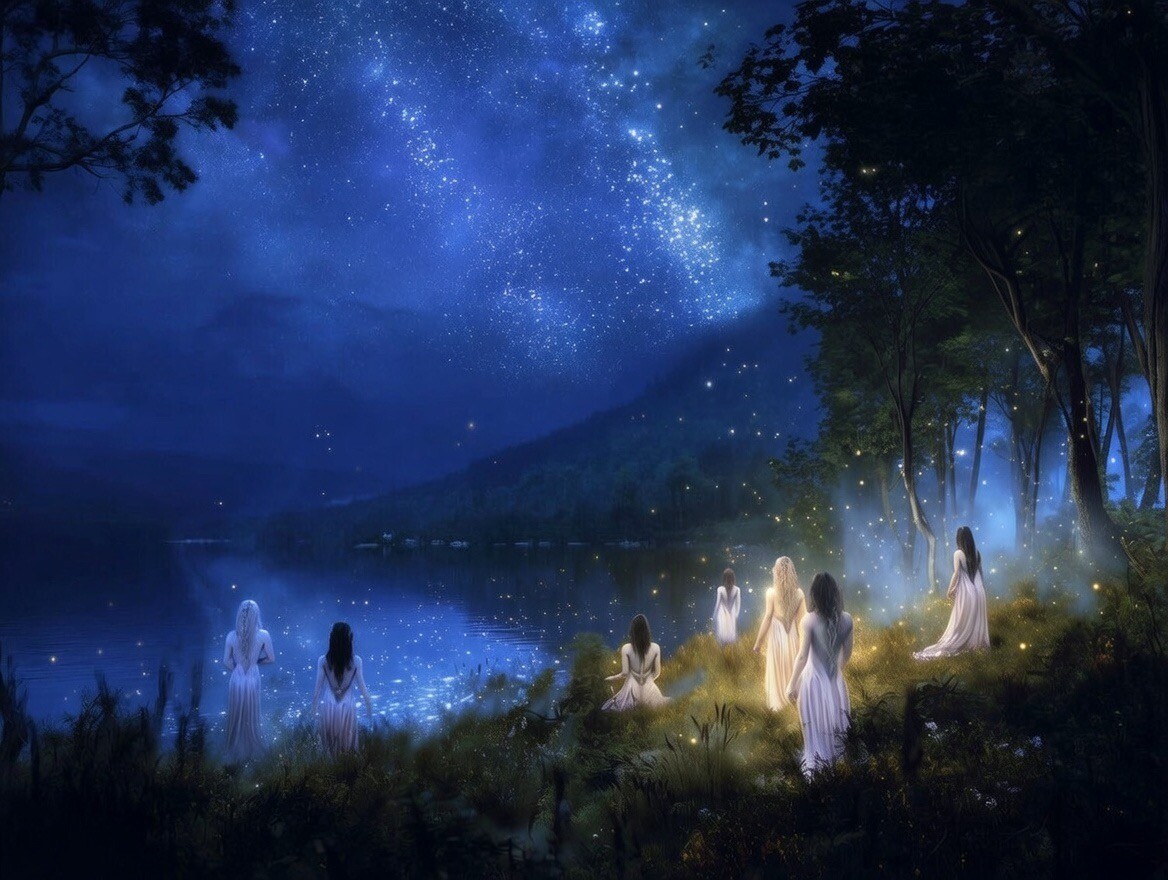
{Image: Cuiviénen under starlight}
It was enormous. The far side existed only as theory. On still nights the water held the sky so exactly that you lost track of which was which, with stars above and stars below and the shoreline a mere suggestion between them.
—•——•——•——•——•——•—
Once I could sit up without falling over, I started taking the world apart in my head.
The Quendi weren’t one people; they were three, and the three were different answers to the question of what it meant to be an elf, answers already visible to a child who was trying hard to look as though he wasn’t paying attention.
The First were the Minyar. Fourteen of them had woken beside the lake at the beginning, the smallest of the three kindreds. They had grown since, of course. A couple of generations’ worth of children now ran between their huts. All of them gold-haired: honey, wheat, a few heads pale enough to glint almost white in the starlight. They had fair skin and quiet bearing, and they were beautiful, every one of them, in a way that made you forget for a moment what you had been about to say.
They were also the most trusting people I had ever met, and that worried me.
Someday the rest of us would call them Vanyar — the Fair.
Next came the Tattyar, the Second. Fifty-six of them at the start, and they too had multiplied. They stood apart from the Minyar in almost every way: taller, heavier through the shoulders, built for work in a way the Minyar simply weren’t. Their men ran close to two meters. Their women were only a little shorter, and no one who met them twice made the mistake of thinking they were soft. Their hair ran dark mostly: black most often, some brown, a few heads the color of wood ash or banked coals.
Where the Minyar drifted, the Tattyar made. There was always a knife in someone’s hand, and always a piece of leather or wood or stone getting shaped into something else.
Someday they would be the Noldor — the Wise.
And last came the Nelyar, the Third — my own people. Seventy-four of us at the beginning, more than either of the other two combined, and thanks to that head start we were still the largest kindred by some distance. We had also been the slowest to wake. Last to open our eyes, last to speak, last to get up and walk around and join the conversation.
We looked somewhat like the Tattyar: tall and strong, if not quite as broad in the frame, a little quicker through the trees, a little more at ease in the water. Our hair ran mostly to silver, pale as moonlight caught on a thread, though a fair number of us came out dark. My own father’s line was silver.
Someday we would be called Teleri — the Last.
Three kindreds. The count at the beginning had been a hundred and forty-four; a generation or two on, it was perhaps three times that. All of them living together in this one place, around this one lake.
For now.
Because the Sundering was coming, and when it did it was going to carve through every kindred in a different way. The Minyar would leave to the last elf. The Tattyar would split cleanly down the middle. My own people, the Nelyar, would tear themselves apart worst of all: families against families, friends against friends, a grief none of them yet suspected.
I intended to make sure as many of the right ones stayed as I could manage.
Assuming I was right about any of this.
That was the quiet worry, the one I didn’t let surface often. I was operating on the strength of books I had read in another body, in another life: fiction, myths, stories and secondhand knowledge about a world where nothing I was now experiencing was supposed to be real.
I could be wrong about all of it: about the timing, about the shape of what was coming, about whether any of the levers I was reaching for even existed.
All I could do was prepare for the version of the future I remembered, and pray the rest was close enough to recognize when it arrived.
—•——•——•——•——•——•—
“He doesn’t sit still.”
My mother’s voice. She was just inside the hut, not quite out of earshot on purpose. I was on the grass in front of it, cross-legged, in the middle of a careful experiment involving my own wrist and my own ability to bend it without watching.
“He is curious, Enelyë,” my father said. “Children are curious.”
“Not like this one.” A pause. “Watch him.”
I felt their attention land on me at the same moment. Both of them in the doorway, wearing matching expressions somewhere between amusement and mild alarm.
I looked up and waved.
My mother made a startled sound that turned into a laugh halfway out. My father’s mouth twitched and lost its composure.
“See?” she said. “What elfling waves?”
“Ours, it would seem.” Enel folded his arms, though the crinkles at the corners of his eyes gave him away. “Perhaps the world will not wait on us forever, and he already knows.”
“Or perhaps he is simply odd.”
“That too.”
They went back inside.
I returned to the experiment, which was the matter of my own balance and which parts of my body were willing to cooperate with it.
Standing was the next conquest. It sounded simple. Every toddler on Earth managed it without particular fanfare. But this body was not the body my instincts remembered.
I got my feet under me and made it halfway up before my knees gave and the grass caught me. The next try brought me three-quarters of the way before I tipped sideways. The one after that was closer, and the one after that closer still, and I was almost —
“You’re doing that wrong.”
I twisted to look behind me, too fast, overbalanced, and ended up sitting hard on the ground.
Standing over me was a small person with gold hair.
She would have come up to about my shoulder if I had been standing, which I wasn’t. Her hair spilled past her shoulders in loose waves and caught the starlight the way only Minyar hair seemed to know how. Her eyes were a ridiculous dark blue, the blue of the lake at its deepest, where the starlight couldn’t reach.
She tilted her head and studied me as though I were something she had found under a leaf.
“You’re a strange one,” she announced.
I blinked up at her.
“The other children sit. They watch the stars. You just keep falling over.” She crouched to bring her face closer to my level. “Why?”
Because I am trying to stand, I thought, and because being this small for this long is a specific kind of torture you would not understand.
I shrugged.
She frowned. “You don’t say much, either.”
I shrugged again, because what else was I going to do.
“Hmm.” She walked around me in a slow circle. I had the uncomfortable impression of being catalogued. Then, without warning, she grabbed me under the arm and pulled.
My legs came up with me, surprised into cooperation. Her grip was far stronger than a child her size had any right to have. She was also, I noticed, adjusting her pull as I rose, shifting her own weight, steadying me, keeping me from pitching forward. Like she had done this before.
“There.” She let go once I had my feet under me. She stepped back, crossed her arms, and considered her work. “Better.”
I wobbled. But I stayed upright.
“You’re welcome.” The severity broke into a bright sudden smile. “I’m Ilvëa. Who are you?”
“Selas.” The word came out rough. I had hardly used my mouth for speech yet, and I hadn’t particularly wanted to.
“Selas.” She rolled the sounds around as though she were weighing them. “Nelyar, aren’t you? I’m Minyar. We woke up before anyone. That makes us special.”
So tribal pride started early, wonderful.
“Can you walk yet?” she asked.
“Working on it.”
“Good. When you can, we’ll play.” She spun, her hair went with her in a pale gold flare. “I’m coming back tomorrow.”
And then she was gone, running back across the settlement toward the Minyar huts at a speed I would have given a great deal to match.
Vanyar, I thought, watching her go. That would be the name her kindred wore someday: the Fair.
I stood there swaying gently and wondered what had just happened to me.
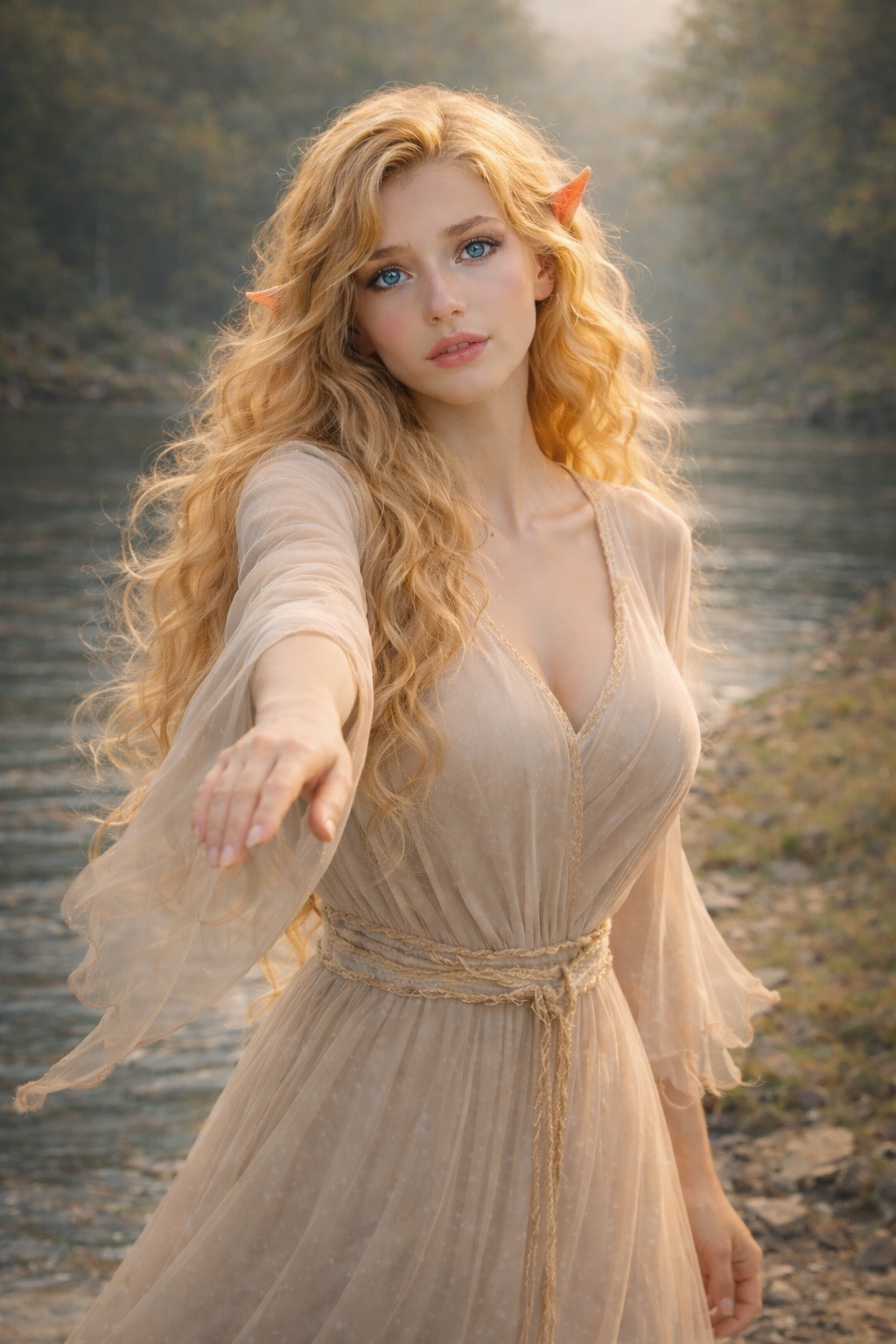
{Image: Young Ilvëa of the Minyar, older version}
—•——•——•——•——•——•—
[End of Chapter 1]
GLOSSARY
For those who wish to go deeper into the world and its vocabulary. This entry covers terms from Tolkien’s legendarium that appear in this chapter. Reading it is entirely optional — the story is written to stand on its own — but it may add a little texture to the journey.
PEOPLES & KINDREDS
Quendi — The elven word for “those who speak with voices.” What the Elves call themselves. All Elves are Quendi; they later divide into many different groups.
Nelyar — “The Third.” The third and largest group of Elves to awaken at Cuiviénen (74 of the original 144). They called themselves Lindar (“Singers”) internally, and were later named Teleri (“The Last”) during the Great Journey.
Lindar — “The Singers.” The Nelyar’s name for themselves, from learning music and song before formal speech. Selas’s people.
Minyar — “The First.” The smallest group of Elves, first to awaken (14 original souls). Later called Vanyar (“The Fair Ones”) for their golden hair and beauty.
Tattyar — “The Second.” The second group to awaken (56 originals). Later called Noldor (“The Wise”) for their craft and lore.
Eldar — “People of the Stars.” The name for those Elves who accepted the summons of the Valar and began the Great Journey to Aman. Separated from the Avari at the Sundering.
Avari — “The Unwilling” or “The Refusers.” Elves who refused the summons of the Valar and remained in Middle-earth. Our protagonist will lead a group of these.
PLACES
Arda — The name of the entire world in Tolkien’s mythology.
Cuiviénen — “Water of Awakening.” The lake in eastern Middle-earth where the first Elves opened their eyes under starlight. The birthplace of all Elven-kind.
CONCEPTS
Years of the Trees — The age before the Sun and Moon, when the world was lit only by stars and the Two Trees of Valinor. Each Year of the Trees was roughly ten mortal years long.
The Sundering — The division of the Elven peoples into Eldar (those who accepted the Valar’s call) and Avari (those who refused). A pivotal moment in Elven history.
The Four-Child Limit — A biological constraint on elven reproduction. Traditionally, no family can have more than four children. Selas suspects this is connected to the Light energy required for pregnancy — and that learning to contain Light might overcome it.