
Work Text:
Hockey Content Creators and Fan-Created Works
The Hockey Guy is a YouTuber who covers the NHL. His videos are relatively short, accessible, and fun, and unlike many hockey YouTubers, he covers the entire league instead of one team.
365 Hockey Girl is a YouTuber focused on the Professional Women’s Hockey League (PWHL). Another fun, accessible, and leaguewide channel, and she does watchalong streams of PWHL games.
The What Chaos! YouTube channel has a Learning Hockey playlist focused on the NHL for new fans. A particularly useful video on the list is an explanation of how the NHL playoffs work.
The PWHL’s official YouTube channel has a Professor Puck series aimed at introducing fans to the PWHL. Some of the videos cover ice hockey generally, while others explain the PWHL as a league and how it differs from the NHL.
An incredibly comprehensive Tumblr post with links to lots of useful resources that help with understanding both hockey generally and how it fits into Shane and Ilya’s story and characterization:
A Tumblr post on how to watch a hockey game as a new fan and what to look for. (My only addition: watching online or on TV is a great intro to hockey, but if you have the opportunity to attend a hockey game in person, it’s an even better way to watch!)
One final Tumblr post on hockey culture, including superstitions, collectivism, and WAG culture.
A couple of wonderful AO3 writers have put together useful reference works! A Guide to the NHL/MLH: Everything but the Hockey covers a ton of aspects of how men’s professional hockey works, including the structure of the league and season, how player contracts, trades, and free agency work, and things players have to be concerned about.
The Fic Writer’s Guide to Life as a Pro Hockey Player is another great one for understanding the day-to-day life of NHL players, including their schedules, what staff members they interact with, their diets, travel, training, and living situations.
Common Fanfic Hockey Errors
Captains don’t run practices. While captains are team leaders in the sense of providing motivation and emotional support to their teammates (think Ilya’s locker room speeches) and representing the team to the on-ice officials, they don’t run practices. The head coach and assistant coaches will have very specific things they want their players to work on and will run practices to get as many of those in as possible. Coaches want their captains focused on their own practice drills instead of leading drills for the whole team!
Teams don’t technically need to have a captain at all. NHL teams have three spots they can use for either one captain and two alternate captains or, if they choose not to have a captain, three alternate captains. Teams may also switch which players are named alternate captains from game to game.
Handshake lines don’t happen after most games. After most games, players will exit the ice through the tunnel to their locker rooms without a handshake with the other team. You can see an example of this in S1 E3 when Ilya fist-bumps his own team and tells them “good job, I love you” while chirping Scott. Handshake lines only happen at the very end of playoff series, including Cup finals, or games in international tournaments, such as the Olympics or International Prospect Cup (this is why we see Shane and Ilya in handshake lines early in E1).
Coaches don’t decide rosters. A team’s general manager (GM), with input from assistant GMs, scouts, and analytics staff, will decide which players to sign, trade, promote from the minor leagues, or demote to the minor leagues. Coaches can give input, but it’s up to the GM in the end. Coaches will decide lines (which groups of teammates play together).
“Bye weeks” or other midseason breaks aren’t a thing for top players. From the beginning of October to the beginning of April, all NHL teams are playing a regular schedule of 82 games in roughly 180 days. Teams will have short breaks for American Thanksgiving (4th Thursday in November) and Christmas (December 24-26) but will otherwise be playing every couple of days on average. Most days that players aren’t taking part in an actual game, they have on-ice practice, conditioning, and tape review with the team. The NHL collective bargaining agreement requires teams to give players 4 days off from team responsibilities each month, but due to scheduling demands and wanting to balance play and rest throughout the season, it’s rare for days off to be consecutive, much less 4 in a row.
The only scheduled breaks in the NHL calendar other than Christmas are 5-7 days off for the All-Star Game and, in years where the NHL allows players to participate in the Olympics, 2 weeks off for the Olympics. (Recently, the NHL has skipped the All-Star Game in years players go to the Olympics.) Ilya and Shane would likely be selected to the All-Star Game every year and at least Shane would participate in the Olympics, so they wouldn’t get this break.
Neither Ilya nor Shane were ever traded to Ottawa; they signed as free agents. Players can move teams by signing with new teams as free agents when their contracts expire or being traded. (As top players, Shane and Ilya probably have no-movement clauses in their contracts after their rookie deals expire and can’t be traded.) Ilya’s contract with Boston expired in 2018 and he chose to sign with Ottawa as a free agent after this. Shane’s contract with Montreal expired in 2021 at the end of TLG and he signed with Ottawa. Examples of GCU trades include Toronto trading Troy Barrett to Ottawa for draft picks after his confrontation with Dallas Kent.
Don’t believe a word Ilya says: Shane’s backhand is exceptional and Hayden Pike is way better than Montreal’s 15th best player. Ilya’s chirps are meant to get under Shane and Hayden’s skin (and Scott’s, if you use book canon for his age) for being obviously untrue, to the point of ludicrous. Shane is based on real-life player Sidney Crosby, who famously has one of the best backhands in hockey history (see examples here). Hayden plays on the first line with Shane, which means he’s likely one of the top offensive players on Montreal other than Shane himself - he would not be the 15th best player on a 23-person roster.
Montreal and Boston/Ottawa/New York can’t face off against each other in the Cup finals. We have a section on NHL and PWHL playoff structure and NHL divisions and conferences, but one important detail: no matter what, the Cup finals will always be between an Eastern Conference team and a Western Conference team.
Shane is very rigid about his diet in harmful ways, but he’s not restricting calories. NHL players can burn several thousand calories in the course of a game and regularly eat around 4,500 to 5,000 calories a day to maintain their weight. If Shane were restricting calories heavily, he would be dehydrated and lose muscle mass, affecting his ability to play, and it would raise alarm bells among Montreal’s trainers and medical staff. Shane’s food struggles center around categorizing foods as “good” and “bad” and being unable to let himself enjoy an occasional treat, not overall calorie restriction. This would be much harder for team professionals to spot and deal with - a lot of hockey players are very particular about their diets, and if his diet is overall healthy for a hockey player, this behavior might even be encouraged.
A 9 PM or 10 PM bedtime isn’t happening during the season. While I firmly believe that Shane is an “early to bed, early to rise” person in his ideal world, most NHL games start at 7 PM local time and, if they end in regulation, end at about 9:30 PM local time. (Overtime or shootout games will go slightly later, but in the regular season, he’ll be done by 10 PM.) After the game, players need to do cooldown stretches, shower, give interviews to the press, and have a postgame meal, so it’s often an hour or more before they’re able to leave the arena. And while we often politely ignore this for the sake of Shane-Ilya games as foreplay, if a flight is short enough, teams playing on the road will hop on a plane home or to their next game immediately after they leave the arena. NHL players end up being night owls with this schedule. To make up for the late nights, afternoon pregame naps are part of most players’ routines.
Hockey IQ is about anticipating plays, not knowing stats. Shane probably knows his opponents’ stats very well, but when commentators refer to him as having the “highest hockey IQ out there,” they’re referring to an in-game skill. Hockey IQ is an umbrella term for having high situational awareness and being able to anticipate what opponents will do. Having a high hockey IQ allows Shane (and Ilya and other star players) to pick the best play or strategy at any given moment in a fast-moving game. Shane probably has this skill through a combination of natural instinct and a lot of time spent reviewing game tape.
Teams charter flights to and from games instead of flying commercial. Our beloveds won't be waiting in the terminal with everyone else: teams charter private flights between games that use private terminals within airports. This has several advantages for the teams: schedule flexibility if a game goes into overtime, having more spacious seating for large hockey players, being able to take along additional staff without adding extra flight ticket costs or sweating sold-out flights, and direct flights between airports that may not have commercial nonstop flights available.
Players don't bring their equipment home. All of the hockey gear players use (sticks, skates, uniforms, tape, etc.) is handled by professional equipment staff who will transport it between the practice facility, home arena, and road games, maintain the equipment, and do the laundry. (We should all be thankful for that last part, because used hockey gear reeks.) Players don't need their gear at home and teams really don't want players getting hurt because they're carrying heavy equipment incorrectly.
Rules, Penalties, Statistics, and Trophies
For an excellent summary of NHL rules, check out Captain Grayson’s Google drive of hockey resource docs.
This is what a hockey rink looks like, as seen from above:
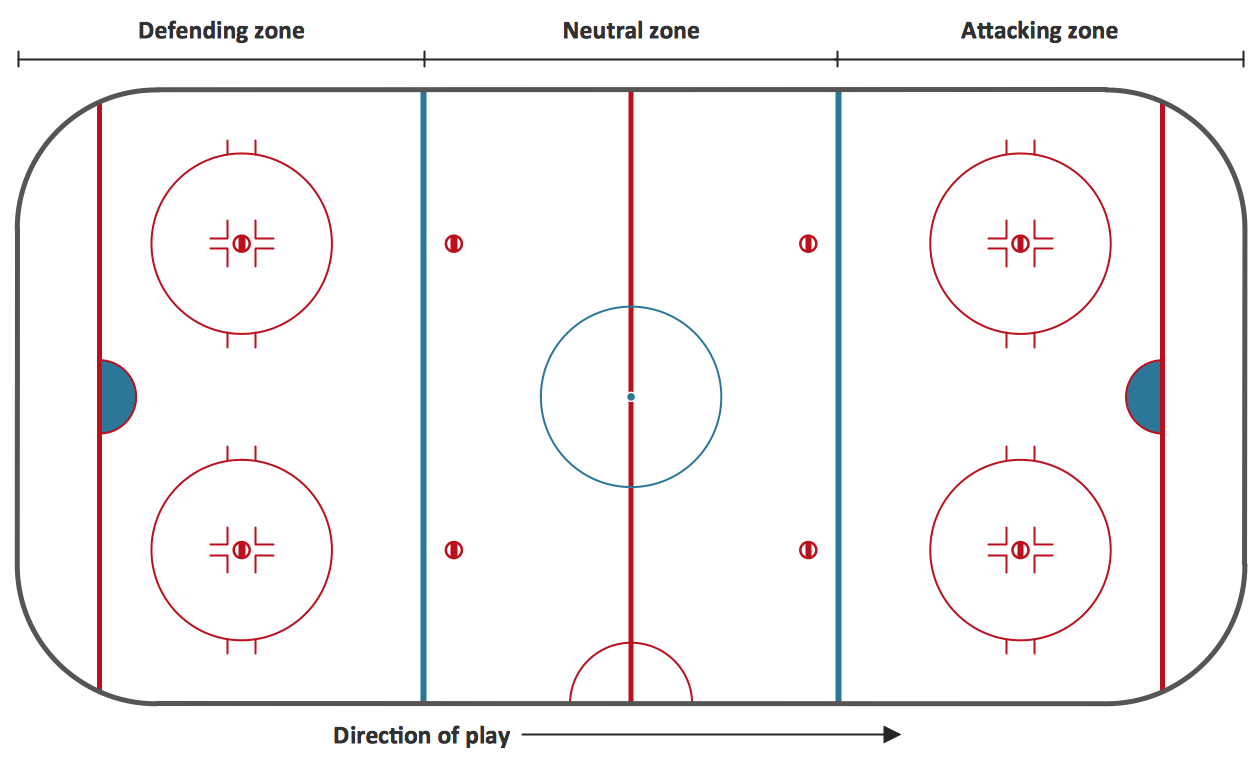
The goal of hockey is deceptively simple: put the puck in your own net (behind the little blue half-circle on the right, known as “the crease”), keep it out of the other team’s net (behind the little blue half-circle/the crease on the left).The red line in the middle is the center line, the two blue lines are very creatively called the blue lines, and the lines by each net are the goal lines. The ice is surrounded by a barrier known as “the boards.”
Hockey games are divided into 3 periods of 20 minutes each of game time. (With stoppages in play, the actual time elapsed is usually 35-40 minutes per period.) Between each period, there is an intermission of 18 minutes. If a regular season game is tied at the end of the third period (“end of regulation”), the game will go to a 5-minute overtime period where the teams play 3-on-3. If a team scores a goal during overtime, the game ends immediately and they win. This used to be known as “sudden death” overtime but is now referred to as “sudden victory.” If the game is still tied after 5 minutes, the teams enter a shootout, in which three players from each team take turns attempting to get a solo shot past the other team’s goalie. (This started in 2015; prior to that it was 4-on-4 during the overtime period.) If one team has more goals after three rounds, they win. If the teams are tied, the shootout rounds continue until one team scores in a round and the other team doesn’t.
-
Playoff hockey works differently: the teams play standard 5-on-5 for 20 minute periods until someone scores a goal. If no one scores at the end of an OT period, there is another intermission, then another period (known as double OT, triple OT, etc.) There are no shootouts in playoff hockey.
When a player’s team has the puck, players will attempt to move the puck toward their offensive zone and goal, evade defenders from the opposing team, pass to teammates who are further up the ice or have better shots on net, and shoot the puck toward the net. Players on the team without the puck will attempt to take possession of the puck away from the team that has it, block the player’s teammates from getting the puck, and block shots before they reach the net. Players on defense will routinely “check” players, a blanket term for using one’s body or stick to interfere with the other team’s puck possession.
Faceoffs - two players from opposing teams competing for the puck after an on-ice official drops it on the ice - happen at the beginning of each period and after a stop in play. They can happen at the center dot, referred to as “center ice,” at one of the four dots in the corners of the neutral zone, or in the dots in the defending and attacking zone. Faceoffs will always be at center ice at the beginning of a game (known as “puck drop”), at the beginning of a period, and after a goal. For other stops in play, the faceoff will happen at the dot closest to the last place where play was happening. Since centers almost always take faceoffs, they’re a great opportunity to write Shane and Ilya flirting with and teasing each other or Ilya chirping other players!
There are some common infractions that lead to a stop in play, but not a penalty:
-
Offside is when a player crosses the blue line into their own attacking zone before the puck crosses the line. Position is determined by the player’s skates - both skates must be over the blue line before the puck for offsides to be called. If offsides is called, play stops and a faceoff is held at the nearest dot in the neutral zone. If a player scores a goal after going offsides, the goal does not count.
-
Most offside infractions are unintentional. However, if the officials think a player intentionally went offsides, they move the faceoff to the defensive zone.
-
A critical rule hockey players learn is not to draw an offside call when your teammate has the puck. Ruining their possession by going offsides is considered bad form and a failure of “hockey IQ”/awareness.
-
-
Icing is when a player shoots the puck from behind the center line and it travels all the way to behind the goal line without any player touching it.
-
If a team is called for icing, play stops and a faceoff is held in the defensive zone of the team that committed the icing. They may not change players during the stoppage in play, to prevent teams intentionally drawing icing calls to switch out tired players.
-
When a team is on a penalty kill, icing is permitted. This is known as “clearing the puck” and is a common strategy to relieve pressure from the other team’s power play and slow them down. However, clearing the puck is not allowed if the opponent has pulled their goalie to bring on a sixth skater, so taking a shot on an empty net and missing is an icing call.
-
Here’s a list of common penalties that lead to a power play - a time when the player who committed the penalty must go to the penalty box (also known as the “sin bin”) and that player’s team must play with one fewer skater for a period of 2 to 5 minutes. This is called a power play for the team that has all their skaters and a penalty kill for the team that loses a skater. If a team scores a goal on their power play, the penalty ends and the penalized player may return to the ice unless they are also serving an additional penalty. Unless otherwise noted, each penalty is 2 minutes, also known as a minor penalty.
-
Aggressor: engaging in a fight with an unwilling combatant. This is a 5-minute major penalty. It will not be charged alongside instigating (see below).
-
Boarding: pushing, tripping, or checking an opponent violently into the boards. Note that checks into the boards are common - this is for violent contact.
-
Cross-checking: hitting an opponent with the hockey stick when it’s held in two hands and not making contact with the ice.
-
Diving/embellishment: exaggerating the effect of a hit in an attempt to draw a penalty on the other team.
-
Fighting: engaging in a physical altercation (usually punches) with an opponent. This is automatically a 5-minute penalty, also known as a major penalty.
-
Goaltender interference: checking or physically impeding the goaltender.
-
If a goal is scored as a result of goaltender interference, it doesn’t count.
-
High-sticking: touching an opponent with the stick above shoulder level.
-
Hooking: using a stick as a hook to try to slow an opponent down.
-
Illegal check to the head: any hit deliberately targeting the opponent’s head or when the head is the main point of contact. Often issued alongside a game misconduct (ejection).
-
Instigating: provoking a fight with another player. This is often used when two players engage in a fight clearly started by one player: both will serve the 5-minute fighting penalty, but the instigator will serve an additional 2-minute instigator penalty as well.
-
Interference: using your body or stick to try to impede an opponent who doesn’t have possession of the puck.
-
Roughing: something of a catch-all term. Can refer to pushing or shoving after the whistle has been blown to stop play or away from the puck, a player making contact with an opponent’s head or neck, or forcibly removing an opponent’s helmet.
-
Too many men on the ice: more than 6 people (usually 5 skaters + 1 goalie) on the ice for a team at one time. Usually the result of a slow or sloppy line change.
-
Tripping: using one’s stick or body to trip an opponent.
-
Unsportsmanlike conduct: behaving rudely or aggressively toward opponents, on-ice officials, or fans. This is used to police the use of slurs in-game.
Note that if a player is injured due to an opponent’s penalty, the penalty can be upgraded, even if the conduct would otherwise be a minor penalty. Penalties may be upgraded to a 5-minute major penalty or a game misconduct, which ejects the player from the rest of the game.
A comprehensive list of penalties can be found here: NHL Rules: Penalties
In hockey, a number of statistics are tracked for players. Separate stats are tracked for skaters (forwards and defenders) and goalies. Here’s a list of stats for skaters:
-
Goals: total goals scored. Top players will score 50-60 goals per season.
-
Assists: number of goals the player has assisted. Sometimes referred to as “apples.” Up to two players may earn an assist on a goal; if two assists are awarded, the player who passed directly to the goal scorer gets the primary assist and the player who made the second-to-last pass gets the secondary assist, but these all count equally as assists.
-
Assist leaders will score 70-90 assists per season. Assist leaders tend to be a mix of star players and linemates of said stars (for example, Hayden would probably rack up assists passing to Shane, but Shane would also score assists by passing to teammates when defenses focus on him and leave them open).
-
-
Points: combined total of points and assists. A season with 100 points or more is considered a very good season. 8 players hit the 100-point mark in the 2025-26 season, with Connor McDavid getting 138 points.
-
Shots on goal: how many times the player shoots the puck at the net. Blocked shots and shots that miss the net don’t count toward this.
-
Hits: how many times the player has initiated legal contact with an opponent that causes the opponent to lose the puck. You don’t get awarded a hit if you commit a penalty.
-
Blocked shots: how many times the player stops a puck shot toward the net from reaching the crease.
-
Penalty infraction minutes (PIM): how many penalty minutes the player has been assessed.
-
Time on ice: how long the player spends on the ice in a game or season. Top players will typically play about 22-24 minutes per game.
-
Plus/minus: how many goals the team scores while the player is on the ice, subtracting how many goals the opponent scores while the player is on the ice.
Each year, the NHL gives out awards to players and teams. Until recently, this was done in a ceremony in late June after the Stanley Cup finals ended (as seen in 2011 and 2017 in the GCU). For most awards, three finalists are named before the awards are announced. Here’s a list of the most prominent awards players can win:
-
Art Ross: player with the most points (goals plus assists) in the regular season.
-
Calder Memorial Trophy: player with the best rookie season.
-
Shane won this trophy in 2011.
-
Not to be confused with the Calder Cup, the trophy given to the team that wins the minor league AHL playoffs.
-
Conn Smythe: most valuable player in the playoffs. Usually goes to a player on the team that won the Stanley Cup, but is sometimes awarded to a player on the team that lost the Stanley Cup Final (6 times out of 61, most recently 2024).
-
Scott won this trophy in 2017 and Shane won it in 2020. The 2014-16 winners aren’t mentioned in canon, so Shane and Ilya may have also won it during their other Cup wins.
-
Unlike other trophies, this one is awarded immediately after the final Stanley Cup game of the season and finalists are not announced in advance.
-
-
Hart: most valuable player during the regular season.
-
Ilya wins this award in 2014.
-
-
Lady Byng: most sportsmanlike player.
-
We have no confirmation that any GCU player has ever won it, but Shane and Ilya jointly presented the trophy in 2014.
-
Fanon diverges wildly on whether Shane has won it. Some believe he does, some believe he argues with players and refs too frequently to get it. We can safely assume that Ilya has never won it and would consider it an insult.
-
-
Norris: best defender in the regular season.
-
Rocket Richard: top goal scorer in the regular season.
-
Selke: forward who is the best at defensive aspects of the game.
-
Ted Lindsay Award: best player in the regular season as judged by other NHL players. The Hart MVP trophy and other awards are voted on by members of the press.
-
The same player has won both the Hart and Ted Lindsay trophies 35 out of the 52 years both have been awarded.
-
-
Vezina: best goaltender in the league during the regular season.
Who’s Playing? Rosters, Positions, Lines, and Special Teams
NHL and PWHL teams have 23 people on the complete roster, with 20 players being eligible to play in any given game: usually 12 forwards, 6 defenders, a starting goaltender (“goalie”), and a backup goalie. Players on the roster may not participate in a game if they are recovering from an injury or if the coach doesn’t want to use them on a given night; the latter is known as a “healthy scratch.” Being a healthy scratch as a forward or defender is usually a bad sign about the player’s ability and/or relationship with their coach. (However, this is not true for goalies. Most NHL teams have 3 goalies on their roster but can only have 2 ready for individual games.)
Most of the time, there are 3 forwards, 2 defenders, and 1 goalie on the ice for each team. Skaters (the collective term for forwards and defenders, everyone but the goalie) play in shifts, which are usually short: 30-45 seconds for forwards and about a minute for defenders.
A quick guide to each position, including their role and how their play is stereotyped:
Center (forward): Play in the center of the ice, take faceoffs against opposing centers, set up plays, and support both the offense and defense. While they are often top scorers, some centers are more focused on setting up plays and getting assists than scoring goals. Often stereotyped as hardworking overachievers and the most likely to play hard on both offense and defense. Shane Hollander, Ilya Rozanov, Scott Hunter, and Dallas Kent are centers in the GCU.
Right wing (forward): Play on the right side of the ice, focus on scoring opportunities and putting pressure on the opponents’ defense. Many top goal scorers play right wing. Often stereotyped as glory-seeking players who don’t “backcheck” (play defense) or play hard when they don’t have the puck. Troy Barrett, Luca Haas, Tanner Dillon, and Carter Vaughn are right wings in the GCU.
Left wing (forward): Play on the left side of the ice, and like right wings, focus on scoring opportunities and putting pressure on the opponents’ defense. Slightly less of a glory-hound stereotype than right wings, but they also sometimes get heat for not playing defense. Hayden Pike, Zane Boodram, and Cale Wagner are left wings in the GCU.
- Some players can play either right wing or left wing. This is very common in the PWHL, but rarer in the NHL. There are also forwards that can play either center or wing. In-universe, Ilya can do this but Shane cannot.
- Note: Cliff Marlow/Marleau and Greg Huff are forwards, but it’s not specified whether he plays left or right wing.
Defenders: Focus on protecting the defensive zone, blocking shots, and stopping opposing players from scoring. They can also help with transitions between zones, creating scoring chances, and supporting offensive plays from further back (the blue line). Play in left/right pairs (see below for more details). Stereotyped as tough and smart but with poor puck-handling skills. Often the largest players on the team. Ryan Price, J.J. Boiziau, Evan Dykstra, Boyle, Frank Zullo, and Matti Jalo are defenders in the GCU.
Goalies: Stay in the net, try to save shots (prevent them from going in the net). “Goalies are weird” is a common stereotype. They have a lot less interaction with their teammates than other players, who have to communicate with their linemates constantly. While many hockey players are superstitious, goalies often crank it up to 11. Eric Bennett, Wyatt Hayes, Patrice Drapeau, Soren “I’m not even that weird” Miitka, Leah Campbell, and Tommy Andersson are goalies in the GCU.
Named players without canon positions (aka stick them wherever you want!) include:
- Boston: Carmichael, Connors, Hammersmith
- Montreal: Gilbert Comeau
- Ottawa: Holmberg, LaPointe, Young
- Max Riley
The 12 forwards who play in a game are broken up into four lines. Each line will have a center, left wing, and right wing.
Coaches use many different strategies with their offensive lines, but most lines will follow these basic principles:
- The first line will usually be the best offensive players on the team. They will play the most minutes (usually about 20-22 minutes a game) and face the best defenders from the team’s opponents.
- The second line will also be highly skilled offensive players. Usually they will be slightly weaker than the first line, but when teams have two star players at the same position (like Connor McDavid and Leon Draisaitl on the Edmonton Oilers), the lines may be of equal ability. The second line will get about 18-20 minutes of playing time per game.
- The top two lines are often collectively known as “scoring lines.”
- The third line is often known as a “checking line.” They may not be as strong offensive players as players on the first or second lines, but they focus on strong defense, physical play, and shutting down the other team’s top scorers. They will try to slow the game down to prevent the other side from getting scoring opportunities.
- The fourth line is sometimes known as an “energy line” or a “wildcard line.” They will be the weakest players and play the fewest minutes, less than 10 minutes per game, but they play an important role in allowing top players to rest during games and bringing energy and hustle to the lineup.
Defenders play in pairs of one left defender and one right defender. Left defenders will often be left-handed and right defenders will often be right-handed, but this is not always the case. Since there are only 6 defenders available for a game, teams play them in 3 pairs of 2. Defenders have to do less skating than forwards and can therefore play slightly longer shifts. Often, coaches will try to pair one defender who is a shutdown player with another defender who is more skilled at scoring.
Like with forward lines, coaches can use a variety of strategies with defender pairings, but these are typical strategies:
- Top pairing/first pair: the strongest defenders on a team. Usually matched up against the first offensive line from the other team. These are most likely to be well-rounded players who can contribute to goal scoring as well as defense.
- Second pairing: these are secondary defenders who are talented, but not quite strong enough to face off against the opponents’ top lines. They’re often used to provide structure during transition or offensive line changes in-game.
- Third pairing: weaker defenders or players with a specialty role. Ryan Price was likely a third-pairing defender when he was used as an enforcer. They are often used to defend leads, bring energy when the top defenders need a rest, or against opponents’ third and fourth lines when scoring danger is low.
Teams will also have specialized lines for power play and penalty kill situations, known collectively as special teams.
Power play units usually consist of four forwards and one defender, though teams may also use three forwards and two defenders or five forwards. Teams will have two power play units. The first unit will have the highest ice time per power play, include the top players on the team, and stay out on the ice for the first minute to minute and a half of a power play. A second unit will substitute for the first unit and will usually be skilled offensive players who are slightly below the first unit. Occasionally, exceptionally talented and durable players will “double shift,” meaning they stay on the ice for the entirety of the power play - Alex Ovechkin does this for the Washington Capitals in real life.
Penalty kill units usually consist of two forwards and two defenders. Like with power play units, teams usually have two penalty kill units, with the first unit playing the first minute to minute and a half of a penalty kill. Top offensive players rarely participate in the penalty kill: the focus is on preventing the other team from scoring, not creating their own scoring opportunities, and the top players are better served by getting rest while defensive-minded players cover penalty kill minutes. The most important skills for penalty kill players are speed (there’s more ground to cover with fewer players on the ice), shot blocking, and hockey IQ (they need to be able to anticipate what the power play unit will do). Often, the forwards included on penalty kill units are third line and fourth line forwards.
Teams may “pull the goalie” late in a game when they are losing by 1-2 goals. This entails having the goalie come out of the net so that they can have a 6th skater on the ice, creating a quasi-power play situation known as 6-on-5. (Having more than 6 players on the ice at any time is a “too many men on the ice” penalty.) This is a high-risk, high-reward situation: the extra attacker makes it easier to score, but the opposing team will be able to score “empty-net” goals if they’re able to get possession of the puck with a clear shot at the goal. Empty net goals are considered quite easy once a player is in position, since there’s no goalie to beat, and players often score them from deep within their defensive zone.
- Teams who have pulled their goalie often play 5 forwards and 1 defender to maximize their scoring chances, though 4 forwards and 2 defenders is also a common setup. Top offensive players will play in these situations alongside offensively-minded defenders.
- Teams facing off against a team that’s pulled their goalie usually play a standard lineup of 3 forwards and 2 defenders. Most of the players on the ice will be defensive-minded players, like a checking line alongside the top defender pair. However, teams will want to have a center skilled at winning faceoffs on the ice to try to get puck possession and some teams choose to have a “sniper” (a player with an exceptionally accurate shot) play in these situations to maximize their chances of getting empty net goals.
When a game goes to overtime during the regular season, teams may play only 3 skaters plus their goalie, known as 3-on-3. The purpose of moving to 3-on-3 in overtime is to encourage a faster style of play that leads to more goal scoring, so skating speed becomes especially important in overtime. Typically, teams will play two forwards (including at least one center for faceoffs) and one defender during overtime and have 2-3 units for 3-on-3 play. As mentioned above, overtime playoffs don't do 3-on-3 and teams will use their typical lineups.
NHL Teams, Divisions, Conferences, Playoffs, and Rivalries
There are currently 32 teams in the NHL, divided among two conferences of 16 teams each, the Eastern Conference and the Western Conference. Each conference is further divided into divisions of 8 teams each. During the regular season, teams play other teams in their division 4 times (2 home, 2 away), teams in the same conference but different division 3 times, and teams in the other conference twice.
Here’s a list of teams, with the real-life team names first, followed by GCU team names (if known) in parentheses. I’ve also noted teams that joined or moved cities after the GCU story begins and when.
Atlantic Division, Eastern Conference
- Boston Bruins (Boston Bears/Boston Raiders)
- Buffalo Sabres
- Detroit Red Wings
- Florida Panthers (note: references to “Sunrise” as a playing location in GCU refer to Florida. They play in Sunrise, FL, a suburb of Miami)
- Montreal Canadiens (Montreal Voyageurs/Montreal Metros)
- Ottawa Senators (Ottawa Centaurs)
- Tampa Bay Lightning
- Toronto Maple Leafs (Toronto Guardians)
Metropolitan Division, Eastern Conference
- Carolina Hurricanes
- Columbus Blue Jackets
- New Jersey Devils
- New York Islanders (Brooklyn Scouts)
- New York Rangers (New York Admirals)
- Philadelphia Flyers
- Pittsburgh Penguins
- Washington Capitals
Central Division, Western Conference
- Chicago Blackhawks
- Colorado Avalanche
- Dallas Stars (GCU is a bit odd here. In the books, Dallas has an unnamed team. In the show, there’s the Houston Drillers - Houston doesn’t have an NHL team in real life - but no confirmed Dallas team. So go wild and pick whatever canon you want!)
- Minnesota Wild (Minnesota Nomads)
- Nashville Predators
- St. Louis Blues
- Utah Mammoth - prior to 2024, the Arizona Coyotes
- Winnipeg Jets - prior to 2011, the Atlanta Thrashers
Pacific Division, Western Conference
- Anaheim Ducks (Anaheim Hammerheads)
- Calgary Flames
- Edmonton Oilers
- Los Angeles Kings (not officially named, but Jacob Tierney has joked/possibly not joked they’d be named the Los Angeles Queens)
- San Jose Sharks (San Francisco Mission)
- Seattle Kraken - 2021 expansion team
- Vancouver Canucks
- Vegas Golden Knights - 2017 expansion team
For a great primer on the structure of playoff hockey (including a longshot way to have an Eastern Conference Finals with Montreal vs. Boston), check out Captain Grayson’s guide here. I’ll put a few bullet points here:
- The top 3 teams from each division make the playoffs, as well as 2 extra wild card teams from each conference.
- All playoff series are best of 7 and follow a 2-2-1-1-1 format: 2 home games for the higher-seeded team (known as “home ice advantage”), 2 away games, 1 home game, 1 away game, 1 home game. The series will end once a team wins 4 games.
- In the first round, the top-seeded team in each division plays against one of the wild card teams - the top seed with the better record plays against the wild card with the worse record, regardless of division. The 2nd team and 3rd team from each division play against each other.
- In the second round, the winner of each series between the top seed and wild card plays against the winner of the #2 seed/#3 seed series.
- This means that if a wild card upsets a top-seeded team, they may play Round 2 against a team from the other division in their conference - but not a team from another conference. This most recently happened in 2023, when Seattle from the Pacific Division got a wild-card spot against Colorado from the Central Division, won the series, and lost to Dallas in the next round.
- In the third round, also known as the conference championships, the winner of each Round 2 series will play the other team still in the playoffs from their conference.
- The fourth and final round is the Stanley Cup Finals. The last team standing from the Eastern Conference will play the last one from the Western Conference.
The NHL tends to encourage very intense rivalries, due to both the schedule/playoffs structure that pits divisional rivals against each other often and the team-first culture. Boston-Montreal is a particularly intense and longstanding rivalry, which is why Ilya and Shane being drafted to these teams as rival players is so meaningful. For a primer on this rivalry specifically, check out a video on the history or the extensive Wiki article. You can see a fan perspective on the rivalry here.
As Ottawa is a newer and historically less successful team, it has fewer IRL rivalries. However, matchups between Ottawa and Toronto are referred to as the “Battle of Ontario” and can get intense. In the GCU, Ottawa and Montreal would likely develop an intense rivalry due to their proximity, shared division, Ottawa’s post-2018 improvement, and Shane signing with Ottawa.
Some other examples of teams with prominent rivalries:
- Boston-Toronto
- Calgary-Edmonton (“Battle of Alberta”)
- Chicago-Detroit (used to be a bigger deal when Detroit played in the West)
- Chicago-St. Louis
- Colorado-Detroit (same as Chicago-Detroit)
- Edmonton-Los Angeles
- Florida-Tampa Bay (“Battle of Florida”)
- Montreal-Toronto
- All combinations of the New York/New Jersey teams
- New Jersey-Philadelphia
- Philadelphia-Pittsburgh (“Battle of Pennsylvania”)
- Pittsburgh-Washington (particularly in the 2010s during Sidney Crosby and Alex Ovechkin’s peaks, which inspired Shane and Ilya in Heated Rivalry)
A final team concept you may come across is the “Original Six.” From 1942 to 1967, there were only six teams in the NHL: Boston, Chicago, Detroit, Montreal, the New York Rangers, and Toronto. The league added 6 expansion franchises in 1967 (Los Angeles, Oakland, Minnesota, Philadelphia, Pittsburgh, and St. Louis) and began a period of rapid expansion from 1967 to 1979. The Original Six franchises tend to be the most profitable and have the largest fanbases. Historically, they have also been quite successful even after NHL expansion, winning 21 out of 58 Cups after 1967. However, this is not a guarantee of current success. 4 of the Original Six teams missed the playoffs in 2026 and only Montreal made it past the first round.
Remember The Ladies: Women’s Professional Hockey
The current professional women’s hockey league is the PWHL, or Professional Women’s Hockey League, founded way back in…2023.
Prior to the formation of the PWHL, there were numerous attempts to create a top-level women’s ice hockey league, but many of them were short-lived and none paid players a salary until 2015. The Canadian Women’s Hockey League (CWHL) lasted from 2007 to 2019, but teams were unstable and folded or moved frequently, players weren’t paid until 2017, and the league collapsed in the spring of 2019.
A competing league, initially called the National Women’s Hockey League (NWHL) and later rebranded as Premier Hockey Federation (PHF) in 2021, launched in 2015 and was the first North American women’s hockey league to pay its players. However, salaries were often less than $10,000 per year and players didn’t have health insurance. Teams played in tiny arenas and lacked regular ice time and devoted training facilities.
After the collapse of the CWHL in 2019, leading women’s hockey players formed the Professional Women’s Hockey Players Association (PWHPA), which advocated for better playing conditions for women and boycotted the surviving NWHL/PHF due to poor conditions for players. (Hilary Knight infamously referred to the league as “a glorified beer league.”) Between 2019 and 2023, the PWHPA organized annual Dream Gap tours, putting on showcases in cities across North America to promote women’s hockey and raise awareness about the lack of support for women’s hockey compared to men’s.
In 2023, the PWHL was formed when the PWHPA partnered with billionaire Mark Walter to purchase the PHF’s assets and end the boycott. The PWHPA is now the official players’ union of the PWHL. While there’s a long way to go, the minimum salary is now over $37,000 a year, with a housing stipend and other benefits. The PWHL has been growing in popularity, helped along by making the games available for free on YouTube outside of Canada, growing interest in women’s sports in North America, and a superb 2026 Olympics women’s ice hockey tournament attracting new viewers.
Women’s hockey is better about homophobia than men’s hockey. There are several dozen openly queer players in the PWHL, while there are none in the NHL, and the PWHL has embraced Pride initiatives. However, some serious issues remain. PWHL player Britta Curl-Salemme (now in Detroit, formerly in Minnesota) has liked and shared anti-trans and racist content online but remains a prominent player and is widely accepted by the league. The league does not have a policy on trans athletes. Women’s hockey also suffers from the same structural problems as men’s hockey: due to how expensive it is to compete at the youth level, women of color and women from poor or working-class backgrounds are often shut out of hockey.
The PWHL launched with 6 teams: the Boston Fleet, Minnesota Frost, Montreal Victoire, New York Sirens, Ottawa Charge, and Toronto Sceptres. In 2025, the PWHL expanded to the West Coast, adding the Seattle Torrent and Vancouver Goldeneyes. Starting in the 2026-27 season, there will be 12 teams, with Detroit, Hamilton, Las Vegas, and San Jose joining. (These teams don’t yet have nicknames.)
Before 2026 expansion, the top 4 teams made the playoffs each year. PWHL playoff series follow a best-of-5 format in a 2-2-1 format: two home games for the higher-seeded team, two away games, and one home game. In the first round, the top-ranked team in the PWHL is allowed to choose their opponent for the first round from the other 3 teams that made the playoffs, while the two teams not chosen must play against each other. The winners of these two series play against each other in the Walter Cup finals.
Due to the small size of the league, there aren’t currently any conferences or divisions. However, this will likely change as the league continues to grow. The playoff format may also change with the addition of 4 new teams this year.
The Minnesota Frost won consecutive Walter Cups in 2024 and 2025, while the Montreal Victoire won the most recent Walter Cup in 2026.
There are professional women’s hockey leagues outside of North America, though the PWHL is considered the strongest (and highest-paying) women’s league in the world and is beginning to draw many stars away from European leagues. Top European leagues include the Swedish Women’s Hockey League (SDHL), the Women’s League in Switzerland (currently the PFWL, previously the SWHL), and the Zhenskaya Hockey League (ZhHL) in Russia. Top players in these leagues will earn decent salaries, though lower than PWHL salaries, and players on the lower end frequently don’t earn living wages.
How Did We Get Here? Player Paths to the NHL
For a brief primer on youth hockey levels below major juniors in Canada and the U.S., check out Youth Hockey Levels Explained.
Canadian juniors: The best prospective NHL players from Canada and the U.S. play in the Canadian Hockey League (CHL), which is considered the top junior hockey league in the world. It’s an umbrella organization covering three junior hockey leagues:
- The Quebec Maritimes Junior Hockey League (QMJHL) recruits players from the Canadian provinces of Quebec, New Brunswick, Newfoundland and Labrador, Nova Scotia, and Prince Edward Island, as well as the U.S. states of Connecticut, Maine, Massachusetts, New Hampshire, Rhode Island, and Vermont (for non USians, we refer to those states as “New England.”) A list of QMJHL teams can be found here.
- The Ontario Hockey League (OHL) recruits players from the Canadian province of Ontario and the U.S. states of Michigan, New York, Pennsylvania, and Ohio, among others. A list of OHL teams can be found here.
- Due to the large number of players in the OHL’s recruiting range and its proximity to major Canadian population and media centers, the OHL typically gets the most media attention among the 3 junior hockey leagues. Shane's junior hockey team in Kingston is in the OHL.
- The Western Hockey League (WHL) recruits players from the Canadian provinces and territories of Alberta, British Columbia, Manitoba, the Northwest Territories, Nunavut, Saskatchewan, and Yukon, as well as U.S. states in the central and west portions of the country. A list of WHL teams can be found here.
Each CHL league conducts a draft of players within their region each year. Players are eligible for the draft beginning at age 15 and may play for a CHL team when they are between the ages of 16 and 20. A handful of players receive “exceptional player status” allowing them to be drafted early, but this is rarely granted: only 9 players in CHL history have received it.
There is also a CHL Import Draft, in which teams may draft players from outside Canada and the U.S. Each team can only have two imports on their roster at any given time, but with 61 current CHL teams, this opens up a lot of roster spots for players from other countries.
In the CHL, each team plays 64 to 68 games per year, a schedule nearly as rigorous as the NHL (84 games per year). Players who are under 18 and who don’t have a high school diploma are required to be enrolled in school, but due to the demands of practices, games, and traveling, academics are often a low priority for players. Some players enroll in online-only school to free up time for hockey. Players are not paid a salary, but they are provided with billet housing free of charge and receive a small stipend to cover expenses as working a typical high school part-time job is impossible on a CHL schedule.
Since players may be drafted by any team in the league covering their home state or province, players often “billet” with host families in the city where they will play. Tough Guy provides an example of the billet system: Fabian’s family billets Ryan when he plays in juniors in their city. The billet system is often criticized due to the lack of screening on families chosen to host players and supervision that host families receive to ensure they are caring for players.
There are a number of cultural issues in the Canadian major junior hockey system. This is not the place for a deep dive into them, but I’ll attempt to briefly summarize them here:
- Misogyny and homophobia are rampant in CHL locker rooms. There have been at least fifteen sexual assault investigations against Canadian junior hockey players and teams since 1993.
- Among the worst known incidents is a 2018 incident in which 8 members of Canada’s national junior hockey team sexually assaulted an intoxicated woman. Hockey Canada refused to investigate any of the players involved and paid the woman a settlement, and the local police closed their investigation without pressing charges until the assault and settlement became public in 2022. Five players were eventually charged with criminal assault, though they were later found not guilty.
- Abusive coaching practices occur regularly, with coaches pushing young players to their breaking points and encouraging them to play through injuries.
- Hockey is a difficult sport to break into for families due to the expense of playing, which can reach tens of thousands of dollars per year at elite pre-junior levels. This leads to hockey often excluding players from poor and working-class backgrounds, particularly people of color.
- Hazing is commonplace among junior hockey teams. This can include sexually violent hazing, physical violence, forced drinking and drug use, racism, and homophobia. There is a strong “no snitching” culture and league and team officials have little incentive to fix the issue.
- Major junior hockey is a big business in cities with CHL teams, with some teams playing in arenas with capacity over 10,000. The governing bodies of the sport often put profit interests ahead of the well-being of young players and the communities where they play.
- Due to the popularity of hockey in Canada and the potential for many CHL players to go pro, they are often treated with extreme deference by billet families, local schools, members of the community where they play, and even local law enforcement. This can lead to players acting with impunity as they harm women and each other.
If you want a deeper dive on these issues, I recommend the book We Breed Lions by Rick Westhead, an investigative journalist in Canada who has worked to uncover and report on many of these issues.
Because so many NHL players and staff come directly from the CHL, these cultural issues affect the NHL as well.
A note on college hockey: in men’s hockey, top players rarely play NCAA college hockey. Until 2024, playing for any CHL team meant waiving your NCAA eligibility, and NHL teams draft players as young as 18 and often bring them into their system, bypassing college hockey entirely. The NCAA changed this rule in 2024 to allow players with CHL experience to play NCAA college hockey, and recent top draft picks Macklin Celebrini and Gavin McKenna played a year of college hockey prior to the NHL. However, this could not have happened during Shane or Ilya’s junior careers.
Women’s hockey works very differently: since the league is much newer and there is no CHL equivalent for women’s hockey, almost all Canadian and American PWHL players played NCAA college hockey and received college degrees prior to being drafted.
Russian junior hockey: Trying to explain the system for each country that sends players to the NHL would be way too long, but given Ilya’s importance to the GCU, let’s talk a bit about the Russian hockey system.
In some ways, Russian junior hockey is very similar to Canadian junior hockey, with an amateur league designed as a feeder league for the Kontinental Hockey League (KHL), Russia’s top professional hockey league. A list of teams is available here. However, there are some key differences:
- The Junior Hockey League in Russia doesn’t use a draft system like the CHL does. Instead, players are recruited by youth teams sponsored by KHL teams.
- JHL teams are directly affiliated with KHL teams. While the KHL uses a draft system similar to the NHL, teams may retain the rights to several players from their affiliated junior team each year.
- The KHL’s minimum age is 17, meaning top Russian players may play professionally in the KHL before joining the NHL. Evgeni “Geno” Malkin, Alex Ovechkin, and Nikita Kucherov did so.
- Sports schools, or sports academies, are common in Russia as a holdover from state-sponsored programs during the Soviet Union era. Schools may be affiliated with a team, such as Dynamo Moscow or CSKA Moscow, or with the state. The sports schools combine rigorous training programs with school enrollment. These sports schools are often criticized for prioritizing sports over academics and for enabling harsh, even abusive, coaches.
The NHL draft: Did your character survive all that junior hockey? Great, now they’re eligible for the NHL draft! Any hockey player age 18 or 19 may be drafted, as well as international (non Canada/U.S.) players age 20. If an eligible player is not selected the first year, they remain eligible until they age out.
NHL draft order is determined by a weighted lottery of non-playoff teams for the top 2 spots. The worse your team’s record is, the more likely it is you get one of those top two spots, but any non-playoff team is eligible for the lottery. Once the lottery is done, the remaining draft picks are assigned in order of team record, from worst to best. So if you’re a high draft pick, you’re probably going to a team that had a shitty season.
When a team drafts a player, they own the NHL rights to that player for at least 2 years. This doesn’t mean the player has to play for that team - many teams leave draft picks unsigned and players may choose not to sign a contract - but it does mean that no other NHL team can sign them while the team that drafted them has their rights. Here’s what might happen after drafting:
- The best players/highest draft picks will often come straight to the NHL the first season after the draft. Yup, as an 18- or 19-year-old!
- Players who aren’t quite at that caliber will often play in the American Hockey League, or AHL. (Despite the name, 6 out of 32 AHL teams are in Canada.) All 32 NHL teams have an AHL affiliate. Teams may “call up” players from their AHL affiliate during the season to join the NHL team, and this is common if an NHL player gets injured or is playing poorly. Teams will use their AHL affiliates to develop players and determine which ones will make the best NHL players.
- For additional details on how the call-up/demotion process works, see this primer.
- If a team feels that a player is a good future prospect but not ready for professional hockey yet, they may wait to sign them until later. The player will continue playing for their junior hockey team (if they’re in the U.S./Canada) or their overseas team until their NHL team decides to sign them. However, if the team doesn’t sign them within that 2-year window (extended to 4 years for international players drafted before age 20), they lose exclusive rights over that player and any NHL team may sign them.
- A final option is the ECHL, the 3rd tier of NHL-affiliated teams. (It used to be called the East Coast Hockey League, but many teams have relocated away from the East Coast, so they kept the initials but now they don’t stand for anything.) 29 of 32 NHL teams have ECHL affiliates, but it’s very rare for players to rise from the ECHL to the NHL.