
Chapter Text
Opening Note:
You almost certainly don't need to read this unless you, like me, are a gigantic nerd.
Granted, you are reading a Silm-fic in general, so that's a higher possibility than it might otherwise be! But to be honest if you just want to read the fic and don't have that much interest in the meta-textual decisions, reasoning and obsessive detail finicking, the most relevant information can pretty much be summed up thusly:
- I am a giant obsessive nerd and one of my obsessions is, in fact, Eä. I am excessively familiar with all available published material thereon. If I appear to be deviating from some point or other of canon, it can be taken as read that one, I know (or I'm deliberately picking one side of an actual open question per the contradictory stuff we have as JRRT did die before he could come up with his own conclusive publishable version), and two, I've made the choice I have on purpose.
- One of my degrees is in social history with a focus on the early mediaeval period and that absolutely applies to what I write.
- Where I've used Quenya:
- I have done so with significant reference to Eldamo.org, to whom I'm extremely indebted.
- I have used it because I feel there is a significant issue of either denotational or connotational meaning between using the Quenya and using the nearest English equivalent.
- With that in mind I have had to coin a number of neologisms and names, which I have generally done with reference to Eldamo; I have put exactly the level of effort into this that I am interested in doing for a piece fanfic and though I am absolutely sure that those with a far higher investment than I have in specifically the linguistic element could find fault, it might just be less frustrating for such an individual to avoid this fic.
-
Glossary
is a work in progressis found here.
- In Quenya words in Latin transliteration, I am absolutely using C and K interchangeably based 100% on my aesthetic preferences. Just go with it. Further discourse on this is also below.
- Argon is an element, not a Nolofinwion, and Finwë had three children, all boys. Similarly Orodreth is Angrod's elder brother, not his son. I'll go into the reasons for those choices below, but unless you're that interested in my meta-process, it's useful to just know that in those three examples I have chosen the published Quenta Silmarillion over later published notes and materials.
- However, I have gone with the other material in making Gil-galad Orodreth's son rather than Fingon's; again, if you're interested in the logic, see below.
- I also promise that I am unaware of basically any fanon you can think of. One of my alpha-readers has told me, for instance, that I've given a particular shortening-of-name-element to a different person than significant chunks of fandom have. I take their word for it, but have no intention of changing it. Everyone gets their own headcanons, including me (and you!) and I don't particularly consider one or another Binding because it's shared by a lot of people.
And that's about it! If you're not into meta-stuff, the rest is 100% skippable.
- Curuwen.
History, Sociology and Anthropology:
Textual Canon:
So as noted one of my degrees is in mediaeval history, which means I've spent (and still do when I can) a lot of time reading through various primary sources, particularly those which claim to be historical sources on earlier parts of the period. (For example: Bede is a primary source! But he is writing about history he could not possibly have been present for, so for that period, he's a secondary source!) This is the kind of shit that gets complicated.
To study mediaeval and ancient history is to unavoidably deal with issues of historiography, and also the relationship of textual records to the archeological and other physical indicators of reality.
With that in mind, Watsonianly I consider the published version of The Silmarillion within that context: as a written source laid down by people (and likely predominantly one person, though with many additional hands on the pen through the history of the recension "we" have) who were genuinely intending to set down an accurate record of events as they saw and understood them, or as their own sources saw and understood them, drawing from whatever sources they had available, but who were nonetheless people writing down history with all the hazards that implies, which was then translated from its original language(s) into a different language (Westron) which was then in turn translated into the language "we" are reading (English).
In the case of this particular history most the basic accuracy I would consider boosted somewhat by the effect of never entirely losing any given generation who were present for the events in question, when it comes to the original language texts. With real-world human history we always reach a point where there is nobody left who could conceivably stand up and go "hey! I was there, and that's bullshit!"; conversely for a historian of any of the Quendi societies we have any record of (Watsonianly speaking) there would always be a significant chance of at least a half-dozen people to correct them based on "I was actually there ", with a significantly higher reliability of memory than is the case even for real-world human eyewitness accounts.
While this is not a guarantee of accuracy it is a check on the seductive possibilities of wholesale alteration, and also offers a much better chance for the original compilers of the history to double-check details. On the other hand, all records inevitably reflect the point of view, perspective, assumptions and prejudices of those recording them, and even with the best and most pure of intentions on the part of the historians, scholars and scribes (Watsonianly) involved that will have an impact.
In this case the most likely (that is most clearly Watsonianly-framed) major historian for the Quenta Silmarillion is a Sindar-speaking ellon from Gondolin of mixed Noldor-Sindar parentage, writing predominantly at the Havens of Sirion after the destruction of Gondolin, and later in Eregion under Gil-galad. The recension history is long and in some cases opaque but goes through multiple potential resting places and copying out, through multiple cultures and multiple translations. This all has an effect on perspective, emphasis and what is both included and excluded.
With real-world sources there is a significant potential of supplementary sources and resources, in increasingly broad spheres, particularly when turning to archeology, anthropology, biology and other kinds of evidence. The ability to, for instance, examine the isotopes of a number of minerals in human remains on Orkney has done an incredible amount to alter how we interpret our written and oral sources of the area; cross-checking something like the Anglo-Saxon Chronicle against the written sources from Ireland of the same time is also profoundly illuminating (if also frustrating). However, with these texts, we cannot do this, and particularly cannot do things like check isotopes in the teeth of remains to find out where they originally came from.
Supplementary "canon" both from other published works qua published works ( Lost Tales and Unfinished Tales , relevant pieces of History of Middle Earth , the individually extended and published The Children of Húrin ) I treat variously as supplementary fragments of occasionally questionable recension history (Watsonianly speaking). When there are massive conflicts, a combination of my other training and overall gut-feeling will end up being the deciding factor, but I genuinely don't pull shit out of thin air.
Funnily enough, working with very early mediaeval history accustoms one to such issues as "we can't seem to tell how many children this incredibly important historical figure actually had" and "this source lists this person as so-and-so's son, but this one lists him as his brother" or "which one of these is the older anyway?" and so on; there are whole centuries wherein our sources are relatively poor, or where one must attempt to triangulate onto a best guess of what happened based on two folk legends that are clearly based on an historical memory but cannot be true As Written, one fairly reliable chronicle that deals only glancingly with the event, and a bunch of archeological evidence that doesn't come with an interpretation key. That is the mindset I tend to bring to developing Silmarillion -timeperiod-events into a novelistic story.
Beyond Texts:
My degree and education also dealt significantly with material history and with the application of anthropological, sociological and material studies to the interpretation of material history and its lens as applied to what written sources we have: that is, taking (for instance) a passage of Tacitus that insists that some very high number of thousands of fighters were at a particular battle, looking at the possible levels of population that the area could have supported, looking at the physical evidence for the correct time period, looking at the cultural practices and tendencies w/r/t exaggeration or use of numbers to signify ideas rather than concrete realities in Roman historical writing, and concluding that actually there were probably a few thousand on each side, not forty thousand, and going from there.
A particularly relevant tendency in texts of the type that Watsonianly The Silmarillion claims to be is for people writing later about events much earlier in their cultural continuity and projecting their current understanding of how society works back in time wholesale, or with only specific significant variations, when cultural understanding may have changed considerably.
While this tendency could be somewhat mitigated by the factors of immortality discussed in the section above, it is unlikely to be entirely avoided even with that in mind, given the tendency of people to even do this with their own lives. Perspective changes lead to reinterpretation.
This is mostly relevant in terms of engaging with the structure and composition of particularly Noldorin society as it emerges out of Valinor and into Endor (the Undying Lands, and into Middle-earth). For instance the term "king" ( presumably "aran" as the term is in both Quenya and Sindarin) is used consistently to refer to everyone from Finwë to Gil-galad, as well as nearly all of Finwë's (male) grandchildren, while also being applied to Elu Thingol, Denethor of the Nandor, and the rulers of the Khazâd, despite all of these arising from different cultures and appearing to have genuinely different levels of control, authority, dominion and different emotional and sociological places in their societies.
It is clear, for instance, that Elu Thingol held a level of power to dictate his subjects' actions that none of the Finwion kings ever did, the latter being beholden to the agreement (or stymied by the disagreement) of their sub-kings and/or the chieftains of major houses. In other words, "kingship" is a variable concept and a variable term, despite the consistency of the word applied to it.
Moreover, these things often change over time as much as between culture: the kingship of Gil-galad is unlikely to have functioned or resembled that of Nolofinwë for a variety of reasons, but because they are both referred to as the High King of the Noldor, a continuity and similarity is presumed and implied that can potentially be misleading. Further it's very difficult to even pin down what being Noldóran meant for Finwë or how the kingship of Nolofinwë in Middle-earth did and didn't resemble that of Arafinwë in Tirion. Forget what structures of leadership existed and how they actually worked prior to the Great Journey to Aman.
All of this is further complicated by the nature of generational turnover (or lack thereof) within the Eldar particularly. Their immortality and how it is and is not disrupted (depending on time period and location, ie Valinor or Endor, Age of Trees or Age of Sun, etc) and the effects of various forces have a number of potential effects on societal development, as - for that matter - does the initial massive disruption of the Great Journey, particularly given that at the point of the Great Journey canon strongly indicates they had no form of writing.
Further, to step a little into the Doylistic perspective here, while Tolkien was remarkable in many ways and his worldbuilding equally so, the fact is that our overall knowledge of how societies form (and how they don't), how cultures interact with oral and written history, the patterns of ethnogenesis and cultural genesis, etc, etc etc, have blossomed in the last forty years, far, far beyond what was likely to be known or accepted by a relatively traditionalist Oxford don in, at the latest, 1973.
To give a particular example based in periods of history he specifically studied, in 1973 it was still generally accepted that there was a violent and systematic invasion of the British Isles by a people known as "Anglo-Saxons" or, at the least, "Angles", "Saxons" and "Jutes", who killed, oppressed and replaced the previous Brittonic inhabitants, leading to the eventual English of history, etc. It was known that there were (for example) early kings with particular names who gave rise to various lineages and who were definitely warrior-kings and invaders.
We now know that this sudden large-scale replacement never happened , that the migration of Continental peoples into Britain of the very early mediaeval period took a far longer and was far more complex than the above implied, had as much to do with economics and with cultural events within the Brittonic societies left by the withdrawal of Continental Rome as anything else, etc. (If you're interested in this area of history specifically I highly recommend the British History Podcast, by the way, which covers this area - and the continuing uncertainties and significant controversies - in some depth and with a fairly rigorous hand, but in a way entirely accessible to the layperson.)
As such I tend to take a lot of the supplemental material that goes into more depth than the published Silmarillion provides about such things in a wholly Watsonian context: as possibly accurate in so much as possibly representing even what the Eldar "knew" as their own history, but not necessarily accurate in terms of what actually happened, especially where it seems highly unlikely (and to be consistent with stories that we historically have tended to tell ourselves about how societies and cultures came to be, as opposed to what we increasingly discover is the far messier process).
This is relevant in terms of how I approach writing fic in that there are various issues of culture, societal norms and so on that the text treats as settled/absolute and projects that settled/decided nature back in time to Valinor and even sometimes beyond to the Great Journey; many of these I treat as reflections of what was understood and normal at the time of the writer putting these things down on paper, but do not necessarily consider "settled" when reflecting on earlier periods of history, both in the early Exile period, the Ages of the Trees, and certainly on the Great Journey.
Of course once one has done that, in many ways - since as discussed above we don't have any actual material history of this society, let alone archeology and significant other sources - one has to start making decisions and obviously I have tended to make decisions that are in line with stuff I want to write (most writers do!); however I still tend to have involved reasons for why those are. The ones that are most relevant in terms of providing background for what I'm writing tend to fall under a few categories:
Sexuality, Reproduction, Marriage and Family:
This is of course the most obvious one, but the difficulties are potentially much deeper than the obvious. Note that this following section discusses society and sexuality fairly clinically, including sexual misconduct (in some cases criminal conduct) and so on, so caveat lector for that.
One such difficulty is that if one assumes that 72 males (that is: individuals who produce viable male sexual gametes and can pass them on in order to create a foetus) and 72 females (that is: individuals who produce viable female sexual gametes and can carry a living foetus to term) woke up when Varda rekindled the stars - which is what is implied - and were immediately and "naturally" entirely rigidly monogamous, then even assuming each woman bore a child a year for seven years (and seven children under ten for every single couple at once is about as many as is plausible for a while there), your population growth and your genetic variability will crawl forward at a much slower pace than the time-period between the Awakening and the Great Journey (and certainly between the Awakening and the arrival in Valinor) imply.
And also assumes that literally every single one of those first 72 men and 72 women survives, has viable and healthy offspring that also survive to have viable and healthy offspring, etc: none of them die accidentally, none of them choose not to have children, none of those children die, etc. This is very possibly what Tolkien meant for us to assume happened, but it is also deeply implausible in terms of how people and societies actually work.
That said I'm not inclined to entirely throw out either the idea that Quendi have a much stronger impulse to monogamy (that is, forming a single strong and exclusive pairbond) than humans do or that they may tend to have a less significant sex drive than is common to humans (although there is a wide range of actual individual expressions of this, as a species we tend to be extremely sexually driven). I think those are honestly reasonable and viable things to think.
I just think it's more interesting (and more similar to what actually tends to happen) to assume that the first round of 144 Quendi on the shores of that particular lake had to figure out how to make a society via trial and error, and that particularly in the very first generation there was extremely likely to be a hell of a lot of interpersonal drama around who was having sex and babies with whom, what that meant in terms of a relationship, what obligations it did and didn't bring, what the emotional and social effects of various different ways of behaving were, and so on.
I also suspect that the attrition of both accident and (to put it bluntly) monster on that initial burgeoning population was more significant, as well as the birthrate and variability of parentage higher; that some Quendi found they really liked having and raising children and some looked at the whole thing and went "to hell with that" and also that - given just about literally every species with sexual dimorphism ever includes same-sex sexual behaviour - that same-sex sexual behaviour happened, and was included in part of how they figured things out.
Now there are genuine repeated tendencies that happen with societies under certain kinds of pressure: when you're under population pressure (that is, for whatever reason you're trying actively to increase it), heterosexual pairbonds tend to be preferred, homosexual ones un-preferred. But that doesn't manage absolutes, especially in societies where there isn't a strong framework of absolute control over behaviours - which almost no societies at that point did. On the other hand, the Quendi seem to absolutely lack the ideas of land-and-resource-ownership and inheritance that have tended to be the driver of strong lineage concerns in human history.
Relatedly, I think it's also extremely probable that Quendi levels of touch-related/touch-based (for lack of a better word) telempathy and bonding and other effects almost certainly interacted with all of these issues in particular ways: for instance, I suspect having a child with someone would result in a particular lingering connection/attachment even if you decided you'd rather drown the other person than touch them again.
And I think all of these are things that would result in a cultural knowledge and push that culminates in a place where you know that, for instance, you should not ever have a child with someone you don't want to commit to being Joined With for the rest of forever - and since Quendi pregnancies require active effort on both parts, that's not that difficult to enforce. Combine that with a lower sex drive than human norm, a longer time to mature (and thus be culturally inculcated) and so on, and some outcomes become easy to track.
In other words, I suspect that by the time that Oromë showed up to actually lead the Quendi (or attempt to do so) to Valinor (which was nearly 200 Valian years after he first discovered them, so quite some time and enough time for significant generations to be born and for related population growth, even if the majority of the older generations did not actually die) things had more or less settled into a pattern that most Quendi of the Second Age of the Sun would basically recognize. But one should take note of the "basically" and "more or less" threaded through there, and also note that the part where the older generations don't necessarily go away does have a slowing effect on that generational cultural change.
Summing up, I tend to go with the assumption that yes: Quendi have (in general) a lower sex drive than Atani - that is humans - have (in general); that as per canon actual procreation is something that takes active work and energy (they do not have accidental pregnancies); that in general they are far more inclined to overwhelmingly monogamous attraction and permanent pairbonding and that particularly an established pairbond is in the vast majority of cases going to result in the person just not having attraction to anyone else - that is, not merely choosing not to act on that attraction but simply not feeling it ; and that sexual activity overall is much more deeply and inextricably entangled in social-interpersonal psychological states, to the extent that many of the things we take for granted about human sexuality and the need to regulate it (because of how behaviours otherwise happen) simply aren't on the radar for them.
(Note: The fact that unwanted children simply are not a thing that happens also has huge implications for them on a societal level. Like I cannot emphasize this enough.)
I also come down on the side of going with Tolkien's assertion that sexual assault and sexual violence are vanishingly rare, not because Quendi are fundamentally so much better than Atani (honestly the events of canon make it clear they are not), but rather because of the nature of the consequences.
It is established that Quendi can abandon their bodies - that in effect they can suicide by act of will. Míriel Serindë literally does this; it's not even extra-canonical word of God, it's right there on the page. Tolkien cites this as his reason that sexual assault does not happen often, as the trauma would cause the Quende in question to, well, do so.
I think it's viable (and consistent with what we're shown in terms of actual events) that this is the case, but simply do not think that sexual trauma is so specifically or individually "special" that it's the only thing that would cause this - I think it's far more viable/consistent to assume that in general shocking, abrupt and horrific trauma has a tendency to result in death, unless there is a specific reason it doesn't.
(This reason may include "absolute need to survive in order to do something else including get back to a loved one" and may also include "an Ainu of significant power won't let you" - that is, it can be both internally and externally determined, but there has to be something.)
However that means that the vast majority of the time, sexual assault is quite simply murder, and that changes how often it's going to happen, and what circumstances it would happen in. (And yes, sexual assault is vastly more common than homicide even in our societies.)
Many of the reasons that sexual assault is a difficult issue in our own societies comes from the fact that it can be and often is an extremely private crime, it can be a crime that leaves no external sign (that is, can only be attested by the testimony of the victim), and it can even be a crime that it is very easy for the perpetrator to lie to others and even themselves about: that what they're doing isn't that bad, that it's something they're entitled to, that it wasn't really rape, etc, etc.
All of this becomes much more difficult when both the opportunity for any kind of unclarity about the nature of the act is removed, both by the nature of their behaviour and also because the outcome is dead body, especially when the immediate outcome is a dead body: when the act itself results in the victim dying, more or less right there. I don't think it necessarily completely eliminates the possibility, but I think it moves it into the kind of thing only done by someone who would also violently stab someone to death, and it also makes it much more difficult to hide. And there are very solid pragmatic reasons that particularly post-Great Journey, Quendi in general would be far less likely to generate anywhere near as many of the kind of person who would violently stab someone else to death than we are, and this is one of those areas where "there are no unwanted children, no really, NEVER" is a critical factor.
(I will leave you to, if you wish, research the connections between reproductive control, child abuse/developmental trauma, and violent interpersonal crime - you will not lack material.)
So there's that.
From the trial and error of the Cuiviénen years, I tend to posit that the Quendi rapidly discovered that things worked better if you did not have sexual intercourse with the first person who seemed vaguely attractive, and especially if you did not reproduce with that person, because it might turn out you didn't like them that much and now you are tied to them forever and ever via a child you share, and that's a bad idea. Also that sexual behaviours and emotional/psychic-level attachment are very tangled up and everything gets messy that way, so it's a rather better idea if you hold off on that, and only start engaging in those kinds of things when you're really sure that you actually want a significant and long term relationship with that person.
I posit that by the end of the Great Journey and their arrival in Valinor, they had established the norms, laws and rationale that lead to Finwë needing dispensation to marry Indis after Míriel refused to return from Mandos: that marriage was permanent and binding, period, particularly given the inherent potential for a dead spouse to return from Mandos at some point, which would make anything else . . . . even messier.
But I also suspect that this arose out of observation of outcomes , not out of fiat by something or other, and I further suspect that marriages are only actually entered into and declared where the intention to procreate also occurs (which among other things would explain why Galadriel and Celeborn were clearly involved for literal centuries before they were actually married); that because of their somewhat telempathic nature it really did become very complex and unfortunate when people went around having children with more than one other person, leading to a lot of conflicts and unfortunate situations, and also that it became understood that you really shouldn't have children with someone until you were really sure that you wanted to be tied to them forever .
(I do not maintain the Catholic-theology-influenced assertion that merely having sex results in a marriage-bond either culturally or in a literal mating-bond kind of way, cf "see in their eyes that they were married" just via sex, etc, as that does not appear to be born out by among other things Finwë's ability and interest in remarrying. I also assume that they honestly have fairly open and decent sexual education and knowledge based on their own species and realities, that they teach their kids this shit, and that while sexual actions and feelings are private in the way that Quendi seem to be pretty private with most of their emotions, that doesn't mean it's shameful or forbidden; and finally that adolescence probably does involve a certain amount of careful experimentation, some of which leads to permanent bonds and some of which does not, but is honestly nowhere as intense or involved as later actual pair-bondings.)
So that means that the norm, and thus the law, is that marriage is permanently binding, but also that marriage is something you do when you are absolutely certain that you are definitely going to start making kids with this person, and you only do that when you are absolutely certain you want to be tied up with this person potentially until the end of recorded time.
However, outside of that specific context of a legally-recognized formally-pledged (procreative) relationship, there would be a lot of grey area and many relatively long-term relationships and even permanent relationships that do not result in procreation undoubtedly exist, and at least some of these are going to be in same-sex pairbonds. When the term of those relationships gets up into, you know, several thousand years I also suspect that even where a formal legal pledge has not been made people tend to class it in the same category as a marriage.
So: the norm is relatively restrained experimentation when young both from a lower sexual drive, from the fact that sex qua sex is less alluring in and of itself, and from cultural norms that teach that it's a bad idea for practical reasons, and thus most sexual behaviour happening within long term to permanent pairbonds, and procreation only happening within legally recognized pairbonds. There are some variations from that norm with the exception of the legal strictures around procreation but while those are variations, they're not transgressions.
I also assume that in and around the norms are a lot of "well it's not normal but that doesn't mean we have to light it on fire" things, particularly in Valinor and early Exile periods, as there's very little reason not to: the society is at peace, and there's little downside for the most part to things that are not already dictated by law to be closely regulated.
This is where I tend to categorize the issue of whether or not first cousins are "allowed" to marry (or carry on marriage-similar relationships): the norm is that no, this is not considered acceptable, but this is a norm based on a few specific circumstances.
One of those is the assumption that first cousins will be involved in each others lives because families are quite close: as such, a first cousin would either be very nearly functioning like a sibling (if they were close in age) or, worse, like an aunt or uncle (if they're of disparate ages), and in both of those cases sexual desire/inclinations only arise out of significantly disordered behaviour and are actively harmful.
By the time you get to the Exiles towards the end of the First Age in Endor, this has in most ways come to be seen as a specific, strict custom: We Don't Do That. But by that point there has also been a huge amount of disruption and suffering in the culture, and a significant amount of times when passing down culture and cultural norms would be seen as needed (the more chaotic, the more people cling).
There would also, ironically, be far fewer cases of vast differences of age or strange interactions of generational points: there would have been a huge attrition of older generations through the course of the War with Morgoth and generational turnover would be closer to what humans perceive as "normal".
Conversely in Valinor and to the much older Exiles, the question is much less custom and much more pragmatics: if you grew up very close with someone when you were both children, then without there being damage involved you simply wouldn't want to be sexually involved, and if you grew up close with someone when you were disparate ages . . . well, then one of you was functioning as a close related adult and, um, ditto, even after you've grown: the problem is the nature of the relationship dynamics, and I would expect a very similar disapproval for non-biologically related but socially-equivalent situations. This would also account for what appears to be a relatively high level of exogamy.
And so when exceptions arise in situations where it's obvious that FUNCTIONALLY, these first cousins might as well be strangers to one another meeting as mutual adults, in Valinor and among those whose norms were Valinoran (even if they are now Exiles), it's not an issue. (Thus explaining also Galadriel and Celeborn, or at least saving one the agonizing difficulty of parsing exactly why first-cousin-once-removed and first-cousin are so significantly different.)
Finally, while I'm at it, Tolkien's precise notes on Quendi children very clearly reveal a man deeply uncomfortable with small children and how small children work, and as someone who spent many years looking after small children and who's other major area of study is their development, it ends up being kind of silly.
I simply tend to posit that with a few minor exceptions Quendi childhood is simply stretched out over a far longer time than Atani childhood but with quite similar stages. I also tend to posit that Quendi children are born at a slightly earlier stage of development than most human children, making them that much less likely to be a Problem to physically give birth to: while their basic lungs/heart/etc are better formed earlier on, they are less responsive and sleep even more than Atani babies for the first chunk of their lives, and it's even more important for them to be with and interacting with their parents/caregivers (even when resting). This also helps to explain why the idea of the parents being separated early on in a child's life is so intensely anathema: Quendi children really do need two dedicated primary caregivers for at least a few years, and not having that is a significant detriment.
Terminology
Family:
In the matter of familial titles, I have made the decision to interpret the Doylistic lack of known familial words for uncle, aunt, niece and nephew in a Watsonian way, and specifically to interpret this as a reflection of the fact that Quendi familial positions within a kin-group are more focused on age/generation, outside the immediate mother-father-siblings, than on specific nature of the relationship from there.
This does not mean that it is irrelevant whether, say, someone is the sibling of your parent or not, but rather that this does not define the title you call them or the nature of your relationship with them; instead, those are defined by three factors:
- Obviously, whether you claim them as blood-kin or not.
- Whether they are younger or older than you.
- Whether you have a recognized duty of adult-to-child care to them or did for a significant and important part of your life.
The default title for someone who is related to you by blood, and who you claim as such, but who is not in your direct line of descent or your sibling, is onóro or onórë (m, f). This is akin to the early-modern use of "cousin": it covers just about everybody, from what we would call cousins to aunts and uncles and distant cousins and whatever.
The title noryo or noryë is essentially a contraction and diminutive and should be interpreted as "little-blood-relative", and is of much more limited use, as it is not simply the word for a younger relative, but one to whom you have a certain intrinsic duty of care.
Almost all related children would be referred to as "noryo/ë" in their presence, as Quendi society does view merely existing in proximity to a child as meaning one has a responsibility for the child. However if you lived in Nargothrond (for example) and the child of your onórë lived in Gondolin but you had never met them, and probably never would, you would likely not use "noryo" for that child.
Conversely if you were very close to the child and had a significant hand in raising them, you might continue using "noryo" even after they became an adult as a nod to that relationship: that even if they are not your child in the sense that you parented them, they are still "your" younger relative in a way that implies you have responsibility/obligation to and influence over them in a way that is not necessarily the case with others.
This is a wiggly area where there is a considerable amount of nuance: calling a relative "noryo" or "noryë" when they're an adult is to make certain claims about your relationship to them, and if they do not agree that can lead to conflict or to them being upset. "Onóro/ë" implies fully adult status and that the nature of the relationship is at least peer to peer if not peer to superior, but also implies less obligation to the relative.
To use an in-story set of examples, on the one hand, Findekáno will probably still be calling Itarillë noryë after the Last Battle in the world to come; on the other, even Nolofinwë sometimes uses onórë to refer to Artanis and not even her oldest cousins would use "noryë".
I have made use of "uncle" and "aunt" and other such terms in narrative, because after trying segments either with onóro, with "father's-brother" or even with "kinsman/woman" and universal use of the word "cousin", these options were all far too obtrusive in the narrative format; I have however avoided them in dialogue.
Spouse:
Similar to the above, I have made use of "husband", "wife" and "spouse" in the narrative in various context where I feel they give the appropriate sense, but tend overwhelmingly to use "veru" and "veri" (m, f) in dialogue.
Affectionates/Diminutives:
I have tended overwhelmingly to go with Quenya for words/titles of affection and diminutives. Some of these are "canonical", others have passed the kind of rigorous democratic scrutiny that gets things into a wider accepted Neo-Quenyan usage, and then some are totally my own coining.
Probably the most significant is the tendency of those who are extremely close followers of the Finwioni - those that the text refers to as "satari" [trusted followers] or "aranduri" [royal-servants] - to refer to their Finwioni as "heruyo" or "heriyë". The suffixes -ya (neutral), -yo and -yë are all suffixes of endearment, though not necessarily diminutives (the diminutive form of "heri" for instance is "herincë"). "Heru" and "heri" are lord and lady respectively, titles of respect; the "right" to append a suffix of affection to that title reflect an acknowledgement of attachment and closeness. The purpose of this may be clearer subsequent to the following section.
Social Stratification/Assumptions:
Here we tag back to the issues around "what does 'king' [aran] mean anyway?" and elaborate somewhat: I tend to assume it very unlikely that early Quendi society (that is, what Oromë finds when he comes to bring them to Valinor) has much in the way of significant stratification.
It has clearly coalesced around certain leaders/leadership personalities who are viewed to have more authority or power than others, three of whom are selected to be the witnesses to Valinor in the first place and then return changed (Ingwë, Finwë, Elwë), but it is difficult to see a significant amount of inherent stratification in this - given what we see of them later it seems likely to be much more a case of "you are able to lead/convince people to follow you" (or in the case of the Three, you have suddenly come back with significantly more force of fëa/capability/etc) "ergo you are a leader" than any preselection of leadership designating someone as more or less significant.
In other words: these three are royalty because of their force of authority; their force of authority does not arise from them being royalty.
It is also noteworthy that apart from Finwë's particular situation there is no further sequence of power or leadership in Aman that we see at all: Ingwë remains leader of the Vanyar, and Olwë of the Falmari and while both of them have children and presumably grand-children and so on there is no indication of this meaning anything beyond them having a family.
Even within the Noldor it seems as if it only becomes an issue of inheritance being linked to leadership for two reasons: the first being that Finwë had children with two different women , and then the second being the significant part of the nation becoming the Exiles and needing to spread out from there.
It is probably worth noting that those who remained behind did not, at first, seem to have a Finwion of their own, as Arafinwë initially set out with the rest of them; although Arafinwë is designated king by Manwë when he turns back, initially there was going to be ten percent of the Noldor who were no longer under Finwion leadership.
The overall point here is that stratification is something that tends to take time to develop and to deepen, and even by the death of Gil-galad - effectively the end of the Finwion dynasty as well as a significant decline among the Noldor in Middle-earth in general - despite the extent of actual chronological time passed, that's still at most (presuming the longest extension of the line, wherein Orodreth is Angrod's son instead of Arafinwë's, which is actually longer than I assume) four generations of inheritance; roughly two hundred or so years in human turnover, assuming relatively long and stable reigns, and in terms of our normal history, probably more like one hundred.
While it is obvious that the House of Finwë holds considerable authority and leadership, it's also true that the vast majority of them show significant abilities in this area (and that those who show less - effectively, younger six sons of Fëanor, if one is blunt about it - also control significantly less power, prestige and authority). In short, there comes a certain amount of prestige and a priori authority with the name . . . .but only so much, and it can erode pretty quickly.
So, much as with the original Three Witnesses to Aman (and Olwë after Elwë abandoned them), it can be readily argued that command flows from competence as much as if not more than identity (and that among the Noldor at least, command rapidly erodes when competence/moral authority subsides, cf the eventual circumstances of the Fëanorion branch).
As such I think it's unlikely that much inherent stratification exists in early Exilic Noldorin contexts, at least in terms of inherited/lineage-based issues, but rather that status in society is linked significantly more to capability, strength of personality and proximity to others who have gained status in this manner. This shifts over time, and in particular in Gondolin and somewhat in Nargothrond in particular there is textual evidence that stricture stratified structures have arisen over the course of the Siege of Angband before the destruction of those cities; we have almost no information about what actual society looked like in Hithlum and Himring or associated areas, but there are actually reasons to think that it remained much more like the early Exilic assumptions, and less like Gondolin and Nargothrond (let alone Doriath).
Of the two Avari cultures we know much about, post-Morgoth's-return at least the Nandor we know of appear to have even less structure/stratification to start with than anyone else, living in clan-groups and small mobile settlements without even having a centralized authority at all; conversely, the Sindar appear to have a much more structured and stratified society, so that Elu Thingol has a very definite sense of social rank and of there being layers and those being part of an inherent being. I don't find this to be at all inconsistent with the way in which he also appears to hold significantly more autocratic power in Doriath than any of the Noldorin kings ever manage.
The difference can likely be located in the fact that before they returned to Middle-earth, the Noldor were living in a no-scarcity context, where there was no point of status that truly marginalized anyone: everyone in Aman had pretty high levels not only of safety and comfort but also of actualization/etc by default, without any concern that this would result in any of it "running out". Conversely the Sindarin culture even prior to Morgoth's return existed in a context where there were, in fact, monsters, and where the lack of a significant source of Light meant that animals and plants were less abundant and there was one specific resource (proximity to Melian) that was of significant impact and also more or less under Elu Thingol's complete authority (or at least appeared to be so).
(Though I tend to assume still less than most people consider common for a mediaeval context, to be fair.)
So those are the socio-political assumptions I tend to make.
A second note on gender norms is worth making, which is that particularly in early Exilic Noldorin contexts I think some gender differentiation exists but it is neither extreme nor rigid, and is thus not something they consider or think about very often: while I think certain actions and events do themselves indicate that the Valinoran and Exilic Noldor both have concepts of "normal" or "expected" for men and women that differ from one another, but at the same time I see no evidence in the same events and actions that they're highly restrictive, or significant.
Conversely there's indications, particularly in Thingol's behaviour and assumptions about his authority over Lúthien, that the Sindar have slightly greater gender-divergences and restrictions on female behaviour. This difference might be explained by the combination of Quendi low-birthrate and the heightened danger of living in Middle-earth during the Ages of the Trees: in a low-fertility society to start with the comparative need to protect the gestating part of the reproductive equation increases period, and while in Aman this was a non-issue, in Middle-earth there were significantly more potential dangers, particularly associated with travel away from safer population centres; this can correspond to a higher restriction of women's movement, which in turn can relate to a lower relative authority for women within society. As Melian is not actually Quendi and this fact would be vehemently obvious at all times, her relative status would not have any relation to that of Sindarin women.
Even here I do not think evidence supports extreme restriction, but I do tend to interpret Sindarin society as less egalitarian on gender levels, as well as more stratified on relative sociopolitical levels.
Since as yet the fic is emphatically before we encounter any Atani I'm not going to go into them here at this point, but will probably come back and add bits if it ever comes up.
Our-world Equivalencies:
Bluntly speaking: there aren't any. This, mind, is an interpretation choice, but: I do not consider any of the cultures of Arda to be equivalents of our world, and that goes double for non-human cultures.
I do tend to assume that Quendi are pale-skinned because the text explicitly describes them as such, and similarly the specific human branches that result in what are later considered the Edain; however, having relatively pale skin is by no means the same thing as being what we, here and now, would call "white", nor does it even require that the cultures in question be "European" or "mediaeval European"; nor, in fact, does anything that's described in terms of events within the text.
There is actually no indication in the text that the strictures of even Atani, let alone Quendi, society match closely to that of mediaeval Europe; the only things indicated clearly is that technologically they do not use electricity or combustion-based locomotion, nor do they use firearms or significant gunpowder weapons in their warfare. Choices I make with regards to clothing, architectural structure, and other fine details, are not going to be based within the idea of being "consistent" within a specific real-world Earth cultural context or moment, but are rather chosen to be consistent to my view within the written culture itself, and with its contexts and the likely outcomes/etc.
In some cases this provides genuine difficulties in terminology: for example it is nearly impossible to describe the piece of furniture known in English by the loan-words "chaise longue" without using that word; similarly, describing the garment which covers each leg with a tube of cloth and fastens at the waist while covering the pelvis can be shockingly difficult as "pants", "trousers", "leggings" and all other available words all invoke very particular arrangements with particular word histories. It's a pain.
Similarly I feel no need to link Quendi adornment norms with our-world human adornment norms (and indeed I think it's pretty clear in canon that they're not linked, given who the Nauglamir was gifted to and worn by, etc), so there's that, too.
Timelines:
Many people have worked very hard (and argued with each other at length) to crab together timelines for the Ages and events prior to the First Sunrise, as well as a few years after. They have put in a remarkable amount of work parsing Tolkien's notes and written decisions about the length of pre-solar years, etc.
I largely ignore most of these because while they may (or may not, I'm not getting into those arguments) be accurate per Tolkien's notes they end up being Extremely Silly, in my opinion, when translated into actual events.
There is, for example, no non-absurd way in which it takes Indision Host (that is, the part of the Noldor lead by the descendants of Indis and Finwë) the equivalent of thirty years to cross Helcaraxë. That's just silly. It may have been what Tolkien intended, but in that case, his intention was silly. While thirty-year migrations are not out of the ordinary for people slowly settling a new area with a more temperate climate over the course of two generations (as often happened in Europe), they are highly implausible when crossing an incredibly hostile landscape with a very sharp cut-off point of "learn how to survive and move here, or die".
As such I use the following timeline, with references to specific events, time measured in Solar Years even where the sun had not yet risen; it is vitally important to keep in mind travel times in a pedestrian (or at the most, an equestrian) society when looking at this timeline.
Year 5 Before Sunrise
**(all in second half of year)
- Destruction of the Trees, murder of Finwë and flight of Melkor
- Fëanor's return to Tirion; Melkor raises Thangorodrim
- Fëanor's rebellion begins; Melkor starts his first attacks on Beleriand; Denethor of the Laiquendi is killed
Year 4 Before Sunrise
- First Kinslaying at Alqualondë; Uinen's grief destroys many of the stolen ships
- Morgoth's siege of the Falas
- Thingol successfully defeats the host sent against him, but withdraws the Sindar within Doriath; the Girdle is created
- The Noldor reach Araman; the Doom of Mandos is pronounced and Arafinwë and a few others withdraw
- At the very end of the year, the Noldor reach Helcaraxë and find themselves at an impasse.
Year 3 Before Sunrise
- At what would be the very beginning of the year (less than a few weeks later)Fëanor steals the ships, burning them at Losgar and beginning his trek inland.
- The Indision host start their crossing of Helcaraxë.
- Dagor-nuin-Giliath.
- Fëanor is killed.
Year 2 Before Sunrise
- Morgoth sends an offer to surrender a Silmaril; Maedhros makes a plan to attack the messengers.
- Maedhros is captured.
- His remaining brothers withdraw to Mithrim and make their fortified camp, making contact with the Sindar who live in the area.
- First news of the Eldarin arrival is sent south to Thingol; messengers sent back to authorize making contact, which they do.
Year 1 Before Sunrise
- Morgoth offers to return Maedhros in return for the withdrawal of the Noldor to the south.
- The offer is refused.
- Maedhros is chained to Thangorodrim
- Elenwë dies in a crevasse
- first Moonrise
- Morgoth's attacks on Tilion
- Indision host arrives on the shores of Middle-earth
The Sun Rises.
First Year of the Sun
- Sun rises.
- 1st solar seasonal cycle begins
- Indision host arrive in Hithlum
- Morgoth fails to cope with the Sun for several months
- Indision host cross Hithlum and Ered Wethrin, reaching Angband by midsummer
- Indision host retreats to Hithlum and evicts Fëanorion host from their southern-shore encampment by autumn
- Indision host makes contact with the Sindar and learns about the first battles and their outcomes
- overwinter in Mithrim
Second Year of the Sun
- Morgoth regains his ability to cope
- Thangorodrim begin to erupt continuously, with ash-fall covering Ard-galen and smoke and fine ash reaching all the way to Mithrim
- Fingon launches his rescue mission
Subsequent to this point I (more or less) follow the timeline as laid out in the published version of The Silmarillion .
Note that hopefully self-evidently things like the Moon-rise to Sun-rise happen within very few days of each other, simply on either side of the year "line" of The First Sunrise.
Flora, Fauna, Agriculture and Geography
Currently this is a much shorter section, but it may be enlarged later on depending.
There are certain aspects of the geography of Endor/Middle-earth that are more or less unfixable: Tolkien was many things but someone who understood how tectonic movements create mountain ranges and how geography creates climate was not one of them. There is, however, a marvellous "gimme" in the structure of writing during the First Age era in particular, which is that It's Entirely Possible Shit Doesn't Work Like That Yet Anyway: Arda is still flat, after all.
As such I follow the geography as given to us on the maps, with a rough guess for where the hell Angband actually is based approximately on the second Silmarillion map .
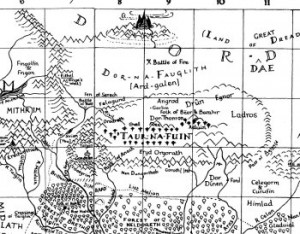
When it comes to flora and fauna beyond the specifically invented, either by Tolkien or by myself - that is, real world flora and fauna as they might exist in Eä - I operate by climate/latitude/biome rather than by strict geographical location: that is to say, no division of "old world" or "new world" species, or division of "Arctic" and "Antarctic" species, is observed. Leopard seals hunt under Helcaraxë while polar bears hunt on top, and raccoons and black bears can be found in Mithrim, along with brown bears and stoats. Don't even try to figure out what's going on with the oceans at this point; only Ulmo knows.
I also assume, based on climate and familiarity with places other than the hyper-settled continent of Europe (which Tolkien seems to sometimes lack) that a) there is significantly and greatly more tree-cover everywhere than is explicitly indicated on the maps, and b) there is significantly more animal life everywhere, as I am assuming at least the animal and tree life of pre-European Contact Americas if not even more.
Finally, in terms of the agriculture of the Eldar, I work under the assumption that people who literally existed under the tutelage of Yavanna and Oromë for a number of millennia would have the knowledge and capacity to work out methods of agriculture, domestic animal husbandry and sustainable hunting that did not significantly disrupt, destroy or continually impoverish the land they lived on, aided significantly by their ability to think in very long time-cycles (and their relatively low population growth). I suspect Melian's influence on the Sindar would have a similar effect.
I work on the assumption that the Eldar have domesticated animals and fowl predominantly for milk, eggs and textiles (wool, feathers, a small proportion of their leather etc), as well as labour and companionship, rather than for meat, which they would tend to hunt (as well as providing other parts of their leather supply).
Miscellaneous Canon Details
House of Finwë
- Obviously I have had to invent a number of amilessë.
- As noted, I maintain the number of Finwion children as that of the published version of The Silmarillion. The addition of a daughter older than Nolofinwë and then another between Nolofinwë and Arafinwë either requires a complete change of family dynamics and what the interactions imply, or they require a framework and set of assumptions about how family relationships and dynamics work that are potentially appropriate for, for example, a Mediaeval English monarch of the 8th century - but as that requires imagining dynamics that are outright abusive and toxic, and arise from specific violence-focused and toxic circumstances of culture that I prefer not to imagine for the Eldar in Valinor (and which seem in conflict with the portrait canon wishes to paint), I'm not that interested in going there.
- Argon appears to have been added, in a story-functional way, more or less entirely to die in an early-orc battle and presumably to remove the implication that the Indision branch of the royal family suffered no casualties until the Dagor Bragollach. Again, there is no sign of him in the actual dynamics. So I'm not interested.
- In order for Artaresto (Orodreth) to be Angárato's son, one must posit yet one more invisible/disposable wife. Some of these are unavoidable, but this one is not, and besides I find Orodreth more interesting as a middle brother in a very loud family than someone in his father's shadow. I also find it more plausible that Finrod would put his brother in command of Minas Tirith than his nephew.
- In choosing between Findekáno or Artaresto as Gil-galad's father one is, effectively, choosing which of the two Finwioni to give a wife who is so unremarkable, in terms of involvement in large-scale historical events, that her name is not recorded. I find it absolutely implausible that any person Findekáno Nolofinwion could find interesting and alluring enough to want to procreate with could possibly be the kind of personality that could disappear into history without even leaving behind a name. On the other hand I find it entirely possible that while she was undoubtedly a worthy person, someone Artaresto married could certainly have attributes that while very valuable even in the day to day running of a kingdom as its queen were nonetheless not the kind that get one on the pages of chronicles. Additionally, self-evidently, Orodreth already had to be married in order to produce Finduilas. As such, conservation of Disposable Wives applies.
- Gil-galad as Artaresto's son also makes more sense in terms of actions such as sending him to the Falas after the Dagor Bragollach, as during that event Artaresto is holding Minas Tirith and so sending his child to Círdan is merely an act of sticking him on a boat and sending him towards and through territories that are still completely unthreatened, whereas wherever one imagines Findekáno sending a child from, it would require passage through enemy-held territory or out into completely wild and uncontrolled territory by sea on a very roundabout voyage.
- Given that Artaresto is Eärwen's son (see third bullet-point), sending his child to Ossë's best friend as refuge is a much more natural impulse.
- Of Artaresto's two children I do assume that Gil-galad is significantly the younger and was a child at the time he was sent to the Falas; and that Finduilas is already an adult by the time of the Dagor Bragollach.
- The twins exist to make name-things difficult: you would think that "Minyarussa" and "Atyarussa" being extended-notes canonical would solve major problems, but then you run into the fact that on its own, "Atya" is "Daddy". I have chosen instead to use the form "Attëa" as despite having moved from the archaic "minëa" and "attëa" to the faster-to-say "minya" and "atya" in actual numbers, I feel like it would be a very small shift to back off to make sure it doesn't sound like you're calling your youngest brother the equivalent of "daddy". I have maintained "Atyarussa" because within the full name it has a different shape and flavour of speech anyway.
- Similarly, various versions of the twins are in conflict, and the notes from which we get their amilessë/i etc also include reversals of their birth order and so on: there is one version wherein Amras is the elder, which is the version by which we get him called "Minyarussa" (first Russa), "ownership" of the "Ambarussa" amilessë (leading to being named Amras) and so on; yet in the published version, Amrod is the elder, making it rather odd that Amras is "first" Russa", but making it make a lot more sense that Amras' ataressë is "Telufinwë" (Last Finwë). Given what I've said in the details about sources, and so that it seemed to me that it would make more sense for the record to be confused about which nickname-version of the shared amilessë belonged to which twin than anything else, their names are as follows:
- Amrod - Umbarto/Ambarto - Pityafinwë - Minyarussa, as this is a name given by others, and he is the eldest.
- Amras - Ambarussa - Telufinwë - Atyarussa, as he is the second twin.
Social Organization
- For a large number of complicated interconnected reasons, the Indision Host in particular tends towards a certain level of communal living with people gravitating to tasks they are inclined to or at least object to least; as a result Hyarestolië is organized around, for instance, communal laundry, communal production of new clothing, communal food production, et cetera. While it would be inaccurate to say there is no sense of private individual property in Hyarestolië, there is a communal ownership of things necessary for the continued well-being of the encampment in general, adjusted for need. It's probably best to say that there's a "soft" sense of ownership: for example, the seal-fur in Findekáno's tent is "his" so long as it isn't needed for actual wellbeing/survival of someone else or some project of general benefit. This is a social pressure more than a "legal" one: particularly as aranon and héru and captain and so on of his people, he would face intense social judgement for refusing to provide the necessities. This is going in this supplement because it's genuinely quite different from most cultural understandings at work in our own context, but is such a strong underlying force of theirs that it's difficult to draw attention to it.
Language
- While I initially attempted to be consistent between the sound represented as [k] in IPA and written with calma (
 ) in Quenyan Tengwar being either written with the Latin K or the Latin C this rapidly put me in a situation where I would either have to write "Findecáno" or "Karnistir" and I just could not deal with that. To each their own but both of those options are genuinely upsetting visually to me. Given that this is literally a transliteration problem and any designation is arbitrary by nature, I came to the conclusion that actually "I will use whichever damn letter based on its aesthetic appeal to me within the word" is actually the most Noldorin damn thing I could do anyway.
 - For some neologisms a reader may notice contractions - the most common being "avatyar'nin", or "forgive me", while in other places words are merely combined as you will see them in lexicons and other contexts. This is because in that case what's being replicated is in fact similar to if in dialogue I were writing "gonna" or "gimme" or other such patterns that represent the actual word/sound combination said while not being "officially" correct. Officially, "forgive me" is "ávatyara nin"; however, saying it specifically like that, aloud, would strike the listening ear as similar to someone saying "I am going to" and very clearly pronouncing each word as written. The full "proper" speaking of the words as written imply a certain emphasis and connotation, vs "I'm gonna", which is what (for instance) most people in my region say aloud. Thus "ávatyara nin" is a level of formal, clear, enunciated speaking that does have it place, but is not that of someone saying "sorry about that", or someone who is in a brainfog trying to apologize for having a bad dream, where "avatyar'nin", each syllable running into the other and the clearly enunciated [a] at the end of the first word disappearing, seems more likely to be the kind of string of sounds with that meaning that would come out of someone's mouth in those circumstances.
Injury/Illness/Healing
- It is actually somewhat difficult to reconcile Tolkien's assertion that Quendi do not experience illness with the fact that he does allow them to be poisoned and allows them to be intoxicated by alcohol, as when one gets right down to it on a cellular level the damage is quite similar, and indeed in many cases what makes us ill is the toxicity from byproducts of infection, rather than other mechanisms of the bacteria. This is why antivenin is literally produced from the immune responses of non-human animals who are better able to handle the venom in question, whereupon the antibodies are injected in us. The work that produced antivenin as a medical tool arose directly from work with vaccines, and so on. Now it is not surprising this did not occur to Tolkien, but it does present me with difficulties. I have in some ways split the difference, determining that Quendi immune systems are sufficiently robust and properly calibrated so that essentially, the only way that an infection or even a poisoning can result is due to a significant injury or invasion of a significant amount of substances into the body, well past the epidermal layer, etc. So for example, a Quende could not catch CoVID-19 unless you took a significant concentrated amount of it and injected it into their body: exposure to the droplets or aerosols that are sufficient to infect us (equivalent to Atani) even in a severe or dangerous event are simply insufficient to allow the virus a reproductive foothold in the Quende's system.
- As a result, Quende are not vulnerable to transmissible/communicable diseases in so much as "you inhaled some infected air or touched a very small amount of infection to one of your mucous membranes": these are simply dealt with by their immune system. Conversely, Quendi are capable of suffering aspiration pneumonia (where foreign objects or fluids are inhaled into the lungs with attendant contaminants which then set up shop in their nice warm new habitat), as well as blood-poisoning, wound infection, being fed poison and being intoxicated by alcohol. This means that, for instance, while a Quende would be less vulnerable to rabies than a human, they could in theory contract rabies from being thoroughly bitten (where humans are at risk merely from touching infected saliva or similar) as that would deposit a significant amount of the virus directly into their circulatory system and past the barriers of epidermis/etc. This allows for a setup that accounts for their lack of pandemic diseases, their lower level of infection all around, their increased ability to survive, but still allows for vulnerability to direct poisoning/envenomation, as well as their intoxication by alcohol and other factors that are canonically attested.
Riding/Horses
- So funny story: if properly fitted to both horse and rider, it's actually better for the horse to have a good saddle than for a human to ride on them bareback. No really. I mean those are also very important "ifs" and fitting horse and rider both are not minor details, but actually having the unsecured weight of a human or human-shaped being on their back can be quite hard on a horse. (You can think of it like the difference between just having someone pile some shit on your back to carry, versus having a properly-fitted high end pack.) As such, yes, the Noldor use (extremely well-made, fitted-to-horse) saddles of multiple designs, depending on what the horse is being ridden for - because a long-distance trail saddle is different from a combat saddle.
- One can square this easily with canon on two points:
- a: Our narrator in The Two Towers doesn't actually know that much about Quendi, but also:
- b: Legolas was being a massive show-off for the stranger Atani and probably Gimli and probably regretted it later. Frankly I doubt one spends a lot of time on horses in Greenwood (after all, "extremely dense tangled woods" are not exactly natural horse country), and I doubt combat on horseback is a big thing for them, but Legolas is canonically a massive show-off and I could absolutely see him in that moment losing to the impulse to wow the strange Atani and possibly his Khazâd friend (who is wary of horses at all) with how he can magically ride a horse without any aids at all. Sort of like he wasted a shitload of effort to walk across the encrusted snow to no particular purpose, snarking at Mithrandir all the way. And since he always has the excuse to let Gimli off he doesn't have any particular reason to run up against the really harshly limiting factor of it being quite hard to stay on a horse in battle while bareback without hurting the horse (given how tightly for how long you would have various pressure-points of knee, heel and so on digging into the horse's body), vs having a nice well-padded strap distributing that all around the strongest bits of the horse without pressure-points instead.
- You may, if you like, imagine Elladan and Elrohir being deeply bemused/amused at him when they show up using (naturally) extremely well-designed combat saddles. I certainly do.
[Other details may be added to this section as needed/as they occur to me. This is probably also the most useful place to ask this kind of question!]