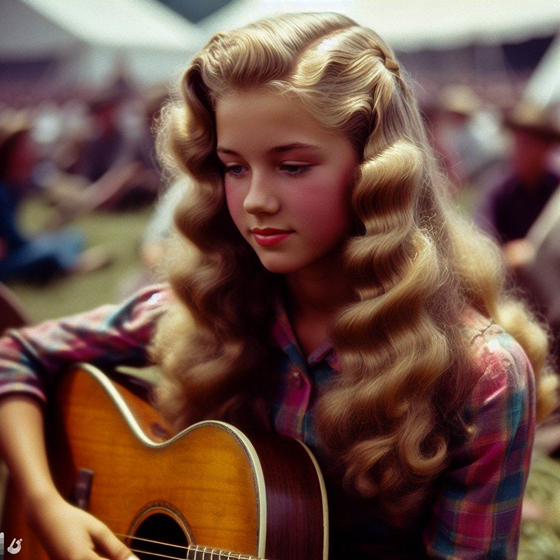
Work Text:
“Have you come far young lady?”
“It’s not that important is it?”
“I’m just curious what you’re going to play.” (-) “I’m a Marylander myself.”
“Ohio.”
“Fantastic, the Mid-West is a swell place. Hey, we’re still in it, it’s just that large.”
Surrounded by a spacious and mostly vacant tent. Fumbling with the tape recorded, the well dressed man held it aloft, displaying an attempt at a reassuring smile. Jennifer remained dubious, her lingering scrutinizing expression prompted him to stuff the device into his pocket. Gesturing as he spoke at an increasingly quicker pace. “I won’t have enough
space to include everything even if I wanted to. But ifit makes you feel more at ease then there.” A thin smile from the blonde, she rolled her shoulders. The guitar case shuffled with her motion, she remained silent.
Evening setting in around her, at a fence post Jennifer stood with a leg braced against the last rung. Her guitar laying
across her knee, she turned it delicately. “In my village, it’s about a quarter the size of here. There ain’t anywhere for a youngster to perform. I mean the few Churches welcome spirituals but I like a range. One time the pastor shooed me away cause my song was too sad.” A pause, a smile showed followed by a soft laugh.
“He said it was a few of the older ladies who didn’t like it and thought I was trying to be funny.” The teen remained
focused on perfecting the sound. Plucking a string, studying the sound then resuming she spoke between her attempts. “My very first guitar? No, this is one I bought myself. I got a couple of others as gifts but they were …”
Nearby her tiny audience offered faint response, she continued unphased. “With anything you’re going to be intimately connected to, it took the right one.” A hesitant laugh, she looked up to see no one remained within earshot.
The festival spread out before her like a quilt of small fields—patches of shade, sun-bleached grass, tents flapping tiredly, a narrow stream of people drifting from one pocket of music to the next. She kept her heel braced on the lowest rung and her guitar across her knee, palm resting the strings so they wouldn’t chatter in the breeze. Someone had chalked a little arrow in the dirt: MAIN STAGE →, and the arrow pointed toward a cluster of canvas and the murmur that meant a crowd, that meant a large voice and a bigger promise.
She wasn’t late. She had told herself that twice already—first when she heard a banjo carrying on the air as if it were calling names, and then again when the banjo switched to a low run of notes that sounded like a grin. But the arrow felt like a hand at her back: go on.
Jennifer slid her guitar into the case and slung it over her shoulder. The leather strap squeaked once as it settled across her back. She tugged the fence splinter free and tucked it into her pocket without thinking, a little piece of place to carry, then joined the flow.
The closer she came to the stage, the more everything else thinned. Distant strains of others’ tuning up or performing. The talk, all of it, folded itself around the rhythm like animals stepping aside for a river. She walked past a woman plucking at an autoharp and biting her lip at a stubborn chord, past an old man asleep with a harmonica resting on his chest, past a tent where someone argued in friendly tones about whether a lyric said graveyard or gray yard. She drifted through like a quiet fish, saying nothing, eyes forward.
Pete Seeger stood at the front edge of the platform with one boot up on a wooden chair, banjo angled to the sky as if he was sighting along it. The wind had that trick it does on long afternoons—it caught the bright notes, tossed them up over heads, and dropped them back like confetti. He wore his sleeves rolled and the particular kind of grin a person gets when they’re about to hand a room to itself.
“Now you know this one,” he said into the cheap metal microphone that looked like it could shock a man if the cloud cover changed. His speaking voice was narrower than his singing voice, like a creek bed you could step across, but it carried, all the same. “Don’t you pretend you don’t. If you don’t know the words, you know the tune, and if you don’t know the tune, you know how to breathe. That’s all a chorus is—breath at the right time.”
It wasn’t a trick so much as an invitation. He played a figure, looked up, and the answer came from the bodies themselves—the field, the trees, the shade where a toddler slept with a thumb in his mouth. People sang without deciding to. Some of them glanced sideways first to make sure it wasn’t silly. Then they forgot themselves. Low voices met high voices and made an ordinary kind of glory that never needed permission.
Jennifer didn’t sing at first; she watched. She took in the tilt of his wrist, the way his forefinger brushed the string before his thumb came down like a heartbeat. She watched the way he leaned his shoulder into a word as if the syllable were a door that sometimes stuck. And she watched the crowd—men who had knuckles like knots, university boys with hair parted sharp, women with pocketbooks resting on their knees, a small cluster of children sitting on the dusty ground with their knees up, faces intent. The faces were everything. Music lived in faces before it lived in air.
He turned from the chorus into a verse with a run of notes so quick it was as if he were clearing away brush with a machete. “There’s more songs in this country than there are fence posts,” he said, not breaking time. “Sometimes I think the fence posts are listening.”
She laughed aloud—she couldn’t help it. The banjo line danced. He sang something old, one of those tunes that traveled by river and rail and kitchen till it wore smooth like a stone. When he lifted his head and let the chorus go again, his palm lifted too—like a conductor who didn’t need to be obeyed so much as matched. And the crowd matched him. The matched part mattered.
“Let’s hear it in the back,” he called, and the back answered because no one likes to be called the back. He turned his head a little toward the right and the right swelled. He did not push. He coaxed.
Jennifer felt her throat loosen. She joined on the second line, barely, under her breath. Then the third, stronger. The chord change sat exactly where her chest wanted to land. The spoon solos from a nearby blanket folded in like a tin laugh at the end of a joke. The whole field leaned forward, not physically—just the feeling of it, like a room bracing for truth.
The last chorus shot up and she caught it as if someone had thrown her a ball. When it ended, the applause looked like corn in the wind—a ripple, a series of small nods that added up to something big.
He set the banjo down and wiped his forehead with the back of his wrist, as if he’d been splitting logs.
“What a thing,” somebody behind her breathed.
She could only agree.
The set unrolled like a good story—new joke, old song, invitation, answer, a hymn that wasn’t called a hymn but made the hair lift on her arms anyway. When he sang a verse about work, he didn’t sing it like a museum piece. He sang it like the hammer was in his hand. At one point he stopped and told a story about a woman in Kansas who could out-sing a train whistle, and Jennifer tucked the rhythm of his speech away the way a seamstress tucks chalk into a cuff.
Toward the end, he leaned back from the microphone and sang a line out into the open air, no amplification, just a man trusting the day. The field leaned up on its elbows and heard him. Then it was over and not over—because people don’t quite know what to do when a thing that felt like a weather system ends. They clapped, they laughed, they reached for thermoses. Somebody called “thank you” like a blessing that could cover more than one thing at once.
Jennifer did not rush the stage. She didn’t have that in her. She stood until the crowd began to loosen and then walked the long way around the platform to where the cables met the grass. Strangely, the back of a stage is always quieter, even with all the clatter—it has the hush of work. There were two men wrapping cords in exaggerated loops and a woman in a polka-dot dress holding a clipboard on which absolutely nothing useful was written. The soundman was trying to talk to a microphone in a loving, argumentative way. Pete was by a water barrel near the steps, rolling his shoulders like a man reminding his muscles they could be ordinary again.
She stopped at the bottom plank of the steps and put one hand on the rail. Up close, he looked exactly like himself and nothing like a picture. He was thinner than photographs made him, lighter; he looked like you could fold him and put him in a mandolin case if you had to smuggle a conscience across a border.
He glanced down. He had a way of looking at a person as if he’d been waiting for them.
“Well now,” he said, and his grin was not a stage grin. “You listened like you meant it.”
“I did,” she said. She heard the steadiness in her voice and trusted it.
He tipped his chin at the case on her back. “Are you going to play too? I noticed your friend there’s been following you around.”
She reached for the strap as if to make sure the guitar was still there. “Yes, sir,” she said. Sir felt too formal as soon as it left her mouth, but it didn’t sit wrong, exactly. “Later today. Small stage. I… I’ve got a few of my own.”
“Good,” he said without hesitation, like she had just told him the weather would be fine for harvest. “Songs of your own are the best kind to forget and remember.” He set his tin cup down on the barrel’s rim. “What’s your name?”
“Jennifer. From Geneva, Ohio.”
“Geneva,” he repeated, rolling it once like he might taste what lake lived inside the word. “I think I’ve tuned a banjo in Geneva. Or near enough it counts.” He hopped down the last step so they were eye-level. “Well, Jennifer from Geneva, I’ll be glad to see it.”
Her throat pinched—for a breath only—and then everything in her went calm, as if the world had clicked into its right notch. He had spoken the line the way a good neighbor says I’ll stop by later, with a casserole; not like a king bestowing. She nodded. She didn’t try to bouquet her words. “Thank you,” she said.
He looked past her for a moment at the milling festival—the tents and the small dramas, the man wrestling with a folding chair, the girl doing a cartwheel that spilled her braid across the grass. “You know,” he said, quiet enough that it wasn’t stage talk at all, “places like this, they’ll make you and break you in the same hour. Folks’ll clap for a chorus and then forget to listen when you say something that hurts. Don’t change your saying on account of either.”
“I won’t,” she said, because promises come easiest when you’ve already made them to yourself.
“Good.” He lifted a hand toward the case. “Let me see your calluses.”
She blinked, laughed, and held out her left hand, embarrassed and not. He took it briefly, the way a doctor takes a wrist, with attention and no fuss. “That’s the right kind of ugly,” he said, satisfied, and released her.
“I… could I ask—” she began, then stopped. He waited. She thought of questions that would make her sound like a child and questions that would make her sound like a thief, and she picked the one that was neither. “When you ask a crowd to sing, and they don’t, what do you do?”
He looked as pleased as if she’d handed him a question he’d been missing. “I sing smaller,” he said. “They think they’ve got to climb a hill to meet you. If you sit down in the grass instead, you’ll be surprised how many sit with you. Or I tell a story I’m not sure about telling. People trust a stumble more than a speech.”
That was worth stitching into the lining of a coat. She folded her arms across the guitar strap as if to hold the idea in place. “Thank you,” she said again, quieter.
“You’re welcome.” He reached for the tin cup and drank and made a face like it was too much water for one mouth. “Who’s running that little stage? Hattie?”
“Hattie, yes,” she said. “Clipboard. Stopwatch.”
He laughed. “She once threw me off for going three minutes too long. Best stage manager I ever had. She’ll keep you safe from yourself.” He tipped his head. “What time?”
“Three-fifteen.”
“I’ll be there if I can shake loose,” he said. “If I’m not, it won’t be because I didn’t want to be.” He glanced over his shoulder as someone called his name with the urgency of a person whose harmony part had just run away. “All right. I’m due to pretend I know where the next chord is.” He moved up one step, then turned back. “Jennifer?”
“Yes?”
“Don’t apologize with your voice,” he said. “If you make a mistake, make it clearly.”
She smiled, and this time it reached all the way into her. “I can do that.”
“I can tell,” he said. Then he was gone up the steps in two lithe strides and into the work of putting a stage back together.
She stood with the water barrel between them and let the quiet return—the festival’s own quiet, which was never a lack but a hum. The sun had slipped a hand’s width toward evening; the shade by the elm near the small stage would be good by three. She checked the watch pinned inside her case and realized she had to tune. Her fingers twitched for it the way they always did when a thing was about to become itself.
On the way around the platform, a woman with a woven bag and a smile like she’d had to practice it caught Jennifer lightly by the sleeve. “You talk to him?” the woman asked, somewhere between envy and elation.
“I did,” Jennifer said. She didn’t add what he’d said; some sentences felt like eggs in a pocket.
“Well,” the woman said. “Go on then.” She squeezed Jennifer’s arm once, conspirator. “Go on.”
The path to the small stage took her past three clusters of people playing tunes simultaneously—one fiddle tune that had the wrong ending but the right heart, a pair of boys trying to outrun each other with flatpicks, and a lone tenor singing a coal-miner ballad so slowly it seemed as if he were measuring time with a teacup. A little girl offered Jennifer a dried dandelion head with most of the seeds blown, as if she had saved the last ones. Jennifer blew the rest into the air and watched them find rides to nowhere specific. The girl clapped like they were her tricks and darted back to her mother.
Behind the library, Hattie ruled her triangle of folding chairs with benevolent severity. “You’re early,” she said without looking up, which somehow felt like the highest compliment. “Make a church of it and you’re done at three-thirty.”
“Yes, ma’am.”
“Don’t call me ma’am,” Hattie said. “It makes me feel like I own pearls.”
Jennifer found a corner of shade and knelt with the case. The flannel lining smelled faintly of cedar. She lifted the guitar out, set it in her lap, and pressed the headstock to her ear. The E string had drifted the way it always drifted when the air was hot and full of other people’s songs. She tuned gently, the way you adjust a sleeping child’s blanket. Two boys slowed nearby and watched as if she were winding a clock. She gave them a look that said later and a small smile to make later a promise.
When she had the last string right, she ran through the first phrase not to show off but to tell her hands they weren’t going to be alone in this. Hattie’s stopwatch clicked once in warning of nothing. The folding chairs filled in the natural way they do—a couple here, a pair there, the odd loner who never knew he had been waiting to find a song shaped like his hands. Jennifer wiped her palms on the side of her skirt as if tuning a different instrument entirely.
From the corner of her eye, she saw him again. Not close. On the far edge, by a kid selling lemonade that had never known a lemon. He had his shoulders tucked in as if to make himself smaller for the benefit of whoever needed the space. He didn’t wave. He just made the choice to be there and let her see it.
Hattie lifted the clipboard to chest height and raised her eyebrows. “Name,” she said, too quietly for the audience and exactly loud enough for the performer.
“Jennifer,” she said. “From Ohio.”
“Good a place as any,” Hattie said, and pointed her pen like a conductor’s baton toward the plank.
Jennifer stepped up. The little triangle of chairs breathed her in. She found the first fret by habit, then lifted her head. If she apologized with anything, it would not be her voice.
“Hello,” she said, and the word came out clean. “I’ve got a few of my own.”
A wind shivered the maple leaves. Far off, somebody shouted about losing a spoon; closer in, a baby sighed. She set her thumb to the bass like a walking man and let the first pattern fall—simple, steady, the kind of line a person could put their day on without it tipping. When the melody rose, her mouth found the words it already knew how to carry. They did not mumble. They did not bow. They went forward, exactly as far as they needed to go.
After the first chorus, she heard it—the small sound a room makes when it chooses you back. Not the big swell, not the clap. Just the collective adjusting in seats, the shared lean.
And somewhere beyond the second row, a banjoist who had given the field an afternoon found the corner of his mouth tugging up, and let himself rest his chin in his hand like any other man with the gift of listening.
She didn’t look up again until the last note, because she didn’t have to. She knew. She’d seen the face of the field already. She carried it with her even as she played something tender that needed both hands and the part of her that had stood at a fence, earlier, with a splinter in her pocket and the lake wind in her ears.
When she finished, the clapping came the way water comes back to shore. She let it wash over and through without taking any of it for herself. She pressed her palm to the strings to quiet the last hum. Hattie’s stopwatch clicked. The boys with the flatpicks grinned like they’d seen somebody land a trick on gravel and keep walking.
She stepped down with her guitar and the air of a person who had done exactly and only what she came to do. Near the lemonade, he lifted his tin cup a fraction in salute. She returned it with nothing more than the small nod of a worker crossing paths with a worker.
“Thank you,” she said to Hattie.
“Don’t thank me,” Hattie said, making another mark only she understood. “Thank whatever stubborn part of you brought you.”
“I will,” Jennifer said, and went to stand for a moment on the edge of the shade, where the late light turned the dust golden and the music from three directions braided together without fuss.
Somewhere, a voice started a new chorus. Somewhere else, a chair scraped. The festival kept breathing, and she breathed with it, and that was enough. For now, it was more than enough.