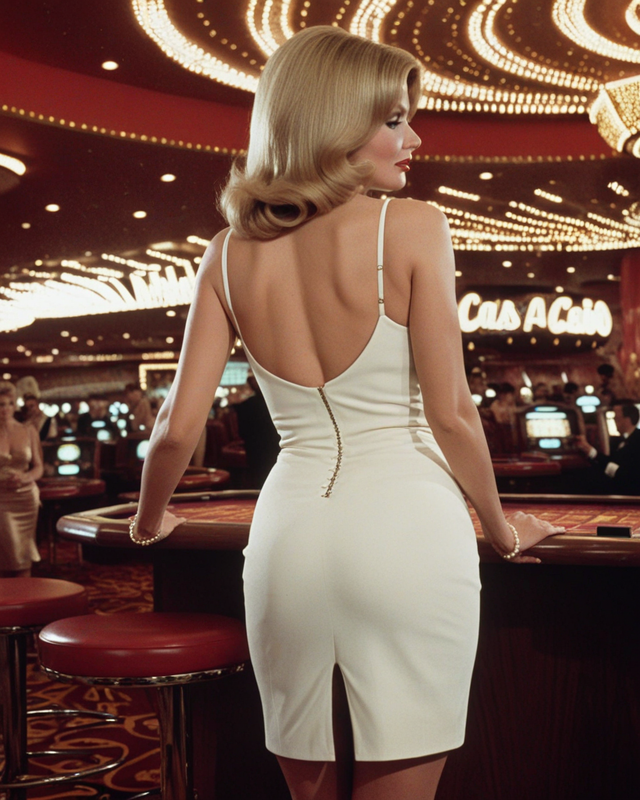
Work Text:
Night sat heavy over the Strip, a velvet stretch broken by neon and the pale ghost of desert stars. The air in January carried a sharper edge than the postcards promised, a thin desert chill that slipped under lapels and down the backs of bare shoulders, but the lights worked hard to convince everyone that winter didn’t exist in Las Vegas.
The casino at the corner had gone all in on the illusion.
Its facade, usually a reliable wash of gold and green, had been remade for a single night into something out of a campaign poster and a Broadway play at the same time. Red, white, and blue bulbs chased one another along the edges of the building, looping in restless circuits around the roofline, racing up and down the columns flanking the doors. They flashed in patterns that suggested trumpets and fanfares, a tiny electrical fanfare that repeated every few seconds, heralding the same message over and over: a new administration, a new era, a new excuse to gamble until dawn.
Above the main entrance, a banner stretched taut between two polished brass poles: KENNEDY / JOHNSON in crisp navy letters clean enough to look official, the paint still smelling faintly new under the harsh glare of the spotlights. The faces on the small round buttons pinned to lapels and collars in the crowd matched the smiling head on the banner’s far left corner, though out here the man was rendered only in silhouette and slogan, a profile framed by stylized rays.
Paper bunting hung in long arcs under the banner, tripled up like layered skirts. The colors had been bright enough in the afternoon when the last of the decorators climbed down from the ladders, but now the bulbs above and below them made them shine almost too fiercely, the white edging toward ivory, the red toward something wine-dark. The wind coming in from the emptier, darker parts of Nevada snapped the bunting in short, sharp bursts, so that the paper whispered and cracked like small flags saluting passing cars.
A Cadillac eased up to the curb, tailfins gleaming, chrome catching the patriotic colors and throwing them back in streaks. The driver leaned over to the couple in the back.
“This is the one?” he asked, voice muffled by the glass.
The man in the backseat, tie already loosened, peered through the window at the sign, squinting at the banner until the letters resolved themselves. “Yeah, that’s the one,” he said. “They got Kennedy big enough, don’t they?”
His date, wrapped in a white fur stole that was more optimism than insulation, laughed and tapped the window with one gloved finger. “Look at those little flags,” she said. “Like the Fourth of July got drunk and forgot what month it is.”
The driver snorted. “It’s January,” he reminded them. “Town’ll take any excuse.”
He climbed out, the door swinging open on a gust of cold air that snatched at the bunting again. The woman’s first breath hitched when the chill bit exposed skin, but then the warmth spilling from the open doors reached her in a wave: cigarette smoke, perfume, whiskey, and the indistinct roar of hundreds of voices layered over a band’s brassy insistence. For a moment she stood between the two climates, desert night at her back, carnival light in her eyes.
People were streaming in under the banner in twos and threes, some with their coats buttoned to the throat, others acting as if the weather was part of the game. Men in dark suits, a few in tuxedos they hadn’t had reason to wear since a cousin’s wedding. Women in cocktail dresses shivering in stilettos, their hair sprayed into careful helmets. A handful of tourists wore campaign buttons they hadn’t taken off since November, dull from being thumbed and straightened. One man had a tie clip shaped like the new president’s profile; he touched it absently as he craned his neck to admire the lights.
A passing bellhop, red cap tilted just so, glanced up at the banner and shook his head in private amusement.
“They’ll have to climb up there again when he runs again,” he muttered to the valet beside him.
“Assuming he does,” the valet said, blowing into his hands. “Assuming anybody remembers this bunting by tomorrow.”
The bellhop tilted his chin at the bulbs running in thick lines around the doors, chasing each other in red-white-blue-red-white-blue. “Hard to forget,” he said. “You shut your eyes, you still see ’em.”
The valet followed the line of lights as they ran their loop: up one pillar, across the marquee, down the other, around and around without pause. The pattern threw strange shadows over the faces of the people clustered near the entrance—patches of red that made their cheeks look feverish, white that bleached them pale, blue that turned them almost spectral for a heartbeat.
A small knot of men in overcoats stood just beyond the rope, passing a hip flask between them with easy discretion. One of them tipped his head toward the banner as he handed it off.
“Camelot,” he said, rolling the word slowly. “That’s what they’re calling it already. Like we’re in a storybook.”
“Storybook don’t have slots,” another replied, nodding toward the doors, where the whir and ding of machines carried even over the band’s swing. “Or a line at the roulette tables.”
The first man grinned. “Give it time,” he said. “Maybe they’ll build a round table in there, too. Knights with comped drinks.”
A pair of young women heading toward the entrance caught only the last phrase. One turned with an amused lift of her eyebrow.
“Where do I sign up for that?” she asked, her voice half-mocking, half-hopeful.
“Inside, doll,” the man said, tipping an imaginary hat. “King Jack, Queen of Hearts, whole royal family’s waiting.”
She snickered and pulled her friend toward the light.
The paper bunting above them flapped again, the wind teasing loose one particularly enthusiastic strip that had been taped a little hastily. It curled downward like a white ribbon, the red and blue stripes twisting as it danced. A casino employee in shirtsleeves hustled out as soon as he noticed, hands jammed in his pockets against the cold until he reached the loose end. He clamped it down with a small strip of tape, straightening the arc with the care of someone who knew his boss would notice if it drooped.
“Hold together, will you?” he murmured to the paper, the way a mechanic might speak to a reluctant engine. “Just tonight. After that, you can fall to pieces all you want.”
From where he stood on the ladder, he had a brief, elevated view of the Strip. Other casinos blazed in their usual colors—greens and oranges, pinks and yellows—and one or two had made half-hearted stabs at patriotism, a bunting here, an extra flag there. But none had gone quite as far as this one, which sat like a slice of campaign rally dropped on top of a gambling den.
Cars crawled past in both directions, some slowing as their drivers craned to look, others honking impatiently in brief staccato bursts. A greyhound bus rumbled by, its windows lined with faces turned toward the brilliance on the sidewalk. In one of the back seats, a boy pressed his nose to the glass.
“Look, Ma,” he said, leaving a foggy oval where his breath hit the window. “They got the president’s name on it.”
His mother, clutching a paper bag of sandwiches and ticket stubs, leaned over to peer past him. “That’s a casino,” she said, even as her voice softened with an involuntary wonder. “They just put his name there so you’ll want to go in and lose your allowance.”
“Do presidents go in there?” the boy asked.
She smiled, maybe thinking of the man on the television set in the bus station earlier that day, bare-headed in the cold, hand raised against the grey sky of Washington. “Not this one,” she said. “He’s got enough trouble without the dice.”
On the sidewalk, closer to the doors, a bored cab driver leaned against his car, collar turned up against the chill. He flicked ash from his cigarette and watched a group of businessmen cluster under the banner. One of them stepped back just far enough to get a wider view, then nodded in satisfaction, as if he’d been responsible for the whole display.
“Camelot,” he said, half to his companions, half to the marquee. “Says in the papers he reads poetry, you know that? Latin or something. Guy runs for president and he’s quoting books nobody’s read since the war.”
His friend laughed, breath puffing in the cold. “That why you voted for him?” he asked. “The Latin?”
“I voted for him ‘cause he wasn’t the other guy,” the first man said. “But the lights look nice, I’ll give him that.”
The cab driver turned his face up to the bulbs long enough to squint. The red-white-blue ripples painted the bridge of his nose, the shadows beneath his eyes. He let the smoke slip out between his teeth in a thin stream, watched it twist and disappear in the glow.
“Doesn’t matter who you vote for in there,” he said, too low for the businessmen to hear. “House still wins.”
He tossed his cigarette into the gutter, where it hissed faintly in a puddle left over from the afternoon’s brief attempt at rain. The ember went out, but the reflection of the lights in the water remained, distended and wavering—KENNEDY / JOHNSON reduced to ripples of color.
A gust of wind swept down the avenue, funneled between casinos and diners and souvenir shops, picking up the smell of popcorn from a stand on the corner and the faint, acrid tang of gasoline. The bunting strained against its tape under the sudden rush, the paper edges fluttering hard enough to whisper. One of the smaller flags patched into the line—an afterthought, stapled in—flapped so violently its staple squealed.
Near the entrance, a pair of showgirls taking a smoke break clutched their feathered wraps tighter around bare shoulders. One of them glanced up at the banner.
“You think he’d like this?” she asked, tilting her head toward the painted name.
“The president?” her friend replied, exhaling a thin plume. “He’s probably busy doing whatever presidents do. Shaking hands. Smiling. Pretending this town’s in some other country.”
The first showgirl smiled sideways. “He comes out here, I’d show him a good time,” she said. “Teach him how to blow on the dice.”
Her friend laughed, a quick, bright sound that bounced off the pavement. “You’d break him in two,” she said. “He’s a baby.”
“Baby in a big chair,” the first one replied. “Big enough they painted his name up there, didn’t they?”
They fell quiet, watching the parade of people moving under the banner—men adjusting their ties, women smoothing their skirts, a tourist in a too-new cowboy hat tipping it to everyone and no one. Every few seconds, the band inside hit a particularly bright brass phrase, the sound bleeding out through the open doors in a warm shout before thinning against the January air.
A little farther down the curb, two men in dark coats with state plates on their car leaned on the hood and shared a cigarette.
“Looks like New Year’s Eve,” one said, nodding toward the entrance.
“Feels like it,” the other answered. “Only this time we already know who kissed who at midnight.”
The first man chuckled, then shrugged, watching the bulbs run their endless loop around the building. “You think it’ll stay like this?” he asked. “Country, I mean. All lit up, new coat of paint, everyone thinking it’s the start of something?”
The second man took his time answering, eyes following the glow as it traced the casino’s edges.
“Lights don’t last forever,” he said finally. “But they’re hell of a thing while they’re on.”
At the very top of the facade, above even the banner, a small American flag had been fixed to the roofline, its fabric snapping sharply in the higher wind. It was almost lost in the blaze of artificial light, but now and then, when the bulbs blinked in just the right pattern, the flag appeared perfectly framed for a heartbeat against the deep desert sky—a scrap of real cloth amid cardstock and paper and neon.
Below, the doors opened and closed, spilling warmth and noise onto the sidewalk, swallowing up people and their hopes and their money and their opinions, then releasing them hours later, changed or unchanged. The sign above remained steady, letters clean and confident, as if it could see the whole Strip, the whole city, maybe the whole country, and believed—just for tonight—that everything truly was about to become something grand and shining and new.
Out on the street, the night rolled on, the desert wind tugged at the bunting, and the red, white, and blue bulbs chased each other through the darkness, tireless in their imitation of daylight.
Inside, the casino pressed in close around everybody.
For all its square footage and the number of bodies it held, the place managed to feel almost low and underwater, the ceilings hovering just above the haze of cigarette smoke like a weather front. Light from shaded lamps and colored bulbs pushed through in soft cones, catching the floating ribbons of smoke and turning them into visible currents that drifted from table to table. Somewhere in the background a ventilation unit fought a losing battle, humming steadily as ashtrays filled and cigars smoldered down to nubs.
The sounds layered on top of one another until they became their own kind of music. Chips clicked and clacked in restless stacks, roulette balls rattled briefly before settling, dice skittered over felt and bounced against padded rails. Murmurs from blackjack tables, occasional bursts of laughter, a barked protest from someone unlucky at the slots—all of it folded together into a steady, throbbing noise that never quite dipped low enough to be called quiet.
Near the back wall, a jukebox glowed like a small shrine, its curved glass reflecting a slice of the room. The chrome trim threw back red and blue gleams from the patriotic bulbs outside, as though the color scheme had seeped indoors. It cycled through big-band standards and early 60s pop, Gershwin and Sinatra giving way to girl groups and back again. The live band on the small stage in the lounge took turns with it, stepping in between jukebox selections with brassy, confident blasts, then ceding the floor while they wiped their brows and drank from sweating glasses.
Every so often, the two sources overlapped: a trumpet note bending into a jukebox saxophone, a bar of one melody bleeding into another. No one complained. The cacophony suited the night.
In one corner, slightly apart from the nearest baccarat table but still within easy view of the bar, a TV sat on a wheeled cart, its wood-panel casing catching cigarette ash like a small altar. The screen showed highlights from the inauguration parade, the parade long finished but endlessly replayed on a loop. The sound had been turned low so as not to compete with the band or the jukebox; the commentator’s lips moved in silent enthusiasm as motorcades inched down a cold Washington avenue and Marines marched in precise lines.
Whenever the camera cut to Kennedy’s face—bareheaded in the wind, smile fixed but genuine enough to stir something in those watching—heads turned instinctively. A dealer lifting a deck to shuffle glanced up and lost count, swore softly under breath, reshuffled. A cocktail waitress paused with a tray full of highballs, eyes flicking to the screen for half a heartbeat before moving on. A man at the bar, tie loosened, stared a little longer, hand closing over his glass as if gripping a new possibility and not only the drink.
The TV’s glow painted the faces nearest it in a cool, bluish wash that did battle with the amber of the room’s other lights. On one side of the cabinet, a small sign had been taped up with more enthusiasm than artistry: INAUGURATION SPECIAL. The marker letters had bled slightly on the cardboard, but the meaning held.
Phoebe moved through all of this like a current in the air, a direction within the chaos.
She wore a sharp, tailored dress that knew exactly what it was doing: dark, clean lines that made her shoulders look a little straighter, her waist a little narrower, the whole silhouette precise and deliberate. The fabric caught every passing light, sometimes looking navy, sometimes black, sometimes almost charcoal when a cigarette ember flared too close. The skirt allowed just enough movement for her to take long, confident strides without ever losing the suggestion of formality.
Pinned to the lapel was a small campaign button bearing a familiar smiling profile. It sat there as though it had always belonged, nestled among the folds of the dress like a piece of jewelry chosen by a discerning eye rather than a partisan hand. Many guests wore buttons tonight, some crooked, some still smelling faintly of the cardboard box they had come in. On Phoebe, the thing looked custom-made.
She passed a craps table, leaning in at just the right angle to allow a high-roller from Chicago to kiss her cheek without smudging her lipstick. Her laugh rose above the ambient roar for a moment—low, warm, practiced but not insincere. One of her hands rested lightly on the man’s shoulder, a brief touch that said she remembered his last visit, the size of his last loss, the name of his last girlfriend. The other hand already held a drink, raised in a half-toast.
“Congratulate the president,” the man said, a little loudly, flushed with whiskey and dice. “He’s the one did the work.”
Phoebe’s smile sharpened just a fraction.
“He had some help,” she replied, voice smooth, before stepping away as the next roller called for the dice.
She made a continuous circuit of the room, never lingering long enough to be trapped, never moving so fast that anyone felt brushed off. A couple from Phoenix stopped her to gush about the decorations; she tipped her head in thanks and deflected the praise to “the staff,” though the slogans on the walls and the placement of the bunting bore her fingerprints. A group of younger men, still in their overcoats, hailed her like an old friend; she paused, listened to a story about their drive from Reno, and left them laughing, their initial awe melted into comfortable camaraderie.
The staff watched her movements with the familiar mix of affection and wariness reserved for someone whose temper could rearrange a schedule and whose kindness could do the same. Waitresses threaded their way between tables with trays held high, the homemade buttons pinned to their uniforms winking in the lights. Each button carried a slogan in slightly uneven lettering, the ink dark and decisive against white circles: LET’S BACK JACK, NEVADA FOR KENNEDY, VICTORY STARTS HERE.
The slogans varied in neatness, but the typeface was the same hand. Phoebe had sat up late more than once in the weeks leading up to November, elbows dug into the back office table, writing and rewriting words until they fit the round spaces. Some buttons had smudges near the edges where the ink had blurred, the consequence of staff grabbing them before they were fully dry. None of them seemed to care.
Near the bar, a bartender in a clean white shirt and a tie that had given up staying straight long ago polished glasses with an efficient, bored rhythm. Behind him, a small chalkboard leaned against the array of bottles. In looping script, someone had written: FREE DRINK IF YOU VOTED FOR THE RIGHT GUY. Underneath, in smaller letters: (WE’LL TAKE YOUR WORD FOR IT).
A patron pointed at the sign and grinned.
“You checking IDs for that?” he asked.
The bartender snorted, flicking his gaze toward the far end of the bar where Phoebe stood, listening to an older woman recount the thrill of seeing the swearing-in.
“Boss says it’s on the honor system,” he said. “Though I heard she can tell when someone’s lying about a ballot the same way she can tell when someone’s counting cards.”
The patron laughed, but his eyes moved to Phoebe, narrowing slightly in speculative respect. She gestured with one hand as she spoke, fingers slicing the air once, twice, in emphasis. There was something of a field organizer in the motion, the echo of someone who had once explained precinct maps and turnout goals instead of drink specials.
At one of the end-of-row slot machines, pushed a little aside from the main currents of traffic, a regular perched on a stool with the boneless ease of someone who had been sitting there for too many hours. The man’s jacket had slipped from one shoulder, his tie forgotten on the seat beside him. He pulled the lever without looking, eyes instead following Phoebe’s progress around the room.
“She worked herself half to death in the sticks for that guy,” he muttered toward the woman playing at the machine next to him, though his gaze never left the casino owner. “Out past nowhere. Knocking on doors where folks don’t even get mail on time, talking to people who think ‘Washington’ means ‘other people’s business.’”
The woman let the reels spin, the symbols blurring into a stream of color, before replying. “Seems to have done something,” she said. “He’s in the big chair now, isn’t he?”
The regular shrugged, a small, uneven roll of his shoulders.
“Yeah,” he said. “But ask her about the dust and the coffee and the nights sleeping three to a motel bed ‘cause nobody thought Nevada mattered.” He sniffed, pulled the lever again. “She knows.”
The slot machine clicked to a stop, lemons and cherries refusing to line up in any meaningful way. Coins did not spill. The man barely seemed to notice.
Closer to the television, Phoebe drifted into the blue spill of its light as if drawn by magnetism. A few patrons made room automatically, shifting stools and chairs to give her a clear line of sight to the screen without being asked. She acknowledged the movement with a tilt of her head and a brief, quiet word of thanks, then turned her attention to the parade marching silently across the glass.
On-screen, a convertible passed, officials in heavy coats waving at bundled crowds. The camera cut to the reviewing platform where Kennedy sat, hatless, coat open against the cold as if to prove a point. His smile looked both fixed and alive, a man in the act of becoming what the country had decided he was.
Phoebe’s expression shifted the moment his face appeared, the change subtle but unmistakable. The wide, generous smile that had been playing across her mouth for the benefit of high-rollers and small-timers alike thinned, grew inward. The muscles around her eyes relaxed, the showbiz spark dimming into something steadier, more private. For a second, some of the shine bled away from her, replaced by the tiredness of long drives on bad roads, of campaign halls that smelled of stale coffee and dust, of heated arguments in union back rooms and church basements.
She did not slump; her spine remained straight. But the weight of the last year settled into the set of her shoulders.
A cocktail waitress passing behind her glanced at Phoebe’s profile and blinked at the fleeting glimpse of that exhaustion. It vanished almost as soon as it appeared, smoothed over by habit. Phoebe lifted her glass, the ice clinking softly, and held it in a small salute to the man on the screen.
“To the new boss,” she said, just loud enough for those immediately around her to hear. “May he be worth the trouble.”
There were a few soft chuckles, a murmured “hear, hear,” and the faint clink of other glasses raised in echo. Someone near the back added, more roughly, “Better than the last one.”
Phoebe’s gaze remained fixed on the television. As the parade moved on and the camera shifted away from Kennedy, her smile returned to something more familiar, brighter, the exhaustion tucked back where it came from. The campaign button on her lapel caught the flicker of the screen, a tiny glint of light over the printed face.
Then she turned away, stepping back into the room’s warm chaos. The smoke, the clatter of chips, the alternating pull of jukebox and band closed over her again as she resumed her circuit, the woman who owned not just the building but the breath and sound within it moving through her domain as if the night—and the bright new era everyone insisted on naming—belonged to her as much as to the man onscreen.
The band slid out of its last number on a lingering, smoky chord, the trumpet’s final note curling up toward the low ceiling and disappearing into the cigarette haze. For a beat the casino’s usual noise swelled in to fill the gap—chips clacking, laughter puncturing the din, the distant steady clatter of the slots.
Then the drummer snapped out a bright, crisp roll, and the band pivoted.
The pianist hit a run of jaunty, almost military chords, the trumpet came back in full brass and sunshine, and the saxophone answered with a jubilant little flourish, like a parade turning the corner onto a wider avenue. The whole sound sharpened, louder and more extroverted than the wandering standards they’d been coasting on before. Heads turned on instinct. People who had been half listening suddenly found their feet tapping under the tables.
At the same time, the lighting shifted.
The diffuse amber that had been flattering the gamblers and their drinks sank away from the gaming floor, dimmers pulling it down by slow degrees. Table lights above the felt dropped to a softer glow, just enough to see chips and cards, leaving faces in shadow. A low murmur of protest rose from a few corners—someone at blackjack complaining he could barely see his hand—but it sputtered and died as soon as the alternative became clear.
A tighter, whiter light snapped on over the small stage near the main bar.
The stage usually sat under house lamps like everything else, a simple riser not much higher than a man’s knee. Tonight, someone had dragged out extra stands and gels: beams swept across the floor in thin arcs, then converged on the little square of wood as if it were suddenly the center of the known world. The jukebox’s colored glow dimmed in deference, its glass front reflecting the new focal point in miniature.
Behind the stage, tacked up with more enthusiasm than craftsmanship, hung a makeshift red, white, and blue backdrop. It wasn’t quite straight; the left side drooped a little lower, and one corner puckered where hastily applied tape strained under its weight. Strips of fabric—some proper bunting, some cut-down tablecloths by the look of their hems—overlapped in uneven stripes. A few small paper flags had been added along the top edge by someone with an eye for filling blank space.
Under the stage lights, the imperfections didn’t matter. The colors popped, the folds caught shadows, and the whole thing read clearly from across the room as one more loud declaration of the night’s theme.
At the craps table, dice rattled across felt as a shooter sent them spinning down the length of the layout. A small crowd leaned in, voices overlapping in a chorus of “come on, come on” and “big eight, baby.” The stickman’s call rode over the noise, smooth and practiced.
“Dice are out,” he intoned. “Coming out now…”
Phoebe stood at the rail, her hand resting with easy ownership on the cushioned edge. She had been mid-story, recounting some embellished detail from election night in Carson City to a knot of regulars who hung on every tilt of her head. The punchline was halfway formed on her tongue when the band’s shift hit her ears.
Her gaze flicked upward, toward the stage.
The trumpet burst into a bright, brassy fanfare, all upward leaps and gleaming notes. The drummer laid a marching beat under it, snare snapping with crisp, martial neatness. A couple of men near the bar instinctively straightened their shoulders, some old muscle memory tugged from army days or high school band.
The overhead lights above the craps table eased down another notch. The dice clacked against the back wall and tumbled to a stop, but for a moment no one looked at the result. The stickman blinked, momentarily off-balance in the shifting shadows, then craned his neck to see where the light had gone.
“What is this now?” the shooter asked, squinting toward the bar as the white beams speared the little stage.
“Somebody won something more important than your roll,” one of the railbirds said, but his tone was more curious than annoyed.
Phoebe’s eyebrows lifted. That particular lighting cue wasn’t in her schedule.
She had approved the decorations herself, had signed off on the band’s set list, had even suggested which parts of the televised parade they could splice for the TV in the corner. Nothing on her carefully annotated program mentioned a full-room dimming and spotlight sweep.
Her gaze drifted along the perimeter of the floor, reading the room the way some people read sheet music. Dealers at the blackjack tables were grinning at one another too much for it to be coincidence. One of the cocktail waitresses—the one with the TEXAS FOR KENNEDY button pinned slightly crooked—bit her lip and tried to school her expression when Phoebe’s eyes brushed past. The pit boss stood with his hands clasped behind his back, attention fixed a little too pointedly on the stage, the line of his jaw betraying amusement.
Up onstage, the bandleader stepped aside, trumpet dangling from one hand. A man in a shiny dark suit, hair oiled into careful compliance, hurried into the fresh cone of light. He carried a microphone as if it were a prop he had been born holding. His smile flashed toward the crowd, bright and practiced, teeth catching the glare.
There was a faint squeal of feedback as he tapped the mic, winced theatrically, then brought it up to his mouth.
“Ladies and gentlemen,” he boomed, the sound rolling out across the room and bouncing gently off smoke and ceilings. “If we could borrow your attention from the dice and the cards for just a moment—”
The chatter dipped. Not entirely—this was a casino, not a cathedral—but enough that his next words could land.
“We have,” he continued, drawing the sentence out with the easy rhythm of someone used to warming up crowds, “a very special treat tonight. A little something put together in honor of this historic day. A special tribute to our new President!”
A round of applause burst from the bar area, some of it genuine, some of it nudged along by tipsy enthusiasm and the contagious thump of the snare. Glasses lifted in reflexive little salutes. Someone whistled. From the corner with the television, a man shouted, “Jack!” and raised his drink toward the grainy replay.
Phoebe’s eyes narrowed by a fraction as she watched the master of ceremonies bask in the response. The phrase “special tribute” had not appeared on any of the memos she’d initialed.
Beside her at the craps table, the Chicago high-roller with the loosened tie followed her gaze and smirked.
“Thought you had every minute of this night choreographed,” he said. “You holding out on us, Whitford?”
“If I was holding out, it’d be for something better than a mic and a bedsheet backdrop,” Phoebe answered, but the remark came absently. Her attention was still scanning.
Across the pit, one of the floor men tried and failed to wipe the grin off his face when he caught her looking. A young change girl at the roulette wheel bounced slightly on the balls of her feet, excitement making her shift her weight too fast for her usual poised stillness. The bartender, polishing glasses beneath the chalkboard sign about free drinks for “the right guy,” caught Phoebe’s eye and immediately dropped his gaze to his work, shoulders hitching in silent laughter.
They were in on it, all right.
Phoebe felt the faintest prickle at the back of her neck—not irritation, not yet, but the alertness that came from realizing her own house was harboring a secret. In her casino, surprises were supposed to be for the customers, not for her.
Still, there was something contagious in the way the staff glowed, a shared glee that softened the edge of her curiosity.
Onstage, the master of ceremonies held out a hand in an expansive gesture toward the wings, milking the moment.
“So stay right where you are,” he called. “Keep those drinks in your hands, keep those chips on the table—but give us your ears for the next few minutes. Because we got us a little slice of Camelot right here in this room tonight—just for you, just for this grand lady’s house—”
He swept his arm in a wide arc that took in the ceiling, the smoke, the crowd, and finally, unmistakeably, Phoebe herself.
“—and just for the woman who busted her knuckles helping put the man in that big white house back East. Miss Phoebe Whitford, this one’s for you.”
Heads turned toward her at the mention, pockets of applause sprouting up again, some of it coaxed, some of it eager. A few guests who hadn’t noticed her presence at the table did now and raised their glasses in her direction, grinning as though sharing a private triumph.
Phoebe’s mouth curved automatically into a show-ready smile, the kind she kept on hand for oversized tips and local reporters with bad questions. She lifted her own glass in acknowledgment, but her eyes had a glint in them now, something sharper than simple pleasure.
“Did you plan this?” the Chicago man asked, half accusing, half impressed.
“If I had, you’d know,” she said lightly. “I’m not shy about taking credit.”
Her gaze slid toward the edge of the stage, where the curtain of the makeshift backdrop didn’t quite meet the wall. In the narrow gap, a shadow shifted, tall and indistinct.
Phoebe clocked it in a heartbeat, then let her attention move on, not giving away that she had seen anything at all. The staff members who stole glances at her looked for signs of annoyance and found only curiosity, amusement, that quirk of one eyebrow that meant she was waiting to be impressed.
The band hit another sharp, brassy chord, the drummer rolling the snare like a drumline at kickoff. The stage lights brightened by a hair, bleaching the backdrop into a brighter tricolor, throwing stark shadows behind the microphone stand.
Around the craps table, the players shuffled their positions, some turning their backs on the layout entirely to watch the stage, others stubbornly keeping their eyes on the dice while clearly listening with half an ear. The stickman, caught between duty and interest, cleared his throat.
“Shooter’s still on,” he reminded them, voice softer than before. “Whenever you’re ready, sir.”
The shooter glanced between the felt and the stage, torn.
“Lady, you don’t know what this is?” he asked Phoebe, nodding toward the lights.
She let out a low, easy chuckle.
“If I did, I’d be charging admission,” she said. Then, with a mild, warning glance toward the master of ceremonies: “Let’s see what my enterprising employees have cooked up.”
Her staff’s grins widened almost in unison. The air in the casino shifted, the ordinary night’s tension replaced by a newer, more electric anticipation, as everyone waited to see what would step into the sudden brightness.
From the wing, just beyond the edge of the homemade backdrop, a tall shadow detached itself from the darkness and lengthened under the glare.
Lucille stepped out into the light.
The spotlight caught first on the platinum of her hair, turning it almost white-hot, then slid down to the dress. It was the kind of white that never existed in nature, crisp and theatrical, cut to mimic a photograph the whole country recognized. On her, the fabric did not simply hang; it accommodated. The halter straps framed broad, freckled shoulders that had known weight and work, and the bodice climbed higher than it would have on a smaller woman, stretched along a torso that seemed to have a few more inches than the pattern had anticipated.
The skirt flared out from her hips in a generous sweep, more sail than flutter, the material thick enough to hold its own shape. Under the stage lights it glowed, every fold catching a different temperature of white—cool blue at the edges where the light thinned, warmer at the center where the beam was strongest. When Lucille took her first careful step onto the boards, the hem trembled almost imperceptibly, catching the faintest movement of air and turning it into a subtle ripple that ran all the way around her.
She moved with deliberation, heels clicking against the stage in the short, echoing taps of someone used to walking with purpose, not to tottering for effect. Each step planted firmly, the muscles in her calves and thighs shaping the dress rather than the other way around. The famous silhouette was all there—the nipped waist, the rising curve of bust, the suggestion of an hourglass—but it had been re-drafted onto a taller template, lines lengthened, geometry recalculated.
The result was less breathy movie star and more something elemental, an old force of nature that had agreed, for one night only, to wear a joke.
For a heartbeat, the room forgot how to breathe.
Conversation pinched off mid-sentence around the bar. Dice hung in the air at the craps table as the shooter’s hand stalled, attention yanked sideways. A glass stopped halfway to a man’s mouth, the ice inside clinking faintly against the rim as his fingers stilled.
Then the reactions broke loose in scattered bursts.
A whistle went up from a cluster of young men near the blackjack tables, sharp and admiring, one of them cupping his hands around his mouth to send the sound arrowing toward the stage. Somewhere else, a more appreciative, drawn-out “whoa” rose, half-laughed, the speaker clearly not sure whether to be impressed or intimidated.
Others simply stared.
It wasn’t only the dress or the hair, though those did their work. It was the height—unignorable, almost shocking in a room built to make everything look slightly larger than life. Under the direct beam, Lucille seemed to stretch even taller, the top of her head brushing some invisible line just beneath the ceiling’s haze. Her presence rearranged the proportions of the stage, made the microphone stand look small, the backdrop more homemade. She did not apologize for any of it.
If there was embarrassment, it did not show. No nervous hands smoothing the fabric, no coy tug at the skirt. Her arms, bare from shoulder to wrist, were strong and lightly freckled, the kind of arms that belonged naturally to someone who had carried more than handbags. She let them hang relaxed at her sides for a moment, shoulders settled, chest expanding with a steady, unhurried breath.
A murmur rippled outward as people adjusted their first impressions. The ones who had been expecting a petite, breathy impersonation—the kind that lived on postcards and stage shows up and down the Strip—blinked and recalibrated. This wasn’t that. This was the same outline poured into different metal, the same role played by someone who had never once been able to disappear into a crowd.
At a table just off the main aisle, two men with the close-cropped hair and straight-backed posture of recent service watched her with narrowed eyes.
“Jesus,” one of them muttered, not quite quietly enough. “Look at the size of her.”
The other squinted harder, something like recognition tugging at his features. The smoke, the lights, the years compressed in his mind into a single cramped ward, a tent somewhere far away, the memory of ducking past a cot and almost running into a tall figure in white, the way she had not moved aside.
“You ever see—” he started, and then shook his head. “Never mind. Thought I knew that walk.”
His friend glanced sideways. “From where?”
“Old life,” the first man said, eyes still on Lucille. He frowned, as if testing her against a mental file of long-ago nurses and orderlies. “Could be nothing.”
Across the floor, another older man in a suit shiny at the elbows leaned forward on his barstool, jaw working a little. The flood of light onstage softened some lines and deepened others, and for an instant her outline overlapped with someone from his own past—a figure moving briskly between rows of cots as shells thumped in the distance. The association hovered, half-formed and unwilling to sharpen; Las Vegas was too far from that world, the dress too incongruous, the year too changed.
He blinked and the vision broke. The stage was only a stage again, and the woman on it was laughing at the noise she had kicked up.
Near the craps table, the regular who had been talking about Phoebe’s campaign work let out a low whistle that was more astonishment than flirtation.
“That is not just some girl from central casting,” he said under his breath.
Phoebe went completely still.
The motion of the table around her continued—hands reaching for chips, a man brushing ash from his sleeve, a dealer tapping the layout with the stick—but all of it seemed to fall away from her in a kind of muffled blur. The music, the applause, the whistles, the master of ceremonies’ voice fading to the edges; the only clean line in her awareness was the woman stepping fully into the center of the stage.
Her usual quick response, the quip that could be snapped off and lobbed back like a chip across felt, dried up halfway to forming. The part of her mind that liked having the best line ready—thanking her staff, teasing the MC, turning this into another neat story about her casino—found nothing to grab onto.
Her gaze climbed, cataloguing without quite meaning to.
Platinum hair first, bright under the lights but not the fragile, candy-floss cloud of the real Monroe. This hair had weight to it, structured waves that refused to go completely soft, a style that had been coaxed, not conquered. A face with angles, cheekbones that owed more to bone and age than to innocent softness. The mouth carried pigment that looked almost too bold under the stage lights, but the line of it suggested restraint, not pout.
Her attention tracked down to the figure: the halter cutting across collarbones that carried a faint map of old sun, the dress pulling snug over a chest that was not so much an invitation as a fact. The arms exposed from shoulder to elbow, strong without bulk. The waist, narrower than the shoulders, but only just. The hips. The length of her legs under the drape of the skirt: calves defined, ankles steady, heels handling the burden of extra inches without wobble.
It was the way the woman held herself more than any of it—the unhurried way she had entered the light, the clear decision not to apologize for taking up space inside the joke—that struck her hardest.
Recognition flared.
Not of the face; Phoebe was certain she had never seen this woman in her casino before, never clocked that towering frame bending over a blackjack table or slipping into the lounge. It was deeper than that. She recognized the type: someone who had stood their ground in worse rooms than this one, under harsher lights, with onlookers more dangerous than tourists in suits and nice dresses.
Someone who had gotten used to filling a doorway and seeing people’s eyes react, and had made the choice, over and over, not to shrink from it.
Onstage, Lucille let the first wave of reaction wash over her without flinching. A faint, crooked half-smile tugged at one corner of her mouth, not the wide, open beam of a showgirl but something more sardonic. Her blue-green eyes (the exact color difficult to pin down under the rim of the spotlight) swept the crowd quickly, taking in faces, the pattern of tables, the gleam of glass and chrome, the knot of staff gathered in the back near the bar.
Her gaze snagged, briefly and unmistakably, on the woman at the craps table.
Phoebe knew the instant their eyes met. A spark of something leaped across the distance—acknowledgment, curiosity, the internal adjustment two formidable strangers make upon realizing the other is not an extra in the scene.
Lucille held the look for a single beat, long enough to read the sharpness in Phoebe’s features, the authority in the way she stood at the table. Then she shifted her attention to the television, where the inauguration footage played its loop, frozen for the moment on a shot of Kennedy waving from the motorcade.
She raised one arm in a slow, deliberate arc. The muscles in her shoulder and upper arm flexed lightly under the skin, visible even under the wash of light, and the crowd responded to the movement with a fresh burst of whistles and laughter.
Then, with a playful exaggeration that almost but not quite mimicked the film scene everyone knew, she puckered her lips and blew a kiss—not toward the nearest table or the loudest group of men, but toward the television set, toward the small, bluish image of the new president.
The kiss was theatrical but not syrupy. Her fingers flicked outward at the end of it, a gesture more dry salute than girlish flirtation.
“She’s gonna give the poor boy a heart attack through the glass,” someone snorted, and a ripple of amusement followed.
Lucille turned slowly in place, the movement measured so the skirt had time to react. The white fabric caught a breath from the vent overhead and lifted, not in the wild, gusting flare of the movie still but in a contained, graceful bell. For a moment, the hem rose to mid-calf, revealing strong shins, the tidy straps of her heels, the confident line of her stance. Then it settled again in heavy, quiet folds.
The crowd applauded as if she had performed a practiced trick.
She finished the turn facing the main body of the room, stage-right shoulder angled ever so slightly forward, as if bracing against an invisible wind. The backdrop’s red and blue stripes framed her on either side, making her dress glow even brighter by contrast.
She lifted her other hand. The gesture was small, a modest, almost shy little waggle of fingers, but her size made it read as something grander, a wave that acknowledged the whole casino without genuflecting to it.
“Evenin’, Mr President,” she said into the mic.
Her voice came through the speakers warm and low, touched by Ireland but worn smooth by years in the States. The accent softened the edges of the words without obscuring them. She didn’t pitch it into the breathy register the impersonators used; instead, she spoke as she would to a man standing in front of her, not to a fantasy plastered on a marquee.
“This is for you.”
The line was simple, but there was a dryness coiled around it, as if she were in on a private joke about the whole arrangement—about presidents and casinos and borrowed glamour, about the absurdity of a six-foot-four woman in a famous bombshell’s dress, paying tribute to a man she had never met.
It slid under the room’s skin.
Phoebe heard the layers without quite knowing why. The wink was there, the showbiz flourish meant to delight tourists and loosen wallets, but threaded through it was something else: a knowing, a history that did not need to be spoken. The words sat differently in Lucille’s mouth than they would have in any other woman’s, weighed down by places and times that had nothing to do with Vegas carpets or neon.
Around the room, people responded to the obvious joke. They hooted, they clapped, they shouted things toward the stage.
“Lucky fella!”
“Take a number, sweetheart!”
“Glamour never looked so big!”
The master of ceremonies laughed into his mic from the side of the stage, dabbing theatrically at his forehead with a handkerchief as if overwhelmed.
Phoebe did not laugh. Her lips parted, but no sound came. She felt, instead, that distinct click in the mind she associated with finding a card up someone’s sleeve or spotting a flaw in a contract: something unexpected, potentially important, requiring closer attention.
She studied Lucille’s half-smile—the lack of strain in it, the way it curved more on one side than the other. The tilt of her chin, unapologetic and uncoquettish. The way her shoulders stayed level despite the heels, as if constant recalibration to whatever ground she stood on was second nature.
In that charged second, the casino, with all its noise and lights and moving money, receded to a backdrop. The band, the MC, the tribute trappings—bunting, flags, slogans—flattened into stage dressing. At the center of the narrowed focus stood a woman who looked utterly comfortable in a body the world insisted on treating as a spectacle, perfectly willing to make herself the punchline if it meant she could control the timing, the angle, the terms.
Phoebe recognized that, too.
The applause ebbed in ragged waves—one last whistle here, a final whoop there—before dissolving back into the larger, familiar roar of the casino. The band slid into something looser and less precise, a mid-tempo tune that stitched itself easily into the clatter of chips and the hum of voices. Laughter rose and fell near the bar; someone shouted for another round.
The room found its equilibrium again, but it was a slightly different center than before, as if the floor had been subtly tilted and everyone had unconsciously shifted their weight.
Patrons drifted back toward their tables, the gravitational pull of the dice and cards reasserting itself. On the way, a few still shook their heads or chuckled, their phrases cutting through the din in brief, bright fragments.
“Did you see the height on her—”
“Marilyn’s big sister, did you hear that guy? It’s true, though—”
“Amazon Monroe, that’s what she is—”
Near the blackjack pit, a man mimed a flare of skirt with both hands, his friends dissolving into laughter. At the bar, the older veteran who had squinted so hard at the stage leaned back on his stool, lips pressed together, eyes distant. His companion clapped him on the shoulder.
“Hell of a show,” the companion said.
The veteran only nodded, gaze drifting toward the path she would have to take from the stage to the floor.
On the riser, the master of ceremonies mopped his brow with a handkerchief, soaking in the lingering amusement as if it belonged to him. He said something into the microphone about “getting back to your losing in style,” earning a scatter of polite chuckles. Then he stepped aside, leaving the stage to the band.
Lucille exhaled.
The microphone stand in front of her suddenly seemed taller, the light hotter. She turned from it with a small, contained motion, not making a fuss, simply breaking the invisible line that had tethered her to the audience. The skirt swayed in a heavy semicircle around her calves as she pivoted toward the steps at the side of the stage.
Frank was already waiting at the bottom.
He bounced on the balls of his feet like a man trying not to boast in church. His security jacket sat on him with unusual pride, the brass badge catching the reflected light from overhead, gleaming like an award. As Lucille descended the few steps, one hand lightly on the rail for form’s sake rather than necessity, his face lit up.
“Perfect,” he said, voice low but fervent as she reached him. “Absolutely perfect.”
Lucille’s mouth tilted. “Nobody tripped or fainted,” she replied. “That qualifies as a success in my book.”
The first couple of steps she took off the stage were cautious, the heels a foreign language her body was still translating. The floor here was different from the boards above, the carpet springier underfoot. For a moment the old stiffness was there in her hips and knees, the ingrained caution of someone who knew too well what happened when a person of her size went down in a crowd.
Then she felt the ground under her, adjusted her center of gravity by instinct, and something in her loosened. The exaggerated posture required for the lights and the microphone shed itself like a husk, leaving behind a walk that belonged more naturally to her.
Her stride lengthened. Her shoulders settled back into their usual alignment. The skirt, which had seemed almost like an enemy at first, began to move with her rather than against her, a white cloud dragged along on a tide it could not resist.
Frank tucked in at her side, just ahead and to the left, performing the role of escort with comical earnestness. He did not touch her; he did not need to. The combination of his uniform and her presence was enough. People parted in front of them without thinking, clusters of guests peeling away from their positions at the bar or tables, as if responding to some unspoken signal.
“Marilyn’s big sister, huh?” a man near the roulette wheel said as they passed, raising his glass. “I’d say her big, mean cousin.”
Lucille’s eyes flicked toward him, amused.
“Depends on what kind of cousin,” she said, just loud enough for him to hear. “Every family has all sorts.”
The man laughed, startled by being answered, and turned back to his chips with a grin.
They moved out into the main artery of the casino floor, the sounds pressing close again—coins dropping into metal trays, the band’s horns punctuating the air, the low murmur of the television still replaying the parade. Lucille’s initial awareness of the dress and the heels faded under the rhythm of her own gait. Once her legs found their cadence, the rest followed.
People stared, yes—eyes tracking her progress from table to table—but fewer now with open-mouthed surprise, more with that measured, sideways appreciation reserved for a spectacle that has already delivered and is now simply present. She met some of the looks head-on, gave a small nod here, a faint smile there, not lingering long enough to invite unwanted conversation but not ducking away either.
Frank glanced up at her as they walked.
“Knew it,” he murmured. “Knew they wouldn’t know what hit ’em.”
She huffed a quiet laugh. “They seemed to enjoy themselves,” she allowed.
“You kidding?” He flashed a quick, sharp grin. “You just made this joint look cheap, that’s what you did. In a good way.”
“That is an interesting compliment,” she said.
He opened his mouth to elaborate, but something over her shoulder caught his eye. His expression shifted—amusement shading into something a little more wary, a little more respectful.
“Ah,” he said softly. “Incoming weather.”
Lucille did not have to ask what he meant. She felt the change in the air before she saw its source: the way people at the fringes of her vision shifted, rearranged themselves, the way a small pocket of space opened in the middle distance where there had been bodies a moment ago.
Phoebe was moving.
At the craps table, she had been in the middle of a story—something about an old union boss and a coffee pot, punchline almost there. The circle around her leaned in, faces expectant. Then her gaze, drifting past their heads, caught the sight of Frank and Lucille threading through the crowd.
The words died on her tongue.
“—and I told him if he wanted—” she began, then stopped.
One of the regulars tilted his head, mid-chuckle. “If he wanted what, Phoeb?”
Her hand lifted, not in apology but in a small, absent gesture of delay.
“Tell you later, Eddie,” she said, the smoothness of the promise taking the sting out of the interruption. “Hold that thought for me.”
She stepped back from the rail, the move so controlled it almost looked like choreography. The men at the table, used to her patterns by now, shifted out of her way without having to be asked. The stickman tracked her with his eyes for a moment, then dragged his attention back to the dice and barked the next call.
Phoebe cut diagonally across the floor.
Her usual swagger was there, the easy roll of shoulders that said she belonged in every square inch of this place, but something in her gaze had sharpened. The campaign exhaustion that had flickered through her earlier in the evening had burned off, replaced by a cleaner, soured curiosity. She was not just a hostess going to thank the evening’s diversion.
This was reconnaissance.
As she closed the distance, she took in the details again—up close now. The height she had already clocked from across the room. The small lines at the corners of Lucille’s eyes that spoke less of powder rooms and studio lights and more of squinting into sun and smoke. The way she navigated the crowd without hesitating, without glancing at her feet, even in borrowed shoes, as if she had spent enough of her life stepping over stretcher legs and around spilled trays to trust her own balance.
She also noticed the way staff reacted.
The change girl at the roulette wheel straightened instinctively when Lucille passed, then immediately looked toward Phoebe, checking her expression. The bartender’s grin, still fixed from earlier, grew a shade tighter as his two loyalties converged in the same ten-foot radius. A floor man who had been leaning on a pillar snapped to a more neutral stance, hands sliding behind his back, eyes gone carefully blank.
Phoebe’s mouth curved. The staff’s affection for her had always been one of the casino’s quiet engines. Seeing them lit up over someone else did not threaten that; it simply underscored how effective the stunt had been. And who, precisely, had become the axis of tonight’s story.
She intercepted them at the point where the main aisle narrowed between a row of slots and the outermost blackjack table.
“Frank,” she said, voice light but carrying. “You planning to walk my surprise guest out of the building without letting me say hello? That would be very bad manners.”
Frank stopped so abruptly someone behind him bumped his elbow and muttered an apology. He pivoted to face her, posture toggling from conspiratorial to professional in a heartbeat.
“Boss,” he said, all innocence. “Was just bringing her over to you, cross my heart.”
Phoebe’s gaze had already moved past him.
Up close, Lucille was even more striking. The dress, which had looked almost like a costume from the far side of the room, showed its imperfections at this range—the seams straining slightly at the bust, a faint crease where the fabric had fought her when she first pulled it on, a stray thread near the hem. None of it diminished the effect. If anything, it emphasized how thoroughly she had outgrown any borrowed shape others might have tried to press her into.
Phoebe let her eyes travel, unhurried and unapologetic, from the white straps over freckled shoulders, down the long line of the bodice, along the sweep of the skirt, then back up again. It was not a crude inspection; it was an assessment, the way a gambler might study a new dealer.
By the time her gaze met Lucille’s, there was a spark behind it that had very little to do with business.
“Miss Monroe,” she said, with a tilt of her head toward the stage. “Thank you kindly for saving me from a dull party.”
Lucille huffed out a breath that might have been the beginning of a laugh.
“Was it dull?” she asked. “From where I was standing, it looked lively enough to me.”
“Lively and dull are not the same,” Phoebe replied. “A lot of things in this town make noise. Very few of them change the air in the room.”
She extended her hand. The gesture was formal—palm open, fingers bare of rings—but the angle of her wrist, the dip of her chin, gave it the faint flavour of an invitation.
“Phoebe Whitford,” she added. “Since they’ve been using my name as punctuation all night, it seems only fair to attach a face to it.”
Lucille considered her for a heartbeat, head slightly cocked, the corners of her mouth lifting.
“I gathered you were the woman of the house,” she said. Her accent brushed the words, softening consonants. “Hard to miss.”
She took the offered hand.
Her grip was firm without crush, warm from the lights and the effort on stage. Phoebe felt the calluses at the base of her fingers, the slight roughness that no amount of lotion erased. The handshake was neither demure nor aggressive; it was simply honest, offered by someone accustomed to touching people in circumstances where pretense was stripped away.
“Lucille Robinson,” she said. “Though I suppose I’ve answered to worse than ‘Miss Monroe’ in the last half hour.”
Phoebe’s lips curved more fully now.
“Lucille,” she repeated, tasting the name. “Well, Miss Robinson, you did my place proud tonight. And my president, if he’s got sense enough to appreciate being toasted by a woman like you, which I suppose remains to be seen.”
“The television did not complain,” Lucille said dryly. “That is as far as my feedback goes.”
Frank made a strangled noise that might have been a laugh he was trying to swallow. He failed, earning himself a brief side-eye from Phoebe that was more amused than chastising.
“Frank here tells me this was his doing,” Phoebe said, flicking a glance toward her security guard. “Which is impressive, given I don’t remember signing any checks for a walking statue of liberty.”
He puffed up a little. “I had help,” he protested. “Friend of mine from the Navy. Said he knew—”
“—a woman I’d never forget if I saw her once,” Lucille finished, with a sideways look that managed to be fond and gently scolding at the same time. “He did not warn me about the dress.”
“If he had, you’d have said no,” Frank shot back.
Lucille’s brows lifted. “You are very sure of that.”
Frank opened his mouth to dig himself deeper, but Phoebe cut in, the interplay between guard and guest filed away in some private ledger.
“Well, however he lured you into my line of sight, I owe him a holiday bonus,” she said. “You know how rare it is for me not to have the sharpest entrance in the room?”
Lucille’s gaze flicked once more over Phoebe—taking in the tailored dress, the campaign button gleaming on the lapel, the way the circle of nearby patrons watched her with the kind of loyalty money alone could not buy.
“I find that easy to believe,” she said. “You wear the place the way other people wear a coat.”
Phoebe laughed, genuinely delighted. “And you wear that dress,” she replied, “like you could walk straight off this floor and into a fistfight without changing your stride.”
Lucille’s mouth curled at one corner. “I would not recommend a fistfight in these shoes,” she said. “But in an emergency, one adapts.”
Phoebe let the line hang a moment, enjoying the image.
“Speaking of shoes and emergencies.” She shifted her weight, the move sending a faint ripple through the group around them, the crowd unconsciously giving her a better angle. “I’ve got a bar that owes you at least one drink for services rendered. Allow me to settle that debt properly.”
She swept an arm in the direction of the bar—an overly gallant gesture, full of old-world courtesy worn half earnestly, half as a joke.
“Name your poison, Miss Robinson,” she added. “So long as it’s not Nixon’s brand, we can accommodate.”
Lucille’s eyes glinted.
“Something simple,” she said. “Whiskey, if you have the real kind. On the rocks. No umbrellas, no fruit.”
“Thank God,” Phoebe said. “I was afraid you were going to make me put cream in it and call it progress.”
She took a half-step closer as they angled toward the bar, close enough now that the scent of Lucille’s skin reached her—soap, a faint trace of powder, undercut by the honest tang of perspiration earned under hot lights.
Her gaze dipped, one more quick, appreciative sweep over the dress. It lingered a fraction longer at the strong line where shoulder met neck, then rose again, a smile hovering that said she knew exactly how obvious she was being and did not care.
Lucille noticed. The wry arch of her brow made that clear. But if the attention rattled her, it did not show.
“Careful, Miss Whitford,” she said, tone easy. “If you stare like that, people might think you are impressed.”
Phoebe’s smile sharpened, not retreating in the slightest.
“People would be right,” she replied. “A woman would have to be blind or made of stone not to be impressed by you.”
Lucille gave a soft, incredulous breath of laughter, the sound low in her throat.
“Fortunately for both of us,” she said, “I am neither.”
Wry amusement sat easily in her expression. She had been looked at all her life—measured, whispered about, categorized on first sight. Usually the gaze slid off her height into caricature or discomfort. Here, under Phoebe’s inspection, the scrutiny felt different: less an attempt to cut her down to size and more a frank acknowledgement of the actual dimensions.
She found that she did not mind it. In fact, she was faintly amused by how little effort it took not to be flustered.
As the two women moved together toward the bar—Frank trailing, suddenly feeling superfluous—the surrounding patrons watched with quick, covert glances. Some saw a casino owner thanking her entertainer. Others, attuned to subtler shifts, saw something else: two formidable forces taking each other’s measure, trading light words while calculating the weight behind them, exchanging a flirtation that wore the easy clothes of banter but carried the promise of deeper, more complicated negotiations yet to come.
As Phoebe and Lucille angled toward the bar, their attention turned inward, orbit tightening. The small, exact shifts in their bodies—the way Phoebe’s shoulder aligned with Lucille’s, the way Lucille’s head tipped slightly to catch a remark—closed the space around them in a way that had nothing to do with furniture.
At the edge of that orbit, Frank slowed his stride by half a step. A man in a checked sport coat began to lift a hand, clearly intending to flag Phoebe down for a word; Frank reached him first with a quiet comment and a clap to the arm, turning the man a few degrees toward the craps table with an easy joke. A woman from the floor staff started to approach, a question on her face; he shook his head once, gently, and whatever she had been about to say dissolved into a shrug and a smile.
By the time the two women reached the bar’s shadow, Frank had drifted just enough to one side that he became a buffer instead of an escort. He fielded a greeting here, intercepted a query there, his body angling so that anyone looking for Phoebe found his shoulder instead. The current of the room bent around them without ever making a show of it.
Phoebe used the opportunity.
Instead of stopping at the crowded length of the main bar, she coaxed Lucille along with a light touch to the elbow—barely there, more suggestion than pressure—and guided her toward a side opening screened by a half-wall and a low velvet rope. Beyond it lay the quieter lounge space, a small pocket carved away from the casino’s larger roar.
Here, the lighting dropped to a softer level, lamps shaded in amber and rose instead of garish white. The carpet thickened, soaking up some of the noise from the floor outside. Plush chairs, upholstered in deep red fabric that had seen better, less-ash-stained years, clustered around low tables. The band’s sound, filtered through distance and drywall, softened into a warm, indistinct thrum, more heartbeat than performance.
The air smelled different here. Less of smoke and spilled liquor, more of polished wood and whatever the cleaning staff used when no one was watching. A few patrons occupied the farthest tables—an older couple sharing a drink and a silence, a pair of middle-aged men comparing notes in low voices over an overflowing ashtray—but they were scattered, leaving pockets of privacy.
Phoebe picked a table with her back to the wall and a clean sightline to both the lounge entrance and a slice of the main floor. It was a habit more than a conscious decision, a campaign instinct repurposed for casino management: always know who is coming and going.
“Sit,” she said lightly, with a small tilt of her hand toward the nearest chair. “You’ve earned it.”
Lucille slid into the seat opposite, the dress folding around her in a white spill. The chair, sturdy enough for most guests, creaked once under her height and weight but held. She adjusted her position until her knees cleared the underside of the table, a small choreography she clearly rehearsed every time she encountered furniture not designed with her in mind.
Phoebe glanced toward the bar proper. A waiter in a crisp white shirt and narrow black tie stood at the bottleneck between lounge and casino, scanning the room with professional boredom. Their eyes met. She did not speak, only lifted her chin and shifted two fingers in a brief, precise motion toward the table and Lucille’s empty hands.
The waiter nodded once, expression smoothing into attentiveness. Without consulting a pad, he peeled away and vanished toward the service station.
“Does that trick work everywhere?” Lucille asked, amusement in her eyes. “Or only on your own payroll?”
Phoebe smiled. “If it works on someone who isn’t on my payroll,” she said, “I will marry them on the spot.”
“That is a dangerous promise to make in Nevada,” Lucille observed.
“Most of the people willing to jump at it are the ones I wouldn’t trust with a tray of drinks,” Phoebe replied. “So the odds are in my favour.”
Lucille’s laughter this time was softer, some of the remaining stage-tightness leaking out of her shoulders. She shifted in her chair, easing her feet back under the table where they could no longer be seen.
A moment later, one shoe slipped off, then the other.
She did it without fuss, movements economical and practiced—ankle crossing over ankle, toes pressing down on the heel strap, the faintest scrape of sole against carpet. Stockinged feet found the floor with palpable relief. Her toes flexed once, twice, unseen, sending little waves of comfort up her calves.
Phoebe caught the motion only through absence: the change in the angle of Lucille’s knees, the way her posture settled by a fraction, tension unwinding around the edges. It read as something small and intimate, more revealing than any amount of batting eyelashes.
Most people did not let themselves be shorter, softer, less prepared for flight in someone else’s domain. Lucille had, after less than an hour.
Under the table, her toes curled and uncurled, reacquainting themselves with the feel of carpet instead of unfamiliar leather. Her hands rested lightly on the table’s edge, giving nothing away.
“Better?” Phoebe asked, tone casual.
“Immeasurably,” Lucille said. “If there is an afterlife, I hope it does not involve heels.”
“There’s a theological debate to be had there,” Phoebe said. “Some people would argue heels are the afterlife, depending on whether they’re looking at them or walking in them.”
Lucille’s mouth quirked. “I have always done more of the walking than the looking,” she said.
The waiter appeared then, easy as a conjuring trick. Two fresh drinks set down on the table: a whiskey on the rocks in front of Lucille, the glass beaded with cold; a rye for Phoebe, neat, catching the yellow light in its amber depths.
“Thank you, sweetheart,” Phoebe said, without taking her eyes off Lucille.
“Anytime, Ms. Whitford,” the waiter replied, and ghosted away, already pivoting toward another small signal near the entrance.
For a few moments, the conversation stayed on surface currents—how the dress fit (or didn’t), how hot the lights had been, the absurdity of blowing kisses at a television set. The sort of debrief that followed any performance, necessary but not particularly revealing.
Then, almost without either of them marking the exact point of transition, the ground beneath the words shifted.
Phoebe nudged it there with a single, carefully chosen phrase.
“So,” she said, swirling the rye gently in its glass. “They send you all the way from Plano for this, or did Frank abduct you off the street?”
Lucille’s eyebrows lifted slightly at the mention of the town. “Plano,” she echoed. “You know it?”
“Only by reputation,” Phoebe said. “And a few regrettable nights in motels along 75 that I’d rather not catalogue. But I know it’s a long way from Reno. And from Elko.”
She said the names of the Nevada towns with a small, possessive emphasis, as if they were relatives she had spent long, difficult holidays with.
Lucille tipped her head. “Elko?” she asked.
“Doorsteps,” Phoebe said simply. “Reno and Elko, mostly. Some of the outlying places where the streets don’t have proper names and the mailman knows which houses to skip because it won’t make a difference at the ballot box. Or that’s what the party men told themselves.”
Her voice carried no soapbox, no capital letters. It had the flat, matter-of-fact cadence of someone reciting miles driven, leaflets folded, coffee poured at church basements past midnight.
Lucille rested her elbow on the table, fingers loosely circled around her glass, listening.
“I got tired of hearing that,” Phoebe went on. “That Nevada didn’t matter. That the unions were set in their ways. That the little places would just vote how they always have and the numbers would shake out the way they always do. So I went and found the people who had never seen anyone knock on their door without a bill in their hand.”
She smiled, small and sharp.
“Doorsteps in Reno, in Elko,” she said. “In trailer parks where the roofs leak and mine towns where the dust gets into their breakfast cereal. Folks who don’t trust either party because all they’ve ever seen is factory foremen in cheap suits and bosses who talk big at election time and disappear after. They didn’t trust me either, at first.”
“What changed that?” Lucille asked.
Phoebe shrugged one shoulder, the motion easy.
“I showed up again,” she said. “And again. And I listened when they swore at me. Didn’t flinch when they told me both parties could go to hell. Told them I agreed about half the time.”
A flash of a grin crossed her face, quick and bright.
“I’m technically independent,” she added. “Not the kind of independent the newspapers like to print in capital letters. The stubborn kind. No pinned-down colour. They don’t know what to do with that, the men in the back rooms. A woman who doesn’t owe them, and who isn’t afraid to say so.”
Her hand drummed lightly on the table once, a small, contained beat.
“And that’s when the conversations got interesting,” she said. “When people realised I wasn’t there to sell them a party line. Just a man who, for all his flaws, seemed less interested in listing enemies and more interested in getting things moving. And when they realised I’d been out in the same dust they were, not sitting in some air-conditioned office moving pins on a map, that helped.”
Lucille’s expression softened as she listened, the lines around her mouth relaxing, her eyes deepening with an emotion that sat somewhere between approval and recognition. She had seen too many men in uniforms and suits who treated ordinary people like pieces on a board. The idea of someone walking up to those doorsteps, not to instruct but to ask, landed squarely.
“Mine workers?” she said quietly. “Out there?”
Phoebe nodded. “People who work the pits, the shafts,” she said. “Men who cough black by forty and whose kids think the only way out is a bus ticket or a marriage certificate. They don’t like being told they’re pawns in some bigger game they can’t see. Can’t say I blame them.”
She met Lucille’s eyes across the table.
“You’ve met their type,” she said. “Different country, maybe. Different accent. Same calluses.”
Lucille lifted her glass, turning it a little so that the ice knocked gently against the sides. In the shifting light, her face seemed to slip briefly into another time: the set of her jaw tightening, gaze going distant.
“Too many tents,” she said, the words slipping out as if worn smooth by repetition. “Too many tents and too much blood for one lifetime.”
The sentence hung between them, quiet but heavy.
Phoebe did not rush to fill the silence.
She watched Lucille, noting the way her fingers tightened around the glass just enough to whiten the knuckles, then deliberately loosened. The way her shoulders rose and fell on a slow breath, conscious control laid over muscle memory that wanted to brace.
“War?” Phoebe asked after a beat, voice pitched low. Not prying, just giving the word a place to land.
Lucille’s mouth edged into a wry line.
“What else comes in tents and blood and men who think God put them in charge of both?” she said. “Yes. War. One in particular, though it felt like several.”
Her free hand made a small, vague gesture that took in whole continents.
“Long days,” she went on. “Longer nights. Rows of cots under canvas. Mud getting into everything. Men who came in believing in a cause and went out… less sure. Or not at all.”
She took a sip of whiskey, letting it sit on her tongue a moment before swallowing.
“And above it all,” she said softly, “men with pins on maps. Lines on charts. Giving orders from rooms that never smelled of disinfectant or cordite.”
Phoebe’s lips pressed together, an acknowledgement rather than an apology.
“And they used it badly,” she said. “The power.”
Lucille’s gaze returned fully to the present. “Often,” she said. “Not always. But often enough that one begins to think the world might be better off if we gave the maps to the nurses and the cooks and the boys who sweep the tents when everyone else is sleeping.”
A ghost of a smile touched her face, there and gone.
“Of course,” she added, “the nurses would be too busy doing real work to play at moving flags.”
Phoebe snorted, the sound edged with admiration.
“Imagine it,” she said. “A world where the people who actually clean up the mess get first say in making it. The mind reels.”
She leaned forward, forearms resting lightly on the table.
“And now?” she asked. “No more tents?”
“No more tents,” Lucille said firmly. “If I never sleep under canvas again, it will be too soon.”
Her expression shifted again, softening into something more domestic, almost shy.
“Now I shelve books,” she said. “In a small, stubborn library in a Texas town that thinks it is bigger than it is. I teach children how to find stories about worlds beyond their own. I remind grown men that there are more important things than the sports pages. I chase teenagers away from the back stacks when they think they are being clever.”
“Plano,” Phoebe said. “Librarian.”
Lucille nodded. “It is quieter than war,” she said dryly. “Though some days, when the school lets out and the weather is bad, the volume approaches familiar levels.”
The image of her—this towering woman who had once moved through blood and canvas—bent over a low desk, showing a small boy how to sign his name on a library card, lodged itself in Phoebe’s mind with surprising force.
“And you’re content with that?” Phoebe asked, not challenging, genuinely curious. “Books and children and quiet?”
Lucille considered.
“Content is a strong word,” she said. “I am… grateful for it. For the quiet. For days when the worst thing I see is someone folding a page corner instead of using a bookmark.”
Her eyes met Phoebe’s again, steady and clear.
“But the tents do not leave,” she added. “The blood does not leave. It simply… moves further down the corridor.” Her fingers made a small, dismissive motion toward some internal hallway. “I would be a fool to pretend I do not carry it with me.”
Phoebe nodded slowly, seeing it. The contrast between the life sketched—a librarian guiding children’s hands along spines of books, recommending novels, shushing teenagers—and the older, darker stories that kept slipping out around the edges.
“And yet,” she said, “you let Frank talk you into a white dress and a spotlight.”
Lucille’s mouth curved.
“As you can see,” she said, “I am not immune to a bad idea delivered with enough enthusiasm. And the money will buy a great many new picture books.”
“Ah,” Phoebe said. “So the great temptress is neither fame nor fun, but a children’s reading room.”
Lucille lifted her glass in a small salute. “There are worse altars,” she said.
The band’s muted chords drifted in from the main floor, a faint, brassy echo. Somewhere outside the lounge, a slot machine spilled coins into a metal tray with a hard, ringing crash, followed by a chorus of delighted shouts. The sound reached them dulled by walls and carpet, half-unreal.
Inside the little pocket of lamplight and plush chairs, the two women sat across from each other, their drinks between them, the conversation easing along a narrow channel that had nothing to do with dice or dresses. Each had begun to map the other: doorsteps and tents, mines and hospitals, card tables and book stacks, the spaces where their very different lives overlapped in stubborn refusal to be used badly by map-makers and machine men.
The whiskey had settled a pleasant warmth into Lucille’s chest, taking the hard edges off her muscles without dulling her mind. Conversation had found its own easy rhythm—push and return, story and counter-story—until the line between politics and personal blurred.
Phoebe nudged it further.
She let her gaze drop, apparently idly, to Lucille’s hands where they rested on the table. Long fingers, blunt nails, a faint web of pale scars across the knuckles, the kind that came from doors slammed on fingers, crates handled, instruments gripped too long. Hands that had clearly done more than turn pages.
“You know,” Phoebe said, tone deceptively casual, “if hands could vote, yours would be the first on the register.”
Lucille’s eyebrow ticked up. “That is a new one,” she said. “I have heard ‘piano fingers’ and ‘basketball reach,’ but not enfranchised knuckles.”
Phoebe leaned in a fraction, glass cradled easily in one hand.
“They look like they’ve done more work in a week than half the politicians I’ve met have done in a year,” she said. “Wouldn’t trust most of them to carry a crate without dropping it. You, though…” Her eyes moved deliberately from Lucille’s hands up to her face. “You look like you could carry most of this place on those shoulders and not spill your drink.”
Colour edged Lucille’s cheekbones, faint but distinct. She covered it by lifting her glass, taking a sip that was just a shade too quick to be entirely nonchalant.
“I prefer lighter loads these days,” she said. “Books, mostly. Children. They wriggle more than crates, but they do not weigh as much.”
“Oh, I don’t know,” Phoebe said. “Some of the kids I’ve seen you librarians turn loose on the world look like they’re going to shift it a few inches to the left all by themselves. That’s not nothing.”
Her gaze drifted, almost lazily, along Lucille’s frame, revisiting the impressions from the stage but now at a much closer range. The dress still did its shimmering work in the lamplight, but here in the half-shadow the white looked softer, less glaring, more skin than costume. The line of Lucille’s throat, the breadth of her shoulders, the way she filled the chair—Phoebe catalogued it all with an appreciation that had shed any need to pretend it was strictly professional.
“And for the record,” she added, “I have never seen my stage look smaller than it did when you stepped onto it. I should be furious about that, but I find I’m not.”
Lucille’s fingers tightened briefly around her glass. The amusement that had been sitting easily at the corners of her mouth deepened into something a little more unsettled.
“You will spoil me,” she said. “I will go home and frighten my patrons with delusions of grandeur.”
“If they’re frightened by a woman knowing her own dimensions,” Phoebe said, “that’s their failing, not yours.”
Her eyes tracked up to meet Lucille’s directly.
“And you do have remarkable dimensions,” she said, letting the compliment land without flinch or frill. “Height like that, it’s wasted in a back office. Or hidden behind a desk.”
Lucille was used to comments about her height. They had followed her since adolescence, from clumsy jokes to outright jeers to clumsy admiration. Most of them slid off now. This one did not. There was no edge of mockery, no hint of “too much” in Phoebe’s tone. Only admiration, plain and unhurried.
The pink in Lucille’s cheeks darkened by a shade, high on the bones. She set her glass down carefully, aware of her own fingers, of their size against the delicate stem.
“In a library,” she said, “being able to reach the top shelves without a ladder is considered an asset.”
“I imagine it is,” Phoebe said. “And in a casino, being able to look down on every man in the room without climbing onto a stool is something I could do a lot with.”
Her smile took on a more mischievous tilt.
“Besides,” she went on, voice dropping half a tone, “not every woman can wear a dress like that and make the room feel like it should say thank you.”
Lucille’s laugh came out too quickly, a little breathless.
“The dress is borrowed,” she said. “You should reserve your gratitude for whoever stitched it.”
“Oh, I will send them flowers,” Phoebe said. “But I know which part of tonight’s spectacle has my attention, and it isn’t the seams.”
She let the words hang, their implication wrapped in humour but unmistakable.
Lucille felt the warmth in her chest deepen, spreading up into her throat. She took another sip of whiskey, this one small, more for something to do than from thirst. The ice clinked softly, betraying the slight lack of steadiness in her hand.
Under the table, her toes flexed against the carpet again, grounding her.
Phoebe watched, noting the micro-movements: the tightening at the corners of Lucille’s mouth, the way her eyes flicked away for a heartbeat and then returned, the subtle shift of her shoulders as she adjusted to the direction things were taking.
Seeing the effect did not deter Phoebe in the slightest. If anything, it sharpened her satisfaction.
She leaned back, relaxing into her chair with the ease of someone completely at home, and let a broader smile unfurl.
“You know,” she said, “this town has certain… amenities. We’ve got suites with sofas softer than sin, balconies that look out over the Strip, room service that doesn’t ask questions after midnight. And that’s just in this building. I could show you… quite a tour, if you were so inclined.”
She spoke lightly, but there was no mistaking the invitation threaded through. Her hand made a small, lazy circuit in the air, sketching an invisible map of hotel floors, elevators, private spaces tucked far above the noise.
“There are shows that start when the other shows end,” she added, casually. “Private games. Bars that don’t bother closing. Balconies where the wind hardly reaches at all. The night doesn’t have to stop when the band packs up.”
Lucille’s lips parted, then closed again.
She liked being seen; that much she could no longer deny, not to herself. The pointed appreciation, the way Phoebe’s eyes lingered and returned, the recognition of strength rather than apology for it—these things touched something in her that had been left alone too long. It was not the first time she had been flirted with, not even the boldest. But it was one of the few times the attention felt like it had been earned, not just given because of spectacle.
Still, the solidity in her did not dissolve. If anything, it braced.
She let a beat pass, long enough to show she was considering, and then smiled—a small, wry curve of the mouth that carried both temptation and refusal.
“Vegas may have all the amenities in the world,” she said, “but it is a long, dry stretch from Plano.”
Her tone was light, almost teasing. The images that came with the mention of home were not desert and neon, but flat roads under hot Texas sun, the endless brown-gold of fields, small houses set far back from the road, a quiet library with its cracked parking lot and children’s bicycles tangled at the rack.
“I do not own wings,” she added. “And I cannot grow them fast enough to make flying visits every time a casino owner wants a dance.”
She said it with humour, the corner of her mouth quirking, but there was steel under the words. A boundary drawn with a smile.
Phoebe heard it. The message was plain: this is delicious, but it is also impractical; there is another life, far from this carpet and these lights, that will still be there when the party ends. Lucille was not a chorus girl who lived three blocks away and could be woven easily into nocturnal habits. She was a woman rooted in another state, another tempo, another set of responsibilities.
For a brief instant, the change showed in Phoebe’s eyes.
Not hurt, not even disappointment—calculation. The sort of quick, silent arithmetic she did when looking at precinct maps, money ledgers, staff rosters. Distance. Time. How often a person could be coaxed across state lines with the right incentive. What it meant to be fascinated by someone whose feet were planted firmly in another soil.
It wasn’t cold. If anything, the flicker of assessment made her look more alive, more engaged. Here was a new variable, a new kind of logistics to consider: not just schedules and flights, but what it would cost *her* to try to keep this woman in her orbit, and what it would cost Lucille.
Then, as quickly as it had appeared, the sharper look smoothed. The calculation didn’t vanish; it tucked itself into the back of her gaze, filed for later.
“Well,” Phoebe said, after a heartbeat, voice gentler. “I wouldn’t want to be responsible for you falling out of the sky. Bad for business.”
Her mouth quirked. “And Plano does sound like the jealous type. The way you talk about it, as if it were an old friend who might come knocking if you stayed out too late.”
Lucille’s smile deepened. “Plano is many things,” she said. “Jealous, I am not sure. Possessive of its librarians, perhaps.”
“Then I should be on my best behaviour,” Phoebe said. “I have had enough trouble with possessive men in suits. I’m not about to start a feud with a town.”
Silence folded over them then—not awkward, not empty, but full.
The lounge seemed to recede a little further, the edges of the room blurring into soft shadow. The lamp between them cast a warm oval of light on the table, catching the amber in their glasses, the pale curve of Lucille’s knuckles, the faint sheen at Phoebe’s throat.
They simply looked at each other.
Phoebe, eyes steady, weighing what kind of story this night might be in six months’ time: a single bright memory, a recurring chapter, the beginning of something she did not yet have language for. Lucille, gaze just as direct, measuring how much of herself she was willing to give to this room, this woman, this city, without stepping away from the life that waited in the long stretch between Nevada and Texas.
The band’s distant horn line curled around them, thin and muted. Somewhere beyond the lounge entrance, someone laughed too loudly at a joke, the sound fraying at the edges as it reached their corner and faded.
For the space of several breaths, neither woman spoke. The conversation carried on in the small adjustments—the slow, unhurried sip of a drink; the way Lucille’s shoulders had relaxed but not slumped; the way Phoebe’s fingers drummed once, softly, then stilled.
Both of them were thinking not just of the night they were inside, but of another map entirely—of where, if anywhere, their paths might cross again once the white dress was put away, the bunting taken down, the campaign buttons dropped into drawers and forgotten by everyone except those who had worn them.
“…and I will confess,” Phoebe said, rolling the empty ice cube around her glass with negligent fingers, “I know absolutely nothing about baseball beyond hot dogs and organ music.”
Lucille’s laugh burst out of her in a deeper, freer sound than anything she had let slip earlier. It surprised even her a little. The lamps caught the lines at the corners of her eyes as her face opened up.
“That is, at least, a starting point,” she said. “There are many who know less and pretend more.”
“Oh, I can pretend with the best of them,” Phoebe replied. “I just pick better subjects. Legislatures. Card tables. The merits of bourbon.”
Lucille shook her head, the motion small but animated. Her hands, which had been quiet on the table, lifted as if of their own accord.
“Baseball is… simpler,” she said. “And not, all at once.”
Her right hand traced a lazy arc over the tabletop, sketching an invisible diamond. “Four bases,” she said. “Ninety feet between each. A man with a ball trying to make another man fail. A man with a stick trying not to.”
“So far, so American,” Phoebe said. “Men, balls, failure.”
Lucille’s eyes flashed with amusement. “You left out the part where sometimes they succeed,” she said. “That is why people keep watching.”
Her fingers tapped the phantom bases—first, second, third, home—then swept outward. “I saw my first game on the radio,” she added. “Back in ’38 or ’39, when I first got off the boat. Some bar with a bad speaker in the corner, half the men listening harder to that than to the woman they were sitting with.”
“Romantic,” Phoebe said dryly.
“In its way,” Lucille answered. “I did not understand the rules yet. But the announcer—he painted pictures. The way he talked, one could see the chalk lines, the way the sun sat on left field, the dust when a runner slid in. I could hear the crowd even when the set crackled. That was what caught me. The sound of all those people breathing together.”
Her hands were moving again, more animated now. She mimed a pitcher’s wind-up, the long, looping motion of an overhand throw; a batter’s stance, weight back, wrists loose. She named teams without thinking, the syllables landing with the ease of long familiarity.
“The first one I learned to curse was the Yankees,” she said. “Everyone did. They were too good, too rich. It was almost a duty to resent them. But the Dodgers—Brooklyn Dodgers—ah.” Her face softened, a private affection surfacing. “They were the first I loved. All those almosts. All those ‘maybe next year.’”
“Sounds like half the men who come in here,” Phoebe said. “Too rich, too lucky, or always ‘maybe next time.’”
“And which do you prefer?” Lucille asked.
“Depends who’s buying the drink,” Phoebe said promptly, then waved one hand. “Keep going. What else do you know ‘absolutely nothing’ about?”
She leaned in as she said it, elbows close to the edge of the table, chin angled toward Lucille. The bravado that had earlier made every word a performance had softened; there was a frank attentiveness there now, unvarnished.
Lucille took another sip of whiskey, then set the glass aside, heedless of the ring of condensation it left.
“Pennant races,” she said. “You know that phrase at least?”
“Pennant is a flag,” Phoebe said. “Race is what horses lose me money on. I assume in this case, neither involves a finish line I can bet on.”
“In this case,” Lucille said, “it is a long chase. All summer. A team trying to outlast the others in its league, to finish with the best record so that it gets a little piece of cloth and the chance to keep playing in October. It is a marathon, not a sprint.”
“And people watch all of it?” Phoebe asked, genuinely curious. “All summer?”
“They do,” Lucille said. “Or they half-watch. That is part of the charm. Baseball can be background. A sound in the room while one cooks, or reads, or folds laundry. The rhythm of pitches and innings, the murmur of the crowd—it is something the day can hang on. Then something happens—a crack of the bat, a sudden shout—and everyone is pulled back in.”
Her hands described it as she spoke, fingers flicking when she mentioned the bat, palm opening when she spoke of the crowd.
“In Texas,” she went on, “when the evenings finally cool down after those long hot days, you can sit on a porch with the radio and hear the game carried on the air like extra breeze. Cicadas, the hum of the announcer, the occasional cheer. Children playing in the yard, trying to copy what they imagine. It makes the world feel… orderly, for a little while. Three strikes. Four balls. Foul or fair. Safe or out.”
“There’s comfort in someone making decisions so clean,” Phoebe said. “As opposed to the Senate.”
Lucille smiled. “And if the umpire makes a bad one, everyone can shout,” she said. “Without being shot. Usually.”
“Usually,” Phoebe echoed, amused.
The conversation flowed from there without effort. Lucille spoke about ballparks—her hands sketching their dimensions in the air, each one a different cathedral.
“Ebbets Field,” she said. “Small, almost intimate. Like a neighbourhood church packed on Christmas Eve. Fenway, with that wall in left field, like a dare someone left lying around. The Polo Grounds—too big, too strange. Like they built it for giants and then invited ordinary men to play.”
“Have you been to all these?” Phoebe asked.
“Some,” Lucille said. “Some I have only visited in my mind, via radio, then television. I have stood in the bleachers at a few, though. The first time, I could hardly speak. All that green. After Europe, after the mud and the camps… to walk into a place where the grass is kept not just alive but immaculate, for the express purpose of games…” She shook her head, at a loss for words for a moment. “It felt almost indecent. And very holy.”
Phoebe listened, chin resting on her hand now. The louder parts of herself had quieted. She was not throwing in jokes at every opening, not performing for an audience that had thinned to almost nothing. Instead, she let the details soak in—the way Lucille’s voice warmed when she said “green,” the reverence coiled in her description of sounds and spaces.
“Say more about the crowd,” Phoebe said. “This breathing together.”
Lucille obliged.
“A good crowd,” she said, “is like one creature. It inhales when the pitcher winds up. It holds its breath as the ball travels. It exhales in a groan or a cheer. The players feel it. When a hometown boy comes to the plate in the bottom of the ninth, two men on, down by one… the noise is not like anything else. It is hope and fear and memory, all piled together. Men who swore they were too old to care shout themselves hoarse over a ball they cannot even see clearly.”
She spread her hands, as if holding that noise between them.
“In those moments, it does not matter what anyone voted for, or what church they attend, or how much they have in their pockets,” she said. “They all want the same thing. Just for a second. A clean hit. A safe slide. A run that crosses the plate.”
Her accent thickened slightly around the words, Ireland brushing Texas.
“And you sit there in the middle of it,” she finished, “and you feel… less alone.”
Phoebe’s throat worked once, as if swallowing something that had risen unbidden.
“It sounds,” she said slowly, “like the good version of a campaign rally.”
Lucille tilted her head. “There is a bad version?”
“Oh, honey,” Phoebe said, the endearment slipping out without thought. “You give a man a podium and a microphone and you’ll see all sorts of bad versions. But the good ones, yes. The ones where the crowd is not being whipped up against someone, but for something. I know that feeling. Electricity under the skin. People who never agree on anything nodding in time. A thousand bodies leaning forward at the same moment.”
She smiled, a little ruefully.
“Maybe that’s why I never learned the rules,” she added. “Thought I already knew this language. Just with different uniforms.”
Lucille’s expression softened. “Then you understand more than you thought,” she said. “You simply call the innings by another name.”
Phoebe’s laugh came out quieter than usual, almost surprised.
“Look at that,” she said. “I’ve been watching baseball metaphors go over my head for twenty years and now I find out I was speaking dialect all along.”
She pushed a stray lock of hair back from her temple, eyes still on Lucille.
“So,” she went on, businesslike but with a smile tugging at the corner of her mouth, “if I wanted to educate myself properly, where would I start? Besides hot dogs.”
Lucille considered.
“A radio,” she said. “On a summer evening. Sit with it, let the sounds soak in. Do not watch at first. Watching makes it too easy. The mind will cheat, think it understands more than it does. Listening makes you pay attention.”
Phoebe’s brows rose. “And here I thought the whole country was going mad for television.”
“Television has its place,” Lucille said. “But a radio game… the imagination has to do half the work. It builds the field, the crowd, the motion. It gives the mind a place to go that is not the same four walls.”
Her gaze drifted for a moment, somewhere beyond the lounge’s yellow lamplight.
“In Texas, when the air finally cools,” she said, “there is this moment just after dark, before the mosquitoes get bold. The sky is still holding the heat, but the ground has started to give it up. You can sit on a stoop or a porch and feel the day let go. The radio crackles, the game goes on, and the town is… quiet, except for the dogs and the cicadas and the far-off sound of someone sweeping their front step.”
Phoebe could almost see it: a small frame house, a wooden porch, Lucille’s long legs stretched out, a radio balanced on the windowsill behind her, its dial glowing weakly. Children’s voices fading as they are called inside. The low murmur of an announcer threading through it all.
She smiled, a little to herself.
“Texas evenings and baseball,” she said. “I suppose there are worse converts’ paths.”
“And if you prefer crowds to porches,” Lucille added, “there is always a ballpark. Even the small ones. Minor league teams in towns nobody in Washington can find on a map. The players there are hungry. Trying to claw their way up. The games are sloppy sometimes, but the feeling—” She shook her head, smiling. “It gets in the blood.”
Phoebe let her shoulders relax, the lines of campaign and casino manager slipping, just for a moment.
“I’ve never seen a live game,” she admitted, almost shy in the saying. “Not properly. Not in a real park with grass and crowds. Closest I’ve come is watching some fellas knock a ball around in a dirt lot outside Elko, trying not to hit the one sad tree.”
Lucille’s eyes widened fractionally. “Never?”
“Never,” Phoebe said. “Poor, uncultured desert creature that I am.”
“That is a crime,” Lucille said.
“Add it to my sheet,” Phoebe replied. “I’ll confess to it gladly.”
Lucille’s gaze shifted to the middle distance, considering. “Maybe one day you will let me take you,” she said. “To a game. Somewhere with proper stands. We can sit in the cheap seats with the sun in our eyes and shout ourselves hoarse over men we will never meet.”
Phoebe’s smile returned, broader now, tinged with mischief again.
“Well, now, Miss Robinson,” she said, “if that’s an invitation to sit in a crowd and watch men run in circles while trying not to spill my beer, I might just be persuaded.”
“It is more dignified than that,” Lucille said primly, then ruined it with a grin. “Only slightly.”
Phoebe laughed outright, then shook her head.
“In the meantime,” she said, “I suppose I’ll have to settle for the Vegas version of education. Bright lights, bad odds, and a very tall librarian explaining the infield fly rule to me over a third drink.”
“A fourth,” Lucille corrected gently. “We have both lost count.”
Phoebe glanced at the glasses, at the level of amber in each, and conceded the point with a tilt of her chin.
“A fourth, then,” she said. “And if you ever decide that long, dry stretch between here and Plano is worth crossing again, I can promise there will be a suite with a radio, a balcony that looks out over this ridiculous town, and a hostess who now knows at least that a pennant is not something you wear on your head.”
Lucille’s eyes crinkled. “We shall see,” she said. “For now, perhaps start with the box scores in tomorrow’s paper. That is where the real poetry hides. Numbers in neat rows. Columns that tell stories if one knows how to read them.”
“Teach me to read them,” Phoebe said. “Not tonight. But someday.”
“Someday,” Lucille agreed.
Around them, the party had thinned. Chairs sat empty at half the tables on the main floor. The band was packing up one instrument at a time, the music fraying into desultory riffs and half-songs. A few diehards lingered at the craps and blackjack tables, eyes bleary, motions slower.
In the lounge, the waiter had begun to wipe down surfaces at the far end, moving quietly around the few remaining patrons. The television in the corner now showed some late-night talk show, the sound still low, the host’s gestures exaggerated in silence.
At their table, drinks sat neglected, condensation halos blooming beneath them. Phoebe and Lucille stayed where they were, lamplight pooling around their faces and hands, their words sketching out a map that spanned more than miles.
They traced ballparks Phoebe had never seen, Texas nights Lucille had lived a hundred times, and a Vegas future Phoebe spoke of with half-joking bravado—shows and balconies and radios that could be tuned, in the middle of the desert, to the same games playing out over those faraway fields.
For the moment, neither the distance nor the logistics mattered. There was just the low murmur of their voices, the shuffle of cards fading outside, and the shared, unexpected pleasure of discovering that somewhere between a quiet Texas porch and a neon-struck casino, they spoke enough of the same language to build a small, bright territory neither had owned before.