Work Text:
The sun made the grass smell sweet—sugar-grass some called it—and the air clung to skin like a damp bedsheet, not stifling but persistent, humming with the heat of a North Texas summer afternoon. Harrington Park, just on the edge of town where the sidewalks began to surrender to cow-worn fences and dust, had been freshly mowed for the occasion. The tufts of clipped blades piled in uneven clumps beneath the cottonwood trees, and the scent of chlorophyll lingered sharp as chalk on the wind. Somewhere nearby, cicadas sawed their metallic song from the high limbs, relentless and unbothered.
It was late August of 1964, the second last Sunday before the town’s youngest children would be swept into their first day of kindergarten, and the city had arranged a small “meet-and-greet” for new students and their parents—a gathering meant to soothe nerves, introduce names, and make the unfamiliar terrain of school feel a little less alien when the bell finally rang.
Folding tables had been hauled out from the Parks Department storage shed, their gray surfaces chipped and ringed with faded paint and old gum scabs. They sagged slightly under the weight of sweating orange drink in squat plastic coolers, a stack of Dixie cups wobbling dangerously beside them like a game of patience waiting to fall. Paper plates held sugar cookies smeared with bright icing, pinks and greens so garish they looked painted by wind-up dolls. Most had already gone soft in the sun. A few ants had made advances toward the frosting, their lines broken only by the shooing hands of idle fathers pretending to keep watch.
Beneath the low-hanging oaks, name tags peeled at the corners on every child’s chest—cheap sticker paper wilting in the heat, ink smudged by the damp press of little fingers. The stickers bore the first names of nearly a dozen toddlers, scribbled in either quick parental cursive or big block letters by teachers trying to organize chaos with a Sharpie and hope. Some tags had already fluttered to the ground, stuck to shoes or stroller wheels or the forgotten juice box someone had crushed underfoot.
The grownups clustered in shaded pockets, drawn by instinct to wherever the trees cast their longest arms. They stood in uneven clumps like grazing animals—mothers in high-waisted skirts and sleeveless blouses, their hair lacquered into place with Aqua Net, fathers in tucked-in polo shirts with white belts and cigarettes tucked behind one ear, nodding at each other with that faint wariness of suburban politeness. Conversation moved in shallow currents: talk of the heat, the road construction on 14th Street, the new grocery manager at Hollins’. Every so often, laughter would crack open a group, sharp and sudden, only to seal up again like the heat settling back in.
The children, less predictable, moved in widening loops around the field like little satellites testing gravity. Some clung stubbornly to their mothers’ legs, eyes half-hidden behind straw brims or hair ribbons, unwilling to be dislodged. Others had already scattered like dandelion seeds—climbing low branches, crawling under benches, flinging handfuls of dry leaves into the air as if to see which way the wind might take them. There was crying in short bursts, giddy shrieking, the sound of a knee scraped on asphalt and the slow, inevitable hush of a popsicle dripping unnoticed onto someone's lap.
Some children had siblings and ran with practiced speed, feet knowing the feel of playground sand. Others, firstborn and unsure, lingered at the edges, turning circles in the grass, hugging teddy bears or dolls too tightly, as if to anchor themselves against the tide of strangeness. A few already shared toys, tugged gently at each other’s sleeves, made tentative overtures of friendship. But for many, this park was too new, too full of noise and the smells of sunscreen and metal swings baking in the sun.
Beneath one sycamore, someone had laid out a patchwork quilt for babies too young to toddle. A mother fanned her infant with a church bulletin. A father opened a thermos and poured coffee with exaggerated care, though it was far too hot to drink anything warm. Time passed in lazy loops—heat bending it sideways, slowing it down like syrup on a saucer. Even the air seemed to hold its breath, waiting for something more important to begin.
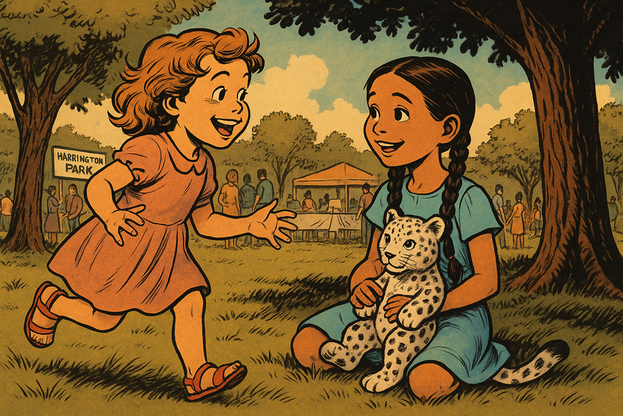
Onawa walked alone, small and slow, as if the very act of being seen might cause her to vanish. Her sandals made the barest sound in the trimmed grass—more whisper than step—and her shoulders were curled forward slightly, arms wrapped around the snow leopard she clutched to her chest like a shield. The toy, worn at the seams and faded around the paws, had the solemn look of something loved for many seasons, its once-white fur now sun-softened to a pale oatmeal hue. Its glass eyes caught the light with a dull glint as she moved, and Onawa held it close, not like a doll or pet, but like a relic.
The sounds of the other children floated on the air behind her, distant and scattered—laughter, high and shrill like whistles through reeds; the clatter of plastic toys knocked over on the picnic tables; the sing-song cadence of a mother calling someone named Charlie to come back, now, not later; a boy shrieking with glee as he chased a butterfly straight into a sprinkler's reach. It was a chorus of small chaos, layered and overlapping, the soundtrack of early childhood in full expression. Onawa moved through it like a ghost.
She didn’t look toward the other kids. Not out of snobbery or fear—but because they were too much. Too fast, too loud, too everything. Their limbs moved like wind-up toys with the keys twisted too tight, always spinning, always colliding. Onawa didn’t spin. She drifted. Her steps were small, measured, as though she was feeling out the shape of the earth beneath her with each footfall, deciding only in the last second whether to keep going forward.
Her braids—two long ropes that swung slightly against her back—had been done that morning by an older girl, who had insisted on adding a special ribbon for the occasion. Each section had been parted clean with the tail of a comb, each plait woven tight with a patience that spoke of ritual more than necessity. Onawa’s hair was thick, dark as earth, and the braids framed her face like bookends to a story she hadn’t told yet. Also present a small red bead inherited at her birth, tied near the end of one, it was something past elders said said would bring calm.
She walked near the tree line, far from the tables and the drinks and the grown-ups, tracing a slow path along the park’s edge as if she were keeping the border safe. Her free hand—her left—brushed along the tall grass near the fence, fingers trailing like she was listening to it speak. Every so often, she paused to look at something invisible to everyone else—a crooked stone, a butterfly caught in a beam of light, the way a shadow moved beneath the picnic bench as clouds passed overhead. She watched these things closely, her head tilted, her brow pinched in thought. If she could have spoken her feelings aloud, she might have said the world felt too big today. The sky too wide. Her thoughts too loud inside her small, quiet self.
Tah-kóxa—the snow leopard—was the one piece of home she had insisted on bringing. She’d gripped it so tightly during the car ride over that her fingers left warm dents in the plush fur.
She had insisted and no one had told her not to. There had been no teasing, no talk of leaving toys behind, no weary “not this time” that so often accompanied adults in a hurry. Instead, Lozen had listened, had knelt down to meet her daughter’s eyes, and said gently, “Then he should come with us. He’s part of the story, isn’t he?” Onawa had nodded, solemn and relieved, and carried the stuffed animal to the car with both arms wrapped around it like a bundle of significance.
He had to come. He always came when she didn’t know what was about to happen. He was her listener. Her memory. Her courage. Granny said he was more than toy—he was story. And stories, when carried close, kept you brave.
She passed the sandbox without glancing in. A boy there was banging a plastic shovel against the rim of a tin pail, shouting something about a volcano. A girl in a yellow dress was twisting a hula hoop over her hips with determined effort and wild elbows. The motion made Onawa dizzy just to watch, so she didn’t.
Instead, she wandered toward the tall tree with its low, spreading arms—more creature than plant, its bark ridged and gnarled like old skin. There, the world felt quieter. The breeze pooled in the shade like a sigh. Onawa sat carefully at the base of the trunk and curled into herself, Tah-kóxa pressed beneath her chin, her thumb resting against the edge of one of his worn ears.
A breeze rustled the leaves above, casting dappled shadows across her arms. Onawa leaned her head against the bark and breathed in—grass, sap, sunlight on soil. A moment passed like that. Then another. The world went on spinning a few feet away, but she had found a still point.
She whispered to her leopard in the hush that only children know how to conjure, “Don’ worry. We jus’ watchin’. No runnin’ today.” She meant both of them.
Glenda Robinson was not clinging. She had wriggled free of Lucille’s hand almost as soon as their feet hit the grass, her small body already thrumming with the restless curiosity that always seemed to go unanswered when grownups were talking. She stomped her way across the open green in red sandals that slapped with each step, sending faint echoes off the hard-packed dirt beneath the blades. Her curls bounced with a rhythm all their own, half-pinned back with a drooping barrette that had shifted during the drive and now hung like a tired butterfly near her left ear.
Her dress—a pale blue cotton number with a tiny stitched sailboat near the hem—was creased from the car seat and slightly askew from her insistence on “doing it herself” that morning. She had refused the offered hairbrush and selected her own socks, mismatched but firm in her decision. Her mother had sighed, straightened the collar once, and let her go. Lucille understood—Glenda was already asserting the early scaffolding of will. And she had never been a follower.
As Glenda moved, she did not run. She surveyed. Her eyes darted from child to child, from cooler to table to tree trunk. The orange drink held no interest. The cookies looked sticky and tired. She ignored the sandbox, stepped around a toppled tricycle, eyed the balloon animal man with undisguised skepticism. Too slow. Too silly. Too… ordinary. The world, she already suspected, had more to offer than icing and name tags. And so she continued, restless, weaving through the chatter and laughter with single-minded momentum.
And then she saw her.
A girl, standing quiet and still under the farthest of the shady trees. Alone. She wasn’t sitting or playing or talking—just being. One small shape under a large crepe myrtle, its branches stretched wide like a benevolent guardian. The girl had a stillness that didn’t look scared. More like she was waiting. And in her arms, hugged close and firm, was a white fuzzy creature—something between a stuffed animal and a small, beloved talisman. Its fur was pale but spotted, with floppy limbs and eyes that glinted faintly even in the shade.
Glenda stopped walking. Something inside her shifted. Not fear, not even surprise. More like… recognition. As if this quiet girl with the long braids and the faraway gaze had stepped out of a story Glenda hadn’t read yet, but already remembered. She tilted her head, squinting into the shade. The girl wasn’t moving. Just holding that spotted thing close.
Glenda felt a tug behind her ribs, sharp and specific. It wasn’t pity. It wasn’t even interest in the toy itself, though that helped. It was fascination. The quiet kind. The kind that said: That one. That one’s different.
She changed direction without announcing it, her feet pivoting in the soft earth. Behind her, Lucille’s voice called something faint and unheeded. Glenda was already gone, walking straight toward the tree line, toward the hush, toward the girl who didn’t seem to belong to any of this—and seemed all the better for it.
She noticed the braids first—tight and perfect, with a red bead near the end of one, the kind of detail Glenda always paid attention to. It reminded her of the strings Mama used to tie herbs in the kitchen, or the old leather bookmark in her prayer book.
Then she saw the girl’s face. Serious. Watching. But not unfriendly. More like listening. Glenda’s eyes flicked to the toy. It wasn’t a teddy bear, or a rabbit, or any of the animals she saw in the church nursery. It had a look to it—like it knew things. Like maybe it had followed this girl out of a dream and was still deciding whether to go back.
That sealed it.
Glenda walked straight up to her—no hesitation, no careful dance of toddler protocol. She stopped a few feet away, hands on her hips like a small sheriff surveying a town she might soon settle.
And in that moment—before the words came, before the first questions or the names or the sharing of stories—something passed between them.
A flicker. A possibility. Glenda had seen a hundred children that day. Only one had pulled her forward like a magnet. The girl under the tree. The one with the snow-spotted mystery. The one who looked like she was carrying something worth knowing. And Glenda, tiny as she was, also already sure of her direction, was determined to know it.
Glenda paused at the edge of the shade, blinking against the sudden shift in light, the warmth still clinging to her skin while the air beneath the crepe myrtle turned cool and dappled. The hush here was different. Not the absence of noise, but a holding of it—like the tree itself had cupped its leafy hands around the moment to keep it from blowing away.
The girl didn’t look up right away. She was sitting now, cross-legged in the grass, her toy still hugged against her chest. The white creature’s tail curled awkwardly beneath her arm. Its nose was rubbed bare. Glenda inched closer. “That a kitty?” she asked, tipping her chin toward it. The question dropped like a pebble in a pond—small, but it rippled.
The girl looked up slowly, her eyes careful, dark, weighing the question like it might come with a trick. There was no fear in her face—just the quiet suspicion of someone who had been asked too many odd questions before and learned not all of them were safe. She held the toy a little tighter. “No,” she said. Barely more than a whisper. “He not.”
Glenda blinked, then dropped into a squat, resting her hands on her knees. Her gaze stayed fixed on the spotted creature, her brow creased in solemn interest. “He looks like a kitty. But diff’rent. What is he?” Onawa hesitated. She glanced down at her snow leopard, then back up at Glenda as if deciding how much of the truth to release.
“He’s a snow leopard,” she said eventually. “Name’s Tah-kóxa.” She said it slowly, deliberately, the syllables pronounced with a weight that made Glenda instinctively straighten. It didn’t sound like something made up. It sounded given. “A snow leopard?” Glenda repeated, astonished. “That real?”
Onawa gave the smallest of nods. “He’s real to me.” It wasn’t defiant. It wasn’t defensive. Just matter-of-fact. Glenda opened her mouth to ask more, but stopped herself. Her eyes wandered instead—trailing up, then widening. “Your hair’s real pretty,” she said suddenly, breathless with admiration.
That caught Onawa off guard. She shifted slightly. Not in retreat—more like surprise. Her hand lifted reflexively toward one braid, brushing the red bead near the end. Her fingers lingered there. “My friend did it,” she mumbled. “She’s so good at it,” Glenda said, voice rising with genuine awe. “Mine just get stuck. Mama tries, but it goes all fuzzy. And I cry sometimes. But yours—yours look like ropes. Like the ropes on boats. But nicer.”
Onawa blinked again, the corners of her mouth softening into something uncertain—hovering between confusion and delight. Compliments were not a familiar language yet.
“She use a comb with a tail,” Onawa said, voice barely above the rustling of the leaves. “An’ sometimes she hums. She don’t pull.” Glenda nodded, as if this was the most valuable information she’d received all day. “Bet she knows lots,” she said. Onawa didn’t answer, but she wasn’t clutching Tah-kóxa as tightly anymore.
For a long moment, neither girl spoke. The wind sifted the branches above them. In the distance, someone squealed over a spilled cup. A paper plate cartwheeled across the grass. It all felt far away. The world had thinned to the shade, the stillness, the two of them.
Glenda rocked forward onto her heels, then settled into the grass with a soft fwump, sitting cross-legged like Onawa.
“Mine’s Glenda,” she offered, glancing sideways. Onawa watched her, one braid swinging slightly as she tilted her head. Then, after a pause: “Onawa.” “That’s nice,” Glenda said, as if she’d just tasted a favorite candy. “Granny says it’s a strong name.” Glenda considered that. “I like strong. I’m strong too. One time I moved a chair all by myself. Mama said it was made of oak.” Onawa looked down at Tah-kóxa, then back up. “He’s strong too. But quiet.”
The shade had thickened around them, and the noise of the park faded into something distant and dreamlike. A wasp hovered near a patch of clover, then moved on. A leaf turned circles in the grass as the breeze lifted it, dropped it, lifted it again. Neither girl spoke for a long moment, content in the new, strange quiet they shared.
Then Glenda, who had been fiddling absently with a twig and watching Onawa out of the corner of her eye, leaned in just slightly. “What’s he do?” she asked, nodding toward the snow leopard. “Tah-kóxa. You said he’s real.”
Onawa glanced down at the toy in her lap, then ran her hand gently over its back. The fur was patchy in places, rubbed thin from years of holding. “Granny said,” she began, slowly, as if testing the edge of a long memory, “that he walks the tops of the clouds. Like how birds do, but softer. He don’t got wings. Just light feet. He walk slow so the clouds don’t fall.”
Glenda’s mouth opened a little. “Like... like he floats?” Onawa nodded. “Uh-huh. But not float like balloons. Float like... mountains when they sleep.” This, of course, made perfect sense to Glenda. She nodded gravely, her hands folded in her lap, waiting. Onawa’s voice shifted slightly—not louder, but deeper, rounder. She was falling into rhythm now, the one she had heard countless times from her grandmother’s rocking chair, on porches that creaked and smelled of cedar, when the sun had gone low and the air felt full of secrets.
“Granny said he’s older’n time,” she continued, eyes half-focused like she could see the pictures as she spoke them. “Said he was made before snow knew how to fall. He’s white so he don’t get seen in the cold places. His spots are stories. They move if you watch long ‘nough. But only if you’re meant to see.” Glenda was completely still.
“She said he picks a child once in a while. Just one. Always one. When they real little. Little like us.” Onawa’s gaze flicked toward Glenda at that, gauging the reaction. She saw no teasing, no smirk—only wonder. Glenda blinked and whispered, “What for?” “To keep from gettin’ lost,” Onawa answered. “But not just lost in the woods. Lost in here.” She tapped her chest with one small finger. “Lost when you feel too small. Or when the world’s too loud.”
Glenda sat straighter. “Is he magic?” “Granny said old things ain’t magic—they just are.” Onawa nodded again, firm this time. “Like thunder. Or sleepin’ rivers.” Glenda exhaled softly, almost in awe. “He ever come to your granny?”
Onawa’s expression turned serious. She nodded, her thumb still brushing Tah-kóxa’s back. “She said... once. When she was ‘bout four. She’d run from home. She was mad. Her mama told her she couldn’t keep a baby jackrabbit, so she left. Went out past the barn. Got turned ‘round in the cane field.”
Glenda knew about being turned around. She’d once gotten lost between clothes racks at Woolworth’s and remembered it like a war. “She said it got dark real fast. Quicker than usual. Sky was all kinds of purple. And she sat down to cry, and then—” Onawa paused, her eyes narrowing as if squinting at the memory she had never lived—“then the wind came. But not like a storm. It was soft. Like breath.”
Glenda didn’t move. Even the wind around them seemed to hush for Onawa’s next words. “She looked up. And there he was. Big. Bigger’n a man. Standin’ not on the ground, not floatin’, but in between. She said his eyes didn’t glow but they knew. She tried to talk, but he didn’t need her to. He already heard her.”
Onawa leaned a little closer, now whispering. “He walked beside her. Didn’t touch, didn’t talk. Just... walked. And when she looked again, the barn lights were there. She was home.”
There was silence between them then—deep and unbroken for nearly a full minute. Glenda’s fingers curled into the grass, and she looked at Tah-kóxa with new reverence. Not like a toy. Like a story still walking. “I never met nothin’ like that,” Glenda said softly. Onawa gave a one-shoulder shrug. “You don’t meet him. He meets you.”
Glenda nodded slowly, understanding in the way children sometimes do when there’s no proof, no logic, but something in the chest says this part is true. She leaned forward, elbows on her knees, studying the leopard again.
“Can I touch him?” Onawa thought. Then, slowly, she held him out—not by the neck or tail, but gently, like a ceremony. “Just gentle,” she said. “He don’t like grabbin’.” Glenda received him carefully, as if the toy might speak. Her hands moved with instinctive grace, thumbs grazing the worn patch near his ear. “He’s warm,” she whispered. “He remembers things,” Onawa said.
Glenda passed him back after a moment, her expression more serious than before. “I hope he likes me.” “He will,” Onawa said. “He already sat with you.” Under the hush of the tree, Glenda looked at Onawa like one looks at a door just opened—and Onawa, for the first time that day, smiled.
The shadows had grown long and golden, slanting through the park like spilled honey, casting everything in that soft, late-summer glow that makes even folding chairs and paper plates look like artifacts of something grand. The wind had cooled, just a little, enough to lift the ends of tablecloths and ruffle loose strands of hair. Parents began collecting diaper bags and juice-stained shirts, half-full snack bags and the occasional stuffed animal left behind in the grass. Children were being herded gently toward goodbyes, a process that ranged from reluctant shuffling to full-scale tantrums.
Lozen had been standing beneath one of the taller trees nearer the lot, her arms folded, watching the crowd with calm interest. She had always preferred the edges of gatherings—close enough to see, far enough to think. She wore a light denim skirt and a sage-colored blouse, a woven satchel slung over one shoulder and a half-empty mason jar of sweet tea in her hand. She had begun scanning the park for Onawa, expecting to see her still near the tree line or perhaps by herself beneath a bench, eyes down, toy in hand.
What she did not expect was the sudden, thundering impact of two small bodies rushing her at full tilt, nearly toppling her off-balance.
“Mama!” Onawa squealed, grabbing hold of Lozen’s legs with surprising force, her words breathless and tumbling. “We runned!” Glenda cried behind her, giggling so hard she hiccuped. “We runned so fast!”
Lozen blinked, startled—but then looked down and smiled as her hands instinctively reached to steady both girls. One was familiar—her daughter, already talking a mile a minute, eyes bright and cheeks flushed pink. The other was unknown, clinging with no less enthusiasm, a red-faced sprite with wild curls and a crooked barrette that was somehow still hanging on.
“Whoa now,” Lozen said, crouching slightly as both girls clung to her. “What’s this stampede about?” Onawa’s voice came in quick, excited bursts. “Mama—this is Glenda—she my new friend—she’s funny—she likes Tah-kóxa—an’ she said my braids look like boat ropes—and we sat forever and made a game and a story—can she come over? Can she come now? Please?”
Glenda added a small gasp of support. “We made a new kind of leopard story,” she said, eyes shining. “With mountains that sleep and a cloud house, and I wanna see Onawa’s room, and her real house, and her toys, and maybe her Granny too—if she lets.”
Lozen, still kneeling, let out a quiet breath as she took them both in. Onawa was practically vibrating with joy. She clutched Glenda’s hand like she was afraid letting go might undo the whole day. There was something in her eyes Lozen hadn’t seen before—not just excitement, but recognition. A kind of fullness. Like a note that had been waiting too long to be played.
The other girl—Glenda—looked completely at home, unbothered by formalities, her eyes jumping between Lozen’s face and Onawa’s with open trust. Lozen gave a slow, deliberate smile. “So you found each other, huh?” Onawa nodded fiercely. “We didn’t even mean to. But we did.” Lozen smoothed Onawa’s hair gently with her hand, and her eyes softened. “Sometimes the best people come like that,” she said. “Just arrive.”
Then, over Onawa’s shoulder, she noticed movement. A tall woman in a sleeveless linen top was making her way across the grass with that quiet, no-nonsense stride of someone who had stopped apologizing for taking up space a long time ago. Her expression was thoughtful, her hands calm at her sides. A breeze caught the hem of her skirt. The sun lit her hair like struck copper. Lucille, Lozen thought at once. Has to be.
She stood slowly, brushing off her skirt. “And that,” she said to the girls, “looks like your mama, Glenda.”
Glenda turned, gave a happy squeal, and waved both arms like semaphore flags. “Mama! I made a friend! She gots a snow leoopard! Her granny met it and didn’t get lost!” Lucille smiled and lifted her eyebrows, as if to say Did she now? She was nearly upon them.
Lozen bent low once more, touched Onawa’s back. “Let’s not plan whole sleepovers just yet,” she murmured gently, her tone a practiced blend of kindness and boundary. “We’ll talk about it. It’s not a no. It’s just a talk-first thing.” Onawa nodded quickly, but her eyes stayed locked on Glenda, still shining with possibility.
Lucille reached her daughter and gently tousled Glenda’s curls. “I should’ve known the day would end like this. I turn my back for five minutes and she finds a new universe.”
“She and my Onawa hit it off,” Lozen said, motioning toward her daughter, who now stood bashfully twisting the edge of her dress. “They’ve been inseparable since they met.” Lucille’s gaze moved to Onawa, then back to Glenda, and something softened in her eyes. She nodded. “Sounds like she had a good afternoon.”
Lozen gave a low, amused chuckle. “They’re already making plans. Onawa wants Glenda to come visit.” Lucille gave a lopsided smile. “She does, huh?” “I told them we’d talk,” Lozen said carefully. “No promises yet. But maybe once we’ve all had a cup of coffee and a proper introduction.” Lucille’s smile deepened, genuine now. “That sounds just right.”
Onawa and Glenda were already walking a slow circle around them, hand in hand, talking in that breathless, half-invented language children make when they feel safe and seen. The bond had been formed fast, but it had weight. Lozen watched them for a moment more, then said softly, “That one’s special. Your Glenda. Onawa doesn’t open like that.” Lucille glanced sideways. “Same for mine.”
For a moment, the two women stood in the hush between words, watching the girls spin small circles in the long light. Not strangers anymore, not quite friends—but already tethered by the sudden weight of this unexpected meeting.
A beginning had begun.