Work Text:
The first thing Glenda noticed was how the world outside the car window kept changing outfits. Plano had been all straight lines and soft colors—neat houses in rows like crayons in a box, telephone poles with their wires drawn tight, shops with big square windows that looked sleepy in the late-morning light. Then, slowly, the houses got farther apart. The shops disappeared. The road straightened, then curved, and the sky seemed to grow taller with every mile.
She sat in the back seat, legs too short to dangle all the way off the vinyl bench, white socks bunched at the ankles above her red sandals. The car smelt like what it always did—old paper from Lucille’s folded road map in the glove compartment, a faint ghost of Phoebe’s perfume in the upholstery, the warm dust of sun on plastic. But the air sneaking in through the cracked-open window smelled different now. It was sharper. Less pavement, more dirt. Less lawn sprinklers, more something wild underneath.
Glenda shifted, pressing her palms into the seat and pushing up with all the power in her small arms. Her body rose a few inches, enough for her to see more than sky and the narrow slice of shoulder. The world jumped into view: barbed-wire fences sketched along fields, cows scattered like punctuation marks, a broken windmill leaning into the horizon. In the distance, something rusted—maybe a tractor, maybe the bones of a barn—stood crooked against the pale blue.
She made a soft sound in her throat—half gasp, half hum.
From the driver’s seat, Lucille caught the movement in the rear-view mirror. A small head popping up, curls frizzing where the barrette had lost its fight, brown eyes wide and intent. For a moment, Lucille’s fingers tightened on the steering wheel. Instinct said, Sit down, sweetheart. Safety first. But she didn’t speak. She only watched, her mouth pressed in a line that wasn’t quite a smile and wasn’t quite a frown.
She’d fought hard not to show her nerves that morning.
Packing the little bag, she’d folded and refolded the same yellow T-shirt twice before realizing what she was doing. It’s just a visit, she’d told herself. People do this all the time. Other mothers took their children to friends’ houses without running disaster scenarios in their heads. But this wasn’t just anyone’s house. And this wasn’t just a playdate.
The word commune sat in the back of her mind like a pebble in a shoe.
She knew better than most that the world had opinions about such places. The papers liked to run stories with pictures of wild-eyed men and barefoot children, all chaos and unwashed hair. But Lozen hadn’t struck her as chaotic. Intense, yes. Sharp as flint, wary as a stray dog that’s learned both kindness and cruelty from human hands—but not reckless. And Onawa—now there was a child who seemed stitched together from quiet and old stories, not from anything dangerous.
Lucille’s jaw flexed once as she guided the car along the two-lane highway, following directions written on a blue index card tucked beside the gearshift. Turn north past Gordonville. Follow the old road. Look for the hand-painted sign.
Behind her, Glenda’s arms began to tremble. Pushing herself up like that took effort. She let herself drop back down with a soft whump, the vinyl sighing beneath her. The window frame cut the world in half again; all she could see now was sky and the occasional flash of a telephone wire. She puffed out her cheeks, considered this injustice, then tried again.
Lucille watched the second rise-and-fall in the mirror and, after a beat, spoke without looking back.
“You’ll get a crick in your neck, doing that,” she said mildly.
Glenda didn’t answer. Not because she was ignoring her mother, but because she was too busy deciding whether the view was worth the effort. Up—cows, fences, a line of trees whose leaves were a new, soft green. Down—seat, door handle, the edge of her own knees. Up again.
“Mama,” she puffed, hands pushing, curls bobbing. “The grass is ‘normous.”
“Aye. It is.”
Lucille didn’t add that it made her feel small, too, in a way she hadn’t felt since leaving Ireland. Texas fields had a different kind of wideness than Cork hills, but the ache was similar—something in her chest remembering what it felt like to stand in a landscape large enough to swallow your worries if you’d let it. She’d been young then, younger than she liked to admit when telling stories. Brave in the way of people who don’t yet know what they should be afraid of.
Glenda pushed herself upright again, elbows locked. A small line appeared between her brows as she studied a cluster of distant buildings—gray shapes slouched against the horizon like tired shoulders.
“What’s that?” she asked, breath a little short.
Lucille flicked her gaze from the road to the mirror and back again. “What’s what, love?”
“Those.” Glenda jerked her chin toward the right side of the car, but the angle was all wrong. From the front seat, Lucille could see only a smear of faded rooftops, a gap-toothed stretch of old main street half-swallowed by trees.
“That’s just an old town,” Lucille said. “From a long time ago, it was called Rutherford.”
“Where the ghosts live?” Glenda asked immediately, eyes brightening with the particular interest she reserved for anything frightening or forbidden in stories.
Lucille huffed a quiet breath that wasn’t quite a laugh. “No, love.” she said. “Ghosts don’t care about street names.”
“Do they care ‘bout cows?” Glenda persisted, still holding herself up, knuckles whitening against the back of the seat.
“Maybe the polite ones,” Lucille replied. “Sit down, Glenda. You’ll fall when I hit a bump.”
Glenda hesitated, looked at the road unspooling ahead—solid, flat—and then at her mother’s eyes in the mirror. Something in the line of Lucille’s shoulders made her relent. With a small grunt, she let herself drop back down, legs swinging.
For a moment, the car was quiet but for the dull roar of the tires and the soft whistle of wind at the cracked window. A grasshopper bounced off the windshield and tumbled up and over. Somewhere in the back, a crayon rolled across the floor mat and lodged itself under the heel of Glenda’s sandal.
She wriggled her toes, feeling the waxy bump. “Mama?”
“Yes?”
“Is this where On’wa lives?”
“This is the way to her home, I’m sure she’s just as excited to see you.”
Glenda tasted the name again, rolling it in her mouth like a sweet. “On-na-wa,” she murmured. “She got the le-pard there?”
Lucille’s mouth quirked. “I imagine so. I doubt he has other places to be.”
“Maybe he goes ‘tween the clouds,” Glenda said, very serious. “But he comes back ‘cause he don’t wanna leave On’wa lost.”
Lucille’s hands tightened once, then relaxed. She remembered that story—overheard in pieces at Harrington Park months ago, filtered through Phoebe’s amused retelling later that night. The two little girls under the tree, one whispering about an old snow leopard who walked the tops of clouds, the other sitting so still it was as if she’d been nailed there, not wanting to miss a word.
The memory warmed and unsettled her all at once. It was a beautiful story. It was also—if she was honest—one more reminder that her daughter was walking into a world shaped by a different kind of magic and a different kind of danger than the tidy suburbs could offer.
Glenda leaned her forehead against the cool glass, watching as the last hint of Rutherford slipped out of view behind a stand of scrubby trees. The fields here looked less organized, more like somebody had dropped green paint from a great height and let it dry where it landed. There were no sidewalks, no mailboxes perched at perfect intervals. Just land.
Her eyelids drooped, the steady hum of the engine lulling her, but every time her head began to tilt she jerked it back up, fighting sleep with stubborn, silent determination. There was too much to look at, and this was, she had already decided, an Important Day. Important days did not include naps.
Lucille glanced over her shoulder again, this time turning her head just enough to see Glenda’s reflection and not just a blur of color. “You all right back there?”
Glenda nodded without lifting her forehead from the glass. “Uh-huh.”
“You can close your eyes if you need to,” Lucille said. “We’re nearly there. I’ll wake you.”
“I don’t wanna miss it,” Glenda mumbled.
“Miss what?”
“The gate,” she said, as if it were obvious.
The directions talked about a turnoff and a dirt road, then another turn at a cedar tree with a crooked trunk, then a hand-painted sign. But of course Glenda was expecting a gate. All good stories had one—a wardrobe door, a rabbit hole, a garden wall with a keyhole. This was no different in her mind. Somewhere between Plano and the place where Onawa’s snow leopard kept watch on the clouds, there had to be a threshold.
“All right,” Lucille said softly. “We’ll look for it together, love.”
They drove on.
The asphalt narrowed, then gave way to a rougher, paler road that kicked up dust behind them like breath. Rocks ticked softly against the undercarriage. The car jostled over ruts, and Glenda grasped at the door and seat to steady herself. She pushed herself upright again—this time bracing one hand on the back of Lucille’s seat, the other on the window ledge. Her eyes narrowed, scanning the world ahead with the serious, measuring expression that often made her look older than she was.
The land had shifted again. Closer now, the earth rose and fell in gentle, uneven waves. Clusters of trees huddled together like conspirators, leaving pockets of bare, packed dirt where trucks had turned in and out. Off to the left, Glenda saw broken chimneys standing alone in the weeds, no houses attached to them at all—stone columns, blackened at their mouths, pointing at nothing.
Her breath caught. “Mama… the houses fell down.”
Lucille followed her gaze and felt a familiar pang. The ruins of Rutherford had that effect—an odd mix of sorrow and accusation. She’d heard the commune folk talking about it at the school meetings: how they took old boards and bricks from the ghost town, reused what other people had tossed aside to build something that refused to die.
“They’re old, is all,” she said. “Sometimes when people move away, the houses don’t have anybody to look after them. They get tired.” She paused, then added, “Somebody’s using the good pieces, though. Making them into new houses.”
“Like puzzles,” Glenda said, satisfied. “You put ‘em back different.”
“Exactly,” Lucille murmured.
The car crested a small rise.
And there it was.
At first, Glenda thought it was just another fence—two weathered posts flanking a gap where the road slipped through. But as they drew closer, she saw the difference. The posts were thicker, rough-hewn chunks of timber sunk deep into the earth, their tops carved into simple, blunt shapes that reminded her of the wooden animals Phoebe sometimes brought home from folk fairs. Between them hung a wide wooden beam, suspended on chains that rattled softly in the breeze.
On the beam, painted in a careful hand that had not rushed, was a name. The letters were big enough that Glenda could make them out even from the back seat, though some of the curves were strange. The white paint had been touched and retouched in places where the wood had soaked it in unevenly.
She sounded it out under her breath, lips moving. “Tuh… Toe… To Naaa…” The syllables tangled. She frowned, trying again.
Lucille slowed the car as they approached, more out of respect than necessity. The gate—if it could be called that—had no actual barrier. No swinging panel, no chain across the road. Just the posts, the beam, the name. A threshold marked in intention, not hardware.
“That’s the sign,” she said quietly. “That’s where they live.”
Glenda’s heart did a peculiar little jump. Something about seeing the word—whatever it was, however it twisted in her mouth—made this all real in a way nothing else had. The stories at the park, the talk at home, the arguments half-whispered between Lucille and Phoebe late at night about safety and culture and what the state thought it was owed—all of it shrank down to the size of those letters.
For a moment, she let herself coast, the car crawling beneath the sign. She tipped her head back just enough to read the word properly, silently, the way she’d done when Phoebe first showed it to her on a leaflet. Tó Nádahłí. Water that flows. Movement. Refusal to stagnate. She didn’t know the language well enough to feel it in her bones the way Lozen did, but she understood enough to recognize the defiance stitched into it.
Glenda craned her neck, watching the beam slide overhead, the chains creaking faintly. As the car passed beneath, she had the odd, fizzy sensation of being poured from one cup into another—same girl, same shoes, but everything around her subtly rearranged.
Then the sign was behind them, and the road changed yet again.
It narrowed to a simple track, twin dirt lines with grass growing up in the middle, the kind of path made by repeated feet and tires rather than any city planner. Mesquite trees leaned in from the sides, their branches scratching at the car as if curious. Somewhere nearby, a dog barked once, sharp and protective, then fell silent.
Glenda’s earlier bravado thinned at the edges. She dropped back onto the seat, spine straight, fingers curling in her lap. The weight of what lay ahead pressed against her in a way it hadn’t on the open highway. At the park, she’d marched directly to Onawa under the tree without a second thought. Here, the space between them felt longer, heavier—filled with adults, houses, rules she didn’t know yet.
Lucille felt it too. Her throat tightened as the track curved and widened slightly, opening onto a rough, packed-dirt clearing. To the left, a low building made of sun-bleached boards and salvaged stone sat with its back to a stand of cottonwoods. To the right, a scattering of smaller structures—some half-finished, some patched, all clearly lived-in—formed a loose horseshoe. Chickens moved like little commas in the space between.
She eased the car to a stop near the edge of the clearing, far enough from the center not to feel as though she were parking in someone’s living room. The engine ticked once, then fell quiet. The silence that followed was not empty; it was full of distant voices, a hammer somewhere, the faint clatter of dishes. A wind chime made from old spoons chimed a crooked little melody near one doorway.
Glenda swallowed. The world suddenly felt very loud inside her and very quiet outside.
Lucille sat for a heartbeat with her hands resting on the steering wheel, listening to the soundless thud of her own pulse in her ears. She glanced into the rear-view one more time.
Glenda’s eyes were wide, but not frightened. Her gaze moved in small, decisive jumps, taking everything in: the way the light hit the stone walls, the chickens pecking, the curve of the path that led further in. She looked as if she were standing at the mouth of one of her storybooks, the page half-turned.
Lucille pushed open her door. The hinges gave a protesting creak, and hot, dry air rushed in, carrying with it the smells of dust, woodsmoke, and something cooking—beans, maybe, or stew. Gravel crunched under her shoes as she stepped out. For a moment she stood, smoothing down the front of her skirt, letting her eyes adjust to the fuller brightness now that there was no windshield between her and the sky.
Then she walked around to the passenger side, opened the back door with a practiced motion, and bent slightly.
“All right, Glenda,” she said. “Out you come.”
Glenda scrambled toward her, the vinyl squeaking under her small hands. Lucille’s fingers found her under the arms and lifted, the familiar weight fitting easily against her. For a second, Glenda’s feet hovered, shoes swinging over the threshold between car and earth. Then Lucille set her down gently.
The ground felt different from the manicured lawns and parks. It was firm but uneven, small stones pressing through the soles of Glenda’s sandals, fine dust puffing up around her toes. She took a tentative half-step, testing it, then another. The sounds were different, too—no distant hum of traffic, no clipped bark of dogs behind backyard fences. Just wind in leaves, a rooster crowing somewhere out of sight, the murmur of a woman’s voice carried on the air from behind one of the buildings.
Lucille closed the car door with a soft thunk and, without thinking, reached down.
Glenda’s hand was already there, small and warm and slightly sticky from the raisins she’d eaten an hour earlier. Her fingers curled around Lucille’s with complete trust, as if there was nowhere else they could possibly belong. Lucille tightened her grip, not too hard, just enough to feel the bones and promise beneath the soft skin.
For a brief, suspended instant, they simply stood.
The car behind them ticked quietly as the engine cooled. Ahead of them, the track leading deeper into the commune stretched out, edged by wildflowers and the faint, beaten marks of many feet. The hand-painted sign they’d passed a minute before seemed to hover in Lucille’s mind, a word she couldn’t quite pronounce but felt the edge of all the same.
Hand in hand, they turned toward the path and began walking ahead.
The world seemed to widen.
It happened the moment both her feet were on the ground. A second ago there had been car doors and roof and window glass framing everything, making it small, like a picture in a book. Now there was just…outside. Sky with no edges. Light on her face. Air that didn’t feel like it had been used by other people first.
The air smelled different out here—cleaner somehow, like dirt and wind and sun had all been brewed together with something old and green. Glenda pulled in a breath so big it puffed out her chest. It tasted dusty on her tongue, but not like the dust under the bed. This dust had been everywhere first.
She blinked at the space around her.
There were no curbs. No fences. Just sky, and scrub trees, and wide open land that didn’t seem to care who was watching.
In Plano, everything had lines.
Lines where the sidewalk stopped and the grass started. Lines of white paint on the road. Lines of little wooden picket fences that said, this is ours, that is yours. Even the park had a fence around it, green metal bars with a squeaky gate. Here, the ground just went. Out and out and out, until it met the sky and decided that was enough.
Glenda turned in a slow, clumsy circle, her hand still locked in Lucille’s. Her head tipped back, curls brushing her collar as she stared up. The blue above them felt bigger than any blue she had ever seen. Like somebody had stretched it extra this morning just for them.
“Mama,” she breathed. “Da sky… it’s huuuge.”
Lucille glanced down at her, then out across the land. “It is, isn’t it?”
“It’s gonna fall,” Glenda said gravely, as if reporting a practical problem. “It too big. Gonna go—” she spread her free hand, fingers wiggling, and made a soft pwff sound, like something collapsing in slow motion.
“I don’t think it will,” Lucille murmured. “It’s been holding itself up a good long while.”
Glenda frowned thoughtfully at the sky, as if reconsidering its structural integrity. Then she looked around again, eyes snagging on the absence of things she was used to.
“Where da sidewalk?” she asked.
“There isn’t one,” Lucille said. “Just the ground.”
“No… no skreet?” Glenda said, testing the word. “No… no lines where you walk an’ no-walk?”
“Not here,” Lucille replied. “You walk where your feet go. As long as you’re careful.”
Glenda considered this like it was a brand-new law of physics. She lifted one foot and stamped it down experimentally. Dust puffed around her sandal.
“It’s crunchy,” she announced. “Da groun’ is crunchy.”
“That’s the gravel,” Lucille said. “Little stones. See?”
She bent slightly and toed a small rock with the front of her shoe, nudging it into view. Glenda let go of her hand for just a second—just long enough to crouch down in a wobbly squat and pinch the pebble between two chubby fingers.
It was pale, with darker specks in it, like the raisins in her morning oatmeal. She turned it over, then held it up toward Lucille, arm stretched all the way.
“Look, Mama. It’s a, um… it’s a tiny egg-rock.”
“Is it now?” Lucille’s mouth softened. “What’s going to hatch out of that, do you reckon?”
Glenda’s eyes lit up. She hadn’t been expecting the question; it was like a door she hadn’t seen had just swung open.
“Um… a teeny lil’… horse,” she decided, words tumbling over each other. “But not inside,” she added quickly, catching herself. “He too big. Just… just pretend horse. In your ‘magination.” She tapped the side of her head with the hand still holding the pebble. “Right dere.”
Lucille reached down and brushed a bit of dust off the hem of Glenda’s shorts. “That’s a good place to keep horses,” she said. “Less mucking out.”
Glenda giggled, the sound small and bright in the wide space. Then the laugh dropped away as another difference hit her.
She straightened slowly to her full, not-very-impressive height, turning again in a circle, feet grinding the tiny stones under her sandals.
“Mama?” she said, voice a little softer.
“Aye??”
“No fences,” Glenda said. It wasn’t a question. She sounded almost offended on the world’s behalf. “Where da fences gone?”
Lucille followed her gaze. Back home, there were fences everywhere—wooden slats, chain-link, hedges clipped into obedient shapes. Here, there were only the timber posts and the buildings they’d parked near, and beyond that, a mess of grass and scrub and thorny brush that didn’t seem to understand the concept of straight lines.
“Some places don’t need fences,” Lucille said.
“Why?” Glenda turned her face up to her again, urgency in the crease between her brows. “’Cause, ’cause nobody wanna take it?”
“Well,” Lucille said slowly, “some of it’s because they share. And some of it’s because there’s just room. Enough for everybody to breathe.” She watched the wind ruffle the low brush, its movement making waves in the grass that reminded her of the sea back home, if she squinted. “And some of it,” she added under her breath, “is because they’re too busy to worry about fences.”
Glenda only caught the first part.
“Room to bweeve,” she repeated, making the word bigger. She sucked in another huge lungful of the strange air and held it, cheeks ballooning, then let it out in a gusty sigh. “It smell funny,” she reported.
“Funny-bad or funny-good?” Lucille asked.
Glenda scrunched up her nose, thinking hard. “Funny… like, like when you open da window when it rain,” she said. “But no wet. Jus’… outside.” Her hands fluttered, trying to shape something that wouldn’t be shaped. “Like dirt-soup. An’ da sun. An’… grass hair.”
Glenda rocked on her heels, tiny rocks protesting underfoot. A gust of wind came, not sharp, but enough to push against her clothes and ruffle her curls. She squeaked and grabbed for Lucille’s hand again with both of hers this time, fingers clinging tight.
“It blowin’ me ‘way,” she complained, though there was a shade of delight in it. “Mama, hold me down.”
Lucille tightened her grip, that quickest, deepest instinct kicking in. “I’ve got you,” she said. “The wind’ll have to fight me first.”
Glenda leaned her weight into Lucille’s side, safe now that the proper arrangement—Mama as anchor had been reasserted.
Beyond them, a scrap of tin on one of the roofs flashed in the sunlight and clanged dully as the breeze shifted. A chicken clucked somewhere, sharp and businesslike. The sound of a laugh—an adult’s, low and easy—floated across the open space from behind one of the nearer buildings, then faded.
Glenda’s ears twitched toward it, but there were too many other new things piling up inside her to chase any one.
She looked at the scrub trees to the side of the clearing, spindly and tough, their leaves a different green than the parks at home. These ones looked like they’d had to earn their green, clawing it out of dry soil.
“Mama, da twees here is… is scratchy,” she observed. “Like… like dey got mad hair.” She patted her own curls by way of comparison. “Not like da park twees. Park twees is all…” She made a round shape in the air with both arms. “Puff-puff.”
“Those are called scrub,” Lucille said. “And oaks, and mesquite. They’re the kind that can live out here when it doesn’t rain much.”
“Skwub,” Glenda said solemnly, immediately misplacing the r. “Skwub twees.”
She stared at one particularly crooked specimen, its trunk bending at an angle that made no sense to her toddler sense of order. It leaned, but didn’t fall.
“It’s like… like when you draw a twee an’ your hand go wiggle-wrong,” she decided. “But it real.”
Lucille followed her gaze, and for a moment, they both just looked. Mother and daughter, two different heights, same uncertain little pause in their stance.
The land didn’t look back. It just was.
No tidy lawns or parked cars. No neighbours’ houses pressing in close. Just that huge sky and the stubborn scrub and the dirty, honest ground. It felt, to Lucille, like standing in a doorway she wasn’t sure she had the right to walk through. To Glenda, it felt like being very small in the best possible way, like standing on the first page of a very big book.
A fat black beetle chose that moment to trundle out from under Lucille’s shoe and head determinedly across the dirt between their toes. Glenda’s eyes dropped to it, immediately and completely distracted.
“Oooooh,” she breathed, squatting down again with a soft oof. “Look, Mama. He got shiny coat. He goin’ on a ‘venture.”
“I suppose he is,” Lucille said. “Where d’you think he’s off to?”
“Home,” Glenda said promptly. “He live in a tiny house. Unner a rock.” Her voice dropped, conspiratorial. “He got no fences neither.”
She stuck out one finger as if to pet him, then thought better of it, tucking her hand back close to her chest.
“I won’ step on you,” she informed the beetle seriously. “You can go bweeve too.”
The beetle, unbothered, continued on its path.
Glenda rose again—this time using Lucille’s hand as a lever, pulling herself up with all the trust in the world. When she was standing, she set her feet wider apart, knees a little bent, as if bracing herself.
“Da outside here is bigger than da outside at home,” she declared, voice almost solemn. “It’s like… like… outside plus more.”
Lucille looked out at the empty horizon, at the patched houses and the spilling, borderless land, and felt something in her chest twist and then settle.
“Yes,” she said quietly. “It is.”
Glenda nodded, satisfied that this had been confirmed.
Her braids were tidy, each plait pulled smooth and straight from her scalp, the parts between them so neat they looked like they’d been drawn with a ruler. The ends were tied off with mismatched bits of ribbon—one blue, one white—that had seen better days but still held on gamely. Her shirt was a little too big, the collar a touch wide at the neck, the sleeves rolled to her elbows in uneven cuffs that showed a pair of thin, sun-browned forearms. Someone had tried to smooth it earlier, but it had already remembered its favourite crinkles.
Her thin shoe soles were dusted red, the leather scuffed at the toes, as if she’d been running errands or cutting across paths she wasn’t strictly meant to use. She walked without hurry, but with clear direction—her gaze fixed, her shoulders loose. Straight to Glenda, who stood near the rain barrel, turning slowly in the dirt like a weather vane trying to decide which way the world was.
The rain barrel itself was an old metal drum painted a once-bright green, now flaking in places to show the silver-gray beneath. It sat on a fat square of cinderblocks, half-full of water that caught the pale sky on its surface, clouds wobbling whenever a breeze skimmed it. Glenda had been watching her own reflection bend and stretch in it, turning in a slow circle so she could see how the light caught her cheeks, her curls, the frill of her socks. Every few seconds she tipped her head to listen to the soft plink of a stray drip from the gutter above.
Onawa stopped right in front of her, dust still settling around her ankles. Her face, usually quiet and intent, softened as she took in the sight of this small, serious stranger with the big eyes and the socks that would not stay up.
Without hesitation, she broke into a wide grin, all white teeth and warmth, her usual reserve slipping away like it had never been there.
“Wanna see somethin’?” she asked, voice brightening at the end.
The words made a little bubble in the air.
Glenda’s head snapped up. For a moment she just stared, brown eyes searching Onawa’s face like she was trying to match it to a picture in her memory. This was Onawa-from-the-park but also different here—more at home, more solid, like seeing somebody in their real colours for the first time.
Her hand, which had been hovering over the rim of the rain barrel, dropped to her side.
She looked up at her mama first.
Lucille stood a few steps away, near the corner of the cookhouse, watching the interaction the way someone might watch a match being held to the edge of paper—not frightened, exactly, but aware something could catch. She met Glenda’s gaze and, after only the briefest pause, gave a small, steady nod.
Go on, that nod said. I’m here. I’m watching.
Glenda’s shoulders relaxed. She turned back to Onawa and, with great seriousness, gave one of her own—a tiny replication of the adult gesture, chin dipping once.
“Uh-huh,” she said, the sound soft but sure. “I wanna see somefin’.”
Onawa’s grin widened, the stoicism she’d worn earlier set aside entirely now, like a coat shrugged off and forgotten.
“’Kay,” she said. “C’mon.”
She reached out and took Glenda’s hand.
Her fingers were warmer than Glenda expected, a little rough in spots from chores, nails short and clean but rimmed in the faint gray of dust that never quite washed all the way out. Glenda’s smaller hand slid into hers without hesitation, palm slightly sticky from where she’d been touching the damp metal of the barrel.
It was a small gesture. Just fingers closing around fingers, skin on skin.
But for Glenda, it felt like stepping into a secret.
Her breath hitched just a little; the world tilted. She had walked with grown-ups before, with Phoebe, with Lucille, with teachers holding her wrist so she wouldn’t dart into the street. This was different. Onawa’s grip wasn’t the careful, hovering hold of an adult. It was firm, yes, but side-by-side, like saying we’re going this way together. Not dragging, not herding. Just going.
Glenda’s heart fluttered in her chest, fizzy, like ginger ale.
Onawa gave her hand a tiny, conspiratorial squeeze, then turned and led the way.
They walked together down a narrow path behind the main cookhouse—the low, busy building that smelled like onions and woodsmoke and steam. Glenda glanced at it as they passed: the open door with a flutter of cloth serving as a curtain, a pot hanging just inside over a low fire, the murmur of women’s voices and the occasional clatter of a spoon against a pot.
Beyond that, the path threaded itself between scrubby mesquite and a stand of wild sunflowers that had sprung up along the fence line in a chaotic row. The sunflowers were in various stages of bloom—some still tight fists of green, some open wide, their yellow petals a little ragged from wind and birds. A couple had gone brown in the centre, heads drooping under the weight of their seeds.
Onawa tugged slightly to avoid a low branch and, without even looking, moved Glenda a half-step to the other side of her, putting herself between the smaller girl and the scratchier bits of brush. It was done with the thoughtless ease of someone used to shepherding younger kids along.
Her body language was casual; her hand never left Glenda’s.
She talked as they went, not with many words, just enough.
“We got six,” she said, eyes on the path ahead.
Her voice had that matter-of-fact tone that said of course you know what I’m talking about. “But da brown one’s mean sometimes. I don’t let him sniff no kids.”
Glenda didn’t know what they had six of.
She didn’t ask.
The mystery felt like part of the magic, like a wrapped present you weren’t supposed to open with your fingers, only your feet. Her imagination darted and skittered: six what? Six dogs? Six ghost-children? Six snow leopards that had come down from the clouds to live on the ground a while?
Instead she just made a small, pleased noise in her throat—“Mmm!”—and nodded, trusting that whatever it was, it would make sense when she saw it. She trusted Onawa, too, in the simple way very young children do: absolutely and all at once.
“’Kay,” she said, almost under her breath. “No sniffin’ kids.”
Onawa huffed a small laugh.
“That’s right,” she said, approving. “You jus’ stand ‘hind me if he look grumpy.”
They went on.
Under their feet, the ground was changing, and Glenda noticed because her mama had told her to look where she stepped. At first it was grass—shorter here, trampled into patches where many feet had passed. It brushed the tops of her sandals, whispering against the straps.
Then it thinned, giving way to dust—looser, redder. Their steps kicked it up into tiny clouds that curled around their ankles and then drifted away. Glenda watched Onawa’s shoes making soft prints ahead of her, the edges crumbling as the breeze touched them.
After a while, even the loose dust settled into something else.
The path became a kind of smooth-packed clay, flattened by hooves and wheels and barefoot kids over and over until it had turned hard, almost shiny in places. It felt different through the soles of Glenda’s shoes—firmer, more serious, like a floor that had decided it belonged out here instead of in a house.
Her steps made duller sounds now, a muffled thup instead of the sandy crunch from before.
She could smell something new.
It crept up before she realized it, threading itself into the air little by little. Stronger than the dirt, bigger than the cookhouse smells, it curled into her nose, thick and deep. Kind of sweet, but not candy-sweet. Kind of sharp, but not like soap. It was… big. That was all her mind could settle on.
Big like the sky. Big like the quiet.
It filled her nose, and her chest too.
Then she took another deep breath of the dirt-and-sun-and-old-green air, let it all the way out, and blinked up at the wide open land that didn’t seem to care who was watching.
Then they came around the bend, and Glenda stopped walking.
Her knees nearly locked. Her fingers squeezed Onawa’s tighter.
Because there—just past the fence made of old wood and wire—stood something huge.
A horse.
Bigger than anything Glenda had ever seen alive. Bigger than people. Bigger than the car. Its coat shimmered in the sun—reddish-gold, like rust and honey. It had a mane that blew sideways when it turned its head, and eyes that were dark and soft and looking right at her.
Glenda’s mouth dropped open.
Onawa watched her. Waited.
“That’s Daisy,” she said plainly. “She da nice one.”
Glenda made a sound—not quite a word. More like a breath that forgot to finish.
“Wanna go closer?” Onawa asked.
Glenda didn’t answer with words. She just nodded, her feet moving slow as the wind pushed hair into her face.
Onawa said. “But don’t go by her back end. Granny say never do that.”
She let go of Glenda’s hand only to rest her own on the top rail. “Put yours here too,” she said. “Let her sniff you. Horses gotta know who you are.”
Glenda lifted her hand. It trembled just a little. She pressed her fingers to the fence, palm up. Her heart felt too big for her chest.
Daisy leaned her head down, blew warm breath over Glenda’s hand, then gently bumped it with her nose.
Glenda gasped—but didn’t pull away.
“She knows me,” she whispered.
Onawa smiled, proud in a quiet way. “Yuh. She do.”
And in that moment, Glenda Robinson fell in love—not just with Daisy, but with the whole wide world that let a person walk barefoot up to something that big and gentle, and say hello.
Onawa pointed to another horse down the way. “That’s Peaches. She like to roll in dirt. Watch her belly—she got freckles.”
They walked along the fence for nearly half an hour. Onawa named every horse. Told Glenda which ones snorted loudest, which one once kicked a bucket, which one only liked apples with the peel.
Glenda listened to it all with her eyes wide and her soul wide open.
When Lucille finally came to find her, Glenda was still standing near Daisy, now holding a fistful of dry hay, which Onawa had shown her how to offer with a flat palm.
“Mama,” she said, breathless with delight, “I saw horses. They gots eyelashes. An’ they sniff you ‘fore bein’ friends.”
Lucille raised her brows at Lozen, who had followed behind, then looked at Onawa.
Onawa was brushing dirt from her dress, not saying anything, but her face was calm. Accomplished. Like she had done her job.
“She showed me all of ‘em,” Glenda added. “Even da mean one. But not too close.”
Lucille laughed and ruffled her daughter’s hair. “Well, sounds like you got a good guide.”
“She real good,” Glenda said, smiling up at Onawa.
Onawa didn’t smile back right away. But she nodded. And her hand brushed against Glenda’s again.
The sun had shifted westward, stretching long gold shadows over the commune’s patchwork paths. After the horses, Glenda’s feet felt lighter, her heart like a jar someone had unscrewed and filled with wind. Her legs were tired but not willing to stop. The dust clung to her calves and left little crescent prints in her sandals, but she didn’t notice. Not really.
Onawa led the way, a step or two ahead, sometimes skipping over dry patches in the grass or pausing to swat a fly from her arm. She had a small scab on one knee and a fading smudge of ash across her wrist from the fire pit earlier that week. She moved like someone who had grown up alongside dogs and chickens and windstorms—not hurried, not clumsy, just measured. Like her steps already knew what came next.
“Wanna see the rest?” she asked, without turning around.
Glenda nodded fast. “More horses?”
Onawa shook her head. “Nah. Different ones. Come.”
They curved around the back of the goat pen and through a row of fig trees, the fruit above just beginning to split from the sun. The air changed here—cooler, shaded, with the faint smell of fur and hay and something earthy underneath it all, like the bottom of a nest.
A small white dog trotted up first—one ear flopped, the other standing tall. It didn’t bark. Just stared at them with its tongue halfway out, then turned and padded back toward a low porch with steps made from cinder blocks.
“That’s Bean,” Onawa said. “She only bites grown-ups.”
The porch was a patchwork of old rugs and shade cloths nailed to the railing. Beneath it, in the shadows, movement stirred. A black cat emerged—tail high, whiskers twitching, eyes like marbles. It didn’t run. It glided.
“Dis my cat,” Onawa said, crouching and patting her knees. “Her name’s Widow. But she not scary. She just quiet.”
Widow moved toward her with dignified slowness, then circled once and pressed against Onawa’s leg.
Glenda crouched beside her. “She shiny,” she whispered. “Like nighttime.”
“Yuh,” Onawa said. “She likes girls best. Boys is too noisy.”
As if on cue, a noise rang out from behind them—barking, sharp and excited. Glenda spun around, startled.
Three more dogs bounded into view. A large brown one with patches of white on his back, a short-legged one shaped like a loaf of bread, and a nervous-looking tan pup with eyes like melting ice cream. They ran in loops around each other, kicking up dust, tongues out, tails wagging like they were each racing the other to joy.
“Dat’s Trouble,” Onawa said, pointing at the big one. “And Soup. And... that one always got new names. Sometimes he’s Pickle. Sometimes Egg.”
“Why he got no real name?” Glenda asked, half-laughing as Pickle—or maybe Egg—tried to sniff her knee.
Onawa shrugged. “He don’t answer to nothin’, so we jus’ try stuff.”
The dogs didn’t bark at them, not in warning—only in greeting. Glenda reached down tentatively, and Soup—short-legged and stout—immediately leaned into her hand like he’d been waiting all day for her to arrive.
Glenda let out a squeal. “He’s squishy!”
Onawa giggled. “He do dat. He don’t got bones, I think.”
They stayed there for a while, crouched on the dirt, dogs leaning and licking, Widow weaving through ankles like shadow, Bean watching from the porch with aloof amusement.
Then Onawa stood. “C’mon. We ain’t seen the chickens yet.”
They rounded the garden and came to a fenced area made from mismatched wood and salvaged mesh. Inside were maybe a dozen birds—brown ones, white ones, speckled, with heads bobbing like they were gossiping as they pecked and strutted. One had feathers all the way down its legs like pantaloons. Another had a crooked beak and a crown of fluff on its head.
Onawa leaned on the fence and pointed. “Dat one’s Lemon. Dat’s Doodle. Dat’s Chair.”
“Chair?” Glenda blinked.
“She sat on a chair once and wouldn’t move,” Onawa said. “All day. My cousin had to eat on da floor.”
One of the chickens clucked loud and flapped its wings like it was scolding someone.
Glenda took it all in—eyes darting from bird to bird, fingers grasping the fence, heart full of something she didn’t have words for yet. So many things lived here. Not in cages. Not on leashes. Just... lived. Big and little, loud and soft, fast and still. Like a storybook with no end.
Onawa suddenly turned and pointed across the garden. “Wanna see my worm bucket?”
Glenda blinked. “You got worms?”
“Yuh,” Onawa said proudly. “We feed ‘em garbage. But they make dirt.”
“You feed garbage to worms?”
Onawa nodded. “They magic. But slow magic.”
And somehow, Glenda believed it.
She followed Onawa past the sunflowers, around the stacked firewood, into the narrow shed where the worm bucket lived. She saw the squirming mass, gasped, and then leaned closer. They stayed there, kneeling in the rich-smelling shade, Glenda holding her breath as Onawa gently turned over a chunk of rotting melon rind to reveal more wriggling wonder beneath.
“You don’t squish ‘em?” Glenda asked.
“Nuh-uh,” Onawa said. “You say hi like anythin’ else.”
When they came out again, blinking in the afternoon light, Glenda felt changed. Not in a loud way. Not in a way you could point at. Just fuller. Like her ribs had been stretched out to make room.
They walked back toward the porch, dust trailing behind their feet, Onawa quietly humming a half-song her granny sang when she swept.
Behind them, the dogs curled into patches of shade. The chickens fluffed into sleep mounds. The black cat vanished. And somewhere in a bucket, the worms got back to work.
The sun had started to lean. That special part of the day when everything turned gold at the edges and the shadows grew soft and stretched out like yawns. Onawa and Glenda sat on an overturned trough near the fence line, their dusty knees brushing as they shared a piece of dried mango from Lozen’s stash. The goats were napping nearby, faint bells chiming when one shifted. The bees hummed loud in the blooming sage, and now and then a cricket chirped, too early for evening but eager anyway.
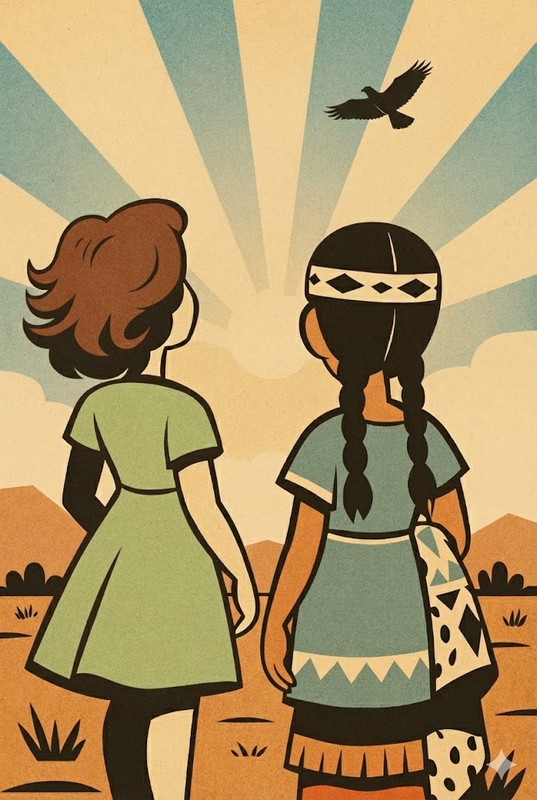
They weren’t talking much now—just breathing together, heads tilted back, eyes squinting into the big blue sky. It was Glenda who noticed it first: a shape. Distant. Slow-moving. Almost still.
“Bird,” she said, pointing. “Big one.”
Onawa didn’t look right away. She chewed the last bite of mango, wiped her fingers on her skirt, then raised her eyes toward where Glenda was staring.
She nodded once, sure and slow.
“Dat’s Hawk.”
Glenda’s eyes stayed skyward. “Hawk?”
“Yuh,” Onawa said. “Not a hawk. Just Hawk.”
The bird moved in great wide circles above them, riding the thermals with barely a flick of its wings. Glenda could see it had a long tail, a curved beak, and wings that looked jagged at the tips like the feathers had teeth. It circled once. Twice. Then again, a little wider.
“He don’t come down?” Glenda asked.
“Nuh-uh,” Onawa said. “Not never. Not really. Just sometimes he sit on dat old power pole out by the edge of the land. But only when it real quiet.”
“Is he yours?” Glenda asked.
Onawa shrugged. “He ain’t nobody’s. But he been here long time.”
The way she said it made Glenda shiver a little—in a good way.
Onawa squinted up. “Granny say when she was a girl he was ‘ready up there.’ And her mama said the same thing. Granny say he’s the watcher. He make sure all da critters stay balanced.”
Glenda frowned slightly. “Balanced like... like what?”
Onawa licked her thumb. “Like… too many rabbits? He eats a few. Too few rabbits? He go somewhere else.”
Glenda thought this over. “He’s like a... fixer?”
“Yuh,” Onawa said. “But a quiet fixer. He don’t bark or neigh or make messes. He just sees.”
Glenda blinked at the sky. Hawk had drifted farther now, just a dot above the ridge, but still wheeling slow and easy.
“You gotta look close,” Onawa added. “Most times he there, but people don’t see 'cause they don’t look good.”
“I looked,” Glenda said, a little proudly.
Onawa smiled gently. “That mean you got hawk-eyes.”
Glenda puffed her cheeks and stuck out her chest. “Yeah! I do!”
Onawa pointed. “One time, I saw him catch a snake. In the air. Just whoosh—gone.”
Glenda’s eyes went wide. “A snake?!”
“Lil one,” Onawa said. “But still. One second it was crawlin’. Next second—nothin’ but feathers up top.”
Glenda shuddered, both horrified and amazed. “Does he eat kittens?”
Onawa looked thoughtful. “Not ours. He know which ones is ours. Granny say he smart enough to know what’s family.”
Glenda leaned her chin on her hands. “He ever come say hi?”
Onawa shook her head. “Nope. But... sometimes he fly low. If you sittin’ real still. Not talkin’. Not movin’. Just listenin’.”
They fell quiet again. Hawk was just a speck now, nearly lost in the bright. But both girls kept staring, as if willing him closer.
Then, from somewhere nearby, the turkeys gobbled—two of them, awkward and loud, stumbling out from the tall grass behind the water tanks.
Glenda jumped. “You got turkeys too?!”
Onawa grinned. “Yuh. They big but funny.”
One of the turkeys squawked and tried to fly over a short fence, barely clearing it with a loud thwump and a puff of feathers.
The girls laughed, falling sideways into each other.
Glenda wiped her nose. “He ain’t fly like Hawk.”
“Nah,” Onawa said. “More like a suitcase fallin’ off a truck.”
They stayed out there a while longer, pointing at bugs and lizards, watching the light slide down the tree trunks. A skinny barn cat slinked past and paused just long enough for Onawa to call him “Ghost,” though Glenda swore he looked nothing like a ghost. There were doves in the rafters above the chicken coop, and someone said there was an old pig behind the compost, but he only came out when it rained.
By the time Lozen rang the bell for supper, Hawk was gone—faded back into sky like a dream you forget on purpose. But Glenda remembered.
As they stood and brushed off their skirts, she whispered to Onawa, “Next time, I’m gonna see him first.”
Onawa gave a serious nod. “You gotta look up, even when nothin’s there.”
Glenda looked up again, just in case.
And maybe, just maybe, she thought she saw the edge of a wing.