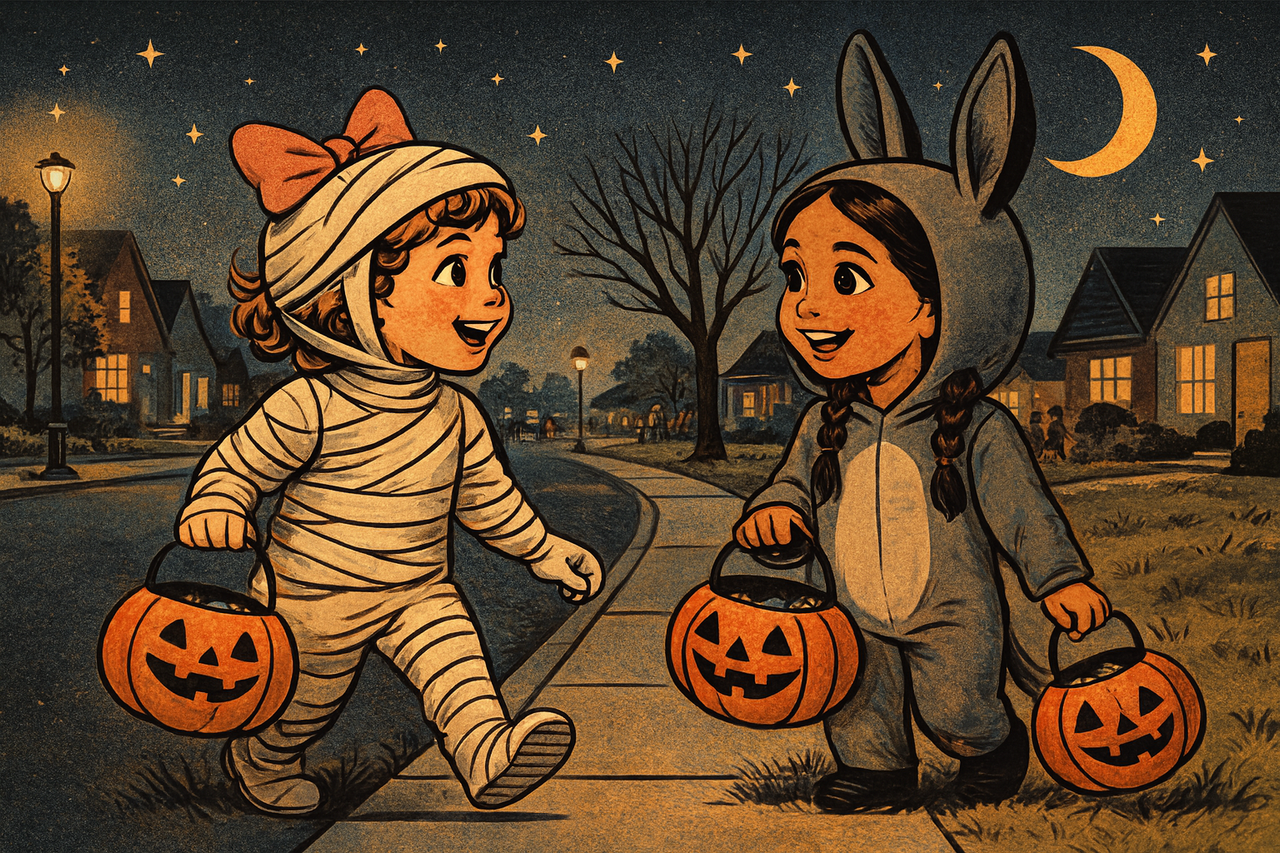
Work Text:
The heat pressed against the little house like a hand.
By late afternoon the sun had slipped around to the front windows, turning the living room curtains into thin, glowing sheets of orange. The box fan in the corner did its best impression of a jet engine, rattling and wheezing as it pushed warm air from one side of the room to the other. Somewhere outside, a dog barked and cicadas droned, but inside, the loudest thing was the chunky color television humming on its rolling stand.
Glenda sat cross-legged on the carpet not three feet from the screen, a small bowl of dry cereal planted beside her like a personal treasure chest. Her summer dress—white cotton with little blue flowers—poofed around her knees. One bare heel made slow circles on the rug, tracing invisible shapes as the TV chattered.
The set itself looked a bit like a piece of furniture that had decided to become a machine: fake wood paneling, fat dials, rounded corners, the faint smell of dust and warmed wiring. Its colors never quite matched the real world—skin tones were a little too pink, grass a little too bright—but to Glenda it was a magic window, and today it was busy flipping from a toy commercial to an old cowboy rerun to something noisy with a cartoon rabbit shouting.
In the kitchen, just visible through the open doorway, Lucille sat at the table with a stack of bills in front of her and her checkbook open at a neat angle. Her glasses were perched low on her nose. She had a pen in one hand and one eye on the numbers, but the rest of her attention kept sliding back to the small brown-haired girl on the floor.
“Don’t sit too close, baby,” she called, for the third time that hour.
Glenda scooted back an inch, which in her mind counted as compliance. “’Kay, Mama.”
The TV sound rose and fell in waves—blaring brass for an advertisement, chatter from some canned-laughter sitcom, the abrupt silence between stations as the dial clicked. Lucille heard each change as noise, something for the house to hum along to while she added and subtracted and tried not to think about how far the next paycheck would stretch.
She wrote out a check for the phone, tore it carefully along the perforated edge, and snuck another look at her daughter.
Glenda’s hair was damp at the temples, dark wisps curling against her neck. A few grains of cereal clung to the front of her dress. Every so often she would laugh suddenly at the TV, or gasp, or say, “Ooh!” in a high, delighted squeak. Lucille didn’t really know what she was watching—just that it kept her from climbing the curtains or trying to “help” with the paperwork.
Happy is happy, she thought, and signed another name: L. Whitford.
Out in the living room, the cartoon rabbit disappeared in a flash of color and the channel slipped into a station break. A man’s voice rattled off something about toothpaste. Glenda’s attention went fuzzy; she grabbed a handful of cereal, crunched it loudly, and swung her foot faster, eyes wandering toward the window. She could see the heavy line of the neighbor’s fence through the gauzy curtain, bright white in the light.
Then the TV flickered, the sound dipped, and a new music slid into the room.
It was different from the jingles and the cartoon clangs. Not bouncy. Not brassy. It was soft and slow, a kind of swaying tune that made Glenda pause with her hand halfway to her mouth. The cereal pieces tumbled back into the bowl with a quiet patter.
On the screen, the commercial dissolved into a painted stretch of sand and sky. The colors were strange and rich: gold and deep blue, tiny dots of white that might be stars or just static. Lines of funny little pictures marched along the bottom—birds and eyes and crooked sticks—that were not letters like on Lucille’s bills.
Glenda leaned closer again, squinting.
A voice floated over the music. Not loud, not silly. A girl’s voice, but not like the girls from the toy ads. This one sounded careful and small, each word like it was being wrapped and set down where you could see it.
Lucille’s pen scratched across another check. She heard the music as just one more TV thing, a different flavor of background noise. Her world, at that moment, was boxes that needed ticking, envelopes that needed stamps, the quiet arithmetic of keeping lights on and food in the pantry.
On the screen, sand shimmered. A small figure stepped into view, outlined against a painted sunset: short, with a round head and a body wrapped in pale strips from toes to chin. Her eyes were big and dark in the middle of all that white, like two perfect circles drawn in ink.
Glenda’s mouth dropped open.
The little wrapped girl walked closer, the bandages around her arms and legs drawn in simple, flat strokes. She wasn’t scary. She didn’t lurch or groan like the monsters in the old black-and-white movies Lucille sometimes watched late at night. She walked like any girl might, hands held a little away from her sides, curious, cautious.
She stopped at the edge of the screen and looked straight out.
Right at Glenda.
The girl on the TV said something, her little voice drifting through the room. Glenda didn’t catch all the words, only the shape of them: “long ago,” “stories,” “remember.” Behind the girl, pointy triangles rose up from the sand, bigger than houses, their sides painted in slanting lines. The sky behind them was purple and red, like the part of the evening when Lucille sometimes called her in from the yard.
Glenda slid forward without thinking until her knees bumped the TV stand. Her bowl tipped onto its side; cereal scattered in a small clatter across the rug. She didn’t notice.
On the screen, the little wrapped girl turned and pointed at one of the triangle mountains, talking about “inside” and “secret” and “safe.” The camera showed a picture of dark hallways with patterns on the walls, little cats and birds marching in rows. The girl’s voice was calm, like she was telling a bedtime story instead of something from a book.
Glenda tilted her head to match the girl’s tilt. Her own dark eyes grew huge, trying to drink in every line, every color.
She shifted onto her knees and pressed her palms together under her chin, copying the way the girl held her own hands for a moment. When the girl walked, Glenda’s shoulders swayed in the same rhythm. If the girl leaned down to touch something in the sand, Glenda’s fingertips brushed the carpet.
Up close, the wrappings didn’t look like the neat bandages in a doctor’s office. They were a little uneven, sketched in pale cream lines like strips of torn sheet. Some overlapped at odd angles; a tiny fray stuck out near her wrist. She had small, bandaged feet and small, bandaged hands. Only her eyes and the tiny triangle of skin between them were bare.
Her eyes were huge, round as buttons, dark with a little shine drawn at the top to make them look wet and alive. They blinked slowly once, twice, and then she smiled underneath the folds, even though her mouth was hidden. Glenda could see the smile because the eyes did it first.
“Hi,” the girl said, looking straight out of the screen. Her voice was higher than Lucille’s, lower than Glenda’s—soft and careful, like she was afraid of breaking the word.
Glenda’s heart did a tiny jump. Her hand found the edge of the TV stand and clung there.
“Hi,” she whispered back.
The girl cupped her bandaged hands around the little lantern and lifted it so it lit up the pictures on the wall. A line of birds glowed orange; an eye with a stripe under it; wiggly shapes that might have been snakes or rivers.
“Do you ever draw pictures?” the girl asked, and it sounded very much like she was asking Glenda, not the kids above the playground. “Do you save them?”
Glenda bobbed her head up and down so fast her hair flopped into her face. “Uh-huh,” she answered, though nobody in the room had asked her anything. “I drawed a… a kitty. It’s on the ‘frigerator.”
On the screen, the girl turned her head a little, like she was listening.
“These are my pictures,” she said, touching the wall. “They’re very old. Older than your grandma and grandpa. Older than your house. Older than your whole town.” She giggled a small giggle. “Older than the ice cream in your freezer.”
Glenda giggled too, because the idea of something being older than ice cream was enormous and delicious.
From the kitchen, Lucille heard the little burst of laughter and glanced toward the doorway. She caught a glimpse of Glenda’s profile, lit by the TV’s glow, mouth open in a wide smile. On the screen, the tiny wrapped girl’s voice floated out with some phrase about “long ago” and “deserts far away.”
“Must be one of them educational ones,” Lucille murmured to herself, not unkindly. She dipped her pen in the checkbook of their life and kept going. If it kept the girl happy and quiet and not climbing onto countertops, she was all for it.
Back underground, the lantern light swung as the girl walked, making the pictures on the wall wiggle.
“Where I’m from,” she said, “we told our stories on stone. We told them on walls and on boxes and on the sides of big, pointy houses.” The scene shifted briefly to pyramids reaching into the purple sky, then slid back to her. “We didn’t always write words like you do. We drew little pictures instead.”
She paused, tipped her head. “Do you know what a pyramid is?”
Glenda’s fingers curled on the edge of the stand. “It’s a… a tri-angle house,” she declared. She knew triangles. She had a puzzle with them.
The girl’s eyes seemed to crinkle in approval.
“A pyramid is a special house,” she said. “Sometimes for kings or queens. Sometimes for stories. Sometimes for both.” She patted the wall fondly. “We didn’t want to forget. So we wrapped up our stories and kept them safe.”
The camera picked up speed, zooming through the hallway, past doorways filled with shadow, past more walls of tiny pictures, until it emerged into a round, bright chamber. In the middle of the room was a low stone table with a box on it. Dust motes floated in the light that dripped down through a crack in the ceiling.
Above that crack, Glenda could see the bottom of the sandbox from earlier: wooden slats crisscrossed like a simple fence. The kids’ feet made dark shapes pattering back and forth over it. Every so often, sand sprinkled down like glittering rain.
The girl—Anka—looked up, eyes wide. Little bits of sand landed on her bandaged head and shoulders.
“Listen,” she whispered. “Do you hear them?”
Glenda held her breath.
From somewhere up in the bright world, a child’s voice drifted faintly down. “I wanna build a castle! Gimme the bucket!”
Another voice, slightly bossier: “It’s my turn. You had it yesterday.”
The kids on the TV sounded a bit like the bigger kids from down the street, the ones who sometimes zoomed past on bikes. But here, their voices floated through stone and time. Anka listened like they were birds that had flown into her secret room.
“They’re playing,” she said, half to herself, half to Glenda. “They don’t know I’m under their toes.”
She smiled again with her eyes. “I like to listen. It makes me feel less… long.” She stretched her arms out wide to show how long, bandages pulling a little. “Sometimes long-ago feels very long.”
Glenda understood that more than she could have put into words. To her, last Christmas already felt like long-ago. The idea of the girl having a whole hallway of long-ago on her own made something tight in her chest loosen.
“You can listen too,” Anka said, starting to walk along the wall. Her bandaged feet made no sound. “You don’t need to be in a pyramid. You can listen in your backyard. In your school. In your own house. When you listen, you find stories.”
The pictures on the wall came into focus as she passed: a little girl with braids holding a doll; a cat curled around a jar; a boat on wavy lines. Each time she tapped one with a finger, a gentle chiming sound rang out.
“Do you think stories are just for grown-ups?” she asked, tilting her head at the camera.
Glenda shook her head fiercely. “No,” she told the TV. “No, no.” The very idea offended her; she had lots of stories in her head already, and she wasn’t grown-up.
“Me neither,” Anka confided. “I think little ones have the best ones.” She stopped at a picture of a small person holding a bigger one’s hand. “Sometimes they just need help keeping them safe.”
In the kitchen, Lucille’s pen paused mid-number as she half-listened to the child-voice talking about stories and pyramids. It was a strange thing to hear coming out of a cartoon show, but stranger things had happened on TV. She smiled faintly, imagining some New York writer somewhere patting themselves on the back for getting kids interested in history.
On screen, a rumbling sound shook the rafters of the underground chamber. A shiver went through the sand above. The kids’ feet scrambled; someone up there shrieked the fun kind of shriek.
“Oh!” Anka gasped, looking up. Tiny stones pattered down around her. “Something’s coming.”
The camera shot back to the surface.
Two kids were kneeling in the sandbox, one boy, one girl, both with messy hair and round cheeks. The boy had a red bucket; the girl had the plastic shovel. They were arguing over where to put the tallest tower.
“I want the castle here,” the boy insisted, patting a lumpy mound.
“But the moat has to go around it,” the girl said. “You can’t have a moat just in one place. That’s silly.”
They tugged at the bucket together; it slipped; a wave of sand slumped down. Something hard and gray poked through the top layer like the corner of a buried brick.
“What’s that?” the girl asked.
“Probably a rock,” the boy said. But he touched it anyway, clearing more sand away.
The music dropped down to a soft, curious hum. The kids brushed harder, and a whole square of stone appeared, carved with the tiny bird-and-eye pictures. The girl’s eyes got wide.
“It’s like in a book,” she breathed. “It’s like—like the mummy story.”
Glenda’s skin buzzed.
“Anka,” she told the stone square, testing the name for the first time even though no one had said it yet. It felt right in her mouth, like a word she’d always known.
As if the TV had been waiting for her, a little title card popped up in the corner: neat letters that spelled out A-N-K-A over the stone. A soft voice—a grown-up narrator this time—said, “Today on Anka, our friend finds something very special under the playground.”
Glenda’s lips moved silently, trying to chase the shapes of the letters, to catch them and hold them.
“An. Ka,” she mouthed.
The living room around her dimmed in her mind. The fan’s wheeze, the clink of Lucille’s coffee cup in the kitchen, the buzz of someone mowing their lawn a few houses down—those all slid to the edges of the world. There was only the desert on the screen and the little mummy girl who seemed to be talking just to her.
Lucille glanced up again, drawn by the sudden quiet.
Glenda was still as a statue, one hand lifted, hovering in the air like she’d reached out and forgotten to finish the motion. Her lips were parted, and there was a tiny smile there, not the big open laugh she used for slapstick, but a softer, private one.
Lucille couldn’t see the details from her chair, only the blur of colors and movement. It was some kind of cartoon, she guessed—she saw the white shape of the little figure, the warm sky, the funny drawings sliding past at the bottom. Not one she recognized. It wasn’t the loud clownish stuff that made her grind her teeth; it sounded gentle from here, almost like the records Glenda liked at nap time.
She watched her daughter for another long second. Watched the way Glenda’s eyes followed the screen like it was a kite string only she could see, the way she breathed in small, steady sips so she wouldn’t miss anything.
Lucille set her pen down and folded her arms on the table, resting her chin on one wrist.
“You like that one, huh?” she called softly.
Glenda didn’t look away, but her hand flapped once in the air—her all-purpose yes.
“Mm-hm. Is the wrap girl,” she said. The words tumbled out all together: “I like her.”
“The what?” Lucille chuckled.
“Wrap girl,” Glenda repeated, louder this time, half-turning her head but not her eyes. “She all wrap-ted. See?” She pointed urgently at the screen, as if Lucille could see what she saw just by being told.
Lucille stood and walked to the doorway, drying her hands on a dish towel as she came. From there she could finally see the little character properly—a child, swaddled head to toe, with only her eyes peeking out. Those eyes were dark and round and took up most of her face, rimmed in simple black lines.
The girl was kneeling beside a painted stone box, tracing the little bird-and-eye pictures with one bandaged finger. Her voice, coming out of the set’s small speaker, was soft and kind of thoughtful. The music underneath it was slow and sweet.
Lucille leaned her shoulder against the doorframe.
“Looks like she’s got a lotta bandages, aye,” she said. “Maybe she had a big fall.”
Glenda shook her head, almost offended by the idea. “No, Mama. She… she from the… the long ’go.” She made her arms long in front of her, as if that could show the size of “long ago.” “She sleeped. An’ now she waked up. She talkin’.”
“Oh,” Lucille said, surprised at how certain her daughter sounded. “I stand corrected.”
On the television, the little girl looked straight out again and smiled, as if she’d heard them.
Glenda smiled back, all teeth.
“She my fren,” she added matter-of-factly, as if that was already settled.
Lucille let the towel twist between her fingers. There were still envelopes on the table, some numbers that didn’t like lining up. The house needed a new fan. The refrigerator was making a noise she didn’t trust. The world, outside their little home, seemed to be spinning faster every year.
But right now, her baby was sitting on the floor in a too-hot living room, enraptured by a tiny bandaged girl, and the look on her face was pure, shining joy.
Lucille exhaled, long and slow.
“All right then,” she said, more to herself than anyone. “You enjoy your wee friend.”
She padded back to the kitchen, leaving the doorway open wide. Even as she picked up her pen again, she tilted her chair so she could still see the top of Glenda’s head—still, intent, haloed by the glow of the screen.
On the TV, the desert wind in the cartoon shifted, stirring painted sand. The little mummy girl started explaining what the funny pictures meant, her words rolling calm and sure.
Down below, dust drifted from the ceiling in sparkling strings. A crack widened. A bright red marble slipped through, tumbling end-over-end like a tiny planet, then fell into the underground chamber.
Anka darted forward. Her bandaged hands flew up, and she caught the marble just before it hit the stone floor. The music made a soft whoosh, like a sigh of relief.
“Got you,” she whispered, cradling it. She held it up to her lantern; the marble glowed from the inside like a little red sun.
“Sometimes,” she told the invisible kids above her—and, by extension, Glenda—“treasures fall right into your hands.”
Glenda’s fingers clenched on nothing, mimicking the catch. She could almost feel the cold, smooth circle resting against her palm. Without meaning to, she looked down at her own empty hand and frowned at it, as if it ought to be holding something now.
The scene split. On the left side, the playground kids peered into the little hole in the sand, puzzled that their marble had disappeared. On the right, Anka set the red sphere gently into a carved bowl on the stone table. Around it were other small things: a button, a feather, a metal charm shaped like a fish.
“These are my new stories,” she said. “From your world.”
She placed her hand lightly over the bowl. Her fingers were drawn with extra care here, each bandage line neat and sure.
“Do you have something special?” she asked the camera. “A rock? A ribbon? A picture?” She paused a beat, letting the question float out. “If you put it somewhere safe and remember why you love it, that’s a story too.”
Glenda nodded so hard this time she bonked her chin on the TV stand.
“Ow,” she said reflexively, then, “I got a rock. I got the… the shiny one. Mama say it’s just glass, but I say it’s a magic one.”
She pictured her treasure box—a little shoe box under her bed with a sticker half-peeled off one corner. There was a rock in there that caught the light funny, like it had a secret inside. She made a quiet promise to herself to look at it later and think “story, story, story” very hard.
Anka tipped her head to one side, eyes soft.
“You might be small,” she said, “but your stories are not small. They can be big as pyramids.”
The camera zoomed up, up the crack, up through the sand. For a moment the view was all gold grains and sunlight, rushing past like stars. Then it burst out into the playground again. The kids had gone back to their castle; the teacher was clapping her hands, calling them to line up. The sky overhead was a bright, friendly blue, the kind of blue that felt like forever to Glenda.
Down below, unseen, Anka’s lantern glowed on the stone.
The last image of the episode was the little mummy girl standing beside her bowl of treasures, looking up at the ceiling as if she could see right through it to the swings and the slide and the kids’ shoes. She lifted one hand and waved—not a big silly wave, but a small, steady one.
“Maybe I’ll see you,” she said, “when you’re digging.”
Her eyes drifted down to the camera again, and Glenda had that dizzy, delicious feeling that the girl was looking straight into her.
“Maybe you’ll see me,” Anka added, “when you’re listening.”
Glenda lifted her hand and waved back, her fingers a little sticky with cereal dust. “I see you,” she told the screen seriously. “I’m listenin’.”
The music rose gently, a soft ribbon of flutes and drums. Credits scrolled up the side of the picture—names Glenda couldn’t read, marching up like another line of little people on the wall. Anka’s small figure shrank as the camera pulled away, back down the hallway, past all the painted stories, until she was just a bright dot in the distance.
Then the desert faded. The colors bled into each other and were gone, replaced by a cheery, too-loud jingle about dish soap. The volume seemed to jump up without anyone touching the dial.
Glenda didn’t move.
She sat there on the carpet, dress rumpled, cereal forgotten, eyes still fixed on the spot where the little mummy girl had been, as if the show might flicker back on if she just stared hard enough.
The jingle on the television crashed in all at once—bright horns, clapping, a woman’s voice shouting about how clean her dishes were now.
It was like someone had slammed a door in Glenda’s face.
She blinked, her eyes stinging a little from not blinking for so long. The little stone room, the glowing lantern, the bowl of treasures all vanished, replaced by a shiny kitchen where cartoon bubbles floated around a plate. A lady laughed too loud. The colors were wrong again.
Glenda stayed exactly where she was, hands in her lap. Her fingers flexed once, missing the feel of the red marble that had never really been there.
In the kitchen, Lucille licked the tip of her thumb and smoothed it down over the edge of the last check, folding it neatly. The bills sat in a small stack to one side, each one now with a child of a check clipped to it. She sat back, rolling her shoulders, and listened.
The fan rattled. The TV blared. But the little voice from before—the small, careful one talking about stories and long-ago—was gone.
Lucille pushed her chair back and stood. She gathered the bills up, tucked the checkbook closed with a soft snap, and padded out of the kitchen, the cool linoleum giving way to the warmer scratch of the living-room carpet under her feet.
The room looked exactly the same as it always did around this time of day and also a little different.
The sunlight coming through the curtains had shifted to a narrower wedge, landing on the couch in a bright strip. The fan had swung just enough that it now sent her a stray breath of warm air as she stepped into the doorway. And Glenda, of course, was still glued to the TV—but she wasn’t bouncing or singing along or making little sound effects like she often did.
She was very still.
Her dress was wrinkled where she’d sat for so long. Tiny oat pieces dotted the rug around her, a small drift of cereal at her knees. One little sandal lay abandoned off to the side where she’d kicked it away without noticing.
“Oh dear,” Lucille sighed, more amused than annoyed. “You dropped half your snack on the floor.”
Glenda didn’t seem to hear that part. Her gaze was fixed on the TV, but now the screen showed a smiling woman holding a bottle of something and comparing a greasy plate to a clean one. A cartoon sparkle popped, right where Anka’s lantern had been.
“Hey.” Lucille’s voice softened. She walked over and crouched behind her daughter, laying one hand lightly on the small, warm curve of her shoulder. “Show’s over, sadly. Time to come back to earth.”
Glenda tipped her head back, eyes huge. When she saw her mother’s face, she broke into a grin, sudden and bright. “She’ll come back again, Mama.”
Glenda’s shoulders dropped a little in relief. She scooted backwards until her back pressed against Lucille’s knees, a solid anchor.
“Mama,” she said, tipping her head back again so she could see her mother’s chin. “Why she wrap-ted?”
“Why is she wrapped?” Lucille translated automatically, then caught herself. She didn’t actually know what the show’s explanation was. The only mummies she knew were the ones from old monster movies, arms out, moaning, or from the thick book about Egypt she’d checked out of the library on a whim then had nightmares for a week.
She did not want those nightmares in her daughter’s head.
She took a breath, choosing her words like steps on a cracked sidewalk.
“Well, it’s… it’s a pretend show, honey,” she began. “A cartoon. But the idea is from a real place called Egypt, far away from here. Waaaay across the ocean.” She drew a long line in the air with her hand.
“Ee-jup,” Glenda repeated, trying it on. It came out a little squished, like “Eejip.”
“That’s right. In the desert. Lots of sand. An’ a long time ago—longer than when your grandma was a baby—people there wrapped up folks when they died, kinda like a… like a special blanket. To say goodbye. To keep ‘em safe.” She watched for a flinch, ready to back off if she saw fear.
Glenda’s forehead wrinkled. She glanced at the TV and then back at Lucille.
“She dead?” she asked, voice small.
Lucille’s heart thudded once, hard. She smoothed her hand down Glenda’s back.
“Not on the show, baby,” she said quickly, gently. “On the show, it’s just a little girl in bandages. She’s like… like playin’ dress-up.” She smiled, softening the edges. “Like when you put a towel on your head and say you’re a princess. It’s pretend.”
Glenda’s shoulders loosened a little at that.
“She don’t sound dead,” she admitted. “She sounds… li’l.” She spread her hands as wide as they would go, then brought them back in a bit. “Little big. Not baby.”
“Like you,” Lucille said. “Not a baby, not a big kid yet. Right in the middle.”
“Yeah.” Glenda looked secretly pleased at being placed in that special middle zone. She twisted to face the TV again, which had moved on to a man with a too-wide smile holding up a rake. “She’s my size,” she added. “She talks nice.”
“She does?” There was something in her tone that made Lucille lean forward, chin on her knuckles.
Glenda nodded. “She don’ yell. She don’ talk like she think I’m dumb.” She waved one hand, mimicking big grown-up blah-blah-blah. “She say, ‘you ‘member?’ and she say ‘you got stories?’” Her voice got quiet again, like she was letting Lucille in on a secret. “She say she like lil’ ones’ ones.”
Lucille swallowed around a tightness in her throat she hadn’t expected.
“Well,” she murmured. “That sounds like a nice girl to know.”
“Yeah,” Glenda said. “She my fren.” She said it the way you might say “the sky is blue,” with complete certainty. “Her name is Anka.” She pronounced it carefully, the way the narrator had: “Ann-ka.”
“Anka.” Lucille rolled it around her own mouth. “That her name on the show?”
“Mm-hmm.” Glenda bobbed her head. “It said.” She traced a little rectangle in the air. “On the… up there. It say An-ka. I saw the A.” She drew a pointy shape. “Like in… apple.” She’d seen the letter on her alphabet chart on the bedroom wall.
“You did?” Lucille’s eyebrows climbed a little. “Look at you, Miss Readin’ TV.”
Glenda beamed.
“I wanna draw her,” she announced suddenly. “The wrap girl. Anka. I wanna draw her on the fidge. An’… an’ I wanna have a bowl. For my ‘memberin’.” She twisted around again, crawling up onto her knees. “Can I have a bowl?”
“A bowl?” Lucille repeated, amused. “What kind of bowl?”
“A… a not cereal one,” Glenda said, instantly, as if that were obvious. “A special. For my rock. An’ my leaf. An’ my, my hair clip.” She grabbed the air near her head. “So they’s stories too.”
Lucille looked down at her, at the earnest set of her mouth and the way her hands were already cupped, holding invisible treasures.
“Tell you what,” she said slowly. “How ‘bout we find you a little box instead? A bowl might spill all over if you bump it. Box keeps things from sneakin’ away.” She mimed a lid closing. “We can call it your story box.”
Glenda’s eyes went round. “Story box,” she repeated, tasting the words. “Yeah. Yeah! My story box.” She squeezed her hands together until her knuckles went white. “Can we do it now?”
Lucille laughed. “Not this second, love. I still have to finish up some things. But we can look after supper, all right? Maybe I got an old shoebox we can dress up.”
“Dress up?” Glenda liked that idea. “Like in band-ges?”
“We’ll see,” Lucille said. “Maybe with some pretty paper. Maybe with some of them stickers your Aunt Jennifer sent.”
Glenda made a small, pleased noise and turned back to the TV. The rake man had given way to a shot of a station logo spinning in place. In the corner of the screen, a little square promised “Saturday Morning” in bright colors, with tiny pictures of cartoon faces around it.
The TV moved on to a news anchor, droning about something grown-up. The fan kept rattling, pushing the heavy air around. In the doorway, the pile of bills sat, corners squared, a problem for later.
On the carpet, Glenda sat back and lifted her hands, tracing the shape of a triangle in the air, imagining a big stone house in the sand, with pictures on its walls and a little girl in bandages walking through it.
“Pire-mid,” she tried, the word wobbling like her finger. “Story house.”
She tucked her knees up under her chin, hugging them, and watched the dull grown-up program without really seeing it, her mind already slipping back under the playground, following a bandaged girl through the dark, listening.
By late afternoon the air in the little house had turned thick and sleepy, like warm syrup.
The sun had crawled around toward the back yard now, pouring itself over the fence and into the patchy grass. From the kitchen window, Lucille could see the white glare bouncing off the neighbor’s aluminum shed, the way it always did at this hour, too bright to look at for long. A thin strip of shade clung to the side of their house, and that was where the back steps sat—a couple of worn wooden planks and a rust-flecked screen door that banged if you didn’t hold it.
Inside, the hum of the TV had given way to the softer, slower sounds of the afternoon: the fan in the living room still grinding away, the clock ticking in the kitchen, the faint glug of the refrigerator starting up. Lucille was rinsing the last lunch plate in the sink when she heard small feet pattering up behind her.
“Mama,” Glenda said, breath already coming in excited puffs. “Can, can I go outside?”
Lucille glanced over her shoulder. Glenda had changed herself, somewhere between the end of the show and now, out of her white dress and into a pair of red shorts and a faded yellow T-shirt that said “SUNSHINE DAYCARE” in letters almost too cracked to read. One sock was on, the other off. Her hair was sticking out on one side where she’d run her fingers through it.
“What for?” Lucille asked, reaching for a dish towel. “It’s the height of it, Glenda. I wouldn’t want-”
Glenda bounced on the balls of her feet. “I wanna play,” she said. “’Sides, she’s in the sand.” She frowned in concentration. “Un’er the kids. ‘Member? I wanna… I wanna go see my stories.”
Lucille wiped her hands, then turned fully to face her. “Your stories, huh?”
“My story house,” Glenda corrected earnestly. “Like the wrap girl. Anka.” She said the name easily now, like she’d been saying it all her life. “She got a story house. I need one too.”
Lucille fought a smile and lost. “Well, you ain’t got a pyramid, but we do have that old sand patch out back.”
“Yeah,” Glenda said at once. “I can use that.” She jutted her chin toward the back door. “I can ‘magine the rest.”
“You can ‘magine the rest,” Lucille echoed, chuckling. “All right, miss Egyptian queen. Lemme get you some shoes. Ground’ll fry your wee toes off.”
The backyard was not much to look at by grown-up standards. The grass, where it still existed, was more yellow than green, broken by bare spots of hard-packed dirt. A laundry line sagged between two posts near the back fence, a few clothespins still clamped on, waiting for the next wash. To one side, an old metal lawn chair tilted at an angle, one leg half-sunk in the ground. A row of scraggly bushes marked the border with the neighbor’s yard, leaves dusty and tired.
In the far corner, someone who’d lived here before them had left a sand patch—once a sandbox, probably, but the wooden frame had rotted away long ago. What was left was a low, square bed of pale, gritty sand that bled into the dirt around it, half full of leaves and dried-up candy wrappers the wind had shoved in.
To Glenda, it was perfect.
She ran straight for it, her dish-towel cape flapping behind her. The sandals slapped against her heels and sent up tiny puffs of dust.
When she reached the sand, she stopped and stood at the edge for a moment, squinting down. The sun hit it full-on, making it almost white, too bright to look at for long. She lifted one foot, hovered it over the surface, and then set it down.
The sand accepted her weight with a soft crunch, giving a little under her sole. It was hotter than the grass but cooler than the concrete steps, warmed through but not yet baking.
“Hi,” she said to it, because it felt like the right thing to do. “’M here.”
She stepped fully into the square and stood in the middle, letting her eyes close for a second. Behind her eyelids, the backyard blurred; the flat roofs and telephone wires and barking dog on the other side of the fence all slid away, and in their place came the painted dunes from the television, the purple sky, the faraway triangles.
“Ee-jip,” she whispered, savoring the word. She opened her eyes and spread her arms. “I’m Anka. This is my… my…” She groped for it. “My story house.”
She took a slow, careful step, imitating the way the little wrapped girl had walked down the hallway—feet turned a bit out, knees a little bent, as if she were always ready to stop and listen. Each footfall made a small huff sound as the sand shifted.
From the kitchen, Lucille leaned her elbows on the windowsill and watched, dish towel still in her hands. Through the slightly fogged glass, she could see her daughter pacing solemnly back and forth, lips moving, eyes wide.
Glenda bent down and scooped up a double handful of sand. It ran through her fingers in a pale stream, back to its brothers. She giggled.
“Stories,” she said to it. “You got stories in you. I gotta find ‘em.”
She dropped to her knees and started digging. The sand was softer and cooler a few inches down, damp where the sun hadn’t touched it yet. Bits of things surfaced as she clawed away—half a plastic soldier with no arms, a bottle cap, a little twig bleached almost white. She examined each one like a treasure.
“You’re a story,” she told the soldier, holding him up. “You… you gots a war.” She’d heard that word from the news; she liked the way it buzzed in her mouth, even if she didn’t quite understand it. “But you tired now. You sleep.” She put him aside gently.
The bottle cap was less impressive. “You’s just trash,” she decided, tossing it toward the bushes. “No story.”
The twig she changed her mind about three times, squinting at it, trying to see a picture in its lines the way Anka had seen things in the carvings.
“You can be a… a snake. Or a river.” She laid it on the surface of the sand and patted a little pile at one end. “This is your house.” Satisfied, she moved on.
A soft clatter made her pause. Something had rolled against her shin.
She fished in the sand and came up with a small, cloudy marble. It was not as bright as the one Anka had caught; its red color was more like an apple peel after you’d left it out too long, but when she held it up to the light, it still glowed a little.
Glenda’s breath caught.
“A treasure,” she said, very softly.
The moment was perfect. The sun behind the marble made a little circle of color on her palm; the bandage-strips on her arms framed it, making her feel, just for a second, like the girl on the TV, catching something that had fallen from a world above.
“Mama!” she yelled, unable to keep it to herself. “Mama, look! I gots a marble!”
Lucille pushed the window open a little farther, the frame squeaking. “You found that in the sand?” she called back.
“Yeah!” Glenda hopped to her feet, nearly losing the marble, then clamped her fingers around it. She ran toward the house, stopping short when she reached the cracked concrete path so she wouldn’t track sand all over the steps. She held her hand up high, and opened it carefully so her mother could see.
“Well, would you look at that,” Lucille said, leaning out over the sink. “Looks like your story house is sharin’.”
“It falled,” Glenda said earnestly. “Like on the TV. It falled down from up here.” She pointed up at the sky. “An’ I catched it. Just like her.”
“Mm-hm,” Lucille said, deciding not to argue with the logic. “You gonna put that in your story box later?”
Glenda gasped. In all the excitement, she’d forgotten.
“Oh!” She clapped her free hand to her mouth, then dropped it again so she wouldn’t crush the marble. “My box!”
It had appeared at breakfast that morning: a small, scuffed shoebox, once home to Lucille’s Sunday shoes, now emptied and wiped clean. Lucille had set it on the table with a couple of Glenda’s precious stickers and a stubby green crayon.
Glenda had drawn a wobbly triangle on the lid and insisted it was a “pire-mid.” They’d stuck a rabbit sticker on one side for no particular reason and declared it finished.
“Can I bring it outside?” Glenda asked now. “So I can put my marble in? So it knows it’s a story?”
Lucille pretended to think about that, tapping her chin. “Well, if you promise not to leave the whole box sittin’ out there in the rain or let the dog carry it off…”
“I promise,” Glenda said instantly. “Cross my heart.” She made an X over her shirt with her right arm.
“And if you don’t dump all the sand in it.”
“I won’t,” she said, though that part was less certain in her mind.
“Then okay,” Lucille relented. “You can bring it out. Wipe those hands off first, though.” She tossed a second dish towel through the open window, and it landed in a soft heap at Glenda’s feet.
Glenda scrubbed her hands quickly, cradled the marble in the edge of the towel like a little hammock, then ran back inside to fetch the box. A moment later she burst out again, box held high in one hand, marble clutched in the other, wrappings flapping.
The box seemed bigger out here in the bright air. The triangle she’d drawn on the lid looked almost important.
She knelt in the sand again, setting the box just outside the edge where the dirt began, as if it, too, were afraid to get its toes too hot. Carefully, ceremoniously, she lifted the lid and placed the marble in the corner. It made a tiny clink against the cardboard.
“There,” she said. “You a story now.”
She put the lid back on and patted it twice for good measure, then went back to digging.
The backyard settled into its lazy rhythm around her. A car drove past out front, its engine a low grumble. Somewhere behind the houses, a lawnmower started up, its drone rising and falling like an enormous fly. The dog next door barked at a passing bird and then gave up, flopping back into the narrow strip of shade by his doghouse.
A faint clatter of chain-link rattled on the far side of the yard. Glenda glanced up, hand halfway into the sand.
Over by the back fence, a small figure had appeared, pressed against the metal diamonds with both hands.
“Glenda!” a voice called. “Glen-da! Hey!”
It was Onawa.
She wore a loose cotton top with a faded pattern of suns on it and shorts that had clearly been patched more than once.
Behind her, a taller, older woman in a long skirt and headscarf was talking to one of the neighbors, arms crossed in friendly conversation. Onawa had slipped away the moment the grown-ups’ heads got close together.
“Hi, Carlett!” Glenda yelled back, abandoning the “S”. She jumped up and ran over, sand puffing around her ankles. “Look! I’m wrap girl!”
Onawa took her in, head tilting. The dish-towel cape, the smudges of sand down her shins, the shoe box perched like a tiny shrine at the edge of the sand patch.
“You look like a burrito,” Onawa declared, grinning.
“I’m Anka,” Glenda insisted. “From Ee-jip. She got a story house.” She pointed grandly at the sand. “This is it. You gotta take your shoes off ‘fore you come in.”
She led the way back to the sand, Onawa clambering over the lower rung of the fence and dropping into the yard with a soft thud. The older woman glanced over and, seeing the two girls together, just lifted a hand in a half-wave before returning to her conversation.
“What’s a story house?” Onawa asked, squinting at the sand patch. “Is it like… a house, but it talks?”
“It’s un’er the ground,” Glenda said. “Like a hidin’ place. She’s got peechers on the walls. An’ a bowl.” She pointed to the shoebox. “That’s my bowl. ‘Cept it’s a box.”
Onawa stepped into the sand, wriggling her toes.
“You be the kids on top,” she decided. “Like on the show. You play castle.” She jabbed a finger at a spot near the edge. “Right here.”
“What you gonna be?” Onawa asked, but there was already a sparkle of interest in her eyes. Any game that involved building something appealed to her.
“I’m down there,” Glenda said. She plopped to her knees and started scooping out a shallow pit. “In my story house.” She lowered her voice to a whisper. “You can’t see me. But I can hear you frough the sand.”
Onawa’s grin stretched wider. “Okay,” she agreed.
She dropped to her own knees on the opposite side and began piling up a crooked, lumpy tower, patting the sides like she’d seen grown-ups pat loaves of bread. The sand still had the imprints of Glenda’s earlier digs; Onawa shoved them around without ceremony, repurposing tunnels as moats, little ridges as walls.
“I’m makin’ a castle,” she announced. “For the donkey prince.”
Glenda tilted her head, eyes bright with curiosity. Onawa giggled as she explained. “He’s the best donkey. He can be whatever he wants.” She brayed, an uncanny, loud sound that made the dog next door bark in echo. “He got big ears an’ big teeth an’ he kicks real high.”
Glenda frowned, then shrugged. “But you gotta talk so I can hear your stories.” She hunched her shoulders and lowered her head, half-closing her eyes. In her mind she was under the sand, in the cool dark, lantern light flickering on stone.
Onawa took a deep breath and launched in.
“One time,” she began, hands flying as much as her words, “the donkey prince, he was walkin’ and walkin’ an’ he saw a snake, but it wasn’t a bad snake, it was a nice snake, and he said, ‘Hi, Snake,’ an’ the snake said, ‘Hi, Donkey,’ an’ then—”
Her voice rose and fell, telling some half-remembered story from the commune—the one about the neighbor’s donkey that had kicked a fence post and knocked it clean over when a coyote got too close. She added details as she went: the donkey wore a crown made out of sunflowers; the snake had bells on its tail “so you can hear when he’s comin’ to hug you.”
Underneath—or at least pretending to be underneath—Glenda closed her eyes the rest of the way. Onawa’s words came through the hot, bright air and turned cool and echoey in her ears, like they were bouncing off stone walls.
She scraped a little more sand away, making a hollow just big enough for her to curl her feet into. The sand against her ankles was cooler down there. She wiggled her toes and pretended it was the cold stone floor of the story house.
“Shh,” she whispered, even though Onawa wasn’t actually too loud. “I’m listenin’.”
“You’re ‘sposed to talk too,” Onawa said, not pausing in her castle-building. “You a… a wrap girl. Wrap girls tell stories. You just told me.”
“Not out loud,” Glenda mumbled, because that’s what Lucille had said about rocks.
“What?” Onawa cupped a hand around one ear.
“Not out loud!” Glenda said again, louder, popping her head up. “She says that. The wrap girl. She says… she says the stories talk in here.” She thumped her chest the same way her mom had. “Not like, yelly talk.”
Onawa made a dubious face. “How’m I supposed to hear that? My inside’s busy already.”
“Busy with what?” Glenda asked, offended on behalf of invisible stories.
“Food,” Onawa said promptly. “An’ donkey noises. An’ my gran’ma singin’ all the time.” She tilted her head, as if she could hear the echo of a faraway voice. Somewhere, faintly, a woman in the commune yard had started a song, the notes drifting on the thick air. “See?”
Glenda listened. The song didn’t sound like the TV music; it was higher in places, lower in others, curving up and down like someone drawing loops in the sky. It made a knot of something in her chest, but a nice knot, like when she hugged too hard and it almost hurt.
“That’s a story too,” she declared. “Your gran’ma. She’s a story.”
Onawa shrugged. “She just sings. That’s what she does.”
“An’ that’s a story,” Glenda insisted, stubborn. “Everything’s a story.” She said it the way Anka had, or at least the way she remembered her the saying it.
Onawa squinted at her, then at the sand, then at the shoebox perched on the edge.
“What’s in there?” she asked, changing gears as fast as only a three-year-old can.
“My marble,” Glenda said quickly, scooting over to shield it. “It’s my treasure. Anka got a marble too. It falled from the ‘bove. Like mine. I gotta keep it safe.”
“I wanna see,” Onawa squaled with delight.
“No!” Glenda caught Onawa’s hand and pushed it back, not hard, more like a startled pat. “You can’t touch it. It’s for my… my… ‘memberin’.” Her brow scrunched as she searched for the word. “It’s special. I gotta be careful.”
Onawa pulled her hand back to her chest, stung but not truly angry. “I got special stuff too,” she said, a little huffy but mostly sad. “You jus’ don’t know ’cause you don’t live there.” She picked at a thread on her shorts. “We got donkey fur. An’ feathers. An’ a rock that look like a heart. I don’t let nobody touch ’em neither.”
Glenda hesitated, the shoebox lid half lifted, some of the sharpness in her chest easing.
“You can look,” she offered after a second, grudgingly. “Just no grabbin’.”
Onawa brightened at once. “Okay!”
They opened the box together. The marble sat in the corner, looking lonely but important.
“It’s not even that shiny,” Onawa said, but the words came out more like a tease than a criticism.
“It’s shiny ’nough,” Glenda defended. “It gots a story.” She touched it with one fingertip. “It says, ‘I fell down from the ‘bove into Anka’s hands, an’ then I went to the show, an’ then I came to you.’”
Onawa considered this, then nodded slowly, accepting the addition to the object’s biography. “Okay,” she said. “That’s pretty good.” She tapped the side of the box. “You should put donkey fur in here too. An’ the heart rock.”
“Then it’d be your story,” Glenda pointed out. “Not mine.”
“We can have both,” Onawa said, as if it were obvious. “It can be our story.” She held her hands out wide. “A huge one.”
Glenda thought about Anka, about the way she’d said the stories could be “big as pyramids.” A big story sounded good. A shared one sounded even better.
“Okay,” she agreed, slowly, feeling magnanimous. “But we gotta ask my mama if we can get donkey fur. She don’t like messes.”
“She’ll say yes,” Onawa predicted confidently. “She likes me.”
“She do,” Glenda admitted.
The two of them sat there in the sand, heads bent together over the little shoebox, as if it really did hold the world.
From the kitchen window, Lucille watched them, chin propped on her hand now, the dish towel forgotten on the sill. She saw the way Glenda’s hands moved when she talked, fingers fluttering like she was shaping the air. She saw Onawa’s animated face, her whole body leaning into the story, nodding hard enough to send her curls bouncing.
The noise of the neighborhood faded for a minute. All she could hear was the faint murmur of their voices, rising and falling, sometimes overlapping, sometimes one listening while the other spoke.
“Look at you,” she murmured, her mouth quirked. “Out there buildin’ your own desert.”
A breeze pushed through the open window and brushed her cheek, scented with hot dirt and the faint, raw-green smell of trampled grass. The song from the commune drifted in clearer for a moment, a woman’s voice hitting a high note and holding it, then slipping down like water.
Lucille closed her eyes briefly, letting it all mix—the song, the feeling of the bills finally written, the sight of her daughter in a dish towel cape turning a tired patch of sand into something holy.
When she opened them again, the shadows in the yard had lengthened. The fence lines drew darker rectangles across the grass, and the sun had dipped just enough that the sand no longer glared like a mirror; it had gone softer, more gold.
Glenda had returned to her “underneath” persona. She sat low in the sand, almost lying on her side, one ear pressed close as if she could hear the footsteps of invisible children above. Onawa tromped around the edge, pretending the low bumps and dips were mountains and valleys.
“I’m stompin’ on you,” Onawa declared. “Can you feel it?”
Glenda scrunched her nose. “You’re not s’posed to know I’m here,” she hissed. “You gotta talk like you don’t know.”
“Oh.” Onawa stopped, then started again, more theatrical this time. “La la la,” she sang, exaggerated. “I’m a kid. I dunno ‘bout no story house. I’m jus’… buildin’ stuff.” She kicked a little mound, sending sand sprinkling over Glenda’s ankles.
“Hey!” Glenda yelped, then caught herself. “No, it’s okay. It’s like on the show. The sand falls down an’ she catches stuff.” She stuck her arms up and wiggled her fingers. “Gimme a treasure.”
Onawa looked around, grabbed the first thing she saw—a small, flat stone at the edge of the patch—and dropped it from as high as she could reach. It plunked into Glenda’s cupped hands.
“Treasure,” she announced. “It’s a… a donkey hoof.” She softened, adding, “For your story box.”
Glenda turned the stone over and over. It was just a rock, really. But it felt different, having been dropped on purpose from “above.”
“Thank you,” she said gravely. “I’ll ‘member you with it.” She waited a beat, then added, as if it needed saying, “You my fren too.”
Onawa puffed up with pleased pride. “Yeah.”
The dog next door barked again, this time at nothing in particular. The woman at the commune fence called Onawa’s name, drawn-out and sing-song, the way adults did when it was almost time to go.
Onawa beamed. “We’ll make it full. So full it bust.” She clapped her hands, delighted by the idea of a story box so full it exploded.
Onawa galloped to the fence, tossed one leg over like she’d climbed it a hundred times (she had), and dropped back into her own world on the other side.
For a moment, the yard was quiet again.
Glenda sat in the middle of the sand, alone but not lonely. The shoebox waited by her knee, lid closed. Inside, one cloudy marble and one flat stone bumped gently against each other whenever she moved, telling stories only she could hear.
She looked up at the sky, which was turning the first shade of evening blue, not yet purple but on its way. Somewhere out there, way past the telephone wires and the clouds and the airplanes she sometimes saw, there was a place called Egypt. It had pyramids and old stone halls and a little girl in bandages, walking very slowly and listening very hard.
Glenda put her hand flat on the sand.
“I’m listenin’ too,” she told it.
Then she dug her fingers in again, because stories didn’t find themselves.
Evening slipped into the house by degrees, hardly noticed at first.
The hot white of the afternoon turned the colour of weak tea, then honey. Shadows in the backyard stretched themselves long and thin across the patchy grass. Someone a street over started up a radio; a country song floated faint and tinny through the open kitchen window. The fan in the living room kept up its steady, complaining whirr, chopping the thick air into lazy slices.
Out back, the sand patch was pitted and scuffed, little hills and trenches marking where two small girls had been an army, an underground explorer, a donkey prince. The shoebox sat just inside the back door now, lid closed, a few grains of sand stuck along its edges like freckles.
Lucille stepped out onto the back step and wiped her damp hands on the front of her dress. She’d been at the cooker for the last half-hour, turning sausages in the pan, watching potatoes cloud the boiling water, keeping an eye on the kitchen clock. The heat from the hob had been nearly as bad as the heat from the day, but there was nowhere else it could be done.
“Glenda, love!” she called, raising her voice over the insect hum beginning in the hedges. “That’s enough adventures for one day. In with you. It’s nearly your tea.”
A small head popped up from behind the low rise of the sand, hair full of bits of grass and a smear of something pale across one cheek.
“One more minute,” Glenda pleaded automatically, though she wasn’t quite sure what she meant to do with the minute in question. The day had been full, and the edges of everything were starting to blur, like the lines on her drawing when she rubbed them too hard.
“Oh no,” Lucille said, though the scold was soft. “You are streaked with muck, and there is sand all the way to Waco stuck to those legs. Inside. We’ll hose the desert off you tomorrow.”
Glenda dragged herself upright and tottered toward the steps, every movement suddenly heavy, as if the sun had thickened around her. The dish-towel cape hung askew from one shoulder. The pillowcase strips around her forearms had come loose, dangling like pale ivy, collecting half the back garden as they went.
Lucille met her at the door, catching her under the arms and lifting her the last little bit up onto the stoop. Sand pattered down from her shorts and bare knees, gathering in a forlorn dune at the threshold.
“My word,” Lucille muttered, looking her over. “You’ve half the Sahara stuck to you.”
Glenda grinned sleepily. “No,” she corrected. “It’s Ee-jip. It’s my story house.”
“Is it now?” Lucille eased the cape knot open and whisked the towel away. “Well, your story house is going to clog the drains if we’re not careful. Come on, out of those things.”
By the time the sausages were set aside under a bit of foil and the potatoes left to sit, Glenda was standing on the cool tiles of the small bathroom, bare as the day she was born, one hand holding onto the edge of the tub while Lucille tested the water.
The bathroom was hardly bigger than a cupboard: sink, toilet, tub-with-a-showerhead, everything close enough that Lucille could brace her hip against the sink and reach the towel rail with one arm. The frosted window was open a crack, letting in a line of deepening sky and the distant chirp of crickets.
Lucille swirled her fingers through the rising water, judging the heat the way her own mother had shown her: three seconds under, then out. Not too hot, not too cold.
“All right,” she said, turning off the tap. “In you hop.”
Glenda climbed in with a small sigh, the warm water lapping around her shins, her knees, her belly. As she sat down, the sound changed from a splash to a deeper, soothing glug. Little smears of sand and dust floated up immediately, circling down with the movement like tiny storms.
Lucille knelt beside the tub, tucking her skirt under her knees. She reached for the flannel and the bar of soap, Glenda watched, sleepy-eyed.
“D’you have story houses in Ireland?”
Lucille paused, flannel hovering in mid-air. A drop of water slid off the corner and fell back into the bath with a plip.
“Well now,” she said slowly. “That’s a question.”
Glenda opened one eye. “You said bout Ee-jip,” she reminded. “An’ the, the stones. ‘Member? With the peechers. Like in the show.” Her hand made a vague scribbling motion in the air. “D’you got stones too? With peechers?”
Lucille thought of the fields back home, that green that never quite existed here, soaked through with rain and stories. She saw again the ancient, leaning stones at the edge of her grandfather’s land, lines carved down their sides like someone had tried to write with a knife. She’d been told the word once—ogham—and it had lodged in her mind like a burr.
“We’ve no pyramids,” she said at last, wringing out the cloth. “No great pointy houses. But aye, we have stones. Big ones, standing up on their own in the middle of nowhere. Older than anyone can say.”
She gave Glenda’s neck a gentle swipe with the flannel, then let herself lean back a little, her gaze drifting not to the tiled wall but somewhere thousands of miles away.
“When I was no bigger than you,” she went on, “my da used to take us walking out past the town. There’s a field there, all lumpy and wet. Cows in it half the time. And in the corner, there’s three big rocks, taller than your Uncle Eddie, stuck into the ground like they’re going to walk off if you’re not looking.”
Glenda’s eyes were wide again, the sleepiness pushed back by interest.
“Do they walk?” she asked.
Lucille laughed, the sound catching in her chest a bit. “Not that I ever saw. We used to say they did, though. My brother would swear blind they moved when the fog rolled in.” She shook her head. “Anyway, there were marks all down the side of one. Little lines and notches, all in rows. I thought it was the cows at it, scratching themselves. But my da said no, that was old writing. From people who lived there long before us. The stone was keeping their words, he said. Like a book that forgot the rest of its pages.”
Glenda shifted, sending a ripple across the water. “Like Anka’s peechers,” she breathed. “On the walls.”
“A bit like that, yeah.” Lucille dipped the flannel again, wiping the soap from Glenda’s back. “He’d stand there and put his hand on it, like this.” She pressed her palm lightly against Glenda’s damp shoulder. “And he’d say, ‘Listen, girl. They’re still talking, if you’ve the patience.’”
“Could you hear ‘em?” Glenda whispered.
Lucille hesitated, then smiled crookedly.
“I liked to think so,” she admitted. “I’d close my eyes and pretend I could hear the old lads arguing over cows and rain and who stole whose coat. Probably it was only the wind in the hedges. But sure, isn’t that half the trick of it?”
Glenda mulled that over, water sloshing around her arms as she hugged herself.
“Anka listens,” she said eventually. “She says she hears us. Trough the sand.” Her brow furrowed. “Do d’people in the stones hear you?”
“Maybe they do,” Lucille said. “Maybe they’re delighted some wee girl from Cork remembered them at all.” She gave Glenda’s nose a gentle tweak with her soapy fingers. “Maybe they’re telling their own children about the mad woman who ran off to America.”
“You’re not mad,” Glenda said promptly, indignant on her behalf.
“Oh, I am so,” Lucille replied lightly. “Came all this way and look at me now.” She clicked her tongue in pretend despair. “Mad as a brush.”
Glenda giggled, the sound bright in the small room.
“I like your story house,” she said, after a moment. “With the cows. I wanna see it.”
“Someday, love,” Lucille said quietly. “When you’re a bit bigger. We’ll go and you can put your hand on it yourself.”
Glenda settled back, the image already firm in her mind: a big stone in a green field, talking under her fingers. Her lids drooped again.
“An’ Anka?” she asked, voice drifting. “Can I see her story house too?”
Lucille rinsed the flannel and squeezed out the last of the suds, tipping a little clean water over Glenda’s shoulders.
“That one’s further away,” she said. “And buried deep. But you’ve seen a piece of it already, haven’t you? On the set. That’s its own sort of magic.”
Glenda wasn’t fully satisfied. “I wanna go in,” she insisted. “Like, walk in. Like her. With my feet. An’ my… my bowl. My box.” She frowned in concentration.
Lucille reached for the towel and held it open.
“Well, if anyone can manage it, it’ll be you,” she said. “Come on, out with you now. We’ll get you dry and into your pyjamas, and you can go off travelling in your head all you like.”
Wrapped in the towel, Glenda was a small, pink-cheeked parcel, hair curling damply around her ears. Lucille rubbed her down briskly, then steered her into the bedroom, flicking on the little bedside lamp as the last of the day slid away outside.
Glenda’s room was simple: a narrow bed with a faded quilt, a low dresser with three drawers (the bottom of which never closed properly), and, dominating one wall, a piece of brown paper Lucille had taped up that afternoon. On it, in green crayon, was a lopsided triangle and, beside it, a figure made of straight lines and circles wrapped in thin, scribbly bands. Two big black eyes looked out from the jumble.
Glenda glanced at it as she pulled on her pyjama top, a small, satisfied smile tugging at her mouth. The drawing anchored the day somehow, made it real. She’d drawn Anka once; she could do it again, and again, until the girl felt as familiar as her own face.
Lucille noticed the look and nodded toward the paper.
“She’s settled in, so,” she said. “You’ll have no shifting her now.”
“Anka lives there,” Glenda agreed. “She watches me. So I can sleep.”
“Oh does she now?” Lucille pulled back the quilt and patted the sheet. “Well, that’s decent of her. Up you get. Say goodnight nicely; you don’t want to be rude to your guardian mummy.”
Glenda climbed into bed with the small, boneless flop of a very tired child. She wriggled onto her side and pulled the sheet up to her chin, then, on second thought, tugged it higher, until it was tucked right under her arms.
“So I don’t get cold.”
Lucille smoothed the fabric along her, tucking it under her legs and around her shoulders in that way that made her feel snug but not trapped. She adjusted the pillow, stroked a damp strand of hair off her forehead.
“There now,” she said softly. “Wrapped up and ready.”
She sat on the edge of the bed and reached for the small lamp, then paused. The light pooled in a warm circle around them, leaving the corners of the room in soft shadow. Outside, a car went by, its tyres hush-hushing on the road. Somewhere far off, a train’s horn sounded, long and low.
“Do you want a story?” she asked. It was a ritual question; she already knew the answer.
“’Bout Anka,” Glenda said immediately. “Please.” She blinked up at her. “From you. In your mouth.”
Lucille folded her hands in her lap, feeling the little weight of responsibility settle there along with them. She wasn’t sure she remembered the episode in any detail beyond what Glenda had already spun out. But that was all right, wasn’t it? The shape mattered more than the facts.
“All right,” she said. “Close your eyes then. Let me think.”
Glenda obeyed at once, squeezing her eyes shut so tightly her lashes made tiny fans on her cheeks. Her breathing puffed softly through her nose.
“All right,” Lucille repeated, her own gaze flicking for a moment to the drawing on the wall, then back to the small face on the pillow. “Once upon a time—”
“No ‘once ’pon a time’,” Glenda interrupted, eyes flying open again. “That’s for… for princesses. She’s not a princess. She’s a wrap girl.”
Lucille’s mouth twitched. “Right you are,” she said. “We’ll start another way so.”
She stroked Glenda’s hair, buying a second to reset.
“There’s a little girl,” she began again, “down under the sand. You know her already. She’s wrapped up in her white cloth, but she’s not cold, and she’s not lonely, not really, because she can hear all the children running about over her head.”
Glenda’s eyelids drooped once more.
“She listens,” Lucille went on. “Every day. She hears them laughing and falling and arguing over buckets. Sometimes a marble drops down, or a spoon, or a wee bit of someone’s treasure, and she catches it. She puts it in her bowl—or her box, if she’s a modern sort of mummy—”
Glenda giggled quietly at that, a puff of warm air against the back of Lucille’s hand.
“And every night,” Lucille said, her voice softening, “when the playground is quiet and the sun has gone, she sits with her lantern and she talks to all the stories she’s gathered. She tells them back to themselves. ‘Here you are,’ she says. ‘You belonged to a boy with a ripped jumper. You fell when he tripped. You belonged to a girl with red ribbons. She cried when she lost you, but she forgot by suppertime.’ She remembers them when no one else does.”
She felt Glenda’s fingers curl around the edge of the sheet, holding it tight.
“And maybe,” she added, tilting her head, “when a little girl very far away, in a place with no pyramids at all, lies in her own bed and thinks very hard about sand and stones and lanterns, maybe Anka hears her as well.”
Glenda’s voice was a murmur now, half sunk in sleep.
“She hears me?” she murmured.
Lucille leaned down and kissed her forehead, the skin there cool from the bath and warm from the day all at once.
“She’d be daft not to,” she whispered. “You’re loud enough, even when you’re quiet.”
Glenda gave a tiny huff of contentment at that, a sound between a laugh and a sigh. Her hands relaxed, fingers unfurling. The line of her mouth softened. Her breaths lengthened and evened out.
“Lucille?” she tried, one last bubble of waking rising to the surface.
“Yes, my girl?”
“When I’m big,” Glenda mumbled, words slurring into one another, “I’ll… I’ll go see your stones. The ones in Cork. An’… an’ I’ll… I’ll tell ‘em… ‘bout her. So they won’t be lonely.”
Lucille’s throat tightened unexpectedly. She cleared it gently.
“All right,” she said. “That’s a bargain. You sleep now. Dream yourself a grand long hallway, with pictures on the walls and a bandaged wee friend to mind you.”
She reached over and clicked the lamp down to its lowest setting, leaving just a faint amber glow. The shadows in the corners deepened, but the drawing on the paper still showed: a crooked triangle, a small wrapped figure, two big, watchful eyes.
Lucille sat for another minute, listening to her daughter breathe. In the quiet, she could almost hear other things too: the low mutter of far-off waves against a Cork pier remembered from childhood, the whisper of wind through hedges around a field with standing stones, the echo of a cartoon voice talking about “long ago” in a careful, measured way.
“Story houses everywhere,” she murmured under her breath. “Even here.”
She stood up carefully, eased her weight off the edge of the bed so the mattress wouldn’t bounce, and moved to the door. Before she switched off the lamp entirely, she glanced back once more.
Glenda lay on her back now, head turned slightly toward the wall where Anka was drawn. One hand had crept up to rest over her own small chest, fingers curled as if holding an invisible marble.
Lucille smiled, something tender and fierce wrapped together, and left the door open a crack as she stepped out into the dim hallway.
Behind her, in the little room, the last of the day’s heat seeped out through the open window. Crickets took up their night song. A lorry grumbled somewhere in the distance.
And in Glenda’s dreams, the sand above an underground chamber shifted, soft and golden, as a bandaged girl lifted her lantern and listened, just in case.
By the time the calendar turned its corner into October, the heat had eased from a shout to a grumble.
It was still warm, of course. Texas did not give up summer easily. The afternoons could still sit on your shoulders like a sleepy cat. But in the evenings there was, at last, the faintest suggestion of mercy: a breeze that didn’t feel like opening an oven, a sky that cooled from white to blue without quite burning the eyes out of your head.
On one such evening, the kitchen window stood propped open with an old jam jar. The curtains breathed in and out with the air, carrying in the smells of dry earth and someone’s charcoal grill a few gardens over. In the corner, the fridge hummed, shouldering along as it always did, old but stubborn. The small table in the middle of the room was scattered with the bits and pieces of the day: a mug with a ring of tea at the bottom, a few crayons, the folded local paper, a church newsletter.
Glenda sat on a chair with her legs tucked up under her, bare toes hooked on the edge, tongue between her teeth as she attacked a sheet of paper with green crayon. Her hair was tied into two lopsided bunches that had begun to lean towards each other, and there was a streak of blue across the bridge of her nose that did not belong there.
On the chair beside her sat the story box.
It had grown heavier in the weeks since Lucille had first brought it out. The lid no longer lay quite flat; something inside was pushing, just a little, as if the stories really might burst out if they were not careful.
Glenda liked that notion.
From time to time, as she drew, she would pause and pop the lid off, peer inside to check that everything was still there. The cloudy red marble lay in one corner, paint rubbed off in a crescent where her thumb always went. Beside it lay the flat “donkey hoof” stone Onawa had dropped into her hands; a white feather she’d found on the pavement; the wrapper from a sweet that had tasted like oranges; a badge Phoebe had given her after some grown-up meeting, with words she couldn’t read but liked the shine of.
She’d hold her breath, look, then close it again, as if air itself might steal the contents.
Lucille stood at the kitchen counter with a pencil in hand and the folded paper open, her brow wrinkled in its habitual crease of concentration. She had the habit, inherited from her mother, of making her shopping lists in the margins of whatever print came to hand. Today, she was using the thick black border of a supermarket advert to tally up potatoes, onions, tea, washing powder. Above her notes, the headline shouted in big cheerful letters:
HALLOWE’EN SPECIAL! COSTUMES & SWEETS!
Little black cats and ghosts cavorted in the corners, printed in a cheap orange that bled slightly into the newsprint.
Lucille scoffed softly at the spelling. They had dropped the apostrophe again, Americans with their impatience for stray marks.
She’d grown up with it as more of a shadow of Samhain than the sugar-frenzy it was here—bonfires and barmbrack and talk of the veil between worlds. But there had been apple-bobbing too, and lads in sheets knocking at doors. She could make peace with pumpkins if it made things easier for Glenda.
She tapped the pencil against the advert thoughtfully. A row of costumes marched across the page: a witch with a hat too big for her head, a cowboy with two plastic guns, a ghost that was nothing more than a sheet with eyes, a vampire with painted-on fangs. Prices in big bold numbers sat beneath them.
“Mama?”
Glenda’s voice pulled her attention back. She lowered the paper a little.
“Yes, love?”
“Why that man got a hat?” Glenda asked, pointing with her green crayon at the tiny cowboy. “He in the paper.”
“He is,” Lucille agreed. “He’s dressed up as a cowboy. See, for Hallowe’en.” She turned the paper so Glenda could see the heading properly. “Do you remember what Hallowe’en is?”
Glenda squinted at the letters, as if she might draw meaning out of their shapes alone.
“It’s the day with…the sweets,” she said after a moment, with the seriousness of someone speaking of a solemn feast day. “And the pumpkins. An’ the… the knockin’ on doors.”
“That’s the one,” Lucille said. “You go round in a costume, and folk give you treats. Hallowe’en.” She let the word roll, a little bit Cork, a little bit Texas.
Glenda’s face lit. “Like the telly,” she said. “With the… the big kids, an’ the sheet ghosts.” She had seen one of the American sitcoms do an episode the week before, a family in a neat house pretending to be frightened of their own children in masks.
“That’s right,” Lucille nodded. “Only stickier.”
“What I gonna be?” Glenda asked, without a breath between question and answer. “What I gonna be, Mama?”
“Ah, I was going to ask you that myself,” Lucille said lightly. “I thought you might have ideas. The paper’s very keen on ghosts and witches, by the look of it. There, see?” She tapped the picture of the witch. “Pointy hat, broom, all that.”
Glenda tilted her head. The witch’s hat was a good triangle, she had to admit. She had a soft spot for triangles now. But the witch’s face was all sharp angles and a hooked nose. She looked cross.
“I don’t want be that,” Glenda decided. “She looks like Mrs. Nolan.” Mrs. Nolan from next door, who shouted at boys for kicking footballs too near her roses. “All… all squinchy.”
“Squinchy,” Lucille echoed, amused. “Fair enough. You could be a cat. There—” she pointed at the bit with ears on a headband, “—or a wee ghost. I have plenty of old sheets.”
Glenda’s nose wrinkled. “Ghosts is just sheets,” she said. “That’s silly. Ghosts don’ wear sheets in real life.”
Lucille pushed down a smile. “And how many ghosts have you met?” she asked.
Glenda opened her mouth, then blinked, wrong-footed. “Um… none,” she admitted. “But if I did, they wouldn’.”
“Right. Well, that’s them told so.” Lucille folded the paper over again, more focused on her daughter now than her list.
Glenda slapped her crayon down and twisted on her chair, restless energy bubbling up. The idea of a whole day dedicated to dressing up and going out at night pulled on the same string inside her that Anka’s underground hall did. It felt…big.
“I wanna be her,” she burst out suddenly, as if the thought had been circling for days and had only now found a gap to dart through. “Mammy, I wanna be her for Halloleen.”
“Her who?” Lucille asked, already half-knowing, but wanting to hear it.
“The wrap girl.” Glenda’s eyes were wide, earnest. “Anka. I wanna be Anka.” She pressed her palms against her chest, fingers splayed. “I wanna be all wrap-ted. An’ have my story bowl. An’ walk like this.” She slid off the chair in one fluid movement and took a few steps across the kitchen tiles, arms held a little away from her sides, feet careful, as if the floor might crumble.
Lucille watched her, the corner of her mouth tugging between a smile and something more complicated.
“Do you now,” she said softly.
Glenda stopped by the table and looked up at her, practically vibrating.
“Can I?” she demanded. “Please? Please can I be her? Not a ghost, not a… a cat. Just her. Just Anka.”
Lucille set the pencil down on the paper and gave herself a second, looking past Glenda’s shoulder at the window.
Hallowe’en costumes here tended toward the straightforward. Witches and cowboys and shop-bought superheroes. A child wrapped up like a mummy—like a wee version of the creatures from the monster films—would not be unheard of, exactly. She’d seen worse. But Glenda would not be a mummy. She would be Anka, and God help the poor neighbour who called her otherwise.
She could picture it now: Glenda on the doorstep of some stranger’s house, firmly correcting them. No, I’m not a mummy, I’m a wrap girl from Egypt, an’ she’s my friend. There would be questions, perhaps. Raised eyebrows. But there would be questions whatever way the tide turned. At least this way, the child would be dressed as something she loved with her whole small heart, not just a thing the shops thought she ought to like.
“Are you sure?” Lucille asked anyway. “It’s a lot of cloth to be dragging round. You might change your mind when you see all the lovely sparkly witches in the shop.”
Glenda’s expression said clearly that the sparkliest witch in Texas could go hang.
“I want be Anka,” she repeated, slower, in case her mother had not heard properly. “Anka. The wee one. With the eyes.” She touched her own face, circling her dark eyes with her thumb and forefinger.
“Will we make it?” she asked, hope edging her voice. “You an’ me?”
Lucille’s throat squeezed at the “we”.
“Aye, we will,” she said. “We’ve no money for shop costumes, and that’s the truth. But we’ve old sheets and pillowcases enough. We’ll think of something. A proper costume. For you and…” She let the thought trail, an idea nudging at the back of her mind.
“And?” Glenda echoed, climbing back onto her chair.
“Well.” Lucille tapped the pencil against the table, where a little orange cartoon pumpkin smiled up at her. “Isn’t there someone you’d like to bring along? You and this Anka-wannabe shouldn’t wander the neighbourhood alone.”
“Onawa,” Glenda said at once. “Onawa come too.” Her face lit up at the picture of her friend on the street with her. “She can be in my story.”
Lucille turned the paper so she could see Glenda properly. “And what will Onawa be? Another wrap girl? Two of you traipsing round like bandage rolls?”
Glenda paused, then shook her head, sending her bunches bouncing.
“No,” she said. “She’s…” The word sat just out of reach. She made a long-ears shape over her head with both hands. “She’s the donkey.”
Lucille had to laugh then.
“She loves the donkey,” Glenda said, a little impatient at her mother’s apparent slowness. “At the ‘mune. She feeds it. She says it’s her best fren. ‘Cept me.” She amended it as fairness demanded. “But I be Anka, and she be the donkey. We go together. In the story.” She reached for the story box, laying her palm lightly on the lid. “Like the stone. From her. An’ the marble. From her world. They together.”
“All right,” Lucille said, surrendering to the child’s logic. “Two little wonders on the road so. One wrapped and the other braying at people.m.”
Glenda giggled. “We say ‘trick or sweet’,” she said proudly.
On the living-room sideboard, the clock chimed the half-hour with a tired clank. From the television—left on low in the other room—came the murmur of some early evening programme, the cadence of adult voices talking about weather patterns and petrol prices. A small, bright jingle for the Saturday morning kids’ block cut through for a moment, the familiar thread of Anka’s theme tune weaving briefly through the kitchen.
Glenda’s head came up like a dog hearing its name.
“That’s hers,” she said. “That’s her music.” She slid down from the chair and ran to the doorway, peering round to catch a glimpse of the screen. For a heartbeat, there it was: a tiny bandaged figure stepping through painted sand, the title ANKA in tidy letters above her, before the advert snapped back to some lad in a cardigan explaining frost.
Glenda stood there, hand on the doorframe, as if the sight alone had sealed something.
“Mammy?” she called, not turning her head.
“Yes, a chroí?”
“Can we make the ‘ye?” she asked. “The… the eye thing. Like on her bowl.” She widened her own eyes for emphasis. “For my bag. For Halloleen. So the stories don’t fall out.”
Lucille wilted in the best of ways. Trust her daughter to remember the Eye of Horus when thinking about sweets.
“You mean the big eye she has on everything?” she said, moving to the kitchen drawer where she kept oddments: pencils, string, a half-used roll of brown tape. “The one that looks like someone’s had a go at eyeliner and lost the run of themselves?”
“Yeah.” Glenda came back to the table, nodding vigorously. “The ‘tectin’ eye. She said it. It ‘tects her stories.” She tried to twist her tongue around “protects” and landed on something close enough.
“We can have a go,” Lucille said. “I’ve a black marker somewhere. We can draw it on a paper bag, or an old pillowcase, and you can carry that. How’s that?”
“Yes,” Glenda breathed. “Yes please.”
Lucille rummaged and produced a thick black marker that had “BILLY” scrawled along the side in someone else’s handwriting, a remnant from one of her friend’s visits that had never found its way back into his pockets. She flattened out the back of an old envelope and, squinting in concentration, began to sketch the eye from memory: almond shape, iris, the odd swoop underneath, the decorative line flicking out like a wing.
It wasn’t perfect. The proportions were a bit off, the lines shakier than she’d have liked. But to Glenda it was instantly right.
“That’s it,” she said in a hushed tone, as if the drawing itself had magic. “That’s hers.”
“We’ll put it on your bag,” Lucille promised. “Big as you like. No one will nick your sweets with that glaring at them.”
Glenda reached out and traced the outline with one fingertip, careful not to smudge the ink. The marker smell was sharp in her nose.
“It looks at you,” she murmured.
“It does,” Lucille agreed lightly. “So no hiding anything in there you don’t want it knowing about.”
Glenda thought of sneaking an extra biscuit and decided the eye could be a useful ally, or at least a stern one.
“Will you… will you help me walk like her?” she asked, after a minute. “So I don’t look silly.”
Lucille softened completely at that. For all her fierce bursts of certainty, Glenda could, in private, be shy—worried about looking foolish, about getting it “wrong.”
“You couldn’t look silly if you tried,” Lucille said. “But yes. We’ll practice. In the garden. Your granddad taught me a thing or two about walking on uneven ground. You’ll manage a bit of cloth and a pavement just fine.”
Lucille took a fresh sheet of paper and slid it towards her.
“Go on,” she said. “Draw me what you think you’ll look like.”
Glenda hesitated, then gripped the green crayon again, then swapped it for the black. Slowly, tongue between her teeth, she began: a round head, two big eyes, body like a rectangle. Then the wraps: pale stripes criss-crossing the limbs, a little loop of cloth trailing. Beside the figure she drew a chest—a square with a lid—and scribbled something inside that was meant to be a marble.
“And Onawa?” Lucille asked gently, watching.
Glenda took up the brown crayon and, next to Anka, added a creature on four legs with very long ears and a lopsided smile. She wrote a proud S over its back, then added a second S when the first one came out backwards.
“There,” she said. “That’s us. That’s Halloleen.”
Lucille looked at the picture and saw her daughter with her roots in Cork and her feet in Texas soil, claiming a little cartoon girl from Egypt as kin. She saw Onawa, fierce and loud and barefoot, trotting alongside. She saw herself at the edge of the frame, just out of sight, carrying a torch and a bag with an eye on it, making sure no one crossed the road without looking both ways.
She swallowed the sudden thickness in her throat and reached out to smooth Glenda’s hair.
“All right, then,” she said. “We’ll do it properly. We’ll get the bits together, and we’ll make you Anka. And we’ll see about Onawa’s donkey. We’ve a few weeks yet.”
“A few what?” Glenda asked.
“Weeks, pet. Little chunks of time. We’ll mark them off on the calendar.”
They did, that very evening. After tea, Lucille stood Glenda on a chair in front of the wall calendar—a free one from the butcher’s, with a picture of a cheerful cow for each month—and guided her small hand as they counted the days to the little square marked “31”. They put a tiny X on that box, and Glenda drew a triangle over it.
“Story house day,” she said.
“Aye,” Lucille replied. “Story house day.”
Later, when the dishes were done and the telly’s glow filled the small sitting room, Lucille found herself circling a tiny listing in the TV guide with Eddie’s marker: Saturday morning, 9:00 am – ANKA. She knew herself well enough to know she might forget otherwise, knee-deep in laundry or bread dough. But Glenda would not, and it did something to her heart to think of disappointing that expectation unnecessarily.
As she circled, she heard Glenda in the doorway, narrating quietly to herself.
“…an’ then we knock, an’ the lady says, ‘Oh, what are you, a mummy?’ an’ I say, ‘No, I’m Anka,’” she murmured. “An’ Onawa goes, ‘Hee-haw!’ An’ Mammy laughs. An’ the eye sees all the sweets.”
Lucille closed the TV guide and rested her hand flat on it, smiling in spite of herself.
“All right, Anka,” she said under her breath. “We’ll make you proud, will we?”
From the bedroom wall, in green crayon and black, the earlier drawing of the wrap girl watched and waited. In Glenda’s chest, the idea of the costume settled in like a small, bright stone—a story she hadn’t yet lived, but could already feel under her fingertips.
Outside, the first shy cool of autumn stroked the air. In the kitchen, the story box sat closed, its treasures resting. Soon there would be a new one: a night full of knocks and “trick or treat” mangled into some kinder shape, of footsteps on pavements and the rustle of improvised bandages.
Mid-October brought its own kind of clutter into the little house.
The days were still warm, but the light had changed: lower, softer, with a touch of amber in it that made the dust in the air easier to see. By late afternoon it slanted in through the sitting-room window and drew a bright rectangle on the carpet, right where Glenda had decided the workshop should be.
The telly sat in its usual corner, turned down low. A newsreader was talking about roadworks and petrol, his voice a gentle drone beneath everything else. The fan had finally been retired for the season; in its place, the open window let in the sound of the street: a car door slamming, a child calling to another, the distant bark of a dog.
In the middle of the floor, the world had been rearranged.
Lucille had dragged the old ironing board off to one side and spread her kingdom across the carpet: a tangle of white sheets and pillowcases; her battered sewing box with its mismatched buttons and reels of thread; a shallow tin full of safety pins; a pair of shears that had belonged to her mother, their handles dulled by years of soap and fabric.
Glenda stood in the middle of it all in her vest and knickers, bare legs prickled with gooseflesh where the evening had started to cool. She was vibrating with contained excitement, fingers twitching at her sides.
“Right,” Lucille said, hands on her hips, surveying her materials as if they were some difficult landscape. “We’ve one old sheet, two pillowcases, and a small child who’ll want to run from here to Clonakilty and back without falling on her face. That’s our challenge.”
Glenda giggled as she always did when Lucille made such references.
“Hold up your arms there for me.”
Glenda obliged, standing like a scarecrow, arms out to either side. Lucille shook out the sheet and then folded it over, eyeing the length.
“We’ll make a sort of wee gown,” she decided aloud. “Not too long. Last thing we need is you tripping over your own ghostly hem. Back open, so you can get at your sweets. Then we’ll add a few wraps, just for the look of the thing.”
She knelt, the old bones of her knees protesting faintly, and held the folded sheet up in front of Glenda, marking roughly with her fingers where the shoulders should fall.
“Don’t move,” she cautioned. “If you wriggle, you’ll end up with one sleeve longer than the other and you’ll be listing to one side all night.”
“I can be a… a crook Anka,” Glenda offered. “Like the… the river.”
“Croke is the stadium,” Lucille corrected absently, “and the river is the Lee, and you’re neither. Stand still.”
She snipped two neat semicircles where the arms would go and a third, smaller one for the neck. The shears made a satisfying shhht, shhht with each cut, threadbare cotton giving up without a fight.
She slipped the improvised tunic over Glenda’s head.
For a moment, the child disappeared completely, swallowed by white. Then her face popped through the neck opening, hair rumpled, eyes bright.
“It’s cold,” Glenda announced, in that accusing tone children reserved for weather and wash water.
“You’ll be running about,” Lucille said, smoothing the fabric down over her shoulders. “You’ll be roasting in no time. Turn around there.”
Glenda spun like a top instead of the careful half-turn Lucille had intended, sending the sheet flapping round her knees.
“Gently,” Lucille laughed, catching the edge before it could slip. “If that tears, you’re going out in your vest and we’ll call you a very small ghost.”
“I don’t wanna be a ghost,” Glenda reminded, serious. “I wanna be Anka. The wrap girl. From Ee-jip.”
“And so you shall,” Lucille said. “Will you give me your arms now, Your Highness, or shall I chase them?”
Glenda thrust one arm out behind her like a sleepwalker. Lucille tugged the sheet straight and reached for a handful of safety pins.
She hesitated, eyeing the sharp glint of the metal and the soft round of Glenda’s shoulder.
“Right,” she muttered. “Pins and children. The great combination.”
She set them aside and reached instead for her needle and thread. It might be slower, but she trusted her own stitches more than the idea of a careless pin in a crowded porch later on.
“Stay there,” she said. “Hands on your hips. Don’t fidget.”
Glenda planted her hands obediently and jutted her chin out, doing her best impression of a statue. The telly burbled on in the corner; a dove cooed somewhere outside. Lucille took a tuck in at each shoulder and put in a few quick, long stitches to hold the fabric. The sheet hung now like a simple shift, just brushing Glenda’s shins.
“How’s that feel?” she asked, sitting back.
Glenda swayed experimentally, then walked a few steps. The cotton whispered around her legs.
“It feels like…” She thought carefully. “Like… like I’m in the telly. But soft.” She reached down and swished the fabric. “I can walk.”
“That’s the main thing,” Lucille said. “We’ll bind your arms a wee bit, for effect, but we’ll leave your legs free. Anka’ll understand. She’s no eejit.”
“Can we do my head?” Glenda asked, patting her hair. “She’s got wraps there.”
“We will,” Lucille promised. “Later. I’m not sewing your hair to anything. Your Aunt Jenny would never forgive me.”
They moved on to the arms. Lucille tore one of the pillowcases into long strips, the sound of ripping fabric loud in the quiet room. Each piece came away in a cloud of small cotton threads that floated for a moment then sank to the carpet.
Glenda watched, entranced.
“Can I tear one?” she begged.
“Aye, go on so,” Lucille said, handing her the other pillowcase. “Here—hold it like this. Put your knee on it. Pull.”
Glenda planted one bony knee on the cloth, gripped both sides, and pulled with all her might. The material resisted for a moment, then gave way with a satisfying riiip. She gasped, delighted.
“I’m strong,” she declared.
“You’re destructive,” Lucille said dryly. “We’ll put that to good use.”
They wrapped her arms together, from wrist to elbow, then elbow to shoulder, Lucille winding the strips in a criss-cross and tying them off snug but not tight. She tucked the ends under and secured them with a couple of small stitches, muttering curses in Irish under her breath at the awkward angle.
“Mind you don’t start chewing at those,” she said. “You’ll have fluff all over your mouth.”
“I’m not a baby,” Glenda protested.
Glenda looked down at herself, arms now encased in white, dress hanging loose. She lifted them slowly, testing the range. The wraps held.
“I’m wrap girl,” she whispered.
“You’re halfway there,” Lucille said. “We’ll do your head last thing. If I put anything near your forehead now, you’ll only rub at it.”
She sat back on her heels and pushed a stray curl behind her ear, taking stock.
The sitting room looked like the aftermath of a small, clean explosion: strips of cloth, loose threads, the open sewing box, the tin of pins, Glenda’s story box pulled closer as if it might want to supervise. On the low table, the brown paper bag that was destined to become the Hallowe’en bag lay ready, the eye Lucille had drawn on it the night before staring up in lopsided glory.
She reached for it now, intending to tidy the line of the eyebrow, when a car door slammed outside, closer this time. A moment later, there was a knock at the front door: brisk, double-tap, unmistakable.
“Phoebe!” Glenda crowed, spinning in place. The wraps on her arms flared slightly.
Lucille’s heart did its odd little squeeze and settle, the way it always did at that sound. She tamped it down and stood, smoothing her skirt as if she expected someone to be examining the pleats.
“Stay there,” she said to Glenda. “Don’t you go falling over your own cleverness while I’m gone.”
“I won’t,” Glenda said, already inching towards it.
Lucille shot her a look that said she saw everything, then went to the door.
Phoebe was on the step, exactly as Lucille had pictured: file folder tucked beneath one arm, hair pulled back in a loose clip, the good blouse she wore when she’d been at some meeting or other.
“Evening,” she said, and the smile that spread across her face when Lucille opened the door was as familiar now as the creak of the floorboards. “I come bearing paperwork and bad influences.”
“We’ve plenty of one and not nearly enough of the other,” Lucille replied. “Come in out of that. You’ll freeze.”
“It’s twenty degrees,” Phoebe pointed out, sliding past her.
“And we’re acclimatised,” Lucille shot back. “Shoes.”
Phoebe toed off her shoes without argument, as she always did, leaving them neatly side by side on the mat. Behind her, Glenda’s small head bobbed in the doorway of the sitting room, eyes wide.
“Phoebe, look!” she called. “I’m the wrap girl!”
Phoebe blinked, then stepped fully into the room and took in the scene: the strip-strewn floor, the child in a makeshift white gown, the careful bandaging of arms.
“Well,” she said, one eyebrow climbing, “if this is what happens when I turn my back for a week, I should come by more often. You look… extremely flammable.”
“Don’t start,” Lucille warned, though she was smiling. “We’ve been very sensible. No pins near the important bits.”
Phoebe laughed and crouched down so she was at Glenda’s eye level.
“You look like you’ve escaped from a linen cupboard,” she said. “In a very dignified way, obviously.”
“I’m Anka,” Glenda informed her, solemn with importance. “From Ee-jip. She’s my fren.”
“I see.” Phoebe nodded, playing along. “I’m honoured to make your acquaintance, Miss Anka.”
“She’s gathering treasures like there’s a shortage.” Lucille said.
Glenda pointed proudly to the shoebox. “It’s full,” she said. “Well, half-full. I got a marble. An’ a donkey hoof rock. An’ a feather. An’ a sweetie paper. An’ your badge.”
“My badge?” Phoebe’s face softened. “You kept that?”
Glenda nodded. “It’s a story,” she said. “You gived it to me when you went to the place with the chairs.”
Her mind recalled it all: a council chamber, hard chairs, harder faces. She’d unclipped the badge on the way out, more than happy to be rid of it, and on a whim had pinned it to Glenda’s jumper instead when she’d stopped by that evening.
“It is a story,” she agreed now. “One that you have improved by keeping it, well done.”
She gestured at the strips of cloth. “But I wonder why you started without me.”
“I didn’t know you were coming,” Lucille said, then immediately heard the faint plaintive note in it and wished she’d rephrased. “You usually ring before you appear.”
“I finished early,” Phoebe said, as if that were an explanation and not a small miracle. “Someone cancelled, and I thought, ‘I can either go back to the office and pretend to rearrange paperclips, or I can come and see my favourite ladies.’ It wasn’t a hard choice.”
She caught the flicker in Lucille’s expression and let it warm something in her chest, then set the file folder on the sideboard, loosening her shoulders.
“So,” she said, clapping her hands once, lightly. “What’s left to do on our little mummy? Or wrap girl. Pardon me, Miss Anka.”
Glenda beamed at the correction.
“Her head,” she said. “She’s got wraps here.” She tapped her forehead. “An’ her bag. With the eye. So the sweets don’t fall out.”
“Ambitious,” Phoebe said. “May I?” She glanced at Lucille, then reached for the brown paper bag. The eye stared up at her, black marker slightly wobbly.
“It’s not bad,” Phoebe said. “I just have a ‘wee’ adjustement or two in mind.” She picked up the marker, uncapped it, and with a few deft strokes thickened a line here, lengthened the tail there. The eye came into sharper focus, suddenly more deliberate.
Glenda watched as if witnessing surgery.
“How you know that?” she asked, awed.
“I’m very well travelled and well read too, darling,”
“Now,” Phoebe went on, “about the head.”
Lucille made a small face. “I was going to improvise a headscarf and hope for the best. I’ve no desire to be digging pins out of her scalp at bedtime.”
Phoebe rubbed her chin, thinking. “Elastic,” she said. “Do you have any?”
Lucille blinked.
“For sewing. Or a hairband. Something stretchy.” Phoebe mimed wrapping something around her own head. “We could make a soft band that sits under the wraps, so the cloth has something to hold on to. Fewer sharp objects near the brain.”
Lucille felt, unfairly, both admiration and annoyance that she had not thought of this herself.
“I might,” she said, moving to the little drawer where she kept such things. After a moment’s rummaging among odd bits—chalk, a stub of candle, a spare key—she produced a length of white elastic that had once been destined for a skirt waistband and never quite made it.
“Will that do you?” she asked.
“Perfect.” Phoebe took it, measuring it quickly against Glenda’s head. “All right, kiddo—stand still. This’ll feel like… like a soft crown.”
Glenda stood very straight at that.
“A crown for the story queen,” she said, pleased with herself.
“Exactly.” Phoebe wrapped the elastic around her head, just above her ears, and pinched it where it met. “Lucille, could you put a couple of stitches in this? My sewing looks like a murder scene.”
Lucille shot a dubious look but obliged, taking the joined ends and tacking them together with a few quick, small stitches. She handed the loop back, and Phoebe slipped it over Glenda’s head.
It sat snug against her hair, not tight, just enough to feel.
“There,” Phoebe said. “Now we have something to tuck the cloth under. You remember what the bandages looked like on the show?”
“Yes,” Glenda said at once. “They went like… like this.” She made a circling motion round her own head. “Not all over. Just here. An’ a bit here.” She pointed to the side of her face. “You could still see her eyes. Big ones.”
“We’ll keep your face free so you can breathe,” Phoebe said. “I’ve grown fond of you.”
Lucille tore another long strip from the remaining pillowcase and handed it over. Phoebe folded the raw edge under to soften it, then began to wind it gently round Glenda’s head, tucking the end under the elastic at the back, bringing the cloth across her hairline, then round again, leaving her eyes and nose clear.
“How’s that feel?” she asked, touching the knot at the back lightly.
“It tickles,” Glenda said. “But it feels good, nice.” She reached up, hands hovering, then remembered orders and let them fall. “I look like her now?”
“Let’s see,” Lucille said. She stood and crossed to the corner where the little mirror hung on the wall, the one over the sideboard. She took it down and held it out.
“Come on, go on,” she urged, motioning Glenda closer. “Go see yourself.”
Glenda stepped toward the mirror, the world narrowing to that small rectangle of glass. She peered in.
A little girl stared back: brown eyes darker than ever against the white of the wraps, fringe ruffled but mostly hidden, cheeks still pink from earlier excitement. The sheet-dress hung straight from her shoulders, the arm wraps neat where Lucille had stitched them. The head cloth framed her face, soft rather than severe.
She inhaled sharply.
“It’s me,” she said, almost surprised. “An’… an’ her.”
“Both,” Lucille said quietly.
Phoebe came to stand beside them, looking over Glenda’s shoulder.
“You look like you could walk out of the television and start lecturing us about history,” she said. “In a very calm, polite voice.”
Glenda tried out an expression in the mirror, widening her eyes, tilting her head just so, the way she remembered Anka doing.
“Do you ‘member?” she asked her reflection, in her best careful tone. It came out a bit squeaky, but she didn’t care.
“I do,” she answered herself, then giggled at the absurdity.
Lucille watched them, mother, child, and the woman on the edge of the family, all framed in the mirror’s view. Phoebe’s face, in reflection, wore an expression she recognised now: that soft, unguarded look she had when Glenda said something that caught her sideways. It made something in Lucille’s chest ache and swell at the same time.
“All right,” she said, clearing her throat gently. “Enough admiring. Try walking, love. Slow.”
Glenda obligingly turned away from the mirror and took a few cautious steps across the carpet. The sheet swished; the wraps held. She took another, then another, adopting that particular measured pace she’d practised in the garden, as if the floor beneath her were made of ancient stone instead of worn boards.
“How’s your balance?” Phoebe asked, walking alongside like a very serious researcher with a clipboard. “Any dizziness? Double vision?”
“No. I can see you twice when I do this.” She crossed her eyes deliberately until both women blurred into identical, laughing shapes.
“Don’t do that,” Lucille said, rubbing her own temple. “You’ll get a headache and then blame the costume.”
“I’ll blame the patriarchy,” Phoebe said, deadpan.
“The what?” Glenda asked.
“Never mind,” they both replied at once, then exchanged a look that held a dozen unspoken things and one shared smile.
They spent the next while fine-tuning. Lucille shortened the hem by another inch when it brushed Glenda’s toes. Phoebe suggested a narrow strip of cloth tied loosely around the waist as a belt, “so she has a shape and not just a sheet.” They slit a tiny opening at the side of the dress and added a hidden loop inside so Glenda’s story box could be clipped on with a bit of string like a secret pocket, leaving her hands free for the bag.
They broke for a bit of tea then—Lucille insisting that no amount of excitement exempted Glenda from drinking something and eating half a sandwich before she drove herself into the ground. Glenda sat on the floor in her wraps, nibbling at the crust, the brown paper bag with its watchful eye propped next to her.
Phoebe took the armchair, perching on its edge, cup in hand. Lucille leant against the doorframe with her own mug, savouring the pause.
“So,” Phoebe said eventually. “We have Anka sorted. How are we doing on Onawa’s outfit?”
Lucille hummed, an aside glance to Glenda, she then continued.
“I spoke to her mother yesterday,” she said. “They’ve half a mind made up already. Apparently Onawa has demanded ears ‘as long as possible’ and refuses any costume that doesn’t allow for full braying.”
“Of course,” Phoebe said, amused. “If she could come dressed as an actual donkey, she would.”
“She nearly has,” Lucille said. “They’ve sewn old socks onto a hairband, stretched out like this.” She mimed floppy ears. “They’ll be up the whole time, mind. I tried to gently suggest adjusting the shape, and her grandmother gave me a lecture on the noble beast of burden that would have done a priest proud.”
“I’ll make a point of calling her ‘Your Donkeyship’ all evening,” Phoebe said.
They cleared away the cups and crumbs, and Lucille made Glenda take off the head wraps so they wouldn’t get soggy when she washed up before bed. The body of the costume went over the back of a chair, and the cut strips were gathered, folded, and set in a neat stack.
As they worked, Phoebe picked up one of the leftover strips and ran it between her fingers.
“You know,” she said quietly, half to herself, “I never got a costume this thoughtful.”
Lucille looked over, a gentle, waiting look, no expectation only reassure. In turn Phoebe showed a terse smile. “Oh, just a stray thought is all.”
They stood there for a moment, shoulder to shoulder, watching Glenda wrestle herself back into ordinary clothes, head already full of the extraordinary night to come.
“Thank you,” Lucille said, so quietly it was almost only air.
“For what?” Phoebe asked, genuinely puzzled.
“For the elastic,” Lucille said, to keep it small. “For the eye. For understanding there’s a difference between a mummy and this.”
Phoebe’s mouth curved. “There’s a difference between horror and a little girl who wants to wrap herself in history and sugar,” she said. “I know which one I’ll vote for.”
She bumped her shoulder lightly against Lucille’s, a gesture that could be taken as friendly if anyone had been watching who needed it to be. No one was, save for the eye on the paper bag, which saw everything and judged nothing.
By the time the sun had slipped fully below the houses opposite and the sky gone that deep municipal violet, the costume was finished enough to hang—literally—on the back of the bedroom door. Glenda insisted on one last look before bed, standing in her pyjamas, feet cold on the floorboards, staring at the white shape.
“That’s me,” she said, in a small, certain voice. “Nearly.”
“Almost,” Lucille agreed. “The rest you’ll put in yourself, on the night.”
Phoebe stood in the hallway, jacket over her arm, watching them with that same soft expression. She caught Glenda’s eye and lifted a hand.
“Goodnight, Miss Anka,” she said.
“’Night, Phoebe,” Glenda replied. “Don’t forget my stories.”
“I won’t,” Phoebe promised. “You’ve scattered them all over this house. It’d be hard.”
When the door had closed behind her and the sound of her car had faded down the street, the house felt different again: quieter, but still full. In the sitting room, the strips of cloth and stray threads on the carpet were a kind of map of the evening.
Lucille fetched the hoover with a sigh and began to tidy, but in her mind she could still see Glenda in the mirror, wraps framing her face, eyes bright and unafraid.
Even in October, when the days began to shorten and the light went from harsh white to a gentler gold, that smell lingered: hay and dust, warm fur, the damp note of the garden earth, a hint of woodsmoke from someone’s cooking fire. Among the constructed, sturdy houses were a scatter of low buildings, sheds and shacks and one bigger, long room where people ate together, all of them spread across a field at the edge of town.
At the far end of the field, near the fence, the donkey paddock ran along in a narrow strip. The fence posts were old, their tops chewed and polished by years of rubbing backsides and scratchy heads. Inside, two small, sturdy donkeys stood hip to hip, tails flicking at flies, ears moving like independent creatures with minds of their own.
Onawa knew every bump and hollow on them.
The soles of her feet as tough as any adults, only the dirt lines across them giving away how young she really was. Her shorts had a grass stain on one knee; her shirt had a painted sun whose face had long since flaked off. Her hair, a mess of curls, had escaped whatever plait someone had attempted that morning and now hung into her eyes as she leaned over the fence rail.
The grey donkey—her donkey, she always said, though no one had ever officially given him to her—breathed warm air into her palm, lips snuffling for a treat.
“I don’t have any now,” she told him, serious. “It’s not feed time. Gran’ma said my hands’ll fall off if I feed you all day.”
The donkey huffed and nudged her shoulder anyway.
“Yeah, yeah,” Onawa said, giggling. “You jus’ want ear scratches.” She obliged, rubbing the base of one of his long ears, feeling the soft underside and the firmer bone beneath. The ear leaned into her hand like a plant toward the sun.
“Onawa!” a voice called from across the yard. “Onawa, bébè, come away from that fence. We need you here.”
Onawa craned around. Her grandmother stood by the big table that lived outside under the crooked elm, hands on her wide hips, scarf tied around her hair. Fabric was spread on the table: one of the old grey sheets they used for everything and a pair of socks Onawa recognised as once belonging to one of the older boys, now with holes at both heels.
“Comin’!” she called back, giving the donkey a last pat. “Don’t go ’way,” she whispered into his ear. “We makin’ you. For Hallowe’en.”
She ran, dust puffing up around her ankles, leaving little crescent-shaped prints behind.
Up close, the table looked like a storm cloud had landed on it. The sheet was faded, soft in the places where many washings had worn it thin, thicker at the seams. Beside it lay a coil of rope, a little jar of buttons, a needle stuck into a pincushion that had once been a child’s toy frog.
Nahasdzáán, gave the socks one last evaluating look and then nodded to herself.
“This is fine,” she said, more to the air than to anyone.
Onawa understood the last word as much from tone as from anything. “Donkey,” she said, nodding solemnly. “A good donkey.”
“One good donkey,” Lozen agreed. “With ears.” She lifted the socks and held them up, dangling. “Maybe longer than intended, but never mind.”
Onawa clapped her hands. “Long ears!” she said. “Long as the donkey. Longer!”
Lozen’s mouth twitched. She had strict ideas about many things—bedtimes, chores, respect—but she had never been strict about play. If Onawa said the ears must be long, then long they would be.
“We will make them long,” she said. “But they must stay up also. Ears that fall in your eyes are no good. You will walk into trees.”
“I won’t,” Onawa said. “I’ll walk into houses. For candy.”
Onawa hopped up onto the bench and then onto the table.
“Feet,” Lozen said automatically.
Onawa giggled and settled with her little toes at the edge of the sheet. Lozen shook her head fondly.
“You have no fear, child,” she said. “You are all sky and no ground.”
Onawa stuck her arms out to the sides, imitating the scarecrow pose Glenda had used. “I’m a donkey,” she declared. “I have four feet. You jus’ can’t see the other two yet.”
“We’ll fix that,” Lozen promised.
She measured the sheet against Onawa’s small body with practiced hands, marking with her thumb where shoulder and knee would go. She talked as she worked; it soothed her as much as anyone listening.
“A long time ago,” she said, “we had one donkey for five families. He belonged to everyone and no one. He carried corn, water, sometimes lazy boys who didn’t want to walk.” She clicked her tongue. “He knew the way home better than any of us. Stubborn, eh—like you.” She tapped Onawa lightly on the nose.
Onawa wrinkled it and grinned.
“People here laugh at donkeys,” Lozen went on, snipping the cloth. “They say ‘dumb as a donkey,’ ‘stubborn as a mule.’ They don’t know.” She shook her head. “A donkey does what needs doing. He keeps his feet when the ground is bad. He carries what others cannot. He doesn’t run away when the load is heavy.”
“I don’t run away,” Onawa said, quick to align herself with that kind of loyalty. “I stay. I help. I can carry things. I carried the bucket yesterday,” she added, remembering, chest swelling a little with the pride of a three-year-old who had managed to hold up the big handle for almost the whole walk to the pump.
“You did,” Lozen said. “You were a very good little donkey.” She cut a hole for Onawa’s head and two more for her arms. “That is why when you say, ‘Gran, I want to be the donkey for Hallowe’en,’ I say yes. You could be a witch, a ghost, something silly. But you choose the worker. That is better.”
Onawa nodded as if this logic had always been hers. “I wanna be him,” she said, jerking her chin back toward the paddock. “My donkey. With the fur. An’ the tail.” She wiggled her bottom to suggest it.
“We will give you a tail,” Lozen said. “You can swat your friends with it if they stand too close.” She winked, and Nahasdzáán gave a short laugh.
They lifted the sheet over Onawa’s head and settled it down. It hung like a rough tunic, brushing her shins. It was a little too wide at the shoulders, but that was easily fixed with a clever tuck here and a stitch there.
“Hold out your arms,” Lozen instructed.
Onawa did so, the sheet hanging straight as rain.
“Itch,” Onawa reported as the fabric brushed the back of her neck.
“It will itch more if you think about it,” Lozen said calmly. “Think instead about how you will walk. Donkeys do not trip over their own feet. They look where they step.”
Onawa took that seriously. She looked down at her toes peeking from under the hem and lifted one foot, placing it carefully in front of the other as if she were walking along a wall.
“That’s it,” Lozen encouraged. “Slow. Solid. No galloping. No running away.”
“I don’t run away,” Onawa muttered again, affronted.
They cinched a rope belt around her waist to keep the sheet from flapping too wildly, knotting it with the kind of simple knot that could be tugged open by small fingers if needed. The rope tickled a little at her sides and smelled faintly of hay.
Then came the ears.
Lozen took the socks and turned them inside out, smoothing the fabric.
“We will stuff them,” she said. “So they stand up like proper ears. Not too heavy, or your neck will complain.”
“Ears don’t complain,” Onawa said. “They just wiggle.”
“Necks complain,” Lozen corrected. “Yours will, if we make you carry the whole laundry on your head.”
They stuffed the socks with some of the leftover sheet scraps, twisting them as they went so the fabric inside filled the toes and shafts. The socks were long, and by the time they were firm enough to hold their shape, they stood nearly as long as Onawa’s forearm.
Nahasdzáán fetched one of the old headbands from the communal box of bits-and-pieces – a strip of bent wire wrapped in cloth that had once belonged to someone’s teenage cousin and then been left behind.
“You sure that thing will hold?” she asked, eyeing the weight of the sock-ears.
“If it does not, we will find another way,” Lozen said, practical as always. “But we start here.” She sewed the open end of each sock to the headband with strong, quick stitches, her fingers nimble.
When she was done and the thread knotted, she held the contraption up. Two grey ears stuck up from the band, imperfect but undeniably long.
“They’re big,” Onawa breathed, delighted.
“They are,” Nahasdzáán said. “They are like—” she cupped her hands behind her own head and wiggled them—“like this.”
“They are like your donkey,” Lozen insisted. “If anyone says ‘rabbit,’ you tell them no. You say, ‘Donkey. Bourrique. He carries you when you are tired.’”
“I will,” Onawa vowed.
“Come, let us see.” Lozen bent so Onawa could duck her head, then slipped the band over her curls and down to her forehead.
The ears wobbled, then settled, standing stiff and proud.
For a moment, Onawa went perfectly still. She felt the gentle pinch of the headband around her head, the weight of the stuffed socks pulling very slightly backwards. The world looked the same, but she felt taller somehow, like the ears reached up into a part of the sky she hadn’t occupied before.
“How do they feel?” Lozen asked.
Onawa lifted her hands and, with uncharacteristic care, touched the base of each ear.
“Big,” she said. “Nice.” Then, unable to help herself, she brayed.
It was a full-throated sound, startling in its accuracy, starting low and rising to a joyful, ridiculous pitch that made the chickens scatter and the ducks in the far pond quack in alarm.
From across the yard, one of the men tending the garden looked up and laughed.
“Who let the donkey into the house?” he shouted.
Onawa brayed again in reply, kicking one small foot.
Lozen shook her head, but there was pride in her eyes. “You see?” she said to Nahasdzáán. “Natural talent.”
Onawa trotted in a small circle around the table, testing her new body. The sheet brushed her calves; the rope belt kept it from tangling. The ears bobbed with each step but did not fall.
“I’m a donkey,” she chanted. “I’m a donkey, I’m a donkey—” She paused, remembering, and added, “Prince. Donkey prince.”
“Of course,” Lozen said. “No one will doubt it when you bray in their face.”
She stepped back, wiping her hands on her apron, and eyed the overall effect.
It was imperfect. Everything they made here was, because everything was repurposed, adapted, made from what they had rather than what some catalogue said they should. The sheet had a small stain near the hem; the ears bent a bit in different directions; the rope belt frayed in one spot.
But Onawa stood there, three years old and full of herself, ears tall, back straight, a smile splitting her face from ear to ear. Behind her, the paddock donkey lifted his head and pinned both his own real ears forward, regarding her curiously.
“You see?” Lozen said, almost to him. “She honours you.”
The donkey snorted and shook his head, as if to say he took such honours for granted.
“Onawa!” another voice called from the doorway of the long room. One of the aunties leaned out, wiping her hands on a dishcloth. “Come set the table, girl. You can be a donkey after you put cutlery down.”
Onawa groaned theatrically.
“Donkeys don’t set tables,” she muttered.
“This one does,” Lozen said. “Donkeys do work. You chose the wrong animal if you wanted to lie around like a cat.” She tapped the rope belt. “Go on. Ears off for eating, or you’ll have soup on them.”
Onawa made a face but reached up obediently and slipped the headband off, handing it to her grandmother with both hands, reverent.
“Don’t let nobody sit on ‘em,” she said.
“No one will sit on your ears,” Lozen promised. “I will put them where even the tallest person cannot reach.”
Onawa wriggled out of the sheet-tunic as well, left in her everyday clothes again, small shoulders suddenly narrower without the costume. For a moment she looked down at herself, ordinary again, then up at the hanging ears in Lozen’s hands.
“They’re me,” she said quietly. “The donkey. That’s me.”
Lozen rested a hand on her head, fingers sinking into the wild curls.
“Part of you,” she corrected. “You are also Onawa. You are also the little girl who runs faster than the rooster and louder than the rain. But yes. For one night, you will also be the donkey. The good one. The one who carries her friend’s candies when her bag is heavy.”
Onawa’s face lit up at the thought of Glenda.
“She’s gonna be the wrap girl,” she burst out. “From the tele-vision. She told me. Her mammy is makin’ it. An’ Phoebe. She’s gonna be all white, like this.” She flapped the sheet in demonstration. “We’re gonna go together. Me an’ her. Donkey an’ wrap girl.”
Lozen nodded. She had heard this before, in fragments over meal times, Onawa’s words tumbling over each other.
“You will mind her,” she said now. “The roads are not play. Cars are faster than donkeys. You will stay with her, and you will stay with her mothers. You will not run off to chase cats or knock on doors alone. You understand me?”
“Yes, mama,” Onawa said. “I’ll be good.”
“And if anyone laughs at you,” Lozen went on, “You will not cry. You will say, ‘Donkeys are strong. They don’t care if you know it or not.’”
Onawa grinned ferociously.
“I’m strong,” she said. “I don’t care.”
Lozen kissed the top of her head, quick and fierce.
Onawa ran off toward the long room, bare feet slapping the ground, already calling to whoever would listen about her ears, her rope belt, her donkey destiny. Her voice floated back in scraps: “—so big—no, not a bunny—carrying everything—”
Lozen watched her go, the sheet draped over one arm, the headband dangling from her fingers. Nahasdzáán gathered up the fallen threads and scraps, sweeping them into a small pile for the compost.
She hung the sheet and the ears on a nail just inside the doorway of her little cabin, where the evening light could catch them. The ears cast long shadows on the wall behind, twin silhouettes that could be rabbit or donkey, depending on who was looking and what they expected to see.
Outside, the paddock donkey brayed once, as if in approval.
By the time Halloween evening arrived, the day had already worn itself thin.
The heat had gone down from its old summer roar to a murmur. The sky over Plano was soft and high and the colour of watered ink, the first stars only just opening their eyes. On the street outside, porch lights were coming on one by one, small halos in the growing dark. A few houses had gone all out: paper ghosts flapped from eaves, crooked cardboard bats dangled in front windows, damp-smelling jack-o’-lanterns flickered on steps.
Inside the Robinson home, the light was yellow and steady, the air thick with the smell of fried potatoes and the faint dust of talc from the bathroom.
“Stand still, a chroí,” Lucille said, for the fifth time in ten minutes. “I can’t paint your eyes if you keep bobbin’ about like a hen.”
“I’m not a hen,” Glenda protested, but she did her best to freeze.
She stood on a towel in the middle of the sitting room, arms slightly away from her sides, sheet-dress already on and wrapped arms snug. The last of the daylight slanted in through the curtains, and the overhead lamp made a small circle of brightness around them. The television was off for once; the corner where it usually glowed looked oddly quiet.
Lucille crouched in front of her, tongue poking out of the corner of her mouth in concentration, a small pot of kohl pencil in one hand.
“It’s only a wee bit,” she murmured. “I’m not puttin’ it on your eyes, God forbid, just around. So you look very ancient and wise and not at all like you’ve been at my mascara.”
Glenda’s nose wrinkled. “It tickles,” she whispered.
“Aye, well, have patience,” Lucille said, then pulled a face at her own words. “Forget I said that. Costumes are tickly, that’s all. Look up there, at the light. Good girl.”
She drew a soft smudge of darkness around each eye, feathering it with her thumb until it looked more like a shadow than make-up. Against the white of the wraps and the pale cotton, Glenda’s eyes seemed to double in size, dark and round.
“There,” Lucille said, sitting back on her heels. “You look like you’ve come straight out of the set.”
Glenda dropped her gaze back down to normal height and looked at her mother instead.
“Do I really look like her?”
“You look like yourself,” Lucille said, because that was true and because she couldn’t bear to say anything else. “And yes, there’s more than a hint of wrap girl about you. Come on, have a look.”
She fetched the mirror from the sideboard again and held it up. The girl in the glass made Glenda’s breath catch just like before: small face framed in white, big eyes, mouth half-open in a soft O.
“Hallo,” Glenda told her reflection, testing the word on this version of herself. “Do you ’member?”
The girl in the glass did, of course.
On the armchair, the story box sat open for inspection. Lucille had decreed earlier that it was not coming out on the roads—“we’ll lose half your history in someone’s hedge, love”—but they were allowed one last ceremony before they left.
“All right,” Lucille said now, placing the mirror back carefully. “What’s going with you, then? You can take something small in your pocket. Maybe two things. The rest will mind the house with me.”
Glenda padded over, sheet whispering around her legs, and peered into the box.
The cloudy marble gleamed faintly in one corner. The flat donkey-hoof stone lay beside it. The feather, carefully smoothed and placed, took up more room than it ought. There were other bits now as well: a little bolt from the broken swing, a pink plastic ring from a party at the neighbours’, a folded scrap of paper with Phoebe’s handwriting on it, though Glenda couldn’t read it.
She frowned in concentration.
“The marble,” she said at last, pinching it between finger and thumb. “It fell from the ‘bove. It gots to come. For… for luck.” She rolled it into her palm and held it there.
“Fair enough,” Lucille said. “One.”
Glenda looked again. The donkey stone stared up at her with the blank impassivity of all good stones.
“An’ this,” she decided, picking it up. “’Cause Onawa. It’s her rock.” She tucked both in her small fist, as if someone might snatch them away.
“Right,” Lucille said. “But mind you don’t go showing them off at every door. If you drop them, they’re gone. The bag is for sweets. The pocket is for stories.”
Lucille took a deep breath and stared at the costume hanging on the back of the door: the little white tunic, the head-wrap folded neatly, the brown paper bag with its big black eye drawn square on the front.
“You realise,” she said, half to herself, “this is what you’re going to remember when you’re thirty and complainin’ about your mother. Not the nights I was up the whole night rockin’ you, no. The time she wrapped you in an old bedsheet and sent you beggin’ at strangers’ doors.”
Glenda didn’t hear the nuance. “I’ll ’member,” she said brightly. “I’ll ’member you made me Anka. That’s good.”
Lucille’s heart did its usual painful, grateful twist.
“Go on with you,” she said, her voice gentler. “Let’s get you wrapped up proper.”
They dressed her again in order: first the sheet-gown over her vest and pants, tugged smooth; then the rope belt, tied snugly round her middle; then the arm wraps, which Lucille had unpicked and re-sewn for extra security, wound from wrist to elbow and back, tucked in carefully.
“Don’t pick at them,” she warned, tapping one cloth loop. “You’ll have no arms left if you go unravellin’ yourself like a ball of wool.”
“I won’t,” Glenda promised, though she could already feel the itch of the edges and knew she’d have to be keep herself in line.
The elastic band went around her head next, soft against her hair, and then the head-wrap, the strip of cloth Phoebe had folded so neatly. Lucille’s fingers weren’t as deft as hers, but she took her time, tucking and smoothing, leaving Glenda’s eyes and nose and mouth free.
“There,” she said. “You look like you’re ready to walk out of the desert and tell us all off for not minding our stories.”
“I won’t tell you off,” Glenda said. “I like you.”
She uncapped the marker and touched up a tiny flake in the Eye of Horus on the bag, then thrust the handle into Glenda’s hands.
“Don’t let go of this,” she said. “If you do, the neighbour’s cat will nick your sweets and I won’t stop her.”
Glenda clutched the bag, eye facing outward like a small guardian.
“I got the ’tectin’ eye,” she said, almost to herself. “It’ll see.”
“Mm-hm.” Lucille glanced at the clock. “Right. Phoebe said she’d be here at six. Which, given her and that car, means sometime between now and sunrise.”
Right on cue, tyres crunched in the gravel outside. A car door shut with a solid thump. Voices drifted in: Phoebe’s low one and another, higher, with a teasing lilt. Then the quick, familiar knock: three raps, two slightly closer together, like a rhythm she’d made her own.
“Speak of the devil,” Lucille said. “And her solicitor.”
Glenda hopped in place, wraps rustling, then stopped when Lucille gave her The Look.
“Stay there,” Lucille said. “Don’t go hurtling out. You’ll trip down the step and that’ll be Hallowe’en over.”
She went to the door and opened it.
Phoebe stood on the step in her coat, scarf already looped around her neck despite the mild air, a small torch in one hand, its silver barrel catching the porch light. Her hair was pulled back, a few strands escaping, and there was that slightly tired look around her eyes that said she’d come straight from some tedious responsibility.
She held up a paper bag of her own in greeting.
“I brought reinforcements,” she said. “Chocolate for you, in case we get mugged by pirates and you need paying off.”
“If we get mugged by pirates, I’m movin’ back to Cork,” Lucille said, but she stepped back to let her in.
Phoebe wiped her shoes on the mat automatically, even though the step was dry, and then looked up—and froze, just for a second, as Glenda came into view.
“Well, look at you,” she said softly.
Glenda, standing very straight in the yellow pool of the sitting-room light, lifted her chin.
“I’m Anka,” she announced. “From Ee-jip. I got my wraps. An’ my bag. An’ my stories.” She opened her fist and showed the marble and the stone.
Phoebe crouched down, bringing herself level with the small bandaged figure.
“You do,” she said. “You look exactly like someone who’s about to lecture me on the importance of remembering where you put your treasures.”
Glenda beamed.
“I’m gonna go on the footpaths,” she said. “Not the road. Mammy says. An’ I’m gonna say ‘trick or treat’. An’ if they say I’m a mummy, I’ll say, ‘No, I’m a wrap girl,’ ’cause there’s a diff’rence.”
“Oh, there is,” Phoebe agreed. “You tell them. Very kindly, of course, because that’s what Anka would do.”
“Very kindly,” Glenda echoed, half-solemn, half-glee.
Phoebe glanced up at Lucille, standing in the doorway, one hand on the frame. Their eyes met; something like pride and something like worry passed between them.
“You did a beautiful job,” Phoebe said. “Both of you.”
“Don’t start or I’ll cry and ruin her make-up,” Lucille replied, brisk. “Have you got your… flash-light?”
Phoebe waggled the torch. “Got it. Extra batteries in my pocket.” She patted her coat. “And I’ve made a mental note, a strong one, not to let the girls eat half the bag before she comes home.”
“She’ll try,” Lucille said. “She’s been making plans.”
Glenda made an affronted face. “I said I’d share,” she objected.
“Right,” Phoebe said. “Well, I’ll help you with that. Very selflessly.”
Another set of footsteps approached then, lighter and slightly uneven. Lucille leaned past them to look down the path.
Onawa was coming up the narrow front walk with her mother, Lozen, in tow.
Lozen had wrapped a shawl around her shoulders, the pattern bright even in the low light. She carried herself like someone who was always ready to catch a falling child. Onawa stalked at her side, already in full donkey regalia: grey sheet tunic, rope belt, and the famous ears, which now stood up from the headband on her curls like two tall exclamation marks.
Her bare feet slapped the little concrete slabs of the path; the hem of the sheet swished around her shins. She was braying under her breath, experimental, like she was warming up.
The combination of socks and headband, as Lucille had half-feared and half-delighted in when she’d first seen them at the commune the day before, did look—at a quick, careless glance—more rabbit than beast of burden. The ears leaned slightly forward and together, a soft U shape.
But Onawa’s face underneath them was all donkey.
“Glen-da!” she yelled, the second she saw her. “You look like the telly!”
Glenda squealed and ran to the doorway, stopping just short of the step as Lucille reached out a hand in reflex.
“Onawa!” she cried. “You’re the donkey!”
“I told you,” Onawa said proudly, reaching the porch and doing a little turn. The ears wobbled but held. “Gran’ma made it. It’s got a tail.” She spun again to show the rope and scrap of cloth dangling from the back of the tunic.
“She’s very pleased with herself,” Lozen said, climbing the step with more care. “Even after I told her donkeys still have to mind the rules.”
“We’ve told Glenda the same,” Lucille said. “Come in for a second, or we’ll lose them both before they reach the neighbour’s gate.”
They all squeezed into the small sitting room: Lucille, ushering; Phoebe, torch and paper bag in hand; Glenda, small and white; Onawa, grey and quivering; Lozen, solid as stone. For a moment, the room felt utterly full of breath and colour, cloth and expectation.
Onawa took one look at the brown paper bag with its black eye and let out an appreciative gasp.
“What’s that?” she asked, eyes alight with curiosity but hands remaining close to her.
“My ’tectin’ eye,” Glenda said, drawing it close. “It’s ’gainst ghosts. An’ cats.” She perked up as she angled it forward. “You can look.”
Onawa peered. “It’s lookin’ at me,” she whispered, delighted. “It knows I’m a donkey.”
“It does,” Phoebe said gravely. “It knows everything.”
Lozen watched, hands folded over the top of her shawl, eyes taking in the details: the careful bandages, the neat hand-drawn eye, the little marble glinting in Glenda’s palm.
“You have been busy,” she said to Lucille.
“Idle hands and all that,” Lucille replied. “If they’re not fiddlin’ with sheet and thread, they’re knockin’ years off my life.”
Lozen chuckled.
“You have the route in mind?” she asked.
“Aye,” Lucille said. She’d been thinking about it all week, in odd moments between washing and bills. “Down to the corner, then across to the Romeros, back up the other side. No further than Mrs Nolan’s. We’ll avoid the house with the big dog.” She shot Glenda a look. “You hear that? No running up to the barking. I know what you’re like.”
“I won’t,” Glenda said, but she bounced on her toes, betraying herself.
“Phoebe’ll be with them?” Lozen asked, though the answer was obvious.
“I will,” Phoebe said. “I’ll walk them up and down, stand at the gate. Glenda’s not crossing any roads without me glued to her hand.”
“And I’ll come along as far as the corner,” Lozen said. “Make sure my donkey remembers she has ears for listening, not just for decoration.”
Onawa brayed softly. “I listen,” she said. “I just… bray also.”
“That you do,” Lozen said fondly.
There was a small, charged pause—one of those moments where time seems to hold its breath before a first step.
Lucille picked up Glenda’s little cardigan from the back of the chair and wrapped it around her shoulders under the sheet, smoothing the fabric so the costume still fell right.
“Right,” she said. “One more thing.”
She leaned down and straightened Glenda’s bag so the eye faced forward.
“You’re going to mind that bag,” she said. “And you’re going to mind yourself. You stay close to Phoebe and Lozen. You say ‘thank you’ when people give you sweets. You don’t push, you don’t go barrellin’ into anyone’s house, and you do not, under any circumstances, let Onawa convince you to jump a fence in that get-up, are we clear?”
Glenda nodded earnestly. “Clear.”
Onawa opened her mouth, presumably to suggest that actually, jumping fences in a sheet sounded brilliant, but Lozen put a hand on her shoulder.
“And you,” Lozen said. “You remember. You are a donkey, not a goat. Donkeys do not butt people, they do not eat decorations, and they do not kick anyone who is giving them chocolate.”
“…what if they try to take it back?” Onawa asked, eyebrows up.
“Then you shout for me,” Lozen said. “Don’t use your hooves.”
Onawa considered this and nodded. “’Kay.”
Lucille bent and pressed a quick kiss to Glenda’s forehead, just above the wrap.
“I’ll bring you a sweetie,” Glenda promised. “A nice one. ’Cause you’re my story.”
Phoebe laughed. “She’d still be adorable,” she said. She held out her free hand to Glenda. “Come on, Miss Anka. Let’s go see what the world makes of you.”
Glenda slipped her small fingers into hers. The marble and stone were still in her palm; she adjusted her grip so she held Phoebe’s hand and her treasures both.
Onawa moved to her other side automatically, rope belt swinging, ears almost brushing the low ceiling. Lozen took up position behind them, a quiet, steady presence. Lucille stood in the doorway, one hand on the frame, the other on the latch.
The world looked different from ankle-height in the dark.
The lamps along the street flickered on in hazy orange halos, their light spilling in uneven puddles onto the cracked concrete. Between them, the gaps were cooler, blue-black, smelling faintly of damp earth and someone’s charcoal. Leaves scraped along the gutter in little rushes whenever the breeze poked them awake.
Glenda felt all of it more keenly than she ever did in the day. The way the air on her cheeks moved when a car passed at the end of the road. The tiny prickle of the sheet where it brushed her calves. The weight of the paper bag handle digging into her palm, the crackle of it when she shifted her grip.
Beside her, Onawa’s rope belt swished, and the big sock ears nodded with each step. Behind them, Lozen’s shoes made a quiet tap on the footpath. Phoebe’s steps were softer, rubber soles against concrete, but the tiny click of her torch switching on and off punctuated the rhythm.
“Leave it on now,” Lozen advised, as Phoebe thumbed the switch again. “No one needs a surprise fall in the dark.”
“Yes, ma’am,” Phoebe said good-humouredly, leaving the beam on.
The torch drew a bright coin of light ahead of them, showing up the uneven cracks, the scuffed chalk hopscotch squares from the week before. Moths flicked in and out of the circle, dazed.
Glenda watched the light as if it were something alive.
“It’s like a… a story,” she said quietly. “In the dark. Comin’ out.” The words sounded bigger than her mouth, so she said them twice in her head to make sense of them.
“It’s like not breakin’ your neck,” Lozen said practically, though there was a little smile in her voice. “First house is there.” She pointed with her chin.
The Doe family’s place sat solid and square on the corner, brick front glowing under the porch lamp. Mrs Doe had gone all in with the decorations: a cardboard witch taped to the door, cotton-wool “cobwebs” in the front bushes, a proper carved pumpkin on the step, its triangular grin a little lopsided.
Through the front window, a telly flickered. Shadows of moving people crossed in front of it now and then. The sound was turned down; the house was listening.
Glenda swallowed.
“’Member what we say,” Phoebe reminded softly, giving her hand a gentle squeeze. “What is it?”
“Trick or treat,” Glenda replied. The words came out in a rush, more like “trickertreet”.
Onawa bounced on her toes. “Trick or treat,” she repeated, leaning hard on the t, as if that increased the chances of sugar.
“Good,” Phoebe said. “We knock, we say it nicely, we take what we’re given, and we say ‘thank you’. And if anyone looks like they’re going to talk your ear off, we say, ‘Happy Hallowe’en!’ and run away.” She winked. “I’m joking. Mostly.”
Lozen snorted. “If anyone looks like that, I will talk their ear off. The children can move on.”
They climbed the short path to the door. Glenda could feel her heart going fast, a small thump-thump against the wraps over her chest. The Eye on her bag stared straight ahead, unwavering.
“Who knocks?” Onawa whispered.
“You do,” Glenda said. “You’re brave.”
“You’re brave too,” Onawa replied. “You’re from Ee-jip.”
“Knock together,” Lozen said. “That way if anything falls off, you’ll both be to blame and I won’t have to guess.”
They both giggled, nerves cracking slightly, and then, on a silent count of three in Glenda’s head, they raised their small fists and knocked.
The sound was softer than Glenda had expected. Not a big booming knock like in storybooks. Just a polite little thunk-thunk on the wood.
There was a beat of silence, then footsteps, muffled through carpet and floorboards. A shadow slipped across the frosted glass panel beside the door. The latch clicked.
The door opened to a wash of warm light and the smell of something garlic-y from the kitchen.
Mrs Doe stood there, apron still on over her dress, hair up in a scarf. She had a tea towel in one hand and a sweet sort of tiredness around her eyes that softened the edges of her features when she saw them.
“Well now,” she said. “What have we here?”
“Trick or treat!” Onawa blurted, a little ahead of schedule.
“Trick or treat,” Glenda echoed, more shyly, bag held out, the Eye peering up.
Mrs Doe’s mouth rounded in delighted surprise.
“Would you look at the pair of you,” she said. “A little bunny and—”
“Donkey,” Onawa corrected immediately, fierce. “I’m a donkey. Hee-haw.” She demonstrated, a bray so accurate it startled Mrs Doe back half a step.
“Oh my goodness,” Mrs Doe said, hand over her heart, then laughed. “Well, that’ll teach me. A donkey, of course. Silly me.” Her gaze shifted to Glenda. “And you… are all bandaged up, I see. Oh, did your mom run out of plasters and just wrap you right up like a little mummy?” She chuckled at her own joke.
Glenda’s chin lifted.
“I’m not a mummy,” she said, carefully, remembering to be very kind. “I’m Anka. From Ee-jip.” She spread her wrapped arms a little, as if that would make it clearer.
“From Egypt,” Mrs Doe repeated, eyebrows up. “Is that right?”
“Yes,” Glenda said. “She sleeps un’er the sand. But she’s not dead. She just… she listens.” She faltered a little, unsure how far to go into the explanation.
Phoebe stepped in lightly, smile easy.
“There’s a cartoon she loves,” she said to Mrs Doe. “Little girl in bandages, very educational and gentle. Glenda wanted to be her for the night.”
“Ahh,” Mrs Doe said, eyes clicking to understanding. “Well, that makes more sense than a head injury, so I’m glad to hear it.”
She glanced down at the bag, drawing in the eye.
“And you’ve an eye on your bag as well,” she added. “That’s… something, isn’t it?”
“It’s ‘tectin’,” Glenda explained earnestly. “It keeps the stories safe. An’ the sweets.” She glanced at the bowl Mrs Doe now lifted from inside, piled high with wrapped sweets and a few small chocolate bars. “If you put somethin’ in, it’s a story,” she added, half to herself.
“That so?” Mrs Doe said, amused and touched. “Well then, let’s start some very sugary stories, shall we?”
She plucked two wrapped sweets and a little chocolate bar and dropped them into each girl’s bag. The sound—small, dense thunks—was more satisfying than Glenda had expected. Her fingers flexed on the handle.
“Thank you,” Glenda said.
“Thank you,” Onawa chimed. “Hee-haw.”
“You’re welcome,” Mrs Doe replied, laughter in her voice. “Happy Hallowe’en, girls.”
“Happy Halloleen!” Glenda called as they turned away, pleased with how round the word felt in her mouth.
They walked back down the path, a little taller, the bags a little less empty.
“At least one person knows you’re a donkey now,” Phoebe told Onawa. “We’re making progress.”
“She almost said bunny,” Onawa muttered. “You heard. I fixed it.”
“You did,” Lozen said. “Very good. You can fix them all, but maybe with less braying right in their faces?”
Onawa only grinned.
The next few houses blurred into a rhythm.
At the Romeros’ bungalow, the door opened to a burst of Spanish and a wave of warm air. Mrs Romero, small and round with her hair in a silver braid, clasped her hands to her chest when she saw them.
“¡Ay, qué lindas!” she exclaimed, her voice full of delight. “Mira, mira, Carlito, ven a ver.” A teenage boy drifted into the hallway behind her, smirking faintly, and leaned on the doorframe.
“What are you?” he asked Glenda, in English, eyebrow cocked.
“Anka,” she said. “From Ee-jip.” She was getting faster at saying it now.
“She’s like a cartoon,” Phoebe supplied. She could feel a slight stiffness in her own shoulders, the old instinct to brace for mockery on a child’s behalf.
But Carlito just nodded, acceptingly.
“Cool,” he said. “Like those mummy movies but not gross.”
“Not gross,” Glenda agreed, relieved.
“And tú,” Mrs Romero said to Onawa, chucking her under the chin with one finger. “Eres un conejo, ¿sí?” A rabbit, yes?
“Donkey,” Onawa insisted for the second time that evening. “I’m a donkey. Hew-haw.” Her bray this time was quieter, but still impressive.
“Ay, burro,” Mrs Romero corrected herself at once, laughing. “Claro. Donkey.” She made ears with her hands, miming long, floppy ones. “Muy importante.”
“Very important,” Carlito echoed dryly, but he grinned as he dropped a mini packet of sweets into each bag. “Here you go, mummy girl. Burro girl.”
“Anka,” Glenda corrected, but without heat. “Not mummy.”
“Anka,” he said. “Got it. Don’t haunt me.”
“I don’t haunt,” she said, scandalised.
As they moved away from that door, Phoebe caught Lozen’s eye and they shared the small, conspiratorial smile of adults watching their children’s worlds expand.
At the little blue house with the peeling paint, an old man who smelt of pipe tobacco and cough sweets peered at them over his spectacles and declared, “Ah, we have a horse and a… bandage.” Onawa threw her hands up in exasperation; Glenda took a breath and began, “I’m Anka—” for what felt like the hundredth time.
At the white house with the sagging porch, a teenage girl with too much eyeliner squealed and said, “Oh my God, you are so cute,” and took a photograph with a boxy camera, the flash making Glenda blink spots for several seconds afterwards. “Mummy and bunny,” she cooed, dropping extra marshmallow sweets into their bags in atonement.
“Don-key,” Onawa hissed under her breath as they walked away, ears trembling with indignation. “Not bunny. Donkey.”
“You can tell ’em all,” Glenda said, half sympathy, half amusement. “You can ’splain. Like Anka does. ‘Cept she don’t shout.”
“I’m not shoutin’,” Onawa insisted, somewhat loudly.
At one house, nobody came to the door at all. The porch light was off, curtains drawn. The girls waited, shuffling from foot to foot, until Lozen said quietly, “No one home. On we go.”
Glenda looked up at the dark window, feeling a small pang of curiosity. What stories were in there, unknocked, untold? She squeezed her marble in her pocket without thinking.
“Some houses are for other nights,” Phoebe said, catching her look. “Tonight we’ll just take the ones who open.”
Each exchange added to the feel of the evening: the shapes of doorways, the colours of rugs glimpsed in hallways, the different smells that rolled out when each door opened—cooking, perfume, wet dog. Glenda’s bag grew steadily heavier, the sweet rustle inside like a quieter echo of leaves in the gutter.
Her arms began to ache a bit, a dull, insistent pull in the muscles the wraps couldn’t soften. She didn’t say anything. Anka, she was certain, never complained about anything.
Onawa noticed anyway.
“I can carry,” she offered, swaggering a little. “I’m a donkey. I can carry loads. I can carry you.” She dropped her voice, as if making a grown-up bargain. “You give me your bag, I’ll give you a sweet. A good one,” she added mysteriously.
Glenda considered. The idea of not having the handle digging into her hand for a while was tempting. But the idea of not having the Eye at her side was not.
“It’s ’tectin’,” she said, hugging the bag closer. “It’s gotta stay with me. Or the stories’ll fall out.”
“Stories don’t fall out,” Onawa said. “They stay in your head. Your head’s big.” She tapped Glenda’s wrap lightly.
Phoebe, listening in, bit back a laugh.
“I’ll carry both for a bit,” she offered, holding out her free hand. “If Miss Donkey will allow her union rules to be bent.”
Onawa gave her a squinty look. “What’s union?”
“It’s when donkeys band together and demand proper wages,” Phoebe explained simply.
Onawa thought about that for a second, then decided it sounded nice rather than objectionable, and handed over her bag.
“You can carry mine,” she decreed. “’Cause I’m on strike. But I still get the sweets.”
“Spoken like a true organiser,” Phoebe murmured. She took Glenda’s bag in the other hand as well, careful not to jostle them. “I’ll be the pack mule for a street or two.”
Glenda flexed her now-empty fingers, feeling the relief even through the faint itch of the wraps.
“Thanks,” she said. “You can hold ’em. But the eye’s still mine.”
“Wouldn’t dream of claiming it,” Phoebe said. “It’d tell on me.”
They paused halfway down the block to catch their breath. A little gaggle of older boys ran past on the other side of the road, capes flying, plastic swords clacking. One of them turned and yelled, “Nice bunny!” at Onawa, then kept going, laughter echoing.
Onawa glared after them, ears quivering.
“I’m a donkey,” she muttered. “Why nobody sees?”
Lozen rested a gentle hand on her shoulder.
“Because people see what they expect,” she said. “Ears and tail, small child, they think ‘rabbit.’ Their minds are simple, quick. But you know what you are. And Glenda knows. And your donkey knows too.” She nodded toward the vague direction of the commune. “That can be enough.”
Onawa thought about that, chewing on her lower lip.
“I know,” Glenda said. “You’re the donkey prince. From the story.” She gently grasped Onawa’s. “An’ if they say bunny, we just say, ‘No, ’s donkey.’ Very kindly,” she added, mimicking Phoebe’s earlier tone.
Onawa’s mouth twitched, fighting a smile. “Very kindly,” she agreed.
They resumed their route, past the low house with the porch swing, the one with the garden gnomes, the one where Lucille had said firmly, “We are not going there, the dog will eat your ears.” At each door that opened, the ritual repeated and shifted a little, like a folk song with endless verses.
By the time they reached Mrs Nolan’s, bags were properly heavy. Glenda could feel the drag of them again, even in Phoebe’s hands. Her feet were starting to feel big and clumsy, her toes sore where the seams of her socks rubbed inside her shoes.
The Nolan house was neat as a pin, as always. The front garden was her pride: rose bushes clipped within an inch of their lives, not a leaf out of place. There were no decorations here. No pumpkins, no paper bats. The porch light was on, but only just, as if under protest.
Lozen made a small noise that might have been suppression of a sigh.
“We’ll just knock once,” she said quietly. “If she doesn’t answer, we move along.”
They walked up the narrow path, taking care not to brush against any of the bushes. Glenda remembered the time a boy’s football had landed here and Mrs Nolan had come out like a thundercloud, shouting about her roses in words Glenda hadn’t been supposed to hear.
At the door, Glenda and Onawa exchanged a glance. This one felt like a bigger test than the others.
“You knock,” Onawa whispered. “You’re brave.”
“You’re brave too,” Glenda replied, but her throat was suddenly dry.
“Both,” Lozen said, before they could argue it into the ground.
They both lifted their hands and knocked, knuckles making a hollow sound on the painted wood.
For a heartbeat, nothing. Then the faint shuffle of slippers, the rattle of the chain being unhooked. The door opened a few inches, then fully.
Mrs Nolan was a thin woman with sharp eyes and even sharper cheekbones. Her hair, grey and neat, was pulled back from her face; her mouth was already pursed as if preparing for complaint.
“Yes?” she said.
“Trick or treat,” Glenda began, but the last word wobbled.
Mrs Nolan’s gaze swept over them: the sheet, the wraps, the ears.
“Good Lord,” she said. “Could you not find a proper costume like the other children? You look ready for the hospital, and you—” she jabbed a finger toward Onawa—“you look like a hare that’s been dragged backwards through a hedge.”
Onawa flinched, just a little.
Lozen, behind them, drew in a breath.
Phoebe stepped forward half a pace, voice even.
“They made them with their families,” she said. “They’re very proud. We thought we’d bring them by the houses on the street.”
Mrs Nolan sniffed. “Hm. Well, mind you don’t tread on my roses, that’s all.”
Her hand tightened on the door as if she might shut it, Hallowe’en or no.
Glenda’s hand moved almost of its own accord.
She held up the bag. The Eye stared back at Mrs Nolan, bold and black.
“I’m Anka,” she said, the words coming out steadier than she felt. “From Ee-jip. I… I keep ’memberin’ things. For people. So they don’t get lonely.”
Mrs Nolan’s brows pinched.
“What?” she said.
“There’s a show,” Phoebe put in gently. “She’s a little mummy girl, but not—” she caught herself and corrected, “wrapped girl. She looks after stories under the playground. Glenda’s taken to her.”
“We made her,” Lozen added, pride threading through her tone. “Her mother and Phoebe and I. We made the little one the way she wanted. We made the donkey there, too.” She nodded at Onawa, whose ears drooped slightly now. “They are very good at carrying things. And at explaining what they are, if you ask.”
The corner of Mrs Nolan’s mouth twitched, just the slightest.
“A donkey, is it?” she said, looking properly at the ears. “Mm. I suppose it could be. If I squint.”
Onawa brightened, almost in spite of herself.
“It is,” she said. “Hee—” She cut the bray short at Lozen’s touch on her shoulder and amended, “Yes, ma’am.”
“And you…” Mrs Nolan squinted at Glenda. “You watch those funny programmes all day, do you?”
Glenda shook her head.
“Sometimes,” she admitted. “I like her. She says little ones got good stories.” She swallowed, then added, quick, “I got a story box. An’ my Mammy says your roses is very pretty.” She didn’t know if that last bit was exactly what Lucille had said, but it felt true enough.
There was a long moment where anything might have happened.
Then something in Mrs Nolan’s face shifted, just a fraction. The line of her mouth softened.
“Hm,” she said again, but differently now. She opened the door a bit wider and reached for the side table in her narrow hall, where a bowl sat, half-filled with wrapped mints.
“I don’t hold with all this American nonsense,” she muttered, almost by reflex. “But I’ve no desire to be the wicked witch of the street, for all that.”
She plucked out two mints and, after a second’s hesitation, two small chocolate coins as well.
“Here,” she said, dropping them into the open mouths of the bags. “That’s your lot. Mind you don’t drop wrappers on my path.”
“Thank you,” Glenda said, almost giddy with relief.
“Thank you,” Onawa echoed, clutching her bag.
“Happy Hallowe’en,” Phoebe added.
“Hmph,” Mrs Nolan said, but when she closed the door, it was more gently than Glenda had expected.
They made their way back down the path, stepping carefully. At the garden gate, Onawa burst into a quiet giggle.
“She said I’m a donkey,” she whispered, thrilled. “She did. She said so. She squinted,” she added, as if that made it even better.
“She did,” Lozen agreed. “Not everyone has eyes like our little Anka’s here.” She squeezed Glenda’s shoulder. “Well done, bébè. You spoke.”
“I was nice,” Glenda said. Her heart was pounding, but in a good way now. “I didn’t shout. I said ’bout the stories.”
“You did,” Phoebe said. “Very dignified. Anka would be proud.”
Glenda felt a glow at that, a warmth that had nothing to do with the evening air.
As they turned back towards home, bags now properly heavy, the night felt different again: not quite as big, not quite as strange. She knew this street. She knew these houses, their smells, their creaks, the particular way each bell or knocker sounded.
But tonight, for the first time, she had walked up to them not just as Glenda Whitford, someone’s little girl, but as something she had chosen: wrap girl, story-keeper, small Egyptian in a Texas autumn.
The Eye on her bag swung with each step, watching the way ahead. The marble in her pocket knocked softly against the donkey stone, two tiny weights, their combined presence a comfort.
Onawa brayed once, quietly, to herself, then took Glenda’s free hand in hers.
“We did it,” she said. “We went to all the story houses.”
“Not all,” Glenda corrected, thinking of the dark porch that hadn’t opened. “Some is for ’nother night. But lots.”
“Lots,” Onawa agreed. “We got loads.” She peered into her bag, eyes wide at the bounty. “It’s like… like a treasure bowl. Like hers.”
Glenda smiled, small and secret.
“In the mornin’,” she said, half to Onawa, half to the world, “I’m gonna put some in my box. Not all. Just some. So they can ’member.”
“Can I put one donkey sweet in?” Onawa asked. “So I’m in there too.”
“Yeah,” Glenda said. “We can both be in. An’ Mrs Nolan. An’ the lady who said conejo.” She mangled the word, but it made Onawa giggle.
“An’ the boy who said mummy,” Onawa added, “but you fixed him.”
“Anka fixed him,” Glenda corrected. “I’m jus’—” she searched for the word Phoebe had used, “—tributin’.”
Phoebe laughed softly behind them.
“You’re doing a very thorough job,” she said. “All right, my sugar goblins. One more corner, and then we’re home. Your mammy will be waiting to hear every last detail.”
The last stretch of the street opened before them, familiar and newly strange all at once. Under the high, ink-coloured sky, with the porch lights now all burning, the little houses looked like rows of lanterns set out along a path.
Glenda took a breath of the cool air, feeling it all the way down to her toes.
She could feel stories pressing at the edges of the night, waiting to be caught, like the marble had been. In her mind, somewhere far below their feet, a bandaged girl lifted a lantern and smiled.
“I’m listenin’,” Glenda thought, not quite forming the words out loud.
And then she walked on, bag rustling, donkey at her side, grown-ups at her back, towards the small warm square of light that was home.