Work Text:
“He expected history to bend to his will. I expected history to belong to the people.
In the end, I think I was right.”
The year ends twice in our home.
First with the secular fuss—appropriately gaudy, loud, and exciting—and then again, more quietly, when I retrieve the menorah from its box and clear a corner of the sideboard for it. On the eve of Hanukkah, it was laid out like a patient on a surgical tray and I was still arguing with a stubborn candle cup that had decided to warp without my approval.
“Hold still,” I muttered.
“I am perfectly still,” Lucille said from the couch.
“Not you. This thing.” I pried at the metal with a butter knife. “If I set it down like this and light it, we’ll be explaining to the fire inspector why our house smells like the Temple.”
Lucille didn’t look up from the book in her lap, but I could feel her smile from across the room.
This, was a family menorah that as I sole daughter intended to retain, not for my entire lifetime, but when it was right to pass it along.
Outside, the city had folded itself into early darkness; the window showed me my own reflection, candles and all—tall, angular, the faint fatigue of a campaign still lingering under my eyes despite the weeks that had passed since the votes were tallied.
There was an envelope on the dining table I was doing my best to ignore. Off-white, heavy, the kind of paper that arrives with a car and a driver attached. In the upper left corner, the State Department crest glared accusingly.
Lucille let me fuss with the menorah a few minutes longer before saying, without looking up, “You’re going to have to open it before we light anything.”
“I know,” I said.
“It’s going to itch in your brain all night,” she added. “You’ll start muttering about tariff schedules in your sleep. I’d like one last peaceful evening before you start speaking fluent economist.”
“I will never speak fluent economist,” I said. “I can barely conjugate ‘bond yield’ as it is.”
“Then at least find out which flavor of headache they’re offering,” she said.
I wiped my hands on a dish towel and went to the table. The envelope had already been slit open by my office; my secretary had delivered it that afternoon with a look that said, Only a senator-elect gets mail this pompous. The contents were folded with military precision.
I took a breath, partly out of habit, partly because there’s a little ceremonial in every act of state, even when it’s just paperwork at your own dining room table.
“Ladies and gentlemen,” I announced. “The wizard has sent for Dorothy.”
The letter was three paragraphs of elaborate throat-clearing wrapped around one simple sentence.
The President and the Secretary of State cordially invite you to join the United States Trade Delegation to Vienna, February 12th–20th, for consultations with the Federal Republic of Germany and other Western partners on matters of industrial standards, agricultural policy, and mutual market access.
That was the meat. The rest was garnish—references to my “unique perspective,” my “demonstrated ability to communicate complex issues to the public,” and my “role as a new voice in the United States Senate.” Which is Washington-speak for: you can talk, you know how cameras work, and we’d like to borrow that.
I read it twice, then set it down on the table and stared at the ceiling.
“Well?” Lucille said.
“Apparently,” I said, “the free world needs me to go to Vienna in February and smile at West Germans about industrial standards.”
She shut the book. “Come again?”
“Trade delegation,” I said. “Vienna. Meetings with officials from Bonn. Agricultural policy, market access, industrial compliance. I’m scheduled to be in the room while men in grey suits argue about whether a widget is allowed to be two millimeters wider if it crosses the Rhine.”
“They need you for that?” she asked.
“They need someone they think can keep the Germans feeling flattered while Commerce and Agriculture play multi-dimensional chess,” I said. “They’re worried less about the Soviets and more about our friends.”
She frowned thoughtfully. “Why?”
“Because geography is a jealous force,” I said. “The Brits, the French, the Benelux crowd—they’re right there. They can hop a train to Bonn and promise the moon over lunch. We’re an ocean away, so we send jazz bands and senators to prove we still care.”
“And you’re the jazz band,” she said.
“I’m the trumpet section,” I said. “Except instead of ‘It Don’t Mean a Thing,’ I’ll be humming about tariff harmonization.”
I picked up the letter again, scanning the middle paragraph. There it was: that telltale phrase, “your ability to build rapport.” They might as well have written razzle-dazzle, but someone in the Secretary’s office had wisely erased that draft.
“I know this tone,” I said. “They’re sending the economists to negotiate and me to make everyone feel it isn’t a hostile takeover.”
“Charm offensive,” Lucille said.
She swung her legs off the couch and sat up, eyes bright now. “So…are you going?”
I hesitated longer than I let on. On the page, it looked simple: the United States of America requests your presence; you pack your suitcase and go. In my head, the calculation ran in parallel—committee schedules, the optics of my first international trip as senator-elect, the quiet landmine of being an out woman in rooms where “family values” meant something very narrow and very heterosexual.
Then I heard my grandfather’s unheard voice in the back of my mind: If history sends you an engraved invitation, kid, you say yes and bring a jacket.
“Yes,” I said. “I’m going.”
“Good,” she said immediately, as though there’d never been an alternative. “I like the idea of you in Vienna. You’ll look good against all that baroque.”
I smiled, then pointed at the letter. “There’s a catch, of course.”
“There always is.”
“They’ve got this thing called the ‘spouse program,’” I said. “Tours, receptions, cultural visits. The letter says, ‘Spouses and partners of delegation members may be accredited to participate in the official spouse program, subject to host country protocols.’”
“Mm.” Lucille’s face did that very precise shift I’d come to recognize over the years—interest sharpening into analysis.
“State sent a staffer by this afternoon to ‘go over logistics,’” I went on. “A polite young man with a tie so tight I could hear it squeaking. He said ‘spouse’ four times and ‘accreditation’ six, and managed to avoid using the word ‘wife’ once.”
Lucille got up and crossed to the table, holding out a hand for the letter. She read the relevant paragraph and arched an eyebrow.
“Let me guess,” she said. “The host government has… expectations.”
“Apparently the Austrians designed the program with a certain image in mind,” I said. “And State doesn’t want to, and I quote, ‘introduce variables that might complicate our European partners’ domestic optics.’”
“‘Variables,’” she repeated, making it sound like something the dog dragged in. “That’s very delicate of them.”
“I told him,” I said, “‘My wife has a name. Two, in fact. Lucille is the one you’d better learn to spell.’”
Lucille’s mouth curled into a slow, delighted grin. “Did you,” she said.
“I did,” I said. “He blushed so hard I thought his ears would ignite. Then he said he’d have to ‘consult with the protocol office,’ which is what you say when you need to go find a grown-up.”
“And the grown-up will say no,” she said calmly.
“Almost certainly,” I agreed. “But at least there will be a memo somewhere in a file that reads, ‘Senator Whitford insists on referring to her companion as her wife.’”
She set the letter down with exaggerated care, then leaned her hip against the table and looked at me.
“This is why they keep sending for you,” she said. “You don’t blink.”
“I blink,” I said. “I just don’t do it on their schedule.”
“I mean it,” she said. “You sit in rooms with men who think the world is a chessboard they built themselves, and you call me your wife to their faces like it’s the most obvious thing in the world. You terrify them.”
“Good,” I said. “The need a dose themsleves.”
She laughed, then reached out and smoothed an imaginary wrinkle from the front of my blouse.
“Do you want me there?” she asked.
I didn’t pretend to misunderstand. “Of course I do,” I said. “I want to drag you through every museum and treat you to maybe-terrible, possibly-great hotel coffee in the mornings. I want to stand beside you in the sort of lobby that thinks it invented carpets.”
“Phoebe,” she said gently. “I know what you want. I’m asking what’s possible.”
I looked at the letter again, at the crisp language wrapping itself around a very old reluctance. Spouse program. Accreditation. Host country expectations. All fine, noble words, doing the work that “We’re not ready to have two women in the official family photo” couldn’t quite bring itself to do.
“I think what’s possible,” I said slowly, “is that the United States would like to borrow me for a week, but not complicate anyone’s photos.”
She nodded, no surprise in it, only recognition. “That tracks,” she said. “Well. Then my job is simple.”
I paused, a curious look lingered, and then.
“To be right here when you get back,” she said. “To listen to every ridiculous story about industrial standards over a plate of latkes. To sit on this sofa and watch the news and say, ‘That’s my wife,’ when they show a wide shot of some conference table like a frozen lake.”
She leaned in and kissed my forehead.
“I’m not upset,” she said. “I’m in awe. Do you know how many women in this town live two lives because they’re afraid to put them in the same room? And you walk into the Senate cloakroom and say ‘my wife’ like you’re announcing the weather. Of course State doesn’t know what to do with you. You don’t fit on their forms.”
“You’ll say yes,” she said. “You’ll go. You’ll walk into that baroque hall in Vienna like you own the lease. And when some German technocrat starts reciting import quotas, you’ll smile that smile that makes men forget their middle names, and you’ll understand enough to ask the one question that actually matters.”
“That’s generous of you,” I said. “Assuming I’ll understand anything. I know how money behaves in a casino. That’s physics. Gravity works, greed is measurable, and you can always tell when a man’s about to lose his shirt. But this—” I tapped the letter “—this is another religion. Balance of payments and non-tariff barriers and the Holy Trinity of the bond market. I’ll need a Talmudic scholar to walk me through half of it.”
She tilted her head. “You’re forgetting one thing,” she said.
“What’s that?”
“You know people,” she said. “Those West Germans you’re going to meet? They still have to go home at night and explain their decisions to a spouse, or a kid, or their own conscience. When the economists finish arguing about decimal points, you’ll be the one who notices who sighs, who relaxes, who looks like they’re still trying to convince themselves. That’s your religion.”
“Manipulation as spiritual practice,” I said. “You always did know how to flatter a girl.”
“I’m not flattering you,” she said. “I’m telling you why they’re right to ask. They think they’re borrowing your charm. What they’re actually getting is your brain attached to it.”
I leaned back against the chair, the letter between my fingers, the menorah waiting patiently on the sideboard.
“Do you ever get tired,” I asked quietly, “of living a life that only counts when it’s convenient for them?”
She considered that. The kitchen clock ticked in the silence.
“I get tired,” she said at last, “of watching them scramble to catch up with reality. But our life counts, Phoebe. When we’re sitting on this couch in our socks, it counts. When I stand in the gallery and watch you speak on the floor, it counts. When some boy from State can’t figure out how to say ‘wife’ without gaping like a fish, it counts then too, because it means we’re already ahead of him.”
She smiled, soft and sure.
“You going to Vienna doesn’t make me less your wife,” she said. “It just means there’s a little more world for you to come home from.”
I reached for her hand across the table, threading my fingers through hers.
“You know,” I said, “there are days when I think you should be the one in the Senate and I should be the one reading case files in my pajamas.”
“Oh, absolutely not,” she said. “Your temperament is made for marble. Mine is made for cross-examining people from the safety of the living room.”
“You do that very well,” I said.
“I do,” she agreed. “And I fully intend to cross-examine every economist they put you in a room with, secondhand, when you get back.”
I laughed, and some of the tightness in my chest loosened. Outside, a car horn honked, then faded down the block. The envelope lay between us, no less officious for all our mocking, but somehow smaller than the space we’d claimed around it.
“Help me light the candles,” I said. “Then I’ll call my staff in the morning and tell them to draft a gracious acceptance on senatorial letterhead. Something humble and patriotic that doesn’t mention how they’re really asking me to be the floor show.”
“Use ‘honored’ twice,” she advised. “They eat that up.”
I went to the sideboard and picked up the shamash, the helper candle, and as I lit it from the match I thought about the absurd geometry of it: a tall, crooked piece of wax burning just a little hotter so the others could catch fire.
I suppose that’s as good a definition of public service as any.
Lucille came to stand beside me. The menorah gleamed, still slightly crooked, still stubborn, exactly like the women lighting it.
“You’ll write me f?” she asked.
“I’ll try,” I said. “But you know how these things go. Half the time you’re in a motorcade, the other half you’re in a room where pens aren’t allowed.”
“Then bring me back something better than a postcard,” she said. “A story.”
I glanced at the envelope one more time, then at the small flames beginning their defiant work against the winter dark.
“Darling,” I said, “that part I can promise.”
February is an ugly month to travel, even if you’re doing it for the Republic.
The morning I left, Washington was the color of dishwater. Slush at the curb, a mean little wind that found the gap between your gloves and your sleeves, and a sky that looked like it hadn’t made up its mind whether to snow or just loom. I stood in our hallway struggling with the second clasp on my suitcase and thinking, not for the last time, that high office ought to come with a valet.
“Stop fighting it,” Lucille called from the doorway. “It’s not going to get any smaller just because you glare at it.”
“Who designed these latches?” I said. “Somebody in Defense who hates fingers.”
She stepped over, wearing an old cardigan and her own air of undeserved serenity, and snapped the clasp shut in one practiced movement.
“This,” she said, “is why they send you to Vienna and not the luggage.”
“Thank you,” I said. “It’s important to know one’s strengths.”
She looked me up and down, assessing. I’d chosen the conservative version of myself for the trip: navy suit, white blouse, hair tamed enough to pass for respectable on two continents. The only concession to vanity was the pair of heels that made my legs look like they knew what they were doing.
“You’re going to terrify them,” she said fondly.
“I’m going to read tables off a briefing binder and nod,” I said. “Terrifying people is just a bonus.”
She patted my lapel, then cocked her head. “Oh you’re spoiled for choice on how.”
“They’re diplomacy,” I said. “If I have to sit across from West German officials while they explain grain subsidies, I at least want them looking at me like I have more to offer than a vote.”
“You do,” she said. “That’s why I’m letting you get on a plane without me.”
She smiled and reached for her coat. “Then let’s get you to your historic airplane, Senator.”
We took a government sedan to the airport—not the presidential kind, just the workhorse sedans that shuttle minor dignitaries and their overpacked suitcases around town. The driver called me “Ma’am” in the faintly wary tone of a man who knows he’s hauling a newly-minted senator and her wife and isn’t sure what the etiquette is.
The airport itself was a government corner of the commercial sprawl: a side terminal where the carpets were slightly cleaner and the guard at the door checked your name against a list instead of your shoes for bombs. Our delegation was gathering near a set of glass doors that looked out onto the tarmac.
I spotted the knot of Commerce and Agriculture men immediately. You can always tell bureaucrats outside their native habitat; they travel in clumps, like nervous herbivores. They were all clutching briefcases as if someone might try to unionize them mid-flight.
A uniformed State Department liaison—too young, too polished—saw me and brightened with the palpable relief of a man who has finally located the most troublesome item on his inventory.
“Senator Whitford,” he said, hurrying over. “Good morning. We’re just about ready to board. The Undersecretary asked me to extend his—”
“Regrets that he couldn’t meet me personally?” I supplied.
The young man flushed. “Yes, ma’am.”
“I imagine he’s busy rehearsing how to say ‘mutual market access’ without his tongue falling out,” I said. “You can tell him I understand.”
Behind me, Lucille squeezed my hand once and let go. She knew when to fade for their comfort, which never stopped annoying me and never failed to impress me.
The liaison’s eyes flicked to her, then back to me. He smiled that tight, respectful smile bureaucrats have when they have been briefed in advance on the existence of a fact they’re not supposed to mention.
“Mrs. Whitford,” he said.
“Lucille is fine,” she replied. “And if you call me ‘ma’am’ I’ll make you carry my bags.”
He half-laughed, uncertain whether that was a joke he was meant to enjoy.
“I’ll give you two a moment,” he said, retreating back toward his herd.
We stepped a little away from the others, toward the window. Outside, the plane sat in the thin winter light, engines quiet, nose pointed toward Europe. It looked absurdly ordinary—just a long silver tube with wings. This was the instrument by which we were meant to reassure an entire continent that we were still paying attention.
“Well,” Lucille said, “there it is. Your flying machine.”
“Out of a hundred senators, forty-odd agencies, and God knows how many assistant undersecretaries. I am literally decimals.”
She bumped her shoulder against mine. “You’re the decimal point people actually remember,” she said.
Her eyes were shining a little, but there was no melodrama in it. Just that quiet awe she carried sometimes, as if she was still surprised the world had not yet succeeded in shrinking me.
“Bring back gossip,” she said. “Not the stuff they’ll put in the papers. The real gossip. Who stammers. Who drinks too much. Which West German official secretly wants to be a jazz pianist.”
“If they’ve got a jazz pianist, he’ll be buried in the Agriculture ministry somewhere,” I said. “Nobody who works in Commerce knows how to swing.”
“And watch your back,” she added. “Not because they’re going to shoot at you, but because they’re going to underestimate you. That’s when you do your best work.”
I cupped her face in one hand, thumb smoothing over the familiar line of her jaw.
“Remind me,” I said, “why you’re not sitting next to me on that airplane, telling me all this twenty thousand feet above the Atlantic?”
“Because the Austrian protocol office has delicate feelings,” she said. “Because the State Department is still afraid of spooking the horses. Because someday they will rewrite the story of this trip and forget that there was a woman in a cardigan who kissed you goodbye in a cold little terminal.”
“I won’t,” I said.
“Good,” she said softly. “That’s what matters.”
They called for boarding. The Commerce men stirred, clutching their attaché cases as if someone had just yelled Fire in a theater.
Lucille straightened my lapel one more time, then leaned in and kissed me, quick and unapologetic.
“Go be historic,” she murmured against my cheek. “Try not to trip on those shoes in front of anybody important.”
“I only fall for you,” I said.
She rolled her eyes. “And that’s my cue to leave you to the diplomats.”
I watched her walk back toward the public side of the glass doors, where the ordinary world kept its own timetable. She turned once, lifted a hand. I matched it. It was not a grand parting; just a continuation of the thousand small goodbyes you say in any long marriage.
Then I picked up my briefcase and went to join the fraction.
On board, the seating arrangements had been left to the natural social order. The Undersecretary of Commerce had claimed the central cluster of seats, already surrounded by staffers orange-peeling briefing books. Across the aisle, the Agriculture contingent were immersed in crop yield tables and something called “phytosanitary regulations,” a phrase that made me want to wash my hands.
I found my assigned seat by the window and settled in, knees barely brushing the tray table, stocking seams already regretting their life choices. A man in his late fifties with a Commerce badge and the wary air of someone not yet convinced women can vote, let alone legislate, took the aisle seat beside me.
“Senator,” he said, nodding. “First trip across as an official, is it?”
“As a senator, yes,” I said. “Other hats, no.”
He blinked. “Pardon?”
“Never mind,” I said sweetly. “Yes, first official trip.”
He cleared his throat and buried himself in a thick folder labeled TRADE BALANCE – FRG. His type had learned that the safest way to deal with me was to pretend I hadn’t said anything confusing and hope it went away.
As the plane taxied and lifted, Washington shrank under us—monuments turning into white stones, the Potomac a line of cheap ink. I watched the city slip away until the clouds swallowed it, then reached down and drew my own binder from my briefcase.
My staff, bless them, had put together a digest of the essentials: trade deficits, industrial cooperation, standardization of electrical components, agricultural exports. It was the kind of document that could kill you if it fell off a shelf onto your head.
I flipped it open and started reading.
On the first page: “The Federal Republic of Germany remains a key industrial partner, with particular strengths in machinery, chemicals, and automobiles. U.S. strategic interest is in ensuring continued access to European markets while preventing rival Western states from monopolizing supply chains via geographic proximity.”
In other words: we’re too far away, they’re too close, and we’re worried they’ll charm the Germans into bed before we’ve even had a chance to buy them a drink.
There were charts. Oh, there were charts. Lines marching up, down, sideways. Numbers broken down into billions, then millions, then percentages. I squinted at a graph detailing bilateral trade flows and felt my brain reach for a familiar crutch.
Running the casino had taught me one thing above all: money is not an abstraction. It sweats, it lies, it flirts. It moves in patterns you can learn if you pay attention—who plays long, who chases losses, who pockets chips when they think you’re not looking. Risk on a casino floor was a lived thing, breathing and impatient, forever trying to climb onto somebody’s lap.
This, though—this was money written as scripture. Bond yields and tariff rates and something called “non-tariff barriers” that sounded more like emotional issues than economics. They talked about “flows” and “liquidity” and “volatility” like weather reports only high priests understood.
I flipped a few more pages and found a section on agricultural exports: American wheat versus European subsidies, the dance of quotas and prices. Here, at least, I could find a foothold. Grain may travel in freight cars instead of chips, but hunger is as blunt a motivator as greed. A farmer deciding whether to plant another acre because the price might crash is not so different from a gambler deciding whether to double down on a hot streak.
Still, the equations marched on: X percent here, Y percent there, conditional on interest rates and something called “most favored nation status” that sounded like the kind of title you’d give a rich uncle to make sure he kept you in the will.
“Light reading?” my seatmate ventured, glancing at my binder with the reluctant curiosity of a man peeking at someone else’s crossword.
“It’s like Torah study,” I said. “The deeper you go, the more you realize you’re arguing about angels dancing on decimal points.”
He sniffed, not quite sure whether that was sacrilegious.
“I suppose you’ll have a different perspective,” he said. “Coming from… well. Your background.”
“I find that odds behave the same on both sides of the Atlantic,” I said. “And men who think the rules don’t apply to them tend to go home lighter in the pockets.”
“That’s not quite how we model it in Commerce,” he said, tightening his grip on his pages.
“I’m sure your models are very elegant,” I said. “Mine involve watching who sweats first.”
He opened his mouth, decided against pursuing that, and retreated into a table of projected tariff reductions.
I went back to my binder.
Every few pages, something familiar would flicker through the jargon: “risk-sharing,” “hedging,” “exposure.” Those words I knew. In Vegas, hedging was what a smart player did when the table turned sour; exposure was the moment you realized you were holding more markers than you could afford. The difference here was scale. Instead of some poor man from Ohio losing his paycheck at the craps table, we were talking about national treasuries and industrial sectors.
I read about “creating an environment conducive to investment” and thought of how we’d adjusted the lighting on the casino floor—subtle things, moving a bank of machines, changing the color of a carpet—so that people felt a little luckier. So much of economics, I suspected, lived in that same liminal space between numbers and feelings.
Somewhere over New England, the Undersecretary himself ambled down the aisle, bracing a hand on seatbacks like a sailor checking the rigging.
“Senator Whitford,” he said when he reached me. “Settling in?”
“As much as one can while learning that the fate of the free world rests on whether a German socket accepts an American plug,” I said.
He chuckled dutifully. “Standards are no small matter,” he said. “If the French or Italians lock in their specs with Bonn, we could find ourselves frozen out of entire markets. It’s not just about tariffs anymore. It’s about who writes the rules the rest of us have to follow.”
I’d seen that dance before, in a smaller ring. At the house, the men who dealt the cards wrote the rules. If they changed the minimum bet on a table, the whole rhythm of the room shifted.
“So we’re going over there to help write the rulebook,” I said.
“Exactly,” he said. “Our European partners are very… partner-y. But they all have their own agendas. We need to remind the West Germans that we are still their best bet. That’s where your presence will be invaluable.”
“My presence?” I said. “As in, my ability to breathe oxygen and not fall over?”
“As in,” he said, “you have a certain way with people. They’ll have seen your cartoons, your speeches. A young woman senator from Nevada who can talk labor and law—symbolically, that matters. Our German friends need to see that the United States is not just grey hair and grey flannel suits.”
“You say that like it’s a bad thing,” I said.
“It has its uses,” he said dryly. “But charm counts. Optics count. You’re a fraction of the government, Senator, but you’re a very visible fraction.”
“A fraction,” I repeated. “I used to run an entire casino. Now I’m one decimal place on a transatlantic spreadsheet.”
“Welcome to public service,” he said, patting the top of my seat. “We’re glad to have your decimal.”
He moved on, leaving me with the roar of the engines and the weight of the silly, serious truth he’d just laid out: that the United States of America, with its arsenals and its GDP, was sending an ex-showgirl-turned-senator across an ocean to smile at West Germans until they remembered whose side they liked being on.
I looked around the cabin. Commerce men murmuring over graphs. Agriculture men pointing at maps of yield zones. One stenographer asleep with his mouth slightly open, pen still tucked behind his ear. We were a flying committee, a bureaucracy in motion.
And me, pressed up against the small oval window, watching the clouds scroll past like blank pages.
Once upon a time, “high stakes” meant a man in a cheap suit who’d put the deed to his car on the table. Now it meant quietly persuading another nation not to set its industrial thermostat too far away from ours.
I tapped my pen against the margin of the binder and wrote, in small letters next to a line about “non-tariff barriers to U.S. exports”: It’s still all about who gets to flip the sign from OPEN to CLOSED.
By the time the cabin lights dimmed and the stewardesses began their slow ballet with the carts, I had read enough to know two things.
First, that I was not about to become an economist in a single flight. The language of macroeconomics was like Latin: you could memorize phrases, grasp the cadence, but true fluency took years of kneeling at the altar.
Second, that despite my ignorance of the higher mysteries, I could feel where the nerves were. There, in a paragraph about “loss of relative advantage to proximate exporters.” Here, in a note about “domestic political pressure in Bonn to diversify partnerships.” Behind each euphemism, a man somewhere was worried about losing his seat, his factory, his election.
Those I understood. Elections and roulette wheels have more in common than most people like to admit.
I closed the binder and let it rest on my lap. Out the window, the Atlantic was just a dark absence; the wing tip light blinked with stubborn regularity, a metronome keeping time on our behalf.
“I used to run a casino on the Strip,” I thought, not for the first time. “Now I am one small percentage point of the U.S. government, stuffed into a metal tube between a man who thinks I’m a walking diversity initiative and a sky that doesn’t care whether we make quota.”
It should have been depressing. Instead, I felt a familiar, reckless thrill—the one that comes when you walk out onto a stage in a dress that cost more than your first car and know that, for the next few minutes, everyone in the room is going to be watching what you do.
This wasn’t sequins and spotlights. It was briefing binders and Bavarian engineers. But the principle was the same: keep your balance, know your lines, and never let them see you sweat.
I adjusted my heel under the seat, shifted to ease the pinch at my toes, and smiled to myself.
“Marble and chandeliers instead of neon and velvet,” I thought. “High-roller table, different currency. Same game.”
Then I leaned back, closed my eyes for a moment, and let the sound of the engines settle into the space where anxiety usually lived.
Vienna was somewhere ahead, waiting with its palaces and its protocols and its men who measured power in different units. I would step off the plane, straighten my suit, and walk down the stairs like I owned the lease.
After all, they’d invited me. The least I could do was give them their decimal’s worth.
Vienna announced itself first as a smell.
Jet fuel and cold air as we came down the stairs, of course, but underneath that—once the diplomatic subset of humanity had been herded into cars and sedans and we’d divested ourselves of luggage and handshakes—there was something warmer drifting on the wind. Coffee. Sugar. The ghost of butter.
“Welcome to the land of real pastry, Senator,” one of the embassy staff said as we crossed the small VIP terminal. “Try not to sign away Wisconsin’s industrial base in exchange for a cake recipe.”
“No promises,” I said.
They deposited us at the hotel like parcels. There was the usual flurry: keys handed out, bags diverted, Undersecretary whisked off for a preliminary briefing with the ambassador, the rest of us given packets with color-coded schedules. Mine said, in tidy type, that I was free until six.
“Free” is a relative concept when you’re an American official abroad. It usually means you’re allowed to choose which corner of the gilded cage you sit in.
Downstairs, near the revolving door, a small knot of men in dark coats and earpieces were conferring. I recognized that peculiar posture: shoulders slightly hunched, eyes always moving, hands resting near their own ribs. Security.
The senior one—mid-forties, stocky, the kind of man who’d spent enough time in embassies to be on first-name terms with boredom—stepped over as soon as he saw me.
“Senator Whitford,” he said. “I’m Agent McKenna, Regional Security Office. I wanted to go over some movement protocols with you.”
“Is this the part where you tell me I can’t leave the hotel without a chaperone?” I asked.
He didn’t quite smile, but one corner of his mouth considered it. “We prefer ‘escort,’ ma’am.”
“I prefer ‘fellow tourist,’” I said. “What are my options?”
He consulted a small notebook as if the answer might have changed in the last thirty seconds. “Officially, we’d like you to stay within the hotel complex until your first event,” he said. “Unofficially, we know that asking politicians to sit still is like asking cats to file their own taxes, so we’ve prepared for limited excursions.”
“Limited excursions,” I repeated. “That sounds like something you sell in a brochure.”
He shrugged. “We can provide you with a security detail—two agents, car, driver—or, if you’d like to walk in the vicinity, we can shadow you at a distance. We just need to know where you’re going.”
“I won’t know where I’m going until I get there,” I said. “I thought I’d wander. See what all the waltzing was about.”
“That’s the answer I was afraid of,” he said.
We stood in the lobby for a moment, the air around us too warm from radiators and too perfumed by the hotel’s attempt to smell like money. Outside, through the revolving door, I could see a tram slide by, red and white against the grey street, and beyond that a row of buildings with the kind of facades America doesn’t build anymore—ornate, fussy, confident in their own permanence.
“Look,” I said, lowering my voice. “If you lock me in here, I’ll start rearranging the furniture out of boredom and then you’ll really have a security problem. How about this: you let me go for a walk, you follow at a distance, and I promise not to spark any international incidents without clearing it with you first.”
He gave me a long, professional look, the kind you develop in this line of work to detect whether someone is joking, reckless, or both.
“Define ‘international incident,’ Senator,” he said.
“I won’t defect,” I said. “I won’t accept any invitations to coup d’états, I won’t assault any archdukes, and I won’t get myself photographed in a compromising situation with a Habsburg. How’s that?”
He actually laughed, a short bark that startled one of his subordinates across the lobby.
“Fine,” he said. “You stay within a reasonable radius. You keep a low profile. If anything seems off, you come back here and let us know. We’ll have one of my guys a block behind you. You won’t see him, but he’ll see you.”
“You make it sound so romantic,” I said.
“It’s not meant to be,” he said. “Take your coat, Senator. It’s cold out there.”
I went upstairs, swapped my blazer for a heavier wool coat and a scarf that had lived in too many winters to be decorative, then came back down and stepped through the revolving door into Vienna.
Cold has different personalities. Washington’s is damp and petulant; it sulks. Vienna’s, that day, was brisk and purposeful. It bit my nose, made my eyes water, and cleared the stale airplane out of my lungs in three breaths.
The street outside the hotel was part of the Ring—a broad, elegant trace where an empire had once paraded itself. Buildings rose on either side like slightly faded dowagers: balconies, pilasters, statues holding up cornices with stoic resignation. Down the center, tram tracks gleamed, and one of the cars rattled past with a soft whine, people inside bundled in coats, faces pale blurs behind the glass.
I started walking, hands in my pockets, heels ticking against the pavement. Somewhere behind me, presumably, an American agent was doing his best to look like a tourist who had gotten tragically lost.
Cities speak in smells as much as in sounds. Vienna in winter was a short story: coffee, exhaust, tobacco, the sugary weight of bakery windows. A man with a cart on the corner was selling chestnuts; the brown paper cones steamed in his hands as he passed them to customers. I watched a little knot of schoolchildren cluster around him, chattering in German that sounded like it had swallowed gravel and honey in equal measure.
I drifted toward one of the coffeehouses I’d seen in photographs—tall windows, curtains just sheer enough to suggest warmth inside. The glass was fogged halfway up; beyond it, silhouettes leaned over marble-topped tables.
If Vegas was neon and noise, this was velvet and hush. The casino had its own rituals, of course—chips stacked just so, croupiers’ hands choreographed, cocktail waitresses doing the slow ballet of glasses and ashtrays—but it wore its heart on its sequined sleeve. Vienna’s ritual spaces felt older, shyer. They assumed you’d know where to hang your coat, which spoon went with which cake. The house on the Strip had taught me how to read men in cheap suits across a crowded room; this city asked if I knew how to read a fresco.
I didn’t go in right away. Instead I walked, letting the streets tug me along.
At a crosswalk, I stopped and looked up. One facade bore the scars of something older than time and newer than stone: pockmarks and chipped plaster where, someone had told me, a firefight had once played itself out. The bullet holes hadn’t been smoothed away, just painted over, like acne under powder. For a moment I saw not the tram and the schoolchildren but the grainy black-and-white newsreels of my childhood—armbands, flags, tanks grinding over cobblestones.
Vienna had been so many things in so few decades: imperial capital, fascist stage, occupied city, now neutral host. A place that had perfected the waltz and the bureaucracy, and had also perfected looking away at just the wrong time.
I thought about the ghosts. The Jewish ones in particular.
Once upon a time, this had been a city where men with names like mine had played in orchestras, written books, argued in coffeehouses until closing, sent their children to schools that accepted their brilliance and not their blood. And then trains had left from this city too, full of people who looked like me and like my parents and grandparents, and most of them had not come back.
Now I, a Jewish woman from Nevada by way of Serbia, with a wife and a Senate pin, was walking those same streets under the discreet eye of American security, invited, credentialed, watched.
The irony was almost too neat, like a writer’s contrivance.
“Don’t get maudlin,” I could hear my grandmother say. “The dead have enough to carry.”
So I filed the thought away, like a note in the margin, and kept moving.
A church bell tolled somewhere ahead—slow, deliberate strokes that counted distance as much as time. I followed the sound and found myself in a small square where pigeons argued over invisible crumbs and a statue of a horse reared up against the sky.
The buildings here were more modest, their ground floors occupied by shops with names I couldn’t pronounce and window displays that needed no translation: shoes, books, sausages. In one window a radio sat between handbags, broadcasting a tinny waltz into the street.
“Lucille would have a field day,” I thought. She would critique the handbags, pronounce the shoes either criminal or divine, and then drag me into the nearest café to explain, in exhaustive detail, why Viennese coffee was superior to anything we brewed on our side of the Atlantic.
I closed my eyes for a moment and tried to hear her running commentary.
“Look at that man’s hat,” she would say, sotto voce, nudging me. “Is there a law you have to wear felt to live here?”
An older gentleman passed me just then, in a dark overcoat and a green felt hat with a feather in the band. He could have walked straight out of a 1930s newsreel. I smiled, because apparently my imagination had good timing.
“You’d like the coats,” I told her, in my head. “You’d insist on buying one and then complain about the weight every time you put it on.”
I ducked finally into a café not because I was cold, but because it seemed ungrateful not to. The interior was exactly what the postcards promised: high ceiling, smoke-stained mirrors, wooden chairs worn smooth by generations of indecision. The smell hit me like a physical embrace—coffee, chocolate, yeast.
The waiter approached with the unhurried assurance of a man whose ancestors had been carrying trays when my grandparents were still in pigtails.
“Kaffee?” he asked.
“Yes,” I said. “And… surprise me. Something with too much cream. I’ve just crossed an ocean on diplomatic duty, I think I’ve earned it.”
He considered me for a beat, decided I wasn’t joking at his expense, and nodded. “Ein Melange,” he said. “And cake.”
“Of course cake,” I said. “Why have neutrality if you’re not going to put cake in it?”
He didn’t react, but I chose to believe that somewhere in his family someone would repeat that line.
I took a small table by the window. Outside, the city moved at a cadence that felt both slower and more purposeful than Washington’s, like a waltz against our fox-trot. I could see my own reflection overlaying the street: tall woman, conservative suit under her coat, hair pinned back, a small U.S. flag pin at the lapel.
An ex-showgirl in a Klimt painting, I thought. It wasn’t entirely wrong. The golds and browns of the café, the intricate wallpaper, the way light pooled on the marble tabletop—all it needed was a swirl of mosaic and a slightly obscene amount of jewelry.
I’d spent years under the hard lights of Vegas, where subtlety went to die. Everything there was loud, on purpose: colors, sounds, the relentless jangle of machines. Vienna’s opulence was older, less eager to impress. It had nothing to prove. The city looked at you like a grande dame at a party: Of course I’m beautiful. What else would I be?
The coffee arrived in a porcelain cup with a silver tray and a tiny glass of water, as if it needed a chaperone. The cake—Sachertorte, the waiter told me, with the solemnity of a priest announcing the sacrament—was a precise rectangle of chocolate with a glossy top that reflected the chandelier.
I took a bite and nearly forgave the twentieth century.
On the wall nearby hung a painting of a man at a table not unlike mine, pen in hand, head bent. Fin-de-siècle type, melancholy and well-dressed. For a moment I imagined him lifting his head, seeing me there in my senator’s armor, and asking, in thickly accented German, what had become of his city.
“How much time do you have?” I would say.
I shook off the thought and concentrated on the cake.
There’s a strange sensation that comes when you’re both very much yourself and a symbol in someone else’s story. Back home, I was used to being The First or The Only in any room: the only woman, the only out woman, the first of some category they hadn’t realized they needed until I showed up. Here, I was an American, full stop. To the people at the neighboring tables, I was probably just another tourist with sensible shoes, or possibly a business traveler determined to ruin her stomach before a meeting.
But I knew what I was carrying: the Senate pin, the accent, the awareness of my own mixed Jewishness in a city that had once enthusiastically applauded a man who wanted people like me gone. And the knowledge that back home, in a small apartment in Washington, there was a woman who bore my ring and my secrets and would never be “accredited” to walk into a room like this on my arm.
I wondered what Lucille would make of the fact that in this café, no one cared. If I walked in tomorrow holding her hand, no one would call the State Department to complain. The scandal was all on our side of the ocean.
“You’d like that,” I thought, stirring my coffee. “You’d sit here with your ankles crossed just so, and you’d lecture me about the balance of sugar and cream while I pretended to listen and actually watched the room for spies.”
From the corner of my eye, I caught a man outside the window standing just a bit too still, looking just a bit too hard at nothing in particular. McKenna’s shadow, I assumed. Bless him. He had the patience of a saint and the posture of a man who would rather be behind a desk.
I raised my cup slightly toward the glass. If he saw it, he didn’t react.
After a while, the noise in the café settled into a comfortable wash: spoons against cups, newspaper pages turning, low conversation in German and something that might have been Czech. I let my mind go slack for the first time since the plane.
Tomorrow there would be briefings, meetings with embassy staff, a dress rehearsal for the first round of talks with the West Germans. I’d have to remember names and titles and which official cared more about machine tools and which one about dairy quotas. I’d be on: the version of myself who knows how to make a room of men feel at once seen and slightly off-balance.
For the moment, I was just a woman with chocolate on her fork and cold feet thawing under the table, trying to map the distance between the neon-bathed casino floor I’d walked years ago and this polished, old-world stage.
In Vegas, we’d built illusions overnight. Here, the illusions were centuries deep. But they served the same function: to make people forget, for a little while, how precarious everything really was.
I finished the cake, sipped the last of the coffee, and checked my watch. I had just enough time to walk once more around the block before my temporary freedom expired.
When I stepped back into the street, the wind had picked up. It blew straight down the avenue like an opinion, sharp enough to make my eyes water again. I pulled my coat tighter and started back toward the hotel, heels ticking time.
“I’m here,” I thought, not sure whether I was telling myself, the city, or the ghosts. “I made it. You tried very hard to make sure people like me didn’t, but here I am, with a Senate pin and a hotel key and a schedule of meetings about wheat.”
It wasn’t triumph exactly. More like a quiet footnote scribbled in the margin of their history.
As I approached the hotel, I saw McKenna’s man detach himself from a doorway and turn casually to look at a newspaper kiosk. He didn’t acknowledge me. Professionals never do.
I went back through the revolving door into the overheated lobby, where carpets muffled all the edges and the air smelled faintly of furniture polish and diplomacy.
Agent McKenna was waiting near the elevators, arms crossed.
“Enjoy your walk, Senator?” he asked.
“Lovely city,” I said. “Good coffee. No coups attempted.”
“Good,” he said. “Let’s keep it that way.”
He nodded toward the bank of elevators. “The ambassador would like a word before the reception,” he said. “Welcome to Vienna.”
“Thank you,” I said. “It’s… complicated.”
He gave me a look that suggested he’d been reading security assessments on this city since before I was tall enough to reach a voting booth.
“Everything worth guarding is,” he said.
The elevator doors slid open. I stepped in, watching my own reflection in the brass.
A woman, an American, a Jew, a queer ex-showgirl turned senator, carrying her own particular bundle of history into a city layered with someone else’s. For a few hours I’d wandered their streets and they’d tolerated me as just another passerby.
Tomorrow we would see what happened when we all sat down at a table and pretended the past wasn’t crowding into the empty chairs.
For now, I pressed the button for my floor and thought about how I was going to describe all this to Lucille, over bad hotel stationery and better memories.
“She’d start with the cake,” I decided. “Of course she would.”
The first thing you learn about international diplomacy is that everyone has the same decorator.
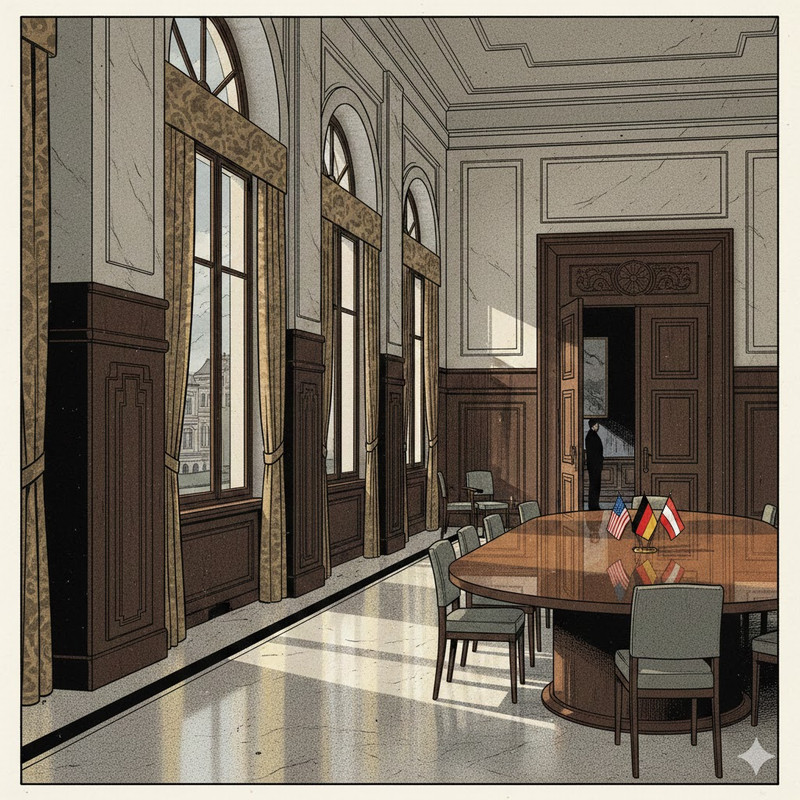
Change the language on the plaques, tweak the crest on the flags, and you could drop half the conference rooms I’ve sat in on top of each other and no one would notice the seams. Vienna’s offering was no exception: long table, polished to a shine; water pitchers sweating into identical glasses; flags arranged like dutiful children—ours and the West Germans’ alternating along the wall; ashtrays stationed at regular intervals like tiny silver lifeboats.
At one end of the room, a row of booths with angled glass waited for simultaneous interpreters. Most of the men present spoke English or German well enough to get into trouble on their own, but nobody trusted nuance to pride, so the headsets sat on the table at every place setting, mute and slightly accusatory.
Place cards told us where to sit. The United States clustered on one side—Commerce, Agriculture, myself, a couple of white-haired advisers who’d been haunting conference tables since Bretton Woods. Opposite, the West German delegation: a senior official from their Economics Ministry, another from Agriculture, a lawyer from what their card delicately called the “Federal Ministry for Economic Affairs and Energy,” and a handful of younger men whose pens already hovered above notebooks like weapons.
I took my assigned seat between our Agriculture man and the ambassador. From where I sat, the room looked like an elaborate mirror: two sides of the same family, dressed for different funerals.
Introductions were made the way they always are: standing, nodding, repeating names you’ve already seen in three briefing books.
“Herr Staatssekretär Müller,” the ambassador said, indicating the Economics man. Narrow face, rimless glasses, a hairline in retreat but not yet routed. “You’ve read his statement on industrial coordination.”
“Senator Whitford,” Müller said in English, bowing his head a fraction. “Ohio, yes? Many of your automobiles find a home in my country.”
“Nevada actually, a little further south. Some of your steel finds a home in mine,” I said. “We try to keep things even so no one gets lonely.”
He smiled thinly. We both understood that the ledger was never as balanced as anyone claimed.
When we’d all sat, there was a moment of ritual fidgeting: people adjusting microphones that didn’t need adjusting, flipping open folders they’d already memorized, checking that their pens worked. This is the diplomatic equivalent of clearing your throat before a song.
The ambassador opened.
“We are grateful to our West German friends,” he said, “for hosting us in this beautiful city and for the opportunity to continue our close cooperation on matters of trade and industrial policy. Our purpose here is simple: to ensure that the prosperity of the Atlantic community is shared and sustained.”
It was the kind of sentence that could have been delivered in any capital in the West since 1947: earnest, bland, exactly as specific as it needed to be and no more.
Müller replied in German, his words caught and turned into English a half-second later by the interpreter in the booth.
“We too,” the interpreter said over the soft murmur of German, “are grateful for the American commitment to our shared prosperity. We have rebuilt much since the devastation of the war. Our people work hard. Our industries compete. But we find ourselves now in a new phase, where the challenge is not only from the East”—here he gestured vaguely, and everyone knew he meant Soviet tanks, but nobody said it—“but from our neighbors to the West and across the seas.”
Polite nods all around. No one wanted to talk about Moscow today. Today’s anxieties were wearing French cologne and Japanese wristwatches.
“As you know,” he went on, “the European Economic Community is deepening. Our partners in Paris, Rome, the Benelux… they are eager to align standards, coordinate policies, present themselves as a unified market.” He glanced at us, just enough to make the point. “Our friends in Washington rightly see this as an opportunity and a challenge. We, in Bonn, see it from both ends. We are at the center of these forces.”
I’d read the brief: West Germany, flanked by allies on one side and adversaries on the other, trying not to be swallowed by either. They were grateful for our umbrella of security; they were also tired of feeling like a client state every time we cleared our throat.
It struck me, as I listened, that this was a family argument disguised as a policy discussion. We all knew the lines: Europe insisting it was grown up now, America insisting it was still the responsible adult at the table.
One of our Commerce officials—the one who’d sat next to me on the plane and flinched at the word “showgirl”—leaned toward his microphone.
“Staatssekretär Müller,” he said, “we understand the pressures you face from your European partners. But we are concerned that, in the rush to harmonize standards within the Community, American manufacturers could be disadvantaged. If, for example, France or Italy insists on specifications tailored to their own producers, and those specifications become the norm, our firms might find the door closed before they can knock.”
“Just so,” Müller said. “We share that concern. We do not wish to be forced to choose between our European obligations and our Atlantic relationships.”
I listened and watched.
Müller himself was classic old-guard: careful diction, posture like a metronome, eyes that gave nothing away unless he wanted them to. To his right sat an Agriculture man with a farmer’s shoulders stuffed into a bureaucrat’s suit; he kept worrying a pencil between his fingers, as if itching to be back in a field.
Further down their side, the younger men were more fluid. One, with his tie slightly askew and hair just a little too long for the old men’s comfort, scribbled notes every time we mentioned “access” or “exposure.” Another tapped the tip of his pen on the table whenever Japan came up—a soft, rapid beat that said the Pacific worried him more than the Elbe.
On our side, we had our own types. Commerce: precise, slightly smug when talking about numbers that supported his argument, defensively vague when they didn’t. Agriculture: blunt, thinking in bushels and votes. The ambassador: smooth as the table, his job to turn all of it into something that sounded like consensus.
And then there was me, sitting there in my navy suit like a wild card slipped into the deck.
I knew my role. My staff had telegraphed it, the Undersecretary had confirmed it. I was here to humanize the machine—to show the West Germans that America was not just a faceless apparatus of tariffs and defense commitments, but a place where actual people sat in actual elected chairs and worried about actual workers.
In the casino, we used to send out the women with the best smiles when a high roller was about to leave the table. Not to cheat him; just to remind him he was having a better time here than he’d have anywhere else. Washington liked to pretend it was above such tactics. It wasn’t.
So I smiled. Not the Vegas smile—too bright, too sharp—but the one I’d developed in committee hearings: warm enough to suggest I might someday remember your name, cool enough to remind you I was not there to pour coffee.
When the first round of statistics had been hurled across the table and everyone had established that they’d done their homework, the ambassador caught my eye and gave a tiny nod.
“Senator Whitford,” he said, “perhaps you could say a word about how these issues look from the perspective of your constituents.”
Which was diplomatic for: we’ve been talking about ships and cars; could you please talk about people.
I flicked my microphone on.
“Thank you, Mr. Ambassador,” I said. “Herr Staatssekretär, gentlemen.”
My German was passable, but not up to the acrobatics this setting required, so I stayed in English and trusted the interpreters.
“I come from Nevada,” I said. “Which is to say, from a place where these discussions end up looking like kitchen-table arguments. A man who works in an factory may never read the minutes of this meeting, but he will feel the choices we make. The same is true, I’m sure, for a machinist in Stuttgart or a farmer in Bavaria.”
Müller inclined his head, the faintest concession.
“In my previous life,” I went on, “I ran a casino in Nevada.”
I heard a little rustle go around the table, like a breeze through paper. Eyes flicked to me, then to the ambassador, to see if this was authorized information.
“Yes,” I said, smiling. “We’re allowed to have previous lives in America. I mention it because it taught me something about risk and about how people behave when they feel the game is rigged against them. If a man thinks the house is cheating him, he stops playing. He may not understand the math, but he understands the feeling.”
I let that sit for half a breath, then continued.
“The workers I represent don’t need to know the exact language of an industrial standard to understand that if a German plug doesn’t fit an American socket, someone somewhere made a decision that will cost them overtime. They don’t have the luxury of thinking in abstractions. Neither, frankly, do you. Because if your manufacturers are locked into a standard that quietly tilts toward your neighbors, your people will feel that the game has been tilted without their consent.”
I saw one of the younger Germans straighten in his seat. The pen-tapper stopped for a moment, pen hovering midair.
“We are not opposed to standards,” I said. “God knows, if you’ve ever seen an American trying to plug in a foreign hairdryer, you know we could use more of them. But we are concerned that in the rush to harmonize, the voices of those who will bear the costs are being treated as background noise.”
I leaned back a little, easing the intensity.
“So I suppose, Herr Staatssekretär, that’s my perspective. I used to run a casino. Now I run a fraction of the government. I’m here to make sure that fraction is paying attention when the big numbers move around.”
There it was: the line my staff had begged me not to use and I’d promised not to, right up until the moment I needed it.
The reaction did not disappoint.
On the German side, the Agriculture man let out a surprised chuckle before he could stop himself, and the tie-askew younger official smiled outright. Müller’s mouth twitched, but he wrestled it back under control, producing instead a small, diplomatic smile that said he had registered the joke and was filing it under “American eccentricities.”
On our side, Commerce looked pained, as if I’d admitted to running a brothel instead of a legal gaming establishment. The ambassador, to his credit, kept his face composed, but I saw a flicker of amusement in his eyes. He knew exactly what I was doing. He also knew State would send him a memo about it later.
The laugh, such as it was, was tepid. Courteous. It washed over the table, then receded, leaving behind a slightly more relaxed silence.
“You ran a casino?” the younger German with the unsettled tie asked, leaning toward his microphone before he thought better of it.
“I helped run one,” I said. “Managed it. Made sure the lights stayed on and the chips came back to the cage at the end of the night.”
“That is… unusual preparation for the Senate,” he said.
“On the contrary,” I replied. “It’s the same job. Different chips.”
This time, the laugh was a shade warmer.
Müller cleared his throat, bringing us back to the agenda.
“Senator Whitford is correct,” he said. “Our workers will not forgive us if they believe that Brussels or Washington has conspired to disadvantage them. That is why we seek, in these talks, assurances that our industries will not be sacrificed to the interests of others who happen to share our alliances.”
And there it was: the quiet, dignified resentment at the heart of their position. They were grateful we’d helped rebuild their country; they were equally determined not to be treated as a permanent junior partner now that they’d crawled out of the rubble and put on a tie.
We spent the next two hours ankle-deep in the details.
There were discussions about automotive safety standards—how thick the steel had to be, how bright the lights, how loud the horn. We argued, politely, about agricultural subsidies: whether West German farmers could continue to receive certain supports without undercutting American grain exports. Someone produced a chart with so many colored lines that I lost track of which one represented us and which one represented the hypothetical Frenchman everyone was politely complaining about.
The Soviets were mentioned exactly once, in passing, as “the Eastern reality.” The real fear in the room was not tanks rolling across borders; it was markets closing, quietly, behind opaque regulations agreed upon by people who looked very much like us.
At one point, the question of Japan arose. A German official with a square jaw and an impeccable pocket square leaned in and said, “We are seeing increased competition from Japanese manufacturers, particularly in electronics and small cars. It is… unnerving.”
Commerce, who had been waiting for this cue, pounced.
“We share those concerns,” he said. “Our view is that an open, coordinated Atlantic market is our best defense against being outpaced by Tokyo.”
The ambassador translated that in the air for me: Stick with us; we’ll keep you from being eaten.
“Yes,” Müller said slowly. “But we do not wish to be eaten from the other side either.”
Every so often, as the numbers and acronyms piled up, I let my mind drift back to the casino floor.
I imagined these men at my old blackjack tables. Müller would stand, not sit, watching the cards with a careful, contained intensity, betting modestly, never chasing a loss, leaving just before the dealer changed and the odds shifted. The younger ones would split hairs and eights with equal enthusiasm, convinced they could count their way out of any hole. The Agriculture man would stay too long, telling stories between hands, his chips dwindling unnoticed until his wife came to pull him away.
Some, I decided, would last five minutes before the house had them. Others might make it through the night, not because they were lucky but because they understood that the game was not about winning once; it was about staying at the table without bankrupting yourself.
The realization made me a little more forgiving. Here we all were, trying to make sure our own people could keep sitting at the global table without being pushed out by the neighbor with longer arms.
Still, there was a part of me that bristled at the role I’d been cast in.
Every time someone from our side used my name in a sentence—“Senator Whitford can speak to the political dimension of this,” “Senator Whitford knows the concerns of the working man”—I could feel the subtext humming beneath the words: See? We’re not just spreadsheets and missiles. We have women and jokes and elections. We are, in fact, charming.
It wasn’t that I minded representing my voters. That was the job. It was that I could feel, in the way the West Germans’ eyes slid toward me when the talk got too technical, that I’d been slotted into the role of “relatable American” while the real decisions were being diagrammed in the margins of someone else’s briefing book.
I leaned into it anyway. If they wanted the human face of our side, I’d give it to them—on my terms.
When the discussion turned to safety standards for machinery, I told a story about a factory in Youngstown where a faulty imported press had nearly taken a man’s hand, and how that man’s daughter had come to one of my campaign events holding up the bandaged fingers like an exhibit in a trial. I watched the Agriculture man across from me flinch; he’d probably heard the same story with a Bavarian accent.
When someone from their side mentioned voter anxiety in the Ruhr about foreign competition, I nodded and said, “I have seen the same fear in the faces of men in Toledo and Akron. They do not care whether the thing that costs them their job is made in Tokyo or Turin. They care that someone far away made a deal that forgot them.”
That wasn’t charm. That was shared reality. But I saw, in the way shoulders shifted and expressions softened, that it was doing the same work the sequins used to do on stage: reminding the audience that there was a person behind the performance.
By the time we broke for coffee, the room felt marginally less brittle. People stood, stretched, rolled their shoulders. The simultaneous interpreters emerged from their glass hives blinking in the fluorescent light, like moles suddenly exposed to day.
Müller approached me during the break, cup in hand.
“Senator,” he said. “I did not realize that—how do you say?—your curriculum vitae included running a casino.”
“America is nothing if not inventive,” I said. “We’re a country where a farm boy can become an astronaut and a showgirl can become a senator. Given enough time, we’ll probably elect a saxophonist President.”
He gave me a look that suggested he wasn’t entirely sure that was a joke.
“In all seriousness,” he said, “your… previous experience gives you a certain perspective. You understand that people must feel the game is fair.”
“I understand that they must feel it, yes,” I said. “And they have a nasty habit of being right when they don’t.”
He nodded, looking down into his coffee as if it held some answer.
“Our people,” he said quietly, “do not forget who has helped them. But they also do not forget who has taken advantage.”
“Mine either,” I said. “We are, as my grandmother would say, a resentful species.”
He smiled at that, small but real.
“We do not want to choose, Senator,” he said. “Between Europe and America. Between partners who have been… different kinds of necessary. We want a role in writing the rules.”
“I don’t blame you,” I said. “Nobody likes being told the house has changed the odds without asking.”
For a moment we stood there, two people in sensible suits holding bad coffee in a baroque room, the weight of our respective electorates sitting invisibly on our shoulders.
“We will see,” he said, “if we can find a way to do this that does not make everyone’s workers feel betrayed.”
“That’s the trick,” I said. “Making sure the arithmetic in here doesn’t add up to a riot out there.”
He regarded me with something like curiosity.
“You are not what I expected,” he said. “From American senators.”
“Neither am I,” I said. “From American senators.”
He laughed then, really laughed, and for a second the room felt less like a set and more like a place where something genuine might happen.
When we went back to the table, the flags were still in their places, the headsets still coiled like sleeping snakes by the microphones. The choreography resumed: statements, counterstatements, polite disagreements choreographed within narrow lanes.
I knew, even then, that these talks would not be remembered as historic. There would be no dramatic breakthroughs, no headlines declaring the “Vienna Accord.” At best, we would shave a few teeth off the gears of friction between our industries. At worst, we would all go home and tell our respective legislators that we had “made progress” and needed more time.
But I also knew that for the men in that room—and, increasingly, for the women who would follow us—it mattered that an American senator who used to run a casino could sit across from a West German bureaucrat and speak the same language when we talked about fairness, even if our accents differed.
In the grand opera of the Cold War, this was a rehearsal, not the main performance. The Soviets were not in the audience today. Our quarrels were with our cousins, not our enemies.
Family politics are often the most vicious, but they’re also the ones where it’s still possible, sometimes, to change the script.
So I took my seat, adjusted my microphone, and prepared to be both fraction and face—one small percentage point of a very large system, trying to remember that even decimals can tip a balance if you put them in the right place.
Conference centers all smell the same after a while: coffee, carpet, and fear of irrelevance.
This one had the added note of marble, which is to say it was a little more dignified than average and a little less forgiving on the feet. The Austrians had carved the heart out of an old building and replaced it with what looked like a cross between an opera foyer and an anthill. Delegations flowed through the atrium in streams—dark suits, sensible shoes, flashes of national pins like bits of colored glass in a riverbed.
Somewhere above us, under chandeliers that had probably watched emperors age, the serious sessions were in progress. Downstairs, in the café tucked off the main hall, we had the holding pattern.
I’d retreated there between rounds of “bilateral consultations” with various people who cared deeply about things like flange tolerances and mutual recognition of safety testing. My badge got me past a velvet rope and into a space that pretended to be informal: little round tables, chrome chairs, a counter where harried staffers in white shirts pulled espresso shots with the concentration of surgeons.
The noise was constant but soft—a multi-lingual murmur overlaid with the clink of cups and the occasional burst of laughter from a corner where someone had just told a joke about tariffs. I understood maybe half of the words being spoken and all of the posturing.
I took my coffee black this time, more for self-defense than taste, and found a table by the wall where I could see the doors. Years of watching who came and went in and out of the casino office had left their mark: I always want my back covered and my exit routes spotted.
Bad habit for a senator. Excellent habit for a woman who has no interest in being surprised.
From that vantage point, the café looked like one of those nature documentaries where the camera sits on the riverbank and watches different species come to drink.
There was a knot of Scandinavians by the window—tall, fair, wearing suits in colors one shade lighter than everyone else’s, as if their tailors had figured out how to weave the phrase “we are reasonable people” into the cloth. A smaller group near the counter spoke rapid-fire Japanese, their hand gestures sharp, their laughter quick and private. A trio of Frenchmen drifted through like they’d taken a wrong turn on their way to a much better party.
Every few minutes, a minister or deputy something-or-other would be swept up from their seat by a staffer with a stack of papers and a worried expression, and a new one would drift in to occupy the vacated chair. It was like watching tide pools refill.
I sat, sipped, and listened.
To my left, two men wearing OECD badges were discussing capital flows as if they were describing a hurricane season.
“If the liquidity keeps moving that direction,” one said in English, tapping his spoon against the rim of his cup to mark an invisible map in the air, “we will have a situation where the periphery is simply starved of investment.”
His companion shook his head. “No, no, you see, the flows are self-correcting when the risk premiums—”
They went on like that, sentences constructed mainly out of nouns, verbs an afterthought. They talked about “flows” and “shocks” and “contagion” in a way that made money sound less like something you held in your hand and more like weather that might decide to strike your coastline on a whim.
I knew risk. I knew what it looked like when a man walked up to a blackjack table with hungry eyes and a wallet he couldn’t afford to empty. I knew hedging: the way smart players slid chips into side bets when the shoe turned strange. But these men were talking about risk and hedging in geological time, across oceans and decades. Their maps had no people on them, just arrows and numbers.
In my head, a stray line from a science fiction novel one of my staffers was obsessed with floated up: a speck on a desert planet. That’s what my old house in Nevada had been compared to the thing they were describing. Our casino had been a tiny, glittering outpost in a sea of sand, concerned with the fate of every chip and every drunk who wandered in out of the heat. These people dealt with storms that spanned continents, crashes that swallowed nations.
“Spice,” my staffer had called it, waving his book. “It’s all about control of the spice.”
Here, the spice was capital. Same addiction, bigger scale.
To my right, a pair of South American delegates in excellent suits were murmuring over a single folder.
“…unexpected arrivals,” one said in Spanish, which I could follow just enough to get gist if not detail. “The Austrians say it was confirmed only yesterday.”
“The Americans knew?” his companion asked.
“A last minute adjustment, they say,” the first replied. “But you know how that is.”
They both laughed a little too hard at that. I filed it away.
At the counter, a slim man with a British accent was ordering tea with the sort of weary precision fellow professionals reserve for one another.
“…and three sugars,” he said. “Yes, three. I’m not trying to impress anyone.”
When he turned, juggling cups, he nearly collided with one of our Commerce staffers.
“Ah, Baker,” he said. “You heard about the extra security for this afternoon?”
Baker frowned. “We were told it was just because of the joint session.”
“Mm,” the Brit said. “Joint sessions don’t usually require the Austrians to clear the entire second floor. Or so my security people tell me. Perhaps they’re just being cautious.”
“Cautious” in this context meant “somebody important enough to make everyone nervous is on the guest list.”
They drifted away before I could catch more. I took another sip of coffee and kept my eyes on the doors.
People-watching is half of politics. The other half is pretending you’re not doing it.
A group of men entered in a loose cluster, badges on their lapels without the country flags most of us wore. Their suits were darker, cut differently; their hairlines and ages varied but something in the way they moved marked them as a team. They spoke quietly in a language I didn’t recognize by ear, with the tones riding over consonants in a pattern that made my brain tilt.
Farther back, trailing them by a few steps, was a man in a plain dark coat whose eyes did not stop moving for a second. He scanned the room, the exits, the ceiling. When his gaze swept over me, it didn’t linger, but it noted.
Austrian security, maybe. Or not.
Two tables away, a woman from the Japanese delegation leaned toward a colleague.
“They closed the side stair,” she said in English, frustration sharpening the edges. “We had to go around. My meeting was delayed twenty minutes.”
Her colleague shrugged. “They said ‘heightened measures.’ Some new attendance confirmed. From Asia.”
“And we’re what, chopped liver?” she muttered. “We’ve been here all week.”
Her accent made “liver” sound almost like “lever.” I wasn’t sure that wasn’t the more accurate word.
“From Beijing,” the colleague added, softer this time.
I pretended to be very interested in my coffee and the notes I hadn’t brought.
Beijing, here. That was new. My original brief had mentioned the possibility of “observers from non-European states”—a nod to Japan, maybe some token presence from the developing world, window dressing to prove this wasn’t just an Atlantic family argument.
Nobody had said anything about Beijing.
I glanced toward the entrance again.
At the far end of the hall, just outside the café’s open side, a knot of Austrian police had appeared. Their uniforms were neat, their hands folded in front of them, but the spacing was wrong for routine. They weren’t blocking anything; they were framing it.
Behind them, a man from our delegation—one of the lower-level State professionals whose job it was to scurry between rooms with messages—was standing with a phone to his ear, thumb pressed hard over the other. His eyes flicked once toward me, then away, as if he’d been explicitly told not to involve the senator until someone higher up had decided what, exactly, to tell her.
I wasn’t offended. This trip had started as a labor-management dispute at the grown-ups’ table. If the agenda was suddenly changing, it stood to reason the ones juggling the plates would get the warning first.
Still. It set my teeth on edge to feel the energy in the building tilt and not know why.
I’d felt it before in the casino. You can always tell when something’s about to happen—before the commotion, before the shout, there’s a small pressure change. A certain table goes quiet. The dealers shift their weight. Security appears at the edges of the floor, not yet moving in but no longer pretending to be invisible.
This felt like that. The floor had gone from a contented buzz to something a little more charged.
I watched a delegation from one of the smaller European countries snake through the café, trailing conversation like a comet’s tail.
“…they told us additional Asian observers, nothing more,” a man with an accent I couldn’t place was saying. “I assume the Americans wanted them.”
“Or the Soviets wanted them and the Austrians couldn’t find a polite way to say no,” his colleague replied. “You know how the neutrals are. Always trying to seat everyone at the same table and then complaining about the bill.”
They laughed and kept walking.
At another table, a woman from our Agriculture team had her head close to that of a Canadian deputy minister.
“They’ve asked us to vacate one of the side meeting rooms this afternoon,” she said.
“Why?” the Canadian asked.
“No reason given,” she said. “Just ‘reallocation of space.’ McKenna’s people are twitchy as hell. They’re doing that thing where they pretend not to be upset so you know they’re upset.”
“Is it a protest?” the Canadian asked. “Did somebody bus in farmers?”
“Not this time,” she said. “Anyway, the Austrians would have a coronary if anyone tracked mud into this place.”
He grinned. “So, dignitaries then.”
“Something like that,” she said.
I let the snippets pile up in my head, like chips in a rack. New arrivals. Extra security. Closed staircases. Asian observers. Beijing.
Put together, they suggested somebody’s chessboard had acquired a new queen.
It was an odd sensation, being close enough to feel the tremors and far enough from the epicenter to be considered part of the scenery. I didn’t feel shut out exactly—I knew my place; I’d been invited here as much for my ability to perform in public as for my vote in committee. Still, the tilt of the room reminded me that there was another layer of conversation happening, one I wasn’t yet party to.
I took another sip of coffee and imagined what Lucille would say if she could see me sitting there, alone at a table, antennae out.
“You look like a cat watching a door,” she’d say. “Somebody feed my wife before she decides to knock it down.”
I could almost hear her voice in my ear: amused, admiring, entirely unsurprised that I’d found the exact spot in the building where I could see the most without being seen.
“You’re the art department,” one of my colleagues had said, half-joking, when we’d boarded the flight. “Commerce writes the script, Agriculture builds the set, State directs, and you do the set dressing.”
I’d laughed then, because it was easier than pointing out that the art department has been known to smuggle messages into the scenery.
Sitting in that café, watching the swirls of people and listening for the words everyone talked around, I felt the truth of it. I was the political color on an economic canvas. The one who could make a paragraph about standards sound like something a voter might listen to between laundry loads.
But something was shifting now into a different register. The conversations in the café were still about trade, about competition from Tokyo and tariffs from Brussels, but under them ran a new current, one my original packet from State had not prepared me for.
I watched a small group of men pass by wearing nametags with unfamiliar characters on them, the Roman letters beneath spelling out affiliations that meant little to me: “Institute,” “Commission,” “Delegation.” Their faces were controlled, their steps measured. They reminded me, oddly, of the more serious gamblers I’d known—the ones who understood that you never show the room your whole hand until you’ve counted every card.
One of them glanced toward the police at the far end of the hall, then at the cluster of Austrian officials who had gathered near a grand staircase, talking in that overly casual way people adopt when they’re trying not to stare in the same direction.
Whatever this week had started out as—West Germans and Americans arguing over who got to sell which machines where—it was becoming something bigger. The architecture of the conference was being rearranged around a presence that hadn’t been on the original floor plan.
I finished my coffee, set the cup down carefully, and stood.
There is a time for sitting and watching and a time for making your presence known. I’d had enough of the first for one afternoon.
As I stepped out of the café and into the main hall, I caught one more fragment of conversation, from a pair of mid-level European diplomats hovering by a schedule board.
“…if they’re really here, it changes the calculus,” one said.
“Of course it does,” the other replied. “You don’t invite dragons to the tea party and then pretend they’re just another guest.”
I didn’t know yet which dragon they meant. But I had a feeling, in the place just under my ribs where intuition likes to curl up, that before this trip was over, I’d be close enough to feel its breath.
For the moment, though, I straightened my jacket, adjusted my badge, and walked toward the cluster of my own delegation gathering by a side door.
Whatever was coming, I suspected they were about to tell me I had a front-row seat.
They came to get me before I’d finished the coffee.
I was standing in the hall outside the café, watching a delegation from somewhere in the Balkans attempt to read the map of meeting rooms without admitting they were lost, when I saw one of our State Department boys jogging toward me, tie slightly askew, badge swinging.
“Senator Whitford,” he said, a little short of breath. “We’ve been looking for you.”
“Well, now I feel loved,” I said. “What’s on fire?”
“Nothing, yet,” he said. “Ambassador Ryder needs you upstairs. They’ve… added a meeting to your schedule.”
“Is this the sort of meeting that comes with sandwiches,” I asked, “or the sort that comes with classified minutes?”
“The second kind,” he said. “If you’ll come with me?”
He was doing that thing junior officials do when they’ve been told not to say too much and their tongues are itching. His eyes kept darting toward the stairwell where two Austrian policemen were suddenly very interested in the architectural details of the landing.
“Who?” I asked, as we walked. “West Germans again? The French? Did somebody tell the Italians I once criticized their wine?”
He swallowed. “The Chairman of the People’s Republic of China has agreed to a brief courtesy call,” he said. “With the ambassador. The President’s office requested that you be in the room.”
We kept walking for a few seconds in silence—boots on marble, distant hum of voices—before I answered.
“I see,” I said. “And you thought I would be best prepared for this important development alone in a corridor with half a cup of coffee inside me.”
“We only got confirmation twenty minutes ago,” he said helplessly. “Security had to clear the route, the Austrians had to reassign rooms—”
“Relax, son,” I said. “I’ve gone on stage with less notice.”
That’s the thing about last-minute bombshells: if you’ve spent enough of your life in casinos and newsrooms, you get used to walking into a room without knowing which way the ceiling will fall. You just hope someone had the decency to sweep up beforehand.
They’d given us one of the smaller anterooms on the second floor. It had clearly been designed for some imperial function a century earlier, then re-purposed by mid-century bureaucrats for meetings they didn’t want on the official tour. The ceiling was high enough to induce vertigo, hung with a chandelier that looked like it weighed more than my first car. The furniture, by contrast, was almost apologetic: a modest rectangular table in the middle, four chairs, a sideboard with a carafe of water and four glasses lined up like a firing squad.
The ambassador was already there, standing by the window, hands clasped behind his back. He turned when I came in, assessed me in a quick sweep—suit in order, hair pinned, no lipstick on teeth—and nodded to himself as if to say, That will have to do.
“Phoebe,” he said. “Thank you for coming on short notice.”
“Thank you for not telling me about it over a loudspeaker,” I said. “So. Mao Zedong. In Vienna.”
He winced slightly at the name, as if it might be bugged.
“Chairman Mao has agreed to a very brief meeting,” he said. “Ten minutes, perhaps less. This is unofficial and off the main agenda. We will be using the usual diplomatic language about ‘exchanges of views’ and ‘frank discussions.’”
“Which usually means ‘we didn’t shout at each other loud enough for the waiters to hear,’” I said.
“Quite,” he said. “He will be accompanied by an interpreter and a small security detail. We will have a stenographer in the corner”—he nodded toward a woman at a small desk, already poised over her notebook—“but no press, no photographers. This is not for public consumption, at least not yet.”
“And me?” I asked. “Why am I here, besides my sparkling personality?”
“The President felt,” he said carefully, “that it would be useful for the Chairman to see that the United States is not represented solely by older men in grey suits. Your…distinctive profile has not gone unnoticed in their press.”
“Ah,” I said. “I’m the jazz band again.”
“You’re a senator from an industrial state with a reputation for speaking plainly,” he said. “You also understand something about how economies look from the bottom up. I’d remind you that you are not here as a private citizen.”
“I appreciate the clarification,” I said dryly. “Any particular red lines?”
“Vietnam will likely come up,” he said. “You know the brief as well as I do. Be candid but not incendiary. On economic questions, you may speak about the concerns of American workers and farmers, but don’t commit us to anything that isn’t in your book. And, for the love of God, don’t let him pull you into doctrine.”
“Doctrine is above my pay grade,” I said. “Dogma gives me hives.”
He allowed himself half a smile.
“And Phoebe,” he added, voice dropping, “remember that every word in this room will end up in at least two reports: one in Washington, one in Beijing. Probably more. That doesn’t mean you have to be timid. It just means you have to be deliberate.”
“I’m always deliberate,” I said. “My staff just wish I’d be less so out loud.”
We sat: he at the head of the table nearest the door, me to his right. The stenographer adjusted her pad, her face arranged into the neutral calm of someone who has trained herself to disappear.
Then we waited.
Waiting is its own ceremony in diplomacy. There’s a hierarchy to it. The most powerful man in the building is never the one already sitting when someone else walks in. The Chairman of the People’s Republic of China was not going to make his entrance to find a room of Americans checking their watches.
So we sat, and we let the seconds lengthen.
I looked up at the chandelier, counted bulbs, and wondered absently how many of them still had original wiring. I thought of Lucille, somewhere across an ocean, probably standing at our kitchen sink, listening to the radio news and not yet knowing that her wife was about to sit across from a man whose portrait hung in propaganda posters half a world away.
“Do we know,” I asked softly, “whether his people have read my file?”
“You have a file in Beijing,” the ambassador said. “As do I. As does the President. You’d be surprised how much of our congressional record turns up in their internal translations. They are very assiduous readers of public information.”
“So they know I drew him with a wolf’s head that one time,” I said.
“I imagine they do,” he said. “Consider this your opportunity to expand their understanding beyond your cartoons.”
There was a knock at the door, a quick double rap that managed to be both polite and authoritative. The Austrian protocol officer leaned in, expression carefully neutral.
“Chairman Mao’s party has arrived,” he said. “May they enter?”
“Of course,” the ambassador said, rising.
We stood as they came in.
First, two men in plain dark suits, shoulders a little too broad, eyes a little too still. Not soldiers in uniform, but the kind of security men you recognize by the way they move: scanning, measuring, always putting themselves between unforeseeable angles and their principal.
Then the interpreter: younger, slim, wire-rimmed glasses, a notebook already in his hand. He looked like half the graduate students I’d seen haunting the edges of embassy receptions, except his gaze was sharper, less diffused. A man who knew his words might someday be used as evidence.
And then Mao.
I’d seen a thousand photographs of him, of course. The West had made images of him into icons and warnings both: on balconies, on trucks, on walls. In some he looked avuncular; in others, implacable.
In person, he was smaller than the myths.
Not small, exactly—there was a solidity to him—but shorter than I’d expected, especially next to his security men. He wore the familiar high-collared tunic, dove-grey, the fabric hanging a little heavy around the shoulders. His hair was greying at the temples, combed back from his forehead with the careless precision of someone who no longer needs to impress anyone with vanity.
What struck me most were his eyes.
They were darker than the photographs suggested, deep set, and they moved constantly—taking in the room, the chandelier, the position of the stenographer, the line of the door. When they settled on you, it felt less like being looked at than being measured.
The ambassador stepped forward slightly.
“Mr. Chairman,” he said. “Welcome. We appreciate your willingness to meet.”
Mao listened to the interpreter murmur the English into Mandarin, then nodded once. He spoke a short phrase in return, his voice lower than I’d expected, with a rasp that suggested too many cigarettes and too many speeches.
“The Chairman thanks you for your welcome,” the interpreter said, “and for your country’s interest in dialogue.”
His gaze swung to me.
“And this is Senator Whitford,” the ambassador said. “From the state of Nevada. A member of our incoming Senate.”
I inclined my head. “Mr. Chairman,” I said. “It’s an honor.”
He spoke again, a slightly longer string this time, never taking his eyes off my face.
“The Chairman says,” the interpreter relayed, “that you are very young for someone in such a position.”
I made a deliberate choice, then, in the space of a heartbeat.
It was not what State would have advised. But State hadn’t spent years learning that sometimes the only way to break a pattern of judgment was to sidestep it entirely.
“Ah,” I said, letting a smile tug at the corner of my mouth. “Yes. Very tall. It’s mostly the shoes.”
The interpreter blinked, thrown off. He’d heard young, not tall. But he recovered quickly, translating my words into Mandarin, substituting what I’d given him.
Mao’s brows drew together for a fraction of a second, then smoothed as the double joke landed: the deliberate mishearing, the deflection.
I angled one foot out a little so the heel was visible beyond the table.
“Old showgirl trick,” I said. “You learn early that if you want to survive in certain rooms, it helps to see over everyone’s heads.”
This time, the interpreter almost smiled as he rendered it. Showgirl took some acrobatics; he chose a phrase that probably meant something like “stage performer.” I imagined how that would sound in the Chairman’s ear.
Mao’s eyes slid down, briefly, to my shoes, then back up.
“And in my house,” I added, taking the plunge, “I’m the short one. My wife is taller than I am in bare feet.”
The room shifted around that sentence.
It was subtle—a faint tightening at the edges of vision. One of the security men’s eyes flicked toward the stenographer. The interpreter’s pen paused for the smallest fraction before he wrote the character for “wife.”
I heard myself say it and felt, in the same instant, the full absurdity of the situation: standing in a baroque anteroom in Vienna, telling Mao Zedong that the woman I share my bed with could look him in the eye without heels.
Which is why I softened it the only way I knew how.
“Though I was raised better,” I added lightly, “than to gossip about a lady’s height. A gentlewoman should know when to stop giving away another woman’s measurements.”
This time, the silence lasted just long enough to be a question.
Then Mao laughed.
It was not the polite chuckle of someone humoring their host. It was a short, sharp burst from the chest, abrupt as a bark. His eyes crinkled at the corners; his shoulders lifted once, briefly, as if the sound had surprised even him.
The interpreter actually stopped translating midway through a word, thrown off by the rarity of hearing his boss genuinely amused.
I watched the lines on Mao’s face rearrange themselves. For a heartbeat he looked less like the looming figure on propaganda posters and more like a man who has just heard a joke he knows he shouldn’t enjoy as much as he does.
The tension in the room thinned by a measurable degree. The chandelier stopped feeling like it was hanging over a gallows and returned to simply being impractical lighting.
“We are pleased,” Mao said in Mandarin, a few syllables, his tone altered now. There was a hint of dry humor in it.
“The Chairman says,” the interpreter offered, “that he is surprised to hear such frankness from an American senator. He did not know your country allowed women with such… experiences to make policy.”
“America is full of surprises,” I said. “We like to keep even ourselves guessing.”
The ambassador cleared his throat gently, a reminder that there were other purposes to this meeting besides my improvisational comedy.
We sat. Mao took the chair opposite the ambassador. The interpreter positioned himself just behind his shoulder, notebook ready. One of Mao’s security men stood by the door, the other near the window, as if he could hold back history by sheer proximity.
The stenographer’s pen hovered above her paper, then began its quiet, relentless scratching.
Formalities first. They always are.
On behalf of the President, the ambassador conveyed greetings. On behalf of the Chinese people, Mao responded. There was talk of “shared responsibility for peace,” “the burdens of leadership,” “the challenges of the modern era.” It was the kind of language that feels like it should mean something profound until you hear it recycled enough times.
Underneath, there were the real currents.
“We know,” Mao said through his interpreter, eyes steady, “that your country is concerned about our development. You watch us through your newspapers and your spies. You do not trust our intentions.”
He did not say we do the same to you, but it was implied in the slight curl of his lip.
“We are concerned about many things,” the ambassador replied. “We are concerned about stability in Asia. About the welfare of your people. About the possibility of miscalculation in a world where miscalculation can be very costly.”
“Very costly,” Mao repeated. “Yes. You speak of cost. Always cost. Dollars. Votes. Markets.”
I decided to take my fraction of the floor.
“With respect, Mr. Chairman,” I said, “we also speak of lives. My brother-in-law doesn’t measure cost in dollars. He measures it in the number of napkins left at an empty place at the table.”
Mao’s eyes shifted to me.
“Your soldiers die in Asia because your leaders fear to lose face,” he said, via the interpreter. “You fight in Vietnam to prove you are still strong.”
“And you send weapons there,” I said, “to prove you are.”
A flicker in his expression—approval, maybe, at my refusal to dissemble.
“Indo-china will decide for itself,” he said. “We simply help them resist imperialism.”
“And we help people resist what we see as oppression,” I said. “We disagree, it seems, about which guns are liberating.”
The interpreter hesitated over “liberating,” picking a word in Mandarin that, judging by the sound of it, skated close to “freeing” and “excusing” simultaneously.
Mao’s mouth thinned. For a moment I thought he might pivot into doctrine after all, give us a lecture on dialectics. Instead, he surprised me.
“You are very direct,” he said.
“I’m from Nevada,” I said. “We don’t have time for embroidery. It snows too much.”
Again, that small involuntary tug at his mouth. I could almost hear some clerk in Beijing, years later, reading this exchange in a transcript and underlining that line in red.
The ambassador steered us toward trade, toward safer ground.
“We have heard,” he said cautiously, “of challenges in your agricultural sector. Harvest shortfalls. Difficulties implementing new methods. The United States is a major grain producer. There may be ways for us to… assist.”
There it was. State speak for “we know your people are starving, and we’d rather they not decide the world works better without you in charge.”
Mao’s gaze cooled.
“Our harvests have been affected by weather and by the obstruction of certain elements who do not understand the revolutionary line,” he said. “We are correcting these deviations. Our people are capable. They have endured much worse than a poor season.”
He did not say famine. Of course he didn’t. In his vocabulary, these things were temporary storms in the great march toward communism, not catastrophes that killed millions.
“I have read reports,” I said carefully, “that suggest your rural areas have suffered greatly in recent years. That some communes reported production they could not possibly have achieved.”
“Ah,” he said, “you refer to your so-called ‘intelligence.’ Men who skulk outside our embassies with cameras. Clerks bribed with Western books. We know about these games.”
“We have our games, yes,” I said. “I assume your people do too. But I also pay attention to what my own contacts say. Doctors. Missionaries. Scholars who’ve been allowed to visit. They talk about… hunger. Not just a poor season. A pattern.”
I chose that last word deliberately. It’s harder to dismiss a pattern.
He listened to the translation with a face like carved stone.
“In any great change,” he said, “there are those who suffer. When your country industrialized, you did not worry about every man who lost his farm. You built your cities on the bones of your Indians and your slaves. Do not lecture me about suffering.”
He wasn’t wrong about our history. That was the trouble.
“I know what my country has done,” I said. “I spend most of my working hours in Washington trying to get us to admit it. But that doesn’t absolve either of us. It just means we should recognize the signs when we start using people as fuel.”
He considered that, fingers resting lightly on the table edge.
“You think I do not care for my people,” he said.
“I think,” I said slowly, “that you have a vision of history so large you cannot always see the individuals under it. It is a common disease among men in your position. We have it too.”
The interpreter’s eyebrows twitched at my use of “men,” but he translated it faithfully.
Mao exhaled through his nose, a sound that could have been irritation or reluctant respect.
“You are a woman,” he said. “In your Senate. With power.”
“So they tell me,” I said. “Most days it feels like I’m wrestling a very large animal with too many heads.”
“In China,” he said, “women work in the fields, in the factories, in the army. They carry rifles. They bear children. But they do not sit where I sit.”
“I’ve noticed,” I said.
“You said your wife is taller than you,” he went on, eyes narrowing with something like curiosity. “She is not… how do you say… hidden?”
“No,” I said. “She is a lawyer. She cross-examines people for a living. Hiding is not in her nature.”
“And your people accept this?” he asked. “A woman in your Senate, another woman in her bed?”
“Some of them,” I said. “Some pretend they don’t notice. Some would like us to disappear. But I was elected anyway. Which suggests there are more of the first sort than the last, or at least that the others were busy that day.”
He made a low sound in his throat that might have been amusement.
“In my country,” he said, “we do not talk about such things. We talk about production quotas. Grain. Steel. Enemies.”
“I’ve noticed that too,” I said. “We talk about all of it. Sometimes to our detriment.”
He tapped a finger against the table, thinking.
“Your President,” he said, “believes that nuclear war can be controlled. That it can be avoided by threat. We do not agree. If there is such a war, many will die. Perhaps half of humanity. But the imperialists will die as well. The people will remain.”
The casualness with which he said this made the back of my neck go cold.
“It’s comforting,” I said, “that you think half of humanity surviving is an acceptable outcome.”
“You exaggerate for effect,” he said.
“No,” I said. “You do. I have a niece who just learned to walk. I would like her to grow up with all her skin attached. I assume there are children in your life you feel the same about.”
He looked at me, and for the first time I saw something like a shadow of doubt. Or maybe it was just age.
“History is not gentle,” he said. “It is not concerned with individual tears.”
“History is written by people who don’t have to watch their own children cough up blood,” I said. “Or if they do, they find a way to pretend it’s for a cause.”
There was a risk, I knew, in pressing him like this. But if the point of this exercise was to trade slogans, we could have mailed each other pamphlets.
The ambassador, sensing the temperature, interjected with something about “the shared responsibility of nuclear powers” and “the necessity of avoiding missteps.” We veered back toward safer abstract nouns: deterrence, stability, balance.
Mao let him talk. His attention kept coming back to me, though, as if I were a puzzle he hadn’t expected to find on the table.
“You speak with great confidence,” he said at one point.
“I speak with great practice,” I said. “Confidence is a side effect.”
“You are not afraid of me,” he said.
“Oh, I’m terrified,” I replied. “I’m just too stubborn to let it show. Where I come from, if the man across the table knows he’s scared you, he’s already taken your house.”
The interpreter hesitated over “house,” then chose a word that probably meant both home and establishment.
“And have you lost your house?” Mao asked.
“Once,” I said. “It burned down. Literally. We rebuilt.”
“Ah,” he said. “Then you know something about revolution.”
“No,” I said. “I know something about fire codes and insurance. The revolution I prefer involves ballots, not bullets.”
He considered that, then gave the tiniest shrug.
“Different methods,” he said.
“Same ash,” I answered.
We circled through trade again—wheat, steel, the possibility of “technical exchanges” in areas that would not alarm the Pentagon too much. He spoke about self-reliance; the ambassador spoke about “complementary strengths.” It was like listening to two men politely jockey for position while pretending the track didn’t exist.
Through it all, that earlier laugh hung in the air, a small, persistent reminder that we’d already broken one rule of these encounters: we’d acknowledged, if only for a second, that the people at the table had lives beyond their titles.
I’ve thought about that more in the years since than any specific sentence we traded about rice yields or mutual suspicion. Not because it made him any less culpable for what he’d done to his country, but because it made him more comprehensible as the kind of person who could do it.
When the Austrian protocol officer appeared discreetly in the doorway to tap his watch, we all read the signal at once.
The ambassador offered the appropriate finalities.
“We appreciate this opportunity, Mr. Chairman,” he said. “We hope it will be only the first of many conversations between our nations.”
Mao listened, then replied, his voice softer now, the interpreter almost leaning in to catch the words.
“The Chairman says,” the interpreter translated, “that China and the United States are not friends. Perhaps not even in the same story. But the Chairman believes it is sometimes useful to hear the voices of those who stand on the other side of the river.”
“That’s an image I can live with,” I said. “Rivers rise and fall, but unless somebody blows up the bridge, you can usually cross if you really have to.”
He tilted his head, as if cataloguing the metaphor.
He stood. So did we. The chandelier loomed above us like a spectator; the stenographer’s pen came to a final rest.
Mao reached out his hand. For a second, I saw the calculus in his eyes: photograph or no photograph? There would be no camera, but somewhere, someone would write they shook hands into a report.
I took it.
His grip was firm, not crushing, the skin warm and dry. I remember thinking, absurdly, that it felt like shaking hands with any older man whose body had shepherded him through more years than his doctors had likely recommended.
“Senator Whitford,” he said, in halting English this time. The accent wrapped around the consonants. “Your… wife. Very tall.”
I laughed, unable to help myself.
“Very tall,” I said. “Very stubborn. You would like her.”
“I do not like stubborn women,” he said, but there was the glint again in his eyes.
“That’s because you’ve never had to live with one,” I said. “They have a way of rearranging the furniture in your head.”
The interpreter hurried to catch up, translating the line as best he could. Mao made that low, amused sound again; it wasn’t quite a laugh this time, but it wasn’t disapproval either.
He turned to the ambassador, shook his hand as well, exchanged the standard farewells. Then he and his party filed out the way they’d come: security first, then interpreter, then Chairman, taking with them the slight drop in air pressure that powerful men bring into and out of small rooms.
When the door closed, the room seemed larger.
For a moment, nobody spoke. The stenographer flexed her fingers, shook them out, as if she’d been holding too much of the world in them.
“Well,” the ambassador said at last. “That was… not dull.”
“No,” I said. “He doesn’t strike me as a dull man.”
He gave me a sidelong look. “You understand that the word ‘wife’ is going to feature prominently in the reports both our governments write about this,” he said.
“Good,” I said. “Let it. Better they write about her being taller than anything else.”
He sighed in that particular way diplomats do when the politicians they escort insist on being themselves.
“You did well,” he said. “More importantly, you were yourself without giving anything away we didn’t intend to give.”
“Thank you,” I said. “I’ll take that as a win.”
Years later, when I finally got to see the declassified transcript, the words read flatter than the room had felt. You couldn’t hear the laugh in the characters or the typewritten English. You couldn’t see the slight relaxation of a pair of shoulders, the way a man’s eyes crinkle when he’s caught off guard by a joke that slipped past his guard.
The record shows that we discussed trade, agriculture, war, peace, and ideology. It notes, in cautious prose, that the Chairman “reacted with some amusement” to my reference to my wife. It concludes that the meeting “contributed modestly to mutual understanding.”
What it cannot show—what no official document ever does—is the thing I walked out of that chandeliered anteroom carrying like a splinter.
Mao Zedong was not a cartoon wolf or a faceless tyrant. He was a person—a deeply dangerous, deeply convinced person—who could laugh at the height of a woman he’d never meet and talk calmly about losing half of humanity in a war.
That is a worse combination than either caricature alone.
I left the room with a renewed respect for the fragility of the line we walk when we grant such men the power to define history. And with a story I knew Lucille would receive with that particular mix of horror and pride that only she could manage.
“You told Mao Zedong I’m taller than you?” she said, when I finally got to tell her the story over our own kitchen table, months later.
“Of course,” I said. “It seemed important he understand what he was up against.”
She shook her head, eyes shining.
“You,” she said, “are out of your mind.”
“Maybe,” I said. “But it got him to laugh. And sometimes, in this line of work, a laugh is the only proof you have that the person across the table is still human enough to be dangerous in ways you recognize.”
That, in the end, was the positive note I took from Vienna.
Not that we’d softened a dictator’s heart. We hadn’t. Not that we’d averted war. We didn’t. But for ten minutes in a we acknowledged, however briefly, that the stories they’d been telling about each other were only that: stories.