Work Text:
The city desk meeting always began with Dot Reiser testing the room the way a bandleader tests a horn—one note to see if everyone was awake. At 8:58 a.m., the newsroom of the Las Vegas Sentinel smelled like hot dust swept in through the loading bay, coffee that had boiled twice, and the invisible iron taste of type slugs cooling in the shop. Reporters drifted in, shaking off the night as if it were still clinging to their coats. Phones rang the way slot machines think—random, insistent, promising.
“All right, children,” Dot said, sliding into her chair at the end of the conference table. She wore a cardigan with shiny elbows and a pencil tucked behind her ear like a conductor’s baton. Her budget sheet—stories, not dollars—was already marked up in red grease pencil. “We have water board at three, school board at five, a councilman who insists his quote was a metaphor—God save metaphors—and a Senate race that won’t stop trying on mirrors. Where’s politics?”
“Here,” said Berman, raising a hand that hadn’t quite made peace with its cigarette. “Whitford’s at the union hall at noon. Her opponent is practicing being tall.”
“And Mort?”
“Hiding in plain sight,” said a voice from the doorway.
He leaned one shoulder against the jamb, a coffee in each hand, the ghost of a smile he’d inherited from vaudeville. Mort Faber looked like a man who’d tried everything on a diner menu and finally learned to order the same breakfast every day. He passed Dot a coffee without being asked. He balanced his own on a stack of paste-up boards.
Dot arched an eyebrow. “You’re on A1 with a panel about hotel ‘air conditioning.’”
“The casino that pipes winter over the sidewalk,” Mort said. “A civic service.”
“Terrific. But politics is going hungry for a cartoon.”
Berman gestured at a page proof. “They’re all taking themselves very seriously. Might be healthy for the city if someone didn’t.”
Dot turned to Mort. “You have something for Phoebe?”
He took a sip, let the heat clarify his thoughts. “I have a premise.”
“Share with the group,” Dot said. She didn’t believe in mystery unless it sold papers.
“She’s promising to ‘take Vegas to Washington,’” Mort said. “Everyone says that. I figured I’d draw what it looks like if she accidentally overshoots.”
Berman frowned. “Overshoots what?”
“The Senate,” Mort said, eyes glinting. “Goes right past it, ends up at the big desk. January twentieth, nineteen sixty-seven. Inauguration Day.”
The room made that sound a newsroom makes when a joke lands and also might get you a lawyer—a soft ‘oof’ through teeth, followed by three polite coughs.
Dot didn’t cough. She smiled. “Is it mean?”
“It’s accurate at speed,” Mort replied. “She’s a town treasure. Everyone knows it. The gag is affection with long legs.”
Berman grinned despite himself. “Long legs play.”
Val from advertising appeared in the doorway as if summoned by the word ‘play.’ “We doing kingmaking on A1 now?”
Dot didn’t turn. “Good morning, Val.”
“Good morning, Dot. I have a half-page from the Horseshoe that pays our electricity bill. They don’t like us tweaking royalty.”
“Phoebe isn’t royalty,” Dot said. “She’s running for public office.”
Val leaned against the jamb, matching Mort’s stance without knowing it. “And your cartoonist wants to seat her in the Oval.”
Mort lifted his hands. “Gently.”
Dot looked around the table. “Raise your hand if you think humor is civic oxygen.”
Half the room raised hands. The other half smirked, which Dot accepted as assent.
She turned back to Mort. “Run me through the panel.”
He did, quick and clean: the rug you’d swear was blue even in black-and-white, the eagle-carved knees on the desk, the date block—January 20, 1967—tucked into the corner like a drumroll. He’d put “SENATOR?” on a little placard and then cross it out, neat as a teacher, replacing it with “WHY NOT PRESIDENT?” He’d draw Phoebe not as a caricature with heroic teeth but as she was: shoulders grounded, eyes amused, a mouth that didn’t smirk so much as keep a secret.
Dot nodded once. “If it’s affectionate, if it’s smart, if it doesn’t punch down, you’ve got a box on A1. One column wide, three deep.”
“Four deep,” Mort bargained.
“Three and a half,” Dot countered, because bargaining was half the joy of a newsroom.
Val exhaled. “If I get a call—”
“You can tell them we held her likeness to the same standard as theirs,” Dot said. “True, fast, and with just enough mercy to keep the lights on.”
The meeting broke up in the choreography of small-town armies. Berman went to find a councilman’s metaphor. A cub reporter hustled toward the courthouse with an Olympia in a battered case. Dot stayed seated for a beat, watching Mort over the rim of her coffee. “Accurate at speed, huh?”
“Best I got,” he said.
“Draw it,” she said. “And don’t fall in love with your own cleverness.”
He tipped an invisible hat and retreated to his corner under the pinboard.
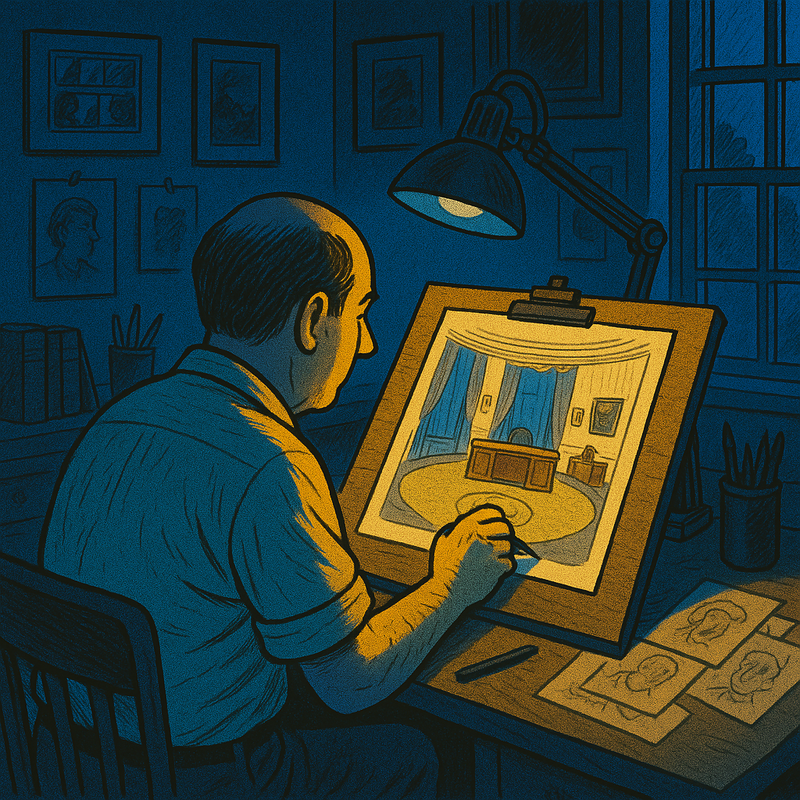
Mort’s drawing table lived in the crook of the city desk like a piano in a church. He squared a sheet of Bristol board under a T-square until the edges lined up as if they might matter to fate. He set out tools like a surgeon—non-repro blue pencils, a crow-quill nib that would sing if you treated it right, an Ames lettering guide, a bottle of Higgins ink that would spill the day you forgot to respect it. A square of Zip-A-Tone leaned nearby like a spare shirt.
He thumbnailed the panel small, as if the idea might get spooked if it saw its own size too soon. Oval. Desk. Rug. She in the chair, but not swallowed by it. The date box in the corner, a perfect, fussy little rectangle: JAN. 20, 1967. He wrote it lightly in blue, then penciled the placard on the desk: SENATOR? He drew a single firm line through it and lettered, in the quick block caps that came from high school yearbook deadlines, WHY NOT PRESIDENT?
A copy boy named Ernesto drifted past, stopped, drifted back. “Is that… the Oval?”
“Looks round in person,” Mort said.
Ernesto grinned, the grin of a sixteen-year-old who didn’t think he’d ever be let into any room that round. “She gonna be mad?”
“Who, Dot?” Mort said.
“The lady.”
“Look close, kid,” Mort said, softening. “If I do my job, she laughs first.”
Ernesto leaned in. Mort, without making a thing of it, adjusted the blue pencil so the boy could see the faint ghost of the rug’s pattern. Ernesto’s grin widened, then he ran to deliver proofs with ink smudges like rosary beads on his fingertips.
At ten-fifteen, Dot swung by with a style sheet. “Oval Office—caps?”
Mort considered the invisible copy desk ghosts who would live in heaven arguing about such things. “Caps. Proper noun. Seat of mischief.”
She penciled a tick on her sheet. “And the date?”
“Inauguration Day, nineteen sixty-seven,” he said. “You’ll get letters.”
“I always get letters,” Dot said. “I’d like a couple that aren’t about commas.”
He switched to ink when the lines were ready to admit permanence. The crow-quill nib scritched on the Bristol like a cricket with opinions. The line of the desk found itself. The curtain took a suggestion of light from a window he didn’t need to draw. He filled the shadow under the lip of the desktop with crosshatch and patience until it felt like you could slip your hand in and lose a pen.
He saved her face for last. He always did. He gave Phoebe the right weight in the chair—present, not perched. He lifted one eyelid a breath more than the other, enough to make mischief a possibility but not a pose. And the mouth—he let it be a half-smile, the kind a person uses when they know the punchline but don’t want to step on your timing. He signed MF small in the lower right and double-tapped the corner with his knuckle, twice for luck.
Berman appeared with two quotes and a look that said the councilman had indeed found a metaphor to die for. “Let me see.”
Mort turned the board.
Berman stared, then let out a low whistle. “She’s going to win this town three times before lunch.”
“Or one good laugh,” Mort said.
Val from advertising returned, hovering, measuring inches with his eyes. “Three and a half deep?”
“Four,” Mort said, for the sport of it.
“Three and a quarter,” Val replied, surprised to find himself enjoying the game.
Dot came back with a blue pencil and drew a neat box where the panel would live on the mock-up. “Three and a half. That’s my final offer. Anyone argues, I make them listen to the water board tape.”
Everyone flinched. The penalty fit the crime.
At eleven-thirty, Mort walked the finished art downstairs to the engraving room, where the air smelled like a mechanic’s daydream—solvents and heat and the metallic sigh of plates accepting their fate. Sal the pressroom foreman stood with a rag in his pocket and a position on everything.
“Faber,” Sal said. “You got my plate?”
Mort held it up like an offering. “Be nice to her.”
“I’m nice to paper,” Sal said. “People can fend for themselves.”
They checked the line weights under the loupe. Sal watched the way the ink sat in the curves of the letters. “You do that thing with the mouth again.”
“What thing?”
“Where you let people decide which way it’s going to turn,” Sal said. “Up into a smile, down into trouble.”
“The mouth’s the whole panel,” Mort admitted. “The rest is furniture.”
Sal grunted, which meant he agreed. “We’re running the A section at five. You want to see the first pull?”
“Always,” Mort said.
He went back upstairs into the high, tinny clatter of the teletype, the click of Olympia SG-1s, the phone-cord curls that stretched across desks like jungle vines. Dot argued with a publisher behind a glass door and won by not raising her voice. Berman explained metaphors to a secretary. Ernesto delivered copy, fast as youth.
At noon, the city changed gears. Heat came off the pavement like a rumor. The newsroom lunches were eaten at desks—egg salad, a mystery noodle under a layer of cling wrap—while the phones kept their own lunch hour. Mort ate a sandwich that had given up on itself and drew a second panel that would never run, just to keep his hands from thinking too hard about the first.
At one-fifteen, the first banana peel hit—the polite call from a donor who loved Phoebe and didn’t trust newspapers, and whom Dot loved in return because he made excellent copy. “We’re not crowning her,” she said into the receiver, voice low and patient. “We’re laughing with her. That’s what she taught us to do.”
At two, the publisher wandered out and performed the ritual of pretending to examine paste-up while actually checking how much of page one was gotcha. Dot showed him the mock-up like a realtor showing a house to a man who would live there no matter what. He harrumphed on schedule. “Do we have to name the office?”
“It has a name,” Dot said. “We’re working journalists.”
At three, the water board droned in a fluorescent room across town and a reporter took notes that would read like a troubadour’s lament if printed without mercy. At four, Berman’s councilman tried a new metaphor and failed again, which meant the old metaphor would run.
At four-thirty, Mort hovered near the pressroom until Sal shouted, “You can come in, you know. We’re not the Vatican.”
He stepped onto the concrete floor into heat that felt like a kiln thinking about lunch. The big presses slept with their eyes open. The plate of his cartoon, fresh and inexplicable, hung in a rack waiting for marriage. Sal and a younger man with a crew cut and a sunburn handled it like a horseshoe rumored to be lucky.
“Watch this,” Sal said.
They locked plates, checked tension, and then—a lever, a nod, a choreographed shrug—and the presses woke. The first sheets galloped through the rollers and came out sulking and perfect, ink still soft enough to be smudged by a breath. A pressman caught the first copy like a doctor catching a baby. He looked down at the panel, at the date in the corner, and let a grin break across his face like a cracked egg.
Mort took one, then another, checking the tooth of the paper under the ink, the way the shadow under the desk read at speed, the fragile pitch of Phoebe’s mouth. He signed the corner of the second pull with a pen that didn’t deserve to be in that room, and he kept it, because there were days you had to be sentimental to remember you weren’t dead.
By five-thirty, the trucks were being loaded with bundles that made the air smell like ink and hot motor oil and the end of a good day. Ernesto, who had borrowed his uncle’s car and a sense of purpose, grabbed a stack for the rack at the El Cortez. Mort watched him go, then went upstairs one more time.
Dot was at her desk, writing a headline she would later forget and a margin note she never would. She looked up at Mort and said nothing, which in Dot meant: you did your job.
“Drink later?” he asked.
“Go on without me,” she said. “Someone needs to defend metaphors.”
The bar on Ogden that Mort preferred had a barman who liked to be called by his first name, which was also his last, and a fan mounted too high to actually cool anyone. The ice well dumped every twenty minutes with a sound like applause.
Mort sat at the end of the bar where the light was yellow and forgiving and drew on a cocktail napkin for a club comic who’d tip in bad jokes but good whiskey. He let the hum of the room tune him—dealers on a break, a showgirl in a robe that looked like a different job, two union men arguing softly about whether a joke can be patriotic.
It got late the way desert evenings do, without announcing it. The neon outside gave the room its false moonlight. The barman wiped a path down the bar as if clearing a runway. “You want another?” he said.
Mort looked at his glass. He was at the border between enough and more. “One for the road that doesn’t exist.”
The door opened and let in a rectangle of night. Conversations didn’t stop; they bent. You feel a certain kind of entrance—the kind that rearranges the air before you identify the person.
She walked in holding a bottle by the neck with the casual authority of someone who’d carried stranger burdens. Phoebe Whitford wore a dress that didn’t apologize and a grin that had never learned to. The bottle had a paper bow tied around it like a joke about gifts.
She slid onto the stool next to Mort, set the bourbon on the bar, and said, “Mr. Faber, you owe me fifty cents.”
He blinked. “For what?”
“The increase in my rent,” she said. “Pennsylvania Avenue isn’t cheap.”
The barman did a double take the way civilians do when a name in a headline grows a body. Phoebe tipped her chin at him. “Two glasses, please. Neat. We’ve both got enough rocks ahead.”
Mort laughed, because the room required it. “Madam President,” he said, laying it on for his own amusement.
“Don’t you start rumors,” she said, eyes bright. “My mother will make scrapbooks.”
The barman poured the bourbon. They held their glasses like a pair of people about to pretend the next part isn’t serious.
“I liked it,” Phoebe said, before he could ask. “Your… overshooting.”
“I did it because you make jokes easy,” Mort said. “And because the city thinks with its shoulders. They relax when they laugh.”
“I heard there were complaints,” she said, pleased.
“There are always complaints,” he said. “They pay for the ink.”
She turned the glass in her hand, watching the bourbon catch the light. “You gave me a mouth I recognize.”
“I try not to put words there,” he said. “Other people fill bubbles.”
“Then here’s one,” she said, leaning closer, lowering her voice as if the punchline might escape otherwise. “If I’m going to be misquoted, let it be upwards.”
He grinned. “I’ll steal that.”
“You already did,” she said, tapping the bar with one fingernail in a rhythm that sounded like a press starting up. “Keep doing it.”
He glanced toward the bottle. “To more overshooting?”
“To working desks,” she said. “Not crowns.”
They drank. The bourbon had opinions. The bar settled around them, approving. Somewhere behind Mort, a showgirl laughed at a joke only she and the bartender heard. Outside, neon blinked code to the night. Inside, the two of them let their silence be full and friendly.
“You ever sit for me,” he said, “I’ll draw you cheekbones that could cut marble.”
She smiled, letting the corner of her mouth choose up. “You’ve got nine years to practice,” she said, standing, the bottle in one hand, the night in the other.
She slid a card across the bar—just a number, no title—and nodded at the barman, who nodded back as if he’d just joined a conspiracy. At the door, Phoebe turned and lifted the bottle in a miniature toast that made the bar feel like a room inside a room.
“Thank you for the laugh,” she said.
“Thank you for making it easy,” Mort said.
She was gone, the door taking the shape of her with it. The barman drifted over, wiped a clean circle on the wood where the bottle had sat. “You know her?”
“Not yet,” Mort said, folding the cocktail napkin and tucking it into his pocket like a telegram he’d decided to keep. “But the city does.”
They closed the bar on time, because there were still rules in 1966. Mort stepped out to the sidewalk into desert heat that lingered like a forgotten conversation. He held under his arm the second pull from the press—ink still faint in the nose, paper still eager to warp. He thought of the mouth he’d drawn and the one he’d heard.
On Ogden, the city exhaled. Somewhere, a pressman washed his hands. In the newsroom, Dot turned off her desk lamp and left the pencils in a cup like a bouquet. In a campaign office lit by one bad fluorescent tube, a volunteer taped the cartoon to a corkboard between a precinct map and a list of phone numbers.
Mort walked home slow, his shadow falling ahead of him in a strip of spilled neon. When he reached his building, he paused on the steps, looked down at the paper again, and tapped the lower right corner twice with his knuckle.
For luck. For the laugh. For the long day that had drawn its own straight line.
# The Afterlife of a Panel (’67–’74)
## 1) Union Hall, 1967 — Pinned above the Coffee Urn
The cartoon lived first where steam and talk met: thumb-tacked above a metal coffee urn the size of a small drum in Local 412’s hall. The plaque under it read PLEASE RETURN MUGS; nobody did.
Gus Ramírez, shop steward with a welder’s forearms and a lapel pin that said SAFETY IS A LOVE LANGUAGE, poured coffee into a chipped mug and studied the panel while the line behind him muttered about shifts.
“Still think she’s aiming too high?” asked Lurleen, hairnet peeking from under her cap, punching two sugars like a drummer.
“Aiming’s free,” Gus said. He traced the date with a finger—JAN. 20, 1967—and left a print where a coffee ring had already made its claim. “I like that the mouth isn’t bragging.”
“Looks like she’s about to tell a joke,” Lurleen said.
Gus sipped and nodded toward the urn. “I’d vote for anyone who can make this taste better.”
A kid from the night class, Manuel—Manny to everyone but the registrar—hovered with a Styrofoam cup and the way of someone new to rooms like this. “You folks really think—”
“We think the town likes itself better when it laughs,” Lurleen said, ripping the sugar packet straight across. “Best campaign promise there is.”
Over the day the panel caught splashes, steam, and two thumbtack holes that enlarged with time. When the coffee was empty, someone would yank the plug, tap the urn twice to make sure it heard them, and look up to read the caption like a superstition. WHY NOT PRESIDENT? grew bolder by accident, a heavy black where fingers pointed as stories turned into arguments and then back into stories again.
## 2) Eloise’s Beauty, 1968 — Taped to the Mirror
Eloise Paget ran a shop with five chairs and four dryers that made conversation pause and resume like a radio with a loose wire. She had taped the cartoon to the bevel of Mirror Two, right where ladies could catch Phoebe’s half-smile over their own.
“No, leave it there,” Mrs. Bouchard said, lifting the edge of the panel and letting it snap back. Her hair was in rollers, a little crown of tin drums. “I like seeing her behind me while you do… whatever Vesuvius you’re planning.”
“It’s a pageboy,” Eloise said, securing a roller with a pin. “For a page who has seen some things.”
Under the dryers, the hooded murmurs became a hum. Madge, who read lips better than people admitted, looked from the panel to Mrs. Bouchard. “She’s not smirking,” Madge said. “She’s thinking.”
“Of what?” Mrs. Bouchard asked.
“Of how to pay the sax player’s doctor bill and still keep the lights on,” Eloise said, because she was the sort who remembered who had done what for whom. She misted a curtain of hair that smelled faintly of apples. “Heads up.”
They watched their reflections and the reflection of the reflection where Phoebe sat at the big desk like it belonged to the town. When the radio brought news too sharp for weekday mornings—sirens in faraway cities, names that felt like newspapers turning black—Eloise would catch the panel in the mirror and let her own mouth set in that same half-smile: a promise not to flinch so hard you break.
A girl named Trina who swept up for tips stood under the panel at closing, mimicked the half-smile, then practiced winks with both eyes. “One day I’m gonna get my picture in the paper.”
“You better,” Eloise said, pulling the tape up to re-stick the curling corner. “And when you do, you better look like you knew it was coming.”
## 3) Sahara Diner, 1969 — Laminated Under Glass
Marta and Julio ran a diner that was open when neon yawned and closed when the sun had already made the kitchen too honest. The cartoon sat under the glass at Table Three, laminated with a heat-sealed edge that made the corners bulge like a pressed flower no one could crush.
A traveling salesman in an off-the-rack suit used sugar packets to mark out states along the edge of the Oval. “Utah. Arizona. California. We’re right—” He nudged a blue sweetener into Nevada and knocked over New Mexico by accident. “We’re right.”
“Take Nevada and leave the rest,” Marta said, topping his coffee. “We got everything we need.”
Two night shift nurses split a plate of eggs and circled things on a want-ad with a butter knife. One of them, Bea, tapped the placard on the desk in the cartoon—SENATOR? crossed out, WHY NOT PRESIDENT?—and said, “My mother calls that chutzpah.”
“Your mother’s from Pahrump,” the other nurse said.
Bea shrugged. “She can still have words.”
Kids loved to press their hands flat on the glass and feel the cold of a picture that had made itself permanent. On Sunday mornings, after church, the Rodriguez twins would race to Table Three to slide their thumbs along the date box until Marta’s voice stopped them midway. “I laminated it for a reason,” she’d say, then slide them a plate of pancakes shaped like states.
Pressman Sal, on his day off, came in and ordered the blue plate out of superstition. He ate with the slow, careful chew of a man who’d spent the week listening to machines. He slid his mug across a ring that had almost—almost—hit the date box, and he smiled like someone who knows how close everything always is.
“Looks blue to me,” Julio said, wiping the laminate with a bar rag.
“It is,” Sal said. “Even in black and white.”
## 4) Rancho High, 1970 — Folded into a Lesson
Mrs. Charlene Huang kept her lesson plans in a binder that smelled of chalk and paper warmth. The cartoon lived inside a plastic sleeve, folded once, the crease like a hinge between years.
“Today,” she told her tenth graders, “we talk about inauguration. Not the eagle, not the hat—what it means to walk into a room and have it become yours without you forgetting who else it belongs to.”
She held up the panel. A murmur went around the room—some knew it from their barbers, their grandmothers’ fridges, the diner their uncles closed down. Manny—no longer a night-class kid but a lanky sophomore with ink under his fingernails from a part-time job at the Sentinel—sat forward.
“What’s with the date?” asked a girl named Tina R., who had once written a letter to the editor about ice cream and lived to be teased for it. “Is it a prediction?”
“It’s a joke,” Mrs. Huang said, “and a prayer, and a dare.” She let the class sit in the quiet after the line, the way she’d learned to let musical rests teach themselves.
“Why does it work?” she asked.
“Because it says we already knew,” Manny answered, louder than he meant to.
“Because the mouth,” Tina said, surprising herself, “isn’t mean.”
Mrs. Huang nodded. “Civics is a room. The joke is the door you prop open.”
She passed the panel hand to hand. Manny lingered. He traced the crosshatch under the desk like a map. “This is…” He searched for a word teenagers fight and rarely win. “Tender.”
“Good,” Mrs. Huang said, delighted. “You thought the word and then earned it.”
When the bell rang, she slid the cartoon back into the sleeve, folded the page on its crease, and placed it under that day’s plan. Through the plastic, the date still read like a percussion mark. JAN. 20, 1967. She tapped it twice with the tip of her pencil for luck and for habit she wouldn’t admit in faculty meetings.
## 5) Break Room, 1972 — Thumbtack, Schedule, Laugh
Behind the glittering insistence of a casino floor was a room styled in pure municipal: beige paint, a soda machine that coughed, a corkboard holding a schedule typed by a person who liked order. The cartoon was thumb-tacked at an angle next to a sign that read WASH YOUR HANDS, PLEASE, NOT JUST IN YOUR DREAMS.
A showgirl named Nikki, feet bare, sat with a sandwich in her lap and a line of rhinestones still marching along her collarbone. She glanced from a note about costume fittings to the panel.
“Why’s she looking at me like that?” asked Donnie, a blackjack dealer with hands like news anchors—calm even when the world burned.
“Because she knows you’ll be back five minutes early,” Nikki said, taking a bite and talking around the bread. “And because your manager is allergic to joy.”
He smirked. “He breaks out in policies.”
A porter named Earl, who read the paper cover to cover and the classifieds twice, tapped the cartoon with a forefinger that had learned its manners on pianos. “It’s a nice thing when a town decides it’s allowed to be in on a secret.”
“What’s the secret?” Nikki asked.
“That we take ourselves less seriously than people think,” Earl said. “And more seriously than they want.”
The soda machine coughed itself into readiness. Donnie bought a cola and used the cold can to smooth the curling corner of the cartoon back against the cork.
“You know this is older than me,” Nikki said.
“Then you’re in luck,” Earl said. “It’s already held.”
## 6) Waiting Room, 1973 — Under Fluorescents
Desert County Health Clinic, nine plastic chairs, magazines from last summer, a poster of a smiling tooth with a name tag. The panel was taped to the bulletin board under a flyer for night school and above a card with pull-off tabs for piano lessons.
A woman named Bernice, eight months along and breathing like a metronome, read it for the third time while her husband, Tom, filled out a form shaped like an accusation. “It’s that same mouth,” she said.
“What same mouth?” he asked without looking up.
“The one you make when you know a story that’s going to land,” she said. “The one you made when you proposed.”
Tom glanced up, then down, then up. “I botched that.”
“You landed it,” she said. “That’s the job.”
A boy in a cast—skateboard, curb, gravity—asked the receptionist, “Is she the president?”
“Not here,” the receptionist said. “Here I am.”
He nodded like that made as much sense as anything. The fluorescent lights hummed. A nurse called a name. Bernice stood, smoothed the tape on the cartoon with two fingers—habit, gratitude—and went to be measured, timed, reassured.
## 7) The Clip File, 1974 — The Morgue Breathes
In the Sentinel’s morgue, where paper slept until remembered, the clip file jacket labeled WHITFORD, PHOEBE — CARTOONS had been opened so many times the manila had the soft edges of a favorite tool. Ernesto—no longer a copy boy, now a layout man who wore his tape dispenser like a ring—flipped to the laminated tearsheet from ’66 and smiled at the coffee ring’s near-miss.
He slid the panel into a layout brainstorm for a retrospective that might or might not happen. “Re-run it?” a young features editor asked, hungry for a fight she hadn’t earned yet.
Ernesto shook his head, remembering Dot’s memo from ’70—We’re not a PAC. “Write another,” he said. “Draw another. Let the old one be alive out there.”
“Out where?” she asked.
“Everywhere,” he said, and he meant the hall above the coffee urn, Mirror Two, Table Three, the folded sleeve in a binder, the break room where rhinestones slept, the clinic bulletin board where tape learned humility. He meant places that made papers into talismans without asking permission.
He put the panel back in the jacket and slid the jacket onto the shelf. The room breathed the way rooms do when no one asks them to.
## 8) Night Bus, 1974 — One More Copy
On the night bus, a driver named Clive kept a clean dashboard and a radio low. A construction worker slumped two seats from the front, a dancer dozed behind him; between them, in the rack above the windshield, a clipping of the cartoon was tucked under the route card.
“Mind if I ask?” said a kid with a sax case and the courage it takes to ride past your stop to keep listening.
Clive glanced at the mirror. “Ask.”
“Why that picture?”
Clive smiled, the tired one good men carry home. “Because sometimes people get on mean and sometimes they get on tired, and that mouth reminds me where to set mine.”
The kid looked back up at the half-smile in the panel, at the date that kept insisting on itself, at the placard that crossed out and wrote forward. He nodded like he was learning a chart.
They crested a small rise where the city’s lights threw a soft, ridiculous necklace over honest dark. The bus’s engine hummed its old, hopeful hum. In the rack, the clipping made the smallest sound paper makes when a breeze catches it—like a flag deciding to participate.
---
In those years, the panel never sat in a frame where the point is to make you whisper. It lived in places with fingerprints. It collected tape, rings, tack holes, and the kind of stains that prove proximity—coffee, hair spray, a baby’s breath, machine oil. People reread it the way you touch your pocket for keys: to be sure the thing you need to leave the house with is still where you put it.
When other headlines came and went—loud, justified, devouring—this one little rectangle kept offering the same small provocation: Why not? It made itself a practice. A town’s habit of setting its mouth just so, before telling the next story.
The newsroom in June of ’75 had the same bones and a different pulse. The hot-metal tang was softened now by the clean, faint-ozone breath of the photostat, the clatter of the teletype chewing on wire copy without pity, and the steady hum of a Mergenthaler that spat out slugs like quiet decisions. The coffee was still bad. The phones still rang in clumps. The place still smelled like deadlines and dust.
At 10:11 a.m., the AP machine threw a stutter into the room’s rhythm, then a bell. Then another. Dot Reiser—hair more silver than not, cardigan elbows shinier, a pencil still living behind her ear like a tuning fork—rose from her chair and read, because that’s how you usher big news into a room.
“President Beale to resign due to illness,” she said, voice level, deliberate. “Vice President Whitford to assume office.”
For half a second, the noise stopped—like a train passing through a tunnel and surprising itself. Then everything resumed at a higher key.
“Mort!” Dot called, not loud, just exact. “Where’s Mort?”
He was at his table under the pinboard, a pair of reading glasses parked halfway down his nose and a Rapidograph uncapped in his hand. The old Bristol board was out—yellowed clipping, plastic sleeve—January 20, 1967 glowing faintly in its corner like a long-held breath. He’d set it beside a fresh board that waited with the patience of paper.
He didn’t stand when Dot reached him. He just smiled a little and tapped the old date box with his knuckle, twice, a ritual that had survived presidents and pay cuts. “We called the shot,” he said.
“We recognized it,” Dot said. “Different sin.”
She glanced at the room: Berman already rewriting a paragraph that had lived in his typewriter for three years; Ernesto—no longer a copy boy, now a layout man with an X-Acto in a holster—rolling wax over galleys like a priest with oil. Val from advertising hovered at the door, pulled in by gravity and the scent of inches.
“Tell me you’re drawing,” Dot said.
Mort reached for a blue pencil, the non-repro kind that let ideas be ghosts until they were ready to be stubborn. “Same desk,” he said, sketching the big curve of the Oval like you remember the shape of a friend’s laughter. “Same rug you swear is blue even when it’s not. Same posture—grounded. But…”
“But?”
He lifted one eyelid a hair higher than the other. “A wink,” he said. “We earned it.”
Dot’s mouth did a thing that wasn’t a smile and wasn’t not. “Speech bubble?”
“Tempted.”
“Do it,” Dot said, surprising them both. “Three letters, apostrophe, two more. No punctuation. It walks in without knocking.”
He penciled the bubble, clean and shameless. Inside, in that block cap hand Vegas could recognize from across a diner, he wrote: Told ya.
Val slipped closer, sniffing trouble and revenue. “Are we gloating or merely clairvoyant?”
“We’re quoting,” Dot said without looking up.
The publisher wandered out of his glass room like a man checking the weather. He peered over Dot’s shoulder. “This is—chutzpah,” he said, trying on a loanword. “Are we sure we want a talk bubble in the Oval?”
“Very sure,” Dot said. “We ran a date in ’66. Today we get to finish the sentence.”
“Finish or start?” Mort murmured, already inking the desk’s eagle knees, the crosshatch under the lip, the window light implied rather than drawn. He switched to the crow-quill for the face—older now, the lines a shade firmer, the cheekbones a touch higher, the mouth shaped as if it knew where to go and would get there without your help. The wink he set lightly, just enough to suggest the town’s long joke had landed.
The publisher cleared his throat. “We don’t… crown.”
“We never did,” Dot said. “We listen. And sometimes we laugh.”
He harrumphed, which was his way of losing gracefully. “How big?”
“Lower left of A1,” Dot said. “Three and a half deep, one column. Preserve the bubble. Keep the date box.”
“Cheekbones print?” the publisher asked dryly.
Mort didn’t look up. “I’ll give Sal a note.”
By noon, the paste-up table was a battlefield of wax, line tape, and galleys that curled at the edges like dogs settling for a nap. Ernesto floated the hole for the panel on the mock-up. He tweezed a hair of kerning between PRESIDENT and the question mark in the old placard, then laughed at himself for kerning a memory.
The teletype burped updates: resignation time; oath schedule; the phrase “orderly transition” repeated like a refrain that knew it was being whistled past a graveyard. Berman juggled verbs. Dot ran interference with two donors and a Congressman who could smell attention at three hundred miles. Val wrote an ad man’s email with his face and then tore it up, because even Val could tell what day it was.
At 1:43 p.m., Mort walked the Bristol board to the photostat room, where the air had that faint, clean bite and the tech on duty wore a grin that said: make it a good one. The PMT camera took the art, flattened it to something the plate would understand. Mort scrawled in the margin of the stat: +5% on cheekbones (artist’s request).
He carried the stat downstairs to the pressroom, where the old hot line had given way to offset plates and a sound that started low and grew like thunder on schedule. Sal—older, broader, whiter at the temples—had a rag in his pocket and ink at the cuticles that would never come out. He held the stat like it might kick.
“You put words in the room,” Sal said, eyeing the bubble.
“Only ones that were already floating there,” Mort replied.
Sal let a smile escape. He slid the stat to the engraver, who shot a plate and brought it back warm and faintly soft at the edges, a thing newly made and already assigned a job. The crew—a kid named Roscoe, a woman everyone called Red because she wasn’t—gathered around. Someone whistled. Red tapped the plate twice with two fingers. “For luck,” she said.
“Like a horseshoe,” Roscoe added, because he liked metaphors when they came with pictures.
“Handle it like one,” Sal said. “Don’t drop my fortune.”
They carried the plate to the tower like pallbearers at the happiest funeral. They nested it into the cylinder, checked the blanket, tightened the bolts until the wrench gave that little stubborn-correct sound. The ink keys came up. The water fell. The press woke.
It started as a purr underfoot, then a rumble, then the big-cat roar that made the walls remember they were useful. Registration marks kissed and aligned. Color wasn’t color here; it was density, it was black that decided how black to be. The first sheets rode the web with the swagger of things that believed in their purpose.
Sal caught the first pull and handed it to Mort like passing a newborn. Mort looked for the thing only he would check—the mouth and its intention, the wink and its mercy, the bubble and its weight. Told ya rode clean on the paper, not shouting, just certain.
He took a second copy and signed the corner small out of habit, then put the pen away because signatures weren’t the point. Sal checked the density with a loupe and a prayer. Red looked up at the panel, touched the plate again as if you can never have too much luck once you’ve got any at all.
“Run it,” Sal said, and the press obliged—sheets flying, fold units snapping, stacks rising. The smell in the room—ink and oil and heat—was the same smell that had hung under the rafters in ’66, altered by machinery, not meaning.
Upstairs, Dot went three rounds with the publisher in his glass box. She didn’t raise her voice. She didn’t move from her chair. She let him make the argument that the paper ought not to be seen as delighted. “We’re not delighted,” she said finally. “We’re precise. And we remember.”
“It reads as a victory lap,” he said.
“It reads as a city that kept a joke alive for nine years and gets to laugh at its own good taste for once,” she said, and then, because she liked to win with geometry rather than volume, she slid him the old tearsheet across the desk. “We put the date in print. We own the callback.”
He folded. He always did, in the end, when she’d already moved the furniture and left him the illusion of rearranging the chairs. He waved her away with a small blessing. “Make sure we spell ‘Beale’ right.”
At four, bundles started coming up on dollies. Ernesto slit one open and pulled a paper free, still warm, still eager to warp if your hands were careless. He walked it to Dot. She looked at the panel first—always the panel, because it held the day at a glance—and let out the smallest breath, the kind you take when something you hoped would land actually does.
“Send the second pull to Mort,” she said. “Send the third to the morgue. Send a clean to the wire room—Western Union will want to play courier today.”
“Who gets the first?” Ernesto asked.
Dot gave him an are-you-new look that he enjoyed as often as possible. “The pressroom,” she said. “They caught it.”
Mort hovered, pretending he wasn’t. Dot handed him the second pull. He didn’t talk. He looked. He tapped the lower right corner twice with his knuckle and folded the page as carefully as if it were a letter.
The rest of the afternoon moved on tracks. Berman filed. Val tried to sell an adjacent half-page to a furniture store and succeeded because even furniture stores like to be near a good line. The teletype clattered updates on oath timing; someone shouted for a fresh ribbon and someone else shouted back that they were already in the drawer.
At six, the trucks shouldered their way into the heat that rises at dusk like an encore. At seven, a showgirl in a robe pinned the new cartoon over the old in the casino break room and made the same joke about being watched by people with better posture. At eight, a union hall taped it above the coffee urn, the steam curling the bubble until it looked like breath. At nine, the diner slid it under glass at Table Three where it found its older sibling and sat beside it like a family photo.
Mort didn’t go to Walt’s on Ogden. He stayed at his table under the pinboard as the newsroom thinned and the city found sit-comfort in the new shape of the day. He was cleaning a nib he didn’t need to clean when Dot’s phone rang, paused, rang again. She picked up, listened, then turned and put the receiver in her palm like a next step.
“For you,” she said. “Try not to say anything you can’t redraw.”
He took the phone. The line had that tiny ocean in it Washington always carried, even when it wasn’t far. “Mort Faber,” he said, as if he were answering a door.
“You’ve got nerve,” she said, and he could hear the smile, that same measured delight he’d inked and re-inked for nearly a decade.
“Madam President,” he said, and this time the joke had retired, living off its pension somewhere warm.
“I keep cheekbones like those and you give me a wink,” Phoebe said. “You’ll spoil me.”
“Room’s earned a little mischief,” he said. “City too.”
“I saw both,” she said. “Room and city. The old one and the new one were on my desk when I sat down.”
“Did they print,” he asked, the professional’s reflex refusing to die, “clean?”
“They printed like a city saying hello to itself,” she said, and he had to put his hand over the part of his chest that sometimes made its own decisions. “Save me the original board if the publisher doesn’t clutch at it. I want to hang it where a kid can get a fingerprint on it.”
“You’ll have a museum for this,” he said.
“I’ve got a youth center,” she said softly. “That’ll do.”
He swallowed. “You know we ran the date. In ’66.”
“I know,” she said. “I kept it. In a drawer. I’m putting this one there, too, until I figure out where to let it breathe. There’s a note on the old one.”
He didn’t have to ask what it said, but he liked hearing her say it.
“Keep them laughing,” she said. “That’s your beat, Mort.”
“It’s the only one I know,” he said.
“Tell Dot the bubble was the right call,” she added, conspiratorial. “There’s going to be a memo about tone. Let them write it. We’ll write what matters.”
He wanted to make a joke, and for once he didn’t. “Thank you for the call.”
“Thank you for the line,” she said. “We all heard it before we said it.”
The line clicked—another aide, another hour, another paragraph—and then went quiet. He held the receiver a second longer, listening to the way silence in a wire isn’t quite silence.
“Good?” Dot asked, already knowing.
“She told me to keep doing my job,” he said.
“She always did,” Dot replied. “Now go home before you start drawing another victory lap.”
He walked past the photostat room—dark now, the smell of clean light lingering; past Ernesto, who was cutting out a headline with the reverence of a man slicing cake; past Val’s empty desk, where a half-written pitch to a mattress store curled like a tired cat. In the pressroom, Sal and Red were wiping ink from their hands and laughing about the plate—how Roscoe had made the new kid tap it for luck and the new kid had done it like a prayer he hadn’t learned the words to yet.
Downtown, in a building with more rooms than a life needs, a new President opened the top drawer of a desk that had been drawn into existence in a hundred thousand minds. Inside lay the old clipping—JAN. 20, 1967 in the corner, coffee ring like a halo—and the fresh sheet, the wink, the bubble that refused to brag. She took a pen she liked because the cap clicked, and on the torn edge of an envelope she wrote again, as practice and promise: Keep them laughing.
She set the envelope atop the two cartoons, rested her palm on the stack for the length of a breath, then closed the drawer—not to hide the paper, but to keep it near. Outside, the city she loved most laughed in a hundred small places at once. Inside, the room learned her shape. The line on the page kept doing what good lines do: carrying more than they had any right to, without smudging.
The Whitford Presidential Museum had the hush of a room that knew how to keep a secret and the gleam of one that had polished itself to hear it better. In the east gallery, the summer exhibit hung like a row of windows: The Lines That Laughed — Mort Faber & a City. Bristol boards floated in shadow boxes; ephemera kept the kind of company that never meets except in museums—bar receipts, pink while-you-were-out slips, a plate tag with grease pencil still winking in the corner.
A school group flowed in with the low-weather sound of sneakers and whispers, a chaperone counting silently on her fingers, a teacher in a navy cardigan making a little steering wheel of his hands to turn the tide away from the gift shop. The docent—lanyard, soft voice, eyes that could herd cats without being mean to cats—took a breath and began her practiced preamble about local papers and national rooms, about how ink had once been a city’s perfume.
The children didn’t need the sentences yet. They clocked the shapes. A big oval. A desk with eagle knees. A date that looked like a drumbeat in the corner. And the panel they had already seen on mugs in aunt kitchens and laminated under diner glass in the part of town where pancakes came shaped like states. The one with the bubble.
“Told ya.”
The bubble seemed to float off the Bristol under glass, not boasting, just continuing a conversation.
The teacher stood a little apart, reading the wall text like someone checking a note in his own handwriting. He glanced at the label beneath the ’66 panel and at the one beneath the ’75—dates, donors, a tiny line about Ernesto’s paste-up margin note—then up again as if to let his eyes recalibrate from words back to lines.
Beside him, a girl with barrettes the color of hard candy edged forward until her breath filmed the glass. She pressed one thumb on the bubble, then the other, two pale ovals blooming in the reflection right where the words rode: Told ya. The docent began to say, “Careful with the—” and stopped, because the gesture was not careless. It was the small ceremony of making contact with a thing that had already touched you.
Fingerprints were a daily battle here, but these two needed a second to be themselves.
Around them, the exhibit told its quiet jokes. A reproduction of the “Walt’s on Ogden” tab was pinned next to a cocktail napkin smudged with a circle that might have been a glass or someone tracing a desk. A blue-ink note under the first panel read, in tidy hand: Keep them laughing. The label didn’t diagram the handwriting; it didn’t have to. A facsimile of the pressroom plate tag sat near a looped soundscape that was mostly silence with a low animal purr far back in it—presses remembered, not reenacted. In another case, the A1 paste-up for the June ’75 edition made a clean rectangle where the cartoon had lived: 3.5 DEEP x 1 COL — PRESERVE BUBBLE in blue pencil, the words like stage directions for a joke that knew its blocking.
A little boy tugged his friend’s sleeve and pointed at the ’66 date box. “It’s like a birthday,” he said, and his friend nodded because dates are always like something when you’re nine.
From the far doorway, the gift shop’s light threw an accidental marquee over the floor. A placard leaned against a stack of programs: Community Night: Stories & Songs — Friday, 7 p.m. Someone had scrawled Guest: P. Whitford on a Post-it and stuck it to the sign at a friendly angle, as if the name refused to be more formal than the evening would be. In the case below, the ’75 “Told ya” board held its wink steadily, the bubble’s letters firm as a handshake.
The girl with the barrettes kept her thumbs where they were, then lifted them and looked at the fogged ovals left behind. Two pale moons evaporating. She rubbed her hands on her jeans like a short apology and glanced up at the teacher, who had caught the breath you take before a room asks you to be the adult.
She pointed—not at the desk, not at the date, but at the bubble itself, at the way the letters didn’t shout.
“Did she really?” the girl asked.
The docent shifted her weight but did not speak. The room made that small settling sound rooms make when they are about to hold still. Outside, the HVAC took a longer inhale. Somewhere down the hall, a piano under practiced hands found a major chord and let it hang.
The teacher looked at the bubble, at the girl, at the two thumbprints already fading from the glass. His mouth did a thing it had learned from a city that loved the straight line of a good joke and the bend in a kind one. He opened it—
—and the room kept the rest.