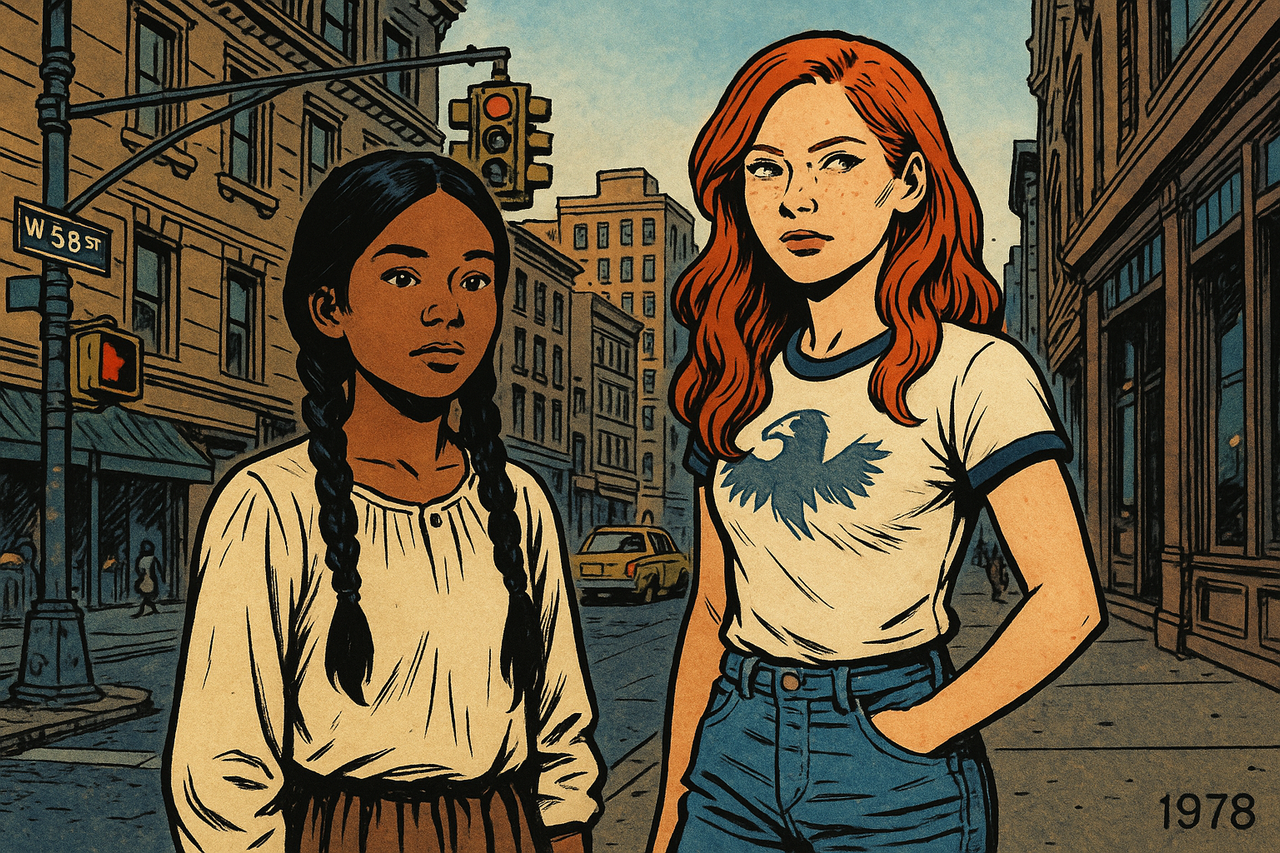
Work Text:
The summer was already electric—the kind of hot, humming season where everything felt like it was on the verge of happening. Glenda and Scarlett were sixteen, tan-kneed and wide-eyed, with cheap sunglasses pushed up into their hair and guitars slung across their backs like they were born wearing them. They’d been calling themselves The Magnetic Fields for about six months—a name borrowed from a paperback science book Glenda had half-read at the library and declared “too cool to waste on actual science.”
The band was just the two of them, really. Scarlett on drums—barefoot, tight-lipped, hitting with that unpredictable, jazz-born defiance—and Glenda on vocals and guitar, voice all ragged velvet and bite. They played punk stripped down to its rawest threads, half-chords and shouted harmonies, lyrics scribbled in margins of math homework. They practiced in a half-collapsed toolshed behind the old orchard near the edge of the commune, swatting gnats and drinking warm root beer between sets.
That July, the county announced its annual summer talent contest—a big event, held in the dusty community center in Española, with prizes donated by local businesses and a borrowed PA system that buzzed when you looked at it funny.
Glenda had never been interested in contests. But Scarlett, ever the quieter instigator, just shrugged and said, “We could use the prize money.” Her eyes had that flash that always meant something was forming behind them.
And so, The Magnetic Fields entered.
They were the only punk act—surrounded by square dance trios, gospel choirs, baton-twirling siblings, and one teenage magician who tried (and failed) to make a dove appear from his hat. They played second-to-last, barefoot and unapologetic, Scarlett hammering the beat out of a borrowed drum kit while Glenda howled their anthem “Flameproof Hearts” into the mic, hair flying, voice cracking gloriously on the high notes.
The crowd didn’t know what hit them.
Some of the older judges looked baffled. But the youth in the audience—other kids in denim jackets, shy girls clutching notebooks, long-haired boys who’d only ever heard punk on the radio—cheered like it was the Second Coming.
They won. Not first place, technically—that went to a baritone who sang “Ol’ Man River” in a rented tux. But they took second, and with it, a cash prize of \$150, handed to them in an envelope with a congratulatory coupon for a free pizza.
The lights didn’t go down. Not really. At CBGBs, they never did.
There was no grand curtain, no spotlight, no announcement. Just a sudden shift in the air, the flick of a wrist behind the soundboard, and the feeling—like static building along your spine—that something wild was about to happen.
And then:
“ONE, TWO, THREE, FOUR—!”
It exploded.
The first drumbeat of “Blitzkrieg Bop” hit the room like someone had dropped a lit firecracker in a shoebox. Dee Dee's count-off didn’t wait for anyone to catch up—it demanded. Johnny’s guitar followed like a buzzsaw through concrete, and then Joey’s voice—a nasal shout that stretched like elastic, slicing through the thick cigarette fog.
Hey! Ho! Let’s go!
It was the first song, and it felt like the last. That’s what it did. Punk didn’t ease you in. It threw you overboard with your boots still on and dared you to swim in spit, sweat, and feedback.
Scarlett’s heart leapt into her throat before her body even had a chance to react. It was like the sound had entered her through her ribs and detonated behind her eyes. She didn’t move—couldn’t yet. She stood in the middle of the swaying, bouncing, half-collapsing crowd, hands clenched to her thighs, watching, listening. Consuming.
Glenda, beside her, let out something between a laugh and a shriek, already screaming the chorus at the top of her lungs, though she couldn’t hear herself. It didn’t matter. Her voice disappeared into the sound and was better for it. She bounced on the balls of her feet, elbows in, boots stomping to the beat that never let up—not for a second. Her curls stuck to her cheeks, already damp with sweat, and her eyes were enormous. She looked—lit.
The crowd was moving like a single body. Not a mosh pit, not yet. Just a tangle of limbs, denim jackets, ripped shirts, safety pins and smeared eyeliner. Strangers slammed into each other with grins. Beer sloshed in plastic cups. Someone in a leather vest surfed the crowd for exactly four seconds before tumbling down with a laugh. No one stopped the music. No one slowed.
Scarlett finally started jumping. Not high—more like jolting in place. Her braids bounced with her, and the tips of her fingers drummed against her thighs. The sound had overwhelmed her thoughts. There was no thinking here, no reasoning. Just movement. She screamed the words without realizing. She didn’t know all of them, but it didn’t matter. Every mouth was open. Every voice said the same thing:
Hey! Ho! Let’s go!
The floor trembled. CBGBs had a floor that groaned when too many boots stomped at once. It was coated in God-knew-what—beer, blood, sweat, maybe tears—but it held. Somehow, it held.
Joey leaned into the mic stand like a half-melted scarecrow, hair like a curtain across his eyes, shoulders hunched, mouth wide. He didn’t perform the song so much as channel it. He was a lightning rod, bent and crackling, swaying to his own internal rhythm.
Dee Dee stomped across the tiny stage, face blank with pure focus. His bass was a blur, the downstrokes relentless.
Johnny barely moved. He never did. He stood solid, head down, slashing at his guitar like he was cutting a path through the jungle.
Tommy, hunched behind the kit, was the heartbeat. The heartbeat would not stop.
The song lasted what—two minutes? One-fifty, maybe. But inside it was a lifetime. A heat wave. A revolution.
For Glenda and Scarlett, it wasn’t just the first song of a concert. It was the end of their childhood in real time. It ripped the varnish off the world. No more wondering if music could change a person. It had. It just did.
By the last “Let’s go!” the crowd was near feral. Glenda was jumping so hard she nearly knocked over a guy in his twenties, who just laughed and bounced with her. Scarlett found herself clutching the back of a stranger’s jacket, steadying herself against the thrill of it all.
Then the guitars cut. The final beat slammed shut like a slammed door.
Silence? No.
Roars. Cheers. The crowd surged forward.
Scarlett gasped for breath. Glenda turned to her and shouted, voice hoarse already, “They’re BETTER than the records!”
Scarlett nodded fast, blinking. “That was the best thing ever.”
She meant it. Every word. No hesitation. No irony. No need for distance.
And as the band rolled right into the next track, the girls barely had time to breathe.
It didn’t matter. They were in. They were in it.
It was only track one. And their whole lives were already changed.
Absolutely. Here is Track 8—“Sheena Is a Punk Rocker”—told in very long, immersive third-person prose from the perspective of Scarlett and Glenda as they experience it live at CBGBs during that legendary 1978 Ramones concert. This moment captures not only the music but the pulse of a generation in miniature—through the eyes of two wide-eyed teenage girls in boots and borrowed leather, standing on sacred, sticky ground.
---
They were six songs deep into the set by the time the opening riff of “Sheena Is a Punk Rocker” hit.
The energy hadn’t dipped, hadn’t wavered, but now it shifted—shimmered—into something brighter. Something joyful.
It was like someone threw a switch in the crowd. Like neon hitting rain.
Glenda felt it first.
She didn’t know why this one grabbed her so fast, so hard—it wasn’t the fastest or the loudest. But the moment Johnny launched into those first jangly chords, strummed fast and clean like sugar buzz turned to rhythm, her heart practically jumped sideways in her chest. She grabbed Scarlett’s hand without thinking and screamed: “This one! THIS one!”
Scarlett didn’t need the warning. She already knew it. Sheena was the anthem. It was one of the few punk songs that even made it to the radio back in Texas—not often, not without someone getting fired afterward—but enough that both girls had taped it off a station once, twin fingers on the play/record buttons, holding their breath through static.
Now it was here. And it was real.
Joey leaned into the mic with a loose smile, hair hanging like vines, and crooned the opening with a kind of sleazy tenderness:
Well the kids are all hopped up and ready to go…
The contrast between the melody and the mayhem was electric.
Scarlett began to jump in place, not like she had in the others—but with rhythm now. She bounced on beat, arms flailing only a little, hair flying behind her. Glenda followed suit, pogoing up and down like a wind-up toy gone ecstatic.
“Sheena! Sheena!” they chanted, and they weren’t alone.
All around them, voices joined in. Half the crowd had that song tattooed on the inside of their skulls. For the first time that night, the chaos turned into something unified. Not less wild—just aimed. A shared joy, exploding in time.
Scarlett laughed in the middle of it. Actually laughed, not screamed or sang—just full, unrestrained joy. Her voice cracked on the high note of the chorus, but she didn’t care.
“Sheeenaa is a punk rockah!”
Glenda echoed, late but loud:
“Sheeenaa is a punk rockah!”
They clutched each other’s sleeves for balance. They nearly toppled over. One of them elbowed a biker in the gut and got a grinning thumbs-up in return.
The walls of CBGBs—painted-over grime layered with stickers and flyers—seemed to thrum in time with the snare. The stage lights weren’t lights at all, just old bulbs that cast everything in a fevered amber. But in that moment, Sheena glowed. She wasn’t a person. She was a frequency. A pulse.
Joey’s voice climbed up that sneering chorus again, higher and wilder, as he shouted into the mic like he was trying to lift someone out of their bedroom and into the world.
Scarlett wasn’t dancing anymore—she was vibrating. Glenda lost her footing for a second and fell into a stranger, who steadied her and shouted, “Hell yeah, baby punk!” into her ear.
Sheena didn’t just rock. She saved.
She was the girl who left disco behind. She was the girl who told the world, You can keep your gloss and your glitz—I want sweat, feedback, and my own name on the wall. She was every girl who didn't fit the mold, who didn’t want to be sweet and small, who found her rage and joy in the same place.
And to Glenda and Scarlett, standing elbow-to-elbow, boots scuffed, breath stolen, cheeks shining under a hundred degrees of punk light—Sheena was the future. Not something to idolize, but something to become.
By the final chorus, the crowd was chanting without breath:
“Sheeenaa is a punk rockah! Sheeenaa is a punk rockah! Sheeenaa is a punk rockah nowwwwwww!”
The drums snapped like a door slamming shut.
The guitar scraped out one final twang.
And then silence—only for half a second—before the crowd lost its collective mind.
Scarlett grabbed Glenda and shouted, “That’s us! We’re Sheena!”
Glenda, flushed, breathless, hugged her back. “Sheena ain’t ready for us!”
And they laughed like wolves in the firelight.
Joey didn’t say a word. He stepped back from the mic. Johnny counted off the next track, and the Ramones kept rolling.
But for those two girls—drenched in heat, ache, and revolution—“Sheena Is a Punk Rocker” was no longer a song.
It was a doorway they had just kicked open. And they would never go back.
Absolutely. Here is a very long, immersive third-person prose scene depicting Track 13 from the 1978 Ramones CBGB show: “Pinhead.” This song was already punk myth by then, but for Glenda and Scarlett, witnessing it live was transformative—equal parts ritual, riot, and liberation.
---
The air had gone thick by the time they reached the thirteenth song.
CBGBs was a steam pot—no windows, no fresh air, just the heat of a hundred bodies bouncing off graffiti-covered walls and cracked floorboards. The sound system wheezed and screamed with every power chord, but no one cared. Glenda and Scarlett didn’t even know they were sweating anymore. Their boots were wet from beer, their faces flushed, and they felt halfway melted into the crowd. Time had blurred. It could have been midnight or 4 a.m.—who cared?
Joey staggered toward the mic again, not saying a word. A small cardboard sign was passed from the back of the stage into his hands, almost ceremonially. He held it up over his head with both arms stretched long:
GABBA GABBA HEY
Scarlett screamed when she saw it. “IT’S THIS ONE!!” she shrieked, jabbing her finger at the sign like it was a holy relic.
Glenda nearly jumped out of her boots. Her hair, matted with sweat and beer foam, stuck to her cheeks, but she beamed like she’d just found treasure. “YES YES YESSSSS!”
Dee Dee stepped forward, nodding fast, already hitting his strings. Johnny’s guitar buzzed up from nothing to full blast like a broken lightbulb going nova. Tommy snapped the drumsticks in the air once—twice—and then—
DUN dun dun-dun-dun DUN...
It was “Pinhead.”
The floor went ballistic.
Not just chaotic, not just wild—ballistic. People surged forward like a collapsing wave, bodies slamming, pogoing, flailing with pure abandon. It wasn’t a pit—it was a ceremony. A tribal stomp under flickering red lights and dripping ceilings.
Glenda and Scarlett threw themselves into the chorus without hesitation:
“GABBA GABBA HEY! GABBA GABBA HEY!”
It didn’t matter that they weren’t in tune. It didn’t matter that their throats burned or that their arms were sore from so much movement. They were shouting it with everything they had, and the rest of the room was right there with them.
The chant rose and fell like a war cry. Everyone was in on it—punk veterans, Bowery locals, out-of-towners, runaways, zinesters, and two girls from Plano, Texas who had dreamed this night into existence for years.
Joey was more animated now, swinging the sign like a priest with a relic. He tilted it toward the crowd, nodded along with the beat, his voice almost swallowed by the wave of chanting fans. It didn’t matter if you could hear the verses—what mattered was the ritual. The incantation:
“Gabba Gabba Hey...”
Scarlett turned toward Glenda mid-song and shouted over the noise, “WHAT’S IT MEAN?!”
Glenda grinned, shouting back, “EVERYTHING!”
And that was the truth. It did mean everything. It meant freaks and weirdos were family. It meant you didn’t need permission to belong. It meant that a broken world could be shouted back into shape—if only for one night.
The crowd was now one mass—moving as a single, pulsing, thunderous thing. Glenda felt a stranger’s hand on her shoulder and didn’t flinch. Someone bumped Scarlett into the amp line and she just bounced off, grinning like a maniac.
The bridge came—“I don’t want to be a pinhead no more...”—and the crowd shouted every syllable like they were taking back the word, wrenching it out of cruel hands and making it theirs.
And then—the chant returned.
Louder.
Harder.
Insistent.
“GABBA GABBA HEY! GABBA GABBA HEY! GABBA GABBA HEY!”
Joey didn’t even need to sing it anymore. He just held the mic out and let the crowd do it for him.
Scarlett wrapped her arms around Glenda’s shoulders and shook her like a rattle, laughing in her face, screaming the chant inches from her nose. Glenda laughed so hard she nearly choked, then screamed it right back.
Their joy didn’t need explanation. Their belonging didn’t need a gatekeeper. The Ramones had made a space for them—with guitars and spit and two-minute anthems—and they had taken it.
And as the last “Hey!” rang out like the final beat of a shared heart, and the lights trembled and the sound shrieked to a halt, the crowd collapsed into cheers and hoarse hollers.
Joey gave a lazy salute. Dee Dee stepped back into the shadows, already tuning for the next blast.
And somewhere in the middle of that crowd, Glenda and Scarlett looked at each other, mouths agape, breath stolen—and said, at the same time:
“We’re never gonna forget this.”
And they didn’t.
Not even decades later.
Not even when their boots were long gone, and the club closed, and the Ramones were echoes on old vinyl.
“Pinhead” was more than a song that night. It was an initiation.
And they were in.
Absolutely. Here is a very long, immersive third-person prose scene capturing Track 23—the final song of the night at the Ramones’ 1978 CBGB show: “Today Your Love, Tomorrow the World.” This isn’t just a closing track. It’s a defiant farewell, an anarchic manifesto shouted one last time into the heat and haze of a legendary night—and Glenda and Scarlett are right in the thick of it.
---
The set had been a sprint. A thirty-minute heart attack. The air inside CBGBs was a living thing now—wet, vibrating, and full of stories. The walls sweated. The floor stank of beer and bodies. Cigarette smoke hung in ragged halos around the dim overhead bulbs, and the amps onstage buzzed like wasps.
Glenda was nearly gasping, her curls soaked and clinging to her temples. Scarlett had lost one of her barrettes in the crowd—her braids were wild now, sticking every which way. Their boots were scuffed. Their shirts clung to them like second skin. But they didn’t care.
They had made it. Track twenty-three.
And when Dee Dee counted off with his last frenzied “ONE-TWO-THREE-FOUR!” it was like opening a door to pure, sneering, electric defiance.
“Today Your Love, Tomorrow the World.”
The title alone sounded like something scraped into a subway wall. A threat and a promise. A declaration of purpose from a band that didn’t pretend to have a master plan—just a need to scream back at everything that had tried to box them in.
Joey’s voice came in cold and sharp, slicing through the noise like a buzzsaw through vinyl:
“I’m a shock trooper in a stupor, yes I am…”
Scarlett felt her spine straighten. That first line always gave her goosebumps, even on tape. But live, it hit different—like a lightning rod stuck in the middle of the Bowery.
The beat was tight and fast, a martial stomp disguised as a pogo-dance groove. Johnny’s guitar snarled like it had teeth. Dee Dee looked like he was about to collapse but didn’t miss a single note. Tommy drove the whole thing forward, relentless, barely blinking.
The crowd was still moving, still slamming, still bouncing like the floor might fall in. No one wanted to admit it was the last song. Not yet. Not ever.
Scarlett grabbed Glenda’s hand. She didn’t say anything—just squeezed. Hard. Glenda squeezed back. Their hands were clammy and scraped from God knew what, but they didn’t let go.
The lyrics flew by. Biting. Brazen. Politically dangerous. The kind of thing parents back home in Plano would’ve yanked out of the tape deck before the second verse.
“I don’t care!” Joey snarled. “Your folks don’t like me, I can’t stand them!”
And Glenda screamed those lines right back at him, practically weeping with laughter. It wasn’t rebellion anymore—it was affirmation. Of being young and loud and right there, in that moment, with no apologies.
Scarlett shouted the chorus over and over:
“Today your love, tomorrow the world!”
Each time, her voice cracked a little more. Her throat burned. But she kept screaming. She wanted to swallow the whole world in that chorus. Wanted to tattoo it to her ribs.
A few punks near the front formed a tiny pit again—just a few loops, arms slung over each other’s shoulders, half dancing, half collapsing. Glenda wanted to leap into it. Scarlett held her back, laughing through clenched teeth. “You’ll break your face before the encore,” she said, though they both knew there wasn’t going to be one.
Joey finished the last verse with a lurch forward, almost falling into the mic stand. His hair was plastered to his face. His hands shook. He held that last “world” like he meant it.
Then—silence.
The guitars cut out like someone had ripped the cord from the wall. Tommy hit the snare one last time—crack!—and that was it.
No slow fade. No thank you. No encore. Just the end.
The lights didn’t come up. They never did. Not here.
And then—screams. Applause. The crowd roared, clapped, howled. Not polite. Not clean. Not rehearsed. Just noise. Pure, grateful, sweaty noise.
Scarlett let her head fall onto Glenda’s shoulder.
Glenda looked like someone who had seen the face of God in a cloud of distortion and cigarette ash. She was glowing.
“That was it,” she whispered. “That was... everything.”
Scarlett didn’t reply. She was too busy breathing. Too busy feeling.
Joey dropped the sign—Gabba Gabba Hey—on top of an amp and limped offstage.
Dee Dee didn’t look back.
Johnny was already unplugging his guitar.
Tommy threw a towel over his head and vanished.
The Ramones were gone.
But they had left something behind.
The chant still echoed in the girls’ heads—Gabba Gabba Hey... Today your love, tomorrow the world...—like a spell that had worked.
They didn’t want to leave. They didn’t want to talk to anyone. They just stood in the corner of CBGBs for another five minutes, eyes wide, hearts full.
A few people trickled out. A girl in a leopard print coat lit a cigarette with trembling hands. A guy with a busted lip laughed and said it was the best night of his life.
Scarlett and Glenda didn’t say that out loud. They didn’t need to.
They’d live it instead.
Tomorrow, they’d walk around New York City with aching legs and no voice. They’d write down the full setlist in a spiral notebook on hotel stationery. They’d buy pins and records and spend their last dollars on a pizza they’d barely finish.
But for now, they just stood there.
Because the world had cracked open—and for the first time, they weren’t just looking in.
They were already through.