Work Text:
The airport terminal was full of late-morning shimmer, all glass and angles and bustle, a bright, echoing expanse of human movement and mechanical rhythm. Light poured through the high vaulted windows in sharp geometric slices, bouncing off polished floors the color of bone, glinting off every surface it touched—steel support beams, aluminum trash bins, brushed metal benches that seemed perpetually too cold or too hot to sit on comfortably. The sun outside cast long silhouettes of travelers across the concourse, shadows layered with the blur of motion: suitcases dragged behind their owners, coats swinging from elbows, the steady bobbing of child seats slung over hips.
It was a place where everything felt both temporary and relentless, designed for transition, not rest. The overhead announcements came and went in a soothing monotone, giving instructions in multiple languages, each one only half-heard by the people rushing past. Between them, there were gaps of soft silence filled by the ambient soundscape of the terminal—the beep of carts backing up, the hiss of the espresso machine at the café kiosk, the dry clatter of wheels rolling across tile, the muffled cough of jet engines idling outside the enormous glass walls.
The smell of the air was uniquely airport: filtered but never fresh, a blend of scorched coffee grounds from the breakfast rush, heated aluminum from warming trays, a trace of cleaning solution, and the faint but ever-present tang of jet fuel leaking in from the tarmac. Somewhere closer to the gates, someone had spilled a bottle of perfume or hand sanitizer, and the overly sweet scent hovered like an invisible cloud over Gate 14. A child laughed, loud and uncontrolled, the sound ringing like a bell before being swallowed again by the murmur of voices.
Everywhere, screens flickered—departure boards, news reports, looping airline advertisements promising comfort and speed, smiling pilots and impossibly spacious seats. The main departure board loomed over the concourse like a digital oracle, its amber letters blinking from "ON TIME" to "DELAYED" in erratic rhythm, sending invisible ripples of anxiety or relief through the crowd below.
Near the security checkpoint, families sorted themselves into lines like flocks of migrating birds, removing shoes, folding strollers, unpacking laptops with the grim patience of seasoned travelers. The fluorescent lighting above added a sterile gloss to everything, flattening shadows, highlighting the sheen of sweat on brows and the fatigue etched into the faces of red-eye passengers still clutching half-empty water bottles.
Café tables were scattered along one edge of the terminal, most occupied by people trying to outwait boredom—students hunched over laptops, business travelers talking into Bluetooth earpieces, couples quietly bickering over boarding times. In one corner, a row of phone-charging stations buzzed with activity, tangled cords sprouting from outlets like a field of vines. Someone had abandoned a newspaper on the bench beside a sleeping man, its pages fluttering with the passing breeze from the automatic doors.
Past the glass wall that separated the terminal from the runway, the planes sat like giant steel birds, noses turned to the wind, wings spread in perfect symmetry. Baggage carts zipped between them, tiny ants in reflective vests weaving between luggage containers and fuel trucks. On one jetway, a line of passengers slowly funneled toward the open door of a waiting plane, each step measured, each glance backward a final look at solid ground.
It was a place of comings and goings, of reunions and departures, where every footstep seemed to echo with possibility. The air itself seemed to vibrate with the thrum of forward momentum. Everyone, in some way, was moving—toward something, away from something, or simply caught in the drift of others.
But Alice stood quite still near the end of the concourse, framed by a shaft of honey-colored light that cut down through the high glass panels overhead like something sacred, untouched by the movement and din around her. The airport swirled with the noise of morning travel—footsteps slapping, wheels clacking, voices rising and falling in waves—but she remained a calm figure of pause in a place built for motion. Everything about her presence was deliberate, poised. She had chosen her spot carefully: just beyond the security barrier, where the terminal narrowed into one long stream of arriving passengers, her vantage point both unobstructed and quietly unassuming.
She stood with the kind of stillness that draws the eye not because it demands attention, but because it offers a kind of relief. In a landscape of rushing, blinking, pushing, she was still—and the stillness felt generous. Her posture was neither stiff nor slouched, but that of someone entirely at home in her body. She shifted her weight lightly from one foot to the other, gaze fixed calmly on the corridor where disembarking passengers would soon spill into view.
In one hand she held a bouquet of orange tulips, their stems neatly wrapped in brown paper, their petals a bold, burning hue—bright as marigolds, soft as flame. They were not perfect flowers, not the kind that come from refrigerated bins at chain grocers. These had character. A few petals had begun to curl at the edges, their veins pronounced in the morning light, as if the flowers had lived a little. As if they had seen things, felt things. The bouquet rested in her grip with the casual intimacy of someone who brings flowers often—not out of obligation, but out of a personal ritual, a quiet belief in the small impact of beauty.
Draped over the crook of her other arm was a jacket—navy, lightweight, neatly folded, its linen collar peeking just slightly from under the sleeves. Not hurriedly carried, not bundled, but folded as if the moment she had taken it off, she had already imagined the moment she might need it again. Beneath it, a canvas shoulder bag rested against her hip, worn and patched in places, embroidered along the edge in deep red thread—some old design, a name perhaps, or a stitched secret.
Her face was lit from the side by that golden strip of sun, its glow softening the shadows around her cheekbones, catching the lines near her eyes in a way that made her expression unreadable but warm. Her hair was swept into a loose bun, a few rebellious strands curling at her temples from the ocean dampness, and a pair of simple earrings glinted as she shifted her gaze to the arrival board and back again.
She was not alone—of course not. The concourse was alive with dozens of people, all locked in their own dramas: the man pacing in front of the smoothie kiosk, muttering into his headset; the teenage girl with a guitar case too large for her frame and a duffel bag slung over one shoulder; the elderly couple sitting side-by-side, their hands not touching but resting just close enough to notice. But Alice stood apart, even within the crowd. She seemed like someone who had arrived at the airport not to retrieve a person, but to witness a moment. Not to claim, but to welcome.
As she waited, she did not check the time obsessively. She simply stood, the tulips shifting gently in her grip with each movement of her hand, and watched the passage of people like a reader at the end of a long novel, already feeling the ache of the final page but not yet willing to turn it.
To a stranger walking past, she might have seemed like a poet waiting for a muse, or an old soul awaiting a promise returned. But to Alice, this was simply the right way to meet someone important: with attention, intention, and the quiet courage to be present.
Her eyes, always perceptive, scanned the crowd with a kind of searching patience, until suddenly—
There they were.
The gate doors slid open with a hushed sigh, and there was Glenda, walking through the crowd, with the seeming ease of stepping off a daily commute. She was dressed in a rust-colored blouse with wide sleeves that caught the light like drying leaves, and a soft green scarf knotted loose at her neck, worn not for warmth but for style. Her strides were confident, grounded—there was something about Glenda that always suggested the earth beneath her was steadier than it was for anyone else.
On her hip, perched like royalty, was Miracle.
The baby was eleven months old and already carried herself with the easy grace of someone well aware that she was deeply loved. She wore a little denim jumper with silver buttons and a pale pink onesie underneath that read Born to Love in fading letters across her belly. Her legs dangled freely in white socks that were slightly mismatched—one with a yellow duck embroidered on the ankle, the other plain. Her hair, though still growing in, was a plush halo of bright blonde curls that caught the light like spun sugar. Her cheeks were flushed from the plane ride, and her lips parted in an inquisitive “o” as her gaze swept across the terminal.
Then her eyes landed on Alice.
Miracle blinked once, slowly, as if measuring this new face, this new presence. Alice, whose expression had softened instantly, let the flowers dip slightly as she stepped forward, her own blue-gray eyes crinkling into a smile. She said nothing at first. She just let Miracle see her—really see her.
“Alice,” Glenda said warmly, catching her breath as she adjusted the diaper bag on her opposite shoulder. “We made it. Miracle, this is Miss Alice. Say hello, sugar.”
Miracle considered this. She didn’t smile yet. She looked at Alice the way babies sometimes do—with old-soul solemnity, as if deciding whether or not this grown-up was worthy of delight. Then she leaned forward a little, one hand still gripping the edge of Glenda’s blouse, and made a soft sound that was halfway between a sigh and a hum.
Alice lowered herself to eye level, tulips still in hand. The light poured through the high windows above them, catching the sheen of her coat buttons and the fine edges of Miracle’s curls. “May I hold her?” she asked gently, her voice low and melodic, a careful invitation rather than a request.
“She’s picky about strangers,” Glenda warned with a knowing smile, shifting the baby on her hip. “But you can try.”
Alice chuckled softly, easing the tulips into the crook of her arm so both hands were free. “Fair enough,” she said, and then turned her full attention to Miracle. “Hello, little one. I come in peace.”
She extended her arms slowly, palms up, open and unthreatening. Not too close, not too fast. Her eyes never left Miracle’s, which were now fixed on her with startling focus for a baby not yet a year old.
Miracle tilted her head slightly. Her fingers curled and uncurled against the fabric of Glenda’s blouse. She blinked once. Then again. Her nose crinkled.
Alice didn’t move. She smiled with her eyes, the corners of her mouth soft but still. “I brought tulips,” she added in a whisper, “but I suspect you’re not easily bribed.”
Miracle made a soft sound—almost a question—and stretched out one chubby hand, not to the flowers, but to Alice’s collar. Then another breathless second passed, and she lunged forward with the sudden, graceless trust of a baby who’s made up her mind.
Glenda let out a quiet laugh. “Well that’s a sign.”
Alice caught Miracle with a quiet "oof" of surprise, expertly shifting her weight and bracing the child against her hip like she’d been doing it all her life. Miracle nestled in immediately, one hand grabbing a tuft of Alice’s scarf, the other patting her shoulder as if confirming structural integrity. Her face tucked briefly into the crook of Alice’s neck.
“Oh,” Alice said softly, stunned by the weight, the warmth, the immediacy of it. Miracle giggled, high and sudden, and kicked her legs once, exuberantly. Alice swayed gently on her feet, cradling the baby as if she were something both priceless and familiar. “I’d say I’m honored.”
Miracle looked up again, pressing her forehead briefly to Alice’s chin, then grinned wide with two tiny bottom teeth showing. Alice laughed, a rich, quiet sound, and the tulips trembled in her arm.
The car pulled out of the airport’s concrete labyrinth and merged onto the freeway with the gentle growl of Octavia’s dependable Ford. Alice drove with steady confidence, her hands loose on the wheel, sunglasses perched on her nose, the tulips now resting in a woven market bag in the back. She drove like someone who had made this journey many times before—not just from the airport to the city, but from moment to moment with deliberate calm. Her seat was pulled close enough to the wheel that her shoulders remained relaxed, and the low jazz station she’d queued up before arrival played softly under the hum of the engine, a slow saxophone drifting between gear shifts.
Beside her, Glenda sat with one leg tucked slightly beneath her, angled toward the backseat without quite turning around. Her body was tired from the flight—cross-country with a baby was no small feat—but her spirit had lifted the moment Alice appeared at the gate. There was something reassuring about Alice’s presence, something gently anchoring. She hadn’t realized how much she needed that until now, watching Miracle in the rearview mirror like she might disappear if they blinked too long.
Miracle, for her part, was in her own little world—a ten-month-old cartographer mapping a landscape of movement and color. The car seat hugged her securely, a soft pink blanket folded beside her in case of chill, but she barely noticed the restraint. Her attention was pinned to the world just beyond the glass, where a procession of new shapes and flashing colors rolled past her window like an enormous, unspeakably vivid picture book. She didn’t babble, didn’t fuss—just stared. Her small hands made soft grabbing motions sometimes, reaching for trees as they whisked by, or tilting toward the sky when a plane banked sharply overhead. She tilted her chin upward and watched the clouds like they were speaking.
“Some babies scream in the car,” Glenda murmured. “She… she takes inventory. Like she’s cataloguing everything for later.”
“She’s an archivist of first sights,” Alice replied, her voice warm with wonder. “Look at her. She’s drinking in the whole city and not even blinking.”
Glenda turned back forward, blinking a little herself. “She did that at the zoo last month. Didn’t smile, didn’t fuss. Just stared at the flamingos like she was trying to solve them.”
Alice laughed. “What’s to solve about a flamingo?”
“I think she was confused that they bent the wrong way,” Glenda said. “She stared at their legs like you can’t be serious.”
They passed through a corridor of sycamores lining the boulevard, the dappled light flickering through the car windows like old film. Miracle reached one hand toward it, fingers splayed as if she could catch the flashes.
“She thinks she can touch light,” Glenda said with a soft laugh.
“She’s not wrong,” Alice said. “Not entirely.”
They turned off the freeway and into the winding roads of the hills, where houses perched like sleepy watchmen and gardens spilled over fences in bright, tangled joy. Miracle let out a quiet “baaa” at the sight of a dog running beside a skateboard. The word had no urgency, no plea—it was a commentary, a single caption. Glenda smiled but didn’t respond aloud. She didn’t want to interrupt the quiet, deep attention of her child.
Soon the road sloped up again, and the bay flashed into view—blue and scattered with sailboats like bits of broken china. Miracle turned toward it immediately, her hands planted firmly on the sides of the car seat. Her mouth opened in a soft oval. Glenda watched her through the rearview mirror and said nothing.
The moment Alice pulls into her driveway—an elegant slope of stone framed by lavender bushes and early hydrangeas—she glances at the rearview mirror and finds Miracle blinking at her from the backseat, expression solemn but curious. The baby’s curls have sprung loose in the humidity, and a faint thumbprint lingers on her cheek from where she’d pressed her hand into her face during the ride. Glenda, beside her, is already reaching for the seatbelt release when Alice stops her gently.
“Let me show her something,” she says, her voice quiet with the beginnings of wonder. “Mum you don’t mind sorting the bags?”
Glenda raises a brow. “You planning to make a citizen of her already?”
Alice grins. “Something like that.”
She opens the back door and unbuckles Miracle with practiced gentleness, scooping her into her arms. “You ready for a little adventure?”
Miracle nods, though it’s not clear if she understands or if the tone alone convinces her. She allows herself to be carried, still blinking from the motion of the car, as Alice leads her not to the grand front steps, but around the side—past a wrought iron gate painted the same shade of green as sea glass, through a trellis twined with flowering jasmine and clematis.
They emerge into a garden that seems to bloom all at once, a burst of secret life behind the house.
Here, the wind is quieter. The trees hunch close like old friends. The flowerbeds spill over with coral-colored poppies, indigo hyacinths, white echinacea like little sunbursts. Bee balm and yarrow brush against Miracle’s bare legs. A line of raised beds holds vegetables in careful rows—stout cabbages, vines of sugar snap peas curling up a trellis, bright baby carrots just visible through the soil. Overhead, strings of glass lights are woven through the branches like stars caught before nightfall.
Alice lowers Miracle to the stone path and takes her hand.
Miracle’s feet are cautious at first. She stands still, absorbing. Then she steps forward slowly, her eyes drawn to everything—the motion of a monarch butterfly lifting from a lavender bush, the gleam of dewdrops caught on a leaf. She clutches Alice’s hand tighter but keeps moving, drawn forward by instinct.
“You like it?” Alice asks, her voice barely above the breeze.
Miracle doesn’t answer, not with words. She points.
First to a bumblebee wobbling drunkenly between the foxglove blossoms. Then to a whirligig of petals spinning in a breeze-caught birdbath. Then to the delicate chime of windbells hanging from an arched wooden trellis, each note like a star falling into the daylight.
“She does,” Alice says to herself, watching the way Miracle’s lips part with delight, her lashes catching the light.
They walk slowly along the path. A stone turtle guards one corner; Miracle stops to tap its head gently. At a wrought iron bench, she climbs up and sits like it’s a throne. Alice lets her. From the bench, Miracle has a view of nearly everything—the arbor, the far roses, the haphazardly growing lemon tree, its fruit just beginning to blush yellow. She looks at it all like a tiny monarch surveying a new kingdom.
“Octavia planted the roses,” Alice tells her softly. “The lemon tree came from a neighbor. And those marigolds over there? They just showed up. Sometimes nature sends you surprises.”
Miracle hums, a soft note of agreement.
From the front of the house, Glenda’s voice calls: “Got the bags! Anything I’m forgetting?”
“We’re in the garden!” Alice calls back, smiling. Then to Miracle, in a conspiratorial whisper: “Let’s show her.”
They return to the path, Miracle leading now, tugging Alice’s hand and pointing the way. By the time they loop back to the trellis and appear in view of the driveway, Glenda’s leaning against the car with a bemused smile and a suitcase handle in each hand.
“Well,” Glenda says. “I see she’s been inducted.”
“Brief orientation,” Alice replies. “She’s passed.”
Miracle trots the last few steps and flings herself into her mama’s legs with a joyful sound, then turns and points firmly back at the garden, gurgling with delight.
Glenda raised her eyebrow, bent down and draped an arm around her shoulder. “Yeah, lots of pretty flowers huh babygirl?”
Alice lifts her shoulder in a shrug. “I make a good garden. She makes a better judge.”
And Miracle—her eyes full of green, her fingers still scented with crushed rosemary and rose petals—grins as if she agrees.
Alice’s front room was a gentle riot of color and texture—sunlight pouring in through gauzy curtains, the floor scattered with overlapping rugs of mismatched origin, each one telling its own quiet story. Built-in bookshelves lined the far wall, crowded with novels, histories, journals, and well-thumbed poetry anthologies, their spines forming a mosaic of language and time. On the mantle above the fireplace stood a small ceramic vase of eucalyptus sprigs and a framed photograph of Alice and Octavia laughing, windblown, atop a cliff in Cornwall. A dish of smooth beach stones sat beside a stack of handwritten notecards and a slightly chipped mug.
It was the kind of room that welcomed you by simply existing—a room with a soul.
Miracle was barely inside two seconds before she wriggled loose from Glenda’s arms with an impatient grunt and landed on the rug with a bounce and a determined wobble of legs. Still in her travel clothes, socks a little twisted, one pant leg riding up, she zeroed in with surgical precision on the basket tucked near the fireplace—a deep, woven thing half-spilling with stuffed animals and soft dolls. The moment she saw it, she gave a delighted squeal and made her way across the floor with an unhurried but certain toddle, giggling as she moved.
Alice, who had just set the tulips in water, turned and laughed. “Well, that didn’t take long.”
Glenda said with a fond smile. “She always knows where the good stuff is.”
Miracle crouched by the basket, tiny hands digging in with earnest purpose. She pushed aside a floppy rabbit, a velvet elephant, a knit dragon missing one wing. Then, triumphantly, she pulled free a slightly squashed tiger with button eyes and an endearingly crooked tail. She gasped—a soft, awed intake of breath—then clutched it to her chest like a long-lost friend. A moment later she was seated cross-legged, back against the wall, murmuring to the tiger in a stream of soft nonsense, her voice melodic and personal.
Miracle crawled a few feet, dragging the tiger with her, and plopped down near the coffee table. She held the toy up to the sunlight coming through the curtain, watching how the light passed through its ears. Her face was rapt with concentration, brows furrowed just slightly. Then she tucked it against her shoulder and rocked side to side, humming tunelessly.
Miracle turned the tiger onto its side and began to gently pat its back. Her voice, light and meandering, slipped into something closer to a lullaby. A rise and fall, shaped not by words but by instinct.
Glenda’s throat caught for a moment.
“She’s composing,” Alice murmured. “A lullaby for a tiger. Very avant-garde.”
In the library, Glenda set Miracle down on the plush, vibrant carpet that cushioned the floor of Alice’s extensive library. It was an inviting patchwork of colors, just soft enough to entice a little one's exploration. Miracle, with the unsteady, determined gait of an adventurer, crawled toward a corner of the room dedicated to children. Her tiny hands found a stuffed toy elephant, grey and worn, sitting amongst a pile of colorful blocks and picture books.
Her eyes lit up, and a squeal of delight escaped her as she hugged the elephant tightly. Glenda, watching her daughter’s joy unfold, couldn't help but join in the magic of the moment. She leaned close to Miracle and, altering her voice to a gentle, playful tone, spoke on behalf of the elephant. “Hello, Miracle! I’m Ellie the Elephant. Will you be my friend?”
Miracle’s response was a bubbling gurgle, her small fingers patting the elephant’s stitched eyes. “Fwen!” she declared triumphantly, her voice a melody only a mother could decipher fully.
As Miracle continued to chatter in her baby language, her words jumbled but filled with wonder, Glenda felt a warmth that only a mother's heart could know. She joined Miracle on the floor, guiding her through a picture book filled with animals. Each page turn brought a new joy, a new sound from Miracle, as if each animal spoke to her in a language she understood.
“Look, Miracle, here’s a lion!” Glenda spoke softly, watching her daughter’s eyes widen in amazement.
“Wawr!” Miracle attempted to mimic, her hands reaching out to touch the vivid image.
The late afternoon sun slanted through the windows of Alice’s front room in golden bands, spilling across the carpet and over the low coffee table where a half-finished cup of mint tea sat beside a tiny pair of baby socks and a well-loved paperback. Outside, the sounds of the city hummed gently—distant wind chimes, a barking dog, a streetcar bell—but inside the house it was a quieter symphony: the soft crackle of turning pages, the occasional creak of an old floorboard settling, and the slow, measured rhythm of Miracle’s breathing as she sat nestled in Alice’s lap.
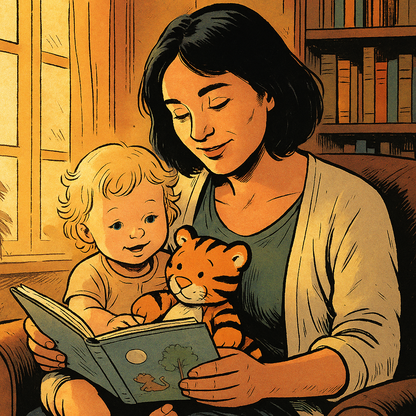
Alice had changed into something softer—a long navy cardigan, linen trousers, socks in mismatched shades of plum and gray—and had settled into her favorite armchair, its cushions molded to her shape by decades of reading, listening, writing. Miracle had wandered over after her brief and exploratory nap, tiger in tow, and without ceremony had clambered up into Alice’s lap, sighing as she wedged herself in and planted her tiny head under Alice’s chin. She smelled faintly of applesauce and sunshine. Alice didn’t question it; she simply adjusted her posture and reached for the thin comic booklet that had been tucked beside the chair.
It was an old strip—British, mostly wordless, gentle and funny in a quiet, strange way. The drawings were hand-inked, black and white, the kind of panels that didn’t shout for attention but invited you to linger. A cat chasing its own tail. A hedgehog building a fort out of toast. A grandmother riding a shopping trolley like a scooter.
Alice began to read aloud, narrating the scenes not with dialogue—there wasn’t much—but with amused observation, a little theatricality, and a voice softened by joy.
“Now this,” she murmured, pointing to a particularly ridiculous drawing of a duck in rain boots, “is a creature with purpose. Look at that stride. That’s a duck who has errands.”
Miracle snorted, a breathy laugh that puffed out against Alice’s chest.
“Shall we name him?” Alice asked, glancing down.
Miracle looked at the drawing with great seriousness. Then she made a sound like “guh,” and tapped the page.
“Gus the duck it is,” Alice declared. “He’s wearing his important boots. He’s got toast to deliver. Possibly to the hedgehog.”
As she continued, Miracle’s eyes followed every line on the page. Her hand rested lightly on Alice’s collarbone, thumb pressing into the fabric of her cardigan like she was anchoring herself there. Every so often, she would look up at Alice, studying the shape of her mouth as she spoke, then glance back at the page, as if checking her translation.
And then came the moment.
Alice turned the page to a new strip—a chaotic scene of animals attempting a picnic in the rain—and Miracle tilted her head, watching Alice’s mouth again as she read: “And now the frog is making tea under a mushroom. Very enterprising. I like this frog.”
Miracle’s mouth opened. She blinked once, twice.
“Ah…”
Alice paused, sensing the shift.
Miracle’s brows furrowed with the effort. She pressed her fingers gently against Alice’s chin.
“Ahhh…”
Alice leaned closer, eyes wide, gentle. “Are you trying to say my name, sweet pea?”
Miracle nodded—not the big bobbing nod of adults, but the small, tight movement of a baby affirming a guess. Then, with great concentration, she tried again.
“Ahh…luh…sss…”
The final s was a whisper, trailing off like the end of a lullaby. She looked up, uncertain, and maybe a little proud.
Alice’s chest tightened with something wordless and beautiful. She set the comic gently aside and cradled Miracle closer, kissing the top of her head, those golden curls warm from the sunbeam.
“That’s me,” she said softly. “Alice. You clever mite.”
Miracle beamed—no longer uncertain—and slapped one hand softly on Alice’s chest like yes, I knew it.
The days unfolded slowly, gently, like a favorite song being played again but softer this time—familiar chords, new harmonies. San Francisco stayed mostly kind, weather-wise. The fog came and went like a mood, curling against the windows in the early mornings and lifting by noon to reveal blue skies and the long, sloping reach of the hills. The house Alice and Octavia’s home, held a certain magic for Miracle—it was a place full of corners and textures, sunlight puddles, windchimes that sang without needing to be touched, and windows where birds perched like stories waiting to be told.
From the first morning, Miracle had made herself at home. It wasn’t a matter of adaptation. It was more like claiming. She toddled through the rooms with tiger in tow, sometimes dragging a blanket behind her like a cape, pausing only to run a palm along the woodgrain of a table or press her face against a window to whisper to her reflection. And always, just a few steps away, was Alice.
There were moments each day that became rituals. After breakfast—oatmeal for Glenda, toast with marmalade for Alice, apples and tiny toast triangles for Miracle—they would settle in the front room. Miracle would point to the armchair, her chair now, and say “Ah-luss?” in her sweet voice, and Alice would appear with a book or a paper or sometimes just her hands and a quiet story that needed no pictures.
She told her about hedgehogs and pigeons. About growing up in London. About the cat that used to live under the market stall and always stole sardines. Miracle listened, eyes wide, thumb in her mouth, tiger tucked under one arm. Sometimes she asked questions in her own language—tilted her head, hummed a syllable, pointed to the sky out the window as if wondering what was beyond—and Alice always answered, even when she didn’t understand the question.
One afternoon, Miracle sat with Alice at the low coffee table as Alice sketched something out on a piece of heavy paper. It wasn’t for work. It wasn’t anything in particular. Just pencil lines and smudged shapes—a house, a tree, a bird, a swirl. Miracle watched, fascinated. Then she picked up a crayon and added a single swoop of pink. A spiral. Alice paused.
“Well,” she said. “That’s much better.”
And from then on, it was their picture. Every day they added to it. Blue dots. Scribbles. A careful line drawn by Miracle’s fist-guided hand, then traced over by Alice in ink like she was illuminating it.
Later, in the garden, they spent long stretches just watching. Miracle would sit on the wide porch step, legs spread, hands planted behind her, and stare out at the wind. There was a patch of lavender, and when the bees came, she’d hold her breath and point, whispering “buh” like she didn’t want to startle them. Alice sat behind her, not hovering, just near enough to catch her if she fell backward or leaned too far toward the edge.
“You’re the most peaceful baby I’ve ever known,” she said once, brushing a leaf from Miracle’s shoulder.
Miracle turned and leaned her head against Alice’s knee, just for a second, then went back to watching the bees.
There were also the noisier moments. Dance parties in the kitchen when the radio played something bouncy and old-fashioned. Alice spinning her slowly, both hands around Miracle’s waist, the baby squealing, curls flying.
And of course, the tiger.
That battered stuffed animal became the center of their world. Every adventure, every nap, every meal—tiger was present. Alice crafted a tiny paper crown for it. Miracle placed it on the tiger’s head with great ceremony. Alice stitched a rip beneath its ear when the stuffing peeked through, humming under her breath while Miracle watched solemnly from her perch on the couch.
“Every tiger deserves a proper seamstress,” Alice said. Miracle echoed, nodding.
Bedtime was sacred.
Glenda handled the diapers and pajamas, the lullabies and brushing of teeth. But after the lights dimmed, when the city glowed quietly outside and the room was full of hush, Miracle would lift her arms and say it one more time: “Ah-luss.”
And Alice would come, sitting cross-legged on the floor beside the crib, her voice barely above a whisper as she read from a cloth-bound book—sometimes poems, sometimes picture books, sometimes something she made up entirely. Miracle would listen with that same intense stillness, fingers tangled in tiger’s ear, until her eyes drifted closed.
On their last night before flying home, Glenda packed the last of Miracle’s clothes while Alice gave the girl her final bath. There was a lot of splashing, a lot of tiger perched nearby on a towel to “watch,” and soft little songs. Alice wrapped her in the towel afterward, held her close, and whispered something only Miracle heard.
The morning of their departure was thick with that particular kind of quiet that comes when the end of something good draws near. The sky outside was pale, pearl-colored, the sun not yet committed to shining. Inside, the house seemed to echo with the absence of the usual morning laughter—no thumping toddler feet, no soft babble from the rug, no sing-song calls of “Ah-luss?” echoing down the hallway. Even Miracle, usually bright-eyed from the moment she awoke, was subdued as Glenda dressed her in the clothes Alice had folded and laid out the night before: soft blue leggings, a shirt with tiny sunflowers on it, and her favorite hoodie with the little bear ears on the hood.
While the grownups were busy in the usual flurry of departure—zipping bags, double-checking pockets, refolding jackets that would just be pulled out again at security—Miracle had quietly slipped away. The house had a rhythm she knew now, a map she’d drawn in her heart over the course of a week: where the stairs creaked, where the light pooled warmest on the rug, where the toy basket sat waiting like a treasure chest. She didn’t need guidance anymore. She moved slowly, tiger clutched in both arms, his matted fur pressed close to her chest.
In the corner of the front room, beside the fireplace where the basket lived, she crouched. Her breath came slow and a little shaky, but she didn’t cry. Miracle was young, but she understood more than most people assumed. Having five older siblings taught her that some things belonged to everyone and no one at once. Toys changed hands. Dresses were passed down. Dolls were lent and never returned. Sometimes someone else needed something more, or for longer, or just because. She had learned to adapt to those quiet losses with a kind of early wisdom.
Still, her fingers lingered on the tiger’s ear.
She looked at him for a long moment, then gave him a soft pat on the head. Not like a goodbye. More like a blessing.
Then, with the same tenderness Alice had shown when repairing his stitching, Miracle placed the tiger back where she’d first found him—curled beside the rim of the basket, his head resting against the plush body of a forgotten rabbit. She adjusted his tail slightly, tucked it under so it wouldn’t get caught. Then she rose, slowly, and padded out of the room without a word.
She didn’t tell Mama. Didn’t cry. Didn’t make a show of it.
And no one noticed—at least not then.
The morning wore on. Glenda packed up the last of the diapers and zipped the bottle bag shut while Miracle sat quietly on the hallway rug, unusually still. She seemed a little dimmed, like a candle with its wick just barely holding flame, but Glenda chalked it up to travel nerves and the disruption of routine. Alice, already feeling the quiet ache of parting, didn’t yet see what had been left behind.
It wasn’t until coats were on, shoes laced, and the suitcase stood ready by the door that Alice, stepping into the front room to grab her scarf, saw the tiger.
There he was. Nestled just where he had lived before Miracle came. Only now, he seemed out of place—too still, too alone, as if the room had changed around him and no one had told him.
Alice froze.
It wasn’t a mistake. This wasn’t an accident.
She turned slowly and walked back into the hallway, where Miracle sat watching her solemnly, hood up, thumb halfway to her mouth.
Alice crouched beside her, brushed a curl away from her cheek, and said, with infinite gentleness, “Darling… did you leave him for me?”
Miracle didn’t answer with words. She just looked at Alice and blinked, then slowly lowered her thumb and gave the tiniest nod.
Glenda turned, puzzled. “What’s this?”
Alice stood, voice quiet but clear. “She left the tiger. Back in the basket.”
Glenda’s face changed—not surprise exactly, but something deeper. Understanding. Awe.
“She thinks she’s being generous,” Glenda said, heart clenching. “She comes from a house full of hands. Toys get passed around like stories. She probably thought she had to.”
Alice’s chest ached.
She turned back to Miracle and knelt again, taking both of the baby’s hands in hers. “Sweetheart,” she said softly, “you are generous. You are so generous. But I want you to know something.”
Miracle watched her intently, eyes big and unblinking.
“That tiger?” Alice said. “He doesn’t belong to the house anymore. He doesn’t belong to the basket or the other toys or even me. Not anymore.”
She let the words land. Let them settle between them like dust in sunlight.
“I think,” Alice went on, “that he belongs to you now. I think he chose you the moment you picked him up. And I think he’s going to be very sad if he doesn’t get to see your room, and your house, and all your sisters.”
Miracle frowned a little, like she hadn’t expected that.
Alice leaned in. “Would you take him with you? Give him a lovely new home. I think he would be so, so happy.”
Miracle was quiet for a moment. Her little fingers curled around Alice’s. Then she stood—wobbled once, caught her balance—and walked back into the front room without another sound.
She returned seconds later, tiger clutched tight in both arms, his ear once again flattened against her cheek. Miracle walked right up to her and held the tiger out—not to return him, but for Alice to kiss goodbye. Alice smiled, pressed her lips gently to the matted fur, and whispered, “Safe travels, old friend.”
Miracle tucked him under her arm again, rested her head briefly on Alice’s shoulder, and murmured, “Ah-luss,” with a sigh that carried the entire stay in it.
The cab’s tires whispered along the damp asphalt, the city’s hills slowly falling away behind them as Glenda sat in the backseat, Miracle resting against her chest, thumb in mouth, tiger nestled between them like a silent chaperone. The ache of parting with Alice still hummed in the quiet space between mother and child, but Glenda—watching the fog roll inland, the faint scent of salt in the air—felt something pull at her, a quiet intuition. Not sadness. Not quite.
The taxi veered west, down through the avenues where sleepy storefronts were still unlocking their gates, until the streets opened up into wind and sky. Ocean Beach stretched before them like a great, soft-gray ribbon, mist curling low along the tide, gulls wheeling high above the surf. The Pacific crashed and pulled in its endless rhythm, and there—past the lot of scattered vans and joggers with earbuds—was the sea, wide and waiting.
Glenda stepped out with Miracle on her hip, thanking the driver with a quiet nod. “We’ll just be a little while.”
She walked briskly toward the dunes, the wind lifting her scarf, her curls tousling free. Miracle’s head turned at the sound of the surf, her gaze sharpening. This wasn’t new, exactly—she’d seen the ocean before—but something about this morning, this beach, the weight of parting behind them, the world stretching open in front of them… it made her very still.
Glenda found a quiet pocket along the dunes, shielded slightly by a driftwood log. She reached into her carry tote—Miracle’s things always packed with gentle foresight—and pulled out a small zip-up bundle of baby swimwear: a soft, lavender one-piece with tiny silver whales printed across the belly. She laid Miracle gently on a towel and whispered, “You ready to feel the world again?”
Miracle blinked, thumb slipping from her mouth.
Glenda slipped off her own jeans and sweater, revealing a modest black swimsuit underneath, wide-strapped and strong. She tugged a rashguard over Miracle’s swimsuit for warmth, then scooped her back into her arms. Together, they walked barefoot across the packed sand, the tide cool against their ankles.
The wind brushed over them in warm gusts, tugging at Miracle’s curls, making her squint and squeal softly. Her feet kicked in the air, eager, uncertain.
They reached the tide line, where the sea curled gently in and pulled back in shimmering sheets.
Glenda knelt.
“Okay, baby girl,” she murmured, one hand cradling Miracle’s back. “Let’s give you to the ocean.”
And with infinite care, she lowered her into the water—face up, body gliding across the thin shimmer of the tide like a petal in slow motion. Her hand remained firmly beneath her back, but her head rested in the curve of Glenda’s wrist, her arms loose, legs wiggling.
Miracle gasped.
Not in fear—but in sheer delight.
The water lapped at her ears, the sunlight hit her belly, and she let out a high, thrilled laugh. Her legs kicked once, sending up a spray, and she laughed again—louder, wild and unburdened, like something inside her had just remembered what it meant to belong to the world.
Glenda smiled, eyes brimming. “That’s it,” she said. “That’s my water baby.”
She glided her gently, slowly, letting the ocean kiss her feet and then her fingers. Miracle shrieked when a small wavelet touched her chin, then blew a raspberry at it like she was talking back to the sea. Her legs kicked again, sending droplets up into the sunlight. Her hands slapped the surface with glee, tiny splashes bursting like applause.
She laughed and laughed.
And Glenda laughed with her, heart full and fierce.
The waves rolled in, lapping against Glenda’s calves. She shifted Miracle closer, cradling her back upright now, and kissed her forehead.
“I wanted you to feel this,” she said softly. “Before we go back. Before we get on another plane and get swallowed up by hours and airports and bags. I wanted you to remember this.”
Miracle tilted her head back, water beading along her temples, the curls behind her ears damp and springing. She stared at the sky, mouth wide with awe, arms flung out like she meant to hold the horizon.