Work Text:
Friday, January 23, 2009—one week after the shared birthdays. Miami had thrown on its winter and gone out: warm wrists, salt in the breeze, bougainvillea misbehaving on the fence. The humanities building spat students into sun; backpacks bobbed; iced coffees sloshed; somebody laughed like a gull.
Toyah stepped out with Jess and stopped as if the sidewalk had said her name.
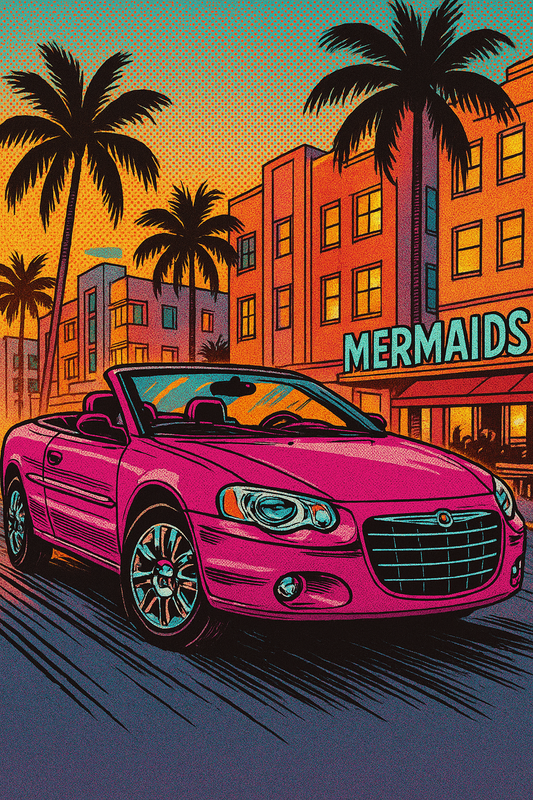
The car glittered without apology. A 2000 Chrysler Sebring convertible: bodywork polished to a mirror you could comb your future in, chrome straight as a promise, top down under a bow the size of a Sunday hat. The wheels threw light—pink hubcaps cut like stylized stars, a cartoon of velocity turned into hardware. Inside? Seats reupholstered in velvet cheetah, lush and ridiculous and exactly right, piped in narrow pink that matched the paint like a secret handshake. A tiny vinyl decal on the lower dash read B.L.M.S. in block letters, as if a factory had been convinced to mass-produce their ritual.
A cluster of onlookers had performed the natural magic of small crowds: two freshmen, a janitor with a broom, a philosophy TA trying not to grin, three strangers who would later claim friendship with the entire event. Addison leaned against the driver’s door, hands tucked in her jacket pockets, trying to look casual and failing. Glenda stood by the fender with a to-go cafecito balanced on a napkin and eyes shiny like tidewater. Neither said “surprise.” The car had taken that word and done the work for them.
Jess whispered, “History just parked itself,” and then clamped a hand over her mouth to keep the squeal from escaping into the general public.
Toyah didn’t move at first. The years telescoped: the corner booth at the Blue Magnolia, a stack of paper placemats, crayons in a cup. Star wheels, heart borders, a trunk for snacks. The pretend car that had lived in her mouth when she was three had just driven out of a drawing and asked for her license.
Addison plucked a key fob from her pocket and held it up. A narrow strip of pink tape crossed the plastic clean and blunt: OPERATOR: TOYAH. She didn’t hand it over yet; she let it catch the light.
“We found the right one,” she said, soft. “We made it honest. New belts. New tires. Alignment true. Fresh top. Steering rack tight. The color… well.” She glanced at Glenda, who had opinions about pink in the same way the ocean has opinions about boats.
“It’s perfect,” Glenda said, unapologetic. “It’s the color of an answer.”
Toyah reached for the fob and felt her hand tremble exactly once. The tremble vanished in contact. She looked at Addison, at Glenda, at Jess shimmering like a hummingbird trying to be a notary public. “Belt, lights, mirrors, seat,” she said, driver-voice sliding into place.
“Breath,” Glenda added, because love is coaching you don’t need.
They did the walk-around first because habit keeps joy from tripping over itself. Tires: sidewalls clean, tread even, valves capped. The star caps were not mere decoration; the lugs underneath sat torqued in a star pattern someone had cared about. Toyah ran a fingertip over the hub face and felt the smooth where a wire brush had been. She knelt, peeked behind the spokes—no glitter paint on the calipers (thank God), pads with plenty of life. “You did this right,” she said to the car and to the people and maybe a little to herself.
“Check the glove box,” Addison said, like a magician with an obvious trick she was nonetheless proud of.
Toyah popped it. Inside: a pink-taped plastic bin labeled EMERGENCY SNACKS, inventoried in Sharpie with engineer seriousness. PB&J bars (4). Sleeved crackers. Two packs of almonds. Pink cookies in a tin that matched nothing and everything. Peppermints. A roll of paper towels and wet wipes. Two bottles of water flat on the bottom. A small flashlight. A hair tie. A $20 bill in an envelope marked GAS/PIE ONLY. Tucked alongside: a slim logbook, pink tape on the spine—SERVICE & MILES—first page already lettered in Glenda’s careful hand.
DATE: 2009-01-23
ODOMETER: 071,428
WORK: DELIVERY, INITIAL INSPECTION, HAPPINESS CHECK
NOTES: B.L.M.S. — ✔︎
Toyah laughed, surprised into sound. She pressed the logbook to her chest a half-second, the way you press a letter, and slid it back where it would live. Then she opened the driver’s door and paused. The cheetah velvet held shadows like a secret club. She ran her palm along the bolster, felt the nap change direction—a luxury and a joke and a memory all in one. The old pink seatbelt pads they’d sewn years ago had been re-stitched to match, neatened, the seams now strong where a child’s hands had once guessed.
She got in. The seat adjusted in two clicks forward, one back. Mirrors: a whisper of car in each side, the rest donated to the world. Headlamps on, then dash dim—no inside carnival tonight. Belt. Breath. Hands saying hello to the wheel.
“Hello,” she told it, because hello matters.
Jess had already slid behind Glenda, knees against cheetah, trying not to physically vibrate the automobile off its mounts. Addison took the passenger seat after a moment of pretending she would watch from the curb. Glenda climbed in behind, cafecito abandoned on the fender for later. The air smelled like old vinyl and new promise and Miami’s winter, which is to say: not winter.
“Signal,” Glenda said, almost under her breath, a superstition more than an instruction.
Toyah signaled. She eased from the curb like leaving a packed pew, tires whispering over lot grit. The star caps winked at the sun. Two dudes in a beige Corolla did a double take, respected the sparkle, and didn’t turn it into anything else. Good omens everywhere.
No radio. Not yet. She wanted the car’s voice without accompaniment. The engine hummed bright, even; the steering spoke clear sentences; the brakes said “present” without dragging their feet like teenagers. She took the first right late, then arced, then unwound in three. The convertible top turned the sky into a ceiling you could own. Her braid ticked the back of her neck in the breeze like a metronome.
“Three-thing game,” she told herself. “Left: campus cop rolling slow in good faith. Rear: blue sedan minding its business. Right: gumbo-limbo trees throwing stripes. Ahead: a crosswalk and the girl who thinks five more steps belongs to her phone.”
Feet win. She eased. The girl made it without looking up. The car remembered how to be polite.
“Don’t outrun what you can see,” Glenda said, habit behind habit. It landed like a chorus, not a correction.
They looped the lot, then took the narrow campus road that kissed the palms. People turned and smiled with the surprise you give to something silly done thoroughly: the pink; the stars; the velvet seats you had to assume were both joke and devotion. A skateboarder coasted along, eyed the hubcaps, and gave a thumbs-up as if praising the existence of nerve in a world that can be stingy about it. Toyah answered with the smallest horn: a doorbell of a toot, a hello, not a shout. The skateboarder nodded. Civilization confirmed.
“Zoo? Library? Texas?” Jess said, because some jokes live forever and don’t become less true for it.
“Parking space A-12,” Toyah said, smiling. “Then paperwork.” She meant the logbook and the ritual of writing your life so it stays steady.
They slid into A-12 wheels straight, brake to still, park last. Engine off. Lights last. The bow tickled the windshield in a small breeze and then lay quiet like a cat that had decided to be decorative. The little audience clapped politely in ones and twos. Someone whistled the kind of compliment that’s not a hazard. Addison hid her face in her hands for a second, then pretended she’d been adjusting her glasses.
“Keys,” Toyah said, opening her palm. Addison laid the fob there like handing over a mic at church.
“Not a prize,” Addison said, the line they’d worn into a family object.
“A promise,” Toyah finished, and felt the word land in her chest with the weight of a torque wrench clicking to spec.
They did the long look-over together because good days deserve to be re-seen. The star hubcaps were glossy enough to make the pink look like it had been poured. The seats were obscene and correct. The trunk opened to reveal a road kit that would make a safety inspector nod: triangles, tire gauge, 12V compressor, gloves, shop towels, duct tape, zip ties, first-aid tin, flashlight. A spare belt coiled in a zip bag like a sensible snake. Under the mat, the donut spare aired to a proper PSI instead of the usual lie. Glenda had put a strip of pink tape under the jack tray with a Sharpie note: WHEEL LOCK KEY → TAPE POCKET. Nobody would be hunting in the rain.
Back in the driver’s seat, Toyah pulled the logbook, uncapped the pen Addison had clipped into the binding, and wrote with precise print as if the paper were as alive as the machine.
DATE: 2009-01-23
TRIP: Campus loop, lot A-12 to palms & back. PASSENGERS: A., G., J.
ODOMETER: 071,433
CHECKS: Belt–Lights–Mirrors–Seat–Breath ✔︎ / Horn (polite) ✔︎ / Wipers (token sweep) ✔︎
NOTES: Fuchsia with a vengeance. Star caps approved. Cheetah seats: morally complex, physically perfect. EMERGENCY SNACKS present.
She looked up. Addison was watching her with the shameless love of a person who doesn’t care if the crowd sees. Glenda had her hands in her pockets and the sort of smile you wear when the math checks out. Jess had already drafted a caption in her head for the disposable-camera photo she would take and tape above her desk: HERE, ON JANUARY 23, 2009, AN IDEA GOT ITS TITLE.
“Take her around the block without me,” Glenda said suddenly, voice low and ordinary like you’d say pass the salt. “One block. A loop and back. I’ll watch from the curb.”
Toyah’s pulse changed shape but not speed. “Copy,” she said, and they performed the ritual again because repetition is respect. Belt. Lights. Mirrors. Seat. Breath. Glenda slid out, put both hands in her pockets against the light, and became a figure steady enough to drive toward.
No radio. She let the car’s own song speak—belt whirr, tire hush, the little snare-drum of the road under the star caps. The turn signal ticked like a metronome. She hummed nothing in particular because this moment didn’t need scoring. A slow right; a complete stop with wheels straight; a left she named in her head—gap in three, two, one—and took like it was theirs to take. She returned to A-12 with time left over, parked as if she’d invented the concept. Hands rested on the wheel an extra beat because good work likes to finish its sentence.
Glenda leaned in the window. “Well?” she said.
“Like I listened,” Toyah said, and felt the car nod in agreement.
They ran the top down for the second lap. Addison said “okay, radio” and Jess scrolled until the city handed them something sprightly and conspiratorial and old enough to be new again. Miami laid out its lanes like a red carpet you could ignore if you were sensible. The pink lifted its chin and did not apologize. A woman in a white Camry smiled like she’d been given permission to be a small version of brave that day. A security guard with a clipboard said, “Y’all look like a party,” and Glenda said, “We’re a checklist,” and he laughed like that was better.
They idled back to the slot and the little crowd, which had become a constellation of people you’d never see again and would always remember. Addison opened the glove box and tapped the bin. “Policy,” she said, mock stern. “Snacks never go extinct. Restock happens on Sundays.”
“Morale is maintenance,” Glenda said, and Jess, who collected lines the way other people collected shells, said, “Yes,” as if she were filing a label under M for everything.
Toyah shut the engine off and put the key in Addison’s hand for one last second like lighting a candle from the original flame. Addison gave it back. The pink tape looked official and silly and right.
“Want to drive to the library?” Jess asked, because she can never not audition a plan.
The stereo blinked awake, and that first electric scrape of “Rebel Rebel” came out like a grin you could dance to.
Toyah whooped—pure daylight, no brake—and threw both hands in the air for exactly one beat. Then she caught the wheel again, palms settling where they knew to live, laughing into the wind like a person who’d just been handed back a childhood drawing turned real.
Jess laughed with her, beaming sidelong the way a twin does when she sees the exact face she feels. Sun on her cheeks, hair pulled up so the top-down air could run past and applaud, she pointed to the road as if the car needed coaching and not an audience. “Go, driver,” she said, voice bright but small enough to keep the magic from spooking.
Belt. Lights. Mirrors. Seat. Breath. The ritual clicked through Toyah’s chest like tumblers in a lock. Parking lights off—daylight did the job; headlamps for shadow later. Dash dim enough that the world stayed the star. Mirrors showed just a whisper of pink, the rest given over to palm-lined lanes and the small polite chaos of a Miami Friday.
“Leaving A-twelve,” Toyah said to nobody and everybody, and the Sebring—fuchsia with a mission—eased into the aisle with a whisper of tire on lot grit. The bow had been carefully relocated to the backseat like a sleeping pet; the cheetah velvet held them, lush and ridiculous and correct.
The riff did its strut. Jess tapped the door with one finger, found the beat, and kept it there. Toyah hummed the part that always felt like a small firework. A security cart trundled past; the guard clocked the star hubcaps, gave a two-finger salute with the resignation of a man who'd seen it all and was still happy to be surprised.
Feet win. She feathered off the gas first, then brought the brake like fruit you don’t want to bruise. The daydreamers found themselves on the far curb as if they’d meant to all along. A skateboarder ghosted by and performed a tiny bow at the pink; Toyah tapped the horn like a doorbell—hello, not a scold. The skateboarder smiled with his whole face and pushed on.
And as they peeled out of the parking lot, hair whipping in the wind, pink hood down and glitter in the air, the legend of the Toyah Mobile became reality.