Chapter Text
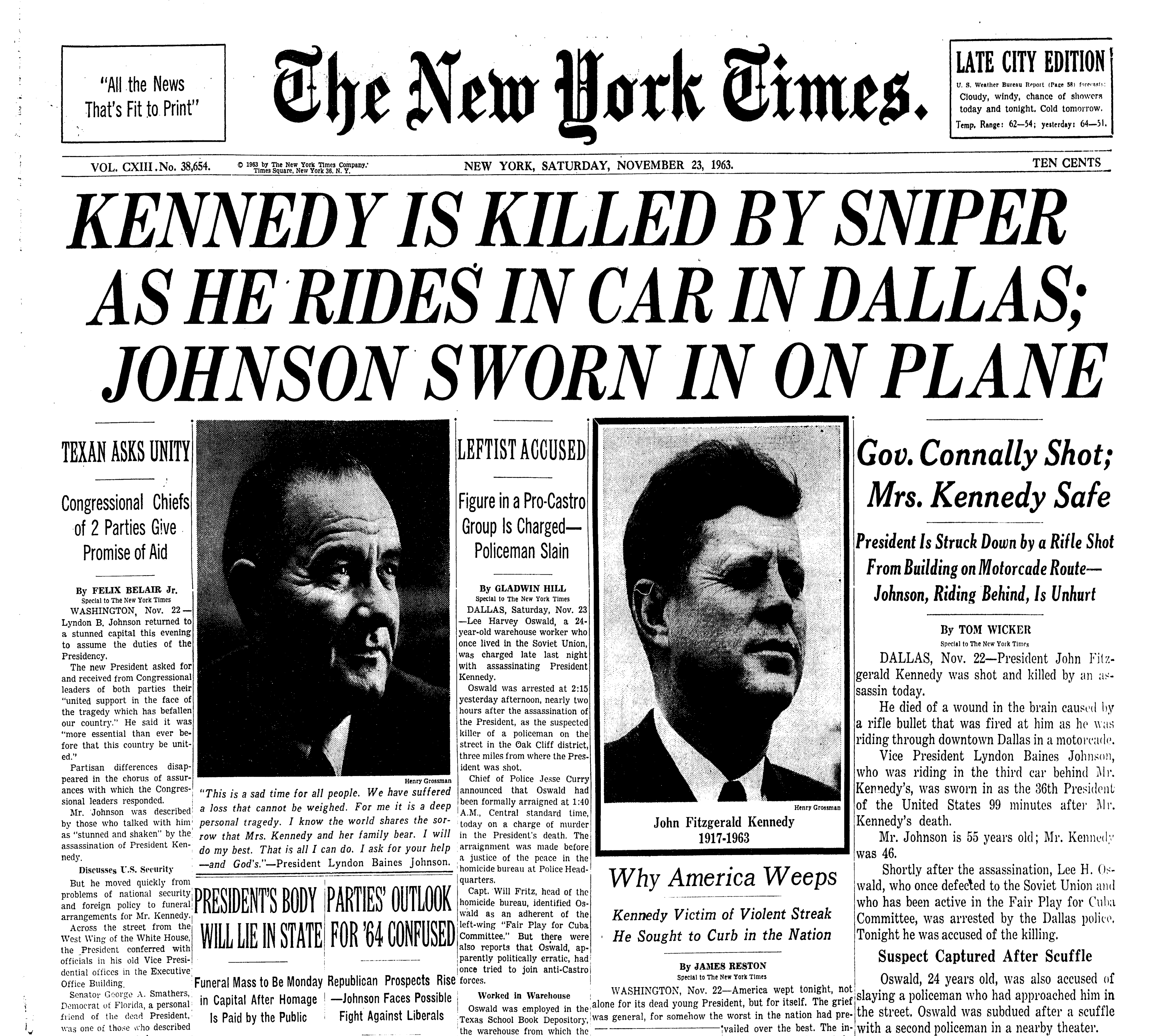
Address before the 18th General Assembly of the United Nations
New York City
September 20, 1963
JOHN F. KENNEDY
…
Finally, in a field where the United States and the Soviet Union have a special capacity--in the field of space--there is room for new cooperation, for further joint efforts in the regulation and exploration of space. I include among these possibilities a joint expedition to the moon.
Space offers no problems of sovereignty; by resolution of this Assembly, the members of the United Nations have foresworn any claim to territorial rights in outer space or on celestial bodies, and declared that international law and the United Nations Charter will apply. Why, therefore, should man's first flight to the moon be a matter of national competition? Why should the United States and the Soviet Union, in preparing for such expeditions, become involved in immense duplications of research, construction, and expenditure? Surely we should explore whether the scientists and astronauts of our two countries--indeed of all the world--cannot work together in the conquest of space, sending someday in this decade to the moon not the representatives of a single nation, but the representatives of all of our countries.
February 1974, Chaffee Lunar Base
From a dozen miles away, the only part of Chaffee Lunar Base still visible to Grace was the imposing 50-foot radio antenna located next to the habitation module. If he looked hard enough—and strained his eyes, he could make out the three steel cables that kept the antenna from falling over. It looked like a thin, shiny teepee sticking into the black of space.
“Shapiro to Grace. Come in, Over”
The headset in his helmet, tinny and too loud, buzzed. Grace breathed against his microphone.
“This is Grace, Over.”
“How much longer is it going to take for you to get the sample? Over.” Her voice was clean, but carried the slightest note of feigned irritation.
“As long as it takes me! Give me another five minutes. Also, do we have to keep saying ‘Over’ every time we’re done speaking?.” Grace said, sighing into the microphone.
He waited for a response, only to get nothing. He sighed again. “Do we have to keep saying ‘Over’ every time, Over.”
Shapiro’s voice chirped back into the helmet. “Yes. It’s the only way we know you’re receiving my signal. I thought you’d like some reassurance considering how jumpy you were in the first week. Over.” She joked.
“Okay, okay. Just don’t complain about my breathing ever again. It’s a good sign for you that I’m not dead. Over.” He replied.
He pushed the wheelbarrow, its metal handles barely registering beneath the thick, fabric-gloved hands of his spacesuit. Inside, moon rocks were piled high, with as much of the regolith shaken off as his clunky suit let him. He huffed as he pushed the load up the crater’s slope, his eyes fixed on the gleaming antenna.
When he first saw photographs of the lunar surface, like many men before him, he marveled. A picture from another world—the one in the sky that he saw every night! Well, almost every night—regardless, the majesty was clear in his mind. But having spent the last two months staring at nothing but gray dust and rock, with the beautiful blue-white ball of the Earth on the horizon, he was quickly becoming bored.
Not all was dull and gray on the moon, though. At Chaffee Lunar Base—which they only ever called Chaffee—Grace had a fully stocked lab in its own module, attached by airlock to the main station. He spent most of his time in the lab, anyway, which wasn’t too dissimilar from his time back in California, mulling over test results and equipment at NASA’s Jet Propulsion Laboratory trying to decipher the last printout from the punchcard computer. If it weren't for the front-facing double-paned window boldly showing the lunar landscape, it would hardly be different from the lab he used to work at. The only meaningful change was the lack of any bald-headed supervisors preventing him from putting on headphones and listening to his cassette tapes, a notable boon considering he had brought dozens up as personal effects.
The small shimmer of sunlight that reflected off of Chaffee Lunar Base grew brighter and brighter as Grace approached the airlock, pushing the wheelbarrow of rock into the impromptu tent that DuBois had rigged together from spare tarp. He tilted the wheelbarrow to its side with ease under the miniscule lunar gravity, which while enjoyable, required consistent exercise to avoid bone decay. The rocks fell to the ground with an inaudible ‘thunk’, pushing motes of dust a few feet off the ground until they settled on the tarp, the wheelbarrow, or Grace himself.
Trying to swipe away the regolith was pointless as it accumulated in the nooks and crannies on his suit. Where a vacuum and rag would have worked plenty on Earth, the moon provided unique challenges due to the vacuum of space making suction useless. They couldn’t clean the suits in the airlock either, because bringing the dust in risked the sensitive electrical equipment which could not fail under any circumstance. The solution the engineers came up with was pretty ingenious: Wipe down with a towel as much as you could, and then plug the two-pronged connector trailing outside the habitat module into a small port located on the left thigh of the suit. The dust, having acquired a charge from billions of years of solar radiation, stuck to everything from static cling. Once power was connected to the small wires embedded in the suit, the resulting magnetic field generated was strong enough to fling even the heaviest particles away from the suit as fast as possible. This had the side effect of plastering whatever was nearby in a thin layer of dust, but it was an acceptable cost when it came to the safety of the base.
Grace faced towards the habitation module and turned a small lever and pulled, revealing a hatch filled with small plastic bags. He picked one up, undid the small seal, and widened the mouth with one hand. Reaching over to pick up a few decent-sized moon rocks, he carefully filled the bag before closing it and moving to the far side of the habitation wall, away from all the equipment left outside.
He grabbed the metal-mesh rag clipped to a hook, wiped off what he could, and then used the two-pronged plug to magnetize the rag. The dust on the rag blew off, and he returned it to its hook. Taking the plug and sticking it into the port on the suit, the same display of dust motes were flung away by the generated magnetic field. This had been done so many times around the area where he stood, that a small ring of previously-gathered regolith was already building up.
“Alright, I'm coming in. Over.” Grace said into the microphone.
“Cool. The laboratory misses you.” Shapiro replied.
“Im sure it—” Grace paused. “Sorry, couldn’t hear you. Repeat please. Over.”
DuBois’s voice cut through the silence. “You’re good to go, Grace. The airlock's depressurized.”
Sure enough, a green light blinked on as soon as DuBois finished speaking.
As Grace moved to enter the airlock, he ribbed Shapiro. “At least DuBois isn’t toying with the radio. You could pick up a thing or two.”
The radio was notably silent for a few moments as Grace shut and re-pressurized the airlock, until Shapiro chimed back in from the speaker fixed to the top of the room. “Oh, I pick up plenty from DuBois.”
Grace grimaced as she spoke, and shook his head trying to toss out the image (moreso the memory) of DuBois and Shapiro refusing modesty with a third person present. Science wasn’t the only reason Grace stayed in the lab most of the time.
Along the wall of the airlock were two other space suits—one fit for DuBois, and another for Shapiro, and an empty dock for the one Grace was wearing. He lifted off the helmet, followed by the chestpiece, and shimmied out of the trousers before setting up the gloves.
The airlock opened from the other end with a small clunk, DuBois on the other end giving Grace a deft nod. “How’d it go?”
“Good enough, I suppose,” Grace spoke. There wasn’t much to be said that he hadn’t already repeated a dozen times over, because Grace had become the de-facto EVA specialist (even if it really was DuBois’s responsibility) whenever he needed samples. For better or worse, Grace was receiving some very excellent on-the-job training.
The habitation module, despite being rather large on the outside, was so packed with different equipment that actually navigating inside was a challenge. The only remotely open area was the dining room, which had quickly become a one-stop-shop for tool repair and storage for when they couldn’t be bothered to fit their things in the secondary habitation module where they slept. It was permanently fixed to the secondary habitation module, and the airlock connecting the two had never been used more than once. It was left open, propped up by a broken TV camera which DuBois had scavenged for parts.
On the opposite side of the primary habitation module, the Laboratory Module (a new addition) was attached by an umbilical airlock initially designed for a potentially expandable Skylab—before it was scrapped to focus efforts on Chaffee Lunar Base.
Grace scooted past the dining area and ducked beneath the over-head cabinets to make his way into the small, tubular chamber, sealed on both ends by a hatch operated by a large handwheel. He set down the sample bag next to his feet, and turned the handwheel until the hatch swung backward, missing his chest by a few inches. He’d become accustomed to the cramped movements over the last two months and it had become a habit to close up the hatches whenever he entered or left the lab—not out of any concern for safety, but because he preferred the quiet. The thick hatches were nearly soundproof.
He brought in the sample bag before donning his PPE—gloves, liner, goggles, and coat among them. He put the sample bag into a larger containment bag, moved a single rock from the inner pouch into the other bag before sealing both. The original sample bag went into a cabinet beside his feet while the isolated sample was set atop the tiny stainless-steel desk.
First, Grace tried to break the rock in half with his hands while it was in the bag. Unlike the other rocks he’d tested so far, this one didn’t even chip. A good sign. He pulled out a rubber mallet that was hooked to the wall and tapped it with steadily increasing force. Eventually, the rock split under the pressure, and a small amount of dust flaked from the fracture. He carefully examined the exposed interior for small reflections of light on the inside of the rock, but could only find a few. A scientist should never rely on just one sense, though. He had a litany of lab equipment with him.
Carefully, Grace opened the bag and scooped a small amount of the dust into a test tube. Pipetting a few milliliters of water into the tube, he plugged the top with his thumb and swirled it around until the solution was completely dissolved. He slotted the tube onto the rack and prepared a pH strip, dipping the end into solution and pulling it out.
“10. Basic,” he said to himself. “So it’s got oxides, that's for sure…” He said, scribbling down into a notebook.
He left the strip in the tube, and pulled out a binder from a shelf above his head. Flipping through the pages, he landed on “Molecular Emission Spectral Data Tables”, and moved to the metals section. In the margin, he took his pen out and scribbled the wavelengths emitted by a number of different metals—importantly, Iron, Magnesium, Aluminium, Calcium, and Silicon.
Directly behind him stood one of the largest pieces of equipment in the entire station: an Atomic Absorption Spectrometer. It occupied a significant part of the laboratory module, and was near impossible to move, but Grace could never run the breadth of experiments he wanted to without it. Dozens of feet of printed readouts spooled out of the print tray from previously run experiments on every sample he could get his hands on. One might call it redundant—he called it thorough. You never knew when an experiment could bear fruit from something mundane.
He was getting closer and closer by the day to the spot, the entire reason they’d been sent up here, and the print results were starting to show it. The first hundred or so lines from the printouts indicated a moderate abundance of Silicon, followed by a smattering of Aluminum, Iron, Magnesium, along with trace Titanium, Potassium, and Calcium.
But as Grace continued to run more tests on a greater variety of rock, he noticed that certain areas, particularly crater depressions, held heavier elements. His working theory was that meteorites deposited heavier metals than were found in average regolith, but he was no astronomer.
It was a pattern he’d suspected he would find when he first came up here, and while he wasn’t disappointed, it was always more fun for your expectations to be shattered rather than slowly confirmed.
Grace guided the AAS’s pump tube into the test tube and opened the nitrogen feed valve. A low hum rose as the device powered up, crescendoing into a buzz that filled the laboratory with vibration. The paper feed clicked into position. Moments later, as the burner reached sufficient temperature, the first results began to spill out of the tray.
“41.1% Silicon, holy mackerel!” He cheered to himself. If he wasn’t busy reading the prints as they came out, he would’ve already written it down. “9.0% Iron, 11.3% Aluminum, 9.5% Calcium, 7.3% Magnesium—” Grace paused. “High Silicon. High Calcium. I bet my bottom dollar this is basalt.”
Grace stumbled across the lab to an improvised bookshelf filled to the brim with textbooks, binders, and an unsorted stack of paper held together by rubber bands. His finger traced across them from left to right until he landed on a thin booklet titled “Geologic History of Hawaii: A Volcanic Legacy”, with the name “François Leclerc” listed as the sole author. He plucked it from the shelf, clipped it into his open binder, and flipped through until he made it to the geological analysis results.
He compared the elemental breakdown between the ones listed in the booklet and the ones on the printout, and although there were a few discrepancies involving Titanium and Magnesium, it confirmed that the rock he held was probably basaltic. Grace spun in jubilation around the laboratory, his legs bumping into all manner of desks and instruments, but there was just too much energy inside of him.
Tempering his joy, he wanted to make sure that it wasn't a fluke. He turned off the AAS, shut off the nitrogen feed, and pulled out the test tube. He flushed the AAS with water, cleaned the test tube, and prepared another sample from another rock with the same bag-hammer-scoop method. He fed the AAS the sample, opened the nitrogen feed, and turned on the AAS. A few moments later, the printout read extremely similar data to the last experiment. Two data points was good, but he could still do better.
Over an hour later, Grace was slumped over the only free desk he could find in the laboratory. He was hungry, tired, and his back hurt, but he wanted to finish up this last sample. Each rock had confirmed the same result as the first. He wasn’t a geologist, but compared to Leclerc’s analysis, these could very well be basaltic lava rocks. He decided to go get Shapiro.
“You think you’ve got lava rocks?” She asked.
“I think. High Silicon and Calcium content, and if you…” He moved over to the page on Leclerc’s analysis. “Look here, I think the data matches up pretty well. It varies but not to a concerning degree.”
She looked over to his shoulder to see the analysis results done by Leclerc, and looked back to the newest lines of the printout. “Were the samples consistent?”
“Yeah. Standard deviation of 0.4 on average, but Iron and Titanium stuck out. They had an SD of 1.1.”
“So you’ve got consistent levels of Silica but the metals vary. You got these from a crater, right?”
“Yes.”
“It sounds like basalt, I just don’t know how it got into the crater in the first place.”
“Do you think it could’ve been formed by the heat of impact?”
“It could be, but the rock looks a little too smooth for that. Were there any spherules when you looked under the scope?”
Grace didn’t move.
“You haven’t even used the microscope, yet, have you?” The question was closer to a statement, but her voice lacked any real bite.
“I was getting to it, I just got carried away with… the spectrometer.” He sighed, turning towards the sample bag. He took the mallet and chipped off a small fragment from the large rock, and brought the fragment up to the stereo microscope. He shifted his glasses to his forehead and looked into the scope.
“I don’t think I can see any spherules… but it is kind of shiny. I see little… shards, I think?” He raised his head up and blinked twice. “Could you take a look? You’d know better than I would.”
They traded places in the lab and Grace fiddled with his hands, trying to find a comfortable position until he left them to dangle awkwardly.
“Crystaline structure, large grain, no spherules… we’ve got a winner, Dr. Grace,” Shapiro said. “This is basalt. Volcanic, too, bet your ass.”
He had explicitly asked them not to refer to him by his title, and they had complied. But on occasions that called for a celebration, they would use it anyway, much to his chagrin.
“You think it's flow basalt?” He asked.
“Yup. The kind you’d expect from an old lava channel. Only two months in and we’re getting this close.”
A wave of excitement flooded over Grace as Shapiro gave him the good news. All his laboring and EVAs hadn’t been for nothing.
“Positive 5, Positive K is a winner,” he said, grinning. “Looks like we’ve got our spot to survey.”
Shapiro nodded at him and made her way to the hatch. “I’m going to give DuBois the good news and mark the gridmap.”
“Don’t forget to tell Houston. They’re going to go buck-wild when they get the news.”
“You won't tell them yourself?” She asked, surprised.
Grace’s smile faltered, and he sighed. “I’ve had my share of excitement for the day. I think I'm going to put on some music and lay on my back.”
“Alright then. Don’t fall asleep again. You got a nasty crook in your neck the last time you fell asleep on the lab floor.”
He chuckled and waved her away. “Yeah yeah, don’t let the hatch hit your butt on the way out.”
Grace couldn’t tell how long it had been since he fell asleep. In his headphones, he could hear Doc Robinson’s voice belting out the lyrics to Dancing in the Moonlight, which meant the cassette was on the ninth song. A little math and he realized he was somewhere by the 50 minute mark, but the automatic rewind mechanism DuBois had installed for his birthday rendered the calculation meaningless. For all he knew, the tape could’ve rewound itself ten times over. If the stiffness in his back was any indication, it probably had.
But that wasn’t what woke him. He had fallen asleep with the cassette player running before and always woken naturally. This time, it was a faint but growing buzz that penetrated through the music playing in his ears.
Behind closed eyelids, the overhead lights strobed relentlessly—white one instant, then pitch black the next. It appeared random, and the intensity of the light grew with every second that passed.
He was up in a flash—his cassette player was flung partway across the lab, and his headphones were jolted off of his head.
“What? DuBois?” He shouted, head whipping as his eyes darted around the room. Oh. He wasn’t in the main habitation module—he was still in the lab. His eyes focused on the small shortwave radio that was tucked above all the cabinets. Despite being turned off, and having never been used, it was sputtering to life with bursts of static and white noise. The red signal light on the bottom was going wild, mirroring the overhead light on the fritz in a meager attempt to match whatever ghost had decided to possess it this time.
Getting his thoughts together, he went to turn off all of the equipment in the room. First were the lights—his hand flicked the switch off, and the lab was filled with darkness. The only light came from the small window fixed opposite to the wall of the hatch, casting small, twinkling shadows from the moonlight. With what little vision remained, his arm stretched to his fullest to pluck the radio from its place stuffed between the cabinets and the ceiling, and pressed the button in with his thumb. The light turned off, but the radio kept sputtering.
“What the heck?” He muttered to himself. He gave the radio a hefty smack, and then another when it refused to shut off. “Damnit!” He shouted, and tossed it across the room. It gave a loud spit of static when it crashed against the wall, and then vibrated quietly on the floor. The buzzing kept getting louder, all around him.
When Grace grabbed the handwheel to leave the lab to get DuBois, he felt the entire world vibrate for just a moment. The clinking of test tubes and rattling of metal filled his head, and the handwheel got so hot he had whipped his hands back like he just touched a hot stove. Then—not a moment later—he was thrown into the ceiling with monumental force, and was knocked out cold.