Work Text:
The hives had been sorely neglected during the war, the colonies absconded and the boxes left out to warp and crack, but I had spent all winter repairing them, and the new swarms I had caught were robust and productive. They needed my meddling about as much as I needed another trip to the continent, but one colony had moved in of its own accord, one I’d caught off a fence post in town, and one had come from another gentleman’s fully-occupied apiary, so they were my responsibility now. I had found the queen in two of my hives— the third was obviously there, laying her eggs day by day, but I had yet to see her— and checked their progress in comb-building and nectar-collection, and was just closing up when the sound of the motorcar rose in the air.
It grew as the car approached, overwhelming the bees' hum until it sounded more like an oncoming Fokker, and then abruptly cut off. Watson's voice then was audible across the garden, but he wasn’t calling to me. He was speaking to the other occupants of the car: his daughter Margaret, and her fiancé whom we were finally to meet.

Maggie was twenty-eight, a governess-turned-nurse in the time of the country’s greatest need despite her fathers wishes. She had been born during my first sojourn to Europe in ‘91, when I’d left Dr and Mrs Watson behind for their safety. When I returned, my mission in pursuit of Moriarty’s network nearly completed, her father and I had rekindled our friendship. She was two years old at the time, and her mother had died unexpectedly, and so she had come with him to Baker Street. Shortly after he moved back in, we found our way to rather more than a friendship, and Maggie had grown up between us and the work.
In the greenhouse, I divested myself of my netted hat and leather gloves, and checked my reflection only briefly in the plate glass window as I went up to the house. Sweaty, but acceptable. I hadn’t seen Maggie in over a year, but it was hard to say exactly what had changed about me that she might notice. More grey hair, perhaps; a thinner face.
Watson was upstairs in the spare room when I came in; I could hear him with the luggage on the floor above. Maggie and her beau were in the sitting room, admiring a watercolor Watson had done of the ocean viewed from the end of our property overlooking the cobble beach. She turned as I entered, and her bright face broke into such a smile that I couldn’t help returning it.
“Holmes!” she cried, and rushed across the room to embrace me. Her golden hair was escaping its carefully set curls, no doubt thanks to the motorcar, and it tickled my cheek. She smelled of lavender. I found myself with my eyes closed, arms wrapped around her shoulders, holding her against me as I had done when she was little.
When she finally let go, I followed suit, and held her out at arms length to look her up and down.
“Enjoying the tennis lessons?” I asked, after a moment of contemplation.
She looked delighted at my deduction, though it was a very simple one, given the freckles on her face and the way one arm felt just a little more muscular than the other. “Yes! My friend Rose has been teaching me over the last few weeks. It’s such a laugh. Oh, Holmes,” she sighed, gazing into my face. “I have missed you.”
“And I you, my dear.” She looked so much like her mother, with her big blue eyes and her rosy cheeks, her delicate nose and chin; and at once like her father, in the shape of her brow, her smile, and the curves of her ears.
Watson came back down, and Maggie turned to him, reaching out with one hand so that she held us both. She looked between us for a moment, giving us what seemed to be a reassuring smile, and finally turned to the man she’d brought along.
“Holmes, this is Sergeant Roger Feeley, my fiancé.”
Sergeant Feeley stepped forward, stretching out his left hand as I reached out my right. I realized, unforgivably late, that the cuff of his right sleeve was pinned to his shoulder.
“Sergeant Feeley, welcome,” I said.
“Mr Holmes, it is my honor,” he replied, as we let go. “Thank you for having me. I have to admit I have been a great admirer of yours since I was a boy, and I— well, when Maggie told me you and Dr Watson were— that is to say, it is an honor, sir.”
I cleared my throat, always uncomfortable with praise from a stranger. “Thank you. Watson and I are most interested to get to know you.”
“Most interested,” Watson agreed. “Cup of tea, Maggie, Sergeant Feeley?”
“Daddy,” Maggie scolded, at the same time that Feeley said, “‘Roger’, please.”
Watson shot me a look that seemed to say, Aren’t we old-fashioned? Or at least, that was what I was thinking. “Roger,” he said, acquiescing.
“Tea would be lovely, thank you, Watson,” I said for all of us, and he went into the kitchen to put the kettle on. I followed him in to wash my hands.
“What do you think so far?” I asked, dropping my voice.
Watson glanced up at the window, using an old trick of mine and checking the reflection of the sitting room behind us. “Pleasant enough chap,” he said. “Did his best to make conversation over the motorcar. He seems a little nervous.”
“I can’t imagine why.” I dried my hands off on the tea towel and touched the cuff of his sleeve with one finger and he slanted me a little smile. We’d discussed discretion, before Maggie had arrived. She, of course, had been raised to ignore us, but it had been a very long time since we’d had any guests at all, let alone a complete stranger in our home. And we’d gotten lax in our old age, enjoying our privacy. I wasn’t sure how Sergeant Feeley—Roger—would react to a couple of old queers if he wanted to marry our girl.
This was a test. Were we supposed to pass it, or was he?
I helped Watson get the tea tray ready while the kettle boiled and then carried it into the sitting room where Maggie and Roger waited.
When we were all seated and the tea had been poured, there was a moment of awkward silence. None of us quite knew what to do now that Roger was here, and I certainly wasn’t going to start the conversation. I was taking him in, and he was weathering the scrutiny remarkably well.
He was Irish, but he’d been born in England. He was a little older than Maggie, maybe thirty or thirty-one. He’d joined up early and been wounded late. He didn’t drink. He didn’t sleep very well.
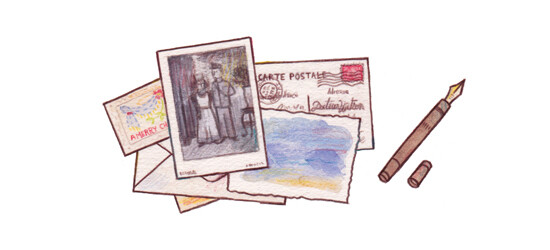
We knew almost everything else we needed to about Roger Feeney from Maggie’s letters: how they’d met (Wimereaux, Lady Hatfield’s Hospital), where he’d served (Flanders, God help him), how long they’d been acquainted (eighteen months, since January 1919, just before the hospital closed), what he did for a living (a solicitor who’d managed to get his position back). We knew perfectly well, as did she, that he wanted to ask for Watson’s blessing, even though they’d already come to an agreement between themselves. I expected Watson to give it, simply because Maggie wanted him to, but it was good to get a look at the man just the same.
Watson finally caved. “How did you find the journey down?” he asked, setting his cup back into its saucer with a click.
“Tolerable enough,” Maggie said, at the same time that Roger said, “Very well indeed.” They looked at each other and Maggie laughed. “I suppose your standards are a little lower than mine, aren’t they?”
“Perhaps,” he agreed with a little smile. “Troop transport does make a chap long for the good old English rail.”
I believed that. I’d done my part from the comfort of my brother’s offices in London, rather than from the front lines, so I’d been able to get back home to Sussex once in a while. The train was a reliable necessity, and whenever it was commissioned for troops the whole network felt it, but it was leagues better than the combination of road and rail transport that shuttled soldiers back and forth, combined with plain, straightforward marching. Being able to sit on a train and look out the window at a mostly intact countryside would have felt positively blissful.
We made polite conversation for about half an hour, skimming the surface and letting Maggie and Roger have their little private jokes, and when the teapot was empty Maggie said, “Daddy, will you help me to give Roger a tour of the downs?”
That left me to tidy up, and to watch them at a distance through various windows as they made their way around the house and across the downs to the cliff. Maggie hung on her father’s arm, so grown and so like the little girl she used to be. She and Watson had always been close— he’d scolded me once, early on, for asking why he didn’t hire a nurse to help him raise her. It wouldn’t have been unusual for him to do such a thing, as a widower with a young child, but he wanted to play the part of the involved father, and I could confidently say he’d been successful. They were devoted to each other, and I watched Roger follow them at a respectful distance, not left behind but certainly at a remove.
It reminded me of myself.
After supper, we sat out on the flagstone patio that was surrounded by my carefully-tended garden. The sun lingered in the western sky, dying the clouds orange and the sky pink, and the air began to cool. I brought out my cherry-wood pipe and lit Roger’s cigarette for him, and together we fell into a contemplative study of the leaves and flowers bobbing in the evening breeze. Watson and his daughter sat close together, talking as if we were no longer there.
“How are your hands?” Watson asked, taking them in his own.
“They’re… sore,” she said. “Stiff. I’m doing the massage, and I think the tennis helps, actually, but it’s devilish hard to hold a pen for long.”
“Holmes noticed your handwriting has changed.”
She sighed. “It’s all the little cuts, and the carbolic, and the infections, and the scarring—”
“I know,” he said soothingly. “I know. And you’ve only just had a chance to let them heal.” He was rubbing her hands between his own, smoothing his thumbs along the tendons and along her fingers. “It takes time.”
Maggie sighed again. “I know, Daddy.”
He didn’t say I told you not to go, though I knew he wanted to. She was old enough to make her choices now, and she’d been old enough six years ago when the war started. The London hospital he’d gotten her assigned to had kept her for a little while, but then she’d transferred to a Red Cross hospital in France just when things started to get really dangerous. My poor Watson lived for years on the edge of madness, waiting for another letter from her. He wouldn’t admit that it was worse than the time I was away on the continent without any communication, but it ate at him. The war separated the two of us for a while as well, since he stayed behind in Fulton to fill in as the town physician, and every time I saw him he’d lost a little more weight. He was only just starting to put it back on.
“What about the rest?” he asked. “Work?”
“I stay busy,” she said. “There are a lot of nurses that came home and need a position, but I’ve kept mine.”
“Mr Holmes, if I may just say,” Roger began, to my left, coming out of his own daze. “We appreciated your cases very much at the front.”
His admission startled me. “You were reading Watson’s work while—?”
“Yes, sir. It kept the mind off the moment, as it were. I never expected, when I met Maggie, that— well, to be here, now, sir; the lads would be very jealous.” There was a smile in his voice that made me smile, too.
“I suppose you’ll write and tell them,” I said.
“Some of them, perhaps.”
We were silent for a moment, thinking of the ones he wouldn’t write to.
“I’m very lucky,” he said softly.
“I’m afraid so,” I agreed. And then, with more enthusiasm than was strictly necessary, “Margaret is an exceptional girl, and I expect anyone who wants to be with her be up to snuff.”
“Yes, sir,” he said. “She is, indeed.”
“I suppose she saved your life.”
He laughed. “Not a bit, which I think is why she gave me the time of day. She covered for someone one night at Lady Hadfield’s, and we got to talking; that was well after they’d nipped my arm off. I was sent back to England shortly after, but I looked her up when the war ended and managed, against the odds, to find her again. I don’t believe in fate, Mr Holmes, but I believe she suits me, and I her.”
“You make a compelling case,” I said, “but it isn’t me you need to convince.”
“Isn’t it?”
Perceptive young man. And flattering me. Since the door had been opened, I asked, “What happened to you arm?”
“Shrapnel,” he said simply.
“I’m sorry.”
“Me too. But I’m learning to cope. Handwriting is shit, if you’ll excuse me.”
I stifled a smile. “Something you’ve never thought you’d have to learn again.”
“It’s coming along,” he said. “I have a secretary at the office, and Maggie does a bit of writing for me even though I know it hurts her.”
“She is generous that way. Have you got a typewriter?”
We discussed the merits of a good typewriter for a while, until finally Maggie stood up, stretched her arms over her head, and declared her intention to go to bed. Gratefully, the rest of us followed suit.
🌊 🏡 🌊
As we lay in the darkness some time later, Watson asked, “Do you think Mary would have liked him?”
I turned towards him, and his profile was just visible in the moonlight that glimmered through the curtains. I put a hand on his chest, feeling him breathe. “Perhaps,” I said. “She was fond of a soldier.”
Mary had been dead twenty-six years by now, and her memory so remote that it felt at times fantastical. Watson had lost her shortly after the birth of their child— though not because of the birth of their child, something for which I was sure he’d never have forgiven himself— and though she had never overshadowed our relationship, she had also never not been present. His love for her lived in a different part of his heart, he said, where it neither grew nor diminished. It was like she was preserved in amber.
The remark had made him chuckle. “She found duty to country very admirable, indeed.”
“She’d have been proud of Maggie,” I said. “Though I can’t decide whether she’d have sided with you or her when she first signed up.”
“Oh, with Maggie,” Watson said with certainty, and that made me laugh. “She would have gone herself, I imagine, if she’d been able. She would have thought a soldier successfully courting his own nurse very romantic.”
“I’m just glad he didn’t get her pregnant in France,” I muttered.
He sucked in a breath. “Holmes, honestly.”
“She’s smarter than that,” I said, shifting so I was on my back once more. “You taught her very well. She’s a sensible girl and she can make a good decision. She reminds me of that girl, who was that? Of the Copper Beeches.”
“Violet, Violet Hunter.”
I grinned in the dark. “That’s right. A very sensible girl.”
🌊 🏡 🌊
Being a lighter sleeper than Watson, I was awoken in the small hours by a shout. I started upright, my heart racing. Such noises did not occur out in the countryside, and my body had grown accustomed to the silence. I sat a moment, listening for it to come again. Instead, I heard the door of the guest room open and Maggie’s slippered footsteps cross the hall and descend the stairs.
Watson snored softly on beside me.
If I got up, the floor would creak.
I stayed put, listening hard. Maggie’s voice downstairs was inaudible, but I heard Roger respond, the pauses suggesting conversation.
I already knew he didn’t sleep well, I reminded myself. Watson had been the same, when we’d first met. I hadn’t had the luxury of rushing to comfort him, but nor had I the instinct. When he’d come back to Baker Street with Maggie, it had been she who’d kept him up at odd hours. Now it was her turn, I supposed. Maybe in the next year she’d be the tired mother responding to her own babies.
There was no threat, so my heart had slowed enough that I could lie down again. Watson was wrapped firmly in the quilt we were supposed to share, but I was used to that. I extracted some from his grip and settled myself. I told myself I’d listen for Maggie to come back upstairs, but I fell asleep again before I heard her ascend.

In the morning, she showed no signs of a disrupted night, and was as fresh and neat as a daisy. Roger too was shaved and tidy, and when I came down to make coffee she was pinning up his sleeve.
I made breakfast for all of us, and we discussed taking a picnic out to the seaside to enjoy the good weather. The ocean was in a good mood today, and Watson would enjoy a few hours with his watercolors.
After breakfast, Maggie helped me to wash up, and used the quiet work without her father present to say, “Holmes, can I ask you something?”
“Always, my dear.” Although her father and I had been intimate for almost as long as I had known his child, I had never fully become a second father to her. Father-ly, perhaps. A trusted figure. But something about our relationship was different from that of hers and Watson’s. It was precious to me, that she confided in me before she told Watson. She trusted me to help her sort things out, to let her consult me without judgement, and to support her when she had to bring something thorny to him. This, I could tell, was one of those things.
“Daddy doesn’t know—” she started.
“I expect not.”
She snorted but sobered quickly. “Holmes, really. This is serious.”
“Of course it is.” I wiped my hands dry and began to put the dishes away in the cupboard. “Something to do with Sargent Feeley?”
She blushed. “Yes. Roger and I— no, well, I was wondering if you think we could convince Daddy to let Roger sleep in the spare room.”
My eyebrows would have hit my hairline, if it had been where it had started. “With you or instead of you?”
“I’ll take the settee, if—”
“You’ve already shared a bed with him,” I realized aloud. I was getting unforgivably slow in my old age. I hung the hand towel over my shoulder and leaned against the counter beside the sink, crossing my arms.
Maggie’s blush deepened. “He sleeps better with me beside him.”
“Margaret,” I said, with something of a mix of reproach and admiration, but I knew the incident last night had not been the first time she’d comforted him after a night terror.
“We’ve been careful,” she protested. “I’m almost thirty, Holmes. And I’m a nurse. I know a thing or two about— about being careful.”
“Probably more than I do,” I admitted, which made her giggle. “You’re not living together in London, are you?” As counter to social norms as our own life was, that was something I knew Watson wouldn’t countenance.
“Goodness, no!” She paused. “But I’ve stayed at his flat a few times.”
In a year? That was probably an under estimate. I took a deep breath and let it slowly out, considering. “I’ll bring it up with him.”
“Thank you,” she said, clasping my hands in hers. “I really will swap with him, if Daddy says—”
I shook my head. “I don’t think that will be necessary.”
🌊 🏡 🌊
“I’m sorry, she wants to do what?”
It wasn’t that Watson hadn’t heard me, so I did not repeat myself.
Maggie had gone upstairs to get herself ready for the walk, and Watson had come in to help me pack the luncheon. Young apples, fresh bread, and cold sliced ham were now wrapped in waxed cloth and tucked carefully into the basket. I was pouring last winter’s honey into a smaller jar. He shook his head. “Holmes, I could never allow it.”
“Why not?”
“‘Why—?’ They aren’t married!”
“Neither are we,” I said mildly.
“That’s different and you know it,” he hissed, slicing a block of cheese with decided force. “Don’t be ridiculous. I can’t believe you’d even entertain such a notion. It’s inappropriate.”
“They’re not children, John.”
“No, they’re adults, which is both what I’m worried about and why they—and you!— should know better.”
I shrugged. “They’ll be sharing a bed soon enough, I don’t see why helping a wounded soldier sleep better is such a—”
“Oh don’t you try that with me,” he interrupted, throwing down the knife and poking a finger into the meat of my upper arm. “You think your aloof logic is so much more superior. That is my daughter. I have a duty to her.”
“I know,” I said, more gently, and folded his prodding hand in mine. “She is more precious to you than all the gold in the world. More than the Agra treasure.” He flushed, scowling. “She is that to me, too. And she’s not a little girl anymore. She’s a woman, she’s made her own rash decisions for years, and you have watched over her all the while. Feeley would never dream of asking you himself, he does know better. But she loves him, and she wants to make this visit easier on him.”
“Or more intolerably awkward,” Watson muttered.
“She offered to switch with him and take the settee.”
“No,” Watson scoffed. “God damn it, Holmes. I’m going to acquiesce, aren’t I?”
“I suspect you might,” I said. “I wouldn’t have broached it if I thought you’d never come around.”
His expression was still dark, annoyed at being so known, even by me after almost forty years.
“They can’t share a bed anyway,” I went on. “All we have left is the camp bed in the shed. It’ll hardly be better than the settee.”
“I shall keep myself warm at night with the knowledge that at least it’s uncomfortable, even if it is dreadfully unconventional,” he muttered.
“That’s the spirit.”
“Shut up, Holmes.”
🌊 🏡 🌊
Admittedly, it made the picnic a little awkward, but I realized Feeley had no idea Maggie had asked this of me— of us— and whispered as much to Watson. He calmed down a little, warmed up again to the poor Seargent, and we had a very pleasant afternoon. When we returned to the cottage, sun-baked and stuffed with bread and cheese and pies and wine, I went to the shed and managed to find the camp bed. Maggie and I set it up while Roger smoked on the patio and Watson unpacked the picnic basket. When the bed was set, across the room from the day bed that Maggie slept in, I went and retrieved the blankets and pillows from their neat little pile in the sitting room. Watson was a better bed-maker than I, but I saved him the trouble this time.
Then she went to collect her young man, and I went down into the kitchen to start thinking about supper. A minute later, I came back out for something, and stopped at the bottom of the stairs, hearing their voices above.
“This is usually Holmes’s room, of course,” I heard her say. “It was ever so kind of him to give it up for me.”
“Mags, it’s all right,” Roger said, and his voice dropped so that I was forced to strain to hear him. “You don’t have to… I can tell Mr Holmes doesn’t sleep in here.”
He was right, of course. Our spare room had never been my bedroom, or Watson’s. It was my laboratory more often than not. The daybed in there was for naps, the cat, and for when Maggie came to visit.
“Oh, well, I suppose they are a little eccentric,” she said, flustered, trying to salvage the ruse.
He laughed, not at her, but with fondness. “You English think you invented everything. Everyone back home knew about my Uncle Pat and his ‘good friend’ Colm who he’d lived with since University. No one said anything; as long as you didn’t acknowledge it, it wasn’t true.” There was a pause, and then he said, even more softly so that I almost couldn’t hear, “I won’t say a word, if that’s what you’re worried about.”
“Thank you,” she said. “Daddy doesn’t publish anymore, but Holmes has a reputation. They both do. It wouldn’t do to upset it all, for what? They’re harmless.”
“And they’re your family.”
I stepped back, away from the stairs, and came up against Watson, who had snuck up behind me. I managed not to make a noise. He grasped my hand and I squeezed back.
“I think they like you,” Maggie said, with a laugh.
“Hard to tell with Mr Holmes, if I’m honest,” Roger said. “But they’re letting you get away with this, so it must not be all bad.
I waved a hand at Watson, telling him to back up. This conversation wasn’t for us, though it was reassuring to eavesdrop on.
“Oh, don’t worry,” Maggie was saying as we crept backwards, “you’d know if Holmes disliked you.”
I’d never have indulged her request if I didn’t think he was a good man: quiet, solid, dependable. Someone who would take care of her the way she deserved. Someone who could keep up with her, too, from the looks of it.
Besides, the two rooms shared a wall, so it wasn’t as if anyone was getting away with anything.
🌊 🏡 🌊
Three months later, they were married at the Church of St Mary the Virgin in Fulworth. Watson gave her away with a mix of joy and sorrow, his only daughter now wholly and completely an adult. She’d been out of our household for years, but now she really was making her own. She wore a fashionable knee-length white dress and a trailing veil that didn’t cover her face, and her hands overflowed with flowers and greenery as she joined Roger in front of the rector. Her golden hair gleamed in the autumn sunlight that streamed through the unadorned windows, and her smile was just as bright. The wedding breakfast consisted of cake and punch, and we saw the couple off in Watson’s motorcar. They were only going back to the cottage, and we stayed for a night in the inn in the village, in a room conveniently provided with only one bed.
Our first grandchild was born in the summer of 1921: a girl they called Mary.