Chapter Text
By common agreement, Cecil Court closed at six o’clock.
The shutters came down, the day’s last customers wandered back towards Charing Cross Road, and the street settled into the quiet version of itself it had been waiting to become. During business hours it belonged to browsers, collectors, tourists and people asking, with varying degrees of obnoxiousness, whether this was the street from Harry Potter. (It wasn’t.)
In the evening, it returned to the residents.
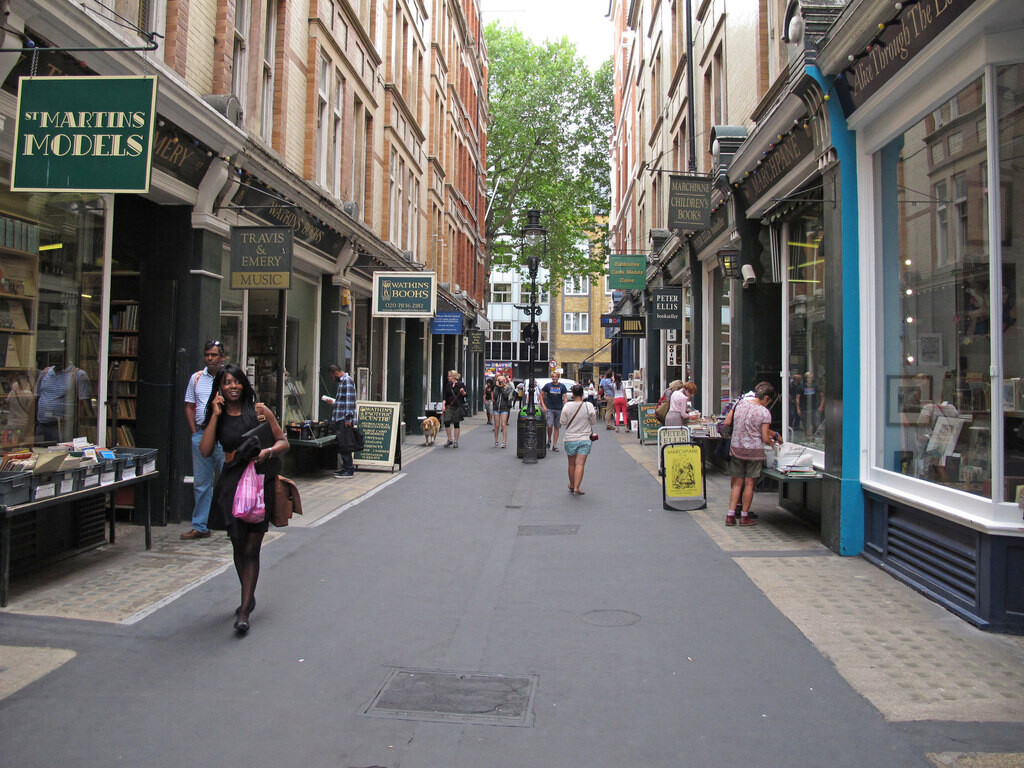
Cecil Court was not a long street, but it had never considered length a meaningful measure of importance. Its late-Victorian shopfronts stood shoulder to shoulder beneath painted signs and dark upper windows, selling antiquarian books, old maps, prints, theatre memorabilia, silver, first editions and objects whose purpose had become less obvious with every passing decade. More than a century of London had moved past its entrance without persuading it to become modern in any serious way.
The building occupied by A. Z. Fell & Co., Antiquarian and Rare Books, was among the older-looking of them, although this was largely a matter of presentation. The brickwork was dark with age, the windows slightly uneven, and the narrow staircase beside the shop had acquired the polished dip of countless feet. The building had survived two world wars, several alterations to the wiring, an unfortunate period of bright orange carpeting and a succession of tenants who believed bookshelves could be put up without consulting the paper-thin Victorian walls. (They couldn’t.)
It had therefore developed patience.
It had also developed opinions.
The ground floor belonged to Aziraphale Fell, proprietor of A. Z. Fell & Co., although "belonged” was not quite the correct word. The shop appeared instead to have accumulated around him, one room at a time, until it became difficult to determine where the business ended and Aziraphale began. Books crowded the shelves, the tables and several pieces of furniture not originally designed to support them. The front window changed infrequently and without reference to season, fashion or commercial opportunity. Opening hours were displayed on the door, but treated by everyone involved as a statement of aspiration rather than fact.
Aziraphale lived in the flat directly above the shop.
This arrangement suited him. He liked knowing that the books were close, though he would have objected to the suggestion that they required supervision. He liked the faint smell of paper that found its way upstairs, the familiar sounds of the street opening in the morning, and the certainty that nothing of significance could happen in the house without first having to pass him.
For many years, the flat above Aziraphale’s had been occupied by a quiet, retired engraver who listened to Radio 3, kept regular hours and died with commendable discretion at the age of ninety-one.
Then, in March 2020, Anthony J. Crowley moved in.
Crowley was not a noisy tenant. This was almost disappointing, since noise would at least have provided Aziraphale with a straightforward reason for objection. He did not play loud music late at night or invite people home at hours that required explanation. He moved into the second-floor flat with minimum fuss, very little furniture and a considerable number of plants.
Also with a magnificent black Bentley, manufactured in 1926.
The Bentley was huge, immaculate and wholly unsuited to Cecil Court. It had the gleaming assurance of something accustomed to being admired and the dimensions of something designed before London had accepted that streets might eventually need to accommodate traffic.
Crowley drove it into the single residents’ parking space beside the rear entrance on his first afternoon and left it there.
Three days later, he found a note beneath the windscreen wiper.
Dear Resident,
I believe there has been a misunderstanding regarding the parking arrangements.
Yours sincerely,
A Neighbour
Crowley read it while standing beside the car. He turned it over, checked that nothing had been written on the back, then looked along the empty street as though the author might still be waiting nearby to provide supporting information.
There was no one.
He folded the note once and put it in his jacket pocket.
The following morning, another note appeared.
Dear Neighbour,
As there appears to have been some confusion, I should clarify that the parking space is intended for the shared use of residents.
Yours sincerely,
The Same Neighbour
Crowley considered this for slightly longer. Then he took a pen from the Bentley’s glove compartment, turned the note over and wrote:
Don’t have a car then.
This was concise, factually accurate and, in every other respect, a mistake.
The reply arrived an hour later.
That is not the point.
Crowley wrote beneath it:
Seems fairly central to the point.
The note disappeared.
For the rest of the day, nothing happened. Aziraphale opened the shop at eleven, spent forty minutes discussing a seventeenth-century sermon with a customer who had no intention of buying it, and closed briefly at half past two for lunch. Crowley left the building at three and returned shortly before seven. Neither man encountered the other.
At eight the next morning, an elegant sheet of cream writing paper had been placed beneath the windscreen wiper.
The fact that I do not currently own a motor vehicle does not invalidate my right, as a resident, to reasonable access to a communal facility.
Crowley read this twice. Then he looked up at the first-floor windows.
One curtain slightly moved.
Crowley smiled without warmth and wrote:
Let me know when you get a “motor vehicle”.
The parking-space dispute continued for nine days.
It began in writing, progressed through two pointed encounters on the staircase and concluded on the street on a Thursday evening, with both men speaking in tones of elaborate courtesy that was more hostile than actual shouting.
"You cannot simply appropriate a communal space indefinitely,” Aziraphale said.
He was standing outside the shop in a pale waistcoat, one hand still resting on the brass door handle. The shop lights behind him gave his hair a faint angelic edge, an effect Crowley noticed only because it made the expression on his face seem even less charitable.
"Not indefinitely,” Crowley said. "Only while I live here.”
"That is what indefinitely means in this context.”
"No, indefinitely means there’s no defined end point.”
"There is no defined end point.”
"I could move out.”
"Are you planning to?”
"Not now.”
Aziraphale drew a slow breath. "Then I think we may safely regard the arrangement as indefinite.”
Crowley leaned one shoulder against the wall. "You still haven’t got a car.”
"That remains irrelevant.”
"To parking?”
"To the principle.”
Crowley looked towards the Bentley, visible through the glass of the outer door. "Car fits. Space is being used. The principle should be pleased.”
"Principles are not pleased by efficiency.”
There was a brief silence. Somewhere inside the shop, a telephone began ringing. Aziraphale did not move to answer it.
"For the record,” he said, "I am not asking you to remove the car entirely.”
"Generous.”
"I am asking you to acknowledge that the space is not yours.”
"It’s not mine.”
Aziraphale hesitated.
Crowley continued, "It’s the Bentley’s.”
Aziraphale stared at him with the expression of a man who had just been presented with proof that civilisation was a temporary condition.
"Good evening, Mr Crowley.”
"Night, Mr Fell.”
It was the first time either of them had used the other’s name. Neither acknowledged this, and the parking space remained occupied.
The parcel incident followed three months later.
The parcel arrived by Royal Mail at twenty-three minutes past eleven on a Thursday morning, while Crowley was in the communal entrance examining a struggling aspidistra.
He was not watering it. Yet. This distinction mattered to Crowley.
The plant had belonged to the building longer than either current resident and was maintained according to no visible schedule. Aziraphale occasionally poured the remains of his tea into its pot. Crowley had seen him do this twice and regarded it as attempted murder.
He was testing the soil with one finger when the postman arrived.
"Fell?”
"Shop.”
The postman glanced at the closed shop door, then at Crowley, who was already there and therefore represented the path of least resistance.
"Can you take it?”
Crowley took it.
He intended to knock on Aziraphale’s door immediately. Then his phone rang, a client informed him that they had changed their mind about an entire garden, and the parcel was placed on the dining table while Crowley explained why replacing a wildlife pond with a sunken firepit would not constitute a minor revision.
By Friday evening, he had forgotten the parcel existed. By Saturday, it had become part of the furniture.
On Sunday morning, someone knocked on his door. Crowley opened it to find Aziraphale Fell standing on the landing in a baby blue linen waistcoat and an expression of extraordinary politeness.
"I wonder,” Aziraphale said, "whether a parcel might accidentally have found its way to your flat.”
Crowley stared at him for a moment, then looked over his shoulder. The parcel was visible from the doorway, sitting exactly where he had left it.
"Oh,” he said.
Aziraphale’s eyebrows rose very slightly. "Oh?”
"Forgot.”
There followed a silence of considerable quality. It was not, strictly speaking, an angry silence. Angry silences contain movement; they pace and compose letters to the council. This silence simply stood between them and reviewed the available evidence.
Crowley retrieved the parcel and handed it over. Aziraphale accepted it with both hands and inspected the brown paper with the concentration of a museum conservator examining flood damage.
"I didn’t open it,” Crowley said.
"No.”
"It was perfectly safe.”
"For three days.”
"Still safe.”
Aziraphale turned the parcel over. "It is an 1864 first edition of Newman’s Apologia Pro Vita Sua.”
"Right,” Crowley said.
"In the original binding.”
"Right.”
"In exceptional condition.”
Crowley began to understand that these were not three separate facts, but one steadily worsening accusation.
"Nothing happened to it. So, we’re fine.”
Aziraphale's face was open and soft by nature, but Crowley was beginning to understand that softness did not rule out judgement. It merely made the judgement look more disappointed.
"Mr Crowley,” he said, "there are objects for which ‘nothing happened’ is not generally considered an adequate standard of care.”
"It was on a table. Indoors.”
"I had gathered that.”
Crowley folded his arms. "Look, sorry.”
The apology surprised both of them. Aziraphale’s expression altered, not enough to become friendly, but enough to suggest that the conversation had briefly escaped its expected route.
"Thank you,” he said.
Crowley waited. Aziraphale continued to stand there.
"That it?” Crowley asked.
"I beg your pardon?”
"Thought you were going to say sorry too.”
"For what?”
Crowley considered this. "The general atmosphere.”
Aziraphale looked down at the parcel, then back at him. "I am sure something will occur to me.”
He turned and went downstairs before Crowley could decide whether this was rude, funny or both. Then he closed the door and turned to Mephistopheles, his eleven-year-old monstera, which occupied most of one wall and had lately begun to threaten the ceiling.
"Bit much,” he said.
Mephistopheles, who had already observed Crowley navigate several relationships with approximately the same level of competence, declined to become involved.
The building, which had seen far worse disputes over considerably less, assumed the matter would resolve itself.
It did not.
Instead, it acquired structure.
There were periods of relative calm, usually lasting several weeks, during which both men became occupied elsewhere and remembered that they had lives beyond the communal entrance. These were invariably followed by some entirely ordinary domestic incident that acquired, through unfortunate timing and accumulated history, the weight of international diplomacy.
The recycling bins, for example.
Crowley approached cardboard with a practical philosophy. A delivery box should be reduced until it occupied the smallest possible volume with the least possible effort. If this meant stamping on it twice in the courtyard before dropping it into the recycling bin, then civilisation had once again justified itself.
Aziraphale disagreed.
In Aziraphale's view, a cardboard box ought first to be opened completely, the packing tape removed, the flaps folded in along their original creases and the resulting sheet placed neatly inside the bin. The council leaflet, which he had read with his usual attention, illustrated precisely this procedure in a series of diagrams that Crowley regarded as optimistic rather than instructional.
Two notes were exchanged.
Aziraphale’s quoted the council website. And provided a sketch.
Crowley’s consisted entirely of the sentence:
The cardboard doesn’t care.
It remained, in retrospect, one of Crowley's better efforts.
The boiler incident was less amusing.
The boiler failed one January during the sort of cold that persuaded Londoners they had always secretly lived in Yorkshire. The engineer promised to repair it on Tuesday, arrived on Thursday and spent much of Friday explaining why boilers manufactured before 1998 expressed themselves differently from modern ones.
Crowley discovered this because he came home to find Aziraphale sitting on the bottom step wearing fingerless gloves and reading Boswell with an expression suggesting that Samuel Johnson had personally destroyed the central heating.
"You've no hot water either?" Crowley asked.
"No."
"Heating?"
"No."
"Hm."
Crowley disappeared upstairs. Ten minutes later he reappeared carrying an electric fan heater of indeterminate age.
"It still works," he said.
"I couldn't possibly –"
"You could. I've got another one."
"You own two?"
"I plan ahead."
Aziraphale accepted the heater with the care usually reserved for diplomatic gifts.
"I appreciate it."
Crowley looked at his hands rather than at him.
When the boiler was finally repaired, the heater reappeared outside Crowley's door accompanied by a tin containing twelve still-warm cheese scones and a note.
Thank you.
Crowley stood looking at the tin for some time. Then he carried it inside.
The following morning the tin was back outside Aziraphale's flat. It had been washed. No note accompanied it.
There were other incidents. A disagreement over whether coriander possessed culinary merit or merely slightly soapy ambition. A brief but memorable exchange concerning the ethics of leaving umbrellas open indoors to dry.
One extraordinary Tuesday in which each man independently attempted to hold the front door open for the other, resulting in a stand-off lasting almost thirty seconds while both insisted, with increasing firmness, that the other should go first.
It would be inaccurate to suggest that they disliked each other. Dislike generally requires strong feelings.
What existed between Crowley and Aziraphale was instead a state of continuous, low-level expectation. They expected to disagree about almost anything, and because this expectation had proved remarkably reliable over the years, it had gradually ceased to feel unpleasant. It became, instead, one of the building's more dependable rhythms, like the church bells from St Martin's or the delivery van that blocked Cecil Court every Thursday morning.
There were surprises along the way, though. The boiler, for example.
And then one Tuesday in December.
It had rained undramatically all afternoon.
London specialised in that sort of rain. It seemed less to fall than to accumulate in the air until everyone discovered they were slightly damp. Cecil Court emptied early, the last tourists abandoning photography in favour of pubs, and by evening the street belonged almost entirely to reflections.
Crowley turned into the passage carrying two bags of groceries and a poinsettia that had looked so profoundly miserable outside a supermarket that leaving it there had seemed unnecessarily cruel.
At precisely the same moment Aziraphale emerged from the other side, beneath an umbrella that had suffered a structural disagreement with the wind somewhere near Leicester Square station.
"Oh," they said together.
They stopped. The umbrella dripped onto the pavement.
Crowley held up the poinsettia. "Rescue mission."
Aziraphale examined it. "It doesn't look terribly grateful."
"It will be."
"You sound remarkably confident."
"I work with plants. Landscape architect."
"I wasn't aware."
"I don't generally issue newsletters."
That, Aziraphale felt, was almost amusing. He made the mistake of smiling.
Crowley noticed. Not because the smile was remarkable in itself, but because it transformed Aziraphale's face in a way that seemed oddly disproportionate to the amount of movement involved. It made him look younger. Less professorial. More radiant.
"Umbrella lost?" Crowley asked.
"It surrendered. Shame. I've grown rather fond of it."
"You've grown fond of... that?"
"It has served me faithfully for almost fifteen years."
Crowley regarded the umbrella with professional scepticism. "It has served you very faithlessly tonight."
There was, Crowley realised, an answer waiting which would almost certainly begin with Some of us value loyalty...
Instead, Aziraphale sighed. "I suppose you have a point."
Crowley blinked. He had not expected victory.
They stood for a moment listening to the rain striking the awning above the shop. It occurred to neither of them to go inside.
"Bit late," Crowley said eventually.
"Library. I was researching."
"At seven?"
"I lost track."
Crowley nodded as though this explained everything. Oddly enough, it did.
"You?" Aziraphale asked.
"Client in Hampstead."
"At this hour?"
"They'd decided their garden needed moving three feet to the left."
Aziraphale frowned. "The... whole garden?"
"So they could see the willow from the conservatory."
A pause.
"Could they not," Aziraphale asked carefully, "have looked out of a different window?"
Crowley couldn’t help laughing.
The rain continued with patient determination. Water ran from the broken rib of Aziraphale's umbrella in a steady rhythm onto the flagstones. The poinsettia looked resigned.
"I've always wondered," Aziraphale said after a while, "what exactly a landscape architect does."
Crowley shifted one of the shopping bags to his other hand. "Mostly persuade people not to build things they saw in magazines."
"I imagine that's difficult."
Crowley turned that over for a moment. "The difficult part is telling them they don't actually want the things they think they want."
"Oh."
"They'll come to you saying they want an Italian courtyard."
"And they don't?"
"They want somewhere to drink coffee on a Sunday morning. So, if you give them an Italian courtyard, they'll still be unhappy."
"Because they haven't had the coffee?"
"Because they only wanted the feeling."
Aziraphale smiled. "I think books are rather similar. People come in asking for a particular title. Nine times out of ten it isn't the book they're actually looking for."
"What are they looking for?" Crowley asked.
"The person they were when they first read it."
Crowley stared at him. "Huh."
"I've occasionally managed to persuade someone to buy an entirely different novel."
"They don't mind?"
"Oh, sometimes they mind dreadfully." Something almost cheerful crossed Aziraphale's face. "But they usually come back."
The rain softened. Not enough to stop, merely enough to become background rather than occupation. Crowley found himself looking through the shop window. Beyond the reflections he could see books in every conceivable direction.
"I've never actually been in."
Aziraphale followed his gaze. "I know. But you pause outside every Tuesday."
Crowley frowned. "I don't."
"You look at the window display."
Crowley opened his mouth. Closed it again. "I've never noticed."
"I have."
Crowley wasn't entirely sure how to feel about that. There was nothing accusatory in the observation. Merely... factual. As though Aziraphale had mentioned that the post arrived around ten or that the church clock was two minutes slow.
"I always wonder," Aziraphale admitted, "whether you'll come in and browse."
Crowley frowned. "I wouldn't know where to start."
"Oh, that's the easiest part. You start with the first shelf."
"The books are in no discernible order."
"They're in perfect order."
"Some are horizontal. They're also on the floor."
"Those are waiting."
"For what?"
"I'll know when I see it."
Crowley laughed again. "You are," he said, shaking his head slightly, "completely mad."
Aziraphale's smile broadened. "I've often suspected as much."
The rain had almost stopped altogether now. Somewhere at the end of Cecil Court a taxi crawled past, tyres whispering over wet cobbles. The poinsettia, apparently encouraged by the change in weather, looked marginally less doomed.
Crowley glanced at his watch. "Well."
"Yes."
Neither moved.
Then, almost simultaneously, they both did.
"I should –"
"I ought –"
They stopped again. Crowley pointed upwards.
"Plants."
Aziraphale pointed towards the shop.
"More research. I've become rather committed to the idea."
Crowley smiled. "I respect commitment to unnecessary projects."
A real smile. It transformed him.
Aziraphale would later remember remarkably little of what they had discussed that evening. He would not have been able to reconstruct the order of topics or explain how they had wandered from umbrellas to gardens to books and back again.
Yet years afterwards, if asked when Anthony Crowley had first ceased to be "the impossible man upstairs" and become something altogether more complicated, his memory would return to that smile.
Time passed.
It did so in the unobtrusive manner preferred by Cecil Court, where years announced themselves less by calendars than by the gradual disappearance of familiar shopkeepers, the appearance of unfamiliar cafés just outside the street's boundaries and the increasingly optimistic prices attached to first editions.
Crowley's practice prospered almost despite him. He acquired a part-time assistant called Bee, who possessed a talent for organisation so formidable that clients occasionally apologised to them before they apologised to Crowley. His name appeared in magazines read almost exclusively by other landscape architects, which suited him perfectly. He spent more nights away than he had when he first moved in, designing gardens in Surrey, Kent and, once, unexpectedly, Belgium.
Aziraphale noticed these absences only because someone had to water Mephistopheles. He did so with conscientious regularity and lamentable technique.
"It isn't difficult," Crowley said after returning from a four-day trip to Hampshire and discovering the monstera looking mildly affronted. "You water the soil."
"I did water the soil."
"You also watered the leaves."
"They looked thirsty."
"They're tropical. They absorb water through the roots."
"They seemed to enjoy the encouragement."
Crowley regarded the plant. The plant regarded Crowley.
"I think," Crowley said eventually, "you've confused horticulture with pastoral care."
"I wasn't aware the two were mutually exclusive."
Mephistopheles recovered within forty-eight hours. Crowley said nothing further.
When Aziraphale travelled – which happened less often and generally only in pursuit of a book someone else had been inconsiderate enough to own – Crowley accepted deliveries for the shop without being asked. He became surprisingly adept at recognising the handwriting of auction houses, specialist dealers and elderly clergymen.
Neither thanked the other. After a while, there no longer seemed much point.
By the summer of 2026 they had achieved a relationship of remarkable stability.
Crowley had developed the habit of glancing into the shop every time he passed. He told himself this was because the window display changed often enough to reward attention. (It did not.)
Aziraphale continued to regard Crowley's understanding of communal parking as morally adventurous.
They nodded when they met on the stairs. They argued occasionally. They laughed together rather more often than either would have admitted.
Neither would have described the other as a friend. Both would have noticed immediately if the other had disappeared.
This distinction, while important to them, was becoming increasingly difficult for everyone else to detect.