
Work Text:
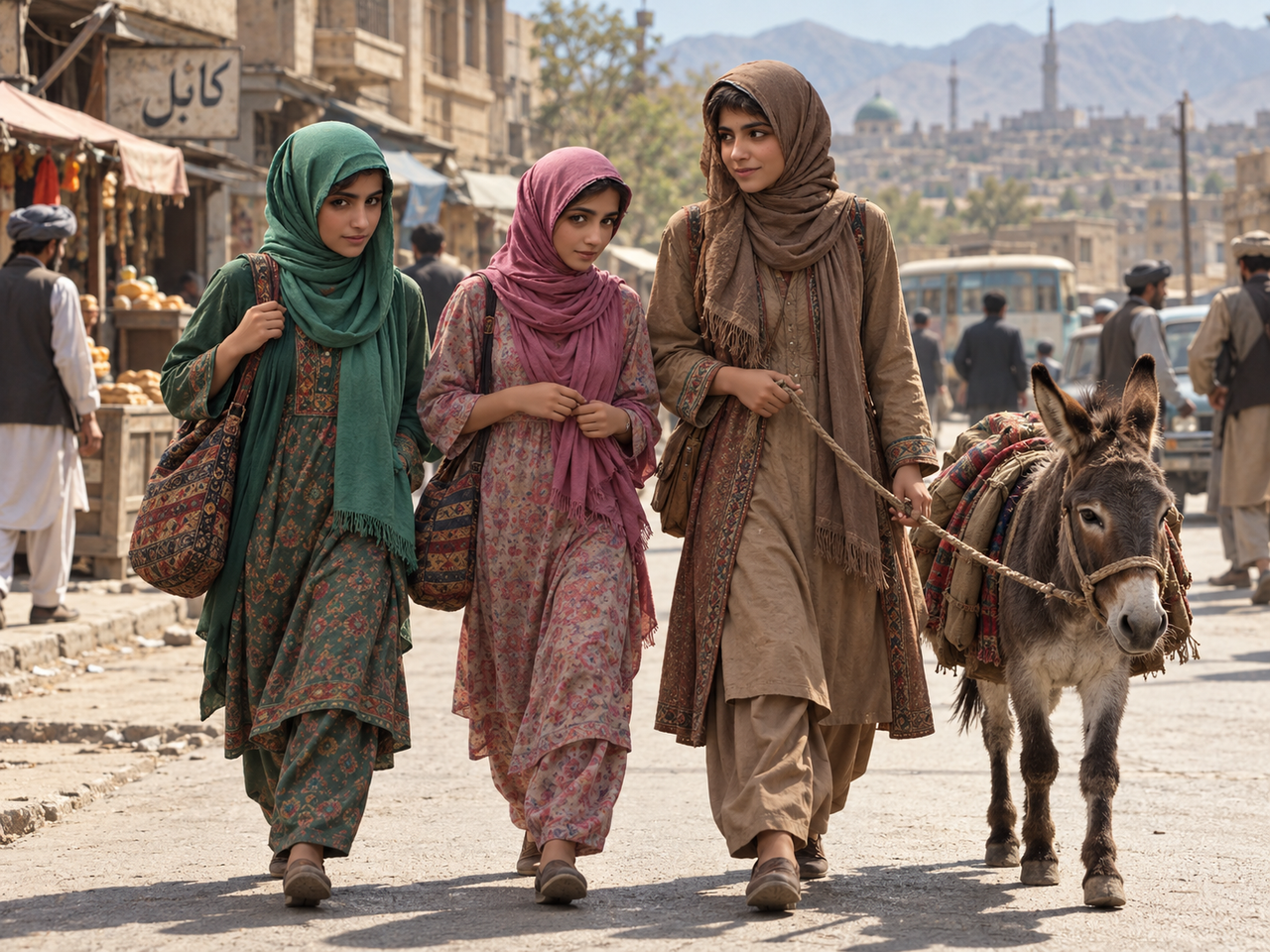
Farida had been walking ahead for the better part of an hour because walking ahead allowed her to pretend that Nasrin was not sitting on Gul while she and Mariam wore their feet down to the bone. Every few minutes she glanced over her shoulder anyway, which weakened the dignity of the protest. The morning had begun cool enough for her to enjoy the climb away from the village, but the sun had climbed with them, turning the pale road white where it curved between low walls and fields.
Dust had gathered along the hem of her green dress and settled in the creases of her shoes. Behind her, Mariam had one hand looped around Gul's lead and the other raised against the glare, while Nasrin rode sidesaddle with the expression of a provincial governor inspecting an irrigation project. "You could come down now," Farida said for what was certainly not the first time.
Nasrin answered that she could, but there was no reason to. Farida informed her that justice was a reason. Mariam, without looking up, said justice had already been consulted and had decided that Nasrin was carrying the event papers, their good shoes, two bottles of water, the apricots, the bread, the clean scarves and the comb. Farida stopped long enough to point accusingly at the packs tied around Gul. "Gul is carrying those things." Mariam considered this and amended the ruling: Gul was carrying the entire expedition and Nasrin was merely exploiting labour.
Nasrin reached down and gave the donkey's neck a fond pat. "Gul and I have reached an understanding." At that exact moment Gul turned off the road toward a patch of scrub, tugging Mariam half a step sideways and forcing Nasrin to clutch the saddle blanket. Farida resumed walking with a satisfied little laugh. "A strong understanding."
She had made perhaps thirty more paces before taking the folded photograph out of the little cloth purse under her shawl. Mariam saw the movement immediately. "Again?" Farida said she had only looked at it once since the village. Mariam said three times, and Nasrin, from behind them, said four. Farida ignored both of them and opened the clipping against her palm, careful despite all her bravado about the dust. Lucille stood beside several women outside some formal building, smiling at something beyond the edge of the frame.
She wore a light suit with the jacket open and one hand resting at her hip, and the people around her seemed to have been arranged by a malicious photographer determined to make her appear impossible.
Farida had drawn a faint pencil line along one edge of the clipping so she could fold it without creasing Lucille's face. Mariam had called that deranged when she discovered it.
Mariam also had two clippings of her own. "Four inches," Farida said. Mariam asked what she was talking about. "At least. The woman next to her is wearing heels and still barely reaches her shoulder." Nasrin said the picture gave no reliable scale. Farida turned around and continued walking backward. "She's supposed to be six foot four." Mariam told her to face the road before she fell into a ditch. "Supposed to be," Farida repeated. "But look at her. Those women aren't tiny. What if she's taller?"
Nasrin said photographs distorted height. Farida replied that if Lucille were six foot four without shoes, and then wore heels, which she plainly did because the Lord had made her both beautiful and unreasonable, the total could approach six foot eight. "No," Mariam said firmly, as though rejecting a medical diagnosis. Farida grinned. "Afraid?" Mariam tucked a loose end of her pink scarf beneath her shoulder. "Of arithmetic, yes. You should be too."
A concrete culvert carried a thin stream beneath the road where the land dipped, the stamped date on its side worn almost smooth. They passed it without slowing. Farther down, electric lines crossed the valley on wooden poles and then climbed toward another cluster of houses, and a white school van came rattling from the opposite direction with girls pressed shoulder to shoulder behind the windows. One waved when she saw the three of them. Farida waved back, then held her clipping flatter against her chest so the draft would not catch it. Mariam gave her a look. "You behave as though you are carrying state papers." Farida said it was rarer than state papers. Nasrin said that depended upon the state.
Farida folded the picture carefully and put it away, then demanded to know why Mariam had brought the Antarctic one if she believed looking at photographs was foolish. Mariam's denial was immediate and much too loud. The Antarctic clipping, she explained, was in her bag because the article had been interesting. Farida wanted to know which part. "The expedition." Farida stared at her. "All that clothing." Mariam's ears coloured beneath the edge of her scarf. "It was cold." Farida said this was precisely her complaint: there were photographs of Lucille in dresses, suits, nursing whites, riding clothes, swimsuits, evening gowns and once, if the magazine were to be trusted, trousers that had nearly caused a national moral emergency, yet Mariam had chosen the picture in which only Lucille's face and hands could be seen.
Mariam replied, with slightly too much feeling, that her face and hands were quite sufficient. Nasrin made a thoughtful sound from Gul's back. Farida spun around. "You agree." Nasrin said she had not said anything. "That sound was agreement." Nasrin denied this. "You have a photograph too." Nasrin's posture became even straighter. "I do not." The sisters looked at each other. Nothing more needed saying.
Farida had tried, more than once, to explain that none of this meant what Mariam claimed it ought to mean. Farida liked men. Everybody knew she liked men because she had spent most of the previous summer finding reasons to pass Rahim's father's repair shop whenever Rahim was outside, and she still went foolish when he smiled at her in the market. Mariam had once announced that she would never marry anybody and then spent three months becoming pink whenever a particular agricultural student visited his aunt in the village. Nasrin had been so taken with a young pharmacist in the district town that the sisters could make her angry merely by pronouncing the first syllable of his name. These were ordinary conditions of life. Lucille was not an ordinary condition.
"She cannot count," Farida said now, returning to an argument apparently begun days before. Mariam asked what could not count. "As evidence. Lucille. If a woman looks like that, she cannot be used to prove anything about anybody." Mariam said this was convenient philosophy. Nasrin, still denying the existence of her own photograph, said it was nevertheless sound. Farida pointed at her. "Exactly. Three sensible women. Men. Marriage. Normal things. Then someone puts Lucille Robinson on television and suddenly God is testing the structure." Mariam tried not to laugh. "You make her sound like an earthquake." Farida folded the clipping with reverence. "Have you seen her walk in heels?" Nasrin muttered that this was why theological arguments should not be conducted before breakfast.
Gul chose that moment to demonstrate that she had no interest in Lucille Robinson, Nawbahar Women's College, or the moral victory of young women travelling to Kabul. A low wall ran beside the road, broken where a farmer had left a gap into a melon patch. Gul saw the opening, paused just long enough for Mariam to mistake contemplation for obedience, then went through it. Mariam followed involuntarily. Nasrin made a noise that began as an order and ended somewhere nearer a shriek as one foot caught against a pack. Farida tried to seize the lead, missed it, stepped into soft earth and nearly lost a shoe.
Gul, discovering that everyone was now willing to accompany her, proceeded with complete serenity toward the nearest green leaves. "Pull her left," Nasrin said. Mariam shouted that she was pulling left. Farida, laughing too hard to be useful, told them both that Gul did not appear politically committed to the left. Nasrin threatened to throw something at her.
A farmer several rows away straightened with a hoe in his hand and watched the scene without any apparent intention of intervening. Mariam finally got both hands on the rope and planted her feet. Gul chewed thoughtfully, yielded two steps, then lunged her neck far enough to steal a mouthful of leaves anyway. Nasrin slid down, scarf half loosened, one side of her brown dress marked with dust. The farmer called that the donkey had excellent taste. Farida bent over with her hands on her knees, overcome by a fresh fit of laughter. "We are going to meet Lucille looking like refugees from a vegetable war."
Nasrin took the lead from Mariam and marched Gul back toward the road. "You are not meeting anyone if you keep laughing." Farida followed, still helpless. "You screamed." Nasrin did not answer. Mariam, traitorously, said she had.
By the time they reached the paved road, all three had abandoned any hope of arriving untouched by the day. Farida had mud dried along one calf. Mariam carried the food bundle because Gul had discovered the apricots and learned that persistent nudging might produce access. Nasrin had repinned her scarf twice. The broad road itself looked almost indecently easy after the track behind them. Buses and farm vehicles moved in both directions, leaving short storms of dust where tyres touched the shoulder.
A faded metal marker stood by the drainage ditch, its older Cyrillic lettering still visible beneath newer Dari paint, and a boxy truck growled past with a red star long ago painted over but not quite erased. Farida raised her arm. The driver passed without slowing. She raised both arms for the next vehicle. Mariam hissed at her to stop. "What?" Farida demanded. "You look as if you're trying to land an aeroplane." Nasrin was walking now, partly from fairness and partly because she had discovered that the safest place around Gul was no longer on top of her. Farida stepped nearer the road and waved again with elaborate determination. A bus driver sounded his horn and kept going. "He saw me." Mariam said everybody saw her.
That was the problem. When the next utility truck appeared around the bend, Mariam merely raised one hand, palm outward. The truck slowed almost at once. Farida stared at her in betrayal. "That was insulting." Mariam smiled sweetly. "Perhaps she prefers signals used by human beings."
The driver was a broad-faced woman with grey threaded through black hair and a cigarette tucked unlit behind one ear. She leaned across to open the passenger door and looked first at the three travellers, then at Gul, then at the packs, then at Farida, whose green scarf had come loose enough for the corner of the Lucille clipping to protrude from the little purse beneath it. "Nawbahar?" she asked. Three voices answered yes so quickly they collided. The woman smiled. "For the speech?" This time Nasrin answered with more control. Yes, for the speech. The driver's eyes moved to Farida's purse. "Or for the speaker?" There followed the kind of silence that made denial childish. Farida attempted one anyway, saying they were interested in the subject of the address.
Mariam asked what the subject was. Farida glared at her. The driver laughed and introduced herself only by necessity, telling them to call her Shukria because "auntie" would make her feel eighty. She could take them as far as a junction beyond the next district. The back of the truck was stacked with cartons of schoolbooks, coils of electrical wire and two wooden crates of ceramic insulators. Gul, who had resisted every human decision since dawn, allowed herself to be led up the loading plank with such calm obedience that Nasrin stood beside the tailgate looking offended. "She likes Shukria better," Mariam said.
Nasrin said Gul was easily impressed by machinery. Farida climbed into the cab between Mariam and the door while Nasrin squeezed in beside Shukria. "If that donkey stays in the truck after Kabul," Shukria said, starting the engine, "I am keeping her." Nasrin replied that by then she might help load her.
Shukria needed less than ten minutes to understand everything the sisters had spent the morning trying to conceal from one another. Farida told her they had left before sunrise, that the college had sent invitations through the district office, that there would be visitors from several provinces, that Lucille was speaking in the main hall, and that Nasrin claimed not to possess a photograph. Shukria glanced sideways at Nasrin with professional interest. Nasrin said Farida had a disease of the tongue.
"My daughter has it too," Shukria said. "Twenty years old. She has spent four days talking about that woman." Farida sat forward. "Really?" Shukria said her daughter had changed her mind three times about what to wear and had ironed a blouse yesterday, decided it made her look twelve, and ironed another. A niece was coming down from the north. One of the teachers at Shukria's sister's school had traded shifts so she could attend. Mariam asked, with suspicious casualness, whether Shukria understood the fuss. Shukria put the cigarette from behind her ear into her shirt pocket before the wind could take it. "I have eyes." Farida beamed. Nasrin sighed. Shukria added that at forty-six she had learned not to behave as though a beautiful woman on television represented a national emergency. Farida replied that this was easy for Shukria because she was not eighteen.
"My daughter says the same thing." "Then your daughter is intelligent." "My daughter also says that if Lucille looked directly at her she would forget her own name." Farida sat back, defeated by the familiarity of this. Mariam said that was absurd. Shukria asked whether Mariam would remember hers. Mariam took perhaps two seconds too long to answer.
The radio crackled beneath the dashboard, disappearing under engine noise whenever the road climbed. They were arguing about whether Lucille's height was exaggerated when the announcer said her name, and the entire cab went quiet so abruptly that Shukria laughed without taking her eyes from the road. Farida leaned toward the speaker. Mariam reached across Nasrin to turn up the volume. The item came among municipal notices, an agricultural report and a short account of a visiting engineering delegation; Lucille Robinson's appearance at Nawbahar Women's College was expected to begin that afternoon, with the main address followed by questions from students and invited guests. A burst of static swallowed half a sentence. Farida heard a word that might have meant earlier and froze. "They changed it." Nasrin asked what. "The time. She said the time changed." Mariam said she had not heard that. Farida insisted that the announcer had said it.
Nasrin demanded that Shukria turn it louder. Shukria snapped that she would gladly listen if three women were not shouting questions over the radio. The announcer moved on to weather. Farida pressed both hands to her cheeks. "We're going to miss her." Mariam said they could not possibly miss her; they had hours. Nasrin, losing all trace of senior composure, demanded whether Shukria knew another station carrying the notice. Shukria changed frequencies until they found a second bulletin ten minutes later. Nothing had changed. The speech remained exactly where it had always been. Relief filled the cab with an embarrassing silence. Farida slowly turned to Nasrin. "You nearly climbed through the windscreen." Nasrin told her to be quiet. Mariam added that Nasrin had sounded close to tears.
Nasrin said she disliked late arrivals. "You did not care this much when the vaccine truck was two days late." Nasrin looked at her cousin with cold dignity. "Vaccines are not scheduled public appearances." Farida made a small triumphant sound. "There she is."
The truck began knocking somewhere beneath their feet fifteen kilometres later. Shukria swore once, affectionately rather than angrily, and pulled onto the shoulder beside a stand of poplars. She listened with the engine running, switched it off, then climbed down and went straight for the tool box behind the seat. Farida asked what had happened.
"Something old is reminding me that it is old." The truck, Shukria explained while unfastening a panel beneath the chassis, had been assembled in a Soviet factory before any of the girls were born and had since acquired an Afghan carburettor, two American electrical components, a replacement fan from Uzbekistan and at least one bolt nobody could identify. "It survives because it has no idea what country it belongs to." She slid beneath the truck on a folded sack.
Nasrin knelt almost at once, peering under the frame. Mariam held the box open. Farida stood on the cleanest patch of ground she could find and asked whether they needed anything. Shukria requested a twelve-millimetre spanner. Mariam handed her a screwdriver. Nasrin corrected her. Farida offered the spanner by its very tip, careful of the grease. Shukria's arm emerged from beneath the truck and stayed there. "Closer." Farida crouched. "Closer." Farida leaned. Shukria's fingers caught her wrist, leaving a dark smear across the skin. "Now you're useful." Farida stared at the grease in horror.
Mariam laughed hard enough to drop a rag. "Lucille will see it from the stage." Farida seized the rag. "Do not joke about that." Nasrin, who had already acquired grease along two fingers, said Lucille would probably assume Farida had repaired the truck herself. Farida looked suddenly interested. "Would that impress her?" Nasrin told her no lie was attractive enough to justify pretending to understand an engine.
The repair lasted half an hour. It was not dangerous, and because it was not dangerous the three younger women quickly became themselves again. Nasrin understood enough from clinic generators and village machinery to follow Shukria's instructions, bracing a fitting while the older woman tightened it. Mariam held tools, checked the water jug and kept Gul from eating cardboard. Farida finally gave up trying to remain clean and lay on one shoulder to reach a nut Shukria could not comfortably see. When the engine started without knocking, they cheered as if they had personally revived a dead patient. Shukria wiped her hands and regarded them with approval. "You travel better than my daughter." Farida asked whether Shukria's daughter would also crawl under a truck for Lucille.
"She would crawl under a moving truck for Lucille, which is why I did not bring her." They were laughing when Farida looked down and discovered another grease mark, this one near her elbow. She groaned. Mariam said it made her look industrious. Farida said she preferred looking beautiful. Nasrin said there was still water, soap at the college, and the clean shoes. Farida held up her wrist. "If she asks to shake my hand—" Mariam nearly choked. "Why would she ask to shake your hand?" Farida said Lucille might greet people in the front row. Nasrin pointed out that they did not know they would be in the front row. Farida said this was exactly the kind of defeatist thinking that kept people from achieving greatness. Shukria, returning the tools to their box, said that if Farida achieved greatness by washing grease from her wrist she expected to be remembered in the speech.
At the junction they unloaded Gul, packs and themselves into a bright wash of midday sun. Shukria refused payment and accepted only two apricots, which she ate while warning them that the next stretch was busier and that they should keep to the shoulder. Before she left, Farida asked whether Shukria would attend the speech herself if she could. Shukria looked toward the road ahead, then back at her cargo.
"I have six schools waiting for books and wire. Somebody has to keep the world running while you three fall in love." Nasrin protested that nobody was falling in love. Shukria raised one eyebrow. "Of course not." She climbed into the cab, then leaned out of the open window. "If she looks at you, remember your names." Farida shouted that she would. Mariam said she would. Nasrin said nothing. Shukria drove away laughing.
For a while the cousins watched the truck shrink into heat shimmer, Gul beside them with ears angled forward as if considering whether to follow. Then Farida shouldered her bag. The next few kilometres would have to be walked. "I hate her," Nasrin said. Mariam asked whether she meant Shukria. Nasrin said yes. Farida said Shukria was wonderful. "Naturally you think so. She encouraged you." "She understood me." "She diagnosed you." Farida fell into step beside them. "And she diagnosed you too." Nasrin tightened her grip on Gul's lead. "There is nothing to diagnose." Mariam said that somebody with nothing to diagnose had spent a great deal of time practising a certain English greeting in front of a mirror the night before. Nasrin stopped dead. Farida's mouth fell open in delight. "You heard her too?"
The accusation followed Nasrin for the next kilometre. She denied practising anything. Mariam repeated the exact cadence she had heard through the thin wall of the room they had shared at an aunt's house the previous night: a careful, low "It is an honour to meet you, Mrs Robinson," each word separated and polished until it no longer sounded like language. Farida copied it with such solemnity that Mariam had to turn away to laugh.
Nasrin threatened to walk back to the village. Farida told her they would miss her deeply and send a photograph of themselves with Lucille. "There will be no photograph." "There could be." "There will be hundreds of people." "Hundreds of women," Mariam corrected. Farida considered this worse. Nasrin resumed walking with a pace intended to end the conversation. It failed. "What would you say after the honour?" Farida asked. Nasrin said nothing.
"Would you tell her you're a clinic assistant?" Nothing. "Would you ask about nursing?" Nasrin's silence changed almost imperceptibly. Mariam noticed. Farida did too. Their teasing softened without vanishing. Lucille's old nursing photographs had always affected Nasrin differently from the glamorous ones Farida collected. She could look at the sea-green dress from the Oscars, the expedition clothes, the tailored suits and the scandalous heels with an appreciation she described as objective. Show her Lucille in a white uniform beside a hospital bed, sleeves rolled, hair pinned back, and Nasrin went very quiet. She had once spent an entire evening reading aloud a translated interview in which Lucille spoke about washing frightened patients, making tea for relatives and remembering that illness made adults feel like children. "You could ask her whether she misses it," Mariam said. Nasrin walked several steps before replying that perhaps she might, if questions were allowed and if there were not hundreds of people and if Farida did not disgrace the family first.
The road flattened as it entered a broad cultivated plain. They passed a repair shop with tyres stacked against a wall, two boys playing football in a patch of shade, and a small health outpost where a woman in a white coat stood in the doorway speaking with an old man. Farida's pace slowed enough for the others to catch her. "I only liked the photographs at first," she said, sounding almost defensive although nobody had challenged her.
Mariam murmured that this was not a revelation. Farida ignored her. "Then I saw that interview from Bosnia. The one where she wouldn't let them keep the children waiting outside the clinic because there was a camera inside." Nasrin remembered. "She made the journalists move." Farida nodded. "And she looked angry. Not pretty-angry. Actually angry."
Mariam said Farida had described that photograph as beautiful several times. "It was beautiful. That is not the point." The point, difficult for Farida to put into words without inviting ridicule, was that Lucille never seemed smaller when she was kind. Farida knew plenty of beautiful women who softened themselves into something decorative when men were present and plenty of strong women whom people described as beautiful only after subtracting everything that made them strong. Lucille appeared to find the entire distinction tedious. She could wear five-inch heels and carry boxes, flirt shamelessly and wash an old woman's hair, tower over a room and then bend her attention toward whoever was speaking as if they were the only person in it. Farida had no language for why that lodged beneath her ribs.
"Also," she added, rescuing herself from sincerity, "her legs are extraordinary." Mariam groaned. Nasrin said that for once she had thought Farida might finish a serious thought. Farida smiled. "I did. Then I added another serious thought."
Mariam's attachment had developed more slowly and therefore, in her opinion, with greater dignity. Farida said this was false because Mariam had once hidden a magazine beneath her mattress. Mariam insisted she had hidden it from their little brothers, who ruined everything they touched. Farida asked why the article had been folded open to a close photograph of Lucille's hands. "Because I was reading it." "For three days?" Mariam gave her the same look she gave village children who claimed goats had eaten homework. She could explain the hands, although she had no intention of doing so for Farida's entertainment.
They were large hands, certainly, but that was not the thing. In photographs from hospitals, relief visits, ceremonies and family events, they were always doing something: holding a cup, steadying an elbow, touching a shoulder, lifting a child, gesturing while she argued, shielding a cigarette lighter from wind in the older pictures, curling around another woman's fingers. They made Lucille seem less like an image and more like someone who inhabited the world physically. Farida listened with increasing delight. "You have thought about this much more than I have." Mariam's face heated. "No." Nasrin said yes. Mariam tried to redirect attention toward Nasrin, whose own interest remained suspiciously undefined.
"At least I have never said I wanted her to pick me up." Nasrin nearly tripped over a stone. Farida stopped walking altogether. "What?" Mariam, who had been saving this information, smiled with terrible satisfaction. "She told Aunt Rukhsana after the television interview last winter that she wondered whether Lucille could lift her." Nasrin's horror was magnificent. "I said she looked strong." "You said you thought she could lift you." Farida's laughter startled Gul. "Nasrin!"
Nasrin's attempt to defend herself only worsened matters. She explained, first, that Lucille was exceptionally tall and visibly strong. Farida agreed with indecent enthusiasm. Second, Nasrin was not heavy. Mariam said nobody had asked for engineering specifications. Third, the conversation had concerned whether strength shown in photographs was real or merely an effect of posture. Farida asked what posture had to do with being carried. Nasrin refused to continue. Farida placed both hands over her heart and looked toward the distant road. "Our mature cousin. Our guardian. Our responsible medical professional." Nasrin said she was an assistant, not a medical professional.
"Our responsible clinic assistant dreams of being swept from her feet by Lucille Robinson." Nasrin caught Farida by the back of the arm and tried to steer her toward a ditch. Mariam intervened only because she was laughing too hard to trust Nasrin's judgment. "I do not dream about it." Farida asked whether she had imagined it while awake. Nasrin's silence answered. The sisters became merciless. Farida wanted to know whether the lifting was bridal. Mariam asked whether Lucille spoke before or afterward. Farida wondered whether Nasrin had planned where her own arms went. Nasrin threatened to abandon both of them with the donkey. This, eventually, made Farida relent. She slipped her arm through Nasrin's for several steps and kissed her shoulder through the cloth. "We love you."
Nasrin said this was not evident. Mariam took her other arm. "It is very evident. That's why we know everything." Nasrin tried not to smile and failed. "If either of you repeat it in Kabul, I will deny we are related."
Their next lift arrived in the form of a produce lorry whose wooden sides rose almost as high as their shoulders. The driver already had passengers, but there was space among sacks of onions, baskets of greens and crates padded with straw. Gul was tied at the rear beside a second donkey that regarded her with immediate suspicion. The human passengers included two women returning from a market, a teenage boy asleep against a sack, and an elderly woman wrapped in a dark blue chador who watched the cousins with bright, appraising eyes. Her name, they learned through the natural exchange of road information, was Bibi Halima, and she had been listening to their destination long before Farida noticed. "Nawbahar," the old woman repeated, as the lorry bounced over a patched section of road. "My granddaughter is there." Mariam asked whether she was a student. "Chemistry. She says she will blow the roof off the country one day." Farida said that sounded impressive. Bibi Halima said it sounded expensive. She asked why they were going, and Nasrin answered carefully that they had received district invitations.
"For the American woman?" Farida nodded. The old woman's eyes sharpened. "The tall one." All three nodded. "The pretty one." Farida's nod became more emphatic. Bibi Halima looked from Farida to Mariam to Nasrin. "Ah." Nasrin did not like the sound of that syllable. "What?" Bibi Halima smiled. "Nothing."
Nothing lasted perhaps three minutes. Bibi Halima asked whether they admired Lucille's work. Nasrin said yes. Mariam said very much. Farida said of course. The old woman asked whether they admired her speeches. Mariam said they did. Whether they admired her courage. Yes. Whether they admired her charity work. Yes. Whether they admired her face. Farida said yes before the others could stop her. Bibi Halima laughed so hard that the teenage boy woke, blinked at everyone and went back to sleep. "There it is." Nasrin insisted that beauty and admiration were not the same thing. The old woman said she had been alive seventy-one years and had learned to recognize girls on pilgrimage.
"This is not a pilgrimage," Mariam said. Bibi Halima looked at the dust on their clothes, the donkey tied behind them, the bags under their feet and the careful scarves folded atop one bundle. "Of course not." Farida, who preferred surrender to bad lying, asked whether Bibi Halima had ever seen Lucille on television. She had. "And?" The old woman pursed her lips. "Very handsome woman." Farida slapped one palm onto her knee in triumph. Nasrin stared at Bibi Halima as if betrayed by age itself.
"You are encouraging them." "At my age I encourage whatever keeps young people walking toward colleges." Farida leaned nearer. "Would you go hear her?" Bibi Halima said she was going to her son's house, where her granddaughter would later describe every detail whether anybody requested it or not. Then she added, with perfect calm, "If I were forty years younger, I might have rearranged my afternoon." Nasrin turned her face toward the open side of the lorry and refused to participate in Farida's delight.
The lorry became a moving court in which each of the three was tried separately. Bibi Halima discovered Farida's clipping first because Farida showed it willingly. Mariam's Antarctic photograph followed under pressure. "Good face," the old woman judged. "Strong nose." Mariam seemed absurdly pleased. Nasrin claimed once more that she carried nothing. Farida and Mariam both objected. Bibi Halima raised a hand for silence, then told Nasrin to open the document pouch because the district paper needed checking before the checkpoint anyway. Nasrin opened it with deliberate care.
The invitation came out. Their identification papers came out. A folded map came out. Beneath the map was a magazine photograph cut so neatly around the margins that a narrow white border framed Lucille from head to heel. She stood on a quay in dark trousers and a pale blouse, one hand shielding her eyes from sun. Nobody spoke. Nasrin tried to put it back. Farida caught her wrist. Mariam made a sound halfway between outrage and admiration. "That is the best one." Nasrin said it had come with a newspaper. Farida asked what newspaper printed photographs on glossy magazine stock.
Nasrin said she did not remember. Bibi Halima held out her hand. Nasrin, trapped, passed it over. The old woman inspected Lucille carefully, then inspected Nasrin. "This one dreams." Farida nearly fell sideways against a sack of onions. Nasrin retrieved the photograph with such dignity that even Bibi Halima spared her another remark for nearly five minutes.
The checkpoint outside the capital was little more than a roofed lane, a striped barrier and a low office beside the road. Two policemen waved vehicles through while a policewoman climbed onto the lorry's side step to check passenger papers. She wore a pale uniform shirt beneath a dark vest, her hair covered in a practical navy scarf, and she had the tired expression of somebody who had already answered the same questions all morning. Nasrin produced the documents. The officer checked the three names, asked where they had begun their journey and whether Gul belonged to them, then looked at the college invitation.
Her expression changed minutely. "Another group." Farida asked another group of what. The officer did not answer. Nasrin, searching for one additional district stamp, opened the pouch too widely. Farida's clipping slid loose. Then Mariam's folded Antarctic article. Then, in what Farida would later insist was divine intervention, Nasrin's carefully trimmed photograph slipped from beneath the map and landed face-up on the bench beside the officer. The officer looked down at three Lucilles. She looked up at three women. Bibi Halima made no attempt to hide her smile. Nasrin said the loose papers were unrelated.
"Naturally," the policewoman said. She picked up Nasrin's photograph by one corner. "This newspaper of yours trims around the subject very neatly." Farida stopped breathing. Mariam bit the inside of her cheek. Nasrin stared straight ahead. "My cousin cut it." Both sisters turned toward her in outrage. The officer laughed, handed everything back and waved the lorry forward. "Hurry. The college district is already crowded." Farida's amusement died instantly. "How crowded?" The officer had moved to the next passenger. "Crowded enough that I have seen her face thirty times since breakfast."
The three cousins sat with that information as the lorry rolled toward Kabul. Until then, other admirers had been funny in manageable numbers: Shukria's daughter, a niece, a teacher, Bibi Halima's granddaughter. Thirty photographs at one checkpoint created an army. Farida looked offended by the existence of competition she had never been promised freedom from. Mariam began calculating capacity under her breath. Nasrin said the invitations had row assignments somewhere. Mariam pointed out that theirs only guaranteed admission, not position.
Farida took out the folded paper and read every line as if a hidden sentence might materialize under pressure. Bibi Halima watched them with increasing enjoyment. "Did you believe she was coming only for you?" Farida said no. "You look as though somebody has told you your fiancé has three other wives." Farida replied that she did not have a fiancé. The old woman said that appeared fortunate, given present circumstances. Nasrin told Farida to stop worrying. They had the invitations. They would be inside. "Inside where? At the back? Behind a pillar?" Mariam said hearing Lucille mattered more than seeing her. Farida turned to stare at her. Mariam lasted three seconds. "I would also like to see her."
Nasrin said the hall could not possibly have pillars placed to obstruct half the audience. Farida asked whether she had ever been in it. Nasrin had not. "Then you don't know." The lorry passed beneath a line of tall trees. Buildings thickened on both sides, first workshops and yards, then apartment blocks behind walls, then offices and shops where the pavement carried more people than Farida was accustomed to seeing in an entire market day. Her anxiety had no room to settle because Kabul kept arriving.
It did not arrive all at once. A trolley of machine parts. A row of bookstalls. A bus painted blue and cream, its windows crowded with students. A woman in a white medical coat cycling with a satchel across her back. An old concrete apartment block with laundry bright against balconies. A newer office building with mirrored glass that reflected a minaret across the road. Shop signs in Dari and Pashto, one repair yard still carrying a line of Russian beneath the newer lettering because nobody had bothered to paint it out. A clinic with a generator enclosure stamped with an American manufacturer's name beside electrical boxes of older Soviet make. Men in work clothes standing around tea glasses.
Women in office skirts beneath long coats, women in chadors, women in patterned village dress, women in hijab carrying textbooks against their hips. Nasrin had been to Kabul before, but not often enough for it to stop widening something inside her. Mariam watched everything with the alertness she normally reserved for reading. Farida watched the women carrying programmes. The first could have been coincidence. The second held a folded sheet with Nawbahar's blue crest. The third carried flowers wrapped in paper. Farida's head turned so sharply that Nasrin noticed. "No." Farida pointed. "Flowers." Mariam saw them too. "That was clever."
"Why didn't we bring flowers?" Nasrin asked what they would have done with flowers through a melon patch, under a truck and in a produce lorry. Farida said they would have protected them. Mariam looked at the dust ground into Farida's sleeve. "With what part of our demonstrated competence?"
They left Bibi Halima near a market where her son was waiting, and the old woman kissed each of them before she went. She pressed Farida's cheek between finger and thumb and told her not to faint because people would step over her to reach better seats. Farida promised nothing. Nasrin thanked her for the company. Bibi Halima patted Nasrin's hand and murmured that being carried was easier if one did not go rigid. Nasrin's face became a furnace. The old woman walked away before either sister could react, which only improved the joke. They found a place to leave Gul at a public stable attached to a transport yard after Nasrin negotiated a fee with an attendant who promised water, shade and absolutely no access to melon patches. Gul went willingly, confirming again that the donkey's deepest loyalty was to strangers. "She's tired of us," Mariam said. Farida replied that the feeling was mutual. Without Gul, they felt abruptly lighter and more exposed.
Their packs were now on their own shoulders, the city around them larger, and Nawbahar still several districts away. A city bus stop stood down the road beneath a metal shelter. Half the women waiting there seemed to be carrying some version of the same programme. Farida slowed. "This is becoming serious." Mariam said it had always been serious. "No, this is organized opposition." Nasrin told her to stop describing other women as an occupying army. Farida said she would stop when they stopped bringing flowers.
The bus arrived already crowded and became more crowded when they boarded. Nasrin found a rail to hold. Mariam was pressed beside a window. Farida ended up between two nursing students whose white coats were folded over their arms. Their conversation required no introduction because one of the students saw the blue crest on Farida's invitation and asked where she had come from. When Farida named the district, the woman whistled softly. "For Lucille?" Farida said yes. The student said she had travelled from farther north the previous evening and slept on her aunt's floor.
Her friend had skipped a laboratory session, with permission, because half the instructor's class had tickets and the instructor herself had gone to the college early. Across the aisle, a married woman carrying a little girl laughed and said her husband had bought her ticket after she had spent a week talking about Lucille over dinner. "He said he wanted peace in the house." The little girl, perhaps nine, corrected her mother: Father had said he wanted one evening in which Mother did not describe Lucille's shoulders. The bus erupted around them. The mother covered the child's mouth too late. "Traitor." Farida looked radiant. Mariam looked horrified. Nasrin, three bodies away, pretended not to know either of them.
The collective confession spread through the bus because shame had no chance against numbers. A teacher in her thirties said she was attending for professional reasons. Her sister, seated beside her, opened a handbag and produced a glossy picture of Lucille in an evening gown. The teacher snatched at it. Her sister held it out of reach and announced that professional reasons apparently lived in a frame beside the teacher's bed. A grey-haired woman near the front said her daughters had ordered her to take notes on the speech, but she intended to take notes on the shoes as well.
One of the nursing students had memorized a translated article about Lucille's years in hospital work. Another woman, who wore a wedding ring and spoke with the serene confidence of somebody who had already embarrassed herself at home, said she did not understand why everybody behaved as if marriage to a man had blinded her. "My husband thinks she's beautiful too. He simply lacks my good sense in how to appreciate her." This prompted an argument over whether Lucille looked better in formal clothes or practical ones. Farida joined at once. Mariam resisted until someone dismissed the Antarctic photographs as unflattering. "They are not unflattering," she said sharply. Farida turned toward her with wicked delight. The woman beside Mariam asked which one she meant. Mariam described the photograph in more detail than was compatible with indifference. By the time she realized what she had done, three strangers were smiling at her. "The face," she said. "I meant the face." Farida said nothing because silence could be crueller.
Height became the bus's governing scientific problem. One woman claimed to have seen Lucille at an event in Herat years earlier and swore that six foot four was nonsense. "I stood beside a man who was six foot four. She was taller." Somebody asked whether Lucille had been wearing heels. She had. This was judged invalid evidence. A second woman said Lucille had once stood beside an athlete listed at six foot five and appeared level with him even before the shoes were considered. A student countered that published heights were unreliable and men often added an inch.
Farida said this was true and therefore Lucille might be six foot six. Nasrin begged them not to encourage her. The grey-haired woman at the front turned around and said six foot six seemed plausible. Farida put both hands over her face. "That is unfair." The nursing student beside her asked unfair to whom. Farida refused to answer. Mariam, who had begun the journey as the sceptic, unexpectedly defended the higher estimate by citing the shoulder line in a photograph from an awards ceremony. Nasrin stared at her.
"You mocked us for this exact discussion." Mariam said new evidence required intellectual flexibility. Farida asked whether intellectual flexibility also explained why Mariam was blushing. The bus lurched around a corner, forcing them all sideways, and for a few minutes the argument dissolved into laughter and complaints about crushed shoes.
By the time Nawbahar's district came into view, the bus had acquired the atmosphere of a wedding party with no bride. Women called information up and down the aisle. Someone said the gates had opened. Someone else said the hall was already half full, which turned out to be a rumour from a cousin who had spoken to a roommate who had spoken to a gate attendant. Farida began checking the invitation every thirty seconds.
Nasrin told her paper could not change through observation. Mariam said Farida was trying to intimidate the row number into improving. Farida replied that perhaps it would. When the bus stopped three streets from the college because traffic had thickened too badly to continue, passengers poured out almost as one body.
The pavements were crowded with women moving in the same direction. College volunteers in blue sashes stood at intersections giving directions. A line of municipal police kept vehicles from blocking the crosswalk. No one seemed alarmed by the crowd; they seemed prepared for it, which somehow made Farida more nervous. The tall gates of Nawbahar appeared beyond a row of trees, banners hung along the railings and students clustered under them checking invitations. For the first time all day, the three cousins stopped joking. The place was real. They had spent hours turning Lucille into a road game because distance had made her safe. Now the college had her name printed across a banner large enough to read from half a street away.
Farida looked down at herself and discovered the full extent of the journey. Dust streaked the lower half of her dress. One sleeve carried the faint grey memory of the truck. Her shoes looked as though she had walked from their village to Moscow. Mariam had a crease across the front of her dress from the produce lorry, and Nasrin's brown scarf had collected a fine layer of road dust along one edge. "We cannot go in like this." Nasrin said they were not going in like this. She had spent the entire day carrying their better things for a reason.
A college volunteer directed them toward a women's washroom in an auxiliary building where visitors from outside Kabul were already performing the same emergency repairs. The room smelled of soap, powder and damp cloth. Mirrors above a row of basins reflected an army of women repinning scarves, brushing hems, changing shoes and borrowing combs. Nobody stared at the three newcomers because nearly everyone looked as though she had arrived through some smaller private disaster.
Farida relaxed immediately. "Civilization." Mariam said civilization was not lipstick. Farida opened her bag and produced a small tube. Mariam stared at it. "You said there was no room for a third bottle of water." "There wasn't." "There was room for that." "Obviously." Nasrin, washing her hands, closed her eyes as if asking heaven for patience.
The transformation took nearly forty minutes because none of them was willing to admit how much she cared. Farida scrubbed the grease from her wrist until the skin pinkened, then changed into her good shoes and repinned the green scarf so the fabric framed her face more neatly. Mariam washed dust from her hands, shook out her skirt and borrowed a tiny mirror from a student who had come from Ghazni. She reapplied no makeup because she wore almost none, yet she spent several minutes smoothing the same section of pink scarf over her shoulder. Nasrin changed shoes last and claimed she was ready before either of them. Farida inspected her.
“Your scarf." Nasrin said it was fine. Mariam tilted her head. "The left side is lower." Nasrin immediately turned toward the mirror. The sisters exchanged a look behind her back. "It is not lower." "A little," Farida said. Nasrin adjusted it. "Now?" Mariam said perhaps too high. Nasrin adjusted it again. Farida bit her lip. Nasrin caught their reflections and turned. "I hate both of you." Farida came up behind her and gently straightened the fold at Nasrin's temple.
"No, you don't." Nasrin watched her in the mirror. Some of the strain left her face. "No. I don't." Then Farida dabbed lipstick onto her own mouth and Nasrin said, "Too much," restoring balance.
Around them, strangers behaved with the generosity of women united by a ridiculous objective. Pins passed from hand to hand. A teacher lent powder to a student. Somebody produced a sewing kit and repaired a torn cuff for a woman she had met two minutes earlier. A girl near the door was crying because one of her shoes had split at the strap; an older visitor gave her a spare pair from a bag and refused payment. Farida noticed these things without turning them into lessons. They simply became part of the day, like the road and the bus and the donkey. Mariam found a faint smudge on Nasrin's sleeve and brushed it away. Nasrin tucked a loose thread under Farida's cuff. Farida took Mariam by both shoulders and told her to stop touching her scarf because she was making it worse. "I am not." "You have rearranged that fold twenty times."
Mariam dropped her hands. "It keeps changing." "Fabric does not become nervous." "You don't know that." Their reflection showed three women who no longer looked as if they had crawled from beneath a truck, though Farida thought the day's travel still lived in their eyes. She suddenly wondered whether this entire expedition had been foolish. The thought arrived without warning and had enough seriousness to quiet her.
Mariam seemed to catch it from her expression. "What?" Farida said nothing. Nasrin waited. At last Mariam asked, very softly, "Have we been idiots?" Farida looked at the doorway leading back toward the campus. "We can decide after." Nasrin, after a moment, nodded. "After."
They emerged into a courtyard washed with afternoon light. Nawbahar's buildings were a mixture of older stone, practical concrete and a newer glass-fronted wing that reflected the trees. Students moved between tables where volunteers checked papers, distributed programmes and directed visitors toward different entrances. A group in medical whites hurried past carrying clipboards. Two engineering students argued beside a display of bridge models that had evidently been moved out of the main foyer to make room for the crowd. The cousins joined the line marked for district guests.
Farida began counting women ahead of them, stopped at thirty-seven and started again because she had lost track. Nasrin told her it made no difference. Mariam read the programme from cover to cover, including the acknowledgments. At the registration table, a volunteer took their invitations, checked the district stamp and searched a typed list. "Safi, Farida. Safi, Mariam. Safi, Nasrin." The three leaned forward together. The volunteer marked each name. "You came from the eastern district?" Nasrin said yes.
"Then you're in reserved seating." Farida blinked. "Reserved?" The volunteer handed back three little cards with numbers printed at the bottom. "The college kept places for outlying districts. City students can get here on a bus. You can't." Farida looked at the card. Row A. For several seconds she assumed the letter indicated a section rather than a row. "What does A mean?" The volunteer looked puzzled. "Front row."
Mariam took the card from Farida and read it herself. Then she read Nasrin's. Then her own. All three said A. Farida's face emptied. Nasrin gripped both cousins by the wrists hard enough that Mariam nearly dropped the programme. "Do not make a sound," Nasrin said. Farida whispered that she had not. "You are about to." "We're in the front." "I can read."
"The front front?" Mariam said there was only one front. Farida looked toward the hall entrance as if someone might come running to correct the error. "There has been a mistake." The volunteer, still within hearing, said there had not. Another staff member pointed them toward a side door reserved for the district rows. Farida walked because Nasrin pulled her. Mariam walked because Farida had hold of her hand. "Front row," Farida said again. Nasrin ordered silence. "She's going to see us."
"She is going to see a room." "We are in the room." "So are eight hundred other women." "We are at the front of the eight hundred." Mariam, who had been strangely quiet, said, "What if she shakes hands?" Nasrin stopped so abruptly that the women behind them nearly collided with her. Farida stared. Mariam stared. Nasrin resumed walking at once. "Nobody is to discuss hands."
The hall was cooler than the courtyard and much larger than Farida had imagined. Rows of upholstered seats descended slightly toward a broad stage where Nawbahar's emblem hung against a deep blue curtain. A lectern stood to one side. Three chairs and a low table had been arranged behind it, with glasses and a jug of water catching the overhead light. The front row seemed impossibly close. Farida could have crossed the distance to the stage in six or seven quick steps.
A volunteer guided them to three seats near the centre and asked that they keep the aisle clear. Nasrin sat first. Mariam sat beside her. Farida remained standing for a second longer because sitting made the position feel permanent. Then a woman behind asked politely whether she was saving the seat for someone, and Farida dropped into it. The entire journey compressed itself inside her body at once: the rough road, Gul's melon theft, Shukria's truck, grease beneath her fingernails, the produce lorry, Bibi Halima's laugh, the crowded bus. They had been moving since darkness. Now there was nowhere else to go. Lucille would come to them.
Mariam opened the programme. Closed it. Opened it again. She smoothed the same fold in her dress with the side of her hand, then caught Farida watching. "What?" Farida said nothing. Nasrin sat very straight with her knees together and hands folded over her bag, the image of a sensible twenty-two-year-old woman who had never in her life wondered what it would be like for Lucille Robinson to pick her up. Farida's mouth twitched. Nasrin saw it. "If you say anything, I will leave." Farida gestured at the front row.
"You will not." Nasrin's eyes narrowed. Mariam leaned across. "Do you remember your English?" Nasrin's composure cracked for half a heartbeat. "Yes." Farida whispered, in Nasrin's careful practice cadence, "It is an honour to meet you—" Nasrin pinched the inside of Farida's arm without moving her face. Farida swallowed a yelp. "Violence at a women's college." "Self-defence." Mariam whispered that they were both behaving like children. Farida said Mariam had been rereading the same line in the programme for five minutes. Mariam looked down. She was holding it upside down.
The hall filled gradually around them, which was worse than if it had filled at once. Every few minutes another cluster came through the doors, voices rising and settling, scarves bright against the dark seats. Students in medical whites took places near the aisle. Engineering students arrived carrying notebooks as if refusing to acknowledge they were excited. Trainee teachers came in groups, talking fast and then stopping whenever anyone approached the side door. Older faculty members sat together near the front. A group of girls from a secondary school filled part of a rear section under the supervision of two teachers who had already given up asking them not to whisper.
Women from rural districts were scattered through the reserved rows, some with daughters, some with sisters, some alone. Flowers appeared everywhere. Farida tried not to resent them. One bouquet was so large it looked capable of blocking the recipient's view; this cheered her considerably. The bus had made the Lucille phenomenon feel comic and collective, but the hall made it immense. Hundreds of women had rearranged work, classes, travel and family obligations to be here. Farida looked over her shoulder once and immediately turned back. "Don't," Mariam whispered. "What?" "Look behind us. It makes it worse." Farida agreed.
A technician came onto the stage and approached the lectern. She was short, compact, carrying a coil of cable and a notebook. The room barely noticed her until she gripped the microphone stand and raised it several inches. Farida went still. Mariam saw the movement and immediately looked away. The technician stepped back, checked something written in the notebook, then raised the microphone again. Nasrin inhaled through her nose. Farida slowly turned toward Mariam. Mariam's gaze fixed on the programme with supernatural intensity. The technician called to someone offstage.
A second woman came out, looked at the stand, made a small measuring gesture with her hand and lifted it another two inches. Farida's shoulders began to shake. "No," Nasrin whispered. Farida pressed her lips together. Mariam's face had gone pink. "Nobody says anything." The second technician moved the lectern's reading light upward as well. Farida made a strangled sound that she disguised as a cough. A woman in the row behind asked whether she needed water. Farida shook her head helplessly.
The microphone rose one final time. Mariam closed her eyes. Nasrin whispered, "If either of you laughs, I will die." Farida leaned closer. "Six foot four, you said." "I said nothing." "The microphone disagrees." Nasrin stared straight ahead. "There are moments in life when silence is a virtue." Farida's entire body trembled with suppressed laughter.
The laughter passed, leaving them oddly tender toward one another. Farida reached beneath the armrest and found Mariam's hand for no reason she could explain. Mariam squeezed once and did not tease her. Nasrin looked over, saw their joined hands and placed her own briefly over both before returning it to her lap. Onstage, a staff member tested the microphone with a few ordinary words that boomed too loudly through the speakers and made half the audience jump. The sound was adjusted.
A glass was replaced because someone noticed a mark on it. The jug of water was moved an inch to the left. These tiny preparations became enormous because each one meant Lucille's arrival was no longer a story told in future tense. Somewhere in the building she might already be removing a coat, greeting the college president, asking for water, towering over a corridor full of people. Farida imagined footsteps behind the curtain and then scolded herself because she had no idea what Lucille's footsteps sounded like.
Mariam whispered that perhaps they should think of a question. Nasrin said she had one. The sisters turned at once. Nasrin refused to share it. "Because you'll ruin it." Farida promised she would not. Nasrin said this promise had no value. Mariam offered to hear it without Farida. Farida objected. Nasrin smiled despite herself and kept the question private.
Farida had assumed all morning that proximity would make her bolder. Distance encouraged extravagant thoughts. On the road she had declared that if Lucille looked at her, she would look back. In the truck she had said she could manage a handshake. On the bus, surrounded by strangers equally afflicted, she had suggested she might even say something clever. Sitting seven paces from the lectern, she discovered that all of these claims had been fraud. Her stomach felt hollow. She could not remember the English greeting she had mocked Nasrin for practising. She was not even sure she could manage Dari if spoken to unexpectedly. Worse, the person she had reduced to beautiful photographs all day began expanding again into the other reasons Farida had wanted to come.
She thought of the Bosnia interview, Lucille moving journalists out of a clinic doorway so frightened children could enter. She thought of a television report in which Lucille had knelt to speak with a woman who had lost her home and never once looked toward the camera while the woman answered. Beauty had opened the door. Everything else had refused to leave. Farida glanced at the front edge of the stage. "I may be sick." Mariam said she was not allowed. "Why?" "Because we came too far and you are wearing the good shoes." Farida laughed softly enough not to disturb anyone. "Thank you for your compassion." "I am compassionate about the shoes."
Mariam was having her own difficulty with the shrinking distance. She had imagined Lucille as a person more easily than Farida had, perhaps because she preferred interviews to portraits, but the person had always existed safely behind paper and glass. A photograph could be studied without consequence. Hands could be noticed. A smile could be stared at. An article could be reread until the words became familiar enough to feel private. Real people looked back. Real people noticed the expression on somebody's face.
Mariam found herself wondering whether her interest would appear childish from the stage, whether Lucille would see a pink scarf, a serious young woman and nothing more, or whether some humiliating portion of her thoughts might somehow be legible. She knew this was absurd. She also knew absurdity had governed the entire day. Farida noticed her staring at the empty lectern. "Hands?" she whispered. Mariam elbowed her lightly. "Legs?" Mariam whispered back. Farida's smile became dreamy.
Nasrin murmured, "Both of you are disgraceful." Mariam leaned toward her. "Lifted?" Nasrin closed her eyes. For several seconds the three fought silent laughter again, heads bowed as though engaged in prayer. When it passed, Nasrin whispered that she had changed her mind and was never travelling with either of them again. Farida said that was fine; she and Mariam would take Gul. Nasrin replied that Gul had shown better judgment than either sister and was staying with her.
Nasrin's private question was simple enough that she hated herself for rehearsing it. She wanted to ask whether Lucille missed nursing. Not whether she missed hospitals, or uniforms, or being younger. Whether she missed the intimacy of useful work: entering a room because someone needed something immediate and real, not because a crowd wanted a speech. Nasrin had spent two years at the village clinic doing the least glamorous parts of care. She washed instruments, tracked supplies, kept anxious relatives from crowding treatment rooms, filled forms, carried basins, held children still for injections and sometimes sat with women who had come too early or too late with pregnancies no textbook could make fair.
She was not a nurse. She had no desire to pretend she was. Yet Lucille's old descriptions of nursing had felt recognizably close to the thing Nasrin loved: usefulness measured in small actions nobody applauded. Fame seemed like the opposite of that. Nasrin wanted to know whether a woman could become famous enough to fill an auditorium and still miss changing sheets. The question mattered. Unfortunately the same woman also possessed shoulders Nasrin had thought about in bed, so the dignity of the inquiry was compromised beyond repair. She looked at Farida and Mariam. They were whispering about whether Lucille would wear heels. Nasrin decided not to tell them anything.
A murmur moved through the hall without an obvious source. Farida straightened before she understood why. Nothing had happened. The side door remained closed. The college president sat in the first chair onstage speaking with another faculty member. Yet the room changed by degrees. Conversations lost volume. Women checked watches. Programmes folded shut. The secondary-school girls in the back became a little less unruly. Someone near the aisle stood to see over the heads in front of her and then sat again. Farida's pulse accelerated in response to everyone else's. Mariam reached for her hand again, this time deliberately.
Nasrin adjusted her scarf, then realized she had done so and dropped both hands into her lap. "Do not touch it again," Farida whispered. "I wasn't." "You were." "I was checking." "Checking what?" "Nothing." Mariam said the left side was perfect. Nasrin glared at her. Farida asked whether her lipstick was still visible. Mariam said yes. Nasrin said too visible. Farida wiped at it. Mariam caught her wrist. "Now you're making it uneven." For a few ridiculous seconds all three became absorbed in Farida's mouth while the auditorium moved steadily toward silence.
A faculty member crossed the stage and whispered to the president. The president nodded. The message travelled to another woman, who rose and disappeared through the side door. Farida stopped breathing. Mariam stopped touching her hand. Nasrin's face went completely still. There were no announcements yet, only ordinary movements seen through the magnifying glass of expectation. Behind them, somebody whispered that Lucille had arrived. A second voice asked how she knew. The first voice said her friend was outside. A third said she had heard the car at the gate.
Farida did not turn around to identify any of them. Her eyes remained on the side curtain. "She is here," she said. Mariam said perhaps. Farida looked at her. "You heard." "Rumours are not evidence." Nasrin said that the college president had just been told something. Mariam asked how Nasrin knew it concerned Lucille. Nasrin said because she had eyes. Farida smiled despite the pressure in her chest. "Our sceptic has abandoned scholarship." Mariam would normally have answered. She did not.
The room's warmth seemed to gather in Farida's face. She thought suddenly of Shukria telling them to remember their names and almost laughed. Her own name felt strange already. Farida Safi. Eighteen. Green scarf. Dust beneath the good shoes despite everything. She had walked, ridden, hitched and argued her way here. Beside her sat Mariam, born ten months after her and therefore forever, in Farida's private arithmetic, both younger sister and closest rival. Beyond Mariam sat Nasrin, four years older, wiser whenever wisdom was convenient, equally foolish whenever Lucille appeared in a photograph.
Their hands were separate now, but the space between them felt charged with the entire road. Farida wished absurdly that Gul could see the hall, not because Gul would care but because she had been present for the beginning and it seemed wrong to leave her out of the end. She imagined the donkey eating through a sack somewhere and almost laughed again. Mariam looked at her, understood nothing, and smiled anyway.
The college president stood. Hundreds of voices collapsed into a low final rustle. Farida's hand moved before thought and seized Mariam's. Mariam seized Nasrin's. Nasrin gripped back so hard that both sisters felt her knuckles press into theirs. Nobody complained. The president stepped toward the microphone that had been raised and raised and raised again. A staff member near the side entrance opened the door. For one instant Farida saw only a strip of brighter corridor beyond it and the shoulder of someone passing.
The hall leaned toward that brightness without physically moving. Mariam's programme lay forgotten in her lap. Nasrin's English sentence, polished the night before, vanished completely. Farida could hear her own breathing and the faint hum of the sound system. Somewhere behind them a woman whispered, with certainty this time, "Lucille."
Farida did not answer. Neither did Mariam. Neither did Nasrin. The three sat in the front row with their fingers locked together, all the jokes they had carried from the village suddenly unavailable, staring at the still-empty edge of the stage as if it were the narrowest possible horizon. They had spent the day chasing a woman who existed in clippings, radio bulletins, stories, arguments, impossible measurements and one carefully hidden photograph.
Now she was only a door away. Farida's shoulders no longer shook with laughter. Mariam had stopped smoothing her dress. Nasrin no longer cared whether she looked twenty-two, responsible or composed. The raised microphone waited above the lectern. The glass of water caught the light. The side door remained open for another heartbeat, and the whole auditorium held itself ready.