
Work Text:
The rental started as a dot on a Thomas Guide.
Sonia Keating, the show’s location manager, spread the book across her desk on the backlot—third-floor production bungalow that rattled whenever an air conditioner kicked on—and traced a finger from their Hollywood soundstage down to the rectangle labeled “El Segundo High School.” She liked the neatness of the place on paper: stadium, oval track, separate faculty lot for base camp, proximity to a city office that answered phones. “Forty minutes without a prayer,” she told her assistant, Max. “An hour if we forget to bribe the traffic gods.”
“Saturday shoot,” Max said, clicking a ballpoint and adding it to the call sheet mock-up. “We can run a skeleton custodial crew. I’ll bring cash for walkies and a peace offering for the groundskeeper.”
Sonia snorted. “Bring respect for the groundskeeper. Cash is nice, but respect gets you last-minute electricity.”
In 1992, permits were paper and patience. Sonia called the City of El Segundo Film Office and the school district office; both faxed back forms that smelled faintly of toner and bureaucracy. She slid the pages onto a clipboard: indemnification language, hold-harmless clauses, insurance minimums. She walked them down the hall to production, where a coordinator stamped the company seal onto a Certificate of Insurance—$2 million general liability, $1 million auto, statutory workers’ comp—naming “El Segundo Unified School District, City of El Segundo, and El Segundo High School” as additional insureds.
Then came the first real hurdle: the track team.
The principal, a precise woman named Dr. Meredith Dwyer, met Sonia at a round table in the main office beneath a framed aerial photo of the campus. To her left sat Coach Alvarez, whose forearms were sun-freckled maps of loyalty. To her right, a site rep the district had assigned—Carl, custodian by title, guardian by vocation. Everyone shook hands like negotiators.
“We need the stadium, the track, one classroom, and the girls’ locker room corridor for a passing shot. Six a.m. load-in, wrap by five,” Sonia said, unclipping a pen. “Saturday in late spring. We’ll sandbag the dolly track off the lane lines and keep spikes on the rubber. No adhesives on the surface. All ‘students’ will be adult background. No real kids on camera. We’ll cover school logos and leave the place better than we found it.”
Coach Alvarez leaned back, skeptical. “I’ve heard that before. What happens when your dolly leaves divots and my hurdlers twist an ankle?”
“We’ll mat the high-traffic zones,” Sonia said. “I’ll put it in writing and give you a direct number. If you see anything you don’t like, you call me, and I will fix it that second.”
Carl’s voice rumbled like equipment being wheeled down a hallway. “Generators go where?”
“Faculty lot. We’ll lay cable runs with crossovers and orange cones. You’ll have final say on where we park, and we’ll keep a fire lane open. We bring our own restroom trailers; we won’t crowd yours.”
Dr. Dwyer folded her hands. “Testing is the following Monday. If your footprint interferes with preparation, we cannot proceed.”
“It won’t,” Sonia said. “We’ll schedule a walkthrough Friday afternoon with your head custodian. We’ll identify anything sacred and post a site map for our crew. If anything looks off, we adjust on the spot.” She slid over a one-page “good neighbor” letter the show used on every location: calm fonts, emergency contacts, a paragraph promising civility. “We’ll also notify nearby residents about the parking and generator hours.”
The principal considered this, then tapped the edge of the insurance certificate. “And the fee?”
Sonia named a number. Dr. Dwyer named a larger one. They met in the middle, with a condition: a donation to the school’s track program earmarked for new hurdles and a set of starting blocks. Sonia smiled. “We’ll deliver them with a bow.”
The contract arrived by fax three hours later. Sonia initialed every page, hand-carried it to legal, then to accounting, then back to the fax. The machine wheezed and sang; signatures crawled through from the other side like a message beamed from a friendlier planet. By dusk, the school was theirs—if only for one day, a small miracle paid for with promises and a cashier’s check.
Scouting was ritual. Sonia and Max walked the campus with Polaroids and a legal pad. They noted the angle of the afternoon sun on the bleachers, the power outlets by the concession stand, the staircase where a pep talk might feel private. They tasted the air and noticed what camera would never capture: ocean salt inside the scent of cut grass, the hush that pools under aluminum seats, the way a seagull will always find an unattended granola bar.
In the faculty lot, Carl pointed with a ring of keys. “Put your base camp along that fence or the band director will complain. That power box is clean. The scoreboard is finicky—don’t promise me it’ll light unless you want to learn new swear words.”
“We’ll bring a genny,” Max said, writing it down. “Any neighbors call about noise?”
Carl shrugged. “They live by the airport. Noise is the tax.”
Which is how Saturday started with a plane hold.
Crew call, 5:00 a.m. The sky was a soft bruise, the stadium lights painting cones of brightness onto empty lanes. Trucks nosed in along the fence; a honey wagon blinked awake; crafty brewed coffee that could strip paint and save souls. Sonia chalked lane crossings where cable would run and taped off the first row of bleachers with blue painter’s tape. “No gaffer’s tape on paint,” she told a grip who’d reached for the wrong roll. “We’re guests.”
“Plane!” Sound hollered as the first departure from LAX arced overhead. Everyone paused. You couldn’t win that fight. You waited it out and pretended you were choosing patience.
By seven, Dr. Dwyer had walked the site with her weekend clipboard, satisfied that no trucks were blocking fire access and that someone had actually posted the restroom trailer guidelines. Sonia handed her a radio and a bag of donuts, a peace treaty in a white box. Coach Alvarez arrived next, circling the track like a hawk. He stopped at the stack of rubber mats near the start line and grunted his approval. “You tracked the lines,” he said to Sonia. “Respect.”
“Habit,” she said. “Also, we like to sleep at night.”
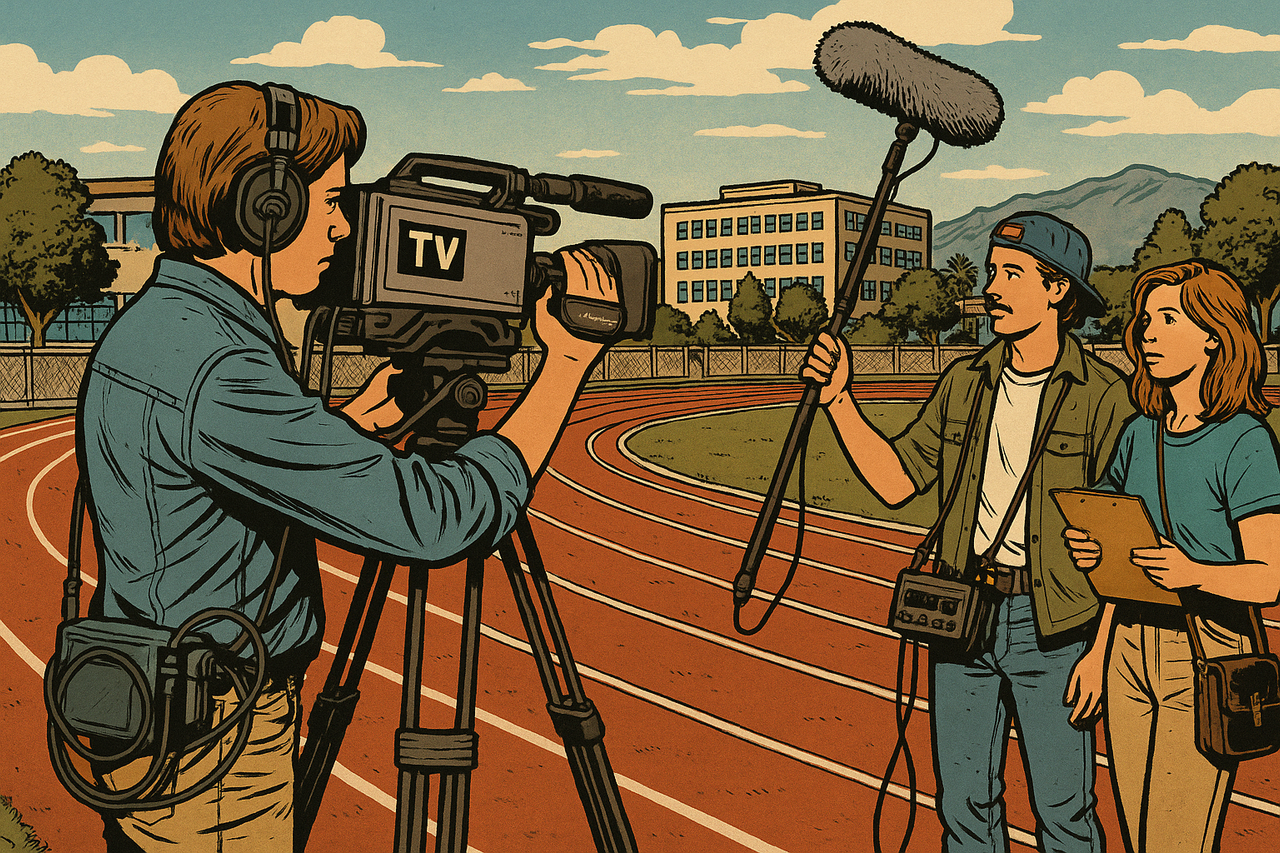
Background actors checked in under a pop-up tent, flash their IDs to prove they were adults playing teens. Wardrobe handed out clean gym tees with a generic mascot and a layer of talc to dull the screen print. Props stenciled “SPORTS DAY” on a banner in the school colors and hunted for zip ties. The dolly crew started laying track off to the side, sandbags in rows like tidy potatoes. Barry, the DP, kneeled at the edge of Lane 3 and pressed his palm to the rubber as if listening for something. “We’ve got the sun for the backstretch until eleven,” he told Dottie, who’d arrived in her denim jacket and a stack of shot lists. “After that, we’ll chase shade.”
Rita’s van rolled in quiet, and she stepped out dressed for humility: spikes in a bag, jacket zipped, hair tucked back. Not a hurricane, a human. She shook Sonia’s hand with the exact amount of squeeze that says, I know the person in this job keeps the day from falling apart. “Thank you for finding us a real place,” Rita said. “You can smell spring here.”
Sonia smiled despite the five radios buzzing on her belt. “They let us borrow it,” she said. “We return it better. That’s the deal.”
The first false start on the track wasn’t in the scene. It was the plan.
They tried to chase Rita with a golf cart rig and lost her by the fifty-meter mark. They tried the Steadicam and watched her outrun the focus puller’s most generous guess. The dolly sang but the world turned to watercolor. Dottie called for a ten-minute huddle, and Sonia watched the director read the day’s fortune in the shape of their problem: the tech couldn’t prove what the human could do.
“Give me the under-bleachers,” Dottie said finally, voice low and decisive. “And one classroom for a safety beat. We’ll pivot to Ellie’s B-story and shoot the scene we’ll remember when we’re eighty.”
Sonia was already on the radio. “Carl, can I get the bleachers shadow and Room 114 unlocked?” she said. “We’ll lay furniture pads and keep shoes off the desks. Classroom shot is just dialogue, two cameras, nothing heavy.”
Carl rattled up keys like a magician. “114 is Ms. Farley’s. No thumbtacks in her cork board. She counts the holes.”
“Copy,” Sonia said, grinning. “We’ll breathe gently.”
Permits live or die on the thousand little courtesies. Sonia reset cones to widen the lane where extras were milling. She spotted a PA about to tape a cable to painted concrete with the wrong adhesive and swapped it out before the paint lifted. She stationed a PA at the hallway to the gym with a stack of Quiet Please—Filming in Progress signs. She sent Max to buy the track team two cases of orange slices and to drop off the purchase order for the new hurdles at a local sporting goods shop. When a neighbor wandered in through a propped gate with a dog on a leash—curiosity is the most powerful pass in Los Angeles—Sonia met her halfway, friendly without flinching. “Hi there! We’re filming with permission today. You’re welcome to watch from outside the fence, but we’ve got cables on the ground and I don’t want your pup stepping on anything hot.”
The neighbor nodded, charmed by being treated like a person instead of a problem. “What’s the show?”
“Backyard Belles,” Sonia said. “Season three. This one will air in the fall.”
“My niece loves that,” the neighbor said. “Tell them to be nice to the girls.”
“We always are,” Sonia said, and she meant it like a job description.
Under the bleachers, light fell in clean stripes. Rita and Ellie found the scene—the one that would make the principal forgive the generator and the coach reconsider his skepticism. Sound called “Speed,” camera slates clapped, and Sonia watched the monitor from a respectful distance. She saw Ellie’s shoulders drop from their ears and a smile lilt up like a question that realized it was an answer. Sonia felt something settle in her chest. This was why you rented real places. The air mattered. Timber mattered. The scent of dust and aluminum mattered. Story knew.
Between setups, the airplane holds kept them honest. Sound would raise a hand, and the whole machine would pause: grips with arms full of flags, a dolly grip with a hand on the brake, a background kid mid-bounce on his toes. They waited while the sky roared and then lowered into itself again. Someone counted ten Mississippis and nodded. “We’re clear,” Sound said. “Going again.”
At noon, Coach Alvarez hovered near crafty, pretending to hate the spread while eating exactly three oatmeal cookies. He watched Rita sign a pair of old spikes for the prop room and draw a tiny thundercloud on the heel. “You’re easy on our place,” he conceded to Sonia.
“We try not to make future enemies,” she said. “I’ve never met a city I wanted to be banned from.”
“What about the scoreboard?” he challenged, last bastion of sternness.
“On our genny, isolated circuit,” said Max, rolling up with an electrician in tow. “You’ll have numbers.”
Carl, from his perch on the utility cart, raised his coffee. “You kept your word about the trash,” he said. “I can tell which productions mean it by hour three.”
Sonia lifted her radio in salute. “We’ll leave the bins nicer than we found them.”
The van eased into the faculty lot like it had a secret to keep. No police escort, no swarm of fans—just a quiet vehicle with a driver who knew to cut the engine before the second idle so sound wouldn’t have to shush him. The morning was barely awake, the sky the color of a new bruise, stadium lights frosting the oval in pale cones. A line of grip trucks leaned shoulder-to-shoulder along the fence. Someone somewhere cracked open a case of walkies; crafty uncapped a tub of coffee that could have powered a small boat. An airplane cuffed the air overhead and a sound mixer raised a hand, automatically counting to ten. Los Angeles at dawn: soft light, loud sky.
Rita stepped down from the van without fanfare: sunglasses, track jacket, spikes slung over one shoulder, long straight black hair tucked behind one ear. No entourage, no drama in her posture. She carried what she needed and nothing that made a noise when it hit the ground.
At the gate, a security guard lifted the clipboard, squinting against the shallow sun. “Name?”
“Rita,” she said, with that even, musical calm that made people stand up a little straighter without knowing why. She took off her sunglasses so he could see her eyes when she smiled.
The man’s expression flickered from official to human. “Right, of course—welcome. They’re set up by the track. Sonia will meet you.”
“I know the way if you’re busy,” Rita said. Not modest—just practical. She signed the line anyway, initials neat, the kind of penmanship that told you she believed in doing small things well.
The grass breathed out its cut-green sweetness as she crossed the lot. Cable runs were already taped down with gentle blue, not the loud, paint-lifting gray; a small act of respect to a place that wasn’t theirs. PAs in windbreakers jogged like purposeful ducklings. A honey wagon winked. The bleachers held their own breath, all aluminum hush and sleepy promise.
“Rita!” Sonia, the location manager, was materializing from a cluster of cones and laminated maps, a headset angled like a crown. “Thanks for coming early.”
“Thanks for inviting me,” Rita said. Her voice had a way of landing in a person like a dropped stone—weight without heaviness. She took in the orderly chaos with a glance that had measured tracks around the world. “You put soft tape on painted concrete. My coach would thank you.”
Sonia laughed, heart in it. “We’d like an invitation back. Also, the custodian will haunt me if we scrape anything.” She gestured toward the stadium. “We’ve got base camp along the fence and a quiet classroom if you want to stretch.”
“Outside’s fine,” Rita said. She tipped her chin toward the oval. “May I?”
“It’s yours until five,” Sonia said. “Or until Coach Alvarez arrives and pretends it isn’t.”
They walked together the last bit, Sonia’s radios hissing on her belt like gentle snakes. A PA offered Rita a lanyard with a large GUEST clipped to it; she accepted it with a nod, slipping it into her pocket, because she did not need it to enter anywhere but understood that other people needed to see it.
Under the pop-up tents, a table sagged with paper cups, bananas, and a bowl of jelly beans. Rita set her spikes on the table edge—black, soft leather, scuffed with a life lived honestly—and wrapped her hands around a paper cup of hot water. Coffee was a pre-race friend she trusted only when the day asked for it.
“Morning,” the craft service woman said, voice low, as if loudness would crack the day in half. “We’ve got oatmeal, too. And toast. I can do peanut butter.”
“Thank you,” Rita said. “Later. The smell is enough for now.” She meant it and the woman knew.
The track pulled at her the way an ocean edge persuades the feet. She walked to Lane 1 and crouched, pressing her palm to the rubber, not like a ritual and not like a superstition—more like a greeting to an old friend you never take for granted. The surface had a fine grit, spring tucked under it like a secret promise. She could feel where a thousand teenage knees had carved their history into it.
“Good morning.” A man’s voice: baritone, guarded. Coach Alvarez. His arms told you he lived in sun.
“Good morning,” Rita said, standing. She didn’t offer a hand across lanes; it’s bad manners to interrupt the lines unless you’re about to run them. “We’ll treat your track like it’s someone’s living room.”
“Some people say that and then lay a dolly on the line,” he said, but his mouth softened at the edges. “You an early person?”
“I’m a rhythm person,” she said. “Sometimes that looks like early.”
He nodded once, the fellowship of people who understand work. He would remain suspicious by habit and generous by choice, and both would be helpful.
A golf cart rattled along the far side of the infield, camera rigged to its spine like an exoskeleton. Barry, the DP, walked alongside, patting the matte box as if to reassure both of them. Behind Video Village, the director—Dottie Kline, denim jacket, squint that belonged to a woman who has been looking into light and into people for a long time—was bent over a monitor, flipping pages of a shot list with her knuckles.
She looked up and saw Rita the way a person recognizes a lighthouse and also the human who climbs it. “There she is,” Dottie said, moving to meet her with a stride that expected meeting in the middle. “Thank you for making time for us.”
“Thank you for the invitation,” Rita said. “And for choosing a place with wind.”
Dottie’s grin split. “I’ll take credit for the good taste, not the weather. We’re keeping it lean and kind. Surprise entrance later; right now we’re just getting the day’s bones up. If you need anything at all, Sonia makes mountains move.”
“I’ll try not to require geology,” Rita said. It was a light line, but there was work behind it. She didn’t pretend not to be extraordinary; she simply refused to be a problem.
A PA named Max, hair uncooperative in the morning damp, materialized with a badge reel and a clipboard. “We’ve got you in the girls’ locker corridor for wardrobe check—” He stalled, realizing he was suggesting an absurdity to a woman who had dressed herself for stadiums before he could tie his shoes.
Rita rescued him with kindness. “I’m dressed for me,” she said. “If you want continuity on the jacket, I can zip or unzip. And the spikes stay. They’re my only superstition: if I carry them in, they’ll carry me out.”
Max nodded, relief flooding his shoulders. “Copy that.”
She began to move. Not running—moving. Ankles rolled. Hips opened. She drew circles with her knees that loosened time. A-skips ghosted down the backstretch, controlled and quiet: pop-pop-pop, the soles like a promise kept under breath. She clipped the corners of breathwork apart and stacked them back in tidy piles. Crew watched without watching, the way people look at fire without admitting it.
Two background actors wandered onto the infield with the brave hesitation of kids in a museum. They were young women cast as students, hair in scrunchies, gym shorts high and hopeful. One of them—freckles, a nervous originality she hadn’t learned to love yet—stopped, shocked into stillness by the sight of the person she’d taped to her bedroom wall with a magazine cutout. Rita turned at exactly that moment, caught the startled open of the mouth, and offered a small bow with two fingers to her forehead, the kind of acknowledgment that says, I see you seeing me. It’s all right. The girl flushed in gratitude that didn’t tip over into hysteria; kindness gave her a place to put it.
“Please don’t run on the infield,” Coach Alvarez called, not unkind. “And tell your wardrobe to keep your laces double-knotted; we don’t want bad comedy.”
“Yes, Coach!” the girls sang, scampering to the track edge, instantly compliant in the presence of someone who took their pretending seriously.
Sonia coasted back on an electric cart, Carl the custodian riding shotgun like he’d been born with a ring of keys. “We’ve got the scoreboard on the genny,” she reported to Barry. “And the classroom is open if we need it.”
“Thank you,” Rita said, meaning all of it, not just the rooms. “Do you have any tape you like on skin? I need a dot where my watch face will rub.”
Sonia produced a small roll with magician speed. “Paper tape. Won’t pull.”
“Perfect,” Rita said, tearing a piece with her teeth and pressing it onto the inside of her wrist with two polite taps. “I appreciate your excellence.”
Sonia gave a short bow with her hand over her radio. People like her built the invisible bridges everyone else used; being seen on one felt like sunlight.
Dottie approached with a small script in her hand, though she hardly looked at it when she spoke. “We’ll rehearse the surprise burst later. For now, if you’re willing, I want to see you arrive in the world. Not to camera—just to the day. Walk the curve. Take the lane like it’s yours. I’ll get what I need from that.”
“It is mine while I’m on it,” Rita said. “And then I give it back.” She slid the spikes from her shoulder into her hands, fingers memorizing the laces. “I’ll try to make it look like something a person could do, if they decided to do it for ten years.”
“That’s my favorite definition of talent,” Dottie said.
Rita bent to lace, the movement so ordinary it became holy. Loop, pull; loop, pull. She checked tension with a quick tug and then touched the starting line with the back of her hand, like greeting a dog you trust. She rose and walked to Lane 4, not because it was the fastest, but because it was honest.
“Plane,” Sound murmured, hand up, head cocked to the sky. They waited while the morning shifted a gear over LAX. Crew learned your patience from the top; Rita’s was easy, lived-in. She bounced gently on her toes twice, a metronome set to calm.
“Clear,” Sound called.
Rita stepped. Not a run, a possession. The sun aslant across her face, sunglasses catching a flash and then settling back to anonymity. The spikes bit, and her posture rose like a question answered. She traced the curve as if reminding the lane of its purpose, hands quiet, chin soft, hair tucked obediently behind her ear and going nowhere until she told it otherwise. No one clapped. The respect was deeper than applause.
A kid with a leaf blower powered up beyond the fence. Sonia was halfway to him before Rita had completed the bend. “Sir! Could we borrow two minutes of quiet? We’ll buy you a muffin.”
“I like blueberry,” he said, laughing, switching the motor off. “You got it.”
Rita came off the curve and drifted to a stop at the 60, not breathing hard. She looked up at the bleachers and read the empty aluminum like a poem: where someone had carved initials; where the slats would let light pour down later; where a girl might sit and cry because someone said she ran funny. She didn’t turn so much as tilt toward that thought, like a dog catching a change in the wind. She filed it somewhere that would make sense later.
“Good?” she asked, to no one and to everyone.
“Better than good,” Barry said, voice thick in a way that had nothing to do with sleep. “Can I have you do that again and forget that I’m here?”
“I can forget anything that isn’t the lane,” Rita said.
She walked back to the start, pausing by the craft table to accept a slice of orange the way an athlete accepts a prayer. The craft woman grinned. “For luck,” she said.
“For sugar,” Rita answered. “Luck’s the thing you get after practice.”
She passed two grips wrestling a stand and stopped just long enough to steady a stubborn leg with a thumb and forefinger. “There,” she said mildly, and the stand obeyed. The grips blinked at her, surprised and gratified; it felt like being knighted by someone who knew what a C-stand was and didn’t expect it to thank her.
A background actor—tall, anxious, with a borrowed letterman jacket that didn’t quite fit—hovered near the edge of the tent, holding a release form like he was afraid it might spontaneously combust. Rita moved toward him as if she had been heading that way anyway. “First time on a set?” she asked.
He jumped, then nodded. “Is it that obvious?”
“It is to people who remember their first time,” she said. “You’ll forget to breathe for a while. Then you’ll remember. That’s the whole arc.”
He laughed, the sound loosening his shoulders. “My mom runs,” he blurted. “She said to tell you… that you made her feel like she didn’t have to stop at thirty.”
“Tell your mom I said thank you,” Rita replied, as if she were receiving a medal from a country that speaks compliments like a native language. “And tell her I never stopped either.”
Dottie caught her eye from the monitor and lifted a hand in a small circle: one more. Rita nodded. On the way back to Lane 4, she paused where the white hash marks begin their quiet mathematics and lifted the hem of her jacket a fraction, letting the air touch the place where breath and ribs negotiate. Not exhibition. Just readiness.
“Speed,” Sound called softly, the word that always made every moving part decide to aim in the same direction.
“Picture’s up,” the AD echoed, a little louder, palm slicing down to cut ambient chatter.
Rita stepped into the lane and the lane stepped into her. She let the sunglasses slide higher on her nose, not out of coyness but because the sun was alive now, throwing coins across the rubber. She glanced once at the starter pistol on the prop cart, the way you look at a bell you will later ring. She looked at the empty bleachers and saw, as plainly as blue chalk, the shape of a pep talk under their ribs. She looked at the camera and it looked back without presumption, and in the space between the two looking there was an agreement: we will show what is true and make room for what is beautiful.
“Mark,” a PA murmured near her ankle, laying down a tiny triangle of tape at the point the focus puller would love most.
Rita smiled but did not move her foot to find it. She already knew where to be.
“Rolling,” Barry said.
“Rolling,” Sound echoed.
The airplane waited. The morning held. And before she ran, before the burst that would make people scream in their living rooms months from now, she did the small thing she always did: reached down and touched the line with two fingers, not to ask for permission and not to demand victory, but to greet the day as an equal.
“Action,” Dottie said, gentle as a door opening.
Rita breathed once, deep and clean, and stepped into the world they’d borrowed.
The pistol snapped. Rita didn’t explode; she cleanly departed. Two tall steps put her past the girls’ peripheral vision. Three more and the Steadicam’s pan reached the end of what a human wrist could promise at 24 frames. The golf cart leapt and fishtailed, operator strapped backward like a rodeo rider with a view of his own doom. By the fifty, she was a line of air that felt like speed, and the frame held only a fleeing shoulder and the wake of extras beginning to scream.
“Cut!” Dottie called, not from frustration but from shock and something that lived next door to awe. Then, a beat later: “That was beautiful. Let’s reset. Background, fifteen minutes—water, shade, please. We’ll adjust.”
The extras flowed off to the tents and the bleachers with the gleeful exhaustion of people who’d just been too close to something extraordinary. Wardrobe fussed with T-shirts. Hair dabbed sweat with Kleenex like someone pressing a thumb to a postage stamp. Ellie broke off from her friends to stare at the lanes, cheeks lit from inside; she looked like a girl who had just seen a magic trick and wanted to learn the method.
On the infield, the grown-ups started speaking in camera.
“Tighter pan, shorter throw,” Barry said, already swapping the 50 for a 35. “Let’s go wider, close down to an eight, give the puller a fighting chance.”
“Copy,” the 1st AC said, his tape measure returning to his belt with a chastened snap. “Your marks are a rumor once she hits twenty meters.”
“Cart’s topping at what?” Dottie asked the grip at the wheel.
“Fifteen, maybe eighteen if you hate your mother,” he said. “But we can’t corner at that.”
“Okay,” Dottie said, brain sorting possibilities like index cards. “We’ll move the dolly to the home stretch. Keep the cart wide for a parallax feel. Let the Steadi pick her up at thirty. Make the frame her environment if she won’t stay in the frame.”
“Or if the frame won’t keep up,” Barry muttered, not unkindly. He tapped the matte box with his knuckle, as if persuading it to be braver.
Rita jogged back, breath not even interested in being fast. She took a paper cup of water from crafty, smiled a thank-you that made the woman there square her shoulders as if she’d been cast, then slid the empty into the recycling bin because she was the kind of person who didn’t make other people pick up after her.
“How’s your reset time?” Dottie asked, catching her eye.
“Reset is the treat,” Rita said, small grin. “Tell me where you want me softer.”
“Stay you,” Dottie said immediately. “We’ll catch up.”
The second setup found the dolly track hugging Lane 2, sandbags lined in potatoes along the edge. The golf cart switched to a side-by-side with the camera offset on a speed-rail, hoping to cheat distance into cooperation. Barry stopped down. Focus went to feet—spikes on rubber, those fine sparks of bite and release.
“Second team, you’re still on a fifteen,” the AD announced to background. “If you step off, stay warm, please. We’re back quick.”
“Roll camera.”
“Rolling.”
“Action!”
Rita took the first five meters like a promise kept, then leaned into clean acceleration. The dolly wheeled paralleled her beautifully until the physics of parallax betrayed them; the world smeared into watercolor, and the matting around the lanes turned into streaks of green that would look artistic and tell you nothing about a person. The golf cart tried to draw level and found itself in a race it couldn’t ethically win without killing a paunchy orange cone. The focus puller’s hand performed an act of contrition on the knob, racking to air where she used to be.
“Cut!” Dottie again, shading her eyes, brain sprinting. She flicked her glance to the focus puller—no blame. To Barry—no panic. To the steady op—no ego. “Okay. Background, you’re still on break. Reset quickly, please.”
Between takes, a plane crossed, and sound held a palm to the sky; the entire field went statue-still, a shared discipline. When it passed, laughter bubbled because someone had to break the spell, and it was always safer if laughter did it.
“Let me put B-camera on the ninety at the far hash,” Barry said. “We park and let her enter. No pan. If she’ll give me one stride at seventy percent, I can hold her in the gate long enough to prove she exists.”
“No acting notes for physics,” Dottie said, dry. “But ask politely.”
He did. Rita considered it for a heartbeat with the respect you give a worthy request. “I can give you two strides at something less than truth,” she said. “It will feel like lying to me and look like kindness to camera.”
“That’s the job,” the steady op said, affectionate.
“Third setup in sixty seconds,” the AD called. “Background, still on fifteen. Stay near, not on the lanes.”
Ellie hovered in the soft edge of everyone’s attention like a moth near a lamp. Rita found her there without theatrics. “You all right?” she asked, voice quiet enough to make a person brave.
Ellie nodded. “I didn’t think… I mean, I knew you were fast, but there’s the sound. Like—” She groped for a word. “Like a drumroll that forgot to stop.”
Rita’s mouth did that small tilt that meant she took the metaphor seriously. “Good ears,” she said. “It’s rhythm when it’s honest.”
“Roll camera,” someone called, and the moment moved on.
For the third attempt, they set B-camera near the ninety, wide open lane, the sun doing favors it didn’t usually do for television. The golf cart idled further back, demoted from hero to witness. A-camera stayed on the dolly, but Barry pulled the field of view just a hair wider, resigned to humility.
“Action!”
Rita gave them what she’d promised: two not-quite-true strides that were still truer than most. For a heartbeat, she and the lens agreed on the same square of world, and the image looked like the day felt—air, heat, muscles arranging themselves into poetry. Then she decided (or remembered) to be herself again, and she was gone, not out of frame so much as into a place the frame didn’t have the budget to visit.
“Cut,” Dottie said, softer, as if she were releasing a bird from her hands. She glanced at the AD. “Hold the background on the break. Let’s look.”
They gathered at Video Village, a congregation in windbreakers. The monitor showed the day reduced to electrons—a little flatter, a little mean, the way video taps always are next to film. But it told the truth you hire it to tell: where a person was and where the camera thought she would stay.
“Playback,” Barry asked, and the script supervisor marked the slate times with the neat penmanship of a person who respects future editors.
Take one rolled. The frame found her in the first seven meters—there she is—and the next moment it held nothing but a wobbling shoulder and a stadium of sound. Someone laughed under their breath, not mockery but the giggle of awe that slips out when you watch a card trick even though you know where the queen is.
“Again,” Dottie said.
Take two. The wider lens gave them more track, more world. The focus puller’s mark hits were valiant; at f/8 the depth of field behaved, but the pan didn’t. The smear was handsome, painterly even, but all the adjectives were things you never put in a coverage report when the script says astonishing cameo at speed. You could feel the idea; you couldn’t see the person.
“Again.”
Take three. The parked B-camera held the square of air in which Rita decided to be slow for two strides. For those frames, time said yes. Her foot struck and the spikes flexed; her jacket lifted a beat behind her ribs; her hair obeyed the law of her ear. Then the thing that wasn’t mercy returned, and the lens simply documented her absence.
Barry exhaled through his nose. “We’re under-rigged for the truth,” he said, not self-pitying. “I can’t pan that fast without turning the world to soup. The cart can’t pace without making the op a widow. The dolly’s the dolly.”
“Could we overcrank to forty-eight?” the 1st AC asked. “Use the extra frames to tame the motion blur, then play it back normal?”
“Daylight gives us the stop,” Barry said, thinking. “But the tap won’t show the win, and the film will spend like a drunken sailor. And we’ll still need to match the Steadi and cart for geography.”
“We don’t have the time for a high-speed body,” Dottie said quietly, eyes still on the monitor. “Even if we had the budget. And that doesn’t solve this.” She tapped the spot on the screen where Rita left the world. “We’re not missing focus. She’s outrunning being photographed.”
A small silence formed, the kind that never lasts on sets because someone will always fix something even if it’s just a piece of tape with no moral stakes.
Sonia, who understood the math of daylight like her own bank account, leaned in. “We have hours on the permit and two on people,” she said. “If you want to pivot, we can. Classroom’s open. Under-bleachers light is getting gorgeous.”
Dottie watched the take again, then glanced sideways—past the gear, past the schedule—to where Ellie stood, fidgeting with the end of a ribbon she’d untied and retied three times in the last ten minutes. The girl wasn’t watching the monitor. She was watching Rita tie her spikes. There was a story in that angle that didn’t require a chase car.
“Okay,” Dottie said, and the word landed like a coin in a decision jar. She scrubbed back to the exact frame where Rita’s foot struck—one true image, an argument for existence. “We can make this work as an impact cut—burst of impossibility, faces responding, myth implied. But the scene we’ll remember at eighty doesn’t need velocity. It needs permission.”
Barry smiled sideways at her. “Under the bleachers.”
“Under the bleachers,” Dottie agreed. “We’ve got our cameo—she’s too fast to film, which is the honest problem and therefore the story. Now we earn the day.” She lifted the bullhorn, voice bright again. “All right, everyone—background, enjoy the end of your fifteen. We’re pivoting to Scene Twenty-Eight. Pep talk with Ellie in the bleacher shadow. Keep the track pristine; we’ll return for the burst once the sun drops a hair.”
Rita, who had been standing close enough to hear the pivot before it got spoken aloud, took off her sunglasses and tucked them into her jacket. “Do you want me to jog the edges of that frame,” she asked, nodding at the monitor, “or let it be a rumor we cut to faces?”
“Give me two steps when we come back,” Dottie said. “Then be a rumor. The rumor is the point.”
Rita nodded once, pleased. Her eyes wandered to Ellie as if drawn there by the field’s own geometry. “Then let’s go teach the rumor where courage lives,” she said.
They broke cleanly, like a team that knows how to turn a drill into a win. Background drifted back to shade, given another slice of orange and the promise of excitement later. The cart powered down for a while. The dolly got a towel wiped across its rails like a blessing. At Video Village, the monitor froze on the frame where Rita existed so perfectly for one crystallized heartbeat that you could feel the editors months hence building a whole crescendo out of that single toe-off.
“Too fast,” Barry said, still measuring the problem even as they moved past it. No complaint in it. Just the most accurate compliment a camera crew could pay an athlete.
“Too fast,” the focus puller echoed, rubbing his palm thoughtfully over the knob, like a violinist after a passage he loved but couldn’t yet play.
Dottie stepped back from Video Village until the chatter thinned to a rustle and the stadium filled the space behind her eyes. She tucked the bullhorn under her arm like a swear jar and pinched the bridge of her nose—a ritual, yes, but also a way to press pause on the part of her brain that wanted to fix things with volume.
If we cut it as-is, it plays like a gag, she told herself. Camera can’t keep up; star vaporizes. Record scratch. Freeze on Ellie’s “whoa.” The audience laughs in the wrong place.
She tested the joke in her head like a dentist taps a tooth. It had the easy rhythm of a beat she could buy with time she didn’t have: whip-pan, golf cart fishtail, focus-puller’s valiant curse under the breath—cue laugh. It would get a chuckle at the table read, a note from network about “fun energy,” and she’d hate it for the way it made a girl’s awe into punchline gravy.
Backyard Belles doesn’t humiliate, she reminded herself. Not the kids, not the camera, not the day.
She turned away from the monitors and let the track talk. The lanes breathed out their faint tire-rubber perfume; a plane wrote a slow sentence over LAX; extras let their shoulders down in the shade, happy for fifteen minutes that felt like permission. Across the infield, Rita waited without waiting—hands on hips, breath on a leash, sunglasses pushed into her hair now that the light had gone soft. Ellie stood near a banner, fiddling the tail of her ribbon into a crisp little rope and untying it again, the universal choreography of an anxious seventeen-year-old.
Dottie made a catalog, quick as shuffling cards:
Option A: Lean into the joke. Play the miss for laughs; literalize the gag—golf cart loses a hubcap, Steadi operator spins and sits down like a dizzy kid, cut to Rita already waiting at the finish line pretending to check a watch that isn’t there. The writers could patch in two lines about “blink-and-you-miss-her” and the audience would forgive it because comedy is forgiving. Except it isn’t; it keeps receipts. And Backyard Belles didn’t run on humiliation. Pass.
Option B: Tech the problem to death. Overcrank a hair, goose the shutter, change lenses, comp in editorial. Pray to motion cadence. Rent high-speed tomorrow with money that doesn’t exist, crew that’s already booked on a funeral and a wedding, and a permit that sunsets at five with a principal who counts thumbtack holes. She could do surgery and still be left with a scar shaped like compromise. Also pass.
Option C: Make it myth. Don’t show speed; show its effect. Keep Rita a rumor with a pulse. The girls’ faces tilt; air flinches; a paper cup skates an inch on a gust that wasn’t wind; Coach Alvarez’s stopwatch glitches between human and miracle and he laughs like a man who refuses to lie about what he saw. The cut lands on the thunder of spikes hitting rubber and then the absence where a body used to be. She liked that. But she heard the note already: “Are we… superhero now?” They weren’t. They were ordinary girls learning ordinary bravery, televised respectfully. Myth, yes—but only the kind that happens in daylight without capes.
Option D: Change the point. If you can’t win the frame, quit trying to. Shoot the essay underneath: that running isn’t for the watcher, it’s for the runner. She could build a pep talk under the bleachers where light falls in stripes like a sheet of music. Give the day a spine. Keep the cameo as a grace note—a burst, an impact cut, a proof. Not a joke. A rumor told by faces.
“Meal in seventy,” the AD murmured from somewhere respectful, as if narrating the hours left in the life of a mayfly. “If we pivot, I can bump the three-legged race after lunch.”
Dottie nodded without looking back. The clock wasn’t unkind; it was just honest. She liked honest.
She let herself consider one more bad idea just to scratch the itch: Option E: Paper it with dialogue. Sneak in two lines in the classroom later: “We tried to film Rita running and she outran the camera, ha-ha.” Insert laugh track that didn’t exist. The readers at Standards & Practices would approve; she’d have to live with it. She felt the no travel through her bones like a subway.
She looked at Rita again—the unshowy way she inhabited ease—and then at Ellie, who was trying to make her hands behave as if someone had told them they were on TV. The B-story about “everyone says I run weird” slid forward like a chess piece she’d wanted to move all morning but hadn’t because the obvious move is often not the brave one. The episode’s thesis had been sitting right there in the call sheet, between the craft services menu and the map to the faculty lot: permission beats perfection.
Other alternatives flickered, little constellations that might work if she had night and extra film stock: silhouettes at dusk, Rita reflected in the gloss of lane numbers, a Rube Goldberg of reaction shots that add up to velocity. The day did not have time for magic tricks; it had time for truth.
She blew out a breath, setting down the last of the false options like plates she’d been balancing for show. Okay. Under the bleachers. Real voices. Keep the burst, but frame it as grace, not gag.
She stepped back toward the monitors long enough to watch the one honest frame they’d snagged—Rita mid-stride, spikes flexed, jacket lifted a beat behind her ribs. The picture looked like the sound of someone finishing a sentence they’d practiced for ten years. You could build a button out of a single frame if you respected it enough.
Barry drifted over, reading her face the way good DPs do—light first, then intent. “You don’t want the chuckle,” he said.
“I don’t,” she replied. “It buys us a beat and sells out the show.”
He angled his chin toward Rita. “Myth without magic?”
“Reaction, sound, one impact image,” Dottie said. “Let the camera confess its limit and let the faces fill the gap. Then change the thesis: it’s not about catching her, it’s about why a kid tries at all.”
Barry’s mouth tipped. “Bleachers are giving us Rembrandt stripes right now.”
“God is a gaffer,” Dottie said, and that made him grin.
She keyed her own quiet on the bullhorn and clipped it back to her belt. No need to shout this part. She walked toward Sonia, who had already sensed the wind change and was mid-sentence with Carl about unlocking a classroom.
“I’ll need the bleachers shadow,” Dottie said. “Two cameras. Keep it bare. If we mic the metal wrong, Ellie will sound like a cymbal.”
Sonia tipped a salute with the corner of a map. “Already pulled furniture pads. I’ll tape off the ladder—no accidental audience.”
“Bless you,” Dottie said, and meant the sacrilege.
Ellie clocked them coming and straightened the way kids do when grown-ups approach—a pretended nonchalance that says, I am reachable if you use the right softness. Dottie used the right softness.
“Hey,” she said, low. “You remember that line of yours? ‘Everyone says I run weird’?”
Ellie made a face that was half apology, half relief. “It’s not a line,” she said. “It’s my life.”
“Good,” Dottie said. “We’re going to put it on camera so somebody else’s life feels seen. I want you under there—” she nodded to the ribs of the bleachers where light fell in obedient slats—“with Rita. No Performance Voice. Say it the way you say it in your head before you try. Can you do that?”
Ellie swallowed. “I can try.”
“That’s the scene,” Dottie said. “Trying, without the apology.” She glanced over Ellie’s shoulder at Rita, who had arrived at the perimeter of the moment without once intruding on it. “You good?”
Rita’s yes was in the way her face opened. “Always.”
Dottie gave Barry the fast plan: “A-camera over Ellie’s shoulder to Rita, let the lines between light and dark cut the frame like staves. B-camera fifty-fifty on a long. We hold. No push. If it gets precious, we lose. Sound, I want breath and metal, not stadium. If a plane flies over, we build it into the beat where she waits for the word.”
“Copy,” Barry said. He didn’t ask for toys; he had tone.
The AD drifted back with the gospel according to schedule. “Background still on break for nine,” he said. “Coach is happy if we stay off Lane 1. Meal in sixty-one unless we can pull the three-legged race up and get you a release valve.”
“Race after lunch,” Dottie said. “We’ll need the joy. Right now we need the spine.”
She caught herself smiling as she said it, because that was the part she liked best—when the job stopped being traffic control and started being a human thing. She thought briefly of the writers’ room, the way they’d pitch fixes like darts and wrap the right one in laughter. Today the field was the room; the dart was a sentence spoken under aluminum.
Just to be sure she wasn’t betraying anything brittle, she ran her mind over compromises one last time: add a shot of Coach Alvarez’s stopwatch ticking implausibly; shoot a comedy cutaway to the golf cart operator mouthing nope; pop a needle-drop of something cheeky. Each idea pulsed with wrongness in her mouth. The show had rules. “Don’t punch down” was one. “Don’t let our camera be the hero” was another; the lens could be brave, but it wasn’t the protagonist. The girls were. The day was. The way permission sounded when someone older handed it to you like a clean towel was the hero.
Under the bleachers the light performed, clean and unrequested. Rita met Ellie where the shadow softened, and there was a very quiet miracle of two voices landing on the right tempo without script sugar. Dottie watched through the monitor—hands off, breath careful—and felt the day slide onto its rightful track. Ellie said the bad line the right way—like it was true and survivable. Rita offered the sentence that puts a spine back in a body. It worked in that ordinary, unfussy way that reasoned with your ribs more than your brain.
When they cut, Dottie didn’t cheer. She didn’t need to. She felt it in the way everybody remained still for a second afterward, as if moving too quickly would break the glaze on a pond.
Behind them, the track was still there, patient as a friend, waiting for the last piece of the day. Dottie looked to the sun—still generous—and to the girls who’d get their fifteen back once they shot the burst. She thought of the editors in autumn, hands on a timeline, smiling at the single, perfect frame that would function like a snare hit before a chorus.
You salvaged it, she told herself. Not by getting faster, but by getting truer.
She lifted the bullhorn again, voice warm now that the decision had heat. “All right! Reset for the burst. We’ll do two honest strides and then cut to wonder. After lunch, three-legged race! Be kind to your partners—no heroes. Heroes get sprains.”
As crew flowed back to positions, Sonia rolled by on the cart, grinning around the rim of a coffee she’d finally remembered to drink. “You found the better story,” she said.
“I think it found us,” Dottie replied. She glanced at the monitors, then at Ellie’s new shoulders, and smiled. “And it doesn’t need a punchline.”
Wrap was a procedure written over years of doing this without breaking things. Sonia walked the field with Carl and the principal, pointing to where mats had protected the lanes, showing the empty trash cans (not sitting open and sad but bagged and tidy), lifting a corner of blue tape to prove no paint came with it. She returned keys and signed the site checklist. Accounting handed Dr. Dwyer the check for the location fee and a separate envelope—donation for the track team, receipt already filled out. Coach Alvarez pretended not to read it and then read it twice.
“You held up your end,” Dr. Dwyer said, and her handshake now had warmer pressure. “If your little girls’ show ever needs a library, we can talk.”
“Don’t let the ‘little’ fool you,” Sonia said, smiling. “They’re large-hearted. And we’ll bring drop cloths.”
Carl tipped his cap, which looked wrong until you realized it meant something here. “Thanks for not stacking C-stands on the gym floor,” he said. “Someone did that to me in ’89 and I still wake up angry.”
“We’ve all had ‘89s,” Sonia said. “We try not to repeat them.”
By five-thirty, the stadium looked like itself again. The crew trucks hummed toward the gate; the honey wagon winked a taillight; the last PA pulled the final “Filming Today” sign from a pole and tucked it into a crate that would be unpacked next week at a dentist’s office or a hardware store or a cul-de-sac with a friendly HOA. In the quiet, you could hear a practice whistle from the baseball diamond two blocks away and the squeak of a lone runner’s shoes somewhere, out for the kind of mile that has nothing to do with cameras.
Sonia lingered long enough to watch the scoreboard numbers blink to zero and die, their work done. She stuck a thank-you note under the flap of the principal’s office door—handwritten on the show’s letterhead, because the good will you seed today is the permission someone grants you next season. Max came up beside her, clutching their battered Thomas Guide like a relic.
“Forty minutes back to the lot,” he said. “If we beat the dinner rush.”
“We won’t,” Sonia said, locking the final gate with Carl and passing the chain through the link twice like he preferred. “But we got what we came for.”
“What’s that?” Max asked, genuinely curious.
“A place with a heartbeat,” she said. “And people who let us borrow it.”
He nodded, because that was the whole job: to make Television build a life inside a real one without breaking the furniture. They climbed into the grip truck and pulled away, the school going soft and gold in the rearview as the evening planes traced their lines across the sky.
Under the bleachers the light fell in tidy ladders, a hush of dust and aluminum separating this small pocket of shade from the hoots and whistles of Sports Day above. The slap of a starter pistol reached them as an echo more than a sound. A plane drew a line somewhere over the coast and kept going. Ellie stood where the sun met the shadow, turning the toe of her sneaker against the concrete until it squeaked, ribbon winding and unwinding between her fingers like a thought she couldn’t tie off.
Rita entered without claiming the space, sunglasses nudged into her hair, track jacket open a hand’s width, long black hair tucked behind one ear. She paused as if asking the light’s permission and then leaned her shoulder to a steel post, a courteous distance away.
“Mind if I borrow the shade?” she asked.
Ellie’s head jerked up. “Oh—yeah. Sure. It’s… public shade.” She winced at herself. “That sounded smarter in my head.”
“It sounded honest,” Rita said, mouth tipping. “Honest is a good warm-up.”
They stood with the bleachers’ bones above them and the day showing through in skinny bright slats, like a sheet of music someone had held to the sun. Rita looked up into that striped sky, then back to Ellie’s hands.
“You looked like you were negotiating with your shoelace,” she said.
“It knows things,” Ellie murmured, letting the ribbon dangle. “Like how everybody says I run weird.”
Rita let the words land. The stadium’s noise thinned and returned. Only when silence had finished its work did she answer. “Do you say you run weird?”
“When I know people are watching.” Ellie stared at the concrete. “I can hear it before I start—their faces. I feel like I’m too much of everything and not enough of anything. Arms, legs, bounce… like a foal that never downloaded the instructions.”
“A foal runs like a foal until it grows into a horse,” Rita said, amusement soft, never sharp. “There’s no shame in being between shapes.”
“It’s hard not to listen.”
“Then let’s give you something better to listen to.”
Rita shifted in the light until the shadows striped her cheek like staff lines. “When someone says you run weird, they usually mean you don’t run like them. Running isn’t a costume—it’s rhythm. Some people carry rhythm in their knees. Some in their hips. Some in the swing of the shoulders.” She tapped the center of her chest. “Mine lives here, where breath becomes a metronome.”
Ellie’s head tilted, curiosity arguing with embarrassment. “Where’s mine?”
“Let’s find it. Show me three steps the way you run when you forget there are eyes.”
“I’ll look silly.”
“Probably.” Rita’s smile warmed but didn’t widen into reassurance. “Everyone looks a little silly being true the first time. Then it starts to look like a choice.”
Ellie dropped the ribbon. She shook her hands out as if tossing invisible bracelets into the shadow and set the toe of her shoe to the painted line of nothing in particular. One step, then another, then a third—arms reaching just a touch too wide for textbook, knees not high, earnestness tipping her forward as if she were chasing a bus she refused to miss.
She stopped, cheeks hot already. “Okay. Now you can say the thing.”
“You reach,” Rita said with bright, certain pleasure. “That’s your rhythm.”
“Reach?”
Rita ran in place at half-speed, not a show, only the truth in slow motion: elbows quiet, wrists soft, chin free to agree with the spine. “When you get shy, you shrink.” She tucked her shoulders and let her arms chop to demonstrate the bounce. “If you let yourself reach on purpose, your stride smooths out. It won’t match anyone else’s exactly.” She lifted her eyes. “That’s the point.”
“So I’m… allowed to take up space?” Ellie asked, like she was trying on a forbidden jacket.
“You’re required to,” Rita said, gentle as a hand to the back. “Same three steps. This time don’t apologize with your shoulders.”
Ellie inhaled and stepped again—one, two, three—and something unclenched mid-stride. The worry didn’t leave; it loosened. She landed with a surprised laugh she hadn’t meant to let out.
“There she is,” Rita said, clapping once.
“I felt less bouncy.”
“Because you decided to be the person running instead of the person watching,” Rita said. “That decision is everything.”
Above them a whistle cut the air; a chorus of oohs rolled and thinned. Ellie looked up and then back, trying not to ask another question and losing. “Does it ever stop feeling like people are watching?”
“No,” Rita said, truthful and warm. “But the running gets louder than the watching.”
Ellie nodded like her neck had just remembered how. “What if I still look weird?”
“Then you look like Ellie running.” Rita didn’t flinch from the word. “Someone whispered that ‘pretty’ is a rule. It isn’t. Integrity is. If they laugh, let them. They’re announcing how small their courage is.”
Ellie studied her hands like they’d just been returned from a repair shop in better condition than she’d sent them. “I like running when it’s just me,” she said, the words small, as if a bigger voice would startle them away.
“Then make a bigger ‘just,’” Rita said. “Keep it ‘just you’ even when there are ten thousand eyes.”
She stepped forward into a bar of light, hips tall, and showed Ellie the quiet map of arm carriage again. “No chopping. Let your arms whisper. Your reach is still there—you’re choosing its volume.”
“Again,” Ellie said, surprising herself with the want.
“Again.”
They worked in a language of feet and breath: a scuff, a soft strike, a third step that landed on its own name. Ellie stopped and a smile found her like weather.
“I feel—” She searched her backpack of metaphors and picked one with two hands. “Like the first ten minutes of a thunderstorm.”
Rita’s eyes lit with genuine delight. “That’s my favorite kind. The air deciding to be honest.”
A muffled announcement floated down—volunteers for the three-legged race to the red cones; please and thank you. Ellie made a face. “We’re signed up. I didn’t want to, but Saff said she’d carry me if I cried.”
“Good friend.” Rita angled her head. “Here’s the trick: don’t try to be the fastest pair. Try to be the most together. Sync beats speed.”
“Permission beats perfection,” Ellie said, testing the sentence and finding it held.
“Keep that line,” Rita said. “Say it when the ribbon tries to tell you who you are.”
Ellie’s fingers, on reflex, sought the ribbon and then tucked it into her pocket like a note she meant to keep. “Can I ask something scary?”
“Scary questions are usually useful,” Rita said.
“Do you ever feel like the thing you’re good at will get bored of you?”
“On days I confuse my talent with my worth,” Rita said without dressing the answer. “That’s when I go back to liking the training. The training never gets bored if you respect it.”
Ellie let out a breath she hadn’t registered holding. “Okay. I can… like practice.”
“You don’t need everyone’s permission,” Rita said. “Just your own.” She nodded at the laddered light. “Open it, Ellie.”
Ellie smiled at the phrase as if it had weight and good edges. “Open it.”
Rita tapped a small square of paper tape on the inside of her wrist where a watch face might rub, a practical charm more than a superstition. “Before you go—two drills. One: count your steps out loud with your partner—‘left-right, left-right.’ Make your rhythm a shared thing. Two: if your brain starts yelling, change the channel. Pick something tiny and kind to notice.” She tipped her chin toward the ground. “Today I like how the light makes ladders.”
“Ladders to a sky you can walk,” Ellie said, then flushed. “Too poetic?”
“Poetry’s honesty that learned to sing,” Rita said.
Footsteps skittered; Saff leaned into the shade, eyes wide, grin wider. “Coach says two minutes until humiliation—celebration,” she corrected, seeing Rita and nearly leaving her body. “Hi. Sorry. I exist. Ellie, red cones. We will be the most together.”
“Go,” Ellie told her, softer and steadier than she’d been ten minutes ago. Saff fled, buzzing.
Ellie turned back. “Thank you,” she said, shy but true. “For… not fixing me. For seeing me.”
“You weren’t broken,” Rita said. “You were crowded.”
Ellie hesitated at the edge of the light. “Will you—if you can—will you watch our first try?”
“I’m here,” Rita said. “And I’ll be loud.”
That earned a grin that reached Ellie’s eyes. She backed into the sun, then pivoted and lengthened her steps as if the air had been rewired.
Rita stayed a moment longer, alone in the lattice of brightness and shade. Through the slats she could see the curve of the track, a strip of rubber where a hundred ordinary tries had become something else just by being repeated. She reached down and touched two fingers to the concrete—no magic, a greeting—and smiled to herself. “Open it,” she said, not loudly, as if the day could hear and agree.
Somewhere a camera would later find a single image—a spike bending rubber, a lane number in flare—and an editor months from now would build a heartbeat of wonder from it. Up here, the wonder was simpler: Ellie at the red cones with Saff, their ankles tied into the same future, cheeks flushed with nerves and permission. Their mouths moved in the same small rhythm—left-right, left-right—and the laughter that rose around them wasn’t the kind that bites. It was the kind that lifts.
The whistle trilled. The crowd leaned as one body toward the line. Rita stepped out of the shade and into the light she’d borrowed, and the stadium sound swelled to meet the girls who were about to learn that sync could outlove speed.