Work Text:
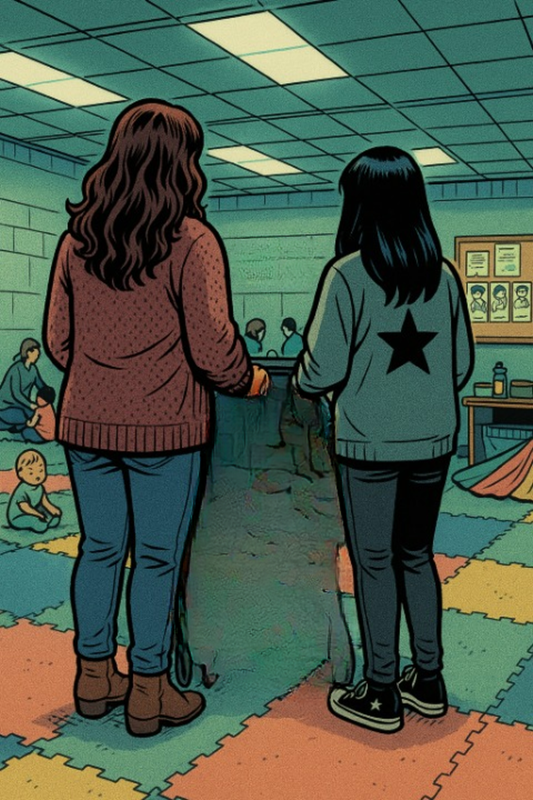
The fluorescent lights of the community center cast a sterile glow on the mismatched toys scattered across the playmats. They hummed faintly, a high thread of sound above the yeep of squeaky sneakers and the soft percussion of baby palms slapping vinyl.
Everything about the room had the compiled look of a place assembled from donations and municipal budgets: cinderblock walls painted an inoffensive eggshell, baseboards scuffed gray where a thousand strollers had cut their corners, ceiling tiles stippled with the faint water-map of a leak long ago solved but never quite forgotten. One tube near the door flickered every so often—an eyelid that couldn’t commit to open or shut—so the light moved in pulses, a heartbeat you could only see if you looked at the floor.
A bulletin board presided over the lobby like a town square, crowded with curling flyers: free tax prep (bring W-2s), infant massage on Thursdays, a babysitting co-op with a hand-drawn logo of a teddy bear, a lost mitten (red, lion face) pinned in the upper right corner with an oversized safety pin like it was being held in place by hope. Someone had taped up a list of emergency numbers in blocky 1992 typewriter font. Below it, a hand-lettered sign read PLEASE LABEL YOUR CUPS and a smaller one under that added NO NUTS in a hurried, worried Sharpie.
The smell said public building and winter: disinfectant’s lemony bite, wet wool steaming off a coat rack bowed under puffy jackets, coffee from a dented percolator in the kitchenette, a ghost of baby shampoo. Somewhere, a vending machine decided and undecided about releasing a packet of crackers, thunking its opinion at irregular intervals like a neighbor with a broom.
Inside the gym, the floor was a geography of taped boundaries and bright islands. The playmats didn’t match—some with zoo prints faded to pastels, some solid squares patched with careful strips of duct tape—spelling out a quilt of safe places. Foam blocks had that chewed-at-the-corners look that meant they’d given up their bright newness to the service of becoming towers and thrones. Stacking cups in a spectrum no manufacturer had ever intended (sunshine yellow from one set, deep lake blue from another) nested near a plastic xylophone with one bar worn to bare metal. A wire basket held rattles and rings; a Rubbermaid tub, its lid cracked and mended with clear tape, kept scarves the color of sherbet tucked away like a weather system.
The soundscape layered itself without trying. A radiator clicked as it considered heat as philosophy. A stroller’s front wheel ticked in uneven time until someone lifted it and spun it free. A dad cleared his throat in a way that said he didn’t know what to do with his hands. A burst of laughter from the hallway bubbled in and then receded as the door sighed shut. The babies made their small, definitive noises—ah! and ba! and a vowel that lived exactly between the two—as if testing the air for resonance, discovering that their bodies could change the room.
Near the snack table, the evening’s offerings waited with the ceremonial look of shared food: stubbily cut banana coins gone a little soft at the edges, pear slices beaded with cold, graham crackers in a sleeve that had given up on being neat, a row of paper cups nested deep enough to make a tower if someone got tempted. A pump bottle of sanitizer stuck on the downstroke and released with a comic squelch. A hand-lettered index card read WATER ONLY, underlined twice, as if pleading with the physics of juice.
The parachute—rainbow nylon folded into a tight, obedient wedge—slept under the table like a bright secret. A plastic bottle of bubbles, cheap and miraculous, sweated on its side. A fat bag of shakers waited with patient purpose, beans whispering inside their shells each time someone bumped the table.
On the far wall, laminated posters stepped parents through baby signs—MILK, MORE, ALL DONE—demonstrated by a model whose smile had a soft early-’90s earnestness. Below the posters, a stack of board books leaned in gentle disrepair: spines gnawed, corners peeled back into paper flowers, the pages thick with drool-varnish and the kind of love that is mostly enthusiasm.
The room itself felt like February trying to be kind. The glass doors breathed cold each time they opened and closed, letting in a thin ribbon of outside air that smelt of wet pavement and exhaust and the metal tang that means the day is already dark even if the clock insists otherwise. Parents stamped snowmelt off their boots on the entry rug and shrugged out of parkas in the slow, one-handed ballet of people who are also catching a sliding child or fishing a pacifier from a pocket without looking.
A night manager’s booth sat at the edge of the lobby—glass, laminate, a swivel chair that squeaked on protest. Behind it, a young man in a tie he kept checking with his thumb moved papers from one side of a blotter to the other as if arrangement could equal control. The fluorescent hum at his back turned the booth into an aquarium: people passed, he watched, wrote a note on a yellow square, stuck it to the monitor, peeled it off again. The phone rang once, and he answered in the voice people use when they’re trying to sound older than their face.
Back in the gym, the carpet of little shoes by the mat’s edge told its own story: Velcro sneakers with pilled loops, leather booties with elastic that had given out but kept trying, socks whose partners had already gone on ahead to the alternate dimension under couches. A diaper bag with stitched patches (a band logo, a daisy) leaned open to show the soft inventory of small lives—wipes, zippered wet bag, a bib with a ghost of yesterday’s sweet potato, a folded blanket that still smelled faintly like sunshine from a rare clear afternoon.
Someone tested the xylophone with one conscientious tap—pink mallet to green bar, a note so sincere you could almost see its shape—and then decided to leave it for later. A mom swept a quick perimeter with her eyes in the way all parents learn, counting bodies without counting numbers. A grandmother, coat still on, hovered like a lighthouse, her hands ready but not intrusive, the gravity of her presence a comfort to everyone whether they knew her or not.
In one corner, a yoga ball the color of hospital scrubs waited with saintly patience to be bounced on by a parent trying to coax sleep onto a stubborn toddler. In another, a donation of puzzles had spilled its mixed pieces together—ducks with the wrong farm, a siren looking for any truck to belong to—and some future hero would unknot them and deliver each to its box.
The floor had a sheen that told the history of mops. Tape marked out a basketball key no one would use tonight; the scuffs there were older, ghost prints of other kinds of running. Above the door, a red EXIT sign hummed a little lower than the lights, the room’s only truly warm color that wasn’t fabric. Someone had laid out a circle of cushions for the grown-ups, the kind that compress with a chuff when you sit, so the room carried, even empty, the expectation of conversation—the low tide of murmurs, the benchmark jokes, the little confessions of sleep tallies and teething.
And then the babies—because babies do this—began to claim their spots like chess pieces finding their squares. One found a stack of cups and began the ancient ritual of putting them in and taking them out and discovering that both are a kind of magic. Another patted the mat with her whole hand, five little smacks in a row, smiling at the noise as if she herself had invented percussion. Two met at the border between the zoo print and the solid square and negotiated the terms of friendship with a ring and a block as if they were treaties.
A shiver of wind worked under the door. The fluorescent chorus held its pitch. The room felt like a safe container, hard edges wrapped in soft rules: inside these squares, we share; inside these minutes, nobody asks more than you can give; inside this light, we pretend February is just a word.
The first adult laugh rose—wry, relieved—and then others answered, the way birds will call back from separate trees to confirm they are in fact a flock. A thermos lid hissed as it loosened. Pear slices met paper plates. Someone started a hello song in a key easy for everyone to find. A volunteer waved from the circle and the babies, as one, looked up—drawn not by authority but by motion, faces open and expectant, as if the whole room were a stage and every object on it had agreed to be gentle.
Outside, the darkness of day’s end swelled. Inside, the gym glowed its steady, unromantic glow, and the ordinary miracle of gathering—strollers parked nose to tail, coats steaming, small hands learning how to reach—got underway again, the way it always did, as if the lights and the hum and the duct-taped mats had been assembled for exactly this reason and none other.
“Circle time, mamas,” called the instructor, a woman with a bird brooch and a cardigan that had seen a hundred spit-ups. “Let’s all come in—big people on the outside, small people in the middle.”
Glenda lowered herself onto a mat with the ease of someone who’d sat on plenty of floors. Her hair was tied back in a scarf; her nametag read GLENDA in block letters, the ink smudged where Jess had pawed at it. Jess, one month past her first birthday, teetered to standing by pressing both hands into Glenda’s knee, then dropped to a determined squat and crawled for the nearest treasure: a scuffed yellow stacking cup.
Across the circle, Addison slid onto a mat that had a faded zoo print, tugging her oversized cardigan around her shoulders. She’d pulled her hair into a loose bun that looked like it had been done one-handed, which it had. Her nametag—ADDISON—tilted sideways. Toyah, all cheeks and concentration, planted a socked foot, considered her options, and wobbled forward—one step, two—before collapsing into a giggle that startled her into a second laugh.
“Hey, you,” Glenda said, low and warm. “Look at you, Miss Acrobat.”
Addison grinned, quick and small. “She thinks falling is a sport.”
Jess spotted Toyah and made a sound that, in any language, meant friend. She crab-crawled with urgency, cupping the yellow toy like a royal offering. Toyah lit up—this particular light was just for Jess—and lifted both arms. They reached each other with the bonk of two soft foreheads, then immediately began the serious work of trading: cup for wooden ring, ring for cup, no rules, all delight.
Toyah offered up a green ring solemnly. Glenda kissed the top of her head. “Thank you, little comet.” She pressed the ring back into Toyah’s hand and wiggled it to make it jingle. Toyah pressed it to Jess’s mouth. Jess accepted the edge like a priest accepting an offering and gnawed with conviction.
The instructor started a song, clapping on offbeats. “Row, row, row your boat—”
Glenda sang harmony without thinking, her voice a low river under the room. Addison, shy at first, found a line just above it, hushed but sure. When they got to “life is but a dream,” Jess stopped chewing to watch Glenda’s mouth form the word dream as if it were a new toy. Toyah bounced in time, hair flying.
Between verses, a mom in a crisp blazer leaned toward Addison. “How old is your little sister?” she asked brightly, nodding toward Toyah.
“My daughter,” Addison said, in the same tone she would use to say this is my hand. She didn’t flinch. “Thirteen months.”
“Oh,” the woman said, cheeks pinking. “She’s precious.”
“She is,” Addison said, not unkind. Glenda tipped Addison a tiny nod, not a rescue, just a companionable acknowledgment: I saw that.
“Okay, mamas,” the instructor chirped, “let’s do our tummy time check-in. What are we working on this week?”
“Walking without face-planting, ideally,” Glenda said. “She’s got the spirit. Gravity disagrees.”
Jess chose that moment to let go of Glenda’s knee, stand free for exactly one breath, and then sit down with a gentle thump and a surprised “uh!”
“See?” Glenda said, delighted. “Scientific demonstration.”
Addison stroked Toyah’s curls. “She wants to carry everything while she walks. Yesterday she insisted on bringing a spoon across the whole living room like it was a trophy.
The circle broke for “free play.” Babies fanned out in short expeditions, each a tiny monarch surveying a kingdom of dulled colors and softened corners. Jess, newly brave, tottered toward a soft pyramid with one hand out for Toyah, an invitation that was also a grab. Toyah obliged and crab-walked beside her, two small bodies leaning like cyclists drafting each other’s wind.
A bright rattle on the far mat caught their attention. Both froze, pivoted in the same awkward half-squat, and then—consultation conducted via babble—proceeded together. Jess reached first. Toyah made a polite sound Genda had started calling her “please chirp.” Jess looked up, met Toyah’s eyes, then wrestled the rattle with toddler diplomacy until they were both holding it, clacking in unison, drunk on the racket.
“Hey, Jess—can Auntie Addy see?” Addison crooned, hand outstretched. Jess beamed obligingly and pressed the rattle into Addison’s palm, then smacked Addison’s cheek with a careful open hand, a ceremonial blessing. Addison kissed her fingers. “I accept this great honor, lil’ miss.”
Glenda traded spots, scooping Toyah into her lap. “Well hello, butterbean,” she cooed. “What’s the news? Did you and my girl fix all international disputes, or do we still have work?”
Toyah patted Glenda’s chest decisively and then rooted for the chain of her necklace. Glenda let her find the pendant, steadying small fingers as if the necklace were a live bird. “Gentle,” she said. “That’s right. Gentle is how we do things.”
From the snack table came the crackle of a sleeve of graham crackers. A few older babies turned zombie-like toward carbs. Addison opened a plastic container of cut-up pears and offered a wedge to Toyah, who accepted it with reverence and immediately tried to share it with Jess. Jess, who had a cracker, mouthed the pear, decided joy was cumulative, and attempted to store both in one cheek.
Addison took the pear back, broke it smaller, and narrated as she worked: “We’re going to make it two bites, okay? Little bites are our friend.” Her hands were quick and certain, the movements of someone who’d had to learn everything she knows without being allowed to admit she didn’t know it yet.
Across the room, two moms compared growth charts in undertones that sounded like weather reports. Glenda looked at Addison, rolling her eyes with mischief. “If percentiles were edible, we’d never need groceries.”
“I’m at a steady ninety-ninth percentile for ‘winging it,’” Addison said.
“Baby,” Glenda said, “you’re summa cum laude at winging it.”
The instructor wandered by with a basket of board books. “Who wants to read?” she sang. Babies ignored her with the single-mindedness of people who had already chosen their narrative: rattle, cup, each other. Glenda snagged a book with farm animals and set it upright like a tiny theater. “Behold, a cow,” she announced, tapping the picture. “It says—”
“Mmmmuh,” Jess offered, extremely convinced.
“Close,” Glenda said gravely. “Still, very advanced.”
Toyah leaned in, cheeks flushed with effort, and kissed the cow. Addison laughed into her fist. “She likes to bless the pictures. Everyone gets a kiss. Even the snowplow last week.”
“I respect an inclusive theology,” Glenda said.
For a while the room shrank to small sounds: the whisper of diaper tabs, the soft wet syllables of babies talking to toys, the glancing chatter of women telling each other the gentle truth about sleep. A radiator clicked. Outside, February made the high windows look like glass bowls full of cloud.
Jess began her I’m tired but I don’t trust the concept of stopping murmur. Glenda scooped her up sideways, forearm under thighs, Jess’s head tucked against the slope where neck met shoulder. “Shh, bird,” she crooned. “We can rest without surrendering. It’s not a political statement.”
Toyah, alerted by the change in Jess’s breathing, steadied herself by Addison’s knee and leaned forward until her forehead rested against Jess’s calf. She hummed a sound that was not a note but made the air change. Jess answered with a sigh that deflated her like a punctured balloon. For a minute they existed in the tacked-together calm that only the other could make, the two of them an electrical circuit closed.
“They did that in the hospital,” Addison said softly, eyes on their daughters and somewhere else at once. “If Toyah was fussy, all she had to do was hear Jess doing that little fox-breath. She’d go quiet like somebody turned down a dial.”
“I remember,” Glenda said. She remembered Addison’s face under the awful lights, pale and steady, and the way she’d spoken to nurses like a girl who’d graduated from needing to ask permission. She remembered saying, Put her in here with me, and saying it in a voice that was not a question.
Across the circle, the blazer mom hovered. “Your girls are… very attached,” she said, trying on casual. “Do you, um, worry they’ll—”
“Love too well?” Glenda asked, smiling without showing teeth. “If that’s our problem, I’ll take it.”
“They’ll learn independence,” Addison added mildly, not looking up, “from people who don’t confuse it with loneliness.”
The blazer mom blinked, then nodded, chastened without knowing why. “Right,” she said. “Of course.” She retreated, already telling another mother how her son slept eight hours uninterrupted, which made the other mother’s laugh sound like a small broken bell.
Toyah yawned so wide Addison could see the gloss of her throat. “Okay,” Addison murmured. “We’re nearing pumpkin o’clock.” She lay back on the mat and put Toyah on her chest, patting a slow three-count between shoulder blades. Glenda mirrored her, sliding down until she was also a cushion, Jess’s breath warming a patch of her collarbone. The two women’s eyes met over their children’s heads. No craving to talk. Only that look people share once life hands them something heavy and both of them decide to carry it without watching to see who drops first.
“Doctor tomorrow?” Addison asked finally.
Glenda’s lashes dipped, lifted. “Yeah. Early. He’s… you know. Some days better, some days—” She let the sentence step into the air and vanish. “They’ll be fine with Scarlett a couple hours.”
“I can come sit,” Addison said. Not offering as charity. Offering as agenda.
“You got class Wednesday,” Glenda said.
“I’ll go after,” Addison said. “I’ll bring you girls supper tonight. I’ve got those beans at the house and that cornbread mix.”
“You are spoiling me,” Glenda said, mock-stern.
“Let me,” Addison said simply. “It’s not spoiling if we need it.”
They dozed like that: not sleep, but that grown-up half-doze where the body rests because the mind has been told there is no other option. Around them the class wound down in a soft bustle. The instructor handed out laminated sheets about “activities for thirteen to fifteen months.” Glenda slid hers into her bag without looking. Addison stuck hers in the pocket with the pear container, the corner already bent.
When it was time to go, the room turned into a choreography of bags, coats, errant socks, and binkies discovered under strangers. Glenda wrestled Jess into a small hoodie with bear ears. “These ears are doing Oklahoma-level work,” she told Addison. “I’m not emotionally prepared.”
Addison zipped Toyah into a quilted jacket that made her look like a berry. “Look at that face,” she said, her voice already in the register reserved for impossibly small mittens. She lifted Toyah to kiss the space between the eyebrows—the spot that always smelled like milk and shampoo and sunshine, even in February.
They buckled the girls into the double stroller they’d learned to share without ceremony. Jess, already sinking back toward napland, reached over the fabric divider with two fingers. Toyah found them without looking and hooked her hand there, the way she always did, as if declaring jurisdiction. Addison tucked a blanket around both sets of knees. Glenda draped her scarf over the handles where it could catch the day’s thinning light.
They rolled out into the corridor where the light was dimmer and kinder. Their boots squeaked on the linoleum. The lobby smelled like old paper and bleach and the faintest memory of last summer’s sunscreen. Outside, the cloud had decided to be sky again. February cold met their faces with a bite but not a malice.
In the parking lot, the work of transferring sleeping babies to car seats commenced: the sacred heist. Glenda whispered stage directions like a sportscaster. “We are approaching the straps. The straps do not know what’s coming. And—ladies and gentlemen—she sticks the landing.” Addison bit back a laugh to keep from waking anyone.
They closed the doors with reverent quiet. Through the glass, Jess’s mouth had fallen open, a tiny sigh fogging the window. Toyah dreamed with her hand still half-curled, grip loosened but not gone. The space between their car seats was too wide for their fingers to keep touching; still, their bodies were angled toward the idea of each other, two commas in the same sentence.
Glenda leaned her back against the car a second and let the cold steal some heat from her thoughts. Addison stood beside her and did the same, shoulder to shoulder, the way two people do who have learned that sometimes presence is ninety percent of the plan.
“You’re okay?” Addison asked, soft.
Glenda stared at the cloud of her breath and let it thin. “I will be.”
Addison nodded once. “Me too.”
They got in. The heater thunked awake. The radio, forgotten on from the last errand, offered a scrap of an old folk song—someone’s voice like a road at dusk. Glenda turned it down, not off.
“Home,” she said.
“Home,” Addison echoed. Then, glancing back at the rearview, at the two baby girls whose first language was each other, she smiled, not at anything, but with the kind of relief that feels almost like faith. “They’re gonna start a union, you know.”
“They already did,” Glenda said, pulling out into the gray-bright afternoon. “Local One: Sisterhood of the Traveling Rattle.”
“Dues paid,” Addison said.
“Benefits excellent,” Glenda said. “No retirement.”
They drove. In the back, Toyah and Jess breathed the slow, synchronized breath of people who have never had to wonder if someone would be there when they opened their eyes. The fluorescent hum of the community center receded. The day made room for them. And if the world outside the car was loud, demanding, full of news neither woman wanted to say out loud yet, none of that followed them right then. Right then there were two sleeping girls and two women who cooed at both of them and smiled like they’d found something worth keeping, and no one in that car intended to let go.
The next week the room was the same—fluorescents buzzing like lazy bees, beanbag animals listing against the plastic fence—but the woman at the front was not. She introduced herself as Mrs. Hawthorn in a voice like a ruler rapped on a desk. Late fifties maybe, a neat gray bun, a blouse the color of library paste. She kept her hands folded and her smile near but never on her face.
“Welcome, everyone,” she said. “I’ll be stepping in this evening. We’ll maintain the usual routine, but I do expect a bit more… order.”
Glenda flicked Addison a glance, amused. “Order,” she whispered. “We’re in the presence of wild anarchists.” Jess, oblivious to the indictment, patted her mother’s cheek and said, “Buh.”
Addison had layered an oversized cardigan over a black tee. The shirt’s print was stark—on a beach a young woman posing, dressed in mid century glamour an inverted U.S. flag reflected in hyer sunglasses, the print faded like a photocopy, and BAD RELIGION stamped in a stencil font across the top. The cotton had been washed to butter softness; Addison had knotted it at the hip to keep it out of Toyah’s reach. It was the kind of shirt you wear when you want to declare a test pattern to the world and see who tunes in.
Toyah and Jess found each other without negotiation. They collided on the playmat by the stackable rings and, upon impact, became a single organism with four hands, two drool strings, and one agenda: inventory everything within a three-foot radius. Toyah offered a blue ring as tribute; Jess offered a red block in return; both immediately reconsidered and negotiated a swap via babble.
“Circle time,” Mrs. Hawthorn announced, clapping once. It sounded like a gavel.
They sang; the babies ignored the rhymes and watched mouths; time elasticized the way it does when toddlers run the clock. When Hawthorn led “If You’re Happy and You Know It,” her smile finally appeared, brittle as a sugar shell. Addison and Glenda clapped on their own rhythms anyway, harmonizing under their breath like it was a private joke neither of them had to explain.
Snack break arrived with the sighing crinkly sound of Ziploc bags. The moms and dads fanned out toward the table. Someone poured juice. Someone else wiped a nose. A thermos wheezed as Glenda twisted its cap. “Tea?” she asked. “Contraband adult beverage.” Addison grinned. “Yes please.” Glenda poured, steam curling. “You okay?” she asked, quietly enough that the question could mean many things. Addison made a wobble with her free hand: yes and no and we’re still here. “Toyah tried to head-butt the ottoman and the ottoman won. But she forgave it.” “Diplomat,” Glenda said, fond. “I raised a few of those, too.”
They stood hip to hip in the half-busy space, sipping. Jess, braced against Glenda’s shin, was deeply committed to a graham cracker; Toyah, in Addison’s crook, methodically gummed a peeled pear slice like it owed her money.
That was when Mrs. Hawthorn approached. The walk itself was a paragraph—chin up, shoulders squared, the precise gait of someone who has rehearsed her sentences. She stopped an arm’s length away and tilted her head at Addison’s shirt.
“Ms.…” She glanced at the smudged nametag. “Addison.” The title didn’t change but the word itself sounded like a cough. “May I have a word?” Addison blinked, open-palmed. “Sure. Many, if you like.”
Hawthorn drew a breath the way people do when they’re adjusting a corset. “I can’t help but notice your… garment. I don’t care for it. The name”—she tapped the letters, like testing the temperature of a stove—“and the inverted flag are inappropriate for a family environment.”
Addison glanced down as if discovering her torso for the first time. “Oh. This old thing.”
Glenda didn’t move, only re-anchored Jess’s hand where it had started to slide. Her face went calm in the way of someone who has been a bouncer at exactly this kind of door.
“It’s from a band,” Addison said, gentle as she could make it without curling up on herself. “Art is the kinda thing you can take it how you like, ma’am.”
Hawthorn’s lips tightened. “We have families here, their relatives served. People died. I think it’s—” She searched for a word that wouldn’t say more about her than about the shirt. “—unhelpful.”
Glenda’s voice stayed low. “Addi and I know folks who served, too. And folks who protested. I don’t think those cancel each other out.”
Hawthorn flicked her eyes toward Glenda as if swatting a fly. “That may be. But I’m responsible for this class tonight, and I’m telling you I don’t like it.”
The air between them went taut. Toyah squinted up at the new voice, then resumed the important task of smearing pear on Addison’s collarbone. Jess leaned around Glenda’s thigh for a better look at the stranger, then decided she wasn’t a toy and returned to carbs.
Addison took a sip of tea and let the steam wash her face. When she spoke again, the edge in her was velveted to something playful. “Alright. Next time I’ll wear my Debbie Boone shirt.”
There was a one-and-a-half-second pause in which the joke traveled, found its mark, and failed to please the intended audience. Glenda snorted into her cup anyway, a tiny, irrepressible laugh.
Hawthorn’s expression did something complicated and then smoothed though it was unclear if she understood or was filing the sentence under Things to Dislike Later. “In the future, please consider the message you’re sending.”
Addison’s smile showed a dimple that hadn’t had a lot of practice lately.
Hawthorn pressed her lips together into a thin careful line. She looked at Toyah, at Jess, at the two women, and then at the shirt again, as if trying to calculate which objects were permanent. “Very well.” She contained her annoyance—Addison could see her carry it the way you carry a hot pan with a towel—and pivoted away. “Five minutes, everyone,” she called to the room at large, voice brisk. “Then we’ll reconvene.”
Mrs. Hawthorn drifted toward the far end of the room with her clipboard, aligning crayons by length like she could will the entire evening into columns and rows. She kept her distance, a polite weather system holding steady just beyond their patch of floor.
Parents settled back onto the mats. The babies resumed their circuits. Toyah planted her hands on Addison’s knee and pushed to standing, wobbly but stubborn, eyeing a foam block like it was a summit. Jess made a quick decision and toddled over in three audacious steps, her hand already outstretched with a blue ring she’d decided Toyah needed more than she did.
“Thank you, ambassador,” Addison murmured. She tipped the ring to her forehead in mock salute before passing it on. Toyah examined it with scientific gravity, then, with equal gravity, pressed it back into Jess’s hand. Exchange complete. Treaties intact.
“Alright, everyone,” called Hawthorn, from her island near the book bin. “We’ll do signs now. Milk. More. All done.” Her demonstrations were precise, almost military—fist opening and closing, fingertips together, palms sweeping. She didn’t come closer; she didn’t look to see who followed.
Addison brought her hands into Toyah’s line of sight. “Milk,” she signed, slow and playful. Toyah’s eyes sparked. She mimicked the open-close of the fist with furious concentration, then looked up to confirm that the air had, in fact, changed shape in a way that counted.
Glenda took Jess’s hand and helped her make the same squeeze-and-release. “That’s it,” she crooned. “You’re fluent in half the language of survival.”
Jess tried again unassisted, then clapped for herself, delighted. Toyah, catching the spirit, slapped her palm on her own chest and beamed. Addison clapped too, because some applause is a kind of food.
Around them, a dozen tiny dramas played out: a power struggle over a rubber banana resolved by a parent’s deft introduction of a second, identical banana; a legitimate crisis when a sock vanished into the alternate dimension that exists between mats; a howl turned into hiccuping laughter when a dad produced a tissue like a magician’s scarf. Hawthorn watched it all from her perimeter, jotting something on her forms, her pencil strokes brisk enough to sound like rain.
“Bubbles,” someone suggested, and a chorus of hopeful baby sounds answered. Hawthorn produced a bottle but didn’t cross the room; she blew a cautious stream toward the center as if reluctant to contaminate the space with fun. The bubbles drifted, fragile and showy. Toyah froze mid-step to watch one wobble past her nose; Jess followed another with her whole head the way sunflowers track the light. A bubble landed on Glenda’s sleeve and sat there, a glass bead trembling on knit. “Look,” she whispered. “Little planet.” Jess leaned in and kissed it so carefully that it burst with a sound that wasn’t a sound at all.
Snack time resumed. Cups reappeared; fruit made one more tour of duty. Addison retrieved their pears, slices still cold from the air, and offered one to each girl. “Bite,” she narrated. “Chew. Think about your life choices.”
“I’ll take that advice,” Glenda said, accepting the pear piece Jess offered her with queenly seriousness, then pretending to savor it like a sommelier. “I’m getting notes of… sticky.”
On the far mat, two moms debated nap schedules with the solemnity of theologians. A dad in a baseball cap laughed too loudly at a joke no one had made. Mrs. Hawthorn stood near the storage closet with her arms folded, gaze skating over Addison and the shirt and back again, as if looking anywhere near them required exacting balance. When another parent approached her with a question about teething toys, she softened three degrees and answered in bullet points. When that parent thanked her, she gave a short nod and retreated into the safety of tasks.
“Parachute!” someone cried, and the weather of the room changed again. A rainbow nylon circle appeared from under the table, that universal carnival. Hawthorn laid it out but didn’t kneel. It spread like a low sky. Adults took hold around the edge. Addison slid in beside Glenda so their grips touched knuckle to knuckle under the same stripe. Toyah and Jess stepped onto the center like astronauts first on a new planet.
“One, two, three,” Hawthorn counted, clipped as a metronome. The parents lifted; the parachute bellied with air and floated down, bright and soft. The girls screamed the good kind of scream, faces tipped up to catch the wind. On the next lift, Jess made for the far side and Toyah followed, the two of them running the fabric’s billow like children of a sea that only appears on Tuesdays. Addison glanced across the circle at Glenda and grinned, crooked and young for a heartbeat. Glenda grinned back, lip caught between teeth, the two of them tugging a little harder to give the girls one extra second of sky.
They played “mushroom,” the parachute puffing up and dropping, up and dropping, little hands trying and failing to hold the edge. On the last lift, kids ducked under the nylon and squatted in a rainbow cave. Addison and Glenda peeked their faces under the rim too, just enough to make eye contact with the girls—just enough for that wordless check-in that says I see you; I’m here; we are having the same miracle. On the other side of the circle, Mrs. Hawthorn stood with her clipboard, watching the riot of color like a museum guard making sure no one touched the art.
Cleanup was its own choreography. The parachute funneled blocks into its bright center; parents lifted and poured them into bins. A wave of wipes swept cheeks and hands. A toddler protested sock reapplication with the vigor of a union organizer; his father negotiated with promises of a car-ride song. Hawthorn leaned a broom against the wall and collected board books with spine-squared precision.
Addison crouched to wrestle Toyah into her little quilted jacket, humming tunelessly to keep the girl distracted from the treacheries of sleeves. Glenda coaxed Jess’s heel into a shoe with a whispered “gotcha,” then kissed the bear ears on the hoodie like she could bless the fabric with weatherproof luck.
A mom in purple leggings paused as she passed them. “Your girls,” she said, smiling softly at the sight of Toyah and Jess leaning toward each other over the stroller divide, hands already seeking the familiar hook. “They’re… they’re like twins who remembered.”
“We call them the union,” Glenda said. “Organized labor from day one.”
“Strong demands,” Addison added. “Fair wages paid in crackers.”
The mom laughed and moved on. Mrs. Hawthorn recorded a final note, slid her pencil into the spiral, and snapped the clipboard closed. If she had a goodbye for them, it lived behind her teeth. She offered the room a general, efficient: “Thank you all for coming. See you next week.” Then she turned to align the mats into a perfect stack, back a small, rigid cliff.
Jess, already half-slumped into the nap-lean, reached toward Toyah with two fingers. Toyah found them without looking and threaded her hand through. Addison tucked the shared blanket tighter across their knees. Glenda slid the thermos into her bag and slung it over her shoulder, her movements practiced, domestic, unshowy—the kind of competence that looks like calm.
They lingered a minute longer than necessary as the room thinned, doing nothing in particular—a few last sips of tea, a final inventory of tiny possessions that mattered only because they did. In the glossy cinderblock light, the four of them felt like a small republic: boundaries soft, customs clear, citizenship granted by touch.
Hawthorn passed by with a crate of rattles, her chin lifted to avoid catching anyone’s gaze. Addison stepped aside to give her room. A neutral nod flickered from Hawthorn and died before it could heat the air between them. That was fine. Whole climates could be survived with a single shared blanket and the knowledge of where your people were.
“Ready?” Glenda asked.
“Ready,” Addison said.
They eased the stroller toward the door, their daughters’ hands still linked across the small gulf between seats. Behind them, the fluorescent hum continued its endless sermon to no one in particular; ahead, another February evening waited to be managed. And in the middle of it—on this shabby mat, in this ordinary room—their little unit held, bright and sure as breath.
The following week, the lobby felt like a waiting room for a storm that hadn’t decided whether to snow or rain. The fluorescent tubes hummed their same thin sermon; the bulletin board still advertised free tax prep, a lost mitten, infant massage on Thursdays. A vending machine clicked and whirred as if trying to remember its purpose. The night manager—a relatively young guy with a tie he kept fussing straight like it wouldn’t obey him—met Addison and Glenda by the sign-in desk before they could roll the stroller toward the mats.
“Hey,” he said, voice pitched into the register called Friendly But Administrative. “Hi, uh, Addison? And Glenda, right? Could we talk for a quick second? Just a sec. Before class.”
He was all edges softened by effort. Early twenties, maybe, clean shave already losing to five o’clock shadow, a tiny scab on one knuckle like he’d argued with a stapler and lost. His nametag read KYLE in block print—under it, night manager in smaller letters, like a secret.
Jess, absorbed in her life’s work of removing a sock with a single shin rub, paid him no mind. Toyah clocked him, filed him under Tall People Who Say “Hey,” and got back to checking if the stroller buckle tasted different this week.
Glenda angled the stroller to the side, half-blocking the hallway automatically, the way you do when you’re making your own safe little corner. “Sure,” she said, easy. “What’s up?”
Kyle cleared his throat and produced a smile that might have been rented. “So. I heard there was a… little run-in last week. With Mrs. Hawthorn.”
Addison, who’d shown up in a thrift-store white tee with a lopsided sharpied star and Somos una familia feliz in block letters—she’d said she would—didn’t bother to look surprised. “A run-in,” she echoed. “Huh.”
“She approached us,” Glenda said, simple fact. “We were eating pears.”
Kyle nodded like a metronome. “Right, right. And, uh, first, thanks for being regulars here. We love having y’all. The girls are—” He glanced down at the stroller where Jess and Toyah were engaged in successful finger-hook negotiations across the divider. “—adorable. So. Sometimes misunderstandings happen.” He spread his hands to show how big misunderstandings could be. “People bring different perspectives to a community space. We, um, try to keep things… neutral. Family-friendly. A place everyone can feel comfortable.”
“‘Misunderstandings,’” Addison said, tasting the word like it might be undercooked.
“It’s a good vocabulary word,” Kyle offered, relieved to be on the ground he’d rehearsed. “Like, if we all assume positive intent, then we can de-escalate and—”
“Positive intent doesn’t cover what she said,” Addison said, not loud, not heated, just clean. “Let’s not sand it down. This ain’t about my shirt. What she didn’t like was what it said. It was saying out loud what I’m allowed to think. That’s not a misunderstanding. That’s exclusion said softly, still trying to push me out.”
Kyle’s smile faltered a millimeter. He looked at Glenda like he might find a rope there. “I’m sure Mrs. Hawthorn didn’t mean to make anyone feel… you know. We get folks from all walks. Some of our donors are very—” He caught himself, tried again. “We want to avoid, like, hot-button things. Especially in front of kids. It can, uh, create… tensions.”
Glenda’s eyes were kind when she wanted them to be and made of rebar when she didn’t. Right now they were some alloy in between. “We bring our girls here to play and sing and chase bubbles,” she said. “We clap on the wrong beats and share pears and pick up the parachute like it’s a holy sacrament. That’s our agenda.”
Kyle seized on that. “Exactly! Exactly. So if we can agree to keep… messaging… to a minimum—just in the space of the class—then I think everyone can—”
“I am the message,” Addison said. “Me. Showing up. Existing. That’s what she didn’t like. If I put on a canvas sack with the word person someone’s still gonna find a reason to be offended. We both know that.”
Behind her, Toyah conducted a slow-motion jailbreak on her sock and succeeded with a triumphant “ha.” Jess, deeply moved by this act of civil disobedience, offered her own sock in solidarity. They grinned at each other, feet bare, toes out like flags.
Kyle tried for a different angle. “Look, I’m not—no one’s saying you can’t be here.”
“That’s what it feels like,” Addison said. “A soft shape around a hard no. ‘We’re not excluding you, we’re just asking you to be smaller. Quieter. Smoother at the edges. Maybe don’t wear the thing. Maybe don’t say the thing. Maybe don’t be the thing that makes somebody’s eyebrows go north.’ You hear how that is the same sentence, right?”
Glenda rested a hand on the stroller bar, fingers drumming a slow, steady beat. “If Addi is being asked to be less,” she said, calm as a doorframe, “we’ll walk right out with her. Me, Jess, the bag with the snack stash, the thermos. Our fees go with us. Our laughs go with us. The little girls who light up your circle time like a pinball machine go with us.”
Kyle flashed that managerial smile again like he could restart the machine by mashing the same button. “No, no, that’s not what anyone wants,” he said quickly. “The class loves your girls. I—I’ve watched. They’re kind of celebrities.” His glance snagged on the star on Addison’s shirt; some nervous part of him decided humor might be a bridge. “So I see the… Debbie Boone—” he gestured, uncertain “—love the, um, commitment to the bit. Ha.”
Addison didn’t make him pay for the joke; she gave him the generous half-smile she reserved for people trying in the wrong direction. “You asked for neutral,” she said. “This is as neutral as I get.”
“We just… and I’m speaking as the manager here,” Kyle said, clinging to his job title like a flotation device, “want to make sure staff feel respected, too. Mrs. Hawthorn has been volunteering here twenty years. She’s got her ways, sure, but she—”
“People who talk the most don’t know shit,” Addison said, and it sounded like she was quoting scripture from a church that met in basements and laundromats and back seats of cars. “They have the longest lectures and the shortest listening. She didn’t come to understand. She came to inform us of our place.”
The moment hung there—Kyle’s mouth slightly open like a kid catching snowflakes, Addison’s words tidy on the floor between them, Glenda’s hand steady on the stroller as if the floor might tilt.
Kyle swallowed. “Okay,” he said finally, and to his credit he didn’t try to scold the language out of existence. “Okay. I hear that.” He looked at the bulletin board like it might coach him. He tried a different tack, softer. “I’m young at this,” he confessed in a voice that wasn’t the manager voice. “I get these trainings and they give us phrases and I try to use them like tools and sometimes they’re just… rubber hammers. I don’t want anyone to feel pushed out. Not on my shift.”
“Then don’t push,” Glenda said. “And don’t let your people do it either. If a staffer has a concern, they bring it to you. You bring it to us like a grown-up, not like a hall monitor. With respect. Not with a list of acceptable T-shirts.”
Toyah, having liberated both socks, leaned hard across the divider to find Jess’s hand. Jess met her halfway, the familiar hook slotting into place like a key.
Kyle watched their fingers and some of the tension in his jaw unwound. “They really do that every time?” he asked, wonder breaking through the corporate varnish.
“Every time,” Addison said, and her face changed too, the hard, bright edge of it softening in the glow of that small, ordinary miracle. “They learned each other’s breathing in the hospital. They’ve been decoding the world in duet ever since.”
Kyle looked back up at Addison, then at Glenda. “We want you here,” he said, sincerity finally beating out policy. “I want you here. I’ll talk to Mrs. Hawthorn about, um, how we approach families. About addressing concerns through staff channels and not… ambushing people on snack break. I can’t fix everything, but I can do that.”
“Do that,” Glenda said. “And when you do, don’t make it our job to teach the class how to treat us.”
“I won’t,” he said, and he sounded like he meant it, like a kid promising to water a plant that he actually liked. “If something like this pops up again, you come find me. I’ll be at the desk or doing rounds. We’ll handle it. And—” he gestured toward the gym doors “—if you want me to sit in tonight, I can. Sometimes having a manager present keeps things… balanced.”
Addison considered him for a beat. “No,” she said. “If you sit in, it becomes about you. We came for ring stacks and that stupid parachute and a bubble that lands on Glenda’s sleeve and makes Jess gasp. We didn’t come for governance.”
Kyle huffed a laugh, a real one this time. “Fair enough.” He tugged his tie, which had re-crooked itself the second he stopped paying attention. “I’ll be at the desk. For what it’s worth, my mom loved Debbie Boone.”
“For what it’s worth,” Addison said, deadpan, “so do I.”
They stared at each other a second and then—because sometimes truce is just deciding to move forward simultaneously—they all nodded. Kyle stepped aside, putting physical space where he’d just promised to put moral space.
“Thanks for talking,” he said, softening it to a normal human goodbye. “Have a good class.”
“Make sure the bubble stuff isn’t watered down,” Glenda called as she maneuvered the stroller toward the double doors. “These children are bubble connoisseurs.”
Kyle threw her a salute. “Full strength. Promise.”
They rolled into the gym, where the mats were already being unrolled like bright tongues and a dad was testing the xylophone with the concentration of a person defusing a cartoon bomb. The same fluorescent hum. The same battered bin of board books. A different temperature in the air, like someone had cracked a window an inch.
Addison exhaled a breath she hadn’t admitted she was holding. Glenda bumped her shoulder. “You okay?”
“I’m always okay,” Addison said, which in her mouth meant not always, but enough. She looked down at the girls. “You wanna tell the union we won a small thing?”
Jess, who did not know what a small thing was but knew what a voice like that meant, squealed softly and kicked one foot. Toyah matched it with a hum that had nothing to do with pitch and everything to do with YES.
They parked by their usual spot. Addison knelt to re-sock two rebellious feet. “Traitors,” she told the socks with affection. “Get back to your posts.” Glenda unzipped the tote and produced pears and the thermos like a magician who only does two tricks but does them perfectly every time.
Circle time began with a new volunteer who said her name was Nisha and clapped on the right beats and didn’t police anyone else’s. When “Row, Row, Row Your Boat” reached “life is but a dream,” Addison caught Kyle’s shape through the tiny window in the door—just a silhouette, just a manager doing his rounds, just a person—then let it go. She had a baby to balance on one knee and a friend to harmonize with and a bubble to kiss before it popped.
Behind the desk, Kyle wrote himself a note on a yellow sticky and stuck it to the monitor where he’d have to see it twice a night: TALK LESS. LISTEN MORE. Then, smaller: ASK, DON’T TELL.
Out on the mats, the girls had already latched hands again. Out on the mats, Glenda and Addison had staked their corner and filled it with laughter and the kind of ordinary bravery that looks like staying. The fluorescent lights buzzed. The parachute waited under the table like a bright, patient sky.
Circle time began with a new volunteer who said her name was Nisha, and the room seemed to tilt toward her the way plants lean toward a better window. She crouched to the babies’ height to wave, not from above but from the small republic of the floor. “Hi, hi, hi,” she sang, a three-note hello that landed like a soft ball in the middle of the mat. Toyah yelped—a bright squeak that was half-laugh, half-bird—and windmilled both arms so hard her socks squeaked on vinyl.
Nisha waved back as if the yelp were a password. “I heard you,” she said, delighted. “That’s your hello, yeah?” She didn’t wait for a grown-up answer. She looked right at Toyah and repeated the yelp, softer, a careful echo. Toyah’s whole face lit; she yelped again, this time with a small hop that threatened to topple her. Jess, who had been busy with the important project of aligning two rings like moons, popped her head up and echoed with a sound that was mostly eager air. The union announced itself in stereo.
“Okay, team,” Nisha said, easing onto a cushion with her legs folded under, palms open on her knees. “We’re going to sing a hello song. If you want me to use a nickname, tell me now.” She glanced up at the ring of adults. “And if you don’t want to sing, you can hum. And if you don’t want to hum, you can clap. And if you don’t want to clap, you can breathe. All of those count.”
Addison, cross-legged with Toyah nested against her shins, lifted her hand. “She’s Toyah,” she said. Her shirt was a thrifted white tee with a lopsided sharpied star and DEBBIE BOONE in chunky letters. “And I’m Addi.”
“Addi,” Nisha repeated, as if sliding the name into her pocket. She turned. “And you?”
“Glenda,” Glenda said. “This is Jess, also answers to Ambassador, Inspector, and Bird.”
“Remarkable titles,” Nisha said, eyes smiling. “We’ll stick with Jess unless the Ambassador objects.”
She strummed the air with her fingers like a pretend guitar. “Ready? It goes like this.” She sang in a low, steady alto that felt like standing near a radiator: “Hello, Toyah, hello, Jess. Hello to every little yes.” She paused so the babies could put sound in the gap, and they did—yelp, puff, squeal, the room filling with a tiny choir of untranslatable affirmations.
“Now the big people,” Nisha said, eyebrows lifting with theatrical dread. She dropped the key a step. “Hello, Addi, hello, Glen—” She caught herself, grinned. “Glenda. Hello to every grown-up friend.”
Glenda harmonized without trying; Addison found a line just above it, like she always did, a ribbon on Glenda’s river. Nisha’s eyes flicked, pleased, and then moved on. She had a canvas tote beside her that had clearly lived a life: stitched patches, a fraying strap, a small bell on a keyring that chimed when she shifted. She reached in and produced two things: a hand puppet that was technically a fox if foxes wore little scarves, and a tiny tambourine.
“Oh no,” she whispered to the puppet, making it peep at the babies. “We forgot everyone’s names already. What will we do?”
The puppet looked worried in the universal language of felt. Toyah leaned so far forward that Addison planted a hand at her waist to counterweight her. Jess made grabby hands with both fists, which in toddler diplomacy meant, I will hold your problem and thereby fix it.
“Let’s ask,” Nisha said. “Fox is great at questions.” She turned to Toyah. “What’s your name?” She signed WHAT with exaggerated, slow hands, then pointed to Toyah and tilted her head.
“Toy—ah,” Addison offered, but Nisha shook her head gently—thanking, not shushing.
Toyah offered her yelp, then patted her own chest with the flat of her hand.
“Toyah,” Nisha affirmed. She made the T-handshape against her palm, slow and clear, then repeated the yelp as if translating it into sign. “Toyah says hi.”
She turned the fox toward Jess. “And you?”
Jess, serious, patted her chest too, but her hand landed on the bear ear of her hoodie. She squeezed it, eyes wide at the sudden discovery that bears have ears on clothes.
She made a J in the air with her pinky, then tapped her own chin like she’d learned somewhere that Jess liked faces. “Jess,” she said, and then, to the fox, a scandalized stage whisper: “Fox, you cannot eat her ear, even if it looks delicious.” The puppet relented with a dramatic sigh. Babies giggled in tiny bursts, bodies wobbling with borrowed balance.
“Okay, we’re warm,” Nisha said. “Let’s move the weather.” She stood, shaking the tambourine once, not too loud, just enough to rearrange the air, and then she started the simplest song possible: “Clap, clap, clap your hands, clap them if you’re able.” She clapped slowly, giving time for copying. “Roll, roll, roll your hands, roll them like a cable.” She rolled her wrists in big circles, tongue poking from the corner of her mouth in exaggerated concentration, inviting imitation. Toyah, eyes riveted, rolled one wrist, then both, then, thrilled by the geometry of her own bones, tried to roll her ankles too. Jess clapped with fierce accuracy, then cheered herself with a shriek.
“Stomp, stomp, stomp your feet,” Nisha sang, and made stomping into a small thunder that didn’t scare anyone. The room followed, a soft storm. Addison’s stomps were gentle, a percussion you could nap on. Glenda’s were syncopated, finding the backbeat; Jess watched her mother’s shoes like they were making magic. Toyah lifted each foot high and set it down like a ceremonial seal.
“Good,” Nisha said, letting the tambourine ring once like a period. “Now a quiet one.” She flopped back to the mat and lay on her side so she was cheek-level with the kids. “Can we breathe like we’re blowing on hot soup?” She pursed her lips and exhaled in long, candle-soft streams. “Hoooo. Hoooo.”
Addison did it; Toyah followed, cheeks puffing, eyes crossing with the effort; she produced a noise like a tiny kettle. Glenda did it; Jess tried and then, overwhelmed by the sophistication of air management, giggled until she tipped into Glenda’s lap. Glenda kissed the place where her hair smelled like rain.
Nisha peeked around the circle. No one was scolding; no one was correcting; the whole thing had the easy look of a game invented five minutes ago by kids who’d been friends forever. She kept going. “We’re going to read a book,” she announced, producing a board book with a cover so chewed it looked like it had pilfered a dog’s life. “But first we need to practice our surprise faces. Ready?” She opened the book and gasped dramatically, eyes wide, hand to chest. The babies gasped back like air could be a joke.
The book was about a bus that met animals that were not usually found on buses. “The bus says ‘beep beep,’” Nisha read. “What does the cow say?” She didn’t say moo; she waited. Jess said “mmmuh” with tremendous confidence and then beamed at herself, looking to Glenda, who whooped softly like Jess had just aced her entrance exams. “Dialectical variant,” Glenda intoned. “Texan cow.”
“And the monkey says—” Nisha waited again.
Toyah offered a sound that was less monkey and more the exact noise the vending machine made when choosing violence. “Perfect,” Nisha breathed. “We’re multilingual.”
Between pages, she looked to the adults. “Wins of the week?” she asked lightly, like weather talk. “Tiny ones count.”
“Toyah shared her cracker,” Addison said. “Then she took it back, then she shared half of it.” She shrugged. “Honestly, it felt like diplomacy.”
“Jess stood for three breaths without assistance,” Glenda said. “Very important to mark the breaths.”
“Three-breath girl,” Nisha said, impressed. “Okay, next time we’re bringing medals.”
She read the last page, the bus arrived somewhere sensible, and then she closed the book and tapped the cover. “All done.” She signed it, palms sweeping away. A few of the babies copied, some by accident, some by genius. Toyah looked at Addison, made a very thoughtful version of the sign, and then applauded herself. Jess signed MORE with her fingers pressed together and a look that said, Consider your options carefully.
“More?” Nisha laughed. “We can do more.” She glanced at the tote like it was a treasure chest. “Scarves or shakers, your pick.”
A murmur rose from the perimeter. “Shakers,” someone said. “Scarves,” someone else said. Nisha held both up like a game show. “Democracy’s hard,” she told the babies. “But also good.”
Toyah lunged for a shaker with a tiny gleam in her eye that meant rhythm. Jess reached for a scarf because it moved like a tame ghost. Decision made.
Nisha didn’t pass them out like a teacher doling detention; she fanned them across the mat and let little hands choose. “One per person,” she murmured, “unless you’re negotiating a trade, in which case I want to see paperwork.” She winked. Addison’s mouth did a surprised little curve; Glenda snorted.
They played call-and-response. “I shake mine,” Nisha sang. “You shake yours.” The room shook, a recorded rain. Then she dropped her voice. “I hide mine…” She hid the shaker behind her back, eyes exaggeratedly innocent. The babies shrieked—the good shriek, the where-did-it-go universe-shift shriek. “Where,” Nisha whispered, “is it?” She popped it out from under her knee. A chorus of awe. Magic in sweatpants.
She switched to scarves. “Up,” she chanted, sending a kite of chiffon into the hummy light. “Down.” The scarves came down like the idea of snow. “On your head.” She plopped hers on her hair and made a face so dramatized even the newest babies understood: ABSURD. Toyah tried to arrange a scarf on her own hair, snarled it, then accepted Addison’s gentle untangle. Jess draped hers over Glenda’s wrist like a bracelet; Glenda modeled it with runway seriousness until Jess belly-laughed herself sideways.
Through the little window in the gym door, Kyle’s silhouette drifted by, a brief eclipse and then gone. No clipboard invasion followed. Nisha didn’t police the clapping. She didn’t correct the cows. She looked at people when they talked and at babies when they made noise and at the space in between as if it were the point.
“Okay,” she said at last, breath a little faster, cheeks pinked. “Two more things. Then bubbles. I promise.” She held up two fingers and then folded one down. “Thing one: we’re going to practice the signs we use a lot, but we’re going to let the kids lead.” She made MILK slowly. Toyah’s fist opened and closed like a lighthouse. Jess tried MORE, fingertips pecking. “Thing two,” she said, folding the second finger down, “is we’re going to make quiet together for the length of one—” she checked an imaginary watch “—very short song.”
The song turned out to be a hummed fragment, just a few notes looped, the kind of tune you invent while waiting for pasta water to boil. Adults breathed with it. Babies didn’t—babies have their own relationship with quiet—but they watched the shapes in the room change because the big people had decided to make them gentle.
Then: “Bubbles,” Nisha declared, and the room’s blood pressure dropped ten points. She uncapped the bottle like a sacrament and lifted the wand. For once, the bubbles were not cheap; they held their shape long enough to be contemplated. A bubble landed on Addison’s knee; Toyah, reverent, leaned in and kissed it until it popped with a mosquito-sound. Another bubble landed on the slope of Glenda’s shoulder; Jess touched it with one careful finger and looked like she’d been entrusted with an egg.
“Last thing,” Nisha said, as the bubbles thinned into little circles of wet on the mats. “If you need to step out, step out. If you need to cry, cry. If you need to nurse, nurse. If you need to be quiet, do that. If you want to talk, I’ll be here after.”
Addison met her eyes for the first time in a way that wasn’t just social. “Thanks,” she said.
“For what?” Nisha asked, genuinely puzzled.
“For running it like a party where everyone knows the rules,” Glenda answered for her. “And the rule is: be human.”
Nisha laughed, almost embarrassed. “That’s the only one I remember.”
The circle dissolved into free play with the ease of a tide. Parents stretched their legs; babies resumed their tiny careers. Toyah made for the stack of cups; Jess followed, already offering a blue ring like a passport. They fell back into their tether, fingers hooking across the small divide. Addison reached into the tote for pears; Glenda poured tea; ordinary bravery settled back over their patch of floor like a blanket pulled up to a chin.
Nisha began to gather scarves, not into a perfect stack but into a soft heap. On her way past their corner, she rested the fox on the stroller bar for a second as if leaving a visiting card. The fox bent toward the girls. “See you next time,” Nisha said through it, then added, to the adults, with no puppet at all, “I’m glad you’re here.”
“Us too,” Addison said.
“All the time,” Glenda said.
Toyah yelped once more, as if to sign the paperwork. Jess answered with a puff of a laugh, as if ratifying. The fluorescent lights kept up their distant hum, bureaucratic and boring. But inside the circle, it felt like someone had cracked a window an inch and let February smell like air again.