Work Text:
The room had the unmistakable warmth of a lived-in home. Light filtered in through the crooked blinds in streaks of gold and dust, casting warm diagonal shadows across the floor and up the legs of the worn coffee table. On that table, a battered Tupperware container held an assortment of mismatched crayons and stubby pencils, and beside it lay an open board book featuring animals and their sounds, each corner gnawed faintly from Jess’s recent explorations.
A pair of tiny socks had been cast off and now lay in the space between the couch and the bookcase, which sagged slightly under the weight of storybooks, cookbooks, and cassette tapes stored in old shoeboxes. Near the far wall, a red plastic chair—part of a toddler-sized table set since outgrown by the older girls—stood askew, as if someone had made a quick escape from an imaginary tea party.
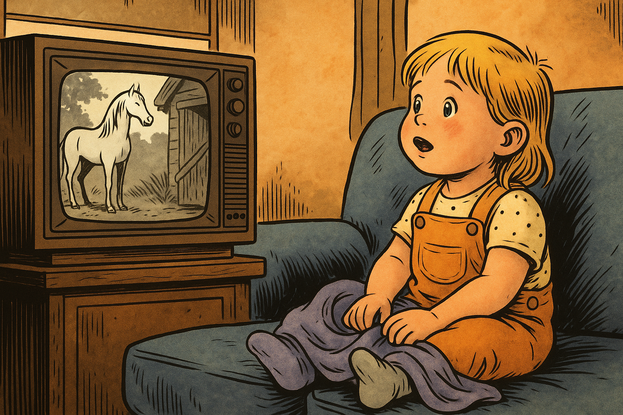
And there in the middle of it all, perched upright in a careful stack of couch cushions, was Jess.
Fourteen months old, a sturdy little thing with pale blonde hair that lay flat and straight against her round, earnest face, Jess had the calm self-possession of a child used to noise, motion, and being adored. Her hair was fine and soft, combed straight that morning by Glenda with a dab of coconut oil, parted slightly to the left in the hopeful gesture that it might stay put for once (it didn’t). A single strand had come loose and now hung just over her brow, brushing the downy lashes that fanned her wide eyes.
She wore a long-sleeved onesie, faded periwinkle with tiny white clouds printed across the chest and shoulders. A plump embroidered sheep dozed just above the left hip. The fabric was soft from many washings, a little loose at the wrists where the elastic had stretched, and the knees showed faint grass stains from an earlier crawl across the backyard. Over it she wore a pair of miniature corduroy overalls in pale sage green, fastened with small plastic buttons shaped like flowers.
Jess’s legs stuck out in front of her, plump and pale and lightly dimpled at the knees. Her socks had long since been kicked off, and her bare feet splayed in opposite directions like she’d simply forgotten they were hers. Her toenails, tiny and pink, bore the faintest smudge of yellow marker—likely a gift from one of the twins. Around one ankle, a plastic bracelet rattled softly when she moved; it had been meant for a doll but had ended up, like so many things, in Jess’s domain.
Her hands rested on either side of her, palms spread wide on the couch cushion as she leaned forward with the stiff, untrained balance of a baby still learning how gravity worked. Every now and then, she would flex her fingers like she was testing the weight of the air. Her lips moved, silently mouthing some imagined word or melody, and her breath came in small, huffing puffs, half from exertion, half from anticipation.
She was no longer a newborn, that was clear. Jess had grown into a toddler with opinions and preferences, a creature of ritual and rhythm who knew which kitchen cabinet held her sippy cups and which songs made her rock side to side in delight. And yet she was still so very young—just fourteen months—her world still drawn in broad strokes of texture and sound, comfort and wonder.
There was a steadiness in her now, though. A way she regarded the room, the couch, the morning, as if it all belonged to her. Not possessively, but with a kind of quiet claim. Like she knew this place, knew its rhythms, knew that this was the moment when the light would pour just so across the floor, and the television would hum, and the scent of coffee would bloom through the air.
Glenda, still in the kitchen, could just see her through the open archway. Jess’s outline was etched in that golden light, her little profile crisp and deliberate, her shoulders rising just enough to show how very small she still was—even sitting up, even alert and alive and utterly intent.
On the television screen, flickering in the loose rhythm of it’s form, played an episode of Benny & the Biggun, a half-forgotten children’s cartoon from the late 1960s. It was the kind of program that once aired in Saturday morning blocks between cereal commercials and soapbox safety PSAs—a product of its era, full of manic energy, slapstick gags, and an undercurrent of Cold War absurdity it never acknowledged but always carried.
The colors, at least to adults, were garish and oversaturated—early technicolor choices that leaned hard into purple skies and mustard-yellow grass. But for Jess, who couldn’t yet name “lavender” or “chartreuse,” it was all just a flickering ballet of motion and shape, blur and shimmer. Her eyes darted across the screen as the colors danced: a red that screamed, a blue that buzzed, a green that flickered like a secret. They didn’t match anything she’d seen in nature, but they were loud and strange and oddly satisfying.
Benny & the Biggun followed a bumbling duo: Benny, a bespectacled mouse with a nervous stutter and a red bowtie, and Biggun, a giant talking turnip inexplicably dressed as a mid-century postman, complete with leather satchel and brass-buttoned coat. The show was written like a vaudeville act for six-year-olds—crammed with wordplay, catchphrases, and fourth-wall breaks that bounced straight over Jess’s head. In this episode, Benny and Biggun were trapped inside a department store after hours, mistaking mannequins for aliens and hiding inside a display toilet while saxophone music played ominously in the background.
Jess had no frame of reference for it. She didn’t understand the jokes—like when Benny tapped on a perfume bottle labeled Eau de Industrial Decline and whispered, “Smells like Cleveland, 1958!” She didn’t understand why the cash register sang in French or why Biggun insisted on delivering mail to a toaster. She didn’t laugh when the mannequin’s arm came off and flew across the screen, knocking over a display of wigs that exploded in confetti.
But she was still engaged, intermittently. Because the movement was constant. Because the rhythm of it—a cascade of pratfalls, honks, accordion riffs, and the occasional unexpected lull—held a music of its own. The way Benny’s nose twitched when he got nervous. The rubbery physics of Biggun’s bouncing walk. The blur of color and nonsense that washed across the screen like weather.
The show’s background art was oddly beautiful in its own way—painterly cityscapes with crooked windows, pastel buildings that leaned like they were whispering secrets to one another, and always, always that inexplicable purple sky. Sometimes the animators snuck in little signs or graffiti messages meant for the grownups: Never trust a cat in a tie, or Down with rotary phones!. It was the kind of cartoon built with a wink, never expecting to be watched this many years later, and certainly not by a one-year-old girl in Alabama with no context for mid-century anxieties or surrealist postal workers.
But Jess didn’t need context. She just needed motion and light and sound. A world unfolding in shapes she couldn’t name but already trusted. A rhythm outside language. A show that, like so many things in her world, made sense not because it explained itself—but because it felt alive.
Jess sat upright, more out of routine than attention, her back pressed gently into the soft slope of the couch cushions Glenda had stacked behind her like a makeshift throne. She didn’t slouch—not because she had learned not to, but because her small, still-learning body hadn’t yet found the vocabulary for casual posture. Sitting upright was something she did instinctively, the same way she reached for her cup with two hands or held her breath when she concentrated. It wasn’t a pose so much as a default—a position that suggested curiosity might strike at any moment, and she wanted to be ready when it did.
But this morning, it hadn't yet.
Her eyes wandered slowly, unhurried and unconcerned, not in the wild flicker of overstimulation but in the dreamy, looping pace unique to toddlers who haven’t yet learned to be bored. She looked past the television, which still blinked and jangled in the periphery of her attention, its chaotic colors washing her cheeks with alternating flickers of blue and gold. She watched the dust motes in the sunlight like tiny fairies doing slow ballet. Her gaze landed on the coffee table, its worn edge smudged with fingerprints and old crayon scribbles, and she studied the objects there with the kind of soft concentration that adults mistake for blankness but is, in truth, deep and consuming.
There was a yellow plastic spoon resting half-on, half-off a napkin, its handle glistening faintly with dried applesauce from breakfast. Beside it, a stack of three foam alphabet blocks leaned slightly to one side, each one bearing tooth marks from some earlier attempt to decode the world with her mouth. A battered plastic toy giraffe lay on its side nearby, its left ear long since gnawed off, its eyes chipped until they looked permanently surprised. Jess reached toward it with one hand, then stopped, distracted instead by something more fleeting.
A beam of sunlight cut across the floor at a diagonal, carving the room in half between cool shadow and warm gold. It stretched from the base of the couch toward the television cabinet, casting long, slow-moving rectangles of brightness across the worn wood and the crumpled rug. Jess tilted her head, following it with the unblinking reverence of someone who had never learned to take light for granted. She watched the way the beam made the scuffed floor gleam, how it turned the pale hairs on her arms into silver threads. She reached a foot toward it.
Her feet, bare and round and still shaped more like muffins than shoes, moved in slow, curious rhythm. The first kick was almost accidental—her right foot lifted and fell again in a lazy arc, the soft flump of skin on cushion the only sound. Then, a moment later, she did it again—this time a little harder, a little more on purpose. Her legs moved in tandem, a gentle pump that rocked her slightly backward, then forward again, as if testing the tension in the air. She wasn’t trying to go anywhere. Not really. It was a gesture of checking, of rhythm, of making sure the world still responded.
And it did.
The light shifted slightly as clouds moved past the sun outside, changing the shade of the beam from yellow to almost white. Jess paused mid-kick to watch it happen. Her eyes widened just a bit. She made no sound, but her expression was one of intense, solemn wonder—the kind of look you only get to have when you’re young enough that nothing has become ordinary.
Then, without fanfare, she let her legs fall still again. Her fingers curled and uncurled on the couch fabric, her gaze floating back to the TV screen where Benny was now attempting to balance on a rolling hatbox while Biggun launched paper airplanes from a coat rack.
She watched, but distantly. Her focus was adrift, floating between objects and thoughts and sensations, moving like sunlight across the floor—never in a hurry, never entirely still.
She sat like that for a long moment. Silent. Watching. Waiting. Until something changed. Until a sound she recognized broke through the static. Until Misty appeared.
In the kitchen, Glenda moved with a practiced rhythm—the kind that only came from years of doing everything yourself, twice as fast as you wanted to. Her steps were quiet but assured, every motion purposeful, not a gesture wasted. She didn’t so much walk as flow from counter to sink to stove and back again, her bare feet whispering against the linoleum floor that peeled just slightly near the edge of the fridge. She was thirty, but in the mornings, with her back still stiff from nursing and her hair pinned up before the girls could even open their eyes, she looked older. Not worn, exactly—but stretched. Like fabric that had been washed too many times and still refused to tear.
Her hair was wrapped in a red scarf, knotted high and slightly off-center, loose strands of deep brown curling out around her ears and temple where the edges had begun to frizz in the humidity. It wasn’t for style, not really—though she made it look good—but necessity. It kept her hair out of the scrambled eggs, out of the coffee pot, out of her youngest daughter’s little fists. Her sleeves were rolled high, baring strong, coffee-brown forearms marked with tiny reminders of life: a faint grease burn from a forgotten skillet; a pen mark that would not wash off and the shallow, healed-over scratch from when Amy had decided to leap into her arms while she was chopping onions.
She wore her old East Limestone track tee from high school, now faded to a foggy grey, the screen print so thin you could barely make out the winged foot on the chest. A hole had frayed open near the hem, the edges soft as cotton lace, and she knew she should probably retire it—but it was her morning shirt. Her working shirt. Paired with cutoff denim shorts so old they’d once been jeans, worn to a buttery softness and frayed at the thighs. A small bleach stain bloomed like a ghost near the right pocket.
There was a quiet tension about her—not the frazzled, chaotic kind, but something simmering underneath. The hum of someone always calculating. Always listening for the next thing. Someone who could hear a bottle tip in another room and catch it before it spilled, who knew by the sound of a drawer if one of the twins was sneaking her good scissors.
She’d already folded two loads of laundry that morning, whites and mixed, and had them stacked neatly in the hallway baskets. She’d made a call to the Diner and confirmed she’d be covering for Carol on Saturday. It meant she’d miss Dana’s softball game, but the electric bill wasn’t going to pay itself.
Now, finally, she was making her first cup of coffee.
The counter was crowded—plates drying on a towel, a glass jar of instant grits, a bottle of baby formula powder, a half-used box of sandwich bags. But Glenda moved through it like a dancer through a routine she’d long since memorized. She filled the kettle and clicked it on with one hand while opening the cabinet with the other, pulling down her favorite mug—the one with the faded peaches on it and the handle that had been glued back on twice.
The French press was already waiting. A gift from a friend who swore it made “real coffee,” though Glenda still preferred the simplicity of her Mr. Coffee drip. But the press made her feel a little fancy. She scooped the grounds with steady fingers, the motion half-blind, half-prayer. Two scoops, maybe a little extra. She liked it strong.
She stirred the grounds after the water hissed and bloomed, and as the steam rose, curling in the light from the kitchen window, she allowed herself—briefly—to pause.
Her eyes drifted toward the living room.
She could just make out the shape of Jess perched on the couch, that little flaxen head tilted slightly, her tiny back upright and determined. Glenda softened as she watched her, just for a second. Then she looked away and reached for the press again. The coffee was ready. She pressed down slowly, evenly, feeling the resistance fade beneath her palm. There was something satisfying about that moment—about the hush that followed the press of the plunger, the way the bubbles settled and cleared.
She poured the dark, fragrant liquid into her mug and added a splash of evaporated milk. Stirred. Tasted.
Perfect.
And as she leaned on the counter for a breath—just one—she felt the quiet weight of the morning settle around her. Not heavy. Not yet. Just dense, like bread dough waiting to rise. She took another sip and let herself watch the steam curl from the mug. The scent was warm and bitter and grounding. A small moment. A tiny reward.
Then, from the other room, a squeal.
Not a cry. Not distress. Something brighter. Glenda turned her head toward the archway, lips parting in surprise. She knew that sound. It was Jess.
And just like that, the day tilted—ever so slightly—into something more than routine.
"You okay, baby girl?" she called gently, her voice low but bright, like she was testing the edge of a song.
There was no response at first. Then, slowly, Jess turned her head—just slightly, just enough to let Glenda know she’d heard. The motion was not sudden, not startled. It was more like a leaf turning in a breeze, graceful and slow, a movement made out of both recognition and deliberation. Her gaze didn’t land squarely on her mother, but somewhere near her voice. Somewhere between the wall and the doorway, like she knew Glenda was there but didn’t want to risk breaking whatever gentle spell the morning had cast on the room.
Her small fingers curled around the couch cushion beneath her hand—squeezed it once, then opened again—almost as if to anchor herself in space. She blinked slowly, once. Then turned her head back toward the television, where Benny and the Biggun were now trying to disguise themselves as coat racks. A gentle gurgle rose from her throat, low and musical.
Glenda smiled. Not expecting more. Not needing it.
Jess didn’t talk yet—not properly, not in words. She had a few sounds that she used with regularity: “da-da” when she wanted milk, “mmm” for anything soft and comforting, “ba-ba” for the cat, who never answered. But real words hadn’t quite arrived. And yet, Glenda never once felt like her daughter wasn’t trying to speak. Because Jess hummed.
All the time.
Little tunes without melody, soft croonings and curious vowel sounds that ebbed and flowed with her moods. When she was happy, they came out in gentle waves, round and warm, rising like steam from her mouth. When she was frustrated, they took on a more percussive edge—grunted half-syllables and tight growls. And when she was focused, like she was now, they became low, breathy trills, a sort of tuneless song she seemed to be building one note at a time.
Glenda had heard all of her girls babble before, each with their own cadence and volume. Dana had screeched, Holly had muttered, the twins had practically invented their own secret language—but Jess? Jess sang. Not to anyone in particular, not always out loud, but with a consistency and quiet purpose that moved Glenda more than she liked to admit. There were moments when the sound of it—those soft, strange half-melodies—felt like something ancient. Like birdsong in reverse. Like she was singing the world back to itself.
Sometimes Glenda would pause mid-task, hand halfway to a shelf, rag half-wrung, and just listen. Not for what Jess was trying to say, but for the shape of it. For the way it filled the air. Like smoke from a candle or wind through a screen door, drifting upward, claiming space. She couldn’t explain it, not even to Mason, who mostly just grinned and said, “That baby’s got a lot on her mind,” before heading off to work. But Glenda felt it—deep down in the marrow of her. Jess’s little warbles weren’t just babble. They were intentional. They meant something.
There was music in her.
Now, hearing it again from across the kitchen, Glenda let the sound settle into her like sunlight. She didn’t interrupt. She didn’t try to coax words from it or label it with praise. She just listened.
“Mm-mm... ba-uh…” Jess crooned softly to the room, watching as Benny crashed into a tower of hatboxes and Biggun emerged covered in neckties. The cartoon’s soundtrack chirped and squealed beneath her murmur, but Glenda could still hear that note of wonder threaded through her daughter’s voice. Something contented. Something ancient and sweet.
She leaned back against the counter, warm mug in hand, and whispered, almost to herself, “Sing your song, baby girl.”
And Jess did.
When the cartoon ended, the screen cut to black for a brief breath of silence, like a held note at the end of a concert. Jess blinked once, then let her eyes drift away. She didn’t seem to notice that the flickering lights had stopped, or that Benny’s honking voice had gone quiet. She looked instead at her foot, which had caught a speck of something—a crumb, a thread, a mystery. Her small fingers reached down with sluggish curiosity to brush it away. Glenda, from the kitchen, glanced at the clock. She poured the last of her coffee and leaned against the counter just as the next program began.
There was no fanfare. No animated intro, no thunderous theme. Just that familiar hush, that slow fade-in—the way Misty always opened, like a breeze entering through a screen door, like something already in motion that you were only just catching up to.
A shot of the sky. Clouds moving across a pale horizon. Wind rustling through dry grass. A distant harmonica began to play—slow, aching, a melody that didn’t announce itself but waited patiently to be heard.
Jess didn’t react at first. She was still playing with the edge of the couch cushion, half-lost in the rhythm of her own humming, her back slightly curved now from sitting upright so long. Her gaze wandered across the room, not avoiding the television but not particularly drawn to it either. She made a soft sound in her throat—“mm-mm-ba”—and returned to absently tapping the side of her foot against the cushion.
On the screen, the episode unfolded in its usual deliberate way. A girl walking alone down a dirt path. The camera following her from a low angle, showing only her scuffed shoes and the hem of her gingham dress. The faint sound of rushing water in the distance. A sudden stumble, a sharp yelp, and the girl vanished from the frame.
Still nothing from Jess.
The image shifted: now the girl was in a gully, muddy and scraped, one ankle twisted beneath her, her breath quick and shallow. She called out, once, twice. No answer. Just wind and distant birds.
Glenda peeked again over the half-wall and saw Jess blink slowly, still unmoved. She gave a small, sympathetic shake of her head—too quiet for her baby, maybe. Too slow. She almost reached for the remote.
But then.
A soft beat on the soundtrack. A shift in the wind.
And there she was.
Misty.
The camera showed only her legs at first—strong, silver-white, stepping with quiet certainty across the uneven ground. Then a shot from below: the horse’s head lowering, ears forward, nostrils flaring slightly as she sniffed the air. No music now, just the distant cry of crows and the low rustle of her mane in the wind.
Jess straightened.
It was subtle, almost imperceptible at first. A small adjustment of her spine. Her hands stopped moving. Her gaze—previously drifting, unfocused—snapped gently to the screen.
Misty took another step forward onscreen. She stood just outside the barn, the wooden slats of the door leaning inward with age. She paused, then lifted her head and nudged it with her nose.
Creaaak.
The door opened.
And Jess—who had been silent for nearly two minutes—let out a sound that could only be described as delight. It wasn’t a full laugh. Not a shout. It was something round and pure and rising, a soft, startled squeal like she had seen someone she knew. Her feet kicked forward once, hard enough to thump the couch cushion. Her hands opened and closed in the air, unsure of what they were asking for, only that they wanted more.
Glenda froze, coffee forgotten, and watched.
Onscreen, Misty stepped fully into view now, framed in shadow and dust. Her coat gleamed. Her eyes, as always, were calm—solemn, intelligent, kind. She turned her head slowly toward the gully, her mane lifting in the breeze like some unspoken greeting. She didn’t whinny. She didn’t gallop. She simply looked.
And Jess was utterly transfixed.
Her mouth had parted slightly. Her breath came in tiny, reverent puffs. She leaned forward, ever so slightly, her little body pulled toward the screen by some invisible thread. One hand hovered mid-air, trembling at the wrist as though she were reaching—not out of instinct, but recognition.
She knew Misty. Not from memory, not from logic. But in that primal way children know things they cannot yet say. Misty was real. Misty was hers.
The girl onscreen shifted in the gully, crying softly now, and Misty turned her head, ears flicking. She stepped back from the door, then whirled in place and disappeared from frame. The music returned, soft and slow, the harmonica joining the piano in gentle chords that sounded like dust and promise.
Jess let out another squeal—shorter this time, but just as bright. Her legs kicked again. Her eyes followed Misty as if tracking a comet across the night sky.
Glenda came into the living room slowly, careful not to break the spell. She crouched beside the couch, setting her mug on the table without looking away from her daughter. Jess didn’t even register her presence. Her whole body was forward now, leaning into the story, even if she didn’t understand the plot or the stakes. She understood the feeling.
That something good had arrived.
That something watched over you.
That someone—a silver horse with solemn eyes—knew when you were in trouble, and came.
Glenda reached out and gently placed a hand on Jess’s back.
“You see her, baby girl?” she whispered. “What a nice horsey.”
Jess didn’t speak. She didn’t even turn.
But she hummed. Softly. Just one long, lilting note.
And Glenda felt her heart catch, not in fear or sorrow, but in awe.
Because she had seen it happen.
Right there, in their cluttered living room in Huntsville, Alabama, on a morning full of laundry and cartoons and cold toast crumbs, she had watched her daughter fall in love with something eternal. A show from half a century ago, a silent horse who said nothing, did nothing flashy—who just arrived.
And for Jess, that was enough.
She was utterly, completely enthralled.
And she always would be.
Glenda had seen it in her posture, the way her daughter leaned forward as though drawn by a force older than television, older than horses even. A silver mare in monochrome had imprinted herself on a girl not yet old enough to say “please,” and something in Glenda’s bones told her this wasn’t just a passing fixation. It was devotion.
The following week the sun had only just risen, casting a soft peach light across the curtains, and the house was still. Glenda was still in bed, half-conscious, drifting in that blurry space between dream and the knowledge that someone would need cereal soon. She heard the small creak of a door, a thump of something soft hitting the hallway floor, and then the unmistakable pat-pat-pat of bare feet.
It was a sound she’d recognize anywhere: Jess’s toddling gait, just a touch off-center, every other step a little heavier as she compensated for the still-new experience of walking upright.
By the time Glenda sat up and swung her legs over the bed, Jess was already halfway to the living room, dragging her blanket behind her like a pageant train. It was her blanket—the blue one with the faded moons and stars, the one she’d had since the hospital, worn soft as gauze in places and chewed to fringe at one corner. She always brought it with her when she wanted to feel safe, when she knew something mattered.
Glenda stood in the doorway and watched in silence.
Jess didn’t speak. She didn’t hum, not yet. She just walked to the couch with sleepy determination, her small arms clutching the blanket tight at her chest, and she climbed up—not gracefully, but with the persistence of a child who knows this is her spot. She wedged herself into the corner cushion and pulled the blanket up to her chin like she was preparing for a ceremony.
Then she waited.
The TV wasn’t on yet. Nothing was playing. But Jess knew. She knew.
Glenda walked past her slowly and clicked on the television, slotting in a videotape, a few episodes shown during the week in an afternoon slot while Jess was unaware, her fasciation elsewhere then.The screen lit up in grayscale, clouds rolling over a dirt road, a crow cawing from somewhere unseen. Jess’s eyes locked on instantly. Her shoulders relaxed. She didn’t blink.
From that morning on, it was hers.
Every Saturday like clockwork, Jess would wake before anyone else, sometimes before the sun, and make her little pilgrimage into the front room. She never made a fuss. Never called for help. She’d gather her blanket—sometimes folded neatly, sometimes in a tangled heap—and shuffle her way down the hall in her pajama feet, thumping gently into door frames, leaving behind a trail of dropped toys or a lone sock like breadcrumbs.
And she would watch. Always the same way.
Spellbound.
There were other shows she liked, of course. Sesame Street or grainy educational cartoons on PBS with talking animals and stop-motion apples that taught the alphabet. Jess would clap or babble at those, bounce in place, laugh at the silly sounds. But nothing held her—not like Misty.
With Misty, she didn’t talk. She didn’t fidget. She didn’t even suck her thumb.
She watched.
When Misty trotted across a pasture, Jess leaned forward.
When Misty reared in the rain to warn the farmers, Jess held her breath.
When Misty stood silent beside a child in trouble, Jess would lift one hand to the screen, barely touching it, as though to say I’m here too.
It wasn’t just affection. It was recognition. Jess saw something in Misty—some kind of quiet knowing that mirrored the girl’s own nature. She wasn’t a loud child, not by default. She observed. She processed. Her joy was real, but never frantic. Her sorrows came quietly, with long looks and deep sighs. Misty, with her calm presence and wordless action, made perfect sense to her.
Second Time Fine, an unglamorous building off Memorial Parkway that used to be a carpet showroom in the 1970s. The sign out front was sun-bleached and slightly askew, its once-bright teal letters now faded to a dusty green, and the word FINE had lost its bottom crossbar years ago, making it look like it said FIVE to anyone driving too fast. The parking lot was cracked and uneven, with tufts of stubborn grass poking through the asphalt. A bent shopping cart always lingered near the back corner, and someone had long ago painted “God is Good” across the side wall in peeling silver house paint.
But inside, it was a whole world.
Second Time Fine didn’t try to be cute or curated. It didn’t do color-coordinated racks or boutique pricing. It smelled faintly of dust and old vinyl, a mix of dryer sheets and something sweetly sour, like the ghost of a candle shop. There was no music playing—just the low hum of the ancient fluorescent lights and the occasional clang of a hanger dropping to the floor. The staff was mostly women from the church up the road, retired schoolteachers and grandmothers who moved slowly, spoke softly, and always gave Glenda a smile and a nod when she came in.
The store was laid out in a loose figure-eight: clothing to the left, housewares to the right, books and toys in the middle, and a wall of appliances, electronics, and mystery cables in the back. Signs were handwritten and taped to the ends of shelves—“Plates 50¢,” “All Lamps Final Sale,” “Ask Sharon for Tools.” There was a dressing room but no mirror, just a curtain on a wire and a crooked stool where Glenda sometimes sat Jess down to retie her sneakers.
The women who worked there all knew Glenda by name. Not in the chummy, gossiping way, but with quiet familiarity. They knew she came in for school shoes and casserole dishes. They knew she liked real cotton bedsheets and glass jars with lids. They knew she never bought anything she didn’t have a use for, and when she did splurge—a $2.50 sweater for Dana once, a porcelain angel with one wing for the windowsill—they treated it like a holiday.
It was in the back corner, past a stack of used curling irons and an unplugged bread machine, that Glenda found the grail. She’d nearly walked past it, distracted by a pair of toddler overalls she was checking for size tags. 16 month Jess was fussy that day, teething and clingy, and Glenda had her propped on her hip with a pacifier clipped to her shirt. The store was warm, the air sluggish. She’d been in and out in under ten minutes most times—but that day, something had tugged at her. She turned the corner and there it was, just sitting on the shelf like it had been waiting.
The box was sun-faded. A little scuffed. But unmistakable. The soft watercolor illustration on the front—a barn in the distance, mist curling over a hillside, and Misty herself in profile, poised as if listening—made Glenda pause.
She stared at it for a long moment. Her fingers twitched. Jess shifted against her, letting out a half-whine.
Then Glenda picked it up. Turned it over. Read the titles. Felt something click into place.
She brought it to the register with a pair of toddler socks and a plastic tumbler with a faded Strawberry Shortcake on it. Miss Sharon rang her up, squinting over her bifocals, and said, “Oh, I remember that show. Sweet little thing. My daughter used to cry over the one with the mine shaft. Misty knew, didn’t she? She always knew.”
Glenda just smiled and nodded, pressing the box gently against Jess’s back like it was fragile. “She still does,” she murmured.
They walked out into the heat, the box set tucked under her arm, Jess quiet for the first time that morning.
Glenda didn’t tell the other girls where it came from—not right away. She just said, “Look what I found,” and set it in the basket by the TV like it had always been there. But years later, when Jess was older, she asked, “Mama, where’d you get these tapes?” And Glenda smiled, stretched back in her chair, and said, “They appeared right when you needed them.”