Work Text:
The exam room smelled like orange cleaner and paper. The kind of orange that wasn’t a fruit smell so much as a bright idea—tidy, sharp, almost happy. Jess sat square in the middle of the cool table on a crinkly sheet, legs churned forward in the fat, determined kicks of a one-year-old trying to invent marching. Every kick made the paper shout. This delighted her. She kicked again. Crinkle. Again. Crinkle-crinkle. She looked at her mother as if to say, Do you hear this magic?
Glenda smiled from the vinyl chair and smoothed the sleeve of Jess’s little blue romper—the one with the apple stitched crooked on the chest where a thread had tugged loose in the wash. “You’re a drummer today,” she said, soft. Her voice always had a second sound in it, like music tucked behind the words.
On the other side, the doctor opened a shallow drawer. She was small and sturdy, with kind eyes behind round glasses and a braid wound tight like she might be ready to jog out the door if the weather turned pretty. Her name tag read HINES, M.D., and there was a sticker of a giraffe stuck to the edge of her clipboard, maybe by a child or maybe by herself on a boring day.
Jess was busy with the paper and then with her toes and then with the way the light made the metal sink shine like a secret. A hum. A vent breathing somewhere in the wall. Outside the half-drawn blind, a rectangle of sky like a blue block someone had stacked on its side. It was all different pieces of a puzzle that didn’t need to fit. She just liked holding them.
“Alright, little Miss Jessica,” said Dr. Hines, voice bright but not chirpy. “Let’s see how you’re growing.”
Jess’s head was measured. A soft tape slipped around the crown of her curls; it tickled. She turned to see the tape and ended up head-butting it on accident, and then laughed at herself for the surprise of it. The doctor laughed, too. Jess didn’t understand jokes yet, but she understood when people shared a sound with her and it felt like being clapped for.
They weighed her—first the creak of the scale, then the cool air on her bare belly, then the quick thrill of being lifted and set down again. She liked that part: the float of air, her mother’s sure hands, the little not-quite-twirl back to the table. She clapped once, palms missing and smacking her wrist instead, which worked just as well.
“Twenty-one pounds, six ounces,” the doctor said, writing it down. “Head circumference right where I like to see it. And that’s a fine set of lungs, I can tell.”
“I wonder where she got that from,” Glenda said, deadpan. From the corner, Mason made the quiet laugh he had lately—the one that was more breath than noise and still warmer than anything. He sat with his elbows on his knees, sleeves pushed to the crooks of his arms, a patient bandage of tape peeking where the nurse had drawn blood earlier that week. He’d insisted on coming today. “Normal life,” he told Glenda in the car, as if it were a place they could both drive to and sit in for an hour.
Jess looked at him, then at the window, then back to the doctor, because now a new thing had appeared.
The doctor had taken it from the drawer: a small, shining stick with a soft, dark triangle at the end. Not a spoon. Not a pencil. Not a thermometer. Something better—something with a familiar shape to it. Jess’s mouth opened around a little O. Her eyes went round in echo.
It was a doll thing. Of course it was. The rubbery triangle was exactly the size and seriousness of the tiny tools that lived in the plastic satchel of her rag doll’s doctor kit, the kit that had a bandage sticker she never let go of and a toy stethoscope that was really just a necklace if you were honest. Jess’s doll—Audrey, soft as a nap and always missing one shoe—had a tiny hammer in that satchel. This was that, but bigger and shinier and held by a real person. Oh!
Jess giggled. It started down in her belly and popped up through her mouth like a hiccup that had decided to be a song instead. She leaned toward it, toward the triangle, little hands opening and closing.
“Ah,” said Dr. Hines, smiling. “The hammer gets a laugh, hm? Most folks eye it like I’ve brought out a lawn tool.”
“She recognizes a toy when she sees one,” Glenda said. “Lord help us.”
Jess lunged again, delighted laugh turning into a squeal, and the doctor, quick and kind, lowered the hammer so Jess could thump the rubber with the soft side of her fist. It rebounded a little, boing, like a secret spring. Jess gasped at the bounce, scandalized by physics, then smacked it again to see if it would dare do that twice. It did. She laughed harder. She looked up at her mother, eyes bright with the question Can you believe it?
“See?” Glenda murmured to Jess, conspirator. “A very serious toy.”
The doctor cleared her throat theatrically. “Now the very serious toy has a job,” she said, and with an easy, practiced motion, she lifted Jess’s leg, supporting the little knee in her palm. “We’re going to see what your muscles think about surprises.”
Jess didn’t know about muscles. She knew about “up” and “Mama” and “Dada” and the way “cookie” sounded even when people tried to hide it in a sentence. But she understood surprises very well. Her life was essentially a series of them.
She watched the dark triangle come closer to her knee. She watched it with the focus she usually saved for ceiling fans. The rubber touched her skin—just a tap—and her foot jumped like it had been told a joke.
Jess gasped, indignant and amazed. Her own foot had betrayed her! Then she laughed again, flooded with the joy of a body doing witchcraft. She kicked deliberately this time, just to prove she was in charge. The paper crackled in applause.
“There we are,” the doctor said, as if the foot’s little dance had been for her. Tap to the other knee. Jump. Jess shrieked with delight. She wasn’t doing this; her legs were! Each knee had a surprise tucked underneath, and the triangle knew where to find it. Magic. She wanted to clap for the triangle. She wanted to put it in Audrey’s satchel and let the doll do doctor things on the dog and on the rug and on the moon.
“Strong reflexes,” Dr. Hines said, scribbling. “Curious disposition.” She winked at Jess. “And a good sense of humor.”
Mason’s smile folded deeper. He reached over and touched the back of Jess’s ankle, a quick, affectionate tag. “That’s my girl,” he said, like you’d say it to a car you’d just coaxed back to life.
From the hallway, someone’s cart rattled by. A printer made an exhausted chirp. In the adjacent room, a toddler protested the existence of tongue depressors with deep philosophical sorrow. Jess listened with interest, leaning sideways so far she became parallel with curiosity. Glenda steadied her with one hand and handed her the knitted giraffe she’d stuffed into the diaper bag, just in case. Jess accepted the giraffe and immediately went for its eyes. The eyes were knots. Knots were fascinating. Who tied the world together? She would like to meet them.
“Any concerns?” Dr. Hines asked as she clicked her pen. “Eating alright? Sleeping… well, as much as any one-year-old chooses to sleep?”
“She’s solid on both,” Glenda said. “She has opinions about peas that I think are political in nature, but we’re working through it.”
“Peas are a controversial constituency,” Mason said. “Split vote at our house.”
Jess, hearing the shape of the word “house,” pictured the one they lived in: the light that came under her door in the morning, the roughness of the hallway carpet under her knees, the warm lap smell of the big chair. If she could have said it, she would have described all of this right now, earnestly, loudly, with punctuating claps. Instead she held the giraffe wrong-side-up and tried to bite the knot again.
Dr. Hines leaned in with a little flashlight and looked in—and through—Jess’s ears with the otoscope, which was like a tiny telescope somebody had invented just for the inside of heads. Jess held very still. The light was an invitation. She stared back at it as if she could stare through it and see the doctor in a tiny room doing tiny doctor things. When the doctor turned to her other ear, Jess reached for the metal speculum with that determined, slow hand of a baby performing a heist in daylight. Glenda intercepted gently.
“This little one likes tools,” Dr. Hines said. “Maybe a future mechanic. Maybe a surgeon.”
“She likes anything that makes a noise when she drops it,” Glenda said. “The rest is gravy.”
The stethoscope came next, warmed in the doctor’s hands. The skip-skim of it across Jess’s chest made her wrinkle her nose and then get lost in the new sound in the room: lub-DUB, lub-DUB, tiny and enormous, the private drum she’d been marching to all along. The doctor’s face softened the way adults’ faces go soft when they’re listening to the hidden things that prove the world is working.
“All heart,” the doctor said. “No surprise there.”
They talked shots. Jess didn’t know what shots were. She knew the word “hot,” which was a completely different vowel, and the word “sock,” which sounded closer, and “shoes,” which everyone tried to make her keep on, as if shoes were anything but an insult. Glenda nodded along. Mason listened like a man learning a new machine. The doctor was thorough but not scary; she had the voice of someone who could read you the instructions to a parachute without making you cry.
Through it, Jess discovered that the reflex hammer had disappeared back into the drawer. She leaned toward the drawer, then patted it with authority. Hello? She looked at her mother to explain that something of tremendous, yes, medical importance had been removed from her jurisdiction.
Glenda understood, because Glenda always did. “We can’t take the triangle with us, baby,” she said. “It lives here and has a job.”
Jess frowned, the tiny weather front of it moving quickly across her whole face and then blowing off again in search of sunshine. If the triangle had a job, that was respectable. Audrey had jobs too: be soft, receive kisses, get lost under the couch or bed and then be found.
The nurse came in with a tray. The tray had more little triangles on it—different ones, with caps and labels and a smell that made the air a little lemon-pointed. The room changed then, in the way rooms change when work is about to happen. Glenda scooped Jess into her lap and braced her own body like a chair inside a chair. Mason slid closer, his big hand warm and solid around Jess’s calf, not holding, just present. Dr. Hines’s braid swayed like a tail as she set everything ready.
“Okay, Jess,” the doctor said softly. “Quick poke, quick cuddle, and then I will personally weigh in on the eternal question of whether we have any penguin stickers left.”
Penguins. Jess knew ducks—angry, hilarious creatures at the park—but she did not yet know penguins. She listened to the word like it might be candy.
The poke happened. The world narrowed to a small bright point and then widened again to a mother’s palm, a father’s breath, the designer’s genius of a sticker drawer somewhere singing open. Jess cried that sudden cry babies do—not a complaint, more like a flare—and then looked around to be sure the room had heard her and obeyed. It had. The cuddle happened immediately. Cuddles were respectful that way.
It was over quickly. The giraffe regained its place. The air returned to its usual orange and paper mixture. Outside the blinds, a bird crossed the rectangle of sky like it was drawing a line with its body.
“She did beautifully,” Dr. Hines said. “Little seal of approval.” She pressed a kiss of alcohol wipe to Jess’s thigh, then turned to the cabinet and brought out a sticker so ceremonious you’d think it was a diploma. “And, as promised, the last penguin in captivity.”
The penguin wore a scarf. Jess reached for it, eyebrows high—surprised that such an animal existed and that it dressed itself for weather like a very sensible aunt. Glenda stuck the penguin to the front of Jess’s romper, where it took up residence just above the crooked apple. Jess patted it reverently. New friend.
“Everything looks good,” Dr. Hines went on, washing her hands. “She’s curious, social, sturdy. Reflexes are… well, enthusiastic. Keep doing what you’re doing.”
“What we’re doing,” Glenda said, “is hoping for a nap and pretending peas are candy.”
“Classic medicine,” the doctor said.
When it was time to go, Mason took the diaper bag (the strap always insisted on flipping; he wrestled it into submission with the same gentle cursing he used on stubborn fan belts). Glenda gathered Jess’s sunhat from the chair. Jess kept the giraffe by its leg like a trophy and left a final kick-crinkle of the exam paper behind her, as if to sign the room.
In the hall, Addison’s laugh rang once—she was perched on a chair with Toyah at her hip, both of them a mirror the same size as Jess’s mirror, a whole other little planet with the same number of moons. “Hey, honeybee,” Addison said, touching Jess’s toes as they passed. “You conquer the triangle?”
Jess showed her the penguin. Addison bowed to the penguin like it was royalty, which seemed correct.
Outside, the air was bright and honest. Late morning had settled into that warm Alabama noon that made everything hum—the power lines, the birds, the tires in the lot. Glenda set Jess on her hip and kissed the top of her head, right where the curls made a little whorl. Mason opened the car door. The car waited like a room they were allowed to drive.
Jess glanced back toward the building, toward the drawer that held the triangle tool that woke knees up when they forgot to dance. She liked that it had a home. She liked that they would come back again and the triangle would be there, still shiny, still knowing the joke. She liked that in this big, busy world there were drawers full of surprises and mothers who knew where they were and doctors who shared their toys.
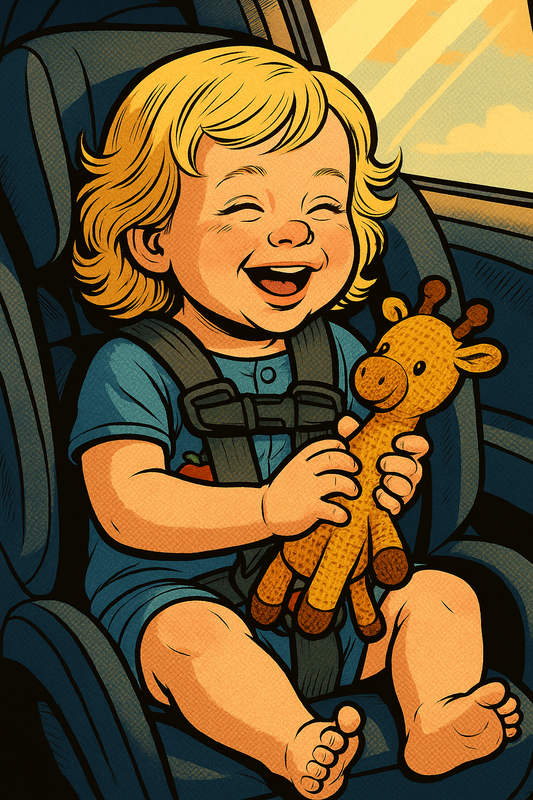
In the car seat, she touched the penguin, then the giraffe, then her own knee as if to ask it politely to hop again. It did not. She laughed anyway, because remembering a joke is a kind of joke too.
“Home,” Glenda said, starting the engine, a low, familiar purr.
Mason reached back and brushed Jess’s foot with two fingers. “Home,” he echoed.
Jess blinked in the bright. The road began to move beneath them, painting itself forward. She leaned her head to the side, thumb tucked against her gums, penguin proud on her chest. The world was big and filled with drawers and triangles and people who clapped when you laughed. It was enough. The engine hummed. The day softened its edges.
She slept on the way, the sticker keeping watch like a tiny flag.