Work Text:
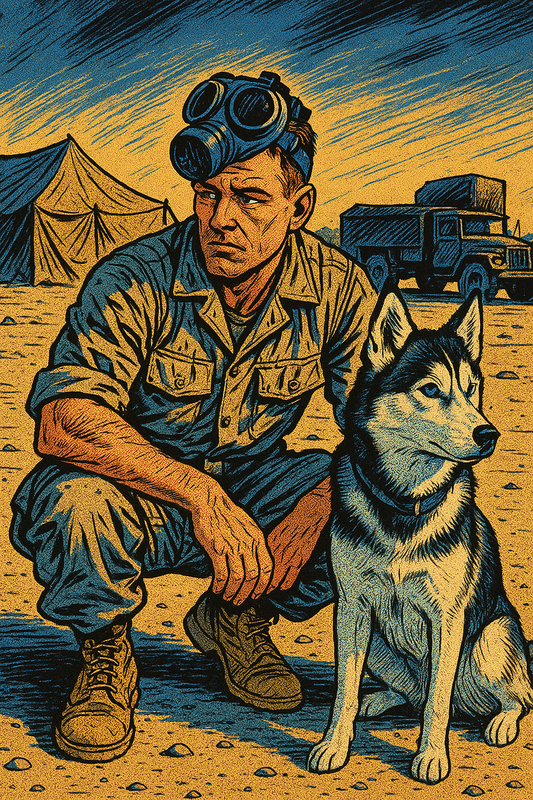
It had been a long day on the tarmac when they met her—a dusk arrival, shuttled in the back of a rattling supply truck alongside crates of rations and a busted antenna mount. The base was still in the process of being constructed, and most of the men were too tired or too dehydrated to notice anything but the persistent ache in their joints and the smell of oil-stained canvas. But as the truck tailgate dropped with a metallic thud, there she was: a husky, mid-sized and taut with lean muscle, her coat already dusted in sand, eyes sharp and pale as winter sun.
No one had been expecting a dog.
She didn’t bark, didn’t whine, didn’t bolt. She just hopped down off the truck bed like she’d always been there, like she was reporting for duty, late but unapologetic. A few heads turned. Laughter sparked from the southern end of the camp, where the engineers were trying to coax a generator back to life.
“Where the hell’d she come from?” someone asked.
“Supply manifest didn’t mention no damn dog.”
“She walk here from Alaska?”
“I’m telling you, I saw a tail hanging off that truck when it pulled in.”
Mason watched her from where he stood, half-crouched near the mess tent, sipping tepid coffee from a scuffed metal tin. She moved with purpose—no tail-wagging, no hesitation. She sniffed the perimeter like she’d been stationed there months ago, then padded into the shade of a communications trailer and flopped down as if to say, I’m here. Proceed.
Private Langley, the youngest among them, tried to offer her a bit of rehydrated beef from his pouch. She ignored it entirely.
The question of her name came later that evening, after the sun fell like a hammer behind the hills and the men gathered loosely near the makeshift fire pit, a repurposed oil drum and some scavenged cinder blocks. There wasn’t much conversation most nights—too hot, too worn out—but the dog had thrown the rhythm off. She was still lying under the trailer, watching them with mild curiosity, ears flicking every so often.
Corporal Vega was the first to speak.
“So what do we call her?”
The silence that followed wasn’t particularly thoughtful—it was the kind of silence that happened when too many men were trying not to look like they cared.
“Dog,” came a dry voice from the back. Laughter.
“Raven,” someone else said. “Eyes like one. Creepy.”
“Should be something local. Desert-themed.”
“Oh yeah? Like Sandstorm? That’s not a dog, that’s a Bond villain.”
“Call her Sarge. She already acts like she outranks us.”
More chuckles, but nothing stuck. Until Sergeant McKittrick, an older man with a face like old leather and a Mississippi drawl that sounded permanently unimpressed, leaned back on his elbows and said, not loudly:
“Name her Chloe.”
There was a pause, then a few scoffs.
“Chloe? That’s a girl’s name.”
“Yeah, like a bridesmaid name.”
“I’m not taking orders from a dog named Chloe.”
Mason, who’d said nothing yet, tilted his head and looked at McKittrick, curious.
“Why Chloe?” he asked.
The sergeant took a beat, then shrugged one shoulder, eyes still on the fire.
“Name of my mama.”
Another pause. Someone coughed.
“She strict?” someone joked weakly.
McKittrick didn’t answer right away. Then: “She was the kind of woman who could stop a man in his tracks with just a look. Didn’t raise her voice. Didn’t need to.”
They all turned, slowly, to look at the dog. Chloe—unnamed still, but sitting up now, watching the fire as though it were a briefing. Her posture was perfect. Her stillness almost eerie.
“She already looks like she’s judging all of us,” Mason muttered.
There was scattered laughter. Someone repeated it louder: “She is judging us.”
And just like that, the name stuck.
It became a joke, but one they treated with odd reverence. Chloe said no rations tonight. Chloe doesn’t approve of your haircut, Martinez. Chloe would like you to shut the hell up, Rogers.
Even Lieutenant Carr, barely older than Mason and desperately trying to command respect he hadn’t earned yet, began calling her that without blinking.
Chloe.
She took to it like she'd been born for it. No tail thumping, no eager response—but when someone called her by that name, she looked. Just once. Just enough.
And for the rest of the campaign, she was Chloe. The mother of the unit. Silent, watching, ever-present. She didn’t bark when the enemy drew close, didn’t growl unless it mattered. And when one of the new guys asked if they shouldn’t give her a name with more "bite," Mason just said, without looking up from his kit:
“Chloe’s got bite. You just won’t see it coming.”
They all laughed then. But that night, every man slept just a little easier knowing she was curled at the edge of the camp, ears up, eyes open, guarding them like a mother who didn’t raise her voice. Didn’t need to.
She was large for a husky, with glacier-pale eyes and a thick salt-and-pepper coat that seemed to shimmer even beneath the dust. Mason would later swear there was something uncanny in her gaze, something almost human, as if she understood the absurdity and the gravity of their situation better than most of the soldiers did.
Chloe had already been with the unit for several months by the time Mason arrived. She wasn't a bomb-sniffer or attack dog—her official designation was morale support and perimeter warning, trained to detect changes in scent and movement during nighttime deployments. But unofficially, she was the camp’s guardian, therapist, and silent confessor. She’d been named, affectionately and with a fair bit of gallows humor, after one of the soldiers’ mothers. No one remembered who had suggested it first—only that when the name stuck, no one dared change it.
The first time Mason saw her, she was stretched out in the shade of a supply truck, panting lazily in the Iraqi heat like a queen watching over her dusty court. He crouched a few feet away, arms dangling over his knees, and studied her the way he might approach a rattlesnake or a troubled engine—quietly, respectfully, with a trace of fascination.
“You Chloe?” he’d asked, not expecting an answer.
The dog turned her head and fixed him with a look that Mason would later describe, only half-jokingly, as “judging my entire soul.”
Their bond began, as many of Mason’s relationships did, with food. The MREs were salt bricks at best, but Mason had managed to barter a small tin of beef jerky from another unit. Instead of eating it, he whistled softly and tossed a piece toward Chloe. She didn’t rush it. She padded over slowly, sat precisely one meter away, and looked him over as if to say: And why exactly are you feeding me, rookie?
He offered another piece, palm up. This time she took it.
Within a week, she was sleeping at the foot of his cot.
Chloe didn’t fawn over anyone. She was no tail-wagger. But she recognized kindness—and Mason had a quiet way about him, a steadiness that animals trusted. He didn’t try to pet her too soon. He didn’t speak to her in that fake high-pitched voice some men used with dogs. He just shared his water, his food, his space. And she, in turn, shared her trust.
When mortar rounds sounded in the distance or the wind kicked up blinding sand, Chloe was the one who noticed first—ears twitching, head up, posture alert. She slept light and moved like breath over dunes. At night, Mason would sometimes rest his hand on her flank while trying to sleep, grounding himself in her steady rhythm.
She kept close during the worst days—the ones when letters from home arrived smudged with bad news, or when the radios fell silent for too long. Once, after a grueling two-day patrol, Mason sat with his back against a Humvee, too tired to speak, too wired to rest. Chloe came over, leaned against him without flourish, and sat like a statue until his breathing slowed.
He wrote about her in letters to Glenda—not long entries, just snippets: “Got a camp dog named Chloe. Smarter than half the platoon. Miss you.” Glenda would later recall those mentions with a tender smile, remembering how the ink smudged on the word “Chloe,” like maybe Mason had paused, or the desert wind had shifted.
Chloe stayed with the unit through most of the campaign, and when rotation came, she went home with one of the officers—an aging colonel with frostbite scars and a wife who ran a husky rescue in Colorado. Mason was glad for her, even if saying goodbye felt like losing something wordless and vital.
Years later, when his children would ask if he ever had a dog, he’d smile faintly and say, “Just one, once. Didn’t belong to me, but she kept me alive.” And they never quite knew if he meant that literally, or the way a man means it when he talks about something sacred.
Chloe remained a ghost in Mason’s memory: a flicker of silver fur in a sunburnt dream, a sentinel in the dust, named after someone else’s mother but loved as his own.
The phone call came on a scorched June afternoon, somewhere between a failed convoy resupply and the ominous stillness of an incoming sandstorm. The air in the comms tent felt too thick for breath, cables coiled like sleeping snakes across the floor, and the satellite link kept blinking out like it, too, was sick of the war.
Mason was off-duty, crouched beside a box fan with a mechanic’s patience and a mess of sweat-soaked sleeves. He’d been working on the thing all morning, pretending it wasn’t 128 degrees inside the aluminum walls. The dog—Chloe—lay curled nearby, her coat dulled by dust but her posture as regal as ever. She hadn’t moved in over an hour except to flick her ear once at a buzzing fly.
When the call came through, Corporal Vega stuck his head in the tent, headset lopsided, expression unreadable.
“Alden. You’re requested on line one.”
Mason wiped his hands on his shirt. “Who is it?”
Vega just shrugged. “Didn’t say. Woman. Said it’s about the dog.”
That got his attention. Mason stood, nodded once toward Chloe, who blinked at him as if to say, Go on then. I’ll hold down the war.
He picked up the receiver. The line crackled, distant and warped, like talking through sand.
“Hello?”
A pause. Then a voice—warm, dry, deliberate, with a Georgia edge to it.
“Is this Specialist Mason Alden?”
“Yes, ma’am.”
“This is Chloe Walters. My son’s in your unit. Corporal Langley.”
Mason’s mouth ticked up before he could stop it. “Yes, ma’am. I know Langley.”
Another pause. Then: “So it is true, then. You named that damn dog after me.”
He blinked. “Well… not me personally. I wasn’t part of the naming vote.”
“I’ve heard three different versions so far,” she said, dry as bone. “Langley says he suggested it first. Sergeant Vega says he did. And someone else claimed the dog chose her own name by growling at anyone who called her anything else.”
Mason chuckled. “Honestly, ma’am, I think she did. There was a list. Sandstorm, Raven, Sarge. Nothing fit. Someone said Chloe as a joke, said it was the name of someone who didn’t take crap off anyone. Next thing we knew, it stuck. She answered to it.”
Chloe Walters didn’t speak for a moment. When she did, her voice had softened, just a hair. “My boy’s been writing about her. Said she sleeps by you sometimes. Said you trust her more than most people.”
“She’s got better instincts than most of us,” Mason replied, glancing toward the dog now dozing against the tent’s far wall. “Won’t take food unless she decides you’ve earned it. Picks her spot every night like she’s surveying a kingdom. I’ve seen grown men walk wide around her like she’s royalty.”
“She always did prefer animals to people. My son, I mean. But he calls that dog his sister now.” She gave a short laugh. “He said she’s like a nosy aunt. Judgmental, but dependable.”
Mason smiled. “That sounds about right.”
The line went quiet again. He could hear faint voices in the background—television, maybe, or the clink of a glass set down.
“I just wanted to say,” Chloe Walters said, “I’m not mad. About the name. I was, a little, when I first heard. Thought they were teasing him. Thought maybe someone was making fun of me.”
“No, ma’am,” Mason said quietly. “It was said with respect. Humor too, sure, but nothing cruel. Chloe’s… she’s important out here. She calms people down. Warns us before storms. Keeps the worst thoughts away on the bad nights.”
“I guess I should be flattered,” she said.
“You should,” he replied.
There was a rustle, like she was shifting the phone from one ear to the other. “My son. He’s young. I know he puts on a tough face, but he’s got that softness he tries to bury. If she’s watching out for him—”
“She is.”
“I believe you,” she said.
He could hear her breathing now, slow and steady.
“Do me a favor?”
“Of course.”
“When it’s over, when you all come home… tell her thank you. Even if she don’t understand.”
“She’ll understand,” Mason said. “She understands more than most people.”
Chloe Walters gave a soft laugh. “You sound like you love her.”
“I do,” he said. “We all do.”
She paused. “Well. Then I guess I’ll take the compliment. If she’s anything like me, I hope she bites the hell out of whoever tries to tell her where she don’t belong.”
Mason grinned. “She already has.”
A soft chuckle across the line. “Good girl.”
They spoke for a few minutes more—about weather, and letters, and how Langley used to sneak stray cats into their backyard as a kid. When the line finally dropped, Mason stood there a long time, receiver still in hand, the air buzzing in his ears.
Behind him, the dog stirred, padded over, and nudged his calf with her nose. He reached down, scratched behind her ears, and murmured, “That was your namesake.”
Chloe the husky yawned, then turned in a slow circle before dropping to the floor with a heavy sigh. She thumped her tail once, just once, like she’d known all along.
Dawn came in a hard line, like a knife sliding under the edge of the horizon and prying the day up. The air was already mean. Heat moved without breeze, the kind of stillness that made every sound—boot steps, canteen clinks, coughs—travel farther than it had any right to. Men spoke soft to save their throats. Coffee tasted like metal.
Chloe had put herself where she always did near first light: a yard off the command trailer, neck long, nose tilted as if scent rode the invisible grain of the air. She did that check every morning—an inventory of the world. If she didn’t find anything, she would fold down like a tent and turn the desert into her mattress. If she did, she’d be on her feet before a human ear knew what had shifted.
Mason was fixing a strap on his vest with a length of 550 cord, hands moving with the quiet economy of a man who’d done the same motion so often his muscles carried instructions his brain didn’t need to say. He’d slept four hours. Six would have been luxury. He had that kind of tired that felt like clean sand in the joints—gritty, but you could still walk on it.
The hiss came first. Not much more than static, the kind of sound you could blame on the wind if there’d been wind to blame. Vega was the one who looked up. He had the headset half-on, half-off, the foam pad jammed against one ear. Static again. Then the voice: clipped, not panicked, all report and no interpretation.
“Possible dispersal event. Repeat: possible chemical dispersal event. Prep and mask. This is not a drill.”
Time did what it always does in the first seconds after a sentence like that: stretched, snapped, then found a faster track. No one shouted. That was the point of all the ugly hours spent practicing. The point of the manuals with their rectangles of diagrams and black arrows. The point of the MOPP tables laminated and thumbed to translucency.
McKittrick’s voice did the local echo: “Mask! Mask! Mask!”
Men moved. Boots planted. Webbing rattled. There is an art to speed that isn’t rushed. They found it. Velcro ripped like quiet thunder. Someone’s chair went over backward. Someone else caught it without looking.
Mason didn’t run. He didn’t need to. The gear was where it always was. He brought the carrier up, one hand under, one behind, let the M40 mask roll into his palm, thumb to eyebrow, chin in first. He’d taught himself to close his eyes on the way down, not for romance—just to keep grit out. Chin. Pull. Seal. He palmed the exhale valve, sucked in, felt the mask grab his face with that sudden animal kiss: tight, close, safe. He tasted the rubber. He always tasted the rubber. The world narrowed to a circle of glass and his own breath in his ears.
“Check!” Vega’s hand was there a heartbeat later, tugging the head harness, fingers quick, professional. Mason returned the favor, thumbs pushing rubber, palm closing the harness spider like he was waking it up.
MOPP 4. Suit up. Hoods up. Gloves. Overboots. The heat grew personal—under his chin, along his lower back, in the decade-old scar where a bike pedal had once bit him as a kid. Sweat had nowhere to go. It signed the papers, took up residence.
“Where’s Chloe?” Langley’s voice was a small distortion in the filter-scraped air. A lot of things could be optional in a moment like this. That question wasn’t.
Chloe had already stood. The husky turned toward the motion that felt like ritual to her now: men becoming insects, faces turned to smooth lenses, voices pressed flat through charcoal. She watched, eyes bright the way ice is bright when it catches a blade of sun.
Mason grabbed the green case from the shelf under the comms table—the one that had gone from a joke to a fixture the day they’d convinced Supply the dog was part of the unit strength. The stenciling on the lid said CHILD FILTER KIT in an old font; someone had bar-markered through it and written DOG MASK in block letters, then, smaller, SIR, PLEASE, in a hand suspiciously like Langley’s.
He dropped to a knee at Chloe’s shoulder. He had learned not to make it theatrical. She didn’t like ceremony. He brought the mask forward like it was business. She tolerated business.
“C’mon, Sergeant,” he said, and that rank wasn’t a joke here. “Bonnet on.”
Her ears flattened with the faintest sigh. She didn’t flinch when he slipped the muzzle piece over her snout. He guided the strap under the ruff, over the thick neck where winter would have lived if there’d been winter to live. He had trimmed the strap ends and burned them smooth weeks ago so they wouldn’t rub. He’d learned her head like he’d learned an engine: where things fit, what they didn’t like, how to listen to the sound before the sound became problem.
The filter assembly was a child’s canister re-machined by a motor pool tech who moonlighted as a luthier; the man could make air sing and metal hum. The adapter collar had been milled from scrap, thread pitch guessed, tested, sanded, tested again. The first time they’d put it on her, she’d looked at them with such flat betrayal Mason had taken it off at once. After that, they’d trained slow. Now her breath fluttered once as the mask sealed. She let him tighten the last strap and took a step as if to say, All right, then.
“Status board!” McKittrick called. Vega’s hand chalked the line: MOPP 4; POSS DISP; 0613L. His handwriting looked like a competent cardiogram.
They moved to positions. The world changed character the way it does when you put your head under bathwater: the same, but rimmed in strangeness. Peripheral vision shortened. Peripheral thinking did not. The ridge to the west. The scrim of low structures to the north. The useless smile of a dry wadi cutting the field like a grin. Mason’s field of view became a slideshow of known quantities: the defect in the latticework of the comms tower, the way the sand nearest the mess tent stayed darker two hours past dawn because somebody had spilled a whole drum of graywater there a week ago.
“Alarm?” Vega asked, and Martinez shook his head. The M8A1 chemical-agent alarm had two moods: quiet, and ruined by the desert. It had been quiet since Kuwait City. Mason, who trusted it like he trusted a drunk uncle, still plugged in an extra detector if supply wasn’t counting.
“Kit, go,” McKittrick said, and Rogers already had the M256 kit flipped open on its cardboard tray. Plastic ampoules glinted like a bad elementary school science fair. He cracked, waved, compared. He moved like a man performing a ritual he didn’t superstitiously believe in but didn’t dare disrespect.
“Samplers out,” Vega added. M8 paper went on tent flaps, on vehicle bumpers, on the chest of a man who’d stand there like an exclamation mark. M9 tape spiraled around a rifle sling—Martinez, who’d won the argument about whether rifles should ever be used as tape dispensers, wrapped with the reverence of a man bandaging his own arm.
“Wind still at zero,” Langley said, which made everyone’s teeth clench because dispersals loved zero.
Chloe stood too still. That was the tell. When there was nothing to find, she paced. When there was something, she picked a direction and stared at it as though time would eventually blush and apologize. She was staring now—north-northeast, toward the busted wall where someone had tried to stencil GO ARMY and the paint had run like tears.
Mason glanced through his mask at her mask. Her breath fogged the small lens for a heartbeat, cleared. He imagined her smell-map—sulfur curls, old oil, sun-baked nylon, sweat that had turned to salt. Whatever the world was doing, she could read it.
“Two minutes,” McKittrick said. “Hold.” His voice always got low and almost musical when he was telling men to do the impossible—which was to do nothing.
They waited because waiting is a job. The noise in the mask became conversation: inhale, exhale, the faint click of the valve, the whisper of sweat deciding on a path. Gloves squeaked against rifles. A fly beat its stupid face against the inside of the comms window and sounded like a snare drum in a gymnasium.
Rogers squinted at the chain of test squares like he could will them to any color other than the worst ones. “Nothing,” he said finally. He didn’t sound relieved. He sounded like a man writing down a negative in pencil.
“Triggers quiet,” Martinez echoed from the M8A1. “Battery light’s still lying.” Laughter doesn’t carry well through filters, but the shape of it still moves shoulders.
“External reports?” McKittrick to Vega.
“Traffic says adjacent units picked up a haze on the far grid—possible smoke, possible something else. Sand loading on their optics. No significant upwind signatures.” Vega’s voice found the middle path between worry and boredom like a man walking a wire he’d chosen himself.
They held. The sky brightened by degrees, adding wattage like a dimmer being worked by a patient hand. Even the faint shadows learned where to stand.
Mason did what he always did to keep the times table on the inside of his skull from counting: inventory. Where would we run if run was intelligent? Where is the low place that becomes the stupid place if the wrong cloud finds it? Who is going to need their hood reseated in ninety seconds because they are about to sweat themselves into a rash and try to scratch it without asking first? (Martinez. Always Martinez.) The mind is good at stacking fear neatly if you give it shelves.
Chloe shifted her weight, sat down, not quite at attention, not quite at ease. Her tail didn’t move. She lifted her head again. There was nothing to hear and plenty to hear: the minute fizz of the world going about its business.
“All stations, command,” the headset crackled in Vega’s ear. “Stand by for all-clear pending further negative indicators. Repeat: stand by.”
Stand by meant keep suffering but allow the thought of relief to sit next to you without touching you. It meant don’t crack your seal because your brain has started suggesting fantasies involving cold air. It meant keep the hood up. The hood was God now.
Langley did what he always did in the worst minutes. He listed. Not out loud. You could see it happen behind his eyes. You could almost hear his mother’s voice telling him to count cans in a pantry before payday, to make a plan in a house where planning was survival. Chloe Walters would be somewhere stateside doing something ordinary—a grocery list, a church committee decision that would take fifteen minutes to accomplish and an hour to schedule. Mason hoped for ordinary for her as if hoping was a job someone had assigned him.
Rogers went down the test strip again, slow: “No G, no H. No lewisite. No V. Reconfirm negative.” He realized, too late, that he’d recited it in the same rhythm as a prayer. Martinez, who had unteachable Catholic in his bones, made a tiny cross on his own chest he thought no one could see inside the suit. It made the glove squeak on the rubber. Someone halfway to a grin tried not to be.
“Command to all stations: All clear. Repeat: all-clear. Negative on contaminants. False alarm traced to upstream smoke stack. Stand down by protocol.”
The way relief arrives after a false alarm has nothing to do with happiness. It’s mechanics: a release of backpressure. Hoods peeled first, like a field of black tulips opening. Seals broke with the kiss-snap that always made Mason think of somebody taking their mouth off a bottle. The air—hot, stale, but open—hit the wet skin behind ears, under eyes, at collarbones, and felt like a lie told kindly.
Masks came off and hung by the straps on elbows. Some men kept them on their faces a minute more not because of fear but because sudden freedom can make a body feel emptied out too quickly. McKittrick tapped his own ear with two fingers—the signal to keep your brain on a leash even when the dog park gate swings open.
Mason dropped to a knee in front of Chloe again. Her paw came up toward the muzzle and she looked almost embarrassed about the impulse, like she’d been caught scratching at church. He unclipped, eased the muzzle away, and her whole face changed shape—muzzle longer, ears less suspicious of gravity. She did a single full-body shake that sent dust in a ring like she’d been rolled in flour. The shake is what joy looks like when animals don’t declare it.
“Tell me she didn’t behave better than half of you,” Vega said, voice back to its normal timbre, which was wry even when it wasn’t trying.
“Better posture than Martinez,” Rogers offered.
“Hey,” Martinez said, without heat, and flicked a corner of M9 tape at him. It stuck to Rogers’s glove like a red accusation.
Chloe sat down without being told and leaned into Mason’s shin like the world had restored itself. He let his hand find that place behind her ear and felt the prickly heat beginning to cool. There’s a pulse on a dog’s neck you can count if you need to; he didn’t need to. It was there, steady.
Vega chalked a new line beneath the old: ALL CLEAR; FALSE POS; 0629L. The morning had aged sixteen minutes but everyone felt like they’d done half a day’s work. That’s what fear does: bill at a higher rate.
McKittrick did the circuit. He always did. Check the faces. Check the hands. Check for the man who doesn’t crack a joke because the joke-making part got stuck somewhere back in the last five minutes. He found Langley and didn’t say anything; he just bumped the kid’s shoulder with his fist like men who were once boys bump in hallways. It’s how you tell someone the world isn’t going to fall right now.
“Reset kits,” he said over the nonsense noise of recovery. “Repack. Filter inventory. Martinez, swap the battery in that liar before it decides to tell us the moon’s made of gas.” The laugh that followed was real this time, not just a pressure change.
They dragged the decon line a few feet to shake the dust out of it and rolled it neat again. Rogers capped ampoules and sealed bags and wrote notes in tiny letters no one would ever read unless the day went bad enough to demand paperwork. Mason hung his mask back where it lived and loosened the straps to his usual marks. He tied a knot in a loose strap end with one hand without looking because useless hands make bad thoughts.
Langley found the dog mask case and held it up like a trophy. “We should mount it,” he said. “So she can clock in under it like a union man.”
“Union woman,” Vega corrected, automatic.
“Union mother,” Martinez added, because that had always been the private joke that wasn’t a joke: Chloe as the mother of the unit—the kind who didn’t raise her voice. Didn’t need to.
There are decisions in a war that happen because someone asks permission, and there are decisions that happen because the idea is too good not to be true. This was the second kind. They cleaned the mask—quick rinse, cloth wipe, sun dry. Mason held it up to the morning and made sure the lenses caught the light. Rogers climbed a ladder, two rungs, three. Vega handed up a length of olive drab strap and a mess of zip ties because war is nothing if not zip ties. They found the right beam above the mess tent entrance, the one that had survived shipping and a forklift and an enthusiastic private, and fixed the mask there with an engineer’s eye for balance.
It hung a little cockeyed, the way everything in a temporary life does. Vega pulled a marker from behind his ear, scuffed his thumb over the tip to get the ink flowing, and wrote neat across the cheek piece: SGT. CHLOE. Then, below it, smaller, the way men leave themselves trail markers they can pretend aren’t sentimental: WATCH STATION ONE.
Chloe looked up at the object version of her own face. She didn’t react because she was a dog and because self-consciousness is a human luxury. She did, however, walk under the mask, turn once in the strip of shade at the threshold, and settle herself facing the yard as if the promotion had been recognized in the only currency that mattered: where you sit when the day needs watching.
Breakfast tasted better than it had any right to. Coffee tasted less like metal for ten minutes. The men doled out jokes like salt: not so much you couldn’t stomach them, just enough to make the plain food living. McKittrick let them run five minutes over the schedule because the schedule had tried to kill them a little and had failed. Small mercies have to be paid back or they stop coming.
Mason found a scrap of cardboard from a radio box and wrote VOL FILTER—INSPECT WEEKLY in block letters, taped it inside the dog mask case. He had the quiet superstition of a mechanic: machines respond to care. So do living things. He scratched Chloe’s chest and felt the weight of the morning convert into something he could carry.
Later—days later, weeks later, accounting gets slippery out there—new guys would come in off a convoy sunburned to lobsters and ask what the mask was about. Somebody would tell them the story quickly, like a hymn with too many verses, and point to the dog under it. The new guys would nod and laugh and the laugh would have respect in it because they’d already learned you survive by attending to the real and by honoring the things that keep you human.
The all-clear didn’t erase anything. It never does. It just meant that on that day, in that hour, invisible death had kept its distance. The routine reclaimed them because routine is the armor you can sleep in. Weapons got cleaned that didn’t need it. A radio cable got re-run in a way that made Vega happier even though it had worked fine before. Martinez finally scratched the itch that had nearly driven him out of his suit earlier and announced to anyone listening that it was the scratch of the century. Rogers said he’d write it up in a memo.
Chloe slept. She did it like work—ears still, but one always slightly canted toward the mess tent, one toward the ridge. The dog mask watched over her like a saint painted on a ceiling by a man who’d never met either subject or God but had loved both ideas fiercely enough to make them real.
Before lights-out that night, Mason wrote a letter on a piece of paper that had a grease thumbprint in one corner because that’s what paper does in a place like this: collects evidence of whatever matters most. He wrote to Glenda, the way he always did when the day tried to push him into the ditch and he preferred not to go. He told her about the false alarm. He wrote, “We put a mask on Chloe and she sat stiller than any of us.” He wrote, “I felt like a fool taking my mask off and a bigger fool keeping it on,” which was true. He wrote, “We hung her mask above the mess like a sign. If it ever saves a second, it will have earned its place.”
He didn’t write about the particular relief of seeing Chloe blink after he took the mask off, that tiny almost-yawn that said the world had not been decided by equipment that day. He kept that for himself because some images felt like they would get smaller if you translated them into words. He’d learned which feelings bleed when you put them on paper. He’d learned to keep those ones in the pocket behind his heart where the picture of home lived.
On the way to his cot, he detoured under the mask. Men had started tapping the case lightly with the backs of their knuckles when they passed, like baseball players touch a sign on the tunnel out to the field. Mason didn’t, not because he didn’t believe, but because he did. He put his hand on Chloe’s shoulder instead and felt the muscle there shift under his palm like river under ice.
“Good drill,” he told her. “Good girl.”
She thumped her tail once, which was a paragraph in her language.