Work Text:
Spring had cracked open the city, all soft wind and pollen, sidewalks salted with tiny pinks from the ornamental pears. Glenda wheeled the double stroller up the curb and into the café on the square, shoulders squared to the familiar choreography of doors and diaper bags and the rattle of the plastic rain cover rolled underneath. The bell on the door jingled. Espresso hissed. Somebody in a NASA T-shirt said “y’all” into a phone like an apology.
“Two chairs, please, if you’ve got the kind with the straps,” she told the barista, tilting her chin toward the stroller. “We’re a lively party.”
Jess blinked wide, solemn as an usher, while Toyah hummed at a volume that was somehow both tiny and unstoppable, palms pat-pat-patting her own knees. Fourteen months old, both of them, the same day girls, the same storm. Glenda unbuckled Jess first—“c’mere, sugar”—and lifted her into the high chair. Jess folded into it like she’d invented the idea, studying Glenda’s hands as they fastened the strap. Toyah squealed and kicked her heels against the stroller footrest, ready to be next.
She required a bit more negotiation, twisting in Glenda's arms as she tried to see everything at once. “I hear you, I hear you,” Glenda laughed, pushing up the sleeves of her denim shirt. “Hold your little horses, Miss Toyah. We’re a one-woman pit crew over here.”
Toyah’s curls had sprung wild in the humidity; Glenda smoothed them with her thumb and set her in the second high chair. She slid a paper placemat in front of each baby—one with a drawing of a smiling muffin, another with a maze shaped like a teacup—then emptied a small Tupperware of banana slices and a fistful of O-shaped cereal between them. Two sippy cups thunked onto the table. Somewhere behind the counter, a milk frother shrieked like a happy kettle.
She could feel spring through the window, the energy of it on the sidewalk. The square had its late-morning rhythm: courthouse clerks with early lunches, a pair of teenagers arguing quietly about a cassette tape, a mailman with calves like tree trunks. In another life, Glenda would’ve taken her coffee standing up, humming half a chorus of something that never quite resolved, and been out the door in five minutes. In this life, time moved in toy-spoon scoops and napkin triangles—and she preferred it, if she was honest with herself. Preferred the ordinary holiness of two babies in high chairs, crumbs on their cheeks, the living proof that after long winters the world still knew how to soften.
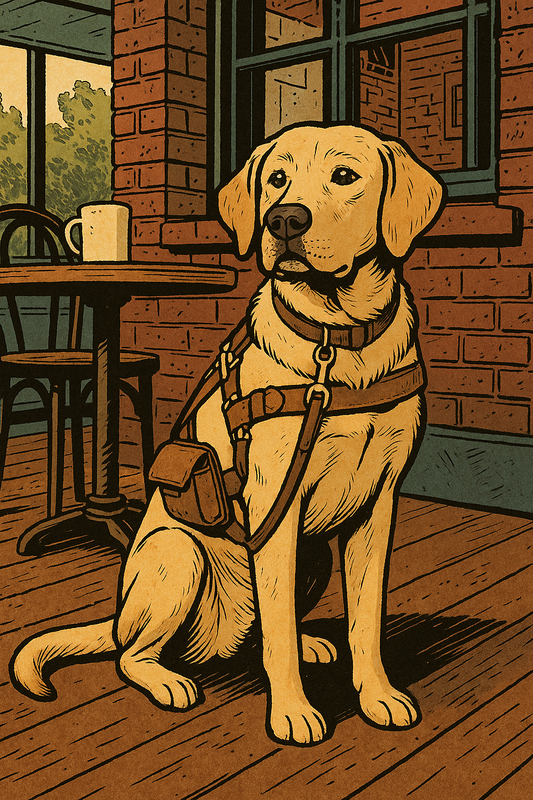
A woman entered on a tide of cool air—late thirties maybe, hair in a loose knot, dark sunglasses. The dog came with her, working smooth beside her hip: a yellow Lab with a white harness, the handle angled in the woman’s hand like a small, shining bridge. The dog was near-gold in the sun, muscle moving under her coat like water, ears pricked toward the room, eyes forward.
Toyah saw her first.
“Do! Do!” she exclaimed, the vowel stretched to a flute note. Both hands shot up, fingers opening and closing. Jess followed a beat later with a whispery, reverent “dah-gee.” She leaned so far forward in her chair that Glenda put a hand lightly against her belly to keep her from toppling. “Baby, I see her,” Glenda murmured, already sliding her chair an inch closer to the table, instinct settling her posture. “Oh, she’s beautiful.”
The woman paused just inside the door, listening for the counter, orienting by sound and scent the way Glenda sometimes thought she herself oriented by music. The Lab checked the floor with a flick of her nose, then guided her human toward an open two-top near Glenda, the harness handle steady as a metronome.
Toyah’s whole body vibrated. One banana slice landed on her own shoulder and stayed there like a badge. “JT!” she chirped suddenly, the word bursting out of some private memory drawer. “JT, JT!”
Jess clapped softly. “Cho-ee,” she added, solemn. “Cho-ee.”
Glenda grinned despite herself. “That’s right,” she said, low, to both girls at once. “Chloe and JT are at home, keepin’ the couch from floatin’ off. But this one here—she’s working, sugar. See her harness? That’s her uniform.”
Toyah’s face tipped from glee toward ache, the gravity of a reach forming in her shoulders. Her tiny hand hovered over the table like someone about to ring a bell.
Glenda leaned in and kissed her on the temple. “Hey now,” she cooed, a lilt gentle as rocking. “Let’s wave. Let’s wave, my heart. The doggy’s got an important job to do. We can’t pet her while she’s working, we can’t call to her. But we can be the friendliest lil’ wavers.”
She waggled her own fingers in a big, silly flourish. Jess immediately mirrored the motion, palm opening and closing like a sea anemone. Toyah startled, then laughed, the threatened fuss evaporating into a delighted squeal. She threw both arms up and shook her hands at the dog with the serious intensity of a conductor, then—because the world was generous and she was too—blew one, two, five kisses into the air.
For a moment, Toyah seemed to waver, caught between her desire to touch the dog and this new suggestion. Her hands hung in the air, still reaching, still grasping. Then, slowly, she began to move them up and down, though it wasn't quite a wave yet—more like a flapping motion. "Yes!" Glenda encouraged, her voice warm with approval. "That's wonderful, sweetheart. What a good wave!" And then, as if a switch had been flipped, Toyah's frustration transformed into something else entirely. Her hands flew up over her head, and she began waving them enthusiastically in all directions. Her face broke into a wide, delighted grin. "Bah-bah!" she called out, her voice returning to its happy register.
The Lab didn’t so much as glance. She settled beside her handler’s chair with the posture of someone listening for a bus that would never be late, breathing the café’s smells, ignoring everything else because ignoring was the work.
“Thank you,” the woman said, a smile in her voice. She’d turned her face slightly toward Glenda, sunglasses catching the light like small black mirrors. “For teaching them that. Early’s best.”
“Of course,” Glenda said. “You mind if we sit close? We’re loud as a parade, but friendly.”
“Close is fine,” the woman said. “I’m Lila. This is Wren.”
“Well now,” Glenda drawled, pleased by the name. “Hi, Miss Lila. Hi, Miss Wren.” She kept her voice even, the vowels round, a hello for the human that acknowledged the dog without pressing into her space. To the girls, she added: “Her name is Wren. Can you say ‘ren’? Like the tiny bird that sings.”
“Wen,” Jess breathed, a whisper-echo.
“Wuh!” Toyah agreed, triumphant with consonant.
Lila folded her cane and set it beside the table. “They’ve got dogs at home,” she said lightly, not as a question but as something she’d just heard in two toddlers’ tender syllables.
“Chloe’s the diplomat—capital D. She’s a very orderly lady. She’ll inventory the room before she relaxes: who’s here, who needs a lane to the door, where the stroller fits so nobody trips. Curb-side on walks is her chosen place. If, more like when the girls are ricocheting, Chloe positions herself at a perfect forty-five to catch a wobble.”
Lila’s mouth tilted. “Orderly lady—I know the type.”
“Oh, she keeps her own playbook,” Glenda said, fond. “Toys get gathered in a little semicircle when they’re done. She does nose-taps for roll call at bedtime, one for each girl, and then she lies where she can see the hallway and the windows both. If there’s a storm, she does rounds like a night manager—pads to the nursery, checks the crate, takes one look at me like, ‘the windows are latched, ma’am,’ and settles. Never flustered. You can feel her telling the house, ‘We’re fine.’”
“Diplomats do that,” Lila said. “They set a temperature.”
“Exactly,” Glenda laughed. “And polite? If a visitor’s anxious, Chloe escorts them to the couch. She’ll sit parallel, not staring—very deliberate—like, ‘we can breathe here together.’ At the park she de-escalates dog drama with a look. She’ll place herself between a wobbly toddler and a spinning scooter and somehow both parties change course like it was their idea. She’s got this way of saying no without a sound.”
“And the other?” Lila asked, amusement warming her voice.
“JT,” Glenda said, and the name alone made her brighten. “Also a lady and she’s the heart of every party. If laughter is happening, she is either the cause or the echo. She can more than keep up with a pair of toddlers; I’m the one begging intermission.
Those two run victory laps, and JT paces them like a track coach who moonlights as a clown—long stride, tongue out, eyes sparkling, checks over her shoulder every few seconds like, ‘you still good?’ Then she’ll dive under the blanket fort and pop out the back with a sock she ‘rescued’ from under the couch.”
Lila laughed. “A sock parade.”
“Daily,” Glenda said. “She also does crowd work around a bubble machine. She knows how to burst the ones the kids can’t reach. At story time, she’s the mobile ottoman: rotates herself so there’s always a soft bit under a small elbow. And if somebody cries, she’s first responder—plants her chest under their hands, offers her neck, whuffs that little golden retriever sigh that sounds like someone lowering the blinds on the heat of the moment.”
“Heart of every party,” Lila echoed, charmed. “And stamina.”
“Stamina for days,” Glenda said. “It’s like she’s got extra gears. We do ‘toddler laps’ down the hallway—there and back, there and back—and JT paces them six to one, then remembers to slow so the littlest legs can ‘win.’ She’ll take a corner wide so a baby can tag her and feel fast. Out in the yard, she is commissioner of games: fetch, chase, leaf-collecting—she turns ‘please bring me that glove’ into a championship relay.”
“And she’s gentle with all that speed?”
“Like she was born knowing,” Glenda said. “Tiny hand near her mouth? She turns her head and smiles around the temptation. When she takes a treat from a baby palm, it’s with lips like tweezers. We practice ‘ask first,’ and she’ll hold still until the question’s answered, then celebrate the yes with a tail that drums the furniture in 4/4 time.”
Lila tilted her sunglasses toward the voices of the girls, a small, pleased angle. “So you’ve got a captain and a cruise director.”
“A captain and a confetti cannon,” Glenda agreed, delighted.
“Both working,” Lila said softly.
“All day, every day,” Glenda said. “Chloe’s résumé says: orderly transitions, perimeter management, emotional weather control. She’s the diplomat at the peace table and the dignitary at the ribbon cutting, all quiet competence and posture. And JT’s says: morale officer, activities chair, chief of giggles. She keeps the current moving. If the mood dips, she’ll trot in with exactly the right ridiculous—one ear inside-out, a ‘lost’ slipper found, a sudden need to demonstrate the art of the slow belly-flop.”
“Slow belly-flop,” Lila repeated, savoring it.
“It’s a signature move,” Glenda said solemnly. “She makes eye contact, lowers herself, and then throws one back leg up like a ta-da. The babies scream laughing every time. Meanwhile Chloe is over there aligning the pile of blocks with her nose so nobody steps on a corner. Two kinds of love, same job title.”
Glenda wiped a smear of banana from Jess’s cheek with her thumb, then from Toyah’s chin, then from her own sleeve because motherhood was a contact sport. She reached for the diaper bag without looking and came up with the small board book with a dog on the cover—the one with the lift-the-flaps that had long ago lost two flaps and a corner to enthusiasm.
“Story?” she offered.
Two heads snapped toward her, hungry as sparrows. Glenda opened the book, held it where both could see, and read in her best stage voice. “This is a dog. This dog is sleeping. Shhh.” She tipped her head toward Wren, stage-whispered: “And some dogs are working, and we say, ‘you go, dog.’”
“Go, dog,” Jess echoed, reverent.
“GO, DO,” Toyah declaimed, throwing a last bouquet of kisses toward Wren just to be sure the encouragement landed.
The book turned its cardboard pages. Jess lifted the flap that wasn’t there anymore and still somehow found something under it. Toyah tapped each pictured dog with her two gentle fingers, practice and love braided together. Lila finished her coffee, the cup set just so in its saucer by a hand that had learned the shape of many tables. Wren breathed in and out, steady as a tide.
When Lila stood, folding her cane again, the Lab rose in the same breath—no jolt, no scramble, just the clean physics of a team that knew how to be a team. Glenda felt the little ache that good competence always gave her, the way it made something inside her stand up straighter in respect.
“It was good to sit next to you,” Lila said. “Thank you for making my dog’s work easier, and my morning nicer.”
“The feeling’s mutual,” Glenda said. “If you ever need a place to rest a minute, we haunt this corner more than is probably legal.”
“I’ll listen for you,” Lila said. She leaned toward where Toyah’s voice had been, tilted toward Jess’s soft “hi.” “Bye, Toyah. Bye, Jess. Thank you for the waves.”
Toyah windmilled both hands again, then opened her arms as if to hug the entire room with air. Jess held her palm to her heart, then extended it with solemn ceremony. “Bye,” she whispered.
Wren turned with Lila and guided her toward the door, harness gleaming. The bell sang once more, brighter for a second, as they stepped back into spring.
For a long beat, the three of them—Glenda and her two small orbiting planets—watched the door.
Then Toyah looked at Glenda with a grin that was larger than her face and shouted “Wen!” like an encore.
“Wren, that’s right,” Glenda said, laughter in her bones. She kissed the tops of both heads, quick and certain, then gathered the scattered cereal rings into a little pile and tapped the book. “Okay, you storied up? Because we’ve got groceries, same as Miss Lila, and a big day of ordinary things where we’re gonna be kind and brave and wave at the world when it’s busy.”
Jess nodded like she’d been sworn into office. Toyah applauded nothing and everything.
Glenda tucked the book back into the bag and wiped the table one more time, not because it needed it but because motion made leaving easier. She slid Jess’s arms into her little sweater, buttoned two buttons and let the third be a mystery for later, then did the same for Toyah. The babies squeaked their shoes against the high chair footrests in perfect unison, a small drumroll for the road.
At the door, before they went out into all that bright air, Glenda crouched so her face was level with theirs. “Tell me again,” she said, playful as a game and serious as a lesson. “What do we do when we see a dog at work?”
“Wave,” Jess whispered, hand lifting.
“WAVE,” Toyah shouted, throwing both arms to the sky and scattering invisible confetti across the café, then puckering up and blowing one last kiss to the day itself. “Wuh!”
“That’s right,” Glenda said softly, love and pride braided together like a song she’d always known. “We wave.” She pushed the door with her shoulder, and spring met them like an old friend. “And we keep going.”