Work Text:
“Glen-da!”
The name carried down the row like a rock skipping across water—bouncing off murals and porch rails, startling a couple of sparrows off the power line. Spring sat easy over Alphaville that afternoon: sun warm but not mean yet, a soft breeze pushing the smell of cut grass and somebody’s overworked fryer oil from up on the main road.
Glenda was halfway under the hood of the car when it came, forearms already smeared with a faint, honest black of engine grime. She froze for half a second, head cocked.
Addison didn’t holler like that. Not unless something was on fire or very, very funny.
She straightened, wiped her hands on a rag that had seen better days, and listened. No second yell. No panicked edge. Just the echo of that first call, settling.
“All right,” she muttered to herself, slinging the rag over one shoulder. “Either my girl’s dyin’ or she discovered somethin’ new and ridiculous.”
She shut the hood with a practiced push, checked that the latch caught, then shaded her eyes and looked down the row.
Addison stood on her own little strip of concrete porch two doors down, barefoot in cutoff shorts and an oversized thrift-store T-shirt, one hand braced on the frame of her screen door like she’d just launched herself out of it. Her dark hair was pulled into a messy knot, few strands sticking to her forehead. Even from here, Glenda could see the jittery energy in the way she bounced on the balls of her feet.
Toyah’s stroller sat folded just inside the doorway, a small blanket draped over the back—Addison’s shorthand for baby’s asleep, approach quiet. The actual baby was presumably inside, out of sight, making soft toddler snore-sounds at the cracked bedroom ceiling.
Glenda cupped a hand around her mouth. “Well, damn,” she called back, voice easy. “Did the apartment catch on fire, or you just testin’ the boundaries of hollerin’ distance?”
Addison’s mouth twitched. Even excited, she tried for deadpan; it was one of Glenda’s favorite things about her.
“Just get over here,” Addison said, not quite loud enough to carry past the nearest few houses. “Please.”
Please did it.
Glenda slung the rag onto her porch rail, checked that the front door was pulled nearly closed behind her—enough air for Jess’s nap at Lucille’s house to be somebody else’s business for an hour—and set off along the sidewalk.
Alphaville in daylight was its usual improbable self: long line of boxy cinderblock houses, identical if you squinted at the bones, impossible to mistake if you looked at the skin. Someone had finally finished the ocean mural on number twelve: blue waves curling up over the corner, a glittering fish with eyelashes big as Glenda’s drawn near the mailbox. Three doors down, a group of kids had chalked an elaborate hopscotch course that zigzagged into the street and back again like a drunk snake.
Half a year ago, when she’d hustled Ronnie out of his two-bedroom and slipped Addison into it in his place, the side wall of Addison’s unit had been plain beige, as flat and institutional as an unwritten form. Now it had the beginnings of something else: faint outlines of shapes traced in pencil, a few test patches of sky-blue and sunflower-yellow, like the promise of a picture. Neighborhood kids had already left handprints along the bottom row, smeared into little ghosts by recent rain.
Glenda smiled as she walked, breathing in that familiar mix of laundry soap, cut grass, and somebody’s radio playing slow jams low enough you had to lean in to catch them.
She liked walking this row. She liked that every porch knew her feet, that every screen door had, at some point, creaked open to her knock. She liked that when you yelled a name here, it wasn’t to shame somebody—it was to invite them, warn them, feed them.
She also liked that if she stood on her own stoop and hollered “Addi-son,” the girl would hear her. That had been the whole point. Hollerin’ distance.
“Hey!” Glenda called as she got close enough not to shout. “If you wake my godbaby up with that yellin’, I’m sendin’ Mama over here with a spoon and the good Bible.”
Addison’s fingers tightened on the doorframe, but her face broke into a quick, guilty grin.
“She’s out,” she said, voice dropping automatically, as if the word itself might disturb the nap. “Promise. Fan on, door cracked, she’s dead to the world. I wasn’t that loud.”
“Mm-hm.” Glenda came to a stop at the bottom of Addison’s short set of steps, tilting her head, mock-judging. “Sounded like you were auditionin’ to call hogs at the county fair. Or summon the dead. One of the two.”
“Yeah, well,” Addison said, shrugging one shoulder. “Good thing you live in the Hollerin’ Distance Chapter, then, huh?”
She said it like it was nothing, but Glenda saw the way her eyes warmed around the phrase, like it was a secret handshake.
“Don’t act like you didn’t roll your eyes at that name the first twelve times I said it,” Glenda replied, starting up the steps. “Next thing I know you’ll be designin’ letterhead.”
“Letterhead is for people who got printers,” Addison shot back. “We got… crayons.”
“We got crayons and strong lungs,” Glenda corrected. “Which leads me to my original question: what the hell’s goin’ on that you hollered like I’d won the lottery?”
She stepped onto the porch, the boards giving a familiar soft creak under her weight. Up close she could see Addison better—freckles standing out a little darker against skin that still hadn’t fully lost its winter pallor, eyes bright in a way that made her look younger and older all at once.
Addison shifted her weight from one bare foot to the other, then glanced over her shoulder, into the dim cool of the apartment.
“I, um.” She folded her arms, unfolded them again. “Okay, so, one—everything’s fine. There’s no emergency. You don’t gotta go into triage mode.”
“I’m always in triage mode,” Glenda said lightly. “Mama didn’t raise me any other way. But go on.”
Addison chewed her bottom lip, watching the sidewalk instead of Glenda’s face.
“I just—” She stopped, huffed out a breath that was half-laugh, half-exasperated-with-self. “I got somethin’ I need you to look at. Before… I don’t know. Before I decide if this was the dumbest idea I’ve ever had or just, like, top five.”
Glenda’s brows went up.
“Oh, that’s reassuring,” she said. “On a scale of one to ‘you married a drummer,' where we at?”
“Ha, ha.” Addison rolled her eyes. “Can you just… come inside? Quiet?”
She said the last word with an instinctive glance back to the cracked bedroom door down the short hallway, where the box fan’s steady whir stood in for a lullaby.
“Of course,” Glenda said, softening. “You know I ain’t gonna stomp in like the Kool-Aid man.”
She reached for the screen door, then paused, eyeing Addison’s bare toes.
“You run outta socks again? I told you, I’ll pick you up some next time I’m at Kmart. There’s a sale on the ugly ones.”
“I got socks,” Addison protested. “I just… it’s hot.”
“It is April in Alabama,” Glenda conceded. “All right. Come on, barefoot wonder, show me whatever’s got you hollerin’ across state lines.”
Addison made a small, strangled sound that might’ve been a laugh, then stepped back to let her in.
The air inside was cooler, dimmed by drawn curtains and the blessed hum of the fan beating thick air into something almost gentle. The living room still had that half-assembled look most young-mom apartments did: furniture mismatched but functional, a thrift-store coffee table bearing rings of old condensation, a basket of clean laundry that had been folded and then rifled through again for a missing onesie. Toyah’s toys—blocks, a plastic ring stacker, a soft-bodied doll that had clearly been loved past the point of newness—were corralled into an old milk crate in one corner, as if Addison had carefully negotiated a treaty between toddler chaos and adult sanity.
On the wall by the couch, a page torn from a magazine had been taped up at kid-eye level: a Black woman in a lab coat, laughing in a way that made the picture look alive.
Glenda’s mouth quirked at that. She knew that picture. They’d gone through the whole article together, late one night at her kitchen table, Addison pointing to the words with the intensity of someone tracing a new map.
“Toyah okay?” Glenda asked automatically, lowering her voice even though there was no sign of distress, just in case.
“Yeah,” Addison said, nodding toward the bedroom. “Out like a light. Wore herself out receivin’ visitors at the corner store this mornin’. Everybody and their auntie wants to pinch her cheeks.”
“That’s what happens when you have cheeks that look like God carved ’em outta sweet bread,” Glenda said. “Price of fame.”
She said it lightly, but she’d seen the way some people looked, too—the way their eyes snagged on Toyah’s brown skin against Addison’s pale shoulder and then flicked away, calculations running behind their irises. She made a habit of standing a little closer when that happened. People tended to mind their business more when Glenda was within slappin’ distance.
“So,” she continued, turning back to Addison. “You dragged me away from my very important time contemplate-in’ carburetors for what exactly?”
“Okay, first of all, your carburetors will forgive you,” Addison said. Her hands were moving again, twisting the hem of her T-shirt of their own accord. “Second of all, I didn’t drag you. I invit— I requested the presence of—”
“You hollered down the block like the town crier,” Glenda cut in. “Which, for the record, I consider a compliment. Means you trust me enough to interrupt my tinkerin’ with nonsense.”
“It’s not nonsense,” Addison said quickly, then flinched at how sharp that came out. She swallowed. “I mean. I don’t think it is. Yet.”
Glenda’s ears pricked.
Yet.
She studied the girl for a moment, letting the silence stretch just enough that Addison’s shoulders eased instead of tightened. That was one of the tricks, she’d learned, both with her own kids and with the stray teenagers life kept setting in her path: don’t rush the story out of them. It would come. People filled quiet if you gave them space and safety.
Addison filled it with a sigh.
“Okay,” she said again, quieter. “So… you know how you’re always sayin’ I should… I don’t know. Let myself have something that’s not work or worry?”
“I do recall givin’ that sermon once or twice,” Glenda said. “Usually while you’re tryin’ to do six things at once and pretending you ain’t tired.”
“Yeah, well.” Addison scrubbed a hand over her face. “Consider this me… doin’ that. Maybe. I think. If I didn’t just lose my mind.”
Glenda felt something like pride tug at her chest, unexpected and warm.
“Okay,” she said slowly. “Okay. Well, now I’m intrigued. You know I love it when my advice causes chaos.”
“This is not chaos,” Addison insisted. “It’s… manageable.”
“That is not a word I trust comin’ outta your mouth,” Glenda said. “Last time you said somethin’ was manageable, you were talkin’ about takin’ a second shift and watchin’ Jess so I could go help Mama, and you damn near fell asleep standing up stirring macaroni.”
Addison winced. “Okay, fair. This is… different. Less… I don’t know. Self-sacrifice-y.”
“Well, hallelujah,” Glenda said. “Lead on, Joan of Arc, but, like, a selfish one. Where we goin’?”
Addison jerked her chin toward the back of the apartment.
“Outside,” she said. “Out back. We gotta be quiet goin’ through, but… yeah. Out back.”
Glenda’s brows arched.
“Oh, so I get the deluxe backyard tour now?” she teased. “What, you finally plant that tomato I told you about?”
Addison hesitated just long enough that Glenda caught the micro-pause.
“Somethin’ like that,” Addison said.
The way she said it—too quickly, eyes sliding away—told Glenda in no uncertain terms that whatever awaited out back was not a tomato.
She felt a flicker of curiosity sharpen into something keener. Addison had that look she got right before she tried something new and terrifying: a little pale around the mouth, shoulders squared like she’d decided she’d take whatever came, even if it bit.
“All right,” Glenda said slowly. “Let’s go see ‘somethin’ like that.’ But if it’s a boy back there, Addi, we are havin’ words.”
Addison actually laughed at that, a short, startled sound.
“Oh my God,” she said. “You think I’d hide a boy in my backyard? Like I got time for teenage romance when I’m fillin’ out WIC forms and tryin’ to remember what sleep feels like?”
“I don’t know your life,” Glenda said dryly. “You could’ve picked up some delinquent poet at the bus stop and decided to rescue him.”
“Pretty sure I am the delinquent poet,” Addison muttered. “And I don’t need rescuin’. I need—”
She cut herself off again, shaking her head, like she’d almost said too much.
Glenda’s chest pinched, just for a second. Addison’s independence was a thing she revered: this girl who’d dragged herself out of a town that wanted her dead, who’d crossed state lines on buses that barely stopped, who’d walked into a hospital alone and walked out with a child and a new address. She’d never once asked Glenda for more than a ride and the occasional cup of coffee. But sometimes Glenda wished she’d let herself lean a little harder.
“You need a break,” Glenda supplied gently. “And you deserve one. So if this is your version of a day off, I am here for it. Literally. I am here. Lead the way.”
That earned her a small, crooked smile.
“Okay,” Addison whispered. “But you gotta promise not to freak out. Or laugh. Or tell Carlos. Or tell your mama. Or—”
“Woah, woah.” Glenda lifted both hands, palms out. “That’s a lot of conditions. I’ll take ‘don’t freak out’ and ‘don’t laugh in a mean way.’ But if it’s somethin’ Carlos needs to know about as your landlord, we tell him. And Mama hears everything eventually, you know that. She’s like the Holy Ghost with better cookin’.”
Addison grimaced, but she didn’t argue. That, more than anything, told Glenda she’d already gone through the practicalities in her head. Addison did not make moves without running three worst-case scenarios first.
“Fine,” Addison said. “No secrets from Carlos. I just… wanted you to see it first.”
That landed different. Soft. Heavy.
Glenda swallowed past the sudden lump in her throat.
“Well,” she said, forcing her tone to stay light. “I am honored to be the designated first witness to… whatever the hell this is.”
Addison looked at her then, really looked, and some of the frantic buzz in her softened.
“I know,” she said quietly. “That’s why I yelled.”
For a second, Glenda saw her not as the almost-seventeen-year-old who cracked dry jokes and argued with paperwork, but as the exhausted girl in the hospital bed, clutching a newborn like a lifeline, eyes wide and clear and terrified. Glenda had walked into that room and said, You scared? Good. Means you got sense, and somehow they’d been tethered ever since.
She felt the echo of that day now, standing in this small living room that smelled like baby lotion and instant coffee and something green from the open back window.
“Come on then,” Glenda said softly. “Before I die of suspense and you gotta explain that on the death certificate.”
Addison nodded once, jerkily, then led the way down the narrow hall.
They passed the cracked-open bedroom door. Glenda couldn’t help glancing in as they went by. Toyah lay sprawled sideways in her crib, cheeks flushed from sleep, one chubby leg flung over the thin quilt, little mouth hanging open. One hand was wrapped around the ear of a stuffed rabbit that had seen better days—fur matted, one eye slightly crooked from too many washes.
Glenda’s heart did that small, involuntary flip it always did when she looked at the girl. She had Jess’s weight installed on one side of her ribcage and now Toyah’s on the other, permanent fixtures.
She stepped carefully, instinctively softening her heel-to-toe, the habit of a mother who’d learned the hard way which floorboards squeaked.
At the back of the apartment, the kitchen opened onto a small utility room that had once been meant for neat stacks of military-issue supplies and now hosted a washing machine that rattled when it spun and a shelf lined with mismatched jars. Addison had tried to keep it orderly—detergent here, clothespins there, jar of spare change labeled SUDDEN EMERGENCIES in black marker—but life had its own ideas. A damp dish towel lay over the back of a chair. A pair of little shoes, Toyah-sized, sat by the door as if waiting for their owner to march back into them and demand an outing.
Addison paused by the back door, hand braced on the knob, and took a breath like she was about to go onstage.
“You ready?” she asked, glancing back at Glenda.
Glenda fought the urge to make another joke, to cut the tension. Addison’s eyes were too earnest now, too raw. Whatever waited beyond that door mattered to her in a way that made Glenda’s chest ache.
She settled for a half-smile instead.
“Sugar, I got four kids and lived through the seventies,” she said. “There ain’t much I’m not ready for.”
Addison huffed out a small laugh, then nodded.
“Okay,” she said. Her fingers tightened on the knob. “Just… remember you said that.”
She turned the lock with a soft click and eased the door open, the afternoon light spilling in around the edges in a bright, promising strip. The smell of sun-warmed concrete and something else—earth, maybe, or just the idea of outside—pushed into the little room.
Glenda squinted against the glare, one hand coming up automatically to shield her eyes as she stepped closer.
Addison stood in the doorway, one shoulder pressed to the frame, body half-turned as if she could still change her mind and slam it shut.
She didn’t.
Instead she blew out a breath, set her jaw in that familiar, stubborn line, and nudged the door open the rest of the way.
“Okay,” she said again, more to herself than to Glenda. “Here goes nothin’.”
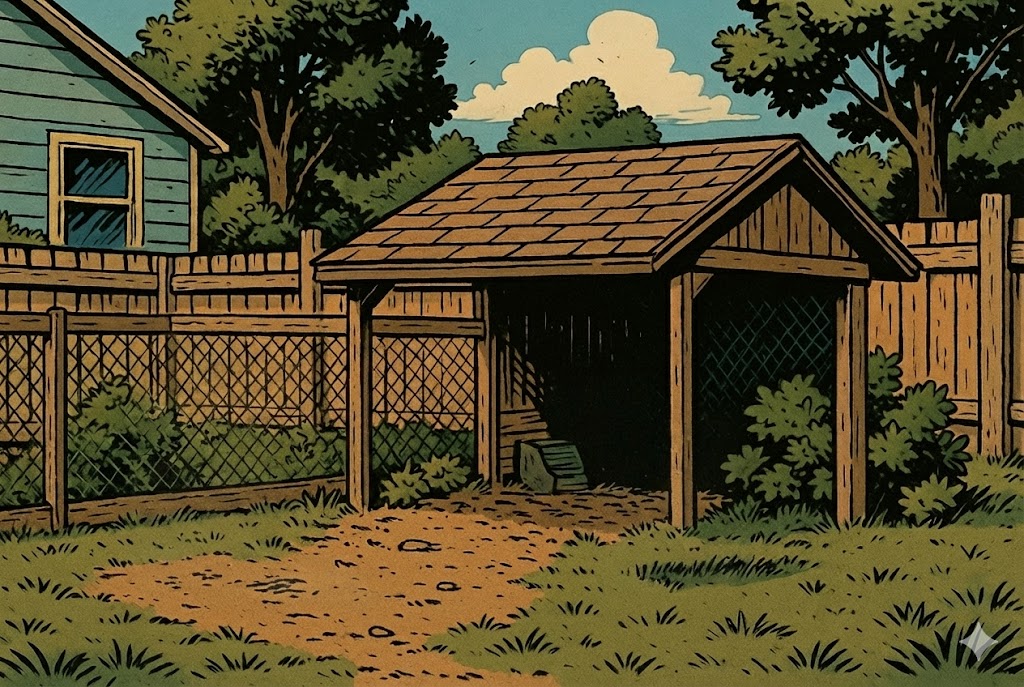
The strip of spring afternoon widened into a rectangle, turning the cramped utility room into a box of contrast—cool shadows clinging to the linoleum, bright heat laying claim to the cracked concrete just beyond. The yard was the same narrow patch every Alphaville unit had out back: two strides deep, three strides wide, boxed in by chain-link and the backs of other lives. Somebody had hung a length of laundry—T-shirts, a pair of jeans, one small onesie with clouds on it—that stirred in the breeze like lazy flags.
A plastic basin sat overturned to one side. There was a bucket, an old broom, a couple of plastic toys sun-bleached to indistinguishable pastel. Nothing out of place, nothing on fire, nothing that screamed wildest idea I ever had.
Then Addison put two fingers to her lips and let out a sharp, practiced whistle.
Glenda jumped, more at the suddenness of the sound in the quiet than at the pitch. “You fixin’ to call the cavalry?”
Addison didn’t answer. Her eyes were on the far corner of the little yard, where the shadow of the chain-link fence fell in a diagonal. For a heartbeat, nothing moved. Then the shadow itself seemed to rearrange.
A small shape detached from it and trotted into the sun.
The creature was roughly knee-high, dainty but sturdy, coat the color of old coffee with cream stirred in—mottled light and dark, with a white blaze down the bridge of her nose. Her ears stuck out sideways, twitching independently, and her legs had that slightly-too-long, still-growing look of something that hadn’t quite left childhood behind. Just past kidhood, Glenda’s brain supplied.
A faint jangling came with her: not the clank of a cheap chain, but the softer, chimier sound of a necklace catching sun. A thin band—dark leather or cord—circled the small neck, and something hanging from it flashed once, metallic, bright, and then swung out of direct view as the animal trotted closer.
The goat—because there was no mapping her into anything else now that she was in full view, tiny hooves clicking smartly on the concrete—slowed as she approached the back step. She looked up at Glenda with frank, horizontal-pupiled curiosity, gave a little huff, then turned her attention to Addison for a second, as if checking in.
Addison looked like someone who’d just thrown a surprise party and was waiting to see if the guest of honor would scream or faint.
“Okay,” Glenda said slowly, one hand drifting to her hip. “I will admit, ‘backyard goat’ was not on my bingo card for today.”
“She’s little,” Addison said quickly. “See? She’s—she’s practically pocket-sized.”
As if to test this theory, the goat trotted right up to the step where Glenda stood. At this range Glenda could smell warm animal, faint hay, and a whisper of something sweet, like the goat had been in somebody’s laundry basket.
The goat tipped her head, appraising Glenda with unhurried seriousness. Then, apparently arriving at a conclusion, she moved closer, placing her front hooves delicately on the bottom step.
“What you doin’, Miss Thing?” Glenda murmured, amusement sneaking in despite herself.
The goat stretched her neck, clearly aiming for the top of Glenda’s jeans pocket where a corner of a red shop rag poked out. She was just that crucial bit too short. Her nose bumped instead against the denim of Glenda’s upper thigh. Undeterred, she adjusted and started nuzzling with single-minded curiosity, snuffling at the seam like there might be treats hidden in there.
“Hey now,” Glenda said, laughing under her breath. “Uh-uh. Those pockets aren’t stores of your lil’ treats, alright?”
She batted gently at the goat’s nose, more of a tap than a swat, and the little animal rocked back a step, blinking as if affronted but not offended. Her necklace swung with the movement, catching the light again in a bright glint before settling.
Addison’s shoulders dropped half an inch at the sound of Glenda’s laugh. Some of the taut line of tension in her jaw eased.
“She’s not gonna bite you,” Addison said, sounding defensive and proud all at once. “She’s just… investigatin’.”
“Oh, I can tell,” Glenda said. “She looks like she’s conductin’ a full audit.”
The goat took this as encouragement and stepped closer again, this time redirecting her investigation to the cuff of Glenda’s jeans. She mouthed at the fabric, tiny teeth tugging with delicate insistence.
“Mmm-hmm, that’s what I get for buyin’ boot-cut,” Glenda muttered, leaning down to gently slide her hand between goat and denim. She scratched the soft bridge of the little head almost on reflex. “You’re persistent, ain’t you?”
The goat stilled, leaned into the touch, and let out a short, pleased bleat—quiet, but sharp enough to make both women glance back toward the cracked bedroom window.
They held their breath for a beat.
Addison exhaled softly. “She’s usually quieter,” she whispered. “That was—she’s just excited. ’Cause you’re new.”
Glenda’s hand softened even more against the goat’s tiny head. “Time to explain Addi.”
Addison bit her lip, then stepped all the way out onto the back stoop, pulling the door nearly closed behind her so the fan noise wouldn’t leak away. She dropped into a crouch beside the goat, who immediately shifted her attention, pressing her head against Addison’s arm like they were old friends.
“This is the one I wanted,” Addison said, the words coming out in a rush now that the dam was cracked. “There was a whole bunch of ’em over at Mr. Riggins’s cousin’s place up by the highway? Like, this little side patch with a busted-up trailer and some pallets and… goats. Just everywhere. And he said I could—well, he said he was tryin’ to get rid of some, and I could take one if I wanted, for cheap.”
Glenda opened her mouth, then closed it. Mr. Riggins’s cousin up by the highway did not feature on any list of reputable livestock dealers she’d ever seen, but then again, neither did most of the folks she bought fresh eggs from. She let Addison talk.
“And the others were big, or like, loud, or they just didn’t…” Addison’s hand moved over the goat’s back, small fingers tracing the ridge of spine beneath the soft coat. “They didn’t look at me like she did.”
The goat turned her head at the pronoun, as if she knew exactly who “she” was.
“She was off to the side,” Addison went on. “Kinda… like she wasn’t invitin’ herself to the party. And he said she’s just out of kidhood, that was the word he used, and she won’t get much bigger, and she’s tough, and she don’t fight with the others much. Just, like, hangs back unless they pick on her.”
Something in her voice shifted on that last sentence, thinning out.
“And I thought…” Addison shrugged, eyes fixed firmly on the goat. “I don’t know. I thought I could… handle her. Better than one of the big ones. And she… she let me—”
She demonstrated, sliding her fingers under the little goat’s chin. The goat tipped her head up obligingly, small mouth relaxed, eyes half-lidded in pleasure.
“—She let me do this right away,” Addison finished. “Didn’t flinch or nothin’. Just… like she’d been waitin’ on somebody.”
“Well, well,” Glenda murmured, watching girl and goat together. “So she picked you.”
Addison’s mouth twitched. “Maybe,” she said, pretending to brush that aside even as the idea clearly settled somewhere warm in her. “Anyway, I wanted her. Not one of the loud, pushy ones. This one. So I, uh—” she cleared her throat “—I made a down payment, and he’s lettin’ me pay the rest off, and she’s, um. Here. Now.”
“That is some real dedication right there. Lotta folks impulse-buy shoes, you went out and financed livestock.”
Color rose in Addison’s cheeks, but there was a spark of pride under the embarrassment.
“Well, yeah,” she said. “She’s not shoes. She’s—she’s Elizabeth.”
At the sound of her name, the goat let out a small, questioning bleat, as if to confirm.
“Elizabeth, huh?” Glenda echoed. Her hand had drifted back to the little head almost without her noticing; she now scratched gently between the ears, thumb rubbing the soft place where horn nubs might’ve been once. The goat closed her eyes in bliss.
“You know. Like Elizabeth Bathory.”
Glenda’s pause taken as a lack of knowledge, Addison’s eyes lit up. “Countess Bathory,” she said, with the particular delight of a teenager getting to share niche knowledge. “Like the Venom song!”
She half-sang the title, the syllables flattened into something heavier, mock-growling under her breath. Even quiet, the melody was clearly not of the hymn-book variety.
Glenda looked down at Lizzie, who was currently attempting to wedge her head further under Glenda’s hand, eyes closed, all but humming with contentment.
“Mm-hm,” Glenda said. “Nothing says ‘blood-bath vampiress’ like a twelve-pound creature tryin’ to climb into my pocket for a snack.”
Lizzie shifted, turning just enough that the necklace around her neck swung out into the full blaze of the afternoon sun again. From this angle, the charm hanging from it resolved into something clearer. Glenda’s eyes tracked it, curiosity pricked.
It wasn’t just a random bit of metal. It was a small, neat five-pointed star enclosed in a circle, lines straight and deliberate, the whole thing no bigger than a quarter. The silver points flashed as it turned, catching on the thin chain or cord Addison had tied it to.
Glenda knew that shape. You couldn’t grow up in the South with one foot in church and the other in record stores and not recognize it. Depending on who you asked, it meant protection, rebellion, Satan, self-expression, bad decisions, or all five.
On a goat, it was… on the nose.
“Well, look at you,” Glenda said softly, reaching out to steady the little pendant as Lizzie nosed at her hand again. “Miss Thing came factory-equipped with jewelry, did she?”
Addison grinned, a quick flash of teeth. “Oh, that? No, that’s me,” she said. “She had this boring leather collar and that was it, and I was like, absolutely not. We are not doin’ naked neck in this house.”
“Oh, we’re not,” Glenda said, fighting a smile. “Is that so.”
“It’s just an old necklace I had,” Addison said, shrugging one shoulder. “From back when I was tryin’ on my, like, spooky phase.”
“From back when,” Glenda repeated, gaze flicking between the black T-shirt with its faded band logo and the goat wearing a pentagram.
She reached out and adjusted the pendant automatically, fingers gentle where they brushed Lizzie’s fur. Up close, the thing was clearly worn—the silver darkened a little in the creases, the ring at the top slightly bent from some long-ago snag. Still, it gleamed against the goat’s coffee-cream coat, an undeniably Addison flourish. If you lined all the apartments up and somehow forgot which backyard belonged to whom, the goat with the pentagram necklace would point you right back here.
“It’s cute,” Glenda said, and meant it, even if there was an entire choirful of older ladies in her imagination clutching invisible pearls at the symbolism. “Suit her. Occult chic.”
Addison’s eyes flicked up, searching Glenda’s face for any sign of real disapproval under the teasing.
“You’re not… you don’t mind?” she asked quietly. “I can take it off if you think it’s… too much. I just wanted her to look like she belongs to me, you know? Not like some… random goat.”
“Baby,” she said, voice going soft around the word, “if there is any animal on God’s earth that can handle wearin’ a pentagram, it’s a goat.”
Addison huffed out a surprised laugh, shoulders loosening another notch.
“Right?” she said, relief pouring into the word. “See, that’s what I thought. It’s like… thematic.”
Glenda agreed. She gave Lizzie’s head a final affectionate rub, then patted the small flank. “Hey there, Miss Elizabeth Bathory,” she cooed, laying the church-woman sugar on thick. “You a scary little devil princess, huh?”
Lizzie responded by leaning so hard into her hand that she nearly toppled sideways, hooves scrabbling for grip on the concrete. Glenda caught her, steadying her with a hand on her collar.
“Yeah, that’s what I thought,” Glenda murmured. “Terrifyin’.”
Addison watched them, a small, incredulous smile spreading until it curved the whole side of her face.
“So… you think it fits?” she asked. “Her name. The… whole thing.”
Glenda considered, letting her gaze travel from the too-big ears to the bright, slightly ridiculous necklace to the stubborn set of the small mouth. She thought about the story Addison had told—about choosing the quiet one, the back-row goat, the one that didn’t shove to the front but didn’t back down either.
She made a thoughtful hum, then nodded. “Yeah, baby. It fits.”
Addison’s grin went all the way up into her eyes, sudden and bright and a little disbelieving, like someone had just told her the test came back negative.
“Okay,” she breathed. “Okay. Good. ’Cause I—”
She broke off with a laugh that sounded half like she was about to cry.
“’Cause I kinda already love her,” she admitted, nearly whispering it, like a secret you don’t say too loud in case it blows away.
Glenda leaned an elbow on the doorframe, watching girl and goat, metal charm glinting between them like a joke only they got.
“Course you do,” she said gently. “That’s how these things work. Sometimes you don’t even mean to. And then one day you look up and realize you’re out here in your backyard, talkin’ about Countess Bathory with a goat on layaway.”
Addison laughed again, more steadily this time, and reached to wrap her arms briefly around Lizzie’s neck, pressing her cheek into the soft fur. The goat tolerated it with regal patience, flicking one ear as if to say yes, yes, adoration is my due.
If anyone had asked Glenda, she would’ve said the whole picture—barefoot teenage girl, backyard goat with a pentagram necklace, the narrow strip of Alphaville sky hazy above the chain-link—looked ridiculous.
She also would’ve said it made a kind of crooked, perfect sense.
And standing there, sun on her shoulders, concrete warm under her soles, Glenda decided that for now, at least, she was all in on this particular brand of ridiculous.
Toyah woke to the feeling of air moving across her face.
It wasn’t a big feeling, not like being lifted up or set down. It was a small push, soft and steady, that brushed her cheeks and her bare arms, turning the warm of her sleep into something cooler. Her eyelashes fluttered once, then again. The world behind them changed from pink darkness to the shade of the room.
She lay very still for a moment, the way babies sometimes do, eyes wide and unfocused, listening with her whole body.
The fan said *whir-whir-whir* from across the room, a sound drawn out and even, like a grown-up humming in one long breath and never stopping. Every so often it clicked, just a tiny sound, like a toy being gently tapped. The air it pushed smelled like familiar things: the powder from last night’s diaper, the cotton of her blanket, the faint milk-sour of her own shirt where it had dried.
Her fingers were closed around something soft. She tightened them, curious, and felt the fuzz of fur press against her palm, the hard bump underneath where the stuffing had been pushed aside. When she turned her head—slow, because her neck was heavy from sleep—the rabbit was there, crooked and waiting.
He lay on his side, one eye staring straight at her and the other pulled down just a little, making him look like he was always about to wink. The fabric on his ear was thin from being chewed. The stitching on his nose had frayed into a tiny smile. Toyah stared at him, serious and still, then exhaled in a long, warm puff through her nose, the baby version of a sigh.
Her hand opened, then closed again in a clumsy pat. *Thup, thup.* She patted his head, his ear, then grabbed the ear and pulled it up, watching it flop back down when she let go. This was a game she knew. Up, down. Again.
Her crib smelled like nap-time things. The sheet under her cheek was cool in some spots, warm where her face had been pressed. It was patterned—little shapes scattered all over it—but the shapes weren’t really shapes to her; they were simply bits of color, islands of blue and yellow that made the white not so white. One hand drifted over the sheet, fingers tracing along the seam until they bumped into the wooden slats at the edge.
The bars were smooth and round under her palm, cool where the fan had brushed them. She pushed her fingers between two, felt the space, then curled them back; the gap was big enough for her hand, not big enough for anything else. She knew that much. She’d tested it before.
Light came in through the curtains by the window, not the bright, hot light from outside but a softer version, filtered through thin fabric. It spread across the wall in a pale rectangle, edged with shadows of the curtain’s folds. The pattern on the cloth—faded flowers or something like them—showed up faintly on the wall, blurred and wobbly, like they were trying to float off and couldn’t quite do it.
Dust moved there, too, tiny specks gliding lazily in the beam. Toyah watched them with the intense concentration of the newly awake, tracking a single mote until it disappeared, then finding another. Her eyes crossed a little, then straightened, lashes lowering and lifting in slow blinks.
Somewhere outside the room there was a sound. Voices, but soft—grown-up voices pushed down low. She heard a murmur, then a hush, then the faint suggestion of a laugh. It came through the wall like a color through thin paper, all the edges taken off.
She didn’t have a word for “Mama,” not the way adults did, but she knew the shape of that voice, the rhythm of it. Even muffled, her body recognized it. Some part of her relaxed again, extra weight sliding out of her chest. The sound wasn’t sharp or frightened. It was easy. That meant the room was safe.
The fan kept singing its round song.
She shifted, rolling from her side onto her back. The world tilted above her, the crib rails cutting tall stripes into the view. Beyond them was the ceiling—wide, off-white, with a hairline crack that ran from one corner toward the middle. Toyah’s eyes found that line because they always did; it was like a road up there, leading nowhere, but steady.
Her legs moved under the blanket of their own accord, knees bending and straightening. Her toes found the edge of the mattress and pushed, creating a little pocket of cool air at the foot of the crib. The blanket bunched around one ankle, soft weight. She kicked again, just to feel it slide.
A tag brushed the back of her hand—a small square of paper on a string, still tied to the crib slats from some time before. She curled her fingers around it, delighted by the crisp crackle. The tag wiggled when she pulled, making a tiny paper sound that was almost like a voice of its own. She brought it toward her face, driving her fist with the tag attached as far as her arm would go, and bumped herself on the chin. A startled breath escaped her, half laugh, half exclamation—“ahh”—then she let her fist drop again.
Down near the foot of the crib, one of the slats wore a faint groove. On another day she had run a toy along it so many times that the paint had worn just a little. Her foot moved there now, heel sitting in the groove as if it had been made exactly for that. She didn’t know why it felt right; it just did. She pressed her heel in, then out, enjoying the way the wood gave the smallest bit under her skin and then held firm.
On the wall beside the crib was a picture, taped at a height that adults would have said was “for the baby.” From where Toyah lay, she could see part of it: a slice of white coat, a flash of a laughing mouth, the curve of dark hair. To her, it was simply “lady.” Lady on the wall. The lady’s mouth was always open, always mid-laugh, and that felt friendly. Toyah turned her head toward it, eyes catching the bright patch of teeth, and stared for a long moment, as if waiting for the picture to move.
It didn’t, of course. But the fan’s air slid across the paper, making it lift and fall just so, a sleepy nod. That was enough.
Her own mouth made a soft sound in answer, a little string of vowels. “Eh… ah. Ahhh.” Her voice surprised her ears; it always did, like a toy you forget you own until it rattles again. She listened to herself, then kicked her legs, pleased.
The room answered only with its usual noises. The fan. A faint ticking from somewhere—maybe the cooling metal of something in the next room, maybe a plastic toy settling. The faraway rush of a car on the road outside, a brief *whoosh* that came and went.
Nothing rushed at her. No sudden hands, no bright lights. The calm of the space wrapped around her like another blanket.
Toyah lifted both hands into her own view, fingers splayed wide. She opened and closed them, watching the small starbursts of her palms appear and disappear. Her nails were tiny, half-moons neat against brown skin. One palm still held a bit of rabbit fur; white hairs clung to her fingers like whispers.
She caught them with her other hand, brought both fists together, then apart again. The rabbit flopped against her chest and she laughed—a quiet, breathy chuckle that was mostly just her lungs pushing joy outward.
Slowly, carefully, she rolled onto her side again, facing the bars nearest the door. From here, she could see the narrow triangle of light that snuck in where the door didn’t quite meet the frame. It painted a sliver on the floor, a brighter line against the darker wood. Dust floated there, too, but different dust; this dust felt like the world outside the room might be holding its breath.
Her eyes followed that line until they grew heavy. She blinked, lids sliding down halfway, then lifting again to make sure the light was still there. It was. It didn’t move much. That, too, meant safe.
Her thumb found her mouth, almost by accident. She sucked on it, the familiar pressure and taste pulling her further into wakefulness even as it soothed. The quiet pop when she briefly let it go and then returned it made her smile against her own skin.
She scooted herself closer to the bars, using her feet to push. Wood pressed against her forehead for a second before she stopped. The crib felt solid; it had always been there, for as long as her memory stretched back, which was not very far, but felt like forever to her. Bars. Mattress. Fan. Picture-lady. Rabbit. The order of the universe.
A thread of sound slipped into the room again from beyond the door—someone saying something, then someone else answering. The words were too blurred to separate, but the cadence was easy, rolling. No sharp edges. A soft laugh at the end, lower and rougher, like a purr.
The corner of Toyah’s mouth turned up around her thumb. Her body recognized this, too. Voices that soothed, even when they were not right beside her. Voices that had carried her, fed her, kissed the top of her head until the scent of them was folded into her idea of home.
She shifted her eyes back to the ceiling, to the crack-road and the faint shadow from the fan blades turning. The pattern of moving shadow slipped across the plaster, slow and predictable. Around and around. Every revolution was almost the same as the last, but not quite; the angles shifted just enough to keep the picture new.
Toyah watched them until the edges of the room softened. Her breath evened out, catching the rhythm of the fan. Her hand, still curled around the rabbit’s ear, relaxed. The stuffed animal stayed close, pressed against the small rise and fall of her chest.
She was not quite asleep again—not all the way—but she was floating in that quiet place between, where everything was as big and simple as light and shadow, warm and cool, near and far.
The back door eased open with a little scrape, and Addison stepped out onto the concrete step with Toyah hitched on her hip.
Afternoon had slid a little further along; the light was softer now, slanting across the narrow yard, turning the chain-link fence into a ladder of shadow. The air smelled of warm concrete and damp earth and that faint animal note that was new to this place, threaded under the familiar scent of laundry and dish soap.
Lizzie wasn’t in sight.
For the moment, the little goat was tucked around the angle of the tiny lean-to Addison had rigged in the far corner—a patch of shade made of two scavenged pallets and a bit of old tin roofing. From here, looking straight out from the back stoop, all you could see was the edge of the makeshift pen: the short section of extra fencing Addison had wired to the existing chain-link to claim a corner of the yard as “goat territory,” and the bright blue plastic bowl sitting just inside, half-full of water that caught the sky.
Toyah’s head rested against Addison’s shoulder, curls flattened on one side from sleep, the rest puffed up in soft disarray. Her cheek was still pink-warm. She smelled like naps—milk and cotton and the faint sweet of baby sweat. One hand gripped Addison’s shirt collar in a lazy fist; the other had Bunbun the rabbit by one ear, the toy’s soft body dragging against Addison’s forearm with each step.
“Okay, sleepyhead,” Addison murmured, kissing the curve of Toyah’s rounded cheek. “Field trip.”
Toyah made a small sound—“mm”—not quite a word, but not just air either. Her eyes were half-open, blinking against the change in light, taking in more color than shape at first. The world had shifted from the pale, still ceiling of her room to sky, fence, concrete. Everything out here was bigger, louder in its quiet.
On the stoop, Glenda stood off to the side, one shoulder leaned against the doorjamb as if it was the only thing keeping her from floating off with this whole situation. She had one hand tucked into the back pocket of her jeans, the other loosely holding a mug she’d long since finished. A grin hovered in the corners of her mouth, soft and anticipatory.
“You bringin’ my godbaby to see the new roommate?” she asked, voice pitched low so it wouldn’t startle.
Addison shot her a quick look over Toyah’s curls—half excitement, half nerves.
“If she hates it, we’re pretendin’ this never happened,” Addison said. “We were just… outside lookin’ at… the fence. Like normal people.”
“Right,” Glenda said, amused. “Because normal people are known for their strong opinions on chain-link.”
She straightened a little, stepping down onto the concrete to give Addison room.
Toyah, sensing more movement than she could see from her half-turn, lifted her head from Addison’s shoulder and tried to twist her upper body, legs wrapping tighter around Addison’s waist in compensation. Her eyes were fully open now, the dark irises wide and bright. They flicked from Glenda’s familiar face to the unfamiliar space beyond, eyebrows knitting together in infant concentration.
“Hey, sugar-plum,” Glenda cooed, stepping close enough to stroke one curled knuckle along the soft underside of Toyah’s arm. “You ready to see somethin’ cool?”
Toyah’s mouth popped open around nothing at all. “Ah,” she said, the sound riding halfway between question and greeting.
Addison smiled and shifted her grip, sliding one hand more firmly under Toyah’s diapered bottom and the other across her back. She walked down the single step into the yard, bare toes curling briefly at the change from the indoor smoothness to the faint grit of concrete underfoot.
“Okay, look,” she said softly, turning so Toyah faced outward, away from her shoulder and toward the little corner she’d spent the last day and a half fussing over. “See this? This is important.”
Toyah’s world rotated in her arms. The line of the fence swung past her vision; the sliver of sky tilted. She blinked, taking it in. Her fingers loosened on Addison’s collar and opened into a half-reach, palm stretching toward nothing in particular yet.
Addison stopped near the edge of the pen and angled Toyah so that the baby could see the setup first: the bright blue water bowl, the plastic feed bucket, the section of fence.
“This is the bowl,” Addison narrated, pointing with her chin because both hands were full. “See the water? That’s for drinkin’. Not for swimmin’,” she added quickly, as if Toyah had already suggested otherwise. “We’re gonna keep it full ’cause that’s our job.”
Toyah’s gaze landed on the bowl. The water inside was smooth, reflecting a slice of the sky and a crooked piece of fence. A puff of wind ruffled the surface and the picture broke into little shards. Toyah gasped softly, delighted, and made a grabby motion with her free hand.
“Ba,” she declared.
“Yeah, baby, *bowl*,” Addison agreed, happily upgrading her daughter’s babble to vocabulary. “Bowl of water. Wet.” She exaggerated the word, eyes miming splash. “We don’t put Bunbun in there, okay? Poor Bunbun will drown and then we’re both gonna cry.”
Toyah looked from the water bowl to Bunbun, whose ear still hung from her fist. She considered this new rule with all the gravity of a thirteen-month-old. Then she shook Bunbun once, as if to see if he objected. The rabbit stayed limp and agreeable.
“She matchin’ her toys to the utilities,” Glenda said lightly behind them. “Gonna have the rabbit file for tenancy by sundown.”
Addison huffed a small laugh, nerves easing a little. She shifted Toyah again, jostling her gently to keep her engaged.
“Okay, and look,” she said, turning them a fraction so the pen itself was in better view. She nodded toward the corner fencing. “See this? This is the fence. This is where we stay on *this* side and somebody else stays on *that* side.”
She bumped Toyah’s tiny toes lightly against the wire, letting her feel the spring. Toyah’s foot flexed, toes splaying, the unexpected resistance making her giggle. She pressed her heel against it again, then kicked, enjoying the little *twang* of metal.
“Gonna make a musician outta her yet,” Glenda murmured, smiling.
Toyah’s eyes followed the line of the fence up, squinting a little where the sun hit it brightest. Something glinted there—a clothespin left from some long-ago load of laundry. She watched the way it flashed once in the light, then settled back into dullness.
“She takin’ it all in,” Glenda said quietly. “Look at that serious face.”
Addison did. From this side, she could see Toyah’s profile: rounded brow, button nose, the soft plump of her lips parted in concentration. A wave of fierce love rushed through her so strong she had to adjust her stance to keep from wobbling.
“Yeah,” she breathed. “She’s… she’s thinkin’.”
Toyah, for her part, had spotted the water again. She leaned forward, straining against Addison’s hold, reaching toward the bowl. Her fingers fluttered above it, not close enough to touch, but her intention was clear.
“Eh!” she said, more insistent. “Eh, eh.”
“I know, baby, it’s cool, right?” Addison murmured. “It’s for drinkin’, though. You’re not a fish. You’re a… what are you? You’re a squish.”
She punctuated this by bouncing Toyah once, earning a delighted squeal and a kick of both legs.
“Squish,” Glenda echoed. “That’s the scientific term.”
Addison took a breath, feeling her heart pick up a strange, quick rhythm. The water bowl, the fence, the little rigged-up shelter—they were the preamble. The throat-clearing. Now came the part she’d been half-dreading, half-aching for since she’d brought Lizzie home.
“Okay,” she said quietly, more to herself than to anyone else. “Okay. You saw the house, the kitchen, the dishes. Time to meet the roommate.”
She turned her body a few degrees, slow and deliberate, so that Toyah’s line of sight swung past the fence, past the bowl, toward the shaded corner where the lean-to cast a darker triangle against the wall.
For a heartbeat, there was nothing.
Then a small, familiar shape stepped out into the sun like she’d been waiting for her cue.
Lizzie trotted into view, hooves tapping smartly on the concrete inside the pen. Her mottled coat shone in the light, the white blaze on her nose bright as chalk. Her ears flicked as she moved, catching the sounds—the fan humming through the open window, the murmur of the women’s voices, the sudden, higher-pitched thread of baby squeal.
The pentagram pendant at her throat swung with each step, catching the late-afternoon sun in bright, sharp flashes. It looked almost comically dramatic on such a small animal, like she was a starlet in a ridiculous piece of jewelry.
Toyah saw her.
Her whole body went still, a tiny, electric pause. Her fingers froze above the water bowl. Her legs stopped kicking. Even her breath seemed to catch.
Then everything happened at once.
She drew in a sharp inhale, eyes going wide and round. Her free hand flew outward, little fingers stretching as far as they would go, reaching toward the moving, snuffling, absolutely-not-a-picture creature before her.
“Da!” she exclaimed, voice high and astonished. “Da! Da-da!”
“Close,” Addison murmured, a laugh shaking loose from somewhere near her ribs. “That’s a goat, not your daddy. But, you know. Both got facial hair.”
Glenda snorted so hard she had to clap a hand over her mouth.
Lizzie, drawn by the sounds and perhaps the irresistible smell of baby-and-milk-and-mystery-crumbs, moved right up to the edge of the fence. She stretched her neck through the gaps, muzzle wiggling, nostrils flaring. She huffed a breath that rustled Toyah’s curls.
Toyah squealed again, but not in fear. It was the startled giggle of discovery, a delighted rush of sound that seemed to surprise her as much as anyone.
Her hand darted forward, still outstretched, fingers trembling with wanting to touch. Addison tightened her arm around the small waist instinctively, ready to pull her back if she grabbed too hard or spooked the animal.
“Gentle,” she murmured into Toyah’s hair, voice low and steady. “Gentle, bug. Soft hands. We do soft hands, okay? Nice touches.”
She caught Toyah’s wrist in her own fingers, not stopping her, just guiding. Together they moved the little hand closer to the fence, toward the warm, velvety side of Lizzie’s face.
Lizzie stood patiently, as if she knew she was part of something important. Her eyes half-closed, she leaned into the offered touch without a hint of flinch.
Toyah’s fingertips brushed the goat’s fur.
For a second, she went perfectly quiet. Her whole focus narrowed to the sensation: not the familiar plush of Bunbun, not the scratchy fabric of her own clothes, but something *alive.* Warm and slightly coarse, giving way under her fingers and then springing back. There was a faint tickle where the hairs moved.
She let out a tiny, awed “oh,” more breath than sound.
“There you go,” Addison whispered, her chest tight. “That’s Lizzie. Say hi to Lizzie, baby.”
Toyah didn’t say *hi.* She said, “Ahhh,” and opened her hand wide, laying her palm flat against Lizzie’s cheek as far as it could reach through the fence.
Lizzie seemed to melt. She pushed her head a fraction closer, neck muscles relaxing, eyes going soft and satisfied. Her little tail gave a pleased flick. A quiet bleat bubbled up in her throat, more like a purr than anything, and she held herself steady so the small hand could explore.
Glenda exhaled slowly, the sound a soft rush.
“Well, I’ll be,” she said under her breath. “Match made in… whatever this is.”
Addison’s eyes stung suddenly, unexpectedly. She blinked hard, focusing on the practical details—the way Toyah’s fingers curled a little as she stroked, the way Lizzie adjusted her stance to keep pace, the flash of the necklace as it swung closer to the fence.
“See her necklace?” Addison said, eager to share every bit. She shifted Toyah’s hand a little, guiding it down along Lizzie’s jaw. The pendant swung between them, silver star-in-circle catching the light. “She got jewelry. Very fancy lady.”
Toyah’s gaze snagged on the glint of metal. Light flashed against her dark eyes and she flinched back half an inch, startled, then leaned in again, curiosity winning. Her fingers left Lizzie’s fur to bat clumsily at the charm, catching it for a triumphant second. It was cool and hard against her warm skin, a new texture entirely. She squeezed, watched it slip away, then grabbed again.
Lizzie tolerated this, too, with the grace of a creature who had already put up with Addison’s fidgeting. She shifted her weight and let the pendant swing, as if showing it off.
“Da!” Toyah repeated, this time maybe meaning *that,* or maybe just finding the only syllable that could do all the work she needed.
“That’s right,” Addison said, nodding solemnly. “That’s her bling. She’s very metal. You two are gonna get along great.”
Glenda chuckled, moving closer. She offered a hand to Lizzie through a different section of fence, scratching under her jaw in the spot she knew the goat liked best. Lizzie flicked an ear in greeting, recognizing the touch, but kept the bulk of her attention on the smaller human.
“You see your new friend?” Glenda crooned to Toyah, her voice taking on that soft, sing-song note it only ever had for babies. “She got a little beard and everything. Look at ’er.”
At the word *beard,* Toyah’s eyes flicked automatically to Glenda’s chin, then back to Lizzie’s. The difference seemed to amuse her; she giggled, a bright, bubbling sound, and patted Lizzie’s face with slightly more enthusiasm.
“Okay, gentle, gentle,” Addison reminded, catching her hand again, slowing the pat to strokes. “We don’t smack the goat, right? We pet the goat. Soft. Like… like this.”
She demonstrated, guiding Toyah’s fingers in a slow, smooth motion from just under Lizzie’s eye to the base of her ear. The goat shivered with pleasure, leaning so hard into the fence that the metal wires creaked.
Toyah watched closely, lips parted, then made an earnest attempt to copy on her own. Her hand was clumsy, not quite coordinated, but it was undeniably gentle. She traced the same path, then let her fingers slide off the end and curl into the fur at Lizzie’s neck, burying them there.
Her face lit up.
“Ahhh,” she crowed, and for once the sound was one Addison thought might actually mean *happy.*
“That’s it,” Addison said, voice thick and light at once. “That’s your goat. We share her, okay? She’s both of ours.”
Toyah didn’t understand *share* or *both,* but she understood *your.* She had heard it in connection to Bunbun, to her cup, to Addison’s arms. *Your.* It meant *mine,* but safe. It meant this thing will not be taken away suddenly, not without a story and a kiss to make it make sense.
She pressed her forehead against the top rail of the fence and laughed again, just for the joy of it.
Lizzie lifted her muzzle, sniffed at Toyah’s curls, and blew a warm breath through them, rearranging the flattened post-nap tufts into new, ridiculous patterns. Toyah froze at the sensation, then giggled so hard her whole body shook.
Addison’s heart did something complicated and painful in her chest, like it was trying to grow another size without warning.
“Yeah,” she murmured, half to herself, half to the baby in her arms. “Okay. This was not the dumbest idea I ever had.”
Glenda glanced up at her, catching the tone, and smiled.
“Nope,” she said. “Not even top five.”
She watched as Toyah’s hand wandered over Lizzie’s face again, then down to the water bowl, then back, her curiosity looping in a contented little circuit. The goat followed the hand like it was a small sun, eyes soft, utterly pleased with the world.
In the narrow backyard of an Alphaville unit none of them had asked for but all of them had claimed, girl, baby, and goat stood in a crooked little triangle of sunlight and shadow, delighted with each other.
Toyah didn’t know the word *Elizabeth,* or *Bathory,* or *pentagram,* or *lease,* or *risk.* She knew only that there was a new, warm thing in her world that moved and breathed and leaned into her touch instead of away from it. Her universe had just expanded by one small, stubborn, necklace-wearing goat.
She reached out again, gentle now, and Lizzie moved to meet her.
A few months is a long time when you’re very small. In that time Lizzie learned the shape of the yard, the angle of afternoon shade, the way the chain-link fence kept out everything but sunlight and neighborhood gossip. She taught herself how to open the gate with her lip if you didn’t latch it tight enough. She tried to eat a laundry list off the kitchen table and succeeded in making confetti. She found the one low board on the porch that moaned like a cello when she stood on it. She was, by most measures, a goat who knew what she wanted and how to ask for it without words.
Toyah, for her part, discovered that if she ran with her arms out, Lizzie would run alongside like a buddy in a very small cavalry. She discovered that goat noses are unexpectedly soft and that goat heads, when butted gently into your knee, were like a knock-knock joke. She learned how to stand still so Lizzie could sniff her hair, and how to giggle so hard she folded in half when Lizzie’s tongue, warm and a little shocking, slid across her cheek. She also learned—after one earnest experiment—that goats have a limited tolerance for how many plastic barrettes can be clipped to their beards.
“Baff-story,” she’d tell the goat now and then, stroking the ridge of Lizzie’s head with a hand so careful it made Addison’s throat ache. That was what she’d made of the name with her own logic: it was a tale you told in water.
“Don’t you go writing it on the walls,” Addison would say, passing with a basket of damp clothes that smelled faintly of diner coffee and lemon soap. “Got that, little author?”
Toyah nodded and then used a stick to draw swirls in the dirt by the steps. Spirals. Rivers. A tub.
The goat, chewing lazily on a twig as if she’d already conquered the yard, looked unimpressed. The toddler, who was busy putting clothespins on her own shirt like medals, heard only the word itself. She chewed on it, the way children test a new sound with their whole face.
But the toddler didn’t care about ladies or history. She cared that the goat’s ears twitched when she clapped, that the goat’s pupils looked like small dark doors, that when she whispered “Liz-zee” it made the goat tilt her head and step closer as if invited into a story. The name stuck in the easy, stubborn way toddler names do, until even Addison forgot to be clever about it and just yelled “Lizzie!” across the yard when she needed to keep the goat from climbing the back steps.
The day it turned into an actual bath story was a warm one, the kind of Alabama afternoon that made even the shadows feel slow. Lizzie had gotten herself into something—Addison never did find out what, only that the goat galloped back to the porch frosted in powdered red clay like a bad makeup experiment and streaked with something green that smelled like cut vines and mischief. When she shook, a cloud rose up from her like a magician’s trick.
“Absolutely not,” Addison said, though she was smiling. She set the laundry basket on the top step and put her hands on her hips, the universal sign for this is happening now. “You are not coming in my house like that. It’s a Bathory day.”
“Baff!” Toyah squealed, running in a tiny circle as if the word itself had let a bird out of her chest. “Baff, baff, baff-ree!”
Addison rolled the hose off its hook and twisted the rusty spigot until water coughed clear. The hose snapped once in her grip like a live thing. She glanced toward the bathroom window, then back at the goat, did the calculation any woman with a small child and a sense of proportion could do: there was no tub in the world big enough for a goat, or at least not one she could lift into it without losing pride and a good towel.
“Out here then,” she muttered. “Field conditions.”
She dragged out the galvanized washtub they used for everything—shelling peas, washing muddy hands, cooling soda in summer—and set it like a little silver moon in the patch of sun by the spigot. She found the bottle of baby shampoo under the sink, the one that claimed it wouldn’t make anyone cry, and a rag that used to be a T-shirt. Toyah, solemn suddenly with importance, fetched her rubber duck from the bathroom and placed it reverently in the empty tub.
“For Lizzie,” she informed the duck, as if the duck had been waiting to be consulted.
Addison crouched to look at the goat eye-to-eye. “Okay, Countess,” she said softly, and the name in her mouth was more lullaby than joke. “We’re going to keep your legend clean.”
She aimed the hose so the stream fanned gentle, rain not blast. The first touch of water made Lizzie stiffen and lift one foreleg as if considering whether drama was called for. When it turned out the water was cool but survivable, she stood and suffered it, flicking her ears, shaking now and then with a high, indignant bleat that made Toyah laugh so hard she hiccuped.
“Baff-story!” the child crowed, dancing from foot to foot in the wet dust, flecks of sunlight blinking in the spray like somebody had cut up a chandelier and thrown it into the air. “Baff-story, Lizzie! Baff-story, Lizzie!”
She worked methodically, one hand steadying the goat at the shoulder, the other guiding the water as if it were a brush. Mud made long paint strokes down Lizzie’s sides and spiraled off her knees. The green mystery smeared, then lifted. The sharp goat smell dampened into something clean and grassy. When the coat lay flat again you could see every small muscle in motion under Lizzie’s hide, the same way you could see Toyah’s thoughts move across her face like cloud shadows.
“Wouldn’t fit in a tub,” Toyah reported to no one in particular, proud with knowledge. “Too big. Too leggy.”
“Too leggy,” Addison agreed, amused at the accuracy. “And the tub would never forgive us.”
When she squeezed a coin of shampoo into her palm the scent of it rose up—sweet and uncomplicated, the smell of all the cheap tenderness she could afford—and for a second she closed her eyes. She had named something for a monster because the world had taught her to take the edge off fear with cleverness, because she understood how to make a joke into a shield. But then a toddler had said no, this is a different story, and suddenly it was. The goat shivered under her soapy hand. The hose hissed. The child sang nonsense syllables that included every letter she liked best. It felt, ridiculously, like grace.
Lizzie tolerated the suds with the patience of a saint slightly bored by ceremony. She chewed the air in a thoughtful way, as if reconsidering her choices. She lifted her chin when Addison rubbed under it, and closed her eyes—just for a second—when fingers worked a slow circle between her horns. Toyah pressed the rubber duck to the goat’s shoulder as if granting permission to something, then set it afloat in a shallow slick of water beside her sneakers and clapped at its bravery.
When it was time to rinse, Addison warned them both in a voice that made even the air agree. “Back up,” she said. “She’s going to shake.”
Toyah obeyed, hands lifted like a conductor about to bring a symphony home. Addison swept the water over Lizzie to chase the last bubbles and then stepped away. For a heartbeat the goat was perfectly still. Then she became all weather. Water flew in a full circle, bright as tin foil. The rubber duck rocketed off on its own small voyage. Toyah shrieked and laughed until she had to crouch, palms on her knees, the laugh tumbling out of her like marbles rolling out of a knocked-over jar.
“Baff! Baff! Baff!” She could barely breathe for the joy of it. “Lizzie did a baff!”
“Bathory’s bath,” Addison said, and shook her head at how the sentence sounded like a spell. She turned the hose off and the sudden quiet landed with the weight of a cooled-down pan. A breeze nosed through the privet and tried to dry everything at once. Water dripped off the goat, a metronome. The dirt turned dark and smelled alive. Toyah, who would later tell the whole afternoon again in a version that made the spray taller and the goat braver and the duck a hero, pressed both damp hands to her cheeks and sighed hard, like this had been serious work accomplished.
“Again?” she asked, because toddlers live by the law of encore.
“Not today,” Addison laughed, rubbing Lizzie down with the old T-shirt in long, efficient strokes. “She’ll melt into a puddle if we do it twice.”
“Goats not puddles,” Toyah countered with terrible authority.
They let the sun finish what they’d started. Lizzie made one last theatrical shiver and then wandered over to butt the washtub, as if to make sure it knew who was in charge. Toyah retrieved the duck and kissed its beak in apology for the shipwreck. Addison wound the hose in wide, even loops and watched her girl out of the corner of her eye the way mothers do, committing nonsense to memory because it was really a map.
After, there were strawberries on the porch steps, warm from the counter and soft enough to squish a little in the middle; there was the whisper of a towel over small shoulders; there was a clean goat standing in the shade pretending not to be proud. Toyah ate two berries and presented a third to Lizzie, who considered, then accepted, then sneezed crimson in a way that made them both howl. The toddler leaned against Addison’s shin, damp and radiating heat like a just-washed teacup.
“Lizzie Bath,” she announced, official voice, holding up the rubber duck as if swearing someone in. “Lizzie Bath-story. Mine goat.”
“Your goat,” Addison said softly, and felt something behind her ribs go loose and kind. “All right.”
“Yours too,” Toyah added, magnanimous.
“That’s fair.” Addison brushed curls off her daughter’s forehead and left her hand there, palm to skin, the exact size of comfort. “We’ll share.”
Later, when the yard had dried into its regular patchwork of dust and grass, when the duck was sun-bleached and the towel hung on the line like a white flag, Toyah fell asleep face-first on the couch with a smear of strawberry at the corner of her mouth and one fist still wrapped around an invisible hose. In sleep she smiled, tiny and conspiratorial, as if she were telling the world a secret and the world, for once, was listening.
Out back, Lizzie tested the porch board she liked until it moaned obligingly, then settled herself where she could see the door and the whole fence and the corner of the house where the hose lived.