Work Text:
The day had already gone soft at the edges, heat blurring the line where the gravel drive met the grass, when Addison started up toward the porch. The drive was all crushed limestone and red clay dust.
The drive held the history in it—tracks from Glenda’s truck, myriad other vehicles also, and tiny half-moons where children’s shoes had pivoted in delight. Addison’s boots found the new places, the way she always did, leaving room for other people’s prints to stay a while.
You could read the last year right there in the limestone and red clay if you knew the alphabet. Glenda’s pickup made the long, even twin rails that curved wide at the mailbox and straightened with a confidence other drivers borrowed—fat treads that bit down after rain and left little ridges like corduroy. Mason’s F-150 wrote heavier lines, close-set, the sort that scalloped when he backed in slow with lumber, the bed humming a work song. Jackson’s old Nova traced tighter S’s because Jackson never took a corner like a person with time; you could still see where he’d eased too far, then corrected, then eased again, his tires drawing a patient paragraph only he could have composed.
The mail carrier’s right-hand-drive Jeep stitched a smaller, busy pattern, tires crisscrossed with a waffle that printed every day at roughly the same hour—except on Saturdays, when the path wandered a foot left because she liked to talk at the fence. A UPS box truck had once left a deep, tidy rectangle—an entire afternoon pressed into the ground while the driver walked up, back, up again with parcels, each footstep ringing its own small bell of dust. There was the wide-mouthed semicircle from the church van turning around the week of VBS, glitter still hiding down in the stones from a craft gone overboard. The propane truck had carved two authoritative trenches in January that frost never quite forgot. A neighbor’s Monte Carlo left a faint italic—low and light, skimming gravel like it believed in glide.
Between the vehicle sentences were the footnotes. Tiny crescents from children’s sneakers where Toyah or Jess—or both in chorus—had spun mid-laugh, arrows of joy changing direction. One set of half-moons smaller and close together, a practice twirl; another bolder, heel dug in, grit pushed out in a spray. You could find the three-toed commas of a bird that had hopped, decided against whatever it had been considering, and taken wing. Dog prints wandered through—some considerate little pairs from the neighbor’s terrier, some larger soft ovals from a visitor with manners. Cat paw hieroglyphs crossed the drive on a diagonal, the light, purposeful walk of someone with an appointment. Once, after a big rain, there had been raccoon hands pressed into the soft clay like a prank and, alongside those, the ribboning script of a blacksnake, a single thought written without lifting the pen.
Weather had annotated everything. The drive carried rain runnels like the staff lines of a song—five narrow channels cascading downhill, singing the memory of the last storm. Puddles left pale bathtub rings when they dried, silt catching at the margins like a whisper. In the dead heat, the dust rose and settled and rose again, a fine red breath that found hems and eyelashes and the creases of a palm; in the cold, the gravel locked itself quiet and blue, every stone suddenly sure of its place.
After Mass, there were the neat edges of good shoes and the skitter of children in socks who couldn’t be made to slow, little scoops where tiny toes had dug in to chase a leaf. Midweek you might read the translation of a day’s work: twin tracks from a borrowed flatbed, a scrape where Addison had dragged a pallet by the rope because she hadn’t the patience to fetch the dolly, perpendicular rut-marks from the wheelbarrow when the earth in the garden turned heavy and sweet.
Once, a bicycle had carved two nervous lines that wobbled, wobbled, and then grew straight as a promise—someone learning balance. Once, too, there was a pair of parallel grooves from a stroller’s plastic wheels and, tucked between, two stippled rows from a toddler’s impatient feet bump-bump-bumping the ground to help.
Here and there the drive glittered with embedded biography. A washer half-swallowed by limestone; a petrified gum wrapper compressed to a silver squiggle; a button shed by a dress on a breathless afternoon and immediately swallowed by the earth; a bottlecap hammered flat by a hundred tires into a coin no country would claim. Oil freckles marked a place where Mason had tuned something that didn’t want to be tuned. A pale smear of chalk lay like the ghost of an X—treasure once buried and triumphantly rediscovered, then forgotten in favor of snacks. A snapped hair barrette, the teeth intact, waiting for a head that had grown past it. On a winter day, the whole drive had recorded the hush of a snowfall, each footstep punched clean, and then the melt had softened those hard-edged records back into suggestion.
Addison saw it all the way a person reads the faces of friends—without conscious effort, collecting meaning as she moved. She fitted her boot soles between prints because she was raised that way—don’t tromp on what tells a story—and because there was pleasure in choosing fresh ground. She let her stride find the narrow ridges nobody else had used, walking the tightrope of the space between, arms loose, the hammer balanced in her left hand because the weight felt right there. Each step set her own small chapter down, but only in the margins. It wasn’t about not belonging; it was about belonging gently.
Elizabeth trotted in her wake, hooves making tidy punctuations that would survive the next quick rain and the next after that. The goat did not step around so much as through; even so, her dainty weight disturbed less than a person’s, and when she paused to investigate the sweet low clover at the drive’s edge, the rope brushed a faint blue underline over a hundred other sentences. She sneezed, three bright syllables, and the dust answered with its soft, unconditional amen.
Farther up, near the porch, you could see where someone had paced during a hard phone call—an oval of compacted stones, back-and-forth, back-and-forth, the length of patience. You could see the abrupt, delighted crater of a heel where good news had landed and someone had jumped. If you looked close near the azalea, there were two uneven tracks from when the church ladies had backed their cars in and decided to take the food inside with one trip instead of two, which had resulted in laughter and a few green beans. At the top, the WELCOME mat made its own page break, catching the last of the road dust and holding it long enough to be shaken free.
Addison paused there and glanced back down the slope. From this angle the drive looked like a palimpsest, each story laid over another, none entirely erasing the last. She loved that about it—the way the present didn’t have to win a fight with what had come before, only learn to stand alongside. She lifted her boot and found, between Glenda’s latest tire rail and the faint lacework of the mail-Jeep’s waffled pass, a strip of untouched powder where her tread could land. She pressed her weight there and felt the stones answer, crisp as a new page taking ink.
Behind her, Elizabeth chose her own unclaimed plot of dust and printed four exclamation points with unhurried care. The afternoon heat pressed its hand between their shoulder blades and guided them the last few yards. Wind fussed the wisteria and sent a soft bright chime from the bent spoons on the porch beam. Somewhere, a screen door sighed. Somewhere else, a truck downshifted and left two more lines in a story that would keep being written whether anyone noticed or not.
Addison noticed. She always did. And she kept to the new places because there were always new places, because there was room, because the kindness of leaving other people’s marks intact cost nothing and returned interest forever.
Her boots made the familiar underbeat—crunch, scuff, pause—her stride tuned to the afternoon. Behind her, a small percussion section added itself: four tidy hooves ticking in time, then quickening, then settling into the same comfortable meter.
Elizabeth, who had been a goat all her life and thus felt no great debt to human schedules, trotted two steps to catch up, then performed a thoughtful sideways pronk that suggested she had just remembered a joke from earlier. The blue rope halter made a neat V at her throat; its frayed tail whisked the ground and picked up grass seeds that rode it like hitchhikers. Every few yards she lifted the rope with her lips, tested the world’s patience, and put it down again, satisfied that gravity was still on the job.
The air hummed. Pine resin and cut grass and the far, tinny memory of someone’s radio hung together, as if the street had made a stew of itself and was letting it simmer. Down in the ditch cicadas worked the zipper of the day up and down. A mockingbird tried on somebody else’s song and admired itself in it. On the fence line, morning glories had given up the ghost hours ago and were shriveling dreamily, blue leaks on green.
Addison’s right hand had the rope’s dye on it in faint denim fingerprints. She flexed her fingers and watched the blue sit there, stubborn as any decision worth making. Her left hand carried what she always seemed to carry—today a hammer she wasn’t currently using, yesterday a grocery list folded into fourths and put through the wash by mistake, most days a tune she half-whistled and half kept for later. She pushed a strand of hair off her forehead with the back of her wrist and left a comet of dust there without noticing.
Ahead, the porch lounged in its own shade, an old friend in a cool dress. Wisteria had claimed the corner post in a slow motion hug and hung itself into tassels; the breeze teased them into polite applause against the painted wood. The swing softly announced itself with the occasional sleepy squeak of chain against hook. A spoon wind chime—mismatched spoons Addison had bent with a vise and a good attitude—argued with the air in quick, bright opinions. The doormat’s WELCOME wore its scallops honestly, a little faded where folks’ heels found the same place every day.
“Don’t chew the mat,” Addison said into the future as much as to the goat. Elizabeth, for the moment, was busy being enchanted by the geometry of small pebbles. She touched one with her hoof, then tapped it twice as if it owed her money. When it did not transform into clover, she blinked long and resettled her priorities.
There was a patch of clover where the drive met the first step. Elizabeth found it with sharp efficiency and lowered her head. The little bell of her beard brushed the gravel like a signature flourish. She sneezed—a bright, three-note trumpet—and shook her ears, satisfied she had announced herself to any other observers.
Elizabeth surveyed for herself, walking where the shade was thickest. She paused at the bottom step and considered the rise with the solemnity of a person about to deliver a speech. Her eyes—those sidelong, coin-slit eyes that made her look older than any argument—flicked up to the door, then to Addison, then back to the clover as if to say there were at least three important things in the world and someone ought to write them down.
“Stairs,” Addison narrated, not so much teaching as including. “These are stairs.” She lifted her own boot deliberately, heel then toe, letting the board give that one soft complaint old wood makes when it accepts your weight. The boards were warm through the sole—sun baked into them and held like a secret. A line of yellow pollen traced the edge of the second step like a boundary drawn by a careful child. Addison stepped over it without smudging.
Elizabeth put one hoof on the bottom step and tested the moral fiber of the porch. It held. She made a face at the new noise her frogless foot made on painted wood, then, having made a note of that also, decided she would not be overruled by acoustics and followed with the other three. The blue rope sighed over the rise and pooled at Addison’s ankle like a faithful river.
“Good girl,” She bent, quick and easy, and looped the rope’s tail around the rail in a tidy half-hitch a sailor would have nodded at.
From here the sense of the house arrived one step ahead of itself. There was the whisper of cooled air pressing against the screen, the faint metal smell of the latch, a breath of coffee from a day that had started earlier than Addison’s had, the ghost noise of a radio inside tuned between stations—the soft sea of not-music that always made her think of anything. On the sill behind the screen sat a jar with azaleas cut a day ago and still holding on; their pink had gone a little smoky with time.
Addison’s shadow lay long and narrow across the boards, a paper doll hinged at the ankles. She watched it meet the door and liked the way the lines lined up; there was a rightness to a body where it belonged, even if the belonging was a thing you had to choose each morning. She set the hammer down gently against the rail, the head flashing once in the wisteria shade, a dark little moon.
Elizabeth, having satisfied herself that the porch was not a sinkhole or a trampoline, investigated the doormat. She placed her chin on the looped fiber and breathed the collected stories out of it—dust, rain, detergent, the faint peppermint of someone’s soap. Finding no crimes in it, she turned her attention to the spoon chime, stared at the glimmering hang of mismatched silver for a long, religious moment, and then decided against eating prayer.
“Thank you,” Addison told her, as sincerely as if the goat had offered to mow the yard by hand. She crouched and plucked a sprig of clover from a crack between the top step and the skirt board—green bright as a brand-new idea—and offered it the way you offer a treaty. Elizabeth accepted with those busy, whispering lips, taking the clover and uttering her own appreciation.
“You’re not getting in the house,” she told Elizabeth, conversational, no hard edges.
A pickup rolled by out on the road, slow as a thought. The driver lifted two fingers off the steering wheel without looking and Addison lifted two back without breaking her line of sight to the goat, who had decided the most interesting thing currently available was the place where the rail post met the floor. She examined the joint with professional curiosity, tapped the post once with a horn bud—tonk—and nodded to herself, as if confirming rumors of structural integrity.
“Not because you’re not a lady. Because you are a lady. And ladies don’t eat drapes.” The goat blinked, which Addison accepted as agreement and not, as it might also have been, blink.
Striking, with according to some, her trademark rap, Addison didn’t have the chance to glance again to her pet before
the latch clicked and the storm door eased back on its spring. Glenda appeared in the rectangle of mottled screen, sunlight crosshatching her smile. She took in Addison first—the denim tarnish on her fingers, the knot on the rail—then the goat, who had arranged herself like a dignitary awaiting reception. Amusement rose like a slow tide. “Well, now, this is a surprise.”
Elizabeth flicked an ear. Addison flashed a smile. “Don’t panic. She’s under oath.” A finger tipped toward the rope. “And before you ask—yes, I hitched.” She let the grin slide sideways. “Not the goat. Me. She rode up front like a lady.”
“I believe both parts.” Glenda stepped out, propping the door with a hip, and took one cautious, admiring look at Elizabeth. “Well, hello there, Lady.” She kept her hands politely to herself. “She got a name, or is she applying for one?”
Addison broke into a grin, leaning closer, Glenda smiled softly and mirrored her. Meeting, the dark haired girl dropped her voice as she shared the title. “Elizabeth.” A nod from Glenda, her lack of full comprehension noticeable, Addison quickly added, the same low tone. “As in Countess Bathory.”
“Jess! Toyah! Come see who’s here!”
Her voice carried down the house, ricocheted off photographs and the good bowl with the oranges, picked up a couple of toy clacks and set them down somewhere gently. There was a beat of held air in which the house seemed to listen along with the women on the porch. Then—there it was—the alert hush before liftoff, the thump-scrape of a chair surrendered, a breathless hush? of recognition forming, and the sudden electric patter of four small feet breaking into a gallop, skimming tile, battering an area rug into ripples, a bright, skittering music that grew larger and closer, charging the doorway like sunlight racing across a floor.
They came like weather: first the hush of expectation in the doorway, then the gust of tiny bodies into view—two small girls crowding Glenda’s knees, faces bright, hair a little wild from whatever they'd been doing inside. Jess had a smear of something pale at the corner of her mouth; Toyah wore it full and proud across her chin like war paint. They peered past Glenda’s legs and saw Addison, saw the blue rope, saw what the rope held.
Toyah’s whole self lit up. She pointed with her entire arm, fingers splayed to catch the sight before it could get away. “Doggy!” she announced, the word round and triumphant, and bounced twice in place, a little dance that made her sway as her socks slipped on the threshold.
Jess leaned out too, slower, assessing. Her gaze did a thoughtful up-and-down of Elizabeth—horn buds, ears, the small beard that flickered when the goat chewed. She didn’t say anything at first, just breathed a quiet “oh,” the kind that could mean wonder or that she was still considering.
Addison’s mouth tilted, soft with the kind of amusement that catches under the ribs. “Hey, baby,” she said to Toyah, then to both of them, “look who came to call. This-”
Glenda’s hand found Jess’s shoulder, light and sure. “Gentle feet,” she reminded, but her voice was smiling. The goat, for her part, set one hoof, then another, as if verifying the arithmetic of all these new small people. Elizabeth’s nostrils flared like commas. She gave the rope a test tug, then huffed through it, undoing nothing.
“Doggy!” Toyah said again, more certain now that the creature had not vanished between one heartbeat and the next. She pushed against the door with both hands, hopeful like a tide against a dock.
“Alright, alright,” Glenda laughed, easing the storm door wider with her hip. “We’ll go say hello on the porch.” She nodded to Addison, who was already half kneel, half spring, hands ready to catch or guide.
They tumbled out two steps ahead of any plan, the air warm on their cheeks, the porch boards a surprise under their socks. The spoon chime gave a bright little gasp, then settled as if to listen. Addison planted one palm to the floor, a quiet stop sign that wasn’t quite one. The girls stopped because they wanted to see, and wanting to see requires stillness; it was the kind of magic that only very new people and a few old ones believe in.
Toyah whispered now, reverent with proximity. She crouched like toddlers do, arms forward, trying to make her center of gravity a negotiable idea. One hand hovered over the welcome mat; the other hovered toward Elizabeth.
Nobody corrected her. Glenda’s mouth bent at the corners, a smile that had mother in it. Addison’s own smile also apparent. There was time enough for sorting names. Today there was this.
Jess eased in on a smaller orbit, she kept one hand on Glenda’s shin and extended the other toward Addison’s knee, not for balance exactly. “Hi,” as if introductions were what made the world go. Elizabeth blinked slow, cathedral-solemn. Her lips did their soft, searching tremble and found the air where Toyah’s fingers hovered. Toyah squeaked and then laughed at herself laughing, her whole torso bobbing with it. “Hi, doggy,” she confided. “Hi-hi.”
Addison laid her fingers on the back of Toyah’s hand, just enough touch to teach without stopping the experience. “Let her smell you,” she said, low and delighted. “Like this. See?” She turned her own palm, showed the goat what was there: nothing but a little clover dust and the day.
Jess mirrored the motion, palm down, fingers loose. Elizabeth breathed them both in: milk and soap and graham cracker, the faint metallic hint of whatever toy they’d been mouthing, something like sun. The goat’s whiskers tickled. The girls’ eyes went wide with the sensation of being greeted by a mouth so serious and careful.
“Big doggy,” Toyah tried again, savoring the shape of the words as the whiskers brushed her. She inched, then another, until her hand rested on the shallow curve of Elizabeth’s cheek. It was warmer than she expected and firmer, alive in a different way than stuffed animals are alive. She squealed again, but quietly, a sound that was all exhale.
Jess committed herself after that—there is bravery in seeing your sister be fine. She patted twice, small, rhythmic, like she was keeping time for a song only she could hear. Elizabeth accepted the adoration with the patience of the well-supervised. She turned her head just enough to show them how a goat’s eyes look out of the sides, how there is more than one way to watch a thing you love.
Toyah had discovered that Elizabeth’s tiny beard moved when she talked. This delighted and confounded her; she tried a sound of her own, experimental: “Buh-buh-buh.” Elizabeth answered with a low, thoughtful bleat that sounded older than anything on the porch. Toyah’s eyes went vast. She made the sound again, softer. The goat considered the exchange a success and went back to inspecting the world an inch at a time.
Jess, curious in a different key, crouched with her face very near the welcome mat, then looked up at the hoof that stood not a foot from her. She touched the wood beside it with two fingers—tap, tap—like she was sketching the outline of where the hoof was without touching the hoof itself. Addison saw the thought happen and felt a pride that wasn’t about accomplishment, only about the newness of someone’s day.
“Soft,” Toyah reported of the cheek she was gently, reverently patting. “Sof.” She drew the f into a hiss, pleased with the way the sound matched the feeling in her palm. “Soft,” Jess tried too, carefully. “Soft. soft.”
Elizabeth, promoted, lifted her head with the modesty appropriate to her new title. She stretched her neck and tasted the air just above Jess’s hair, then toyed at a loose curl with her lips. Jess froze, eyes rolling up to see a thing you cannot see while it is happening to you. Then she giggled, wordless, side-leaning into Glenda’s leg for the joy of having a place to tip.
Erected the previous evening, the skeleton of a pen crouched behind Addison’s little place—four pallets wired together like hands in a huddle, a length of hog wire marching between two cedar posts, and a gate that was only a gate because someone had said so and looped a bungee through it. A rubber bucket waited in a corner for water. A coffee can full of nails sat like a paperweight on the idea of a roof.
Elizabeth was not in it.
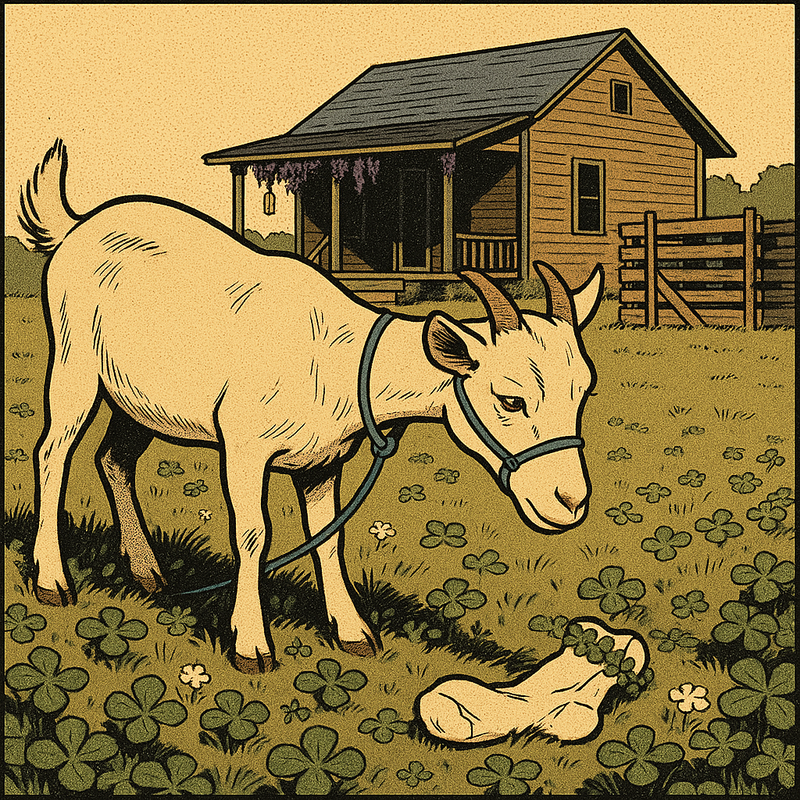
She was out in the tufty field that ran down toward the ditch, where clover thickened and the grass came up to toddler knees. The blue rope still circled her neck in a tidy halter, its tail dragging the ground like a gentleman’s coat. Every so often she picked up the rope with her lips, thought about it, then dropped it again as if the notion had not passed committee.
Toyah barreled into the grass with a single balled sock clamped like treasure in her fist. It was one of Addison’s—white, heel blown a little thin, rolled into itself until it became a soft sphere the size of a lemon. “Lizzie!” Toyah called, bright as a bell. “Fetch!”
She wound up with her whole body, the way very small pitchers do, and let the sock fly. It traveled a valiant eight feet, turned once in the baked air, and fell with authority. Elizabeth watched it land with the solemn interest one gives a new law. Then she lowered her head and went on eating.
“Fetch,” Toyah repeated reasonably, pointing. She pointed with such dedication that her pointing hand trembled. Elizabeth flicked an ear in the general direction of grammar and took another mouthful of clover.
Jess arrived at a more measured pace, a little commissioner of fairness, her hands already full of small plans—two daisies, a crooked stick, and the belief that all things could be arranged. She pressed the daisies into Toyah’s palm. “Make pretty,” she advised.
They decorated the sock with flowers, working in tandem. Toyah threw it again. It achieved nearly the same arc and landed in nearly the same patch of earth with nearly the same outcome. Elizabeth blinked. The daisies looked like applause around a mistake.
From the shade of the chinaberry near the back steps, Addison folded her arms and tried very hard not to interfere with science. She had the posture of a foreman trusting the crew, and the soft, crooked smile of a mother who knows the job will take as long as it takes. The hammer she’d been using to persuade a nail sat on the step beside her, cooling.
“Lizzie,” Toyah tried again, sing-song. “Feh!” She patted her thigh like she’d seen dog people do. “Come on. Come on, doggy.”
Elizabeth did not come on. She chose instead to nibble the exact spot where the sock had fallen, like she was doing the math and had determined the shortest path to victory was to erase the variable. When she reached the sock she put one hoof on it with care, as if she were blessing it, and resumed chewing the ground around it.
Toyah looked at Addison, scandalized by the lack of textbook compliance. “She not,” she announced.
“Try showing her,” Addison said, the words wrapped in amusement thin as tissue so they wouldn’t dent the experiment. “Show her how it’s done.”
Toyah marched to the sock, pried it out from under Elizabeth’s patient hoof, trotted back the precise number of steps that felt like “far,” threw it, chased it herself, grabbed it, and charged back with triumph vibrating her little frame. She planted it against Elizabeth’s cheek like a trophy.
Elizabeth accepted the award, then lifted her top lip and very delicately tasted the sock. Her whiskers wrote a sentence on the cotton. She mouthed it like a question, considered, and then—chewed.
“No eat!” Toyah cried, flustered. She tugged gently. Elizabeth tugged back, pleasantly surprised to discover the world came with handles.
Jess, who had been kneeling to examine a ladybug, saw the stalemate and intervened: she touched the sock very lightly with one finger, as if tapping a chess clock. “Share,” she suggested to all parties.
For a moment the scene held like a painting—two toddlers, one goat, one sock, the whole field paying attention. Then Elizabeth, apparently satisfied with the flavor profile, let the sock go and took a single pronk sideways that made both girls squeal; the balled cotton popped free and sailed all of two feet on goat momentum alone.
“FETCHED!” Toyah declared, fully convinced by the technicality. She clapped for the goat, for herself, for the pretty certainty that the world listened.
“Again,” Jess said happily, because again is the most beautiful word on a good day.
They commenced the loop. Toyah threw; the sock bounded eight feet; Elizabeth contemplated; the girls fetched for her, returned, applauded. Sometimes they attempted coaching—“In yoo mouf, Lizzie. In”—accompanied by dramatic demonstrations in which Toyah put the sock in her own mouth for a distance of three triumphant steps before dissolving into giggles. Jess tried rubbing the sock on a clover head, then a dandelion, as if scent might unlock a secret button in the goat.
Elizabeth participated in her own way. She shadowed the flights with mild interest, took half-steps after the sock if it landed in the precise direction her mouth had already been headed, and occasionally lifted it with her lips just enough to toss her head and let it flop back down. The girls met each of these with the fanfare appropriate to breakthroughs. “She did it!” Toyah reported to Addison with the crisp confidence of a field correspondent. “She fetched.”
Glenda’s eyes shone, a spark that matched the girls’, “And before you even ask, between me, Mason, and Jackson we can knock together a little lean-to out back. I’ve got scrap two-bys in the shed, Mason’s got that leftover tin roofing, and Jackson’s got the post-hole digger he insists on introducing at every opportunity.” Her grin tipped wry. “We’ll give Miss Elizabeth a proper address that isn’t my front room.”
Addison’s mouth went theatrical with relief. “Ain’t that just the best of Southern hospitality. I was about to suggest a futon and a reading lamp.”
Glenda lifted a finger, mock stern. “Mm-hmm. Which reminds me—goats are not the best house pets. They will eat your curtains, your laundry, your patience, and then ask what’s for dessert.”
Addison put a hand to her heart. “I take offense on behalf of indoor goats everywhere.” Then, failing to keep a straight face: “But yes, okay, this one’s an outdoor girl. She’s got… rustic tastes.”
“Rustic,” Glenda echoed, amused. She stepped to the edge of the porch and sighted along the side yard, the way people do when they’re measuring with the part of the brain that knows what a weekend looks like. “We’ll set her up on the east fence, where the ground’s high and the shade comes early. Mason can run a rail. Jackson’ll talk to the dirt ‘til it behaves.”
Glenda’s teasing softened into fondness as she looked back at Addison—the blue smudges on her fingertips, the knot on the rail, the two little girls anchored to her by invisible thread. “We’ll keep her close,” she said, and then, because she couldn’t help herself, added, “But not on my couch.”
Addison held up both palms. “Scout’s honor. No hooves on upholstery.”