
Chapter Text
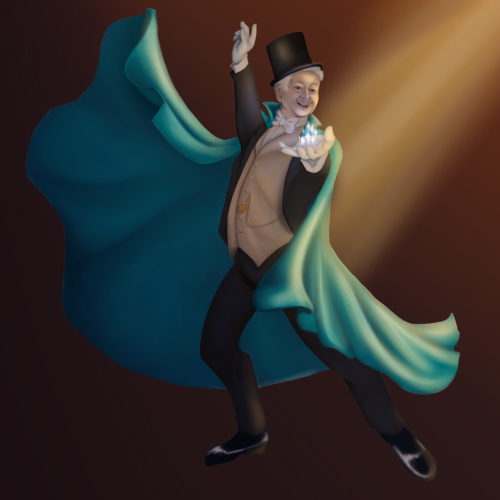
Jiggery Pokery
From the diary of Mr A.J. Lewis, known professionally as the magician Professor Hoffmann.
Excerpts pertaining to Mr A.Z. Fell, also known as Fell the Marvellous. All notes discreetly stored.
12th March 1863
I have a new apprentice, who shows such enthusiasm as I have not seen the like, in his attempts to learn the subtle art of prestidigitation. It is quite fortuitous to meet this young man whilst I am starting to write my own book on the art of learning Modern Magic, as I can put into practice many of the skills I hope to teach others in teaching him these very same skills.
Of his personal life, I know very little, except that he is a bookshop owner, inherited from his father who opened the bookshop about sixty years prior. He strikes me as a most unusual and reserved man, with blond, unkempt curls and striking blue eyes. He seems to have few friends, save for one close friend he mentions in passing, but they seem to no longer be in communication. From the little we have worked together, I cannot say with any certainty that he would ever make it to the level of professional conjurer, but it seems as though he needs an escape from the world of his books and a distraction from no longer having the company of his close friend. As I am in need of a good editor for my book who understands magic, we have entered into a loose partnership as he helps to prepare me for publication and as I teach him the tricks in the book along the way.
He has little in the way of family that I can gather. He mentions visitors occasionally who seem to distress him a great deal, who have a lot of opinions on how he should be spending his time, which I take to mean could be his mother or siblings. He says they live up from here, which I assume means in Oxford or Bristol. Their visits always bring him to my door in a desire to learn more in the art of conjuring.
He once showed me a trick that he claimed fooled Nefertiti with only a caraway seed and three cowrie shells in an old precursor to the Three Card Monte trick. It seemed a strange invented backstory as few people may fully understand the reference or would know why his magician’s character would have performed for someone who lived 3,500 years ago. Even in watching the trick, I am not convinced it would have fooled the ancient Egyptian queen, even in fancy, unless she was simply too polite to disappoint him.
Astonishingly, I also find it difficult to be anything but polite to this charming and enthusiastic young man, so perhaps it does seem like that could be a possibility.
The way he fumbles through all of his tricks is unmatched in any I have witnessed. He frequently alternates from an articulate conqueror with a powerful stage presence, to a bumbling clown in the next moment, frequently dropping his cards or gimmicks and apologetically picking them up, while still trying to finish the trick even after it is revealed.
It truly boggles the mind.
He is certainly giving me plenty of material for my book on trying to teach other beginners the art of magic.
The entire last chapter I am dedicating specifically to him, even though he may never realize it.
23rd August 1863
After many months and many attempts to teach routines that Mr Fell could perform with ease, without success, just yesterday we alighted upon one that he has been able to perform with reasonable consistency.
The trick is one of his own design, based on the skills he has been learning from me. He places a sixpence and a farthing into his left hand, says the magic words, blows on his hand, and opens it to reveal the farthing has vanished.
The magic words he chose for the trick were banana, fish, gorilla, shoelace and a dash of nutmeg.
When I asked him the meaning behind this, knowing him to be literate in nearly all the books in his vast collection in his shop, and knowledgeable in many subjects besides, he quoted my own book back to me, the very first rule: “Never tell your audience beforehand what you are going to do.” He said with such a carefully crafted selection of words, it would keep the audience guessing.
I will note that when watching Mr Fell perform, magic words or not, it is impossible to guess what he will do next, even if one knows the trick he is performing.
But we are both pleased to have found a trick he can show others without accidentally revealing the secret, as long as he keeps his palm flat enough to not reveal the smaller farthing hiding under the sixpence, and as long as he closes his palm before the coins can fall on to the floor.
14th January 1864
Mr Fell has additional skills than he had previously revealed to me. He is a talented illustrator, and showed me his own book of detailed drawings that he had been making for his own reference in learning the tricks I was showing him. I realized at once how useful that would be for the book, and asked if he would care to illustrate Modern Magic. He enthusiastically agreed, and showed me so many illustrations we could already put to use, but stated that he would not wish his name on the published work. He also said he only wanted to learn the tricks in lieu of payment. As he would learn them anyway in illustrating them, I agreed, but tried to insist on payment anyway, knowing what I would have to pay if recruiting another artist to the project, but he still declined. I am ecstatic knowing how worthwhile it will be to have someone who understands at least the concepts of the tricks when illustrating.
We now spend many of our afternoons together with me explaining a trick, which he then attempts, almost always without success, and this permits me then to refine how I can better explain the trick and account for what may go wrong in attempting it. His bumbling has proven extraordinarily useful in this sense. And when we both feel the explanation is as clear as it can be, he illustrates what I have shown him as I finalise the wording for each piece. In this manner we are making great strides on crafting the book.
Mr Fell possesses a deep curiosity and asks me so many questions that help me clarify my meaning. He also has a great memory, and helps me frequently reference other similar tricks that could help in comparison for building upon specific skills such as sleight of hand. I could not recruit an editor so possessed of such details as Mr Fell has demonstrated through our simple weekly conversations and I am truly fortunate in our partnership.
I'm finding that I am learning a great deal about teaching through everything Mr Fell does wrong, like teaching an incredibly eager overgrown child who shows a unique wonder at the world, and for this I am truly grateful.
20th January 1870
Mr Fell asked quite a few questions about the ethos of the art of conjuring.
He said he felt he was initially quite gullible, but after many years had learned the importance of not showing all one’s hand, as it were, particularly when dealing with his overbearing relatives. He said he was as honest with them as he deemed possible, that he went along with them as far as he could. But when there was a struggle of true conscience, what he knew to be true and right against what he was being told to do, that over the years he had developed a habit of lying, even to his closest companions. And this distressed him, but he could see no other options. He said he noticed that the art of prestidigitation was essentially the same. It was the art of clever and harmless deception for the benefit of entertaining others.
I gave this some thought before replying. I told him that actors rarely see themselves as liars, because the real skill of performing is revealing truth. They may not be in truth an old Caesar or king or beggar, but they find in themselves part of the same truth from the original character, and reveal that to the audience in that unique shared daydreaming experience we call the theatre. And magic is essentially the same. We hold the truth until the very last moment, through all our carefully rehearsed misdirections, and then as the final prestige we reveal what was there all along. In my view, magic is not about lying, as much as using the most carefully crafted judgment in what we allow our audiences to see.
I explained that this was the most important part of our craft; that anyone could learn the mechanics of a trick, but the true magic was in the belief in self and the character.
I quoted to him this section from Modern Magic:
The performer should always bear in mind that he fills the character of a person possessing supernatural powers, and should endeavour, in every word and gesture, to enter into the spirit of his part. As the true actor, playing Hamlet, will endeavour actually to be Hamlet for the time, so the magician must, in the first place, learn to believe in himself. When he steps upon the stage he should, for the time being, persuade himself that his fictitious power is a reality. If a performer has sufficient imaginative faculty to do this—if he can so enter into the spirit of his part, as himself to believe in the marvels he professes, he will achieve an almost unlimited mastery over the imaginations of his audience.
Mr Fell contemplated this in silence as I refilled our drinks. He said he found revealing that type of truth to be the most challenging.
He also asked, purely hypothetically, if there was a supernatural being who could in fact perform such feats, but still wanted to try the art of prestidigitation instead, if that was merely another level of deception from the audience. On further reflection, he also asked if so how that being might find the truth of the performance as other performers did.
I told him I’m sure supernatural beings still needed to find the art of believing in themselves and confidence that other beings did, and that in even pretending to do a trick that they could in fact actually do, still would need to learn the art of revealing truth as a conjurer did in order to perform magic with the greatest impact.
This answer seemed to give him some great relief, and he thanked me profusely for sharing with him my thoughts on the matter. He said he found the art of learning to believe in one’s own self the most challenging trick of all.
19th September 1873
We are near to finishing our book, and I spent some time on the last chapter to give Mr Fell some personal advice, as well as our future readers:
When the performer has made his bow to his audience, there are still one or two little points that he will do well to bear in mind. They may be summarized as follows:—
1. Don’t be nervous. (The reader may possibly consider that this is a matter in which he has no choice; but nothing could be a greater mistake.)
2. Take your time. Deliver your boniment like an actor playing his part. Give your audience time to see and appreciate your movements. The change of, say, an orange to an apple, falls decidedly flat if nobody noticed that the article was an orange in the first instance.
3. Don’t affect any unusual quickness in your movements. The perfection of conjuring lies in the ars artem celandi—in sending away the spectators persuaded that sleight-of-hand has not been employed at all, and unable to suggest any solution of the wonders they have seen.
4. Don’t force yourself to be funny. If you are naturally humorous, so much the better; but in any case perform in your natural character.
5. Avoid personalities. We except the case of the often recurring nuisance, the gentleman who professes to know how everything is done, and whose special endeavour it is to embarrass the performer. When you can make a person of this kind look like a fool (by no means a difficult task) by all means do so.
6. Never plead guilty to a failure. Keep your wits about you, and if anything goes wrong, try to save your credit by bringing the trick to some sort of a conclusion, even though it be a comparatively weak one. If you are so unfortunate as to experience a complete and unmistakeable break-down, smile cheerfully, and ascribe the fiasco to the moon being in a wrong quarter.
Bearing in mind these parting counsels, and thus armed against failure as well as prepared for success, you may safely ring up the curtain with the marvels and mysteries of MODERN MAGIC.
I will note through our work together that Mr Fell has grown in his confidence as a performer and orator. He can easily command the attention of a room, and speaks with such great diction as would make Shakespeare himself proud. His lead-ins for the illusions are as good as any I have seen.
It’s what comes afterwards that inspired me to write the final rule in my book, as detailed above, and hope he gives it some consideration for his future attempts at performance.
26th April 1875
Mr Fell and I have nearly completed our manuscript. He is still eager to learn, and I’m certain we can work together on new books in the future as I still have many additional tricks I would like to record, but for his desire to further himself as a performer I feel he has reached the end of what I am able to teach him.
I have recommended him heartily to a professional associate of mine who delights in teaching beginners. Even though Mr Fell has illustrated nearly every trick I know, and we have worked together closely over a decade in going through each trick in great detail, I would still hesitate to call him anything more than a beginner.
I wrote a personal letter of recommendation to John Maskelyne for him, saying he was a remarkable pupil, quick of understanding if not skillful at execution, extraordinarily enthusiastic and eager to learn.
Mr Maskelyne accepted Mr Fell into his class, but had a few follow up questions for me after he started taking them. I do hope he can work with Mr Fell on his flaws as a performer in ways that I was unable to assist. One can’t help but feel for him as he bumbles through his tricks.
15th March 1876
I invited Mr Fell over to celebrate the publication of our book, Modern Magic, and upon his insistence I also inscribed a dedication to him in his copy, “To Mr Fell - A wonderful student. Yours - The Hoff.”
We shared a quiet drink of port together and reflected on our years creating the book. Mr Fell then asked if I thought he might be ready to take the stage as a professional conjurer. I answered as honestly as I could, saying I knew no other student who had attended himself to study the craft as well as he had, and that if years of study were the only indicator, that surely he would have earned his doctorate in magic by now. He seemed pleased at my answer, and I still urged him to continue to hone the finer skills of prestidigitation before he attempted it in front of an audience.
Mr Fell had spent some time over the years admiring an old turquoise cape of mine that I had hanging in my workshop, and brought up again how nice it looked. He expressed a desire to have one himself just like it at some future point. He said the stars on it reminded him of his friend, who had a great passion for astronomy. I gently reminded him that I had included a chapter in my book explaining that capes were no longer the fashion for professional magicians:
“It is not very many years since the orthodox dress of the conjuror was a long and flowing robe, embroidered more or less with hieroglyphic characters, and giving ample space for the concealment of any reasonable sized article—say from a warming-pan downwards. The very last specimen of such a garment, to the best of our belief, is, or was, worn by the magician attached to the Crystal Palace. We do not know whether he is compelled by the regulations of the establishment to wear such a robe; but if so, it ought to be liberally considered in his salary.”
However, even after sharing that with him, I knew that current trends meant little to Mr. Fell, who always seemed to dress in clothes a few decades behind, and was often in the same exact ensemble each time I saw him. So I noted it at least with interest that he desired a different attire for his magician persona, and couldn’t help but ask what other details he had thought up for performing.
He told me he picked out a magician’s name for himself. ‘Fell the Marvellous.’ I do feel that it is appropriate, as it was impossible to do anything but marvel at Mr Fell’s attempts at magic.
22nd March 1876
Mr Fell came in a week later in his full magician attire for my approval, and showed me the illustrated poster he had made himself to advertise any future performances as Fell the Marvellous. I was impressed with the thought and attention to detail he put into these tasks, when he had still not perfected the routines that would be necessary for performance. But he definitely looked the part of a magician, and I told him so to his delight.
I also asked him why he penciled on a mustache, knowing he was capable of growing his own. He muttered something about it being another magician’s stage trick to make it look like he had a mustache when he did not, in fact, possess one.
I chose not to push the issue further.
18th October 1876
There was a strong reaction to the publication of our book from the magician’s community, as I expected, that resulted in several threats upon my life upon which I placed little weight.
Magicians are nothing if not dramatic. I took their threats as little more than overblown dribble, simply attempts to try to claim the stage that my book was firmly standing on, and it must be noted that even the negative press resulted in positive sales for the book, so it did not concern me greatly.
My dear friends and colleagues in the professional community reacted positively to the book and gave me great encouragement while writing it, and it is their opinions that matter dearest to me. John Maskelyne even contributed several chapters of his personal tricks and clever use of automata at the end. For any other magicians I interviewed in the creation of the book, I was very careful to designate in my own notes with the letter P if the trick was private and not to be shared with the general public. The only tricks revealed in my book were either my own or shared with permission.
Mr Fell was gravely concerned about the reaction and threats on my life, and to my complete surprise came into my workshop one day carrying a large novel, “Mrs Beeton’s Book of Household Management,” and gifted it to me. I asked him why, and he said that much like a magician’s apparatus, not everything is as it seems.
I opened the book, and inside its hollowed out pages was a Derringer pistol.
I told him I did not think I would have need of it, but Mr Fell said he would feel better if I had it. He said I should also advise him if there was ever any trouble.
The bumbling would-be magician would not normally have been my first choice, but looking at his earnestness and subtle righteous anger in the way he said it, made me quickly believe that no one would cause me trouble while he was around.
So I took him at his word and swore I would do so.
To be continued...