Chapter Text
Water. Cold, heavy, dark. A burning, in his throat and lungs.
There’s only so long a human body can go without taking a breath before it forces one. After that, the throat either closes up and you suffocate or water enters the lungs. Either way, after that point, survival is unlikely.
After his father drowned, he read reports. Accounts from survivors. Scientific studies.
None of it has prepared him for the real thing.
He had just finished the construction of the Palace. His name was known throughout Sumeru. He was going to pay off his debt, get a new place, design more wonders.
Now, he won’t get to do any of that.
<><><>
Kaveh is nineteen, fresh out of his first year in the Akademiya.
Already, the pressure is intense. Kshahrewar hasn’t had a graduate who’s done much of, well, anything for a long time, and they’re already eyeing him as their next brilliant pupil. Light of Kshahrewar, they’re calling him, like they don’t see his low grades in most subjects or the way he gets in trouble in nearly every class. The lecture halls weren’t built for someone like him, with a focus that scatters on the lightest breeze and a constant habit of snapping his fingers or tapping his feet or doodling architectural designs in the margins of his class notes.
He’s already been yelled at by several professors for it, and that was just within the past week. And so, as Kaveh usually does, he goes to the shoreline to unwind, listening to the sound of the wind and the waves until the chatter in his brain fades.
He lets out a breath, long held in.
Sure, going here late at night messes up his sleep schedule, but almost everyone in the Akademiya is running on only a few stolen hours of sleep and gallons of coffee. He’s made some friends, has a study group now. He brings his sketchbook to class so he can doodle in it instead of his notes. His grades are slowly getting better.
He lets out another breath.
The sky is clear, the moon a graceful crescent hanging among the stars. The clouds of the latest storm have all but passed, the seaweed and driftwood scattered along the shoreline the only testament to the final remnants of the monsoon season.
Kaveh holds up his lantern, watching the way the light glimmers off the ever-changing waves. Sand crusts on the edges of his Akademiya robe.
He doesn’t know why he keeps coming back to the water. When Kaveh was young, he had loved the ocean. Loved the stories of merfolk and magic and treasures hidden beneath the waves. Of palaces made out of coral and jellyfish that sang harmonies.
After his father’s ship sank, the ocean hasn’t held the same magic for Kaveh.
He sighs, adjusting the edge of his binder. Despite his own issues with the ocean, his latest class project involves designing a building inspired by the ocean and its fluid movements, and so here Kaveh is, far closer to the ocean than he usually gets on these nightly excursions.
Instead of inspiration for his project, he finds a body.
They’re buried under seaweed and driftwood, the outline of a head and arms still visible. Kaveh almost doesn’t notice them at first, until the sound of ragged breathing gives them away.
Shit shit shit–
Stumbling over rocks and debris, Kaveh scrambles over to them, shining his lantern over their face. They look close to Kaveh’s age, maybe a year or two younger, with short silver-grey hair covered in sand. Their shoulders and cheeks are stained with mud or oil or blood, until Kaveh pulls the seaweed and driftwood away and realizes it’s not any of those, but scales.
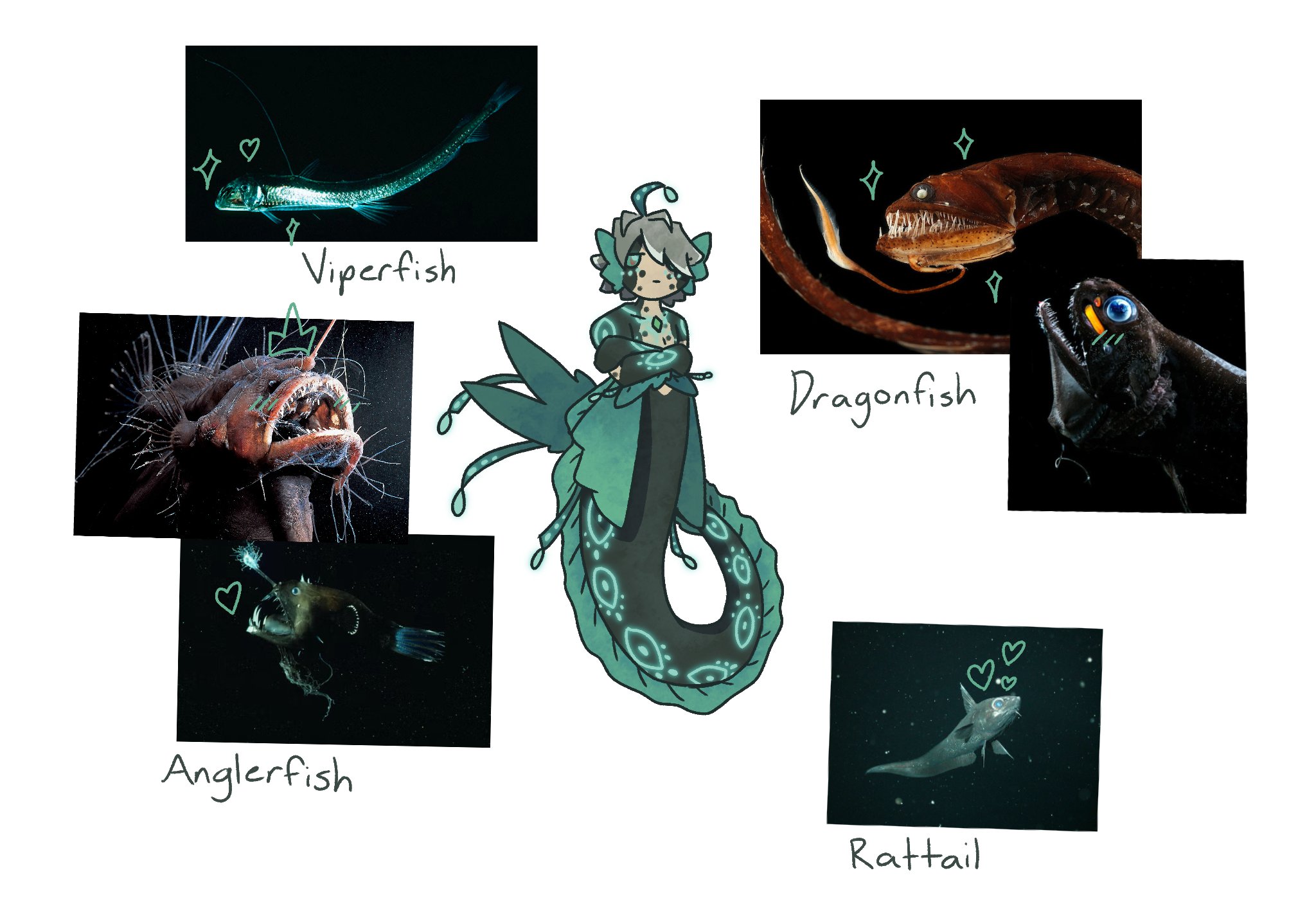
When Kaveh drags the debris off where their legs would be, he is met instead with the long tail of a fish. The scales are a deep black, reminding Kaveh of obsidian, only they aren’t shiny, reflecting none of the light from his lantern. The tail is longer than those of Sumeru’s reef merfolk, covered in sand and algae and trailing behind the mer. The fins are blue-green, fading to a paler color near the tips. Trailing lures extend from their fins and a shorter one from their head, flickering a faint teal as the creature twitches. The scales cover all of the creature but their chest, most of their face, and arms, scales starting again at the creature’s wrists.
Instinctively, he takes a step back.
He’s – well, he’s not familiar with Sumeru’s merfolk, secretive as they tend to be, but this certainly isn’t one of them. Sumeru’s reef merfolk have brilliantly patterned scales and large, bright fins that sparkle in the sunlight. They don’t have lures or glow or look like this. This is– something else.
They – he? – are a deepwater mer.
Kaveh has never seen one before. Sure, he’s heard stories – that they’re massive, sometimes over thirty feet long. That they’re little more than predators, incapable of human speech, empathy, or reason. That they were hungry ghosts, rising at night to devour those who strayed too far from the shore.
The reef merfolk didn’t like to talk about them. Though they didn’t seem to like to talk to humans in general, they seemed especially tight-lipped on the topic of deepwaters.
The primary impression Kaveh had received was that they were dangerous.
But the one in front of Kaveh is small. He’d probably be shorter than Kaveh if it weren’t for the tail. He looks skinny, faint outlines of ribs showing near the mer’s flapping gills. He twitches every now and then, as if in pain. Can he even breathe air? Is he suffocating?
Kaveh wrings his hands, chewing on his lip. Dangerous or not, he can’t just let the mer die. But as Kaveh approaches him again, the creature’s eyes snap open.
Piercing, faintly glowing teal. Red at the center. No pupils, just wide irises that stare directly at Kaveh. The mer’s tail drags over the sand. He makes a low clicking noise as he bares his teeth, eyes fixed on Kaveh. Watching him.
Waiting.
<><><>
It’s dangerous to leave the deep, Alhaitham has been told. Outside of the deep, the waters are everchanging, unpredictable. The sun, when it rises, is harsh.
And yet.
If Alhaitham has a fatal flaw, it is a hunger for knowledge. After his grandmother passed to the Below, he’s started to explore beyond his usual hunting grounds each night, when the setting of the sun drapes the shallows in comfortable darkness.
Tonight, though, he has failed to account for the unpredictability of the surface waters.
He recalls a roaring sound, a sickening crack from above. The way the waves churned. A blinding light, jagged and disorienting. Something heavy hitting his head.
Darkness.
Now, sand sticks to his scales and his hair, and each shuddering breath he takes scrapes the inside of his throat. His gills flap, dry and itching. His body must have switched to using its vestigial lungs, Alhaitham realizes. He’s never tested them before, though, and so he’s unsure for how long they’ll continue to supply him with proper oxygen.
Seaweed and driftwood are dragged off his tail through no power of his own, and Alhaitham hears a gasp. He blinks, and then his eyes snap open.
Light. A lure, held out in front of a face. Colors Alhaitham has never seen. Crimson eyes, gold hair.
The figure shuffles backwards, and Alhaitham looks down to where their tail should be.
Legs.
It’s a human.
His grandmother’s warnings run through his mind. Humans are dangerous, predatory. With Alhaitham stranded on the sand, meters away from the ocean, this one has every advantage.
Alhaitham bares his teeth, a growl starting in his throat. If he’s dealing with a predator, all he has to do is convince it he isn’t worth the meal. He lights up the eyelike patterns on his body, lashes his tail.
The human’s eyes grow wide. Good, Alhaitham thinks, before the thing puts its lure down in the sand, crouching down in front of him. Still blocking the path to the water.
It’s smart.
“It’s okay,” the human coos, voice gentle. “I’m not going to hurt you.”
Is the human mimicking words, or can it really speak? Alhaitham looks back to the being’s lure, still resting in the sand. It’s much larger and brighter than any of his. Clearly it hopes to draw in big prey.
Alhaitham hisses. Get away.
The human is undisturbed. “Did you wash up in the storm? I could probably find someone to check you ever for injuries, or–”
Alhaitham hisses again, flaring his fins for emphasis. He is not letting a human touch him. He needs to get back to the water. Alhaitham’s claws dig into the sand – curses, he thinks as the grains work their way underneath his nails and webbing – as he stares down the human.
The human makes an exasperated noise. It, or maybe he – this one is clearly intelligent – reaches into its bag, pulling out a small, edible-smelling object. Alhaitham is instantly alert, eyes on the food. He hasn’t eaten in nearly a week. It’s obviously a trap, but if he times things right, he might be able to get it out of the human’s hands on his way back to the water.
“Will you let me get closer if I give you some of my shawarma?” the human asks, holding out the object like Alhaitham is some sort of squid he hopes to bribe with a treat.
If the human really desired to eat him, he would be dead already. It wouldn’t have taken much effort to kill Alhaitham, helpless as he is on the sand. It would be an easy meal.
And yet. The human hasn’t tried anything. Is it biding its time, or is there another reason?
“Fine,” Alhaitham relents, voice raspy from the air and a general lack of use. “But move out of the way so I can get back to the ocean first. I don’t know what happens if I spend too much time out of the water, and I’m not interested in finding out.”
The human nearly drops his bribe. “You can speak?”
Alhaitham raises an eyebrow. “You sound surprised. Is there a reason I wouldn’t be able to?”
Stepping out of the way, the human takes a moment to study him, eyes darting over his fins, his tail, his lures. “I don’t know. I’ve – uh, well – overheard some things from the mer on the reef that I guess… weren’t true. My name’s Kaveh, by the way.”
“Alhaitham.”
The sand itches his gills and the space between his scales. The thin membrane over his scales is starting to lose moisture, flaking in the dry air. The water beckons, a cool embrace. He can probably drag himself forward with his arms, but Alhaitham isn’t sure if he’s strong enough to do that.
“Do you want me to help you?”
Alhaitham turns. Kaveh glances at him expectantly. “Get back to the water, I mean. It looks like a pretty far distance to crawl, and your tail must be heavy.”
“I don’t require assistance,” Alhaitham mutters, dragging himself forward. Unfortunately, Kaveh is right about his tail. On the beach, it’s essentially dead weight, and, as he soon learns, the limited capacity of his lungs to process oxygen makes any form of exertion difficult.
He huffs, gills flapping uselessly. Sand grates against the bare skin of his chest.
“This is painful to watch,” Kaveh mutters. “I’m gonna drag you the rest of the way, okay? Hold out your arms.”
…what?
Kaveh steps closer, offering his own hands for Alhaitham to grab on to. After more than a few moments of hesitation, he does, allowing the human to drag him the rest of the way to the water. He’s shocked at just how warm Kaveh’s hands are.
Water caresses his scales, gentle waves lapping against Kaveh’s ankles. Almost immediately, the vulnerability of being dragged back is replaced with a sense of deep relief. By the time the ocean has reached halfway to Kaveh’s knees, Alhaitham is able to move on his own.
He dips his head below the waves, drawing water into his mouth and through his gills. “I suppose you aren’t so bad,” he admits once he emerges.
Kaveh folds his arms. “That’s a weird way to say ‘thank you’. Can you breathe air and water?”
“Do humans always ask invasive questions about the biology of other creatures?” Alhaitham asks. “I can breathe both. My lungs just don’t work very well anymore. They’re… less efficient than yours.”
He watches as Kaveh sits down on a rock, chin in his hands, feet dangling in the surf. “What do you mean, ‘anymore’?”
Alhaitham adjusts his position, dipping underwater for another breath. He’s not especially keen on giving too much information to the human, not yet. “I believe you promised me your edible item. You can have more questions later.”
Kaveh laughs. “You mean the shawarma? Let me take it back out. I don’t know if you’ll like the vegetables in it, but you’ll probably enjoy the meat.” As he speaks, Kaveh removes several strips of meat from the ‘shawarma’ before handing them to Alhaitham. “What are you doing all the way at the surface, anyway?”
Gently, Alhaitham takes the food from Kaveh, feeling the way the heat radiates off his skin. He wonders if it’s a human thing, if all of them are this warm.
“Curiosity,” Alhaitham admits. He inspects one of the strips, then places it in his mouth. It’s richer than the fish he usually catches, closer in flavor to the meat his grandmother once took from the sinking carcass of a whale. But something is different about it, drier, with strange new flavors that Alhaitham can’t decide if he likes or not. He eats another.
“You can have the rest if you’d like,” Kaveh offers, setting the shawarma down on the rock next to him. “I’m not hungry, anyway.”
Foolish, Alhaitham thinks. In the deep, you eat at any chance you get.
It doesn’t matter how hungry you are. There are fish whose stomachs can expand to be three times as large as their body to hold as much food as they can. Eels with mouths that make up most of their bodies. In the deep, the timing of your next meal is an unknown variable.
Perhaps things are different on land. Food could be plentiful there. Or maybe this is the only meal Kaveh has had all week, and he’s just decided to share it with someone he just met.
Kaveh takes out another object as Alhaitham inspects the shawarma, tries each of the items inside one by one. None are as good as the meat.
Once the meat is gone, he loses interest, instead investigating Kaveh’s new item. Small drawings, more detailed than anything Alhaitham’s grandmother has made in the sand, have been etched onto thin sheets. They seem to show some sort of cave or nest.
“Do humans live in those?” he asks, tapping the edge of the sheets. The surface immediately grows soggy and limp. “They seem unnecessarily fancy.”
Kaveh huffs, swatting Alhaitham’s hand away from the sheet. “What do you mean! These buildings are just the right level of fancy! Humans like having beautiful living spaces.” He makes a grumbling noise. “Most of them do, anyway.”
Alhaitham tilts his head. “That hardly seems necessary. A living space should prioritize function over form. Unless the gaudy decorations are to attract a partner?”
“What?!” Kaveh’s face takes on a pinkish shade. “No! Form and function are of equal priority. The ability to appreciate beauty is a very important trait. It’s what keeps artists like me in business.”
“Ah. The importance of beauty is to secure your access to food?”
Kaveh huffs. “No! It’s important because art is an expression of the soul!”
“Hm.”
This earns him a sigh from Kaveh. “Whatever.” He draws a few symbols next to the human-cave he’s sketched. Alhaitham stares.
“What are those symbols? Do they mean something?”
“Yeah,” Kaveh says. “They’re writing. Humans record information this way. I guess you can’t really do that underwater. I overheard the reef merfolk say that they recorded information through song.”
Alhaitham nods, drawn in by the promise of information. “We sometimes use different symbols to record information. In the deep, we don’t sing as much. How long would it take you to teach me those symbols?”
“A while,” Kaveh admits. “It takes human kids years to learn to read.”
He could learn, Alhaitham thinks. Patience is a virtue he has plenty of. And what secrets would he be able to uncover from the books of humans? While it was true that the sea-silk scrolls his grandmother had hoarded held plenty of information, Kaveh is talking about land knowledge here.
He looks back to the ocean. It was unwise for him to have stayed this long. Going back to the shore in the future would only mean trouble.
And yet.
“It wouldn’t be much trouble for me to return here each night,” he says. “If you require something in exchange, I would be willing to indulge your curiosity about the deep sea if you show me how to decipher these symbols.”
Kaveh nods. The deal is struck.
<><><>
Water enters his lungs as the last of his air escapes through his mouth. It burns, hurts worse than anything he’s experienced before.
This shouldn’t be happening.
He still had so much to do. He still has to fix his mistakes. He still hasn’t apologized to Alhaitham.
He can’t die here.
<><><>
The creatures of the deep rise to the surface with the setting of the sun, and sink below once more. The waves change, become calmer. The creatures of the deep rise and sink again and again, for many cycles. Now, Alhaitham rises with them, joins Kaveh on the beach to read the ‘books’ other humans have written.
Kaveh has just turned twenty.
Alhaitham doesn’t quite understand why this is meaningful; in the deep, there is no turn of the seasons to mark the passing of time. There is just the Rising and the Falling, the times when the creatures of the midwater go to the surface to hunt and to the below to hide.
But Alhaitham understands that it is a day that is special to Kaveh, and it means something that he has chosen to share it with him.
Kaveh… isn’t like anyone Alhaitham has met. Not that he’s met many individuals over the course of his fairly solitary life – something he’s perfectly happy with – but still, Kaveh is unique. His mind is bright, filled with ideas. He dreams of becoming a famous architect, designing beautiful buildings.
Alhaitham still believes that function should come over form. Kaveh believes in a balance. They argue over this frequently, which Alhaitham enjoys, because debate is when Kaveh is at his finest.
Crimson eyes flashing, voice raised and clear, ideas flowing – something about this version of Kaveh fascinates Alhaitham.
He never thought he’d enjoy the company of someone so loud. But here he is.
“I brought kebabs!” Kaveh crows from across the beach. He’s jogging across the sand, Akademiya robe fluttering in the breeze. “They’re fish this time! I figured it would be cool for you to try the cooked version of your usual food.”
Alhaitham nods, accepting the gift as Kaveh sits down next to him. Cooked fish is definitely different from raw, the taste distinct with a flavor Kaveh describes as “smoky”. The stick is pleasantly crunchy, too, pairing well with the texture of the fish.
Kaveh stares at him, face somewhere between shock and horror. “You weren’t supposed to eat the stick!” he protests. “You’ll get splinters in your throat!”
Alhaitham just shrugs. It’s not like it’s all that different from fish bones, after all.
As they talk, Kaveh sketches. He’s been working on a project for the Akademiya, something involving a very fancy cave for a human that Alhaitham has learned is called a ‘house’. Kaveh rambles when he talks, jumping from one subject to another like darting fish. After Kaveh’s lantern goes out, he asks Alhaitham to sit next to him and provide some light with his lures.
Alhaitham thinks it foolish that Kaveh, despite not being able to see in the dark, is seemingly nocturnal.
While Kaveh draws, Alhaitham watches his hands, so similar to his yet so different. There are no scales, no fins, no claws. He holds his own hand up next to Kaveh’s to compare. No webbing, either.
Kaveh switches to drawing with his left hand, holding his right still and spreading his palm as if to let Alhaitham see.
Carefully, Alhaitham curls Kaveh’s hand into a fist, eliciting a surprised squeak from his friend. Interesting. All the joints of their hands work in the same way.
The next thing he discovers is that Kaveh’s hand does have webbing, which is very short, nearly to the point of not being there, and only visible when he forces the fingers apart. It seems most prominent between Kaveh’s thumb and index finger, but even then, nowhere near enough to catch the water.
And just like the first time they met, Kaveh’s hands are warm. By now, Alhaitham has decided that this is a human thing. His grandmother had always been only a few degrees warmer than the surrounding water, and Alhaitham figures the same is true for him.
There’s an amused crinkle in the corners of Kaveh’s eyes as he studies Alhaitham. “What are you doing?” he asks.
“Scientific research,” Alhaitham states, pressing his palm to the underside of Kaveh’s arm. “It’s warmer on land than it is in the water. Is there a reason you need to make so much of your own heat?”
“Er…” Kaveh rubs the back of his neck. “I think you’re just cold. I mean, your hand is freezing. It’s also a bit slimy.”
Alhaitham hums, thinking. “So most humans have skin as dry as yours, then?”
“What’s that supposed to mean?” Kaveh huffs. “I’ll have you know, my skincare routine is excellent! Most humans have much drier skin.”
Another seemingly human thing unfamiliar to Alhaitham. Given Kaveh seems to do quite a lot of things to make himself look pretty – which, as Alhaitham has pointed out, is quite foolish, as he already is – this ‘skincare routine’ is likely one of them.
“The thin membrane of mucus over my scales prevents bacterial infections,” Alhaitham points out, studying his arm. “I suppose it’s never occurred to me to think of it as slimy, though. Most of the ocean feels like this. It’s normal.”
Kaveh reaches out, hand hovering over Alhaitham’s arms. “Can I feel it?” he asks.
Alhaitham ponders this. He’s always had issues with certain textures – certain types of algae, wet sand, and so on – and even more so with touch. But something about Kaveh is different. “I believe it would only be fair.”
If anything, it will let him test his hypothesis on the matter.
Kaveh’s touch is much more hesitant than Alhaitham's, his hands warm as he takes Alhaitham’s own in his. Kaveh brushes over his scales, the webbing between his fingers, the fins on his arms, the space halfway to his elbows where his scales fade away into skin. Alhaitham waits for the familiar revulsion to kick in, but it never does.
He almost misses Kaveh’s touch when it’s gone.
Interesting.
“Your scales are colder than your skin,” Kaveh mutters. “But even then, you’re still really cold. I wonder if your lures produce any heat.”
“They don’t,” Alhaitham says. “The light just attracts fish.”
Kaveh’s eyes linger on him, his expression close to fondness. Alhaitham tilts his head. Is there something Kaveh wants? Then, without warning, Kaveh reaches out and squishes Alhaitham’s face.
Alhaitham pushes himself off the rock. “Would that happen to have been another human thing?”
“Mm,” Kaveh hums, returning to his drawing. “Maybe.”
<><><>
A song echoes below him, akin to the mournful call of a whale. Words in a language he can’t understand, something ancient, even though the singer’s voice is eerily familiar.
Will he sink to the deep? Or will sharks and scavengers carry his body to the reef?
Someone he used to know had once told him that in the deep, every death is both a sorrow and a blessing.
The song sounds sad, something in the singer’s voice aching.
<><><>
He is 22 now, in his last year at the Akademiya. Kaveh has become the rising star Kshahrewar dreamed of, but still his constant tapping and unreliable focus make him the bane of certain professors, and the stress is wearing him down in ways he doesn’t talk about to Alhaitham. Every night he can, he goes down to the shoreline.
Alhaitham has graduated from picture books to scientific articles and dictionaries. The mer picks things up quickly, and his observations are sharp and astute. Like how Kaveh comes to the shore smelling of alcohol more and more nights. How he procrastinates and panics to rush a project at the last moment, or insists on overexerting himself despite the binder he wears, or spends a great deal of time worrying what others think of him. How he frequently splits his dinner with a being more than capable of catching food himself.
Sometimes, Kaveh wishes Alhaitham weren’t so observant.
Kaveh’s latest project has actually been Alhaitham’s project as well, and previously the project of a small group of students from other Darshans, though the latter few had dropped out after a few weeks of Kaveh covering their parts of the work.
Alhaitham hadn’t initially been involved. But when Kaveh took the first rough draft of the thesis to him, on decoding runes from an ancient civilization now sunken under the waves, it had become impossible to remove the mer from the group. By this point, he’s become so intertwined with the project that Kaveh has vowed to put his name on the thesis.
Alhaitham has said it doesn’t matter, but he secretly seems proud.
Truth to be told, Kaveh appreciates Alhaitham’s help on the project more than anything. Given his resistance to ocean pressure, he’s been able to actually visit the ruins and transcribe some of the runes. The mer has a serious talent for languages, to the point where he’d likely be the star of the Haravatat Darshan were he human.
Every now and then, Kaveh catches himself admiring Alhaitham out of the corner of his eye. Over the years, he’s grown a bit larger, his ribs no longer showing. His tail has gotten longer, too, and it now curls around the rocks, the edges of his fins sometimes brushing Kaveh’s ankles. Kaveh tries not to think about it too hard. Nothing good can come from wanting, anyway.
Something about the way Alhaitham’s mind works fascinates him. The way he’s so different from Kaveh and yet so similar to him. His brilliance, his bluntness, the way the world seems to him like a puzzle to be solved.
The way he listens to Kaveh, takes the time to understand him, in a way that no one ever has. Though perhaps, sometimes Kaveh thinks the mer knows him a little too well.
Weeks pass. The thesis grows every closer to completion.
And then they are fighting.
Kaveh is twenty-two and they are fighting, and Kaveh is saying words that aren’t true and that he’ll later regret, and Alhaitham is saying things that are true and hurt all the more for it. Kaveh is tearing apart a thesis and throwing it into the water, and Alhaitham is sparing him one last glance before turning and sliding back into the waves, his dorsal fin cutting through the water, and then he’s gone.
And then Kaveh is thirty-one, and he is drowning.
<><><>
No. No.
It’s not supposed to end like this.
A light wavers in the distance. He’s heard that you’re supposed to see a light before death takes you. He’s out of time.
The song grows closer. Scales brush against his skin, the song pausing long enough for a single phrase, whispered in Sumerian:
“You are not going to die.”
<><><>
The present snaps back, sharp and vicious.
Kaveh is thirty-one, and he is drowning. The song is a roar in his ears now as pain slices across his ribs, tearing him open. The next breath his body forces him to take is cold, but breathing doesn’t hurt anymore. Something flutters against his ribs, just under his binder. The garment presses tightly against something sensitive that wasn’t there before, pinches it against Kaveh’s body.
Drowning doesn’t hurt anymore. There’s a strange warmth blooming in his core, slowly spreading out into his frozen limbs.
“How has realizing your ideals gone for you?”
The voice is oddly gentle. Kaveh still can’t shake the familiarity of it.
A shift in the water, another brush of scales against skin. A cold hand, resting on his arm. Lights glimmer in the darkness.
Kaveh’s skin prickles, pain sparking over his face, his arms, his legs. The sensation comes in waves, ripples across his body as cold tears through him, slides across him like a second skin.
The song pauses, wavers, before picking up. Kaveh closes his eyes, focuses on the sound. It’s calming, almost hypnotic, and for a moment, he lets it take the panic away.
There’s only so much the song can do before Kaveh breaks.
What can only be described as pure agony spears through Kaveh, ripping across his body, white-hot in its intensity.And then what can only be described as pure agony spears through Kaveh, ripping across his body, white-hot in its intensity.
He screams, a twisted, strangled cry that comes out warped and warbling. Kaveh tastes blood in his mouth, his stomach churning, his legs numb and paralyzed. He can’t fight, can’t kick his way to the surface. Can only sink deeper.
Something sharp is breaking through the skin of his back, his ears, his waist, his arms, spreading and fanning out into the water. The song breaks off again.
Claws brush against Kaveh’s face, surprisingly gentle. “Breathe.”
A whisper, a plea. Something is melting and snapping inside Kaveh, organs and bones twisting and warping and reforming. He reaches out blindly, gripping onto whatever creature is out there as the pain spreads in waves, each anguished cry sounding less and less human.
Kaveh’s hands meet cold scales, feel the rumbling vibrations as whatever he’s clinging to starts to sing again. It’s a different song this time, hesitant and soft. Kaveh feels the edges of his mind start to fog, the song dragging him into unconsciousness through the pain.
He’s not drowning any more. But he doesn’t know if this is any better.