Work Text:
By midafternoon the sun had slid to a slant that made the dust look golden, though it did nothing to make the heat feel kinder.
The rally ground stretched out in a broad, scraped rectangle on the edge of nowhere, a patch of earth that had been bulldozed flat and then hurriedly dressed in patriotism. Beyond the perimeter, the Nevada desert ran off in low, dun-coloured waves, interrupted only by a few scrubby creosote bushes and the faint mirage of heat shimmying over the highway. Far in the distance, the white bones of some new hotel’s frame on the Strip were visible if you squinted, like a half-finished skeleton against the pale sky.
Here, though, the eye was pulled toward the stage.
It was a temporary thing, hammered together from rough boards and two-by-fours, raised just high enough that the men at the back might feel they weren’t wasting their time. Red, white and blue bunting draped its front in loops, edges already going slack in the dry heat. Behind the lectern, a giant lithograph of President Harry S. Truman beamed down at everyone—eyeglasses, bow tie, the neat assurance of a man who’d been on more posters than most of the people here had had hot dinners. To one side of him, a smaller, hastily mounted poster showed the square jaw of Congressman Baring, the state’s own man in Washington, his smile a little too tight in this particular print.
Rows of folding chairs spread out from the stage like watered-down ripples of importance. The first two sections, closest to the front, were reserved—signs on the metal chairs marked out “DISTINGUISHED GUESTS” and “UNION OFFICIALS,” though only the former section was even half occupied. Men in summer-weight suits, fanning themselves with the programmes they’d been handed, leaned toward one another to murmur and chuckle. Some wore campaign buttons on their lapels: “TRUMAN – GIVE ’EM HELL” with a little caricature of the president’s grin. Others had their jackets off and shirtsleeves rolled, ties loosened in a display of solidarity that didn’t quite manage to erase the shine of their cufflinks.
Behind them, the general admission crowd filled in the gaps with less ceremony and more hesitation. Mothers shifted babies from one hip to the other, brushing flies away from soft cheeks. Teenagers slouched in their chairs, feet scuffing the dirt. Men in work shirts and peaked caps sat with arms folded, the day’s dust still on their boots. Here and there, a war ribbon glinted in the sun as a veteran shifted on his seat, squinting up at the stage with the steady, narrowed gaze of someone who had looked at worse things than a political rally.
The turnout was respectable, on paper. From the right angle, it might even make a good photograph. But there were bald patches everywhere—empty seats sitting like missing teeth in the rows, and a ragged fringe along the back where people lingered on their feet, half-committed, ready to leave the moment boredom outweighed curiosity.
Near the left side of the seating area, a young woman sat alone on a folding chair, her legs crossed neatly at the ankles, a paper fan idle in her hand. She wore a pale yellow dress that had been ironed carefully but now clung to the back of her knees with sweat. The campaign button pinned at her collarbone tugged the fabric down with its little disc of weight.
She glanced up at the stage, then down at her wristwatch. The tiny second hand clicked forward. Her lips moved almost imperceptibly, counting. When another ten seconds had passed, she sighed and resumed fanning herself.
Beside her, an older woman with a sunhat that had seen better years leaned over. “You got someplace better to be, honey?” she asked, voice rasped by cigarettes and weather.
The girl gave a little start, as if caught out. “No, ma’am. Just—thought they said two o’clock.”
“It is two o’clock,” the older woman said. “This is politics. That means two-thirty, if you’re lucky.” She smiled around the cigarette that hung at the corner of her mouth. “You from town?”
“Yes, ma’am.”
“Good.” The older woman shifted, tugging at the waistband of her skirt. “Then at least you didn’t have to sit on that damn bus for an hour with no air. Don’t know what they paid those farmers to haul their cousins in, but it wasn’t enough for the smell.”
The girl’s gaze flicked, just for a moment, to the far right edge of the field.
Two dusty buses sat there, their engines silent, doors propped open like mouths panting in the heat. A knot of people in mismatched clothes—overalls, housedresses, Sunday shirts—stood in the bus shade, not quite bothering to pretend they were part of the rally yet. A man in a short-sleeved white shirt and tie was making his way among them, clipboard in hand. Every so often he’d tear a slip from a small pad and press it into a calloused palm, smiling a quick, practised smile that didn’t quite reach his eyes.
“You see that?” the older woman said quietly, following her gaze. “That there’s democracy on layaway.”
The girl swallowed a laugh she wasn’t sure she should let out. “Maybe they just like the president,” she said, more out of politeness than conviction.
“Honey, you like the president, you still got to milk the cows,” the woman replied. She took the cigarette from her lips and flicked ash into the dirt between her shoes. “That there’s something else.”
On the makeshift gravel path that served as an aisle, two men in white shirtsleeves and straw hats moved among the seated, offering paper cups of water from a pair of galvanized buckets. The water was tepid and tasted faintly of metal, but people reached for it gratefully all the same, murmuring thanks.
One of the water men leaned toward a cluster of young men at the end of a row—three of them, all around nineteen or twenty, hair slicked back with the last of the pomade that hadn’t melted. They wore their one good shirts, the ones they’d have chosen for church or a job interview, sleeves rolled to show forearms browned by outdoor work.
“You boys from Henderson?” the water man asked as he handed over cups.
“Yeah,” the tallest of them said, peering into his paper cup as if hoping something stronger might materialise there. “They told us there’d be music.”
“There’ll be music,” the water man assured him. “And a speech. You like hearing the congressman talk?”
The tall boy shrugged. “We like the music,” he said. His friend beside him snorted and sipped his water to hide the grin.
The third, quieter one glanced toward the stage, where a group of men in suits had gathered behind the lectern, conferring in little knots. One of them was gesturing toward the back of the crowd, sweeping his hand as if trying to conjure more bodies out of thin air.
“They sure look like they like hearing themselves talk,” the quiet boy murmured.
An older man in a felt hat turned from the row ahead of them. “Show some respect,” he said mildly. “That’s our congressman there. Baring’s the reason you had a GI Bill to come home to.”
“Yes, sir,” the boy said automatically. The older man studied him for a moment, the lines at the corners of his eyes deepening, then turned back to the front as a crackle of static burst from the speakers.
Up on the stage, a skinny man with slicked-back hair and a badge that read “FIELD ORGANIZER” tapped the microphone with two fingers. The speakers, which had been whistling and humming faintly, gave a sharp pop that made most of the first few rows flinch.
“Testing, testing,” the man said. His voice boomed out across the dusty field, oddly flat and too loud. “Can you hear me at the back?”
A faint, unenthusiastic “Yeah” came from somewhere near the bus crowd.
The organiser grinned too widely. “Good. Good.” He wiped his forehead with a handkerchief, then tucked it back into his sleeve. “Ladies and gentlemen, thank you for coming out today to support the president and to hear from your own Congressman Baring, a man who has been working tirelessly in Washington—”
His words washed outward in a practiced flow, familiar phrases about hard work and brighter futures, about the stakes in November, about how Nevada mattered. Out in the seats, very few people were listening closely.
A mother in a floral dress tried to bounce a fussing baby on her knee in time with his speech, as if the rhythm alone might soothe the child. The baby let out a wail just as the word “prosperity” bellowed from the speakers, eliciting a few sympathetic smiles from those within earshot.
“So when’s Harry himself coming?” a man in a straw hat asked his neighbour, leaning sideways so he wouldn’t have to raise his voice over the echo.
The neighbour, a heavyset fellow with a carpenter’s forearms and a rolled-up campaign poster tucked beneath his seat, shook his head. “They told me he’s in California,” he said. “We get the man who talks to the man who talks to him.”
“You mean Baring?” the straw hat asked.
“I mean the one talking right now,” the neighbour replied. “Baring’s after him. We’re still in the warm-up show.”
The straw hat snorted. “Thought it was too hot for a warm-up show.”
Behind them, two teenage girls sat side by side, their chairs tilted back on their rear legs, balancing precariously. One had her hair tied up in a red scarf, the other wore it loose, the humidity making it frizz out at the edges. They passed a single bottle of soda between them, careful not to let the glass clink too loud.
“Think they’ll put us on the newsreels?” the one with the scarf whispered. “Like in the pictures? ‘Nevada supports the President’?”
The other made a face. “What, our little mugs up on the big screen at the El Portal?” she asked. “No, thanks.”
“You don’t want to be famous?” the first said, mock-scandalised.
“I don’t want to be famous like this,” the second replied. “Standing in the middle of nowhere, sweating through my dress, listening to some man from Washington promise everything but a new pair of shoes.”
They both giggled, earning a sharp look from an elderly woman two rows ahead, who turned just long enough to put a finger to her lips.
From the edges of the field, more latecomers drifted in—two men in dusty hats leading a little boy between them by the hands, a pair of women sheltering under a shared umbrella that did more for their sense of dignity than it did for the sun. A group of young men clustered just behind the seating area, not quite willing to commit to sitting down, their hands shoved into pockets, their posture radiating readiness to leave.
Near the back, under the shadow of a hastily erected flagpole where a large Stars and Stripes hung lazy in the nearly still air, a small knot of union men stood together. Their shirts were less pressed, their shoes more worn, but they had the same pins on their suspenders or collars—a small emblem of their local. One of them, a short man with a square jaw and dark hair plastered to his forehead with sweat, leaned toward the others.
“See that bus?” he said, jerking his chin in the direction of the parked vehicles. “That’s the second one this week I’ve seen at one of these.”
“So?” another asked. “Folks got to get here somehow.”
“Yeah?” The short man scratched at the side of his neck. “You see how that fella with the clipboard shook their hands before they walked in? How some of ‘em suddenly had money for a soda they didn’t have before?” He shrugged. “Reckon they didn’t all turn into patriots overnight.”
One of his companions, older with grizzled hair and a cigarette tucked behind his ear, took this in with a slow, measured glance around the crowd. “You never minded a paid crowd when it was for a picket line,” he said mildly.
“That’s different,” the short man replied. “That’s us making a point. This is them trying to make it look like we feel a way we don’t.”
“You feel some kind of way?” the older man asked.
The short man hesitated, then looked up at the stage, where the organiser was now introducing the local band that would play between speeches. A few men in ill-matched suits and bow ties shuffled onto the stage with instruments in hand, a trumpet catching the sunlight in a way that made at least a few heads turn.
“I feel hot,” he said finally. “And I feel like if they want me to clap, they can at least start on time.”
On the edge of the stage, a woman in a navy blue dress and sensible shoes bent over a cardboard box and extracted stacks of mimeographed leaflets. She passed them to two teenage boys in rolled-up sleeves, who began working their way down the aisles, offering the papers to whomever would take one.
“Ma’am?” one of the boys said as he reached the young woman in the yellow dress. He held out a leaflet with slightly ink-smudged fingers. “You want one?”
She accepted it and glanced down. The top read, in bold capital letters: “NEVADA STANDS WITH TRUMAN.” Beneath, smaller print outlined the administration’s accomplishments: victory in the war, the Marshall Plan, civil rights initiatives, the promise of continued growth. The words blurred slightly in the heat.
“You read all that?” the older woman beside her asked.
“Trying to,” the younger replied, though she’d only got as far as the second bullet point. The paper was already beginning to wilt a little where her damp fingers held it.
“You don’t need to read it,” the older woman said, taking a drag on her cigarette. “It says: ‘We’re the good fellows, the other lot are trouble, and you should remember which way to tick your little box in November.’ Same as every year.”
The younger woman smiled, embarrassed and half-amused. “You don’t sound too impressed,” she said.
“I’m impressed enough not to stay home,” the older woman replied. “That’s more than I can say for some people.” She nodded toward the horizon, where a line of low houses could just be seen beyond a shimmering wave of heat. “Plenty of folks thought about coming and then went back to their porches when they felt the sun.”
A sharp, brassy blast from the trumpet on stage cut through the low buzz of conversation. Heads turned, some out of interest, some out of reflex. The band struck up “The Missouri Waltz” with more enthusiasm than finesse, the melody warbling slightly as the heat seemed to curl around the notes. A few of the older couples in the front row swayed gently in their seats, some out of nostalgia, some to keep their legs from cramping.
As the music played, the last stragglers were herded into seats by a pair of harried volunteers in white armbands. One of them, a bespectacled college-aged boy with a Truman button pinned crookedly to his chest, stopped at the young woman in yellow.
“Thank you for coming out,” he said earnestly. Sweat had darkened his shirt under the arms. “We’re—uh—we’re expecting a bigger crowd once the congressman starts. Some people are running late from town.”
She nodded, trying not to look at the number of empty chairs between her and the union section. “It’s a good crowd,” she said politely.
“Could be better,” he admitted, then seemed to realise he wasn’t supposed to say that. “But every voice counts,” he added quickly. “Every person here— it matters.”
He gave a little bob of his head and hurried on, leaving her to look back down at her watch. Two-fifteen. She bit back a sigh and went back to fanning herself.
Near the front, at the edge of the Reserved section, a local businessman in a cream-coloured suit leaned toward Congressman Baring, who had just arrived and taken his seat with the quiet efficiency of a man used to walking into rooms already primed for him.
“Turnout’s not bad, considering,” the businessman said, dabbing at his brow with a monogrammed handkerchief. “Heat like this, people would rather hide under their beds.”
Baring glanced over the crowd, taking in the empty rows and the thinness at the back with a practised eye. “You call that not bad?” he asked, keeping his voice low.
The businessman shrugged. “They told us we’d get three, four hundred. Maybe we got two.”
“They told Washington we’d get four,” Baring said. The lines bracketing his mouth deepened. “Truman’s people are going to see the photographs.”
“We’ll bunch ‘em up for the cameraman,” the businessman replied. “Bring the back row forward, maybe. Give the illusion of… density.”
Baring snorted softly through his nose. “Illusion,” he repeated. “That’s what we’re good at these days.” He straightened his tie and plastered on a smile as one of the photographers raised a hand.
The organiser stepped back up to the microphone as the band slid into the final bars of the song. “Ladies and gentlemen,” he called, his voice booming. “If you’d all please take your seats, we’re about to begin our programme. We have some wonderful speakers lined up for you today, and we’re so grateful you chose to spend your afternoon with us instead of at the—” He caught himself just in time before saying “casino” and switched to, “—instead of at home, out of this sun.”
There was a ripple of laughter, thin but present.
In the rows, people shifted, settling. Chairs squeaked and scraped against the baked earth. The babies who had been lulled half to sleep by the drone and the heat roused and fussed, as if protesting on principle. Somewhere near the back, a man coughed a long, dry cough that seemed to go on too long.
The young woman in the yellow dress folded the leaflet neatly in half and slipped it into her handbag, then laid the bag in her lap. She smoothed her skirt with both hands and drew in a small, steadying breath, though she couldn’t have said exactly what she was steadying herself for.
On stage, behind the lectern, the American flag hung heavy and still, its red stripes dulled to brick in the sun. The Truman poster smiled with printed confidence. The microphone, newly adjusted, waited.
Beyond the rally grounds, the desert shimmered on, indifferent.
The organiser’s voice boomed out over the field, magnified just enough to make every “r” sound like it had gravel in it.
“…and now, friends, neighbours, fellow Nevadan patriots,” he was saying, arm spread in a practiced arc toward the wings of the stage, “it’s my honour to introduce a man who has been at the president’s side through some of the toughest decisions any administration has ever had to make. He’s come all the way from Washington to talk with you today about where we’ve been and where we’re going. Please welcome Assistant Secretary Charles L. Harroway!”
He stepped back, clapping hard into his own microphone. The band struck a quick, brassy flourish that sounded like a radio jingle. From the wings emerged Harroway, blinking once at the sunlight before his face rearranged itself into a broad, campaign-trail smile.
He was middle-aged in the way Washington men were middle-aged: hairline already retreating, but dyed just enough to preserve a suggestion of youth; a bit of weight at the waist, carried with the stiffness of someone who spent more days at desks than on sidewalks. His white shirt looked crisp even in the heat, collar starched, tie knotted so precisely it might have been drawn on. The only concession to Nevada was the light-coloured summer suit in place of the darker wool he would have worn back East.
Polite applause washed over him as he crossed to the lectern. It wasn’t hostile, nor quite warm. The young woman in the yellow dress brought her hands together dutifully, palms sticking slightly, while beside her the older woman clapped twice and then let them rest back in her lap. The union men near the flagpole exchanged a glance and contributed a few solid thumps of their calloused hands. From the bus crowd at the back, a handful clapped with more enthusiasm than the rest, eyes flicking toward the clipboard man as if to confirm they were seen.
Harroway reached the lectern and laid both hands on either side, as if steadying a ship. Up close, the photographer nearest the stage could see a faint sheen of sweat already forming at his temples.
“Thank you,” Harroway said into the microphone, and his voice came out smooth, confident, a perfect radio timbre shaped by years of committees and hearings. “Thank you, Nevada!”
He paused to let the small wave of applause swell and die. It died quickly.
“Well,” he said, chuckling as he squinted out at the sun-silvered rows. “I thought Washington was hot in August, but you folks have us beat by a country mile.”
A few scattered laughs. Someone called, “You’re not in the Senate cloakroom now!” from near the front, a voice that sounded practised in heckles but pitched affectionately. Harroway smiled in that direction, spreading his hands as if to say, You caught me.
“That’s right,” he said. “Back in Washington, some of the fellows try to hide from the heat. They sit in their cloakrooms, they sit in their clubs, they sit in their offices with the blinds drawn, and they hope the weather—and the voters—forget about them.” He leaned forward, his voice lowering in mock conspiratorial tone that carried through the speakers. “But I don’t know if you’ve noticed—President Harry S. Truman is not one of those fellows.”
There was a polite smattering of applause, boosted slightly by the paid contingent near the buses. The organiser off to the side clapped demonstratively, nodding along with a grin that said, *Yes, that’s the line, there it is*.
The girl in the red hair scarf behind the young woman in yellow tipped her head toward her friend. “Does he talk about the weather all day?” she whispered.
“Shh,” her friend murmured, though there was no real reproach in it. “He’s just starting.”
Harroway took off his hat—tan felt, wrong season but right shape—and laid it carefully on the lectern. “Now, before anything else,” he said, “I want to bring you all a message from the President of the United States.”
He let the title hang there for a moment, as though the man himself might step out from behind the Truman poster.
“President Truman wanted very much to be here in person,” Harroway continued. “But he asked me to tell you that while he may not be here in the flesh, he is with you in spirit. He remembers Nevada. He remembers the brave men you sent overseas. He remembers the silver and the copper and the labour and the sweat this state has put into making victory possible. And he knows you’re going to be with him in November—just like he’s been with you these past four years.”
He punctuated the last phrase with one hand, palm up. There was more applause this time, helped along by a couple of sharp whistles from the union section. The older man in the felt hat near the front nodded, as if to himself. The younger men behind him clapped, then let their hands drift back to their laps.
“Now, I want to talk to you for a few minutes,” Harroway said, “about what that means. About what it means when we say Harry Truman has been with the working man and woman of this country. Because you’ve heard a lot of talk, from a lot of quarters. You’ve heard the other party say we’re soft on this, tough on that. You’ve heard people say we’ve done too much, others that we haven’t done enough. But when you strip away all the talk, when you step back from the newspaper headlines and the rumours and the gossip, it comes down to something simple.”
He lifted one hand and held up a finger.
“It comes down to what’s been done.”
He began to tick items off on his fingers, each one accompanied by a slight rise of his voice, a gentle swell from the speakers.
“Under this administration, we did not walk away from victory in Europe. We did not say, ‘Well, that’s their problem now.’ We put our money where our mouth is. We rebuilt. We sent ships full of food and medicine and hope, not because it was easy, not because it was cheap, but because we knew a hungry Europe is a playground for tyrants.”
At “tyrants,” he flattened his palm and let the word land with a little extra weight. A veteran in the third row shifted, jaw tightening, memories flickering like old film behind his eyes.
“We passed the G.I. Bill,” Harroway continued. “We told every man who put on that uniform, ‘We’re not going to throw you back where we found you and say, Good luck.’ We said, ‘You go to school. You buy a home. You build a business. You build a life.’ And I see some of those G.I.s here today.”
His gaze swept the crowd, landing on the cluster of young men in Sunday shirts near the centre. One of them, the quiet one, felt the focus like a physical heat on his face. The older man with the rolled-up poster in front of them straightened in his seat, as if the praise belonged to him by proxy.
“And when some folks said to the President, ‘That’s too much. That’s too generous. That’s too big a bet on the common man,’ you know what he said?” Harroway asked. “He said, ‘I’ve been the common man. I’ve stood behind the counter of a store, I’ve been in the trenches of France, and I’ll take that bet.’”
A small ripple of laughter at the phrase, and a murmur that might have been approval. The young woman in yellow found herself nodding, almost despite herself; there was something reassuring about the idea of the man on the posters having once stood behind a counter, just like the clerk who weighed out flour in the corner store near her boarding house.
“And I want to talk about something else,” Harroway went on. “I want to talk about jobs.”
At that, more heads inclined, if only because “jobs” was a word that belonged to everyone, not just the men in suits.
“Four years ago,” he said, “there were a lot of people who said, ‘We can’t do it. We can’t turn a war economy into a peace economy without leaving people behind. There’ll be breadlines. There’ll be riots. There’ll be chaos.’ They wanted you scared. Because scared men are easy to control. Scared men will take any deal, so long as someone tells them it’s safe.”
He shook his head firmly. “But Harry Truman didn’t buy that. He said, ‘We’re not going to go back to 1932. We’re not going back to soup lines and shantytowns. We’re going forward.’ He kept the New Deal alive. He kept those protections in place. And now, we have more men and women at work in this country than at any time in our history. Not working for thirty cents a day like in the old days, but making enough to buy a car, take their kids to the picture show, maybe even—” he gestured vaguely toward the faint, skeletal outline of the Strip’s new construction—“spend a night or two at one of these fine establishments springing up out here in the desert.”
That drew a chuckle from the crowd, even a few scattered cheers from the men who’d been promised overtime on the hotel sites. The girl with the red scarf leaned toward her friend again. “He talk like that in every town?” she whispered. “’Maybe you can go to whatever you like to go to’?”
“Probably,” her friend said. “They just swap out the names. ‘Maybe you can go to Coney Island. Maybe you can go to the pictures.’ Maybe you can get one day off where you don’t think about the rent.”
Up by the flagpole, the short union man took out his cigarette and rolled it between his fingers, unlit. “He’s not wrong,” he muttered to the grizzled older man beside him. “I’m making more now than my old man ever did.”
“That’s true,” the older man said. “Question is who gets the credit—and who gets the bill.”
Harroway had moved on, shifting his weight slightly from one foot to the other as he spoke.
“Now, I’ve heard it said,” he continued, “that this administration is too friendly to the unions. That we’ve given the working man too much power.” He let a note of incredulity creep into his voice, as if the idea were a mildly amusing joke. “Well, I say this: after the years you put in, after the blood you shed and the sweat you poured into building this country up out of depression and war, if anyone deserves a little power, it’s you.”
This line got a stronger response. The union men near the back clapped harder, a few of them giving a short, sharp whistle of approval. Even some of the businessmen in the reserved section felt obliged to nod cautiously, as if the sentiment were a necessary ritual, like kneeling in church even if your mind was elsewhere.
“And while we’ve been doing all this,” Harroway said, “while we’ve been rebuilding Europe, helping our boys home, keeping jobs in this country, what have some of the folks on the other side of the aisle been doing?”
His smile turned wry, the consummate insider about to share a little gossip.
“They’ve been wringing their hands,” he said. “They’ve been crying socialism one day and isolationism the next. They’ve been telling you the sky is falling, the Reds are under the bed, and the only way to save America is to put the same crowd back in power who were too busy worrying about their golf games to notice a depression until it sat down in their lobby.”
There was laughter at that, genuine if not uproarious. The straw-hatted man in the middle rows slapped his knee. “I like this guy,” he told his neighbour. “He sounds like my brother-in-law after three beers.”
“Your brother-in-law ever balanced a budget?” the neighbour asked dryly.
“Neither has this one, probably,” the straw hat replied. “But he’s funnier.”
“And when they’re not scared of labour,” Harroway went on, “they’re scared of change. They’re scared of the idea that a coloured man might want more than a mop in his hand. They’re scared of the idea that a farmer might want a fair price for his crop. They’re scared of the idea that a girl from out here in Nevada might grow up expecting more than to be told to smile and keep quiet.”
He didn’t linger on that last line; in a different speech, in a different town, he might not have included it at all. Here, it slipped out almost mechanically, a line from the national script. A couple of women in the crowd glanced at each other with faint surprise. The older woman beside the young woman in yellow gave a small, appreciative hum through her nose.
“Now, I’m not going to stand up here and tell you everything’s perfect,” Harroway said, bringing his tone down a notch into what he likely thought of as “honest.” “We’ve got problems. We’ve got inflation nipping at our heels. We’ve got folks in Congress—on both sides of the aisle, mind you—who’d rather play politics than solve them. We’ve got Russia breathing down Europe’s neck, trying to snuff out the lights we just finished helping relight.”
He paused, measuring the crowd’s restlessness. Some people shifted in their seats, more because of the heat than because of anything he’d said. A baby had given up on fussing and finally fallen asleep against its mother’s shoulder. A man in the back had his campaign leaflet folded into a fan and was flicking it against his neck in slow, rhythmic strokes.
“But I’ll tell you what we don’t have,” Harroway said. “We don’t have a President who’s afraid to make a tough decision. We don’t have a President who’s going to leave veterans on the side of the road. We don’t have a President who’s going to sell this country to the highest bidder so he can retire to a nice warm club somewhere and tell stories about the time he used to care.”
The rhythm of his speech had settled into a familiar rise and fall now, the cadence of someone who had said all this before and knew where the applause lines ought to be. They came, dutifully if not thunderously. From the bus crowd, the man with the clipboard clapped with particular vigour, glancing at his watch in between.
He segued into the international stakes, painting Europe and Asia in broad, abstract strokes—a chessboard on which America, under Truman, had shrewdly placed its pieces. Communism here, democracy there; the crowd followed as best it could, the names of faraway cities blending with the names of congressional committees. A veteran in the third row stared down at his hands, where the scars along his knuckles seemed suddenly more vivid under the filtered sunlight.
Every so often, Harroway circled back to Nevada specifically, the trick every national man learned when talking to local crowds.
“You here in Nevada know about building something where people once said there was nothing,” he’d say, gesturing toward the horizon. “You know about turning dust into opportunity. You know about taking a strip of highway and a handful of dreams and making a city out of it. That’s what this administration is trying to do for the whole country.”
Or: “When I flew in over your mountains last night, I thought about the pioneers who came out here with nothing but wagons and grit, and I thought—that’s who we’re fighting for, whether it’s in the halls of Congress or on the floor of the United Nations.”
Each tailored image got a small, appreciative murmur. They were the kind of lines that were easy to nod at without feeling particularly moved by.
Down among the folding chairs, some minds wandered. The young woman in yellow found herself thinking about the night shift she had ahead of her, counting tips in the dim light of the boarding house, whether she could afford new stockings this month or if she’d have to patch the old ones one more time. The older woman beside her listened with half an ear while silently adding up what she had in the icebox and whether it would stretch to Sunday.
The teenage girls in the row behind had switched to whispering in little bursts between applause lines.
“He said ‘Russians’ again,” the one in the scarf murmured. “They ever get tired of saying that?”
“They ever get tired of telling us to be scared of something?” her friend replied. “Last year it was Germans. Before that it was banks. Before that—” She broke off as the older woman ahead of them shot another look over her shoulder. “Sorry,” she mouthed, though she doubted her apology carried as far as the lecture.
Near the back, the union men listened more intently whenever wages or hours or bargaining were mentioned, less so when the subject drifted to foreign policy or shining cities on hills. The short man with the unlit cigarette caught a phrase he liked—“a fair day’s work for a fair day’s pay, enforced by law and not by the goodwill of the boss”—and nodded, turning it over in his head like something that might be useful later in a meeting.
Beside him, the grizzled older man smirked slightly when Harroway vowed to “stand up to big business” with the same breath he used to praise the building boom on the Strip. “They always say that with a smile, don’t they?” he murmured.
Officer Owens had drifted to the side of the crowd, standing in the patch of shade cast by one of the loudspeaker towers. He wasn’t strictly speaking needed—this kind of event policed itself more than not—but it was his beat, and there had been talk about “agitators” in certain quarters of town. He let the speech wash over him like distant radio, picking up only the broad strokes. Something about jobs, something about freedom, something about the Four Freedoms again. He scanned the crowd automatically, looking for raised voices, for faces turned not toward the stage but toward each other in the wrong way. He found only yawns, fidgets, the occasional stifled cough.
Onstage, Harroway saw the attention slipping at the edges and shifted gears for his conclusion.
“So,” he said, drawing in a breath and letting his voice ring with renewed emphasis, “here’s what it comes down to, my friends. In November, you are going to have a choice.”
He chopped his hand down on the word “choice,” the way a man might slam a card on a table.
“You can choose to go backward,” he said, ticking off the option on an invisible list. “You can choose to go back to a crowd that sat on its hands while the country burned. You can choose men who tell you that unions are your enemy, that the coloured man asking for a fair shake is your enemy, that the farmer asking for a fair price is your enemy. You can choose men who think the only folks worthy of a helping hand are already members of their club.”
He let a beat of silence fall, just long enough for the negative image to settle.
“Or,” he said, voice lifting, “you can choose to go forward. You can choose a man who came from Independence, Missouri, not from some Wall Street boardroom. You can choose a man who understands what it is to work for a living. You can choose a man who’s stood up to dictators abroad and demagogues at home. You can choose Harry S. Truman.”
The applause that followed was the strongest yet. It still wasn’t a roar; the field wasn’t full enough for that. But it was at least a solid wave, chairs rattling a little as people leaned forward to clap more heartily. The high school girls joined in, the union men clapped with a kind of cautious conviction, the paid crowd at the buses clapped with professional zeal. Even the mother with the sleeping baby managed a few gentle pats with one hand.
“And,” Harroway added quickly, over the noise, “you can choose a Congress that will stand with him. You can choose men like your own Congressman Baring, who have been shoulder to shoulder with the President every step of the way, fighting for Nevada, fighting for the West, fighting for the working man. You send him back to us, and I promise you, when we’re counting votes on the Hill next year, we’ll know Nevada is in the win column.”
This did the trick for the Baring supporters in the reserved section. They applauded with a sense of ownership now, some rising briefly to their feet in a half-hearted attempt at a standing ovation that petered out when they realised not many others were joining them. The businessman in the cream suit slapped his palms together with satisfied force, glancing sideways to see Baring’s reaction. The congressman smiled, small and tight, and nodded once.
Harroway held up both hands to settle the crowd. The applause dwindled, leaving behind the soft hush of rustling clothes and clearing throats.
“I’m going to get out of your sun,” he said, with another genial glance upward, “and make way for your congressman, who can speak to you more directly about what this administration has meant for Nevada.”
He leaned closer to the mic for one last line, his voice dipping into the intimate register again.
“But before I go, I want to leave you with this. I’ve seen a lot of towns. I’ve seen a lot of fields like this. I’ve seen a lot of faces in a lot of crowds. And I can tell you this much: the folks who came out in the heat, who brought their kids and their questions and their hopes—they’re the ones who decide what kind of country we’re going to be.”
He spread his hands, encompassing the patchy audience, the buses, the union men, the teenagers, the mothers, the veterans.
“So ask yourself,” he said. “What kind of country do you want?”
It was the kind of line that was supposed to leave a ringing silence, a sense of solemn responsibility. Instead, it left a moment of slightly awkward pause, the crowd unsure if they were meant to sit with it or applaud. The organiser solved it by starting to clap again, vigorously, and others followed suit.
“Thank you, Nevada!” Harroway called over the rising noise. “God bless you, and God bless the United States of America!”
The band came in with a brassy, cheerful stinger, slightly off-key in their haste. Harroway scooped up his hat, gave a last wave that was more habit than feeling, and stepped back from the lectern, his smile fixed and professional.
The applause swelled and then ebbed, like water hitting a shore it had no intention of flooding. As he disappeared to the side of the stage, the organiser stepped forward once more, already lifting the microphone back toward his mouth, already gearing up to introduce the next act, the next appeal, the next carefully composed slice of enthusiasm.
Out in the seats, people shifted, resettled, took sips of water gone warm. The young woman in yellow let her hands fall still and glanced at her watch again. The short union man finally put the cigarette to his lips and lit it, the first curl of smoke rising pale and thin into the relentless afternoon air.
The sun beat down. The flags hung heavy. The glib, polished words of Washington began to dissipate into the heat, leaving behind only the faint echo of applause and the restless murmur of a crowd that had been spoken at more than spoken to.
For a few seconds after Harroway disappeared into the wings, the stage stood bare.
The bunting stirred faintly in a passing breeze; the giant Truman poster smiled its fixed, benign smile over an empty stretch of planks. The microphones waited like idle sentries. From the field below drifted the restless sounds of a crowd let off the leash: chairs scraping, programmes rustling, someone calling for more water, a baby starting up a thin whine. The band had put their instruments down to gulp from tin cups in the shade, and the organiser was nowhere at the lectern—he’d stepped off to confer with a man in a dark suit, heads bent, hands chopping irritably at the air.
For the first time all afternoon, nothing was happening on the stage.
People shifted, half-standing, rubbing the backs of their thighs where the metal chairs had pressed. A few turned toward the buses, calculating how soon they could leave without drawing a disapproving look. The young woman in the yellow dress fished for her compact, caught herself, and instead reached for her paper fan again. Officer Owens glanced toward the band, as if to see whether they’d been instructed to start up another tune.
Then a streak of colour moved at the edge of his vision.
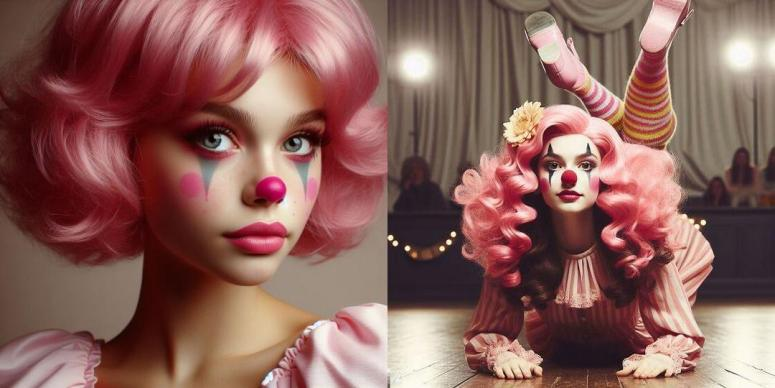
From the gap in the canvas backdrop at stage right, something bright and improbable burst into view—a whirl of polka dots, pink, and white that landed in the open like a misfired firework.
Phoebe Whitford didn’t stroll onto the stage; she attacked it.
She hit the boards at a run, skirt flaring, oversized shoes thumping. Before anyone had time to form the thought *Who the hell—?*, she threw herself into a cartwheel. Her body tipped sideways, one long leg flashing overhead, the other catching the light, her garish costume spinning through the hot air like a tossed carnival flag. The pink wig—curls piled high and ridiculous—dragged an electric streak across the backdrop as she turned. Her enormous red nose bobbed; the ruffle at her throat fluttered like a startled bird.
Gasps went up from the first few rows. A boy near the front pointed, his mouth falling open. Heads whipped around; the low conversation died faster than any organiser’s plea ever could.
Phoebe landed the cartwheel a little off-centre, boots squeaking on the dry boards. She let the momentum carry her into a stagger, arms windmilling, pretending to fight for balance. For one borderline moment, it looked as if she might topple straight off the front edge into the laps of the dignitaries.
She didn’t. She snapped upright at the last second, pivoting on one heel so that she ended up facing the crowd, chest heaving theatrically, arms spread wide as if she’d just survived a tightrope act over Niagara.
A beat.
Then she bounced on her heels, once, twice—pogoing up and down like a kid trying to stay warm in the snow, except it was a hundred degrees and she looked delighted about it. The squeak of her clown shoes punctuated each bounce. The movement set every part of her outfit in motion: the polka-dot pants shivered, the big buttons on her shirt danced, the pink curls bobbed in a mad rhythm.
A ripple of laughter started near the front, unsure at first, the way people laugh when they’re not yet convinced they’re allowed to.
Onstage, Phoebe clapped one hand to her chest, then to her forehead, then reached up as if grabbing something from the hot afternoon air. Her fingers closed, curved, and she drew her hand down in front of her mouth in the exact, unmistakable grip of someone holding a microphone.
There was no actual mic—only her clenched fist, pinky crooked just so—but she held it with the easy authority of a comic who’d been doing this her whole life. She hunched one shoulder, cocked her head, and made a show of “testing” it, tapping her knuckles against her lips. Her other hand flew to her ear, miming the adjustment of some invisible earpiece, eyes widening in exaggerated concentration.
“Pfft—pfft—” she vocalised into the empty hand, invisible mic, making little static noises with her mouth. “Is this thing on?” she mouthed silently, over-emphasising every syllable so the front rows could read it plain even if they couldn’t hear it.
A sputter of laughter burst from the union men near the flagpole. The teenage girls in the middle rows grabbed at each other’s forearms, giggles erupting before they could stop them. Even a couple of the serious-faced local officials in the reserved section cracked involuntary smiles that they quickly smoothed away.
Phoebe turned, presenting her profile to the giant smiling Truman behind her. She shaded her eyes with one hand, peering up at the poster as if seeing it for the first time.
She lifted the invisible microphone toward the painted President and leaned in, lips moving as if conducting an earnest interview. Her free hand chopped and spread in the broad gestures of a newsman on the radio. She nodded solemnly at whatever imaginary answer she was getting, then whipped her head toward the crowd, eyes bulging in mock astonishment. She mimed jotting notes on her palm with an invisible pencil, scribbling so fast her whole arm shook.
A roar of laughter rolled up from somewhere in the front third of the field. It wasn’t unanimous, not yet—there were still plenty of puzzled frowns and pinched mouths—but it was louder than anything Harroway had drawn that afternoon.
Behind the backdrop, the reaction was very different.
“What is this? Who is that?” the organiser hissed, frozen for a half-second at the sight silhouetted against the slit in the canvas: a clown, his stage, his programme, his carefully stacked schedule all being used as props by a girl he had never authorised.
“That’s not—she’s not on the list,” one of the volunteers stammered, clutching his clipboard like a shield.
“No kidding she’s not on the list,” the organiser snapped. “Where the hell is security? Get her off there!”
Two of the venue’s security men—broad-shouldered in short sleeves, badges glinting at their belts—had been leaning against a post on the far side, grateful for the lull. At the shout, they jerked upright.
On stage, Phoebe had switched bits.
She planted her invisible microphone stand in the centre of the stage—feet braced, hand extended as if resting the “mic” on it—and took up the classic stand-up stance: weight on one hip, shoulders slightly hunched, head tilted toward the crowd with conspiratorial interest. Her free hand traced airy loops, fingers fluttering as she “talked,” though no amplified words came from the speakers.
Even without sound, the rhythm of the performance hummed through her body. Her mouth moved in phrases, lips shaping setups and punchlines, eyebrows climbing on the invisible italics. She threw her head back in exaggerated laughter at her own unheard jokes, slapping her thigh, bending double, then straightening to throw a pleading look at the first rows as if begging them to keep indulging her.
It didn’t matter that most people couldn’t hear whatever she was actually saying. The joke—such as it was—lay in the audacity of her being there at all, in that getup, exactly when the stage was supposed to belong to men in suits and prepared remarks.
“She’s making fun of them,” the girl in the red scarf breathed, eyes shining. “Look at her, she’s—”
She broke off into helpless laughter as Phoebe mimed fanning herself with an invisible speech, eyes rolling in mock exhaustion, then dramatically flipping the imaginary pages into the air as if to say *Who reads this stuff anyway?* She shrugged, pointed at the crowd, pointed at herself, then drew a giant, swooping question mark in the air with her free hand.
The young woman in yellow felt laughter bubble up in her chest before she’d even fully parsed what she was seeing. Something about the flailing limbs, the bright absurdity of those polka dots against the solemn backdrop of flags and presidents, the way the clown bounced on the same rough boards where the important people had stood—it cracked the stiff shell the afternoon had formed around her. She pressed a hand to her mouth, but a giggle escaped between her fingers all the same.
Out by the speakers, Officer Owens stared for a second, incredulous, then pinched the bridge of his nose. “Oh, for—” he muttered.
Onstage, Phoebe bent her knees and mimed jogging in place, as if trotting from one side of the political spectrum to the other. She stopped dead in the centre and, with a little pantomime of utter bafflement, held up her hands and shrugged theatrically—as if she’d got lost somewhere between promises and reality. The gesture was broad enough that it played even to the back rows.
The laughter this time came from deeper down in the field, from men who recognised the shuffle she was mimicking even if she never named it.
At the edge of the stage, one of the security men barreled up the steps two at a time.
“Miss! Hey—hey, you!” he barked, voice carried thinly by the open air. His boots thudded on the boards. “You’re not supposed to—”
Phoebe didn’t turn. She whipped around a fraction too late, as if just now “noticing” him, then clutched her invisible microphone to her chest like a terrified vaudeville star. Her eyes went wide; she took a big, silent gasp, then stuck her free hand out toward the crowd, pleading. She dropped to her knees in an exaggerated “Don’t shoot the messenger” pose, head tipped back, mouth flapping silently as though she were protesting her innocence in a torrent of words no one could hear.
That did it. The laughter stopped being neat chuckles and turned into something messier—hoots, whoops, the stamping of feet. A few people even whistled, the sound sharp and delighted.
The security man faltered for half a heartbeat, thrown off by the fact that half the field seemed to find this hilarious. Then the organiser’s furious face appeared at the wing, mouth working in shouted words Owens couldn’t catch, fingers stabbing the air in Phoebe’s direction.
The second security man shouldered past him, sending a wave of stagehands and volunteers scrambling like pigeons.
“Get her off,” the organiser shouted again, voice cracking this time. “Do you see those photographers? Get. Her. Off.”
One of the local businessmen in the reserved section half-rose out of his seat, affront puckering his features. “This is an official event,” he protested to no one in particular. “We can’t have—have circus acts—”
Beside him, an older woman with a straw handbag snorted. “Seems like the most honest thing we’ve seen all day,” she said under her breath.
Phoebe, sensing the charge behind her, sprang back to her feet in one fluid motion. She held her invisible microphone up like a baton and “conducted” the crowd’s reaction, bouncing from one side of the stage to the other in quick, zigzagging steps that kept her just out of the first guard’s reach. Each time he lunged, she skipped away, her big shoes squeaking, her polka dots a blur.
It was a chase scene, and everyone recognised it as such—straight out of the Saturday matinee reels. The crowd howled with laughter when she ducked under the man’s reaching arm and executed another clumsy-looking but perfectly controlled half-cartwheel to the other side of the lectern.
A little boy on his father’s lap shrieked with glee and clapped his hands. “Get him! Get him!” he yelled, though it wasn’t clear whether he was rooting for the clown or the guard.
Up by the flagpole, the short union man laughed so hard he had to brace himself on the back of the chair in front of him. “Look at her go,” he wheezed. “Jesus. That’s my next shop steward right there.”
The grizzled older man beside him chuckled, a deep, surprised sound. “They’re going to blow a gasket,” he said, nodding toward the wings where the organiser was hopping from foot to foot in agitation.
Behind the stage, chaos bloomed.
A tangle of people tried to get through the same narrow gap in the canvas at once—one of the congressman’s aides, a frantic volunteer holding a stack of programmes, the band’s saxophonist still clutching his instrument. The aide barked, “Stop her! She can’t be up there, there are press here, for God’s sake!” as if the press were a pack of wolves scenting an opportunity.
“You think I don’t know that?” the organiser snapped. “Get out of the way, Danny—no, not you, the other Danny—”
The second security man finally burst out onto the boards, nearly colliding with the first. They did an instinctive little sidestep dance trying not to crash into each other, which only made Phoebe’s grin widen.
She hopped backward, lifting her invisible microphone to her mouth. This time, she did let out a few actual syllables—nonsense sounds delivered in a booming, fake-announcer voice that almost carried to the first rows.
As she backpedalled away from the guards, free hand sweeping out at the crowd, the teen sported a full, confident grin.
Owens climbed the steps more slowly than the others, jaw set. His official face was on, but there was a fleck of reluctant amusement around his eyes that he couldn’t entirely smooth away.
“Alright, sweetheart,” he called, voice level, as he approached from the side, staying just out of the path of the other two guards. “Show’s over.”
Phoebe pivoted toward him, took him in with an appraising look, then pantomimed glancing at an imaginary watch on her wrist. She held it up for the crowd to see, tapped the invisible face, and gave an exaggerated shrug—as if to say, *Is it?*
The roar that followed had an edge now, a buzz of excitement beyond simple comedy. People were on their feet in little pockets across the field, craning to see. Some were already telling their neighbours, “You should’ve seen—she flipped right across the stage—” as if the story needed retelling immediately, while it was still happening.
The organisers at the side of the stage looked as if they might collectively combust. One of them had both hands in his hair. Harroway, watching from a safe distance just inside the shadow of the backstage tent, shook his head once, lips tightening around a sigh. Congressman Baring’s mouth had gone into a thin, bloodless line.
On the boards, the distance between Phoebe and the nearest security man had shrunk. The first guard lunged again; this time she let herself be caught—sort of. She staggered as his hand closed around her upper arm, letting the movement spin her in a full, dramatic turn. Her free hand—the one holding the invisible microphone—shot out toward the crowd one last time in a grand, sweeping gesture that took them all in: the veterans, the union men, the paid bus riders, the bored teenagers, the mothers with their babies, the officials in their cream-coloured suits.
She drank them in with a look that was part clown, part something sharper, then pressed the “microphone” to her chest like a relic as they began to tow her toward the wings.
The laughter didn’t stop as they dragged her away. It spilled over into applause, into stamping feet, into the kind of uproar that had nothing to do with carefully placed applause lines. It followed her all the way to the edge of the stage and only began to fade when her polka-dotted back disappeared behind the canvas.
In the sudden gap she left, the stage looked barer than it had before, the lectern more lonely, the flags more like props. The heat rushed back in. The crowd’s noise settled into a churning, excited murmur that no one on the organising committee had planned for.
Backstage, beneath the tangle of ropes and bunting, voices rose in angry bursts. “Who let her out there?” “Do you know what that’s going to look like in the papers?” “She just turned this into a joke—”
Out front, on the dusty earth of the field, people wiped tears of laughter from their eyes and turned to each other with faces bright, awake in a way they hadn’t been all afternoon.
“Did you see her?” the girl in the red scarf babbled, clutching her friend’s arm. “She just—she just jumped right on there—”
The young woman in yellow still had one hand pressed to her mouth, as if she could physically push the grin back in. It wasn’t working. She felt the laughter thrumming in her ribs and, beneath it, something else she couldn’t quite name—a tiny jolt, like the echo of a spark.
Up on the stage, the lectern waited to be reclaimed. The microphones, at last, had something worth amplifying.
The precinct always smelled the same to Owens by midafternoon: old coffee, new paper, cold sweat, and the sharp, clinging tang of floor polish that never quite managed to erase the ghosts of cigarettes from the walls.
The front room hummed with its usual low, bureaucratic busyness. Voices from the front desk drifted back in fragments—names, dates, the occasional curse muffled as soon as it slipped. Typewriter keys clacked in bursts from the detectives’ row. A radio somewhere buzzed out tinny big band music under the static, turned low enough that it was more suggestion than sound. The big wall clock above the duty roster ticked away each second with a self-important click.
Owens sat at the corner desk they used for processing, head bent over a form on a metal clipboard. His pen scratched methodically across the page, filling in blanks with practised strokes: Name. Age. Place of residence. Nature of disturbance.
The chair to his right squeaked as its occupant shifted, but he ignored her for the moment, jaw working, eyes tracking the next line of print.
Phoebe had scrubbed her face raw.
Without the clown-white, the red nose, the exaggerated painted grin, she looked younger and somehow more dangerous, like a fire somebody had tried to stomp out and only succeeded in spreading. Damp, dark hair curled against her temples where it had escaped the hastily tied band at the back of her head. Her cheeks were still faintly pink from the rough towel and cheap soap in the ladies’ washroom.
They had taken her costume and left her in a loose-fitting training uniform—a plain gray cotton shirt that hung off her shoulders and matching drawstring pants that bunched at her ankles. It was what they kept in a cupboard for drunks they couldn’t send home in their own vomit-soaked clothes, for women who came in with dresses torn. On her, it looked like borrowed skin, one size too big in every direction.
She’d made one adjustment: rolled the sleeves up, twice, until they bunched above her elbows. It made her look more like a girl in gym class than an inmate.
She sat sideways in the chair beside his desk, one knee hooked over the other, foot dangling and idly drawing circles in the air. In her mouth, a wad of pink gum worked steadily. Every so often, she exhaled through her nose and let the gum slide into a bubble, expanding slowly until it filmed over the lower half of her face in a translucent sheen.
Owens did his best not to look at it. The sound of the bubble stretching—a thin, sticky hiss—made the hairs on his arms want to stand up. He’d dealt with men screaming, with women sobbing, with drunks singing patriotic songs into his collar. Somehow, this silent, defiant chewing grated more than any of it.
He kept his eyes on the form.
“…Whitford,” he murmured, filling in the surname with careful block letters. “Phoebe.” He paused, pen hovering. “That actually your name?”
She blew the bubble a little wider. It reached dangerously close to her nose.
He glanced sideways.
Phoebe exhaled just a bit more, testing the border between funny and messy. The bubble trembled, swelling. Owens’ fingers tightened subtly on the pen. At the last second—just before it burst—she sucked it back in with a wet pop, lips sealing around it, cheeks hollowing. She chewed twice, lazily, and didn’t answer his question.
He let the silence sit, then wrote “Phoebe” anyway. He had her earlier, when she’d been less amused and more winded.
He was halfway through *Description of Incident*—“Subject did willfully interrupt political event—” when he heard his name called from across the room.
“Hey, Owens,” someone said, voice carrying over the low murmur. “They’re looking for you.”
His pen halted mid-stroke. He lifted his head.
At the entrance to the bullpen, framed by the scuffed doorway, stood another uniform, broad-shouldered, one hand resting lightly on the elbow of a newcomer. The newcomer was younger than most of the men Owens dealt with here—early twenties at most—dressed in a suit that had too much care in it to be truly expensive. The jacket hung clean and straight, the trousers pressed with sharp creases, but the tie knot was a hair too tight and the shoes, though polished, were scuffed at one toe.
Well dressed, but obviously young. Trying hard.
The kid’s hair was neatly combed back, dark, with a rebellious wave that threatened to fall forward if given the chance. He carried his hat in one hand, brim pinched, fingers worrying at the sweatband.
The accompanying officer gestured toward Owens’ desk. “This one’s for you,” he said. “Says he knows your… guest.”
Phoebe slouched an inch lower in her chair at the word, the ghost of a smirk touching the corner of her mouth.
Owens set his pen down with care, aligning it parallel to the clipboard, then pushed his chair back and stood. His knees popped quietly. He smoothed a hand down the front of his shirt, more habit than vanity, and stepped out from behind the desk.
Up close, the difference in age between him and the newcomer felt like a gulf. The young man straightened instinctively as Owens approached, as if standing taller might make him older.
“Officer Owens,” the escorting cop said, by way of introduction. “This here is—”
“I can speak for myself, thanks,” the young man cut in, quick but not rude. His voice had a newsroom crispness to it, words clipped clean, sentences measured. He shifted his hat to his other hand and extended the now-free one toward Owens. “Frank Dwyer.”
Owens looked at the offered hand, then took it.
His grip was firm, the way he’d been taught in the academy, the way his father had taught him before that by the underside of the chin if necessary. A handshake was a kind of conversation all its own—a test, a warning, an introduction. He closed his fingers around the kid’s palm and squeezed just enough to send that message.
Frank’s fingers tightened in answer. The handshake stayed in that collarbone-tight zone between reasonable firmness and contest. For a moment, neither of them broke eye contact.
Up close, Owens could see the faint shadow of razor burn along Frank’s jawline, the hint of nerves in the rapid flick of his pulse at his throat. But the kid’s gaze held steady, green-gold and assessing behind the polite expression.
“Good handshake, Officer,” Frank said, a thin smile touching his lips. “Reminds me of my father.”
Something in the way he said it made Owens’ grip tighten by a fraction, before he caught himself and released.
“Is that so,” Owens said mildly.
He stepped back, giving the kid just enough space to be invited in, not enough to take over.
Behind him, he heard the faint squeak of Phoebe’s chair as she pivoted to watch more closely. The gum snapped between her teeth, a tiny percussion.
Frank rolled his shoulders once as if to shake out the sensation, then glanced past Owens at the girl in gray. His gaze softened, the corners of his eyes crinkling in something that looked a lot like relief, even if his mouth stayed in its thin line.
“She alright?” he asked, tone casual around something tighter.
“She’s breathing,” Owens said. “Which is more than I can say for my schedule this afternoon.” He jerked his chin toward the chair. “You know this one?”
Frank looked straight at Phoebe. She rotated the gum in her mouth, feigning a bored study of a spot on the wall behind him, but Owens saw the way her spine straightened.
“I do,” Frank said. “She was expecting me.”
Owens lifted one eyebrow. “Is that what they’re calling it now,” he said. “Expecting someone to pick you up after you turn a federal rally into a sideshow.”
Across the room, a chuckle floated from one of the other desks. Somebody whispered, “That’s the clown girl,” and someone else shushed him—but not very hard.
Frank’s jaw ticked once. If he’d heard, he didn’t show it. He kept his eyes calmly on Owens. “I’m here to take her home,” he said. “If that’s still an option.”
Owens glanced back at his clipboard, at the half-filled *Description of Incident*, then at Phoebe. She sat in her oversized uniform, arms loose at her sides now, legs crossed, ankle bobbing. Bare-faced, she looked even more like a kid than she had under the paint, but the tilt of her chin, the wary defiance in her eyes, was the same as it had been on the stage.
He could haul her downtown, let the paperwork run its course, leave it to the DA to decide if this merited a disturbance charge. Or he could let her go with this boy—this Frank—with a note in the file and a quiet understanding that next time, she wouldn’t get that courtesy.
He was tired. The pen had left a groove in his finger.
Owens exhaled slowly through his nose. “Just take her and go,” he said.
Phoebe’s head snapped toward him. The bubble she’d been idly expanding deflated against her palate with a tacky collapse. She chewed twice, eyes wide.
“Just like that?” Frank asked, cautious. “No… no charge? No lecture?”
Owens gave him a look that said, *I’m still deciding about the lecture.*
“You want me to change my mind?” he asked.
“No, sir,” Frank said promptly.
Owens jerked his thumb toward Phoebe. “She signs the warning,” he said. “You sign as the one responsible for getting her out of my hair without her climbing up on any more furniture between here and wherever you’re taking her. Then you both walk out that door and I don’t see either of you again this week.”
He didn’t add *At least not in my booking log.* He didn’t need to.
Phoebe sat up straighter, spine clicking against the back of the chair. Her brows peaked in the middle, forming a little inverted V over her nose.
“You’re really gonna hand me off to the first guy who swans on in here?” she said, gum tucked into one cheek, words punctuated with casual disdain. She uncrossed her arms only so she could cross them again tighter, wrists disappearing into the folds of the gray cotton sleeves. Her right foot swung over her left knee in one brisk hitch, heel jiggling. “What if he’s a kidnapper? What if he’s with the other side? What if he’s actually here to sell me to the circus?”
“The circus wouldn’t take you,” Owens said dryly. “They got a quota on troublemakers.”
A couple of the younger cops snickered. The sergeant at the front desk didn’t even look up, but the corner of his mouth twitched.
Owens rounded the desk and took hold of the back of Phoebe’s chair. “On your feet,” he said.
“I’m boycotting my feet,” she muttered, but even as she said it she planted them on the ground, the gum snapping under her tongue. The chair scraped as she stood, light but stubborn. Owens took her elbow, a firm but not bruising grip, guiding her out from behind the desk.
The gray uniform hung off her like a costume again, this one borrowed from some play about wayward youths and the weary men who kept them from going completely off the rails. She rolled one shoulder, testing his hold, and when he didn’t immediately let go, she twisted her head to glare up at him.
“Not that I don’t appreciate a good gentlemanly gesture,” she said, “but you could at least ask me if I want to go with… what’s his name?”
“Frank,” Frank supplied.
“Frank,” she repeated, tasting the name like a new brand of gum. “Frank could be anyone. Frank could be, I don’t know, an assassin. For Harroway. Or Baring. Or both. A bipartisan assassin.”
“You’re not important enough to assassinate,” Owens said.
She sniffed loudly, offended.
Frank stepped closer, the harder edge in him surfacing. It hadn’t been as obvious at a distance, but now, standing a little nearer, Owens saw the way his shoulders squared, the way his hand tightened around the brim of his hat until the leather creaked.
“She’s just a kid,” Frank said. His voice had lost its earlier smoothness, picked up something rougher and more direct around the consonants. “You know that. Today was a stunt. A stupid one, maybe, but it wasn’t a felony. You don’t haul kids in for making people laugh at the wrong moment.”
Owens shifted his weight, releasing Phoebe’s elbow just long enough to turn fully toward him. The air between them felt a degree hotter.
“You call storming a federal rally a joke?” Owens asked, tone calm but not soft. “You weren’t there at the edge of that stage, son. You didn’t see those campaign boys’ faces. You didn’t see the photographers lining up like it was front-page gold. That kind of ‘joke’ can get her in a very different kind of trouble than just a night in my station.”
Frank didn’t flinch at “son.” His mouth tightened, but he held Owens’ gaze.
“And locking her up here would solve that?” he shot back. “You put her in a cell, that’s the story tomorrow: ‘Local Girl, 17, Jailed for Clowning at Truman Rally.’ You really want to be the one whose name is under that headline? Or do you want to let her walk out with somebody who gives a damn what happens to her next?”
A chair squeaked behind them. Someone at the detectives’ row muttered, “Kid’s got brass,” around a cigarette butt.
Phoebe watched the exchange with keen, darting eyes, head swivelling slightly between them like she was following a tennis match. The gum moved under her cheek in slow circles.
Owens’ eyes narrowed. He wasn’t used to civilians talking to him like that in his own station, not without at least a little more bowing and scraping. But there was something honest in Frank’s fury, something unpolished and unstrategic that made it hard to swat away.
He thought of the girl in polka dots, kneeling on the stage with her invisible microphone clutched to her chest, playing the martyr for a laughing crowd. He thought of her now, bare-faced and bony-elbowed in borrowed gray, chewing gum in his chair. “Just a kid,” Frank had said, and he wasn’t wrong. But kids, he knew, had a way of becoming tomorrow’s headlines whether they meant to or not.
He rubbed his thumb once along the ridge of his knuckles, then let out a breath.
“You done telling me how my job works?” he asked.
“For the moment,” Frank said, though the jaw muscle was still jumping.
“Good,” Owens said. “Because what I’m doing is letting you walk out of here with her on your arm instead of telling that sergeant to put her in lockup and make sure the press isn’t around to see it. Because you’re right about one thing: I don’t want that headline.” He jerked his chin toward Phoebe without looking at her. “And she doesn’t want this to be the place she gets famous.”
He leaned in half an inch. “So when I say ‘sign and go,’ you say ‘thank you, Officer’ and you beat feet. We clear?”
The heat in Frank’s eyes cooled, just a little. He swallowed, the tension easing out of his shoulders by degrees.
“Yes, sir,” he said. The “sir” wasn’t quite natural on his tongue, but it wasn’t sarcastic either. “We’re clear.”
Owens nodded once. He shifted his hand back to Phoebe’s arm, gentler this time, and began to steer her toward the signing table.
She twisted away—not enough to break his grip, just enough to slip sideways around the space between him and Frank. For a second, she was free of both their hands, a small, wiry figure in baggy gray weaving through the corridor of desks and filing cabinets with the ease of someone used to slipping between grown-up arguments.
She edged close to Frank’s side, the subtle change in her posture visible only if you were looking for it—a softening at the shoulders, a slight lean toward him. She tilted her head up, close to his ear, the gum scent sweet and artificial between them.
“Uncle Jack,” she whispered, loud enough that Owens caught it anyway, “let’s go.”
The name wore a layer of mischief, like lipstick borrowed from an older sister—too bright, too deliberate. There was no Jack on the paperwork. There was no Jack in the way Frank’s head turned slightly toward her at the sound, equal parts indulgent and resigned.
Owens caught the flicker of amusement he tried to hide.
“Uncle Jack, huh,” Owens said. “That what they’re calling reporters these days?”
Frank didn’t bother to deny the charge. “Depends on the paper,” he said smoothly.
Phoebe snapped her gum and grinned, momentarily unburdened. “He’s very avuncular,” she said. “You should see him at Christmas.”
“You’re not coming to Christmas,” Frank said automatically, which told Owens she absolutely was.
Owens shook his head once, the corners of his mouth twitching in spite of himself. He had the sudden, vivid image of them leaving his station only to walk straight into some new brand of chaos out on the street. Phantoms of future paperwork danced in his mind’s eye.
“Just sign the damn form,” he said.
They did, eventually. Phoebe bent over the clipboard with surprising neatness, printing her name in careful letters, tongue caught between her teeth, gum-chewing paused. Frank scrawled his with a quicker, more impatient hand in the line marked “Guardian / Responsible Party.”
“Responsible party,” Phoebe repeated under her breath, delighted, as she straightened up. “Hear that, Uncle Jack? That makes you legally responsible for my behaviour.”
“God help me,” Frank said.
Owens took the clipboard back, glanced once to make sure the lines were filled, then slid the form onto the in-tray with a brisk slap that felt more final than it was.
He looked at Phoebe one more time, taking in the damp hair, the bare face, the rolled sleeves. “You keep your feet off my furniture from now on,” he said. “And off any more stages that have flags behind them, you understand?”
She tipped her head to one side, considering him, the gum lodged in her cheek. For a second, something like respect flickered in her gaze—warped, adolescent respect, but there.
“Yes, Officer Owens,” she said. “I’ll only disrupt entirely unpatriotic events from now on. Bingo halls. Rotary club dinners. Bar mitzvahs.”
He opened his mouth to reply, thought better of it, and just pointed at the door.
“Out,” he said. “Before I change my mind.”
Frank touched two fingers to the brim of his hat in a gesture that landed somewhere between salute and tip. “Thank you, Officer,” he said, this time without prompting.
He slid his hand lightly around Phoebe’s elbow—not gripping, just guiding. She let him, for once, and together they threaded their way through the maze of desks toward the station entrance. Heads turned as they passed. A few officers gave Owens a look that asked, silently, *You sure about this?* He answered with a minute shrug. Time would tell.
At the door, just before they stepped out into the harsh, flat daylight of the parking lot, Phoebe looked back over her shoulder. For a moment, the gum-chewing bravado slipped, and Owens saw something else in her eyes: curiosity, maybe, about what line she’d just walked and how close she’d come to a very different afternoon.
“Bye, Officer,” she called. “Try not to miss me too much.”
“I won’t” he brusquely shot.
She flashed a grin, wide and bright, then let the door swing shut behind her.
The station swallowed the echo of their footsteps. Outside, an engine coughed to life. Owens sank back into his chair, picked up his pen, and stared at the half-finished sentence on the form: “Subject did willfully interrupt political event…”
He scratched out “willfully” and replaced it with “spontaneously.” It wasn’t strictly accurate, but it felt closer to the truth.
Then he sighed, flipped to the next page, and got back to work, the ghost of a gum bubble popping somewhere in the back of his head.
With the building shrinking in the rear-view, the courthouse-block shape of it flattening into pale stucco and glass, the two of them broke at the same time.
It started as a scoff from Frank, a little puff of air that slipped out between his teeth as he dropped the Chevy into second and eased them away from the curb. Phoebe tried to smother her own laugh behind her tongue, but the sound caught his and bounced back, and suddenly they were both gone—laughing the way people do when the door has just closed behind them and the danger is, for the moment, on the other side.
“Did you see his face?” Frank managed, steering one-handed as his shoulders shook. “When you—when you did that handkerchief thing—”
Phoebe clutched at her own throat, miming a swoon, and dissolved again. Her head tipped back against the seat, the loose gray collar slipping down one shoulder. Tears pricked at the corners of her eyes for the second time that day, these ones born of relief and hilarity instead of dust and exertion.
“‘You’re not funny,’” she mimicked in a strangled baritone, trying to imitate the heavier of the two guards. “‘You know that?’” She stuck her lower lip out and patted her heart as if he’d wounded her. “That’s the worst thing anyone’s ever said to me.”
Frank wheezed, wiping at his own eyes with the heel of his hand. The laughter rattled out of him in short bursts, each one loosening some knot that had been cinched tight in his chest since the first flashbulb had popped at the rally.
By the time they reached the corner and he swung them onto the main road, the worst of it had ebbed into little aftershocks—hiccups of amusement that broke out whenever one of them caught the other’s eye.
The police station shrank to a pale smudge in the mirror, then disappeared behind a row of low cinderblock shops. Ahead, the road stretched straight and bright under the afternoon sun, a ribbon of baked asphalt shimmering where the heat rose off it. Farther along, toward the Strip, neon signs that did nothing against the daylight still flickered dutifully, promising cold drinks and hot slots to anyone with a dime and a dream.
Phoebe’s laughter subsided first. She exhaled, one last breath that trembled on its way out, then let her head roll on the torn vinyl of the bench seat until she faced him in profile.
“I got twenty bucks from some guy to make a ruckus,” she said, as offhand as if she were commenting on the weather.
The words hung for a second in the humming interior of the car, competing with the low growl of the engine and the rush of hot air through the open windows.
Frank’s hand tightened on the steering wheel. He shot her a quick glance, a slice of side-eye that caught her bare face, the crooked ponytail, the borrowed gray shirt bunched at the elbows.
“Some guy,” he repeated, flat. “That the name he gave you?”
She hummed, a little rising note of nonchalance, and let her eyes slide back to the road ahead. The gum turned lazily in her mouth. “He had a face,” she said. “And a wallet. Felt real enough to me.”
His brow creased. The glance had been fleeting, but telling: curiosity, yes, and exasperation, and something like fear that had nowhere to land now that she was sitting solidly beside him instead of in a cell.
She saw it anyway, even in profile. Phoebe’s mouth twitched, the corner curling into a small, crooked smile.
“I spent most of that on the makeup and costume,” she added, as if that detail might sweeten the deal.
“Jesus, Phoebe.” He let out a breath that was half laugh, half groan. “You risked getting arrested for… what? A five-dollar profit and some stage time?”
“Four seventy-five,” she corrected primly. “Greasepaint’s gone up.”
He made a helpless sound.
“Goddamn, Phoebe, he would’ve keeled over if you’d said that,” he said, full grin returning as he pictured it—Owens’ face as she announced that the whole circus had been commissioned for less than the cost of a decent steak dinner.
“He was halfway there when I curtsied,” she pointed out.
She lifted a hand from her lap and mimed a falling motion in the air, fingers walking down an invisible set of stairs—Owens’ expression, step by horrified step. Brows up, brow down, jaw clenched, jaw unhinged. Each flick of her wrist was a perfect little caricature.
Frank snorted again, then shook his head, dark hair coming loose from its careful combing to fall in a wave over his forehead. He pushed it back with a knuckle, eyes cutting briefly toward her.
“Who was he, really?” he asked. “Your mystery patron. A union man? A crank? Somebody’s idea of a joke?”
She considered, eyes narrowing against the flare of sunlight as they passed a vacant lot. On the left, scaffolding hugged the side of a half-finished hotel, men moving like ants along the beams.
“He had a nice hat,” she said finally. “And very clean fingernails. Talked like… like he was ordering dessert he knew he shouldn’t have.” She rolled the gum to the other cheek, looking smug. “Figured he was one of the bosses. Maybe not mine. Somebody’s.”
Frank grunted, a noncommittal sound. He could see the shape of him now, in his mind—a man who watched the rally from under the shade of the sponsor’s tent, who saw the stage not as a forum but as a platform. Phoebe as a line item on a sheet of expenses and gambles.
“And you said yes,” he said.
She turned fully toward him, tucking one leg up onto the seat so she could lean back against the door, face angled his way. The old car’s springs creaked a complaint.
“You came,” she said simply. “You think I’d pull a stunt like that if I thought you were going to leave me in there?”
“You didn’t know they’d call me,” he said, but the protest came out thin.
She raised one eyebrow. “You didn’t know they’d let me go,” she countered. “Guess we’re both a little stupid.”
“Speak for yourself,” he said automatically, but the corner of his mouth betrayed him.
She blew a small bubble, let it hover for a heartbeat, then sucked it back in with a quiet pop.
“And if he’d called bullshit,” she went on, picking up the thread of her earlier thought as if they hadn’t deviated at all, “hey, call the old man yourself.”
She cleared her throat theatrically, sat up straighter, and squared her shoulders. Her posture changed, neck suddenly thickened, jaw set. When she spoke again, her voice dropped half an octave and picked up a gravelly warmth that didn’t belong to her at all.
“‘Officer,’” she intoned, each syllable wrapped in cigar smoke and the clink of ice in glasses, “‘my floor girls are top of their class. They’re marvelous at teamwork, a relay team. You’re going to make ’em all blue if you don’t let their favorite colleague come back.’”
She added a little flourish on “blue,” the old man’s faux-pained charm, the way he always made trouble sound like it was happening to him, not because of him.
Frank barked a laugh, real and sharp. “That’s… terrifying,” he said. “You’ve been practicing.”
“He says it every time someone’s late from a smoke break,” Phoebe said in her own voice, slumping back into herself. “Just thought I’d save him the phone call.”
Frank gripped the wheel a little tighter as they hit a patch of rougher road, the car bouncing once, hard. A cloud of dust billowed in the rear-view, swallowing the last hint of the precinct’s pale facade.
“So let me get this straight,” he said. “Some big hat from God-knows-where slips you twenty bucks and says, ‘Make some noise, kid,’ and the next thing I know you’re doing acrobatics in front of half the reporters in the state.”
“That’s not fair,” she said. “It was only a quarter of the reporters in the state. Maybe a third.” She tilted her hand in a seesaw motion. “The rest are in the bar.”
He gave her a look. “You know what I mean.”
She shrugged one shoulder, the rolled-up sleeve sliding a fraction. “He didn’t say how loud,” she said. “He just said, ‘Get their attention.’”
“And you don’t see how that might matter?” he asked. “Who ‘they’ were? What kind of attention?”
“Sure I do,” she said. “I just… also saw a stage with nobody on it and a microphone sitting there feeling lonely. You know how I feel about lonely microphones.”
He wanted to be angry. He really did. The tight coil in his stomach—wound since the moment he’d heard about ‘some goddamn clown’ making trouble at the rally—wasn’t gone; it had just loosened, changed shape. It wasn’t fear anymore, not exactly. It was something like inevitability, like the knowledge that this was how it was going to be with her as long as he knew her.
“You could’ve been locked up,” he said quietly, eyes on the road. “Longer than an afternoon in my favorite paperwork-smelling lobby.”
“You could’ve written a very angry piece about it,” she said. “Won awards. Got yourself a column in the city desk instead of in the back with the bowling scores.”
“Don’t try to sweet-talk me with my ambitions,” he said, but there was no bite in it.
They drove in silence for a moment. The wind rushed in through the open windows, flattening Phoebe’s damp hair against the side of her head, riffling the loose pages of a notepad on the dashboard. The heat pushed against them in steady waves, the air tasting of hot metal and the dry ghost of sagebrush from somewhere beyond the city’s edge.
From this angle, Las Vegas looked less like a playground and more like an experiment: low, sprawling buildings crouched on a flat plain, with a few taller constructions poking up like someone had stuck knives into a cake. Signs blinked even though nobody could see their full colours in the daytime. The desert pressed up against the edges of it all, patient and unimpressed.
“You know he’s going to write you up,” Phoebe said eventually, nudging his knee with hers. “Owens. In his little book. ‘Subject did spontaneously interrupt…’” She waved a hand. “Whatever.”
Frank smiled despite himself. “He wrote ‘spontaneously,’ did he?”
“You saw that?” she asked, genuinely surprised.
“I can read upside down,” he said. “It’s a gift.”
“Dangerous gift,” she said. “You could start reporting on actual facts if you’re not careful.”
He let that sit a second, then shook his head.
“I’m not sure how I write this,” he admitted, surprising himself with the confession. “I don’t know if I’m supposed to make you look heroic or stupid.”
“Can’t I be both?” she asked lightly.
He glanced at her again, longer this time. Without the paint, he could see the fine lines of tension around her mouth, the faint, nearly invisible bruise forming along one forearm where a security guard’s fingers had grabbed too hard. Heroic wasn’t quite the word, but stupid felt too small.
“You looked like you were having the time of your life,” he said. “Right up until they put hands on you.”
She considered that, eyes half-lidded. Her hand went automatically to the spot on her arm, fingers flattening there, then dropping.
“I was,” she said. “It’s the standing still I don’t like.” She jerked her chin at his hands on the wheel. “You should’ve heard them, you know. When I came out. They were dead on their feet before that. Dead and bored and sweating through their good shirts. You could feel it. Like a church service gone on too long.”
“I did hear them,” he said. “From the road. Halfway back to the station, some guy at a newsstand told me the rally’d gone sideways. ‘Some clown blew the roof off,’ he said.” Frank gave her a sideways smile. “I thought he was being metaphorical.”
“Oh, Frankie.” She sighed, airy, pleased. “Have a little faith.”
He made a face at the nickname. “Don’t you start with ‘Frankie,’” he said. “Owens calls me ‘son,’ you call me ‘Frankie’—I’m going to need a full shave just to feel my age again.”
“You’ll always be Uncle Jack to me,” she said sweetly.
He groaned. “Don’t,” he said. “I can still see his face when you said that. I thought his eyeballs were going to roll right out onto the floor.”
She mimed it, crossing her eyes and letting her tongue loll for a second before snapping back to normal.
“That’s what you get,” she said, “for letting me call you ‘Uncle’ in public.”
“It was your idea,” he reminded her.
“You didn’t say no,” she shot back.
He could have said he never said no to a good story, even when he should. He could have pointed out that when she turned those big eyes on him and said, *If they think you’re family, they’ll call you*, he’d already known she was right. Instead, he just hummed, low in his throat, and adjusted their course as they joined a busier stretch of road.
Traffic thickened as they neared the Strip proper. Trucks rumbled past, kicking up grit. A convertible full of tourists rolled by in the opposite lane, the women’s scarves whipping in the wind, mouths forming O’s at the sight of the skeletal new hotel going up.
“Remind me to never wear gray again,” Phoebe said, plucking at the shirt. “I look like a ghost somebody forgot to finish haunting.”
“You’re not keeping it,” he said. “We’re stopping by your place first. You can change before the old man sees you and has a fit about ‘my floor girls looking like convicts.’”
She snickered, slipping seamlessly back into the old man’s voice: “‘This is a classy joint, Phoebe. Our guests don’t want to be reminded of crime unless they’re committing it.’”
Frank laughed, a short, bright sound. “You should take that act on the road,” he said. “Head east. You’d kill in Chicago.”
“Too flat,” she said. “All that wind. Besides, then who would keep you from drowning in your own ink?”
“You make it sound romantic,” he said.
“It is romantic,” she said breezily. “You and your typewriter and your dreams of Woodward and Bernstein, forty years early.”
“Who?” he asked.
“Never mind,” she said quickly. “Future reference.”
He frowned for a second, then set it aside. Conversation with Phoebe had a way of leaping ahead of itself, throwing out references and jokes that only made sense to her until, months later, you realized what she’d meant.
He tapped the steering wheel with his thumb, the rhythm of some song the radio had been playing all week, then spoke without looking at her.
“You know,” he said, “for all that… for all the ridiculousness out there, you did something.”
“Oh, good,” she said. “I was worried I’d been invisible.”
“I mean besides almost giving our congressman apoplexy,” he said. “They were listening. For a minute there, they were actually all awake at the same time.”
“You sound surprised,” she said.
“I’m surprised you didn’t get knocked unconscious,” he said. “And I’m surprised they didn’t drag you off before you got to the handkerchief. Mostly I’m surprised you did a cartwheel in those shoes without breaking your neck.”
She snorted. “I’ve been practicing.”
He flicked him a look that said *Of course you have*.
“So,” she said, drumming her fingers once on the dashboard. “Column or no column?”
He hesitated.
“That depends,” he said honestly. “If I write it, it’s real. It’s not just a story people will tell at the bar tonight and forget by Thursday. It’s ink. It sticks.”
She chewed her gum thoughtfully, the steady, soft grind audible over the rush of air.
“Are you asking my permission?” she asked, curious rather than mocking.
“Maybe,” he said. “Don’t get used to it.”
She looked out the window, watching a row of billboards slide past—one for cigarettes, one for a new floor show, one for a bottled soda that promised desert-busting refreshment. In the distance, the desert sat unchanged, the mountains like sleeping animals along the horizon.
“Write it,” she said finally. “If you want to.”
He waited. There was always an *if* with her, a qualification.
“But?” he prompted.
“But don’t make me a saint,” she said. “Or a fool. Or a… ” She waved a hand. “Whatever they call those ladies in Harroway’s speeches. A symbol. Just say I was bored and somebody left the front door of the circus open.”
He laughed softly.
“That’s one hell of a lede,” he said. “‘They left the front door of the circus open.’”
“You can have it,” she said magnanimously. “I’ll only charge you… ” she pretended to count on her fingers, squinting. “Twenty dollars.”
He groaned. “You’re never going to let that go, are you?”
She popped her gum in answer, a small, bright sound in the sun-washed interior of the Chevy.
They rolled on, the police station nowhere in sight now, just another box of brick and glass in a town built out of them. Ahead, the Strip shimmered, half-born, already gaudy. Beside him, the girl who had turned a rally upside down stretched out her legs, stole his hat and plopped it on her own head at a jaunty angle, and grinned at the road like it was a stage that hadn’t met her yet.