Work Text:
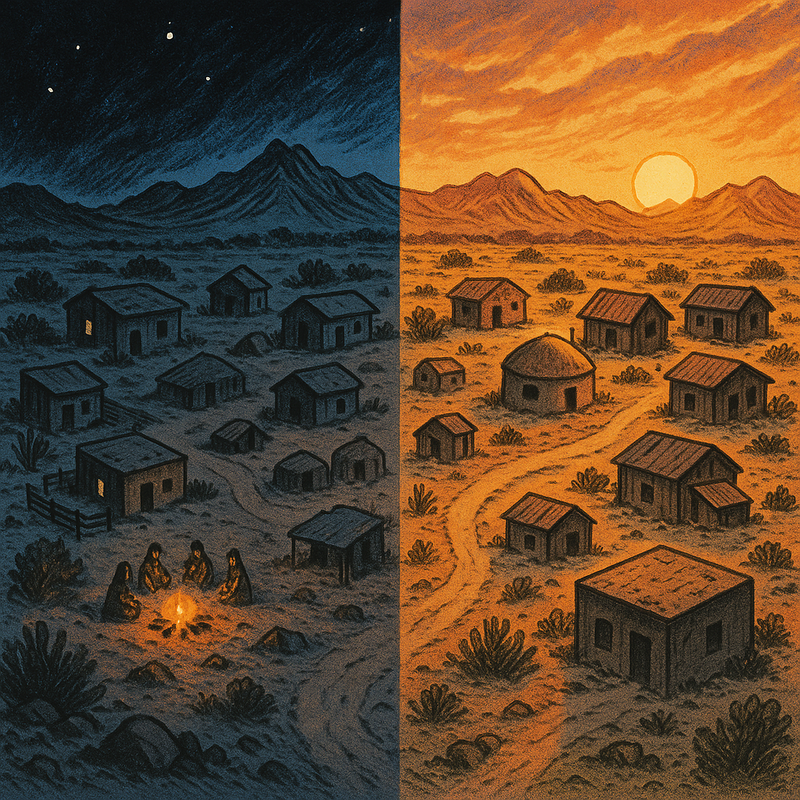
The night before began like a held breath. Wind slid over the low-slung mesquite and cottonwoods, shook dry seedpods, worried at old tin rooflines repurposed to become Tó Nádahłí. Lantern light pooled in doorways. From the communal kitchen came the smell of blue corn and sage, coffee simmered to tar, juniper smoke that clung to hair and fabric and the skin at the wrist. Children were gathered in the periphery, restless as moths. Elders sat—a ring of silhouettes—hands moving with the silent grammar of work: twisting yucca cord, smoothing a hem, pinching salt with two fingers as if measuring weather.
Scarlett slept little—more a weave of shallow dozing and surfacing. The braids that defined her were already plaited, polished with a thin slip of tallow and tied with leather. Her dress waited on a cedar rack just inside the lodge: a weeks-labored buckskin fringed from shoulder to hem, beads that glinted like stars if you turned your head and let the lamplight catch them edgewise. The dress held the scent of hands—her mother’s, her grandmother’s, aunties from the far corners of the commune—oil and smoke, resin and the faint sweetness of sumac berries that had stained a fringe by mistake and been left, because flaws were only one more story stitched into the whole.
Outside, a windbreak of canvas had gone up in the afternoon, guy lines drawn taut from scavenged nails hammered into timbers that once framed a general store. The old sign—Rutherford Mercantile—had been lifted and turned backward years ago so only the blank pine showed. On the newly plain face, a child had scrawled a circle with four lines radiating like compass points. The chalk had held through a winter and into this early summer, faded but stubborn.
She was twelve. The number had its own gravity—an orbit just crossed, a threshold of bone and mind. She had been waiting all her life without knowing she was waiting. The ceremony had waited for her too, like a gate that only revealed itself when she drew near enough to need it. In the weeks before, there had been the quiet preparations that looked like ordinary days from a distance: longer runs at dawn, weaving lessons that felt more like meditations than craft, hours spent with elders whose voices seemed to arrive through several kinds of time. Each hour had been its own kind of sanding, a smoothing down of splinters the world leaves in a girl as she grows, a polishing toward readiness.
Glenda arrived just as the last of the light gave way. She stepped with careful feet, a guest among family, palms open to show nothing was taken or presumed. She had been named Running Cub here when she was younger, for the way she moved in quick bursts then stilled, eyes wide and taking in everything. She kept to the edges at first, doing the small, necessary things a guest can do: carrying water in glass jugs beaded with condensation, refilling bowls of pinole, lifting extra blankets from a cedar chest whose lid creaked like a door to someplace holy. She felt her own chest lighten and tighten at once, the way it always did here, like the ribs were both opening for more breath and remembering how to hold a new note.
The night’s cold crept from the ground by the time the songs began. They did not announce themselves with spectacle. They rose from a throat and were answered; they were a way of naming the space, a way of remembering how to speak to the world in the old manner. Scarlett sat cross-legged at first beside the medicine bundle wrapped in deerskin, her hands quiet on her knees, chin lifted not from pride but to better hear. The bundle smelled of pollen and leather and something mineral, like distant rain striking dust. Her mother stood a pace behind her. On another side of the fire, Nahasdzáán—her grandmother, stone-back straight despite the decades—rested her hands lightly on the head of a drum whose skin held the faint imprint of many winters.
Glenda watched with the steady attention of someone who knew the line between reverence and hunger. She watched the rhythm of the elders’ shoulders, the way the heat laid itself along cheekbones, the way the circle breathed—tightening, loosening, like fingers making a knot. She understood nothing with the mind she used in school, and everything with the mind she carried in her chest. The ceremony did not need her to understand anyway. It only needed her to stay, to witness, to hold her place and not add a single scrap of needless movement. She sensed the currents of work beneath what her eyes could see, the invisible labor of names carried forward and harms remembered without spectacle.
Just before midnight, Scarlett stood and the dress was lifted from its rack. The weight of it settled over her shoulders with a hush that felt like snow, like ash, like falling light. The fringe ghosted against her calves. There was a moment in which the dress made a sound—softer than a breath, the sibilance of beads shifting in sympathy—and the hairs rose along Glenda’s forearms as if the room itself had exhaled. Hands moved to tie, to smooth, to check small seams. Powder ground fine as dust brightened a palm and brushed to her cheeks and wrists. Somewhere behind the ring of people, a night insect rasped at the edge of the fire’s light; a dog turned once and settled; a child, not much younger than the two had been when they first met, blinked and fell asleep against her mother’s hip.
The hours between night and almost-morning had their own texture. They were stitched with running. Scarlett’s body knew the distances not as punishment but as prayer. She ran out from the lodge toward the east until darkness thinned and the grass silvered, turned and returned to the center, breath like heat in the throat, heels striking dirt with a cadence that called to mind horses, thunder, the slap of bare feet on river rock. To the south, to the west, to the north—the four lines the child had chalked became tracks in the land. Each arc and return made a geometry you could not sketch with a hand but that the body could remember forever. On her third running, she passed Glenda, who had moved closer to set and lift buckets of water, and the air that trailed her carried the smell of crushed Artemisia and warmed leather and something like lightning.
In the lulls between, there were hands at Scarlett’s back and temples, small pressings that felt like commas in a sentence too long to be spoken without such breath. Pollen touched her hairline, then the crown of her head. A low chant braided with the higher thread of women’s voices and a rhythm that felt less like drumming than like someone knocking at a door in the oldest part of the house. People stepped forward to place their fingers lightly against her forearms, to take some of what she carried into themselves and leave some of what they carried with her, an exchange without tally or ledger, a traffic of blessing that could not be measured. The weave of community shifted and resettled, as if seven or seventy or seven hundred strands had been drawn through a single ring and tightened.
The sky began to pale, not blue but a milked bone color at the far edge of the prairie. Elsewhere in Texas, a rooster might have crowed. Here there was only the layered talk of insects rising, the far rumor of a train that had not come through Rutherford in decades, and the unscrolling of light like a page turned in careful hands. Breath made ghosts in the air. Scarlett faced east one last time and ran not as a girl testing her legs but as a person stepping from one kind of life into another, feet placing themselves where the earth seemed to lift for them, lungs opening until the ribs felt like gates.
At the turn she did not stop but slowed, a feathered decrescendo, and returned to the circle already opening for her. The dress swung and settled. Her grandmother lifted a small gourd and drew a line in the air that glittered in the just-light with the fine gold of pollen, then rested the gourd at her heart and let her hands fall. Scarlett’s hands rose in answer, not because anyone signaled but because the old choreography had already written itself into her, a memory older than her bones. Around her, the faces in the circle looked both closer and farther, each individual resolving and dissolving as if seen through heat.
Glenda felt her chest change shape. It would be easy to name it pride, but the feeling held quieter layers—relief, awe, a kind of sober gladness that had nothing to do with spectacle and everything to do with the rightness of sequence. Scarlett had always carried a certain composure that was not stiffness but deep alignment; to see that composure welcomed, recognized, affirmed by the people who had given it to her made Glenda’s own spine straighten, as if some thread ran from one girl’s body into the other’s and was being lightly tugged so they both stood truer to themselves.
The sun lifted without fanfare, a dull coin rising through a lid of cloud, and the ceremony’s hours slipped from the world’s count and into the commune’s ledger where seasons and births and losses were kept. Bread was broken, not from hunger but from the desire to seal a moment with something warm held in hand. Coffee steamed in dented enamel cups. Someone laughed—a low sound like bark. The dogs spiraled through the brush with their tongues out and the rough happiness of animals who understand exactly this much: their people are gathered, and there is food, and nobody is leaving yet.
Scarlett’s hair had loosened slightly at the temples where sweat had dampened the baby hairs that never quite learned to obey. Her cheeks carried the faint bloom of clay and heat. The beads caught the morning’s new brightness and flashed now and then as she turned to greet hands, to accept the touch of a hundred separate moments that collectively said you have crossed and we have seen you cross. The density of attention did not fluster her; it rested on her as on a stone warmed all day by the sun, a weight familiar and welcome.
Glenda moved through the morning the way a shadow follows the body that casts it—present, precise, unnoticed unless needed. She took bowls as soon as they emptied, set them in a dishpan, slid more water to the elders before anyone asked, gave a child her own cup of pinole when the small hand reached blind and sure. She did not touch the beadwork or the dress; she did not ask to. Her participation was the maintenance of the world that allowed the sacred to unfold without snag. Even so, she felt an inclusion that could not be faked or claimed, offered in the simple way of a space made wide enough for her to take a seat when it was time to sit, a piece of bread pressed into her hand by someone whose name she did not know but whose eyes told her she was accounted for.
By midmorning the light went thin and hard, the first heat of day striking the clay so that a brittle, baked scent lifted in waves. The canvas windbreak snapped softly, the seams talking to themselves. Children returned to their chaos, staging elaborate dramas with goat kids and lengths of rope and the old reel mower that never cut anything but made a satisfying clicking sound when pushed. The grown people moved more slowly, tired in the good way that comes after a night spent in a room that has held something larger than any single heart.
Scarlett stood a little apart and closed her eyes, not to escape but to contain. Somewhere between the crown of her head and the soles of her feet, the hours had coalesced into a single, continuous note that did not demand to be sung but would linger for years—under every later fight, every later solitude, every act of refusal and care. To the world beyond the cottonwoods, she would still look like a thin girl with two braids and a quiet stare. Inside herself, she had grown a ring of rooms.
Lozen approached and lifted the hem of the dress to inspect a place where a stitch had given way when the fringe caught on a nailhead near the lodge door. The needle came out of nowhere as it always did, threaded already. The mend took three breaths. Scarlett felt the small tug and release at her thigh and almost smiled—an indulgence she allowed her face in profile for a heartbeat. Somewhere behind them, Nahasdzáán’s hands resumed their gentle cadence against the drumhead, not to summon anything now, but to remind the ground it had been spoken to with care.
Glenda’s eyes went to the horizon without meaning to. Beyond the windbreak the land ran out into low ridges and thickets, then into the idea of distance itself. She thought of the miles she would soon travel, of the shift her own life would make by autumn’s first cold front, of laboratories she did not yet know and apartments where a window would look out over a stranger’s street. None of it lessened this morning. If anything, the scale of change sharpened the edges of what she was living here. She catalogued it with the tenderness of someone packing a trunk: the exact tone of the drum at daybreak, the feel of pollen on air, the sight of Scarlett running out and back with the world’s four threads tied invisibly to her wrists.
By noon, the ceremony had emptied itself of what it carried without losing anything. People drifted to tasks—hoe handles lifted, goats led to shade, a carburetor opened on the tailgate by a man with a wrench and a patience that could have mended bones. Two young cousins took the chalked board down and set it against the lodge wall so the afternoon wind would not catch it. The chalk circle with its four lines was faint but visible, like the ghost of a previous season in a ring of a tree.
Scarlett changed in the dark cool of the lodge, the dress carefully lifted and laid on a folded blanket. Her forearms bore the faint dusting of pollen that would work its way into the threadbare fabric of her work shirt. When she stepped back into the glare, her braids still shone. People looked at her the way one looks at a newly planted tree—not to admire, but to fix location in memory so they might return to check its growth. The gaze wasn’t heavy. It laid itself on her and moved on, a blessing that did not ask for eye contact.
Glenda set a pan to soak, watched the grease break on water into brief shimmering continents, then vanish. Nearby, Scarlett’s grandmother crossed the yard without hurry, gaze so steady the ground seemed to come up to meet her steps rather than the other way around. For an instant—no longer than a breath the body doesn’t quite notice taking—Glenda saw the line that connected everything in the yard: the dress still breathing smoke in the shade, the drumskin, the chalked compass, the soft exhaustion in Scarlett’s shoulders, the exact way the wind lifted the top leaves of the cottonwood and turned them pale as fish bellies. A net thrown and held that none of them would ever fully see and all of them would live inside.
Afternoon wore on and heat drove everyone thinner, into strips of shade, into silence. The world buzzed. A cicada molted on the lodge post, a wet, green thing struggling free of its old shape, leaving behind a precise husk that glinted and crackled when an eager hand finally plucked it loose. Scarlett rested, then rose again, not to run but to walk the four paths she had cut before dawn, to look from their ends in the full light and see what altered and what held. At each terminus the land offered something dull and ordinary—scratched limestone, a rusted can, a patch of prickly pear—and each ordinary thing felt like proof.
In the late light, when the land turned the color of bread crust and the goats came in on their own with the dust making little banners around their legs, gluings began—the small, merciful ways a day like this seals itself into an ordinary evening. Scarlett’s fringe swayed as she bent to set a bowl near the smallest children. Glenda put another stick on the fire and watched it take. From the far end of the commune, a shout rose and then broke into laughter; a bucket had spilled or a stubborn gate had yielded at last.
The sun dropped, and for a moment the world stood in amber. Then it released. Night came like a door closing softly. Stars stepped out of their hiding places. The canvas windbreak whispered. Someone covered the drum. The dress slept in its folded shape. The lodge breathed out the last of the day’s heat. A coyote said something to the dark in a voice that made the hair lift at everyone’s napes and then lay down again.
Scarlett lay on her pallet under the open window, the night slipping in and out as if the whole building were a lung. Her body hummed, the way a tuning fork hums after you set it vibrating against a tabletop. The hum would linger a long time. It would surface at odd moments—a fight that needed cooling, a silence that needed filling, a hill that demanded a pair of lungs that understood dawn. She had been remade and not moved at all. She had been put in place.
In another part of the compound, Glenda rested on a borrowed quilt and stared at the dark seam where roof met wall. She felt the gravity of leaving beginning its patient pull, but it met an older gravity that held her here. The two forces braided, made a new vector. Somewhere, in the half-sleep that follows a day of right work, she smiled without knowing she did. Morning would come and then more mornings. The world was a wheel she was only beginning to learn the spokes of. One of them, she now understood with a certainty that did not require words, would always point her back to this circle and the way Scarlett moved through it—precise as a star at first rising, steady as the note a drum keeps long after the hand has left it.
They woke the ground with a low rhythm before they would let the sky wake. All through the last black hour the drum spoke to the dirt, steady and sure, a pulse knuckled from palm to hide and back again as if reminding the earth of its own heartbeat. People gathered without summons, stepping into places already kept for them by habit and memory. Breath hung in the air as thin ghosts. The fire made a column that did not rise so much as breathe, hushing and brightening as hands fed it cedar and mesquite with the thrift of those who had measured woodpiles by winter.
Scarlett came through the doorway while the lodge still smelled of sleeping wool and the faint iron scent of night-cooled tools. She stepped in bare feet onto swept clay, the cool pressing into the soft pads beneath her toes, rooting her with a precise certainty. The dress lifted from its folded rest and fell over her shoulders with a whisper that sounded like a handful of creek stones poured into a basin. Fringe lay against her calves; beads winked like early stars caught out past their time. Her hair held the shape of braids done the evening before by hands that had told stories without words. A dust of pollen drifted where she moved, as if the air itself had learned her path overnight.
Around her, the circle arranged itself. Elders leaned forward in their blankets, women settled the small ones on hips or quilt edges, the thin dogs drew patient spirals and found their places just beyond the heat. Glenda slipped along the windbreak, pouring water into bowls, balancing enamel cups in neat ranks at the edge of a hay-bale bench. She stood a little apart, a guest and a witness, her attention tuned utterly to the work unfolding. The old Rutherford sign—turned blank-side-out years ago—rested against the lodge wall, its chalked circle and four lines faint but unmistakable, a child’s compass that had outlasted storm and sun and turned itself into a kind of flag.
The first work of the morning belonged to the runners. Scarlett stood at the eastern edge of the circle’s light, the dress swaying with the breath she took into her ribs, and when the drum paused she broke forward, light, direct, heel and toe placing themselves as if they had already walked this path a hundred times in a future someone had promised. Past the windbreak, past the goat pen with its cedar rails scoured smooth by horn and boredom, past the stand of cottonwoods that stitched their leaves together against even the gentlest breeze—she ran toward the idea of morning as if it were a door she could reach with her hands. The darkness there was not flat but alive, seeded with the gray that comes just before blue, and when she reached the mark—a stunted mesquite holding a bird’s ledger of silhouettes—she turned in a skidding half-moon and ran back with the cold catching tears at the corners of her eyes. Her breath rowed the air. The dress kept time at her knees.
At the circle, hands lifted, palms out. The air held that heat as she crossed back into it. Pollen brushed her hairline in a touch like wind. A gourd rattled once as an answer no one needed to translate. The drum, which had quieted as if to listen for her steps, resumed, and the logic of the ceremony clicked forward a notch, an oiled machine of flesh and wood and voice.
South, then. A path worn thinner by goat hooves and children’s games, the ground tamped to a chalk hardness that threw sound back. The smell there held more sun from yesterday, a stored warmth pushing up through her soles in defiance of the night. When she turned at the old cattle gate with its rusted loops and bent nail latch, she felt the first true tremor of light on her cheek—no more than a rumor sent ahead of the sun. She returned with that rumor braided into her breath.
West carried the weight of what the day would become. There the brush grew low, the soil sanded and sparse, stones written with old water that seldom came now. A wind moved against her as if testing and then permitting her, a hand pressed very briefly to a sternum to gauge how fast a heart was willing to go. She returned through that little resistance and stepped again into the circle the drum had kept for her, and this time the air received her as if it had been waiting to seal something broken and made whole.
North was the demanding line, the slope that rose just enough to tell the truth about lungs. Coyotes left their tidy arabesques in the dust; a moth, out late or early, blundered against her shoulder and vanished into the shade before she could mark its color. Here, turning, she saw what the ceremony would accept from her and what it would not: the effort that did not make noise; the attention that did not grab; the strength that belonged to everyone and no one at once. She came back with a steadiness that wasn’t triumph but calibration, as if someone had tuned her from inside.
The circle quieted with her fourth return. The drum’s palm pulse softened until it sounded like a human heart heard through a pillow. The horizon, attending to its own work, began to unroll. Dark relented to a pale that was not yet color, a raw primer of morning drawn in a single band above the long flat country. The cottonwoods shifted their talk, the dry-side whisper changing into the small applause leaves make when they can finally be seen.
Scarlett took her place in the exact east of the circle. A braid of smoke coiled forward and lifted, taking with it the last scents of night—iron, damp clay, the faint cold ash of a day gone. Hands moved around her with choreographies older than any one mind. Someone lifted water in a shallow bowl and watched the surface steady; someone else pinched powder from a small horn and tapped the very air above the crown of Scarlett’s head. A shawl fell for a moment around her shoulders and was lifted again. Each gesture was simple; together they made a net that could carry a person into another way of being without dropping her.
Glenda’s eyes found the hem of the dress and stayed there, watching the fringe breathe with each inhale, each exhale. She felt the ceremony as an architecture of small obediences. No one rushed a step. No one pointed. Even the children seemed caught by the geometry of the thing, craning and then remembering their own centers, settling back into them as naturally as dust settles after rain.
Light showed its first true color, a barely there apricot rinsed with slate, the band of it widening like a slow inhalation. The lodge cast a longer, sharper shadow. The goats in the far pen stamped and huffed; a rooster three properties distant announced a fact everyone already knew, but the cry threaded itself neatly into the mesh of sound—drum, breath, the soft rattle of gourd, the quiet shift of a blanket edge—and belonged at once.
Scarlett raised her hands the slightest degree toward the east, not to ask or to claim but to mirror what was rising. Her grandmother’s hands, veined and particular, cupped air at Scarlett’s shoulders and then lifted, as if drawing out of the scarce light a garment that would be worn the rest of her life. A line of pollen wrote itself in the untroubled air and broke apart very slowly, bright as if the sun already stood higher than it did. The dress picked up that same brightness and made of it a soft, moving constellation.
When the sun’s rim finally showed—an unadorned coin edge, plain and clean in a sky that had not yet chosen any bravado of orange or gold—the circle’s breath changed. Not a sound; a settling. A recognition making itself felt in bones and in the surfaces of eyes. Scarlett stood as if she were not merely watching the day begin but participating in its construction, her body a necessary pier in the bridge thrown between night and morning. The heat reached her a second later, a measurable sweetness on one cheek, the other still cool, the exact seam between dark and light lying across her face like a promise that did not need witness.
The first shadows formed with a delicacy that made even the smallest gestures consequential—the tilt of a head, the lowering of a hand, the turn of a wrist echoed on the dirt in long, skeletal notes. The fringe at Scarlett’s hem made calligraphy as she breathed. Children reached for those letters and then thought better of it. Someone’s cup sent up a small steam thread that caught the light and made itself briefly visible as an independent thing before folding into the bright.
There was food at the edges, unremarkable and perfect. Warm bread torn and passed made of the moment a closed circuit: hand to hand, heat to heat. Coffee that had boiled too long and would paint the mouth with a burr of bitterness tasted exactly like morning ought to taste after a night of watching. Cornmeal, dust-fine and gold, lived under everyone’s nails and would linger there as a reminder that this dawn had required work the day before and would require it again tomorrow. Glenda lifted her own piece of bread and felt, not as metaphor but as felt fact, the continuation between what they were doing and what they would do at sundown with the goats and the dishes and the frayed rope that always needed splicing.
Now the songs bent toward brightness. They did not get louder; they got wider. A line of melody opened a door in another room. The drum closed it, gently, when it was time. Scarlett’s face, when she turned slightly to follow the sun’s small climb, showed no strain and no smile, only the quiet condition of someone adequately named by the work around her. The dress, which in lamplight had been a thing of bead and fringe, became in sun the summary of a hundred patient hours: plant dyes, needles sharpened against stone, stories repeated across laps until the cloth itself seemed to have learned them. Light moved in the beads not as glitter but as articulation; each glint said this is the labor we share; this is how a person can be carried by what other hands have made.
A bowl of water went around and paused with Scarlett. She lowered her fingers and drew that early light across her brow, her temples, the tendons at her wrists, the inside of each arm where skin remembers almost-touch. The drops there magnified the first true blue of the sky and then let it go, slipping down to vanish into dress and skin. When she handed the bowl on, a small crescent of moisture remained where her thumb had been, evaporating as everyone watched and pretended not to.
The ceremony did not end; it thinned. Its density eased like a summer rain going slack. People did not disperse so much as shift tasks inside the same frame. The drum rested beneath a folded cloth. The gourd lay with the sun in it. Someone began scraping plates with the kind of thoroughness that says we will use this plate again and again until the edge chips and then we will sand the chip smooth. Two teenagers braided a rope from yucca fiber in long, practiced pulls, the twist as steady as a second pulse in the wrist. The dogs, long-suffering, shook themselves from stillness and trotted out to inspect whatever might be blooming, edible, or foolish.
Scarlett’s path around the yard changed in a way only those who loved her could see. Not heavier. A little more deliberate, as if each step now consulted something just beneath the surface of the ground and received an answer. She moved to where the chalked board leaned and touched the pale lines without smearing them, a reading rather than an edit. The four runs she had made hung in her legs as a map that no one could take away. If anyone had traced the pattern of her morning with a stick in the dust, they would have found what looked like a simple cross. Standing inside it, she had felt a lattice.
Glenda shaped the morning back into usefulness. She stacked bowls rim to rim, rinsed and set them like silver moons along a plank to dry. She carried blankets to the line and watched light find each woven flaw and make of it a feature. She kept one eye on Scarlett without hovering, as a person watches a new-built bridge—not testing it, exactly, but noticing how it takes weight.
Heat rose, the kind that throws a jar-glass shimmer above the hardpan and turns the metal latches of gates too hot for careless fingers. The commune shrugged itself into its day. A carburetor gave up its secret at the third try under the hands of a man whose patience was a form of prayer. A child filled a pail and sloshed a miniature flood along a row of beans until adult hands righted the experiment into irrigation. Somewhere a radio found a station and then lost it, the brief jangle of music folding back into insect talk and low human voices.
By then the sun stood higher, the bright unambiguous light of an hour once called for work. The ceremony—still present, still binding, no less real for being quieter—rode under everything like bedrock. Scarlett carried it in the set of her mouth and in the subtle wideness of her gaze. When she lifted a pan, when she bent to show a smaller child how to pull a weed without breaking the root, when she crossed from sun to shade and back again, a line traced itself through the air: here walked someone who had faced the east and been faced by it in return.
At midday the dress was hung in a cool, shadowed place where smoke could thread its way through the fringe and bead and leave behind a scent that would never entirely depart. Pollen would hide in its seams and wake in later summers when heat demanded it. Threads would work themselves loose and be coaxed firm again. A girl would lengthen and someone would take in and let out stitches as needed. The garment would become what such garments become: use married to memory, beauty that holds because it has work to do.
The day, increasingly ordinary, felt nevertheless different at each edge. The goat bells knocked against bone and wood and made their dry, companionable music. The cottonwoods flashed the pale undersides of their leaves when a breeze found the yard and then stilled into their glossy summer green. Far past the commune, the long country burned in its habitual silence, but the silence here had been shaken and tuned and set, like a drumhead warmed and tightened. Evening would come, and more work, and then sleep in rooms that remembered dawn. The sky would forget the exact shade it had been when the sun’s rim showed; the clay would take back the night’s cool each hour at a time.
Whatever could be kept of the ceremony had been kept. A line had been crossed in a way so simple it could be mistaken for nothing at all until some later day when the wind came hard and the person it had remade stood and held. Scarlett moved through the yard as one of the holding things now, not larger or louder, but set to a pitch people around her unconsciously matched. Glenda, watching, felt her own spine answer, a small recalibration barely detectable from the outside but certain as a compass needle finding its work.
By the time shadows lengthened and the first stories of evening began to collect themselves under porches and around cookfires, the sunrise ceremony was already becoming what it is meant to become: not a spectacle, not even a story, but a way of describing the world with the body. The east lay where it had always lain. The day would lift there tomorrow. Between now and then, everything mattered, and everything could be carried.
The yard had begun to unmake itself—pit covered, bowls stacked into a drying galaxy along a plank, blankets folded on their old creases—when the two of them sank to the ground and let all the careful posture drain. The dirt there had remembered night longer than the rest, cool still under the thin crust of sun; it pressed its temperature through the fabric at their hips and along the ridges of two hipbones and then spread, a quieting from below. Scarlett leaned and the hinge of the moment closed: weight given, weight taken. Glenda wrapped her arms around the girl’s shoulders, forearms crossing like a bar set for carrying, and the shape of the embrace arranged their breathing into one slow measure.
They did not choose a special spot. It happened beside the windbreak’s loosened guy line, where a scuff of footprints recorded the day in overlapping ellipses, near the old mercantile sign turned blank-side-out, its ghost-compass brightening if looked at sideways. Scarlett’s braids had loosened at the temples where sweat had softened the baby hairs no ceremony ever taught to obey; those stray curls found Glenda’s collarbone and clung, smelling of smoke, fat, and the mineral sweetness of clay rinsed from the ankles not long before. The girl’s breath went low and wide now that the spine no longer held a set; Glenda felt it against her chest and, without deciding to, matched it.
Around them, the commune continued the practical liturgy that follows any great making. Two cousins lifted the canvas and walked it toward shade in a practiced, crabwise dance, letting wind pass through rather than fight it. The drum moved from center to edge under its cloth, skin carrying a day’s accumulation of heat and dust as if it were an extra, smaller weather; the hands that bore it stepped around the pair as one steps around a stone set to mark something—without comment, with accuracy. The gourd slid into a cedar box and let its dry, bright voice sleep. Children, allowed back into motion after so much learning to be still, cartwheeled their way toward goat chores and then remembered themselves halfway and detoured, giving the seated figures a wider berth with the thoughtless mercy of those who already understand how rooms are made by what is not stepped on.
Scarlett’s weight found its rest first at the shoulder where Glenda’s arm made a shelf, then along the ribs that had learned openness in the last hours, then lower where the dress had pressed its lessons and was now a folded memory. Pollen still glittered in the shallow notch at the base of her throat and along the tie-line at her side where a knot had been coaxed flat; in the angled light it showed itself briefly and then returned to being only brightness. Clay made a pale, flaking map along one shin, the fine relief of a riverbed drying; with each breath that map loosened and drifted into dust, the way names of pain let go when the body finds the posture that does not argue.
Glenda’s hands had spent four days mending, fetching, placing, taking away the split-second before an absence became a thought. Now they rested where there was nothing to manage. One palm lay along the slope of Scarlett’s upper arm, feeling the low tremor that comes when use and endurance are done and muscle remembers itself as simply muscle; the other anchored at the far shoulder, thumb making the small, unconscious circles that teach a back it can fall against something without falling through. She did not look up to see who was passing. She had learned the room this yard could be with her eyes closed.
The immediate air clung with the ordinary perfumes of completion: steam escaping a cracked crust where the great round lay cooling, coffee gone thick at the bottom of a dented pot, juniper smoke thinning toward absence. Farther off, cottonwoods negotiated with the light wind, showing the pale underside of their leaves in a clatter, then returning to the hush of full gloss. A dog, respectful and interested, set his chin on the ground two arm-lengths away and watched the space in front of the two as if guarding it from whatever might need guarding against. Somewhere a basin of water mirrored a neat rectangle of sky; a bee passed and then passed again, as if comparing two airs.
People moved not to the periphery but around, weaving their trajectories as water learns to run around a rock it will not insist on moving. An elder paused near enough to account for the pair with a glance that acknowledged and then relieved them of being seen. A teenager stepped close with a folded towel and, finding no need, made the small course correction that took the towel to the cedar box instead. A child slowed, serious with the concentration of newly minted stealth, and eased a heel-toe path along the shadow of the blank sign, treating silence as a balancing beam; before she could tip, an aunt rerouted her with a touch to the shoulder blade that reentered the general flow of work.
Scarlett let more weight go. The line of her jaw softened under Glenda’s cheek; bones and effort stopped advertising themselves. The hum under her skin—tuned one register lower each day until it was nearly ground-note—settled against Glenda’s sternum like a smaller drum answering a larger one. Through fabric Glenda felt the blunt punctuation of a heartbeat that had been measured for days by footfall and drum and now chose its own cadence, uncoerced. The girl’s hands, empty at last, learned idleness without shame; a thumb, habituated to counting beads back into right relation, counted breaths and lost count and did not go looking for the number again.
Memory did what memory does when a body stops making new instructions: it replayed. Not in pictures, but in textures with temperatures. The bite of dew at the ankles on day one, the rain’s brief cool that wrote polka dots into hardpan on day two, the clay’s velvet drag along calves on day three, the clean heat rising from the pit on day four. Bread torn and passed—a warmth that had made a circuit through every hand—moved again along the inside of Scarlett’s mouth as a taste. The tiny ache where a strap had rubbed, now salved, announced itself once more in order to say it was leaving. The four runs laid their lines again across her legs, but as a map to carry rather than a distance to cover.
Glenda’s mind, built to scan edges and differences, allowed itself the unfamiliar practice of dwelling. Her back—a ledger that keeps the small math of what gets lifted and when—unclenched one column at a time. The beat she had indexed herself to from the edge of the circle all through the nights found a seat inside her ribs and, like a guest who has understood the room, made itself smaller without vanishing. Even her gaze altered, unspooling from the wide looping watch for frays and corners and narrowing to the quarter-moon of space between Scarlett’s temple and the hollow at the base of her own throat. It was an old, exact piece of real estate that held weather like a bowl, and the weather in it was good.
A shawl passed within reach and did not stop; the gesture toward covering was accounted for and declined without words. The sun’s angle shifted and laid a thin bar of warmth across their ankles, then climbed on into its larger obligations. A train—in reality or only in the stubborn rumor that had crossed this place for years—breathed somewhere far beyond seeing; the goats resolved a small disagreement in three chews and the stamping of one foot. The canvas windbreak, freed from duty, exhaled and went quiet in shade. The chalked compass kept faint companionship at their backs, the four lines legible only if a person refused to look directly and, refusing, accepted that some directions are carried in the body afterward and do not require sign.
Time altered its speed. The moment lengthened without stretching. When someone laughed, the sound traveled around the two the way a creek breaks in two for a boulder and re-joins itself without loss. A moth, late or early, signed its erratic script through a sunlit slice of air and then wrote itself into shadow. The world continued to add and subtract small figures and made no claim on the sum at their center.
They did not speak. There was nothing to translate. Glenda’s arms remembered other weights—a coil of yucca passed from lap to lap, the slosh of water in a jug that wants to tilt, a child gone asleep on the edge of a blanket during the long night—but this one organized the others into a story that closed instead of breaking off. Scarlett’s lean answered the question the ceremony had asked for four days without hurrying the answer; the body’s first grammar—toward, around, with—found expression without any classroom.
When the heat arrived to its clean, unarguable noon, a shadow fell across them and then withdrew, not to blot but to shade and go. The pair took neither it nor its absence personally. The embrace did not tighten to prove itself against work resuming; it did not slacken to show it could be let go. It stayed. It held just enough to teach the body what enough feels like. If a person had placed a bowl of water near their knees, its surface would have stilled quickly and held sky.
Eventually—that word meaning only that the day kept on—their breathing made a small adjustment that announced nothing beyond comfort. The girl’s head found a fractionally lower angle; the woman’s hands eased and stayed eased. A piece of bread, forgotten under a folded towel, was discovered and torn and passed; no one offered, which was a form of respect as precise as any offering. A dog, deciding the perimeter no longer required his focus, put his head down on his paws and slept with the alertness of the kind of sleep that knows its duty.
The moment did not end so much as enter the bloodstream. When they rose, it would go up with them, set its hand at the small of the back, stand behind the ribs where breath begins. But for as long as the yard had work to finish and they had nothing to add to that finishing, they sat—two figures on the packed earth, the circle of their bodies making a small, exact room in which nothing was asked. The world worked around them the way a river works around a remembered stone, grateful for the witness of something that has learned to hold and be held without instruction. The ground kept the cool a little longer there. The east, already storing light behind the cottonwoods for tomorrow out of habit, began its slow arithmetic. The house built across the four days stood, invisible and undeniable, inside the posture of two spines at rest.