Work Text:
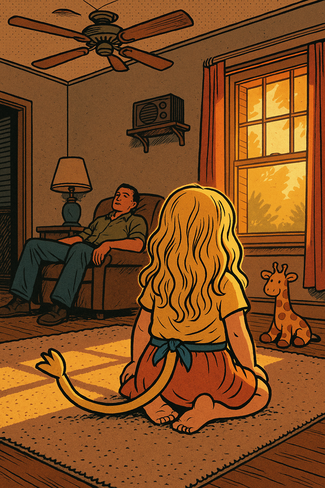
The Alabama summer hummed outside, its thick, slow warmth sliding through the open windows of the Robinson household like syrup. The ceiling fan above moved in languid circles, more symbolic than functional, barely cutting the weight of the heat. The air carried the scent of cut grass, dust, and something faintly sweet—maybe honeysuckle, maybe the pear preserves cooling in jars on the kitchen counter. The room itself was quiet. Not the silence of absence, but of saturation. Of a house full of presence resting all at once.
Mason had drifted into sleep in the recliner—not abruptly, but gradually, like a man slowly folding into the shape of his own weariness. His body had settled the way the old chair did: familiar creaks in both. He sat with his head tilted back just enough for gravity to part his lips, his breath shallow and steady. One arm lay across his stomach, rising and falling in rhythm with his breath; the other dangled loose, fingertips grazing the upholstery. His boots sat abandoned near the edge of the rug, kicked off without care, the toes pointing in different directions. One sock was a navy blue crew cut, the other a worn-out athletic sock that had once been white. He hadn’t noticed. He never did when he was this tired.
The issue of Popular Mechanics that had occupied his attention just before sleep had slipped from his hand and lay facedown on the floor. The edge of the page curled slightly from the fan’s slow push of air. It was open to an article about backyard solar panels—a dream project he’d been entertaining for months but hadn’t touched since spring. The tools for it still sat neatly arranged in the garage, untouched but not forgotten. Just waiting for when the time returned to him.
The living room, half-lit by the dusky spill of afternoon sun, seemed to lean into Mason’s slumber. The curtains breathed inward with each gust of breeze, as if the house itself were trying not to disturb him. The old radio on the shelf clicked faintly every so often—settling, not playing. Even the cicadas outside, rowdy as they’d been earlier, seemed to pull back in reverence for the stillness that had settled over this corner of the world.
There was no sound of children chattering, no pots clanging in the kitchen, no creak of the screen door. Just Mason. The weight of him. The fullness of his fatigue.
He hadn’t meant to fall asleep, not exactly. He’d told himself it was just a moment—just sitting down, just resting his back, just reading an article. But the moment had stretched. His eyes had wandered toward the ceiling fan, then closed under the pretense of blinking. Somewhere between thoughts about solar batteries and a list he meant to write for the hardware store, his mind had simply let go. The kind of letting go that doesn’t happen often. Not when you’re the one who’s supposed to hold so much together.
He looked older when he slept—not in a worn-down way, but in a way that revealed the weight he carried when he was awake. The lines on his forehead were more visible now, his brow no longer lifted in concentration or gentleness. His face, usually animated with expression—lopsided smiles, furrowed thoughtfulness, soft encouragements—was slack, unguarded. Exhaustion hadn’t ambushed him. It had called to him. And he had answered, without resistance.
Outside, a lawnmower started in the distance, its low growl muffled by the thrum of heat and distance. Somewhere down the street, a dog barked once and then gave up. The rhythm of summer in Huntsville carried on around him, but within the living room, time felt stalled. Mason slept like a man not just tired from the day, but from long, steady years of being needed. He slept like someone who had earned it a hundred times over.
The dust motes in the sunbeams swirled without urgency. The old clock on the wall ticked and ticked. And Mason, still and sun-warmed in his chair, didn’t stir.
Toyah was only two years old, but she carried herself with a gravity that sometimes felt like she’d been alive for many more seasons. There was something in the way she moved—measured, thoughtful, like each step was considered and necessary, not the chaotic toddle of a typical child. Her curls were a little wild from the backyard breeze, her cheeks kissed pink by the sun, and her little cotton shirt stuck to her back with a patch of sweat shaped like a lopsided heart. Her bare feet were smudged with dirt, toes caked with blades of grass, and there was a tiny scratch along her shin—earned nobly, in her mind, as part of an important lesson in dog-training.
The ribbon—sky blue, slightly frayed at one end—had been found in a kitchen drawer. It was one of those things that lived in houses like Glenda’s, long-forgotten, too pretty to throw away but too worn to serve its original purpose. For Toyah, it was perfect. Her idea was simple. If she held it just right, wiggled it just so, the dogs would learn to “paw it,” as she put it, and then she would say, “Good job,” and maybe there would be a treat involved. .
The afternoon sun draped itself lazily over the backyard, steeping everything in gold. The light filtered through the branches of the pecan tree, dappling the ground with fluttering patches of warmth and shadow. The air was soft with the kind of Southern heat that clung rather than scorched—sweet, humming, slow. Out by the chain-link fence, cicadas had begun their chorus, a steady, high-throated buzz that threaded through the stillness like background music to something quietly grand.
Toyah stood near the center of the lawn, barefoot in the grass, gripping a long blue ribbon in her hand like it was a magician’s wand. She held it aloft with great care, her small brows drawn together in thoughtful focus. The ribbon fluttered lazily in the breeze, the end catching bits of sunlight as it danced. It was her tool. Her instrument. Her lesson plan.
This was important work.
She had turned down the trip to the park with Veronika and the older girls—offered with all the gentle encouragement and cheerful promises of swings and juice boxes and maybe even a popsicle. But Toyah had stood her ground with the solemnity of a general. “No fank you,” she’d said. “Me doin’ doggy teachin’ today.”
Now she stood ankle-deep in clover, her curls springing out in all directions, her cheeks flush from the heat and the satisfaction of having a mission.
“Okay,” she declared, turning to her audience.
JT bounded past her in a blur of fur and noise, his entire body wagging as he skidded to a halt a few feet away, turned too fast, and tumbled over his own front legs. He popped up again with a bark, tongue lolling, tail thumping. He was ready. He had no idea for what, but he was so ready.
“Sit down,” Toyah said, her tone firm but not unkind.
JT barked again.
“Sit,” she said again, frowning with great patience.
JT sat. Sort of. One back leg slipped out from under him, but he looked up at her with such eagerness that Toyah nodded, deciding it counted.
“Okay. Good boy. Now da ribbon.” She held it out dramatically, letting it trail through the air with a graceful swoop. “You gotta paw it. Not bitey. No teeth. Just paw. You paw it. Like dis.”
She squatted low and brushed the grass with her own hand, demonstrating what she meant.
JT lunged.
“No!” she yelped, yanking the ribbon back as he barreled toward it, mouth open, trying to snatch it from the air like it was prey. “No no no, JT! Not eat it! You paw it!”
JT spun in a circle, barked twice, then dropped into a crouch, tail wagging so hard his whole hind end wagged with it. Toyah gave a long-suffering sigh—half frustration, half theatric exhale of a tiny teacher trying very hard to be patient with an uncooperative pupil.
“Try again,” she muttered, getting back up. “Now. Ready? Paw!”
She waved the ribbon low, slowly this time. JT crouched, wiggled—and pounced again with his teeth.
Toyah jumped back and shook the ribbon at him. “You not lis’nin’! No teeth, JT! You s’posed to tap it. Wif your foots.”
JT barked once, then flopped over on his side and rolled onto his back, paws in the air.
Toyah stared at him, mouth slightly open.
“Dat’s... not pawin’,” she said slowly, puzzled. “Dat’s just bein’ silly.”
She turned toward the pecan tree, where Chloe sat in the shade like a queen observing her kingdom. The older dog had not moved much during all this commotion, save for the occasional flick of an ear. But as Toyah approached, ribbon in hand, Chloe lifted her head.
“Okay, Chloe,” Toyah said, walking with the quiet determination of someone preparing to demonstrate something very serious. “Your turn now. We doin’ teachin’. I fink you gonna get it.”
She knelt in front of the shepherd-mix and laid the ribbon carefully in the grass, holding one end so that it wiggled just a little. Chloe watched it with calm, intelligent eyes. She didn’t lunge. She didn’t bark. Her tail tapped once against the dirt.
“Okay,” Toyah whispered. “Now... paw.”
Chloe didn’t move.
“Paw, Chloe.”
The dog blinked once, then leaned forward and gave the ribbon the barest nudge with her nose—soft, deliberate, precise.
Toyah gasped. “You did it!”
She jumped to her feet and clapped, then crouched again quickly and laid a hand on Chloe’s head, stroking her gently between the ears.
“You didn’t even cheat,” she whispered. “You so smart. You got da paw part. Not wif your foots, but dat’s okay.”
Chloe gave a soft chuff, the corner of her mouth twitching in what almost looked like a smile, and settled back into her spot.
Toyah turned back toward JT, who had resumed his bouncing antics on the other side of the lawn.
“You watchin’?” she called to him. “Chloe showed you. Now you do it.”
JT barked and chased his own tail.
Toyah nodded solemnly to herself. “He gon’ get it,” she said under her breath, with all the conviction of a future dog trainer. “Maybe not today... but he gon’ learn.”
And so the lesson continued. The ribbon was waved. The commands were issued. JT pounced and rolled and barked until he tired himself out. Chloe remained noble and composed and touched the ribbon once more with her nose, earning more whispered praise. The sun dipped lower, the light softening. Toyah’s curls grew damp with sweat, and her small shoulders dusted with bits of grass and the faintest smudge of dirt.
But she kept at it. Over and over. In her mind, the lesson was working. The dogs were learning. She was teaching.
And she was doing a very good job.
Backyard heat shimmered in soft waves as the sun ambled its way westward, draping everything in that late-afternoon light that made grass glow and shadows stretch long and gentle. The training session was reaching its climax, and Toyah stood with her hands on her hips, her lion’s tail still proudly tied around her waist, swaying slightly behind her like the banner of a field commander surveying her troops.
JT, the ever-bouncy beagle mix, stood before her panting with ecstatic energy, his tongue lolling from his mouth like a ribbon of pink satin. His paws tapped the ground rhythmically, a little cha-cha of excitement. Chloe, ever composed, sat statuesque and regal by comparison, her ears alert but relaxed, posture precise. Though she had not once barked, lunged, or bounced like JT, she had nonetheless done exactly what Toyah had asked. Nose to ribbon. Paw lifted in perfect precision. She had been the very picture of dignified obedience.
Toyah gave one firm nod. “You dids it,” she said aloud to no one in particular. “You both dids da trick.”
Then she turned on her heel—her tiny, bare foot padding across the sun-warmed concrete of the porch—and marched with the unmistakable swagger of accomplishment toward the back door. The dogs watched her, JT letting out a hopeful yip, Chloe simply standing and stretching with a slow motion that spoke of confidence.
The treat bin stood beside the door, just beneath the window where a line of herbs grew in small ceramic pots. It was a squat plastic container with a snap lid that made a satisfying pop when opened—provided you had the strength and will to pop it, and Toyah, of course, did. She crouched in front of it, her face scrunching with determination as she pried at the lid with both hands.
“Come on,” she whispered with narrowed eyes, tugging one side, then the other, until finally—pop!
Victory.
Inside lay treasure. Dog biscuits shaped like bones and hearts, all smelling faintly of oats and chicken and something Toyah could only describe as “puppy food smell.” She dug both hands in—left, then right—and plucked out one biscuit in each small fist, each about the size of a toddler’s palm. She held them aloft like offerings to the sun.
“Dis for doin’ good,” she announced with ceremonial weight.
She turned back toward the yard, the biscuits held high in each hand, walking slowly now like a priestess carrying sacred relics down the temple steps. JT began his wiggle-dance the moment he saw her, tail a blur of excitement, whole body poised on invisible springs. Chloe, ever the soldier, sat again, poised and proud, only her tail giving a soft sweep against the grass.
Toyah reached the edge of the porch and took her place. She stood tall, lifting both arms to either side of her body, a biscuit in each hand. She looked to JT. Then to Chloe. Her face was solemn.
“You both good,” she said. “Now dis how we do it.”
She paused dramatically, making sure they were watching. Chloe’s amber eyes locked onto her hands. JT bounced once in anticipation.
“Ready… set…”
She swung her arms like a carnival performer launching into a grand finale.
“GO!”
And with that, she tossed both biscuits high—one to the left, one to the right—with the kind of giddy theatricality only a toddler in full command of her moment could muster. The biscuits soared unevenly but enthusiastically through the air.
JT leapt first, nearly tumbling over his own feet, catching the biscuit in an awkward chomp that made him stagger sideways before landing in a triumphant sprawl on the grass, tail beating the ground in wild approval of himself.
Chloe didn’t leap. She didn’t flinch. She simply took one precise step forward, opened her mouth, and caught the biscuit in a clean, perfect snap. Then she resumed sitting, tail giving a single pleased flick.
“YES!!” Toyah cheered, throwing both hands up in the air. “You did it! You cawt it! You both did!”
JT bounced around in a circle, biscuit half gone already, the rest clutched between his teeth as he paraded in celebration. Chloe chewed once, twice, then gave Toyah a long, satisfied look that might as well have said, I know.
Toyah plopped down on the edge of the porch with a huff, tail puffing out behind her, arms resting on her knees. She gave herself a moment to enjoy the feeling. The power. The joy. The pride.
“You my bestest dogs,” she declared, grinning from ear to ear. “My team. My proud.”
And the lioness sat in the sun, her pride feasting at her feet.
The sliding back door let out a gentle shhhk as Toyah pushed it open, her small fingers grasping the frame with the practiced ease of someone who had done it many times, though always with effort. The sudden shift in air—cooler, stiller—made her pause just past the threshold, one foot on tile, the other still in the grass. The ribbon, now a bit crumpled and wilted with wear, hung loose from her hand like a forgotten streamer after a parade.
She stepped inside, slow and quiet, as if crossing into a dream.
The house greeted her with its familiar hush, a kind of softened stillness that wrapped itself around her like a favorite blanket. The girls weren’t here. She remembered that. They’d gone to the park with Veronika after all, which had seemed unimportant at the time. But now the absence settled a little more clearly—no giggles from the hallway, no sound of water running or clattering from the kitchen. Just quiet.
She tiptoed past the laundry basket still sitting by the wall and into the front room.
And there he was.
Mason.
Asleep in the recliner.
He looked like a picture in a bedtime story—not one with dragons or giants, but one with peace in it. One where things are safe. His head had tipped back slightly, his mouth parted, a gentle snore barely stirring the air. One arm lay slack across his stomach. The other hung off the side of the chair, fingers curled toward the floor. His boots had been discarded near the edge of the rug, socks mismatched—one blue, one off-white—and a magazine lay facedown beneath his open hand.
Toyah froze in the doorway, eyes wide and bright. She looked at him for a long moment, her body still, as if her thoughts had paused to make room for a new idea blooming inside her.
And then she scampered.
A quick dash—barefoot and decisive—carried her across the room, past the edge of Mason’s chair and over to the little wicker basket in the corner where her toys lived. Not all her toys—some were in her room, others under beds or couches, or on grand adventures behind the curtains—but this box was hers. The one near the front window. Her “right now” box.
She rifled through it with purpose, murmuring softly to herself. “Not dat one… not da ponies… not da stickers…” Her eyes lit up when she saw it, the long stretch of yellow, the yarn poking out one end like a tiny wild tuft.
The lion’s tail.
It had once been a sock, bright banana-yellow and far too stretched to wear properly anymore. One Sunday—slow and soft, with bread rising on the counter and jazz playing low on the record player—Toyah had brought her favorite picture book to Glenda and solemnly announced, “He got a tail. I need one too.” The lion in the book was small but brave, and that mattered. Glenda had smiled in the way she did when something was absolutely serious in a toddler’s world, and they’d sat together with scissors and string, cutting and knotting until the sock had become something new. Something important.
Now, Toyah held it reverently, running a hand down its length to smooth it. The yarn tuft flopped gently. She turned around, dropped to her knees, and bent forward just enough to loop it around her waist. It took her three tries to get it tied right—once it slid too low, once it tangled in her shirt—but she kept at it, her little hands working with quiet urgency.
When she finally got the knot tight, she sat back on her heels, breathed out through puffed cheeks, and stood.
Tail: secured.
She gave a small shake of her hips. The tail bobbed with her. A grin broke wide across her face. She was no longer just Toyah. She was the lion. The small but brave one. Just like the story. Just like the tail.
With the pride of a knight freshly armored, she turned slowly and padded back toward the living room, past the drowsing hush of the walls, back toward the recliner and the man who had once lifted her up high and said, “You’re stronger than you look.”
Mason didn’t stir. The fan above hummed softly. The golden light slanted across the rug like honey.
Toyah tiptoed to the edge of his chair, tail swaying gently behind her, and crouched beside him, watching his chest rise and fall with the slow rhythm of true rest.
Her fingers curled around the ribbon again.
She had another idea now. A very good idea.
But first—she whispered to herself—she had to test her lion powers. She had to be stealthy.
The hunt was on.
“I’m the lion,” she whispered with conviction, although no one had asked. “Lions guard.”
The words were spoken with quiet gravity, as if they sealed an oath. Her voice was small, but it carried all the weight of a solemn promise. She planted her palms firmly into the plush rug and adjusted her stance, elbows slightly bent, chin lifted, and knees tucked under her as if poised to leap—or pounce—at any threat that dared disturb the hush of the house.
Her yellow tail bounced faintly with each breath, trailing behind her like a banner of courage. She puffed out her chest as far as it would go, mimicking the pose of the lion from her picture book—the one who had stood at the mouth of the cave with the little birds behind him and said, “No, not today,” to the storm.
She squinted toward the window first. The curtain stirred faintly in the breeze from the ceiling fan, and Toyah’s eyes narrowed. That movement? Suspicious.
“Grrrrr,” she warned softly, her voice a low hum in her throat, not meant to alarm but to assert presence. She gave a small nod as if to say, That’s right. I see you.
Then she turned her head toward the hallway. It was dim and empty, stretching off toward bedrooms and shadowed corners. Toyah stared down its length with all the seriousness of a soldier watching a battlefield. Her fingers clenched, and her brow knit into what she imagined was a fearsome glare.
She didn’t know exactly what she was guarding Mason from. But she knew it mattered. Because sometimes, grownups had things they didn’t say out loud. She’d heard them once—Mason and Glenda—in low voices in the kitchen, long after the others had gone to bed. Mason’s voice had been quiet and hoarse, and Glenda’s steady like water, and Mason had said, “Sometimes I don’t know why I remember the worst ones. The dreams I want to forget are the ones that always come back.”
Glenda had squeezed his hand and murmured something back, but Toyah had only caught pieces. “Safe now… can rest… we’re here…”
She hadn’t fully understood. But she had understood enough. Dreams could be bad. Dreams could sneak in and hurt someone who was sleeping. That wasn’t allowed. Not in her house.
Not on her watch.
She shifted her weight from foot to foot and pressed her fingers into the soft weave of the rug. She could feel the beat of her own heart in her hands, a quick, determined thump-thump-thump. Her breath was steady. Her tail sagged slightly to one side, but she reached back and adjusted it with a huff of effort. Had to be just right. A brave lion did not wear a crooked tail.
Outside, a bird chirped from somewhere near the porch. Toyah’s head whipped toward the sound. Her curls bounced with the motion, but she didn’t flinch.
“Only birds,” she whispered to herself. “Not monsters.”
She turned back to Mason, peering up at him with an expression of deep responsibility. He hadn’t moved. His face looked soft and peaceful, though Toyah studied it carefully for signs of unease. One time she had seen him twitch in his sleep, his fingers clenching like he was holding something invisible. Another time, he had whispered something she couldn’t understand and his eyes had fluttered but not opened. Today, though, he was still. Gentle. Asleep like someone who needed it, and was finally allowed to have it.
So she crouched a little lower, shifting so she could rest her weight on one elbow while keeping her other hand free. Just in case she needed to swat away a shadow. Just in case one of those dreams tried to sneak up the hallway and tiptoe in.
“Not today,” she whispered, echoing the lion’s words from the book.
Time passed strangely while she guarded. The light coming through the curtains softened, warmed, shifted angles. The hum of the fan above her continued its sleepy rhythm. Somewhere in the back of the house, a faucet dripped once. Toyah’s eyelids drooped slightly, just for a moment, and her head nodded forward—but she caught herself.
“Gotta stay ‘wake,” she muttered. “Lions don’t nap when dere’s guardin’.”
She adjusted again, repositioning herself with more drama than was strictly necessary. She stretched one arm forward and clawed softly at the rug, a pantomime of her wild, imaginary paws. The other hand rested near Mason’s boot, close enough to pat his sock if needed, but not so close as to wake him. This was serious work. She wouldn’t interrupt him. She was his shield.
Every so often, she issued a small growl—just a soft “grrrr”—in the direction of any movement, whether it was a breeze or the shadows stretching longer on the walls. She was very thorough. Once, the ribbon she had dropped earlier caught a gust of air and flitted like a startled butterfly across the floor. Toyah pounced, pinning it with both hands.
“Not today, dream,” she muttered, and then smoothed the ribbon with careful fingers before returning to her post.
She didn’t know how long she sat like that, crouched and alert and proud. She didn’t measure time like adults did, in minutes or hours. She measured it in purpose. In duty. In the sacred stillness of keeping watch.
And when Glenda passed quietly through the hallway a while later, unseen but watching, she paused for a moment at the doorway. Her eyes took in the scene—the recliner, the man asleep in it, the girl crouched beside him with a sock tied around her waist and a lion’s heart in her chest—and something deep in her smile settled. She didn’t say a word. She only moved softly back down the hall, letting the lion do her work.
Toyah remained.
A tail swishing.
A glare ready.
A small protector on duty.
Because some dreams weren’t kind.
And lions guard.
His breathing was steady, deep—the rhythm of someone who had finally surrendered to sleep after holding too much for too long. One leg had shifted slightly to the side, the arch of his mismatched sock just brushing the edge of the ottoman where he’d propped his feet earlier before letting them slide away. His mouth was still parted in rest, the fine lines at the corners of his eyes smoothed away by the ease of unconsciousness. In the golden hush of the room, he looked not younger, exactly, but less guarded. Like a man left momentarily untouched by worry.
Toyah didn’t speak to him directly. Not once. This wasn’t about being noticed.
This was about being there.
The lion guarding him didn’t need thanks, or hugs, or even acknowledgment. That wasn’t why she sat with her tiny hands curled into the rug, her eyes darting toward the corners of the room. That wasn’t why her knees ached or her back wobbled slightly from holding the same crouch for so long.
This was what lions did. Especially the small ones. Especially the brave.
They watched.
They waited.
They protected, unseen.
Her palm, still a little sticky from ribbon and dog fur and the sweat of afternoon effort, settled lightly on the soft fabric of his shirt sleeve. She didn’t press hard—just enough to feel the warmth beneath, the rise and fall of his breath. Mason didn’t stir. His chest continued its calm rhythm, his face still slack with sleep, utterly unknowing that the lion had touched down beside him.
Toyah leaned in slightly, her curls falling across her forehead, her yellow tail sagging low with the hush of the moment. She placed her lips near his shoulder, not close enough to wake, but close enough for her words to find their way through whatever clouds dreams made.
“It’s okay, daddy,” she whispered, solemn and sure. “I’s the lion.”
She paused, eyes scanning the hallway one more time, then glanced toward the fan-blown curtain and the shadows gathering in the corner where afternoon began to give way to early evening. Nothing moved that shouldn’t. Her voice softened further, a hush layered on top of the hush.
“Dreams don’t get past me.”
Her hand remained where it was, fingers relaxed now. Not gripping. Not guarding. Just being there.
And Mason, still asleep, still utterly unaware, breathed out a little deeper. Not because he heard her—he didn’t—but because something in the room, in the air, in the very walls of the house, had shifted toward safety. Not loudly. Not with grandeur. But with quiet, stubborn love.
The lion stayed at her post.
The house held its breath.
And the dreams stayed far, far away.
She crawled back into her guarding position, her movements slow and deliberate now, the weight of her mission sinking deep into her little limbs. Her yellow tail dragged behind her across the rug like a banner of valor—creased, frayed, noble. The yarn tuft at the end bobbed once before settling into place as she crouched beside the recliner once more, chest low to the ground, arms planted firm, eyes narrowed toward the shadows.
But something tugged at her imagination—a lion was never alone.
She turned, scanning the room with the instinct of a leader. Her gaze landed on the couch, where a toy giraffe had been left earlier in the day, half-buried under a quilt. She scampered over, snatched it by the neck with care, and trotted it back to her post like a returning scout.
“You’s in da pride now,” she informed it gravely, propping it upright against the base of the recliner.
The giraffe’s plush limbs sprawled in different directions, one ear bent inward from love and overuse. It looked confused but determined, like any good recruit.
Then she turned her attention to the play corner near the front window, where the late afternoon sun cast slanted beams across a scattered kingdom of toys. A floppy rabbit slumped against the side of a basket, one ear twisted, its button eye barely hanging on.
Toyah seized it, tucked it under one arm, and then paused—her eyes darting toward something else.
The doll.
Scraggly, barefoot, her yarn hair matted into tangled knots and one shoe long gone, she lay facedown between a block and a plastic teacup. Toyah scooped her up gently, brushing off a bit of lint before placing her beside the rabbit and giraffe, right at Mason’s feet.
They now formed a triangle around the recliner, a mismatched assembly of jungle beasts and loyal sentries.
The lion. The giraffe. The rabbit. The doll.
All of them watching.
All of them guarding.
She crouched once more, nodding to each in turn. “You gotta be brave,” she said in a whisper that was half command, half encouragement. “We takin’ turns if we get sleepy, but no leavin’ post. Dreams is tricky.”
The giraffe nodded in silence. The rabbit remained limp but attentive. The doll leaned a little to one side but kept her face toward the hallway like a proper scout.
Toyah settled beside them, adjusting her tail and planting her hands firmly on the rug once again. She let out another soft growl—just enough to remind the house that the lion was still present, still alert, and still in charge.
And there they stayed, the whole pride assembled. A jungle of love and scraps and threadbare fur. A fortress of playthings and purpose. And at the center of it all, the sleeping man, unaware of the army that surrounded him. Unaware of the lioness child beside him, who watched the shadows and whispered her vows of protection into the stillness.
The sun dipped lower. The fan turned overhead. The world went on.
But in that room, in that golden hour of soft breath and toy-soldier stillness, Mason was safe.
Because the pride was watching.
Time passed, and the cicadas sang on.
Their chorus swelled and softened in invisible waves beyond the window screens, a slow, pulsing backdrop that stitched the afternoon into the early threads of evening. The sunlight had turned honey-thick now, pooled low across the floor, tracing golden lines over the recliner and painting the crown of Toyah’s curls with a halo she didn’t know she wore. The room itself seemed to breathe with them—Mason’s steady rise and fall, Toyah’s smaller, quicker breaths slowing now as the minutes stretched.
The pride remained gathered.
The giraffe leaned slightly against the recliner leg, one sewn eye cocked upward as if peering at Mason’s resting face for any sign of distress. The rabbit slouched with the weariness of long service but remained at his post. The doll, with her one bare foot and crooked grin, kept watch on the hallway. Even the ribbon lay coiled nearby, a fallen banner from earlier battles, its frayed edge fluttering now and then with the fan’s lazy push.
And the lion—small, brave, and slowly drowsing—was still on duty.
Toyah had shifted positions several times over the last while, first kneeling, then sitting on her bottom with her knees pulled up, then crouched low with one elbow resting on her giraffe’s shoulder. She rubbed her eyes once with the back of her hand, hard and quick, like she’d seen Jess do when cartoons were playing and bedtime loomed but she really didn’t want to miss the ending. That blink, that hard blink, was her tool now. She used it against the pull of sleep like armor.
But it got heavier, that pull.
Her spine remained straight out of sheer will, her tail sagging to the side, her little hands pressed into the rug for grounding. She whispered now and then to herself—not play, not nonsense, just check-ins, like a soldier reporting to no one.
“Still here.”
“No baddies.”
“Chloe’s out back. She’d bark if somethin’ came.”
Each time Mason shifted, she stirred from her haze, eyes wide for a breath before softening again. Once he sighed—one of those deep sighs that comes not from the mouth, but from the chest, the ribs, the place inside where old things live—and his fingers curled slightly into his palm.
She leaned in closer then, drawn not by worry but instinct.
It wasn’t fear she saw in him. Not a bad dream taking root. Just depth. Something deep and worn and heavy, but quiet for now.
So Toyah eased onto her side, finally giving in to the ache in her arms and the wobble in her legs. She tucked her knees up close to her belly and rested her cheek against the rug, her ribbon tail caught underneath her, the yarn tuft poking at her elbow.
She reached out one hand—not touching Mason this time, just near—and let it rest between them. A halfway point. A line of connection.
“I’s still guardin’,” she murmured, eyes half-lidded now, lashes casting long shadows on her cheeks. Her voice was soft, not quite sleep-thick, but drifting. “Don’t worry.”
It wasn’t for him to hear, not really. It was the kind of thing you say to the room, to the quiet, to yourself. The kind of thing that keeps you anchored when your body wants to float away into dreams.
Her lion’s tail lay askew, looped gently under her side, still tied with its determined little knot. Her feet, dirty from the backyard grass, twitched once. Her doll had tipped over now, lying in a mirrored pose across from her, yarn hair fanned out like wild fronds.
And still, she guarded.
Not with vigilance anymore, not with fierce little growls or narrowed eyes, but with presence. With closeness. With the quiet assurance that she was there and that nothing bad could reach him without going through her first.
The cicadas kept singing.
Mason remained asleep, unaware of the tiny lion curled at his feet, of the stuffed rabbit and giraffe and doll that flanked him like an enchanted guard.
But the house knew.
The house held the memory of it.
And the lion, though her eyes drifted closed at last, still guarded in her sleep, her body pressed against the quiet, her dreams curled around a single, unwavering promise:
Dreams don’t get past me.
The gentle creak of the hallway floor announced Glenda’s quiet approach before her figure emerged in the doorway, framed by the fading afternoon light that now poured in at a low angle through the living room windows. She carried the ease of someone who knew every board and breath of the house, who could walk without sound when needed—but the old wood liked to murmur a little in greeting, no matter how softly she stepped.
A faded tea towel was still slung over one shoulder, its edge dusted with flour. Her sleeves were rolled up to her elbows, and a faint smudge of something—maybe peach juice or powdered sugar—marked her forearm, the lingering evidence of a cobbler half-assembled on the counter. The quiet of the house had tugged at her, not with worry but with curiosity. A mother’s instinct for stillness that feels too still. She’d peeked down the hallway and, finding it undisturbed, had wandered into the living room to check on Mason.
What she saw stopped her breath, just for a beat.
There he was—Mason, sound asleep in the recliner. His whole body slack with deep rest, the Popular Mechanics still forgotten on the floor beside him, his mismatched socks visible just past the edge of the ottoman. His jaw hung open slightly, his breathing slow and even. The man had earned this rest and a hundred more like it. She’d seen him carry exhaustion like armor, worn silently and without complaint. But here, now, he looked peaceful. Unburdened.
And at his feet—oh, sweet baby girl.
Toyah.
Curled like a comma on the carpet, still in her backyard clothes, a little trail of grass on one knee and a smudge on her ankle where dirt hadn’t quite been wiped away. The yellow sock-tail was still tied proudly around her waist, its yarn tuft trailing behind her like the end of a sunbeam. One arm stretched out just far enough that her small fingers brushed the base of Mason’s recliner. A point of contact. A tether. Her head rested on the rug, turned slightly toward her toys.
Those toys. Lord.
Arranged in a solemn semicircle like an honor guard: the giraffe slumped sideways but loyal, the floppy rabbit with his ear flopped across his own button eye, and the scraggly doll with the one bare foot and lopsided braid. They’d been placed with purpose, not haphazardly tossed but stationed. Glenda recognized the instinct behind it—the protective arrangement, the ceremonial stillness. It was how children showed love and duty before they had words big enough to carry the weight.
Her heart caught in her chest.
She stepped forward as softly as she could manage and knelt down, the tea towel slipping from her shoulder to the floor without her noticing. Her knees clicked faintly as she lowered herself, but Toyah didn’t stir beyond a twitch of her toes. A soft sheen of sweat still clung to the girl’s forehead, her curls slightly damp and pushed into uneven little ringlets. Glenda reached out and, with a tenderness that had lived in her hands since the first time she’d held a newborn, brushed one curl back from Toyah’s brow.
“Good lion,” she whispered, voice dipped in fond amusement, her eyes glinting with the beginnings of tears she had no intention of letting fall. She smiled and added, “You got your whole pride lookin’ fierce, baby.”
Toyah stirred just barely. Her lashes fluttered like wings folding for the night. She didn’t open her eyes fully—just cracked them enough for the world to blur into shape. Her gaze met Glenda’s, warm and glazed with sleep. She gave a tiny nod, more of a tilt of the chin than a movement of the head.
“Still guardin’,” she murmured, lips barely parting. “Dreams ‘kay now.”
It wasn’t said like a question. It was a status update. A final report. Her mission, in her own eyes, had been a success. The bad dreams hadn’t found a way in. The lion had stood her ground.
Glenda didn’t answer with words. She just leaned in, touched her lips softly to the curve of Toyah’s temple, and stayed close for a moment longer, her fingers tracing a gentle path over the girl’s curls.
And then, with the quiet exhale of someone who had done their part, Toyah let herself drift.
Not into a deep sleep—just a nap, just a small one. The kind of sleep you take when you’ve kept the watch, and now the world feels safe enough to let go. Her arm slackened but didn’t move. Her fingers still touched the recliner, the connection to Mason still held. Her tail stretched behind her like a trail left in the sand by something proud and brave. The rabbit sagged forward a little more, as if nodding off too. The giraffe leaned slightly to the left. The doll kept her crooked watch.
Glenda stayed there a little while longer, crouched beside them. She took in the whole scene—the sleeping man, the lion child, the pride of misfit protectors—and tucked it deep into that place inside a mother where snapshots live forever.
Then, with a sigh that was all warmth and ache, she reached for the tea towel, rose to her feet, and tiptoed away.
The cicadas still sang.
The house still held its breath.
And the dreams, if they had ever considered coming, had already turned away at the sight of the lion asleep beside the chair.