Work Text:
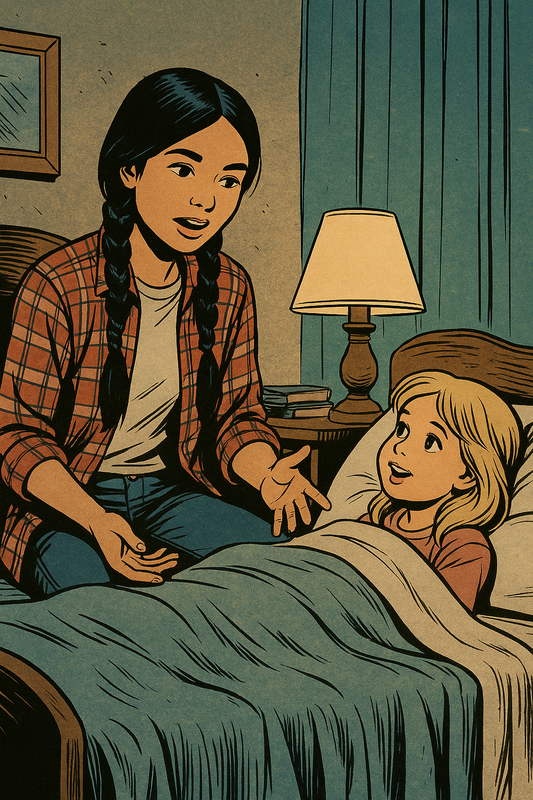
Jess’s room was honey-dim with one lamp and the faint hum of the box fan. The stitched ponies on her blanket seemed to run when the fabric rose and fell with her breathing. Scarlett sat on the bed’s edge, one knee sinking into the quilt, the other nudging against a tumble of stuffed animals—two floppy rabbits and a foam-stiff horse with a yarn mane. Jess’s thumb eased toward her mouth; her other hand patted the horse she kept under her cheek like a talisman.
Jess looked up at Scarlett with the kind of eyes that make promises to the night—big and brimming with hope, wet-lashed from a bath that still pearled at her hairline. Her voice came out a soft coo, round and careful as a new marble. “Stowy?”
Scarlett’s hand was already on the move, the heel of her palm resting a moment at Jess’s temple as if to take the measure of the day’s heat, then the slow glide of her fingers across the soft slope of cheek. She used the pads, light as moth wings, tracing a path that ended under Jess’s ear where small children keep their last, secret giggles. “Of course,” she said, and the words carried the smile that lived at one corner of her mouth. “Everything else is done; now lil’ Jess is dressed up and tucked in.”
The room agreed with her. It smelled faintly of baby shampoo and warm cotton, the damp at the ends of Jess’s curls curling tighter where the towel had missed, a thin crescent of soap-bubble scent lingering like a good idea. The small chores of evening had lined themselves up and ticked their boxes: teeth brushed to a minty shine (Jess had presented them for inspection with a solemn “Ahhh,” then bit the toothbrush once for luck); knees wiped of the day’s crayon dust; pajama top buttoned—slowly—over a belly that could not stop being pleased with itself; socks with tiny ponies abandoned neatly on the chair because “toes wanna bweathe.” Her chosen guardian, lay on duty beneath her cheek, muzzle polished satin-smooth by naps and secrets, one ear nicked in a way that only made him more reliable.
The lamp on the nightstand made a generous puddle of honeyed light that pooled across the rug and climbed the legs of the table where a cup of water stood at parade rest, half-moon of condensation already drying. Dust motes floated like tiny lanterns that had forgotten their strings. The box fan in the window gave its small, faithful shush—sea in a tin frame—every spin sighing the same quiet answer to a question no one needed to ask. Outside, a summer cricket tuned itself and decided it was close enough to music. Inside, the stitched ponies on Jess’s blanket waited in mid-canter, their thread catching and winking as the fabric rose and fell with her breathing. When she inhaled, the herd climbed the hill of her ribs; when she exhaled, they cantered into a soft valley and grazed.
Scarlett sat carefully on the bed’s edge, testing the spring with a knee so gentle that the mattress only gave a contented little hush, like a friend scooting over to make room. Her thigh pressed a warm dent into the quilt. With the back of two fingers she smoothed a wrinkle near Jess’s shoulder, then tucked the corner in under a small arm with the deftness of someone who understands the geometry of comfort. She tipped her head so that a curtain of hair drew a faint shadow over Jess’s brow, and gave that shadow a smile, too, so it wouldn’t feel left out.
Jess’s excitement crackled—polite, but impossible to hide. It ran in quick little currents through her body: a wiggle at the knees that scooted the blanket a thumb’s width higher, a flutter of toes under the covers like minnows in a shallow stream, a two-finger pony gallop across the quilt that paused at every stitched mane to say hello. Her thumb hovered at the corner of her mouth, thinking about duty and deciding it could stay on leave for now. She tapped the wooden horse twice—tick, tick—tiny hoofbeats on varnish. Her eyes, huge and bright as spills of lamplight, searched Scarlett’s face the way sailors look for a lighthouse they already know is there.
Scarlett’s thumb drew one slow circle on Jess’s cheek, the kind that smooths the last wrinkles out of a day. “Mm,” she said, a promise humming under the sound. “We’ve got everything set to rights. Hair washed. Teeth sparkling. Jammies on properly—” she glanced at the slightly askew buttons and pretended not to notice, “—blanket herd at the ready, wooden pony reporting for duty, cup of water standing tall, fan making ocean noises so the fish in your dreams don’t get lonely.” She tipped her chin toward the nightstand. “And your eyelids,” she added, keeping her face very serious, “are clearly charged to one hundred percent.”
Jess slammed them shut for a second, then popped them back open, laughing in the back of her throat at the glitch in the test. Her legs did a secret kick under the covers. She scooted her small body nearer to Scarlett’s knee until their warmth touched, then lay very still, as if she knew stories preferred quiet bodies even when the inside of a child was all fireworks.
Scarlett let her gaze take inventory of the small kingdom. The pale ring of a damp washcloth on the dresser. The nightlight in the socket, patient and low, waiting its turn. The tower of picture books on the chair, their spines making soft shoulders—horses, moon, a bear who was too polite to eat anyone. A crayon—green—forgotten under the bed, a bright secret nobody needed to mention. All the machinery of bedtime had done its steady work and spun down to its hum. What remained fit between the distance of Scarlett’s palm and Jess’s cheek, between the fan’s whisper and the lamp’s gold.
“Of course,” Scarlett said again, this time the words sliding gentle into the space between them like a boat onto still water. “I’ll tell you about the day your mama and I helped an old friend with a cattle drive.” Her hand settled in Jess’s hair, combing through the damp curls once, twice, as if counting in the story’s beginning. “We’re here. We’re ready. Little horse, big heart and all snug.” She bent close enough that Jess could feel the smile move. “Let’s ride.”
Jess had just settled into the lamplight like a small moon when Scarlett began. “We were fifteen,” she said—soft as a secret the night could keep—and to show it she lifted one hand, palm out, fingers unfurling one by one like little flags.
Jess’s whole face brightened, purpose clicking into place behind her eyes. Counting was work, and work made you tall. She pushed herself up on an elbow, wooden horse wedged under her cheek like a friend who refused to be left behind, and brought her free hand to Scarlett’s waiting palm.
Tap.
“One,” she declared, all breath and certainty.
Tap.
“Two.”
Tap-tap, quicker now.
“Fwee. Fo’.” Her tongue peeked out at the corner of her mouth—serious business happening. The box fan’s steady shush braided itself through her small voice, a metronome for numbers that sometimes arrived out of order and never minded.
“Five,” she said, proud to reach the end of one hand, as if five were a landing at the top of a flight of stairs. The stitched ponies on her blanket rose and fell with her breathing; when she leaned forward to reach the next finger, they climbed a quilted hill.
Scarlett, silent and smiling, brought up her other hand beside the first, palms like two small pages laid open. No words, only the invitation of more.
Jess touched the new thumb reverently. “Siss,” she breathed, then “seben,” tapping with the solemn authority of a magistrate. Dust motes drifted in the warm light; they could have been little numbers floating down to be counted if numbers liked to sparkle.
“Eight,” she said, round and certain. “Nine.” She paused a heartbeat, consulting the ceiling for advice. The wooden horse fogged and cleared against her cheek with each small breath, as if it were whispering help. “Ten!”—triumphant, the flag on the hill. She looked up at Scarlett for confirmation and found only a quiet nod and a smile that crinkled at the edges—go on.
Jess returned to the first hand, untroubled by the idea that numbers might reuse fingers if they needed to.
“’Le-bin,” she said, tapping the index with a scholar’s gravity. Tap. “Twelb.” The lamp hummed. The fan sighed. Scarlett did not correct the b; she let the sound be a warm little pebble in the room.
“Teer-teen,” Jess tried, stretching the middle of the word so it could hold all the importance, tapping a ring finger as if bestowing a title. Then, careful: “For-teen.” She touched Scarlett’s pinky and paused, brows knitting as if she could feel the end of the hand run out under the number, like a path meeting a fence.
Scarlett tipped her head, that one-corner smile widening just enough to make room for whatever came next. She shifted her wrists so the hands lay like a figure eight—fresh fingers by sleight of palm—offering, not instructing.
Jess’s relief was audible. She tapped the nearest thumb and planted the last word like a flag. “Five-teen!”
She sat back a little, glowing, as if a small sunrise had happened behind her ribs. Her thumb hovered at her lip, remembered its duties late, and decided to wait; there were official things to conclude. She checked Scarlett’s face again, looking for the rubber stamp that made a fact real.
Scarlett stayed in her quiet—delighted, proud, patient. She let the nod be slow enough to be felt and not just seen. At the edges of the room, bedtime’s small machinery continued its hush: the cup of water on the nightstand making a crescent of condensation, the house settling with a single, agreeable tick, the crickets outside tuning their polite one-note fiddles. Inside, Jess’s counting finished settling into the air like flour sifted over a bowl.
“Fifteen,” Jess repeated, satisfied now that the word and the idea matched. She pressed both of Scarlett’s hands with her small palm, sealing the number in like a pact. “You…an’ Mama. Fif-teen.”
Scarlett turned her hands and, without breaking the silence, let her fingers curl gently around Jess’s tapping one, a soft cage that held nothing but the moment. She brought the back of Jess’s knuckles to her cheek for a second, as if to warm them on her own smile, then set their hands back, open again, ready for the next thing.
Jess, confident she had done the heavy lifting, exhaled a pleased little puff that glazed the horse’s flank with a sheen and cleared it again. She sank down into the quilt, still watching Scarlett with the bright patience of someone who knows the show will go on only when the audience is properly seated. Her feet wiggled once under the blanket—secret applause for herself—and stilled.
“’Kay,” she whispered, magnanimous, granting permission to the rest of the story. “Fif-teen.”
Scarlett stroked Jess’s cheek with two fingers, small circles that matched the fan’s rhythm, and let her voice come back into the room like a boat onto still water. “Fifteen,” she echoed, and in the echo there was approval, and in the approval there was the doorway. “Two girls, two good horses, and a long day that behaved itself.” She glanced down at Jess’s hand, where her own fingers had just been counted into being fifteen, then back to the wide, waiting eyes. “You ready to ride the rest with me?”
Jess nodded so hard her curls jostled, a tiny halo taking flight and landing again. The wooden horse, loyal sentinel, bumped her chin and found its spot. Her palm went back to Scarlett’s left hand and patted it once—thank you, fingers—then tucked under her cheek. The room, satisfied with the arithmetic of love and patience, settled deeper into its gold. And Scarlett, having honored the number to the last tap, let the story step forward on quiet hooves.
“It was bigger than your toy box,” Scarlett smiled. “More than three hundred cows—mamas and calves—one long, gentle herd.”
Jess’s heel nudged the toy box at the foot of the bed as if to check the measurement, then stilled. Her eyes went wide the way windows do when you pull the curtains.
“The herd started like a small thought,” Scarlett said, “just a few backs moving, tails flicking, ears turning to catch the morning. Then the gate breathed out, and the thought grew. Ten. Twenty. Fifty. It kept coming until the ground sounded different—hoofbeats laying down a soft drum you can feel in your knees. The dust stood up and turned golden where the sun poked through it, and you could smell warm hide and hay and the green-bitter bite of crushed stems. All that motion, but slow, like a big animal remembering how to stretch.”
She touched two fingers to Jess’s blanket, drawing a lazy S through the stitched ponies. “A herd doesn’t go in a straight line like blocks. It folds and unwinds. The front end checks the world and decides it’s safe; the middle carries the warmth; the back makes sure nobody gets left with their worries. The mamas walked steady, heads level, eyes soft as creek water. The calves kept close and made those small question sounds—mmm?—and the answers came right away, mmm, I’m here. You could hear that call-and-answer even over the hoofs and the grasshoppers and the windmill doing two turns, changing its mind, and doing two more.”
Jess’s hand crept out from the blanket and patted the wooden horse twice: tick, tick. Scarlett’s smile tucked itself a little deeper.
“Three hundred looks like weather,” she went on. “Not a storm—more like a long, brown river under a big sky. If you raised your eyes, the horizon was a straight mouth. If you lowered them, the herd made hills and valleys out of backs and hips and shoulders. Ears twitched like little flags when flies had opinions. Tails drew lazy cursive in the air. From far off you could see the herd’s shadow, one wide shape that changed its mind as it walked. Up close you could see the private things: a calf working on a wobbly lick of milk dribbling down its chin; a brown cow with a single white sock on her left hind; a brindle with a map of a river on her face; a pair of friends who always stepped in the same rhythm as if they’d practiced.”
She let the picture thicken, then thinned her voice to a hush. “Counting a herd is like counting raindrops on a window—possible, but not important the way it is to count your toes. We still counted, because counting is love in a long line. I said numbers in my head as they filed past the cottonwoods: twenty-seven, thirty, fifty-four—quiet numbers that didn’t bump anybody. Your mama counted too, her big star winking whenever a calf did a brave shuffle forward. By a hundred, the herd was already telling us it was whole. There’s a sound a herd makes when everyone knows where their someone is; it’s like a room exhaling.”
Scarlett cupped Jess’s cheek in her palm, then let her hand drift to the quilt, drawing a little horse in the air as if she were sketching on water.
“You’d have liked them right away,” she said. “My mare and your mama’s gelding. They were the sort that meet you halfway without making a fuss.”
She tipped her head toward the window, toward the night where fields ought to be. “Most mornings, before the kettle even thought about singing, they were already by the gate. You could hear them before you saw them—a slow scuff of hoof on packed dirt, the soft leather-whisper of a swinging lead rope, that start-of-day snort that puffs like a kettle testing its voice. When the screen door squeaked”—she made the tiny noise with her teeth—“Blue would lift his head, one ear to the door and one to the pasture, whereas Juniper always put both ears right on me like two little question marks.”
“Bwoo,” Jess said, smiling into the wooden horse. “Hansum.”
“Very,” Scarlett agreed, eyes warming. “Blue’s a blue roan—up close he looks like rain on stone. From a distance, he’s the color of a cool shadow. Your mama’s had her hands on him since his baby winter—brushed him with a little stiff brush that fit her palm, braided one tiny section of his mane with dandelion stems because a cousin showed her how. He learned her hurry from the way her boots sounded on the boards, and her quiet from the way she hummed when she filled buckets. Even now, if she coughs, he turns an ear so quick it might as well be a hand.”
Jess’s fingers made two small ears and wiggled them. Scarlett smiled and went on.
“My mare’s called Juniper,” she said. “A bay with a moon-white star right where you’d kiss it, and the softest nose in three counties. She was wary when she was little—stood sideways and watched the world out of the corner of her eye like a girl at a door deciding if the room is friendly. I didn’t talk her into anything. I just kept showing up with apple cores in my pocket and a brush that made circles where the winter hair wanted to let go. After a while, she started making the first move. She’d come put her forehead here”—Scarlett touched the flat of her chest—“and breathe a little question. I keep my answers in my breath, and she knows where to look.”
Jess watched Scarlett’s ribs rise and fall and matched them, as if that were part of the lesson.
“At home,” Scarlett said, “the halters hang on the bent nail shaped like a fish, and the tack room always smells like leather and cedar shavings and the coffee tin where somebody keeps the lost nails. There’s a row of pegs over the feed bins with names burned into them. Blue’s bridle lives under your mama’s, and my saddle knows where it sits by the way the wall is shiny there. If you look close at Blue’s cheekpiece, you’ll see two faint scuffs from the summer a kitten decided leather was a hill. Your mama sanded them smooth, but they still catch a little light. She reads to him sometimes, leaning on the top rail while he breathes fog onto the slats. He rests his chin there and pretends the words are hay.”
“Woids hay,” Jess echoed, delighted.
“Juniper has opinions about puddles,” Scarlett confided. “If nobody asks her, she’ll go around and put a foot on the bank to show excellent judgment. If I sigh just so, she’ll step in and make rings like bracelets and act as if it was her idea. She moves sideways like water remembering a rock. If I press at the girth with the inside of my calf and breathe halfway out, she’ll float left, the way a shadow floats when the sun goes behind a cloud. If I laugh, she pricks both ears—always—like she wants to see the joke.”
She leaned in a little. “Blue stands like a fencepost when your mama swings up from the rail. He doesn’t blink at the clatter. He knows the geometry of her legs and leaves a slice of stillness where the stirrup will be. If there’s a sleeping kitten in the barn aisle, he bends his route so precise it’d make a draftsman proud. He drinks like a gentleman, too—tongue deep, two gulps, eyes soft—while Juniper blows bubbles and snorts them at me like a trick she invented yesterday.”
Jess snorted gently, then hid behind her hand, pleased with herself.
“They both know the sound of the chalk,” Scarlett said, a smile in her voice. “When the day’s jobs get written on the board, you can hear the little tap-tap of it through the wall. Juniper always lifts her head at the first tap; Blue waits for the second. When the windmill clanks twice and the trough starts singing, they come on their own. Your mama says ‘wait’ like she’s telling a secret to the dust, and Blue waits with his head low. I say ‘and’ instead of ‘whoa’ because I like to end a thing in the middle of breathing, and Juniper likes that, too.”
She let the herd-day slide back into the room. “Out with the cows, they took their places like they’d read the board. Blue on the right because the fence kinks near the wash and he can get small without getting nervous. Juniper on the left where the ditch grows greedy and she can pour herself across the idea of it without spilling. When the eager ran up the middle—smelled the clover and thought about running—your mama shifted her weight and Blue put one more thought between his strides, and the eager turned into steady. When a calf tried a new geometry in a corner, I lifted my knee and Juniper slid a shoulder where the wall didn’t need to be.”
In the lamplight, Scarlett’s hand unconsciously patted the quilt the way you pat a damp neck after a ride. “After work, there’s a hose that throws water cold as a creek. Blue stands with a hind hoof cocked, dreaming, while your mama guides the stream over his back like she’s painting. Juniper bites the water and looks offended when it bites back. We curry the sweat into soft swirls and the swirls into quiet. Burlap wipes leave dark maps on their coats until they dry. There’s always a child or three—bare feet, grass on their knees—carrying apple slices like offerings. Blue takes them with lips neat as a pickpocket. Juniper lips your sleeve first to see if you’re hiding anything better.”
Jess presented the back of her hand, very official. “Nuffin’ hidin’,” she announced to the imaginary mare.
Scarlett’s mouth tilted. “In winter,” she said, “their breath is white strings you could almost knit with. There’s a blue noseband I made out of old wool that keeps Juniper from chafing when the wind gets rude. Blue hates blankets unless the storm really means it; he’d rather stand hip-shot with your mama’s hand under his jaw, the place she scratches when the flies are thinking about being somebody. When the frost squeaks and the buckets skin over, your mama breaks the ice with the heel of her glove and Blue puts his muzzle in, goes ‘hff’ at the cold, then drinks anyway because he trusts the hand that broke it.”
Jess made a small, satisfied sound, as if that settled an argument she’d been having with the night.
“They’ve both known the babies from first wobbles,” Scarlett added. “If a foal is learning how to legs and gets his complicated parts in the wrong order, Juniper will step just far enough to be a wall and just near enough to be a friend. Blue will stare into the middle distance and pretend not to see, which helps some horses more than help does. If one of the elders leans on a fence post and tells a story while whittling—chips falling like pale leaves—Blue will stand there and listen until the knife is quiet. Juniper will listen, too, but she’ll lay her chin on the board like she’s holding the story down so it doesn’t blow away.”
Scarlett’s hand found Jess’s hair and combed through a damp curl with two fingers. “And when the day is done, and the gate makes that little click you like to tap with your tooth, you can look back and tell by their necks how the work went. On a hard day, their poll stays a little high, and you rub the knots with a slow thumb. On a right day—like the one with the three-hundred—the muscles at the base of their manes go soft the moment you say thank you. Blue leans a whisker’s weight into your mama’s sleeve and blinks half-closed. Juniper leans her whole thought into your chest and hums that not-a-sound sound only a horse makes when all the sharp edges of the world have been sanded down.”
Jess hummed back, a tiny echo, proud to know the sound.
“People say horses carry you,” Scarlett finished, voice a hush that fit the room, “but those two carry the day, and they never drop it. They know the gate latch by ear, the kettle by breath, the chalk by tap, and the girls who love them by the way our hands remember where to go.”
She touched the wooden horse’s nose. “That’s Blue. That’s Juniper. That’s how they are.”
Jess tapped the toy twice—tick, tick—like a signature, and snuggled deeper, the stitched ponies rising to meet her. The box fan kept its small ocean going. Scarlett let the quiet fill the spaces their horses knew by heart.
Scarlett tipped her head toward the memory-pasture and let her voice go warm. “You remember Mr. Harlan’s dogs?” she asked, already knowing Jess would like the names in her mouth. “Two good boys who worked like they’d read the day ahead of time.”
“Soot,” Jess said carefully, then brighter, “Patch!”
“That’s them.” Scarlett’s smile tucked itself into one cheek. “Soot’s the elder—salt-and-pepper coat with little white freckles across his nose, one ear with a torn tip that looks like somebody folded it wrong once and he never bothered to fix it. He moves the way dusk moves: steady, like the light knows where to go. Patch is the young one, black over one eye like a pirate’s idea of handsome. He’s spring and commas and the word ‘what-if’ turned into legs.”
Jess patted the wooden horse twice—tick, tick—as if that were how you invited dogs into a story.
“In the yard before sun-up,” Scarlett said, “they were already taking attendance. Soot trotted the fence with his nose at the ground just enough to make sure the night hadn’t left anything strange behind. Patch stood on the hay bale nearest the gate, chest out, one paw lifted like the picture on a biscuit box. When the screen door squeaked, Soot gave one tail-thump—just the one, not wasting extras—and Patch did three so fast his back end tried to pass his front. Mr. Harlan came out with his hat shoved back and said, ‘Mornin’, boys,’ and both of them stood taller because that’s what the word does to them.”
“’Mornin’,” Jess whispered, trying on the deep vowels.
“We rode to our marks and Mr. Harlan set the day out with his whistle,” Scarlett went on. “He keeps three notes in his pocket: two soft ones and a hard one. He never wastes the hard one unless the world is going the wrong way. Two soft notes says: come on up quiet. Soot arrives like a thought; Patch arrives like the thought waving its arms. When Harlan clicks the side of his tongue—” Scarlett made the tiniest click “—that means: hold that corner shut with your idea, not your teeth.”
“Teeff,” Jess echoed, solemn. “No nippy.”
“No need,” Scarlett agreed. “Soot does more with a look than some dogs do with a bark. He’ll arc himself just so and become a very polite wall the cows prefer not to argue with. Patch wants to be an exclamation point, but he’s learning to be a comma: curve here, pause there, carry on.”
“Com-ma,” Jess said, pleased to own the grammar.
“On the push out the first gate,” Scarlett said, “Soot took the tail end. He doesn’t herd the cows so much as he keeps the day from unraveling. He glances once at the last calf the way a grandparent glances—no panic, just counting with his eyes. If a laggard puts his nose in the wrong clump of grass, Soot widens, narrows, widens, until forward feels like the least embarrassing choice. Patch does the corners: he races the long way round, ears folded flat, paws throwing little puffs of dust the color of toast. He loves the bend in a fence line because a bend is a place to be clever. He’ll run past the cow, then slow down and make ‘being there’ do the work.”
Scarlett glanced at Jess, who had begun to demonstrate Patch’s path with two fingers, zigging around the quilt’s stitched ponies. “Exactly,” she said. “Like that. And Juniper and Blue—our horses—know them. Juniper tips an ear for Soot—just one, like passing a note in class—and Blue hums along with Patch’s prancing and pretends he doesn’t see.”
“Bwoo pretend,” Jess said, conspiratorial.
“At the creek,” Scarlett continued, “they both tested the water like engineers. Soot stepped onto the first flat stone, waited to feel the rock answer him, then stepped to the next. Patch put both forepaws in the shallows, considered the cold, and shook his toes one at a time like he was unscrewing raindrops. When the first brave calf said ‘Oh!’ with his feet, Soot turned his head to line the calf up with his mother’s breath. Patch started to dance a circle, then caught Soot’s look—just a small, tired teacher look—and turned the dance into a neat half-moon that guided, not chased. They both drank after, quietly, tongues making that scoop-scoop sound, then shook from nose to tail. Water flew in a silver curtain. For one second there were tiny rainbows; Patch tried to catch one with his teeth and got a mouthful of shine and surprise.”
Jess clapped once, then muffled her own clap against the wooden horse, etiquette intact.
“Under the cottonwoods at midday,” Scarlett said, “Soot lay down exactly where his shadow matched the shape of the tree trunk; he likes to be geometry that makes sense. He kept his head up, ears ticking to the herd’s low talk—mamas and babies doing the I’m-here, I’m-here song. Patch flopped on his side with all four legs straight—staged fainting—and sighed like a bellows. Then his paws started running in his sleep, chasing the dream where all the calves agreed to be impressed. Mr. Harlan scratched Soot in that slot just behind the ear where old dogs store the day. Soot did the slow blink that means, Thank you, now hush. Harlan told Patch, ‘You’re on the clock, son,’ and Patch replied by snoring for exactly nine heartbeats, then popping up to check if anyone had needed a flourish while he was gone.”
“Fwour-wish,” Jess breathed, trying the word sideways.
“Wind came up with clover in it,” Scarlett said, “and the herd got longer around the edges. That’s where the dogs earn their suppers. Soot trotted the seep where grass wears a darker green, because darker green is where minds wander. He puts his shoulder in just enough to make the idea of ‘inside’ feel friendly again. Patch worked the fence kink by the wash. He sees the place where a calf might try new geometry before the calf sees it. He slices a clean curve in front of that thought and—poof—no triangle trap. He never touches, only suggests. His tail makes a small metronome when he’s proud of himself; Soot’s tail doesn’t brag, but it writes neat cursive in the dust.”
Scarlett’s fingers drew two paths on the quilt—one a slow, even line; one a nimble crescent. “When Mr. Harlan needs them close,” she said, “he gives the soft pair of notes, and they come as if the sound pulled them on a string. He has a hand signal for patching holes—open palm, low; both dogs slide into the gap like a cork into a bottle. He has another for settling—fingers down, a little flutter—and Patch remembers that looking important sometimes works better than being dramatic. Soot has a trick where he yawn-wags—big yawn, slow wag—and the calves relax because yawns are contagious and cows are polite.”
“Yawny,” Jess echoed, and made a demonstration yawn so honest it almost took her down with it.
“At the low rise where we could see the whole S of the herd,” Scarlett said, “Soot stopped and took inventory without moving a muscle. You could watch him count by the way his eyes traveled—front, middle, tail—by the way his ears pointed—left, right, wind—and by the way the skin over his ribs flickered when a fly forgot itself. Patch used the pause to perform what he calls ‘air trotting.’ He lifts his knees high and floats sideways for six steps, just to show the horizon he owns a dance step. Your mama’s star caught him mid-float and winked like a judge holding up a ‘9.’ He preened, then got back to the job.”
“Patch dancin’,” Jess sighed, enamored.
“When the last gate opened,” Scarlett said, “Soot took the left post and Patch took the right without being told. It’s a door they make with their bodies. The herd flows through that door, and the dogs make sure it doesn’t forget its shape. A calf thought about being brave and stopping dead to graze—patch of clover right there—and Soot gave a single ‘hff’ through his nose, barely sound at all. The calf remembered he could chew later. Patch let the last tail flick past his toes and then did something only Patch would do: he bowed to the new pasture. Front legs down, rump high, a flourish hello. Two butterflies approved.”
Jess bowed in bed, rump rising under the quilt, then giggled and flattened again, whispering, “’Scuse me.”
“Excused,” Scarlett said. “In the pasture, off duty, they have their rituals. Soot patrols the fence once more, not because he doubts but because he likes neat edges. Patch invents a game called ‘Be Tall.’ He stands on the biggest clod and surveys the field like a captain. Then—” Scarlett leaned in, a conspirator—“they both collapse in the same patch of dirt and turn three circles for science. Soot lands with his paws tucked just so; Patch lands sprawled, grinning. If a calf tiptoes close, Soot pretends not to see and lets the small nose inspect his split ear. Patch holds very still like a statue until the calf sniffs his pirate patch, then he blinks slow: hello, friend, no autographs, I’m on break.”
“On bweak,” Jess repeated solemnly, approving of unions.
“Mr. Harlan thanks them in his Mr. Harlan way,” Scarlett said. “He rubs Soot’s chest where the fur grows like wheat and says, ‘Good hand.’ He flicks a burr out of Patch’s tail and says, ‘You’ll be somebody when you grow up, which is never, I hope.’ Soot leans a whisker’s worth into the touch. Patch leans all the way and nearly tips Harlan into the fence. Harlan laughs and calls him a ham, and Patch remembers that ham is delicious but dogs get kibble, and he loves kibble, so he grins wider.”
“Ham,” Jess giggled, knowing it was funny without needing the why.
“When we water the horses,” Scarlett went on, “the dogs drink from the arc the hose makes, snapping at the falling beads like children bite rain. Soot’s muzzle goes gray with foam and he steps back politely when Blue asks for the stream. Patch tries to drink the rainbow again and ends up sneezing himself sideways. Juniper’s whiskers drip—drip—drip, and Patch counts the drips with his eyes until he loses count and starts over. He is very busy. Soot takes the shady triangle where two fences meet and tucks his feet under his chest—compact as a folded coat.”
Scarlett’s tone softened to the end-of-day key the room liked. “When the light slides from copper to honey to the color of your blanket, the dogs match the herd’s breathing. It’s a funny thing, but true. They go quiet in the way good work goes quiet. Soot’s gaze loosens from grammar to poetry; he’s still reading, just softer. Patch’s ears, finally, sink into the sides of his head, which means the day has used him up. Mr. Harlan whistles the smallest note, hardly a note at all. Soot stands, stretches forelegs long—one, two—and the spine ripples from neck to tail. Patch stretches and yawns until his tongue finds tomorrow. They both look back at the pasture once, taking a picture with their dog-cameras for later. You can see them save it.”
Jess, eyes glossy with sleep, whispered, “Save it,” and tucked her wooden horse closer as if to press the shutter.
“And when we ride home,” Scarlett finished, “they trot behind the horses, close enough to be a shadow, far enough not to catch a careless heel. Soot’s paws land—pad, pad, pad—the same music as Blue’s. Patch matches Juniper’s tail swish without meaning to. At the yard, Soot goes to his bowl and sits without being asked; he has manners that never get tired. Patch pretends to forget where his bowl is so Harlan will point at it; then he races the point and arrives first, triumphant, as if he had invented supper.” She smiled. “He did, in his mind.”
“Good boys,” Jess murmured, the words a soft blanket over the dogs’ backs.
“The best,” Scarlett said, and let her hand make one last pass over Jess’s hair, the kind of stroke dogs close their eyes for. “Soot keeps the day from falling apart. Patch keeps it shining. Between them, the herd walks easy.”
Outside, the cricket kept its single note. Inside, the fan shushed the room smaller and softer. Jess’s lashes settled; her mouth made a small, contented line. Somewhere in the pasture of her dreams two heelers trotted the edges—one a comma, one an exclamation point—while three hundred gentle cattle practiced the art of being together.
“oh, Jess—you should’ve seen the frolicking.”
“Fwoll-ik!” she announced, and then, with great authority, “I tell it. I tell.”
Scarlett’s smile tucked itself into one cheek. She gave the smallest nod—yes, captain—and settled her hand warm near Jess’s shoulder so the story could climb it like a step.
“Cows go in,” Jess began, breathy with importance, “an’ gate go—” she tapped her teeth with a fingernail, “—click. In teef.” She nodded once, satisfied to have captured the sound exactly. “An’ den… Big Stwetch.” She threw her arms long, long, long, pushing the horizon off the end of the bed. “Feets out, bootoms up. Cow yo-gas.”
Scarlett’s shoulders shook once with a silent laugh. She nodded, solemn as a judge, and mouthed, Cow yoga, impeccable.
“Den wiggle,” Jess said. “Tails do swish-swish-swish. Like—” She shook her whole body so the stitched ponies glittered. “Wound-up. Let go.” She blew a puff to demonstrate the letting go and the fan stole it and made it part of the room.
“The babies,” she went on, aware that any good audience wanted action, “have… zoomies.” She drew quick zigzags in the air. “Boing! Boing!” She bounced twice on her knees, both feet leaving the mattress for a glorious half-inch. “All feets up—high—say, ‘Dis gwass! Dis sky! Dis me!’” She kissed the last me on her fingertips and flung it toward the ceiling. “An’ mamas say, ‘Wunnerful, dah-ling, but not frough da fwont of me,’” she added, a soft parody of grown-up gentle, then giggled at herself.
Scarlett nodded to this accurate governance. “Mmm,” she hummed, encouraging—go on.
“An’ mamas do hop too,” Jess confided, eyes sparkling because she knew a secret. “Pretend big and ’spons’ble.” She drew her face into a cow’s mask of gravity and then broke it with a sudden little hop of her hands. “Hop!” She looked left, looked right, scandalized and delighted with herself. “Fwiends do hop, hop. Make west side pawty. Cow hop.” She pinched invisible tickets from the air and handed one to Scarlett. “Tickit,” she said. “On-ly a few. Vel-y fancy.”
Scarlett accepted the pretend slip between two fingers, inspected it as if it glittered, and tucked it into her shirt pocket like a treasure. Jess, pleased, continued her report.
“Blue an’ June-per”—she said the name carefully, like a word with tiny wheels—“they eat by fence. Watch wit ears.” She cupped her hands like ears and turned them this way, that way. “Jooper do big sigh. All ’cord-ee-on.” She flopped back and sprang up, then flopped again. “Roll! Feets up! Dust ev-vywhere.” She shook her curls; the fan’s breeze turned them into a soft halo. “Blue say ‘me too’ an’ roll, then stand an’—” she pursed her lips and flapped her cheeks with a quick shake—“blblblblbl! He hansum.” She added gravely, “Scarlett say.”
Scarlett bowed a tiny bow: certified handsome.
“Soot an’ Patch…” Jess’s voice dropped into the register reserved for Important Announcements. “New game. ‘Look ’portant do—nuffin.’” She set her chin, arranged her small hands into paws, and stared at the far wall with the total sincerity of an old dog. “Soot win.” Then she snapped her fingers and grabbed an invisible hopper. “Patch catched a g’asshoppah. Cheaty,” she whispered, scandalized and proud all at once. “He meaned to catch dat ’zact bug. Onwy dat one.”
Scarlett made a face of exaggerated skepticism; Jess collapsed into a giggle and rushed on.
“Den… snack.” She spread her fingers wide and waggled them like grass. “Munch-munch-munch. Rip—rip—rip.” The sound was crisp, perfect. “Open tiny pwesents.” She mimed unwrapping, eyes wide, then popped a pretend leaf into her mouth and chewed in a solemn circle. “Some ladies sit down—foomp—fold legs like—” She stacked her hands neatly, wrist to wrist. “Aww at once. Some babies do plop.” She tipped a hand puppet of a calf onto its cheek. “Plop,” she said, pleased with the soft thud of the word. “Den ’member, ‘We s’posed to up!’ an’…sproing!” Two fingers pogoed across the quilt.
“One baby haf…a…a buttahfwy.” Jess crossed her eyes magnificently at her own fingertip. “On nose.” She went still, as if she could feel the tickle. “He go—’chhoo!’—an’ scoot back.” She scooted her bottom an inch down the bed. “’Scuse me,” she added, proper. “Buttahfwy go teach a…’thissle.’” She nodded, satisfied she’d found the right th.
Scarlett’s mouth made a tiny circle of admiration: perfect thistle.
“Tree cows make…com-tee,” Jess continued, counting to three with very deliberate fingers. “Talk ’bout best nappin’. Make a twiangle. Look at gwound—” She leaned over the quilt, peering as if the answers were stitched there. “Feel extra seen.” She patted the blanket in reassurance.
“And a pawade!” Her voice rang, then remembered the sleeping house and dropped to a whisper-shout. “Baby find stick. Walk like—” She lifted her chin and goose-stepped with her two galloping fingers. “D’um may-jer. Two more babies go behind. Pawade needs…aud’ence. An’ sec-ind marcher.” She marched a figure-eight around the wooden horse, which endured admirably. “Round da twees,” she narrated, “cer’mony at a puddle,”—she mimed great dignity—“den put stick back to bein’ a stick.” She clapped once. “Good job, stick.”
Scarlett’s eyes were soft with pride. She let her hand rise, fall in a tiny applause that made no sound and all the approval.
“Den…sound change,” Jess said, suddenly serious. She put her ear close to the quilt and listened with her whole face. “All day is hoof-hoof, dusty-dusty, ‘I’m here, where you are?’” The question-moo came out so true Scarlett nearly answered it. “But now…flat. Wide. Steady.” Jess’s palm moved slow, smoothing the invisible field. “Smell like cut clovo. Warm milk. Day get…cool on iron side.” She smoothed her own cheek, as if it were the day’s cheek. “Sun fold up. ’Tarts copper, den honey, den—” She pinched the corner of her blanket. “Dis cullah.”
“Gate go click ’gain,” she said, tapping her teeth lightly, just once for punctuation. “Grass go ‘ahhh.’ Cud is…bubba gum.” She made a fat little chewing circle and popped an imaginary bubble with decorum. “Cozy.”
Scarlett’s nod was a slow yes that matched the cud’s rhythm. “Mm,” she breathed, the tiniest thread of sound.
“Mommy star,” Jess remembered suddenly, brightening. She lifted her chin and fanned two fingers delicately. “She go flap-flap. Make wind. Two ’portant breezes. Blue is gen-yus”—she pressed a kiss into her palm and bestowed it on the quilt—“do best weft turn in da county. Need scratch here.” She pointed, with surgical precision, to a spot just behind an imaginary jaw. “Mommy do. An’ you,” she turned back to Scarlett, eyes shining, “you tell June-per she is best wivver bank. ’Cause she is shade an’ patient.” Jess leaned forward and pressed her forehead to Scarlett’s forearm for one small second, making the polite little groan she’d heard earlier. “Cor-rect,” she said, pleased to get it right.
Scarlett laughed without sound, eyes crinkled, and touched the tip of Jess’s nose with one fingertip in salute.
“Mr. Haw-lan say, ‘Well now,’” Jess intoned, lowering her voice into a grown-up rumble. She hooked a thumb in an invisible belt and leaned on an invisible gate. “Dat mean day be-haved.” She nodded, gravely satisfied with the translation.
She paused to organize the end in her head, then rolled on, gentler. “Cows do last lil’ hops—one-two—like a peri…perid…” She squinted. “Like a dot at da end.” She lifted one finger and placed it solemnly in the air, an invisible period settling on the story. “Babies be commas.” She curled into a comma herself, then uncurled because commas were only for a minute. “Mamas is sen-ten-ces.” She made a long line with her arm to show stability. “’Tars come on. Buttahflies turn off.” A tiny snort of laughter escaped. “Dogs pick ’portant dirt. Turn fwee circles. Science.”
Scarlett nodded so seriously that Jess nearly giggled again. “Science,” Scarlett mouthed. Jess beamed.
“Your ban-dana ’birds,” Jess remembered, reaching to touch the corner of Scarlett’s cloth with reverence, “look up a’ da whevver so it be nice. Bead is norf.” She touched the small bead at the tail, rubbed it once the way she’d seen Scarlett do, then patted it for luck. “Mommy star wink at da fiwst evenin’ pwanet.” She held her hand in the air, star and planet greeting. “Dey fwends.”
Her voice softened to a drowsy hum. “An’ den…munch-munch, blink slow, lay down in soft. Night say names. Gate hold line. Evewyfing say ‘we home.’”
The fan kept its sea-in-a-box hush. The stitched ponies on the blanket seemed to breathe with Jess’s small chest; when she inhaled, they climbed; when she exhaled, they grazed. She tipped her head back to make very sure Scarlett had seen the whole thing assembled correctly.
“Dey fwollick,” she finished, fiercely pleased, pressing the word like a stamp onto the end of the day. “All of dem. Proper.”
Scarlett’s smile was a sunrise that decided to happen just for one person. She didn’t add a single word. She only nodded—a slow, delighted yes—and smoothed a tiny wrinkle near Jess’s shoulder, then curled her palm to Jess’s cheek in quiet thanks for the story well told.
Jess’s eyelids, gallant to the last, tried to stay up and then admitted their batteries were low. “I did good tell,” she whispered, seeking the official seal.
“The very best,” Scarlett breathed, and the praise landed like a blanket. Jess tucked herself deeper under the real one, thumb finding its way back to the corner of her mouth. Her free hand patted the wooden horse twice—tick, tick—tiny hoofbeats signing off.
“And,” Jess murmured, almost gone, still guarding the bright center of her invention, “maybe…tomowwow…cow hop ’gain.”
Scarlett’s nod was a promise. She tipped a kiss to Jess’s temple so light it didn’t disturb the air, then sat a moment longer, watching the last flickers of the little parade march by behind Jess’s closing eyes: the stick-bearer, the committee, the butterfly with excellent manners. When Jess’s breathing settled into that end-of-day steady—the sound that flattens and widens—Scarlett reached for the lamp and turned the puddle of gold down to a saucer.
She didn’t correct a thing. She never would. The gate had clicked. The field—real and imagined—was full of the happiest, most professional frolicking anyone could ask for. And the best part of the story, as told by a two-year-old with a star in her chest, was that tomorrow could have tickets, too.