Work Text:
They stepped off the escalator and into a river of Saturday—the kind that shimmered and shoved at once—where tinsel made its own weather and the air tasted like sugar and warm bread. A loop of carols scratched from the ceiling speakers, tinny and cheerful, sleigh bells trapped inside little square grilles. Garlands were everywhere, stitched from plastic pine and gold ribbon and belling with glossy red ornaments that reflected the crowd in tiny, bent panoramas: a hundred miniature malls inside each sphere. The floor was a glossy lake of tiles, carrying the reflection of a cardboard fireplace by the Santa set—paper stockings taped to cardboard brick, a cotton batting drift piled on the mantel as if it had snowed inside Alabama.
“No stroller,” Jess had announced in the parking lot, with the solemnity of someone rejecting training wheels. And so now her damp-warm hand was clasped inside Glenda’s, small fingers working like a little engine. She took one bright look around and squared her shoulders, ponytail flouncing with the confidence of a girl who had a list even if she couldn’t write it yet. “Mama, we get Ho-Ho’s ‘prises now!”
“Lead the way, sugar,” Glenda said, amused and game. She adjusted her tote up on her shoulder and, with the effortless choreography of a mother who’d holiday-shopped with toddlers in three states, let Jess tug her into the current.
“I know da stores,” Jess declared, eyes as round as the red ornaments. She pointed with her whole arm, a sweep that took in the food court and the Santa castle and a kiosk selling glitter hair clips arranged like candy. The scent of cinnamon came in warm waves from somewhere—sticky, buttery, spiced—and drifted through the garlanded air, hooking into every nose. Shoppers passed with puffy winter coats half-unzipped, soft with static, glitter snowflakes clinging to hats. One man wore a sweatshirt with a Rocket City patch; a teenager in a crimson windbreaker hurried by with a tube of wrapping paper like a lance; two college girls compared nail polish at a table of holiday gift sets and laughed hard enough to make the bells on a nearby wreath jingle.
Jess held up their linked hands for emphasis, a pendulum of purpose. “I know da stores, Mama,” she repeated, confidence compounded, and then sucked in a gasp so big her toes rose inside her shoes. “Lights!” The strings of them looped from balcony to balcony, blinking in friendly patterns. A life-size plastic reindeer tilted its painted head from a platform, sleigh hitched behind it, and an animatronic toy train circled a tree whose bottom branches were armored against little hands by a white picket fence. A velvet rope kept the Santa line tidy; beyond it, the red suit, throne, and a helper elf in green tights, queue snaking, children bouncing, parents negotiating a ceasefire between coats and candy canes.
“Maybe later we say hi to Santa,” Glenda murmured, leaning down just enough to press a kiss into Jess’s hairline, where it smelled like apples from her morning shampoo. “But first we’re on a mission.”
“A ‘mission,” Jess said, savoring the complication of the word as if it were caramel. She tugged them toward the sound of the cinnamon. “Ho-Ho likes in there.”
“Does she now?” The smile pulled at one corner of Glenda’s mouth. She let Jess set their path but slowed them enough to take it in: the kiosk with the man writing names on grains of rice under a magnifying lens, his breath fogging the glass; the cart with a pyramid of bath beads that looked like marbles—lavender and wintergreen, ocean blue; the sweater store window arranged like a peppermint tray—cable-knit towers, scarves draped like candy canes.
“Ho-Ho like pink,” Jess confided, as if sharing state secrets. “An’ purple. An’ sparkly.” She turned her face up for confirmation, cheeks lit by the kind of joy that makes grownups sweetly helpless.
“She does love her sparkly,” Glenda agreed. “And she’s partial to purple, that’s true.”
“Ho-Ho twelve,” Jess added, fingers splayed, then adjusted with care, curling two down to make a ten and then adding two more with earnest precision. “Twelve in da twenny-two.” She beamed at her accomplishment and then resumed her leading.
They passed a storefront where paper snowflakes floated in a window blizzard, cut with patient kindergarten care and taped with pride. The speakers swapped to “Deck the Halls,” and the small, breathy ha-ha-has of children singing along popped like bubbles from all directions. Somewhere behind the scent of cinnamon there was coffee, dark and bitter, and somewhere else the fried-salt cheer of French fries. A bell rang—sharp, human—and they turned to see the man by the entrance with the red kettle, gloved hand making a rhythm, his smile as raveled and kind as an old scarf. When he noticed Jess waving with her whole forearm again, he rang his bell in a little flourish for her and she went pink with happiness from neck to ears.
“Happy holidays,” Glenda called, and the man tipped his cap.
Jess dragged them three small steps faster. “Mama, smell,” she commanded, and there it was, full-force: hot, butter-laden, cinnamon-laced air that softened the edges of the cold they had brought in with them. The counter gleamed under the haze of sugar; behind it, a ribbon of buns slid through a glass-fronted oven, frosting folded like snowdrifts on top. People stood with napkins tucked like bibs, eyes half-closed, steam fogging their glasses.
“It does smell like trouble,” Glenda said, laughter tucked in the words.
“’Cinnamans,” Jess whispered reverently. Her free hand patted the pocket of her corduroy jumper as if checking for currency she did not possess. “Ho-Ho want a ‘cinnaman?”
“Ho-Ho would never say no,” Glenda said, “but we’d better not start with sticky.” She glanced toward the Santa line and the parade of velvet dresses and tiny ties. “Tell you what: we find a present first, and then we’ll see about a treat.”
“A ‘treat,” Jess echoed, bargaining settled, and swiveled like a weather vane toward the central corridor where every store had translated itself into December. The toy store’s windows were a tank of color—boxes with windows showing unboxable worlds; stuffed animals arranged with their paws out, as if mid-hug. A carousel horse stood in a menswear display, inexplicably adorned with a necktie; a jewelry shop had a red pillow caressing a small gold pendant that winked like it had thoughts of its own. On the second level, a band of teen hand-bell ringers arranged themselves, silver bells nested on green felt, their director tapping a music stand. The first clear notes floated down the atrium like drops of water in a well.
Jess stopped dead to listen, eyes wide. “Jingle,” she murmured, as if she had discovered it. “Mama, da bells.”
“I hear ‘em.” Glenda’s voice softened to match the air, that strange mall alchemy where public space briefly becomes living room. She bent again so Jess could see the bells over the balcony, and Jess, who believed that up and down and near and far were all places she could reach by asking, reached anyway, small fingers opening into the space, catching notes no one else could see.
A gust of laughter rolled out from the food court, and with it the ripening smell of oranges from a stand where they pressed them to order, the peels piling in bright curls. Snowmen of stacked Styrofoam cups grinned with marker faces from a burger counter; a taped sign announced a toy drive drop-off beside the fake poinsettias. A teenage boy in an elf hat tripped and recovered his tray with showman grace; his friends applauded, and the clatter became a joke, and the joke became the sparkle that kept everything moving.
Jess tugged again, remembering her purpose. “Da ‘mission,” she said firmly, the word now theirs, stamped with her breath. She steered them toward a shop where the window held a rainbow of hair ribbons and a coterie of barrettes shaped like butterflies mid-flight. “Ho-Ho hair,” she proposed, pointing, then, immediately distracted, she pivoted to the bookshop next door, where a display of picture books sat beneath a cardboard moon. “Ho-Ho stories.” Her voice went dreamy, the way it did at bedtime, when the lamp made a little sun on the ceiling and the pages turned like quiet doors.
“We can look at both,” Glenda said, because December wasn’t just lists and lines; it was the permission to be led by delight. A pair of little brothers clattered past, arguing about who would get the green dinosaur; behind them, their mother murmured a countdown that sounded like a warning and a song. A couple in matching reindeer sweaters negotiated a roll of wrapping paper the thickness of a baseball bat. Two older ladies in quilted vests walked arm-in-arm, each with a bag from the same shoe store, the contented tilt of their heads suggesting that they had gotten a bargain worth discussing later in whispers over coffee.
As they moved, the carnival of smells stitched itself around them—cinnamon, coffee, orange, the faint tang of cold air that still clung to coats and hair. The carols hopped to “Hark! The Herald Angels Sing,” trumpets thin and brave, and up above, the handbells answered with a bright counterpoint that made the garlands seem to hum. Jess watched everything. A stroller wheel squeaked; a baby in a knitted hat yawned big enough to make strangers yawn in sympathy; someone’s tissue paper refused to stay in its bag and floated up like a shy balloon before being batted back down.
“Mama,” Jess said, thinking hard enough to make a little crease appear between her brows, “Ho-Ho like… like… purple books, an’ da sparkly hair, an’ maybe… maybe a tiny music box.” She pronounced it “moo-sick,” tasting each piece, assembling Holly in gifts like a collage of love.
Glenda squeezed her hand. “That sounds like our girl,” she said. Holly at twelve, glittered and grounded, reading under blankets, hair clipped back with whatever the day wanted, calling out from upstairs to ask if anyone had seen her other sock. “We’ll see what we find.”
Jess’s chin lifted: the soldier returned to her mission. “I know da stores,” she repeated, and then, because the cinnamon softened even the resolute, she added, “An’ afta… a ‘cinnaman for me, an’ a ‘cinnaman for Mama, an’ maybe for Ho-Ho, if we save it very, very good.”
“If we save it very, very good,” Glenda promised, though both of them knew exactly how long a cinnamon roll could survive a three-year-old’s attention. They paused a moment so Jess could watch a snow globe being shaken behind a kiosk counter—glitter whirling over a plastic village—and in the swirl she saw, perhaps, what everyone else did, too: the season as a tiny, perfect world, held behind glass but somehow inside them, too. Then Jess set her feet again on the tile lake, tugged her mother toward the books, and the garlands shivered as if in encouragement while the bells and carols kept time for their steps.
Francesca’s glowed like a candy box cracked open—mirrors catching the garlanded lights from the atrium and flinging them back over rows of pegboard, little cards stapled with barrettes and bows. The threshold itself had a twinkle: a beaded curtain strung up for decoration, not to walk through but to wink at, each strand a thin, plastic prism. Inside, everything was arranged in tempting flurries—earrings clustered like constellations, velvet scrunchies in sherbet colors mounded in bowls, slender chains draped across felt busts, a carousel of sunglasses doing a slow, unnecessary spin. A table near the front was labeled HOLIDAY CHEER in block letters cut from red glitter paper. On it: snap-clips and barrettes fanned like paint swatches, a dozen kinds of sparkle making their own weather.
Jess made a soft “ooooh,” which was toddler for I have found the treasure cave. She let go of Glenda’s hand exactly long enough to plant both palms on the edge of the nearest display and rise onto her toes, nose almost level with a row of iridescent snap-clips that looked like fish scales. “Dese,” she breathed, reverent, and her fingers, careful for once, pinched one free from the sample strip. The sign above read TRY ME with a smiley face someone had drawn eyelashes on.
Glenda hovered the way mothers do—half permission, half safety net. “Gently, sugar.”
Jess nodded hard enough to bob her ponytail. She pressed the snap-clip open—tiny jaws gaping—and then, with the concentrated seriousness of a surgeon in cartoons, she brought it to her own hair. It went on upside-down, mouth smiling the wrong way, snagging a puff of bangs onto her forehead where they stuck like a proud pennant. She patted it as if to cement the victory. “I did it.”
The clerk behind the counter, a college girl with a star-shaped name tag that read KAYLA in bubble letters, saw the ceremony and leaned on her elbows, amused without patronizing. “Accessorizing for the holidays?” she asked, the way you ask when you know that for some people it’s a whole sport.
Jess looked up at her, cheeks rosy from effort. “Hair cwips for Ho-Ho!” she announced, pointing at the rows like a maestro. “She be fancy.”
Kayla made the appropriate impressed face. “Oh, a fancy Ho-Ho. Very important.” She smiled over at Glenda, eyebrows lifted in a question—Are we good?—and when Glenda nodded, she came around with a hand mirror the size of a dessert plate. “You wanna see how you look?”
Jess bent toward the mirror, which threw back a small person with a clip grinning upside-down like a mischievous fish. Her expression went from triumph to suspicion. She poked the clip; it responded with a resigned click. “It’s upside,” she said finally, tone grave, as if the clip had betrayed them.
“Almost,” Glenda said, biting back a smile as she reached to fix the angle. “It’s just saying hello to your nose instead of your ear.” She righted it, the metal making a tidy snick as it settled into the right direction, and smoothed Jess’s bangs with a thumb. “There. Now it’s waving at Auntie Kayla.”
“It waving,” Jess confirmed, and then, satisfied, turned her head left and right to admire the prism shine. The iridescence caught every mall color and ate it—pink, green, a flash of blue—and spit it back like soap bubbles. “Ho-Ho like this one.”
“She might,” Glenda said, and felt the yes of it land in her chest. Hair clips were a little bridge, sweet but edging toward big girl, a way to honor the twelve-year-old hunger for sparkly independence without tossing away the softness of still liking bedtime stories and cocoa. “Let’s look for some she can wear to school without blinding her teachers.”
Kayla laughed. “We’ve got levels,” she said, sweeping her hand over the display like a magician introducing assistants. “From ‘Christmas tree’ to ‘I’m just twinkly inside.’ And we’ve got a buy-two-get-one today.”
Jess had already rediscovered the loudest stars—a card of five-pointed beauties dipped in glitter thick as frosting. “Stars,” she breathed, remembering which shape ruled every sky. She set her palms on the table, eyes lifted pleadingly to Glenda. “Ho-Ho stars. Dey are loud.”
“They are,” Glenda agreed. The stars shouted in a way Holly would adore when she was on stage in the living room, commandeering a hairbrush microphone. Glenda reached for a second card, this one neat with enamel flowers—soft cream petals outlined in the thinnest gold, centers blushed a shy pink. They whispered in comparison. “And these,” she added, laying them beside the stars, “are for days she wants to look like she grew in a garden.”
Jess put her small hand on each card in turn, as if feeling their moods. Stars, flowers. Loud and whisper. Her face did a little seesaw. “Ho-Ho like both,” she decided, magnanimous. “She like loud and… shhh.”
“Lucky for us,” Kayla said, “both is totally allowed.” She plucked one of the flower clips up and snapped it open and closed to show Jess its confidence. “See? Same kind. Friends.”
Jess nodded. “Fwiends,” she echoed, delighted at the idea that hair accessories could have social lives.
The mall’s tinny carols seeped in through the store’s ceiling speakers, the melody slightly behind the handbells upstairs so it felt like the songs were chasing one another around the atrium. The cinnamon from the bakery had softened to a memory; in here, it smelled faintly of fabric sizing and new plastic. A mother and teenage daughter at the earring carousel negotiated between silver hoops and delicate studs; the daughter held a peacock feather earring to her ear with longing and the mother made the face of someone doing math against a budget. On a low shelf, a basket labeled TWEEN DREAMS held mini lip glosses that looked like strawberries and alarmingly neon nail polishes that made Kayla’s eyebrows climb in sympathy for future parents.
“Okay,” Glenda said, anchoring the little constellation of choices with her palm. “We get the stars because she’s our shining thing and she knows it. And we get the flowers because she’s also tender when she wants to be.” She angled the cards together, then reached for a third option—something between—small barrettes lined in a satin ribbon, one lavender, one deep plum. “And maybe one set that’s just… quiet pretty.”
Jess peered. The ribbon ones looked like secrets you kept in a pocket. “Quiet pwetty,” she repeated, tasting the dignity. She looked up at Kayla. “Is it on da sale?”
“It is,” Kayla said solemnly. “The quiet pretty is very affordable today.”
Jess’s seriousness cracked into a grin. “Afford-bull,” she tried, and Kayla clapped her hand lightly on the counter as if the attempt had rung a bell.
Glenda slid a glance at the price stickers—$6.50, $7.00, $5.00—the mental register ringing in practiced 1994 arithmetic. Not bad. She pictured Holly’s hair in all its moods—down and wild, braided by impatient hands, yanked back with a pencil when she wanted it out of the way. These would meet her anywhere she was.
“Do you want to carry them up to pay?” she asked Jess, who made a cradle of her hands and accepted the cards like ceremonial offerings.
“Careful,” Jess whispered to herself, walking slow and grave to the counter, clips balanced like teacups on a tray. As she went, she paused beside a display of tiny trinket dishes shaped like hands and moons, little places to sleep hairpins. “Mama,” she said, the word a gentle tug. “Ho-Ho need a bed for da cwips.”
Glenda followed her look and considered. The moon dish, porcelain glazed in a pearly wash, would sit neatly on a dresser. “That,” she conceded, “is a very good thought.” She picked one up; it was cool to the touch, the crescent deep enough to hold a handful of stars and two flowers. “We’ll get her a clip bed.”
“Clip bed,” Jess repeated, satisfied with the nomenclature. She set the cards and the moon dish on the counter with all the ceremony due a crown. “For Ho-Ho. She be fancy.”
Kayla rang them up with the soft staccato of keys that hadn’t yet ceded their kingdom to touch screens. The register had those satisfying plastic buttons that made little hills; the drawer chimed when it opened. “You want a gift box?” she asked, already unfolding a small white one from under the counter and tucking tissue paper inside with a rustle. “We’ve got snowflake tissue or plain.”
“Snowflake,” Jess said quickly, as if the plain might insult the gifts.
“Snowflake it is.” Kayla swaddled the clips, slipped the moon dish into its own paper sleeve, then tied a thin ribbon—lilac to match the quiet pretty—around the box in a bow Jess could admire. She set a sticker with a glitter star on the lid. “There. Officially fancy.”
Jess bounced once on her toes, hands clasped under her chin. “Fanks,” she told Kayla, full of three-year-old politeness and the joy of being part of the grown-up choreography.
“You’re welcome, Miss Stylist,” Kayla said, passing the small bag with its tissue paper plume to Jess first, then to Glenda to be sure. “Happy holidays. And happy… Ho-Ho Day?”
“Ho-Ho’s birfday,” Jess corrected, glowing with the authority of someone entrusted with lore. “Twenny-two.”
Kayla gave a mock salute. “Happy twenty-second. May it be very sparkly and just the right amount of quiet pretty.”
Glenda slid bills across—cash from the envelope she’d labeled GIFTS at the beginning of the month—and tucked the coins Jess offered back into the child’s corduroy pocket, a ritual that meant we did this together. The bag crackled cheerfully as Jess hugged it to her, chin resting on the ribboned bow so it made a dent.
As they turned to go, Jess glanced at the mirror by the door and remembered herself. She patted her bangs, found the clip still waving in the correct direction, and made a tiny “ta-da” gesture with her free hand. “Mama,” she said, earnest as a pledge, “I think Ho-Ho will be happy.”
Glenda’s smile held a shine that had nothing to do with the store lights. “Me too, baby,” she said. “Me too.” And back out they went into the mall’s cinnamon-and-bell air, the little bag rustling at Jess’s chest like a heartbeat, stars and flowers and quiet pretty nestled together, waiting to meet Holly’s hair.
JCPenney swallowed them in that specific department-store brightness—fluorescents casting a soft winter over islands of folded flannel, robe racks like pink and blue forests, the air faintly warm with the smell of new cotton and paper tags. Somewhere nearby a price gun kept time—beep, beep, beep—while hangers whispered along chrome rails and the overhead speaker cleared its throat to announce a paging for Housewares. Jess marched past pajama pants stacked in tidy towers, past a mannequin in plaid who looked like it had never once been sleepy, and made a beeline for the pinks as if she’d been GPS-tagged from birth.
JCPenney swallowed them in that specific department-store brightness—fluorescents casting a soft winter over islands of folded flannel, robe racks like pink and blue forests, the air faintly warm with the smell of new cotton and paper tags. Somewhere nearby a price gun kept time—beep, beep, beep—while hangers whispered along chrome rails and the overhead speaker cleared its throat to announce a paging for Housewares. Jess marched past pajama pants stacked in tidy towers, past a mannequin in plaid who looked like it had never once been sleepy, and made a beeline for the pinks as if she’d been GPS-tagged from birth.
“Ho-Ho cold sometimes!” she declared, a mission statement and diagnosis in one. The little bag from Francesca’s bumped her chest with each determined step, tissue paper puffing like a tiny parade float. “Ho-Ho cold sometimes,” she repeated, pleased with the practical wisdom rolling around her mouth.
The robe rack answered with a halo of fuzz. Jess’s hands went straight in—plunge and sigh—into a bathrobe the color of cotton candy at twilight, a plush so deep it made dimples where her fingers disappeared. She leaned with all her small weight, cheek first, then her whole face, as if listening to its heartbeat. “Mama!” came her voice, muffled and triumphant from the pink. “I found da warm.”
Glenda smiled, tugging one shoulder of the robe forward to check the tag while keeping the other hand ready to catch her daughter if she slid. “Feel this,” she said, pinching the cuff between finger and thumb and offering it up to Jess’s cheek like a swatch of weather. “Like hugging a kitten.”
Jess inhaled through her nose, eyes going soft as slippers. “Soft like cloud. Ho-Ho say ‘ahhh.’” She said the last with theatrical relief, a little old-lady exhale that made a woman across the aisle grin into her cart of sale socks.
Around them the sleepwear section moved in its gentle December choreography: a clerk in a holiday vest price-gunning a row of nightgowns with rhythmic beeps; the hush-rattle of tissue as someone checked sizes inside a boxed pajama set; carols from the ceiling slightly out of sync with the echo from the mall, so angels seemed to be singing in rounds. A sign clipped to the rack promised a weekend sale in curly font; a stack of JCPenney circulars stood by the endcap like hymnals, edges red and green.
“Ho-Ho cold sometimes,” Jess said again, lifting her head to make sure the world understood. She patted the robe with the grave tenderness reserved for pets and babies. “Dis keep her warm.”
Glenda flipped the tag at the collar. Girls 10/12 on the one Jess loved—perfect for right now, she could picture it: Holly post-bath, hair damp, pads of her feet whispering on the kitchen linoleum as she hunted cocoa. But there had been that recent lengthening—sleeves creeping up wrists, bony knees gaining altitude under jeans. Glenda slid the hanger down the rail until she found the same robe in 14/16, the fabric singing softly against the chrome as she pulled it free. She held the two up shoulder to shoulder, judging how much room lived in an inch. Holly liked to cocoon, to sit pretzeled on the couch with a book, hidden inside her own weather. Room was good; room let you grow and still be held.
“Try the bigger one, Mama,” Jess advised, because choosing was a family sport. “Ho-Ho grow long like a giraff.”
“She is part giraffe lately,” Glenda agreed. She draped the larger robe over her forearm and gave the belt a testing tug, checking the stitch on the loops—double-stitched, thank goodness; this wasn’t a season for hunting runaway sashes. Pockets deep enough for cold hands and contraband peppermint, sleeves wide enough to cuff for now and uncuff in March when Holly had grown another whisper. “This one’ll last her through winter and then some.”
Jess nodded as if she’d performed the math herself. “An’ down to her knees so her legs not cold.” She reached for the hem and let the plush slide between her fingers, staticky enough to make a strand of hair float up with surprise. “Ho-Ho say ‘ahhh’ and ‘mmm’ and ‘yay.’”
The clerk with the price gun paused nearby, friendly eyes tucked under a sprigged headband. “Those are good and warm,” she offered, the way salespeople do when they’ve felt the fabric a hundred times. “We’ve got that pink, and there’s a dusty rose if you like a little quieter.”
Jess pointed earnestly at the cotton-candy one. “Ho-Ho like pink.” She leaned in conspiratorially. “She be fancy.”
“Then you’ve got the one,” the clerk said, and resumed her beeps, each one a small permission.
Glenda checked the care tag—machine washable, tumble dry low, nothing fussy. She imagined Monday mornings, the robe slung over the laundry basket like a sleeping animal. Imagined Holly opening the box—snowflake tissue, lilac ribbon—on the twenty-second and burying her face just the way Jess had, making that involuntary little contented sound that meant you’d been met exactly where you were. She laid the smaller size back on the rack with a pat. “We’ll cuff the sleeves on this one,” she said, half to Jess, half to the future. “Give her room to reach.”
Jess hugged the bigger robe, which promptly swallowed her up to the chin. Only her eyes peered over the fluff, bright and proud. “Ho-Ho cold sometimes,” she proclaimed from behind it, as if issuing a press release, and then, satisfied that the problem had been solved decisively, added in a softer, private voice, “She be so warm now.”
“Let’s check the belt doesn’t drag,” Glenda said, looping it once around her own waist to feel the length. “Good. And it’s got pockets.”
“Pockets!” Jess repeated, delighted. She tucked her hands into one as far as they’d go, then pretended to put something inside. “Ho-Ho keep her cwips in here,” she said, tapping the robe with the Francesca’s bag for emphasis. “An’ a lip-boss.” She meant lip gloss; it came out like a small executive title.
“Pockets for clip treasures,” Glenda agreed. She held the robe up to the light; the plush caught it like snowfall. A woman on the next rack murmured to her teen, “That’s a good one,” in the shared-language way mothers talk across aisles. Glenda smiled a thank-you without looking over, then found the price tag and did the quiet ledger inside her head—stacking it against the envelope still warm from Kayla’s register. The sign would shave some off; the coupon tucked in her wallet might shave a little more. It would fit.
Jess, energized by the sense of decisive purchase, turned and pressed her cheek to the robe again. “Soft like cloud,” she said, a final, satisfied verdict. “Ho-Ho say ‘ahhh.’”
“She will,” Glenda said, and with the unshowy efficiency of a holiday veteran slid the hanger hook over her finger, captured the belt so it wouldn’t slither to the floor, and steered them toward the register. They passed a display of flannel nightshirts printed with tiny reindeer; Jess had to stop and pet each reindeer in greeting. The price gun’s beeps gave way to the register’s chunking keys—real buttons with edges—and the crisp drawer ring that always made Jess’s head snap up like a bird’s.
At the counter, Glenda laid the robe down, pink fluff spreading like a small sunrise. “We’ll take this one,” she said.
The clerk—her name tag said FRAN in tidy block letters—smoothed the belt into a bow and wrapped the robe against itself with professional tenderness. “Great pick,” she said, sliding the barcode across the scanner. The beep sounded pleased. “Gift receipt today?”
“Yes, please,” Glenda said. “It’s for my Holly. Her birthday’s the twenty-second.”
“Holiday baby,” Fran said, printing the ribbon of paper. “My sister’s the twenty-first. People think you can double up, but you can’t. Two days; two reasons to celebrate.”
“Exactly right,” Glenda said, and Jess, who understood presents as a moral universe, nodded solemnly.
Fran slipped tissue around the robe and tucked it into a handled bag, not quite as rustly as Francesca’s but satisfyingly secure. “There you go. Keep warm out there.”
“Ho-Ho cold sometimes,” Jess told her, duty-bound to educate, and Fran hid a smile behind the staple remover.
On the way back into the main artery of the store, they passed a rack of slippers with noses like bears. Jess paused, patted one, then looked up at Glenda with the slow, dawning thoughtfulness of a strategist. “Mama… if Ho-Ho cold sometimes… her feets cold, too.”
Glenda cocked her head, already imagining the slipper sizes, the budget envelope, the treat promise ticking at the back of Jess’s mind like a metronome. “Make your case, counselor,” she said, light.
Jess considered, then held up her Francesca’s bag with both hands like an exhibit. “She need cwips bed and robe and…” She searched for the lake word she wanted. “An’ warm toes.”
Glenda laughed, soft as flannel. “Let’s pay for the cloud first,” she said. “Then we’ll see what the toes tell us.” She bent to kiss the top of Jess’s head, where the repaired snap-clip still waved in the correct direction, and together they walked toward the registers, the robe bag swinging against Glenda’s knee, the little clip-box thumping gently against Jess’s chest, and somewhere beyond the Juniors section the faint cinnamon promise of what came after presents.
Firefly Dollhouse Depot sounded like evening—tiny bulbs twinkling along the shelves, a model train whispering around the ceiling on a track that circled the whole store, and a hundred little “Try Me” buttons chiming out tinny songs and doorbell pings and the occasional cat meow. The air had that toy-store blend of new plastic and cardboard, the faintest scratch of ozone from the train transformer, and the warm breath of a dozen families exclaiming at once. It was cacophony and it was homey; it was December in a box with the lid off.
Jess stepped through the archway—painted like a dollhouse front door—and her mouth made a perfect O. The Francesca’s bag thumped her chest. The JCPenney bag swung from the crook of Glenda’s elbow. A stack of dollhouse living rooms rose to their left, each arranged with miniature couches and a bowl of fruit the size of a thumbnail. To their right, a carousel of baby dolls blinked with algorithmic patience. The train clicked over a join and blew a very polite whistle as if to say, Welcome, keep moving.
“Tea party with Ho-Ho!” Jess gasped, because the thing had caught her in its gravity: a towering plastic tea set boxed like a skyscraper, a clear window showing molded cups stacked like nesting moons, saucers like pink coins, plates, spoons, and a teapot nearly the size of Jess’s head beaming a smile stamped in its side. The box declared itself TEATIME DELUXE in candy font. The top was just high enough that Jess had to reach, fingertip to cardboard edge, and then she hugged it, arms wide as a gull, pulling it just enough off-center that the whole column did that dangerous shimmy.
Glenda’s hand shot out. She caught the box and her daughter in the same gentle check, the JCPenney bag sliding down to her wrist so she had leverage. The cardboard groaned but the boxes above stayed put, wiggling themselves back into balance like tired dancers. Jess, unbothered by physics, wrapped herself around the bottom box, cheek flattened against the plastic window, eyes sparkling through the reflected twinkle lights. “Tea party with Ho-Ho,” she repeated, glory-drunk. “We pour tea in big cups.”
A clerk in a navy apron—name tag reading LIZZIE with a sticker of a tiny cup on it—materialized with a hand ready to steady and a smile that wasn’t scolding. “You okay there, captain?”
Jess grinned at her with the sort of shameless happiness that made adults complicit. “We do tea. Ho-Ho is pourer.” She said it like a title. “I do cookies.”
Lizzie nodded, conspirator. “Excellent division of labor.” She looked to Glenda, whose face had already slipped into that inward tilt, like she was listening to music only she could hear.
The music was this: twelve was almost-teenager. Twelve could be nail polish and movie posters and the early, private sighs at the way a grown-up asked a question. Twelve was long limbs and new shyness. Was a tea set too young? This tea set, especially—so pink, so big, so baby-loud. Glenda saw two Holly futures at once: the one where the tea set perched, unopened, in the corner of a room being outgrown; and the one where the living room rug was a party of two sisters, one solemn with the duty of pouring, one solemn with the duty of taking cookies, both dissolving into giggles when Jess “refilled” an empty cup.
Holly humored tea parties. More than that—she didn’t just humor them. She played. She was good at letting play be real for Jess. Still, the box was taller than Jess’s torso. The teapot’s grin was so… gummy. Glenda crouched, robe bag against her knee, and smoothed Jess’s hair where the snap-clip waved. “Would Holly pour the tea or would you?” she asked, gentle, not leading.
“Ho-Ho is pourer,” Jess said immediately, decisive as a forewoman. She patted the plastic window as if patting Holly’s hand through it. “I do cookies.”
“Mm,” Glenda said, which in their language meant: I’m thinking. “I like the sound of that.”
A battery-operated dollhouse doorbell ding-donged from the next aisle. A boy in a puffer vest kept mashing it, delighted that houses could have heartbeats. A dad test-drove a remote-control car, which zipped under the skirt of a display table and made a clerk dive in to rescue it, laughing. The train tapped another join overhead. The store was a chorus of tiny worlds, each with its own weather.
“Can I show you something?” Lizzie offered, sensing the fork in the road without trampling it. She took a few steps sideways and pointed to a lower shelf, where a smaller tea set sat in a tidy suitcase—tin, not plastic, a sweet lilac print of violets and a soft gray polka-dot lid. The cups were small enough to fit in a palm; the sugar bowl had a lid with a little knob like a pearl; the tray had scalloped edges and a line of painted violets around the rim. The tag tied to the handle said Ages 5+ in optimistic font. “This one’s a favorite for sisters,” Lizzie said. “Sturdier than porcelain, not as… jumbo as that guy. And it packs up. Kids love putting things in their own suitcase.”
Jess turned from the skyscraper box to the suitcase as if it had called her name. “It’s purple,” she breathed, reverence for Holly’s color carrying her forward. She set both hands on the little case and lifted. It was manageable—solid but not toppling—and she swayed on her feet with the satisfaction of being strong. “Ho-Ho like purple.”
“Ho-Ho does like purple,” Glenda said, her inward music shifting key. The suitcase made sense. It was pretty without being babyish, still play without being pre-school. And tin would ring when the spoons tapped—there was something delightfully grown about a real clink. She reached and unbuckled the tiny latch so Jess could open it, and the smell of factory-new tin—something like pennies and clean paper—floated up. Inside, the cups stacked two by two, saucers nested, the pot’s spout poking out like a shy bird. “Look at the sugar bowl,” she said, lifting its lid to show the interior. “Spoon fits right there.”
Jess pressed a fingertip to the lip of a cup, gentle as if greeting a sleeping baby. “It’s tiny-hot,” she said with deep satisfaction, meaning the pretend heat that made play real. She plucked the little spoon and set it into the bowl, then took it back out. Clink. Took it back out. Clink. Her eyes widened at the noise. “It says ‘ting.’”
“It does,” Glenda said. She rested her hand on the suitcase lid, felt the press of a price tag under the canvas. More than the jumbo set? Less? The mental register started counting—the clips, the robe, the envelopes. It hummed along, respectful of December’s arithmetic. The lilac violets tugged at her, Holly’s room with its window sticker that caught morning sun and threw it in rainbows. Holly would understand this tea set. She would open the little suitcase and make a ceremony of setting each piece down.
Jess, between impulses, hefted the big plastic box again and nearly took herself with it. The tower creaked. Glenda steadied it with two fingers and said, kindly but like the last green light of caution, “Let’s not play Jenga with Auntie Violets.”
Jess’s mouth made that thinking crease again. She looked from the giant teapot grin to the tidy violets. “Big tea,” she said, then, loyally, “but dis is Ho-Ho’s purple.” Her hands settled on the suitcase, palms claiming it. She glanced up at Glenda with a kind of fierce hope. “She pour. I do cookies.”
Glenda pictured the tea time on the rug: the tin tray, the little cups. She saw real cookies next to pretend cups, saw herself in the kitchen with Holly on her birthday afternoon, mixing butter and sugar and laughing when flour poofed into a tiny storm. “How about,” she said, keeping her voice in that low, conspiratorial register that signaled a plan, “we get this one, because it looks like Holly’s favorite color, and it’ll sit pretty on her shelf. And for the cookies—” she let the word hang the way you dangle a ribbon “—we make them for real on her birthday. You and me and Ho-Ho. We’ll be the Cookie Committee. Chocolate chip? Or stars with sprinkles?”
Jess bounced once on the balls of her feet, the decision lighting all her wires. “Stars,” she said, decisive again. “Like Ho-Ho’s cwips.” She patted the Francesca’s bag to show the thematic integrity of her soul. “Purple sprinkles.”
Lizzie, who had witnessed hundreds of negotiations but liked this one, leaned her hip against the shelf and said, “I can throw in a tiny paper doily pack—we use them for dollhouse tables. Makes the whole thing very fancy.” She wiggled her fingers in a flourish.
Jess’s mouth opened; a little sound that was half gasp, half giggle slipped out. “Fancy,” she echoed, a word that had been marching beside her all afternoon like a friend.
“Thank you,” Glenda told Lizzie, and meant it past the doilies. She clicked the suitcase shut and handed it to Jess, who hugged it like a lunch pail from a storybook. “Carry it careful, sugar. That latch is a gentleman, but we don’t need to test his patience.”
“I carry like a waiter,” Jess promised, using two hands, elbows in, serious as a surgeon again. She tested the weight and pronounced, “It’s not topply.”
On their way to the register, they passed a wall of miniature foods—crate of oranges the size of marbles, a roast chicken like a thimble, a cake with a slice cut out revealing pink layers. Jess pointed at the cake with a small, restrained whine of wanting and then held herself back like a hero. “We make cake later,” she told the cake, magnanimous. “Today is tea.”
At the counter, Lizzie laid a square of tissue in the tiny doily pack for drama and tucked it into the suitcase with a wink. The register’s buttons clacked—a retro satisfaction—then beeped where it had learned to be modern. “Gift receipt?” she asked.
“Please,” Glenda said. Not because she planned to take it back, but because December was a series of hedges against the future.
Lizzie slid the suitcase into a handled bag printed with tiny houses and a tiny train at the top. Jess insisted on carrying that one, too, hands threaded through both handles, arms bowed out like parentheses around the treasure. “Ho-Ho pour,” she reminded the universe. “I do cookies.”
“She will,” Glenda said, and felt the decision settle into her like a warm thing—a choice not just for a toy but for the picture it promised. She imagined the scent of cinnamon still hanging in the mall air replaced, on the twenty-second, with butter and sugar and a tiny tin spoon saying ting as two sisters arranged a party. The store bell chimed them back into the corridor, where carols braided with handbells and distant laughter. The train overhead gave one more polite toot as if to send them off, and Jess, who had now acquired three bags and a mission big enough for all of them, marched into the mall light with her chin tipped up and her refrain rolling in her mind.
They came upon the import kiosk the way you happen upon a campfire at dusk—by the nose first. A slow, friendly ribbon of sandalwood drifted into the corridor, warm and resinous, threaded with something floral from a bundle of incense sticks tied up in twine. The kiosk was a little square of other places planted in the middle of Alabama: lacquer trays stacked like black moons with gold cranes sweeping across them, silk scarves folded into bright, obedient triangles, little brass elephants in a parade along the edge, and—front and center in tidy ranks—Matryoshka dolls standing shoulder to shoulder like a choir of painted aunties.
The nesting dolls watched with their round calm faces, their cheeks two dots of winter pink, their kerchiefs a riot of florals—violets, roses, tiny strawberries with vines that curled over shoulders. Some were tall as a soda bottle; some were squat; a few were no higher than Glenda’s thumb and had eyes like commas. A strip of tiny wind chimes hung from the kiosk roof and the air current of passing shoppers made them tick in high silver whispers. Beneath the mall’s carols and the handbells upstairs, beneath the faint ghost of cinnamon, the space here had its own sound: wood on wood, the soft thread of paper being folded, and the click, click, click of a practiced hand opening and closing little worlds.
“Welcome,” said the vendor—a man in a knit vest, hair grayer at the temples, the smile of someone who liked to show things. His name badge said NIKOLAI in neat, careful print; below it, someone had stuck a tiny sticker of a red lacquer tray. He took one of the taller Matryoshkas from the front row and held it at child height, tipping it so Jess could see the seam where the top met the bottom. “These are all hand-painted,” he said, voice low as if letting them in on a magic trick. “See? Each one is a family.”
Jess leaned in, the Francesca’s bag puffing against her as she remembered not to let it swing. The wood had that faint, sweet smell of something cut and sanded and brought to life. Nikolai twisted the doll with a little pressure. Click. He lifted the top. Inside, a smaller face looked up, the same coloring, the same flowers, smaller and somehow funnier, like a whisper. Click. Twisted again, another came out—click, click—revealing tinier and tinier sisters nested like secrets. Jess’s eyes widened with each reveal. When he got to the smallest—barely a bean with painted eyes and the hint of a smile—he cupped it on his palm, palm out, as if he were showing them a grain of rice with a story written on it.
“All hand-painted,” he repeated gently, proud of the labor in it. “See the tiniest?”
Jess put her own finger beside it without touching, the solemnity of a child in a museum. “Baby-baby one,” she whispered, awe making her vowels soft. Then, thinking strikes like lightning: “Ho-Ho can put all her stuff in dese!” She turned to Glenda, explaining, hands fluttering as if to demonstrate inventory. “Cwips in the big one. An’ bracelet in da next. An’ her… her pwincess ring. An’ picture. An’—” Her logic unspooled with giddy order. “All her stuff in dese!”
Glenda laughed quietly, the sound low and fond. The metaphor wasn’t lost on her. Sisterhood as one life inside another, nested and inevitable—Holly with Jess inside her days, and Jess with Holly inside her stories, and Glenda holding both in the broad top half of her own life, twisting open, making room. She watched the little column of faces stepping down in size and felt a momentary ache that was also joy: how they were all inside one another’s weather, and would be forever, even as the shapes changed.
“They are for treasures,” Nikolai agreed, pleased with Jess’s practical genius. He nudged the tiny baby back into her slightly larger sister and showed the trick of aligning the painted flowers so the seam disappeared. “You see? The rose to the rose, the leaf to the leaf. Then—” click “—closed.”
Jess nodded like an apprentice. “Rose to rose,” she repeated. She reached with gentle hands for the top half he offered, set it on the bottom, turned until the vines kissed, then pressed until the wood gave that soft, satisfied click. Her face flickered through a dozen very grown-up expressions—competence, pride, a pinch of reverence. “I did it.”
“You did,” Glenda said, and it felt like more than a toy lesson.
Around them, the mall streamed by—buckets of wrapping paper marching past on shoulders, a toddler across the way wailing and being scooped and soothed, a teenage couple negotiating whether matching beanies were dorky or adorable. The incense plume from the stick in its ceramic holder curled and vanished and reappeared; a tray of small carved animals—owls, foxes—gleamed with the shine of someone’s hands. A woman in a red coat stopped to finger a lacquer box with a crane and sun and asked, “Is it Japanese?” and Nikolai, with the diplomacy of December, said, “This one is from India, but the cranes are a language that many places speak.”
Jess was still kneeling the way she did when she focused, one knee bent, one foot flat, all purpose. She looked up at the rows of Matryoshkas, mapping them to the world she knew. “Ho-Ho get purple one,” she told Glenda, because pattern was destiny and purple meant Holly. She pointed at a set with soft lilac kerchiefs dotted with white flowers and tiny gold leaves. The largest doll’s cheeks were a shy rosy-peach; the smallest was barely a seed with the suggestion of a smile. “Dey look like candy.”
“They do,” Glenda said, sliding her gaze to the tiny handwritten price tag tucked behind the biggest doll. The mental register did its math—clips and dish, robe cloud, tea suitcase with doilies. This was… manageable, if she went careful on the rest of the month and remembered that birthdays counted as their own season. She could see the dolls on Holly’s dresser, purple beside purple—dolls and hair ribbons, tin cups clinking, the moon dish catching light. A little world with its own ecosystem.
Nikolai saw the interest and lifted the lilac set down, holding it as if he were holding a newborn. “This one is good family,” he said. “She has six.” He rested the biggest in his palm and turned the top half with the slow precision of someone who still enjoys the trick even after the thousandth time. Each click pulled another face from inside; each face was similar but not identical—different eyebrows, a slightly different smile. He lined them up across the lacquer tray like a parade from mother to baby-baby. “All hand-painted,” he said again, like a blessing. “Each painter, you know, has her own way with eyes. Some make them dream. Some make them laugh.”
Jess leaned so close the tip of her nose nearly touched the third-smallest. That one did look like it was keeping a secret. “She know somethin’,” Jess whispered, and Glenda felt the same ridiculous, happy burn she always did when her daughter noticed something small no one told her to notice.
“Would Holly pour the tea or would you?” Glenda asked, half-teasing, half to see where Jess’s little mind pushed this new treasure.
“Ho-Ho is pourer,” Jess said promptly—this was the day’s law. “I do cookies. An’ we put sugar in here.” She tapped the second-smallest doll. “It be sugar jar.”
Nikolai widened his eyes with proper gravity. “A very secret sugar jar,” he said. “But you must remember which is sugar and which is sister.” He pointed to the tiniest, tucked on the tray like a comma at the end of a sentence. “You don’t want to sweeten the tea with a baby.”
Jess cackled, the sound bubbling, then clapped a hand over her mouth because laughing right at the kiosk felt like it might make the dolls wobble. She whispered, “No baby in tea,” as if she were writing a rule on an invisible chalkboard.
Glenda rubbed the pad of her thumb over the largest doll’s painted shawl. The paint had a slight ridge where the brush had moved. You could feel the hours in it. She imagined Holly opening the box, the tissue parting, the first twist. She imagined Jess’s knees on the rug, her solemn head bent, the two of them making little rows, making little speeches, storing treasures in the bellies of painted women. She thought, too, of how, someday, Jess might lift the top half of herself the way Holly did—becoming older in a twist you don’t notice until suddenly you do—and there would be someone smaller inside that needed to be kept and known. Little worlds inside little worlds. It made her chest tight in the sweet way.
“Do these have… are they, um… sturdy?” Glenda asked, aiming for practical because if you didn’t stay a little practical in December you woke up in January with buyer’s remorse and three extra sugar jars.
“Good wood,” Nikolai said, pleased, tapping one gently so it made a hollow thip. “Not too thin. Not too heavy. Paint is sealed. Not for the bathtub, of course.” His eyes tracked to Jess with playful warning. “Tea, yes. Bath, no.”
“No bath,” Jess repeated, shaking her head violently. “Only sugar.”
Glenda smiled. “Okay,” she said, tasting the okay to make sure it fit. “We’ll take the lilac family.”
Nikolai’s smile was simple and genuine; December could make some salespeople edgy, but this one seemed to still like the exchange. He made the family again, click click click, nesting the smallest inside the next, aligning rose to rose, leaf to leaf, until the big doll held everyone quietly. He wrapped them in tissue that made a paper snow sound and slid the whole into a narrow box printed with tiny blue stars. “For the birthday?” he asked, catching the note of special in Glenda’s face.
“For her big sister,” Glenda said, and something in saying it that way made Jess lift onto her toes, preening like she’d just been called “little sister” in a formal announcement. “On the twenty-second.”
“Ah,” Nikolai said, nodding as if he understood the logistics and the poetry. He tied a thin gold cord around the box and, because he was the sort who liked to add a flourish when the audience was good, tucked a single extra incense stick into the knot—a lavender-scented one with a tiny paper tag that said WISH. “For when you have tea,” he told Jess. “One day—outside,” he added, with exaggerated emphasis. “Not in the house without Mama. You light it and make a wish and watch the smoke tell your wish to the ceiling.”
Jess exhaled a wow too big for her face. “It be cloud,” she said reverently. “Soft like Ho-Ho robe.”
Glenda reached into the envelope inside her tote and found the right bills, the arithmetic singing neatly for once. She took the little stack of change, felt the old comfort of coin and the register drawer’s ring. “Thank you,” she told Nikolai, meaning the whole thing—the clicks, the tiny faces, the little extra wish.
He tipped two fingers to his name tag as if it were a cap. “Enjoy,” he said softly. “Little worlds.”
Jess insisted on carrying the starry box with both hands, the handles of the tea bag nestled over one crooked elbow, the Francesca’s bag given a proud spot against her chest, the robe bag now properly Glenda’s. They stepped back into the mall’s wide light. The handbells upstairs had shifted to “Carol of the Bells,” fast and crisp, a scatter of silver. The cinnamon drifted back in like a bookmark perfume. Jess walked carefully, concentrating on keeping all her worlds balanced.
“Ho-Ho can put all her stuff in dese,” she told the tiles, the air, anyone in earshot, content in her logic. “That’s the idea,” Glenda said, falling in beside her, all their lives nested in the crook of her arm for now, leaf to leaf, rose to rose, click, click, click.
The food court was its own town square—strings of paper wreaths taped up along the soffits like bright, cooperative halos, a clatter-and-hum of trays and chairs, the echo of voices made shiny by tile and glass. Air moved in flavors: pizza red-sauced and confident, French fries salted to a dare, oranges juiced to order, the doughy balm of pretzels, the ghost of cinnamon that had followed them like a small friendly dog all afternoon. A teenage quartet of hand-bell ringers had drifted down from the balcony and were now set up near the fake ficus, sleeves rolled, bells nested on green felt while their director counted time with two fingers in the air. Overhead a banner promised HOLIDAY HOURS in block letters cut from cardstock; beside it, a paper Santa grinned around the staple through his hat.
“Cocoa,” Jess decreed, as if she were a city councilwoman calling for a vote. Her bags—moon dish and clips, tea suitcase with doilies, lilac stars box—thumped her shins in a complicated rhythm as they crossed the terrazzo. The JCPenney bag swung from Glenda’s elbow like a tame pink cloud.
“Cocoa,” Glenda agreed. They queued at a kiosk where a plastic gingerbread man leaned against a chalkboard that said today’s special was PEPPERMINT MOCHA!!!, the exclamation points looking a little sweaty from earlier attention. The young guy behind the counter wore a Santa hat listing to starboard; the older woman beside him had a string of battery-operated fairy lights tucked into her apron pocket, warm pinpricks glowing through the fabric.
“For her,” Glenda told the woman, nodding at Jess, “hot cocoa. Not lava. Marshmallows if you’ve got them.”
“We’ve got hats,” the woman said, cheerful, and then to Jess: “Little marshmallow hats for your cocoa.”
Jess beamed. “It got hats!” she whispered to Glenda, too delighted to keep volume as she watched the white puffs plop into a pool of brown. “Baby-baby hats.”
“And for me a coffee,” Glenda said. “Just… coffee. Bless you.”
“Bless me,” the woman said with the weary solidarity of December service work, and pulled the lever that sent dark comfort into a paper cup. At the pretzel stand next door, a tray came out glistening and salt-flecked; the smell was enough to make knees weak. Glenda slid a few extra dollars, and a minute later they had one long, warm pretzel coiled on wax paper like a friendly serpent, salt shining like frost.
They found an open table under a wreath with crinkled red bows—folded paper, staples pinning the loops—and the handbells gave a tentative ding nearby as the kids tuned their ears to one another. Glenda set the bags down as if unloading a picnic from another dimension; Jess climbed into the chair with a determined scrabble, cocoa cupped in both hands like she’d been entrusted with a living creature. She blew across the surface the way she’d been taught—little puff, little pause—and watched the marshmallow hats bob and turn.
“Blow-blow,” she informed herself. “It’s hot.”
“It is,” Glenda said. She tore the pretzel in half and then again, made quarters with the fairness of Solomon, salted tips crisp under her fingers, the belly of the thing soft and steaming. She put a piece on a napkin in front of Jess, pulled one to her side, left the other two at kingdom center for negotiating later. Her coffee smelled like someone had wrung the morning out of the day and given it back to her.
Jess swung her feet, the rubber soles of her shoes nearly but not quite scuffing the chair rung. Swing-swing. Sip. She hummed a tiny nothing, a contented thread that tucked itself between the bells and the general clatter. The first sip drew a blissy “mmmm.” She pressed her cheeks with her free hand like she needed to keep all that warmth inside. “Ho-Ho robe,” she said, unprovoked, thinking it through out loud. “She wear it and drink ‘cocoa. She say ‘ahhh.’”
“She will,” Glenda said, and let the picture live for a second: Holly damp-haired in the doorway, robe sleeves cuffed to her wrists, the first cloud of steam making her close her eyes and smile without knowing she was smiling. December let you time travel without moving. She took a sip of coffee. It was blunt and perfect.
Jess dragged a chunk of pretzel through the little paper ramekin of neon cheese like an artist loading a brush. “I share,” she announced and pushed one of the middle pieces closer to Glenda, then reconsidered and pushed the other, too, so the generosity would be official. “We bof share.” Her cocoa left a brown moustache that she licked away with concentration, missing a small crescent that clung just above her lip like a painted grin.
“Thank you, baby,” Glenda said. Pride moved through her like a private weather front, warm and lifting. Jess was generous the way kids are before they learn there’s an economy to it; she gave because giving pulled a string inside her in the right direction. To see it, to be the one it lit up and also the one watching from just outside the circle, made Glenda want to press a hand to her own chest to keep from overflowing. She tore her pretzel piece into bitable pieces and lined them by her coffee cup like she was rationing kindness to herself on purpose.
The bells found their song—“God Rest Ye Merry, Gentlemen,” nimble and bright, the director’s two fingers flicking the air in a tiny dance. Around them, the food court’s winter pageant went on: a toddler in a snowflake sweater banging his tray with the ecstasy of percussion; a couple in Navy gear sharing a slice and an inside joke; a teenager in a camouflage cap trying to look bored in line with his grandma and failing because the cinnamon hearts at the next kiosk looked like a dare; a girl in a field hockey hoodie flicking her ponytail just so when boys walked by and then pretending she hadn’t.
In the middle of it, Glenda let her mind do the quiet math and then the softer kind. Hair clips, moon dish. Robe cloud. Tea suitcase, doilies. Lilac family of painted aunties hiding secrets inside their bellies. It was a good haul and felt like Holly—tender and giggly, inward and careful, queen of purple and seeker of sparkles. But there was that prickle at the back of her weather, the one that felt like sleet if you ignored it too long: almost twelve. You didn’t fall off a cliff into teenager; you edged into it, slid, skinned your knees a little. Twelve wanted something more than toys—it wanted something that said, not just I love you, but I see the new you walking toward me.
She sipped her coffee and watched the mall’s river go by. The jewelers’ kiosks glittered at the mouth of the court, chains catching light, little trays of charms and birthstones and the delicate, almost-embarrassing gleam of grown-upness. Beyond that, the bookstore where she’d seen a display of journals earlier—fabric covers, embossed moons, locks that were ceremonial at best. A booth sold friendship bracelets and another monogrammed anything that would hold still. An electronics store two corridors over would have Walkmans and Discmen and headphones with sponges like tiny doughnuts. Holly liked music. Holly toyed with writing; last week, Glenda had found a folded page under a pillow—six short lines about rain that felt like the inside of Holly’s face when she was quiet. A journal with a pen that felt good in the hand. A very small necklace that would sit at the notch of a throat and say, This is yours, not because you’re older but because you’re you.
Jess, oblivious to the calculus beyond cocoa and hats, picked up one of the spare pretzel quarters and tore off a corner to feed to her imaginary party. “Tea,” she said, solemn, setting the tiny bite on a napkin circle she had designated as plate. “Ho-Ho pour. I do cookies. We have stars.”
“Stars it is,” Glenda said. She could almost hear the cookie cutters rattling in the drawer at home, the sugar crashing into the bowl like small snow, the purple sprinkles pinging against the counter. She could see Holly in the kitchen, laughing at Jess for flinging flour like she’d trained a storm, Holly’s bravado melting into goofy when Jess appointed her Official Pourer.
She broke off a bit of her pretzel and slid it to Jess as an offering passed on, and Jess did the reciprocal ritual without prompting, eyes event-bright. “Mama,” Jess said, licking off the last of the cocoa moustache and somehow making more, “we give Ho-Ho big-dirl pwesent too.” She frowned a little at the word and then smoothed it like a wrinkle in a skirt. “Big girl.”
“Do we?” Glenda asked, keeping her voice mild, calm lake that could hold a stone. Her heart jumped at the phrase without asking her permission.
Jess nodded hard, bangs bobbing, clip holding the line. “Like…” Her eyes went searching. The world around them obligingly offered cues: a teenager passing with a shopping bag from a jewelry kiosk; a college girl at the next table uncapping a pen with satisfying weight; the bell ringers handling polished silver with grown tenderness. “Like a… a necklace,” Jess guessed, then, too practical to commit without options, broadened it. “Or a… book to keep secrets. Ho-Ho got lots.”
Glenda huffed a soft laugh. “She does.” The private weather shifted—less sleet, more bright cold that made your breath look like a story. The idea had a shape now. She pictured Holly opening a little box to find a small silver star, or maybe an H on a tiny disc, something that could be hers and only hers; pictured her opening a journal with paper that didn’t fight the pen, the kind of paper that invited secrets instead of eating them. “We can look,” she said. “See what calls her name.”
Jess accepted that as concrete fate. She took a long cocoa sip and then set the cup down with two hands like a pilot landing a plane. “We do it,” she said, final.
“Eat your pretzel, pilot,” Glenda said, love making the words warm. She took another drink of coffee and let her eyes rest for a second on the far corner of the court, where a small jewelry kiosk had hung tiny stars along its edge, cut from foil and catching light in a way that felt like permission. Beside it a cart had journals spilling like a fabric garden—violet, charcoal, navy, one with a moon phases chart stamped in gold. Past that, the electronics store’s window glowed with a wall of headphones like a classroom of round, quiet faces.
“Ho-Ho cold sometimes,” Jess remembered suddenly, mind looping back with contented symmetry. “But we got cloud. She be warm. An’ she pour. An’ she have secrets.” Jess counted them on the air, small finger points tallying the afternoon. “An’… an’… cwips. Quiet pwetty.” She exhaled like a list had finally unspooled to its end and leaned back with the boneless satisfaction of a three-year-old whose workday had been significant. Her feet swung. The bells ran their last quick pattern and stopped, the last tone hanging above the tables like breath in cold.
Glenda tucked a stray hair behind Jess’s ear, the clip winking. The pretzel was half gone, the cocoa marshmallow hats had dissolved into a soft top cloud. For a minute, she let the moment just be what it was: a pause with paper wreaths and tin bells and warm cups, her daughter’s generosity sitting like a candle in the middle of the table, and that prickle of worry now doing its right job—not scolding, just nudging—so the next gift would be the right one. Not bigger. Not fancier. Just true.
“Ready?” she asked at last, gathering the handles into her hands again, stacking their little worlds so Jess could carry what she insisted on carrying and Glenda could carry the rest.
Jess nodded, solemn because cocoa was serious. “We find big-dirl pwesent,” she said, climbing down from the chair with a thump. She slipped her hand into Glenda’s without looking, the way you do when you trust the shape of what holds you. “For Ho-Ho’s new you.”
Glenda smiled at the phrase as if it had been gift-wrapped. “For her new her,” she said, and they walked out into the river again, bells behind them, wreaths batting their paper lashes as the mall’s weather took them back in.
Waldenbooks had its own weather—warm and papery, like stepping into a cupboard where the air had been saving up the smell of ink and glue just for them. The mall’s bright clatter softened at the threshold; sound sank into carpet and book spines and the hush of people reading without meaning to. A spinner rack near the door squeaked companionably as a teenager flicked it with a fingertip, the wire arms showing off paperbacks with lurid fonts and sunsets. Staff picks perched in clear plastic stands along the counter, each with a little handwritten note on an index card: a heart drawn over an i here, a starred exclamation point there. A man in a sweater coughed in a library way and then looked embarrassed for making noise in a place that wasn’t actually a library.
Jess slowed, awed, the way she always did here. Her mittens—still clipped to her coat by elastic cords like tiny parachutes—had been tugged off in the food court, but she pressed one to the glass case of fancy fountain pens anyway, the wool leaving a fogged oval on the display. The pens lay like asleep dolphins on velvet, lacquered and serious. Jess’s eyes went big at the way the nibs shone. Then she tipped her small chin toward the middle-grade aisle like a pointer dog who’d just remembered its job. “Ho-Ho read big words,” she announced. “I look at ’ictures.”
“Perfect division of labor,” Glenda murmured, relief already pooling warm and steady in her chest. Yes. A bridge-gift. Child-to-teen, and back again for storytime. She squeezed Jess’s hand once and let go, the way you do when you want a little person to lead you somewhere important without thinking they’re being watched.
They turned down the aisle where the spines all seemed to belong to girls on the cusp of something—mysteries, adventures, feelings like weather fronts rolling in. The carpet gave underfoot. Covers showed porches and bicycles and shadowed houses; others were fields of color with a title like a dare. A book with a gold medallion sticker caught the light; another had a silver one. Jess reached for whatever glimmered first, testing the weight of a paperback in both hands, then flipping it open with reverence to the table of contents.
“Names,” she breathed, delighted. “Da chap-ter names.”
She couldn’t read a one, not really, but she liked the way they lined up—marching tiny soldiers of words with dots and numbers like uniforms. She ran a finger down the list, whispering made-up versions to herself with total confidence. “Dis one say ‘cookies,’” she decided. “An’ dis one say ‘a secret door,’” because everything worth reading had at least one of those.
Glenda stood shoulder-to-shoulder with her, bending just enough to skim the summary blurbs, the little promises on the backs. She held two or three at a time, weighing possibilities the way some people weigh peaches: is this ripe, is this bruised, is this the right sweetness for today? She watched Jess’s face more than the print—the little creases of interest, the look she got when a cover illustration made sense in her private logic. Holly’s almost twelve. She sleeps with the radio on low and the door half-open. She makes jokes that are suddenly clever and then still plops down hard in your lap with the gravity of a toddler when she’s cold. She wants something that says I see the new you and also, without saying it, Come sit under the lamp and let me read to you when your eyes are tired.
“Look,” Jess whispered, as if they were in a museum and something fragile might hear them. She had found a paperback with a picture of two kids under a towering ceiling, the suggestion of a statue behind them. “’Ictures,” she said again, flipping to a page with a line drawing—columns, a fountain, the high hush of a place meant for whispering. “Ho-Ho like museums. Dis book has a ’fountain like the big one.”
“It does,” Glenda said, smiling at the coincidence as she recognized it—two children, a museum, a puzzle you solve with your whole heart as much as your brain. She thumbed to the first page and felt the paper—smooth, a little tooth at the edges. A good weight. A good sound when you turn it. It was the kind of book you could read in a soft voice at the kitchen table after hot cocoa, one chapter a night, and it would feel like a secret club. The little staff-pick card for it said, in tidy blue ink: “Runaway adventure + art + clues = perfect winter read. —Tara (who cried at the end, in a good way).” Glenda smiled at “in a good way,” that tiny truth-teller.
Jess hopped once, containment failing. “We do da chap-ters,” she said, full of ceremony. She traced the words she could not read, then pressed her palm to the corner of the page like she was taking an oath.
“We do,” Glenda said. She slid the book into her hand and let its shape live there a second. A bridge-gift, yes. For Holly who wandered between worlds right now—child, almost-teen, the in-between a whole country unto itself.
They let themselves meander, not because they were uncertain but because wandering is part of book-picking. A squeak from the spinner rack drifted down the aisle as someone fussed with the mass-market mysteries. A little boy slid on his socks across the carpet and was gently reclaimed by a dad with the look of a person who had been saying the same patient sentence all day. Near the back, a calendar stand showed January with a tiger stretching across dates like a stripey promise. The register gave a friendly ka-chunk and a soft inhale as the drawer closed. Somewhere beyond the endcap, a clerk in a denim vest stapled a coupon to a receipt and explained the difference between trade paperbacks and “the little paperbacks” in a voice that made it sound like she was sharing family history.
Jess tugged another title free—a paperback with a purple border and a girl on a rooftop, night scratched in navy around her. “Dis one purple,” she said, devotion to theme intact. She flipped pages, frowned at the block of text that ran without pictures for too long, then lightened when a chapter break appeared with a little decorative squiggle. “Dis one take a breath,” she decided, satisfied that stories should know when to pause.
“We can bring Holly two,” Glenda said, thinking out loud, checking the budget arithmetic she carried like a second heartbeat. “One she reads to herself, one we read together.” She pictured the gift bag at home—snowflake tissue—and the moon-dish for clips, the tin tea suitcase with its doilies, the robe waiting like a pink cloud. She saw the night of the twenty-second, cocoa steam making the kitchen window silver, Holly half-smiling around the lip of a cup while Jess leaned against her shoulder to see the words she couldn’t read yet. Yes.
An employee drifted by with a step-stool and a helpful smile. “Need a hand finding anything?” she asked, the practiced cheer not quite hiding that she genuinely cared whether they left happy.
“We’re good,” Glenda said, lifting the museum book slightly. “Birthday for a twelve-year-old who likes puzzles and purple and being older than she is.”
“Then you’re in the right aisle,” the clerk grinned. “That one’s a classic.” She tapped the cover with a gentle knuckle, then pointed to a display a few feet down. “Journals are over there if she’s the secret-keeper type.”
Jess, who had been paging solemnly through an index of chapter names like a captain checking maps, glanced up. “Ho-Ho got secrets,” she reported, as if filing an official note. “We get her a ’journal next. Latah.”
“Noted, ma’am,” the clerk said, saluting with a barcode scanner and moving on.
Glenda let her hand hover a moment over the journals anyway—fabric covers, a few with tiny locks that were ceremonial at best, one with a moon phases chart stamped in gold that felt like a kiss. Later, she told herself, giving the moment its due. The book first. The book that says: I see you, puzzle-minded and tender, a girl who sits in doorways and listens to other rooms breathe and still likes to be read to in the half-light.
Jess swung herself into a sit on the carpet without asking, crossed legs clumsy, the museum book open across her knees. She turned a page carefully, as if not to wake something. “Dis chap-ter called ‘We hide here,’” she announced, inventing boldly. “Ho-Ho like dat.”
“She does.” Glenda crouched beside her, looked where Jess’s finger rested. The chapter title, whatever it truly said, gleamed like promise. For a second, she let the ache and the joy mingle—her girls nested in one another’s lives like the little dolls they’d bought, leaf to leaf, rose to rose, click, click, click—and then she stood, book in hand, and scanned the shelf one last time to be certain.
Glenda was sliding the museum book into the crook of her arm when her eye caught a sun-faded strip of yellowing red—down on the second shelf, a paperback whose spine had been thumbed by a dozen winters. She eased it free. The cover showed kids in homemade regalia, cardboard crowns and eyeliner courage, a sandy courtyard scrawled with chalk hieroglyphs that were half-pretend and half-perfect. The title had that old-fashioned certainty that dares you to open it.
She held it down where Jess could see. “This one’s about clever girls who make a whole kingdom and solve a mystery.”
Jess made a small chime of delight and reached with both hands, reverent. She opened to the table of contents the way she always did, the rows of chapter titles marching like toy soldiers across the page. She didn’t read them so much as taste them—eyes skimming, finger tapping each line with a private yes. Then she flipped forward, letting the paper whisper. Line drawings—a hand with a ring, a courtyard wall—flashed up like clues, and her whole face tipped toward them as if they were speaking directly to her. “Dey make a kingdom,” she breathed, almost to the book itself. “Ho-Ho like dat.”
Glenda felt the click in her chest—the gentle fit of the thing you didn’t know you were hunting until it looked back at you. Imagination as a bridge between ages: a story where you built a world with what you had and then walked into it together. It could meet Holly in both places at once—the big-brain puzzle and the little-kid epic living politely under the same crown.
Jess pressed the edge of the book to her cheek as if to feel the ink through the paper. For a second her shoulders did a tiny, familiar wiggle, the one they both did on Saturday mornings when the cartoon theme they loved came on, desert sun rising over adventure. She didn’t say it, but the recognition set a soft light behind her eyes.
The counter had its own little stage: a square of green carpet worn to velvet, a glass case with the fancy pens asleep on blue felt, a mug of free bookmarks with their tassels breathing in the heater breeze. Above it, a paper sign said STAFF PICKS in loopy marker, each index card tucked in its plastic stand signed with a first name and a doodle. Behind the register, the clerk with the denim vest and the tidy blue-ink handwriting—Tara, the one who “cried at the end (in a good way)”—slid a clear jacket over the sun-faded spine and snapped it smooth with practiced thumbs.
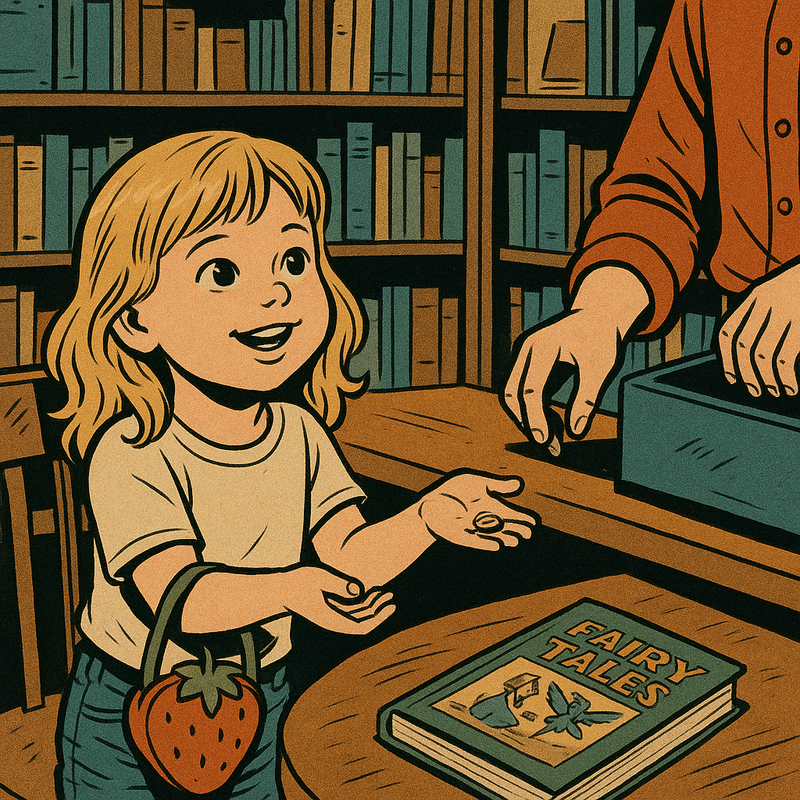
Jess came up on tiptoe, strawberry purse already in her hands. It was vinyl red with tiny embossed seeds, the zipper pull a green felt leaf that made a satisfying fwip when she tugged it. She laid it down with ceremony, palm flat. “I pay,” she said, solemn the way kids are at weddings.
Tara’s smile softened to meet the moment. “An excellent plan,” she said, and set the two paperbacks side by side like sleeping cats, the scanner’s red line whisking over the back covers with two polite bleeps. The register keys made that satisfying chunky clack—real buttons, rounded at the corners from a decade of holidays. The drawer sighed open with its small bright ding.
Jess pinched the zipper tab between finger and thumb and pulled. Coins scooted forward with a little metallic hiss. She rooted in with decisive fingers and came up with treasure: a quarter, two dimes, a nickle that looked tired, and a triumphant scatter of pennies, some shiny, some the color of old rooftops. She poured them onto the counter in a river that made Tara’s eyes go delighted and the woman behind them in line tilt her head like she was hearing a tiny song.
“Strawb’rry had moneys,” Jess reported, nudging a penny so it didn’t roll. “It’s heavy.”
“Oh, I can tell,” Tara said, and she reached under the counter for a little plastic dish with a bookstore logo and slid it close. “We’ll give your strawberries a rest and let the money take a nap in here.”
Jess tipped the quarter into the dish as if placing a baby into a crib. Then the dimes, then the nickle. The pennies she counted on the counter itself, lining them like buttons. “One, two, five, six, ten, twelve… a lot,” she concluded, satisfied.
“Classic math,” Tara said gravely. “My favorite kind.” She lifted one penny to the light as if it might be a special vintage and set it back with its brothers.
While Jess arranged her army of copper into two squads, Glenda slid the Waldenbooks bag’s paper mouth open with her left hand and, with her right, eased a folded bill from the deep pocket of her coat. It was the kind of movement that had practice in it—nothing sneaky, nothing showy, like palming a mitten. The bill rested for a second against the shadow of the glass pen case, then made a small, private journey to the counter edge where Tara’s fingers already were, tidying a stack of receipt paper. Tara’s hand closed around it without looking down, the way you reach for a friend’s elbow when the crowd shifts.
“Do you want a bookmark?” Tara asked, eyes on Jess, voice cheerful as a kettle. She turned the mug so the choices presented themselves like a fan: cats peering over pages, a moon with phases in white ink, a rocket ship shaped like a pencil, a spray of stars.
“Stars,” Jess said immediately, pouncing on the constellation. She stroked the tassel as if it were fur. “For Ho-Ho.”
“A stellar selection,” Tara said. The register hummed, printed. She tore the receipt on the soft-perf metal edge, its curl of paper smelling faintly of ink and warm machine. Without missing the beat of the game, she slid one long ribbon—folded very small—toward Glenda with two fingers, the way you pass a secret note under a desk. The other, shorter ribbon she presented face-up to Jess. “Your copy,” she said, as if the tiny totals meant anything but ceremony.
Jess accepted it with the care of a diplomat. “I hold da paper,” she said, tucking it into the strawberry purse and patting the zipper closed with both hands. The purse made its fwip again, satisfied.
“And now,” Tara said, reaching toward the dish with all the gravitas of a bank teller, “I shall give the cashier… that’s me… your very important coins.” She let the quarter ride on her knuckles, flipped it once—a shy little arc—caught it with a snap that made the boy in line behind them lean forward. She laid the quarter in the drawer tray, where it made a round sound. The dimes chimed; the nickle thunked like a small opinion. The pennies, all together, went with a pleasant, clattery hush. She plucked one especially bright penny back out and held it like a prize. “And look at this,” she whispered to Jess. “For you—a good-luck penny for next time.”
Jess’s mouth made an O big enough to catch snow. “For me?”
“For you,” Tara said, putting it flat on Jess’s palm. “You paid like a pro. That deserves luck.” The penny looked absurdly beautiful there, a tiny sun on a mitten-warm hand.
“Fank you,” Jess breathed, closing her fingers around it so tight her knuckles went white. She popped it into the strawberry purse as if it might evaporate in air, then zipped and patted again for good measure.
The drawer dinged shut. Tara slid the books into a handle bag printed with tidy block letters, nestled the star bookmark on top as if tucking someone in. “Do you need a gift receipt?” she asked the air in a tone that, by miracle of December, fell on adult ears only.
Glenda’s chin dipped: yes. Tara slipped the small strip under the book’s flap where it wouldn’t be discovered by the wrong eyes. Then, unable to help herself, she reached into a ceramic cup and pulled out a rubber stamp, a self-inker with a star on its face. “We have a very official thing here,” she told Jess, lowering her voice. “We can stamp the inside front page so the book knows who it belongs to. May I?”
Jess considered, then nodded with the gravity of someone licensing a wizard. Tara opened the Egypt book just enough to find the white before the story began and pressed the stamp—thup. When she lifted it, a small star bloomed in purple, right above the first line. “There,” she said. “Now it knows it’s going home with the right people.”
Jess arched on her toes to see. “Star,” she whispered, delighted. “Like cwips.”
“Like clips,” Tara echoed, handing the bag handle to Jess first. The paper made a rustle that sounded like pages turning. Jess wrapped her fingers around the twine and lifted. It was heavier than Francesca’s, lighter than the tea suitcase; she adjusted her elbow to balance all her worlds and beamed.
Glenda reached for the bag, then stopped herself and set her knuckles on the counter instead, just in case they needed to anchor the air. “Thank you,” she said, and the thanks had layers in it.
“Happy reading,” Tara said, because that’s the blessing you give in a place like this. Then, like an encore, she reached beneath the counter and came up with one of those tiny sheets of gold star stickers—teacher currency. She peeled one and stuck it, with ridiculous ceremony, on the corner of the paper bag. “For the person who paid,” she said.
Jess put her hand over the little gold badge as if taking an oath. “I buyed it,” she announced to the table of staff picks, the squeaky spinner, the adolescent in line with the skateboard who tried not to smile and failed. “It’s for Ho-Ho.”
“Ho-Ho has excellent taste,” Tara assured her.
They stepped back from the counter as the next customer edged up, and the noises of the store stitched themselves together again—ka-chunk, bleep, the soft hush of a paperback being tested open. Glenda slipped the folded small receipt into her coat pocket, felt the reassuring grain of the paper against her fingers, and let her hand fall to Jess’s shoulder, light.
At the threshold Jess paused, turned around, and executed a very formal wave. “Bye-bye,” she told Tara, who was already ringing someone else up but somehow found a free hand to give a tiny salute with the receipt spool core as if it were a telescope.
“Bye, ma’am,” Tara said, grinning. “See you after chapter one.”
The mall air hit them again—brighter, louder, cinnamon sneaking back in like a friend who’d been waiting by the door. The spinner rack behind them squeaked once for luck. Jess took three measured steps, then stopped as if her brain had caught up with her feet and needed to make an announcement. She tipped her face up so Glenda could see the shine of it. “Mama,” she said, breath sweet with cocoa memory, “I paid.”
Glenda kissed the spot between her eyebrows where the clip held the hair back and said, “You surely did, baby.” She took the robe bag; Jess took the books. The penny in the strawberry purse made a tiny, contented tap with each step, like a heartbeat muffled in vinyl.
They were three steps out of Waldenbooks when glass did its old magic. A display case along the corridor—mirrored back, glass shelves—caught the mall’s light and multiplied it into a constellation of tiny worlds. Snowglobes in ranks: planets you could hold. Inside them, miniature villages with red doors and smoking chimneys, a carousel horse forever mid-prance, a polar bear in a scarf, a nativity no bigger than a walnut shell, a pewter train circling a hill that would never be climbed. Some sat on plain black bases; others wore music boxes around their waists, gold keys tucked like secrets.
Jess drifted toward them as if the tiles had gone magnetic. She pressed her fingers to the glass and felt the cold through her little heat. The saleslady behind the case—silver hair swept into a twist, holly pin at her collar—looked up with the slow, fond smile of someone who understood the ritual.
Jess’s breath made a foggy oval. “Look,” she whispered. “Dey have tiny snow.”
“I see ‘em,” Glenda said, sliding up beside her. The globes were all the season in miniature—the rush made small enough that you could set it on a shelf and tell it to calm down.
A pair of teenagers wound a key on one of the music-box bases, and a tinkling “O Tannenbaum” rose thin and sweet. Another globe had a little Huntsville secret inside it: a thumb-sized rocket pointing at the ceiling, snow falling around its clean white edges, a crescent moon the color of a pearl caught in the glass sky. Jess spotted it and made a soft, involuntary sound that lived between an ooh and an oh.
“For Toyah,” she said in a rush, urgency fizzing up under her words the way water sometimes fizzes when you tip a globe too fast. “We get one for Toyah now ‘fore they all gone.” Her chin went brave, eyes big, as if she’d seen the future and it was a shelf with only a sad empty circle where a snowglobe used to sit.
Glenda felt the little tug in her chest again—pride loosening like a warm hand inside her—and she hid the wet smile before it took up residence. “Okay,” she said, quick as a promise, because being earnest deserved speed. “We’ll pick one now.”
“Dis one.” Jess tapped the glass very gently above the rocket. “Toyah like sky. An’ it’s Hunts-bill,” she added, copying a pronunciation she’d heard all week and believed in.
The saleslady had watched the selection land. She bent with a key, opened the case, and lifted the rocket globe with both hands, the way you pass a newborn. Up close, the glycerin held the snow in patient suspension; the rocket’s stripes were painted with the world’s tiniest brush; the moon winked whenever the mall lights got brave. “Want to hear it?” the lady asked, and wound the base. Notes stumbled out—a polite, tinkly “We Wish You a Merry Christmas.” Jess tipped the globe and the flakes swirled, a slow, starry blizzard. She held her breath to listen.
“Toyah like dat,” she declared, eyes not leaving the orbiting flakes. “An’ she shake it soft, like dis.” She demonstrated the gentle tip and let the snow fall without slamming.
“We can have her name written on a little tag,” the woman offered, reaching for a drawer with tissue that made the sound of paper snow. “For the ribbon.”
Jess nodded so hard her clip flashed. “We need to say… ‘To Toyah, fwom Jess an’ Glenda.’” She paused, frowning, then added, “An’ Ho-Ho,” generous to include a sister in every good thing.
“We’ll get all the names,” Glenda said, amused and disarmed by the fervor. She set the Waldenbooks bag on her arm, shifted the robe cloud to her other side, and gave the woman the quiet nod that meant she should ring it up before the little customer’s urgency evaporated in a new direction. The lady wrapped the globe in tissue and tucked it in a narrow box with a clear window so the rocket could peer out like a secret that wasn’t trying very hard to hide. The scanner made a single chirp; the receipt curled warm into Glenda’s palm. When the woman slid the box across, Jess laid her hand on the plastic and breathed, as if the snow might fog.
“We save it till Cwiss-mas,” Jess said, the box already gathering gravity in her arms. She looked up, face earnest. “I don’t want it be all gone.”
“It won’t be,” Glenda told her, smoothing a thumb over the crown of her head. “We’ve got it safe. Toyah’s getting her own little winter.” She said it with a soft laugh she didn’t quite try to hide, because Jess had wound herself up with the thought of scarcity and then solved it like a pro. The saleslady made a mental note to tell someone later about the girl who rescued Christmas from potential emptiness by sheer force of will.
They made their way down the corridor, bags thumping in complicated rhythm, until the smell of Scotch tape and curling ribbon announced the wrap station before the sign did. A long table stood outside a shuttered storefront, draped in red cloth, supporting a forest of wrapping paper rolls in a bucket: snowmen with carrot noses aimed skyward, metallic stars that turned every light into a bright mistake, candy cane stripes bold as a barbershop pole, a pale pink satin-finish that looked like frosting. A hand-lettered sign read GIFT WRAPPING—DONATIONS BENEFIT THE SHELTER, with a glass jar beside it where bills slouched and coins winked. Volunteers in jolly sweaters and Santa hats worked in pairs, tape guns holstered, scissors sliding through paper with that satisfying zip. Behind them, a card table held tags, twine, and a bowl of cheap pens with heroic aspirations.
“Next!” sang a woman with a reindeer brooch, cheeks apple-red even without blush. She had the brisk kindness of a school secretary and an apron that read WRAPPING IS MY LOVE LANGUAGE. Her partner—a teenage boy with a buzz cut and the gentle hand speed of someone who took pride in crisp corners—cleared a rectangle on the table with a sweep of his palm.
Jess stepped forward like a contractor with blueprints. “Pink for da robe,” she announced, pointing with two fingers at the frosting roll. “An’ starry silver for da book. An’ candy canes for da tea set because tea needs candy.” Her authority wobbled only enough to be adorable.
“Specialist on staff,” the reindeer brooch said, mock solemn. “I love when project managers come prepared.” She hauled the pink roll to the fore and measured the robe cloud bag by eye. “Bows big or small?” she asked as her scissors started their whisper.
Jess took a breath, set her shoulders, and delivered judgment. “Big. Ho-Ho is big girl.” She added the last three words with such conviction that the boy with the buzz cut bit his grin back into a respectful line.
“Bows to match,” Glenda murmured under her breath, unable not to smile as she eased the robe from its store bag, keeping the receipt tucked in her coat. The fleece sighed onto the table and the volunteer folded pink paper up over it like tucking in a child. The tape made little satisfied pips. A fat satin bow bloomed on top—pink on pink, not subtle in the least and exactly right.
“Tag?” the boy asked, pen poised. “To and from?”
Jess leaned across the table on her elbows, as close as her ribs would allow. “To Ho-Ho,” she intoned, then added the family tree in case of confusion. “Fwom Glenda an’ Jess.”
“Glenda and Jess,” he wrote in tidy capitals and then, because he’d been listening, drew a tiny star in the corner. He looped the twine through and set the tag like a little flag by the bow’s knot.
Next came the books. Glenda laid the Waldenbooks bag flat and slid the museum paperback and Egypt book onto the paper like cards in a trick. The boy tested the width of the metallic stars with a small tug and the paper gave back its light in a rainbow blink. He wrapped with surgical corners, a gift that felt like a promise even before the tag went on. Jess supervised with the kind of gravity usually reserved for bridge engineers. “Stars need a star bow,” she decreed, pointing to a spool that threw sparks under the fluorescent lights.
“Star bow it is,” the reindeer woman said, and made one from scratch with a flourish—loops that layered and pinched into a bloom. She set it off-center like the sky knew what it was doing.
“Tag?” the boy asked again.
Jess pointed to her own chest, then to Glenda. “Fwom both.”
“To Holly,” he wrote, because in the end you write the name you say all day.
The tea suitcase was the oddball. Jess plonked it up, patting the handle. “Candy canes,” she reminded, lest anyone present the wrong festival.
“You heard the lady,” the woman said, and rolled out a rectangle of red-and-white stripes. The boy cocked his head, considered the geometry of wrapping a suitcase without making it look like a trout, and then ran his scissors with a zzzip. He folded the paper so a clean stripe followed the suitcase’s seam and taped along the handle’s base, leaving the loop out so someone small could carry it and still not ruin the paper. A bow went on one corner like a bright thought. He stepped back, admired his own work, and then put a candy cane from a dish under the bow’s knot because campers don’t ignore obvious metaphors.
Jess clapped once, trying to keep it quiet and failing. “Tea needs candy,” she whispered approvingly, as if she’d invented the food pyramid.
“And what’s this little beauty?” the reindeer woman asked, as Glenda lifted the lilac nesting dolls’ starry box from their bag. The woman leaned in, caught the picture in the clear oval, and made an oh at the tiny faces. “For the same big girl?”
“For the same,” Glenda said. She cleared her throat around a sudden tenderness and fished in her tote for the lilac ribbon that had come with the shop, laying it on the table like a color key. “Maybe just tissue and this? So she can open the box and see them in a line?”
“We can do the gentle sort,” the boy said, reaching for crisp white tissue. He wrapped the box like a bandage, snug enough to keep its dignity and loose enough to let the starry blue peek through. The lilac ribbon bow went small and smart on top, a little crown rather than a prom dress.
A bell from somewhere made a delicate sound—maybe the handbell ringers on their break testing one note in the middle of the food court. Jess wobbled a little with happy fatigue, then rallied. She lifted the rocket snowglobe box onto the table and tapped it decisively. “For Toyah,” she told them. “She likes sky.”
“Ahh, a good eye,” the woman said. “We have… snowflake paper.” She pulled a roll that looked like frost frozen mid-breath and wrapped the globe tight enough to keep the window over the rocket’s face. “So she can peek without peeking,” she said, and Jess nodded, approval of trickery granted.
“Tag?” the boy asked, again, lifting his pen.
Jess dictationed solemnly. “To Toyah. Fwom Jess an’ Glenda… an’ Ho-Ho.” She added the last with a glance at Glenda that said she knew the universe had rules about including siblings in generosity.
“That’s a lot of Santas,” the boy said, writing, and stuck a little sticker of a crescent moon in the corner of the tag just because it felt right.
Glenda pulled an envelope from the inner pocket of her coat where she kept the month’s arms-length plans, slid folded bills into the donation jar’s mouth, and heard the soft chatter of paper against glass. The jar clinked back—coins saying their goodbyes to the afternoon. The reindeer woman gave her a small, grateful look without making a moment out of it; December is full of moments and some are better kept folded inside the day.
“Big or small bow for Toyah?” the boy asked, holding two candidates in the air.
Jess considered this as if choosing crown sizes for a coronation. “Small,” she decided at last. “She’s not big girl Ho-Ho. She’s… she’s Toyah.” Which somehow meant the bow should sit neat and clever, not shouty.
“Small and smart,” the woman said, pinching loops into place. It landed like a punctuation mark.
They loaded the finished parcels back into their arms, an armory of boxes and soft-wrapped promises: pink cloud with its audacious bow, starry rectangle that chimed faintly when you shook it because a bookmark tassel had ideas, candy-caned suitcase with its carrying loop preserved on purpose, lilac-crowned secret, and the little winter for Toyah with its moon-stamped tag. The volunteer slid a handful of stick-on gift tags across the table as a bonus. “In case you think of anyone on the walk to the car,” she said, knowing full well how minds worked when paper was near.
“Fank you,” Jess said, mouth round with sincerity. She reached into her strawberry purse on instinct, came up with two pennies and a button shaped like a star she’d forgotten she had, and dropped the pennies into the jar with a ping-ping. The star she kept, pressing it into her own palm as if it needed to feel her decide. Then she looked up at the volunteer with the most serious face she had. “We need bows big ‘cause Ho-Ho big girl.”
“Bows to match,” Glenda murmured, smiling where only Jess could hear.
“Bows to match,” the reindeer woman repeated, pleased by the poetry, and sent them off with a flutter of tape end like a flag. The mall air wrapped around them again—bells and cinnamon and the faint ghost of sandalwood still clinging from the import kiosk. Jess walked like a page in a procession, arms full of promises, the pink bow bobbing, the candy-striped suitcase’s loop held in her small hand like a leash for a very good pretend dog. Glenda took the heavier bags, the lighter jokes, and the rest of the afternoon, and together they went looking for their car under the false sky that carried its own December.
The escalator hummed its low, tireless song, a silver river flowing down toward the parking lot doors. The steps winked their yellow edges as they rose out of the comb plate—teeth and tongue—and disappeared again, carrying whole afternoons on their backs. Air shifted cooler near the exit; the cinnamon of the mall thinned into the faint draft that smelled like winter and damp coats, tape and ribbon static against sleeves. In each of Jess’s hands a bag bobbed—starry rectangle in one, candy-caned tea suitcase looped through the other—while the pink-bowed robe rode in the crook of Glenda’s arm like a dozing cat. The lilac-ribboned dolls, slim and dignified, leaned against her hip; the Waldenbooks sack knocked her knee with a respectable thump. The snowglobe box with its peeking rocket nested safely in Glenda’s other hand, tissue whispering under plastic.
They reached the shiny steel lip together. Jess stepped first, aiming for the timing she always nearly had. For a half second the world did a tiny slip—bag tugging one way, foot hovering, the step’s sudden shiver under rubber soles—and she hesitated, the tread passing away just before her toes met it. Glenda’s hand was already there, the automatic catch a mother’s body knows by heart, fingers closing above Jess’s wrist like a strong ribbon. She guided the small foot forward to the very next step, onto the grooved metal, onto now instead of almost, and there they were, rising and falling and going, the rubber handrail warm under their palms. The pink bow shivered; the tea-suitcase loop swung like a tail; Jess let out a puff of breath that fogged for a second in the cooler air and then vanished, like the fake snow back by Santa.
Glenda felt her heart bump—just one surprised knock against her ribs—and then she laughed, soft, because the world had righted itself and her hand was still on her girl. “Gotcha,” she said, as if she’d caught a hat the wind had tried to steal.
Jess blinked up, all eyelashes and solemnity, then smiled because that’s what you do when the scare is already turning into a story. “I okay, Mama,” she announced, chin brave, bags steadying into their sway. She leaned her shoulder into Glenda’s side, a small ballast. “Ho-Ho be so happy.”
“She will,” Glenda said, and the escalator’s hum agreed. The view widened as they rode: wreaths retreating, the paper stars at the charity table glinting like winks, the Santa set in miniature at the far end, his hat bell a memory. The glass railing gave them back to themselves in reflections—Jess’s clip flashing, the pink bow a flag, Glenda’s coat collar furred with a fine drift of glitter someone else had shed.
She watched their feet where metal teeth met rubber soles. Steadying small feet today; steadying a new young woman tomorrow. Same job, different steps. The thought came clean as a bell, as simple and entire as the way her hand had found Jess’s. Holly at the top of a different escalator in a different year—longer legs, a new kind of hurry in her, a laugh that would sometimes start down in her chest like a grown person’s. You keep a palm light at the elbow; you say the name out loud when the world is loud; you make sure the next step is there when it needs to be. You don’t change the work, just the angle.
Below them, a toddler in a pom-pom hat stomped the moving stairs on purpose, testing the physics with gleeful disbelief, while his dad pretended to grab his hood every other step like a tractor beam. Behind, a teenager rode hands-free, bags looped at her wrists like bangles, eyes distant in that I-am-in-a-song far away way, and Glenda thought, That’s a step too. The handbells had gone quiet now, but somewhere the kettle by the charity jar rang with a practiced wrist, and the sound folded into the escalator’s drone like a harmony you only hear if you’re listening.
Jess’s strawberry purse bonked her hip. Inside, the good-luck penny knocked once against the vinyl—a small, tinny heartbeat that kept time with the stairs. The candy cane from Santa’s line slept in the JCPenney bag’s pocket like a promise to be discovered after dinner. The star bookmark nestled with the paperbacks, tassel making a faint, conspiratorial rustle whenever Jess swung an arm. The lilac dolls, belly-secret keepers, waited to be opened and opened and opened. The robe—cloud waiting for a shoulder. The tea suitcase—doilies like moons. A whole day of tiny worlds balanced on moving metal.
“Next time we ride we hold the handrail, captain,” Glenda said, not a scold, just the way you name the weather so everyone brings a sweater. She curled Jess’s fingers around the rubber and felt the static pop, felt Jess’s palm settle.
“O-kay,” Jess agreed, and then, because reassurance wasn’t a one-way street, she added it again for good measure: “I okay, Mama.” She tipped her head, cheek grazing Glenda’s sleeve. “Ho-Ho be so happy.” The words carried all the packages they had bought and some they hadn’t: the kind where you sit on a couch with your feet under a robe and a book in your lap and a three-year-old’s head on your shoulder; the kind where you pour pretend tea and then real cookies appear as if by magic; the kind where secrets go into a journal and some come back out as questions you’re brave enough to ask.
The escalator teeth kissed the lower comb and the steps flattened into floor again. Jess made a tiny hop to land on tile—ceremony—and the bags all rustled like applause. The doors yawned open in their glass frames; beyond, the parking lot lay under a sky the color of metal, streetlights just beginning to find their halos. A gust pushed in, gentle enough to lift the pink bow’s loops and make them breathe. Somewhere to the left, a cart boy whistled a song that might have been a carol if you were generous; Glenda was, and it was.
They adjusted loads without speaking—Glenda trading the snowglobe box to her inside arm so it wouldn’t take the wind, Jess proud with the book bag because it was the important one. The tea suitcase loop found Jess’s wrist again; the lilac ribbon trailed an inch and Jess smoothed it with a forefinger like petting a kitten. Their reflection in the glass doors doubled, then parted as the sensor found them and granted exit.
On the concrete spillway outside, air thinner and bright, Glenda angled them toward the side where the wind didn’t bite so sharp. She thought of the sentence that had rung in her: same job, different steps. She thought of the elevator inside the hospital where Holly had been born, the way she’d stepped out trembling with a brand-new person and found that every floor felt like a cliff and also a porch. She thought of the escalator the first time she’d ridden it with Holly—how tiny sneakers had hesitated and how her hand had been exactly the right size, then, too. She smiled at the sameness of the difference.
“Mama?” Jess said, checking her with a glance like a bird checks the wind. “We home soon?”
“Soon,” Glenda said. “We’ll put the presents where Ho-Ho can’t sniff ‘em out, and we’ll make something for supper, and maybe we’ll do chapter one before bath.”