Work Text:
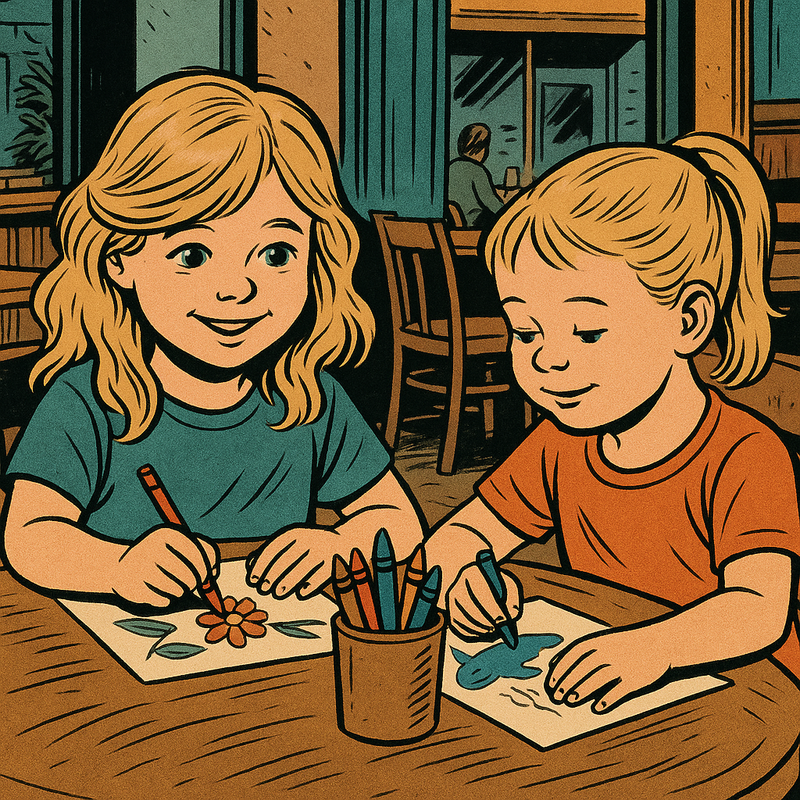
The Blue Magnolia was awake in its steady way—coffee thumping in the old Bunn, forks chiming bowls, the low talk of regulars rising like heat from grits. Glenda had claimed the corner booth by the mural—a wash of blue petals and blackbirds the teenagers painted two summers ago—and turned it into a small kingdom: paper placemats, a cup full of crayons, two small sippy cups sweating rings on the Formica. Jess and Toyah sat on their knees like queens, toes tucked under, eyes bright with the industry of artists who had just remembered their favorite task.
“Okay, my artists,” Glenda said, tying her apron, pencil tucked behind her ear. “Y’all are in charge of masterpieces. I’m in charge of biscuits and coffee. If you need me, holler ‘Gwen-duh!’ like a fire truck, but only if it’s real important, okay?”
“’Kay,” Jess said, already selecting a purple crayon with the solemnity of a surgeon choosing a scalpel.
“’Kay,” Toyah echoed, patting the stack of paper like it might purr if she was gentle enough.
Glenda bent to kiss both heads—one that smelled like kid shampoo and warm sugar, the other like crayons and orange slices—then slid out toward the counter.
Between plates, the day gave Glenda a little pocket of quiet—the sort that opens when the coffee is topped off, the cornbread’s in the oven, and the bell at the door is catching its breath. She slid a check beside Mr. Ellis’s soup and, as she turned, memory rose up the way steam does when a lid is tilted: warm, familiar, impossible not to breathe.
Earlier, the kitchen had been all morning light and the dry whisper of the calendar page as she flipped it. Mason stood by the back door like he always did, keys in his hand, that look on his face that said he’d already found five “little things” to fix on the way to nowhere.
“Uh-uh,” she’d said, stepping into his space with a grin, pressing her palms flat to his chest as if pinning him to the moment. “Make yourself scarce today.”
He smiled, already arguing without words.
“No,” she said, more amused than stern. “Not a honey-do, not a might-as-well. Scarce. As in, if I go looking, I can’t find you.”
He looked past her shoulder at the sink piled with breakfast bowls she’d ignored on purpose. “You sure?”
“I’m aggressively sure.” She plucked the keys from his fingers and dropped them back—permission granted, but on her terms. “In fact, call one of the boys from the garage. Let him be your chauffeur. You ride shotgun. Y’all can sing Merle to your hearts’ content up and down the county.”
Mason ducked his head, the smile creasing deeper. “Merle, huh.”
“Mm-hmm. Honky-tonk, heartache, and harmonies. Something that isn’t a socket wrench. Take the road out to the lake, or the junk store with the maps, or the diner with the terrible pie you claim to love because the woman at the register calls you ‘sweetie.’ I don’t care where—just not here, and not under anybody’s hood.”
He scratched his jaw, the little stall he used when he wanted to say yes but habit made his mouth slow. “A chauffeur. I gotta get a hat for the parade?”
“You have a hat,” she said. “You never wear it because you think it makes you look like a man who’s about to sell a tractor. Which you are but in a handsome way.”
“Merle,” she said, and tugged his shirt to pull him down for a kiss. “Let that boy drive and you sing like your life depends on it. I’ll see you tonight with a story in your pocket.”
“Only if you take a minute for yourself,” he bargained, because love is made of trades that aren’t really trades.
“I get my minute every time I pass the corner booth,” she said. “Now go. Be scarce. Call when you’re done being scarce.”
He had nodded, finally, surrender written all over him in a way that looked like grace. On his way out he’d palmed the battered cassette he kept on the counter—a copy he’d dubbed himself years back—and slid it into his jacket. “In case the radio’s preachin’ or talkin’ sports,” he’d said, knowing she knew.
In the corner gallery, Toyah’s tongue peeked from the corner of her mouth as she drafted. First came the wheels, not circles but stars—five points each, a little lopsided where her small hand decided points were better if they leaned. She pressed harder at each tip so the lines darkened, giving the stars weight, as if the car would grip the road by sheer sparkle. She narrated under her breath, the running commentary of a designer at work. “Star, star, star.”
Jess watched, purple crayon poised above her latest horse, and nodded in approval. “Stars make you go fast,” she said. “Like—” Her hand opened and shut. “Like snap.”
“Fast but polite,” Toyah murmured, revisiting the rule. She stroked the outline of the body, long and open, the convertible line dipping low, then rising with a proud little curve over the back wheel. She drew the windows next. Hearts, of course—one big swoop, then another, until the border of each window wore a frame like a valentine. Any straight line that tried to be a rectangle got rescued and bent into soft curves. “Love windows,” she explained, serious. “You wook out and see love.”
Jess, who had just decided her baby horse needed a blanket with scallops, gasped appropriately. “Ohhh. So nice.”
Toyah added a windshield with a single careful tilt. Inside, a round-headed driver with five eyelashes and a bow sat upright at ten-and-two. A passenger—stick limbs, wide grin—wore a tiny triangle hat that meant “sun hat” to anyone who knew Toyah’s iconography. She dotted a little dashboard. “Buttons,” she said. “One for vwoom, one for toot.” She paused, drew a third, then tipped her head. “An’ one for… ’mergincy snacks.”
Jess approved with a sage “Mmm,” then pointed her purple at the back. “Make trunk big. For cookies.”
“Big,” Toyah agreed, and gave the trunk a generous belly. The outline stood there, sure of itself and waiting. The body’s color was white paper still, humming with possibility.
A clatter from the kitchen—somebody dropped a pan—and Glenda was moving before the sound fully landed, her hand tapping the girls’ table twice on the way by as if to pin the moment in place. “Two specials up,” called Bea through the pass. “And tell Will he can’t sing Conway Twitty at eleven-thirty in the morning. We got children in here.”
“It’s educational if he’s on key,” Glenda said, and Bea snorted.
Between orders, she brought the girls a plate of apple slices and two extra napkins folded into triangles. “Snack break,” she sang softly, because everything that rhymed was easier with children and exhaustion. “One for Jess, one for Toy.” She kissed each forehead without asking. “No sharing of germs, just crayons.”
“Okay, mama,” Toyah said gravely, accepting the rules as if they were ancient law.
“’Kay,” Jess echoed, already chewing, already drawing again, apple slice stuck politely in her cheek like a secret.
She searched like a bird for water, quick turns of the head, then—there. At the edge of the cup, half-buried under a green and a tired blue, the hot-pink lay like a secret. The sight of it prompted a squeak. “Eee!” And another. “Peeeenk.”
Toyah remembered herself. She tucked her hands in her lap and turned to her cousin with the gravity of ceremony. “Jess,” she said, gentle voice very polite, “pwease pass the hot pink to me pwease.”
Jess’s smile bloomed like it had been waiting on the windowsill. She fished the crayon out, wiped a little wax dust off on her own paper as if to present it shiny, and handed it across thw table with an open palm. “Here you go, Toyah.”
“Fank you,” Toyah said, and only then did her fingers close around it, both hands like it might fly away if she wasn’t gentle.
She tested a corner. The pink laid down a bright, glossy stripe. Her whole face lit, cheeks rounding. Then she began in earnest.
She started at the front fender, coloring in small, tight circles the way Glenda had once shown her when they decorated a sign for the bake sale—no hard stripes, no long scrapes; circles make it deep. Layer by layer, the body filled. The hot pink leapt off the paper in little gleams, catching the restaurant light where the wax thickened. At the wheel wells she had to slow, steer around her star points like a driver taking a corner without bumping the curb. “’Scuse me, stars,” she murmured, tip of tongue back out. “No touchie.”
Jess leaned her elbow on the table and propped her chin in her hand, horse temporarily forgotten. She watched with the kind of reverence reserved for magic tricks and trucks that carry animals. “It so pink,” she whispered. “Like candy.”
“Fast pink,” Toyah clarified. She worked past the door and into the sleek belly she’d drawn, keeping to the line as if it were a rule you could love. The wax left little curls at the edge. She paused to brush them aside, blowing very softly so she wouldn’t scatter them over her clean windows. The hearts stared back at her, white for now, waiting to be decorated later with something silver or maybe tiny dots. “Heawt windows,” she reminded herself, because names mattered, then set back to it.
The pink warmed under her grip, the paper warming too, and the smell of wax—sweet, almost like a crayon factory picnic—rose in a little cloud. Toyah’s circles widened when she reached the door, then tightened again at the handle. She switched to her left hand for a second to rest her right, then remembered she wasn’t ambidextrous and switched back with a huff.
“Do you want me to hold your paper?” Jess asked, reading the huff for what it was.
“Pwease,” Toyah said, and Jess flattened both palms on the top corners like a bookend. The paper stopped wriggling. The pink went smoother. The car began to glow.
Across the aisle, Mr. Ellis half-turned in his seat at the motion, spoon suspended. He didn’t say anything, just smiled then turned back to his soup.
Toyah reached the trunk, and that was where she poured the most pink of all, because that was where the snacks lived and you had to protect snacks with color. The crayon got shorter in her hand, the paper took on a waxy sheen you could see from the doorway. The pink didn’t just fill the space; it came forward, like the car itself had slid an inch toward the aisle, as if it wanted to be parked right there between the sugar caddy and the salt.
“Sparkly,” Jess breathed.
Toyah paused and looked. It did sparkle, in the way wax will when it’s laid thick and rubbed twice, little facets where her circles overlapped catching the light from the window, the neon diner sign next door flickering an extra life across it. She smiled, wide and private, then went back to smooth any places that still looked like paper.
“Girls, how’s our creative division?” Glenda’s voice floated by on the way to the counter, but she didn’t stop because Ms. Loretta had raised an eyebrow that meant coffee. She tapped the booth once with her knuckles—carry on, I see you—then moved along, the selective attention of a mother who can see six things at once.
Toyah finished the main body and blew across it gently, the way Addison blew on her coffee. A fine pink mist of wax crumbs scattered like confetti. She giggled, then, remembering, pressed the side of the crayon and burnished the door until it glowed even more. The pink leapt so hard off the page it looked like it could paint your hand if you hovered it in the air.
“Shiny parts,” Jess said helpfully, nudging the silver crayon Glenda had dropped off earlier. “The bumps. The metal.”
“Yeah, soon.” Toyah said, as a person with a comprehensive plan might. First she colored the small stripe along the hood; then she paused to outline the license plate rectangle and wrote, deliberate and wobbly: T O Y A H. The letters sat proudly crooked. She outlined them in the faintest pink. “Mine,” she announced, not to stake ownership but to complete the ritual.
She set the pink down and flexed her fingers—one, two, three. The pad of her pointer was rosy, as if it had borrowed a little color. With ceremony, she picked up the silver and traced a thin border around the hearts that framed each window. The silver didn’t shout; it whispered, and in whispering made the pink shout louder. She added a tiny silver line for a chrome strip along the side because the Toyah mobile was classy, and two dots for bolts on the bumper because bolts were important.
“Bumpah,” Jess echoed, absorbing new vocabulary.
Toyah took a breath. “Seat-belts,” she said, drawing two diagonal lines across the stick figures’ shoulders—one for her, one for Jess—then two little squares for buckles that clicked with a sound you could almost hear. She drew a small rectangle under the dash and labeled it with one careful B. “Bafroom,” she explained, pleased that she’d remembered to include the essentials of a long drive.
Jess pointed with the purple. “Cup holdeh,” she suggested, because some luxuries were not optional.
Toyah drew two circles between the seats and filled them with the lightest blush of pink, as if they were holding strawberry milk already. She reached for the gold crayon then, testing the hood with two gentle swipes. The sun came alive on it, a warm gleam. She dabbed a dot of gold at the center of each star wheel, a hubcap jewel. The wheels, already stars, seemed to wink. “Twinkle twinkle,” she sang under her breath, a single bar, and tapped each tip to make sure it felt finished.
Jess’s horse herd had been patiently waiting. She gave them a job: the purple mama horse now stood at the crosswalk, a traffic guard with a gold badge she quickly scribbled on, while the orange baby watched the car go by. “We stop ’cause polite,” Jess told them, aligning fiction with rules. She added a little stick sign at the corner—S T O P, letters like stepping-stones—and nodded at Toyah. “Okay, green light now.”
She added the turn signals, little amber triangles pointing left and right. “Fireflies,” she said, flicking an imaginary switch. She touched the horn she’d drawn and whispered “toot,” experimentally. Then she looked up and found Glenda watching from the end of the aisle, coffee pot tucked like a baby at her hip, pride spread over her face like sun.
Toyah set the paper down carefully, smoothing the edges with both palms like a baker doing a crumb coat. She touched the pink one more time, just a light pat, as if to bless it. The color didn’t smudge. It stayed, bright and sure, as if it had made a promise to the page and meant to keep it.