Work Text:
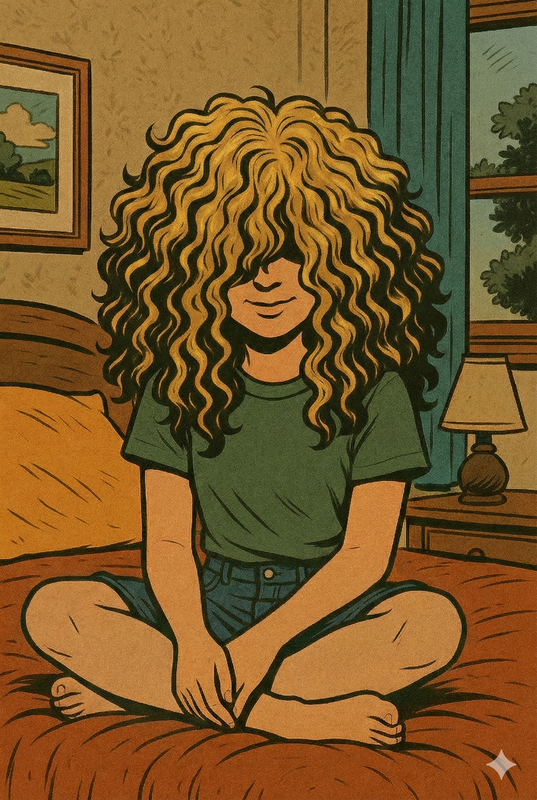
Holly sat on the edge of the bed with her shoulders squared and her chin level, a small statue of resolve dressed in an oversized sweater. A tide of blonde curls—dense, springy, deliberate—poured forward from her crown and settled over the upper half of her face like a veil. The curls kept their own counsel, banded in soft spirals that caught the light and made a tiny, private weather out of the space in front of her eyes. She did not push them back. The sweater sleeves had crept past her wrists and pooled at her knuckles, soft with years, the knit pilled in constellations that mapped every wash and wear.
Her feet were planted, toes gripping the edge of the rug as if she could anchor the whole room by the press of two heels and ten quiet toes. The bed beneath her creaked a familiar creek-plank note, the sound of a frame that had known other seasons and other moods and had learned not to argue with either. The quilt was slightly askew from the straight line she liked—just enough to prove a life was being lived on top of it. One hand found the seam of the quilt and worried it, thumb crossing and re-crossing the same inch as though a path might wear smooth if she was patient enough.
Spring filtered in through the open window in clean, damp breaths, the kind that left the room feeling rinsed. The curtain breathed, ballooned, surrendered, ballooned again, a slow pulse that set the dust motes tumbling in lazy parabolas. Somewhere outside, someone’s radio was tuned wrong between stations—a smear of melody with too much static to sing along—and a lawn mower started, stopped, started again, then gave up like a conversation left for later. On the sill, a jar of water held two stems of something green that hadn’t decided to flower. Their shadows trembled across the wall in pale, underwater shapes.
The room was one room and also two. It had never been split, not by tape or furniture line, but the division was as clear as the seam down a well-made dress. Dana’s side drifted a little, arranged by motion, by projects in mid-air; Holly’s side gathered itself, composed by quiet. In the middle, an overlap—neutral ground—held a braided rug the size of an embrace and a low shelf where shared things lived: a stack of board games with softened corners, a jar full of anonymous buttons and the occasional lost marble, a cracked plastic kaleidoscope that still worked if you squinted with kindness.
On Dana’s side, a corkboard carried a thicket of pins and notes that didn’t mind touching. Notebook pages were overlapped and speared on a single pushpin: lists nested in lists, arrows pointing to arrows, a map of thought that made sense from the distance of its maker. There were leafed-through paperbacks with starbursts of sticky flags, a pencil case that wouldn’t close because it had more ideas than it could contain, a pair of high-tops collapsed in the doorway as though the person who wore them never bothered with the ceremony of unlacing. A small electric fan with a missing blade guard sat on the dresser, talented at collecting dust. A mug that used to be a Christmas gift housed pens in arrested migration—gel, felt-tip, the confident scratch of a fineliner. A black spiral notebook lay open and face-down, spine arched like a cat, a pen tucked inside as if the sentence had only stepped out for air.
Holly’s side didn’t reach, it beckoned. Her books stood straight, their spines flushed to a line; the hairbrush was set bristles-up on a folded handkerchief as if it were a small creature given a nest. A thrifted mirror leaned against the wall, oval and gilt in a way that had once been grand and was now simply warm; the glass had a faint tidal wave when you moved. On the dresser, she curated an arrangement the way some people curated weekends: a shallow dish with rings like moons rolling toward each other, a line of nail polish bottles ordered by a logic known only to her, a tiny glass bird with a chip in its wing turned so the chip didn’t show. A short string with wooden clothespins ran from the mirror’s frame to the corner of a shelf, holding up square photographs that looked like they’d been rescued from shoeboxes and given simple frames of air. Each image hovered a fraction crooked by choice.
The light found her hair first and stayed there, a loyal thing. Under that honeyed weight, the parts of her face that showed were all precision: the neat hinge of her jaw, the set of her mouth, the steady line of her chin. She breathed in a measured way, long and metered, as if each breath were being cross-stitched onto the inside of her ribs. When she blinked, the veil quivered, a curtain testing its rod. The curls smelled faintly of apples and something else that was just water-warmth and clean scalp, a private citrus caught in wool.
She had rolled up one sweater cuff to reveal the slim white of her wrist, where a hair tie lived like an extra finger’s promise. The other cuff was still down, swallowing the heel of her palm, letting her hide a fidget in the minuscule movement of fingernails against knit. Her nails were cut short and rounded, the color she wore on them grown out and honest at the moon. On one knee a tiny ladder of pilled yarn had risen where the sweater had snagged and been picked free. It made a relief map so small you could only read it by touch.
Over her shoulder, the door wore its own ornament: a denim jacket on a hook layered with the soft give of sweaters worn on other days. A tote bag hung there too, with the print half-flaked away from being read by fingers. On the floor beside the bed, a pair of socks waited in a harmless heap, one inside out, a boyish surrender to gravity. Two notebooks sat under the bed within easy reach—one for lists that steadied her like railings, one for lines that came whole and left again if ignored. The edges were darkened where her thumbs always found them.
The air had that tender brightness that comes in spring when it has rained in the night and then thought better of it by morning. It made the wood of the dresser smell like the inside of a library, and it softened the edges of the poster on the wall above her bed: a constellation chart where the names of things didn’t entirely matter, because she had her own for most of them. A sticker had been pressed on the ceiling near the light fixture, a glow-in-the-dark star that had drifted from its original sky and was now content with exile. Even now, in daytime, it held onto a suggestion of luminescence the way good memories do.
On Dana’s desk, a small digital clock with a missing segment insisted the time was either 1:58 or 7:58, depending on stance. A cassette player in the corner had a tape inside labeled in block letters with a season and a year. The plastic lid was translucent enough to let the reels show through; they looked like two unsleeping eyes. A pair of foam-covered headphones coiled patiently beside it, one ear pad nibbled by the passing of time. When the window breathed, a paper mobile made of folded cranes dipped in agreement, the quiver of air teaching them a soft choreography.
Holly’s bedspread had been chosen for the way it felt under palm and cheek; it took fingertip imprints and kept them for seconds before rebounding as if the bed itself were an optimist. Near her elbow sat a small ceramic dish shaped like a leaf, holding safety pins, a short length of ribbon, a charm whose ring had broken and was waiting for the right kind of attention. Beside it, a stubby pencil with a chewed eraser waited like a faithful dog, the lead always sharp because she wrote lightly and sharpened rarely. A folded note lay underneath the dish, not hidden so much as given a respectful shade.
At the window, the curtain breathed again and the room answered: the corner of a page lifted, a single thread on the rug waved in place, the glass bird cast a new, narrower shadow. Holly did not move more than a degree; the change happened inside the posture she had made for herself. There was nothing theatrical in the stillness, no audience to measure it, but the decision to sit like this—shoulders squared, chin level, hair a soft armor—had been made the way you choose a road you already know you’ll take. She looked like a figure from the kind of painting that pretends to be casual and instead tells you everything: the hands that know where to rest, the mouth that does not confide until it’s ready, the crown of hair that has learned its own weather and refuses to apologize for rain.
The invisible seam of the room held—her side precise as a sentence that lands, Dana’s side in motion like a thought mid-leap—and the overlap between them remained an easy country. On the shared shelf, the cracked kaleidoscope caught a slant of light and scattered it into obedient shards across both floors. A coin rolled in the dish on the dresser and came to rest with that small, definitive ring that means a thing has found its place. Outside, the mower started once more and decided to persist this time, the steady mechanical purr setting the curtain into its slow inhalations.
Holly breathed with the room, not exactly in time but near enough to keep the peace between heartbeat and house. The sweater held her like a sentence holds meaning; the hair sheltered whatever the eyes were doing; the bed remembered her weight without complaint. Everything that was hers looked back at her and waited without tapping its foot. The season had crossed the threshold, the year had unspooled to this ordinary afternoon, and in the open plan of the room—two lives practicing how to share—she sat as she chose to sit: composed, not to hide, but to become clear.
A knuckle tapped lightly on the doorframe. Phoebe slipped in with a traveling smile and the patient gait of someone who has been welcomed everywhere and never assumes it. “Darling, am I interrupting?”
Holly’s lips made a tiny, affirmative bud. She patted the quilt.
“Then I’ll interrupt beautifully,” Phoebe said, as if that were a compromise with the house. She drew a chair from the overlap between the two halves of the room—the braided rug’s neutral country—and brought it close. The chair legs made the soft hush of wood agreeing with wood. She angled the seat not toward Holly’s invisible eyes but toward the blond veil itself, arranging a conversation directly with the curls. Then she set her purse across her knees and clasped it with both hands, as though the purse were a small, nervous animal she meant to reassure.
The purse had lived a life: firm corners gently softened, a thread here and there showing where the world had caught at it. When Phoebe pressed the clasp, it made a bright, discreet click, the sound of something well-made refusing to be dramatic. A clean handkerchief waited inside among the usual pocket things—pen, tin of mints, envelope with nothing written on it yet—like a folded promise she carried around in case anyone needed one. The faintest drift of a scent came with her, not perfume exactly, more the suggestion of pages and air and the kind of soap that never advertises itself.
“Hello, you magnificent weather,” Phoebe said to the hair, her voice pitched to the curls’ level, as if good manners applied to veils. “If I speak to you, will the person you’re protecting hear me?”
Under the spill of blond, Holly made the smallest sound—half sigh, half laugh—then lifted one hand and pressed her thumb into the knit at her knee. The sweater, which had been content to drown her hands, adjusted to show the bone-bright hinge of her wrist. She gave a soft, assent-like hum that felt, somehow, like permission to proceed without promises.
“All right,” Phoebe said. “We can do this three ways: I can be an ear, I can be a mouth, or I can be furniture.”
Holly pointed, two fingers emerging from wool like pale fish surfacing, toward where the chair leg met the rug. Furniture, then. She adjusted the curl curtain with the same motion—two spirals leaping and then settling again, like good little sentries returning to post.
“Furniture it is,” Phoebe agreed, pleased. “The kind you can lean on, if required.”
The curtain at the window inhaled, exhaled. Somewhere outside, a mower found its rhythm at last, its steady burr like a cat purring in the neighborhood’s lap. The paper cranes above Dana’s desk nodded to each other: we are in a scene, we are in a breeze, we are delicate but hinged. On the shared shelf, the cracked kaleidoscope caught a slant of spring light and salted it over both halves of the room in obedient islands of color. It put a pink patch on the toe of Phoebe’s shoe and a blue coin on the floor just past Holly’s heel.
Phoebe let her eyes walk the seam that divided the room while keeping her body square to the curls. Dana’s half was itself: notes overlapping notes, a pencil marching off with a soldier’s assurance, the small fan wearing a tutu of dust. Holly’s half answered with alignment and pause: books like quiet city blocks, the hairbrush nested on its folded handkerchief, the oval mirror whose glass made everything breathe a fraction. Both approaches were correct, the room suggested; both could be true and companionable at once.
“If I address the veil,” Phoebe said lightly, “am I permitted to make statements for the record?”
Holly’s lips tilted, not quite a smile, more the preface to one. “Briefly,” she murmured—a voice from a tent, small and intact.
“For the record,” Phoebe said, “I notice the courage in your posture. It has squared its shoulders. For the record, I am happy to sit at the border and pay both customs. For the record, I brought contraband.” She opened her purse and, without fuss, took out the tin. The lid whispered when she turned it. “Would the veil accept a mint?”
Holly’s hand appeared again, palm up like a saucer. Phoebe dropped a wrapped disc into it—the paper crinkled, a soft starched sound—then withdrew, letting the hand vanish back into wool as though it had been the briefest apparition and not a handshake. The mint lived for a moment in Holly’s closed fist, gathering warmth, then disappeared toward her mouth. The paper wrapper, folded smaller and smaller, joined the stubby pencil and ribbon in the dish on the bedside table, given the same courtesy as permanent things.
“I can also offer silence,” Phoebe said. She leaned back but didn’t retreat, the angle of her shoulders attentive the way a lamplight is attentive. The purse looked content where it rested, a polite weight.
Holly turned the curl-veil a degree. It sent a bright tide across the oval mirror, which returned a gentle wave. The hair had its own gravity; you could see it deciding to stay. After a few seconds, a single spiral was captured between her thumb and forefinger and twirled once, twice—something to do with careful hands while the heart negotiated with itself. The curl sprang back, pleased with the routine.
In the uneasy quiet of rooms where communication must be translated into gesture, Phoebe had always been good with tools: a pause placed where a question might be, a glance softened so it carried no edge. She set one palm flat against her purse as if to steady the entire day there. “Do you want me to count your breaths with you?” she asked softly, not instructional, just offering to keep tempo with the invisible metronome inside the sweater.
Holly shrugged in the smallest way—a yes that wouldn’t commit itself to language—and drew a breath that was not particularly theatrical and therefore important. Phoebe counted in her head—not aloud, never aloud—accompanying rather than directing: one, two, three, hold the top, down again; as if a church bell were being rung from within a ribcage and she were only listening from the nave.
“You know,” Phoebe said after a respectful interval, “there were certain mornings when my hair”—she tilted her head toward the historical record of her own—“was an entire courthouse. Proceedings under the dome. I argued cases to it. Very fair judge. Occasionally stern; never cruel.”
Holly’s hand lifted, a dismissal that still liked the joke. “Mine’s a fort,” she said, almost not moving her mouth to let the words out. “No visitors. Maybe one.”
“I have an outstanding letter of reference,” Phoebe said. “From your pillow.”
That coaxed the bud into bloom. Not a laugh—no sharpness to startle the hair—but the warmth of it, which floated under the veil and made two or three curls shiver as if they could feel a change in weather. Phoebe allowed herself the smallest victory: the chair settled deeper under her, and she shifted so the hem of her coat wouldn’t crease.
On Dana’s desk, the digital clock with the traitorous segment declared some time that could be this or that. On Holly’s dresser, the tiny glass bird tipped a degree toward Phoebe, as though grateful to have been included. The window tenderly advertised the outside again: soft brightness, a sound like a ball bumping once against a fence and then rolling away.
“Would it help,” Phoebe asked, “if I described something very plain? Something without suspense?”
Holly nodded in profile. The mint clicked once against her teeth.
“This morning,” Phoebe said, “I watched a man try to decide if his hat was in his pocket or on his head. He patted both carefully with the same hand as if that would keep his dignity balanced while he checked. The hat was on his head. He decided to be delighted instead of embarrassed, and the difference altered his entire posture by six small degrees. I admired him terribly.”
Holly’s shoulders loosened a notch. Her feet, which had been gripping the rug’s edge as if it were the rail of a ship, softened their hold and became merely feet again. “Six degrees is a lot,” she said, and it was surprising how clear she sounded from behind hair.
“It is,” Phoebe agreed. “It can turn winter to something else if you keep at it.”
They listened to the mower trundling, a steady arithmetic outside. The cranes kept practicing their diplomacy. The kaleidoscope, soldier of a thousand small campaigns of light, shifted its bright polygons across the floor until one landed on the toe of the sock left inside out. That, somehow, felt like permission to the day to be ordinary.
“Do you want me to look away while you—” Phoebe gestured vaguely, not naming it, not asking the hair to surrender. The gesture meant anything from pushing a strand behind an ear to opening a gate.
Holly considered. Then, with the deliberation of a surgeon, she pinched a curtain-corner and raised it just enough to produce a narrow crescent of eye. The eye was dry and exact; you could have used it to cut fabric. Phoebe did not lean in. She only widened her own gaze a fraction, the subtle acknowledgment of being granted a small sight-line to the person she had been addressing through the ambassador.
“Hello, my dear,” she said, as if they were meeting anew at a train platform. “You are perfectly framed.”
Holly let the veil drop again. The gesture wasn’t a retreat, only a door gently closed after a guest peeks inside to see that the room is tidy. “You’re good at chairs,” she said.
“I’ve had practice.” Phoebe’s smile lived in the corners, where it wouldn’t ask for any response except the one freely given. “Would you like a story about a teacup that survived a fall? Or about a tree that held so still a bird forgot it wasn’t sky?”
Holly tilted her head, curtain swaying. “Teacup,” she decided.
“Very well,” Phoebe said. “There was once a teacup that—” She stopped, mindful. “—actually, I must confess: it begins on a shelf and ends on the same shelf, and the most dramatic thing that happens is that it develops the smallest soft flaw that makes it more beloved and less likely to be loaned out. It is the kind of story that threatens no one.”
“Go on,” Holly said, and the word sounded like a door unlocking somewhere in the wall behind her, a hidden panel that led to a room of ordinary wonders.
Phoebe told the story in the gentlest present tense, so it didn’t bring any pasts with it and didn’t borrow any futures. She spoke as if describing objects on the table, not lessons. While she talked, she let her hands rest, the fingers making a soft arch over the purse as if keeping watch. The window breathed, the house breathed, and Holly matched them because it was simpler than deciding not to.
By the time the teacup resumed its place—slightly changed, perfectly itself—Holly’s shoulders had left their parade-rest and found something like the posture of a person sitting on a bed in the afternoon. She slid her heels off the rug and let them dangle, uncommitted, then set them down again, committed after all. A curl separated from the congregation and lay warm against her cheek like a comma. The mint had dissolved without ceremony, leaving a winter-quiet in her mouth.
“Thank you,” she said, in the tone you use when you’ve been handed water and you didn’t realize you were thirsty.
Phoebe inclined her head, as if the thanks were a bird she didn’t want to scare. “I can stay,” she said, “and we will keep being furniture. Or I can fetch tea and we will be a table. Or I can leave the room just as I found it and you can continue your negotiations with your excellent fort.”
Holly lifted her hand and made a small, circling gesture in the air—stay, the gesture meant, but slowly, like weather. Phoebe settled the chair a little closer to the bed so the two territories of the room could claim her evenly. She didn’t speak. She didn’t need to.
A coin in the dish shifted and found its place with a tiny, definitive ring. Outside, the mower stopped for good, as if someone had suddenly remembered something else and decided the grass would keep. The curtain at the window breathed one more tidal breath and then, satisfied, rested in its own shadowy fold. The hair remained exactly as it wished to be—veil, fort, sky—and the woman inside it sat, seen precisely as much as she chose to be, with a chair angled toward her and a listener patched in at the seam where the room was one and also two.
“I hear there’s been a bit of administrative kerfuffle,” Phoebe said. “And I also hear that my girl stood her ground without tipping over a teacup.”
Holly’s mouth pressed, then relaxed. “They said it’s a lot,” she whispered, the words riding a breath rather than a voice. The curls didn’t move; they were sovereign, and still.
“Mmm,” Phoebe hummed. “A lot can be a compliment when it’s about abundance. I have been called a lot by people who meant it as a weather report.” She let a smile crease one corner. “Naturally, I disagreed. With tact.”
Holly’s shoulders let out a notch of air. The mint-cool on her tongue seemed to remind her that breath could be ordinary. The curtain at the window inhaled and gave back a soft square of light that crossed Phoebe’s shoe and came to rest on the braided rug like a calm hand.
“They said they can’t see me,” Holly said. She did not lift the hair. “They want to see me to take attendance. They said my face is hiding.”
Phoebe adjusted the chair by the smallest angle, careful not to scrape. “I see you,” she said, as if stating the time. “I see how you choose your angle and your breath. I see how you listen from behind a fort. The person who taught me about your brightness was you.”
Holly’s fingers found a single spiral and rolled it once, then let it spring back. The movement was a clock hand.
“When you were a tiny starfish in a crib,” Phoebe went on, “you never stared at the mobile. You watched the shadows it put on the wall. You tracked the slice of light that crept along the ceiling after breakfast. You looked up and I could tell you were mapping routes. The very first time I leaned over you and put my finger in your palm, you didn’t close your fist and pull. You pressed, testing. You were asking the world to show its hinge so you could see how it worked.”
A crease near Holly’s mouth softened, remembering. Her feet eased from the rug’s edge and came back with less grip.
“Then there was the day you discovered bounce,” Phoebe said. “You were small enough to stand on a chair while I brushed. I told a story about a rabbit and every time the rabbit jumped, your curls jumped. You laughed so thoroughly that the brush became a second instrument. You looked into the mirror and did not look at your nose or your mouth or your eyes. You looked at motion. The first thing that made you happiest was learning how the world moved. That has not changed.”
Holly turned her head a degree. A thin crescent of one eye appeared between two springs, bright as a coin found in sand.
“They said it blocks my expression,” she murmured, the crescent steady.
“I have never known your expression to hide,” Phoebe said. “It travels in your shoulders, your hands, your timing. When you love something your quiet gets taller. When you are done, your stillness decides to be heavy. When you need space, you arrange it like furniture and then sit inside it. The hair is not the agent. It is the weather over a landscape that already knows itself.”
Holly let the hair drop back into place. Not a retreat, more the closing of a book after a page has been understood.
Phoebe opened her purse. The clasp made its bright click. From inside she took nothing more than the folded handkerchief and set it on her knee, smoothing it with her palm as if to iron the moment. “If I were to walk into that office,” she said, light as a feather landing, “I would only go as a gran. I would bring biscuits. I would wear my plainest coat. I would use my inside voice and introductions would include photographs of small people painting cardboard castles. I would not bring any other hat.”
Holly gave a small huff that warmed the veil and set two spirals swaying. “You would bring biscuits,” she said, almost smiling now. “That’s a threat.”
“A promise,” Phoebe said. “They would have to open their mouths to chew, which is very helpful when one hopes to speak uninterrupted.”
The cracked kaleidoscope on the shared shelf threw a scatter of soft shapes onto Dana’s side and then onto Holly’s side, as if to underline the idea of both. One pink lozenge climbed the chair leg and stopped at Phoebe’s knee. She rested her fingertips there, amused by the decoration.
“What did you say,” Phoebe asked, returning to the kernel. “When they made their announcement about your weather.”
“I told them I can hear and think like this,” Holly said. “I told them I answer when called. I told them I will move it if I need to see a lab flame or a diagram. I said I am not trying to hide. I said this is how I am comfortable.”
Phoebe nodded once, slow. “That is the teacup on the saucer. Firm, balanced, not a drop spilled.” She let the picture sit between them. “Did anyone tip you, with words.”
“They tried,” Holly said. “They said it was distracting. They said I would be easier to teach if I were more visible. They said there are rules.”
“Rules are often written for tidy rooms,” Phoebe said. “Yours and Dana’s are tidy in different ways. The school can learn two dialects at once.” She shifted a glance toward the oval mirror where her own reflection trembled slightly, then back to the veil. “Would you like to rehearse phrases. Or would you like a ribbon.”
Holly’s head tilted. “A ribbon.”
“Yours,” Phoebe said, and reached not for the purse but for the shallow dish on the bedside table where a little length of ribbon lived with safety pins and a charm awaiting repair. She held the ribbon on her open palm as one offers a tool. “This is not a surrender. This is a hinge. If you choose to lift one window for a count of five at roll call, that is your choice. Then the fort may close its gate again and the lesson can proceed on your terms.”
Holly looked at the ribbon without reaching. “If I do, it will be because I like the window,” she said. “Not because they said.”
“Exactly,” Phoebe said. “Windows belong to the person who opens them.”
Holly took the ribbon and passed it between forefinger and thumb. The satin made a small whisper against her skin. For a second she touched it to the edge of the hair and then let it fall into her lap, not fastening anything, only showing her hands that the option existed.
Phoebe tipped her head, measuring Holly and the room in the same glance. “If I go down there,” she said, “I go as your grandmother.”
“That aside,” she said, and the shift in her voice was plain. Not brighter, not softer, just steady. “Would you like a story about me?”
Holly answered without lifting the veil. “I’d love to hear it,” she said, and the line rose on love and settled cleanly on hear. The rise wasn’t showy. It was the kind of lift that belongs to someone careful with matches.
Her mouth found a small, tidy curve at one side. Not a grin, not a pose. It softened the line of her cheek and made a faint bracket near the corner where a dimple would live if she let it. The curl lying close to her lip shifted a millimeter and stayed.
She kept the ribbon between her fingers, smoothing the edge once with her thumb. The sound of satin against skin was low and even, a second hand ticking. She tilted her chin a fraction toward Phoebe, not to display, only to align. Under the hair, her eye narrowed in the way that says I’m here without needing to be seen.
Her shoulders left that guarded set by a notch you’d miss if you didn’t know her. Relax, then choose. The heel of one hand pressed lightly into the quilt, a small anchor, then eased. She breathed once through her nose and it shaped the next syllable before it arrived.
“Please,” she added, almost a secret, and the curl veil trembled with the breath that carried it. Not extra weight, just permission, wrapped small.
Phoebe shifted her chair a thumb’s width closer and stopped. No scrape. No flourish. She glanced once at the oval mirror and let the wavering reflection be. Then she returned her eyes to the quilt, lined her breath with the curtain’s slow pull, and opened her mouth to begin.
She clasped her hands. “When I was first working, my uniform didn’t say my age, but my face did, and I had to decide what it was going to say besides little.”
She let the words sit. Her thumbs made one slow pass over each other, then stopped. “So I borrowed a trick,” she said. “I copied Veronika Lake.”
A small pause. The corner of her mouth ticked, nothing theatrical, just the sign she gives when a memory still cooperates. She caught the faintest flicker from behind Holly’s curls, the kind that means the name did not land anywhere useful. Phoebe did not add a date or a film title. She reached up and showed it instead.
She parted her own hair with two fingers, not fussing with it, just setting a path. She drew the top section forward and let it slope, a clean diagonal. It covered one eye without swallowing it. She tipped her chin a touch, the way you do when you want your sight line to be steady. The shift was quiet but the effect was immediate. Her face read different. Not older, exactly. Set. Composed. The playful lines around her eyes smoothed. Her eyebrows did less of the talking.
She let Holly see it. Then she released the strand and her face returned to normal. Another pause, softened by a small smile that asked nothing.
“The first time I tried it,” she said, “was in a back-room mirror with a pocket comb that liked to snag. I practiced the angle until I could still catch a person’s shoes and their shoulders, even with one side shaded. I learned where to stand, under which kind of light. I learned how to tuck it behind my ear when I needed a clear line, then let it fall when I wanted to shorten people’s guesses.”
Her hands stayed folded. The ribbon in Holly’s lap made a quiet press against her fingers.
“The men at the door stopped calling me kid,” Phoebe said. “They switched to miss and then ma’am. The older women started asking where I got my combs. The younger ones watched my hands and copied. A look is a tool. It sets the temperature of the conversation before you open your mouth.”
She showed the shape again. Two fingers, a neat sweep, one eye half-shaded. She angled the chair a fraction, so the window light fell across the uncovered side and the hair kept the other in soft shadow. No pose. Demonstration. She held it three beats, then loosened it and pushed the hair back behind her ear with the flat of her fingers, a practical move.
“I carried bobby pins in a matchbox,” she said. “I had three places I could put them without thinking. Wrist. Collar. Purse. If I needed to see everything, I hooked the hair back. If I needed people to slow down and meet me, I let it down. Those were choices I could make with my hands while the rest of me stayed quiet.”
Holly did not lift the veil. She didn’t need to. The curl nearest her mouth rose and settled as if it were listening. Her smile showed in the line of her cheek, thin as pencil, warm as breath.
“I still use it when I am tired,” Phoebe added. “If I want to keep the noise down, I lower the shade. If I feel like standing in a clear square, I lift it. It is not a disguise. It is a sign.”
She glanced at the oval mirror. It gave her back a slight ripple. She looked away before the ripple could turn into anything else.
“The trick has rules,” she said. “You do not walk fast unless you have pinned it. You do not step off a curb without a full look. You do not argue from behind it. You make your point with it. Then you move it and let your eyes do the rest.”
She drew her hair forward one last time and let it sit just so. A pause, then the same small smile, a little self-teasing but not coy. She lifted it again and shook it free, short and efficient, and it fell into its usual part.
“I figured out I didn’t have to be taller,” she said. “I just had to decide what my face was saying first.”
Holly angled a fraction toward her. The ribbon lay across her fingers like a slim bridge. The curl curtain held its line.
Phoebe leaned in. Her arms moved without hurry; one circled the back of the sweater high at the shoulders, the other found the far forearm and settled there, warm through wool. She fit herself to the posture Holly had chosen—square, steady—and matched it so the contact didn’t tilt either of them. Her chin came close to the veil without pressing it. She left space where the hair asked for it and closed the rest.
The bed gave a small, familiar creak and then stilled. Phoebe’s rings were cool for a second against the knit, then lost their chill. The sweater’s pilled places rasped lightly under her palm, a sound almost like a match drawn without striking. She held steady. No patting. No rub. Just a measured hold that gave a clear signal: here, and here as long as needed.
Holly breathed out into the narrow room between them. The mint on her breath aired and thinned. The curl nearest her mouth ticked against Phoebe’s cheek and stayed where it wanted to be. Her feet, which had been gripping the rug’s edge, loosened until they were simply set on the floor. The ribbon folded once in her hand, then opened. Her shoulder found the shape of Phoebe’s hand and leaned a thumb’s width more.
Phoebe’s eyes softened without closing. She watched the seam of the room over Holly’s shoulder—the shared shelf with its cracked kaleidoscope, the cranes holding their places above Dana’s desk, the stubborn digital clock with its missing segment—and kept her breathing even. In and out at the pace of the curtain’s tide. A pulse answered against the side of her wrist where it met the sweater: light, present, returning to an easier tempo.
The oval mirror caught them at a slant and turned the moment into a tremor of light. Phoebe didn’t look there again. She kept her focus small: the knit under her palm, the warm weight across her forearm, the steady drop of Holly’s shoulders as they released another notch.
A strand of Phoebe’s hair slid forward; she eased it back behind her ear with the hand on Holly’s arm, careful not to disturb the balance they had made. The other hand anchored at the shoulder seam, fingers curved just enough to say stay. The chair edged forward a whisper so she could carry her own weight and keep the hold easy on Holly’s spine.
Holly’s posture softened by degrees. It wasn’t collapse; it was choice. Her head tilted until a section of curls touched the side of Phoebe’s cheek. The contact made a quiet exchange—apples and clean soap from one side, wool and a trace of paper from the other. Her free hand, the one without the ribbon, found a fold of quilt and pressed there once, then let go.
Outside, the mower had stopped; the neighborhood had settled. The house contributed small sounds: a pipe contracting, a floorboard answering elsewhere, the curtain pulling in and letting go. The kaleidoscope threw a pale coin of color over the toe of one sock on the floor and another onto Phoebe’s sleeve near the elbow. Neither of them moved to catch them.
Time stretched into a simple count. Four breaths. Eight. Phoebe adjusted nothing. If anything, she trimmed the hold finer: a little less weight at the forearm, a little more steadiness at the shoulder, enough for Holly to lean without being held in place. The ribbon made a shallow crease where Holly’s thumb rested; the crease eased as her grip loosened.
When the first long breath came—one that filled and emptied without snag—Phoebe felt it through the knit before she heard it. Another followed, quieter. Holly’s knees shifted a half inch toward the chair, then stilled. The curtain breathed once as if in agreement and hung straight.
Phoebe let her head angle so her cheek could rest a second against the crown of curls without pressing. The hair sprang back from even that light contact, proud of its shape, and she allowed it. Her thumb found the sweater’s shoulder seam and traced the line of stitching once, then stopped where it began.
They stayed like that until the room made a new inventory: cranes unmoved, clock insisting on its number, mirror holding its ripple, the shared shelf unmistakably in the middle of everything. On both sides of the invisible border, the air felt even again.
Phoebe eased back the smallest amount, not a break, only a breath of space. Her hands did not leave first; they revised their hold into a rest. Holly’s shoulders stayed low. The ribbon lay flat now across her palm, uncreased. The curl veil remained, unchanged and sovereign, and under it the set of her mouth was calm.
“You know,” Phoebe added, conversational as rain on a porch roof, “I served people who came off night shifts and people who hadn’t gone to bed yet. It taught me to read things other than eyes. Hands tell stories. Shoulders tell stories. And mouths…” She smiled. “Mouths are telegraphs. I could tell if a man was going to tip by the way he set his mouth when he said ‘thank you.’ I could tell if a woman needed a moment of quiet by the way she protected her lips with the rim of a coffee cup. I see your feelings in the line of your mouth. I know your ‘thinking tuck,’ and your ‘I’m okay but not for questions right now’ and your ‘I have a joke I’m saving.’ Eyes are lovely, but they’re not the only windows.”
Holly’s bottom lip caught between her teeth and then was released, the universal sign for trying not to grin. “They said,” she whispered, “that they can’t tell what I’m thinking.”
“Oh, sweetheart,” Phoebe said, her hand floating, then resting light as a leaf on Holly’s wrist, “that’s an old administrator’s trick: put the burden of their uncertainty on your head. You don’t owe them the architecture of your face to soothe their nerves. If they need to know what you’re thinking, they can ask you with respect. And if what they mean is ‘We wish you were easier to sort,’ well—” She tipped her head. “You are not a file folder. You are Holly.”
The girl’s lips made a small, decisive line, a fence raised against a cold wind.
“Now,” Phoebe continued, “I changed my hair plenty over the years. Sometimes because the fry baskets were ambitious and I preferred to keep my strands un-fried. Sometimes because I was bored. Or I fell in love with a scarf in a shop window and my hair said, ‘We should meet.’ But I never changed it because someone else’s comfort was more important than my ownership of my head.” She smiled, soft and wicked at once. “If a rule keeps soup safe, I obey it. If a rule tells a girl to make herself less to be ‘appropriate,’ I bake a pie chart and serve them a slice labeled ‘No, thank you.’”