
Work Text:
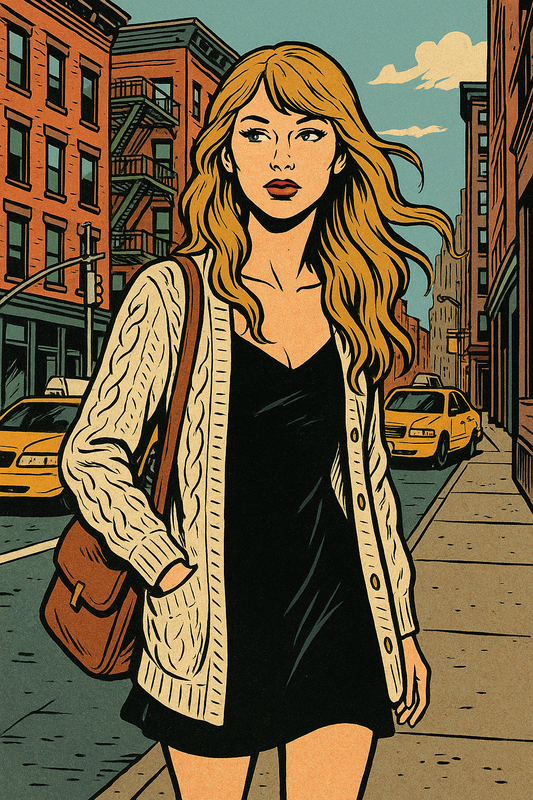
Dana steps out of Port Authority into a gust of exhaust and cold air that smells like rain on pavement, even though the sky is clear.
The doors sigh shut behind her. A bus growls somewhere to her left. Taxi horns volley at each other like they’re arguing in Morse code.
Okay. Okay. This is it. You’re in it now.
She tightens her fingers around the strap of her canvas bag until the fabric bites into her palm. The bag is heavier than it needs to be—journal, a paperback she probably won’t open, map folded and refolded until the creases look like veins. Mason’s watch is loose on her wrist; it turns with her, sliding bone-light against the pulse at the base of her hand.
She glances up.
42nd Street feels like a mouth someone forgot to close. Billboards stacked on billboards, signs above signs, lights even in daylight. The wind funnels between the buildings, cold enough to sting the tips of her ears. A man in a Yankees cap barrels past her with a rolling suitcase. A woman in a brown coat speaks rapid Spanish into a flip phone, not even glancing up as Dana sidesteps her.
People really just… live here. Like this. Like it’s normal to have fifteen thousand things yelling at your eyeballs at once.
She tugs the sleeves of her cardigan down under her denim jacket. The cardigan still smells faintly like home—fabric softener and Glenda’s cheap lavender hand cream. The denim jacket smells like the Greyhound bus. It’s a kind of layering she’s getting used to: Alabama under everything, a film you can’t scrub off, no matter how many miles of highway you put on top.
There’s a moment—just a second—where she has the urge to turn around, go back inside the terminal, buy a ticket for anything heading south.
You could. You absolutely could. Call Mama, say you tried it and it was too much. Blame the crowds. Blame the smell. Blame the way your chest feels like there’s a hand around it.
Instead, she steps off the curb when the walk sign lights up, joining the wave.
---
Times Square appears gradually—first more signs, then more noise, then a sudden bright assault that makes her squint. It’s not the glamorous movie version. It’s daytime, and everything looks slightly faded, like a TV turned down too low.
Neon shouts about Broadway shows she only half recognizes. There’s a giant ad for Coca-Cola, another for some cologne cupping a shirtless man in grayscale. A digital ticker scrolls news she only half reads: markets, sports, somewhere far-off that’s on fire.
This is like standing in the middle of every commercial break you ever sat through.
She stops near a cluster of tourists pointing cameras at nothing in particular, lifting her face up to the billboards like she’s checking if they’re real. They are. They’re also… tired-looking. Layers of posters peeling underneath the glossy surfaces, like even the ads have a history here.
A man in a Statue of Liberty crown tries to hand her a flyer.
“Comedy show, beautiful. Tonight, nine o’clock. Best in the city.”
She shakes her head, offering a small smile. “Thanks, but I—uh—I’m meeting someone later.”
“Bring him too,” the man says, already turning away, fanning flyers like cards.
Not “him,” actually. Or not just “him.” But sure. Keep it simple for the man in the foam crown.
She catches her reflection in a darkened shop window: pale, a little wind-flushed, curls pulled into a loose bun that’s already losing the battle against humidity and motion. The pencil tucked behind her ear makes her look more student than tourist, which is exactly what she wants. Not the wide-eyed girl from Alabama. The girl who belongs in a place where people carry tote bags and unfinished books.
You’re not just visiting,she reminds herself. You’re rehearsing.
Somewhere below her ribs, the thought lands and then shifts, like the city’s pulled it out of her and is turning it over under the light.
---
She heads east, away from the thickest part of Times Square, following the green signs for Bryant Park like they’re a spell she’s been practicing.
The city rearranges itself with every block. Video screens give way to office buildings with lobbies made of glass. Street vendors appear in little bursts—pretzels, hot dogs, a cluster of knock-off sunglasses neatly laid out on a blanket. A man with a portable radio plays something tinny and familiar.
Dana blinks, hard, like she can clear the overlay the way you’d wipe a lens.
Nope. Not right now. Not in the middle of 41st Street.
She focuses instead on the rhythm of her feet—heel, ball, toe—and the feel of the watch loose on her wrist.
“You’re going to see that city,” he’d told her back when his voice still came from a chest that worked the way it was supposed to. He’d been watching some game on TV, New York flashing across the screen. “And you’re not gonna be scared of it even for five minutes. You hear me?”
She hadn’t believed him then. She barely believes him now.
I am scared, Daddy, she thinks, stepping around a trash bag taller than she is. But I’m here anyway. Does that count?
---
The New York Public Library rises at the end of the block like someone dropped a piece of another country in the middle of all this chaos. Stone steps. Columns. Two lions watching everything with heavy-lidded eyes.
Dana slows without meaning to.
Hello, church,she thinks.
Bryant Park is mostly empty, just a few early-year tourists and office workers eating quick lunches on metal chairs, collars turned up against the chill. The trees are still bare, but there’s a green insistence in the little shoots clinging to their branches. Chairs scrape on pavement. Coffee steams in paper cups.
She climbs the library steps, fingers grazing the worn groove in the stone rail where thousands of hands have done the same thing.
Inside, the air shifts temperature and texture—cooler, drier, wrapped in that particular hush that says we read here. Her sneakers squeak on polished floors. She feels the urge to whisper even though she’s alone.
She doesn’t go far. Just into the first big hall, just enough to see high ceilings and shelves that look like they could go on forever. A teenage boy in a Metallica T-shirt is asleep over an open textbook at one of the tables. A woman in a suit types with her shoulders hunched, jaw set as if the screen has personally offended her.
Dana stands there, bag still slung across her chest, letting the air fill her lungs.
You could be one of them, she tells herself. Nursing textbooks, coffee rings on library tables. You could be half-dead tired and still feel more alive than you’ve ever felt in your life.
For a second she imagines it: herself in scrubs, ID badge clipped at her chest, coming here on a rare afternoon off to study. Her handwriting fills notebooks: dosages, diagrams, little sketches of ventricles and valves, the stories of the patients behind them tucked quietly in the margins.
The thought feels less like fantasy and more like… a memory she just hasn’t reached yet.
Her fingers itch for her journal, but she doesn’t open it. Not here. Not yet. She’s too aware of the echo of her own footsteps.
Instead, she murmurs under her breath, to the air, to the lions waiting outside, to whatever listens in a place like this.
“Soon.”
Her voice disappears into the space, swallowed not unkindly.
---
Back outside, she heads south, letting Fifth Avenue drag her along like a conveyor belt.
The storefronts change shape and price point. Designer windows with mannequins posed in mid-stride, wearing more money on their shoulders than Glenda makes in three months. Dana pauses at one—a pale blazer on a headless form, a dress the color of wet cement, heels like tiny sculptures.
I am very much not that girl, she thinks. And I don’t want to be. But I kind of want her shoes for, like, ten minutes. Just to know what it feels like.
She pictures herself in those heels pushing a gurney down some hospital hallway and almost snorts out loud.
A group of schoolkids in matching jackets rush past, a teacher shouting half-heartedly for them to stay together. Their laughter snaps at the air. She catches bits of conversation—something about “field trip,” someone complaining about their feet already hurting.
She thinks of the kids back in Huntsville, of Holly in her room painting her nails on the windowsill, of Jess curled up in a corner with a book. Of the baby still kicking under Glenda’s ribs.
She’s probably twisting around in there while Mama’s watching her cartoons, Dana imagines. Complaining already that her big sister ran off to New York before she even got a shot at seeing her face.
A pang cuts through her.
She can still feel the warmth of Glenda’s hand gripping her wrist at the bus station. The softness in her eyes that never quite made it to her mouth because if it did, her mouth would tremble, and she doesn’t allow that in public.
“You go,” Glenda had said, voice even, thumb rubbing just once over the beating place in Dana’s arm. “You go see it. Bring some of it back for us.”
“Should you be traveling now?” Veronika had asked over the phone when Dana told her the plan. “Mama’s—”
“If I don’t go now, I don’t go at all.”
They all know this is true. Grief has a way of making the world smaller, shrinking it down to whatever room the loss happened in. If she waits too long, the radius of her life might contract to hospital corridors and the living room couch and the space beside Glenda in bed. She loves those spaces, but she is not meant to be held inside them forever.
You can love your mother without stitching your whole self to the hem of her skirt, she thinks now, stepping around a puddle that reflects the skyscrapers like they’re leaning down to eavesdrop.
She passes a church—tall doors, stone facade, a sign out front that reads ALL ARE WELCOME in letters so big it’s almost defensive. She touches her fingers absently to the small cross in her pocket, the one Lucille gave her “just in case,” and keeps walking.
---
By the time the street numbers start dropping into the twenties, her legs ache in that pleasant way that feels like proof.
She cuts left, away from the avenue, following a narrower street lined with smaller shops. Vintage clothes. Record stores. Cafés with their tables crowded too close together and chalkboard menus that list things like “single-origin coffee” and “rosehip tea.”
Her stomach reminds her she hasn’t eaten since the pre-dawn peanut butter sandwich she forced down while Glenda pretended not to watch.
She ducks into the least intimidating café she can find: small, dim, walls lined with flyers and mismatched frames. A jazz record plays low in the background. There’s a rainbow sticker on the glass door, half-peeled but still hanging on.
The barista—a girl with a shaved head and dark lipstick—glances up as Dana approaches the counter.
“What can I get you?”
Dana scans the menu. “Uh… tea, if that’s okay. Just… black tea? With milk?”
“You got it,” the girl says, not even a hint of judgment for the non-fancy order. “Name?”
Dana hesitates, then says, “Dana,” because there’s no reason not to.
The girl scribbles it on a paper cup. You’d think seeing her name in someone else’s handwriting in this city would feel strange. It doesn’t. It feels a little like planting a flag.
She takes her tea to a small table by the window, slips her bag off her shoulder with a little sigh, and finally pulls out her journal.
The page she opens to is blank, but it edges up against an older entry: bullet points from the week Mason went into the hospital for the last time. She catches phrases without meaning to—“oxygen saturation,” “palliative,” “it’s time to call everyone.”
Her chest tightens again. She covers the old words with her forearm like someone might read over her shoulder.
Not right now. Not here.
She flips to the very back, to a crisp page that smells faintly like glue and potential, and starts writing.
“New York, morning,” she scripts at the top, then pauses.
She wants to capture everything—the way the air feels sharper, the absurdity of so many shoes on one block, how people stand on corners without flinching as taxis skim past their knees. The sound of “Oceans” echoing off glass. The way her feet already hurt and she doesn’t even care.
Instead, what comes out is:
> There are too many stories here and I want all of them.
She taps the end of her pen against the paper.
Then she adds:
> I don’t think I’m scared of it. I think I’m scared of deserving it.
Her own honesty annoys her. She takes a sip of tea to punish herself—it’s too hot, scalds her tongue, and she swallows the burn.
At the table next to her, two women lean in close over a shared muffin. One of them has a tiny silver hoop in her nose, hair cropped short at the nape and curling forward around her face. The other has ink curling up the inside of her wrist, disappearing into her sleeve. Their knees touch under the table. Every now and then, one of them reaches out and pushes a crumb toward the other like it’s a joke only they understand.
Dana’s eyes catch on their hands. The easy, unconscious way their fingers find each other’s knuckles.
Okay, she thinks. So we do this here. Out loud. In daylight.
She’s not unused to the sight—Glenda’s house is a revolving door of women who love women, men who love men, people who love across and between those lines. But there’s something about seeing it here, in a city she’s only ever met in books and disaster movies, that feels like confirmation.
You won’t be the only one, here, she tells the girl version of herself who hid her first crush in the margins of her algebra notebook. You might even be boring.
The thought makes her smile.
Her watch—Mason’s watch—ticks under her sleeve. She glances at it.
11:07.
Oscar won’t be done with class until two. They’d talked about it on the phone last night, his voice low through the long-distance fuzz.
“I’ll meet you at Union Square, okay?” he’d said. “By the big greenmarket. You’ll see where the skateboard kids are terrorizing everybody. I’ll find you.”
“You sure?” she’d asked. “I can get the subway up to wherever you are. Harlem, right?”
“You gonna trust the trains your first day?” he’d teased. “Walk it. You like walking. You got those long legs for a reason.”
She’d rolled her eyes even though he couldn’t see it, heat climbing up her neck.
You got those long legs for a reason, she hears now, echoing in her head as she closes her journal. Fine. We’re using them.
She tucks the pencil behind her ear again, drops a crumpled dollar into the tip jar, and steps back out into the light.
---
The Village feels more human-scaled, like someone took the city and shrank it down just enough that she can hold it in her hands.
Brownstones lean into each other. Fire escapes crisscross their faces like penciled-in wrinkles. Street names go from numbers to words—MacDougal, Bleecker—and suddenly the grid she studied on her map back in Huntsville doesn’t matter as much as where her feet want to go.
She follows the sound of a saxophone to Washington Square Park.
The arch rises white and insistent against the pale sky. It looks smaller than in every movie she’s seen it in, which somehow makes it better. The fountain is empty for now, just a wide stone basin holding a few leaves and a stray quarter. Pigeons strut like they own everything.
A busker plays half-recognizable jazz under the arch, case open at his feet, a few crumpled bills keeping the wind from flipping it closed. A cluster of kids with skateboards take turns launching themselves off a low ledge, boards clattering, curses flying when they miss.
She slips onto a bench at the perimeter, setting her bag between her feet, arms crossed loosely over her chest. The air smells like pretzels and something faintly sweet from the cart nearby.
This is it, she tells herself. The version they put on postcards. You’re in the postcard.
It’s still strange that Manhattan has sky. In photos, it always looks like pure building. But sitting here, she can see a wide strip of pale blue, thin clouds moving faster than the people. The sun glances off the apartment windows facing the park, making some of them look like they’re on fire.
She watches a little boy in a red hat trip and face-plant on the concrete. His mother is there in two strides, scooping him up before the wail has fully formed. Dana automatically goes through her mental checklist.
No blood, okay, he’s moving all limbs, crying is good, crying means breathing, her grip is solid, she’s calming him down—
Sometimes her brain feels like it’s already in a hospital while the rest of her is still walking around in regular clothes.
She thinks of the last hospital she spent any significant time in.
The memory comes in flashes: Mason’s IV line taped to the back of his hand. The dry crackle of his lungs on a monitor. The nurse with kind eyes who always turned his pillows just so. The way the hallway light made everyone look a little green.
No matter how hard she tries, she can’t remember his last clear sentence. The words are there in her mind, but they’re underwater. What she remembers, vividly, stupidly, is the smell of his hospital room: antiseptic layered over old smoke, like the building was trying to scrub his lungs on the outside too.
And you want to work in that environment, some inner skeptic says. On purpose.
She presses her thumb into the base of her palm until it hurts.
Yes. I do.
Because for every smell and fluorescent light and machine beep, there was also that nurse. The one who didn’t flinch, who listened when Dana asked, “What does this mean?” even though she wasn’t technically supposed to explain. Who took the time to look at Glenda square in the face and say, “He’s not in pain,” in a voice that made it more true.
If Dana can be that for even a handful of people, then the rest is background noise.
She watches another skater face-plant, this time popping back up with a laugh and a high five from his friend.
Bodies fall down. Bodies get back up. Sometimes they don’t. You’re not scared of that. You’re scared of what happens to the people still standing when someone doesn’t.
Her fingers curl in her lap.
She doesn’t realize she’s crying until a tear hits the back of her hand. It startles her more than the pain in her palm had.
Oh, no. We are not doing this on a public bench in Washington Square Park, Robinson.
She swipes quickly at her face, sniffing once.
Nobody’s looking at her. That’s the quiet mercy of this city: you can be falling apart on a bench in the middle of everything, and people will step around you, not unkindly, just… allowing.
She takes a long breath, counting to four on the inhale, four on the exhale. A trick she learned from some pamphlet Holly brought home once and left on the kitchen table.
“Don’t you start hyperventilating now,” she mutters, voice low, half-laughing at herself. “You finally got to the city. The least you can do is look at the arch without fogging up your own eyeballs.”
She stays until her breathing settles and the edge of panic dissolves into something softer. Not gone. Just… parked for later.
When she stands, her legs feel steadier.
---
South and east, the city changes again.
On West 4th, shop windows press records and books against the glass. St. Mark’s Place is a riot of signs and color, even in the muted winter light—tattoo parlors, head shops with incense leaking out their doors, used clothing stores with racks spilling onto the sidewalk.
Flyers fight for space on lampposts. Bands with names like MOTHERSHIP RIOT and SUGARGLASS. A poster for an anti-war rally. Another for a poetry open mic in a bar basement.
You’re going to read somewhere like that one day, she tells herself. Some grimy little room with a broken microphone and a crowd that’s half drunk and half holy. You’ll read something about a girl from Alabama who thinks she’s too much and not enough at the same time, and someone in that room will need to hear it.
She imagines it so clearly she can almost feel the paper of the notebook in her hands, hear her own voice shaking through the first lines.
A siren wails somewhere; a cop car slides past at the end of the block. She automatically checks that her bag is still zipped, that her wallet is still in the inner pocket alongside the folded piece of paper with Oscar’s dorm address on it.
Union Square appears not all at once but in pieces: first a wider stretch of sky, then more trees, then the sound of wheels on pavement as skateboarders carve between columns of pedestrians.
She’s early. Of course she is. The digital clock over a bank says 1:32. They’re supposed to meet at two.
The greenmarket is in full swing today. Stalls packed tight, vendors shouting about apples and bread and cheese. It smells like cut herbs and something fried.
Dana drifts along the stalls, sliding into the flow.
A woman in a knit cap presses a sample of apple slice into her hand without asking. “Try this one, honey. Better than anything you’ve had back home.”
Dana almost says, “You don’t know what my back home is like,” but then she bites into the apple and the crisp sweetness shuts down every clever retort.
“Mmm.” Her eyes widen. “Okay. You win.”
The woman laughs. “Told you.”
She buys one apple, because it feels symbolic, and tucks it into her bag like some fairy-tale heart.
When she finally circles back toward the subway entrance, he’s already there.
Oscar leans against the low stone wall like he owns it. Hands in the pockets of a faded Army-green jacket, scarf looped loosely around his neck, headphones hanging around his collarbone. His skin is the warm brown of strong coffee with too much sugar in it, and his hair is cropped close on the sides, a soft curl on top under his knit cap. He spots her before she can decide how to approach.
“There she is,” he calls, straightening up, the grin spreading across his whole face.
Her heart does something unhelpful in her chest.
Do not trip. Do not trip. You walked from 42nd Street like it was nothing; you are not allowed to eat it now in front of the cute boy.
She makes it to him without falling, which feels like a minor miracle.
“Hey,” she says, suddenly unsure where to put her hands. She settles on shoving them into her jacket pockets so he won’t see how they shake.
He opens his arms a little, an invitation rather than an assumption. She steps into the hug, letting his jacket coolness and body warmth surround her. He smells like laundry detergent and something faintly metallic, like the subway.
“You did it,” he says into her hair. “You came.”
“Of course I came,” she replies, pulling back enough to see his face. “You think I rode seventeen hours on a bus just to get off in New Jersey?”
He laughs, and the sound loosens something in her shoulders.
They start walking without really deciding to. It’s like their feet already agreed.
“Where you been so far?” he asks. “Besides Port Authority hell.”
“Times Square,” she says. “Which is… louder than TV but also kind of sad. The library. Fifth Avenue. Some café with good tea and better gay vibes. Washington Square.”
“Look at you,” he says, nudging her shoulder with his. “Already more New York than some kids who been here since birth.”
“Don’t get ahead of yourself,” she warns. “I still haven’t done the subway. That’s, like, level two.”
He grins. “We’ll get there. Today we walk. I wanna show you the Brooklyn Bridge.”
She makes a face. “You trying to kill my feet?”
“You said you like walking,” he reminds her. “You said you wanted to see the city, not ride under it.”
He’s right. Of course he is.
“Fine.” She draws the word out, pretending to be put-upon. “Lead the way, tour guide.”
---
They cut downtown, weaving through streets Dana could never have pieced together on a map. Broadway funnels them past electronics stores and jewelry shops, into Canal Street’s chaos—fake handbags, crowds thick enough she has to tuck herself behind Oscar to keep from getting separated.
He glances back every few seconds, checking without being obvious.
“You good?” he asks once, when they’re briefly halted by a traffic light.
“Yeah,” she says. “Just… collecting data.”
He laughs. “You and your data.”
He doesn’t say “you and your diary,” even though he’s seen her scribble in it on the phone, seen pages full of writing when she held it up to the camera once by accident. He doesn’t tease her for it. That, more than almost anything, is why she trusted him enough to get on the bus.
As they walk, he points things out like he’s narrating a documentary just for her.
“That’s Chinatown proper,” he says, nodding toward a stretch of blocks rich with red signage and hanging ducks in windows. “Over there’s Little Italy—well, what’s left of it. You get good cannoli there, though. And down that way, see that tower? That’s City Hall.”
Everything has a story, and he’s generous with them, even when he thinks they’re boring. She tucks each detail away like an index card.
You’ll need these later, she tells herself. When you’re stuck in some hospital basement, you’ll need to remember that you know your way from Union Square to the river without a map.
The approach to the Brooklyn Bridge feels like stumbling into a different city altogether. The ramp rises gently, wooden planks underfoot instead of pavement. Cars roar on the lower deck, but up here, it’s mostly foot traffic—tourists with cameras, joggers with headphones, couples sharing quiet arguments in languages she can’t place.
They step onto the walkway, the suspension cables rising around them like a web.
Dana stops.
The skyline of lower Manhattan spreads in front of her—buildings like teeth, the river cutting a gray line between boroughs. The air is colder here, the wind unobstructed.
She grips the railing, fingers going numb.
“Wow,” she breathes.
Oscar stands beside her, shoulder brushing hers.
“Yeah,” he says, like he’s hearing it again through her eyes. “It’s a lot.”
She doesn’t say it looks like every establishing shot of New York she’s seen in movies, because it doesn’t. It looks less polished, more jagged, like someone left the edges raw on purpose.
This is where you’re going to live, she thinks. Not on this bridge, obviously, but in all that mess. In one of those buildings. In the cracks between them. On the trains underneath. At a clinic whose name you don’t know yet. In classrooms. In parks. In little slivers of sky like the one over Washington Square.
The idea is both enormous and oddly calm. Like a diagnosis she’d been half-suspecting and finally heard confirmed.
Oscar leans his arms on the rail, looking out.
“How’s your mom?” he asks, voice softer now that the city’s pulled away a bit.
The question lands with more weight than anything he’s said all day.
Dana watches the water chop at the pylons.
“She’s…” She searches for the right word. Not good. Not okay. Those aren’t precise enough. “…still standing,” she settles on. “Which is something. She’s tired. She pretends she’s not. The baby’s kicking like it’s mad at gravity. The house is… loud, but also very quiet, if that makes sense.”
“Yeah,” he says. “Makes sense.”
He doesn’t say he’s sorry. She’s grateful for that. She’s worn thin by sorrys—sincere, hollow, all of them clinging to the edges of casseroles and church hugs back home.
“How are you?” he asks instead.
No one’s asked her that without meaning “how are you holding up for your mother” for weeks.
She considers lying. Saying “fine,” or “okay,” or “good, actually,” because look, here she is on a bridge with a boy she likes and a future humming in her bones.
But the city doesn’t seem like the place for lying to yourself, even if you can get away with lying to other people.
“I’m… here,” she says slowly. “I miss him. It feels wrong that he’s not in the world anymore. Like the physics of everything got messed up. And at the same time, I’m… excited? About school. About being here. And then I feel bad for being excited. And then I feel bad for feeling bad.”
“Double guilt,” Oscar says. “That’s advanced level.”
She huffs out a laugh. “Yeah. I’m gifted.”
He doesn’t reach for her hand, not yet. He just stands there, shoulder to shoulder, giving her the kind of presence she recognizes from that nurse in the hospital. Not filling the silence. Not offering solutions. Just… anchoring.
“You know he’d want you to be excited, right?” Oscar says after a while, eyes still on the water. “My mom says grief’s not a debt. You don’t owe it your whole life.”
She swallows.
“He told me not to be scared of this place,” she says. “I think he knew he wasn’t gonna—” The words kink, then break. “I think he knew.”
“Then you’re doing what he asked,” Oscar says. “You’re here. Being not scared. Or, like, scared, but walking anyway. That counts.”
She nods.
Scared, but walking anyway. That sounds about right.
The wind cuts colder across her cheeks. Her eyes sting, but she doesn’t know if it’s from the wind or from everything else.
She slides her hand along the rail until the back of her finger brushes his. He doesn’t look at her, but he turns his hand, letting their fingers slot together like they’re two pieces of something that always meant to fit.
There, in the midst of cars and cables and strangers, Dana lets herself breathe into it.
Into the grief, the guilt, the unimaginable hugeness of the city, the strange comfort of warm fingers in hers, the memory of “Oceans” warbling from a busted radio, the half-formed notion of a classroom and a clinic and a tiny apartment with a leaky faucet in some neighborhood she can’t name yet.
You will learn these streets the way you learned the freckle patterns on Holly’s face, she tells herself. You will know which subway rumble means what. You will memorize the smell of each season on each block. You will build a life here that doesn’t erase Alabama but doesn’t stay trapped there either.
She looks out at the water and, without fully meaning to, prays—not to anything she could diagram in catechism, but to whatever held Mason’s hand when she couldn’t be there at the very end, to whatever is currently looping Glenda’s tired heart to the tiny one beating inside her.
Let me be brave enough to stay, she thinks. And soft enough not to turn into the city’s worst parts. And please watch over them while I figure out how to do that.
The river keeps moving.
Beneath her feet, traffic hums like a low, constant heartbeat.
Oscar squeezes her hand once, firm.
“C’mon,” he says gently. “Walk to the middle with me. That’s the best part.”
She nods, pushing off the rail.
They walk.
Her feet hurt. Her chest hurts. Her heart is doing something complicated she doesn’t have a name for yet.
But her legs keep moving, carrying her forward across the span, into a city that is no longer just a promise on the page, but a place under her shoes—with all its noise, all its stories, all its uncharted corridors she is already, quietly, beginning to map.