Work Text:
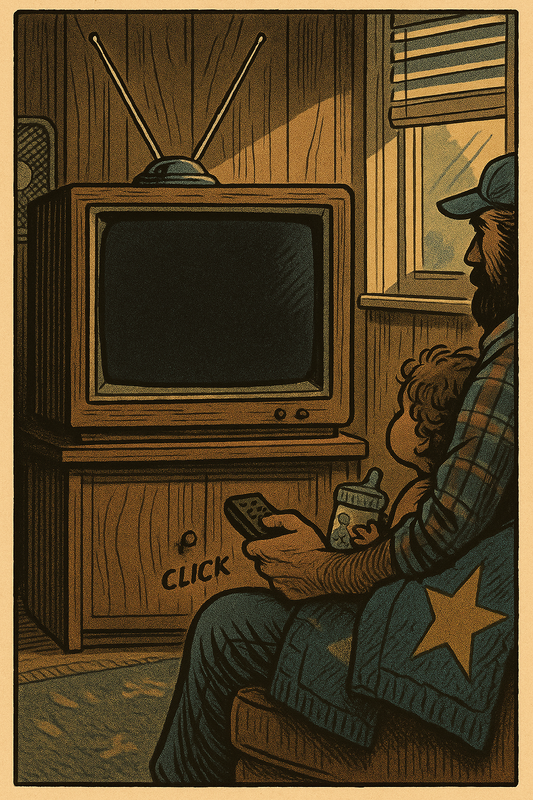
On a Saturday that smelled faintly of mop water and overripe bananas, Huntsville was laid out in heat and cicada noise, and the Robinson television—thick-backed, wood-paneled, rabbit ears bandaged in tin foil—was tuned to the weekend matinee. The picture fuzzed and then steadied into a grainy skyline. A black-and-white giant strode out of fog.
Toyah—three years old, sockless, hair escaping its elastic in increasingly heroic curls—stood planted two feet from the screen with both hands splayed on the console as if she could steady the city herself. “Monkee!” she breathed, round-mouthed with delight. “Big, big monkee. He fwenly. He ha-ha funny.” She slapped her own belly twice in a ceremonial thump that made her little bellybutton pop through her tee, then laughed at her own echo.
From the recliner, Mason watched her watch the movie. He’d meant to nap. The morning had been one of those good mornings that still left him feeling borrowed—breath fine but fickle, legs good for the hallway and back, not much else. Glenda was pulling a lunch shift; Jess was out behind the house singing to the dogs. The ceiling fan talked to itself in a low clatter and somebody on the porch had left the screen door unlatched so it hiccuped with every small gust. The house had its noises; the house was alive. He kept the remote tucked in his palm like a worry stone.
“A gorilla,” he offered.
Toyah turned, serious. She had the sober deliberation of toddlers delivering scientific correction. “It’s a monkee,” she said, then pointed at the screen with two sticky fingers. “Kong. He name is Kong. He my fwiend.”
“All right,” Mason said, smiling. “He’s your friend.”
She nodded, deeply satisfied to have set the taxonomy of the universe back in order, and pressed her face so close to the glass that her breath fogged a little oval. On-screen, Kong was smaller now—toy-sized compared to the steeples and the steamships—but to Toyah he was just right. She squealed when he scratched his ear with a whole hand. She squealed when he blinked. When he picked up a car not to smash it but to peer inside at the tiny people, she cooed, “Gentle, gentle. See? He good. He no bite. He nice monkee.”
Mason tried to keep his eyes on the movie. He kept his eyes on her instead. The delight she broadcast was warm as a lamp, uncomplicated, contagious. He thought, not for the first time, that there ought to be a word for the way a child’s joy could lift a grown man’s chest from the inside. He took a careful breath and willed the air to stay.
On cue, Kong beat his chest again and roared. Toyah roared back at a fraction of the volume and full of gusto.
“Juice?” he asked.
“Yesh,” she said without looking away. “P’ease.”
He levered himself forward, felt his body complain, ignored it, and poured apple juice in a plastic cup with a cheerful zoo printed around the rim. A smaller, ordinary monkey grinned up from the cup, teeth cartoon-bright. He set it on the console beside her chubby forearm. Her hand groped sideways without her eyes leaving Kong, found the cup, and tipped a too-confident sip. Juice skittered down her chin and onto the wood.
“Napkin,” Mason said, already reaching. She leaned into the swipe, eyes still fixed, a soldier receiving field treatment.
“All right, sir,” a man in a hat on the TV said, voice tinny from the old set’s speaker. “Bring her down.” The strings swelled. The city sharpened into night.
Mason’s stomach cinched. He had seen this movie more than a dozen times, the way you see certain storms more than once no matter how far you move. It was a good story in its bones and a mean one at its finish. He could watch it. He had watched worse. But he looked at Toyah, at the intent tilt of her head, at the way her hand squeezed the air by her cheek as if she were coaxing the giant from the screen into being kind, and he felt his chest ache in a different place than where it usually did. He could not watch it with her.
Planes began to buzz into the frame—little black gnats with teeth. Toyah frowned. “No-no,” she said softly. “Hey! Don’t ’ttack. Is bad manners.”
“That’s true,” Mason said. His thumb slid along the remote, found the mute and then hovered over the power like a secret.
Kong climbed. Toyah hopped once in place, little knees flashing. “He up high-hiiiigh!” She stretched her arms overhead and then, because the body wants to match the story, stood on her toes.
Mason’s thumb pressed. The set went black with a soft bell of a sound. The fan clacked. The house sighed.
Toyah blinked at her reflection—her own small face where Kong had been. She blinked once, twice, then turned, startled, devastation an arm’s-length away. “Oh no,” she said, voice small but very clear. “Oh no.”
“Yeah,” he said lightly, like it was nothing, a cloud passing a sun. “Looks like it… hm. Maybe the set got tired.”
She padded over on bare feet, clutching her cup in a fist. “Monkee,” she said, looking from his lap to the blank screen and back, trying to be braver than she felt. Her lip thought about wobbling, didn’t. “I was wookin’. He was up, up. He do big climb.” She put the juice down with the grave decisiveness of a surgeon. “Where he go?”
Mason patted his thigh. “C’mere a sec.”
She was already climbing. Three-year-olds are practiced mountaineers; she scaled the recliner arm and found his lap like a bird finding a branch, managing not to jostle his breath. He pulled the afghan off the recliner arm over both their knees, its squares sun-faded to a soft quilt of old colors. Toyah folded into the tent of his chest and peered back at the blank television as if the picture might reconsider.
“He go bye-bye,” she announced, not accusing after all, just reporting. Then, cautiously: “Is he okay?”
Mason could say three things, he thought. He could say the world as it was; he could say nothing; or he could ask for a better world and listen to her build it. He tipped his head toward hers so his beard brushed her temple. “How d’you think it ends?”
She froze. He felt her consider the problem as if it were a block tower she might stack without letting it fall. Slowly, she lifted her hand and held her thumb and forefinger just apart, the way she did when she tried to show a size that was too magical to measure. “Um,” she said, syllable rolling soft, mouth busy. “Um… okay. Um… Kong… he… he go down the ’teps.” She looked back at him to see if there were stairs involved. He nodded. “Yeah? He go down ’teps. He say, ‘scuse me, p’wanes,”—she crooked her hand and made a little flapping motion, a kindness offered to the attacking things—“an’ p’wanes say sowwy. They was bein’ ’noying. They say sowwy and go home fo’ snack time.”
Mason kept his face solemn. “That’s good of them.”
“They have c’ackers,” she said, satisfied. “With smush.”
“And Kong?” he prompted.
“Kong come down,” she said, eyes big, seeing it. “He no fall. He gentle feet.” She patted his knee twice to demonstrate gentle feet in miniature. “An’ den… he… he get a baff.” Her voice went up a half-step with each new marvel. “Bubbles.” She drew a giant invisible oval in the air that nearly knocked her juice cup over. “Bubbles all ’round him. He have a ’ponge. He scrub-a-scrub! An’ he say, ‘ahhh,’ ’cause is warm.”
“Warm bath is key,” Mason agreed.
“An’ then…” Now she was rolling. “He have ’nana. Many many ’nanas. Big ’nana.” She widened her hands wider than his chest, then narrowed, then widened again, calibrating for realism and pure exuberance. “He say, ‘tank you,’ ’cause he polite. He share wif the lady. His lady fwiend. The la— the lay-dee… the p’etty one.” She leaned sideways to peer into his face, searching for the name she’d heard the grown-ups use. “She wear a dress. She say, ‘oh, Kong! you silly monkee!’—” and here Toyah pitched her voice up into a breathless parody of glamour that had Mason bite the inside of his cheek not to laugh—“an’ she pat-pat him on da nose. Boop.”
“Boop,” Mason echoed gravely.
“Den he get a blankie,” she said, softening, the story drawing itself toward the place all her stories liked to land. “Soft one. Blue wif stars. Like night-night. He go,”—she tucked her chin and closed her eyes in a well-practiced imitation of sleep—“mm-mm,” two fake snores, “and he hug his lady fwiend so gentle, ’cause he no squish. He know ‘bout gentle.” She opened one eye. “He knows.”
“He knows,” Mason promised her.
“An’ p’lice?” she remembered, sudden, the little men on the ground, the line of them like ants. “P’lice say, ‘okay, s’all right,’ an’ den they give him a hat.” She made a hat descending like a UFO onto an enormous head. “A nice one. A— a… a cap. Like you.” She patted the brim of his battered ballcap where it had been resting on the arm of the chair. “Matchin’ fwiends.”
“Matching friends,” he said, awed by the diplomacy, by the mercy of her arrangement.
She chewed the inside of her cheek and kept building. “Den… he go to da zoo,” she said, but the way she said it meant not the zoo of iron bars and gawkers on a hot day, but the zoo on her cup—smiling, cooperative, everyone with decent snacks. “But da zoo is not a ’cage. Is a big park. He have a swing.” She leaned back far enough that he had to steady her. “A biiig swing. He go whoosh whoosh. He wave. I wave back.” She raised both arms over her head and flapped, fingers spread. “Hiiii, Kong!”
“Hi, Toyah!” Mason rumbled, playing the part.
She slapped his chest, delighted. “He know my name!” Then, thoughtful again, she tucked two fingers into her mouth, considered a moment more, pulled them out shiny. “An’ den… he come to our house. Just fo’ a bit. Jus’ to visit. He sit on couch”—she eyed the couch, calculating weight and fabric fatigue—“okay, he sit on floor. He sit cwiss cross, wong as he is, an’ we watch ’nother monkee moofie. Funny one. No p’wanes. He laugh. He go ‘hoo hoo hoo’ like dat.” She did it, small and airy.
Mason laughed then, softly, couldn’t help it. It was not the laugh of the joke but of the reprieve the joke created.
“An’ he be careful wif his tail,” she added.
“Gorillas don’t—” he began, then let it go. “Right. He’s careful.”
She nodded, generous. “An’ when is bedtime, he kiss everybody head”—she leaned up and planted an apple juice kiss on Mason’s stubbled chin by way of demonstration—“an’ he say, ‘night-night, I go home now, thank you fo’ da baff an’ ’nanas,’ an’ we say, ‘you welcome, big monkee,’ an’ he go wif his lady, hand-in-hand. He hold widdle. He hold widdle-hand like dis.” She laced her tiny fingers through his, her palm a hot petal. “An’ dey walk slow. No ’cary. No fall. It over.” She sighed, satisfied. “The end.”
Mason didn’t look at the blank screen. He looked at the fierce, orderly peace she had arranged and felt something settle in his spine. “I like your ending better,” he said.
“Mm-hm,” she said, the sound of someone accustomed to being correct. She tipped forward and reclaimed her juice, took a triumphant gulp, and wiped her mouth with the back of her hand like a dockworker. “Easy.”
“Easy,” he echoed, wearing the word like a borrowed coat that, somehow, fit.
They sat with it. The fan clacked. Somebody—Jess—laughed outside at something the dogs had done that could not possibly be funny and was. From the kitchen bulletin board, a paper fluttered—Glenda’s neat block letters listing everyone’s shifts and pickups, a life arranged so the edges met as often as possible. The remote warmed in his palm. He did not turn the television back on.
Toyah set her cup down, then patted the afghan’s squares as if searching for a particular color. “Dis one is like Kong,” she told him, finding navy. “Night-night. Dis one is like ’nana.” She pressed the yellow. “Dis one is like bubbles.” Pale green. “Dis one is like… like… like a hat.” She smoothed a red square with both hands and crowed, “Hat!”
“You’re a good sorter,” Mason said.
“I’m big,” she said. “I can do ‘tories.”
“You sure can.”
“Wanna ’nother?” She was already gearing up, her body rocking with the momentum of a new narrative and the security of an audience who did not interrupt.
“I could listen to you all day,” he said, and meant it so completely it startled him. He felt the complicated ache in his ribs but also felt, strange and new, that the ache had edges she could sand down just by talking.
She obligingly leaned back against him, took a breath big enough to store a paragraph, and then, because three-year-olds have the attention span of a bird and the wisdom of an old woman, she reached forward and pressed the power button herself. The set did not flare back to life; it clicked and then stayed dark. She shrugged, unbothered now that there was no cliff.
“TV is sweepin’,” she announced, magnanimous. “No p’wanes. S’all done.”
“S’all done,” he said.
From the porch came the rattle of the screen door and the quick machine-gun patter of Jess’s feet—she burst through with cheeks hot from the yard. “Daddy, daddy! Dog is eatin’ the dirt again.” She stopped at the sight of Toyah in his lap and, after a glint of a thought, climbed up to tuck herself on his other side like a matched bookend. “Hi, Toy.”
“Hi, Jess,” Toyah said seriously. “Monkee movie had a happy endin’.”
“Oh,” Jess said, already nodding as if this had always been the case. “Good.”
“Boop,” Toyah told her, and touched her nose.
Jess booped her back.
“Boop,” Mason said, and let his finger rest for an extra beat on each of their noses, the way a man might memorize a chord shape with his hands. The house held them; the house was a lap big enough for all of it.
Later, when Glenda came home with the smell of the diner in her hair and a paper bag of day-old rolls under her arm, he would tell her about it. He would say Toyah fixed King Kong. He would say the planes said sorry and went home for crackers with smoosh. He would say that the giant got a bath with bubbles and a blue blanket with stars and that he did not fall, not once, not in the version that counted. He would say, because he needed to say it out loud, that the child had saved the ending for him too.
But for now he just sat with the girls tucked against him, the afghan a soft geography under their hands, the television a dark mirror that showed only their outlines. Toyah’s head grew heavy on his chest, the way toddlers’ heads agree to sleep without asking permission. Jess traced circles on his forearm with one small finger and murmured a song under her breath that did not quite scan. Outside, the dogs were—for reasons known only to themselves—barking at a mailbox.
“Daddy?” Jess whispered, not because anything was wrong, but because whispering made it feel like a secret.
“Mm?”
“I like Toyah’s ’tories.”
“Me too,” he said, and Toyah, eyes closed now, hummed smugly.
In the old movie, in another room, atop a tower in a city that was always someone else’s, a myth would still be falling. Here, in their worn living room on Juniper Lane, a giant had been given a bath, a blankie, a hat, and a way home. The planes had apologized, snack time had intervened, and the last thing anyone saw was a big gentle hand saying goodnight.
Mason let the fan’s clatter be the only clock. He stroked back the soft hair at Toyah’s temple the way you would calm any creature who had earned sleep. “Good ending,” he murmured.
“Good endin’,” Toyah echoed, almost asleep, and with the stubborn authority of the very small, she made it true.