
Chapter Text
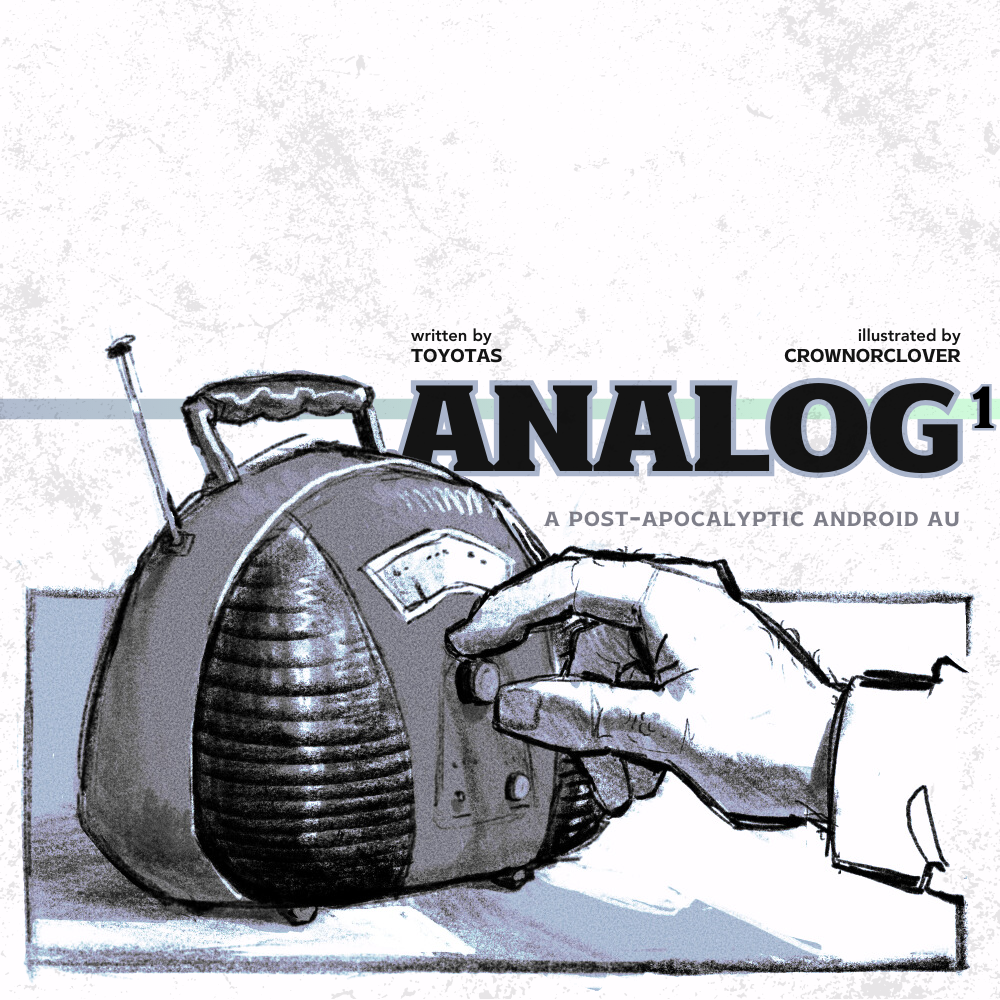
01. radio
Outside the cafe window, the seasons change. The sun gets hotter. The cicadas cry louder. Serizawa Katsuya’s routine doesn’t shift. It’s written too deep to his core. Guided by the hand of his own internal clock, Serizawa cannot dwell; he simply does.
At seven in the morning, the sign flips to ‘open’ on the door; at four in the afternoon, the lock clicks shut. Everything between those two junctures of time fades sepia into the background. All the while, the ocean bites eagerly at the edges of the grassy hills and iron street lamps. When it finally ebbs, it leaves crumbly lines of salt behind, like a child measuring its height, taller and taller against the doorframe.
At the edge of the countertop, an AM radio stumbles through the morning’s news, echoing across a handful of empty wooden tables. Serizawa has rotated the antennae this way and that, dowsing for reception, but the broadcast still fights against the encroaching blanket of static. It’s even heavier lately, burning at the edges of the program, stealing back so many of the words.
Small, black, and missing a dial, the radio belonged to the man who owns the café. It was on, playing this station when he left, and — Serizawa will be sure — it will be on and playing this station when he returns.
Serizawa hadn’t listened to it intently then. He doesn’t now. Routine.
“…reports of flash flooding after a dam break near what was once downtown Seasoning City…”
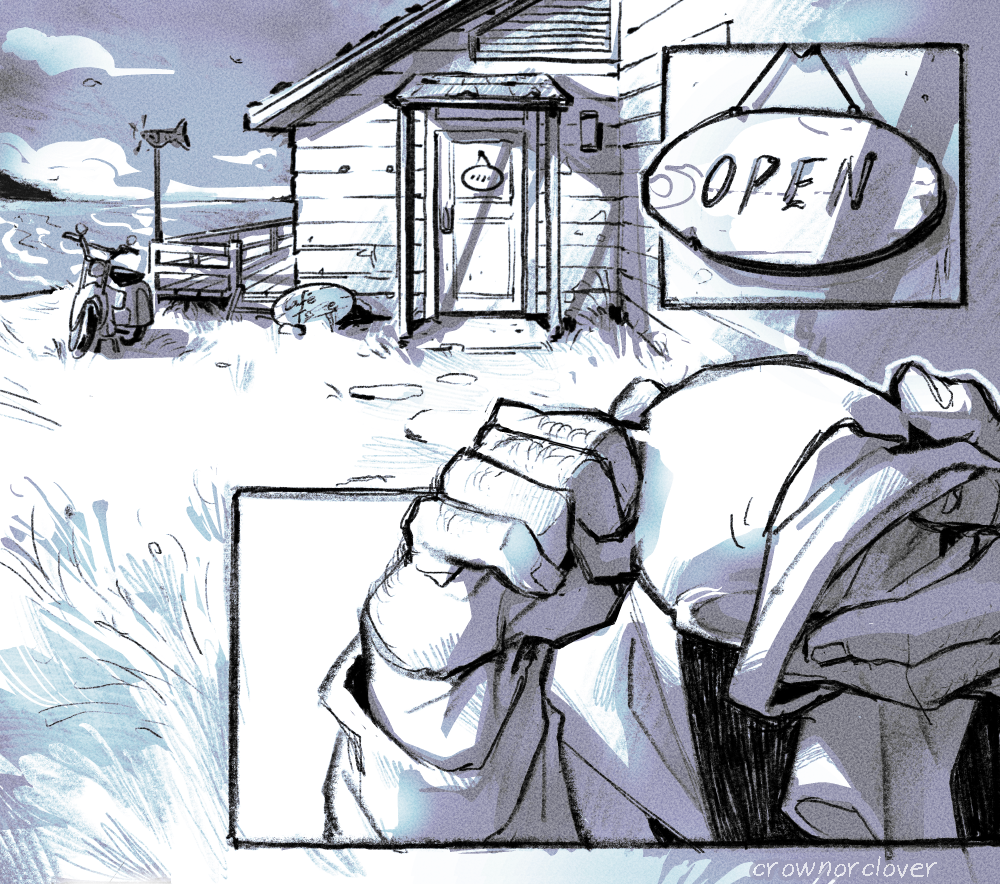
At 3:41, Serizawa wipes down the last mug. It’s white, pristine despite the threat of tea stains. He remembers it just as it was in the president’s hand. Black tea, no sugar, a splash of cream. A thin paper doily resting between cup and saucer. A silver spoon. A modest but dry cinnamon biscuit. It paired with a newspaper, back when those were still delivered, or one of the dog-eared books from the shelves on the back wall. A pen clicking over the table. A yellowed legal pad. A set of reading glasses.
Serizawa cleans the teacup, even though it hasn’t touched a lip in two weeks. It doesn’t even bear fingerprints. He cleans the others too. Routine.
“…officials have established evacuation and family reunification areas in the outskirts of the city…”
At 3:44, he aligns it with the rest of the mugs along the top of the bar, handles turned perpendicular to the polished granite counter’s edge. When he does handle the event of a customer arrival, they’re simpler to grab that way. Efficient. No wasted motion for a machine who churns customers into loose coins in the register drawer. Routine.
“…expect that many families will need to find new homes on higher ground…”
By 3:56, the tables are cleaned and dried and the metal chairs are stacked upside-down upon them. He sweeps underneath them and disposes of the detritus. Routine.
“…several people reported missing—”
He clicks off the radio. It’s 4pm.
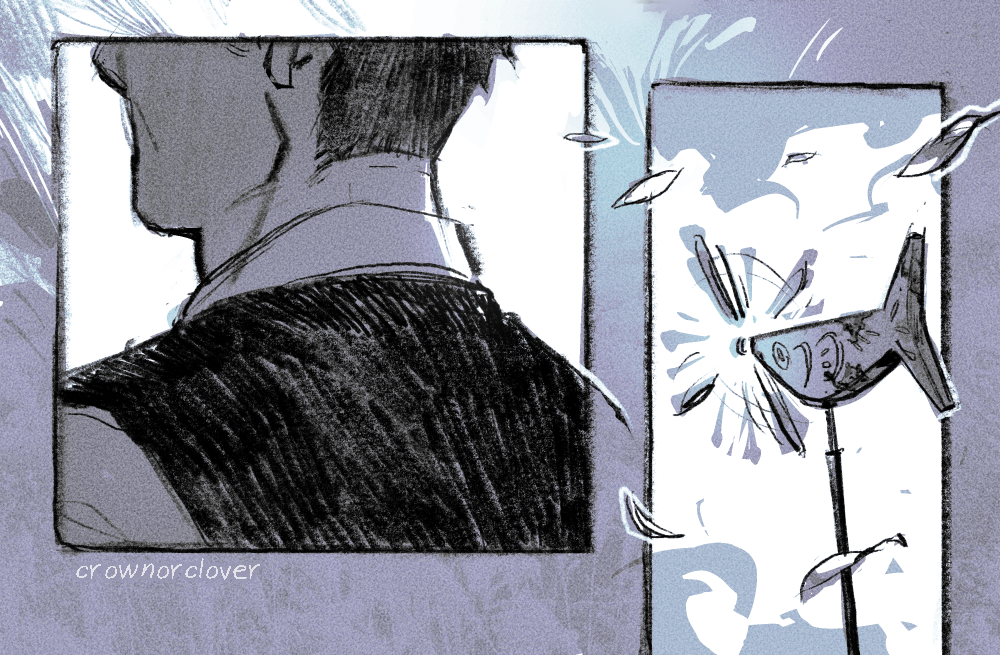
Outside, the weather vane spins at the propeller and turns, strained by the wind. The iron flying fish ornament sits on top, rust creeping into its fins, wrenched south and away.
With the sign flipped, the door locked, the lights extinguished, and the shutters closed, another day ends — and at the tail of it, Serizawa retreats alone to the living quarters in the back. After nightly tasks, he’ll power down until it’s time to do it all again. Visitors may come and go or not come at all; the day remains the same.
Serizawa’s time is the ocean outside the café window. Every day, it gets louder.
02. memory i
Serizawa’s recollections begin with at a point five years earlier. That specific memory is crisp, the entryway to a perfect timeline into the present.
All memories that predate it are a haze. In fact, Serizawa isn’t sure if the other memories exist. If they ever existed. There are holes where they should be, silhouettes burnt into the disc, empty outlines that span terabytes. He hasn’t reclaimed any of the space they hold. If he destroys what should be there, then the memories are truly gone for good, and he’d lose everything. It wouldn’t be right to trample on the past. Even wandering through the reserved addresses looking for scraps of bits feels like trespassing.
Regardless of the specifics, he knows he lived a valuable life, because he knows the people who lived in it were valuable, even if he doesn’t remember them. For instance, he remembers the president, he remembers he’d spent a long time with the president, even if he only remembers the last day with any clarity.
The man had been in such a hurry.
Having stuffed a pile of documents and clothes into a four wheel trunk, he clicked the lock shut, grumbling to himself something Serizawa couldn’t quite hear, even with his sensors engaged. The president emerged from the living quarters in the back, the room that Serizawa assumed was his office, where he worked in insistent solitude.
Serizawa had never seen it for himself. Or… No. Maybe Serizawa had been there before. He couldn’t remember, and searching for a memory led him from one empty space to another with nothing to show for it. Dizzy, he canceled the memory retrieval process before he wasted further time.
He knew inherently that the president preferred to keep his work to himself. He handled the details of everything they shared and delegated tasks to Serizawa to support him as needed. Serizawa had wondered how much he took on entirely on his own. Being responsible for so much — it was admirable, wasn’t it? To be the lone pillar holding up the world alone.
As enthusiastic as Serizawa had been to offer it, help was never what the president wanted. Never what he needed. Then too, he ignored Serizawa. Not knowing what else to do, Serizawa kept himself as small as possible, pressed against the wall and out of the way as the president and his secured luggage made for the door.
“You’re not taking me with you?”
The president’s march didn’t halt. “No. Not this time.”
“Then… What should I do in the meantime?”
“Whatever you want. It’s of no concern to me.”
“When will you return?”
“It’s hard to say.”
Error, Serizawa thought. Undefined numeric.
“But you will return?”
The president had stared at him for a long while. Serizawa watched a line emerge between his two harsh eyebrows. Then his eyes wandered to the clock hung on the wall. He sighed, then fastened the button on his suit jacket.
“Perhaps eventually. Time isn’t an issue, is it?” the president said. “It shouldn’t be. Not to someone like you.”
It had been an average late-summer day. Flies buzzed around the window screens. Humidity creeped in. The sun crept closer to the horizon. Dark, heavy clouds formed a regiment along one edge of the sky, pulled in by a wind that rustled the cattails and nudged the weathervane nose seaward.
“Is this really okay?” Serizawa had wracked his memory for protocol, any precedent for the emerging situation, and came back empty-handed. “Left on my own, I-I’m not sure that I’m the best-suited for—”
“I’m confident in your ability to adapt to any situation. It’s part of who you’re supposed to be.”
“Um. Right. Yes. But—”
“You ask too many questions. Do anything. Change nothing. Stay under this roof and continue your routines if it suits you.”
It was nearly 4pm as that trunk rolled over the hardwood floor. One of the wheels caught briefly on a knobby floorboard, swinging one of its leather handles over the remnants of a torn but vaguely familiar sticker on the trunk’s side. Serizawa stepped forward, but the president quickly pulled it free before Serizawa could offer assistance. He reached for the screen door.
Serizawa remembers it clearly — that the president hadn’t finished his tea. His mug sat half-finished on a café table, cold and over-steeped and staining a brown line over the white porcelain. The radio played a song Serizawa didn’t know, one whose melody led with a flutter of yueqin strings.
Serizawa’s cold fingers curled against the edge of his sleeve. “There isn’t anything I can do?”
“It doesn’t matter any more. None of it does. You should be wary of anyone who insists otherwise. They’ll take advantage of you. That’s my advice.”
The front door clicked behind the president, inches behind his heel. He left no room for discussion. No remaining space for Serizawa to fill. The front door sign flipped, settled. Closed.
“What about the café?” Serizawa asked.
Serizawa could see it through the screen door — the upturn of the president’s lip.
“Hm. It’s been in the family for a long time. I suppose it’d be a shame to close it too early.”
The car sped away, a flash of headlights and spit of gravel from the tires. Serizawa stood alone in the hollow room, suddenly aware of the wind and the waves and the cicadas and the first rumblings of a thunderstorm outside. So many noises he’d never noticed before. Had they always been so loud? They grated relentlessly on his sensors as he tried to make sense of what remained around him.
He said he’d be back, he reminded himself. It would be a mantra he kept cached close to his chest.
For the rest of that evening and so many of the ones that followed, he kept to the things he knew. He dulled his hearing, stayed inside, and returned to his routine — waiting for that ‘eventually.’
03. merfolk
‘Eventually’ takes days and days turn into years, and after years, Serizawa finds his excitement at the bell on the screen door turn into something more like dread.
Luckily, the bell doesn’t ring too often.
He has his first visitor in weeks on an unsuspecting Monday afternoon. She’s about fifteen years old, dressed in mud-caked boots and a fishing vest, bewildered by the drink menu, and deeply concerned with whether Serizawa is—
“—a reliable person,” Kurata Tome tells him, eyeing him from head to toe with a stubborn wrinkle in her nose. “I’ve never seen you in town before. I’ve never seen anyone I know come here either. And my mom told me not to walk too close to the shore. I’ve been grounded for that before.”
“Shouldn’t you listen to your mother?” Serizawa asks.
“I did listen,” she says. “And then I decided to stop listening to her and listen to my gut instead! I’m old enough to make my own decisions, aren’t I? I’m practically an adult.”
She settles on a simple cup of coffee. No cream or sugar. She’s insistent about that. He has doubts. Customer service is something Serizawa finds equal parts unnatural and absolutely mandatory — it seems easiest to comply with customer demands, even if he doesn’t understand them.
“The shore’s more interesting than anything in town. Like… You’ve seen the shipwreck, haven’t you?”
“I have.”
It’s a capsized research boat. Serizawa can spot its upturned white hull, strangled by algae and sea kelp when he rides into town. Greener every month and plunged in the sandbar like a gravestone.
“Plus, Tome says, “crabs are pretty cool.”
Serizawa doesn’t have any particular feelings about crabs, but Tome does, so he says nothing and lets her pepper in her crab knowledge.
Behind the counter, he manually grinds the beans he roasted that morning through a ceramic burr and, once he has enough, assembles the pourover. He heats filtered water over an induction burner until his sensors register the perfect brewing temperature. After the grounds bloom to life, he wets them again in a meticulous spiral around the body of the pourover funnel. The water climbs up the corners of the paper filter, steam gasps into the air, and coffee drips slowly and evenly into the ceramic below. By Serizawa’s mark, it should be nutty, drinkable, with top notes of cocoa and nectarine, showcased by the water’s perfect pH level.
Tome taps impatiently over the tabletop, out of rhythm with the soft, halfhearted melody from the radio speakers. He discards the grounds into compost, wipes a bit of condensation from the saucer, and sets it over the table. Tome takes a sip with all the hurried eagerness of a parched man stumbling into a desert oasis.
She sets down the teacup with a much more solemn expression.
“On second thought, I’ll have the cream and sugar. A tiny bit.” She pinches her fingers tightly enough that only a molecule of air could pass. “I mean it. The smallest amount.”
Serizawa obliges. She drops a sugar cube into her coffee. When she thinks Serizawa isn’t watching, she drops five more and then upends the entire cup of cream. A splash gets on the table beside her elbow.
“This is going great,” she says, swiping away the residual milk mustache. “You’re even more reliable than I expected. You passed my test.”
“I did?”
“With flying colors. That’s a huge accomplishment, because I’m actually a great judge of character. This might be a surprise, but I didn’t come for the coffee. Right now, you’re probably wondering why I’ve been holding back so much.”
“Oh. Was there more you wanted to say about crabs?”
“No, no. Forget the crabs! That was a diversion. Listen. I’ve been curious about this place for a while. I told my friend about it. I said, ‘I just know that guy…’ —uh, what’s your name again?”
“Serizawa,” he supplies.
“Right. I knew that,” she says. “I told my friends that if anyone knew the truth about our society, it was gonna be Serizawa-san! Maybe that’s why he lives out here on the edge of society. I thought…” She drops her voice into a more conspiratorial register. “I thought maybe you knew about them too.”
Tome checks either side of the empty café, covers the side of her mouth, and whispers, “Merfolk.”
Serizawa has many trainings and customer simulations stashed away in his memory bank. Most of them are standard interactions. Taking orders, making drinks, server etiquette. More difficult interactions too, like disputes over pricing and explaining the difference between a cortado and a macchiato. Even crustaceans fall within the praxis of shop keeping. Normally, this level of preparation is overkill for a café with so few regular customers.
Despite all this, Serizawa still feels ill-prepared for—
“Merfolk,” he repeats doubtfully.
Tome frowns. “Are you keeping secrets from me? Don’t tell me I risked getting grounded for nothing! Someone as weird as you has to get it!”
Serizawa ponders this for a cycle. Then two.
“Isn’t their existence improbable?”
“No. They’re real.”
“Or more accurately,” Serizawa amends, “scientifically impossible?”
“I can’t believe you don’t get it,” Tome groans, dropping a fist over the table. “They’re definitely real.” She stabs a finger at him. “Oi. I came all the way here. The least you can do is humor me, yeah? What kind of adult disparages someone’s sincerely-held girlhood dream? Is this why no one comes to this café?”
His programming offers little to save him from the wrath of a resentful teenage girl.
“I’m not sure…”
Tome takes a generous sip of cream-with-room-for-coffee while Serizawa searches fruitlessly for the end of his sentence. Once satisfied with his discomfort, she waves a dismissive hand, as if swatting away a gnat.
“I’m not that upset. Some people need some proof? Fine! I’ll convince you. I know merfolk are real, because I saw one once.”
“What did they look like?” Serizawa asks, ignoring a background calculation that has pegged the veracity probability of Tome’s storytelling to .03%.
“I don’t know. I saw one but… Well, okay, so technically, I didn’t actually see them. But it still counts.”
.02%.
“A couple years ago, I was walking home on the rock bridge. You know the one down the road? It was really foggy that day. I was stepping over a rock. I thought it was dry, but I slipped. Next thing I knew, I was in the water. Shoes, backpack, all of it. It was so dark there. Darker than anywhere I’ve been. I couldn’t see the fish. I couldn’t tell up from down, and right as I thought I was done for—”
She smacks the tabletop with a flat hand, jostling the teacup over the saucer and splattering more cream over the table.
“—someone pulled me to shore! I was saved.”
Serizawa says nothing. He pulls the linen cloth tucked in his vest pocket and wipes away the mess.
“How could it be anything else? It has to be merfolk! Everyone thinks I’m lying but — think about it! I was alone out there! The water was freezing. I couldn’t see a thing. No one could’ve. No normal person would have been there. No. Not unless they lived there. It’s the only reasonable explanation.”
“When you frame it that way,” Serizawa says, “it’s hard to argue with you.”
“See? I knew I’d convince you!”
“That’s not really what I—”
“Yeah, exactly! Now tell that to Takenaka-kun. He says I’m goofing off, so I don’t bother with him anymore. Guys like that only agree to whatever fits their worldview. Don’t ever be someone like that.”
“Um. I’ll do my best.”
Tome takes a smug sip from her mug — only to pull back in dismay when it’s empty.
Serizawa retrieves her dishes. “Would you like to order something else?”
“Probably not,” she says sheepishly. “Funny story, I actually don’t have any money.”
“...I suppose it can be on the house this time.”
“Start a tab for me then. I’ll be back when I have some allowance money. I’m not gonna ignore the one other cryptozoologist in this boring town.”
Tome doesn’t order another drink. She doesn’t leave either. She regales him with other information she’s gathered on merfolk from a combination of sources — classified information, she insists while sliding a dog-eared volume of manga deeper into her fishing vest pocket. Serizawa works through his afternoon tasks in deferent silence. When she gets tired of talking, she flips through her book and listens halfheartedly to the static chatter of a life advice talk show on the radio. And when she gets tired of that, she picks at a gash in the wooden tabletop, hisses in surprise, pulls a small splinter out of her thumb, and then decides, as Serizawa’s soapy sponge makes a pass over a metal milk carafe, that she’s had enough.
“I mean it about the tab,” she reminds him. “Don’t you forget it. I’m an adult who keeps her word.”
He nods.
She stands up from the table. Serizawa rinses away soap suds. Tome’s boots clomp over the floorboards. The door swings open, bell jingling against the inset window pane.
“Serizawa-san…”
She pauses at the open door. It’s 3:59pm, Serizawa’s internal clock notes. Closing time. Routine.
“Don’t you get bored when the cafe’s all empty like this? They say you’re supposed to see other people from time to time or you’ll go insane.”
“Is that so?”
“Uh huh. It’s why getting grounded sucks.”
Serizawa finds himself in the reflection of the polished metal. Glowing eyes, dull hair, synthetic skin worn through in a slice over a cheek, revealing hints of the metal components controlling his calculated facial expressions. He hadn’t patched it. Why would he? Nothing of his functionality is impeded. Resources are too precious to waste on the inconsequential.
“Humans are fragile, aren’t they…?”
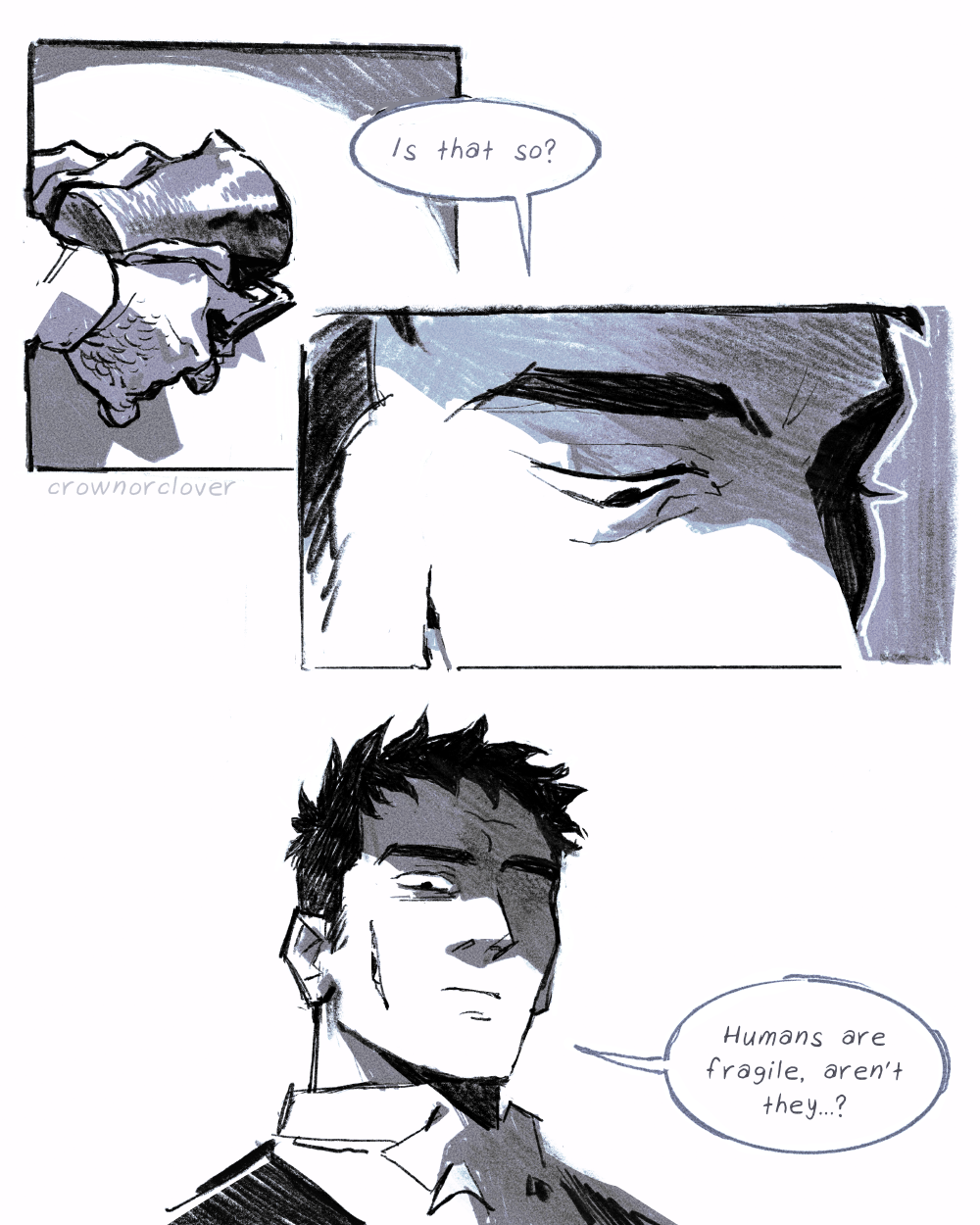
Tome scrunches her nose. “Huh? Didn’t catch that.”
He offers a muted smile, cast like a barrier.
“I’m an android,” he tells her. “You don’t have to worry about me.”
He wipes the last of the dishes dry. They align at perfect angles. Tome fidgets in place at the threshold. 4pm. Closing time. He crosses from the counter to the entryway. Routine.
“Yeah, obviously you’re an android, but I wasn’t gonna make a whole thing about it. I just thought. I dunno…”
Serizawa’s hand hovers over the door. “It’s fine. Have a safe trip home, Kurata-san.”
04. dig
Tome doesn’t return within the week, although, Serizawa supposes, a loss of allowance might follow a grounding like thunder follows lightning. In a nod to her probable suffering, he overlooks the interest on her tab and leaves her receipt in a drawer.
Without many customers to attend to otherwise, Serizawa hurries the sluggish flow of time between turns of the door sign as routine dictates. Outside the normal life cycle of dishes and washcloths, there’s long-term upkeep of the building to attend to as well — inspecting for termites, patching weak spots in the roof, and cutting back the wild grasses before they overtake the cafe’s lone stone-lined path from door to street.
Outdoor work is twofold. While Serizawa completes any odd task, he can simultaneously recharge the solar inputs distributed throughout his skin layer. At full capacity, he can function regularly without issue for a month. Operating at more conservative levels, he estimates he can manage three months without issue. Continuous input is the most taxing. Day-to-day activities don’t require constant bookkeeping over sight and sound, feeling and temperature and the thousand other fluctuating variables. On long days without customers, he runs more efficiently stowing himself away without sensors or voice at all.
Sometimes, outdoor work is more involved than simple upkeep. This particular morning is especially egregious. When Serizawa brews the first cup of coffee of the day, the finer notes are eclipsed by a bite of salt and sulfur. The rancid taste is strong enough to make his mechanical joints shudder.
“…Eeegh.”
He pours the rest down the sink drain. It’s unwelcome, but after successive days of rain, it isn’t a surprise either — when the ocean overtakes the cafe’s hand-dug freshwater well, he has to find a new one as soon as possible.
The cafe sign flips over. Serizawa tacks a short note to the door beside it: “Closed for repairs, back soon.”
Because, he reminds himself, there’s always a chance.
The first order of business is proper equipment, and the local farm stand is only a few miles down the road. The air is thick with dew, but the heaviness is offset by the breeze on Serizawa’s face as he sets off on his bike.
It’s a simple operation — a canopy tent beside a greenhouse on a few neat acres of cultivated farmland. Several rain collection barrels rest at the greenhouse’s corner, dressed up with elaborate water-filtration systems. Green leaves press against the inside of the glass. Grapevines, from what Serizawa can tell.
Dealing primarily in fresh produce, the stand sells a little bit of everything within season. Glistening cucumbers, edamame pods, and fuzzy, unripe apricots piled up in crates near the cash box. A pyramid of bitter melons balances on an old picnic table. On the shelves along the canopy’s side sit packets of seeds, bags of fertilizer, and basic gardening equipment — trowels and lengths of hose — much of it used, patched, and refurbished. Serizawa spots a stack of buckets, a roll of handwoven chicken wire, bouquets of dried herbs, and a deer scare. The rest of the shelving supports propagated plants nestled in an eclectic mix of containers — staked tomato vines growing from the belly of a drum, bell peppers spreading over the razored edges of tin cans, and garlic bulbs nestled and squeaky, the strange eggs in an old styrofoam carton.
At the end of the checkout table, a sign bluntly declares that prices are up to the stand’s owner at time of payment. Said owner, Minegishi, greets Serizawa with a frown, deeply inconvenienced by the suggestion of working at their job. They set down their book — The Myth of Sisyphus and Other Stories.
“Serizawa. Haven’t seen you in a while.”
“Ah. Yes. I’ve been busy with…”
Serizawa recalls his last visit — replacing a broken lawn mower blade. That was around two years ago. 742 days, by Serizawa’s count. In that time, 82 unique customers arrived, which left around 17,000 hours of—
“…various things,” he finishes.
Minegishi scans him over once. Twice. Serizawa wonders if they can tell how much graphite lubricant he’s saved by limiting his range of motion in the past year. Maximizing efficiency is all about incremental changes. Minegishi, a botany research android, should understand the need to conserve resources better than anyone. Instead, their eyes linger on the gash in Serizawa’s cheek, but they don’t ask questions. The pair stands together in unblinking silence for two more excruciating clock cycles. Then, bored of this, Minegishi resumes their reading.
“…Is it a good book?” Serizawa asks.
“No,” Minegishi says, setting down the book once more. “Are you going to buy something already?”
Serizawa appreciates the pointedness, even though his training data informs him that patterns like this are labeled ‘rude’ with a 99% confidence. Minegishi must not know what Serizawa knows — that sticking with human niceties usually works better for whisking people along, even if it doesn’t make a lick of logical sense to fill the air with talk of nothing.
“I need equipment to fix the cafe’s freshwater well. With all the flooding last week, it was contaminated and…”
Serizawa trails off when Minegishi pushes themselves to their feet and disappears behind the adjacent greenhouse. He hears a tool shed door swing open, its padlock clapping against a fence.
Their voice follows: “I didn’t say ‘stop talking.’”
“Um. Sure. I need a new well as soon as possible, and I have a rough idea of where to dig, but I need—”
“I know what you need.”
A few ensuing noises — plastic bins scraping across the floor, the clunk of wooden garden tool handles, and the screech of atrophied metal in a neglected tool relegated to the shed’s dark back corner.
Minegishi returns with a hand auger — a metal pipe with a handle on one end and a helical screw blade on the other, meant to churn a small, circular hole deep into the soil. They ask if he needs to download instructions, but Serizawa is familiar with the process already. How, he isn’t sure — the details are lost to the ether.
Minegishi hands over the rest of the hardware Serizawa needs — metal pipes, filter, hand pump, and others. Once its all in order over the counter between them, Serizawa takes out his wallet to pay. Minegishi holds up a hand.
“It’s fine. You’re renting it for now. Bring it back when you’re done. I won’t need it for a while, and that kind of equipment isn’t easy to find in town anymore.”
“Done? But I need it for the cafe.”
“That’s got a few years at best. You can come back when you’re done playing house for the humans.”
“It’s my job. It doesn’t have an end date.”
“Why bother? It’s not like you’re the one who needs the water. Or the money. What do you even get out of all of that?”
“It’s my job,” Serizawa repeats, perplexed. “You work here. What about you?”
“It’s my preference. I’d rather spend time with plants than people.”
“Because you enjoy plants?”
“Eh. Not really. They’re fine, I guess. I could take them or leave them.”
Serizawa says nothing. He organizes the new equipment into a hard case he can buckle to the side of the moped. Minegishi might have a point, maybe one that Serizawa could excavate from under the thick layers of skepticism and misanthropy with the hand auger. Still, Minegishi seems to have their entire existence sorted out and satisfied, and Serizawa wonders if there’s an obvious logical flaw he’s missing. Or maybe they simply live lives too opposed. Serizawa would give anything for a return home or, at the very least, a sense of conviction as clear-cut as Minegishi’s. And Minegishi, on the other hand,…
“Suit yourself,” they reply, returning their attention to their open book. “Going to all that trouble… Sounds like a big waste of time to me.”
On the last wire shelf under the canopy, there are lawn ornaments for sale. A stone lantern. A blue heron. A cat reaching for a butterfly. Things Minegishi must have rescued from a dumpster or an old estate or wherever they find such things. These are the trinkets that buy money, money that buys charcoal and metal and oil.
At the end of the rack, a small, blown glass figurine catches Serizawa’s attention. It’s a mermaid, crafted from smooth cerulean glass with flecks of violet and gold marbled in. With her tail twisted in an elaborate loop like a treble clef, she stares hopefully above at the cracks of sunlight filtering in through the canopy’s vent.
He moves on quickly.
Human entanglements aside, they all have their own roles to play — and maintaining an unblemished routine is Serizawa’s.
The air sags even thicker as Serizawa pulls back onto the road. Even if the full heft of the heat and humidity hasn’t yet settled over the earth, it’s unpleasant. Serizawa doesn’t care for the moisture seeping into his components. It feels like glue, gumming him up at the seams. After he drives through a cloud of gnats, he shuts off his sensors, relying on vision and sound alone to navigate around the hazardous cracks and pockmarks years of weather tore into the street.
He rides back past the same handful of mile markers along the road. His next destination is closer to the cafe, a green patch on a map increasingly colored blue. The odds are in his favor. The spot he has in mind sits on a gravel deposit in a valley between the tallest hill north of the cafe. It’s further from town and the sea, so the chance of water contamination is low but still close enough to pipe back to the cafe without encountering many obstacles.
When Serizawa comes to the top of the dirt road over the first hill, he can spot the tops of the cedar shingles on houses in the village. He takes in the view from this vantage. It’s better to admire them from here, where he can observe their lives from a detached distance, like ships over the horizon or ants in a farm.
Every day is the same, he thinks as he spots a caved-in roof from a fallen tree — and nothing changes until it does.
When he arrives at the meadow below, Serizawa walks his moped through the mud and tangled grass. The outer edges of the valley are flanked by trees, but the meadow is mostly wild grass and shrubs, taller life stunted by the veins of sand and gravel below the surface. It’s exactly as Serizawa expected. He parks his bike under a tree. His shoes are damp at the edges, lined in grass and wafting petrichor. Yesterday’s rain drips from a leaf and plops over the seat. He wipes it away.
With his gear unpacked, Serizawa gets to work in the clearing he’d predetermined, pulling away weeds to reveal the topsoil. The commotion clears away all but the dragonflies, darting between dewy sprigs of grass. The midday sun bears down from above. His hand auger spins deeper into the ground, mercifully softer after the torrential downpour a day prior.
A twig snaps behind him.
He checks over his shoulder. He finds only a lone tree, its weeping branches bouncing, scattering wet flakes of bark over his bike and the gnarled roots below.
It’s not worth the energy to dwell on it.
He gets back to work.
He falls into a rhythm — digging, retracting, emptying the auger of dirt, and digging again until the auger’s blade comes out of the ground packed with sticky mud. He bails out the sludge sitting at the new well’s foot — a puddle to him, a lake to the delight of the stubborn dragonfly buzzing above his shoulder — until he’s left with a clearer channel into the reservoir below.
With the valves and pump installed into the narrow, Serizawa tests the water. He braces for a mouthful of salt—
“...Oh, that’s not too bad.”
— and he’s pleased to find none. He takes another thoughtful sip and spits it into the grass. His shoulders settle. With more filtering, it should be potable enough for the cafe.
By his estimate, the new well will last at least another year or two, depending on storm patterns. The more the ocean rises, the less sustainable this will be. Accessible groundwater sits in low lying areas, closer to shore, where it sits prey to the creep of salt and bacteria. It’ll be harder to dig in the dips between mountains on the horizon, further and further away from his role at the cafe.
Serizawa rises from his kneel, wiping his hands along the seams of his work pants.
There’s movement at the corner of his eye.
“Eh?”
He swivels his head, fixed on a rotting dandelion, weeping the last of its seeds over a mossy tree root. Nothing. The dragonfly is nowhere to be found.
Another insect, he figures. Ants, beetles, a clever mantis, though he hasn’t seen one in a while. There are more insects than anything else in this world, a gap that grows wider every passing day. And if not an insect, then a rare animal, or simply, the wind through the jagged weeds. After a moment lost to inspection, he dismisses it. With his sensors numb to the world around him, Serizawa misses a streak of red, ducking behind the bushes.
He’ll connect the new well to the cafe tomorrow. For now, he fills a few jugs of fresh water, secures them to his bike, and leaves the pump, the lone soldier in the empty meadow. There’s a rumble of thunder in the distance. He packs away his tools and starts back to the cafe. More rain will follow. Always more rain.
Meters back down the dirt road, Serizawa spots the angled roof of the cafe framed between the wide boughs of cicada-infested oak trees. The building sits on relatively-higher ground, but the ocean’s already in sight. By Serizawa’s estimate, it could seep into the foundation in a few more years. The water takes everything. It’s already taken a good chunk of the village shore — coastal homes submerged, smaller abodes hoisted further up the hills.
Watch over the cafe.
Eventually, it will take this too. If the president isn’t back by then, Serizawa isn’t sure what he will do.
05. visitor
Weeks after her sworn vow to return — time Serizawa assumes was spent scribbling out homework under strict parental surveillance — Tome visits the cafe. Serizawa starts the kettle when her boots clomp haphazardly over the stepping stone path.
Unlike last time, she isn’t there for merfolk evangelism.
She pokes her head through the open door. “Do you believe in destiny, Serizawa-san?”
“‘Destiny’? Hm…”
He consults his memory stores. It takes a thousandth of a second.
“No,” he says.
“Okay, whatever, enough about your thing. Earlier, I was so bored that I thought I would sneak out of the house to come here. Do you know how long I’ve waited, wanted, friggin’ prayed for something to happen in this town? And then… Get this!”
“Yes?”
“Something finally happened!” she announces with an excited swing of her arm, sending the door careening into the wall and a new chip in the paint. “Guess. Go on. You’ll never get it but try anyway. I’ll wait.”
“Um. You—”
Tome blurts, “I found a guy in a ditch!”
Serizawa blinks at her. “I— Who?”
“Dunno. But see? Whether you like it or not — destiny’s happening.”
She pauses expectantly, half inside the cafe. He stares at her. A fly breaches the cafe through the undefended threshold.
She groans audibly. “So are you coming with me or not?”
Serizawa switches off the hot water. He turns the sign to ‘closed’ at 1:23pm. No time to leave a note. Not routine.
True to Tome’s word, there’s a man facedown in a ditch, irrigation for the tangle of thorny bushes lining either side of the dirt road. He’s covered in a thick splash of salty mud. Half-submerged in the swamp beside him is a moped, laying on its side, back wheel still spinning lazy circles. The man’s poorly-secured possessions dot over the scene like sad, day-old confetti.
Tome quickly fills Serizawa in on her current prognosis.
“I poked him in the shoulder, and he made a noise, so I’m pretty sure he’s not dead.”
“I’m alive,” a muffled voice barks.
“He’s alive,” Tome confirms.
“Hello,” Serizawa greets tentatively. “Do you mean to be lying there?”
“Yeah. Uh huh. Absolutely. I’m having a great time. It’s my favorite position.”
A brief pause.
“Of course I don’t mean to be lying here! What kind of question is that?” the man cries. His legs kick out in emphatic punctuation. “Give me a hand already!”
06. memory ii
At some point between the clap of the screen door and the roar of the engine, Serizawa had quickly decided that the best way to handle the time until the president’s return was to stop it entirely. What would the president say if he came back to a place he didn’t recognize? Serizawa knew the discomfort of lost memories. He would spare anyone else that fate if he could.
Thus, Serizawa would keep the cafe exactly as it was that fateful day with all the diligence of a curator maintaining a museum. Or, perhaps more accurately, a shrine — the sole remaining witness to what things used to be, engorged with prayers that it would become those things again.
Serizawa would be the modest shrine keeper to a school of inanimate fish.
Paintings of flying fish hung on the white popcorn walls. The flying fish rusting atop the weathervane, always pointing away. A flying fish model posed atop the sparse bookshelf. Flying fish silhouettes carved into the back of the chair, embroidered into a work apron, and burnt into the cafe chalkboard above ‘omurice 50% off.’ Omurice had been 50% off for as long as Serizawa would remember, despite that he had never once made it.
But it was not for him to question, Serizawa had decided. He lived with his sole and silent companions, appreciating them for what they must have been in all the days he doesn’t remember. He liked the sight of them. And the president must have had them for a reason, after all. He’d even left a flying fish sticker on the locked office door.
Early on, Serizawa thought preserving the cafe in a time capsule would be straightforward — but as the weeks went on, life challenged this stasis. The tide rose, machinery wore out, and supplies of certain items ran dry. Serizawa agonized over these decisions, caught in an endless loop of speculation — the shrine keeper, burdened with the task of interpretation.
Optimistically, he had expected further direction within the first days of the president’s departure. Before, tasks had clearer directions — procedure and expectation, input and output, x and y.
But then his first week passed. No word came. And then another week and another and another after that. Nothing. Time piled up with the garbage, and Serizawa had no data to analyze, no progress to report, nothing to do but sit beside it as it grew.
He’d handled customers, the few of them who came. For most of them, the cafe was a quick pit stop on a journey inland. Like the president, they all seemed to be running from something. These were simple interactions, and Serizawa acted the dutiful conveyor belt, funneling people from point A to point B without much effort. The real trouble came in the evenings, as he stared out the bedroom window, anticipation cresting at the shine of a passing headlight over the gravel road, then waning as it inevitably passed him by.
More weeks passed without incident. In one of them, Serizawa ferried a customer through the drink shortlist. He’d kept wandering while he stood at the counter, determined to discuss anything but the matter at hand until, after some gentle coaxing, he settled on a cafe au lait. Serizawa took the order, gestured to the seating, and turned up the radio. He readied the order while the man drummed his fingers over the table by the window.
“Did you hear? I was picking up supplies earlier, and some guys in town said they’re having fireworks for the summer festival next week.”
“Fireworks?”
“It’s nice, isn’t it? Even if they’re just using the simple stuff. You don’t see much of that anymore, not anywhere I’ve been at least. It’s a shame. Maybe I’ll stick around and watch. This kind of thing really takes me back…”
Serizawa set the mug over a wooden coaster.
The man took a sip and frowned. “Actually, could I have something sweeter instead?”
Serizawa nodded and retrieved the mug. Humans could be so indecisive. It was a shame, how they could possibly spend such significant fractions of their lives turning away satisfaction and stability.
Two paces from the counter, he halted in place.
Human error, he thought, and it felt like the floor dropped underneath him. Of course. It had been sitting in front of him all along. How could he have missed it?
“Something wrong?” the man asked.
“…No. I’m fine. I’ll have this ready for you shortly.”
Serizawa stirred simple syrup into a mug and returned it to the customer’s table, nearly counting down the milliseconds from the first sip until the man’s moped peeled out of the driveway and disappeared down the road.
Alone and desperate, Serizawa finally confronted the locked door at the end of the hall.
It ran contrary to what he had internalized as a personal directive — but Serizawa wondered if he had miscalculated from the beginning. The president could be just as full of frustrating contradictions as anyone else. Humans patched their faults with technology, with conscientious androids like Serizawa meant to make up the difference. The study was locked, yes — but Serizawa had seen a key in a drawer behind the bar.
It followed — the answers were there.
He was meant to go inside.
He reached out. Gripped the doorknob. Turned it. Met resistance. He could go retrieve the key. It might not even be necessary. The doorknob felt so delicate in his hand. It was a simple calculation of a thin slice of metal in the doorframe against an unstoppable force — how little energy it might take, how little time would pass, how easily he could make the wood splinter — and finally, how soon he could know the truth. Some noble reason for why he was there alone and why the president wasn’t. Some direction over what he was supposed to do. What he was supposed to feel. Some answers. Any answer. Any shield against forever.
One last thought crept into his mind. Serizawa could open the door and find another potential truth — that the president made no mistakes at all.
In that moment, a sudden fear sprouted within Serizawa — the possibility that his missing memories were not as precious as he’d envisioned.
He let the door knob go.
Another time, he thought. Like the president said, time isn’t an issue to an android. There will be another time, a better time, when everything will be clear. He can wait until then. The president might return. He’ll know eventually. Just not now. Not yet.
Another week passed, silently save for the rain pattering over the roof and sliding down the windows. The clouds cleared by the weekend. From the top of the hill behind the cafe, Serizawa gazed over a small crowd gathered along the main street. Colorful paper hanging from the vine-entangled street lamps. A small stand, passing out clouds of spun sugar and candy-coated apples. Kids dressed in yukata reaching for the fireworks bursting over the far shore. The reflection in the water was blinding. He took a picture with his camera, but it didn’t capture the brilliance.
Difficult a calculation as it was, Serizawa had made the right choice. The door remained locked that evening; the room, unknown. And as more time passed, days, months, years — he found the temptation to open it lessened. Gradually, he forgot that it was even there at all.
07. destiny
Gingerly helped into a sitting position beside his upturned moped, the stranger pushes back the slick bangs plastered to his forehead. He coughs twice, spits a mouthful of mud into the thicket, and announces—
“The name’s Reigen Arataka. Hey, thanks for the assist. It felt like I was stuck in quicksand.” He flings away a clump of dirt adhered underneath his chin. “Obviously, I would’ve figured it out myself, but this was much faster.”
“Huh,” Tome stage-whispers to Serizawa. “I thought having a visitor would be exciting but this guy is kind of…”
“Lost?”
“Sure. I was gonna say ‘screwed’ actually.”
“Yes. I’m a bit worried.”
“Oi, don’t talk about me like I’m not here!” Reigen snaps. “I’m perfectly fine. Never better. I—” He waves his hand and then instantly doubles over in pain, clutching it to his stomach. “Shit. I’m good, I—ah. God. It’s just a bruise from the—agh—fall earlier.” He sucks in a labored breath. “Rub some dirt in it, and I’ll be good to go. I just—” He suppresses a groan, gritting his teeth.
Serizawa kneels and inspects the damage. Based on a quick visual scan over Reigen’s injuries, he concludes that Reigen requires prompt medical attention — a reality that Reigen denies just as immediately.
“No. No, no, no. I don’t have time for something like that! I need to make it to the other side of the coast before the tide rises again. These damn roads keep changing! I can’t afford a pitstop for a couple of scrapes.”
“Reigen-san,” Serizawa begins in typical customer-service cadence, “I would strongly urge you to see a doctor.”
Reigen’s attention swivels to Tome. “Hey! You tell your robot friend I’m perfectly—”
Tome interrupts. “You have a spare room in the cafe, don’t you, Serizawa-san? I thought I saw a hallway to the back last time I was there. Once this guy sees a doc, you could put him up.”
“Ah. Yes. Technically, I do. But…”
Not routine, he thinks. His processor stutters over a cycle. He can feel his own fan kick in. Not routine at all.
Reigen raises his voice. “Hey now. I have camping gear. I’m not a charity case.”
Serizawa glances beside them, where Tome’s padded boot nudges the broken tent pole amidst the other strewn debris of the man’s poorly-packed luggage. The moped sinks deeper into the mud. Its owner sinks too. The forced easy-going smile slides off his face, and in its absence, a disgruntled scowl.
Serizawa’s fan spins faster. He kicks off a series of ill-fated calculations.
“I can take care of myself just fine,” Reigen insists.
This must be one of those times where humans don’t say what they mean, Serizawa decides. There’s sweat beading on Reigen’s forehead, his jaw is tight, his face is red with exertion. Pain.
“You’ll need freshwater to clean your wounds,” Serizawa says to Reigen’s empty canteen. “Exposure to stagnant water like this can lead to microbial infections.”
“Brain-eating amoebas!” adds Tome.
“Those aren’t a thing,” Reigen says to Tome. Then to Serizawa: “Right?”
“Actually, that’s a possibility,” Serizawa says.
Reigen pales. “A small one though.”
“This guy’s totally screwed,” Tome says.
Serizawa cocks his head. “Considering the state of your equipment and your injuries, your odds of surviving exposure are—”
“You know what?” Reigen huffs. “I don’t want to know all of that stuff! I just — ah, why the hell does this hurt so much? Shit...” He grimaces, wiping away the cold sweat in the crook of his elbow. “Okay, okay. Listen, both of you. All I need is an updated map and I’ll be on my way. I—hah—have to keep going. And if you have to do something for me, then help me get the moped cleaned up.”
Serizawa’s brow furrows. “But Reigen-san, you can’t ride that moped.”
“Eh? The hell do you mean ‘I can’t ride that’? I rode it here, didn’t I?”
“Yes, that’s true, but I really don’t think—”
“You think I forgot how to ride it?”
“That’s not what I—”
“I wouldn’t have crashed if you all took better care of your roads! Bet you never thought about it that way.”
Serizawa’s brow furrows. It’s true that he never thought about it that way, but that’s because it seems irrelevant. “I—”
Tome stabs a finger at their waterlogged visitor. “How are you gonna ride your bike when your hand’s all busted like that?”
Reigen scoffs. “Please.” His gaze drifts down to his swollen, mangled hand. “My hand isn’t b—...”
Serizawa and Tome watch the blood drain from Reigen’s face. He passes out, face down, plopped back into the mud.
Definitely not routine.
“We can carry him to the clinic in town,” says Tome. “I’ll get his legs.”
In a moment, the sun gets hotter and the cicadas cry louder, and Serizawa balks at a forked path, paralyzed by indecision. It’s as if he’s standing on a crumbling hill between two troughs, deciding which black pit seems shallower.
Someone’s hurt. It tugs at him. Someone’s hurt, and that means the answer should be obvious. But someone’s hurt, and there’s always a chance that it all goes wrong and…
Tome nudges his foot with the toe of her shoe. “Serizawa-san?”
Getting involved, staying away — his personal directive provides nothing to grasp onto for guidance. All the while, the moped wheel turns its useless circles.
“C’mon Serizawa-san. Geez! Did you short out or something?”
Serizawa wonders what the president would say.
“I’m confident in your ability to adapt to any situation.”
It’d be so much easier if someone would just tell him what to do.
“You gotta give me a hand with this,” Tome barks. She wiggles one of Reigen’s boots out of the mud. “He’s denser than he looks.”
“...Yes,” Serizawa agrees. “Yes. Right.”
When he reaches for Reigen, it feels hauntingly familiar. A hand on the doorknob. It twists slowly as he pulls a disoriented Reigen out of the mud by the armpits. It expects to meet the usual resistance of a steel lock — but somehow, despite all of Serizawa’s fears, it keeps moving.