Work Text:
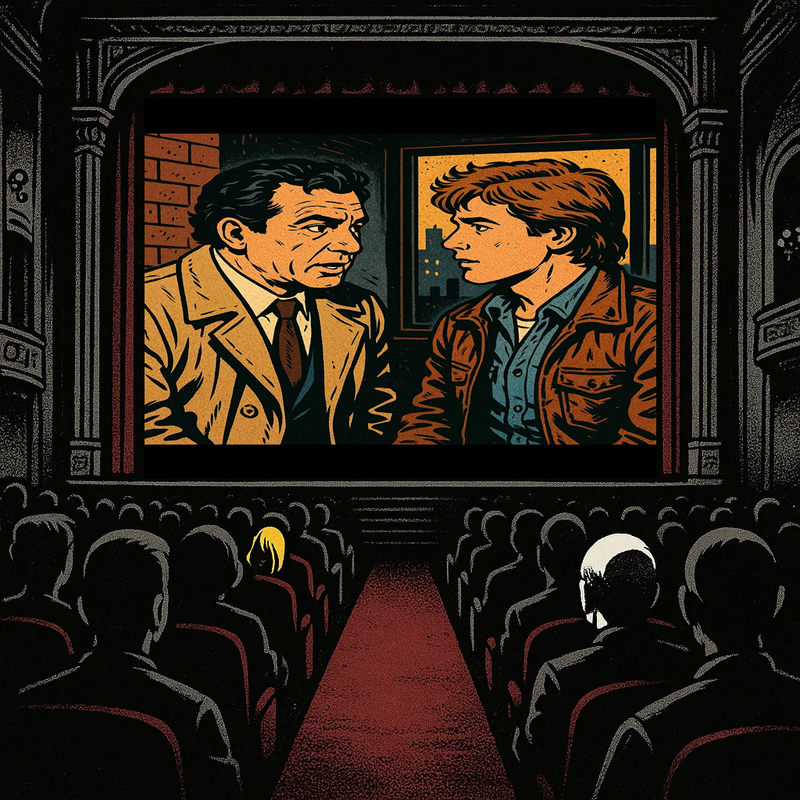
They slipped in with the noon crowd—coats and boots and chatter—and the dark swallowed them like a mouth. Billie blinked until the ceiling constellations steadied. The air smelled of syrup and old carpet, of salt and pretend butter and the faint iron of the radiator humming behind a torn velvet curtain. She moved the way Rick had taught her to: soft, angled, unremarkable. He leaned toward a side aisle, the pair becoming shadows in a river of knees. Warmth pressed against her cheeks. The screen glared white, then bloomed into color so bright it felt like it could stain her eyes forever.
Cartoon, the word sat in her head like a tiny drum. She’d never seen one. She thought a drawing would sit there flat and still like a picture in a book. Instead the picture breathed. A blonde girl existed, clear as a bell and twice as stubborn, and the sky above her was too blue to be real but it was, emphatically, the realest thing in the room. Billie’s ribs loosened. The dark could not be bothered to notice her; the light very much could.
Rick didn’t sit so much as fold himself into a smaller set of possibilities. One knee edged into the aisle, an eye on the door, the seats, the people who came and went. He watched the corners while the picture did its tricks. Every few minutes, a hand—his—appeared in Billie’s peripheral vision and pressed something into her palm. A tuft of popcorn. A few kernels. Once, half a candy twisted in cellophane. The hand withdrew again, same way it came, without comment. She ate like a mouse: quick, precise, careful to bite in time with the music so the crackle would drown her crunch.
Onscreen, a rabbit barreled past, frantic: “I’m late! I’m late!” He flashed a pink ear like a warning flag and was gone into a hole that had clearly been waiting for him since the invention of holes. Billie’s mouth went small. The rabbit’s hurry felt familiar. The hole felt familiar too, a kind of door that kept pretending to be a trap and vice versa. The girl—Alice—peered into it with an expression Billie recognized: not caution, not bravery exactly, more like refusal to be left out. Then down Alice went, down and down through the dark, books and chairs and frames flowing past her in a slow rain. Billie’s shoulders lifted. Falling, but not breaking. The city had made falling a sharp word; the film turned it into a long, soft vowel.
In that muttering light, Billie noticed the headband. It held Alice’s hair like a spell: a blue bar across gold, a line saying Here and No Farther to the strands that wanted their own stubborn journey. Billie did not like dresses. Even the thought of skirts made her bristle; too much air, too much showing, too many hands that might think they were allowed to help. But a headband—that was a tool. Order that could draw across the top of one’s thoughts. She could see herself with one, not delicate ribbon but something plain and flat and certain, something that said this is mine. She touched her own hair under the peacoat collar, as if the movement on the screen could conduct itself into her through the dark.
The colors moved like they’d been waiting to be let out. Teacups spun and the table stretched as if made of elastic. A cat unspooled from the night, grin first, the rest of him arriving only by degrees. The forest blinked; the flowers sang. “Curiouser and curiouser,” the girl exclaimed, and Billie held the words in her mouth without letting them out, little coins she could rub smooth later. The world inside the picture worked on rules that were honest about their dishonesty. When the door said too small, it was really too small; when the bottle said “Drink Me,” it meant the truth and the trick all at once. It was a relief. Upstate, grown-ups had made nonsense and called it wisdom; here, nonsense admitted itself and allowed you to plan around it.
A smooth, dry voice rolled from a hookah, slow as a tide: “Whooo are you?” Smoke turned into curly letters without asking permission. Billie swallowed. The question moved past her ears and down into her chest where it sat—a pebble in a pocket—heavy and fine to hold. Who are you. As if the asking were a kind of door, too. As if you could open it yourself. She didn’t answer; there was no need. Alice answered with her face, which kept changing without her consent—too big, too small—until she put herself together again by pure intention and a little luck. Billie found herself frowning at the caterpillar, at his lazy authority. A hand brushed hers. Popcorn. She ate, the salt making the picture brighter for a moment, the kernels tiny planets she could absorb.
A song about unbirthdays tumbled like beads. An orange cat in a hat poured tea from five spouts at once, and the table refilled itself like a river flipping direction. Billie had never been to a party—she imagined them as places where people noticed you the wrong way—but the unparty on the screen felt like a place where mistakes were not tragedies, where you could be wrong without becoming unsafe. Teacups hit the table with little clicks that felt like yeses. The March Hare’s ears boinged as though the animator had a string tied to Billie’s grin and tugged it, against her will, a fraction upward.
The Queen arrived in a whirl of red, a shape like an angry tomato with jewelry. “Off with their heads!” Her bellow rummaged through the theater and rifled Billie’s spine. She went still. Not fear exactly, but recognition—the sound authority makes when it forgets it’s only pretending. The soldiers were cards; even as they marched, you could see the fold line. Billie felt the cold edge of a sung scar—memories that smelled like church basements and damp walls—then the image sailed to a new chaos: paint the roses red, drip, drip, hurry, hide the evidence. Paint over what you’re not allowed to grow. The brushstrokes looked thick enough to peel off and save.
On the seat beside her, Rick adjusted his angle a hair. His eyes flicked to a teenage couple two rows down, their heads bent together over the cup holder while one reached blindly for a carton that wasn’t there anymore. His hand shifted—a quiet, practiced animal. Another small gift found its way to Billie’s fingers. She tucked it into the fold of her coat like a secret note. The movie thundered into a chase and all the colors ran wild around Alice as if they’d been waiting their turn since Woolworth’s windows. “Run, run,” the music said. Billie did not move. Being in the dark with so many strangers and not moving felt like a kind of superpower.
A door, a keyhole, a bottle, a cake. Names the size of objects and objects the size of names. Billie counted them in her head the way she counted crosswalks: small inventory turned into comfort. She liked the way the picture never lied about wanting things. It wanted to be bigger. It wanted to be smaller. It wanted cake. It wanted an answer. The wanting wasn’t shameful, just complicated—sometimes you paid for it with a neck stretched like a reed, sometimes with tears the size of ponds. Alice’s tears, a lake; Billie’s, tight and shy and private, nothing like a lake. Even so, she felt a wetness collect at the corner of one eye and rubbed it away before it could cool on her cheek.
“Now, don’t let’s be silly,” said the White Rabbit, adjusting his waistcoat with a fussy paw. Billie tucked the line into the same pocket as the headband—useful, not because it was true but because you could throw it back at the world when it pretended to be reasonable while stepping on your foot. The screen turned a shade of green she had never seen anywhere but in the inside of eyelids when you looked at the sun for a second. She breathed in as if she could inhale the color and keep it.
Somewhere behind them, a little kid laughed with sticky abandon. Somewhere to the left, ice clanked in a paper cup. The projector chuffed softly, a machine that sounded like it needed a nap but would never allow itself one. Billie felt the vibration of the sound through the seat back and imagined riding it like the rabbit’s pocket watch, ticking into the next minute without asking permission. Rick’s hand ghosted her elbow, just a brush—a check-in as brief as a heartbeat. She did not look at him. She did not need to.
The trial scene piled every silly cruelty in a high, wobbling tower. Witnesses pointed, rules inverted, the Queen’s mouth opening and closing like a wound. Billie’s jaw clenched. She knew the weight of accusations that made their own evidence with the volume of a voice. The cards swarmed. “Sentence first—verdict afterwards,” bleated a mouth that thought it was the world. The swarm came forward. Billie pressed her tongue to the roof of her mouth until it ached, a steadying pain. Onscreen, Alice grew. Onscreen, she refused. The refusal felt like a handhold.
Light flickered, then softened, then gathered itself into the ending. A soft doze on a riverbank. A voice that might have been a sister’s. The story folded itself neatly and placed itself in a drawer. The theater lights didn’t come up all the way—just a tired lift, a nap disturbed. People stood as if being assembled by an unseen stage manager; coats shook out their sleeves, purses snapped shut, a seat sprang up with a lonely thwack.
Billie sat still. Her eyes were bright and sore. The afterimages persisted: the headband like a ribbon of sky, the cat whose smile stayed after its face left, the word on smoke: who. The movie had opened a seam in the day and crawled inside, warm as a pocket. She had stepped through a door where none had existed, then stepped back out, carrying a small, hard thought the way you carry a pebble smoothed by your own palm: not treasure, exactly, but something worth keeping.
Rick’s hand appeared one last time, not with food but with the smallest tug on her sleeve. It said everything words would have clattered over. She rose, the peacoat settling around her like a curtain. The dark in the theater felt friendlier now, as if it knew her. She walked up the aisle with the others but not like the others; she walked as someone who had borrowed a little piece of blue and intended to keep it.
At the door, the corridor’s red EXIT sign leaked its quiet order into the dim. Outside this room, more rooms waited: other screens, other stories, other chances to become invisible in a crowd and visible to herself. The rabbit’s hurry still ticked in her bones, but there was no late here, only next. From the lobby, the muffled sound of a different soundtrack vibrated—a bassline like someone knocking from under the floor. Billie followed that faint knock as if it were a pulse. Her stomach made a small sound of its own, nothing dramatic, just a reminder. She pressed her lips together, tasted salt, and discovered a piece of popcorn she hadn’t noticed, dry and perfect against her back molar.
She didn’t speak. Neither did Rick. The movie’s words had already said enough for both of them, and their quiet, shared and unspectacular, felt richer than any conversation. He angled them toward a different door, the better one, the one with a hinge that didn’t squeal. Billie let herself be steered, chin up, eyes flicking only once to the poster where the cartoon girl smiled forever into forever. A headband, blue as a dare. She memorized it like a map.
Then the door hushed open. Warmth breathed from another auditorium. The day outside could wait its turn. Inside, the dark welcomed them a second time, and Billie stepped back into its soft, careful mouth with the certainty of someone who had learned, in ninety minutes, that pictures could be truer than rules and that a strip of blue cloth could be as powerful as a spell.
Rick picked the auditorium like he picked a sleeping spot: angle, cover, exits. The poster in the corridor had done half the work for him—Al Pacino’s face in a stark tangle of hair and shadows, the pupils hot as burned sugar. He’d seen that face on the blank-mouthed televisions in appliance-store windows, the picture flickering in silence while the city’s noise ran over it. Even with the sound off, Pacino’s body had spoken—shoulders hiked like a boxer who refuses to back into a corner, hands cutting the air like he was kneading an argument into shape. That electricity had tugged at Rick’s ribs every time. Now, stepping into the dark on that promise, he felt it again: a small jump in his chest, a current he didn’t want to shake.
He slid them into seats with a clear sightline to the left exit and the little red EXIT sign that glowed like a watchful ember. Billie settled, a compact knot of quiet in the chair to his right. Her peacoat swallowed her to the chin; only the blunt blade of her gaze showed. He lined his knee against the aisle, kept one shoe slightly crooked—ready to pivot. The room smelled like syrup and cigarettes and a floor that had learned to hold secrets. Down front, someone coughed, a rough bark that sounded like wood being split. Behind them, the projector began its steady, chuffing prayer.
The film seized the room by the throat. There he was, Pacino, eyes live-wire bright, already mid-argument with fate. He moved like he was too full of thoughts for his bones, an animal pacing a cage that he kept insisting was a hallway. Every gesture seemed to have three endings and he took all of them at once: a hand half-raised in surrender that became a jab, a flinch that became a pounce. Rick felt his whole body lean forward without permission, as if the seat had tilted and he had to follow or fall.
But the tilt never took his eyes off the room. The ushers were shadows at the margins, bored silhouettes that brightened when a door opened. A couple down the row negotiated a tray, focus narrowed to the teetering soda; Rick’s hand slipped out and returned with a film-warm fistful of popcorn, feather-light. He tipped it into Billie’s palm without looking at her, feeling the brush of her glove against his knuckles like proof of a blueprint he checked hourly. She ate in time with the screen’s noise—crunch masked by a swell of traffic, a burst of voices, the far siren that laced the soundtrack like a steady nerve.
Pacino’s face did things Rick didn’t know a face could do. Not the big things—anybody could make their mouth wide and shout; it was the little contractions, the quick stutter at the corner of the eye when a plan went brittle, the way his jaw set not like a rock but like a hinge holding back the door. The camera loved him like a problem it wanted to solve and couldn’t. It felt like watching somebody learn to walk on a different planet’s gravity and deciding to sprint anyway. In the flicker, Rick compared: the way he himself had learned to take up as little space as possible, to turn narrow and shallow and unremarkable.
Pacino made a different math with space—he moved so the room had to count him. Rick stored that, quietly. It wasn’t useful for shoplifting or sleeping in stairwells, not directly. But somewhere farther down the road—if there was a road—he could imagine needing it. Another handful of popcorn changed hands when the couple leaned in to whisper. Billie’s fingers closed and disappeared into her coat like a squirrel banking a nut.
The story rolled its tension tight. A plan that felt like an accident. A street that became a stage. People outside craned and multiplied; people inside shrank and sharpened. The camera pressed close and Rick could see sweat prick on Pacino’s upper lip, the sheen of it taking the light and throwing it back in a small halo. He’d seen men’s fear before—commune elders faking calm, cops with eyes like locked cabinets—but this fear was bright, almost tender. It made something aching open under Rick’s ribs while at the same time his training kicked, his glance clipping from aisle to aisle, seat to seat, gauging—three rows back: a man loosening his tie; front left: a kid bouncing a heel off the sticky floor; right: an usher scratching his cheek, bored enough to be dangerous only if someone gave him a reason.
On the screen, authority arrived the way it always did—too loud, too sure. Sirens braided themselves into a single unbroken shriek while a wall of blue and brass collected, shoulders squared by the weight of their belts. The room absorbed the cops’ entrance as if somebody had opened a freezer. Rick felt Billie tense, a string drawn to its furthest note. Her brow had been furrowed since the first scene, a workmanlike knot as she sorted cause from effect—who held the power and for how long at a time. The blue uniforms took the frame like settlers laying claim. Bullhorns made voices bigger than throats.
The cops swelled into the frame—sirens serrating the soundtrack, blue a bruise across the screen—and Billie, chin up, spoke to them like they’d stormed the aisle itself. “Pigs!” she howled, as if the uniforms were three rows down and the bullhorn were aimed at her seat instead of the camera.
For a blade-thin beat the room held—Rick leaned forward, inventorying exits and temperaments, a pocketful of soft fixes fanned and ready: a quick grin and “she’s ten,” a palm-low hush, a small shift to slide himself between her and any stray mouth; and, if the crowd snarled, the hard option cocked—outshout the objector with “shut the fuck up.”
But the room didn’t bite. The nearest seats let their shoulders loosen; then a sound rose with the unhurried confidence of a thing that had been waiting its cue. Amusement lifted, not cruel but grateful, a ripple traveling out in concentric rings—two rows, five, to the back—until it broke like surf against the far wall and came back as laughter. Not the kind that points, not the kind that makes you smaller; the kind that gives permission. It felt like the audience agreeing with itself in public, relieved to find out it wasn’t alone. Someone slapped a knee three seats over. Somewhere behind them a soda fizzed and the straw squeaked as if adding a high note to the chord. The usher never uncrossed his arms.
The laugh washed over Billie and she didn’t move under it. She didn’t look for approval; that wasn’t the currency she spent. She kept her eyes on the screen as if the men could still hear her the way she had meant them to, as if the frame were a pane and she had fogged it with her breath. Her brow stayed furrowed in the workmanlike way it had been since the opening scene—counting power’s moving parts, tracking where it pooled and how quickly it shifted. The siren’s pitch climbed; the bullhorn flattened voices into metal. She sat very straight, the navy peacoat making a small mountain around her, and stared through the theater’s mild laughter to the uniforms that existed only in light and yet managed to be as heavy as any door.
Rick let his breath out slow because you don’t give away relief like a secret; you parcel it. The contingency cards stayed in his head where they belonged. He kept the grin folded. He kept the shoulder where it was. He organized the room again: the couple already lost in their own whisper; the kid with restless feet finally still; the usher receding into the wallpaper of the job. He timed a small forage to the audience’s afterchuckle—fingers out and back with a warm, forgiving handful of popcorn—and tipped it into Billie’s palm without breaking the line of his gaze. She accepted it by habit, a soldier refilling a canteen mid-march. Her thumb smoothed salt off her forefinger with a concentration that sat right next to fury without arguing with it.
Onscreen, the police thickened like weather. Authority’s grammar filled the frame—chest out, jaw tight, stance wide. Rick watched it with something like clinical interest and old contempt. He had known too many men who put on voice like armor, who mistook posture for ethics. He watched Pacino’s answering body language unspool like a new dictionary: hands that vibrated with decision, shoulders that spoke even when the mouth lied, eyes that refused to be catalogued neatly. He stored it without ceremony. He wouldn’t become that; he didn’t want to become anyone but himself. But there are ways a person can stand that change what rooms try to do to them, and he collected those the way other people collected keys.
The laughter thinned. The screen reclaimed what it was owed—attention, breath, the little animal of the crowd that likes to be led. Still, Billie’s word hung in Rick’s chest for a few beats more, humming like a tuning fork. He knew that tone. He’d used it himself under his breath, at windows, at backs turned by authority’s confidence. Hearing it out loud from her—placed precisely, not as a dare to the room but as a judgment on the men whose job it was to manage fear—tightened something in him and loosened something else.
He did another slow sweep. A few faces had turned, earlier, at the cut of her voice, the kind of swivel a person does when they’re looking for a fight they can name. Those faces hadn’t found purchase. They’d turned back because the room had told them what kind of moment this was: not an argument, a chorus. The comedy of a child saying the truest thing first. Rick made a note—how quickly a crowd decides itself, how a single well-placed word can tilt strangers toward each other instead of against. Useful, this. Not for shoplifting. Not for sleeping in stairwells. For something else they didn’t have yet, something that needed the city to hear them as one when they decided to speak.
Billie kept watching the men as if she were supervising their work and finding it lacking. The bullhorn boomed commands and turned around to listen to itself. The line of blue pretended to be inexorable. “Pigs” rode with them through the next cuts like a sticky label, and Billie’s eyes followed the label, not the uniforms. When the negotiator smiled, she saw the safeties under his suit jacket; when a baton twitched, she watched the hand, not the leather. Children, in movies, were meant to fidget or to cling. Billie did neither. She audited.
The scene pushed into its next terrain. Nature of crowds. Nature of rooms. Nature of how power behaves when it thinks it’s being watched kindly. Rick measured his breathing to the film’s cadence—slow when the frame steadied, quicker in the churns—without ever letting his attention sink fully under. Billie didn’t sink either. The word she’d thrown had landed and she had no interest in fishing it back out to show it around. It did its work without her needing to shepherd it. She ate her stolen popcorn like a professional, each kernel a decision, each decision precise enough not to make noise when noise would rob her of detail.
The theater’s mood never turned. It stayed soft around the edges, the laughter’s residue making a film on every seat like butter. After a while, even the people who’d bristled at a child’s voice allowed themselves to be moved by the larger machine—the way the story built and unbuilt a man’s choices in front of them. They were all there for the same reason, after all: to be seized and returned, transformed just enough to make it worth walking back into daylight.
Rick timed his next forage to a jump cut. People adjusted, reached, stretched; his fingers found a box with more kernels than dust and translated it into Billie’s lap without breaking line of sight to the exit. She took it like a soldier takes a canteen mid-march—no thanks, no glance, just the shared fact of resource. He thought, briefly, of the commune’s mess hall, the clatter and the sermons ladled out with the stew. He thought of the rule that pretended to be kindness and the kindness that pretended to be rule. Onscreen, a negotiation collapsed and reassembled in the space of three breaths. Pacino wove himself through the wreckage with a grace that didn’t look like grace until you tried to put your feet in the same footprints and realized the floor was on fire.
He paid attention to how the man held a room. It wasn’t bigness. It was attention as a weapon and a blanket. When he looked at someone, he pressed that look on like a hand to the chest. When he looked away, he made it clear it was a decision, not a flinch. His body language messaged sending and receiving both at once—no single answer, just a refusal to stop asking the question. Rick felt himself mimic it without moving, his spine taller by a notch, the hinge of his jaw set to “not yet.” He did not want to be a man in that way, not exactly, but he wanted a piece of that grammar, the sentence that said I am here, try translating me.
The crowd on the screen did its thing—schadenfreude and sympathy braided like tourists’ bracelets. The police performed calm from the waist up and threat from the waist down. A negotiator smiled with his mouth and bargained with his shoulders, the two halves of him not on speaking terms. Through it all, Pacino’s hands told a second script that contradicted and completed the lines. Rick wanted to clap, which was ridiculous; this wasn’t that kind of theater and anyway he didn’t clap. He kept the feeling in his chest where the bones could polish it into some future shine.
Billie’s brow never smoothed. She sat like a judge in an unmarked court, the case being what people do when they’re watched. Children in movies were cute or prophetic or in danger; Billie was none of those things in the seat beside him. She was a practiced evaluator of exits who had just discovered the pleasure of watching a stranger be the loudest person in a room for a reason that wasn’t cruelty. When the camera cut to the line of uniforms again, she didn’t repeat herself; once had done the work. But a faint twitch at the corner of her mouth said the joke still hummed in her blood.
The film’s middle acted like an engine running hot. Everything vibrated a little higher. Rick felt his vigilance notch up with it, not because anything in the room had changed—if anything, the audience was more still now, the kind of stillness that drinks every drop of the light—but because he knew how contagious energy was. He tracked the usher’s orbit and clocked the three seats in their row left empty when a pair decamped to the back. He let himself watch the screen full-on during Pacino’s little implosions—those sudden collapses to a whisper that made the quiet louder than any shout—then sipped the room again the way a swimmer lifts for air.
Sound and image braided themselves in a way Rick trusted. He had long ago taught himself to read lips on those TV windows; now the sound filled the missing half of the shapes he already knew. The bullhorn’s distortion flattened certain consonants and made the police sound like machines. Pacino’s vowels were human, frayed on the edges, made of throat and spit. Somewhere two rows up, a man laughed when he swore; somewhere across the aisle, a woman sucked her teeth when the negotiator made a promise he didn’t plan to keep. The theater became a choir of tiny responses, each answering the screen in its own key. Rick tuned himself between them and the exit sign, between Billie’s contained heat and Pacino’s unraveling, between the need to be ready to move and the desire to stay exactly where he was until the last frame hit the wall.
When a quiet scene ambled in—sweat cooling, stakes shifting like furniture pushed around a room—Rick let himself think about the poster again. The way the printer had caught Pacino’s eyes, grainy but unblinking. The way a picture you walk past in a hallway can feel like it follows you, not with malice but with insistence. He imagined being the kind of person who could hang something like that on a wall he owned, a wall that had only the nails he’d decided on. He imagined Billie picking out a headband in a drugstore and daring the mirror to disagree. The daydream felt dangerous in the way all daydreams felt: the knife-edge brightness of wanting something you can’t immediately convert into calories or heat. He let the picture fold itself and slid it deep into a pocket where hope wouldn’t make him clumsy.
The story lunged for its crest. Police thickened, a blue bruise across the frame. Pacino shrank and swelled like a lung. Rick felt his calves knot, his body imitating the screen’s coil, the way a dog tenses at thunder without understanding any weather reports. He slid a knuckle against Billie’s sleeve—not a warning, just a pulse check. She was there, solid as a sentence. The audience leaned as one organism, chairs creaking in a sympathetic chorus. And then the thing that had to happen happened, the way storms eventually decide on a direction and take it. The screen flared, and the room, seasoned by a thousand endings, absorbed another.
Credits climbed. The house lights rose halfway, like someone had remembered a recipe but forgotten a step. People stood in sections, collecting their coats and their opinions, talking themselves back into their own lives. Rick stayed seated as long as he dared, counting the distances, cataloguing the faces of those who looked around instead of up. He stood when the aisle thinned enough to let them through without contact. Billie rose with him, small and exact.
In the tunnel of the exit, the poster waited again—those eyes, the promise of a body that turned nerves into declaration. Rick eased them past, down the corridor’s gray seam, toward another door and another darkness. He was vibrating with a kind of happiness that didn’t fit in his pockets, so he carefully filed it under something else: tactics learned. He had watched a man torque a room with nothing but his shoulders and his certainty; he had seen Billie test her voice against a crowd and find that it held. He had kept them fed through the duration without attracting a hand on a shoulder or a “ticket please.” All of that went into the ledger he carried in his head, the one that had no numbers and yet always added up.
The next auditorium breathed warm into the hall, a new weather. He palmed the door, paused, checked the angles, usher silhouette nowhere in sight. Billie’s brow was still furrowed, but softer now—not confusion, but the kind of concentration people have when they’re tucking away new tools. They slipped inside, swallowed again by the dark that had learned their names, and the beam laid a new set of instructions across their faces. Rick let the seat take him, one knee in the aisle, one eye on the exit, heart still strung tight from a man on a wall who had taught him, for two hours, that being seen could be a kind of defense if you did it right.
He breathed. The projector began to purr. Somewhere in the row behind, someone opened a box and the smell of salt rose like a curtain. He didn’t have to decide yet what to take. He had time—the length of a feature—to chart the room and to be moved by another life that wasn’t his and still mattered to him in a way he couldn’t talk about and didn’t need to. Billie’s shoulder barely touched his sleeve, a pressure light as punctuation. He counted exits. He counted breaths. He let the memory of Pacino’s hands settle like a new language learned by listening, and then, obligingly, he turned his face toward the next light.
They slid into the dark a third time, bodies learning the geography of aisles and knees like a second language, and the first image that met them was not ink and paint but a girl’s room—books, toys, mirrors, a dog whose nose intruded on the frame as if the movie were a window left ajar. Billie’s heart sank a notch. No cartoon lines. No painted sky. Live people, with the confusing, unpredictable weight of them. She felt her mouth set, the little square it made when she had to swallow disappointment without showing it.
Rick felt the shift in her without looking—something in the way her shoulder firmed against the peacoat, a small hardening of the air around her. He clocked the differences in the room—older audience, a few couples holding hands like they’d agreed in advance to pretend at romance even if the movie didn’t supply it—and found the angles and exits fast, almost absentmindedly now, as if his body had taken over the job and freed his head for the screen. On it, a teenage girl (Sarah, though he hadn’t heard her name yet) rehearsed a piece of a fairy tale as though insisting on a truth she needed to make stick. He recognized the rehearsal: the way you say a thing to get your insides to believe it.
Billie made peace with the lack of drawings as the rules of this world arrived. The baby’s crying—fretful, unstoppable—felt familiar in the same irritating, human way all real sounds do. The wish—“it’s not fair”—tilted the room. When goblins blinked out of corners and the air went strange, her scowl softened into something else, the line between annoyed and intrigued smudging. The creatures looked like lies that had decided to be honest, seams and stitches visible, expressions overshot and therefore sincere. When the Goblin King arrived—hair like a dare, eyes lit from an unkind angle—she sat up despite herself. He looked like a rule disguised as a person.
Rick tried to keep a little distance for the sake of vigilance, but the movie kept dragging him closer. It wasn’t just the spectacle—though there was that, with its tricks and puppets and staircases that pretended gravity was a rumor—it was the way the strange behaved like a diagram for life outside the auditorium. The baby took one dumb wish too seriously and vanished into a system with rules that weren’t designed for you. The older kid owned the mistake and went after him. Sarah (played by Jennifer Connelly, he’d learn from the poster later, but right now she was just the girl) got handed a map with no scale and was told to trust nothing and keep moving. Rick felt that in his shinbones: how the path only existed when you put your foot down.
Billie made a small, nearly invisible face when Sarah wore a dress in a framed photograph; when the film’s actual dress arrived later, a ball gown swollen with somebody else’s idea of beauty, Billie’s expression returned, stronger. But the jacket, the boots, the way the girl knotted her hair when it got in her way—those passed inspection. In the labyrinth proper, when the camera slid along walls that seemed to change length as you looked, Billie’s eyes sharpened. Mazes were honest about making you doubt what you knew. Honest lies again. She approved.
Rick kept one knee angled toward the aisle and made a few low-key trades—one paper tray for another, a blind reach that returned with salted proof of his competence—but his attention drifted inexorably into the film’s argument. A goblin world that ran on caprice. A set of helpers whom you could trust for a minute at a time if you handed them the right kind of respect. A guide who betrayed you out of fear and then hated himself for it. He saw Hoggle and thought of men who’d kept their heads down at the commune so long they mistook obedience for survival; he saw Ludo calling rocks with a sound nobody taught him and thought of how you stumble on the kindness of certain strangers in doorways, of how a skill can be a friend if you use it right.
Billie watched the Helping Hands catch Sarah when she fell. The hands argued about which way to send her, fingers making mouths, palms deciding her fate. Billie felt a prickly heat under her collarbones, a memory of too many grown-up hands telling her where to go, which name to answer to. She liked that the hands were obvious about what they were—hands. She liked that Sarah insisted and chose. She stored the insistence.
The Bog of Eternal Stench made her snort despite herself, a quick involuntary sound she squashed in her scarf. It was funny because it was rude; the world literally farted at them and they had to keep their balance anyway. That felt true. Sir Didymus, fussing bravely with his twig-sword and etiquette, tickled an off-beat part of her. She wouldn’t admit to liking him, not out loud, not even in the privacy of her own head where admiring sweetness felt dangerous. But the creature’s loyalty worked on her like a small, steady heat.
Rick thought about maps. The subway map folded in the lining of Billie’s coat, his mental notes about which stations had gates you could sneak through and which ones sprouted uniforms like weeds. The labyrinth didn’t reward knowledge so much as stubbornness and the right kind of companionship. You could argue with a door forever and make no ground; you could treat a rock with dignity and the ground would come to you. You had to choose your tricks carefully; not all of them traveled well. He admired the girl’s criteria: she trusted those who helped without humiliation. He tried to do that too, but it was harder when you were hungry.
When the film conjured a fake bedroom—the same posters on the walls, the toys in their places, a bed that looked big enough to sleep an entire future—Billie’s mouth flattened again. She had opinions about rooms that pretended to be safe. The woman with the pile of junk on her back pressed objects into Sarah’s hands, naming each thing as if the weight of nouns could keep a person from moving. Billie’s shoulders rose. She had left an entire world of named things, each tag hung with a should. She watched Sarah set the stack down and push back and felt a small, mean joy. The world would try to bury you in stuff and names; you could step out of the pile.
Rick stared at that false bedroom longer than he meant to. The layout was too tidy, the surface of the bed spread smooth like a lie. The junk woman reminded him of the way certain adults had offered versions of safety in exchange for total surrender: stay here, be good, don’t think too hard, and nothing bad will happen that we can’t explain away. He had seen that bargain in a hundred doorways and on the faces of some shelter workers: warmth at the price of becoming inventory. He thought about how quickly he and Billie had learned to take the warmth and refuse the count. Sarah blew the room apart with a memory that felt like a decision. He breathed out, not knowing he’d been holding the air.
The masquerade ball scene turned the sound in the auditorium cottony and odd. Masks everywhere, a girl in a dress she’d never choose and a man who could pass for a promise if you forgot how promises worked. Billie’s eyes went narrow, and not because of the dress (though, yes, the dress). It was the press of faces that weren’t faces, the way the world pretended to be glamorous when it was really a trap. She did not like the Goblin King’s nearness; she did not like how the room tried to tell the girl to stop remembering. The shards of glass when the illusion broke pleased her. If something whispers “forget,” you break its window.
Rick had to sit very still in his seat to keep from nodding too hard when the girl’s jaw set. He recognized the way charm and threat interleaved; it was the favorite braid of the elders he’d left, the men who smiled like gifts and then collected everything worth having in the room. The Goblin King’s beauty was the beauty of a lock: perfectly made, quietly cruel. Rick could see the offer underneath the offer: stay with me and I will remove your responsibility. He thought about cigarettes, how they brass-knuckled appetite, how the world will always give you a tiny lie you can put between yourself and the ache. He thought about how easy it is to live inside a peach if you refuse to admit you’re asleep.
When Sarah and the friends fought their way into the goblin city—a battle that felt like a carnival meaner than it meant to be—Billie stopped blinking so much. There was real danger here, but it was a danger you could see, not a rule in a ledger that fell on your head without warning. Rocks answered kindness. A coward could be brave for ten seconds and those ten seconds might be enough. The world wasn’t fair, but it could be worked, and the working might even be fun if you had the right people beside you.
The Escher stairs at the end made both of them hold their breath without meaning to. The geometry wrong on purpose, gravity a suggestion. Billie liked the defiance of it: the way the picture said “your mind can be tricked and you can still find your way by staring hard.” She tracked the baby, the angles, the path that wasn’t a path until it became one under the girl’s feet. Rick saw himself and his sister laid over the scene like a tracing—him on a stair that refused to reach the door he needed, her one fall away from being somewhere he couldn’t go. He wanted to put his hand flat to the screen as if to steady the angles. He did not move.
And then the line that would survive long after credit fonts had climbed. It didn’t land with a blast but with a bright, measured weight: “You have no power over me.” The room absorbed it the way a throat takes water. Rick felt it settle into the place he kept his rules. Not the city’s rules. His. Two taps means I’m here. Never leave your shoes out where someone can slip them away while you sleep. Never take more than a store can hide. And now this: say the name of the thing that insists it owns you and it shrinks. It didn’t mean you were safe. It meant you remembered how to fight.
Billie liked that the victory wasn’t a punch. Words did work. The whole movie had been proof of it—doors that required statements, riddles that surrendered to phrasing, the way goblins scattered at the force of a firm name. She thought of the word she had thrown earlier in the Pacino theater, not as a joke but as a correct label, and felt calibrated. Names could be weapons and they could also be ways of setting a thing down.
The ending did what endings do. The world folded itself back into a room. Friends appeared in a mirror because you could need help even after the quest was done; you don’t unlearn that kind of needing just because the music stops. Billie did not trust mirrors, but she respected the admission that help might be a forever thing. Rick watched the girl smile with exhaustion and relief and thought about how neither of those pay for dinner. He didn’t mind. He wasn’t looking to the movie for dinner. He was collecting grammar and found a new tense.
The house lights lifted to their indecisive half. People stood like crops in a field caught by wind, all bending in the same direction for a moment, then breaking into smaller currents. The aisle invited them without speaking. Rick stayed seated for three more heartbeats to let the rush thin, then rose with Billie in his turbulence, moving them along the wall the way water skims stone.
In the corridor, the poster waited: the girl’s face sharp with intention, the Goblin King’s gaze the kind of attention you could mistake for love if you were very tired. Rick filed the actress’s name automatically now—Jennifer Connelly—like knowing what to call her would help, somehow, next time he needed to talk about what had happened on the screen without sounding like he was talking about himself. He didn’t need the name to carry the lesson, though. He had that already, folded into the deck of cards he lived by.
Billie’s dissatisfaction about the lack of drawings was gone. In its place a humming alertness, the afterglow of a puzzle you solved by refusing its terms. She thought of the girl’s jacket, her boots, the hair pushed back by necessity. She thought of that false bedroom and the weight of named objects and how good it felt to leave. She thought of the crooked stairs and the baby’s small body always almost out of reach and decided that next time they moved between car and curb she’d look up and check the angles, just because.
They angled toward the lobby as if they had planned it. Another auditorium breathed warm nearby, a new weather pattern promising a different grammar. Rick’s hand hovered at Billie’s sleeve and then dropped—no need for a signal when both of them already felt the next door opening. The city would still be there when the films ran out, with its own labyrinth and its own kings and its own tricks. For now, they had the line. For now, they had each other. The dark ahead of them felt less like a mouth and more like a tunnel. They stepped into it without ceremony, carrying new words like tools on a belt: not heavy enough to slow you down, sturdy enough to matter when the wall moved.
They caught the tail of a crowd and flowed with it into a smaller auditorium, the kind where the screen seemed to sit closer to the seats, like a television someone had rolled into a living room and asked you to take seriously. The air was a little cooler here—maybe the vents worked, maybe fewer bodies meant the heat had somewhere to go. A hand-painted placard outside had read LANTERNS AT NOON (1959), the ink dark where the manager’s brush had paused.
Billie felt differently. The first frames confirmed her suspicion: no animation, no impossible blues and invented greens, just a summer street rendered in silver and shadow, curtains breathing in a window breeze, a fly idling at the rim of a lemonade glass like a punctuation mark that hadn’t decided what sentence it belonged to. Two women on adjacent porches, each with a casserole balanced like an excuse. Their husbands off somewhere with guns and permission. A power cut rolling through the neighborhood like a wave you could hear before you saw it. The film settled into the rhythm of voices and glances.
“Two old broads yakking,” Billie mumbled, already halfway to unimpressed, head tipping to one side inside the navy peacoat. The fabric sighed against her cheek. She had slept in worse places—under brighter lights, on louder floors—but something about the murmured cadence of the dialogue, the layered crickets and far-off thunder, turned the seat into a hollowed-out spot that seemed to fit the shape of her exactly. She tucked her hands into the sleeves like paws. “Bowie shoulda made more flicks,” drifted from her several minutes later, opinion held together with drowsiness, her mouth making a small righteous line even as it softened. Then the line loosened. Her breathing dialed down through its gears. The screen kept talking. Billie’s eyes, after a last slow blink at the sheen of a bare kitchen floor and the tired romance of a battery lantern, closed.
Rick placed a finger lightly at the edge of her sleeve, not to shake her, not to claim—just a touchstone. He let it fall away when her breathing found its steady. He counted the exits. Left aisle: two steps to the door and then the hall; right: the usher was a lump of shadow with a flashlight who had already decided to save his batteries for someone else. He sat with one knee turned toward the aisle, making himself a hinge in case the room suddenly required opening, and then he gave himself to the film the way you give your weight to a door you trust will hold.
It was the kind of picture that pretended to be about small things so the big things could happen without anyone getting arrested. Two women passing casserole dishes across a low fence—cornbread and zucchini, the plates mismatched from kitchens that had learned to make do—talked about the heat, about the men who had taken the car and the shade of the woods, about a power cut that had silenced the neighborhood radios and left the clocks dumb. On the edges of their words lived other words that would not fly under a censor’s nose: the longing in a hand that lingered on a handle, the way one woman glanced toward the empty street before she laughed at something that was not, strictly speaking, funny.
Rick felt the catch and release of it in his sternum. The lighting did half the work. When the electricity went, the film got honest: rooms lit by lanterns and kitchen matches, eyelids shined from below so they looked like confessions. The camera lingered on the unglamorous facts of summer—the dark at noon, the way a ceiling fan stilled becomes a test of patience, the tack of skin to cotton—and turned them into a map for hunger that had nothing to do with mouths. They exchanged casseroles and, under that, exchanged sentences: I see you. You can rest in my shade. The older woman’s wrist—freckled, practical—brushed the younger’s knuckles, and both of them pretended it was the dish that made it necessary to touch.
Onscreen, a neighbor boy tried the light switch as if his insistence could bully the current back into behaving. It did not. The women said his name with the tired fondness of people who have been doing emotional housework since they were twelve. The boy wandered away. The women remained. One folded a hand towel with decisive grace and laid it over the other’s forearm because the dish was “still too hot.” The line was nothing. The line was everything. The film had the patience to let you see it.
Billie murmured and turned her face deeper into the coat, the edge of a stolen paper napkin peeking from the pocket like a white flag. Rick checked the aisle with his peripheral vision, measuring, then let himself feel the ache of recognition blooming in the low light. In the commune, affection had been a public performance with a price tag attached: you could be embraced, rewarded for compliance, and then the bill would arrive folded into someone’s palm. Here, tenderness happened in the spaces between words, where it belonged. Two women sat on a kitchen floor because the linoleum was the coolest place in the house. Their knees touched because there was nowhere else to put them and because it didn’t have to mean anything right up until the moment it meant everything. The camera would cut away before fingers threaded; it didn’t have to show you. It trusted you to supply the road between glance and breath.
He thought—not about boyfriends, not in the near term; the city did not schedule that kind of merciful complication when you were thirteen and responsible for a living person—but about the way the room sounded when the women stopped performing. Power out. Radios quiet. No one to overhear you except the fan ticking itself to sleep and the sweat arguing with your blouse. He thought about making tea in a future that had a stove you paid for, about a kettle that announced itself, about another body that took up space beside his in a way that made every other space less hostile. He didn’t picture a face; he pictured a posture. Two people leaning shoulder to shoulder on a kitchen floor, heads bumped together, the day outside held at the threshold by the joined pressure of their backs.
He did not leave Billie out of the picture. He could not. Even in the fantasy—a kitchen ringed with the mild clutter of survival, a sink that sometimes dripped and was dependable for it—there was a Billie-shaped movement in the doorway, some complaint about the kettle or the taste of the tea or the state of the weather that would end with her stealing the heel of a loaf and announcing she hated bread today even as she ate it. In the shadowed movie room, a woman’s hand brushed the other woman’s hair off a damp forehead—practicality masquerading as worship—and Rick’s chest squirmed with the unbearable rightness of how love disguises itself to live in daylight.
He kept watch even while being moved. That was the arrangement. During a scene where the older woman opened her icebox and found it a warm, white cave—milk bottle sweating uselessly, a plate of butter doing its best to remain itself—someone in the back row reached too far for a soda and failed to catch the cup; it thunked to the aisle and rolled. Rick’s head ticked that way and away. Billie remained folded into the coat, the furrow between her eyebrows smoothed by sleep into a tender crease that looked borrowed from a younger childhood. He checked the usher. The usher scratched his cheek and stayed uninterested. The film held.
The men, when they returned, were not brutes; the film was not sloppy like that. They were good in the way men learned to be good when the rules were written by people who looked like them. They entered the heat and took the chair nearest the ice tray. They asked, “How was it?” in a voice that meant the power cut, not the hour of relief their absence had offered. They removed their hats and set them on counters as if the kitchen were a train station staffed by women who wore aprons like uniforms. The current flickered back and radios in the neighbors’ windows whooped and then settled into songs that had learned to be careful. One husband kissed his wife like a stamp firmly applied; the other patted the air near his wife’s shoulder, gratitude approximated. No one said anything about the way the two women’s dresses had wrinkled in matching patterns from sitting on a particular patch of tile. The lanterns went out. The noon returned to noon. The title worked backwards through the film, explaining itself.
Rick admired the tightrope the story walked. It did not punish. It did not reward in any cheap way. It let the room experience that brief transfer of weight—the shift of a life’s center of gravity for the length of an afternoon—and then it handed the weight back to its legal owners. Underneath, though, you could feel the redistribution had left a warp in the floorboards. The next time those women stepped there, the boards would remember.
He pictured a different house, not the brand of post-war wallpaper or the lemon oil shine of someone else’s kitchen table, but the fact of a home where he did not need to sit with one knee angled toward an exit. Where leaving was elective, a pleasure, not an emergency mechanic. Where Billie, even grown, would come in with some bitter joke about “old broads yakking” and a plastic bag that crackled too loudly and a book she would insist she wasn’t reading even as she read it. He saw himself at a stove that chose cooperation most days, nudging a kettle so it wouldn’t rattle. He saw a lamp—not a lantern because power would be a reasonable expectation, not a miracle—casting a circle that made faces look like they meant what they said. He saw another boy—man by then—leaning where the wall met the counter, their shoulders aligned in a pact that didn’t need a treaty to enforce itself. His mind didn’t give that man a jawline or a voice. It gave him a steadiness that stopped the hum of the room from sounding like a threat.
Onscreen, one of the wives visited the other’s house at dusk with a pie her husband “wouldn’t miss.” The line landed like a leaf and drifted down to cover something bright. They stood in the doorway so no neighbor could say they had stepped into each other’s rooms. They spoke in the small change of recipes. The camera watched their hands. Rick felt an argument settle that he hadn’t known he was having: that you could survive on glances and the courage to name what you were not allowed to name, and that the naming alone might get you through to a next day where you could try again. It didn’t have to be triumphant. Sometimes lasting was the victory.
Billie’s head slid an inch on the seat back and found a position that would punish her neck later. Rick, without looking away from the screen, nudged two fingers against the edge of her collar and turned it so the seam wouldn’t bite. She made a small sound that meant the body remembers kindness even when the brain is closed for repairs, and settled.
The film’s heat broke with a final summer storm, a practical narrative mercy. Rain needled the porches and made the street a mirror. Neon reflected in the puddles from a diner sign two blocks over; in black-and-white the electric red became an elegant gray that promised coffee. The women stood at their adjacent windows and looked out at the same rain as if they’d agreed to meet there without ever speaking. One lifted her hand to the glass and spread her fingers. The other did not copy; she tilted her face and let the room light shape her mouth into a thing it would not be allowed to be in the morning. The thunder rolled. The screen went to its tasteful end.