Work Text:
The backyard of the Geneva Pet Shelter stretched wide behind the squat clapboard building that had once been a schoolhouse, long ago before the Depression turned everything practical. It wasn’t fenced in like a prison yard—though it was enclosed—but it gave the dogs room enough to forget their fences, at least for a little while. Roughly a third of an acre in size, the yard sloped gently downward from the rear of the shelter’s main structure, opening like a cupped palm toward the woods beyond.
The fence itself was a mismatched patchwork of salvaged timber and chain-link, cobbled together over the years from donated materials and the occasional repurposed barn door. It was low in places, waist-high, but extended with wire mesh in others where the more agile dogs had once made daring escapes. No barbed wire, no warning signs—just a hand-painted board nailed over the main gate that read: Play Nice. All of You.
The soil underfoot was loamy and well-trodden, worn to bare earth in patches where paws had run repeated circuits around favorite trees and sniffing corners. But the rest—where the dogs didn’t congregate in packs or wear paths—had thick, green grass, long and unshorn, dotted with dandelions and white clover. There were old stumps here and there, remnants of trees that had either fallen or been cut for firewood during leaner times, and now served as canine podiums. Some dogs liked to leap onto them mid-chase, planting themselves as if delivering victory speeches to an invisible crowd.
Toward the eastern side of the yard stood the largest of the trees: a red oak with limbs like a cathedral. Its canopy was wide enough to shade a small circle of ground beneath it, and the branches sagged just low enough to tempt ambitious climbers—both canine and the occasional visiting child. A knotted rope still hung from one of its limbs, the frayed end just brushing the top of a barrel-turned-water-trough. On warm days, the trough was filled with hosewater, and many of the bolder dogs would wade through it, splashing and drinking all at once.
There was a bench beneath that oak tree, built from weathered railroad ties and crooked planks, where Eli Merrow often stood, leaned, or sat depending on the heat of the day and the mood of his knees. Beside the bench, an old metal feed bucket was turned upside down and had become a sort of unofficial platform. Some of the smarter dogs learned to leap onto it and bark for attention—Eli suspected they thought it made them look taller, more adoptable.
To the west, the yard opened out toward a flatter expanse where agility equipment had once been half-installed—now, a single ramp remained, weather-stained but sturdy, along with two upright poles that might’ve once been part of a slalom. The rest had likely been taken down when repairs proved too expensive. Still, the ramp was well-loved, and on any given afternoon, at least one dog could be found scampering up it before tumbling down the other side in delight.
Closer to the building itself, just off the back steps, was a brick-laid patio of sorts—a rough, uneven circle where volunteers sometimes brought out folding chairs or a water bowl or two. It was also the preferred sunbathing spot for older dogs who no longer raced the length of the yard. The bricks were mismatched in color and size, some chipped, some bearing faint old markings—names of long-gone companies, or even initials etched in during some forgotten year.
On the northern edge of the fence line stood a row of shrubs and young dogwoods, planted more for privacy than beauty, though in the spring they burst into delicate white blooms that floated like tiny flags among the branches. A gap in the foliage opened to a short path—a little gate for Eli or visiting families to step out and walk a dog further down into the woods behind the shelter. The dogs, however, rarely needed more space. Here in the yard, they had everything that mattered: open air, trees to chase squirrels up, soft earth to dig, and others to chase or be chased by.
And scattered throughout—like offerings at a festival—were the toys. Old tennis balls in every state of use, from pristine to exploded. Chewed ropes. Frisbees gone soft with wear. Sticks, of course. The sticks changed daily. There were buckets where sticks had once been neatly stored, but now the dogs simply dragged new ones in from the edges of the yard, often longer than they were, held proudly like trophies.
This was no sterile kennel. It was a kingdom of exuberant chaos, worn and kind, made for creatures with boundless hearts and muddy paws.
Jennifer Fischer-Scott, age thirteen, stood on the edge of the yard, denim overalls rolled at the ankle, a scrap of ribbon tucked into her wavy bright blonde tresses, her hands shoved into her pockets not from nerves, but restraint. Because every fiber of her was ready to scoop up every dog on the property.
The sun was high but not harsh, filtered through the new spring leaves of the towering red oak near the center of the yard. The scent of damp earth, cut grass, and dog fur clung to the air, mingling with the faint sweetness of blooming clover and the distant perfume of lilacs from someone’s backyard beyond the fence. It was a scent Jennifer would remember decades later, like the smell of bread just out of the oven, or woodsmoke in the fall—something that lodged in the chest and stayed.
Jennifer’s eyes didn’t linger on any one dog for long, because the scene as a whole was overwhelming—a pageant of fur and motion and hope. But it wasn’t chaos. It was symphony. She didn’t want to disrupt it by reaching out too soon. She didn’t want to grab one dog and break the rhythm, the holy thrum of it all.
She kept still in the way someone did when holding in a laugh or a sob, her boots planted in the well-packed soil just beyond the cracked stone walkway. All around her, the shelter’s canine residents ran wild in the long, sloping yard—some in bursts of delighted speed, others in lazy zigzags of sniffing and socialization. A mutt with bristly grey fur flopped beneath a sunbeam, paws twitching with dream-logic. Two brindle siblings wrestled near a stump, trading mock-growls that never rose to anger. A nervous spaniel kept darting toward the chain-link gate, pausing only when Jennifer looked her way.
From behind her, the porch screen door creaked open and slapped shut, and Eli Merrow stepped down into the yard. His boots found the brick path by feel, the same way they always did. His weathered ball cap cast a shadow over his squinting eyes, and he leaned for a moment against the split-rail fence near the old feed bucket-turned-dog-throne.
“Take your time,” he said, without looking directly at her. “They know what this means even when we don’t. You’ll find each other.”
Jennifer didn’t answer. She nodded slightly, her gaze continuing its sweep.
The yard extended well past the old schoolhouse’s rear wall, and it was bigger than anyone expected from the street. It was irregularly shaped, like someone had drawn a rectangle and then changed their mind halfway through. In one corner, a patch of ground had been deliberately left wild, filled with tall grass and buttercups, where a few shy dogs tended to lurk and watch. In another, closer to the house, was the sun-bleached agility ramp, part of an old training course now mostly claimed by moss. A line of crooked bricks traced a semicircle around the patio, marking the boundary between built and natural.
She smiled as a clumsy retriever slid past her in pursuit of a tennis ball, his ears flapping like laundry in the wind. A squat bulldog rolled over himself chasing a butterfly. A mutt with one white paw padded up to her, leaned gently against her knee for a moment of affection, then trotted off as if content just to be seen.
And then there was him.
He wasn’t in the pack or among the nappers or the wrestlers. He was under the dappled shade of the red oak’s widest limb, hurling himself—again and again—at a moving shadow. Not a bird, not a bug. Just the shadow of a swaying branch above, the flickering shape dancing across the dirt in front of him like a silent dare.
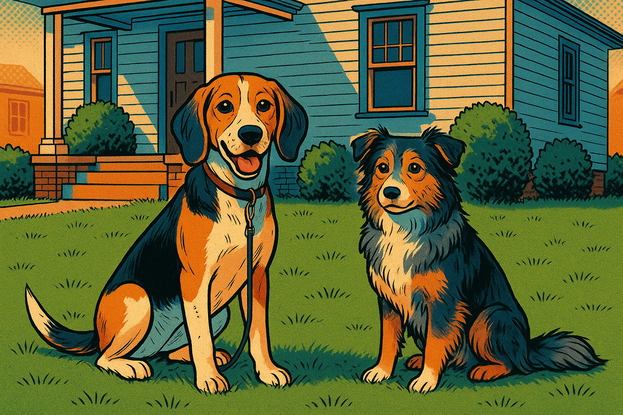
The American Foxhound was gangly in the way only puppies on the brink of doghood could be—legs too long, paws too big, tail a metronome of irrepressible excitement. He darted beneath one of the low-hanging branches, chasing not a squirrel or even a falling leaf, but a shadow—his head tilting, feet scrambling with such intensity he tripped over himself, rolled twice, popped up, and resumed the chase as though nothing had happened.
His coat was a rich, mottled tri-color—deep russet across his back, ivory streaks down his legs and chest, and a brush of black along the ridge of his spine, like someone had stroked charcoal there with a lazy hand. His ears were long and pendulous, flapping like dishcloths each time he launched into motion, which was often. There was no stillness in him—only pauses between bursts. He zigzagged under the dappled shade of the oak, paws kicking up soft tufts of earth, his nose momentarily distracted by the scent of a dandelion before bounding after another flickering patch of moving light.
His enthusiasm was volcanic. Everything he did seemed to be the first time he had ever done it, and the best thing he had ever done. He wasn’t coordinated yet—his limbs moved like they were auditioning for different dogs—but he had heart, and he had joy, and he had no idea what dignity meant, which made him all the more endearing.
Several other dogs gave him a wide berth, not out of fear but because it was simply safer. A squat bulldog bitch raised her head from her sun patch and watched him roll past with an expression of mild offense before flopping back down. A dignified shepherd mix gave a single warning bark when he skidded too close, and he bounced backward like a rubber ball, tongue out, utterly unbothered.
He didn’t bark much—only once or twice, quick, staccato bursts that sounded less like calls for attention and more like commentary. When he finally stopped, it wasn’t out of exhaustion but from a puzzled fascination with his own tail. He whirled, mouth open in panting glee, caught it once, let it go, and immediately chased it again in dizzying circles.
And then he saw her.
He stopped mid-spin. His body stilled all at once, tail lifted like a flag, ears pricked forward. For a moment, the whole yard seemed to hush. He stepped forward cautiously, his legs uncertain in the grass, and tilted his head.
Jennifer tilted hers in reply.
That was all it took. He bolted toward her with the velocity of joy incarnate, flinging himself across the space that separated them, his bark catching halfway in his throat as his legs tangled again. He stumbled, slid to a stop inches from her boots, then sat so suddenly and so earnestly that his rear end bounced twice on the ground before settling.
Jennifer knelt, slowly, carefully. The dog didn’t leap this time. He leaned in, long muzzle gently pressing against her arm. His tail wagged once, twice, then kept going, rhythmically thudding the earth like a slow heartbeat.
And Jennifer, without hesitation, reached out and buried her fingers in his ruffled fur. He sighed into her shoulder.
The shadow games were over.
He had found his sun.
Eli joined them with a soft grunt and a chuckle, reaching down to tug gently at the dog’s collar.
“Name’s yours to give,” he said, “but he’s been Charlie for a week now, on account of looking like a rascal and getting into things.”
Jennifer wrapped her arms around the hound’s neck, burying her face in his fur for a moment. It smelled of hay and sun-warmed dust and something sweetly canine. Charlie didn’t wriggle. He leaned in, pressing his weight against her, his tail wagging a steady, metronomic beat. J
ennifer rested her cheek against the Foxhound’s head, letting her eyes close for a breath, feeling the soft tickle of his ear against her neck and the damp warmth of his breath along her collarbone. His heart was thudding against her ribs, not frantic—just full. A living, grateful rhythm.
Eli gave them that moment, leaning his weight slightly on one knee as he stood a respectful distance away. He rubbed the calloused pads of his fingers together, patient, quiet, the way a man might be at the edge of a river while someone else learned to cast.
Then, after a few seconds that felt like a small forever, his voice came low and easy. “Three dollars,” he said gently. Not unkind, not transactional—just a simple truth, offered in the tone of a man who understood that some prices were only a formality.
Jennifer didn’t move at first. Her arms tightened slightly around the Foxhound. She slowly opened her eyes, brushing her fingers through the soft fur at his scruff, then pulled back just enough to see his face. Charlie looked up at her with a mouth hanging half-open in dog laughter, panting lightly, his ears twitching as if the world was brimming with possibilities he’d barely begun to imagine.
She reached into the pocket of her rolled-up overalls and carefully unfolded the five-dollar bill, still crisp. She offered it to him without a second thought, her small hand steady.
But just as Eli reached to take it, Charlie let out a sudden, sharp yip, his whole body jolting as if struck by a jolt of joy. He barked again—higher, this time—and squirmed in her arms, bouncing in place, front paws dancing in the dust.
Jennifer blinked, half-laughing. “What is it, boy?”
Charlie’s tail whipped side to side, then froze, lifted like a flag. He barked once more, then turned his head—expectant, yearning, as though trying to call someone closer.
Jennifer turned to follow his gaze.
Near the far edge of the yard, where the grass grew in thicker tufts beside the wildflower patch, a figure stood apart from the chaos. An Australian Sheepdog, her coat a sweeping blend of slate blue and pale smoke with faint ginger undertones in the sun, was watching them.
Rue was not the kind of dog who demanded attention. She did not bark or bounce, did not leap at the fence when new visitors approached the shelter yard. There was no flashiness in her movement, no garish charm in her behavior. And yet, the moment one’s gaze happened to fall on her, it became very hard to look away.
She didn’t twitch with nervous energy like the younger pups, nor lounge with the regal indifference of the older dogs. She stood—quiet, unmoving, utterly present. Her eyes, a deep amber flecked with dusk tones, were fixed on the girl kneeling beside the Foxhound. Not in jealousy. Not in hope. In stillness. The kind of stillness that belonged to a creature who had seen many children come and go. Who had watched gates open, and hearts open, and other dogs leave—again and again.
She was young still—perhaps ten or eleven months—but carried herself with the stillness of a much older dog. Her frame was compact but elegantly built, light on her paws, with a slightly lean, rangy shape that suggested both stamina and speed. She was a medium-sized dog, perhaps just under twenty inches at the shoulder, though the graceful slope of her back and the slight tuck at her waist gave her a delicacy that felt almost feline.
The sun caught along the wisps of fur along her ribs, making the lighter streaks shimmer like water. She stood with one forepaw lifted just slightly off the ground, not in hesitation, but in something like poised expectation. She wasn’t hiding. She wasn’t yearning. But she waswaiting.
Her coat, thick and layered, held the palette of a storm at sea: slate blue at the shoulders deepening into soft charcoal along her back, with smoky silver feathering her haunches and chest. Down her legs ran a subtle marbling—barely-there dapples of ash and frost. In the sunlight, her fur shimmered with faint undertones of ginger, like the lingering kiss of autumn across an early winter sky. These warmer tones curled at the edges of her ears, along the fringe of her tail, and at the base of her throat, giving her an unexpected glow in just the right light.
Her fur was longest around her neck and shoulders, where it formed a subtle ruff—not enough to seem wild, but enough to whisper of the mountains in her lineage. Her chest was broad without being stocky, and her legs were finely muscled beneath the downy guard hairs, her paws small and deliberate in their placement. The tail—slightly curled at the end—seemed to float behind her as she moved, rarely wagging, but never still without meaning.
But it was her face that held people longest.
Rue had the eyes of a storyteller.
Set slightly wide in a narrow, intelligent face, her eyes were a rich, liquid amber—not the bright gold of show dogs or the flat brown of mutts, but a layered, expressive hue that deepened at the edges like varnished wood. They carried the weight of time, of patience, of having watched too much too quietly. There was an old soul in that gaze. Rue didn’t just look at you. She looked into you. Not with judgment. Not with need. With understanding.
A streak of white ran up the bridge of her nose, starting between her eyes and rising toward her brow, fading into silver before it could quite reach the crown of her head. The rest of her face was a perfect balance of smoky blue and soft grey, with a single copper spot beneath one eye, like a freckle made of firelight. Her ears, high-set and expressive, often folded partway, flopping just enough to give her a permanently curious tilt.
She seemed to watch Jennifer with a quiet patience, as though she were observing not if the girl would notice her, but when.
Jennifer felt the pull before she understood it.
Something in her chest went warm and tight, like the feeling of a storybook coming true before the final page turned. Charlie was still wriggling in her arms, full of his cartoonish joy, but her eyes had fixed on the sheepdog, and she didn’t blink.
It wasn’t pity that stirred her. It wasn’t even duty. It was recognition.
Like meeting the eyes of someone you hadn’t realized you’d been searching for until they looked back.
Rue didn’t flinch under her gaze. If anything, her head tilted slightly, the breeze catching the longer tufts of fur at her neck. She blinked once, very slowly. A slow dog-blink—soft and deliberate. Not submissive, not pleading. Just open.
And Jennifer—still on her knees in the grass, her arm looped gently around the puppy who had already decided to stay—felt her throat tighten.
The world around them kept moving, but this moment stayed perfectly still.
One heartbeat. Then another.
Then Rue shifted her weight forward, just barely. A signal.
She would come—if asked. But only if asked with intention.
And Jennifer, not yet knowing the dog’s name or story or sorrow, made a silent promise with a single look: I see you. I will not forget.
“That one?” he said softly, nodding toward the sheepdog, who had now taken a tentative step forward. “She’s eight bucks.”
“Is she his sister?” Jennifer asked, voice quiet. Her throat felt suddenly tight.
Eli followed her gaze, then scratched the back of his neck. “Nope. Not by blood, anyway. Though they act like it. He’s the shadow-chaser. She’s the shadow-watcher.” He said it without malice, without pity.
Jennifer took a few steps forward, then paused, her boots pressing into the grass now. The sheepdog hadn’t moved. Her gaze didn’t falter.
“Will she still be here next month?” Jennifer asked, turning to look at Eli, her voice gentler than before. “I could come back. I’ll save. I—I can work. I could ask mom if I can take on extra mending, or maybe—maybe dad can help me print some flyers. If it’s eight dollars, I’ll get it.”
Eli didn’t answer right away.
He stepped down from the low bench and crossed the uneven ground with the gait of a man who’d seen more kindness go unfinished than fulfilled. His eyes weren’t sharp—just clear. He looked at Jennifer the way someone might look at the first green sprig in a thawing field.
“I’ll come back,” she whispered, mostly to herself. “I’ll find a way.”
Eli studied her for a long moment. “You’ve got the look of a good worker,” he said at last. “Strong back, quiet mouth. Eyes like someone who doesn’t spook easy. That tells me more than a handful of crumpled bills ever could.”
Jennifer turned toward him, startled. “You come back here tomorrow morning,” he continued, “and you give me a week’s worth of help—feeding, cleaning, walking, whatever needs doing. You keep your promise, and I’ll make you a deal. These two are all yours, free of charge.”
Her chest burned with joy—sudden, overwhelming, impossible to speak around. She nodded hard. “Yes. Yes, sir. I will.”
“I know you will,” he said, his voice like a gentle door creaking open.
Jennifer turned back toward the dog—Rue—and took a tentative step forward, then another. Rue didn’t run. Her paws lifted in slow motion, her eyes wide and searching. When Jennifer knelt again, Rue came the last few feet herself, lowered her head, and nudged gently into Jennifer’s hand.
It was a quiet claiming.
Behind her, Charlie let out a delighted bark, then flopped sideways onto the grass like the world had finally righted itself.
Jennifer stroked Rue’s head with reverence, her eyes prickling as if the sunlight had gotten too strong. Rue’s body was solid, warm, trembling slightly.
Jennifer stood at the edge of the front entrance, one hand tightly gripping the woven leash Eli had fetched from a pegboard inside, the other resting on Rue’s ruff, her fingers half-buried in the sheepdog’s thick, dappled coat. Charlie was practically vibrating with excitement, his entire body wagging in rhythm with his tail, paws prancing at the threshold of the open gate like a child before a summer fair. He had no concept of solemnity, no sense of pacing himself. To him, the world had already been remade.
He stood nearby, arms crossed loosely over his chest, his cap tilted just enough to shade his squinting eyes. The late afternoon sun was starting to dip lower, the shadows of the oak tree stretching like long fingers across the packed earth. Jennifer adjusted the strap of her satchel, now holding nothing but a folded-up flyer and two well-worn buttons she’d found in Rue’s fur.
“You’ll want to keep that one leashed,” Eli said finally, nodding at Charlie with a dry but not unkind smile. “At least till you’re home and he’s had a chance to realize he belongs somewhere now.”
Jennifer turned to him. “Why? He’s sweet.”
“Oh, he’s sweet as maple in April,” Eli said, “but he’s got more bounce than brains just yet. That pup’ll see a butterfly across the street and try to make it his new best friend. Or decide a trash barrel needs investigating. Or bolt after a leaf and forget he’s got bones and limits.” He chuckled softly. “He’s got a body that hasn’t caught up to itself yet. Give it time.”
Jennifer looked down at Charlie, who barked once—sharp, joyful, and unrepentant—and leapt into the air, only to land slightly sideways, nearly colliding with the gatepost. He righted himself instantly, tail wagging harder, as if the world had just confirmed that his instincts were correct all along.
“I’ll keep him close,” Jennifer promised, curling the leash twice around her wrist. “I’ll teach him.”
“You will,” Eli said. Then he inclined his chin toward Rue, who stood still as a shadow at Jennifer’s side. “That one… you won’t need to worry much about her. She’ll follow. She always does.”
Jennifer looked down at Rue, who was watching the open road beyond the gate—not with longing, not with fear, but with a quiet, contemplative calm. There was wisdom in her, some quiet dignity built from months of watching others go and not knowing if it would ever be her turn. Now, standing beside Jennifer, she made no move to dart, no tug at an invisible tether. She simply waited.
Eli shifted his weight, rubbing the back of his neck absently. “Rue’s the kind that doesn’t ask for much. Doesn’t push. She watches. Learns. Won’t stray unless you stray first. She’s the kind of dog that memorizes your footsteps. She’s got the shape of loyalty in her bones.”
Jennifer blinked quickly, her throat tightening in the way it did when her grandparents said something kind without meaning to. “I won’t stray,” she said, softly.
Eli gave a small nod. “Didn’t think you would.”
Beyond the gate, the road sloped gently back toward town, flanked on either side by young maple trees whose new leaves fluttered in the wind like coins. The sky had softened into that first golden hour glow, where the edges of the world felt painted by hand. The air smelled of lilacs and distant woodsmoke, and far off, a train horn called once—low and lonely—before falling silent.
Jennifer stepped forward, Charlie bounding ahead as far as the leash would allow, already pulling slightly, yipping at the wind like he wanted to greet it personally. Rue followed at her heel, her stride measured, eyes alert but serene.
Eli watched them for a moment longer.
“You walk them both again this evening,” he called after her. “Let ’em get their bearings. He’ll want to taste every inch of the world. She’ll just want to know it’s hers now.”
Jennifer stopped and turned to look back. Rue paused beside her, sitting with quiet grace. Charlie, having been restrained from charging headfirst into the neighbor’s flowerbed, sat down too—but in a twitchy, I’m-only-doing-this-because-I-want-to way.
“Thank you,” she said. It came out firmer than she expected, but no less heartfelt. “For trusting me.”
Eli nodded. “Thank me by showing up tomorrow. Week’s work, remember.”
They made a strange little procession: a bright-haired girl in patched overalls with a ribbon fluttering in her braid; a wild-limbed, tail-wagging Foxhound pulling slightly ahead with the uncontainable hope of youth; and a watchful sheepdog trotting a half-step behind, ears flicking, eyes soft and alert, as if memorizing the sound of her new girl’s footsteps with every stride.
The road welcomed them. The wind lifted Jennifer’s hair as they rounded the first bend. Charlie barked at a mailbox and tried to eat a pebble. Rue glanced once toward Eli, as if to mark him in her memory, then resumed her place at Jennifer’s side.
And down the road they went—girl and dog and dog—into the kind of evening that only ever happens once, where beginnings come wrapped in gold, and the world is quiet just long enough to hear your heart say yes.
It was just past six in the evening when Jennifer reached the gate of her grandparents’ home, the familiar path up from the road edged with flowering crabapple trees that drooped under their own late-spring weight. The house itself—a squat, pale green clapboard with white trim and a broad front porch—stood bathed in golden light, the wooden screen door creaking open before she even set foot on the first step.
April stood there, hand on her hip, a dishtowel tossed over her shoulder, her auburn hair pulled into a loose knot that had begun to unravel in the humidity. Behind her, the warm scent of biscuits and roasting carrots drifted out like an embrace. Her sharp green eyes flicked from Jennifer to the two creatures trotting beside her and widened with delighted astonishment.
“Well, now,” April said, drawing the towel down into her hands. “Looks like we’re a little outnumbered all of a sudden.”
Brandon followed just a moment later, stepping onto the porch in his threadbare slippers, sleeves rolled to his elbows from some half-finished tinkering project out back. His eyebrows lifted high on his broad forehead, and then—true to form—he smiled with quiet warmth and stepped aside to let them all through.
Jennifer gave a soft smile and tugged gently on Charlie’s leash. He immediately tried to bolt up the steps, tongue flapping from his wide-open mouth, but she reeled him back in with practiced calm. Rue moved more cautiously, pausing at the bottom of the steps to sniff one of April’s flower pots and look around before following Jennifer inside with unhurried grace.
“Don’t think I’ve seen a dog run like that since cousin Robbie got loose at the county fair,” Brandon said as Charlie bounded into the front room, skidding slightly on the worn rug. He was already sniffing every corner of the floor, investigating furniture legs as if checking for hidden treasure.
Jennifer was still catching her breath. “This one’s name might as well be Trouble,” she said, unlooping the leash and letting it fall to her side. “The other one—well… she’s the opposite.”
April had crouched to greet Rue, her tone gentling as she held out her hand. “And what do we call this beautiful girl?”
“I don’t know yet,” Jennifer said, reaching down to smooth a tuft of Rue’s fur. “I don’t think she knows either.”
Brandon chuckled as he reached into the cupboard and pulled down the tin of dried beef. “Well, we’ll have to come up with something. You’ve got a little pack now. They’ll need proper names. What about Lewis and Clark?”
“Too many syllables,” April said over her shoulder, returning to the kitchen. “Besides, Jenny-beam didn’t have a name right away either, remember?”
Brandon nodded sagely and tossed a sliver of beef in Charlie’s direction, which the hound caught midair with an impressive snap of his jaws. Rue remained sitting near Jennifer’s feet, eyes following the scene but not asking for more than she’d already received.
After dinner—warm biscuits and roasted carrots and a simple stew that made everything smell like home—Jennifer sat out on the back steps with her elbows on her knees, the sky streaked with that soft violet that only arrived in late Ohio dusk. Charlie sprawled belly-up in the grass, mouth open and legs twitching in dreams of squirrels or shadows. Rue sat at Jennifer’s side, head pressed against her thigh, still and observant.
Jennifer leaned back, one hand resting gently between Rue’s ears, and let the silence settle over them like a quilt.
She had spent the day mulling it over—at the shelter, on the walk home, even during dinner. She wanted names that meant something, names that weren’t just cute or easy, but that reflected what these dogs were. What they symbolized. They were strays—like her, in a way. Castoffs that had found one another.
The rain had begun sometime just after lunch, a soft hush against the windows that quickly became a steady drumbeat on the tin roof of the old house. It was one of those early spring storms that seemed to take its time—more gray than thunder, more soaking than crashing. By two in the afternoon, the backyard was already a marsh, the tomato beds standing in puddles, and the laundry had been brought in damp and folded over chairs to dry.
Jennifer, age ten, sat cross-legged on the floor of the small upstairs landing. She wasn’t bored—she wasn’t a child who found boredom easily. She liked having things to do, little tasks she could call hers. She liked order, purpose. Especially when April was away, as she was today, off visiting a neighbor who had just come home from hospital. Jennifer knew her grandmother would be gone most of the day, the rain made the yard unwelcoming and there were no errands to run.
But she didn’t mind. As Grandpa had suggested earlier that morning—while buttoning up his shirt with a thoughtful squint out the window—they could spend the afternoon sorting through the attic. “Let the ghosts out for a stretch,” he’d said with a lopsided smile, tugging at the collar like it didn’t quite sit right but he wouldn’t change it anyway. Jennifer had giggled at that, not because she was afraid of ghosts, but because she liked how he said it. As if history was something alive and tired and worth checking on from time to time. Like an old cat in a warm cupboard.
And so she sat on the narrow upstairs landing now, with the biscuit tin of buttons beside her—already sorted and re-sorted for the third time—and her knees drawn up to her chest. The floor beneath her was cool and worn smooth by decades of footsteps. She leaned her head against the banister and listened.
Grandpa wasn’t really old, not in the way Jennifer imagined old people to be. He moved slowly sometimes, sure, and his hair had gone mostly white by the time she was in kindergarten, but he had clever eyes and strong hands, and his voice never wavered when he told her stories. He still climbed ladders and fixed fences and remembered all the words to old protest songs. She had seen old men in the street who moved like the wind would carry them off but grandpa still planted tomatoes with his knees in the dirt.
The air changed the moment she crossed the threshold. Warmer, denser. The wooden beams above were thick with cobwebs, and the small dormer windows rattled gently in the breeze. Light spilled in soft and dusty, catching the edges of forgotten boxes, old trunks, and stacks of yellowed books.
Brandon was crouched near the back, tugging at a splintered crate with a crowbar. He wore his oldest shirt—one Jennifer remembered from every gardening season.
From above came the faint groan of wood, a dull thump, the shuffle of careful feet across old beams. Brandon was up there already, checking for leaks in the roof, giving the wasp nest in the far eave a wide berth, and clearing out anything precarious before his granddaughter came clambering up behind him. The attic was full of the sort of things that weren't quite junk but weren't quite useful either—the kind of things Brandon couldn’t bring himself to part with, though he often threatened to.
She picked at a thread on her sock as she waited, the rain still falling in that gentle, persistent way that made the whole world seem muffled and slow. Somewhere downstairs, the radio murmured faintly, the static low between the song and the voice of a Cleveland DJ reminding everyone to stay indoors and keep warm. A bird chirped from the tree outside, confused by the weather.
The door to the attic stairwell was open, and she could just barely see the warm glow of the single hanging bulb through the crack in the floorboards above. She liked that glow. It was the sort of light that made you feel like you were about to discover something—an old map, a treasure chest, a secret no one else remembered.
A few more minutes passed, the floor above creaking now and then as Brandon shifted boxes around. Jennifer imagined him brushing the dust off the top of a cedar trunk, lifting the lid, pausing to read a yellowed envelope before placing it back. He never rushed in the attic. Everything deserved a second look.
She wrapped her arms around her knees and closed her eyes for a moment. The smell of the rain and old wood drifted down the stairs, mixing with something like cedar, and maybe cinnamon. Or dust pretending to be cinnamon. The house always smelled different when it rained. Not cleaner, exactly—but older, like it remembered something.
Suddenly, she heard his voice—muffled at first, then a little clearer: “All right, Jennifer! Step lively, it’s ready for you!”
Her eyes opened. She stood up quickly, brushed off the back of her dress, and gave the railing a firm pat as she passed. She was careful with the first step—it always groaned like it might give out, though it never had—and then climbed steadily into the attic.
It was warm up there, thick with old air and the feeling of stories hanging just behind the cobwebs. The single bulb swung slightly on its cord, casting amber light across stacked trunks, bundled newspapers, and a rocking chair draped with an old army blanket. Brandon stood near a long table someone had dragged up here decades ago, now serving as a makeshift workbench.
“There’s our junior archivist,” he said. “The boxes to the left are all family stuff, I think. Photographs, letters, old Christmas cards. The ones near the window are books, and that back corner—” he jabbed a thumb over his shoulder “—is where furniture goes to die.”
Jennifer giggled and stepped further in, her shoes making little thuds on the boards. The air smelled like mothballs and cedar, with something sharper beneath it—ink, maybe, or aged paper.
“Where should I start?”
Brandon scratched his chin. “Wherever your instincts lead you. But if you find anything marked ‘1951,’ give it to me. That was the year your grandmother tried to build a still behind the garden shed.”
“She did what?”
Brandon chuckled. “A story for later. Come on—let’s see what the ghosts left behind.”
Before them lay a jumble of decades. Worn trunks with leather straps, crates sealed with nails, boxes labeled in fading ink. Old furniture leaned against the walls, stacked like polite guests at a crowded party. A coat rack stood in one corner, holding a lone hat Brandon hadn’t worn since before Jennifer was born.
“Well,” he said, pushing his sleeves up. “We’ll take it slow. I’ll handle the heavy lifting, and you keep track of what we find. Think you can sort the papers and books while I pry open these crates?”
Jennifer nodded with quiet resolve. “You want piles by year or by subject?”
Brandon laughed. “Surprise me.”
Jennifer went straight for a crate near the window. The label had faded completely, but inside she found an assortment of letter bundles tied in red yarn, their envelopes browning and soft at the corners. She lifted one and read the postmark: July 1939. Her eyes widened. Carefully, she set it aside and reached for another.
As the rain pattered above, they worked in companionable silence—Brandon occasionally humming to himself, Jennifer quietly sorting the papers into neat piles on the old desk. They found a stack of Brandon’s school essays, a faded recipe for sour milk pie in April’s loopy script, and a tin full of campaign pins from elections Jennifer had only seen in history books.
“Ghosts with opinions,” she murmured, holding up a pin that read ‘Landon for President.’
Brandon laughed from across the room. “Poor man never had a chance.”
There were also Theater playbills. Ration books. A scrapbook full of news clippings from a textile strike in 1912. She set each into neat stacks, labeling with torn slips of paper. “Labor,” “Family,” “Local News,” “Unknown.”
Brandon cracked open a crate of books and began dusting them off with a handkerchief. “You know,” he said after a while, “there’s something I’ve been meaning to show you. Since you’re getting older.”
Jennifer looked up from the pamphlets she was sorting. “What is it?”
He stood and crossed the room, pulling a slim folio from the narrow bookshelf tucked under the eaves. He held it like it was precious, but not delicate—something strong that had simply waited a long time to be held again.
He sat down beside her and opened the folio. Inside were carefully kept newspaper clippings, all browned with age.
Jennifer blinked. The names and faces looked strange—almost like characters from an old Western, or a story in one of the books she read about revolutionaries. She leaned closer.
The clipping was brittle, its edges flaked with time. Two oval-framed photographs sat side by side above the fold. The first man—thin-faced, his dark eyes intense and weary—had a long, straight mustache. The other looked younger, broader in the jaw, with a stubborn set to his mouth and a loosened collar like he’d just risen from hard work.
Jennifer looked up at her grandfather. “Who were they?”
Brandon settled into the creaky armchair beside her, resting his elbows on his knees. He took a long breath—not dramatic, but measured, like someone flipping through mental pages of something long memorized.
“They were workers,” he began. “Immigrants. Italians. Nicola Sacco and Bartolomeo Vanzetti. They came here for what most folks come for—opportunity. They worked, they organized. They spoke out. They weren’t quiet about what they believed in. Fair pay. No war. Bread for the hungry. Liberty, even when it scared people.”
Jennifer ran her finger along the edge of the page, careful not to smudge it. “What happened to them?”
“They were accused of robbery and murder. A payroll guard and a clerk were killed in South Braintree, Massachusetts. They said Sacco and Vanzetti did it, but the trial…” Brandon shook his head slowly. “It was a mess. The evidence was weak, the judge was biased, and the prosecution made a circus of their beliefs. They didn’t like that the men were anarchists. Didn’t like that they were foreign. Didn’t like that they had ideas that shook the pillars.”
He flipped to the next page. More clippings—some from major papers, others clearly mimeographed leaflets from workers’ unions or mutual aid groups. Jennifer caught headlines like “Global Outcry Over Unjust Trial”, and “Writers, Clergy, Scientists Demand Clemency.”
“There were protests,” Brandon said. “Not just here. All over. Paris. London. Buenos Aires. People marched in the streets. Writers like H.G. Wells and Einstein spoke out. Even people who weren’t anarchists—people who didn’t agree with Sacco and Vanzetti—said the trial was rigged. It wasn’t about guilt. It was about making an example.”
Jennifer’s brows drew together. “Did anyone try to stop it?”
“Plenty tried. But fear moves faster than justice. The appeals failed. They were sentenced to death.” He turned to the final page in the folio, and gently tapped a printed block of text at the bottom.
“It’s Vanzetti’s final statement,” he said softly.
Jennifer leaned in. The words were typed in close, dark strokes, the kind from an old typewriter. She read aloud.
Jennifer looked down at the sheepdog pressed against her and whispered, “Nicola.” Rue’s ears flicked. Her body tensed just a little. Then she exhaled through her nose and leaned closer, resting her full weight against Jennifer’s leg. “Nicola,” Jennifer repeated. “That’s you.”
She reached toward Charlie then, and he stirred, yawning dramatically before flopping onto his side and thumping his tail against the ground. “And you,” she said, running a hand down his belly, “you’re Bart.” He sneezed. Then barked once—sharp and full of pride.
“Bart and Nicola,” she said softly. “For Sacco and Vanzetti. Because you don’t need to be big to matter. You just have to belong.” Nicola closed her eyes, her head still resting on Jennifer’s thigh. Charlie rolled upright and trotted over, leaning into her other side as the sky deepened to blue-black.
Jennifer lay flat on her back beneath the quilt her grandmother had sewn when she was just a baby, the one with the fading squares of denim and flannel from Brandon’s old shirts and a sun-yellow patch cut from one of April’s summer dresses. The ceiling fan clicking overhead in its steady, failing rhythm, pushing the humid Ohio night around her little room without ever quite cooling it. The summer heat hung thick in the air, making her skin feel sticky even after her evening wash. A few moths danced on the other side of the screen in the open window, fluttering toward the porch light, which cast faint golden streaks across the wooden floor.
Bart was already snoring. He lay sprawled in a patch of moonlight by the dresser, one hind leg twitching now and then, the occasional huff escaping his muzzle like he was chasing something absurdly important in his dreams—a grasshopper, perhaps, or a runaway sock. Nicola was quieter. She had taken up her place at the foot of the bed again, one paw tucked beneath her, the other resting across Jennifer’s ankle. Her breathing was deep, steady. Comforting.
Jennifer, though, was not asleep.
She lay on her side, curled loosely beneath the quilt April had sewn years ago, the fabric now soft from hundreds of washings, its colors faded but still bright in her heart. She stared at the wall, eyes half-lidded, wide awake despite the hour. The joy from the day still throbbed inside her, full and bright and humming like a wire pulled too tight.
She had two dogs. Her dogs. Companions. A little pack, just like Eli had said. It didn’t feel real yet—but then again, everything had happened so fast. One moment she was watching a blur of fur and paws chase shadows in the shelter yard, the next she was walking home with Bart tugging like a wild thing on his leash and Nicola gliding beside her like she’d always belonged.
She wanted to share it with someone. Needed to.
Her thoughts turned, as they so often did, to her friends. Clara. Pete. Leah. Big John with his permanent scowl and surprising tenderness. They weren’t so far but still, it was too far to walk, especially for a thirteen-year-old girl with no car and no bus fare. A drive away. Twenty-five, maybe thirty miles. Not impossible, but unthinkable on foot. Close enough that their voices were still fresh in her mind, but distant enough that seeing them again always had to wait until someone’s uncle was heading that direction, or until harvest festival came and families made the trip.
She missed them terribly.
Their friendship had never been loud or performative—it had formed slowly, like sap thickening into amber. They had shown her kindness without needing to ask questions. They had shared stories, food, songs. Clara had once braided Jennifer’s hair using a pattern she said came from her grandmother, and Pete had taught her how to whistle with two fingers, grinning wide when she finally got it. They weren’t school friends or church friends. They were something else. Kin, almost. At least in spirit.
Jennifer rolled onto her back, arms folded under her head, staring now at the shadows on the ceiling cast by the fan blades. She pictured Clara sitting cross-legged on the porch back home, the same way she always did, with a carved pendant bouncing lightly against her chest as she spoke. She imagined Pete tugging at her sleeve and saying, “Well? What’re their names? You better not’ve named one ‘Spot.’”
And that made her smile. But it faded quickly.
There was no way to tell them—not tonight. Not tomorrow, either, unless she started a letter before breakfast and ran it to the post office before the line built up. Letters were fine. She wrote often. She decorated the envelopes, tucked in little pressed flowers or copied out parts of stories she thought they'd enjoy. But they were slow.
What she wanted tonight was something instant. A phone call. To pick up a receiver, spin the dial, and hear Clara’s tired voice on the other end saying, “What’s the news?”
She sighed, loud enough for Nicola’s ears to twitch.
They didn’t have a phone.
Never had.
There were still parts of town, like their street, where lines hadn't been run all the way out. Brandon said it had something to do with costs, distance, the county prioritizing “central development.” But Jennifer knew what that meant—people in the fancier neighborhoods got their phones first. People like them had to wait. And even if the lines had come to Linden Street, there was no money for a monthly bill. Not when things like shoes, canned peaches, and medicine came first.
She didn’t blame Brandon and April. Never had, never would. They gave her everything they could—warm meals, a roof, books, time, safety. Brandon built her a new bookshelf out of salvaged oak just last fall. April had cut her old cardigan down to fit Jennifer’s smaller frame, stitching little stars into the sleeves because she knew how Jennifer loved the constellations. Love didn’t always need a telephone line to be loud.
Still—tonight—Jennifer’s heart ached.
Not out of ingratitude. Not even really out of anger. Just… longing.
“I just wanna tell them,” she murmured aloud, her voice small in the dark. “Just call up and say it. Say I got them. Say they’re mine now. That Nicola picked me.” Nicola’s paw flexed slightly at the sound of her voice, but she didn’t stir. Bart gave a muffled yip.
Jennifer rolled onto her side again, facing the open window where the night air drifted in, thick with the scent of grass and rain-soaked earth. The stars were just visible through the screen—dim but steady.
She stared up at them, trying to will her thoughts into motion, to send the news outward like smoke signals.
She imagined Clara out there somewhere, maybe also looking up at the sky. Maybe they were both seeing the same star. Maybe that meant something.
“I got a dog that doesn’t bark and watches like she’s memorizing the whole world,” Jennifer whispered. “And another one that doesn’t know how to not love.”
The room was quiet again, save for the soft ticking of the clock on the dresser.
Jennifer’s fingers curled into the edge of the quilt.
She wasn’t jealous of other kids who had phones. But it didn’t stop her from wondering—if the country could run all those lines across thousands of miles, from coast to coast, from cities to army bases and radio towers… why not just a little farther? Why not to Linden Street? Why not to the homes that waited quietly, patiently, never demanding anything more than a chance to be part of things?
She squeezed her eyes shut.
“I’ll write them,” she said, a promise now. “Tomorrow. First thing.”
She’d tell them about Charlie—Bart—and his flopping paws and grass-stained belly. About Nicola, and how she watched like an elder, like someone who had already survived the parts of life that hadn’t happened yet.
She’d tell them everything. Even if it took a week to reach them. Even if her words arrived after the joy had already settled into something softer.
The fan clattered again overhead. Nicola rose, turned in a slow circle, and resettled herself just a little closer. Jennifer let out a breath and closed her eyes.
The night wrapped around her like a hush, and sleep crept in at the corners. Bart shifted and snored again. And Jennifer dreamed—of phone lines that ran just a little farther, of letters with wings, and of voices carried on the wind, reaching the people who mattered most.
The next morning dawned soft and hazy, with sunlight seeping in through Jennifer’s east-facing window in a pale gold wash. Birds chattered in the hedgerows. Somewhere down the road, a screen door slammed—Mr. Dobbins heading to town, probably—and the world began to hum with its usual quiet rhythm. But inside Jennifer’s room, everything was still, deliberate.
She’d been awake since the first pink light touched the walls, lying quietly between Nicola and Bart, the former curled along her legs, the latter nestled like a loaf of bread beside her pillow, snoring so softly it sounded like wind through grass. Her eyes had been open for a while, but she hadn’t moved. Not until she was certain—absolutely certain—about what she wanted to say.
She slipped out from under the quilt without disturbing them, tugged on her softest cotton dress and a hand-me-down cardigan that was fraying at the sleeves. Then she crept to her desk in the corner, where the tin box of letters and stamps lived, nestled beside her writing journal and the narrow envelope she’d set aside weeks ago—the one with the pressed clover still tucked into the corner.
Jennifer pulled the wooden chair out slowly, careful not to scrape the legs against the floor. She opened the box, set out her fountain pen, and smoothed a sheet of thick writing paper. It had tiny flecks of gold in the weave—not real gold, of course, but a shimmer that caught the eye if you turned the page just right. It felt like the kind of paper meant for important news.
She began: Dear Clara, Pete, Leah, John, and everyone—
Her pen moved slowly, not because she didn’t know what to write, but because she did, and she wanted to savor every syllable. She told them how the shelter yard had smelled like clover and dog fur and how there’d been dozens of animals tumbling over one another in the shade of the wide old oak. How Charlie—no, Bart—had made a fool of himself chasing shadows, tripping over his own paws like a character in a silent film. And how Rue—now Nicola—had been standing quietly by the wildflowers, watching, waiting. Choosing.
She described the long walk home, the way Bart tried to pull her into the ditch at every frog sound, how Nicola had trotted beside her like a whisper. She told them about her grandparents’ expressions—April’s theatrical surprise, Brandon’s quiet amusement—and how naming them had taken until just before bed. The names Sacco and Vanzetti weren’t ones most kids her age would think of, she admitted, but they felt right. True, somehow. Not just for what the men had stood for, but because they reminded her that being misunderstood didn’t mean being unworthy.
She wrote about how she missed them. How often she thought of Clara’s fierce laugh and Pete’s drawings, of Leah braiding grass bracelets and little John’s suspicious glares that always melted after a smile.
Then, at the very end, she paused. Set down the pen. Re-read it all.
It felt full. Honest. The kind of letter that would flutter open like a bird when someone received it.
But it needed something else. Not just her hand.
Jennifer looked over her shoulder at the two dogs still curled in sleep. Nicola had shifted, head now resting over the edge of the bed, one ear flopped inside out. Bart was on his back, paws in the air, the very picture of trust.
She rose quietly, padded over, and crouched beside them. Bart’s nose twitched as she approached, his tail thumping once without him waking. Nicola opened one eye, then closed it again slowly, content.
“Alright, you two,” Jennifer whispered with a smile. “Time to make it official.”
She walked softly back to the desk and took out her small inkpad—the one April had used for fingerprinting labels on mason jars. It was nearly dry, but with a little coaxing and a damp rag she managed to bring it back to life. Then she tore a small square of cardstock and returned to the dogs.
Bart was first.
She knelt beside him and gently took his front paw, murmuring reassurances as she pressed the pad against the ink and then onto the card. He gave a half-hearted wriggle, unsure what she was up to, but calmed instantly when she kissed the top of his head.
A perfect, smudgy pawprint bloomed across the paper—wide and blobby, with one crooked toe that looked just like him.
Nicola took a little more patience.
Jennifer didn’t press, just waited with the inkpad resting on her knee. When Nicola finally sat up, she offered her paw before it was even asked for, lifting it slowly, her amber eyes steady on Jennifer’s. Jennifer dabbed it gently in the ink and printed it beside Bart’s—a narrower paw, more delicate, but firmer. Her mark was darker, cleaner. Thoughtful, like the dog herself.
When both prints were dry, Jennifer folded the letter with care, tucked in the card, and slid them into the envelope. She addressed it in neat script, then dug through her tin for a stamp—just one, since she didn’t have enough for more pages.
Outside, the sun was rising higher. Brandon was probably in the backyard already, checking the squash, and April’s radio would be crackling its morning news into the kitchen. The town postbox waited just three blocks away.
Jennifer stood, pulled on her shoes, and called over her shoulder, “Come on, you two. Let’s go make a delivery.”